

EN 17694-1:2023
(Main)Hydrometry - Minimum performance requirements and test procedures for water monitoring equipment - Devices for the determination of flow - Part 1: Open channel instrumentation
- Abstract
This document specifies general requirements, minimum performance requirements and test procedures for open channel instrumentation used to determine either volumetric flow-rate and/or total volume passed of waters in artificial open channels. It covers the following technology categories:
- Level sensors with associated electronics designed to be used with a conventional gauging structure. (The requirements and test procedures for gauging structures, such as weirs and flumes, are excluded. The stage discharge characteristics for many of these structures are established and published in national and international standards).
- Water velocity sensors.
- Integrated velocity area instruments comprising level and velocity sensors that may be separate or combined in a single assembly.
- Velocity sensors that determine the mean water velocity through a channel.
It is recognized that for some OCIs, certain tests cannot be carried out.
- Status
- Published
- Publication Date
- 09-May-2023
- Technical Committee
- CEN/TC 318 - Hydrometry
- Drafting Committee
- CEN/TC 318 - Hydrometry
- Current Stage
- 6060 - Definitive text made available (DAV) - Publishing
- Start Date
- 10-May-2023
- Due Date
- 05-Aug-2022
- Completion Date
- 10-May-2023

Overview
EN 17694-1:2023 (CEN) is the European product standard for hydrometry that defines minimum performance requirements and test procedures for open channel instrumentation (OCI) used to determine volumetric flow-rate and/or total volume passed in artificial open channels. The standard covers level sensors used with conventional gauging structures, water velocity sensors, integrated velocity‑area instruments (level + velocity), and sensors that determine mean channel velocity. Requirements for gauging structures themselves (weirs, flumes) are excluded.
Key topics and technical requirements
EN 17694-1:2023 sets out comprehensive technical topics to ensure reliable flow measurement and water monitoring equipment performance:
- General requirements for OCIs and associated documentation (manufacturer declarations, manuals).
- Minimum performance requirements expressed in terms such as bias, repeatability and combined performance.
- Laboratory test procedures and field test procedures for verification, including guidance on test planning and reporting.
- Computational accuracy and verification of flow computations performed by instruments.
- Data retention and uptime/maintenance considerations for monitoring applications.
- Environmental and installation influence requirements (ambient temperature, humidity, solar radiation, water temperature, sensor location, incident light).
- Specific electrical/operational checks (e.g., supply voltage, output impedance, response time) and recognition that some tests may not be applicable to every OCI design.
- Normative and informative annexes covering evaluation of test data, reference methods, uncertainty calculations, and an example report format.
Practical applications
EN 17694-1:2023 is practical for:
- Continuous monitoring of effluent discharges at industrial sites.
- Compliance monitoring at sewage treatment works and regulatory reporting.
- Flow measurement in irrigation channels, water transfer channels and engineered open conduits.
- Product conformity testing for manufacturers of level sensors, velocity sensors and integrated velocity‑area instruments.
Using this standard helps ensure that instruments deliver traceable, reproducible flow data suitable for regulatory compliance, environmental management and operational control.
Who should use this standard?
- Sensor and instrument manufacturers (product design, performance claims, test evidence).
- Independent test laboratories (laboratory and field testing against CEN requirements).
- Water utilities, environmental agencies and industrial compliance teams (procurement specifications and acceptance testing).
- Hydrometrists and consultants carrying out monitoring programme design and data validation.
Related standards
- EN ISO 772 (Hydrometry - Vocabulary and symbols)
- CEN ISO/TS 25377 (Hydrometric uncertainty guidance, HUG)
- EN 17694-2 (Closed conduit instrumentation) and ISO 11655 (basis for specifications)
Keywords: EN 17694-1:2023, hydrometry, open channel instrumentation, flow measurement, water monitoring equipment, level sensors, velocity sensors, performance requirements, test procedures.
Relations
- Effective Date
- 28-Jan-2026
- Effective Date
- 28-Jan-2026
Get Certified
Connect with accredited certification bodies for this standard

BSMI (Bureau of Standards, Metrology and Inspection)
Taiwan's standards and inspection authority.
Sponsored listings
Frequently Asked Questions
EN 17694-1:2023 is a standard published by the European Committee for Standardization (CEN). Its full title is "Hydrometry - Minimum performance requirements and test procedures for water monitoring equipment - Devices for the determination of flow - Part 1: Open channel instrumentation". This standard covers: This document specifies general requirements, minimum performance requirements and test procedures for open channel instrumentation used to determine either volumetric flow-rate and/or total volume passed of waters in artificial open channels. It covers the following technology categories: - Level sensors with associated electronics designed to be used with a conventional gauging structure. (The requirements and test procedures for gauging structures, such as weirs and flumes, are excluded. The stage discharge characteristics for many of these structures are established and published in national and international standards). - Water velocity sensors. - Integrated velocity area instruments comprising level and velocity sensors that may be separate or combined in a single assembly. - Velocity sensors that determine the mean water velocity through a channel. It is recognized that for some OCIs, certain tests cannot be carried out.
This document specifies general requirements, minimum performance requirements and test procedures for open channel instrumentation used to determine either volumetric flow-rate and/or total volume passed of waters in artificial open channels. It covers the following technology categories: - Level sensors with associated electronics designed to be used with a conventional gauging structure. (The requirements and test procedures for gauging structures, such as weirs and flumes, are excluded. The stage discharge characteristics for many of these structures are established and published in national and international standards). - Water velocity sensors. - Integrated velocity area instruments comprising level and velocity sensors that may be separate or combined in a single assembly. - Velocity sensors that determine the mean water velocity through a channel. It is recognized that for some OCIs, certain tests cannot be carried out.
EN 17694-1:2023 is classified under the following ICS (International Classification for Standards) categories: 07.060 - Geology. Meteorology. Hydrology; 17.120.20 - Flow in open channels. The ICS classification helps identify the subject area and facilitates finding related standards.
EN 17694-1:2023 has the following relationships with other standards: It is inter standard links to EN ISO 772:2022, EN ISO 25377:2022. Understanding these relationships helps ensure you are using the most current and applicable version of the standard.
EN 17694-1:2023 is associated with the following European legislation: EU Directives/Regulations: 2000/60/EC. When a standard is cited in the Official Journal of the European Union, products manufactured in conformity with it benefit from a presumption of conformity with the essential requirements of the corresponding EU directive or regulation.
EN 17694-1:2023 is available in PDF format for immediate download after purchase. The document can be added to your cart and obtained through the secure checkout process. Digital delivery ensures instant access to the complete standard document.
Standards Content (Sample)
SLOVENSKI STANDARD
01-julij-2023
Hidrometrija - Minimalne zahteve za tehnične lastnosti in preskusni postopki za
opremo za nadzor vode - Naprave za ugotavljanje pretoka - 1. del: Instrumenti z
odprtim kanalom
Hydrometry - Minimum performance requirements and test procedures for water
monitoring equipment - Devices for the determination of flow - Part 1: Open channel
instrumentation
Hydrometrie - Leistungsanforderungen und Prüfverfahren für
Wasserüberwachungsgeräte - Geräte zur Bestimmung des Durchflusses - Teil 1:
Messgeräte für offenes Gerinne
Hydrométrie - Exigences minimales de performance et modes opératoires d'essai pour
les équipements de surveillance de l'eau - Dispositifs de mesure de l'écoulement - Partie
1 : Instruments de mesure pour écoulements à surface libre
Ta slovenski standard je istoveten z: EN 17694-1:2023
ICS:
07.060 Geologija. Meteorologija. Geology. Meteorology.
Hidrologija Hydrology
17.120.20 Pretok v odprtih kanalih Flow in open channels
2003-01.Slovenski inštitut za standardizacijo. Razmnoževanje celote ali delov tega standarda ni dovoljeno.
EN 17694-1
EUROPEAN STANDARD
NORME EUROPÉENNE
May 2023
EUROPÄISCHE NORM
ICS 07.060; 17.120.20
English Version
Hydrometry - Minimum performance requirements and
test procedures for water monitoring equipment - Devices
for the determination of flow - Part 1: Open channel
instrumentation
Hydrométrie - Exigences minimales de performance et Hydrometrie - Leistungsanforderungen und
modes opératoires d'essai pour les équipements de Prüfverfahren für Wasserüberwachungsgeräte - Geräte
surveillance de l'eau - Dispositifs de mesure de zur Bestimmung des Durchflusses - Teil 1: Messgeräte
l'écoulement - Partie 1 : Instruments de mesure pour für offenes Gerinne
écoulements à surface libre
This European Standard was approved by CEN on 13 February 2023.
CEN members are bound to comply with the CEN/CENELEC Internal Regulations which stipulate the conditions for giving this
European Standard the status of a national standard without any alteration. Up-to-date lists and bibliographical references
concerning such national standards may be obtained on application to the CEN-CENELEC Management Centre or to any CEN
member.
This European Standard exists in three official versions (English, French, German). A version in any other language made by
translation under the responsibility of a CEN member into its own language and notified to the CEN-CENELEC Management
Centre has the same status as the official versions.
CEN members are the national standards bodies of Austria, Belgium, Bulgaria, Croatia, Cyprus, Czech Republic, Denmark, Estonia,
Finland, France, Germany, Greece, Hungary, Iceland, Ireland, Italy, Latvia, Lithuania, Luxembourg, Malta, Netherlands, Norway,
Poland, Portugal, Republic of North Macedonia, Romania, Serbia, Slovakia, Slovenia, Spain, Sweden, Switzerland, Türkiye and
United Kingdom.
EUROPEAN COMMITTEE FOR STANDARDIZATION
COMITÉ EUROPÉEN DE NORMALISATION
EUROPÄISCHES KOMITEE FÜR NORMUNG
CEN-CENELEC Management Centre: Rue de la Science 23, B-1040 Brussels
© 2023 CEN All rights of exploitation in any form and by any means reserved Ref. No. EN 17694-1:2023 E
worldwide for CEN national Members.
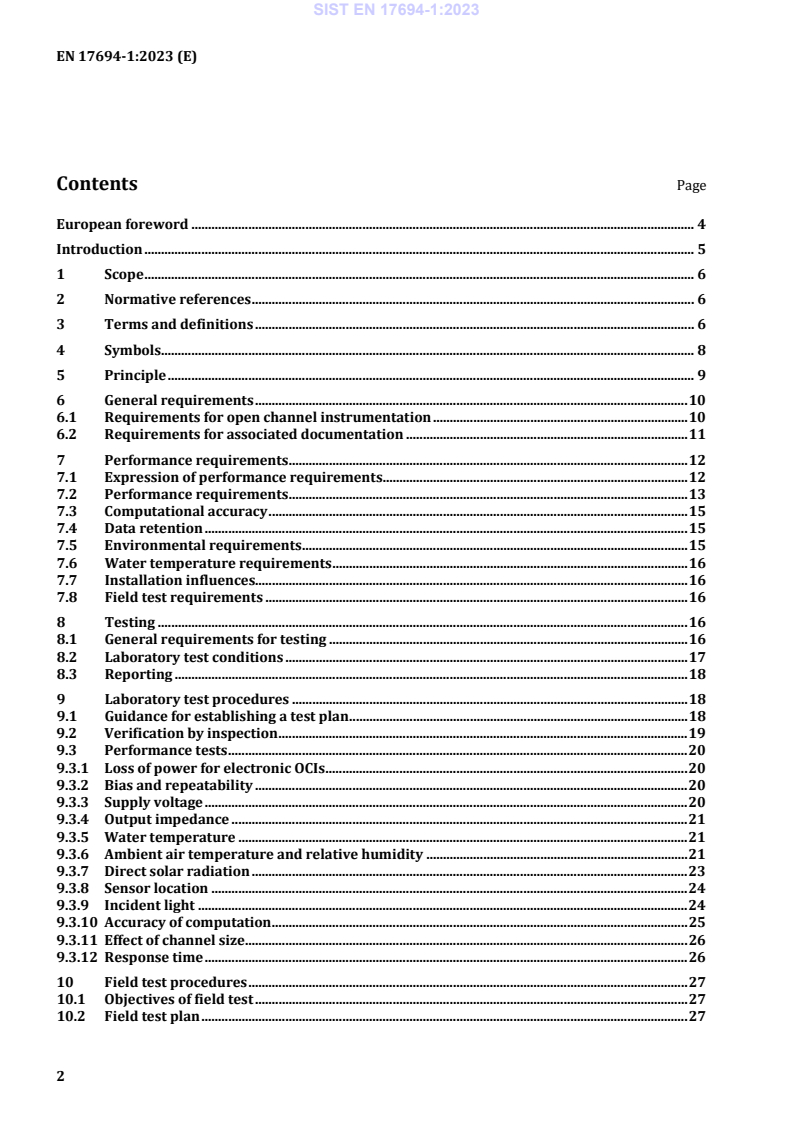
Contents Page
European foreword . 4
Introduction . 5
1 Scope . 6
2 Normative references . 6
3 Terms and definitions . 6
4 Symbols. 8
5 Principle . 9
6 General requirements . 10
6.1 Requirements for open channel instrumentation . 10
6.2 Requirements for associated documentation . 11
7 Performance requirements . 12
7.1 Expression of performance requirements . 12
7.2 Performance requirements . 13
7.3 Computational accuracy . 15
7.4 Data retention . 15
7.5 Environmental requirements . 15
7.6 Water temperature requirements . 16
7.7 Installation influences. 16
7.8 Field test requirements . 16
8 Testing . 16
8.1 General requirements for testing . 16
8.2 Laboratory test conditions . 17
8.3 Reporting . 18
9 Laboratory test procedures . 18
9.1 Guidance for establishing a test plan . 18
9.2 Verification by inspection . 19
9.3 Performance tests . 20
9.3.1 Loss of power for electronic OCIs . 20
9.3.2 Bias and repeatability . 20
9.3.3 Supply voltage . 20
9.3.4 Output impedance . 21
9.3.5 Water temperature . 21
9.3.6 Ambient air temperature and relative humidity . 21
9.3.7 Direct solar radiation . 23
9.3.8 Sensor location . 24
9.3.9 Incident light . 24
9.3.10 Accuracy of computation . 25
9.3.11 Effect of channel size . 26
9.3.12 Response time . 26
10 Field test procedures . 27
10.1 Objectives of field test . 27
10.2 Field test plan . 27
10.3 Field test requirements . 27
10.4 Error under field test conditions . 28
10.5 Up-time . 28
10.6 Maintenance . 29
Annex A (normative) Evaluation of test data . 30
A.1 Introduction . 30
A.2 Bias . 30
A.3 Repeatability . 31
A.4 Effect of influence quantities . 31
A.5 Combined performance requirement . 31
A.6 Worked example – Laboratory tests . 33
A.6.1 Bias . 33
A.6.2 Repeatability . 34
A.6.3 Influence conditions . 34
A.7 Worked example - Field tests . 35
Annex B (informative) Reference methods . 39
B.1 Laboratory methods . 39
B.2 Field (in situ) methods . 39
Annex C (informative) Reference uncertainty and error calculation . 41
Annex D (informative) Example report format . 43
Bibliography . 46
European foreword
This document (EN 17694-1:2023) has been prepared by Technical Committee CEN/TC 318
“Hydrometry”, the secretariat of which is held by BSI.
This European Standard shall be given the status of a national standard, either by publication of an
identical text or by endorsement, at the latest by November 2023, and conflicting national standards shall
be withdrawn at the latest by November 2023.
Attention is drawn to the possibility that some of the elements of this document may be the subject of
patent rights. CEN shall not be held responsible for identifying any or all such patent rights.
This standard is published in two parts:
— EN 17694-1, Hydrometry — Minimum performance requirements and test procedures for water
monitoring equipment — Devices for the determination of flow — Part 1: Open channel instrumentation
— EN 17694-2, Hydrometry — Minimum performance requirements and test procedures for water
monitoring equipment — Devices for the determination of flow — Part 2: Closed conduit
instrumentation
Any feedback and questions on this document should be directed to the users’ national standards body.
A complete listing of these bodies can be found on the CEN website.
According to the CEN-CENELEC Internal Regulations, the national standards organisations of the
following countries are bound to implement this European Standard: Austria, Belgium, Bulgaria, Croatia,
Cyprus, Czech Republic, Denmark, Estonia, Finland, France, Germany, Greece, Hungary, Iceland, Ireland,
Italy, Latvia, Lithuania, Luxembourg, Malta, Netherlands, Norway, Poland, Portugal, Republic of North
Macedonia, Romania, Serbia, Slovakia, Slovenia, Spain, Sweden, Switzerland, Türkiye and the United
Kingdom.
Introduction
This document is a product standard for open channel instrumentation for the determination of the flow
of waters in artificial channels (e.g. effluent discharges from industrial installations, wastewaters from
sewage treatment works, water irrigation channels, and water transfer channels). An open channel
instrument (OCI) is either a level sensor used in conjunction with a gauging structure or a velocity area
instrument or a velocity sensor. It is normally fixed in position and used to determine either volumetric
flow-rate and/or total volume passed. This document specifies general requirements, minimum
performance requirements, and test procedures. These specifications are derived from ISO 11655 [1]. An
OCI that is shown, by means of the tests, to conform with the general requirements and performance
requirements is considered to be fit for purpose. However, this document does not cover the installation
and on-going use of an OCI for which relevant standards exist.
The acronym “OCI” is used throughout this document except where it is necessary to be specific about
the particular type or component (e.g. sensor) of an instrument.
Measurement ranges are not specified as part of the performance requirements, though a minimum ratio
(maximum measured value: minimum measured value) is specified. It is for the manufacturer of the OCI
to decide on the measurement range over which the performance requirements are shown to be met by
the specified test procedures.
Water monitoring equipment is widely used for compliance monitoring purposes under national and
European regulations.
1 Scope
This document specifies general requirements, minimum performance requirements and test procedures
for open channel instrumentation used to determine either volumetric flow-rate and/or total volume
passed of waters in artificial open channels. It covers the following technology categories:
— Level sensors with associated electronics designed to be used with a conventional gauging structure.
(The requirements and test procedures for gauging structures, such as weirs and flumes, are
excluded. The stage discharge characteristics for many of these structures are established and
published in national and international standards).
— Water velocity sensors.
— Integrated velocity area instruments comprising level and velocity sensors that may be separate or
combined in a single assembly.
— Velocity sensors that determine the mean water velocity through a channel.
It is recognized that for some OCIs, certain tests cannot be carried out.
2 Normative references
The following documents are referred to in the text in such a way that some or all of their content
constitutes requirements of this document. For dated references, only the edition cited applies. For
undated references, the latest edition of the referenced document (including any amendments) applies.
EN ISO 772, Hydrometry - Vocabulary and symbols (ISO 772)
CEN ISO/TS 25377, Hydrometric uncertainty guidance (HUG) (ISO/TS 25377)
3 Terms and definitions
For the purposes of this document, the terms and definitions given in EN ISO 772 and CEN ISO/TS 25377
and the following apply.
ISO and IEC maintain terminology databases for use in standardization at the following addresses:
— IEC Electropedia: available at https://www.electropedia.org/
— ISO Online browsing platform: available at https://www.iso.org/obp
3.1
aspect ratio
for side mounted sensors, the ratio of the measurement range to height where the range is the horizontal
distance from the instrument and height is the vertical distance to the surface or bottom
Note 1 to entry: Aspect ratio is fully defined in ISO 15769 and applies specifically to side mounted water velocity
sensors.
3.2
combined performance requirement
combination of individual performance requirements
3.3
determinand
property that is required to be measured
3.4
open channel instrument
OCI
device which measures the flow-rate and/or totalized volume of water passing along an open channel, or
computes such quantities from measurements of one or more properties which have a relationship with
the flow-rate
Note 1 to entry: For the purposes of this document an open channel instrument is:
— a level sensor with associated electronics designed to be used with a conventional gauging structure (e.g.
weir or flume for which the stage discharge characteristics are established and published, in a national
or international standard) or a water velocity sensor;
— an integrated velocity area device comprising level and velocity sensors that may be separate or
combined in a single assembly;
— a velocity sensor that determines the mean water velocity through a channel.
3.5
flow-rate
q
volume of water passing per unit time
3.6
influence quantity
quantity, generally external to the OCI, which may affect the performance of the equipment
3.7
measurement range
range over which the OCI conforms within the performance requirements specified in this document
Note 1 to entry: For level sensors the measurement range is expressed in terms of the depth of water above a fixed
datum (stage). For integrated velocity area devices, the measurement range is expressed in terms of volumetric
flow-rate and for velocity sensors the measurement range is expressed in terms of mean water velocity.
Note 2 to entry: The measurement range is defined from a minimum non-zero value to a maximum value.
3.8
non-contact sensor
velocity or level sensor that is not in direct contact with the water
3.9
percentage error
error in measurement expressed as a percentage of the true or actual value
Note 1 to entry: In this document the true or actual value is the reference value and percentage error is calculated
using the following equation: percentage error = 100 × (measured value – reference value)/reference value.
3.10
performance requirement
one of the quantities (described by values, tolerances, range) that define an OCI’s performance
3.11
rated operating conditions
minimum to maximum values of any environmental, water or electrical parameter within which an OCI
is designed to operate without adjustment
Note 1 to entry: The performance requirements are specified in this document.
3.12
reference conditions
specified set of values (including tolerances) of influence variables, delivering representative values of
performance requirements
3.13
reference method
method to be used to obtain the determinand value to a stated uncertainty, against which the readings
from an instrument under test can be compared
3.14
repeatability
ability of an OCI to provide closely similar indications for repeated applications of the same determinand
under the same conditions of measurement
3.15
totalized volume
total volume of water which has been measured over a period of time which commenced when the
totaliser was set to zero
3.16
totalizer
indicating device showing the totalised volume
4 Symbols
For the purposes of this document the following symbols apply.
b bias
S repeatability
R
X errors due to variations in supply voltage
V
X errors due to variations in output impedance
O
X errors due to variations in fluid temperature
FT
X errors due to variations in ambient air temperature
T
X errors due to variations in relative humidity
RH
X errors due to variations in incident light
LX
XSR errors due to variations in direct solar radiation
X errors due to variations in sensor location
S
X errors due to variations in the user defined curve
U
U combined uncertainty performance requirement
C
5 Principle
This document sets general requirements, minimum performance requirements and test procedures for
an OCI that is to be used for determining the flow of water in artificial channels.
The general requirements are based on experience of users’ needs when operating an OCI in a range of
applications.
The minimum performance requirements are parameters, derived from ISO 11655, that identify the
capability of an OCI to provide reliable measurements. The requirements specify limit values in terms of
percentage of reading for measurement bias and repeatability, and for a range of environmental and
sensor operational parameters, and for a combination of all of these values. These limit values were
established originally through dialogue with OCI manufacturers, users and regulators. They have been in
use for over 20 years and have been validated through extensive testing of OCIs. An OCI that can be
demonstrated by the specified tests to conform with the performance requirements is judged to be fit for
purpose.
For the majority of applications where OCI are used, the required parameter is volumetric flow-rate. For
an integrated velocity area instrument the performance requirements are expressed as percentage of
volumetric flow. For level sensors, the performance requirements are tighter because account has to be
taken of the inherent uncertainty of the conventional gauging structure with which it is to be used. (The
requirements and test procedures for gauging structures, such as weirs and flumes, are excluded. The
stage discharge characteristics for many of these structures are established and published in national and
international standards.) ISO standards state that the uncertainty inherent in the algorithm used to
convert the measured determinand to flow of the conventional gauging structure can be in the range of
1 % to 3 %. Mean velocity instruments require an input of the channel cross sectional area, usually
derived from a level sensor, to determine volumetric flow-rate. Allowance therefore is made for the
uncertainty of the level sensor. The performance values in Table 2 have therefore been chosen such that
the root sum square of the values for the separate level and velocity sensors equal the value for the
integrated velocity area instrument for example:
S =√+SS
( )
Rint Rvel Rlevel
where
SRint is the repeatability of an integrated instrument;
S is the repeatability of a velocity sensor; and
Rvel
S is the repeatability for a level sensor.
Rlevel
The overall measurement reliability of an OCI is captured by bringing the individual performance
characteristics together in the form of a combined performance characteristic expressed as a
measurement uncertainty. However, the combined performance requirement for each category of OCI is
less than the sum of the specified individual performance values combined in quadrature. This allows for
some differences in performance of OCIs within a category with respect to the applicable individual
requirements.
The laboratory test procedures are designed to show whether an OCI can conform with the applicable
performance requirements under a range of environmental and sensor operational conditions.
Laboratory testing is used to determine the performance characteristics in a systematic and consistent
way in a controlled environment.
Statistical procedures are defined for evaluation of the laboratory test data to produce the individual
performance characteristic measurement uncertainties, u, and the combined performance characteristic
measurement uncertainty, U . They are based on the ISO Guide to the Expression of Uncertainty in
C
Measurement (GUM). The procedure for calculating the combined performance characteristic
measurement uncertainty involves converting the individual performance characteristic uncertainties to
standard uncertainties. This takes account of the distribution of errors. In the GUM, standard
uncertainties are combined using a root sum of squares with due account taken of the contribution of
each component through the use of sensitivity co-efficients. To determine sensitivity co-efficients, it is
necessary to know the functions by which each component contributes to overall error. In the case of OCI
testing this will rarely be known. Hence for the purposes of this document, the sensitivity co-efficients
are all taken as 1.
The combined performance characteristic, U , is expressed as an expanded uncertainty. The expanded
C
uncertainty, (U), is obtained by multiplying the standard uncertainty by a coverage factor. The coverage
factor is determined by the confidence level. This document uses a 95 % confidence with a coverage factor
assumed to be 2.
The field trial is used to demonstrate that the performance of an OCI can be maintained under operational
conditions and to determine the OCI’s up-time.
6 General requirements
6.1 Requirements for open channel instrumentation
An OCI shall have:
a) a unique designation that unambiguously identifies the OCI (e.g. model, serial number);
b) a means of protection against inadvertent or unauthorized access to the control functions (e.g.
password, physical locks, etc.);
c) an output signal and/or display scaled in metric units (the units of measurement shall be displayed
on the indicating device);
d) one or more output signals and/or a means of displaying the measured determinand and/or either
the totalized volume and/or volumetric flow-rate. If the OCI does not incorporate a local display, it
shall be possible for an authorized person to obtain the current reading by communicating with the
OCI on site using a portable device, such as a laptop, tablet or smartphone. Communication with a
portable device to display a reading shall not interrupt the measurement and shall not allow the user
to defeat access security features;
e) a means of displaying its operating status, for example, normal operation. stand-by, maintenance
mode or malfunction;
f) a return to normal operating mode from maintenance, service or programming mode if no user
interactions have been detected after a defined time period;
g) an audible or visual method of indicating loss of power supply (applies only to OCIs operating from
an external power supply);
h) an audible or visual method of indicating when the power supply voltage is below its normal
operating limit (applies only to OCIs operating from a battery);
i) where required by the user, a means for using a user defined stage-discharge or velocity index rating
for computing flow from a level and/or velocity measurement sensor;
−1 −1
j) a minimum rated operating range for water conductivity between 50 μS cm to 1200 μS cm for an
electro-magnetic device;
k) a means for displaying the firmware and software versions installed;
l) a means to ensure that there is no interference between adjacent sensors where multiple sensors are
required to make a measurement, for example in a wide channel.
6.2 Requirements for associated documentation
The following information shall be incorporated into the associated documentation:
a) operating instructions which cover the full functionality and measurement principle of the OCI. These
instructions shall make clear if they are applicable to specific versions of software or firmware;
b) guidance on the time period over which the OCI can operate continuously without requiring manual
adjustment or intervention;
NOTE 1 Automatic routines for cleaning, maintenance or recalibration can be used to maintain
performance within the required limits between manual interventions. It is up to the user to ensure that a
suitable regime is adopted for an individual application.
c) a statement of the types of gauging structures where applicable, for which the OCI is pre-
programmed to compute flow-rate without the input of data other than the type and dimensions of
the structure and a zero datum;
d) a statement defining minimum up and downstream straight lengths of channel of uniform section
adjacent to the sensor required to meet the performance characteristics of this document;
NOTE 2 Where these dimensions are specified in other standards include an appropriate reference.
e) a statement of any limitations on the channel dimensions or shape into or onto which the OCI’s sensor
can be installed; to meet the performance requirements of this document. If multiple sensors are
required, for example in wide channels, the number, and spacing of these sensors shall be stated;
f) for non-contact sensors, a statement of the minimum and maximum separation distances from the
sensor face to the water surface;
NOTE 3 The maximum separation distance will be the measurement range of the level sensor plus the
minimum separation distance.
g) a statement of the positioning required for the operation of submerged sensors (e.g. aspect ratio,
distance from channel base, minimum depth of overhead water);
h) a statement of the quality (e.g. contaminants, salinity), nature and quantity of particulate or other
material that the OCI can pass whilst maintaining its performance within the limits of this document.
If a minimum level of particulate is required for operation of the OCI, this too shall be stated;
i) a statement of any specific requirements relating to the location or shielding of components
necessary to maintain performance within the limits of this document under varying environmental
conditions;
j) a statement of the measurement resolution for level sensors according to EN ISO 4373 [2];
NOTE 4 The stated measurement resolution can be included in the calculation of the combined performance
requirement; see Annex A, A.5.
k) a statement of the rated operating conditions for the power supply;
l) a statement, for an electronic OCI, of the rated operating conditions for the signal load impedance on
the analogue output, if present;
m) a statement of the rated operating conditions for water temperature, ambient temperature and
humidity as appropriate;
NOTE 5 Guidance on the ambient temperature and relative humidity for water sensors can be found in
EN ISO 4373 [2].
NOTE 6 The influence of ambient temperature and relative humidity on the performance of an OCI is tested
(see 7.5.2 and 9.3.6) over the stated environmental operating conditions.
n) minimum rated operating range for water conductivity for an electromagnetic OCI;
o) a register table or other appropriate instructions for digital (bus) outputs, to ensure the user is able
to read the correct value(s).
7 Performance requirements
7.1 Expression of performance requirements
ISO 11655 provides a framework for specifying the performance of hydrometric equipment and includes
the variables and influence conditions that form the basis for this document. This document applies that
framework to the specific applications described in the scope and sets minimum values on key
performance characteristics for those applications.
Specific requirements are expressed as bias (b), variations in error (X), standard deviation (u) or
expanded uncertainty (U) as shown in Table 1.
Annex A describes in detail how the values are calculated for each requirement.
NOTE Not all requirements will apply to every OCI.
Table 1 — Expression of performance requirements
Requirement Symbol Expression of requirement
Bias b The bias measured at each test point (see Annex A)
Repeatability S The standard deviation of the errors measured at each test
R
point (see Annex A)
Resolution u See 6.2 j)
RES
Output impedance X The value to be reported for each individual performance
O
requirement, and to be used in the calculation of the
Supply voltage X
V
combined performance characteristic, shall be the maximum
Ambient air temperature X value obtained (see Annex A).
T
Relative humidity X
RH
Incident light X
LX
Direct solar radiation X
SR
Water temperature X
FT
Sensor location X
SL
Stray currents X
SC
Computation accuracy X
AC
User defined curve X
U
Combined performance U An expanded uncertainty obtained by combining
C
requirement uncertainties derived from the measured errors for the
individual performance requirements. It is expressed at a
95 % confidence with a coverage factor assumed to be 2 (see
Annex A).
For level sensors, the larger of S and u shall be used in the calculation of Uc to avoid double counting.
R RES
7.2 Performance requirements
7.2.1 An OCI shall be capable of meeting the performance requirements of this document over a
measurement ratio of at least 20:1 (maximum measured value: minimum measured value).
Table 2 shows the maximum value for each performance requirement for each OCI category as
determined by the tests specified in Clauses 9 and 10. An OCI shall conform with each relevant
performance requirement and the combined performance requirement. These performance
requirements are quantified versions of the performance characteristics described in ISO 11655.
All performance requirements are expressed as percentage errors compared to a reference value of the
relevant determinand.
NOTE 1 Water level: Performance requirements for level sensors are referenced to the depth of water, whether
this is measured directly or indirectly, as in the case of a non-contact sensor that measures the distance to the
surface and determines water level by referencing this measurement to a datum.
NOTE 2 Water velocity: Performance requirements for velocity sensors are referenced to the mean flow velocity
across the cross section of the flow (as this is what is required for the determination of volumetric flow), even though
the instrument can be measuring velocity at a known point or points within or on the surface of the flow. The
performance requirements therefore include the algorithms within the instrument that convert the measured
velocity(ies) to the mean velocity.
Table 2 — Performance requirements for OCIs
Symbol Test OCI Category
Integrated velocity area
Level sensor Velocity sensor
instrument
% error % error
% error
Determinand Volumetric flow-rate or
Liquid level Mean channel velocity
totalised volume passed
Bias b 9.3.2, 9.3.11 ±0,3 ±2 ±1,9
a
Lower limit value for bias 9.3.2 ±0,5 ±5 ±4
Repeatability S 9.3.2 0,15 1 0,96
R
Supply voltage X 9.3.3 0,075 0,5 0,49
V
Output impedance X 9.3.4 0,075 0,5 0,49
O
Water temperature X 9.3.5 0,075 0,5 0,49
FT
Ambient air temperature X 9.3.6 0,075 0,5 0,49
T
Relative humidity X 9.3.6 0,075 0,5 0,49
RH
Incident light X 9.3.9 0,075 0,5 0,49
LX
Sensor location X 9.3.8 0,075 0,5 0,49
SL
Direct solar radiation X 9.3.7 0,15 1 0,99
SR
Accuracy of computation X 9.3.10 0,075 0,25 0,24
AC
Combined performance requirement U 0,5 4 3,95
C
Warm up 9.2 To be reported
b
Response time 9.3.12 30 s
a
The lower limit value for bias is only applicable from the minimum value to the minimum value plus 10 % of the measurement range.
b
The response time of an OCI will be assessed over a variation in flow-rate of at least 20 % of the measurement range.
7.2.2 An OCI shall meet the requirements for bias and repeatability with and without any ancillary device
used to derive an electronic output.
7.3 Computational accuracy
7.3.1 General
NOTE See test 9.3.10.
7.3.2 Level sensors, integrated velocity area instruments and velocity sensors shall meet performance
requirements for computational accuracy, X of 0,075, 0,25 and 0,24 respectively expressed as % error.
AC
7.3.3 A level sensor used with a conventional gauging structure shall be able to compute volumetric flow
either from a user defined stage discharge curve programmed into the OCI and/or predefined curves
where the user only needs to enter the structure type and geometry. Such discharge characteristics are
nonlinear by nature. Similarly, a velocity sensor may be required to compute volumetric flow from a user
defined velocity index rating. Again, such functions may be nonlinear. The computational error is the
maximum deviation from a smooth curve that results from any limitations in the methods used by the
OCI to approximate a smooth curve.
7.4 Data retention
7.4.1 General
NOTE See test 9.3.1.
7.4.2 All pre-set data, including calibration and alarm set points and adjustments, shall be retained for a
minimum period of 30 days after disconnection of the power supply.
7.4.3 The totalised volume shall be retained for a minimum period of 30 days after disconnection of the
power supply.
NOTE National regulations can require significantly longer times.
7.5 Environmental requirements
7.5.1 General
NOTE See tests 9.3.6.
7.5.2 An OCI shall meet the performance requirements detailed in Table 2 over its rated ambient
temperature range (see 6.2 m)). For OCIs that are used in external locations, the minimum rated
operating conditions for an OCI with respect to ambient temperature should be − 10 °C to + 50 °C. This
temperature range is consistent with the requirements for class 2 water level measuring devices specified
in EN ISO 4373 [2].
7.5.3 An OCI shall meet the performance requirements detailed in Table 2 over its rated relative humidity
range (see 6.2 m)). For OCIs that are used in locations which may have high humidity, the minimum rated
operating conditions for an OCI with respect to relative humidity should be 5 % to 95 % including
condensation. This relative humidity range is consistent with the requirements for class 1 water level
measuring devices specified in EN ISO 4373 [2].
7.6 Water temperature requirements
NOTE See test 9.3.5.
The minimum rated operating conditions for water temperature shall be + 0,1 °C to + 35 °C. An OCI shall
meet the performance requirements for water temperature detailed in Table 2 over the rated water
temperature range.
7.7 Installation influences
NOTE See test 9.3.11.
An OCI shall meet the bias and repeatability requirements detailed in Table 2 when installed in channels
within the manufacturer’s specified size range.
7.8 Field test requirements
7.8.1 General
NOTE See Clause 10.
7.8.2 During the field test, the OCI error, calculated from a minimum of 24 reference measurements shall
be less than or equal to the value of the combined performance requirement detailed in Table 2, in at least
90 % of the paired readings taken.
7.8.3 During the field test the OCI shall have an up-time greater than 95 %.
8 Testing
8.1 General requirements for testing
The tests defined in Clauses 9 and 10 are designed to demonstrate that an OCI conforms with the
performance requirements defined in Clauses 6 and 7. OCI testing shall be carried out by laboratories
that apply quality management system practices in accordance with EN ISO/IEC 17025 [3] or other
equivalent standards accepted at international level to ensure that the results of testing are acceptable.
The reference methods, simulated inputs or secondary standards for testing listed in Annex B shall be
used as appropriate. The use of simulated inputs or secondary standards shall be recorded and justified
in the test report.
The uncertainty of the reference method shall be included in the calculation of the results for all tests
except where the uncertainty of the reference method is no more than 1/5 of the performance
requirement being tested. Further information is given in Annex C.
A level sensor can be tested using a direct input of level generated by means other than a flow of water,
for example: a target surface at a known distance from the sensor or a static water column. For testing a
level sensor that determines level from a signal (e.g. ultrasonic or radar) reflected from a surface, the
material of the target surface should be chosen to provide a reflected signal of similar characteristics to
that which would have been obtained from a water surface.
Fewer measurements than required by an individual test can be made if this can be justified, e.g. where a
pattern of low variability is supported by statistical analysis. If this approach is adopted it shall be
recorded and justified in the test report.
The OCI shall be maintained, cleaned or recalibrated in line with manufacturer’s instructions prior to any
test, but adjustments shall not be carried out during the course of the test.
Readings shall be allowed to stabilize after any change in an influence quantity or determinand value.
SIST EN 17694-1:
...