

EN 1093-7:1998+A1:2008
(Main + Amendment)Safety of machinery - Evaluation of the emission of airborne hazardous substances - Part 7: Separation efficiency by mass, ducted outlet
- Abstract
This European Standard specifies a test rig method for the measurement of the separation efficiency by mass of air cleaning systems, operating under defined conditions. The method shall apply to systems that clean air of aerosols (smoke, dust, fume, mist), vapour or gas with defined air inlet and air outlet which can be connected to measurement ducts.
Measurement of the separation efficiency by mass of an air cleaning system for an intended use can serve for the:
a) evaluation of the performance of an air cleaning system;
b) evaluation of the improvement of the air cleaning system;
c) comparison of air cleaning systems;
d) ranking of air cleaning systems according to their separation efficiency by mass;
e) determination of the state of the art of air cleaning systems of the same intended use with respect to their separation efficiency by mass.
- Status
- Published
- Publication Date
- 15-Jul-2008
- Technical Committee
- CEN/TC 114 - Safety of machinery
- Current Stage
- 9020 - Submission to 2 Year Review Enquiry - Review Enquiry
- Start Date
- 15-Jul-2026
- Completion Date
- 15-Jul-2026
- Directive
- 2006/42/EC - Directive 2006/42/EC of the European Parliament and of the Council of 17 May 2006 on machinery, and amending Directive 95/16/EC (recast)OJ Ref: C, C 214 OJ Date: 08-Sep-2009
98/37/EC - MachineryOJ Ref: C, C 22 OJ Date: 28-Jan-2009

Overview
EN 1093-7:1998+A1:2008 (CEN) is the European test method for measuring the separation efficiency by mass of air cleaning systems with a ducted outlet. It specifies a test-rig procedure to quantify how much of a given pollutant (aerosols, smoke, dust, fume, mist, vapour or gas) is retained by an air cleaning system when operated under defined conditions and connected to measurement ducts. The standard supports evaluation, comparison, ranking and improvement of air cleaning systems and provides evidence of state‑of‑the‑art performance for machines subject to EU machinery directives.
Key topics and requirements
- Scope: Applies to systems with defined air inlet and outlet that can be connected to measurement ducts; suitable for aerosols, vapour and gases.
- Principle: Measure mass of test substance upstream and downstream of the air cleaning system while operating under specified conditions; separation efficiency is the mass retained divided by mass entering, expressed as a percentage.
- Test arrangement: Air cleaning system fitted with inlet and outlet ducts, injection point(s) for test substance, and measurement planes (typically two upstream planes and one downstream plane). An air mover may be attached to the outlet if required.
- Measurement:
- Air flow rate must be measured in inlet and outlet ducts.
- Concentration (mass) of test substance is measured at defined measurement planes during the test period.
- Use the same type of instrument upstream and downstream where possible; if not, establish their relationship for each test substance.
- Sampling duration should account for changes in efficiency over time (e.g., filter cleaning cycles).
- Expression of results: Mean separation efficiency calculated from measured masses or concentrations over the test period, with particle-size-specific efficiencies possible where relevant.
- Test report: Must include reference to standard, test environment, system identification, operational data (flow rates), test substance details (concentration, particle-size distribution), measurement methods and calibration, environmental conditions, results and any deviations.
Applications
- Performance evaluation and quality control of industrial air cleaners, filters, dust collectors and fume extractors.
- Comparative testing and product ranking for procurement or certification.
- Research and development to quantify performance improvements.
- Demonstrating conformity with the emissions aspects of EU machinery directives (Annex ZA/ZB relationship to 98/37/EC and 2006/42/EC).
Who should use this standard
- Air cleaning system manufacturers and designers
- Independent testing laboratories and certification bodies
- Occupational hygiene and safety engineers
- Regulatory compliance teams and procurement specialists
Related standards (normative references)
Includes EN 1093-1 (selection of test methods), ENV 1070 (terminology), EN 292 series, and several ISO standards for flow and measurement (as referenced in EN 1093-7). These provide measurement methods, definitions and uncertainty guidance used in test execution and reporting.
Relations
- Effective Date
- 18-Jan-2023
- Effective Date
- 28-Jan-2026
- Effective Date
- 28-Jan-2026
- Effective Date
- 28-Jan-2026
- Effective Date
- 28-Jan-2026
- Effective Date
- 28-Jan-2026
- Effective Date
- 28-Jan-2026
- Effective Date
- 28-Jan-2026
- Effective Date
- 28-Jan-2026
Get Certified
Connect with accredited certification bodies for this standard

CIS Institut d.o.o.
Personal Protective Equipment (PPE) certification body. Notified Body NB-2890 for EU Regulation 2016/425 PPE.

Kiwa BDA Testing
Building and construction product certification.
Kmetijski inštitut Slovenije
Agricultural Institute of Slovenia. Soil testing, plant health, agricultural product analysis.
Sponsored listings
Frequently Asked Questions
EN 1093-7:1998+A1:2008 is a standard published by the European Committee for Standardization (CEN). Its full title is "Safety of machinery - Evaluation of the emission of airborne hazardous substances - Part 7: Separation efficiency by mass, ducted outlet". This standard covers: This European Standard specifies a test rig method for the measurement of the separation efficiency by mass of air cleaning systems, operating under defined conditions. The method shall apply to systems that clean air of aerosols (smoke, dust, fume, mist), vapour or gas with defined air inlet and air outlet which can be connected to measurement ducts. Measurement of the separation efficiency by mass of an air cleaning system for an intended use can serve for the: a) evaluation of the performance of an air cleaning system; b) evaluation of the improvement of the air cleaning system; c) comparison of air cleaning systems; d) ranking of air cleaning systems according to their separation efficiency by mass; e) determination of the state of the art of air cleaning systems of the same intended use with respect to their separation efficiency by mass.
This European Standard specifies a test rig method for the measurement of the separation efficiency by mass of air cleaning systems, operating under defined conditions. The method shall apply to systems that clean air of aerosols (smoke, dust, fume, mist), vapour or gas with defined air inlet and air outlet which can be connected to measurement ducts. Measurement of the separation efficiency by mass of an air cleaning system for an intended use can serve for the: a) evaluation of the performance of an air cleaning system; b) evaluation of the improvement of the air cleaning system; c) comparison of air cleaning systems; d) ranking of air cleaning systems according to their separation efficiency by mass; e) determination of the state of the art of air cleaning systems of the same intended use with respect to their separation efficiency by mass.
EN 1093-7:1998+A1:2008 is classified under the following ICS (International Classification for Standards) categories: 13.040.40 - Stationary source emissions. The ICS classification helps identify the subject area and facilitates finding related standards.
EN 1093-7:1998+A1:2008 has the following relationships with other standards: It is inter standard links to EN 1093-7:1998, EN 292-2:1991, EN 292-2:1991/A1:1995, EN 1093-1:2008, EN 292-1:1991, EN 12779:2015, EN 12629-7:2004+A1:2010, EN ISO 15012-1:2004, EN 16770:2018. Understanding these relationships helps ensure you are using the most current and applicable version of the standard.
EN 1093-7:1998+A1:2008 is associated with the following European legislation: EU Directives/Regulations: 2006/42/EC, 98/37/EC; Standardization Mandates: M/079, M/396. When a standard is cited in the Official Journal of the European Union, products manufactured in conformity with it benefit from a presumption of conformity with the essential requirements of the corresponding EU directive or regulation.
EN 1093-7:1998+A1:2008 is available in PDF format for immediate download after purchase. The document can be added to your cart and obtained through the secure checkout process. Digital delivery ensures instant access to the complete standard document.
Standards Content (Sample)
2003-01.Slovenski inštitut za standardizacijo. Razmnoževanje celote ali delov tega standarda ni dovoljeno.Sicherheit von Maschinen - Bewertung der Emission von luftgetragenen Gefahrstoffen - Teil 7: Masseabscheidegrad, definierter AuslassSécurité des machines - Evaluation de l'émission de substances dangereuses véhiculées par l'air - Partie 7: Efficacité massique de séparation, sortie raccordéeSafety of machinery - Evaluation of the emission of airborne hazardous substances - Part 7: Separation efficiency by mass, ducted outlet13.110Varnost strojevSafety of machinery13.040.40Stationary source emissionsICS:Ta slovenski standard je istoveten z:EN 1093-7:1998+A1:2008SIST EN 1093-7:2000+A1:2008en,fr,de01-december-2008SIST EN 1093-7:2000+A1:2008SLOVENSKI
STANDARD
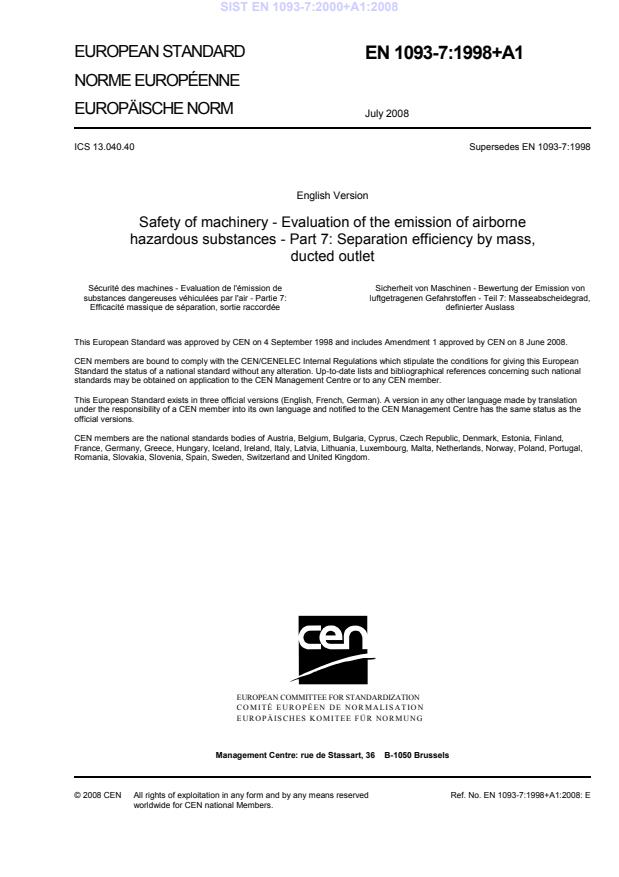
EUROPEAN STANDARD NORME EUROPÉENNE EUROPÄISCHE NORM
EN 1093-7:1998+A1
July 2008 ICS 13.040.40 Supersedes EN 1093-7:1998 English Version
Safety of machinery - Evaluation of the emission of airborne hazardous substances - Part 7: Separation efficiency by mass, ducted outlet
Sécurité des machines - Evaluation de l'émission de substances dangereuses véhiculées par l'air - Partie 7: Efficacité massique de séparation, sortie raccordée
Sicherheit von Maschinen - Bewertung der Emission von luftgetragenen Gefahrstoffen - Teil 7: Masseabscheidegrad, definierter Auslass This European Standard was approved by CEN on 4 September 1998 and includes Amendment 1 approved by CEN on 8 June 2008.
CEN members are bound to comply with the CEN/CENELEC Internal Regulations which stipulate the conditions for giving this European Standard the status of a national standard without any alteration. Up-to-date lists and bibliographical references concerning such national standards may be obtained on application to the CEN Management Centre or to any CEN member.
This European Standard exists in three official versions (English, French, German). A version in any other language made by translation under the responsibility of a CEN member into its own language and notified to the CEN Management Centre has the same status as the official versions.
CEN members are the national standards bodies of Austria, Belgium, Bulgaria, Cyprus, Czech Republic, Denmark, Estonia, Finland, France, Germany, Greece, Hungary, Iceland, Ireland, Italy, Latvia, Lithuania, Luxembourg, Malta, Netherlands, Norway, Poland, Portugal, Romania, Slovakia, Slovenia, Spain, Sweden, Switzerland and United Kingdom.
EUROPEAN COMMITTEE FOR STANDARDIZATION
COMITÉ EUROPÉEN DE NORMALISATION EUROPÄISCHES KOMITEE FÜR NORMUNG
Management Centre: rue de Stassart, 36
B-1050 Brussels © 2008 CEN All rights of exploitation in any form and by any means reserved worldwide for CEN national Members. Ref. No. EN 1093-7:1998+A1:2008: ESIST EN 1093-7:2000+A1:2008
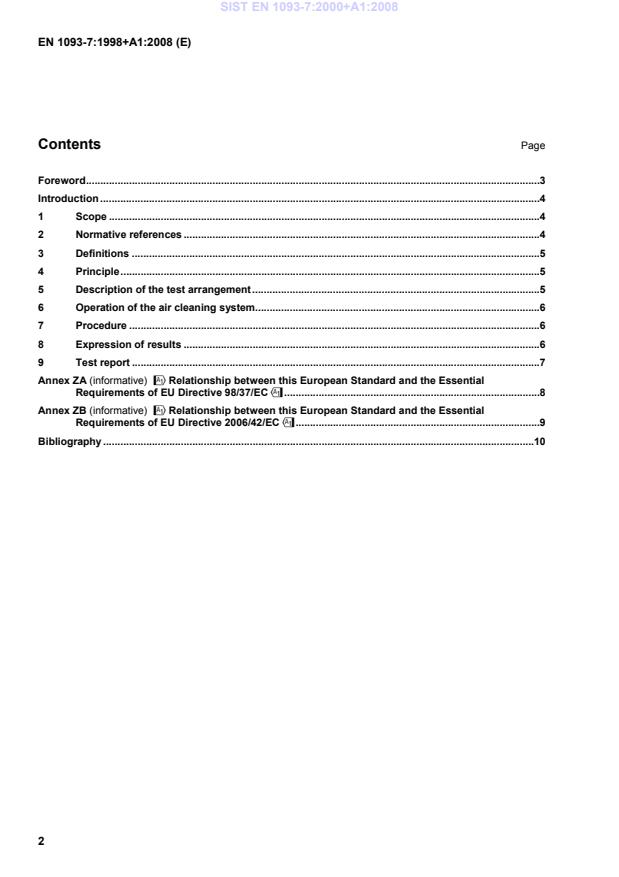
!Relationship between this European Standard and the Essential Requirements of EU Directive 98/37/EC".8 Annex ZB (informative)
!Relationship between this European Standard and the Essential Requirements of EU Directive 2006/42/EC".9 Bibliography.10
EN 1093-7:19
...