

EN 1093-6:1998+A1:2008
(Main + Amendment)Safety of machinery - Evaluation of the emission of airborne hazardous substances - Part 6: Separation efficiency by mass, unducted outlet
- Abstract
This European Standard specifies a test rig method for the measurement of the separation efficiency by mass of air cleaning systems with unducted outlet, operating under defined conditions. The method shall apply to systems that clean air of aerosols (smoke, dust, fume, mist), vapour or gas.
Measurement of the separation efficiency by mass of an air cleaning system for an intended use can serve for the:
a) evaluation of the performance of an air cleaning system;
b) evaluation of the improvement of the air cleaning system;
c) comparison of air cleaning systems;
d) ranking of air cleaning systems according to their separation efficiency by mass;
e) determination of the state of the art of air cleaning systems of the same intended use with respect to their separation efficiency by mass.
- Status
- Published
- Publication Date
- 15-Jul-2008
- Technical Committee
- CEN/TC 114 - Safety of machinery
- Current Stage
- 9020 - Submission to 2 Year Review Enquiry - Review Enquiry
- Start Date
- 15-Jul-2026
- Completion Date
- 15-Jul-2026
- Directive
- 2006/42/EC - Directive 2006/42/EC of the European Parliament and of the Council of 17 May 2006 on machinery, and amending Directive 95/16/EC (recast)OJ Ref: C, C 214 OJ Date: 08-Sep-2009
98/37/EC - MachineryOJ Ref: C, C 22 OJ Date: 28-Jan-2009

Overview
EN 1093-6:1998+A1:2008 is a key European Standard developed by CEN that defines test rig methods for measuring the separation efficiency by mass of air cleaning systems with unducted outlets. This standard applies specifically to air cleaning technologies designed to reduce airborne hazardous substances such as aerosols (smoke, dust, fume, mist), vapour, or gas emitted from machinery. By standardizing how separation efficiency is assessed, EN 1093-6 supports safety measures in machinery environments by ensuring reliable evaluation of air cleaning system performance.
The standard is part of the broader EN 1093 series, which addresses the evaluation of emissions of airborne hazardous substances from machines, contributing significantly to workplace safety and environmental protection.
Key Topics
Separation Efficiency by Mass
Defined as the ratio of pollutant mass retained by the air cleaning system to the mass entering it, expressed in percentage terms. This metric is critical for assessing filter and air cleaner performance under controlled test conditions.Test Rig Setup
The standard specifies a test rig with a cabin connected to inlet and outlet ducts, through which air flows while carrying the test pollutant. The air cleaning system operates in this rig with a well-defined arrangement to ensure repeatable and accurate measurement of pollutant concentration upstream and downstream.Measurement Procedures
Procedures include quantifying the test substance mass flow rate at the inlet and outlet, measuring air volume flow rates, and ensuring appropriate sampling durations to capture system behavior, including transient effects. Recommended international standards for flow and concentration measurements are referenced to ensure precision.Operating Conditions
The air cleaning system is to be tested under its intended operational conditions following manufacturer guidelines, using representative pollutants or surrogates. Conditions such as air flow rates and pollutant loading cover expected real-world variations. The test setup is designed to minimize errors from pollutant deposition or flow disturbances.Results Expression and Reporting
Separation efficiency results are expressed as mean values over the test duration and can also be differentiated by particle size distribution where applicable. Detailed test reports must include system identification, operational data, test substances, instruments used, environmental conditions, results, and any deviations from standard procedures.Compliance and Conformity
EN 1093-6 aligns with essential requirements of EU Machinery Directives 98/37/EC and 2006/42/EC relating to the emission of hazardous substances. Complying with this standard provides a presumption of conformity with these legal frameworks within its scope.
Applications
Performance Evaluation
Enables manufacturers and testing bodies to systematically evaluate how effectively air cleaning systems reduce airborne hazardous substances by mass, ensuring safety in machinery environments.Product Improvement and R&D
Provides a standardized method to evaluate improvements in air cleaning systems, facilitating innovation and technology optimization to achieve better air quality control.Comparative Assessment and Ranking
Assists in benchmarking different air cleaning solutions by their separation efficiency, supporting informed purchasing and regulatory compliance decisions.State-of-the-Art Determination
Helps define the current performance level of air cleaning systems within a specific intended use category, supporting regulatory bodies and industry stakeholders.Environmental and Occupational Safety Compliance
Supports compliance with EU directives requiring the control of emissions of airborne hazardous substances in workplaces, contributing to health and safety standards enforcement.
Related Standards
- EN 1093-1 – Selection of test methods for evaluation of airborne hazardous substances emissions.
- EN 481 – Defines size fractions for measuring airborne particles, useful for particle size distribution analysis in separation efficiency testing.
- EN 292-1 & EN 292-2 – Basic concepts, principles, and terminology for machinery safety design, providing foundational terminology and methodology referenced by EN 1093-6.
- ISO Standards – Includes ISO 3966, ISO 4006, ISO 5167 series for fluid flow measurement, ensuring accuracy and consistency in air flow rate determinations needed for test calculations.
Conclusion
EN 1093-6:1998+A1:2008 is an essential European standard offering a robust framework for testing the separation efficiency by mass of air cleaning systems with unducted outlets used in machinery. By following this standardized method, manufacturers, test institutes, and regulatory bodies can ensure reliable and comparable evaluations of air cleaning performance, contributing to improved safety, compliance, and environmental protection in industrial and workplace settings. This standard integrates seamlessly with related safety and performance standards, ensuring comprehensive coverage of emission testing practices.
Relations
- Effective Date
- 19-Jan-2023
- Effective Date
- 28-Jan-2026
- Effective Date
- 28-Jan-2026
- Effective Date
- 28-Jan-2026
- Effective Date
- 28-Jan-2026
- Effective Date
- 28-Jan-2026
- Effective Date
- 28-Jan-2026
- Effective Date
- 28-Jan-2026
Get Certified
Connect with accredited certification bodies for this standard

CIS Institut d.o.o.
Personal Protective Equipment (PPE) certification body. Notified Body NB-2890 for EU Regulation 2016/425 PPE.

Kiwa BDA Testing
Building and construction product certification.
Kmetijski inštitut Slovenije
Agricultural Institute of Slovenia. Soil testing, plant health, agricultural product analysis.
Sponsored listings
Frequently Asked Questions
EN 1093-6:1998+A1:2008 is a standard published by the European Committee for Standardization (CEN). Its full title is "Safety of machinery - Evaluation of the emission of airborne hazardous substances - Part 6: Separation efficiency by mass, unducted outlet". This standard covers: This European Standard specifies a test rig method for the measurement of the separation efficiency by mass of air cleaning systems with unducted outlet, operating under defined conditions. The method shall apply to systems that clean air of aerosols (smoke, dust, fume, mist), vapour or gas. Measurement of the separation efficiency by mass of an air cleaning system for an intended use can serve for the: a) evaluation of the performance of an air cleaning system; b) evaluation of the improvement of the air cleaning system; c) comparison of air cleaning systems; d) ranking of air cleaning systems according to their separation efficiency by mass; e) determination of the state of the art of air cleaning systems of the same intended use with respect to their separation efficiency by mass.
This European Standard specifies a test rig method for the measurement of the separation efficiency by mass of air cleaning systems with unducted outlet, operating under defined conditions. The method shall apply to systems that clean air of aerosols (smoke, dust, fume, mist), vapour or gas. Measurement of the separation efficiency by mass of an air cleaning system for an intended use can serve for the: a) evaluation of the performance of an air cleaning system; b) evaluation of the improvement of the air cleaning system; c) comparison of air cleaning systems; d) ranking of air cleaning systems according to their separation efficiency by mass; e) determination of the state of the art of air cleaning systems of the same intended use with respect to their separation efficiency by mass.
EN 1093-6:1998+A1:2008 is classified under the following ICS (International Classification for Standards) categories: 13.040.40 - Stationary source emissions. The ICS classification helps identify the subject area and facilitates finding related standards.
EN 1093-6:1998+A1:2008 has the following relationships with other standards: It is inter standard links to EN 1093-6:1998, EN 292-2:1991, EN 292-2:1991/A1:1995, EN 1093-1:2008, EN 292-1:1991, EN 16770:2018, EN 12629-7:2004+A1:2010, EN ISO 15012-1:2004. Understanding these relationships helps ensure you are using the most current and applicable version of the standard.
EN 1093-6:1998+A1:2008 is associated with the following European legislation: EU Directives/Regulations: 2006/42/EC, 98/37/EC; Standardization Mandates: M/079, M/396. When a standard is cited in the Official Journal of the European Union, products manufactured in conformity with it benefit from a presumption of conformity with the essential requirements of the corresponding EU directive or regulation.
EN 1093-6:1998+A1:2008 is available in PDF format for immediate download after purchase. The document can be added to your cart and obtained through the secure checkout process. Digital delivery ensures instant access to the complete standard document.
Standards Content (Sample)
2003-01.Slovenski inštitut za standardizacijo. Razmnoževanje celote ali delov tega standarda ni dovoljeno.Sicherheit von Maschinen - Bewertung der Emission von luftgetragenen Gefahrstoffen - Teil 6: Masseabscheidegrad, diffuser AuslassSécurité des machines - Evaluation de l'émission de substances dangereuses véhiculées par l'air - Partie 6: Efficacité massique de séparation, sortie libreSafety of machinery - Evaluation of the emission of airborne hazardous substances - Part 6: Separation efficiency by mass, unducted outlet13.110Varnost strojevSafety of machinery13.040.40Stationary source emissionsICS:Ta slovenski standard je istoveten z:EN 1093-6:1998+A1:2008SIST EN 1093-6:2000+A1:2008en,fr,de01-december-2008SIST EN 1093-6:2000+A1:2008SLOVENSKI
STANDARD
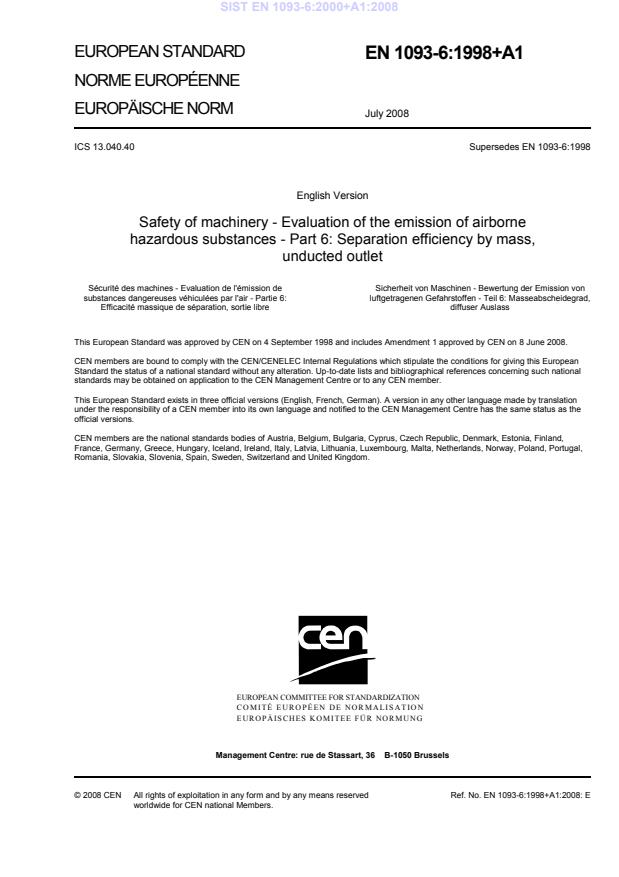
EUROPEAN STANDARD NORME EUROPÉENNE EUROPÄISCHE NORM
EN 1093-6:1998+A1
July 2008 ICS 13.040.40 Supersedes EN 1093-6:1998 English Version
Safety of machinery - Evaluation of the emission of airborne hazardous substances - Part 6: Separation efficiency by mass, unducted outlet
Sécurité des machines - Evaluation de l'émission de substances dangereuses véhiculées par l'air - Partie 6: Efficacité massique de séparation, sortie libre
Sicherheit von Maschinen - Bewertung der Emission von luftgetragenen Gefahrstoffen - Teil 6: Masseabscheidegrad, diffuser Auslass This European Standard was approved by CEN on 4 September 1998 and includes Amendment 1 approved by CEN on 8 June 2008.
CEN members are bound to comply with the CEN/CENELEC Internal Regulations which stipulate the conditions for giving this European Standard the status of a national standard without any alteration. Up-to-date lists and bibliographical references concerning such national standards may be obtained on application to the CEN Management Centre or to any CEN member.
This European Standard exists in three official versions (English, French, German). A version in any other language made by translation under the responsibility of a CEN member into its own language and notified to the CEN Management Centre has the same status as the official versions.
CEN members are the national standards bodies of Austria, Belgium, Bulgaria, Cyprus, Czech Republic, Denmark, Estonia, Finland, France, Germany, Greece, Hungary, Iceland, Ireland, Italy, Latvia, Lithuania, Luxembourg, Malta, Netherlands, Norway, Poland, Portugal, Romania, Slovakia, Slovenia, Spain, Sweden, Switzerland and United Kingdom.
EUROPEAN COMMITTEE FOR STANDARDIZATION
COMITÉ EUROPÉEN DE NORMALISATION EUROPÄISCHES KOMITEE FÜR NORMUNG
Management Centre: rue de Stassart, 36
B-1050 Brussels © 2008 CEN All rights of exploitation in any form and by any means reserved worldwide for CEN national Members. Ref. No. EN 1093-6:1998+A1:2008: ESIST EN 1093-6:2000+A1:2008
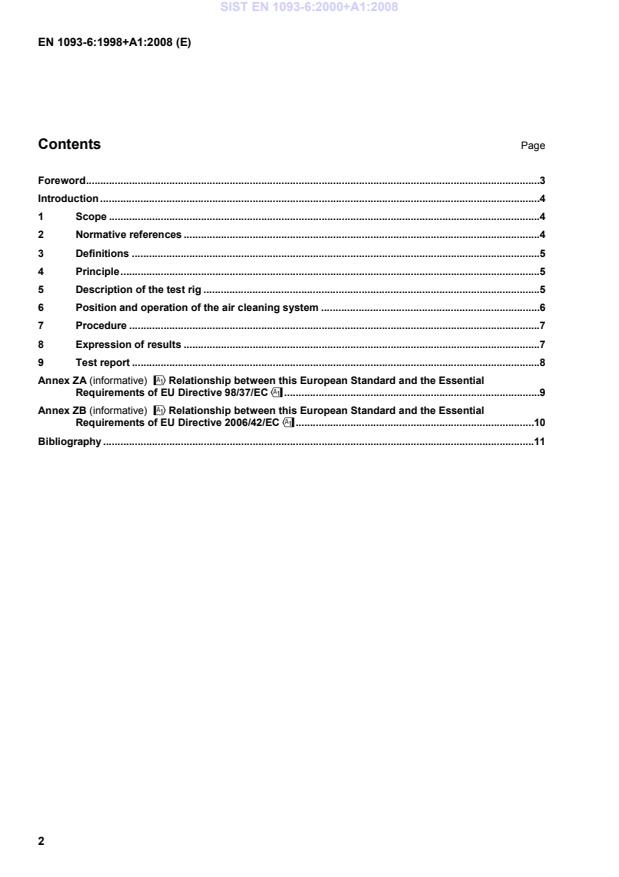
!Relationship between this European Standard and the Essential Requirements of EU Directive 98/37/EC".9 Annex ZB (informative)
!Relationship between this European Standard and the Essential Requirements of EU Directive 2006/42/EC".10 Bibliography.11
The separation efficiency of an air cleaning system as a percentage is expressed as follows: 10013⋅=mmsη (1) 4 Principle The principle of the measurement method is to operate the air cleaning system under defined conditions in a test rig and to determine the mass of the test substance in the air upstr
...