

EN 1093-11:2001+A1:2008
(Main + Amendment)Safety of machinery - Evaluation of the emission of airborne hazardous substances - Part 11: Decontamination index
- Abstract
This standard describes a method for the measurement of the decontami¬nation index of pollution con¬trol systems e. g. capture devices including local exhaust ventilation, water spray systems and, when appropriate, separation equipment installed on a machine. This method uses the real pollutant (see 4.2 of EN 1093-1 : 1998 “ Safety of machinery — Evaluation of the emission of airborne hazardous substances — Part 1: Selection of test methods”) and can be operated in room or field environments.
It should be observed that during the test, especially during the shutdown or the removal of the pollution control system, the concentration of hazardous substances , if present, can reach levels which are liable to incur a risk to the health of the operators or other occupants present in the room.
Warning: This standard does not deal with the protective measures required to control these risks.
Measurement of the decontamination index of pollution control system can serve for the:
– evaluation of the performance of a pollution control system of a machine;
– evaluation of the improvement of a pollution control system;
– comparison of pollution control systems for machines of similar design;
– ranking of pollution control systems according to their decontamination efficiency;
– determination of the air flow rate in the case of an exhaust system to achieve a given level;
– determination of the state of the art of pollution control systems for machines with respect to the decontamina¬tion efficiency.
- Status
- Published
- Publication Date
- 08-Jul-2008
- Technical Committee
- CEN/TC 114 - Safety of machinery
- Current Stage
- 9020 - Submission to 2 Year Review Enquiry - Review Enquiry
- Start Date
- 15-Jul-2026
- Completion Date
- 15-Jul-2026
- Directive
- 2006/42/EC - Directive 2006/42/EC of the European Parliament and of the Council of 17 May 2006 on machinery, and amending Directive 95/16/EC (recast)OJ Ref: C, C 214 OJ Date: 08-Sep-2009

Overview
EN 1093-11:2001+A1:2008 is a European standard developed by CEN that focuses on the safety of machinery with respect to the evaluation of airborne hazardous substance emissions. Specifically, it addresses the measurement of the decontamination index for pollution control systems installed on machinery-such as capture devices with local exhaust ventilation, water spray systems, and separation equipment. This standard outlines a method for quantifying the effectiveness of these pollution control systems using the actual pollutants emitted.
The method can be applied in both controlled room environments and field settings, providing practical means to evaluate and compare the performance of various pollution control systems. EN 1093-11:2001+A1:2008 supports improved occupational safety by enabling manufacturers, safety engineers, and regulatory bodies to assess pollution mitigation efforts and ensure better air quality around industrial machinery.
Key Topics
Decontamination Index Measurement
The decontamination index represents the improvement in ambient air quality due to the operation of pollution control systems. It is calculated by measuring pollutant concentrations under three conditions:- Machine and pollution control system off (background level)
- Machine and pollution control system on
- Machine on and pollution control system off (shutdown or removal phase)
Pollution Control Systems Covered
The standard applies to systems such as:- Capture devices including local exhaust ventilation
- Water spray systems
- Separation equipment, where applicable
Test Procedure and Phases
Measurements are conducted at multiple predefined points surrounding the machine during controlled test phases. Each phase requires multiple repeated measurements to ensure accuracy and account for variability.Influencing Factors
Factors affecting measurement validity include:- Operating conditions of the machine and surrounding processes
- Room dimensions and ventilation design
- Airflow rates within control systems
- Environmental conditions such as temperature and humidity
Safety Considerations
The standard warns that during shutdown or removal of pollution control systems, hazardous substances may reach dangerous concentrations, posing health risks. However, it does not provide protective measures and advises operators to take additional precautions during testing.
Applications
Performance Evaluation
Assess the effectiveness of pollution control systems on machinery by determining the actual reduction in hazardous airborne substances.System Improvement Assessment
Measure how modifications or upgrades to pollution control equipment impact air quality.Comparative Analysis
Compare decontamination efficiency between different pollution control systems or machinery designs.Airflow Optimization
Calculate the required airflow in exhaust systems to achieve specific decontamination targets.Regulatory Compliance and Reporting
Provide detailed test reports that can support compliance with EU machine safety directives and workplace safety regulations.
The standard is particularly useful for industries where airborne pollutants are generated during machine operation, facilitating safer working environments and adherence to air quality standards.
Related Standards
EN 1093-1:1998
Safety of machinery - Evaluation of emission of airborne hazardous substances - Part 1: Selection of test methods
Provides foundational test methods referenced for pollutant selection and measurement.EN 1070
Safety of machinery - Terminology
Defines terms used in machinery safety standards.ISO 3966:1977, ISO 4053-1:1977, ISO 5167-1:1991
International standards covering measurement of fluid and gas flows relevant to airflow rate determinations within pollution control systems.EN 481
Workplace atmospheres - Size fraction definitions for measurement of airborne particles
Referenced for assessing particle size distribution alongside pollutant concentrations.EU Directives 98/37/EC and 2006/42/EC
Frameworks for machinery safety to which this standard contributes by establishing test methods for hazardous substance emission.
EN 1093-11:2001+A1:2008 plays a critical role in machinery safety by providing a standardized, reproducible approach to evaluate airborne pollutant control. Adopting this methodology enables industrial stakeholders to improve pollution control system design, benchmark performance, and maintain safer, healthier workplace atmospheres.
Relations
- Effective Date
- 19-Jan-2023
- Effective Date
- 18-Mar-2026
- Effective Date
- 18-Mar-2026
- Effective Date
- 18-Mar-2026
- Effective Date
- 18-Mar-2026
- Effective Date
- 18-Mar-2026
- Effective Date
- 09-Feb-2026
- Effective Date
- 28-Jan-2026
- Effective Date
- 28-Jan-2026
- Effective Date
- 28-Jan-2026
- Effective Date
- 28-Jan-2026
- Effective Date
- 28-Jan-2026
- Effective Date
- 28-Jan-2026
Get Certified
Connect with accredited certification bodies for this standard

CIS Institut d.o.o.
Personal Protective Equipment (PPE) certification body. Notified Body NB-2890 for EU Regulation 2016/425 PPE.

Kiwa BDA Testing
Building and construction product certification.
Kmetijski inštitut Slovenije
Agricultural Institute of Slovenia. Soil testing, plant health, agricultural product analysis.
Sponsored listings
Frequently Asked Questions
EN 1093-11:2001+A1:2008 is a standard published by the European Committee for Standardization (CEN). Its full title is "Safety of machinery - Evaluation of the emission of airborne hazardous substances - Part 11: Decontamination index". This standard covers: This standard describes a method for the measurement of the decontami¬nation index of pollution con¬trol systems e. g. capture devices including local exhaust ventilation, water spray systems and, when appropriate, separation equipment installed on a machine. This method uses the real pollutant (see 4.2 of EN 1093-1 : 1998 “ Safety of machinery — Evaluation of the emission of airborne hazardous substances — Part 1: Selection of test methods”) and can be operated in room or field environments. It should be observed that during the test, especially during the shutdown or the removal of the pollution control system, the concentration of hazardous substances , if present, can reach levels which are liable to incur a risk to the health of the operators or other occupants present in the room. Warning: This standard does not deal with the protective measures required to control these risks. Measurement of the decontamination index of pollution control system can serve for the: – evaluation of the performance of a pollution control system of a machine; – evaluation of the improvement of a pollution control system; – comparison of pollution control systems for machines of similar design; – ranking of pollution control systems according to their decontamination efficiency; – determination of the air flow rate in the case of an exhaust system to achieve a given level; – determination of the state of the art of pollution control systems for machines with respect to the decontamina¬tion efficiency.
This standard describes a method for the measurement of the decontami¬nation index of pollution con¬trol systems e. g. capture devices including local exhaust ventilation, water spray systems and, when appropriate, separation equipment installed on a machine. This method uses the real pollutant (see 4.2 of EN 1093-1 : 1998 “ Safety of machinery — Evaluation of the emission of airborne hazardous substances — Part 1: Selection of test methods”) and can be operated in room or field environments. It should be observed that during the test, especially during the shutdown or the removal of the pollution control system, the concentration of hazardous substances , if present, can reach levels which are liable to incur a risk to the health of the operators or other occupants present in the room. Warning: This standard does not deal with the protective measures required to control these risks. Measurement of the decontamination index of pollution control system can serve for the: – evaluation of the performance of a pollution control system of a machine; – evaluation of the improvement of a pollution control system; – comparison of pollution control systems for machines of similar design; – ranking of pollution control systems according to their decontamination efficiency; – determination of the air flow rate in the case of an exhaust system to achieve a given level; – determination of the state of the art of pollution control systems for machines with respect to the decontamina¬tion efficiency.
EN 1093-11:2001+A1:2008 is classified under the following ICS (International Classification for Standards) categories: 13.040.40 - Stationary source emissions. The ICS classification helps identify the subject area and facilitates finding related standards.
EN 1093-11:2001+A1:2008 has the following relationships with other standards: It is inter standard links to EN 1093-11:2001, ISO 4053-1:1977, ISO/TR 5168:1998, ISO 3966:1977, ISO 7145:1982, ISO 4006:1991, ISO 5167-1:1991, EN 1032:1996/A1:1998, ENV 1178-2:1994, EN ISO 12001:1996, EN 12019:1997, EN 12215:2004, EN 12629-7:2004+A1:2010. Understanding these relationships helps ensure you are using the most current and applicable version of the standard.
EN 1093-11:2001+A1:2008 is associated with the following European legislation: EU Directives/Regulations: 2006/42/EC, 98/37/EC; Standardization Mandates: M/079, M/396. When a standard is cited in the Official Journal of the European Union, products manufactured in conformity with it benefit from a presumption of conformity with the essential requirements of the corresponding EU directive or regulation.
EN 1093-11:2001+A1:2008 is available in PDF format for immediate download after purchase. The document can be added to your cart and obtained through the secure checkout process. Digital delivery ensures instant access to the complete standard document.
Standards Content (Sample)
2003-01.Slovenski inštitut za standardizacijo. Razmnoževanje celote ali delov tega standarda ni dovoljeno.Varnost strojev - Vrednotenje emisije nevarnih snovi, ki jih prenaša zrak - 11. del: Indeks dekontaminacijeSicherheit von Maschinen - Bewertung der Emission von luftgetragenen Gefahrstoffen - Teil 11: ReinigungsindexSécurité des machines - Évaluation de l'émission de substances dangereuses véhiculées par l'air - Partie 11 : Indice d'assainissementSafety of machinery - Evaluation of the emission of airborne hazardous substances - Part 11: Decontamination index13.110Varnost strojevSafety of machinery13.040.40Stationary source emissionsICS:Ta slovenski standard je istoveten z:EN 1093-11:2001+A1:2008SIST EN 1093-11:2002+A1:2008en,fr,de01-december-2008SIST EN 1093-11:2002+A1:2008SLOVENSKI
STANDARD
EUROPEAN STANDARD NORME EUROPÉENNE EUROPÄISCHE NORM
EN 1093-11:2001+A1
July 2008 ICS 13.040.40 Supersedes EN 1093-11:2001 English Version
Safety of machinery - Evaluation of the emission of airborne hazardous substances - Part 11: Decontamination index
Sécurité des machines - Évaluation de l'émission de substances dangereuses par l'air - Partie 11 : Indice d'assainissement
Sicherheit von Maschinen - Bewertung der Emission von luftgetragenen Gefahrstoffen - Teil 11: Reinigungsindex This European Standard was approved by CEN on 19 April 2001 and includes Amendment 1 approved by CEN on 6 June 2008.
CEN members are bound to comply with the CEN/CENELEC Internal Regulations which stipulate the conditions for giving this European Standard the status of a national standard without any alteration. Up-to-date lists and bibliographical references concerning such national standards may be obtained on application to the CEN Management Centre or to any CEN member.
This European Standard exists in three official versions (English, French, German). A version in any other language made by translation under the responsibility of a CEN member into its own language and notified to the CEN Management Centre has the same status as the official versions.
CEN members are the national standards bodies of Austria, Belgium, Bulgaria, Cyprus, Czech Republic, Denmark, Estonia, Finland, France, Germany, Greece, Hungary, Iceland, Ireland, Italy, Latvia, Lithuania, Luxembourg, Malta, Netherlands, Norway, Poland, Portugal, Romania, Slovakia, Slovenia, Spain, Sweden, Switzerland and United Kingdom.
EUROPEAN COMMITTEE FOR STANDARDIZATION
COMITÉ EUROPÉEN DE NORMALISATION EUROPÄISCHES KOMITEE FÜR NORMUNG
Management Centre: rue de Stassart, 36
B-1050 Brussels © 2008 CEN All rights of exploitation in any form and by any means reserved worldwide for CEN national Members. Ref. No. EN 1093-11:2001+A1:2008: ESIST EN 1093-11:2002+A1:2008
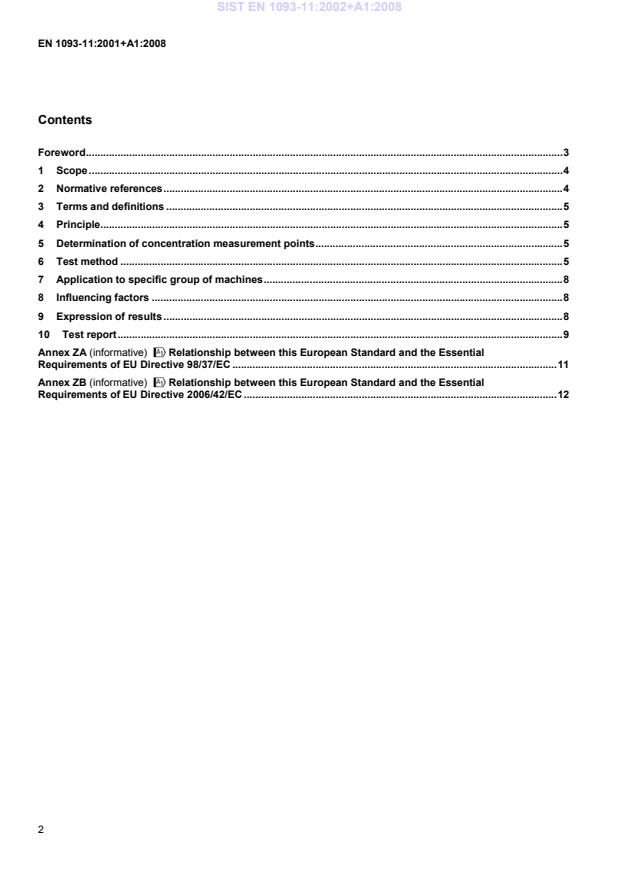
!Relationship between this European Standard and the Essential Requirements of EU Directive 98/37/EC.11 Annex ZB (informative)
!Relationship between this European Standard and the Essential Requirements of EU Directive 2006/42/EC.12
Foreword This document (EN 1093-11:2001+A1:2008) has been prepared by Technical Committee CEN/TC 114 "Safety of machinery", the secretariat of which is held by DIN. This European Standard shall be given the status of a national standard, either by publication of an identical text or by endorsement, at the latest by January 2009, and conflicting national standards shall be withdrawn at the latest by January 2009. This document includes Amendment 1, approved by CEN on 2008-06-06. This document supersedes EN 1093-11:2001. The start and finish of text introduced or altered by amendment is indicated in the text by tags ! ". This document has been prepared under a mandate given to CEN by the European Commission and the European Free Trade Association, and supports essential requirements of EC Directive(s). !For relationship with EC Directive(s), see informative Annexes ZA and ZB, which are integral parts of this document." According to the CEN/CENELEC Internal Regulations, the national standards organizations of the following countries are bound to implement this European Standard: Austria, Belgium, Bulgaria, Cyprus, Czech Republic, Denmark, Estonia, Finland, France, Germany, Greece, Hungary, Iceland, Ireland, Italy, Latvia, Lithuania, Luxembourg, Malta, Netherlands, Norway, Poland, Portugal, Romania, Slovakia, Slovenia, Spain, Sweden, Switzerland and United Kingdom.
hazardous substances — Part 1: Selection of test methods”) and can be operated in room or field environments. It should be observed that during the test, especially during the shutdown or the removal of the pollution control system, the concentration of hazardous substances , if present, can reach levels which are liable to incur a risk to the health of the operators or other occupants present in the room. Warning: This standard does not deal with the protective measures required to control these risks. Measurement of the decontamination index of pollution control system can serve for the: – evaluation of the performance of a pollution control system of a machine; – evaluation of the improvement of a pollution control system; – comparison of pollution control systems for machines of similar design; – ranking of pollution control systems according to their decontamination efficiency; – determination of the air flow rate in the case of an exhaust system to achieve a given level; – determination of the state of the art of pollution control systems for machines with respect to the decontamina-tion efficiency. 2 Normative references This European Standard incorporates by dated or undated reference, provisions from other publications. These normative references are cited at the appropriate places in the text and the publications are listed hereafter. For dated references, subsequent amendments to or revisions of any of these publications apply to this European Standard only when incorporated in it by amendment or revision. For undated references the latest edition of the publication referred to applies (including amendments). EN 1070, Safety of machinery - Terminology ISO 3966:1977, Measurement of fluid flow in closed conduits - Velocity area method using Pitot static tubes ISO 4006:1991, Measurement of fluid flow in closed conduits - Vocabulary and symbols ISO 4053-1:1977, Measurement of gas flow in conduits - Tracer methods - Part 1 : General ISO 5167-1:1991, Measurement of fluid flow by means of pressure differential devices - Part 1: Orifice plates, nozzles and Venturi tubes inserted in circular cross-section conduits running full ISO/TR 5168:1998, Measurement of fluid flow - Evaluation of uncertainties ISO 7145:1982, Determination of flowrate of fluids in closed conduits of circular cross-section - Method of velocity measurement at one point of the cross-section SIST EN 1093-11:2002+A1:2008
...