

ASTM F3226/F3226M-19
(Specification)Standard Specification for Metallic Press-Connect Fittings for Piping and Tubing Systems
General Information
- Abstract
ABSTRACT
This specification establishes the material, manufacturing, performance, and testing requirements for Metallic Press-Connect Fittings used in piping and tubing systems with a maximum allowable working pressure of 300 psi. Metallic Press-Connect Fittings are directly attached to pipe or tube by mechanical deformation of the pipe or tube or fitting, or a combination thereof, creating a seal and a restrained joint. The seal may be created via the mechanical deformation (of the pipe, tube or fitting) or created independently. Press-Connect fittings shall be made from one or more of the following material grades: Grade A (carbon steel), Grade B (stainless steel), Grade C (copper and copper-alloy), Grade D (copper-nickel), and Grade E (brass). The fittings rated pressure shall be one of the following classes: Class 1 (100 psi [0.69 MPa] maximum), Class 2 (200 psi [1.38 MPa] maximum), and Class 3 (300 psi [2.07 MPa] maximum). The elastomeric seals are of three types: Type 1 (ethylene propylene diene monomer [EPDM]), Type 2 (hydrogenated nitrile butadiene rubber [HNBR], and Type 3 (fluoro-elastomer or synthetic fluorinated rubber [FKM]).
This specification also covers ordering information, dimensions, and workmanship, finish, and appearance, as well as sampling for testing, tests and re-tests, specimen preparation, inspection, certification, and product marking.
SCOPE
1.1 This specification establishes the performance characteristics required for Metallic Press-Connect Fittings for use in piping and tubing systems with a maximum allowable working pressure of three-hundred pounds per square inch (300 psi) [2.07 MPa]. These fittings directly attach to pipe or tube by mechanical deformation of the pipe or tube or fitting, or a combination thereof, creating a seal and a restrained joint. The seal may be created via the mechanical deformation (of the pipe, tube or fitting) or created independently. Successful completion of the tests described herein constitutes completion of the technical portion of the qualification process.
1.2 The tests specified are applicable only to ascertain the performance characteristics. These tests are not intended for use in the evaluation of non-Press-Connect Fittings.
1.3 Refer to IACS UR P2.7.4, Table-7 for Metallic Press-Connect Fittings applications.
1.4 The values stated in either SI units or inch-pound units are to be regarded separately as standard. The values stated in each system may not be exact equivalents; therefore, each system shall be used independently of the other. Combining values from the two systems may result in non-conformance with the standard.
1.5 This standard does not purport to address all of the safety concerns, if any, associated with its use. It is the responsibility of the user of this standard to establish appropriate safety, health, and environmental practices and determine the applicability of regulatory limitations prior to use.
1.6 This international standard was developed in accordance with internationally recognized principles on standardization established in the Decision on Principles for the Development of International Standards, Guides and Recommendations issued by the World Trade Organization Technical Barriers to Trade (TBT) Committee.
- Status
- Published
- Publication Date
- 31-Jul-2019
- Technical Committee
- F25 - Ships and Marine Technology
- Drafting Committee
- F25.11 - Machinery and Piping Systems
Buy Documents
ASTM F3226/F3226M-19 - Standard Specification for Metallic Press-Connect Fittings for Piping and Tubing Systems

REDLINE ASTM F3226/F3226M-19 - Standard Specification for Metallic Press-Connect Fittings for Piping and Tubing Systems
Overview
ASTM F3226/F3226M-19 establishes the requirements for metallic press-connect fittings used in piping and tubing systems with a maximum allowable working pressure of 300 psi. These fittings are mechanically attached to pipes or tubes by deformation, creating sealed and restrained joints. The standard outlines material specifications, performance tests, and quality requirements to ensure that press-connect fittings provide reliable and leak-resistant connections in various piping applications.
Key Topics
Material Requirements: The standard covers multiple material grades for press-connect fittings:
- Grade A: Carbon steel
- Grade B: Stainless steel
- Grade C: Copper and copper-alloy
- Grade D: Copper-nickel
- Grade E: Brass
Pressure Classes: Fittings are classified based on their maximum pressure rating:
- Class 1: 100 psi (0.69 MPa) maximum
- Class 2: 200 psi (1.38 MPa) maximum
- Class 3: 300 psi (2.07 MPa) maximum
Elastomeric Seals: Seal types supported by the standard include:
- Type 1: EPDM (Ethylene Propylene Diene Monomer)
- Type 2: HNBR (Hydrogenated Nitrile Butadiene Rubber)
- Type 3: FKM (Fluoro-Elastomer or Synthetic Fluorinated Rubber)
Performance & Testing: The standard specifies a range of tests to qualify fittings, including:
- Hydrostatic proof and burst testing
- Pull-out, vacuum, and vibration tests
- Fire resistance and impulse pressure tests
- Ammonia vapor testing for certain copper alloys
Workmanship and Quality: Requirements for finish, appearance, and dimension tolerances, as well as sampling, inspection, and product marking, are included to guarantee product consistency and safety.
Applications
Metallic press-connect fittings specified by ASTM F3226/F3226M-19 are essential in a variety of piping and tubing systems, making them valuable for:
- Building services: Used in potable water, heating, and cooling systems
- Industrial piping: Ideal for process piping where rapid and leak-free installation is needed
- Marine and shipbuilding: Approved fittings are suitable for shipboard systems as referenced in IACS UR P2.7.4, Table-7
- Fire protection systems: Compliant with specific material and pressure class requirements
- Retrofitting and maintenance: Facilitates rapid replacement and repair without welding
These applications benefit from the quick installation, secure joints, and long-term performance provided by press-connect technology.
Related Standards
When using ASTM F3226/F3226M-19, the following standards are relevant for reference or compatibility:
- Referenced ASTM standards:
- ASTM A53/A53M (Steel Pipe)
- ASTM A312/A312M (Stainless Steel Pipes)
- ASTM B88 (Copper Water Tube)
- ASTM D2000 (Rubber Products Classification)
- ASME standards:
- ASME B1.20.1 (Pipe Threads, General Purpose)
- ASME B16.51 (Copper and Copper Alloy Press-Connect Pressure Fittings)
- International and industry standards:
- ISO 19921, ISO 19922 (Fire resistance of metallic pipe components)
- IACS UR P2.7.4, UR P2.11 (Mechanical Joint Applications and Approvals)
- AWS A5.8M/A5.8 and AWS B2.2/B2.2M (Brazing Procedure and Performance)
Referencing these related standards ensures comprehensive compliance, compatibility, and optimal performance for metallic press-connect fittings in demanding piping and tubing systems.
Keywords: ASTM F3226/F3226M-19, metallic press-connect fittings, piping systems, tubing systems, pressure class, elastomeric seals, hydrostatic testing, building services, marine piping, industrial piping, standard specification, ASTM, compliance.
Relations
- Effective Date
- 01-Aug-2019
- Effective Date
- 01-Mar-2024
- Effective Date
- 01-Mar-2024
- Refers
ASTM B124/B124M-20 - Standard Specification for Copper and Copper Alloy Forging Rod, Bar, and Shapes - Effective Date
- 01-Apr-2020
- Effective Date
- 01-Apr-2020
- Effective Date
- 01-Oct-2019
- Effective Date
- 01-Oct-2019
- Effective Date
- 01-Apr-2019
- Refers
ASTM B124/B124M-19 - Standard Specification for Copper and Copper Alloy Forging Rod, Bar, and Shapes - Effective Date
- 01-Apr-2019
- Effective Date
- 01-Apr-2019
- Effective Date
- 01-Oct-2018
- Refers
ASTM B124/B124M-18 - Standard Specification for Copper and Copper Alloy Forging Rod, Bar, and Shapes - Effective Date
- 15-Mar-2018
- Effective Date
- 01-Mar-2018
- Effective Date
- 01-Mar-2018
- Effective Date
- 01-Apr-2017
Buy Documents
ASTM F3226/F3226M-19 - Standard Specification for Metallic Press-Connect Fittings for Piping and Tubing Systems
REDLINE ASTM F3226/F3226M-19 - Standard Specification for Metallic Press-Connect Fittings for Piping and Tubing Systems
Get Certified
Connect with accredited certification bodies for this standard

Institut za varilstvo d.o.o. (Welding Institute)
Slovenia's leading welding institute since 1952. ISO 3834, EN 1090, pressure equipment certification, NDT personnel, welder qualification. Only IIW Au
Sponsored listings
Frequently Asked Questions
ASTM F3226/F3226M-19 is a technical specification published by ASTM International. Its full title is "Standard Specification for Metallic Press-Connect Fittings for Piping and Tubing Systems". This standard covers: ABSTRACT This specification establishes the material, manufacturing, performance, and testing requirements for Metallic Press-Connect Fittings used in piping and tubing systems with a maximum allowable working pressure of 300 psi. Metallic Press-Connect Fittings are directly attached to pipe or tube by mechanical deformation of the pipe or tube or fitting, or a combination thereof, creating a seal and a restrained joint. The seal may be created via the mechanical deformation (of the pipe, tube or fitting) or created independently. Press-Connect fittings shall be made from one or more of the following material grades: Grade A (carbon steel), Grade B (stainless steel), Grade C (copper and copper-alloy), Grade D (copper-nickel), and Grade E (brass). The fittings rated pressure shall be one of the following classes: Class 1 (100 psi [0.69 MPa] maximum), Class 2 (200 psi [1.38 MPa] maximum), and Class 3 (300 psi [2.07 MPa] maximum). The elastomeric seals are of three types: Type 1 (ethylene propylene diene monomer [EPDM]), Type 2 (hydrogenated nitrile butadiene rubber [HNBR], and Type 3 (fluoro-elastomer or synthetic fluorinated rubber [FKM]). This specification also covers ordering information, dimensions, and workmanship, finish, and appearance, as well as sampling for testing, tests and re-tests, specimen preparation, inspection, certification, and product marking. SCOPE 1.1 This specification establishes the performance characteristics required for Metallic Press-Connect Fittings for use in piping and tubing systems with a maximum allowable working pressure of three-hundred pounds per square inch (300 psi) [2.07 MPa]. These fittings directly attach to pipe or tube by mechanical deformation of the pipe or tube or fitting, or a combination thereof, creating a seal and a restrained joint. The seal may be created via the mechanical deformation (of the pipe, tube or fitting) or created independently. Successful completion of the tests described herein constitutes completion of the technical portion of the qualification process. 1.2 The tests specified are applicable only to ascertain the performance characteristics. These tests are not intended for use in the evaluation of non-Press-Connect Fittings. 1.3 Refer to IACS UR P2.7.4, Table-7 for Metallic Press-Connect Fittings applications. 1.4 The values stated in either SI units or inch-pound units are to be regarded separately as standard. The values stated in each system may not be exact equivalents; therefore, each system shall be used independently of the other. Combining values from the two systems may result in non-conformance with the standard. 1.5 This standard does not purport to address all of the safety concerns, if any, associated with its use. It is the responsibility of the user of this standard to establish appropriate safety, health, and environmental practices and determine the applicability of regulatory limitations prior to use. 1.6 This international standard was developed in accordance with internationally recognized principles on standardization established in the Decision on Principles for the Development of International Standards, Guides and Recommendations issued by the World Trade Organization Technical Barriers to Trade (TBT) Committee.
ABSTRACT This specification establishes the material, manufacturing, performance, and testing requirements for Metallic Press-Connect Fittings used in piping and tubing systems with a maximum allowable working pressure of 300 psi. Metallic Press-Connect Fittings are directly attached to pipe or tube by mechanical deformation of the pipe or tube or fitting, or a combination thereof, creating a seal and a restrained joint. The seal may be created via the mechanical deformation (of the pipe, tube or fitting) or created independently. Press-Connect fittings shall be made from one or more of the following material grades: Grade A (carbon steel), Grade B (stainless steel), Grade C (copper and copper-alloy), Grade D (copper-nickel), and Grade E (brass). The fittings rated pressure shall be one of the following classes: Class 1 (100 psi [0.69 MPa] maximum), Class 2 (200 psi [1.38 MPa] maximum), and Class 3 (300 psi [2.07 MPa] maximum). The elastomeric seals are of three types: Type 1 (ethylene propylene diene monomer [EPDM]), Type 2 (hydrogenated nitrile butadiene rubber [HNBR], and Type 3 (fluoro-elastomer or synthetic fluorinated rubber [FKM]). This specification also covers ordering information, dimensions, and workmanship, finish, and appearance, as well as sampling for testing, tests and re-tests, specimen preparation, inspection, certification, and product marking. SCOPE 1.1 This specification establishes the performance characteristics required for Metallic Press-Connect Fittings for use in piping and tubing systems with a maximum allowable working pressure of three-hundred pounds per square inch (300 psi) [2.07 MPa]. These fittings directly attach to pipe or tube by mechanical deformation of the pipe or tube or fitting, or a combination thereof, creating a seal and a restrained joint. The seal may be created via the mechanical deformation (of the pipe, tube or fitting) or created independently. Successful completion of the tests described herein constitutes completion of the technical portion of the qualification process. 1.2 The tests specified are applicable only to ascertain the performance characteristics. These tests are not intended for use in the evaluation of non-Press-Connect Fittings. 1.3 Refer to IACS UR P2.7.4, Table-7 for Metallic Press-Connect Fittings applications. 1.4 The values stated in either SI units or inch-pound units are to be regarded separately as standard. The values stated in each system may not be exact equivalents; therefore, each system shall be used independently of the other. Combining values from the two systems may result in non-conformance with the standard. 1.5 This standard does not purport to address all of the safety concerns, if any, associated with its use. It is the responsibility of the user of this standard to establish appropriate safety, health, and environmental practices and determine the applicability of regulatory limitations prior to use. 1.6 This international standard was developed in accordance with internationally recognized principles on standardization established in the Decision on Principles for the Development of International Standards, Guides and Recommendations issued by the World Trade Organization Technical Barriers to Trade (TBT) Committee.
ASTM F3226/F3226M-19 is classified under the following ICS (International Classification for Standards) categories: 23.100.40 - Piping and couplings. The ICS classification helps identify the subject area and facilitates finding related standards.
ASTM F3226/F3226M-19 has the following relationships with other standards: It is inter standard links to ASTM F3226/F3226M-16e1, ASTM A312/A312M-24, ASTM A53/A53M-24, ASTM B124/B124M-20, ASTM B75/B75M-20, ASTM B124/B124M-19a, ASTM B16/B16M-19, ASTM B371/B371M-19, ASTM B124/B124M-19, ASTM B75/B75M-19, ASTM B124/B124M-18a, ASTM B124/B124M-18, ASTM B858-06(2018), ASTM B466/B466M-18, ASTM B62-17. Understanding these relationships helps ensure you are using the most current and applicable version of the standard.
ASTM F3226/F3226M-19 is available in PDF format for immediate download after purchase. The document can be added to your cart and obtained through the secure checkout process. Digital delivery ensures instant access to the complete standard document.
Standards Content (Sample)
This international standard was developed in accordance with internationally recognized principles on standardization established in the Decision on Principles for the
Development of International Standards, Guides and Recommendations issued by the World Trade Organization Technical Barriers to Trade (TBT) Committee.
Designation: F3226/F3226M −19 An American National Standard
Standard Specification for
Metallic Press-Connect Fittings for Piping and Tubing
Systems
ThisstandardisissuedunderthefixeddesignationF3226/F3226M;thenumberimmediatelyfollowingthedesignationindicatestheyear
of original adoption or, in the case of revision, the year of last revision.Anumber in parentheses indicates the year of last reapproval.
A superscript epsilon (´) indicates an editorial change since the last revision or reapproval.
1. Scope 2. Referenced Documents
1.1 This specification establishes the performance charac-
2.1 ASTM Standards:
teristics required for Metallic Press-Connect Fittings for use in
A53/A53MSpecification for Pipe, Steel, Black and Hot-
pipingandtubingsystemswithamaximumallowableworking
Dipped, Zinc-Coated, Welded and Seamless
pressure of three-hundred pounds per square inch (300 psi)
A135/A135MSpecification for Electric-Resistance-Welded
[2.07 MPa]. These fittings directly attach to pipe or tube by
Steel Pipe
mechanical deformation of the pipe or tube or fitting, or a
A262Practices for Detecting Susceptibility to Intergranular
combination thereof, creating a seal and a restrained joint.The
Attack in Austenitic Stainless Steels
seal may be created via the mechanical deformation (of the
A269Specification for Seamless and Welded Austenitic
pipe, tube or fitting) or created independently. Successful
Stainless Steel Tubing for General Service
completionofthetestsdescribedhereinconstitutescompletion
A276Specification for Stainless Steel Bars and Shapes
of the technical portion of the qualification process.
A312/A312M Specification for Seamless, Welded, and
1.2 The tests specified are applicable only to ascertain the
Heavily Cold Worked Austenitic Stainless Steel Pipes
performance characteristics. These tests are not intended for
A795/A795MSpecificationforBlackandHot-DippedZinc-
use in the evaluation of non-Press-Connect Fittings.
Coated (Galvanized) Welded and Seamless Steel Pipe for
Fire Protection Use
1.3 Refer to IACS UR P2.7.4, Table-7 for Metallic Press-
B16/B16MSpecification for Free-Cutting Brass Rod, Bar
Connect Fittings applications.
and Shapes for Use in Screw Machines
1.4 The values stated in either SI units or inch-pound units
B62Specification for Composition Bronze or Ounce Metal
are to be regarded separately as standard. The values stated in
Castings
each system may not be exact equivalents; therefore, each
B75/B75MSpecification for Seamless Copper Tube
system shall be used independently of the other. Combining
B88Specification for Seamless Copper Water Tube
values from the two systems may result in non-conformance
B124/B124MSpecification for Copper and Copper Alloy
with the standard.
Forging Rod, Bar, and Shapes
1.5 This standard does not purport to address all of the
B140/B140M Specification for Copper-Zinc-Lead (Red
safety concerns, if any, associated with its use. It is the
Brass or Hardware Bronze) Rod, Bar, and Shapes
responsibility of the user of this standard to establish appro-
B283Specification for Copper and Copper-Alloy Die Forg-
priate safety, health, and environmental practices and deter-
ings (Hot-Pressed)
mine the applicability of regulatory limitations prior to use.
B371/B371MSpecification for Copper-Zinc-Silicon Alloy
1.6 This international standard was developed in accor-
Rod
dance with internationally recognized principles on standard-
B466/B466M Specification for Seamless Copper-Nickel
ization established in the Decision on Principles for the
Pipe and Tube
Development of International Standards, Guides and Recom-
B467Specification for Welded Copper-Nickel Pipe
mendations issued by the World Trade Organization Technical
B584Specification for Copper Alloy Sand Castings for
Barriers to Trade (TBT) Committee.
General Applications
This specification is under the jurisdiction ofASTM Committee F25 on Ships
and Marine Technology and is the direct responsibility of Subcommittee F25.11 on
Machinery and Piping Systems. For referenced ASTM standards, visit the ASTM website, www.astm.org, or
Current edition approved Aug. 1, 2019. Published August 2019. Originally contact ASTM Customer Service at service@astm.org. For Annual Book of ASTM
ɛ1
approvedin2016.Lastpreviouseditionapprovedin2016asF3226/F3226M–16 . Standards volume information, refer to the standard’s Document Summary page on
DOI: 10.1520/F3226_F3226M-19. the ASTM website.
Copyright © ASTM International, 100 Barr Harbor Drive, PO Box C700, West Conshohocken, PA 19428-2959. United States
F3226/F3226M − 19
B858TestMethodforAmmoniaVaporTestforDetermining 3.1.5 joint, n—interface between the fitting and pipe or tube
Susceptibility to Stress Corrosion Cracking in Copper where the seal is maintained and mechanical holding strength
Alloys is applied or maintained.
B967/B967MSpecification for Copper-Zinc-Tin-Bismuth
3.1.6 leakage, n—theescapeoffluidorgasfromanyholein
Alloy Rod, Bar and Wire
the pressure containment wall, sufficient to drip or flow from
D2000Classification System for Rubber Products in Auto-
thepointofformationorgasbubblesrisingtothesurfaceafter
motive Applications
the first minute of submersion.
2.2 ASME Standards:
3.1.7 ‘P’ designation, n—indicates a Press-Connect fitting
ASME B1.20.1Pipe Threads, General Purpose, Inch
end (that is, P × NPT).
ASME B16.51Copper and Copper Alloy Press-Connect
3.1.8 permanent, n—cannot be disassembled and reused
Pressure Fittings
after initial assembly.
ASME B36.10Welded and Seamless Wrought Steel Pipe
3.1.9 pipe, n—hollow cylindrical shape used to transport
ASME B46.1 Surface Texture (Surface Roughness,
liquids, gases, or oil. Pipe is specified by nominal outside
Waviness, and Lay)
diameter (OD) and schedule (wall thickness).
2.3 IACS Document:
3.1.10 press connection, n—typeoffittingjointthatattaches
UR P2.11Type Approval of Mechanical Joints
directly to pipe or tube by mechanical deformation of the pipe,
UR P2.7.4Mechanical Joints
5 tube or fitting or combination creating a seal and restrained
2.4 ISO Standards:
joint. The joint is created by use of an elastomeric seal or
ISO 19921Ships and Marine Technology – Fire Resistance
mechanical deformation, or both. Mechanical deformation is
of Metallic Pipe Components with Resilient and Elasto-
achieved by use of an electro-hydraulic pressing tool. Press-
meric Seals – Test Methods
Connect ends may vary by design as found in Fig. 1.
ISO 19922Ships and Marine Technology – Fire Resistance
3.1.11 rated pressure, n—the manufacturer’s recommended
of Metallic Pipe Components with Resilient and Elasto-
maximum in-service pressure at a defined temperature.
meric Seals – Requirements Imposed on the Test Bench
3.1.12 re-test, n—performed when the original test speci-
2.5 AWS Standards:
men leaks or separates during testing as a result of any cause
ANSI/AWS A5.8M/A5.8Specification for Filler Metals for
that is not related to the design of the fittings being qualified.
Brazing and Braze Welding
AWS B2.2/B2.2MStandard for Brazing Procedure and Per-
3.1.13 specimen, n—a prepared assembly consisting of fit-
formance Qualifications
tings assembled onto a preselected pipe or tube. The specimen
isplacedintoacontrolledenvironmentandtestedtodetermine
3. Terminology
if the assembly meets the specified test requirements.
3.1 Definitions:
3.1.14 test pressure, n—selected pressure used during
3.1.1 class, n—a group of fitting of a particular design with
testing, based upon the rated pressure of the fitting, pipe or
the dimensions proportional to pipe or tube outside diameters,
tube.
madefromthesamematerialgrade(orcombinationofgrades),
3.1.15 tube, n—hollow thin-walled cylindrical product that
for the same rated pressure, or for a rated pressure inversely
is usually specified with respect to inside diameter (ID) and
proportional to the diameter.
wall thickness.
3.1.2 ‘FTG’, n—indicates a pipe-end or tube-end of a
Press-Connect fitting (that is, FTG × NPT). A fitting ends
4. Classification
configuration that is dimensionally the same as a pipe or tube
4.1 Press-Connectfittingsshallbeclassifiedintothefollow-
and intended to insert into a Press-Connect fitting.
ing categories:
3.1.3 failure, n—the condition of not achieving the desired
4.1.1 Material (see 4.2).
performance, as evidenced by leakage or joint separation.
4.1.2 Rated operating pressure (see 4.3).
3.1.4 fitting, n—connecting device used to join multiple
4.1.3 Elastomeric Seals (see 4.4).
pipes or tubes or other fittings together to create a working
4.2 Fittingsshallbemadefromoneormoreofthefollowing
system.
material grades:
4.2.1 Grade A—Carbon steel.
4.2.2 Grade B—Stainless steel.
Available from American Society of Mechanical Engineers (ASME), ASME
4.2.3 Grade C—Copper and Copper-Alloy.
International Headquarters, Two Park Ave., New York, NY 10016-5990, http://
4.2.4 Grade D—Copper-nickel.
www.asme.org.
Available from International Association of Classification Societies (IACS)
4.2.5 Grade E—Brass.
Limited, Permanent Secretariat, 6th Floor, 36 Broadway, London SW1H 0BH, UK,
4.3 The fittings rated pressure shall be one of the following
http://www.iacs.org.uk.
Available from International Organization for Standardization (ISO), ISO
classes:
Central Secretariat, BIBC II, Chemin de Blandonnet 8, CP 401, 1214 Vernier,
4.3.1 Class 1—100 psi [0.69 MPa] maximum.
Geneva, Switzerland, http://www.iso.org.
6 4.3.2 Class 2—200 psi [1.38 MPa] maximum.
Available from American Welding Society (AWS), 8669 NW 36 St., #130,
Miami, FL 33166-6672, http://www.aws.org. 4.3.3 Class 3—300 psi [2.07 MPa] maximum.
F3226/F3226M − 19
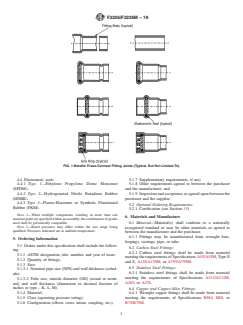
FIG. 1 Metallic Press-Connect Fitting Joints (Typical, But Not Limited To)
4.4 Elastomeric seals: 5.1.7 Supplementary requirements, if any;
4.4.1 Type 1—Ethylene Propylene Diene Monomer 5.1.8 Other requirements agreed to between the purchaser
(EPDM). and the manufacturer; and
4.4.2 Type 2—Hydrogenated Nitrile Butadiene Rubber 5.1.9 Inspectionandacceptanceasagreeduponbetweenthe
(HNBR). purchaser and the supplier.
4.4.3 Type 3—Fluoro-Elastomer or Synthetic Fluorinated
5.2 Optional Ordering Requirements:
Rubber (FKM).
5.2.1 Certification (see Section 15).
NOTE 1—When multiple components resulting in more than one
6. Materials and Manufacture
materialgradearespecifiedwithinanassembly,thecombinationofgrades
used shall be galvanically compatible. 6.1 Material—Material(s) shall conform to a nationally
NOTE 2—Rated pressures may differ within the size range being
recognized standard or may be other materials as agreed to
qualified. Pressures indicated are at ambient temperature.
between the manufacturer and the purchaser.
6.1.1 Fittings may be manufactured from wrought bars,
5. Ordering Information
forgings, castings, pipe, or tube.
5.1 Orders under this specification shall include the follow-
6.2 Carbon Steel Fittings:
ing:
6.2.1 Carbon steel fittings shall be made from material
5.1.1 ASTM designation, title, number, and year of issue;
meetingtherequirementsofSpecificationsA53/A53M,TypeE
5.1.2 Quantity of fittings;
and S, A135/A135M,or A795/A795M.
5.1.3 Size;
6.3 Stainless Steel Fittings:
5.1.3.1 Nominal pipe size (NPS) and wall thickness (sched-
6.3.1 Stainless steel fittings shall be made from material
ule).
meeting the requirements of Specifications A312/A312M,
5.1.3.2 Tube size, outside diameter (OD) (actual or nomi-
A269,or A276.
nal) and wall thickness (dimension in decimal fraction of
inches or type – K, L, M). 6.4 Copper and Copper-Alloy Fittings:
5.1.4 Material; 6.4.1 Wrought copper fittings shall be made from material
5.1.5 Class (operating pressure rating); meeting the requirements of Specifications B584, B88,or
5.1.6 Configuration (elbow, cross, union, coupling, etc.); B75/B75M.
F3226/F3226M − 19
6.4.2 Castcoppersalloyfittingsshallbemadefrommaterial 7.1.2 Tests shall be repeated any time changes are made in
meeting the requirements of Specifications B584 or B62. the design, material, or manufacturing process, which in the
opinion of the purchaser, may degrade performance.
6.5 Copper-Nickel Fittings:
6.5.1 Copper-nickel fittings shall be made from material
7.2 Intermixing of Subcomponents—The intermixing by the
meeting the requirements of Specifications B466/B466M or
purchaser of subcomponents of the same design, but of
B467.
different brands or trade names, is not permitted.
6.6 Brass Fittings:
7.3 Qualification Requirements—Testing shall use speci-
6.6.1 Machined brass fittings shall be made from material
mens of the same type, grade (or combination of grades), and
meetingtherequirementsofSpecificationsB140/B140M,B16/
class. The pipe or tube selected for the technical qualification
B16M, B124/B124M, B371/B371M,or B967/B967M.
to this specification shall meet the requirement specified in
6.6.2 Forged brass fittings shall be made from material
7.3.3. Technical qualification of the assemblies shall be based
meeting the requirements of Specification B283.
uponsuccessfulcompletionofallrequiredtesting.Eachdesign
6.7 Flow of Grain—If machined from hot- or cold-drawn
is qualified for use with the pipe or tube material and the
bars fittings shall have their longitudinal axis parallel to the
minimum to maximum wall thickness tested or extended by
longitudinal axis of the bar with at least the center one third of
interpolation (see 7.3.1 and 7.3.2).
the bar removed during the manufacturing process unless
7.3.1 Through reasonable interpolations between the sizes
testingshowsthecentermaterialtobefreeofinjuriousdefects.
tested, all other sizes within the same type, grade (or combi-
6.8 Material Quality—Material shall be of such quality and
nation of grades), and class, will be considered acceptable if
purity that the finished product shall have the properties and
the specimens pass all of the testing requirements specified by
characteristics to meet the performance requirements of this
the purchaser. Extrapolation is not acceptable.
specification.
7.3.2 Acceptance of tees, elbows, and other shapes within
the same class, may be accomplished by parametric analysis
NOTE 3—The term “recovered materials” is interpreted as those
materials that have been collected or recovered from solid waste and (see7.3.2.1)basedontheacceptanceofcouplings,asagreedto
reprocessedtobecomeasourceofrawmaterial,asopposedtoextravirgin
between the manufacturer and the purchaser.
raw materials.
7.3.2.1 If tees, elbows, and other shapes are made from a
6.9 Seal Materials—Seals shall be as specified in 4.4.
different raw material form than the coupling (for example,
6.9.1 Seal materials shall meet the minimum property and
tees and elbows manufactured from castings versus couplings
test requirements specified in Classification System D2000.
manufactured from solid bar or round tube), this alternate
6.9.2 Only seal lubricants as specified by the manufacturer
material form shall undergo the same test regimen as the
shall be used.
coupling. Once this is complete, parametric analysis may be
used to qualify the remainder of the shapes as agreed to
6.10 Surface Applications and Coatings—Surface applica-
tions and coatings if applicable, shall be applied and tested in between the purchaser and the manufacturer.
accordance with a nationally recognized standard or may be
7.3.3 Recommended pipe or tube for use with Press-
other materials as agreed to between the manufacturer and the
Connectfittingsshallbequalifiedthroughoutitswallthickness
purchaser.
range.
6.11 Fabrication—If fabricated from two or more parts, the 7.3.4 Press-Connect fittings may incorporate other end con-
components may be welded or brazed.
figurations or features allowing for the transition when con-
6.11.1 Welding procedure qualification and welding opera- necting to other piping and tube components (for example,
tor performance qualification shall be in accordance with
bolted flanges, threaded, grooved, and others).
ASME Section IX.
7.4 Test Report—Upon completion of testing, a test report
6.11.1.1 The welding procedure qualification test shall du-
shall be written and maintained on file during the life cycle of
plicate the joint configuration to be used in production.
the design.Acopy of this report shall be made available upon
6.11.2 Taper pipe threads shall conform to ASME B1.20.1.
request from the purchaser.
6.11.3 Brazed copper connections shall conform to ANSI/
7.4.1 Any failure during testing shall be analyzed and the
AWS A5.8M/A5.8 and AWS B2.2/B2.2M.
failure analysis (see 11.3.1 and 11.3.2) and corrective action
6.12 Processing Stainless Steel Forgings—Austenitic stain-
shall be included in the test report.
less steel components manufactured by hot forge or other
7.4.2 A retest as specified in Section 11 may be allowed
sensitizing processes shall be solution annealed and certified
when failure of the original assembly occurs during testing.
freeofintergranularprecipitation.PracticesA262shallbeused
When retesting the failure analysis and corrective action shall
to evaluate carbide precipitation in stainless steels.
be included in the test report as specified in 7.4.1.
7. Performance Requirements
7.5 Test Equipment and Inspection Facilities—The manu-
facturer shall ensure that test equipment and inspection facili-
7.1 Testing Requirements—FittingsShallbesubjectedtothe
standard performance tests specified in Section 13. ties are of sufficient accuracy, quality, and quantity established
7.1.1 Specimens can be reused for other primary tests as and maintained to permit the performance of required inspec-
longasallrequirementshereinarecompliedwithforeachtest. tions.
F3226/F3226M − 19
7.5.1 Calibration System Requirements—The manufacturer quality assurance procedures maintained by the manufacturer
shall maintain a calibration system for all measuring and test and approved by the purchaser.
equipment (M & TE).
10.2 In-Process Inspection Sampling—Inspection sampling
7.5.1.1 Accuracy of the M &TE used to measure allowable
plans shall be mutually agreed upon between the manufacturer
variables during testing shall be within one third of the
and the purchaser. Level of inspection and acceptable quality
tolerances permitted (see 7.6).
level (AQL) shall be in accordance with the manufacturer’s
7.6 Test Conditions—Unless otherwise specified in the test- quality assurance procedures.
ing procedures, the following tolerances shall be used to
10.3 Lot Acceptance—Lot acceptance sampling plans shall
control conditions of the testing.
be mutually agreed upon between the manufacturer and the
7.6.1 AmbientConditions—Whenambientisspecified,stan-
purchaser.
dard ambient conditions shall be maintained at 77 6 18°F [25
6 10°C].
11. Tests and Re-Tests
7.6.2 Pressure—Unless otherwise specified, the tolerance
11.1 Number of Test Specimens—The number of specimens
for the internal pressure applied to the test specimen during
required for each test shall be as determined by the test
testing shall be maintained at 65%.
laboratory and the manufacturer.
7.6.3 Test Fluids—Water and other test fluids compatible
11.2 Replacement of Test Specimens—Whenuntestedspeci-
with the sealing elastomer may be used without affecting the
mens are rejected as a result of over-tightening, inferior
validity of the test.
workmanshipormaterials,orassembly,thespecimensshallbe
7.6.4 Temperature—Unless otherwise specified, the allow-
dispositioned in accordance with the manufacturer’s quality
able tolerance for temperature applied to the test specimen
assurance procedures.
during testing shall be 610°F [65°C].
11.2.1 The original unique numbers assigned in accordance
7.7 Pass or Fail Criteria—Pass or fail criteria for each test
with 12.3.1 shall be recorded in the test report along with the
shall be based upon meeting or exceeding the performance
reason for rejection.
requirements specified in each test.
11.2.1.1 New test specimens of the same type, grade, and
class, and pipe or tube of the same outside diameter and wall
8. Dimensions
thickness shall be prepared in accordance with Section 12.
8.1 Dimensions:
11.3 Re-Testing—In the event of a test failure, the manufac-
8.1.1 Fitting dimensions shall be as specified by the manu-
turer shall proceed with one of the following options:
facturer.
11.3.1 If the failure is determined to be design related, the
8.1.2 Tube dimensions shall be copper tube sized (CTS) as
manufacturer shall redesign and start all tests from the begin-
specified in Specification B88 for Press-Connect fittings.
ning. The requirements in 11.3.2 shall not apply to redesigned
8.1.3 Pipe shall be
...
This document is not an ASTM standard and is intended only to provide the user of an ASTM standard an indication of what changes have been made to the previous version. Because
it may not be technically possible to adequately depict all changes accurately, ASTM recommends that users consult prior editions as appropriate. In all cases only the current version
of the standard as published by ASTM is to be considered the official document.
´1
Designation: F3226/F3226M − 16 F3226/F3226M − 19 An American National Standard
Standard Specification for
Metallic Press-Connect Fittings for Piping and Tubing
Systems
This standard is issued under the fixed designation F3226/F3226M; the number immediately following the designation indicates the year
of original adoption or, in the case of revision, the year of last revision. A number in parentheses indicates the year of last reapproval.
A superscript epsilon (´) indicates an editorial change since the last revision or reapproval.
ε NOTE—Editorial corrections were made throughout in April 2017.
1. Scope
1.1 This specification establishes the performance characteristics required for Metallic Press-Connect Fittings for use in piping
and tubing systems with a maximum allowable working pressure of three-hundred pounds per square inch (300 psi). psi) [2.07
MPa]. These fittings directly attach to pipe or tube by mechanical deformation of the pipe or tube or fitting, or a combination
thereof, creating a seal and a restrained joint. The seal may be created via the mechanical deformation (of the pipe, tube or fitting)
or created independently. Successful completion of the tests described herein constitutes completion of the technical portion of the
qualification process.
1.2 The tests specified are applicable only to ascertain the performance characteristics. These tests are not intended for use in
the evaluation of non-Press-Connect Fittings.
1.3 Refer to IACS UR P2.7.4, Table-7 for Metallic Press-Connect Fittings applications.
1.4 The values stated in either SI units or inch-pound units are to be regarded separately as standard. The values stated in each
system may not be exact equivalents; therefore, each system shall be used independently of the other. Combining values from the
two systems may result in non-conformance with the standard.
1.5 This standard does not purport to address all of the safety concerns, if any, associated with its use. It is the responsibility
of the user of this standard to establish appropriate safety, health, and environmental practices and determine the applicability of
regulatory limitations prior to use.
1.6 This international standard was developed in accordance with internationally recognized principles on standardization
established in the Decision on Principles for the Development of International Standards, Guides and Recommendations issued
by the World Trade Organization Technical Barriers to Trade (TBT) Committee.
2. Referenced Documents
2.1 ASTM Standards:
A53/A53M Specification for Pipe, Steel, Black and Hot-Dipped, Zinc-Coated, Welded and Seamless
A135/A135M Specification for Electric-Resistance-Welded Steel Pipe
A262 Practices for Detecting Susceptibility to Intergranular Attack in Austenitic Stainless Steels
A269 Specification for Seamless and Welded Austenitic Stainless Steel Tubing for General Service
A276 Specification for Stainless Steel Bars and Shapes
A312/A312M Specification for Seamless, Welded, and Heavily Cold Worked Austenitic Stainless Steel Pipes
A795/A795M Specification for Black and Hot-Dipped Zinc-Coated (Galvanized) Welded and Seamless Steel Pipe for Fire
Protection Use
B16/B16M Specification for Free-Cutting Brass Rod, Bar and Shapes for Use in Screw Machines
B62 Specification for Composition Bronze or Ounce Metal Castings
B75B75/B75M Specification for Seamless Copper Tube (Metric) B0075_B0075M
B88 Specification for Seamless Copper Water Tube
This specification is under the jurisdiction of ASTM Committee F25 on Ships and Marine Technology and is the direct responsibility of Subcommittee F25.11 on
Machinery and Piping Systems.
Current edition approved Dec. 15, 2016Aug. 1, 2019. Published March 2017August 2019. Originally approved in 2016. Last previous edition approved in 2016 as
ɛ1
F3226/F3226M – 16 . DOI: 10.1520/F3226_F3226M-16E01.10.1520/F3226_F3226M-19.
For referenced ASTM standards, visit the ASTM website, www.astm.org, or contact ASTM Customer Service at service@astm.org. For Annual Book of ASTM Standards
volume information, refer to the standard’sstandard’s Document Summary page on the ASTM website.
Copyright © ASTM International, 100 Barr Harbor Drive, PO Box C700, West Conshohocken, PA 19428-2959. United States
F3226/F3226M − 19
B124/B124M Specification for Copper and Copper Alloy Forging Rod, Bar, and Shapes
B140/B140M Specification for Copper-Zinc-Lead (Red Brass or Hardware Bronze) Rod, Bar, and Shapes
B283 Specification for Copper and Copper-Alloy Die Forgings (Hot-Pressed)
B371/B371M Specification for Copper-Zinc-Silicon Alloy Rod
B466/B466M Specification for Seamless Copper-Nickel Pipe and Tube
B467 Specification for Welded Copper-Nickel Pipe
B584 Specification for Copper Alloy Sand Castings for General Applications
F3226/F3226M − 19
B858 Test Method for Ammonia Vapor Test for Determining Susceptibility to Stress Corrosion Cracking in Copper Alloys
B967/B967M Specification for Copper-Zinc-Tin-Bismuth Alloy Rod, Bar and Wire
D2000 Classification System for Rubber Products in Automotive Applications
2.2 ASME Standards:
ASME B1.20.1 Pipe Threads, General Purpose (Inch)Purpose, Inch
ASME B16.51 Copper and Copper Alloy Press-Connect Pressure Fittings
ASME B36.10 Welded and Seamless Wrought Steel Pipe
ASME B46.1 Surface Texture (Surface Roughness, Waviness, and Lay)
2.3 IACS Document:
UR P2.11 Type Approval of Mechanical Joints
UR P2.7.4 Mechanical Joints
2.4 ISO Standards:
ISO 19921 Ships and marine technologyMarine Technology – Fire resistance of metallic pipe components with resilient and
elastomeric seals – Test methodsResistance of Metallic Pipe Components with Resilient and Elastomeric Seals – Test Methods
ISO 19922 Ships and marine technologyMarine Technology – Fire resistance of metallic pipe components with resilient and
elastomeric seals – Requirements imposed on the test benchResistance of Metallic Pipe Components with Resilient and
Elastomeric Seals – Requirements Imposed on the Test Bench
2.5 AWS Standards:
ANSI/AWS A5.8M/A5.8 Specification for Filler Metals for Brazing and Braze Welding
AWS B2.2/B2.2M Standard for Brazing Procedure and Performance Qualifications
3. Terminology
3.1 Definitions:
3.1.1 class, n—a group of fitting of a particular design with the dimensions proportional to pipe or tube outside diameters, made
from the same material grade (or combination of grades), for the same rated pressure, or for a rated pressure inversely proportional
to the diameter.
3.1.2 ‘FTG’, n—indicates a pipe-end or tube-end of a Press-Connect fitting (that is, FTG × NPT). A fitting ends configuration
that is dimensionally the same as a pipe or tube and intended to insert into a Press-Connect fitting.
3.1.3 failure, n—the condition of not achieving the desired performance, as evidenced by leakage or joint separation.
3.1.4 fitting, n—connecting device used to join multiple pipes or tubes or other fittings together to create a working system.
3.1.5 joint, n—interface between the fitting and pipe or tube where the seal is maintained and mechanical holding strength is
applied or maintained.
3.1.6 leakage, n—the escape of fluid or gas from any hole in the pressure containment wall, sufficient to drip or flow from the
point of formation or gas bubbles rising to the surface after the first minute of submersion.
3.1.7 ‘P’ designation, n—indicates a Press-Connect fitting end (that is, P × NPT).
3.1.8 permanent, n—cannot be disassembled and reused after initial assembly.
3.1.9 pipe, n—hollow cylindrical shape used to transport liquids, gases, or oil. Pipe is specified by nominal outside diameter
(OD) and schedule (wall thickness).
3.1.10 press connection, n—type of fitting joint that attaches directly to pipe or tube by mechanical deformation of the pipe, tube
or fitting or combination creating a seal and restrained joint. The joint is created by use of an elastomeric seal or mechanical
deformation, or both. Mechanical deformation is achieved by use of an electro-hydraulic pressing tool. Press-Connect ends may
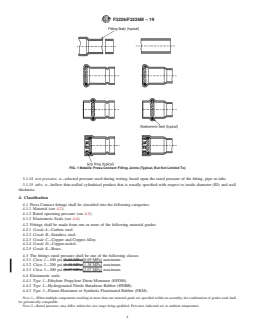
vary by design as found in Fig. 1.
3.1.11 rated pressure, n—the manufacturer’smanufacturer’s recommended maximum in-service pressure at a defined tempera-
ture.
3.1.12 re-test, n—performed when the original test specimen leaks or separates during testing as a result of any cause that is
not related to the design of the fittings being qualified.
3.1.13 specimen, n—a prepared assembly consisting of fittings assembled onto a preselected pipe or tube. The specimen is
placed into a controlled environment and tested to determine if the assembly meets the specified test requirements.
Available from American Society of Mechanical Engineers (ASME), ASME International Headquarters, Two Park Ave., New York, NY 10016-5990, http://
www.asme.org.
Available from International Association of Classification Societies (IACS) Limited, Permanent Secretariat, 6th Floor, 36 Broadway, London SW1H 0BH, UK,
http://www.iacs.org.uk.
Available from International Organization for Standardization (ISO), ISO Central Secretariat, BIBC II, Chemin de Blandonnet 8, CP 401, 1214 Vernier, Geneva,
Switzerland, http://www.iso.org.
Available from American Welding Society (AWS), 8669 NW 36 St., #130, Miami, FL 33166-6672, http://www.aws.org.
F3226/F3226M − 19
FIG. 1 Metallic Press-Connect Fitting Joints (Typical, But Not Limited To)
3.1.14 test pressure, n—selected pressure used during testing, based upon the rated pressure of the fitting, pipe or tube.
3.1.15 tube, n—hollow thin-walled cylindrical product that is usually specified with respect to inside diameter (ID) and wall
thickness.
4. Classification
4.1 Press-Connect fittings shall be classified into the following categories:
4.1.1 Material (see 4.2).
4.1.2 Rated operating pressure (see 4.3).
4.1.3 Elastomeric Seals (see 4.4).
4.2 Fittings shall be made from one or more of the following material grades:
4.2.1 Grade A—Carbon steel.
4.2.2 Grade B—Stainless steel.
4.2.3 Grade C—Copper and Copper-Alloy.
4.2.4 Grade D—Copper-nickel.
4.2.5 Grade E—Brass.
4.3 The fittings rated pressure shall be one of the following classes:
4.3.1 Class 1—100 psi (0.69 MPa)[0.69 MPa] maximum.
4.3.2 Class 2—200 psi (1.38 MPa)[1.38 MPa] maximum.
4.3.3 Class 3—300 psi (2.07 MPa)[2.07 MPa] maximum.
4.4 Elastomeric seals:
4.4.1 Type 1—Ethylene Propylene Diene Monomer (EPDM).
4.4.2 Type 2—Hydrogenated Nitrile Butadiene Rubber (HNBR).
4.4.3 Type 3—Fluoro-Elastomer or Synthetic Fluorinated Rubber (FKM).
NOTE 1—When multiple components resulting in more than one material grade are specified within an assembly, the combination of grades used shall
be galvanically compatible.
NOTE 2—Rated pressures may differ within the size range being qualified. Pressures indicated are at ambient temperature.
F3226/F3226M − 19
5. Ordering Information
5.1 Orders under this specification shall include the following:
5.1.1 ASTM designation, title, number, and year of issue;
5.1.2 Quantity of fittings;
5.1.3 Size;
5.1.3.1 Nominal pipe size (NPS) and wall thickness (schedule).
5.1.3.2 Tube size, outside diameter (OD) (actual or nominal) and wall thickness (dimension in decimal fraction of inches or type
– K, L, M).
5.1.4 Material;
5.1.5 Class (operating pressure rating);
5.1.6 Configuration (elbow, cross, union, coupling, etc.);
5.1.7 Supplementary requirements, if any;
5.1.8 Other requirements agreed to between the purchaser and the manufacturer; and
5.1.9 Inspection and acceptance as agreed upon between the purchaser and the supplier.
5.2 Optional Ordering Requirements:
5.2.1 Certification (see Section 15).
6. Materials and Manufacture
6.1 Material—Material(s) shall conform to a nationally recognized standard or may be other materials as agreed to between the
manufacturer and the purchaser.
6.1.1 Fittings may be manufactured from wrought bars, forgings, castings, pipe, or tube.
6.2 Carbon Steel Fittings:
6.2.1 Carbon steel fittings shall be made from material meeting the requirements of Specifications A53/A53M, Type E and S,
A135/A135M, or A795/A795M.
6.3 Stainless Steel Fittings:
6.3.1 Stainless steel fittings shall be made from material meeting the requirements of Specifications A312/A312M, A269, or
A276.
F3226/F3226M − 19
6.4 Copper and Copper-Alloy Fittings:
6.4.1 Wrought copper fittings shall be made from material meeting the requirements of Specifications B584, B88or , or
B88B75/B75M.
6.4.2 Cast coppers alloy fittings shall be made from material meeting the requirements of Specifications B584 or B62.
6.5 Copper-Nickel Fittings:
6.5.1 Copper-nickel fittings shall be made from material meeting the requirements of Specifications B466/B466M or B467.
6.6 Brass Fittings:
6.6.1 Machined brass fittings shall be made from material meeting the requirements of Specifications B140/B140M, B16/B16M,
B124/B124M, B371/B371M, or B967/B967M.
6.6.2 Forged brass fittings shall be made from material meeting the requirements of Specification B283.
6.7 Flow of Grain—If machined from hot- or cold-drawn bars fittings shall have their longitudinal axis parallel to the
longitudinal axis of the bar with at least the center one third of the bar removed during the manufacturing process unless testing
shows the center material to be free of injurious defects.
6.8 Material Quality—Material shall be of such quality and purity that the finished product shall have the properties and
characteristics to meet the performance requirements of this specification.
NOTE 3—The term “recovered materials” is interpreted as those materials that have been collected or recovered from solid waste and reprocessed to
become a source of raw material, as opposed to extra virgin raw materials.
6.9 Seal Materials—Seals shall be as specified in 4.4.
6.9.1 Seal materials shall meet the minimum property and test requirements specified in Classifications Classification System
D2000.
6.9.2 Only seal lubricants as specified by the manufacturer shall be used.
6.10 Surface Applications and Coatings—Surface applications and coatings if applicable, shall be applied and tested in
accordance with a nationally recognized standard or may be other materials as agreed to between the manufacturer and the
purchaser.
6.11 Fabrication—If fabricated from two or more parts, the components may be welded or brazed.
6.11.1 Welding procedure qualification and welding operator performance qualification shall be in accordance with ASME
Section IX.
6.11.1.1 The welding procedure qualification test shall duplicate the joint configuration to be used in production.
6.11.2 Taper pipe threads shall conform to ASME B1.20.1.
6.11.3 Brazed copper connections shall conform to ANSI/AWS A5.8M/A5.8 and AWS B2.2/B2.2M.
6.12 Processing Stainless Steel Forgings—Austenitic stainless steel components manufactured by hot forge or other sensitizing
processes shall be solution annealed and certified free of intergranular precipitation. PracticePractices A262 shall be used to
evaluate carbide precipitation in stainless steels.
7. Performance Requirements
7.1 Testing Requirements—Fittings Shall be subjected to the standard performance tests specified in Section 13.
7.1.1 Specimens can be reused for other primary tests as long as all requirements herein are complied with for each test.
7.1.2 Tests shall be repeated any time changes are made in the design, material, or manufacturing process, which in the opinion
of the purchaser, may degrade performance.
7.2 Intermixing of Subcomponents—The intermixing by the purchaser of subcomponents of the same design, but of different
brands or trade names, is not permitted.
7.3 Qualification Requirements—Testing shall use specimens of the same type, grade (or combination of grades), and class. The
pipe or tube selected for the technical qualification to this specification shall meet the requirement specified in 7.3.3. Technical
qualification of the assemblies shall be based upon successful completion of all required testing. Each design is qualified for use
with the pipe or tube material and the minimum to maximum wall thickness tested or extended by interpolation (see 7.3.1 and
7.3.2).
7.3.1 Through reasonable interpolations between the sizes tested, all other sizes within the same type, grade (or combination
of grades), and class, will be considered acceptable if the specimens pass all of the testing requirements specified by the purchaser.
Extrapolation is not acceptable.
7.3.2 Acceptance of tees, elbows, and other shapes within the same class, may be accomplished by parametric analysis (see
7.3.2.1) based on the acceptance of couplings, as agreed to between the manufacturer and the purchaser.
7.3.2.1 If tees, elbows, and other shapes are made from a different raw material form than the coupling (for example, tees and
elbows manufactured from castings versus couplings manufactured from solid bar or round tube), this alternate material form shall
undergo the same test regimen as the coupling. Once this is complete, parametric analysis may be used to qualify the remainder
of the shapes as agreed to between the purchaser and the manufacturer.
F3226/F3226M − 19
7.3.3 Recommended pipe or tube for use with Press-Connect fittings shall be qualified throughout its wall thickness range.
7.3.4 Press-Connect fittings may incorporate other end configurations or features allowing for the transition when connecting
to other piping and tube components (for example, bolted flanges, threaded, grooved, and others).
7.4 Test Report—Upon completion of testing, a test report shall be written and maintained on file during the life cycle of the
design. A copy of this report shall be made available upon request from the purchaser.
7.4.1 Any failure during testing shall be analyzed and the failure analysis (see 11.3.1 and 11.3.2) and corrective action shall be
included in the test report.
7.4.2 A retest as specified in Section 11 may be allowed when failure of the original assembly occurs during testing. When
retesting the failure analysis and corrective action shall be included in the test report as specified in 7.4.1.
7.5 Test Equipment and Inspection Facilities—The manufacturer shall ensure that test equipment and inspection facilities are
of sufficient accuracy, quality, and quantity established and maintained to permit the performance of required inspections.
7.5.1 Calibration System Requirements—The manufacturer shall maintain a calibration system for all measuring and test
equipment (M & TE).
7.5.1.1 Accuracy of the M & TE used to measure allowable variables during testing shall be within one third of the tolerances
permitted (see 7.6).
7.6 Test Conditions—Unless otherwise specified in the testing procedures, the following tolerances shall be used to control
conditions of the testing.
7.6.1 Ambient Conditions—When ambient is specified, standard ambient conditions shall be maintained at 2577 6 10°C
(7718°F [25 6 18°F).10°C].
7.6.2 Pressure—Unless otherwise specified, the tolerance for the internal pressure applied to the test specimen during testing
shall be maintained at 65 %.
7.6.3 Test Fluids—Water and other test fluids compatible with the sealing elastomer may be used without affecting the validity
of the test.
7.6.4 Temperature—Unless otherwise specified, the allowable tolerance for temperature applied to the test specimen during
testing shall be 65°C (610°F).610°F [65°C].
7.7 Pass or Fail Criteria—Pass or fail criteria for each test shall be based upon meeting or exceeding the performance
requirements specified in each test.
8. Dimensions
8.1 Dimensions:
8.1.1 Fitting dimensions shall be as specified by the manufacturer.
8.1.2 Tube dimensions shall be copper tube sized (CTS) as specified in Specification B88 for Press-Connect fittings.
8.1.3 DimensionsPipe shall be iron pipe sized (IPS) as specified by thein Specification Table 1A53/A53M or Table 2 and the
manufacturer. ASME B36.10 for Press-Connect fittings.
8.1.1.1 Dimensions specified in Table 1 shall be utilized for copper tube sized (CTS, Specification B88) Press-Connect fittings.
8.1.1.2 Dimensions specified in Table 2 shall be utilized for iron pipe sized (IPS, Specification A53/A53M) Press-Connect
fittings.
9. Workmanship, Finish, and Appearance
9.1 Machined Surfaces—Machined surfaces shall be free from burrs, cracks, laps, or seams which would affect the suitability
for the intended service.
9.1.1 All machined surfaces shall be 3.2-μm125-μin. roughness, average (Ra) (125-μin. Ra)[3.2-μm Ra] as specified in ASME
B46.1 or duplicate of that qualified.
9.1.1.1 External surfaces that do not affect overall function shall be excluded from the requirement specified in 9.1.1.
9.2 Un-Machined Surfaces—Un-machined surfaces, such as forging or casting surfaces and bar stock flats, shall be free from
scale, blisters, fins, folds, seams, laps, segregations, or cracks which may be injurious to personnel or equipment or affect
performance.
9.3 Cadmium plating shall not be used if intended for use on U.S. Navy vessels.
10. Sampling for Testing
10.1 Inspection Sampling of Raw Material—Except when specified herein, the number of samples required for inspection of raw
materials for conformance of products during manufacturing and processing shall be in accordance with established quality
assurance procedures maintained by the manufacturer and approved by the purchaser.
10.2 In-Process Inspection Sampling—Inspection sampling plans shall be mutually agreed upon between the manufacturer and
the purchaser. Level of inspection and acceptable quality level (AQL) shall be in accordance with the
manufacturer’smanufacturer’s quality assurance procedures.
F3226/F3226M − 19
10.3 Lot Acceptance—Lot acceptance sampling plans shall be mutually agreed upon between the manufacturer and the
purchaser.
11. Tests and Re-Tests
11.1 N
...