

ASTM B62-17
(Specification)Standard Specification for Composition Bronze or Ounce Metal Castings
General Information
- Abstract
ABSTRACT
This specification establishes requirements for an alloy having a composition of copper, tin, lead, and zinc which is used for component castings of valves, flanges, and fittings. The specimen shall have the chemical composition of major elements: copper, tin, lead zinc, nickel including cobalt. It must also be comprised of the following residual elements: iron, antimony, sulfur, phosphorus, aluminum, and silicon. Mechanical properties shall be determined from separately cast test bars. Castings shall not be repaired, plugged, welded or burned-in. Valves, flanges, and fittings shall be marked accordingly in such position as not to injure the usefulness of the casting.
SCOPE
1.1 This specification2 establishes requirements for an alloy having a composition of copper, tin, lead, and zinc, used for component castings of valves, flanges, and fittings. The common trade name of this alloy is 85-5-5-5; the correct identification is Copper Alloy UNS No. C83600.3
1.2 The castings covered are used in products that may be manufactured in advance and supplied from stock from the manufacturer or other dealer.
1.3 Units—The values stated in inch-pound units are to be regarded as standard. The values given in parentheses are mathematical conversions to SI units, which are provided for information only and are not considered standard.
1.4 This international standard was developed in accordance with internationally recognized principles on standardization established in the Decision on Principles for the Development of International Standards, Guides and Recommendations issued by the World Trade Organization Technical Barriers to Trade (TBT) Committee.
- Status
- Published
- Publication Date
- 31-Mar-2017
- Technical Committee
- B05 - Copper and Copper Alloys
- Drafting Committee
- B05.05 - Castings and Ingots for Remelting
Buy Documents
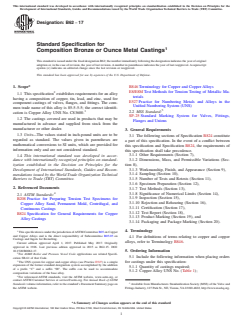
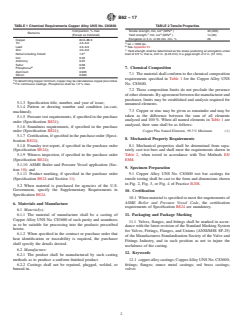


ASTM B62-17 - Standard Specification for Composition Bronze or Ounce Metal Castings
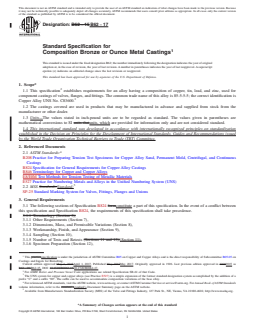
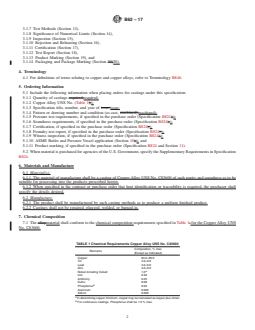

REDLINE ASTM B62-17 - Standard Specification for Composition Bronze or Ounce Metal Castings
Overview
ASTM B62-17: Standard Specification for Composition Bronze or Ounce Metal Castings establishes requirements for the chemical composition and mechanical properties of copper alloy castings primarily used in valves, flanges, and fittings. Recognized under the common trade name 85-5-5-5 and correctly designated as Copper Alloy UNS No. C83600, this standard is widely referenced for ensuring the quality and consistency of bronze components across various industries. ASTM B62-17 is suitable for products manufactured in advance and supplied from manufacturer or stock, emphasizing reliability and traceability for stock and custom parts.
Key Topics
Material Composition
ASTM B62-17 specifies that castings must be composed of copper, tin, lead, and zinc, with controlled levels of each element. Additional allowable elements include nickel (with cobalt), iron, antimony, sulfur, phosphorus, aluminum, and silicon, ensuring a robust and versatile alloy suitable for demanding applications.Mechanical Properties
Required properties such as tensile and yield strength and elongation are determined from separately cast test bars, ensuring each batch meets rigorous standards for performance in operational environments.Manufacturing Requirements
The standard prohibits the repair, plugging, welding, or burning-in of castings, which helps manufacturers deliver components with assured integrity and performance. Valves, flanges, and fittings must also be properly marked in compliance with ANSI/MSS SP-25 to guarantee traceability and compliance.Ordering and Certification
Clear guidelines are set for the information required in purchase orders, including quantity, alloy number, specification details, special tests, certification, and marking requirements. For products used in pressure vessel applications (ASME Boiler and Pressure Vessel Code), additional certification in accordance with the referenced standards is mandatory.
Applications
ASTM B62-17 is extensively used in the manufacturing of:
- Industrial and commercial valves
- Pipe flanges and fittings
- Components for fluid handling systems
- Parts for plumbing and HVAC systems
- Marine and general engineering applications
The robust chemical and mechanical requirements of Copper Alloy UNS C83600 specified by this standard make it ideal for service in environments exposed to water, steam, and non-aggressive liquids where reliability and resistance to corrosion are crucial. Products following ASTM B62-17 are often stocked by manufacturers and suppliers, enabling quick response for maintenance, retrofit, or construction projects.
Related Standards
- ASTM B208: Practice for preparing tension test specimens for copper alloy castings.
- ASTM B824: General requirements for copper alloy castings, including procedures for testing and certification.
- ASTM B846: Terminology for copper and copper alloys, which harmonizes definitions and descriptions across relevant standards.
- ASTM E8/E8M: Test methods for tension testing of metallic materials.
- ASTM E527: Practice for numbering metals and alloys in the Unified Numbering System (UNS).
- ANSI/MSS SP-25: Standard marking system for valves, fittings, flanges, and unions used in the industry.
- ASME Boiler and Pressure Vessel Code (SB-61): For pressure vessel applications referencing related product requirements.
Practical Value
Standardizing on ASTM B62-17 enables manufacturers, engineers, and procurement specialists to ensure compatibility, quality, and safety when specifying bronze castings for valves, flanges, and fittings. Its comprehensive coverage streamlines contract and supply chain specifications while supporting adherence to international and national regulations. By referencing ASTM B62-17, organizations can assure stakeholders and regulatory bodies of consistent material and performance standards in critical infrastructure and fluid handling applications.
Relations
- Effective Date
- 01-Apr-2017
- Effective Date
- 01-Jan-2024
- Effective Date
- 01-Aug-2019
- Effective Date
- 01-Jan-2019
- Effective Date
- 15-Oct-2016
- Effective Date
- 15-Jul-2016
- Effective Date
- 01-Feb-2015
- Effective Date
- 01-Apr-2014
- Effective Date
- 01-Jun-2013
- Effective Date
- 01-Dec-2011
- Effective Date
- 01-Jun-2011
- Effective Date
- 01-Apr-2011
- Effective Date
- 01-Jan-2011
- Effective Date
- 15-Nov-2009
- Effective Date
- 01-Nov-2009
Buy Documents
ASTM B62-17 - Standard Specification for Composition Bronze or Ounce Metal Castings
REDLINE ASTM B62-17 - Standard Specification for Composition Bronze or Ounce Metal Castings
Get Certified
Connect with accredited certification bodies for this standard

Element Materials Technology
Materials testing and product certification.

Inštitut za kovinske materiale in tehnologije
Institute of Metals and Technology. Materials testing, metallurgical analysis, NDT.
Sponsored listings
Frequently Asked Questions
ASTM B62-17 is a technical specification published by ASTM International. Its full title is "Standard Specification for Composition Bronze or Ounce Metal Castings". This standard covers: ABSTRACT This specification establishes requirements for an alloy having a composition of copper, tin, lead, and zinc which is used for component castings of valves, flanges, and fittings. The specimen shall have the chemical composition of major elements: copper, tin, lead zinc, nickel including cobalt. It must also be comprised of the following residual elements: iron, antimony, sulfur, phosphorus, aluminum, and silicon. Mechanical properties shall be determined from separately cast test bars. Castings shall not be repaired, plugged, welded or burned-in. Valves, flanges, and fittings shall be marked accordingly in such position as not to injure the usefulness of the casting. SCOPE 1.1 This specification2 establishes requirements for an alloy having a composition of copper, tin, lead, and zinc, used for component castings of valves, flanges, and fittings. The common trade name of this alloy is 85-5-5-5; the correct identification is Copper Alloy UNS No. C83600.3 1.2 The castings covered are used in products that may be manufactured in advance and supplied from stock from the manufacturer or other dealer. 1.3 Units—The values stated in inch-pound units are to be regarded as standard. The values given in parentheses are mathematical conversions to SI units, which are provided for information only and are not considered standard. 1.4 This international standard was developed in accordance with internationally recognized principles on standardization established in the Decision on Principles for the Development of International Standards, Guides and Recommendations issued by the World Trade Organization Technical Barriers to Trade (TBT) Committee.
ABSTRACT This specification establishes requirements for an alloy having a composition of copper, tin, lead, and zinc which is used for component castings of valves, flanges, and fittings. The specimen shall have the chemical composition of major elements: copper, tin, lead zinc, nickel including cobalt. It must also be comprised of the following residual elements: iron, antimony, sulfur, phosphorus, aluminum, and silicon. Mechanical properties shall be determined from separately cast test bars. Castings shall not be repaired, plugged, welded or burned-in. Valves, flanges, and fittings shall be marked accordingly in such position as not to injure the usefulness of the casting. SCOPE 1.1 This specification2 establishes requirements for an alloy having a composition of copper, tin, lead, and zinc, used for component castings of valves, flanges, and fittings. The common trade name of this alloy is 85-5-5-5; the correct identification is Copper Alloy UNS No. C83600.3 1.2 The castings covered are used in products that may be manufactured in advance and supplied from stock from the manufacturer or other dealer. 1.3 Units—The values stated in inch-pound units are to be regarded as standard. The values given in parentheses are mathematical conversions to SI units, which are provided for information only and are not considered standard. 1.4 This international standard was developed in accordance with internationally recognized principles on standardization established in the Decision on Principles for the Development of International Standards, Guides and Recommendations issued by the World Trade Organization Technical Barriers to Trade (TBT) Committee.
ASTM B62-17 is classified under the following ICS (International Classification for Standards) categories: 77.150.30 - Copper products. The ICS classification helps identify the subject area and facilitates finding related standards.
ASTM B62-17 has the following relationships with other standards: It is inter standard links to ASTM B62-15, ASTM E8/E8M-24, ASTM B846-19a, ASTM B846-19, ASTM B824-16, ASTM E8/E8M-16, ASTM E8/E8M-15, ASTM B824-14, ASTM E8/E8M-13, ASTM E8/E8M-11, ASTM B846-11a, ASTM B824-11, ASTM B846-11, ASTM B846-09a, ASTM B846-09. Understanding these relationships helps ensure you are using the most current and applicable version of the standard.
ASTM B62-17 is available in PDF format for immediate download after purchase. The document can be added to your cart and obtained through the secure checkout process. Digital delivery ensures instant access to the complete standard document.
Standards Content (Sample)
This international standard was developed in accordance with internationally recognized principles on standardization established in the Decision on Principles for the
Development of International Standards, Guides and Recommendations issued by the World Trade Organization Technical Barriers to Trade (TBT) Committee.
Designation:B62 −17
Standard Specification for
Composition Bronze or Ounce Metal Castings
This standard is issued under the fixed designation B62; the number immediately following the designation indicates the year of original
adoption or, in the case of revision, the year of last revision.Anumber in parentheses indicates the year of last reapproval.Asuperscript
epsilon (´) indicates an editorial change since the last revision or reapproval.
This standard has been approved for use by agencies of the U.S. Department of Defense.
1. Scope* B846 Terminology for Copper and Copper Alloys
2 E8/E8M Test Methods for Tension Testing of Metallic Ma-
1.1 This specification establishes requirements for an alloy
terials
having a composition of copper, tin, lead, and zinc, used for
E527 Practice for Numbering Metals and Alloys in the
component castings of valves, flanges, and fittings. The com-
Unified Numbering System (UNS)
mon trade name of this alloy is 85-5-5-5; the correct identifi-
2.2 MSS Standard:
cation is Copper Alloy UNS No. C83600.
SP-25 Standard Marking System for Valves, Fittings,
1.2 The castings covered are used in products that may be
Flanges and Unions
manufactured in advance and supplied from stock from the
manufacturer or other dealer.
3. General Requirements
1.3 Units—The values stated in inch-pound units are to be
3.1 The following sections of Specification B824 constitute
regarded as standard. The values given in parentheses are
a part of this specification. In the event of a conflict between
mathematical conversions to SI units, which are provided for
this specification and Specification B824, the requirements of
information only and are not considered standard.
this specification shall take precedence.
1.4 This international standard was developed in accor- 3.1.1 Other Requirements (Section 7),
3.1.2 Dimensions, Mass, and Permissible Variations (Sec-
dance with internationally recognized principles on standard-
tion 8),
ization established in the Decision on Principles for the
3.1.3 Workmanship, Finish, and Appearance (Section 9),
Development of International Standards, Guides and Recom-
3.1.4 Sampling (Section 10),
mendations issued by the World Trade Organization Technical
3.1.5 Number of Tests and Retests (Section 11),
Barriers to Trade (TBT) Committee.
3.1.6 Specimen Preparation (Section 12),
2. Referenced Documents
3.1.7 Test Methods (Section 13),
3.1.8 Significance of Numerical Limits (Section 14),
2.1 ASTM Standards:
3.1.9 Inspection (Section 15),
B208 Practice for Preparing Tension Test Specimens for
3.1.10 Rejection and Rehearing (Section 16),
Copper Alloy Sand, Permanent Mold, Centrifugal, and
3.1.11 Certification (Section 17),
Continuous Castings
3.1.12 Test Report (Section 18),
B824 Specification for General Requirements for Copper
3.1.13 Product Marking (Section 19), and
Alloy Castings
3.1.14 Packaging and Package Marking (Section 20).
1 4. Terminology
ThisspecificationisunderthejurisdictionofASTMCommittee B05onCopper
and Copper Alloys and is the direct responsibility of Subcommittee B05.05 on
4.1 For definitions of terms relating to copper and copper
Castings and Ingots for Remelting.
alloys, refer to Terminology B846.
Current edition approved April 1, 2017. Published May 2017. Originally
approved in 1926. Last previous edition approved in 2015 as B62-15. DOI:
10.1520/B0062-17.
5. Ordering Information
For ASME Boiler and Pressure Vessel Code applications see related Specifi-
5.1 Include the following information when placing orders
cation SB-61 of that Code.
The UNS system for copper and copper alloys (see Practice E527) is a simple for castings under this specification:
expansion of the former standard designation system accomplished by the addition
5.1.1 Quantity of castings required;
of a prefix “C” and a suffix “00”. The suffix can be used to accommodate
5.1.2 Copper Alloy UNS No. (Table 1);
composition variations of the base alloy.
For referenced ASTM standards, visit the ASTM website, www.astm.org, or
contact ASTM Customer Service at service@astm.org. For Annual Book of ASTM
Standards volume information, refer to the standard’s Document Summary page on Available from Manufacturers Standardization Society (MSS) of the Valve and
the ASTM website. Fittings Industry, 127 Park St., NE, Vienna, VA22180-4602, http://www.msshq.org.
*A Summary of Changes section appears at the end of this standard
Copyright © ASTM International, 100 Barr Harbor Drive, PO Box C700, West Conshohocken, PA 19428-2959. United States
B62−17
TABLE 1 Chemical Requirements Copper Alloy UNS No. C83600 TABLE 2 Tensile Properties
A B
Composition, % max Tensile strength, min, ksi (MPa ) 30 (205)
Elements
C A B
(Except as Indicated) Yield strength, min, ksi (MPa ) 14 (95)
Elongation in 2 in. or 50 mm, min, % 20
Copper 84.0–86.0
A
Tin 4.0–6.0
ksi = 1000 psi.
B
Lead 4.0–6.0
See Appendix X1.
C
Zinc 4.0–6.0
Yield strength shall be determined as the stress producing an elongation under
A
Nickel including Cobalt 1.0
load of 0.5 %; that is, 0.01 in. (0.25 mm) in a gage length of 2 in. (51 mm).
Iron 0.30
Antimony 0.25
Sulfur 0.08
B
7. Chemical Composition
Phosphorus 0.05
Aluminum 0.005
7.1 The material shall conform to the chemical composition
Silicon 0.005
requirements specified in Table 1 for the Copper Alloy UNS
A
Indeterminingcopperminimum,coppermaybecalculatedascopperplusnickel.
B
No. C83600.
For continuous cast
...
This document is not an ASTM standard and is intended only to provide the user of an ASTM standard an indication of what changes have been made to the previous version. Because
it may not be technically possible to adequately depict all changes accurately, ASTM recommends that users consult prior editions as appropriate. In all cases only the current version
of the standard as published by ASTM is to be considered the official document.
Designation: B62 − 15 B62 − 17
Standard Specification for
Composition Bronze or Ounce Metal Castings
This standard is issued under the fixed designation B62; the number immediately following the designation indicates the year of original
adoption or, in the case of revision, the year of last revision. A number in parentheses indicates the year of last reapproval. A superscript
epsilon (´) indicates an editorial change since the last revision or reapproval.
This standard has been approved for use by agencies of the U.S. Department of Defense.
1. Scope*
1.1 This specification establishes requirements for an alloy having a composition of copper, tin, lead, and zinc, used for
component castings of valves, flanges, and fittings. The common trade name of this alloy is 85-5-5-5; the correct identification is
Copper Alloy UNS No. C83600.
1.2 The castings covered are used in products that may be manufactured in advance and supplied from stock from the
manufacturer or other dealer.
1.3 Units—The values stated in inch-pound units are to be regarded as standard. The values given in parentheses are
mathematical conversions to SI units thatunits, which are provided for information only and are not considered standard.
1.4 This international standard was developed in accordance with internationally recognized principles on standardization
established in the Decision on Principles for the Development of International Standards, Guides and Recommendations issued
by the World Trade Organization Technical Barriers to Trade (TBT) Committee.
2. Referenced Documents
2.1 ASTM Standards:
B208 Practice for Preparing Tension Test Specimens for Copper Alloy Sand, Permanent Mold, Centrifugal, and Continuous
Castings
B824 Specification for General Requirements for Copper Alloy Castings
B846 Terminology for Copper and Copper Alloys
E8/E8M Test Methods for Tension Testing of Metallic Materials
E527 Practice for Numbering Metals and Alloys in the Unified Numbering System (UNS)
2.2 MSS Standards:Standard:
SP-25 Standard Marking System for Valves, Fittings, Flanges and Unions
3. General Requirements
3.1 The following sections of Specification B824 formconstitute a part of this specification. In the event of a conflict between
this specification and Specification B824, the requirements of this specification shall take precedence.
3.1.1 Terminology (Section 3),
3.1.1 Other Requirements (Section 7),
3.1.2 Dimensions, Mass, and Permissible Variations (Section 8),
3.1.3 Workmanship, Finish, and Appearance (Section 9),
3.1.4 Sampling (Section 10),
3.1.5 Number of Tests and Retests (Sections 11 and 13),(Section 11),
3.1.6 Specimen Preparation (Section 12),
This practicespecification is under the jurisdiction of ASTM Committee B05 on Copper and Copper Alloys and is the direct responsibility of Subcommittee B05.05 on
Castings and Ingots for Remelting.
Current edition approved May 1, 2015April 1, 2017. Published May 2015May 2017. Originally approved in 1926. Last previous edition approved in 20092015 as
B62 – 09.B62-15. DOI: 10.1520/B0062-15.10.1520/B0062-17.
For ASME Boiler and Pressure Vessel Code applications see related Specification SB-61 of that Code.
The UNS system for copper and copper alloys (see Practice E527) is a simple expansion of the former standard designation system accomplished by the addition of a
prefix “C” and a suffix “00”. The suffix can be used to accommodate composition variations of the base alloy.
For referenced ASTM standards, visit the ASTM website, www.astm.org, or contact ASTM Customer Service at service@astm.org. For Annual Book of ASTM Standards
volume information, refer to the standard’sstandard’s Document Summary page on the ASTM website.
Available from Manufacturers Standardization Society (MSS) of the Valve and Fittings Industry, 127 Park St., NE, Vienna, VA 22180-4602, http://www.msshq.org.
*A Summary of Changes section appears at the end of this standard
Copyright © ASTM International, 100 Barr Harbor Drive, PO Box C700, West Conshohocken, PA 19428-2959. United States
B62 − 17
3.1.7 Test Methods (Section 13),
3.1.8 Significance of Numerical Limits (Section 14),
3.1.9 Inspection (Section 15),
3.1.10 Rejection and Rehearing (Section 16),
3.1.11 Certification (Section 17),
3.1.12 Test Report (Section 18),
3.1.13 Product Marking (Section 19), and
3.1.14 Packaging and Package Marking (Section 20)20).
4. Terminology
4.1 For definitions of terms relating to copper and copper alloys, refer to Terminology B846.
5. Ordering Information
5.1 Include the following information when placing orders for castings under this specification:
5.1.1 Quantity of castings required,required;
5.1.2 Copper Alloy UNS No. (Table 1),);
5.1.3 Specification title, number, and year of issue,issue;
5.1.4 Pattern or drawing number and condition (as-cast, machined),machined);
5.1.5 Pressure test requirements, if specified in the purchase order (Specification B824),);
5.1.6 Soundness requirements, if specified in the purchase order (Specification B824),);
5.1.7 Certification, if specified in the purchase order (Specification B824),);
5.1.8 Foundry test report, if specified in the purchase order (Specification B824),);
5.1.9 Witness inspection, if specified in the purchase order (Specification B824),);
5.1.10 ASME Boiler and Pressure Vessel application (Section 10),); and
5.1.11 Product marking, if specified in the purchase order (Specification B824 and Section 11).
5.2 When material is purchased for agencies of the U.S. Government, specify the Supplementary Requirements in Specification
B824.
6. Materials and Manufacture
6.1 Material(s):
6.1.1 The material of manufacture shall be a casting of Copper Alloy UNS No. C83600 of such purity and soundness as to be
suitable for processing into the pro
...