

ASTM B75/B75M-20
(Specification)Standard Specification for Seamless Copper Tube
General Information
- Abstract
ABSTRACT
This specification establishes the requirements for seamless round, rectangular, and square copper tube (UNS Nos. C10100, C10200, C10300, C10800, C12000, and C12200) suitable for general engineering applications. The material of manufacture shall be billets, cast bars, or tube. The tube shall be manufactured by hot- and cold-working processes, shall be cold drawn to the finished size and wall thickness, and shall be supplied in cold-drawn or annealed temper condition. The material shall conform to the chemical composition requirements prescribed for copper, phosphorus, and arsenic, as determined by chemical analysis, and to the mechanical property requirements including tensile strength, yield strength, Rockwell hardness, and straightening. Requirements for grain size, electrical mass resistivity, and dimensions are specified. The following test methods are detailed: grain size, electrical resistivity, tensile and yield strength, and hardness tests, expansion test for round table, microscopical examination, test for hydrogen embrittlement, and nondestructive tests such as electromagnetic (eddy-current), hydrostatic, and pneumatic pressure tests.
SCOPE
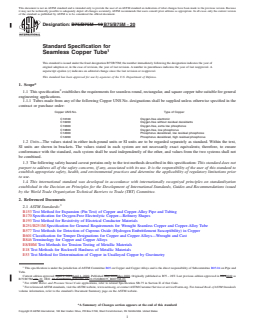
1.1 This specification2 establishes the requirements for seamless round, rectangular, and square copper tube suitable for general engineering applications.
1.1.1 Tubes made from any of the following Copper UNS No. designations shall be supplied unless otherwise specified in the contract or purchase order:
Copper UNS No.
Type of Copper
C10100
Oxygen-free electronic
C10200
Oxygen-free without residual deoxidants
C10300
Oxygen-free, extra low phosphorus
C10800
Oxygen-free, low phosphorus
C12000
Phosphorus deoxidized, low residual phosphorus
C12200
Phosphorus deoxidized, high residual phosphorus
1.2 Units—The values stated in either inch-pound units or SI units are to be regarded separately as standard. Within the text, SI units are shown in brackets. The values stated in each system are not necessarily exact equivalents; therefore, to ensure conformance with the standard, each system shall be used independently of the other, and values from the two systems shall not be combined.
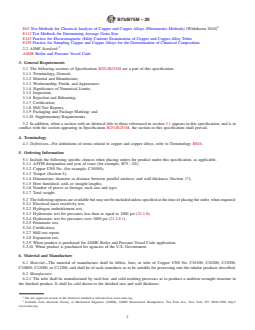
1.3 The following safety hazard caveat pertains only to the test methods described in this specification: This standard does not purport to address all of the safety concerns, if any, associated with its use. It is the responsibility of the user of this standard to establish appropriate safety, health, and environmental practices and determine the applicability of regulatory limitations prior to use.
1.4 This international standard was developed in accordance with internationally recognized principles on standardization established in the Decision on Principles for the Development of International Standards, Guides and Recommendations issued by the World Trade Organization Technical Barriers to Trade (TBT) Committee.
- Status
- Published
- Publication Date
- 31-Mar-2020
- Technical Committee
- B05 - Copper and Copper Alloys
- Drafting Committee
- B05.04 - Pipe and Tube
Overview
ASTM B75/B75M-20: Standard Specification for Seamless Copper Tube defines the requirements for seamless round, rectangular, and square copper tubes, primarily intended for general engineering applications. Established by ASTM International, this specification covers copper tubes made from specified copper alloys (UNS C10100, C10200, C10300, C10800, C12000, C12200) and details manufacturing, chemical composition, mechanical properties, dimensions, permissible variations, and applicable testing methods. Both inch-pound and SI units are supported, ensuring international applicability.
Key Topics
- Copper Grades: Applies to multiple copper UNS numbers, each with unique properties, such as oxygen-free electronic, oxygen-free without residual deoxidants, extra low or low phosphorus, and phosphorus deoxidized types.
- Tube Forms: Covers seamless copper tubes in round, rectangular, and square shapes.
- Material Requirements: Tubes must be produced from high-quality billets, bars, or tubes using hot- and cold-working, and then cold drawn to final size.
- Temper Conditions: Tubes are supplied in cold-drawn or annealed tempers, with temper designations such as H55, H58, H80, O50, O60, and O62, each suited for different engineering needs.
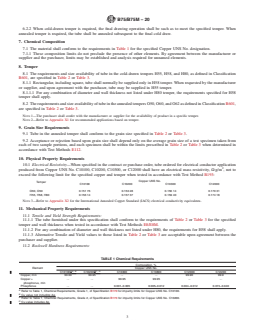
- Chemical Composition: Tubes must conform to stringent limits for copper, phosphorus, and arsenic; additional elements may be regulated by agreement.
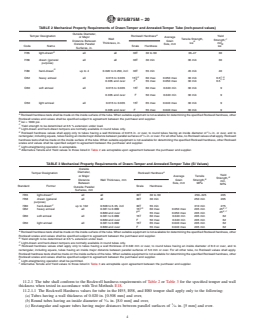
- Mechanical Properties: Specification of tensile strength, yield strength, Rockwell hardness, and grain size is required for compliance.
- Electrical Resistivity: Especially significant for electrical applications, with specified resistivity values for certain copper grades and tempers.
- Testing and Inspection: Includes mandatory and optional test methods-tensile, hardness, expansion (pin test), grain size, resistivity, hydrogen embrittlement, and nondestructive tests like eddy current, hydrostatic, and pneumatic pressure.
- Dimensions and Tolerances: Cover diameter, wall thickness, length, straightness, and corner radius requirements.
- Order Information: Purchasers should specify copper grade, temper, dimensions, form (coil or straight length), and desired tests or certifications.
Applications
Seamless copper tubes manufactured in accordance with ASTM B75/B75M-20 are widely used in:
- General Engineering: Mechanical and structural applications requiring corrosion resistance and reliable mechanical properties.
- Heat Exchangers and Condensers: Where seamless tubes support efficient heat transfer.
- Electrical Conductor Systems: Tubes from specific copper grades with defined electrical resistivity levels.
- Piping and Fluid Transport: Where internal cleanliness, mechanical integrity, and dimensional accuracy are critical.
- HVAC and Refrigeration: Systems leveraging copper's thermal conductivity and formability.
Tempers are selected based on end-use requirements:
- H55 for applications requiring a balance of stiffness and ability to bend.
- H58 for general purposes.
- H80 where maximum strength is necessary.
- Annealed tempers (O50, O60, O62) for applications requiring greater ductility.
Related Standards
ASTM B75/B75M-20 references and aligns with several other standards to ensure comprehensive quality assurance:
- ASTM B153: Expansion (Pin Test) of Copper Pipe and Tubing
- ASTM B170: Oxygen-Free Electrolytic Copper
- ASTM B193: Resistivity of Electrical Conductor Materials
- ASTM B577: Detection of Hydrogen Embrittlement in Copper
- ASTM B601: Temper Designations for Copper and Copper Alloys
- ASTM B251/B251M: General Requirements for Wrought Seamless Copper Tube
- ASTM E8/E8M: Tension Testing of Metallic Materials
- ASTM E18: Rockwell Hardness of Metallic Materials
- ASTM E112: Determining Average Grain Size
- ASTM E243: Electromagnetic (Eddy Current) Examination
- ASME Boiler and Pressure Vessel Code: Relevant for pressure applications
Practical Value
Using ASTM B75/B75M-20 ensures:
- Reliable performance and long service life in structural and fluid handling systems.
- Product consistency through rigorous testing, inspection, and certification protocols.
- Global acceptance by meeting internationally recognized quality and safety marks.
- Suitability for critical industries where copper’s unique properties offer tangible advantages.
For engineers, manufacturers, and specifiers, adherence to ASTM B75/B75M-20 provides a trusted benchmark for producing and sourcing high-quality seamless copper tubes, supporting robust application across industries.
Relations
- Effective Date
- 01-Apr-2020
- Effective Date
- 01-Jan-2024
- Effective Date
- 01-Aug-2019
- Effective Date
- 01-Apr-2019
- Effective Date
- 01-Jan-2019
- Effective Date
- 01-Oct-2018
- Effective Date
- 01-Jul-2018
- Effective Date
- 01-Jun-2018
- Effective Date
- 01-Mar-2018
- Effective Date
- 01-Oct-2017
- Effective Date
- 01-Jul-2017
- Effective Date
- 01-Oct-2016
- Effective Date
- 15-Jul-2016
- Effective Date
- 01-Apr-2016
- Effective Date
- 01-Apr-2016
Get Certified
Connect with accredited certification bodies for this standard

Element Materials Technology
Materials testing and product certification.

Inštitut za kovinske materiale in tehnologije
Institute of Metals and Technology. Materials testing, metallurgical analysis, NDT.
Sponsored listings
Frequently Asked Questions
ASTM B75/B75M-20 is a technical specification published by ASTM International. Its full title is "Standard Specification for Seamless Copper Tube". This standard covers: ABSTRACT This specification establishes the requirements for seamless round, rectangular, and square copper tube (UNS Nos. C10100, C10200, C10300, C10800, C12000, and C12200) suitable for general engineering applications. The material of manufacture shall be billets, cast bars, or tube. The tube shall be manufactured by hot- and cold-working processes, shall be cold drawn to the finished size and wall thickness, and shall be supplied in cold-drawn or annealed temper condition. The material shall conform to the chemical composition requirements prescribed for copper, phosphorus, and arsenic, as determined by chemical analysis, and to the mechanical property requirements including tensile strength, yield strength, Rockwell hardness, and straightening. Requirements for grain size, electrical mass resistivity, and dimensions are specified. The following test methods are detailed: grain size, electrical resistivity, tensile and yield strength, and hardness tests, expansion test for round table, microscopical examination, test for hydrogen embrittlement, and nondestructive tests such as electromagnetic (eddy-current), hydrostatic, and pneumatic pressure tests. SCOPE 1.1 This specification2 establishes the requirements for seamless round, rectangular, and square copper tube suitable for general engineering applications. 1.1.1 Tubes made from any of the following Copper UNS No. designations shall be supplied unless otherwise specified in the contract or purchase order: Copper UNS No. Type of Copper C10100 Oxygen-free electronic C10200 Oxygen-free without residual deoxidants C10300 Oxygen-free, extra low phosphorus C10800 Oxygen-free, low phosphorus C12000 Phosphorus deoxidized, low residual phosphorus C12200 Phosphorus deoxidized, high residual phosphorus 1.2 Units—The values stated in either inch-pound units or SI units are to be regarded separately as standard. Within the text, SI units are shown in brackets. The values stated in each system are not necessarily exact equivalents; therefore, to ensure conformance with the standard, each system shall be used independently of the other, and values from the two systems shall not be combined. 1.3 The following safety hazard caveat pertains only to the test methods described in this specification: This standard does not purport to address all of the safety concerns, if any, associated with its use. It is the responsibility of the user of this standard to establish appropriate safety, health, and environmental practices and determine the applicability of regulatory limitations prior to use. 1.4 This international standard was developed in accordance with internationally recognized principles on standardization established in the Decision on Principles for the Development of International Standards, Guides and Recommendations issued by the World Trade Organization Technical Barriers to Trade (TBT) Committee.
ABSTRACT This specification establishes the requirements for seamless round, rectangular, and square copper tube (UNS Nos. C10100, C10200, C10300, C10800, C12000, and C12200) suitable for general engineering applications. The material of manufacture shall be billets, cast bars, or tube. The tube shall be manufactured by hot- and cold-working processes, shall be cold drawn to the finished size and wall thickness, and shall be supplied in cold-drawn or annealed temper condition. The material shall conform to the chemical composition requirements prescribed for copper, phosphorus, and arsenic, as determined by chemical analysis, and to the mechanical property requirements including tensile strength, yield strength, Rockwell hardness, and straightening. Requirements for grain size, electrical mass resistivity, and dimensions are specified. The following test methods are detailed: grain size, electrical resistivity, tensile and yield strength, and hardness tests, expansion test for round table, microscopical examination, test for hydrogen embrittlement, and nondestructive tests such as electromagnetic (eddy-current), hydrostatic, and pneumatic pressure tests. SCOPE 1.1 This specification2 establishes the requirements for seamless round, rectangular, and square copper tube suitable for general engineering applications. 1.1.1 Tubes made from any of the following Copper UNS No. designations shall be supplied unless otherwise specified in the contract or purchase order: Copper UNS No. Type of Copper C10100 Oxygen-free electronic C10200 Oxygen-free without residual deoxidants C10300 Oxygen-free, extra low phosphorus C10800 Oxygen-free, low phosphorus C12000 Phosphorus deoxidized, low residual phosphorus C12200 Phosphorus deoxidized, high residual phosphorus 1.2 Units—The values stated in either inch-pound units or SI units are to be regarded separately as standard. Within the text, SI units are shown in brackets. The values stated in each system are not necessarily exact equivalents; therefore, to ensure conformance with the standard, each system shall be used independently of the other, and values from the two systems shall not be combined. 1.3 The following safety hazard caveat pertains only to the test methods described in this specification: This standard does not purport to address all of the safety concerns, if any, associated with its use. It is the responsibility of the user of this standard to establish appropriate safety, health, and environmental practices and determine the applicability of regulatory limitations prior to use. 1.4 This international standard was developed in accordance with internationally recognized principles on standardization established in the Decision on Principles for the Development of International Standards, Guides and Recommendations issued by the World Trade Organization Technical Barriers to Trade (TBT) Committee.
ASTM B75/B75M-20 is classified under the following ICS (International Classification for Standards) categories: 77.150.30 - Copper products. The ICS classification helps identify the subject area and facilitates finding related standards.
ASTM B75/B75M-20 has the following relationships with other standards: It is inter standard links to ASTM B75/B75M-19, ASTM E8/E8M-24, ASTM B846-19a, ASTM B577-19, ASTM B846-19, ASTM B601-18a, ASTM E18-18, ASTM E243-18, ASTM B601-18, ASTM B251/B251M-17, ASTM E18-17, ASTM B601-16, ASTM E8/E8M-16, ASTM B193-16, ASTM B577-16. Understanding these relationships helps ensure you are using the most current and applicable version of the standard.
ASTM B75/B75M-20 is available in PDF format for immediate download after purchase. The document can be added to your cart and obtained through the secure checkout process. Digital delivery ensures instant access to the complete standard document.
Standards Content (Sample)
This international standard was developed in accordance with internationally recognized principles on standardization established in the Decision on Principles for the
Development of International Standards, Guides and Recommendations issued by the World Trade Organization Technical Barriers to Trade (TBT) Committee.
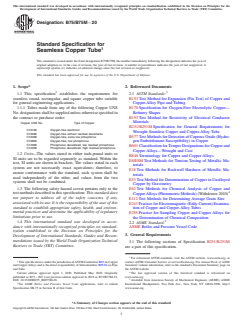
Designation: B75/B75M −20
Standard Specification for
Seamless Copper Tube
This standard is issued under the fixed designation B75/B75M; the number immediately following the designation indicates the year of
original adoption or, in the case of revision, the year of last revision.Anumber in parentheses indicates the year of last reapproval.A
superscript epsilon (´) indicates an editorial change since the last revision or reapproval.
This standard has been approved for use by agencies of the U.S. Department of Defense.
1. Scope* 2. Referenced Documents
2 3
1.1 This specification establishes the requirements for 2.1 ASTM Standards:
seamless round, rectangular, and square copper tube suitable B153Test Method for Expansion (Pin Test) of Copper and
for general engineering applications. Copper-Alloy Pipe and Tubing
1.1.1 Tubes made from any of the following Copper UNS B170Specification for Oxygen-Free Electrolytic Copper—
No.designationsshallbesuppliedunlessotherwisespecifiedin Refinery Shapes
the contract or purchase order: B193Test Method for Resistivity of Electrical Conductor
Materials
Copper UNS No. Type of Copper
B251/B251MSpecification for General Requirements for
C10100 Oxygen-free electronic
Wrought Seamless Copper and Copper-Alloy Tube
C10200 Oxygen-free without residual deoxidants
B577TestMethodsforDetectionofCuprousOxide(Hydro-
C10300 Oxygen-free, extra low phosphorus
C10800 Oxygen-free, low phosphorus
gen Embrittlement Susceptibility) in Copper
C12000 Phosphorus deoxidized, low residual phosphorus
B601ClassificationforTemperDesignationsforCopperand
C12200 Phosphorus deoxidized, high residual phosphorus
Copper Alloys—Wrought and Cast
1.2 Units—The values stated in either inch-pound units or
B846Terminology for Copper and Copper Alloys
SI units are to be regarded separately as standard. Within the
E8/E8MTest Methods for Tension Testing of Metallic Ma-
text, SI units are shown in brackets. The values stated in each
terials
system are not necessarily exact equivalents; therefore, to
E18Test Methods for Rockwell Hardness of Metallic Ma-
ensure conformance with the standard, each system shall be
terials
used independently of the other, and values from the two
E53Test Method for Determination of Copper in Unalloyed
systems shall not be combined.
Copper by Gravimetry
1.3 The following safety hazard caveat pertains only to the
E62Test Methods for Chemical Analysis of Copper and
testmethodsdescribedinthisspecification: This standard does
CopperAlloys(PhotometricMethods)(Withdrawn2010)
not purport to address all of the safety concerns, if any,
E112Test Methods for Determining Average Grain Size
associated with its use. It is the responsibility of the user of this
E243PracticeforElectromagnetic(EddyCurrent)Examina-
standard to establish appropriate safety, health, and environ-
tion of Copper and Copper-Alloy Tubes
mental practices and determine the applicability of regulatory
E255Practice for Sampling Copper and Copper Alloys for
limitations prior to use.
the Determination of Chemical Composition
1.4 This international standard was developed in accor-
2.2 ASME Standard:
dance with internationally recognized principles on standard-
ASMEBoiler and Pressure Vessel Code
ization established in the Decision on Principles for the
3. General Requirements
Development of International Standards, Guides and Recom-
mendations issued by the World Trade Organization Technical
3.1 The following sections of Specification B251/B251M
Barriers to Trade (TBT) Committee.
are a part of this specification.
For referenced ASTM standards, visit the ASTM website, www.astm.org, or
ThisspecificationisunderthejurisdictionofASTMCommitteeB05onCopper contact ASTM Customer Service at service@astm.org. For Annual Book of ASTM
and CopperAlloys and is the direct responsibility of Subcommittee B05.04 on Pipe Standards volume information, refer to the standard’s Document Summary page on
and Tube. the ASTM website.
Current edition approved April 1, 2020. Published May 2020. Originally The last approved version of this historical standard is referenced on
published as B75–28T. Last previous edition approved in 2019 as B75/B75M-19. www.astm.org.
DOI: 10.1520/B0075_B0075M-20. Available from American Society of Mechanical Engineers (ASME), ASME
For ASME Boiler and Pressure Vessel Code applications, refer to related International Headquarters, Two Park Ave., New York, NY 10016-5990, http://
Specification SB-75 in Section II of that Code. www.asme.org.
*A Summary of Changes section appears at the end of this standard
Copyright © ASTM International, 100 Barr Harbor Drive, PO Box C700, West Conshohocken, PA 19428-2959. United States
B75/B75M − 20
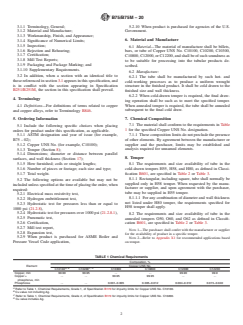
3.1.1 Terminology, General; 5.2.10 When product is purchased for agencies of the U.S.
3.1.2 Material and Manufacture; Government.
3.1.3 Workmanship, Finish, and Appearance;
6. Material and Manufacture
3.1.4 Significance of Numerical Limits;
3.1.5 Inspection;
6.1 Material—The material of manufacture shall be billets,
3.1.6 Rejection and Rehearing;
bars, or tube of Copper UNS No. C10100, C10200, C10300,
3.1.7 Certification;
C10800,C12000,orC12200,andshallbeofsuchsoundnessas
3.1.8 Mill Test Reports;
to be suitable for processing into the tubular products de-
3.1.9 Packaging and Package Marking; and
scribed.
3.1.10 Supplementary Requirements.
6.2 Manufacture:
3.2 In addition, when a section with an identical title to
6.2.1 The tube shall be manufactured by such hot- and
thosereferencedinsection3.1appearsinthisspecification,and
cold-working processes as to produce a uniform wrought
is in conflict with the section appearing in Specification
structure in the finished product. It shall be cold drawn to the
B251/B251M, the section in this specification shall prevail.
finished size and wall thickness.
6.2.2 When cold-drawn temper is required, the final draw-
4. Terminology
ing operation shall be such as to meet the specified temper.
4.1 Definitions—For definitions of terms related to copper When annealed temper is required, the tube shall be annealed
subsequent to the final cold draw.
and copper alloys, refer to Terminology B846.
7. Chemical Composition
5. Ordering Information
7.1 The material shall conform to the requirements in Table
5.1 Include the following specific choices when placing
1 for the specified Copper UNS No. designation.
orders for product under this specification, as applicable.
7.1.1 Thesecompositionlimitsdonotprecludethepresence
5.1.1 ASTM designation and year of issue (for example,
of other elements. By agreement between the manufacturer or
B75–02);
supplier and the purchaser, limits may be established and
5.1.2 Copper UNS No. (for example, C10100);
analysis required for unnamed elements.
5.1.3 Temper (Section 8);
5.1.4 Dimensions; diameter or distance between parallel
8. Temper
surfaces, and wall thickness (Section 17);
5.1.5 How furnished; coils or straight lengths;
8.1 The requirements and size availability of tube in the
5.1.6 Number of pieces or footage; each size and type;
cold-drawn tempers H55, H58, and H80, as defined in Classi-
5.1.7 Total weight.
fication B601, are specified in Table 2 or Table 3.
8.1.1 Rectangular, including square, tube shall normally be
5.2 The following options are available but may not be
supplied only in H58 temper. When requested by the manu-
includedunlessspecifiedatthetimeofplacingtheorder,when
facturer or supplier, and upon agreement with the purchaser,
required:
tube may be supplied in H55 temper.
5.2.1 Electrical mass resistivity test,
8.1.1.1 For any combination of diameter and wall thickness
5.2.2 Hydrogen embrittlement test,
not listed under H80 temper, the requirements specified for
5.2.3 Hydrostatic test for pressures less than or equal to
H58 temper shall apply.
1000 psi (21.2.8),
5.2.4 Hydrostatictestforpressuresover1000psi(21.2.8.1),
8.2 The requirements and size availability of tube in the
5.2.5 Pneumatic test,
annealed tempers O50, O60, and O62 as defined in Classifi-
5.2.6 Certification,
cation B601, are specified in Table 2 or Table 3.
5.2.7 Mill test report,
NOTE 1—The purchaser shall confer with the manufacturer or supplier
5.2.8 Expansion test,
for the availability of product in a specific temper.
5.2.9 When product is purchased for ASME Boiler and
NOTE 2—Refer to Appendix X1 for recommended applications based
Pressure Vessel Code application, on temper.
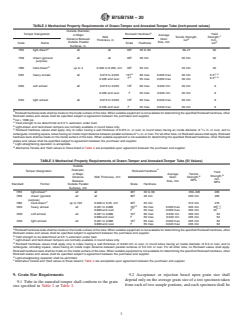
TABLE 1 Chemical Requirements
Composition, %
Element Copper UNS No.
A, B C, D
C10100 C10200 C10300 C10800 C12000 C12200
Copper, min 99.99 99.95 . . 99.90 99.9
Copper + . . 99.95 99.95 . .
phosphorus, min
Phosphorus . . 0.001–0.005 0.005–0.012 0.004–0.012 0.015–0.040
A
Refer to Table 1, Chemical Requirements, Grade 1, of Specification B170 for impurity limits for Copper UNS No. C10100.
B
Cu value not including Ag.
C
Refer to Table 1, Chemical Requirements, Grade 2, of Specification B170 for impurity limits for Copper UNS No. C10200.
D
Cu value includes Ag.
B75/B75M − 20
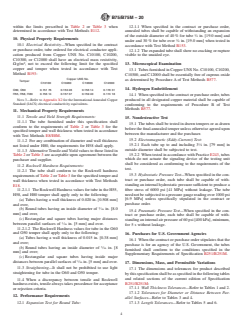
TABLE 2 Mechanical Property Requirements of Drawn-Temper and Annealed-Temper Tube (inch-pound values)
Outside Diameter,
A
Temper Designation Rockwell Hardness
Yield
or Major Average
C
Wall Tensile Strength,
Strength,
Distance Between Grain
B
Thickness, in. ksi min.,
Outside Parallel Size, mm B
Code Name Scale Hardness ksi
Surfaces, in.
D
H55 light-drawn all all 30T 30 to 60 36–47 30
H58 drawn (general all all 30T 30 min 36 min 30
purpose)
D
H80 hard-drawn up to 4 0.020 to 0.250, incl 30T 55 min 45 min 40
E F, G
O62 heavy anneal all 0.015 to 0.035 15T 60 max 0.050 max 30 min 6.5
E F, G
F 6.5
0.035 and over 55 max 0.050 max 30 min
O60 soft anneal all 0.015 to 0.035 15T 60 max 0.040 min 30 min 9
0.035 and over F 50 max 0.040 min 30 min 9
O50 light anneal all 0.015 to 0.035 15T 65 max 0.040 max 30 min 9
0.035 and over F 55 max 0.040 max 30 min 9
A
Rockwell hardness tests shall be made on the inside surface of the tube. When suitable equipment is not available for determining the specified Rockwell hardness, other
Rockwell scales and values shall be specified subject to agreement between the purchaser and supplier.
B
ksi = 1000 psi.
C
Yield strength to be determined at 0.5 % extension under load.
D
Light-drawn and hard-drawn tempers are normally available in round tubes only.
E
Rockwell hardness values shall apply only to tubes having a wall thickness of 0.015 in. or over, to round tubes having an inside diameter of ⁄16 in. or over, and to
rectangular, including square, tubes having an inside major distance between parallel surfaces of ⁄16 in. or over. For all other tube, no Rockwell values shall apply. Rockwell
hardness tests shall be made on the inside surface of the tube. When suitable equipment is not available for determining the specified Rockwell hardness, other Rockwell
scales and values shall be specified subject to agreement between the purchaser and supplier.
F
Light-straightening operation is acceptable.
G
Alternative Tensile and Yield values to those listed in Table 2 are acceptable upon agreement between the purchaser and supplier.
TABLE 3 Mechanical Property Requirements of Drawn-Temper and Annealed-Temper Tube (SI Values)
Outside
A
Diameter,
Temper Designation Rockwell Hardness
Yield
or Major Average
Tensile
B
Strength,
B
Distance Wall Thickness, mm Grain Strength,
min,
MPa
Between Size, mm
MPa
Standard Former Scale Hardness
Outside Parallel
Surfaces, mm
C
H55 light-drawn all all 30T 30 to 60 250–325 205
H58 drawn (general all all 30T 30 min 250 min 205
purpose)
C
H80 hard-drawn up to 102 0.508 to 6.35, incl 30T 55 min 310 min 275
D E, F
O62 heavy anneal all 0.381 to 0.889 15T 60 max 0.050 max 205 min 45
D E, F
F 45
0.889 and over 55 max 0.050 max 205 min
O60 soft anneal all 0.381 to 0.889 15T 60 max 0.040 min 205 min 62
0.889 and over F 50 max 0.040 min 205 min 62
O50 light anneal all 0.381 to 0.889 15T 65 max 0.040 max 205 min 62
0.889 and over F 55 max 0.040 max 205 min 62
A
Rockwell hardness tests shall be made on the inside surface of the tube. When suitable equipment is not available for determining the specified Rockwell hardness, other
Rockwell scales and values shall be specified subject to agreement between the purchaser and supplier.
B
Yield strength to be determined at 0.5 % extension under load.
C
Light-drawn and hard-drawn tempers are normally available in round tubes only.
D
Rockwell hardness values shall apply only to tubes having a wall thickness of 0.040 mm or over, to round tubes having an inside diameter of 8.0 or over, andto
rectangular, including square, tubes having an inside major distance between parallel surfaces of 5.0 mm or over. For all other tube, no Rockwell values shall apply.
Rockwell hardness tests shall be made on the inside surface of the tube. When suitable equipment is not available for determining the specified Rockwell hardness, other
Rockwell scales and values shall be specified subject to agreement between the purchaser and supplier.
E
Light-straightening operation shall be permitted.
F
Alternative Tensile and Yield values to those listed in Table 3 are acceptable upon agreement between the purchaser and supplier.
9. Grain Size Requirements 9.2 Acceptance or rejection based upon grain size shall
depend only on the average grain size of a test specimen taken
9.1 Tube in the annealed temper shall conform to the grain
from each of two sample portions, and each specimen shall be
size specified in Table 2 or Table 3.
B75/B75M − 20
within the limits prescribed in Table 2 or Table 3 when 12.1.1 When specified in the contract or purchase order,
determined in accordance with Test Methods E112. annealed tubes shall be capable of withstanding an expansion
of the outside diameter of 40% for tube ⁄4 in. [19.0 mm] and
10. Physical Property Requirements
under and 30% for tube over ⁄4 in. [19.0 mm] when tested in
10.1 Electrical Resistivity—When specified in the contract
accordance with Test Method B153.
or purchase order, tube ordered for electrical conductor appli-
12.1.2 Theexpandedtubeshallshownocrackingorrupture
cation produced from Copper UNS No. C10100, C10200,
visible to the unaided eye.
C10300, or C12000 shall have an electrical mass resistivity,
13. Microscopical Examination
Ω·g/m , not to exceed the following limit for the specified
copper and temper when tested in accordance with Test
13.1 TubesfurnishedinCopperUNSNo.C10100,C10200,
Method B193:
C10300, and C12000 shall be essentially free of cuprous oxide
Copper UNS No.
as determined by Procedure A of Test Methods B577.
Temper
C10100 C10200 C10300 C12000
14. Hydrogen Embrittlement
O60, O50 0.151 76 0.153 28 0.156 14 0.170 31
H55, H58, H80 0.156 14 0.157 37 0.159 40 0.174 18
14.1 Whenspecifiedinthecontractorpurchaseorder,tubes
NOTE 3—Refer to Appendix X2 for the InternationalAnnealed Copper produced in all designated copper material shall be capable of
Standard (IACS) electrical conductivity equivalents.
conforming to the requirements of Procedure B of Test
Methods B577.
11. Mechanical Property Requirements
11.1 Tensile and Yield Strength Requirements:
15. Nondestructive Test
11.1.1 The tube furnished under this specification shall
15.1 Thetubesshallbetestedindrawntempersorasdrawn
conform to the requirements of Table 2 or Table 3 for the
before the final-annealed temper unless otherwise agreed upon
specified temper and wall thickness when tested in accordance
between the manufacturer and the purchaser.
with Test Methods E8/E8M.
15.2 Electromagnetic (Eddy-Current) Test:
11.1.2 For any combination of diameter and wall thickness
15.2.1 Each tube up to and including 3 ⁄8 in. [79 mm] in
not listed under H80, the requirements for H58 shall apply.
outside diameter shall be subjected to test.
11.1.3 AlternativeTensileandYieldvaluestothoselistedin
15.2.2 WhentestedinaccordancewithPracticeE243,tubes
Table 2 or Table 3 are acceptable upon agreement between the
which do not actuate the signaling device of the testing unit
purchaser and supplier.
shall be considered as conforming to the requirements of the
11.2 Rockwell Hardness Requirements:
test.
11.2.1 The tube shall conform to the Rockwell hardness
15.3 Hydrostatic Pressure Test—When specified in the con-
requirementsofTable2orTable3forthespecifiedtemperand
tract or purchase order, each tube shall be capable of with-
wall thickness when tested in accordance with Test Methods
standinganinternalhydrostaticpressuresufficienttoproducea
E18.
fiber stress of 6000 psi [41 MPa] without leakage. The tube
11.2.1.1 TheRockwellHardnessvaluesfortubeintheH55,
neednotbesubjectedtoapressuregaugereadingover1000psi
H58, and H80 temper shall apply only to the following:
[6.9 MPa] unless specifically stipulated in the contract or
(a)Tubes having a wall thickness of 0.020 in. [0.508 mm]
purchase order.
and over,
(b)Round tubes having an inside diameter of ⁄16 in. [8.0
15.4 Pneumatic Pressure Test—When specified in the con-
mm] and over,
tract or purchase order, each tube shall be capable of with-
(c)Rectangular and square tubes having major distances
standinganinternalairpressureof60psi[400kPa],minimum,
between parallel surfaces of ⁄16 in. [5 mm] and over.
for 5 s without leakage.
11.2.1.2 The Rockwell Hardness values for tube in the O60
and O50 temper shall apply only to the following:
16. Purchases for U.S. Government Agencies
(a)Tubes having a wall thickness of 0.015 in. [0.38 mm]
16.1 When the contract or purchase order stipulates that the
and over;
purchase is for an agency of the U.S. Government, the tubes
(b)Round tubes having an inside diameter of ⁄16 in. [8
furnished shall conform to the conditions specified in the
mm] and over;
Supplementary Requirements of Specification B251/B251M.
(c)Rectangular and square tubes having inside major
distances between parallel surfaces of ⁄16 in. [5 mm] and over.
17. Dimensions, Mass, and Permissible Variations
11.3 Straightening—It shall not be prohibited to use light
17.1 The dimensions and tolerances for product described
straightening for tube in the O60 and O50 temper.
bythisspecificationshallbeasspecifiedinthefollowingtables
and related sections of the current edition of Specification
11.4 When a discrepa
...
This document is not an ASTM standard and is intended only to provide the user of an ASTM standard an indication of what changes have been made to the previous version. Because
it may not be technically possible to adequately depict all changes accurately, ASTM recommends that users consult prior editions as appropriate. In all cases only the current version
of the standard as published by ASTM is to be considered the official document.
Designation: B75/B75M − 19 B75/B75M − 20
Standard Specification for
Seamless Copper Tube
This standard is issued under the fixed designation B75/B75M; the number immediately following the designation indicates the year of
original adoption or, in the case of revision, the year of last revision. A number in parentheses indicates the year of last reapproval. A
superscript epsilon (´) indicates an editorial change since the last revision or reapproval.
This standard has been approved for use by agencies of the U.S. Department of Defense.
1. Scope*
1.1 This specification establishes the requirements for seamless round, rectangular, and square copper tube suitable for general
engineering applications.
1.1.1 Tubes made from any of the following Copper UNS No. designations shall be supplied unless otherwise specified in the
contract or purchase order:
Copper UNS No. Type of Copper
C10100 Oxygen-free electronic
C10200 Oxygen-free without residual deoxidants
C10300 Oxygen-free, extra low phosphorus
C10800 Oxygen-free, low phosphorus
C12000 Phosphorus deoxidized, low residual phosphorus
C12200 Phosphorus deoxidized, high residual phosphorus
1.2 Units—The values stated in either inch-pound units or SI units are to be regarded separately as standard. Within the text,
SI units are shown in brackets. The values stated in each system are not necessarily exact equivalents; therefore, to ensure
conformance with the standard, each system shall be used independently of the other, and values from the two systems shall not
be combined.
1.3 The following safety hazard caveat pertains only to the test methods described in this specification: This standard does not
purport to address all of the safety concerns, if any, associated with its use. It is the responsibility of the user of this standard to
establish appropriate safety, health, and environmental practices and determine the applicability of regulatory limitations prior
to use.
1.4 This international standard was developed in accordance with internationally recognized principles on standardization
established in the Decision on Principles for the Development of International Standards, Guides and Recommendations issued
by the World Trade Organization Technical Barriers to Trade (TBT) Committee.
2. Referenced Documents
2.1 ASTM Standards:
B153 Test Method for Expansion (Pin Test) of Copper and Copper-Alloy Pipe and Tubing
B170 Specification for Oxygen-Free Electrolytic Copper—Refinery Shapes
B193 Test Method for Resistivity of Electrical Conductor Materials
B251/B251M Specification for General Requirements for Wrought Seamless Copper and Copper-Alloy Tube
B577 Test Methods for Detection of Cuprous Oxide (Hydrogen Embrittlement Susceptibility) in Copper
B601 Classification for Temper Designations for Copper and Copper Alloys—Wrought and Cast
B846 Terminology for Copper and Copper Alloys
E8/E8M Test Methods for Tension Testing of Metallic Materials
E18 Test Methods for Rockwell Hardness of Metallic Materials
E53 Test Method for Determination of Copper in Unalloyed Copper by Gravimetry
This specification is under the jurisdiction of ASTM Committee B05 on Copper and Copper Alloys and is the direct responsibility of Subcommittee B05.04 on Pipe and
Tube.
Current edition approved April 1, 2019April 1, 2020. Published May 2019May 2020. Originally published as B75 – 28T. Last previous edition approved in 20112019 as
B75/B75M–11.-19. DOI: 10.1520/B0075_B0075M–19.10.1520/B0075_B0075M-20.
For ASME Boiler and Pressure Vessel Code applications, refer to related Specification SB-75 in Section II of that Code.
For referenced ASTM standards, visit the ASTM website, www.astm.org, or contact ASTM Customer Service at service@astm.org. For Annual Book of ASTM Standards
volume information, refer to the standard’s Document Summary page on the ASTM website.
*A Summary of Changes section appears at the end of this standard
Copyright © ASTM International, 100 Barr Harbor Drive, PO Box C700, West Conshohocken, PA 19428-2959. United States
B75/B75M − 20
E62 Test Methods for Chemical Analysis of Copper and Copper Alloys (Photometric Methods) (Withdrawn 2010)
E112 Test Methods for Determining Average Grain Size
E243 Practice for Electromagnetic (Eddy Current) Examination of Copper and Copper-Alloy Tubes
E255 Practice for Sampling Copper and Copper Alloys for the Determination of Chemical Composition
2.2 ASME Standard:
ASME Boiler and Pressure Vessel Code
3. General Requirements
3.1 The following sections of Specification B251/B251M are a part of this specification.
3.1.1 Terminology, General;
3.1.2 Material and Manufacture;
3.1.3 Workmanship, Finish, and Appearance;
3.1.4 Significance of Numerical Limits;
3.1.5 Inspection;
3.1.6 Rejection and Rehearing;
3.1.7 Certification;
3.1.8 Mill Test Reports;
3.1.9 Packaging and Package Marking; and
3.1.10 Supplementary Requirements.
3.2 In addition, when a section with an identical title to those referenced in section 3.1 appears in this specification, and is in
conflict with the section appearing in Specification B251/B251M, the section in this specification shall prevail.
4. Terminology
4.1 Definitions—For definitions of terms related to copper and copper alloys, refer to Terminology B846.
5. Ordering Information
5.1 Include the following specific choices when placing orders for product under this specification, as applicable.
5.1.1 ASTM designation and year of issue (for example, B75 – 02);
5.1.2 Copper UNS No. (for example, C10100);
5.1.3 Temper (Section 8);
5.1.4 Dimensions; diameter or distance between parallel surfaces, and wall thickness (Section 17);
5.1.5 How furnished; coils or straight lengths;
5.1.6 Number of pieces or footage; each size and type;
5.1.7 Total weight.
5.2 The following options are available but may not be included unless specified at the time of placing the order, when required:
5.2.1 Electrical mass resistivity test,
5.2.2 Hydrogen embrittlement test,
5.2.3 Hydrostatic test for pressures less than or equal to 1000 psi (21.2.8),
5.2.4 Hydrostatic test for pressures over 1000 psi (21.2.8.1),
5.2.5 Pneumatic test,
5.2.6 Certification,
5.2.7 Mill test report,
5.2.8 Expansion test,
5.2.9 When product is purchased for ASME Boiler and Pressure Vessel Code application,
5.2.10 When product is purchased for agencies of the U.S. Government.
6. Material and Manufacture
6.1 Material—The material of manufacture shall be billets, bars, or tube of Copper UNS No. C10100, C10200, C10300,
C10800, C12000, or C12200, and shall be of such soundness as to be suitable for processing into the tubular products described.
6.2 Manufacture:
6.2.1 The tube shall be manufactured by such hot- and cold-working processes as to produce a uniform wrought structure in
the finished product. It shall be cold drawn to the finished size and wall thickness.
The last approved version of this historical standard is referenced on www.astm.org.
Available from American Society of Mechanical Engineers (ASME), ASME International Headquarters, Two Park Ave., New York, NY 10016-5990, http://
www.asme.org.
B75/B75M − 20
6.2.2 When cold-drawn temper is required, the final drawing operation shall be such as to meet the specified temper. When
annealed temper is required, the tube shall be annealed subsequent to the final cold draw.
7. Chemical Composition
7.1 The material shall conform to the requirements in Table 1 for the specified Copper UNS No. designation.
7.1.1 These composition limits do not preclude the presence of other elements. By agreement between the manufacturer or
supplier and the purchaser, limits may be established and analysis required for unnamed elements.
8. Temper
8.1 The requirements and size availability of tube in the cold-drawn tempers H55, H58, and H80, as defined in Classification
B601, are specified in Table 2 or Table 3.
8.1.1 Rectangular, including square, tube shall normally be supplied only in H58 temper. When requested by the manufacturer
or supplier, and upon agreement with the purchaser, tube may be supplied in H55 temper.
8.1.1.1 For any combination of diameter and wall thickness not listed under H80 temper, the requirements specified for H58
temper shall apply.
8.2 The requirements and size availability of tube in the annealed tempers O50, O60, and O62 as defined in Classification B601,
are specified in Table 2 or Table 3.
NOTE 1—The purchaser shall confer with the manufacturer or supplier for the availability of product in a specific temper.
NOTE 2—Refer to Appendix X1 for recommended applications based on temper.
9. Grain Size Requirements
9.1 Tube in the annealed temper shall conform to the grain size specified in Table 2 or Table 3.
9.2 Acceptance or rejection based upon grain size shall depend only on the average grain size of a test specimen taken from
each of two sample portions, and each specimen shall be within the limits prescribed in Table 2 or Table 3 when determined in
accordance with Test Methods E112.
10. Physical Property Requirements
10.1 Electrical Resistivity—When specified in the contract or purchase order, tube ordered for electrical conductor application
produced from Copper UNS No. C10100, C10200, C10300, or C12000 shall have an electrical mass resistivity, Ω·g/m , not to
exceed the following limit for the specified copper and temper when tested in accordance with Test Method B193:
Copper UNS No.
Temper
C10100 C10200 C10300 C12000
O60, O50 0.151 76 0.153 28 0.156 14 0.170 31
H55, H58, H80 0.156 14 0.157 37 0.159 40 0.174 18
NOTE 3—Refer to Appendix X2 for the International Annealed Copper Standard (IACS) electrical conductivity equivalents.
11. Mechanical Property Requirements
11.1 Tensile and Yield Strength Requirements:
11.1.1 The tube furnished under this specification shall conform to the requirements of Table 2 or Table 3 for the specified
temper and wall thickness when tested in accordance with Test Methods E8/E8M.
11.1.2 For any combination of diameter and wall thickness not listed under H80, the requirements for H58 shall apply.
11.1.3 Alternative Tensile and Yield values to those listed in Table 2 or Table 3 are acceptable upon agreement between the
purchaser and supplier.
11.2 Rockwell Hardness Requirements:
TABLE 1 Chemical Requirements
Composition, %
Element Copper UNS No.
AA, B BC, D
C10100 C10200 C10300 C10800 C12000 C12200
Copper, min 99.99 99.95 . . 99.90 99.9
Copper + . . 99.95 99.95 . .
phosphorus, min
Phosphorus . . 0.001–0.005 0.005–0.012 0.004–0.012 0.015–0.040
A
Refer to Table 1, Chemical Requirements, Grade 1, of Specification B170 for impurity limits for Copper UNS No. C10100.
B
Cu value not including Ag.
C
Refer to Table 1, Chemical Requirements, Grade 2, of Specification B170 for impurity limits for Copper UNS No. C10200.
D
Cu value includes Ag.
B75/B75M − 20
TABLE 2 Mechanical Property Requirements of Drawn-Temper and Annealed-Temper Tube (inch-pound values)
Outside Diameter,
A
Temper Designation Rockwell Hardness Yield
or Major Average
C
Wall Tensile Strength,
Strength,
Distance Between Grain
B
Thickness, in. ksi min.,
Outside Parallel Size, mm B
Code Name Scale Hardness ksi
Surfaces, in.
D
H55 light-drawn all all 30T 30 to 60 36–47 30
H58 drawn (general all all 30T 30 min 36 min 30
purpose)
D
H80 hard-drawn up to 4 0.020 to 0.250, incl 30T 55 min 45 min 40
E F, G
O62 heavy anneal all 0.015 to 0.035 15T 60 max 0.050 max 30 min 6.5
E F, G
F 6.5
0.035 and over 55 max 0.050 max 30 min
O60 soft anneal all 0.015 to 0.035 15T 60 max 0.040 min 30 min 9
0.035 and over F 50 max 0.040 min 30 min 9
O50 light anneal all 0.015 to 0.035 15T 65 max 0.040 max 30 min 9
0.035 and over F 55 max 0.040 max 30 min 9
A
Rockwell hardness tests shall be made on the inside surface of the tube. When suitable equipment is not available for determining the specified Rockwell hardness, other
Rockwell scales and values shall be specified subject to agreement between the purchaser and supplier.
B
ksi = 1000 psi.
C
Yield strength to be determined at 0.5 % extension under load.
D
Light-drawn and hard-drawn tempers are normally available in round tubes only.
E 5
Rockwell hardness values shall apply only to tubes having a wall thickness of 0.015 in. or over, to round tubes having an inside diameter of ⁄16 in. or over, and to
rectangular, including square, tubes having an inside major distance between parallel surfaces of ⁄16 in. or over. For all other tube, no Rockwell values shall apply. Rockwell
hardness tests shall be made on the inside surface of the tube. When suitable equipment is not available for determining the specified Rockwell hardness, other Rockwell
scales and values shall be specified subject to agreement between the purchaser and supplier.
F
Light-straightening operation is acceptable.
G
Alternative Tensile and Yield values to those listed in Table 2 are acceptable upon agreement between the purchaser and supplier.
TABLE 3 Mechanical Property Requirements of Drawn-Temper and Annealed-Temper Tube (SI Values)
Outside
A
Diameter,
Temper Designation Rockwell Hardness
Yield
or Major Average
Tensile
B
Strength,
B
Distance Wall Thickness, mm Grain
Strength,
min,
Between Size, mm MPa
MPa
Standard Former Scale Hardness
Outside Parallel
Surfaces, mm
C
H55 light-drawn all all 30T 30 to 60 250–325 205
H58 drawn (general all all 30T 30 min 250 min 205
purpose)
C
H80 hard-drawn up to 102 0.508 to 6.35, incl 30T 55 min 310 min 275
D E, F
O62 heavy anneal all 0.381 to 0.889 15T 60 max 0.050 max 205 min 45
D E, F
F 45
0.889 and over 55 max 0.050 max 205 min
O60 soft anneal all 0.381 to 0.889 15T 60 max 0.040 min 205 min 62
0.889 and over F 50 max 0.040 min 205 min 62
O50 light anneal all 0.381 to 0.889 15T 65 max 0.040 max 205 min 62
0.889 and over F 55 max 0.040 max 205 min 62
A
Rockwell hardness tests shall be made on the inside surface of the tube. When suitable equipment is not available for determining the specified Rockwell hardness, other
Rockwell scales and values shall be specified subject to agreement between the purchaser and supplier.
B
Yield strength to be determined at 0.5 % extension under load.
C
Light-drawn and hard-drawn tempers are normally available in round tubes only.
D
Rockwell hardness values shall apply only to tubes having a wall thickness of 0.040 mm or over, to round tubes having an inside diameter of 8.0 or over, and to
rectangular, including square, tubes having an inside major distance between parallel surfaces of 5.0 mm or over. For all other tube, no Rockwell values shall apply.
Rockwell hardness tests shall be made on the inside surface of the tube. When suitable equipment is not available for determining the specified Rockwell hardness, other
Rockwell scales and values shall be specified subject to agreement between the purchaser and supplier.
E
Light-straightening operation shall be permitted.
F
Alternative Tensile and Yield values to those listed in Table 3 are acceptable upon agreement between the purchaser and supplier.
11.2.1 The tube shall conform to the Rockwell hardness requirements of Table 2 or Table 3 for the specified temper and wall
thickness when tested in accordance with Test Methods E18.
11.2.1.1 The Rockwell Hardness values for tube in the H55, H58, and H80 temper shall apply only to the following:
(a) Tubes having a wall thickness of 0.020 in. [0.508 mm] and over,
(b) Round tubes having an inside diameter of ⁄16 in. [8.0 mm] and over,
(c) Rectangular and square tubes having major distances between parallel surfaces of ⁄16 in. [5 mm] and over.
B75/B75M − 20
11.2.1.2 The Rockwell Hardness values for tube in the O60 and O50 temper shall apply only to the following:
(a) Tubes having a wall thickness of 0.015 in. [0.38 mm] and over;
(b) Round tubes having an inside diameter of ⁄16 in. [8 mm] and over;
(c) Rectangular and square tubes having inside major distances between parallel surfaces of ⁄16 in. [5 mm] and over.
11.3 Straightening—It shall not be prohibited to use light straightening for tube in the O60 and O50 temper.
11.4 When a discrepancy between tensile and Rockwell hardness exists, tensile always takes precedence for acceptance or
rejection criteria.
12. Performance Requirements
12.1 Expansion Test for Round Tube:
12.1.1 When specified in the contract or purchase order, annealed tubes shall be capable of withstanding an expansion of the
3 3
outside diameter of 40 % for tube ⁄4 in. [19.0 mm] and under and 30 % for tube over ⁄4 in. [19.0 mm] when tested in accordance
with Test Method B153.
12.1.2 The expanded tube shall show no cracking or rupture visible to the unaided eye.
13. Microscopical Examination
13.1 Tubes furnished in Copper UNS No. C10100, C10200, C10300, and C12000 shall be essentially free of cuprous oxide as
determined by Procedure A of Test Methods B577.
14. Hydrogen Embrittlement
14.1 When specified in the contract or purchase order, tubes produced in all designated copper material shall be capable of
conforming to the requirements of Procedure B of Test Methods B577.
15. Nondestructive Test
15.1 The tubes shall be tested in drawn tempers or as drawn before the final-annealed temper unless otherwise agreed upon
between the manufacturer and the purchaser.
15.2 Electromagnetic (Eddy-Current) Test:
15.2.1 Each tube up to and including 3 ⁄8 in. [79 mm] in outside diameter shall be subjected to test.
15.2.2 When tested in accordance with Practice E243, tubes which do not actuate the signaling device of the testing unit shall
be considered as conforming to the requirements of the test.
15.3 Hydrostatic Pressure Test—When specified in the contract or purchase order, each tube shall be capable of withstanding
an internal hydrostatic pressure sufficient to produce a fiber stress of 6000 psi [41 MPa] without leakage. The tube need not be
subjected to a pressure gauge reading over 1000 psi [6.9 MPa] unless specifically stipulated in the contract or purchase order.
15.4 Pneumatic Pressure Test—When specified in the contract or purchase order, each tube shall be capable of withstanding an
internal air pressure of 60 psi [400 kPa], minimum, for 5 s without leakage.
16. Purchases for U.S. Government Agencies
16.1 When the contract or purchase order stipulates that the purchase is for an agency of the U.S. Government, the tubes
furnished shall conform to the conditions specified in the Supplementary Requirements of
...