

ASTM D5912-20
(Practice)Standard Practice for (Analytical Procedure) Determining Hydraulic Conductivity of an Unconfined Aquifer by Overdamped Well Response to Instantaneous Change in Head (Slug)
General Information
- Abstract
SIGNIFICANCE AND USE
5.1 Assumptions of Solution:
5.1.1 Drawdown (or mounding) of the water table around the well is negligible.
5.1.2 Flow above the water table can be ignored.
5.1.3 Head losses as the water enters or leaves the well are negligible.
5.1.4 The aquifer is homogeneous and isotropic.
Note 6: Slug and pumping tests implicitly assume a porous medium. Fractured rock and carbonate settings may not provide meaningful data and information.
5.2 Implications of Assumptions:
5.2.1 The mathematical equations applied ignore inertial effects and assume that the water level returns to the static level in an approximate exponential manner.
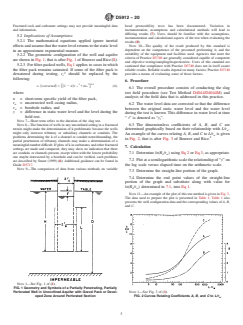
5.2.2 The geometric configuration of the well and aquifer are shown in Fig. 1, that is after Fig. 1 of Bouwer and Rice (1).
Note 7: Short term refers to the duration of the slug test.
Note 8: The function of wells in any unconfined setting in a fractured terrain might make the determination of k problematic because the wells might only intersect tributary or subsidiary channels or conduits. The problems determining the k of a channel or conduit notwithstanding, the partial penetration of tributary channels may make a determination of a meaningful number difficult. If plots of k in carbonates and other fractured settings are made and compared, they may show no indication that there are conduits or channels present, except when with the lowest probability one maybe intersected by a borehole and can be verified, such problems are described by Smart (1999) (6). Additional guidance can be found in Guide D5717.
Note 9: The comparison of data from various methods on variable head permeability tests has been documented. Variation in instrumentation, assumptions and calculational methods will lead to differing results (7). Users should be familiar with the assumptions, instrumentation and calculational aspects of the test when evaluating the results (8).
Note 10: The quality of the result produced by this standard is dependen...
SCOPE
1.1 This practice covers the determination of hydraulic conductivity from the measurement of inertial force free (overdamped) response of a well-aquifer system to a sudden change in water level in a well. Inertial force free response of the water level in a well to a sudden change in water level is characterized by recovery to initial water level in an approximate exponential manner with negligible inertial effects.
1.2 The analytical procedure in this practice is used in conjunction with the field procedure in Test Method D4044/D4044M for collection of test data.
1.3 Limitations—Slug tests are considered to provide an estimate of hydraulic conductivity. The determination of storage coefficient is not practicable with this practice. Because the volume of aquifer material tested is small, the values obtained are representative of materials very near the open portion of the control well.
Note 1: Slug tests are usually considered to provide estimates of the lower limit of the actual hydraulic conductivity of an aquifer because the test results are so heavily influenced by well efficiency and borehole skin effects near the open portion of the well. The portion of the aquifer that is tested by the slug test is limited to an area near the open portion of the well where the aquifer materials may have been altered during well installation, and therefore may significantly impact the test results. In some cases, the data may be misinterpreted and result in a higher estimate of hydraulic conductivity. This is due to the reliance on early time data that is reflective of the hydraulic conductivity of the filter pack surrounding the well. This effect was discussed by Bouwer (1).2 In addition, because of the reliance on early time data, in aquifers with medium to high hydraulic conductivity, the early time portion of the curve that is useful for this data analyses is too short (for example,
1.4 Units—The values stated in S...
- Status
- Published
- Publication Date
- 31-May-2020
- Technical Committee
- D18 - Soil and Rock
- Drafting Committee
- D18.21 - Groundwater and Vadose Zone Investigations
Overview
ASTM D5912-20 is the Standard Practice for Determining Hydraulic Conductivity of an Unconfined Aquifer by Overdamped Well Response to Instantaneous Change in Head (Slug), developed by ASTM International. This standard provides an analytical procedure for estimating the hydraulic conductivity (K) of unconfined aquifers based on the overdamped recovery response (negligible inertial effects) of groundwater levels following a sudden change in water level within a well - commonly referred to as a slug test.
This practice, when used in conjunction with the appropriate field procedure, offers reliable guidance for groundwater professionals conducting aquifer tests in unconsolidated, porous media. It is crucial to note that this method provides an estimate of hydraulic conductivity representative of the material very near the well screen and is not suitable for deriving the storage coefficient or for use in highly fractured or karst systems.
Key Topics
- Hydraulic Conductivity Estimation: The standard outlines an analytical process for calculating hydraulic conductivity based on the well-aquifer system's overdamped response. The analysis assumes water level recovery follows an exponential trend and is not influenced by inertial forces.
- Assumptions and Limitations:
- The aquifer is considered homogeneous and isotropic.
- Drawdown/mounding around the well and flow above the water table are negligible.
- Head losses caused by water entering or leaving the well are ignored.
- Applicability is limited to unconfined, unconsolidated aquifers-results may not be meaningful in fractured rock or carbonate (karst) settings.
- Test Data and Interpretation: Slug test results reflect hydraulic properties immediately adjacent to the well and are heavily influenced by the condition of the filter pack and well efficiency. Early-time data, especially in higher permeability aquifers, may not accurately represent true aquifer properties due to rapid water level changes.
- Reporting Requirements: The standard specifies details to be included in reports, such as well construction data, field procedures, equipment calibration, head measurement frequency, data tables, and plots.
Applications
ASTM D5912-20 is widely used for:
- Groundwater Site Characterization: Determining hydraulic conductivity for environmental assessments, site remediation planning, and water resource development.
- Well Design and Monitoring: Providing input for designing monitoring well networks and for evaluating well performance.
- Regulatory Compliance: Supporting data requirements for permitting processes, environmental impact statements, and compliance monitoring.
- Aquifer Property Evaluation: Supplementing comprehensive aquifer testing programs, especially in scenarios where large-scale pumping tests are impractical.
Typical users include hydrogeologists, engineers, environmental consultants, and regulatory agencies conducting site investigations or monitoring groundwater flow.
Related Standards
For a comprehensive groundwater assessment, ASTM D5912-20 is often used with the following standards:
- ASTM D4044/D4044M - Field procedure for slug tests in aquifers (data collection).
- ASTM D653 - Terminology relating to soil, rock, and contained fluids.
- ASTM D4104/D4104M - Analytical procedures for transmissivity in confined aquifers.
- ASTM D3740 - Minimum requirements for agencies engaged in testing soils and rock.
- ASTM D6026 - Guidelines for significant digits in geotechnical data.
- ASTM D4043 - Guide for aquifer test method selection.
- ASTM D5717 - Guidance for groundwater monitoring in karst and fractured-rock aquifers (for specialized hydrogeologic settings).
By adhering to ASTM D5912-20, organizations ensure standardized, reproducible, and scientifically-accepted estimates of aquifer hydraulic conductivity, supporting robust groundwater management and environmental decision-making.
Relations
- Effective Date
- 01-Jun-2020
- Effective Date
- 01-Nov-2023
- Effective Date
- 01-Oct-2019
- Effective Date
- 01-Jan-2017
- Effective Date
- 01-Sep-2015
- Effective Date
- 01-Aug-2014
- Effective Date
- 01-May-2012
- Effective Date
- 01-Mar-2012
- Effective Date
- 01-Sep-2011
- Effective Date
- 01-Sep-2011
- Effective Date
- 01-Aug-2010
- Effective Date
- 01-Mar-2010
- Effective Date
- 01-Jan-2009
- Effective Date
- 01-Dec-2008
- Effective Date
- 01-Nov-2008
Get Certified
Connect with accredited certification bodies for this standard

Zavod za gradbeništvo Slovenije (ZAG) - Inšpekcija
ZAG inspection body for construction products, structures, and materials.
Sponsored listings
Frequently Asked Questions
ASTM D5912-20 is a standard published by ASTM International. Its full title is "Standard Practice for (Analytical Procedure) Determining Hydraulic Conductivity of an Unconfined Aquifer by Overdamped Well Response to Instantaneous Change in Head (Slug)". This standard covers: SIGNIFICANCE AND USE 5.1 Assumptions of Solution: 5.1.1 Drawdown (or mounding) of the water table around the well is negligible. 5.1.2 Flow above the water table can be ignored. 5.1.3 Head losses as the water enters or leaves the well are negligible. 5.1.4 The aquifer is homogeneous and isotropic. Note 6: Slug and pumping tests implicitly assume a porous medium. Fractured rock and carbonate settings may not provide meaningful data and information. 5.2 Implications of Assumptions: 5.2.1 The mathematical equations applied ignore inertial effects and assume that the water level returns to the static level in an approximate exponential manner. 5.2.2 The geometric configuration of the well and aquifer are shown in Fig. 1, that is after Fig. 1 of Bouwer and Rice (1). Note 7: Short term refers to the duration of the slug test. Note 8: The function of wells in any unconfined setting in a fractured terrain might make the determination of k problematic because the wells might only intersect tributary or subsidiary channels or conduits. The problems determining the k of a channel or conduit notwithstanding, the partial penetration of tributary channels may make a determination of a meaningful number difficult. If plots of k in carbonates and other fractured settings are made and compared, they may show no indication that there are conduits or channels present, except when with the lowest probability one maybe intersected by a borehole and can be verified, such problems are described by Smart (1999) (6). Additional guidance can be found in Guide D5717. Note 9: The comparison of data from various methods on variable head permeability tests has been documented. Variation in instrumentation, assumptions and calculational methods will lead to differing results (7). Users should be familiar with the assumptions, instrumentation and calculational aspects of the test when evaluating the results (8). Note 10: The quality of the result produced by this standard is dependen... SCOPE 1.1 This practice covers the determination of hydraulic conductivity from the measurement of inertial force free (overdamped) response of a well-aquifer system to a sudden change in water level in a well. Inertial force free response of the water level in a well to a sudden change in water level is characterized by recovery to initial water level in an approximate exponential manner with negligible inertial effects. 1.2 The analytical procedure in this practice is used in conjunction with the field procedure in Test Method D4044/D4044M for collection of test data. 1.3 Limitations—Slug tests are considered to provide an estimate of hydraulic conductivity. The determination of storage coefficient is not practicable with this practice. Because the volume of aquifer material tested is small, the values obtained are representative of materials very near the open portion of the control well. Note 1: Slug tests are usually considered to provide estimates of the lower limit of the actual hydraulic conductivity of an aquifer because the test results are so heavily influenced by well efficiency and borehole skin effects near the open portion of the well. The portion of the aquifer that is tested by the slug test is limited to an area near the open portion of the well where the aquifer materials may have been altered during well installation, and therefore may significantly impact the test results. In some cases, the data may be misinterpreted and result in a higher estimate of hydraulic conductivity. This is due to the reliance on early time data that is reflective of the hydraulic conductivity of the filter pack surrounding the well. This effect was discussed by Bouwer (1).2 In addition, because of the reliance on early time data, in aquifers with medium to high hydraulic conductivity, the early time portion of the curve that is useful for this data analyses is too short (for example, 1.4 Units—The values stated in S...
SIGNIFICANCE AND USE 5.1 Assumptions of Solution: 5.1.1 Drawdown (or mounding) of the water table around the well is negligible. 5.1.2 Flow above the water table can be ignored. 5.1.3 Head losses as the water enters or leaves the well are negligible. 5.1.4 The aquifer is homogeneous and isotropic. Note 6: Slug and pumping tests implicitly assume a porous medium. Fractured rock and carbonate settings may not provide meaningful data and information. 5.2 Implications of Assumptions: 5.2.1 The mathematical equations applied ignore inertial effects and assume that the water level returns to the static level in an approximate exponential manner. 5.2.2 The geometric configuration of the well and aquifer are shown in Fig. 1, that is after Fig. 1 of Bouwer and Rice (1). Note 7: Short term refers to the duration of the slug test. Note 8: The function of wells in any unconfined setting in a fractured terrain might make the determination of k problematic because the wells might only intersect tributary or subsidiary channels or conduits. The problems determining the k of a channel or conduit notwithstanding, the partial penetration of tributary channels may make a determination of a meaningful number difficult. If plots of k in carbonates and other fractured settings are made and compared, they may show no indication that there are conduits or channels present, except when with the lowest probability one maybe intersected by a borehole and can be verified, such problems are described by Smart (1999) (6). Additional guidance can be found in Guide D5717. Note 9: The comparison of data from various methods on variable head permeability tests has been documented. Variation in instrumentation, assumptions and calculational methods will lead to differing results (7). Users should be familiar with the assumptions, instrumentation and calculational aspects of the test when evaluating the results (8). Note 10: The quality of the result produced by this standard is dependen... SCOPE 1.1 This practice covers the determination of hydraulic conductivity from the measurement of inertial force free (overdamped) response of a well-aquifer system to a sudden change in water level in a well. Inertial force free response of the water level in a well to a sudden change in water level is characterized by recovery to initial water level in an approximate exponential manner with negligible inertial effects. 1.2 The analytical procedure in this practice is used in conjunction with the field procedure in Test Method D4044/D4044M for collection of test data. 1.3 Limitations—Slug tests are considered to provide an estimate of hydraulic conductivity. The determination of storage coefficient is not practicable with this practice. Because the volume of aquifer material tested is small, the values obtained are representative of materials very near the open portion of the control well. Note 1: Slug tests are usually considered to provide estimates of the lower limit of the actual hydraulic conductivity of an aquifer because the test results are so heavily influenced by well efficiency and borehole skin effects near the open portion of the well. The portion of the aquifer that is tested by the slug test is limited to an area near the open portion of the well where the aquifer materials may have been altered during well installation, and therefore may significantly impact the test results. In some cases, the data may be misinterpreted and result in a higher estimate of hydraulic conductivity. This is due to the reliance on early time data that is reflective of the hydraulic conductivity of the filter pack surrounding the well. This effect was discussed by Bouwer (1).2 In addition, because of the reliance on early time data, in aquifers with medium to high hydraulic conductivity, the early time portion of the curve that is useful for this data analyses is too short (for example, 1.4 Units—The values stated in S...
ASTM D5912-20 is classified under the following ICS (International Classification for Standards) categories: 07.060 - Geology. Meteorology. Hydrology; 93.020 - Earthworks. Excavations. Foundation construction. Underground works. The ICS classification helps identify the subject area and facilitates finding related standards.
ASTM D5912-20 has the following relationships with other standards: It is inter standard links to ASTM D5912-96(2004), ASTM D3740-23, ASTM D3740-19, ASTM D4043-17, ASTM D4044/D4044M-15, ASTM D653-14, ASTM D3740-12a, ASTM D3740-12, ASTM D653-11, ASTM D3740-11, ASTM D4043-96(2010)e1, ASTM D3740-10, ASTM D653-09, ASTM D653-08a, ASTM D653-08. Understanding these relationships helps ensure you are using the most current and applicable version of the standard.
ASTM D5912-20 is available in PDF format for immediate download after purchase. The document can be added to your cart and obtained through the secure checkout process. Digital delivery ensures instant access to the complete standard document.
Standards Content (Sample)
This international standard was developed in accordance with internationally recognized principles on standardization established in the Decision on Principles for the
Development of International Standards, Guides and Recommendations issued by the World Trade Organization Technical Barriers to Trade (TBT) Committee.
Designation:D5912 −20
Standard Practice for
(Analytical Procedure) Determining Hydraulic Conductivity
of an Unconfined Aquifer by Overdamped Well Response to
Instantaneous Change in Head (Slug)
This standard is issued under the fixed designation D5912; the number immediately following the designation indicates the year of
original adoption or, in the case of revision, the year of last revision. A number in parentheses indicates the year of last reapproval. A
superscript epsilon (´) indicates an editorial change since the last revision or reapproval.
1. Scope* this standard. Reporting of test results in units other than SI
shall not be regarded as nonconformance with this standard.
1.1 This practice covers the determination of hydraulic
conductivity from the measurement of inertial force free
1.5 All observed and calculated values shall conform to the
(overdamped) response of a well-aquifer system to a sudden
guidelines for significant digits and rounding established in
change in water level in a well. Inertial force free response of
Practice D6026.
the water level in a well to a sudden change in water level is
1.5.1 Theproceduresusedtospecifyhowdataarecollected/
characterized by recovery to initial water level in an approxi-
recorded and calculated in the standard are regarded as the
mate exponential manner with negligible inertial effects.
industry standard. In addition, they are representative of the
1.2 The analytical procedure in this practice is used in
significant digits that generally should be retained. The proce-
conjunction with the field procedure in Test Method D4044/
dures used do not consider material variation, purpose for
D4044M for collection of test data.
obtaining the data, special purpose studies, or any consider-
1.3 Limitations—Slug tests are considered to provide an
ations for the user’s objectives; and it is common practice to
estimate of hydraulic conductivity. The determination of stor-
increase or reduce significant digits of reported data to be
agecoefficientisnotpracticablewiththispractice.Becausethe
commensuratewiththeseconsiderations.Itisbeyondthescope
volume of aquifer material tested is small, the values obtained
of these test methods to consider significant digits used in
arerepresentativeofmaterialsveryneartheopenportionofthe
analysis methods for engineering data.
control well.
1.6 This practice offers a set of instructions for performing
NOTE 1—Slug tests are usually considered to provide estimates of the
one or more specific operations. This document cannot replace
lower limit of the actual hydraulic conductivity of an aquifer because the
test results are so heavily influenced by well efficiency and borehole skin
educationorexperienceandshouldbeusedinconjunctionwith
effects near the open portion of the well. The portion of the aquifer that is
professional judgment. Not all aspects of the practice may be
testedbytheslugtestislimitedtoanareaneartheopenportionofthewell
applicable in all circumstances. This ASTM standard is not
wheretheaquifermaterialsmayhavebeenalteredduringwellinstallation,
intended to represent or replace the standard of care by which
and therefore may significantly impact the test results. In some cases, the
data may be misinterpreted and result in a higher estimate of hydraulic
the adequacy of a given professional service must be judged,
conductivity.Thisisduetotherelianceonearlytimedatathatisreflective
nor should this document be applied without the consideration
of the hydraulic conductivity of the filter pack surrounding the well. This
2 ofaproject’smanyuniqueaspects.Theword“Standard”inthe
effect was discussed by Bouwer (1). In addition, because of the reliance
title of this document means only that the document has been
on early time data, in aquifers with medium to high hydraulic
conductivity, the early time portion of the curve that is useful for this data
approved through he ASTM consensus process.
analyses is too short (for example, <10 s) for accurate measurement;
1.7 This standard does not purport to address all of the
therefore, the test results begin to greatly underestimate the true hydraulic
conductivity.
safety concerns, if any, associated with its use. It is the
responsibility of the user of this standard to establish appro-
1.4 Units—The values stated in SI units are to be regarded
as the standard. No other units of measurement are included in priate safety, health, and environmental practices and deter-
mine the applicability of regulatory limitations prior to use.
This practice is under the jurisdiction of ASTM Committee D18 on Soil and
1.8 This international standard was developed in accor-
Rock and is the direct responsibility of Subcommittee D18.21 on Groundwater and
dance with internationally recognized principles on standard-
Vadose Zone Investigations.
Current edition approved June 1, 2020. Published June 2020. Originally ization established in the Decision on Principles for the
approved in 1996. Last previous edition approved in 2004 as D5912–96(2004),
Development of International Standards, Guides and Recom-
whichwaswithdrawnin2013andreinstatedinJune2020.DOI:10.1520/D5912-20.
mendations issued by the World Trade Organization Technical
The boldface numbers in parentheses refer to a list of references at the end of
this standard. Barriers to Trade (TBT) Committee.
*A Summary of Changes section appears at the end of this standard
Copyright © ASTM International, 100 Barr Harbor Drive, PO Box C700, West Conshohocken, PA 19428-2959. United States
D5912−20
2. Referenced Documents 3.2.13 y [L]—head difference at beginning of straight-line
3 portion of graph.
2.1 ASTM Standards:
3.2.14 K [LT–1]—hydraulic conductivity.
D653 Terminology Relating to Soil, Rock, and Contained
Fluids
4. Summary of Practice
D3740 Practice for Minimum Requirements for Agencies
4.1 This practice describes the analytical procedure for
Engaged in Testing and/or Inspection of Soil and Rock as
analyzing data collected following an instantaneous change in
Used in Engineering Design and Construction
head (slug) test in an overdamped well.The field procedures in
D4043 Guide for Selection of Aquifer Test Method in
conducting a slug test are given in Test Method D4044/
Determining Hydraulic Properties by Well Techniques
D4044M. The analytical procedure consists of analyzing the
D4044/D4044M Test Method for (Field Procedure) for In-
recovery of water level in the well following the change in
stantaneous Change in Head (Slug) Tests for Determining
water level induced in the well.
Hydraulic Properties of Aquifers
D4104/D4104M Practice for (Analytical Procedures) Deter-
4.2 Solution—The solution given by Bouwer and Rice (1)
mining Transmissivity of Nonleaky ConfinedAquifers by
follows:
Overdamped Well Response to Instantaneous Change in
r ln~R ⁄ r ! 1 y
c e w 0
Head (Slug Tests)
K 5 ln (1)
2L t 2 t yf
~ !
f 0
D5717 Guide for Design of Ground-Water Monitoring Sys-
tems in Karst and Fractured-Rock Aquifers (Withdrawn
where:
2005)
if D>H
D6026 Practice for Using Significant Digits in Geotechnical
1.1 A1Bln@ D 2 H /r #
~ !
w
Data ln~R /r ! 5 1 (2)
F G
e w
ln~H/r ! L/R
w w
3. Terminology
if D=H
3.1 Definitions—For definitions of common technical terms 1.1 C
lnR /r 5 1 (3)
F G
e w
used in this standard, refer to Terminology D653. ln H/r L/r
~ !
w w
NOTE 2—Other analytical solutions are given by Hvorslev and Cooper
3.2 Symbols and Dimensions:
et al; (2, 3, 4) however, they may differ in their assumptions and
3.2.1 A [nd]—coefficient that is a function of L/r and is
w applicability.
determined graphically.
NOTE 3—Bouwer (1) provided discussion of various applications and
observations of the procedure described in this practice.
3.2.2 B [nd]—coefficient that is a function of L/r and is
w
NOTE 4—Practice D4104/D4104M describes the analytical solution
determined graphically.
following Cooper et al (3).
NOTE 5—The use of the symbol K for the term hydraulic conductivity
3.2.3 C [nd]—coefficient that is a function of L/r and is
w
is the predominant usage in groundwater literature by hydrogeologists,
determined graphically.
whereas, the symbol k is commonly used for this term in soil and rock
3.2.4 D [L]—aquifer thickness. mechanics and soil science.
3.2.5 H [L]—distance between static water level and the
4.3 Morerecentwork(Zlotniketal.2010 (5))haverevealed
base of open interval of the well. that the shape factors used for calculation of hydraulic con-
ductivity (K) in the Bouwer and Rice model may result in the
3.2.6 L [L]—length of well open to aquifer.
under estimation of K by as much as 25 % to 40 % depending
3.2.7 rc [L]—inside diameter of the portion of the well
on the well construction and aquifer characteristics. Please
casing in which the water level changes.
refer to the work of Zlotnik et al. (2010) (5) for a discussion of
3.2.8 R [L]—effectiveradius,determinedempiricallybased
e
the development of general steady state shape factors for the
on the geometry of the well, over which y is dissipated.
condition of an overdamped, partially penetrating well.
3.2.9 r [L]—radial distance from well center to original to
w
4.4 Numerous commercial computer software programs are
well casing.
available to evaluate slug test data. Only those programs that
3.2.10 t [T]—time at end point of straight-line portion of
provideanalysisofthedatabasedongraphicalcurvematching,
f
graph.
rather than simply least-squares analysis, and allow for the
generation of data plots should be used.
3.2.11 t [T]—time at beginning of straight-line portion of
graph.
5. Significance and Use
3.2.12 y [L]—head difference at end point of straight-line
f
5.1 Assumptions of Solution:
portion of graph.
5.1.1 Drawdown (or mounding) of the water table around
the well is negligible.
5.1.2 Flow above the water table can be ignored.
For referenced ASTM standards, visit the ASTM website, www.astm.org, or
5.1.3 Head losses as the water enters or leaves the well are
contact ASTM Customer Service at service@astm.org. For Annual Book of ASTM
negligible.
Standards volume information, refer to the standard’s Document Summary page on
the ASTM website.
5.1.4 The aquifer is homogeneous and isotropic.
The last approved version of this historical standard is referenced on
www.astm.org. NOTE 6—Slug and pumping tests implicitly assume a porous medium.
D5912−20
Fractured rock and carbonate settings may not provide meaningful data head permeability tests has been documented. Variation in
and information. instrumentation, assumptions and calculational methods will lead to
differing results (7). Users should be familiar with the assumptions,
5.2 Implications of Assumptions:
instrumentation and calculational aspects of the test when evaluating the
5.2.1 The mathematical equations applied ignore inertial
results (8).
effectsandassumethatthewaterlevelreturnstothestaticlevel
NOTE 10—The quality of the result produced by this standard is
dependent on the competence of the personnel performing it, and the
in an approximate exponential manner.
suitability of the equipment and facilities used.
...