

ASTM D4043-17
(Guide)Standard Guide for Selection of Aquifer Test Method in Determining Hydraulic Properties by Well Techniques
General Information
- Abstract
SIGNIFICANCE AND USE
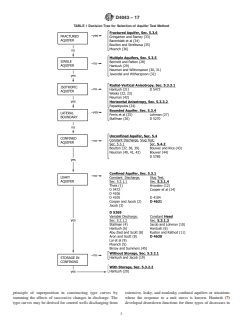
4.1 An aquifer test method is a controlled field experiment made to determine the approximate hydraulic properties of water-bearing material. The hydraulic properties that can be determined are specific to the test method. The hydraulic properties that can be determined are also dependent upon the instrumentation of the field test, the knowledge of the aquifer system at the field site, and conformance of the hydrogeologic conditions at the field site to the assumptions of the test method. Hydraulic conductivity and storage coefficient of the aquifer are the basic properties determined by most test methods. Test methods can be designed also to determine vertical and horizontal anisotropy, aquifer discontinuities, vertical hydraulic conductivity of confining beds, well efficiency, turbulent flow, and specific storage and vertical permeability of confining beds.
SCOPE
1.1 This guide covers an integral part of a series of standards that are being prepared on the in situ determination of hydraulic properties of aquifer systems by single- or multiple-well tests. This guide provides guidance for development of a conceptual model of a field site and selection of an analytical test method for determination of hydraulic properties. This guide does not establish a fixed procedure for determination of hydrologic properties.
1.2 The values stated in SI units are to be regarded as standard. No other units of measurement are included in this standard.
1.3 Limitations—Well techniques have limitations in the determination of hydraulic properties of groundwater flow systems. These limitations are related primarily to the simplifying assumptions that are implicit in each test method. The response of an aquifer system to stress is not unique; therefore, the system must be known sufficiently to select the proper analytical method.
1.4 This standard does not purport to address all of the safety concerns, if any, associated with its use. It is the responsibility of the user of this standard to establish appropriate safety and health practices and determine the applicability of regulatory limitations prior to use.
1.5 This guide offers an organized collection of information or a series of options and does not recommend a specific course of action. This document cannot replace education or experience and should be used in conjunction with professional judgment. Not all aspects of this guide may be applicable in all circumstances. This ASTM standard is not intended to represent or replace the standard of care by which the adequacy of a given professional service must be judged, nor should this document be applied without consideration of a project's many unique aspects. The word “Standard” in the title of this document means only that the document has been approved through the ASTM consensus process.
- Status
- Published
- Publication Date
- 31-Dec-2016
- Technical Committee
- D18 - Soil and Rock
- Drafting Committee
- D18.21 - Groundwater and Vadose Zone Investigations
Buy Documents
ASTM D4043-17 - Standard Guide for Selection of Aquifer Test Method in Determining Hydraulic Properties by Well Techniques
REDLINE ASTM D4043-17 - Standard Guide for Selection of Aquifer Test Method in Determining Hydraulic Properties by Well Techniques
Overview
ASTM D4043-17: Standard Guide for Selection of Aquifer Test Method in Determining Hydraulic Properties by Well Techniques provides a structured approach to selecting appropriate aquifer test methods for evaluating groundwater systems. Developed by ASTM International, this guide is a vital reference within a series of standards focused on assessing the hydraulic properties of aquifers via single- or multiple-well tests. By assisting practitioners in choosing field and analytical test methods tailored to specific site hydrogeology, ASTM D4043-17 supports accurate and reliable characterization of groundwater resources.
Key Topics
- Aquifer Test Methods: The guide addresses various field methods, such as constant-rate discharge, slug tests, and constant drawdown tests, for controlled evaluation of aquifer response to stress.
- Hydraulic Properties: It focuses on the determination of key groundwater properties, including:
- Hydraulic conductivity
- Storage coefficient
- Transmissivity
- Specific capacity
- Anisotropy (horizontal and vertical)
- Well efficiency and turbulent flow
- Site Characterization: Emphasizes developing a comprehensive conceptual model using geological mapping, well logs, geophysical data, and other relevant site-specific information.
- Test Method Selection: Provides a logic-based decision framework for aligning test procedures with hydrogeological conditions, assumptions inherent to analytical models, and measurement objectives.
- Limitations and Assumptions: Outlines key limitations due to model simplifications and the uniqueness of aquifer system responses, emphasizing the importance of professional judgment.
Applications
ASTM D4043-17 is intended for professionals involved in groundwater studies, hydrogeology, environmental engineering, and water resource management. Typical applications include:
- Groundwater Resource Assessment: Supporting sustainable water extraction planning by accurately estimating aquifer yield and properties.
- Site Investigation: Guiding well test selection for environmental site assessments, remediation projects, or construction dewatering plans.
- Regulatory Compliance: Assisting in hydrogeological studies required for permits and compliance with local, state, or national water regulations.
- Aquifer Characterization: Selecting testing approaches to identify aquifer boundaries, layers, and confining beds, particularly in complex or multi-aquifer systems.
- Well Performance Evaluation: Informing maintenance, design, or improvements of water supply wells based on tested hydraulic properties.
Related Standards
ASTM D4043-17 references several related ASTM standards to provide a comprehensive framework for in situ determination and analysis of aquifer hydraulic properties:
- ASTM D653: Terminology Relating to Soil, Rock, and Contained Fluids
- ASTM D4044: Field Procedure for Instantaneous Change in Head (Slug) Tests
- ASTM D4050: Withdrawal and Injection Well Testing
- ASTM D4104: Analytical Procedure for Overdamped Well Response to Slug Tests
- ASTM D4105/D4106: Methods for Transmissivity and Storage Coefficient in confined aquifers
- ASTM D5269/D5270: Test methods for specific aquifer properties and bounded aquifers
- ASTM D5472/D5473: Methods for analyzing partial penetration and specific capacity
- ASTM D5785/D5881: Slug test analysis for transmissivity in various aquifer conditions
- ASTM D5786: Practice for constant drawdown tests in flowing wells
- ASTM D5850/D5912: Methods for anisotropy, transmissivity, and hydraulic conductivity
Conclusion
By adhering to ASTM D4043-17, professionals ensure a logical and informed selection of aquifer test methods, leading to more accurate groundwater system assessments. The standard emphasizes the practical integration of site-specific data, test limitations, and professional expertise-fostering reliable groundwater management and sustainable resource development. For comprehensive application, users should consult related ASTM standards and always consider the unique characteristics of each project site.
Relations
- Effective Date
- 01-Jan-2017
- Effective Date
- 01-Jun-2020
- Effective Date
- 01-Feb-2019
- Effective Date
- 01-Dec-2018
- Effective Date
- 01-Jan-2018
- Effective Date
- 01-Nov-2017
- Effective Date
- 01-Jan-2017
- Effective Date
- 15-Apr-2015
- Effective Date
- 15-Apr-2015
- Effective Date
- 15-Apr-2015
- Effective Date
- 01-Aug-2014
- Effective Date
- 01-Jun-2014
- Effective Date
- 01-Feb-2014
- Effective Date
- 15-Nov-2013
- Effective Date
- 15-Mar-2013
Buy Documents
ASTM D4043-17 - Standard Guide for Selection of Aquifer Test Method in Determining Hydraulic Properties by Well Techniques
REDLINE ASTM D4043-17 - Standard Guide for Selection of Aquifer Test Method in Determining Hydraulic Properties by Well Techniques
Get Certified
Connect with accredited certification bodies for this standard

CIS Institut d.o.o.
Personal Protective Equipment (PPE) certification body. Notified Body NB-2890 for EU Regulation 2016/425 PPE.

Kiwa BDA Testing
Building and construction product certification.
Kmetijski inštitut Slovenije
Agricultural Institute of Slovenia. Soil testing, plant health, agricultural product analysis.
Sponsored listings
Frequently Asked Questions
ASTM D4043-17 is a guide published by ASTM International. Its full title is "Standard Guide for Selection of Aquifer Test Method in Determining Hydraulic Properties by Well Techniques". This standard covers: SIGNIFICANCE AND USE 4.1 An aquifer test method is a controlled field experiment made to determine the approximate hydraulic properties of water-bearing material. The hydraulic properties that can be determined are specific to the test method. The hydraulic properties that can be determined are also dependent upon the instrumentation of the field test, the knowledge of the aquifer system at the field site, and conformance of the hydrogeologic conditions at the field site to the assumptions of the test method. Hydraulic conductivity and storage coefficient of the aquifer are the basic properties determined by most test methods. Test methods can be designed also to determine vertical and horizontal anisotropy, aquifer discontinuities, vertical hydraulic conductivity of confining beds, well efficiency, turbulent flow, and specific storage and vertical permeability of confining beds. SCOPE 1.1 This guide covers an integral part of a series of standards that are being prepared on the in situ determination of hydraulic properties of aquifer systems by single- or multiple-well tests. This guide provides guidance for development of a conceptual model of a field site and selection of an analytical test method for determination of hydraulic properties. This guide does not establish a fixed procedure for determination of hydrologic properties. 1.2 The values stated in SI units are to be regarded as standard. No other units of measurement are included in this standard. 1.3 Limitations—Well techniques have limitations in the determination of hydraulic properties of groundwater flow systems. These limitations are related primarily to the simplifying assumptions that are implicit in each test method. The response of an aquifer system to stress is not unique; therefore, the system must be known sufficiently to select the proper analytical method. 1.4 This standard does not purport to address all of the safety concerns, if any, associated with its use. It is the responsibility of the user of this standard to establish appropriate safety and health practices and determine the applicability of regulatory limitations prior to use. 1.5 This guide offers an organized collection of information or a series of options and does not recommend a specific course of action. This document cannot replace education or experience and should be used in conjunction with professional judgment. Not all aspects of this guide may be applicable in all circumstances. This ASTM standard is not intended to represent or replace the standard of care by which the adequacy of a given professional service must be judged, nor should this document be applied without consideration of a project's many unique aspects. The word “Standard” in the title of this document means only that the document has been approved through the ASTM consensus process.
SIGNIFICANCE AND USE 4.1 An aquifer test method is a controlled field experiment made to determine the approximate hydraulic properties of water-bearing material. The hydraulic properties that can be determined are specific to the test method. The hydraulic properties that can be determined are also dependent upon the instrumentation of the field test, the knowledge of the aquifer system at the field site, and conformance of the hydrogeologic conditions at the field site to the assumptions of the test method. Hydraulic conductivity and storage coefficient of the aquifer are the basic properties determined by most test methods. Test methods can be designed also to determine vertical and horizontal anisotropy, aquifer discontinuities, vertical hydraulic conductivity of confining beds, well efficiency, turbulent flow, and specific storage and vertical permeability of confining beds. SCOPE 1.1 This guide covers an integral part of a series of standards that are being prepared on the in situ determination of hydraulic properties of aquifer systems by single- or multiple-well tests. This guide provides guidance for development of a conceptual model of a field site and selection of an analytical test method for determination of hydraulic properties. This guide does not establish a fixed procedure for determination of hydrologic properties. 1.2 The values stated in SI units are to be regarded as standard. No other units of measurement are included in this standard. 1.3 Limitations—Well techniques have limitations in the determination of hydraulic properties of groundwater flow systems. These limitations are related primarily to the simplifying assumptions that are implicit in each test method. The response of an aquifer system to stress is not unique; therefore, the system must be known sufficiently to select the proper analytical method. 1.4 This standard does not purport to address all of the safety concerns, if any, associated with its use. It is the responsibility of the user of this standard to establish appropriate safety and health practices and determine the applicability of regulatory limitations prior to use. 1.5 This guide offers an organized collection of information or a series of options and does not recommend a specific course of action. This document cannot replace education or experience and should be used in conjunction with professional judgment. Not all aspects of this guide may be applicable in all circumstances. This ASTM standard is not intended to represent or replace the standard of care by which the adequacy of a given professional service must be judged, nor should this document be applied without consideration of a project's many unique aspects. The word “Standard” in the title of this document means only that the document has been approved through the ASTM consensus process.
ASTM D4043-17 is classified under the following ICS (International Classification for Standards) categories: 13.060.10 - Water of natural resources. The ICS classification helps identify the subject area and facilitates finding related standards.
ASTM D4043-17 has the following relationships with other standards: It is inter standard links to ASTM D4043-96(2010)e1, ASTM D5850-20, ASTM D4630-19, ASTM D5881-18, ASTM D5850-18, ASTM D4104-17, ASTM D5786-17, ASTM D4105-15, ASTM D5269-15, ASTM D4106-15, ASTM D653-14, ASTM D5920-14, ASTM D5270-96(2014), ASTM D5881-13, ASTM D5785-95(2013). Understanding these relationships helps ensure you are using the most current and applicable version of the standard.
ASTM D4043-17 is available in PDF format for immediate download after purchase. The document can be added to your cart and obtained through the secure checkout process. Digital delivery ensures instant access to the complete standard document.
Standards Content (Sample)
This international standard was developed in accordance with internationally recognized principles on standardization established in the Decision on Principles for the
Development of International Standards, Guides and Recommendations issued by the World Trade Organization Technical Barriers to Trade (TBT) Committee.
Designation: D4043 − 17
Standard Guide for
Selection of Aquifer Test Method in Determining Hydraulic
Properties by Well Techniques
This standard is issued under the fixed designation D4043; the number immediately following the designation indicates the year of
original adoption or, in the case of revision, the year of last revision. A number in parentheses indicates the year of last reapproval. A
superscript epsilon (´) indicates an editorial change since the last revision or reapproval.
1. Scope* document means only that the document has been approved
through the ASTM consensus process.
1.1 This guide covers an integral part of a series of
standards that are being prepared on the in situ determination
2. Referenced Documents
of hydraulic properties of aquifer systems by single- or
2.1 ASTM Standards:
multiple-well tests. This guide provides guidance for develop-
D653 Terminology Relating to Soil, Rock, and Contained
ment of a conceptual model of a field site and selection of an
Fluids
analytical test method for determination of hydraulic proper-
D4044 Test Method for (Field Procedure) for Instantaneous
ties. This guide does not establish a fixed procedure for
Change in Head (Slug) Tests for Determining Hydraulic
determination of hydrologic properties.
Properties of Aquifers
1.2 The values stated in SI units are to be regarded as
D4104 Test Method (Analytical Procedure) for Determining
standard. No other units of measurement are included in this
Transmissivity of Nonleaky Confined Aquifers by Over-
standard.
damped Well Response to Instantaneous Change in Head
(Slug Tests)
1.3 Limitations—Well techniques have limitations in the
D4105 Test Method for (Analytical Procedure) for Deter-
determination of hydraulic properties of groundwater flow
mining Transmissivity and Storage Coefficient of Non-
systems. These limitations are related primarily to the simpli-
leaky Confined Aquifers by the Modified Theis Nonequi-
fying assumptions that are implicit in each test method. The
librium Method
response of an aquifer system to stress is not unique; therefore,
D4106 Test Method for (Analytical Procedure) for Deter-
the system must be known sufficiently to select the proper
mining Transmissivity and Storage Coefficient of Non-
analytical method.
leaky Confined Aquifers by the Theis Nonequilibrium
1.4 This standard does not purport to address all of the
Method
safety concerns, if any, associated with its use. It is the
D4630 Test Method for Determining Transmissivity and
responsibility of the user of this standard to establish appro-
Storage Coefficient of Low-Permeability Rocks by In Situ
priate safety and health practices and determine the applica-
Measurements Using the Constant Head Injection Test
bility of regulatory limitations prior to use.
D5269 Test Method for DeterminingTransmissivity of Non-
1.5 This guide offers an organized collection of information
leaky Confined Aquifers by the Theis Recovery Method
or a series of options and does not recommend a specific
D5270 Test Method for Determining Transmissivity and
course of action. This document cannot replace education or
Storage Coefficient of Bounded, Nonleaky, Confined
experience and should be used in conjunction with professional
Aquifers
judgment. Not all aspects of this guide may be applicable in all
D5472 Test Method for Determining Specific Capacity and
circumstances. This ASTM standard is not intended to repre-
Estimating Transmissivity at the Control Well
sent or replace the standard of care by which the adequacy of
D5473 Test Method for (Analytical Procedure for) Analyz-
a given professional service must be judged, nor should this
ing the Effects of Partial Penetration of Control Well and
document be applied without consideration of a project’s many
Determining the Horizontal and Vertical Hydraulic Con-
unique aspects. The word “Standard” in the title of this
ductivity in a Nonleaky Confined Aquifer
D5716 Test Method for Measuring the Rate of Well Dis-
charge by Circular Orifice Weir
This guide is under the jurisdiction ofASTM Committee D18 on Soil and Rock
and is the direct responsibility of Subcommittee D18.21 on Groundwater and
Vadose Zone Investigations. For referenced ASTM standards, visit the ASTM website, www.astm.org, or
Current edition approved Jan. 1, 2017. Published January 2017. Originally contact ASTM Customer Service at service@astm.org. For Annual Book of ASTM
ɛ1
approved in 1991. Last previous edition approved in 2010 as D4043–96(2010) . Standards volume information, refer to the standard’s Document Summary page on
DOI: 10.1520/D4043-17. the ASTM website.
*A Summary of Changes section appears at the end of this standard
Copyright © ASTM International, 100 Barr Harbor Drive, PO Box C700, West Conshohocken, PA 19428-2959. United States
D4043 − 17
D5785 Test Method for (Analytical Procedure) for Deter- by the control well.The decision tree references the sections in
mining Transmissivity of Confined NonleakyAquifers by this guide where the test methods are cited.
Underdamped Well Response to Instantaneous Change in
5.2 Pretest-Selection Procedures—Aquifer test methods are
Head (Slug Test)
highly specific to the assumptions of the analytical solution of
D5786 Practice for (Field Procedure) for Constant Draw-
the test method. Reliability of determination of hydraulic
down Tests in Flowing Wells for Determining Hydraulic
properties depends upon conformance of the hydrologic site
Properties of Aquifer Systems
characteristics to the assumptions of the test method. A
D5850 Test Method for (Analytical Procedure) Determining
prerequisite for selecting an aquifer test method is knowledge
Transmissivity, Storage Coefficient, and Anisotropy Ratio
of the hydrogeology of the test site. A conceptual understand-
from a Network of Partially Penetrating Wells
ing of the hydrogeology of the aquifer system at the prospec-
D5881 Test Method for (Analytical Procedure) Determining
tive test site should be gained in as much detail as practicable
Transmissivity of Confined Nonleaky Aquifers by Criti-
from existing literature and data, and a site reconnaissance. In
cally Damped Well Response to Instantaneous Change in
developing a site characterization, incorporate geologic
Head (Slug)
mapping, driller’s logs, geophysical logs, records of existing
D5912 Test Method for (Analytical Procedure) Determining
wells, water-level and water-quality data, and results of geo-
Hydraulic Conductivity of an Unconfined Aquifer by
physical surveys. Include information on the thickness,
Overdamped Well Response to Instantaneous Change in
lithology, stratification, depth, attitude, continuity, and extent
Head (Slug) (Withdrawn 2013)
of the aquifer and confining beds.
D5920 Test Method (Analytical Procedure) for Tests of
5.3 Select Applicable Aquifer Test Methods—Select a test
Anisotropic Unconfined Aquifers by Neuman Method
method based on conformation of the site hydrogeology to
assumptions of the test model and the parameters to be
3. Terminology
determined. A summary of principal aquifer test methods and
3.1 Definitions—For definitions of common terms used in
their applicability to hydrogeologic site conditions is given in
this test method, see Terminology D653.
the following paragraphs. The decision tree for aquifer test
selection, Table 1, provides a graphic display of the hydrogeo-
4. Significance and Use
logic site conditions for each test method and references to the
4.1 An aquifer test method is a controlled field experiment
section where each test method is cited.
made to determine the approximate hydraulic properties of
5.3.1 Extensive, Isotropic, Homogeneous, Confined, Non-
water-bearing material. The hydraulic properties that can be
leaky Aquifer:
determined are specific to the test method. The hydraulic
5.3.1.1 Constant Discharge—Test method in which the
properties that can be determined are also dependent upon the
discharge or injection rate in the control well is constant are
instrumentation of the field test, the knowledge of the aquifer
given by the nonequilibrium method of Theis (1) for the
system at the field site, and conformance of the hydrogeologic
drawdown and recovery phases. The Theis test method is the
conditions at the field site to the assumptions of the test
most widely referenced and applied aquifer test method and is
method. Hydraulic conductivity and storage coefficient of the
the basis for the solution to other more complicated boundary
aquifer are the basic properties determined by most test
condition problems. The Theis test method for the pumping or
methods. Test methods can be designed also to determine
injection phase is given in Test Method D4106. Cooper and
vertical and horizontal anisotropy, aquifer discontinuities, ver-
Jacob (2) and Jacob (3) recognized that for large values of time
tical hydraulic conductivity of confining beds, well efficiency,
and small values of distance from the control well, the Theis
turbulent flow, and specific storage and vertical permeability of
solution yields a straight line on semilogarithmic plots of
confining beds.
various combinations of drawdown and distance from the
control well. The solution of the Theis equation can therefore
5. Procedure
besimplifiedbytheuseofsemilogarithmicplots.Themodified
5.1 The procedure for selection of an aquifer test method or
Theis nonequilibrium test method is given in Test Method
methods is primarily based on selection of a test method that is
D4105. A test method for estimating transmissivity from
compatible with the hydrogeology of the proposed test site.
specific capacity by the Theis method is given in Test Method
Secondarily, the test method is selected on the basis of the
D5472. Test Method D5716 provides a means of means of
testing conditions specified by the test method, such as the
measuring discharge from high capacity wells. Test Method
method of stressing or causing water-level changes in the
D5269 provides a method of determining transmissivity in a
aquifer and the requirements of a test method for observations
non-leaky aquifer.
of water level response in the aquifer. The decision tree in
5.3.1.2 Variable Discharge—Test methods for a variably
Table 1 is designed to assist, first, in selecting test methods
discharging control well have been presented by Stallman (4)
applicable to specific hydrogeologic site characteristics.
and Moench (5) and Birsoy and Summers (6). These test
Secondly,thedecisiontreewillassistinselectingatestmethod
methods simulate pumpage as a sequence of constant-rate
on the basis of the nature of the stress on the aquifer imposed
stepped changes in discharge. The test methods utilize the
3 4
The last approved version of this historical standard is referenced on The boldface numbers in parentheses refer to the list of references at the end of
www.astm.org. this guide.
D4043 − 17
TABLE 1 Decision Tree for Selection of Aquifer Test Method
principle of superposition in constructing type curves by extensive, leaky, and nonleaky confined aquifers or situations
summing the effects of successive changes in discharge. The where the response to a unit stress is known. Hantush (7)
type curves may be derived for control wells discharging from developed drawdown functions for three types of decreases in
D4043 − 17
control-well discharge. Abu-Zied and Scott (8) presented a aquifer is assumed to be radial, and flow in the leaky confining
generalsolutionfordrawdowninanextensiveconfinedaquifer beds is assumed to be vertical.
in which the discharge of the control well decreases at an
5.3.3 Extensive, Confined, Anisotropic Aquifer:
exponential rate. Aron and Scott (9) proposed an approximate
5.3.3.1 Radial-Vertical Anisotropy—Solutions to the head
test method of determining transmissivity and storage from an
distribution in a homogeneous confined aquifer with radial-
aquifer test in which discharge decreases with time during the
vertical anisotropy in response to constant discharge of a
early part of the test. Lai et al (10) presented test methods for
partially penetrating well are presented by Hantush (23).
determining the drawdown in an aquifer taking into account
Weeks (24, 25)presentedtestmethodstodeterminetheratioof
storage in the control well and having an exponentially and
horizontal to vertical hydraulic conductivity. Methods for
linearly decreasing discharge.
analysis of a pumping test in a radial-vertical anisotropic
5.3.1.3 Constant Drawdown—Test methods have been pre- aquifer are given in Test Methods D5473 and D5850.
sented to determine hydraulic-head distribution around a dis- 5.3.3.2 Horizontal Anisotropy—Papadopulos (26) presented
charging well in a confined aquifer with near constant draw- a test method for determination of horizontal plane anisotropy
down. Such conditions are most commonly achieved by in an aerially extensive homogeneous confined aquifer.
shutting in a flowing well long enough for the head to fully
5.3.4 Areally Bounded Aquifers—Aquifer test methods dis-
recover, then opening the well. The solutions of Jacob and
cussed previously are based on the assumption that the aquifer
Lohman (11) and Hantush (7) apply to aerially extensive,
is extensive. Effects of limitations in the extent of aquifers by
nonleaky aquifers. Rushton and Rathod (12) used a numerical
impermeable boundaries or by source boundaries, such as
model to analyze aquifer-test data. Reed (13) presents a
hydraulically connected streams, may preclude the direct
computer program that includes some of the above procedures
application of an aquifer test method. The method of images,
and also includes discharge as a fifth-degree polynomial of
described by Ferris et al (27), Stallman (28) and Lohman (29),
time. Practice D5786 provides information on performing
provide solutions to head distribution in finite aquifers. The
constant drawdown tests in flowing wells. theory of images for determination of transmissivity and
storage coefficient in bounded aquifers is given in Test Method
5.3.1.4 Slug Test Methods—Test methods for estimating
D5270.
transmissivity by injecting a given quantity or slug of water
into a well were introduced by Hvorslev (14) and Ferris and 5.3.5 Multiple Aquifers—Test methods for multiple
Knowles (15). Solutions to
...
This document is not an ASTM standard and is intended only to provide the user of an ASTM standard an indication of what changes have been made to the previous version. Because
it may not be technically possible to adequately depict all changes accurately, ASTM recommends that users consult prior editions as appropriate. In all cases only the current version
of the standard as published by ASTM is to be considered the official document.
´1
Designation: D4043 − 96 (Reapproved 2010) D4043 − 17
Standard Guide for
Selection of Aquifer Test Method in Determining Hydraulic
Properties by Well Techniques
This standard is issued under the fixed designation D4043; the number immediately following the designation indicates the year of
original adoption or, in the case of revision, the year of last revision. A number in parentheses indicates the year of last reapproval. A
superscript epsilon (´) indicates an editorial change since the last revision or reapproval.
ε NOTE—The units statement in 1.2 was revised editorially in September 2010.
1. Scope Scope*
1.1 This guide covers an integral part of a series of standards that are being prepared on the in situ determination of hydraulic
properties of aquifer systems by single- or multiple-well tests. This guide provides guidance for development of a conceptual
model of a field site and selection of an analytical test method for determination of hydraulic properties. This guide does not
establish a fixed procedure for determination of hydrologic properties.
1.2 The values stated in SI units are to be regarded as standard. No other units of measurement are included in this standard.
1.3 Limitations—Well techniques have limitations in the determination of hydraulic properties of groundwater flow systems.
These limitations are related primarily to the simplifying assumptions that are implicit in each test method. The response of an
aquifer system to stress is not unique; therefore, the system must be known sufficiently to select the proper analytical method.
1.4 This standard does not purport to address all of the safety concerns, if any, associated with its use. It is the responsibility
of the user of this standard to establish appropriate safety and health practices and determine the applicability of regulatory
limitations prior to use.
1.5 This guide offers an organized collection of information or a series of options and does not recommend a specific course
of action. This document cannot replace education or experience and should be used in conjunction with professional judgment.
Not all aspects of this guide may be applicable in all circumstances. This ASTM standard is not intended to represent or replace
the standard of care by which the adequacy of a given professional service must be judged, nor should this document be applied
without consideration of a project’s many unique aspects. The word “Standard” in the title of this document means only that the
document has been approved through the ASTM consensus process.
2. Referenced Documents
2.1 ASTM Standards:
D653 Terminology Relating to Soil, Rock, and Contained Fluids
D4044 Test Method for (Field Procedure) for Instantaneous Change in Head (Slug) Tests for Determining Hydraulic Properties
of Aquifers
D4050 Test Method for (Field Procedure) for Withdrawal and Injection Well Testing for Determining Hydraulic Properties of
Aquifer Systems
D4104 Test Method (Analytical Procedure) for Determining Transmissivity of Nonleaky Confined Aquifers by Overdamped
Well Response to Instantaneous Change in Head (Slug Tests)
D4105 Test Method for (Analytical Procedure) for Determining Transmissivity and Storage Coefficient of Nonleaky Confined
Aquifers by the Modified Theis Nonequilibrium Method
D4106 Test Method for (Analytical Procedure) for Determining Transmissivity and Storage Coefficient of Nonleaky Confined
Aquifers by the Theis Nonequilibrium Method
D4630 Test Method for Determining Transmissivity and Storage Coefficient of Low-Permeability Rocks by In Situ
Measurements Using the Constant Head Injection Test
This guide is under the jurisdiction of ASTM Committee D18 on Soil and Rock and is the direct responsibility of Subcommittee D18.21 on Groundwater and Vadose
Zone Investigations.
Current edition approved Aug. 1, 2010Jan. 1, 2017. Published September 2010January 2017. Originally approved in 1991. Last previous edition approved in 20042010
ɛ1
as D4043–96(2004).D4043–96(2010) . DOI: 10.1520/D4043-96(2010)E01.10.1520/D4043-17.
For referenced ASTM standards, visit the ASTM website, www.astm.org, or contact ASTM Customer Service at service@astm.org. For Annual Book of ASTM Standards
volume information, refer to the standard’s Document Summary page on the ASTM website.
*A Summary of Changes section appears at the end of this standard
Copyright © ASTM International, 100 Barr Harbor Drive, PO Box C700, West Conshohocken, PA 19428-2959. United States
D4043 − 17
D4631 Test Method for Determining Transmissivity and Storativity of Low Permeability Rocks by In Situ Measurements Using
Pressure Pulse Technique (Withdrawn 2017)
D5269 Test Method for Determining Transmissivity of Nonleaky Confined Aquifers by the Theis Recovery Method
D5270 Test Method for Determining Transmissivity and Storage Coefficient of Bounded, Nonleaky, Confined Aquifers
D5472 Test Method for Determining Specific Capacity and Estimating Transmissivity at the Control Well
D5473 Test Method for (Analytical Procedure for) Analyzing the Effects of Partial Penetration of Control Well and Determining
the Horizontal and Vertical Hydraulic Conductivity in a Nonleaky Confined Aquifer
D5716 Test Method for Measuring the Rate of Well Discharge by Circular Orifice Weir
D5785 Test Method for (Analytical Procedure) for Determining Transmissivity of Confined Nonleaky Aquifers by Underdamped
Well Response to Instantaneous Change in Head (Slug Test)
D5786 Practice for (Field Procedure) for Constant Drawdown Tests in Flowing Wells for Determining Hydraulic Properties of
Aquifer Systems
D5850 Test Method for (Analytical Procedure) Determining Transmissivity, Storage Coefficient, and Anisotropy Ratio from a
Network of Partially Penetrating Wells
D5881 Test Method for (Analytical Procedure) Determining Transmissivity of Confined Nonleaky Aquifers by Critically
Damped Well Response to Instantaneous Change in Head (Slug)
D5912 Test Method for (Analytical Procedure) Determining Hydraulic Conductivity of an Unconfined Aquifer by Overdamped
Well Response to Instantaneous Change in Head (Slug) (Withdrawn 2013)
D5920 Test Method (Analytical Procedure) for Tests of Anisotropic Unconfined Aquifers by Neuman Method
3. Terminology
3.1 Definitions:
3.1.1 aquifer, confined—an aquifer bounded above and below by confining beds and in which the static head is above the top
of the aquifer.
3.1.2 aquifer, unconfined—an aquifer that has a water table.
3.1.3 barometric effıciency—the ratio of the change in depth to water in a well to the change in barometric pressure, expressed
in length of water.
3.1.4 conceptual model—a simplified representation of the hydrogeologic setting and the response of the flow system to stress.
3.1.5 confining bed—a hydrogeologic unit of less permeable material bounding one or more aquifers.
3.1.6 control well—well by which the aquifer is stressed, for example, by pumping, injection, or change of head.
3.1.7 hydraulic conductivity (field aquifer tests)—the volume of water at the existing kinematic viscosity that will move in a unit
time under unit hydraulic gradient through a unit area measured at right angles to the direction of flow.
3.1.8 observation well—a well open to all or part of an aquifer.
3.1.9 piezometer—a device used to measure static head at a point in the subsurface.
3.1.10 specific capacity—the rate of discharge from a well divided by the drawdown of the water level within the well at a
specific time since pumping started.
3.1.11 specific storage—the volume of water released from or taken into storage per unit volume of the porous medium per unit
change in head.
3.1.12 specific yield—the ratio of the volume of water that the saturated rock or soil will yield by gravity to the volume of the
rock or soil. In the field, specific yield is generally determined by tests of unconfined aquifers and represents the change that occurs
in the volume of water in storage per unit area of unconfined aquifer as the result of a unit change in head. Such a change in storage
is produced by the draining or filling of pore space and is, therefore, mainly dependent on particle size, rate of change of the water
table, and time of drainage.
3.1.13 storage coeffıcient—the volume of water an aquifer releases from or takes into storage per unit surface area of the aquifer
per unit change in head. For a confined aquifer, the storage coefficient is equal to the product of specific storage and aquifer
thickness. For an unconfined aquifer, the storage coefficient is approximately equal to the specific yield.
3.1.14 transmissivity—the volume of water at the existing kinematic viscosity that will move in a unit time under a unit
hydraulic gradient through a unit width of the aquifer.
3.1 Definitions—For definitions of othercommon terms used in this guide, test method, see Terminology D653.
4. Significance and Use
4.1 An aquifer test method is a controlled field experiment made to determine the approximate hydraulic properties of
water-bearing material. The hydraulic properties that can be determined are specific to the test method. The hydraulic properties
The last approved version of this historical standard is referenced on www.astm.org.
D4043 − 17
that can be determined are also dependent upon the instrumentation of the field test, the knowledge of the aquifer system at the
field site, and conformance of the hydrogeologic conditions at the field site to the assumptions of the test method. Hydraulic
conductivity and storage coefficient of the aquifer are the basic properties determined by most test methods. Test methods can be
designed also to determine vertical and horizontal anisotropy, aquifer discontinuities, vertical hydraulic conductivity of confining
beds, well efficiency, turbulent flow, and specific storage and vertical permeability of confining beds.
5. Procedure
5.1 The procedure for selection of an aquifer test method or methods is primarily based on selection of a test method that is
compatible with the hydrogeology of the proposed test site. Secondarily, the test method is selected on the basis of the testing
conditions specified by the test method, such as the method of stressing or causing water-level changes in the aquifer and the
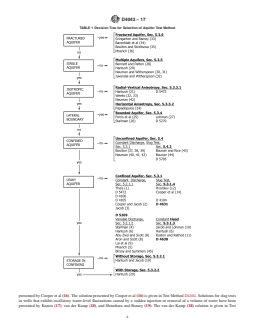
requirements of a test method for observations of water level response in the aquifer. The decision tree in Table 1 is designed to
assist, first, in selecting test methods applicable to specific hydrogeologic site characteristics. Secondly, the decision tree will assist
in selecting a test method on the basis of the nature of the stress on the aquifer imposed by the control well. The decision tree
references the sections in this guide where the test methods are cited.
5.2 Pretest-Selection Procedures—Aquifer test methods are highly specific to the assumptions of the analytical solution of the
test method. Reliability of determination of hydraulic properties depends upon conformance of the hydrologic site characteristics
to the assumptions of the test method. A prerequisite for selecting an aquifer test method is knowledge of the hydrogeology of the
test site. A conceptual understanding of the hydrogeology of the aquifer system at the prospective test site should be gained in as
much detail as possiblepracticable from existing literature and data, and a site reconnaissance. In developing a site characterization,
incorporate geologic mapping, driller’s logs, geophysical logs, records of existing wells, water-level and water-quality data, and
results of geophysical surveys. Include information on the thickness, lithology, stratification, depth, attitude, continuity, and extent
of the aquifer and confining beds.
5.3 Select Applicable Aquifer Test Methods—Select a test method based on conformation of the site hydrogeology to
assumptions of the test model and the parameters to be determined. A summary of principal aquifer test methods and their
applicability to hydrogeologic site conditions is given in the following paragraphs. The decision tree for aquifer test selection,
Table 1, provides a graphic display of the hydrogeologic site conditions for each test method and references to the section where
each test method is cited.
5.3.1 Extensive, Isotropic, Homogeneous, Confined, Nonleaky Aquifer:
5.3.1.1 Constant Discharge—Test method in which the discharge or injection rate in the control well is constant are given by
the nonequilibrium method of Theis (1) for the drawdown and recovery phases. The Theis test method is the most widely
referenced and applied aquifer test method and is the basis for the solution to other more complicated boundary condition
problems. The Theis test method for the pumping or injection phase is given in Test Method D4106. Cooper and Jacob (2) and
Jacob (3) recognized that for large values of time and small values of distance from the control well, the Theis solution yields a
straight line on semilogarithmic plots of various combinations of drawdown and distance from the control well. The solution of
the Theis equation can therefore be simplified by the use of semilogarithmic plots. The modified Theis nonequilibrium test method
is given in Test Method D4105. A test method for estimating transmissivity from specific capacity by the Theis method is given
in Test Method D5472. Test Method D5716 provides a means of means of measuring discharge from high capacity wells. Test
Method D5269 provides a method of determining transmissivity in a non-leaky aquifer.
5.3.1.2 Variable Discharge—Test methods for a variably discharging control well have been presented by Stallman (4) and
Moench (5) and Birsoy and Summers (6). These test methods simulate pumpage as a sequence of constant-rate stepped changes
in discharge. The test methods utilize the principle of superposition in constructing type curves by summing the effects of
successive changes in discharge. The type curves may be derived for control wells discharging from extensive, leaky, and nonleaky
confined aquifers or any situation situations where the response to a unit stress is known. Hantush (7) developed drawdown
functions for three types of decreases in control-well discharge. Abu-Zied and Scott (8) presented a general solution for drawdown
in an extensive confined aquifer in which the discharge of the control well decreases at an exponential rate. Aron and Scott (9)
proposed an approximate test method of determining transmissivity and storage from an aquifer test in which discharge decreases
with time during the early part of the test. Lai et al (10) presented test methods for determining the drawdown in an aquifer taking
into account storage in the control well and having an exponentially and linearly decreasing discharge.
5.3.1.3 Constant Drawdown—Test methods have been presented to determine hydraulic-head distribution around a discharging
well in a confined aquifer with near constant drawdown. Such conditions are most commonly achieved by shutting in a flowing
well long enough for the head to fully recover, then opening the well. The solutions of Jacob and Lohman (11) and Hantush (7)
apply to aerially extensive, nonleaky aquifers. Rushton and Rathod (12) used a numerical model to analyze aquifer-test data. Reed
(13) presents a computer program that includes some of the above procedures and also includes discharge as a fifth-degree
polynomial of time. Practice D5786 provides information on performing constant drawdown tests in flowing wells.
5.3.1.4 Slug Test Methods—Test methods for estimating transmissivity by injecting a given quantity or slug of water into a well
were introduced by Hvorslev (14) and Ferris and Knowles (15). Solutions to overdamped well response to slug tests have also been
The boldface numbers in parentheses refer to the list of references at the end of this guide.
D4043 − 17
TABLE 1 Decision Tree for Selecti
...