

ASTM D4630-19
(Test Method)Standard Test Method for Determining Transmissivity and Storage Coefficient of Low-Permeability Rocks by In Situ Measurements Using the Constant Head Injection Test
General Information
- Abstract
SIGNIFICANCE AND USE
5.1 Test Method—The constant pressure injection test method is used to determine the transmissivity and storativity of low-permeability formations surrounding packed-off intervals. Advantages of the method are: (1) it avoids the effect of well-bore storage, (2) it may be employed over a wide range of rock mass permeabilities, and (3) it is considerably shorter in duration than the conventional pump and slug tests used in more permeable rocks.
5.2 Analysis—The transient water flow rate data obtained using the suggested test method are evaluated by the curve-matching technique described by Jacob and Lohman (1)4 and extended to analysis of single fractures by Doe et al. (2). If the water flow rate attains steady state, it may be used to calculate the transmissivity of the test interval (3).
Note 2: The quality of the result produced by this standard is dependent on the competence of the personnel performing it, and the suitability of the equipment and facilities used. Agencies that meet the criteria of Practice D3740 are generally considered capable of competent and objective testing/sampling/inspection/etc. Users of this standard are cautioned that compliance with Practice D3740 does not in itself assure reliable results. Reliable results depend on many factors; Practice D3740 provides a means of evaluating some of those factors.
Note 3: The function of wells in any unconfined setting in a fractured terrain might make the determination of k problematic because the wells might only intersect tributary or subsidiary channels or conduits. The problems determining the k of a channel or conduit notwithstanding, the partial penetration of tributary channels may make determination of a meaningful number difficult. If plots of k in carbonates and other fractured settings are made and compared, they may show no indication that there are conduits or channels present, except when with the lowest probability one maybe intersected by a borehole and can be verified, such pr...
SCOPE
1.1 This test method covers a field procedure for determining the transmissivity and storativity of geological formations having permeabilities lower than 10−3 μm2 (1 millidarcy) using constant head injection.
1.2 The transmissivity and storativity values determined by this test method provide a good approximation of the capacity of the zone of interest to transmit water, if the test intervals are representative of the entire zone and the surrounding rock is fully water-saturated.
1.3 Units—The values stated in SI units are to be regarded as standard. No other units of measurement are included in this standard. Reporting of test results in units other than SI shall not be regarded as nonconformance with this standard.
Note 1: Unit Conversions—The permeability of a formation is often expressed in terms of the unit darcy (non-SI). A porous medium has a permeability of 1 Darcy when a fluid of viscosity 1 cp (1 mPa·s) flows through it at a rate of 1 cm3/s (10–6 m3/s)/1 cm2 (10–4 m2) cross-sectional area at a pressure differential of 1 atm (101.4 kPa)/1 cm (10 mm) of length. One Darcy corresponds to 0.987 μm2. For water as the flowing fluid at 20°C, a hydraulic conductivity of 9.66 μm/s corresponds to a permeability of 1 Darcy. Permeabilities may also be expressed as millidarcy (md), which is not an SI unit.
1.4 All observed and calculated values shall conform to the guidelines for significant digits and rounding established in Practice D6026.
1.4.1 The procedures used to specify how data are collected/recorded or calculated, in this standard are regarded as the industry standard. In addition, they are representative of the significant digits that generally should be retained. The procedures used do not consider material variation, purpose for obtaining the data, special purpose studies, or any considerations for the user’s objectives; and it is common practice to increase or reduce significant digits of repor...
- Status
- Published
- Publication Date
- 31-Jan-2019
- Technical Committee
- D18 - Soil and Rock
- Drafting Committee
- D18.21 - Groundwater and Vadose Zone Investigations
Overview
ASTM D4630-19, titled Standard Test Method for Determining Transmissivity and Storage Coefficient of Low-Permeability Rocks by In Situ Measurements Using the Constant Head Injection Test, is a key international standard used to evaluate groundwater flow characteristics in low-permeability geological formations. Developed by ASTM International, this standard outlines a field procedure for measuring the transmissivity and storativity (storage coefficient) of rocks-crucial properties for hydrological investigations, site assessments, and resource management in environments where flow through rock is limited.
The constant head injection test method offers several advantages:
- Minimizes the effects of well-bore storage on the results
- Applicable across a wide range of rock mass permeabilities
- Shorter testing durations compared to conventional pumping and slug tests used for more permeable rocks
This standard ensures measurements are consistent, reliable, and internationally accepted, underscoring its critical role in groundwater engineering and geotechnical practices.
Key Topics
- Transmissivity and Storativity Measurement: The standard focuses on determining how much water a geological formation can transmit and store, crucial for evaluating groundwater resources.
- Field Procedure: Details step-by-step methods for conducting in situ tests using boreholes with packed-off intervals, applying constant pressure, and measuring water flow rates over time.
- Data Analysis Techniques: Provides guidance on interpreting test data using established curve-matching techniques (notably those of Jacob and Lohman) to derive accurate hydrogeological parameters.
- Applicability: Effective for formations with permeabilities lower than 10−3 μm² (1 millidarcy), making it suitable for tight rocks where traditional aquifer testing is not feasible.
- Quality Assurance: Emphasizes the importance of competent personnel, proper equipment calibration, and adherence to related ASTM practices (such as D3740 and D6026) for consistent results.
- Reporting and Documentation: Outlines standard practices for data recording, result presentation, and error analysis to improve transparency and reproducibility.
Applications
ASTM D4630-19 is widely used in geotechnical and environmental engineering for:
- Groundwater Resource Evaluation: Assessing aquifer properties in regions characterized by low-permeability rocks, such as shale, granite, or dense limestone.
- Environmental Site Investigations: Monitoring potential contaminant migration in low-transmissivity formations, important for waste management and remediation projects.
- Engineering and Construction Projects: Providing critical inputs for infrastructure design where subsurface water movement in bedrock impacts foundations, tunnels, or excavations.
- Hydrologic Modeling and Risk Assessment: Supplying essential data for numerical models predicting groundwater flow and storage in fractured and heterogeneous rock masses.
- Research and Academic Studies: Serving as a benchmark method for comparative studies in hydrogeology, karst environments, and fractured reservoirs.
Related Standards
Several standards complement ASTM D4630-19 by providing essential definitions, practices, and background for hydrogeological testing:
- ASTM D653 – Terminology Relating to Soil, Rock, and Contained Fluids
- ASTM D3740 – Practice for Minimum Requirements for Agencies Engaged in Testing and/or Inspection of Soil and Rock as Used in Engineering Design and Construction
- ASTM D6026 – Practice for Using Significant Digits in Geotechnical Data
- ASTM D5717 – Guide for Design of Ground-Water Monitoring Systems in Karst and Fractured-Rock Aquifers
By referencing these standards, ASTM D4630-19 ensures consistency and compatibility with broader engineering and hydrogeological practices.
Keywords: ASTM D4630-19, constant head injection test, transmissivity, storativity, storage coefficient, low-permeability rocks, groundwater testing, in situ measurement, hydrogeology, permeability, field test method, borehole test, ASTM standards
Relations
- Effective Date
- 01-Feb-2019
- Effective Date
- 01-Nov-2023
- Effective Date
- 01-Oct-2019
- Effective Date
- 01-Aug-2014
- Effective Date
- 01-May-2012
- Effective Date
- 01-Mar-2012
- Effective Date
- 01-Sep-2011
- Effective Date
- 01-Sep-2011
- Effective Date
- 01-Mar-2010
- Effective Date
- 01-Jan-2009
- Effective Date
- 01-Dec-2008
- Effective Date
- 01-Nov-2008
- Effective Date
- 01-Mar-2008
- Effective Date
- 15-Dec-2007
- Effective Date
- 01-Nov-2007
Frequently Asked Questions
ASTM D4630-19 is a standard published by ASTM International. Its full title is "Standard Test Method for Determining Transmissivity and Storage Coefficient of Low-Permeability Rocks by In Situ Measurements Using the Constant Head Injection Test". This standard covers: SIGNIFICANCE AND USE 5.1 Test Method—The constant pressure injection test method is used to determine the transmissivity and storativity of low-permeability formations surrounding packed-off intervals. Advantages of the method are: (1) it avoids the effect of well-bore storage, (2) it may be employed over a wide range of rock mass permeabilities, and (3) it is considerably shorter in duration than the conventional pump and slug tests used in more permeable rocks. 5.2 Analysis—The transient water flow rate data obtained using the suggested test method are evaluated by the curve-matching technique described by Jacob and Lohman (1)4 and extended to analysis of single fractures by Doe et al. (2). If the water flow rate attains steady state, it may be used to calculate the transmissivity of the test interval (3). Note 2: The quality of the result produced by this standard is dependent on the competence of the personnel performing it, and the suitability of the equipment and facilities used. Agencies that meet the criteria of Practice D3740 are generally considered capable of competent and objective testing/sampling/inspection/etc. Users of this standard are cautioned that compliance with Practice D3740 does not in itself assure reliable results. Reliable results depend on many factors; Practice D3740 provides a means of evaluating some of those factors. Note 3: The function of wells in any unconfined setting in a fractured terrain might make the determination of k problematic because the wells might only intersect tributary or subsidiary channels or conduits. The problems determining the k of a channel or conduit notwithstanding, the partial penetration of tributary channels may make determination of a meaningful number difficult. If plots of k in carbonates and other fractured settings are made and compared, they may show no indication that there are conduits or channels present, except when with the lowest probability one maybe intersected by a borehole and can be verified, such pr... SCOPE 1.1 This test method covers a field procedure for determining the transmissivity and storativity of geological formations having permeabilities lower than 10−3 μm2 (1 millidarcy) using constant head injection. 1.2 The transmissivity and storativity values determined by this test method provide a good approximation of the capacity of the zone of interest to transmit water, if the test intervals are representative of the entire zone and the surrounding rock is fully water-saturated. 1.3 Units—The values stated in SI units are to be regarded as standard. No other units of measurement are included in this standard. Reporting of test results in units other than SI shall not be regarded as nonconformance with this standard. Note 1: Unit Conversions—The permeability of a formation is often expressed in terms of the unit darcy (non-SI). A porous medium has a permeability of 1 Darcy when a fluid of viscosity 1 cp (1 mPa·s) flows through it at a rate of 1 cm3/s (10–6 m3/s)/1 cm2 (10–4 m2) cross-sectional area at a pressure differential of 1 atm (101.4 kPa)/1 cm (10 mm) of length. One Darcy corresponds to 0.987 μm2. For water as the flowing fluid at 20°C, a hydraulic conductivity of 9.66 μm/s corresponds to a permeability of 1 Darcy. Permeabilities may also be expressed as millidarcy (md), which is not an SI unit. 1.4 All observed and calculated values shall conform to the guidelines for significant digits and rounding established in Practice D6026. 1.4.1 The procedures used to specify how data are collected/recorded or calculated, in this standard are regarded as the industry standard. In addition, they are representative of the significant digits that generally should be retained. The procedures used do not consider material variation, purpose for obtaining the data, special purpose studies, or any considerations for the user’s objectives; and it is common practice to increase or reduce significant digits of repor...
SIGNIFICANCE AND USE 5.1 Test Method—The constant pressure injection test method is used to determine the transmissivity and storativity of low-permeability formations surrounding packed-off intervals. Advantages of the method are: (1) it avoids the effect of well-bore storage, (2) it may be employed over a wide range of rock mass permeabilities, and (3) it is considerably shorter in duration than the conventional pump and slug tests used in more permeable rocks. 5.2 Analysis—The transient water flow rate data obtained using the suggested test method are evaluated by the curve-matching technique described by Jacob and Lohman (1)4 and extended to analysis of single fractures by Doe et al. (2). If the water flow rate attains steady state, it may be used to calculate the transmissivity of the test interval (3). Note 2: The quality of the result produced by this standard is dependent on the competence of the personnel performing it, and the suitability of the equipment and facilities used. Agencies that meet the criteria of Practice D3740 are generally considered capable of competent and objective testing/sampling/inspection/etc. Users of this standard are cautioned that compliance with Practice D3740 does not in itself assure reliable results. Reliable results depend on many factors; Practice D3740 provides a means of evaluating some of those factors. Note 3: The function of wells in any unconfined setting in a fractured terrain might make the determination of k problematic because the wells might only intersect tributary or subsidiary channels or conduits. The problems determining the k of a channel or conduit notwithstanding, the partial penetration of tributary channels may make determination of a meaningful number difficult. If plots of k in carbonates and other fractured settings are made and compared, they may show no indication that there are conduits or channels present, except when with the lowest probability one maybe intersected by a borehole and can be verified, such pr... SCOPE 1.1 This test method covers a field procedure for determining the transmissivity and storativity of geological formations having permeabilities lower than 10−3 μm2 (1 millidarcy) using constant head injection. 1.2 The transmissivity and storativity values determined by this test method provide a good approximation of the capacity of the zone of interest to transmit water, if the test intervals are representative of the entire zone and the surrounding rock is fully water-saturated. 1.3 Units—The values stated in SI units are to be regarded as standard. No other units of measurement are included in this standard. Reporting of test results in units other than SI shall not be regarded as nonconformance with this standard. Note 1: Unit Conversions—The permeability of a formation is often expressed in terms of the unit darcy (non-SI). A porous medium has a permeability of 1 Darcy when a fluid of viscosity 1 cp (1 mPa·s) flows through it at a rate of 1 cm3/s (10–6 m3/s)/1 cm2 (10–4 m2) cross-sectional area at a pressure differential of 1 atm (101.4 kPa)/1 cm (10 mm) of length. One Darcy corresponds to 0.987 μm2. For water as the flowing fluid at 20°C, a hydraulic conductivity of 9.66 μm/s corresponds to a permeability of 1 Darcy. Permeabilities may also be expressed as millidarcy (md), which is not an SI unit. 1.4 All observed and calculated values shall conform to the guidelines for significant digits and rounding established in Practice D6026. 1.4.1 The procedures used to specify how data are collected/recorded or calculated, in this standard are regarded as the industry standard. In addition, they are representative of the significant digits that generally should be retained. The procedures used do not consider material variation, purpose for obtaining the data, special purpose studies, or any considerations for the user’s objectives; and it is common practice to increase or reduce significant digits of repor...
ASTM D4630-19 is classified under the following ICS (International Classification for Standards) categories: 07.060 - Geology. Meteorology. Hydrology. The ICS classification helps identify the subject area and facilitates finding related standards.
ASTM D4630-19 has the following relationships with other standards: It is inter standard links to ASTM D4630-96(2008), ASTM D3740-23, ASTM D3740-19, ASTM D653-14, ASTM D3740-12a, ASTM D3740-12, ASTM D653-11, ASTM D3740-11, ASTM D3740-10, ASTM D653-09, ASTM D653-08a, ASTM D653-08, ASTM D3740-08, ASTM D653-07f, ASTM D653-07e. Understanding these relationships helps ensure you are using the most current and applicable version of the standard.
ASTM D4630-19 is available in PDF format for immediate download after purchase. The document can be added to your cart and obtained through the secure checkout process. Digital delivery ensures instant access to the complete standard document.
Standards Content (Sample)
This international standard was developed in accordance with internationally recognized principles on standardization established in the Decision on Principles for the
Development of International Standards, Guides and Recommendations issued by the World Trade Organization Technical Barriers to Trade (TBT) Committee.
Designation: D4630 − 19
Standard Test Method for
Determining Transmissivity and Storage Coefficient of Low-
Permeability Rocks by In Situ Measurements Using the
Constant Head Injection Test
This standard is issued under the fixed designation D4630; the number immediately following the designation indicates the year of
original adoption or, in the case of revision, the year of last revision.Anumber in parentheses indicates the year of last reapproval.A
superscript epsilon (´) indicates an editorial change since the last revision or reapproval.
1. Scope* commensuratewiththeseconsiderations.Itisbeyondthescope
of this standard to consider significant digits used in analytical
1.1 This test method covers a field procedure for determin-
methods for engineering design.
ing the transmissivity and storativity of geological formations
−3 2
1.5 This standard does not purport to address all of the
havingpermeabilitieslowerthan10 µm (1millidarcy)using
safety concerns, if any, associated with its use. It is the
constant head injection.
responsibility of the user of this standard to establish appro-
1.2 The transmissivity and storativity values determined by
priate safety, health, and environmental practices and deter-
this test method provide a good approximation of the capacity
mine the applicability of regulatory limitations prior to use.
ofthezoneofinteresttotransmitwater,ifthetestintervalsare
1.6 This international standard was developed in accor-
representative of the entire zone and the surrounding rock is
dance with internationally recognized principles on standard-
fully water-saturated.
ization established in the Decision on Principles for the
1.3 Units—The values stated in SI units are to be regarded
Development of International Standards, Guides and Recom-
asstandard.Nootherunitsofmeasurementareincludedinthis
mendations issued by the World Trade Organization Technical
standard. Reporting of test results in units other than SI shall
Barriers to Trade (TBT) Committee.
not be regarded as nonconformance with this standard.
2. Referenced Documents
NOTE 1—Unit Conversions—The permeability of a formation is often
expressed in terms of the unit darcy (non-SI). A porous medium has a
2.1 ASTM Standards:
permeability of 1 Darcy when a fluid of viscosity 1 cp (1 mPa·s) flows
D653Terminology Relating to Soil, Rock, and Contained
3 –6 3 2 –4 2
through it at a rate of 1 cm /s (10 m /s)/1 cm (10 m ) cross-sectional
Fluids
area at a pressure differential of 1 atm (101.4 kPa)/1 cm (10 mm) of
D3740Practice for Minimum Requirements for Agencies
length. One Darcy corresponds to 0.987 µm . For water as the flowing
fluid at 20°C, a hydraulic conductivity of 9.66 µm/s corresponds to a Engaged in Testing and/or Inspection of Soil and Rock as
permeability of 1 Darcy. Permeabilities may also be expressed as
Used in Engineering Design and Construction
millidarcy (md), which is not an SI unit.
D5717Guide for Design of Ground-Water Monitoring Sys-
1.4 All observed and calculated values shall conform to the
tems in Karst and Fractured-Rock Aquifers (Withdrawn
guidelines for significant digits and rounding established in
2005)
Practice D6026.
D6026Practice for Using Significant Digits in Geotechnical
1.4.1 Theproceduresusedtospecifyhowdataarecollected/
Data
recorded or calculated, in this standard are regarded as the
3. Terminology
industry standard. In addition, they are representative of the
significant digits that generally should be retained. The proce-
3.1 Definitions:
dures used do not consider material variation, purpose for
3.1.1 Fordefinitionsofcommontechnicaltermsusedinthis
obtaining the data, special purpose studies, or any consider-
test standard, refer to Terminology D653.
ations for the user’s objectives; and it is common practice to
3.2 Symbols:
increase or reduce significant digits of reported data to be
−1 2
3.2.1 C —bulk rock compressibility (M LT ).
b
ThistestmethodisunderthejurisdictionofASTMCommitteeD18onSoiland
Rock and is the direct responsibility of Subcommittee D18.21 on Groundwater and For referenced ASTM standards, visit the ASTM website, www.astm.org, or
Vadose Zone Investigations. contact ASTM Customer Service at service@astm.org. For Annual Book of ASTM
Current edition approved Feb. 1, 2019. Published February 2019. Originally Standards volume information, refer to the standard’s Document Summary page on
approved in 1986. Last previous edition approved in 2008 as D4630–96(2008), the ASTM website.
which was withdrawn March 2017 and reinstated in February 2019. DOI: 10.1520/ The last approved version of this historical standard is referenced on
D4630-19. www.astm.org.
*A Summary of Changes section appears at the end of this standard
Copyright © ASTM International, 100 Barr Harbor Drive, PO Box C700, West Conshohocken, PA 19428-2959. United States
D4630 − 19
−1 2 4
3.2.2 C —compressibility of water (M LT ). matching technique described by Jacob and Lohman (1) and
w
extended to analysis of single fractures by Doe et al. (2). If the
3.2.3 G—dimensionless function.
water flow rate attains steady state, it may be used to calculate
−1
3.2.4 K—hydraulic conductivity (LT ).
the transmissivity of the test interval (3).
3.2.4.1 Discussion—The use of symbol K for the term
NOTE 2—The quality of the result produced by this standard is
hydraulic conductivity is the predominant usage in groundwa-
dependent on the competence of the personnel performing it, and the
ter literature by hydrogeologists, whereas the symbol k is suitability of the equipment and facilities used. Agencies that meet the
criteria of Practice D3740 are generally considered capable of competent
commonly used for this term in the rock and soil mechanics
and objective testing/sampling/inspection/etc. Users of this standard are
and soil science literature.
cautioned that compliance with Practice D3740 does not in itself assure
−1 −2
3.2.5 P—excess test hole pressure (ML T ).
reliable results. Reliable results depend on many factors; Practice D3740
3 −1
provides a means of evaluating some of those factors.
3.2.6 Q—excess water flow rate (L T ).
NOTE 3—The function of wells in any unconfined setting in a fractured
3 −1
3.2.7 Q —maximum excess water flow rate (L T ).
terrain might make the determination of k problematic because the wells
o
might only intersect tributary or subsidiary channels or conduits. The
3.2.8 S—storativity (or storage coefficient) (dimensionless).
problems determining the k of a channel or conduit notwithstanding, the
−1
3.2.9 S —specific storage (L ). partial penetration of tributary channels may make determination of a
s
meaningfulnumberdifficult.Ifplotsofkincarbonatesandotherfractured
2 −1
3.2.10 T—transmissivity (L T ).
settings are made and compared, they may show no indication that there
are conduits or channels present, except when with the lowest probability
3.2.11 b—formation thickness (L).
one maybe intersected by a borehole and can be verified, such problems
3.2.12 e—fracture aperture (L).
are described by Worthington (4) and Smart, 1999 (5). Additional
−2
guidance can be found in Guide D5717.
3.2.13 g—acceleration due to gravity (LT ).
3.2.14 k—permeability (L ).
6. Apparatus
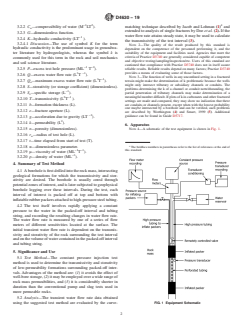
3.2.15 n—porosity (dimensionless). NOTE 4—A schematic of the test equipment is shown in Fig. 1.
3.2.16 r —radius of test hole (L).
w
3.2.17 t—time elapsed from start of test (T).
Theboldfacenumbersinparenthesesrefertothelistofreferencesattheendof
3.2.18 α—dimensionless parameter.
−1 −1
this standard.
3.2.19 µ—viscosity of water (ML T ).
−3
3.2.20 ρ—density of water (ML ).
4. Summary of Test Method
4.1 Aboreholeisfirstdrilledintotherockmass,intersecting
geological formations for which the transmissivity and stor-
ativity are desired. The borehole is usually cored through
potentialzonesofinterest,andislatersubjectedtogeophysical
borehole logging over these intervals. During the test, each
interval of interest is packed off at top and bottom with
inflatablerubberpackersattachedtohigh-pressuresteeltubing.
4.2 The test itself involves rapidly applying a constant
pressure to the water in the packed-off interval and tubing
string, and recording the resulting changes in water flow rate.
The water flow rate is measured by one of a series of flow
meters of different sensitivities located at the surface. The
initial transient water flow rate is dependent on the transmis-
sivity and storativity of the rock surrounding the test interval
andonthevolumeofwatercontainedinthepacked-offinterval
and tubing string.
5. Significance and Use
5.1 Test Method—The constant pressure injection test
method is used to determine the transmissivity and storativity
of low-permeability formations surrounding packed-off inter-
vals. Advantages of the method are: (1) it avoids the effect of
well-borestorage,(2)itmaybeemployedoverawiderangeof
rock mass permeabilities, and (3) it is considerably shorter in
duration than the conventional pump and slug tests used in
more permeable rocks.
5.2 Analysis—The transient water flow rate data obtained
using the suggested test method are evaluated by the curve- FIG. 1 Equipment Schematic
D4630 − 19
6.1 Source of Constant Pressure—A pump or pressure inductionandgamma-gammadensitylogs.Wheneverpossible,
intensifier capable of providing an additional amount of water also use sonic logs and the acoustic televiewer. Run other logs
to the water-filled tubing string and packed-off test interval to as needed.
produce a constant pressure of up to 1 MPa in magnitude,
7.1.6 Washing Test Holes—The test holes must not contain
preferably with a rise time of less than 1% of one half of the
any material that could be washed into the permeable zones
flow rate decay (Q/Q =0.5).
during testing, thereby changing the transmissivity and stor-
o
ativity. Flush the test holes with clean water until the return is
6.2 Packers—Hydraulically actuated packers are recom-
free from cuttings and other dispersed solids.
mended because they produce a positive seal on the borehole
wall and because of the low compressibility of water they are
7.2 Test Intervals:
alsocomparativelyrigid.Eachpackershallsealaportionofthe
7.2.1 Selection of Test Intervals—Determine test intervals
boreholewallatleast0.5minlength,withanappliedpressure
from the core descriptions, geophysical borehole logs, and, if
at least equal to the excess constant pressure to be applied to
necessary, from visual observation of the borehole with a
the packed-off interval and less than the formation fracture
borescope or TV camera.
pressure at that depth.
7.2.2 Changes in Lithology—Test each major change in
6.3 Pressure Transducers—The pressure shall be measured
lithology that can be isolated between packers.
as a function of time, with the transducer located in the
7.2.3 Sampling Discontinuities—Discontinuities are often
packed-off test interval. The pressure transducer shall have an
the major permeable features in hard rock. Test jointed zones,
accuracyofatleast 63kPa,includingerrorsintroducedbythe
fault zones, bedding planes, and the like, both by isolating
recording system, and a resolution of at least 1 kPa.
individual features and by evaluating the combined effects of
6.4 Flow Meters—Suitable flow meters shall be provided
several features.
3 3
for measuring water flow rates in the range from 10 cm /s to
7.2.4 Redundancy of Tests—To evaluate variability in trans-
−3 3
10 cm /s.Commerciallyavailableflowmetersarecapableof
missivity and storativity, conduct three or more tests in each
2 3
measuring flow rates as low as 10 cm /s with an accuracy of
rock type. If the rock is not homogeneous, the sets of tests
−5 3
61% and with a resolution of 10 cm /s; these can test
should encompass similar types of discontinuities.
−3
permeabilities to 10 md based on a 10-m packer spacing.
7.3 Test Water:
Positive displacement flow meters of either the tank type
7.3.1 Water Quality—Water used for pressure pulse tests
(Haimson and Doe (6) or bubble-type (Wilson, et al (3) are
−3 3
shall be potable and free of particulates, and compatible with
capableofmeasuringflowratesaslowas10 cm /s;thesecan
−4
the formation. Even small amounts of dispersed solids in the
testpermeabilitiesto10 mdbasedona10-mpackerspacing.
injectionwatercouldplugtherockfaceofthetestintervaland
6.5 Hydraulic Systems—The inflatable rubber packers shall
result in a measured transmissivity value that is erroneously
be attached to high-pressure steel tubing reaching to the
low.
surface. The packers themselves shall be inflated with water
7.3.2 Temperature—The lower limit of the test water tem-
using a separate hydraulic system. The pump or pressure
perature shall be 5°C below that of the rock mass to be tested.
intensifier providing the constant pressure shall be attached to
Cold water injected into a warm rock mass causes air to come
thesteeltubingatthesurface.Aremotelycontrolleddown-hole
out of solution, and the resulting bubbles will radically modify
valve, located in the steel tubing immediately above the upper
the pressure transient characteristics.
packer, shall be used for shutting in the test interval and for
instantaneous starting of tests.
7.4 Testing:
7.4.1 Filling and Purging System—Once the packers have
7. Procedure
been set, slowly fill the tubing string and packed-off interval
with water to make sure that no air bubbles will be trapped in
7.1 Drilling Test Holes:
the test interval and tubing. Close the downhole valve to shut
7.1.1 Number and Orientation—The number of test holes
in the test interval, and allow the test section pressures (as
will be sufficient to supply the detail required by the scope of
determined from downhole pressure transducer reading) to
the project. The test holes will be directed to intersect major
dissipate.
fracture sets, preferably at right angles.
7.1.2 Test Hole Quality—The drilling procedure will pro- 7.4.2 Constant Pressure Test—Pressurize the tubing, typi-
vide a borehole sufficiently smooth for packer seating, shall cally to between 300 and 600 kPa above the shut-in pressure.
contain no rapid changes in direction, and will minimize
This range of pressures is in most cases sufficiently low to
formation damage. minimizedistortionoffracturesadjacentatthetesthole,butin
7.1.3 Test Holes Cored—Core the test holes through zones no case should the pressure exceed the minimum principal
of potent
...