

ASTM D5920/D5920M-20
(Practice)Standard Practice for (Analytical Procedure) Tests of Anisotropic Unconfined Aquifers by Neuman Method
General Information
- Abstract
SIGNIFICANCE AND USE
5.1 Assumptions:
5.1.1 The control well discharges at a constant rate, Q.
5.1.2 The control well, observation wells, and piezometers are of infinitesimal diameter.
5.1.3 The unconfined aquifer is homogeneous and really extensive.
5.1.4 Discharge from the control well is derived initially from elastic storage in the aquifer, and later from gravity drainage from the water table.
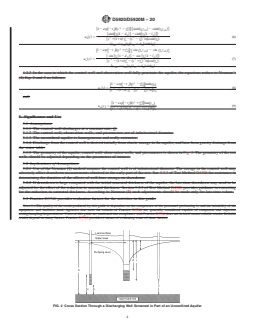
5.1.5 The geometry of the aquifer, control well, observation wells, and piezometers is shown in Fig. 2. The geometry of the test wells should be adjusted depending on the parameters of interest.
FIG. 2 Cross Section Through a Discharging Well Screened in Part of an Unconfined Aquifer
5.2 Implications of Assumptions:
5.2.1 Use of the Neuman (1) method assumes the control well is of infinitesimal diameter. The storage in the control well may adversely affect drawdown measurements obtained in the early part of the test. See 5.2.2 of Practice D4106 for assistance in determining the duration of the effects of well-bore storage on drawdown.
5.2.2 If drawdown is large compared with the initial saturated thickness of the aquifer, the late-time drawdown may need to be adjusted for the effect of the reduction in saturated thickness. Section 5.2.3 of Practice D4106 provides guidance in correcting for the reduction in saturated thickness. According to Neuman (1) such adjustments should be made only for late-time values.
5.3 Practice D3740 provides evaluation factors for the activities in this practice.
Note 1: The quality of the result produced by this practice is dependent on the competence of the personnel performing it, and the suitability of the equipment and facilities used. Agencies that meet the criteria of Practice D3740 are generally considered capable of competent and objective testing/sampling/inspection/etc. Users of this practice are cautioned that compliance with Practice D3740 does not in itself ensure reliable results. Reliable results depend on many fact...
SCOPE
1.1 This practice covers an analytical procedure for determining the transmissivity, storage coefficient, specific yield, and horizontal-to-vertical hydraulic conductivity ratio of an unconfined aquifer. It is used to analyze the drawdown of water levels in piezometers and partially or fully penetrating observation wells during pumping from a control well at a constant rate.
1.2 The analytical procedure given in this practice is used in conjunction with Guide D4043 and Test Method D4050.
1.3 The valid use of the Neuman method is limited to determination of transmissivities for aquifers in hydrogeologic settings with reasonable correspondence to the assumptions of the theory.
1.4 Units—The values stated in either SI units or inch-pound units are to be regarded separately as standard. The values stated in each system may not be exact equivalents; therefore, each system shall be used independently of the other. Combining values from the two systems may result in nonconformance with the standard. Reporting of test result in units other than SI shall not be regarded as nonconformance with this standard.
1.5 All observed and calculated values shall conform to the guidelines for significant digits and rounding established in Practice D6026.
1.5.1 The procedures used to specify how data are collected/recorded or calculated in the standard are regarded as the industry standard. In addition, they are representative of the significant digits that generally should be retained. The procedures used do not consider material variation, purpose for obtaining the data, special purpose studies, or any considerations for the user’s objectives; and it is common practice to increase or reduce significant digits of reported data to be commensurate with these considerations. It is beyond the scope of this standard to consider significant digits used in analysis methods for engineering data.
1.6 This practice offers a set of in...
- Status
- Published
- Publication Date
- 14-May-2020
- Technical Committee
- D18 - Soil and Rock
- Drafting Committee
- D18.21 - Groundwater and Vadose Zone Investigations
Buy Documents
ASTM D5920/D5920M-20 - Standard Practice for (Analytical Procedure) Tests of Anisotropic Unconfined Aquifers by Neuman Method
REDLINE ASTM D5920/D5920M-20 - Standard Practice for (Analytical Procedure) Tests of Anisotropic Unconfined Aquifers by Neuman Method
Overview
ASTM D5920/D5920M-20 is the standard practice issued by ASTM for conducting and analyzing tests of anisotropic unconfined aquifers using the Neuman method. This standard provides an analytical approach to determine key hydraulic properties-such as transmissivity, storage coefficient, specific yield, and the ratio of horizontal to vertical hydraulic conductivity-of unconfined aquifers. The Neuman method is widely recognized for its applicability in pumping tests that assess groundwater flow characteristics in aquifers that do not exhibit isotropy or complete confinement.
This standard practice is essential for hydrogeologists, engineers, and environmental professionals engaged in groundwater investigations, resource management, and contaminant transport studies.
Key Topics
- Analytical Procedure: The standard describes analytical procedures for evaluating aquifer properties based on drawdown data from pumping tests in anisotropic unconfined aquifers. The practice covers both type-curve and semilogarithmic analysis methods.
- Key Assumptions: The Neuman method relies on several assumptions, including constant discharge rates from the control well, infinitesimal diameters for wells and piezometers, and the aquifer being homogeneous and extensive. It also assumes initial drawdown is due to elastic storage, followed by gravity drainage.
- Significance of Use: Results provide critical parameters for groundwater resource evaluation:
- Transmissivity indicates the ability of the aquifer to transmit water horizontally.
- Storage coefficient and specific yield determine the aquifer's water release/storage capacity.
- Hydraulic conductivity ratio characterizes anisotropy by comparing horizontal and vertical water movement.
- Reporting Requirements: Users are required to document the site hydrogeology, test installation details, field data, and analysis results, including conformity to associated ASTM guides and standards.
Applications
ASTM D5920/D5920M-20 is applicable in a variety of hydrogeologic and engineering contexts:
- Groundwater Resource Assessment: Determining the availability and sustainable yield of unconfined aquifers for municipal, agricultural, and industrial water supply.
- Environmental Investigations: Characterizing groundwater flow and contaminant transport pathways in environmental site assessments and remediation projects.
- Aquifer Storage and Recovery (ASR): Assessing aquifer suitability for managed recharge or temporary storage.
- Infrastructure Development: Supporting design and construction of well fields, water treatment plants, landfills, and other projects that interact with shallow groundwater systems.
By accurately determining aquifer parameters using standardized procedures, practitioners can make informed decisions on groundwater management, permitting, and protection.
Related Standards
Several ASTM standards complement or are referenced by ASTM D5920/D5920M-20:
- ASTM D653 - Terminology Relating to Soil, Rock, and Contained Fluids
- ASTM D3740 - Practice for Minimum Requirements for Agencies Engaged in Testing and/or Inspection of Soil and Rock
- ASTM D4043 - Guide for Selection of Aquifer Test Method in Determining Hydraulic Properties by Well Techniques
- ASTM D4050 - Test Method for Withdrawal and Injection Well Testing for Aquifer Systems
- ASTM D4105/D4106 - Analytical Procedures for Confined Aquifers
- ASTM D6026 - Practice for Using Significant Digits in Geotechnical Data
These related standards ensure consistent terminology, quality control, selection of appropriate test methods, and reliable data reporting across groundwater and geotechnical investigations.
Keywords: ASTM D5920, Neuman method, unconfined aquifer, anisotropic aquifer, aquifer test, transmissivity, storage coefficient, specific yield, horizontal vertical hydraulic conductivity, groundwater, pumping test, observation well, hydrogeology, ASTM standards.
Relations
- Effective Date
- 01-Nov-2023
- Effective Date
- 01-Jan-2020
- Effective Date
- 01-Oct-2019
- Effective Date
- 01-Jan-2017
- Effective Date
- 15-Apr-2015
- Effective Date
- 15-Apr-2015
- Effective Date
- 01-Aug-2014
- Effective Date
- 01-Jun-2014
- Effective Date
- 01-May-2012
- Effective Date
- 01-Mar-2012
- Effective Date
- 01-Sep-2011
- Effective Date
- 01-Sep-2011
- Effective Date
- 01-Aug-2010
- Effective Date
- 01-Mar-2010
- Effective Date
- 01-Jan-2009
Buy Documents
ASTM D5920/D5920M-20 - Standard Practice for (Analytical Procedure) Tests of Anisotropic Unconfined Aquifers by Neuman Method
REDLINE ASTM D5920/D5920M-20 - Standard Practice for (Analytical Procedure) Tests of Anisotropic Unconfined Aquifers by Neuman Method
Frequently Asked Questions
ASTM D5920/D5920M-20 is a standard published by ASTM International. Its full title is "Standard Practice for (Analytical Procedure) Tests of Anisotropic Unconfined Aquifers by Neuman Method". This standard covers: SIGNIFICANCE AND USE 5.1 Assumptions: 5.1.1 The control well discharges at a constant rate, Q. 5.1.2 The control well, observation wells, and piezometers are of infinitesimal diameter. 5.1.3 The unconfined aquifer is homogeneous and really extensive. 5.1.4 Discharge from the control well is derived initially from elastic storage in the aquifer, and later from gravity drainage from the water table. 5.1.5 The geometry of the aquifer, control well, observation wells, and piezometers is shown in Fig. 2. The geometry of the test wells should be adjusted depending on the parameters of interest. FIG. 2 Cross Section Through a Discharging Well Screened in Part of an Unconfined Aquifer 5.2 Implications of Assumptions: 5.2.1 Use of the Neuman (1) method assumes the control well is of infinitesimal diameter. The storage in the control well may adversely affect drawdown measurements obtained in the early part of the test. See 5.2.2 of Practice D4106 for assistance in determining the duration of the effects of well-bore storage on drawdown. 5.2.2 If drawdown is large compared with the initial saturated thickness of the aquifer, the late-time drawdown may need to be adjusted for the effect of the reduction in saturated thickness. Section 5.2.3 of Practice D4106 provides guidance in correcting for the reduction in saturated thickness. According to Neuman (1) such adjustments should be made only for late-time values. 5.3 Practice D3740 provides evaluation factors for the activities in this practice. Note 1: The quality of the result produced by this practice is dependent on the competence of the personnel performing it, and the suitability of the equipment and facilities used. Agencies that meet the criteria of Practice D3740 are generally considered capable of competent and objective testing/sampling/inspection/etc. Users of this practice are cautioned that compliance with Practice D3740 does not in itself ensure reliable results. Reliable results depend on many fact... SCOPE 1.1 This practice covers an analytical procedure for determining the transmissivity, storage coefficient, specific yield, and horizontal-to-vertical hydraulic conductivity ratio of an unconfined aquifer. It is used to analyze the drawdown of water levels in piezometers and partially or fully penetrating observation wells during pumping from a control well at a constant rate. 1.2 The analytical procedure given in this practice is used in conjunction with Guide D4043 and Test Method D4050. 1.3 The valid use of the Neuman method is limited to determination of transmissivities for aquifers in hydrogeologic settings with reasonable correspondence to the assumptions of the theory. 1.4 Units—The values stated in either SI units or inch-pound units are to be regarded separately as standard. The values stated in each system may not be exact equivalents; therefore, each system shall be used independently of the other. Combining values from the two systems may result in nonconformance with the standard. Reporting of test result in units other than SI shall not be regarded as nonconformance with this standard. 1.5 All observed and calculated values shall conform to the guidelines for significant digits and rounding established in Practice D6026. 1.5.1 The procedures used to specify how data are collected/recorded or calculated in the standard are regarded as the industry standard. In addition, they are representative of the significant digits that generally should be retained. The procedures used do not consider material variation, purpose for obtaining the data, special purpose studies, or any considerations for the user’s objectives; and it is common practice to increase or reduce significant digits of reported data to be commensurate with these considerations. It is beyond the scope of this standard to consider significant digits used in analysis methods for engineering data. 1.6 This practice offers a set of in...
SIGNIFICANCE AND USE 5.1 Assumptions: 5.1.1 The control well discharges at a constant rate, Q. 5.1.2 The control well, observation wells, and piezometers are of infinitesimal diameter. 5.1.3 The unconfined aquifer is homogeneous and really extensive. 5.1.4 Discharge from the control well is derived initially from elastic storage in the aquifer, and later from gravity drainage from the water table. 5.1.5 The geometry of the aquifer, control well, observation wells, and piezometers is shown in Fig. 2. The geometry of the test wells should be adjusted depending on the parameters of interest. FIG. 2 Cross Section Through a Discharging Well Screened in Part of an Unconfined Aquifer 5.2 Implications of Assumptions: 5.2.1 Use of the Neuman (1) method assumes the control well is of infinitesimal diameter. The storage in the control well may adversely affect drawdown measurements obtained in the early part of the test. See 5.2.2 of Practice D4106 for assistance in determining the duration of the effects of well-bore storage on drawdown. 5.2.2 If drawdown is large compared with the initial saturated thickness of the aquifer, the late-time drawdown may need to be adjusted for the effect of the reduction in saturated thickness. Section 5.2.3 of Practice D4106 provides guidance in correcting for the reduction in saturated thickness. According to Neuman (1) such adjustments should be made only for late-time values. 5.3 Practice D3740 provides evaluation factors for the activities in this practice. Note 1: The quality of the result produced by this practice is dependent on the competence of the personnel performing it, and the suitability of the equipment and facilities used. Agencies that meet the criteria of Practice D3740 are generally considered capable of competent and objective testing/sampling/inspection/etc. Users of this practice are cautioned that compliance with Practice D3740 does not in itself ensure reliable results. Reliable results depend on many fact... SCOPE 1.1 This practice covers an analytical procedure for determining the transmissivity, storage coefficient, specific yield, and horizontal-to-vertical hydraulic conductivity ratio of an unconfined aquifer. It is used to analyze the drawdown of water levels in piezometers and partially or fully penetrating observation wells during pumping from a control well at a constant rate. 1.2 The analytical procedure given in this practice is used in conjunction with Guide D4043 and Test Method D4050. 1.3 The valid use of the Neuman method is limited to determination of transmissivities for aquifers in hydrogeologic settings with reasonable correspondence to the assumptions of the theory. 1.4 Units—The values stated in either SI units or inch-pound units are to be regarded separately as standard. The values stated in each system may not be exact equivalents; therefore, each system shall be used independently of the other. Combining values from the two systems may result in nonconformance with the standard. Reporting of test result in units other than SI shall not be regarded as nonconformance with this standard. 1.5 All observed and calculated values shall conform to the guidelines for significant digits and rounding established in Practice D6026. 1.5.1 The procedures used to specify how data are collected/recorded or calculated in the standard are regarded as the industry standard. In addition, they are representative of the significant digits that generally should be retained. The procedures used do not consider material variation, purpose for obtaining the data, special purpose studies, or any considerations for the user’s objectives; and it is common practice to increase or reduce significant digits of reported data to be commensurate with these considerations. It is beyond the scope of this standard to consider significant digits used in analysis methods for engineering data. 1.6 This practice offers a set of in...
ASTM D5920/D5920M-20 is classified under the following ICS (International Classification for Standards) categories: 07.060 - Geology. Meteorology. Hydrology. The ICS classification helps identify the subject area and facilitates finding related standards.
ASTM D5920/D5920M-20 has the following relationships with other standards: It is inter standard links to ASTM D3740-23, ASTM D4050-20, ASTM D3740-19, ASTM D4043-17, ASTM D4106-15, ASTM D4105/D4105M-15e1, ASTM D653-14, ASTM D4050-14, ASTM D3740-12a, ASTM D3740-12, ASTM D3740-11, ASTM D653-11, ASTM D4043-96(2010)e1, ASTM D3740-10, ASTM D653-09. Understanding these relationships helps ensure you are using the most current and applicable version of the standard.
ASTM D5920/D5920M-20 is available in PDF format for immediate download after purchase. The document can be added to your cart and obtained through the secure checkout process. Digital delivery ensures instant access to the complete standard document.
Standards Content (Sample)
This international standard was developed in accordance with internationally recognized principles on standardization established in the Decision on Principles for the
Development of International Standards, Guides and Recommendations issued by the World Trade Organization Technical Barriers to Trade (TBT) Committee.
Designation:D5920/D5920M −20
Standard Practice for
(Analytical Procedure) Tests of Anisotropic Unconfined
Aquifers by Neuman Method
This standard is issued under the fixed designation D5920/D5920M; the number immediately following the designation indicates the
year of original adoption or, in the case of revision, the year of last revision. A number in parentheses indicates the year of last
reapproval. A superscript epsilon (´) indicates an editorial change since the last revision or reapproval.
1. Scope* of this standard to consider significant digits used in analysis
methods for engineering data.
1.1 This practice covers an analytical procedure for deter-
mining the transmissivity, storage coefficient, specific yield, 1.6 This practice offers a set of instructions for performing
and horizontal-to-vertical hydraulic conductivity ratio of an one or more specific operations. This document cannot replace
unconfinedaquifer.Itisusedtoanalyzethedrawdownofwater education or experience and should be used in conjunction
levels in piezometers and partially or fully penetrating obser- with professional judgment. Not all aspects of the practice may
vation wells during pumping from a control well at a constant be applicable in all circumstances. This ASTM standard is not
rate. intended to represent or replace the standard of care by which
the adequacy of a given professional service must be judged,
1.2 Theanalyticalproceduregiveninthispracticeisusedin
nor should this document be applied without the consideration
conjunction with Guide D4043 and Test Method D4050.
of a project’s many unique aspects. The word “Standard” in
1.3 The valid use of the Neuman method is limited to
the title of this document means only that the document has
determination of transmissivities for aquifers in hydrogeologic
been approved through the ASTM consensus process.
settings with reasonable correspondence to the assumptions of
1.7 This standard does not purport to address all of the
the theory.
safety concerns, if any, associated with its use. It is the
1.4 Units—The values stated in either SI units or inch-
responsibility of the user of this standard to establish appro-
pound units are to be regarded separately as standard. The
priate safety, health, and environmental practices and deter-
values stated in each system may not be exact equivalents;
mine the applicability of regulatory limitations prior to use.
therefore,eachsystemshallbeusedindependentlyoftheother.
1.8 This international standard was developed in accor-
Combining values from the two systems may result in noncon-
dance with internationally recognized principles on standard-
formance with the standard. Reporting of test result in units
ization established in the Decision on Principles for the
other than SI shall not be regarded as nonconformance with
Development of International Standards, Guides and Recom-
this standard.
mendations issued by the World Trade Organization Technical
Barriers to Trade (TBT) Committee.
1.5 All observed and calculated values shall conform to the
guidelines for significant digits and rounding established in
2. Referenced Documents
Practice D6026.
1.5.1 Theproceduresusedtospecifyhowdataarecollected/ 2.1 ASTM Standards:
recorded or calculated in the standard are regarded as the
D653Terminology Relating to Soil, Rock, and Contained
industry standard. In addition, they are representative of the Fluids
significant digits that generally should be retained. The proce-
D3740Practice for Minimum Requirements for Agencies
dures used do not consider material variation, purpose for Engaged in Testing and/or Inspection of Soil and Rock as
obtaining the data, special purpose studies, or any consider-
Used in Engineering Design and Construction
ations for the user’s objectives; and it is common practice to D4043Guide for Selection of Aquifer Test Method in
increase or reduce significant digits of reported data to be
Determining Hydraulic Properties by Well Techniques
commensuratewiththeseconsiderations.Itisbeyondthescope D4050Test Method for (Field Procedure) for Withdrawal
and Injection Well Testing for Determining Hydraulic
Properties of Aquifer Systems
This practice is under the jurisdiction of ASTM Committee D18 on Soil and
Rock and is the direct responsibility of Subcommittee D18.21 on Groundwater and
Vadose Zone Investigations. For referenced ASTM standards, visit the ASTM website, www.astm.org, or
Current edition approved May 15, 2020. Published May 2020. Originally contact ASTM Customer Service at service@astm.org. For Annual Book of ASTM
approved in 1996. Last previous edition approved in 2014 as D5920-14. DOI: Standards volume information, refer to the standard’s Document Summary page on
10.1520/D5920_D5920M-20. the ASTM website.
*A Summary of Changes section appears at the end of this standard
Copyright © ASTM International, 100 Barr Harbor Drive, PO Box C700, West Conshohocken, PA 19428-2959. United States
D5920/D5920M−20
D4105/D4105MPractice for (Analytical Procedure) for De- 3.2.10 r [L]—radial distance from control well.
termining Transmissivity and Storage Coefficient of Non-
3.2.11 s [L]—drawdown.
leaky ConfinedAquifers by the Modified Theis Nonequi-
3.2.12 s [L]—corrected drawdown.
c
librium Method
D4106Practice for (Analytical Procedure) for Determining 3.2.13 s [nd]—dimensionless drawdown, equal to 4πTs/Q.
D
Transmissivity and Storage Coefficient of Nonleaky Con-
3.2.14 s [L]—drawdown of the water table.
wt
fined Aquifers by the Theis Nonequilibrium Method
3.2.15 S [nd]—storage coefficient, equal to S b.
s
D6026Practice for Using Significant Digits in Geotechnical
−1
3.2.16 S [L ]—specific storage.
Data
s
3.2.17 S [nd]—specific yield.
y
3. Terminology
3.2.18 t [T]—time since pumping started.
3.1 Definitions—For definitions of common technical terms
3.2.19 t [T]—time since recovery started.
used within this standard, refer to Terminology D653. r
3.2.20 t [nd]—dimensionless time with respect to S , equal
3.2 Symbols and Dimensions: s s
to Tt/Sr .
3.2.1 b [L]—initial saturated thickness of the aquifer.
3.2.21 t [nd]—dimensionless time with respect to S , equal
3.2.2 d [L]—vertical distance between top of screen in
y y
to Tt/S r .
pumping well and initial position of the water table. y
3.2.22 t [T]—time, t, corresponding to intersection of a
3.2.3 d [nd]—dimensionless d, equal to d/b.
β
D
horizontal line through the intermediate data with an inclined
3.2.4 J (x)—zero-order Bessel function of the first kind.
line through late data on semilogarithmic paper.
−1
3.2.5 K [LT ]—hydraulic conductivity in the plane of the
r
3.2.23 t [nd]—dimensionless time, t , corresponding to
yβ y
aquifer, radially from the control well.
the intersection of a horizontal line through intermediate data
−1
3.2.6 K [LT ]—hydraulicconductivitynormaltotheplane
Z
with an inclined line through late data in Fig. 1.
of the aquifer.
2 2
3.2.24 (t/r ) [T]—t/r correspondingtotheintersectionofa
3.2.6.1 Discussion—The use of the symbol K for the hy- e
straight line through the early data with s=0 on semilogarith-
draulic conductivity is the predominant usage in groundwater
−2
mic paper [TL ].
literature by hydrogeologists, whereas, the symbol k is com-
2 2
monly used for this term in soil and rock mechanics and soil
3.2.25 (t/r ) [T]—t/r corresponding to the intersection of a
l
science.
straightlinethroughthelatedatawith s=0onsemilogarithmic
paper.
3.2.7 l [L]—vertical distance between bottom of screen in
2 −1
control well and initial position of water table.
3.2.26 T[L T ]—transmissivity, K b.
r
3.2.8 l [nd]—dimensionless l, equal to l/b.
D 3.2.27 z [L]—vertical distance above the bottom of the
3 −1
3.2.9 Q[L T ]—discharge rate. aquifer.
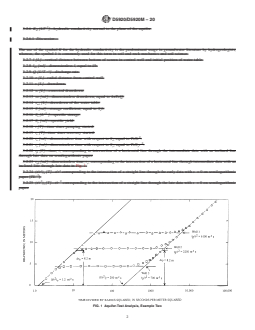
FIG. 1 Aquifer-Test Analysis, Example Two
D5920/D5920M−20
2 2
3.2.28 z [L]—vertical distance of the bottom of the obser- 1 2 exp 2t β y 1γ cos γ z
$ @ ~ !#% ~ !
s n n D
u ~y! 5 (3)
n 2 2 2 2 2
vation well screen above the bottom of the aquifer. $y 2 ~11σ!γ 2 ~y 1γ ! /σ% γ
n n n
3.2.29 z [L]—verticaldistanceofthetopoftheobservation
sin γ 1 2 d 2 sin γ 1 2 l
@ ~ !# @ ~ !#
n D n D
well screen above the bottom of the aquifer.
·
l 2 d sin γ
~ ! ~ !
D D n
3.2.30 z [nd]—dimensionless elevation, equal to z/b.
D
and the terms γ and γ are the roots of the following
0 n
3.2.31 z [nd]—dimensionless elevation of base of screen,
1D
equations:
equal to z /b.
2 2
σγ sinh γ 2 y 2γ cosh γ 50 (4)
~ ! ~ !
~ !
0 0 0 0
3.2.32 z [nd]—dimensionless elevation of top of screen,
2D
equal to z /b.
2 2
γ ,y
3.2.33 α—degree of anisotropy, equal to K /K .
z r 2 2
σγ sin γ 1 y 1γ cos γ 50 (5)
~ ! ~ ! ~ !
2 2 n n n n
3.2.34 β [nd]—dimensionless parameter α r /b .
3.2.35 ∆s [L]—the difference in drawdown over one log
e
~2n 2 1!~π/2!,γ ,nπ n$ 1
n
cycle of time along a straight line through early data on
semilogarithmic paper. 4.2.1 The drawdown in an observation well is the average
over the screened interval, of which u (y) and u (y) are
3.2.36 ∆s [L]—the difference in drawdown over one log
0 n
l
described by Neuman’s (1) Eqs 29 and 30:
cycle of time along a straight line through late data on
semilogarithmic paper. 2 2
$1 2 exp@2t β~y 2γ !#% @sinh~γ z ! 2 sinh~γ z !#
s 0 0 2D 0 1D
3.2.37 σ [nd]—dimensionless parameter S/S .
y
$sinh@γ ~1 2 d !# 2 sinh@γ ~1 2 l !#%
0 D 0 D
u y 5
~ !
2 2 2 2 2
y 1 11σ γ 2 y 2γ /σ cosh γ ·
$ ~ ! ~ ! % ~ !
0 0 0
4. Summary of Practice
z 2 z γ l 2 d sinh γ
~ ! ~ !
~ !
2D 1D 0 D D 0
4.1 Procedure—This practice describes a procedure for
(6)
analyzing data collected during a withdrawal well test. This
2 2
1 2 exp 2t β y 1γ sin γ z 2 sin γ z
~ ! @ ~ ! ~ !#
$ @ s n #% n 2D n 1D
practice should have been selected using Guide D4043 on the
sin γ 1 2 d 2 sin γ 1 2 l
$ @ ~ !# @ ~ !#%
basis of the hydrologic characteristics of the site.The field test
n D n D
u y 5
~ !
n 2 2 2 2 2
y 2 11σ γ 2 y 1γ /σ cos γ ·
$ ~ ! ~ ! % ~ !
(Test Method D4050) requires pumping a control well that is n n n
z 2 z γ l 2 d sin γ
opentoallorpartofanunconfinedaquiferataconstantratefor ~ ! ~ ! ~ !
2D 1D n D D n
a specified period and observing the drawdown in piezometers
(7)
or observation wells that either partly or fully penetrate the
4.2.2 In the case in which the control well and observation
aquifer. This practice may also be used to analyze an injection
well fully penetrate the aquifer, the equations reduce to
test with the appropriate change in sign.The rate of drawdown
Neuman’s (1) Eqs 2 and 3 as follows:
of water levels in the aquifer is a function of the location and
2 2
depths of screened open intervals of the control well, observa- 1 2 exp 2t β~y 2γ ! tanh~γ !
$ @ #%
s 0 0
u ~y! 5 (8)
0 2 2 2 2 2
tionwells,andpiezometers.Thedrawdownmaybeanalyzedto
$y 1~11σ! γ 2 @~y 2γ ! /σ#%γ
0 0 0
determine the transmissivity, storage coefficient, specific yield,
and:
and ratio of vertical to horizontal hydraulic conductivity of the
2 2
1 2 exp 2t β y 1γ tan γ
aquifer. The accuracy with which any property can be deter- $ @ ~ !#%
~ !
s n n
u y 5 (9)
~ !
n 2 2 2 2 2
mined depends on the location and length of the well screen in
y 2 11σ γ 2 y 1γ /σ γ
$ ~ ! ~ ! %
n n n
observationwellsandpiezometers.Twomethodsofanalysis,a
type curve method and a semilogarithmic method, are de-
5. Significance and Use
scribed.
5.1 Assumptions:
4.2 Solution—The solution given by Neuman (1) can be
5.1.1 The control well discharges at a constant rate, Q.
expressed as:
5.1.2 The control well, observation wells, and piezometers
`
Q ` are of infinitesimal diameter.
1/2
s r, z, t 5 4yJ yβ u y 1 u y dy (1)
~ ! * ~ !F ~ ! ~ !G
0 0 n
(
4πT 5.1.3 The unconfined aquifer is homogeneous and really
n51
extensive.
where, for piezometers, Neuman’s (1) Eqs 27 and 28 are as
5.1.4 Discharge from the control well is derived initially
follows:
from elastic storage in the aquifer, and later from gravity
2 2
1 2 exp 2 t β y 2γ # cosh γ z
$ $ ~ ! % ~ !
s 0 0 D
drainage from the water table.
u ~y! 5 (2)
0 2 2 2 2 2
$y 1~11σ! γ 2 ~y 2γ ! /σ%cosh~γ !
0 0 0
5.1.5 The geometry of the aquifer, control well, observation
wells, and piezometers is shown in Fig. 2.The geometry of the
sinh γ 1 2 d 2 sinh γ 1 2 l
@ ~ !# @ ~ !#
0 D 0 D
· test wells should be adjusted depending on the parameters of
~l 2 d !sinh~γ !
D D 0
interest.
and:
5.2 Implications of Assumptions:
5.2.1 Use of the Neuman (1) method assumes the control
wellisofinfinitesimaldiameter.Thestorageinthecontrolwell
The boldface numbers in parentheses refer to a list of references at the end of
the text. may adversely affect drawdown measurements obtained in the
D5920/D5920M−20
7. Procedure
7.1 Procedure—The procedure consists of conducting the
field procedure for withdrawal well tests (see Test Method
D4050), and analyzing the field data as addressed in this
practice.
7.2 Analysis—Analyzethefieldtestdatabyplottingthedata
and recording parameters as specified in Section 8.
8. Calculation and Interpretation of Results
8.1 Methods—The drawdown data collected during the
aquifer test may be analyzed by either the type-curve method
orthesemilogarithmicmethod.Anyconsistentsetofunitsmay
be used.
8.1.1 RefertoPracticeD6026ontheuseofsignificantdigits
in the calculations. Commercial Software is available for
FIG. 2 Cross Section Through a Discharging Well Screened in
performing the calculations and plottings described in this
Part of an Unconfined Aquifer
practice. Users should verify the correctness of the software
and results.
8.1.2 Type-Curve Method—Plot drawdown, s, on the verti-
calaxisandtimedividedbythesquareoftheradiustothewell
earlypartofthetest.See5.2.2ofPracticeD4106forassistance 2
or piezometer, t/r , on the horizontal axis using log-log paper.
in determining the duration of the effects of well-bore storage
Group data for all wells or piezometers that have screened
on drawdown.
intervals the same elevation above the base of the aquifer, z
D
5.2.2 If drawdown is large compared with the initial satu-
(for piezometers), or z and z (for observation wells).
1D 2D
rated thickness of the aquifer, the late-time drawdown may
8.1.2.1 Prepare a family of type curves for different values
need to be adjusted for the effect of the reduction in saturated
of β. For tests in which both the control well and the
thickness. Section 5.2.3 of Practice D4106 provides guidance
observation wells fully penetrate the aquifer, the values in
in correcting for the reduction in saturated thickness. Accord-
Table 1 and Table 2 may be used to prepare the type curves, as
ing to Neuman (1) such adjustments should be made only for
shown in Fig. 3. For piezometers, or tests in which the control
late-time values.
well or observation wells do not effectively penetrate the full
thickness of the aquifer, the values of s corresponding to
5.3 Practice D3740 provides evaluation factors for the
D
values of t and t for a range of values of β must be computed
activities in this practice.
s y
using computer programs such as those of Dawson and Istok
NOTE 1—The quality of the result produced by this practice is
(2), or Moench (3). The program requires that values for the
dependent on the competence of the personnel performing it, and the
dimensionless parameters l and d be supplied for the control
D D
suitability of the equipment and facilities used. Agencies that meet the
criteria of Practice D3740 are generally considered capable of competent well, and values of z be supplied for the piezometers, or that
D
and objective testing/sampling/inspection/etc. Users of this practice are
the values of z and z be supplied for observation wells.
1D 2D
cautioned that compliance with Practice D3740 does not in itself ensure
Onlydrawdownsforwhichthesedimensionlessparametersare
reliable results. Reliable results depend on many factors; Practice D3740
similar may be analyzed using the same family of type curves.
provides a means of evaluating some of those factors.
Prepare as many data plots and families of type curves as
necessary to analyze the test.
6. Apparatus
8.1.2.2 Holding the axes parallel, overlay the data plot on
6.1 Analysis—Analysisofdatafromthefieldprocedure(see
the type curves. Match as many of the early time-drawdown
Test Method D4050) by this practice requires that the control
data as possible to the left-most part of the type curve (TypeA
well and observation wells meet the requirements specified in
curves).Selectanearly-timematchpoint,andrecordthevalues
the following subsections.
of s, t/r ,s and t . Moving the data plot horizontally, match
D s
as many as possible of the late-time data to the right-most part
6.2 Construction of Control Well—Installthecontrolwellin
ofthetypecurves(TypeBcurves)andselectalate-timematch
the aquifer, and equip with a pump capable of discharging
point. Record the values of s, s , t/r , and t for this match
water from the well at a constant rate for the duration of the D y
point.Thevaluesof sand s shouldbethesameforeachmatch
test.
D
point, that is, the data curves should be shifted only
6.3 Construction of Observation Wells—Construct one or
horizontally,notvertically,onthetypecurve,andthevaluesof
more observation wells or piezometers at a distance from the
β for each observation well should be the same for early and
control well. For this practice, observation wells may be open
late times.
through all or part of the thickness of the aquifer.
8.1.2.3 Repeat the procedure in 8.1.2.2 for all additional
6.4 Location of Observation Wells—Wellsmaybelocatedat dataplotsandtypecurves.Thevaluesof sand s shouldbethe
D
any distance from the control well within the area of influence same for all plots in a single test. If necessary, repeat the
of pumping. analysisforeachplotuntilaconsistentsetofvaluesisobtained
D5920/D5920M−20
A
TABLE 1 Values of S for the Construction of Type A Curves for Fully Penetrating Wells (1)
D
t β = 0.001 β = 0.004 β = 0.01 β = 0.03 β = 0.06 β =0.1 β =0.2 β =0.4 β =0.6
a
−1 −2 −2 −2 −2 −2 −2 −2 −2 −2
1×10 2.48 × 10 2.43 × 10 2.41 × 10 2.35 × 10 2.30 × 10 2.24 × 10 2.14 × 10 1.99 × 10 1.88 × 10
−1 −1 −1 −1 −1 −1 −1 −1 −1 −2
2×10 1.45 × 10 1.42 × 10 1.40 × 10 1.36 × 10 1.31 × 10 1.27 × 10 1.19 × 10 1.08 × 10 9.88 × 10
−1 −1 −1 −1 −1 −1 −1 −1 −1 −1
3.5×10 3.58 × 10 3.52 × 10 3.45 × 10 3.31 × 10 3.18 × 10 3.04 × 10 2.79 × 10 2.44 × 10 2.17 × 10
−1 −1 −1 −1 −1 −1 −1 −1 −1 −1
6×10 6.62 × 10 6.48 × 10 6.33 × 10 6.01 × 10 5.70 × 10 5.40 × 10 4.83 × 10 4.03 × 10 3.43 × 10
0 0 −1 −1 −1 −1 −1 −1 −1 −1
1×10 1.02 × 10 9.92 × 10 9.63 × 10 9.05 × 10 8.49 × 10 7.92 × 10 6.88 × 10 5.42 × 10 4.38 × 10
0 0 0 0 0 0 0 −1 −1 −1
2×10 1.57 × 10 1.52 × 10 1.46 × 10 1.35 × 10 1.23 × 10 1.12 × 10 9.18 × 10 6.59 × 10 4.97 × 10
0 0 0 0 0 0 0 0 −1 −1
3.5×10 2.05 × 10 1.97 × 10 1.88 × 10 1.70 × 10 1.51 × 10 1.34 × 10 1.03 × 10 6.90 × 10 5.07 × 10
0 0 0 0 0 0 0 0 −1
6×10 2.52 × 10 2.41 × 10 2.27 × 10 1.99 × 10 1.73 × 10 1.47 × 10 1.07 × 10 6.96 × 10 .
1 0 0 0 0 0 0 0
1×10 2.97 × 10 2.80 × 10 2.61 × 10 2.22 × 10 1.85 × 10 1.53 × 10 1.08 × 10 . .
1 0 0 0 0 0 0
2×10 3.56 × 10 3.30 × 10 3.00 × 10 2.41 × 10 1.92 × 10 1.55 × 10 . . .
1 0 0 0 0 0
3.5×10 4.01 × 10 3.65 × 10 3.23 × 10 2.48 × 10 1.93 × 10 . . . .
1 0 0 0 0 0
6×10 4.42 × 10 3.93 × 10 3.37 × 10 2.49 × 10 1.94 × 10 . . . .
2 0 0 0 0
1×10 4.77 × 10 4.12 × 10 3.43 × 10 2.50 × 10 . . . . .
2 0 0 0
2×10 5.16 × 10 4.26 × 10 3.45 × 10 . . . . . .
2 0 0 0
3.5×10 5.40 × 10 4.29
...
This document is not an ASTM standard and is intended only to provide the user of an ASTM standard an indication of what changes have been made to the previous version. Because
it may not be technically possible to adequately depict all changes accurately, ASTM recommends that users consult prior editions as appropriate. In all cases only the current version
of the standard as published by ASTM is to be considered the official document.
Designation: D5920 − 14 D5920/D5920M − 20
Standard Test Method (Analytical Procedure) Practice for
(Analytical Procedure) Tests of Anisotropic Unconfined
Aquifers by Neuman Method
This standard is issued under the fixed designation D5920;D5920/D5920M; the number immediately following the designation indicates
the year of original adoption or, in the case of revision, the year of last revision. A number in parentheses indicates the year of last
reapproval. A superscript epsilon (´) indicates an editorial change since the last revision or reapproval.
1. Scope*
1.1 This test method covers an analytical procedure for determining the transmissivity, storage coefficient, specific yield, and
horizontal-to-vertical hydraulic conductivity ratio of an unconfined aquifer. It is used to analyze the drawdown of water levels in
piezometers and partially or fully penetrating observation wells during pumping from a control well at a constant rate.
1.2 The analytical procedure given in this test method is used in conjunction with Guide D4043 and Test Method D4050.
1.3 The valid use of the Neuman method is limited to determination of transmissivities for aquifers in hydrogeologic settings
with reasonable correspondence to the assumptions of the theory.
1.4 The values stated in SI units are to be regarded as standard.
1.5 This standard does not purport to address all of the safety concerns, if any, associated with its use. It is the responsibility
of the user of this standard to establish appropriate safety and health practices and determine the applicability of regulatory
limitations prior to use.
2. Referenced Documents
2.1 ASTM Standards:
D653 Terminology Relating to Soil, Rock, and Contained Fluids
D3740 Practice for Minimum Requirements for Agencies Engaged in Testing and/or Inspection of Soil and Rock as Used in
Engineering Design and Construction
D4043 Guide for Selection of Aquifer Test Method in Determining Hydraulic Properties by Well Techniques
D4050 Test Method for (Field Procedure) for Withdrawal and Injection Well Testing for Determining Hydraulic Properties of
Aquifer Systems
D4105 Practice for (Analytical Procedure) for Determining Transmissivity and Storage Coefficient of Nonleaky Confined
Aquifers by the Modified Theis Nonequilibrium Method
D4106 Practice for (Analytical Procedure) for Determining Transmissivity and Storage Coefficient of Nonleaky Confined
Aquifers by the Theis Nonequilibrium Method
D6026 Practice for Using Significant Digits in Geotechnical Data
3. Terminology
3.1 Definitions—For definitions of general technical terms used within this guide, refer to Terminology D653.
3.2 Symbols and Dimensions:
3.2.1 b [L]—initial saturated thickness of the aquifer.
3.2.2 d [L]—vertical distance between top of screen in pumping well and initial position of the water table.
3.2.3 d [nd]—dimensionless d, equal to d/b.
D
3.2.4 J (x)—zero-order Bessel function of the first kind.
−1
3.2.5 K [LT ]—hydraulic conductivity in the plane of the aquifer, radially from the control well.
r
This test method practice is under the jurisdiction of ASTM Committee D18 on Soil and Rock and is the direct responsibility of Subcommittee D18.21 on Groundwater
and Vadose Zone Investigations.
Current edition approved June 1, 2014May 15, 2020. Published July 2014May 2020. Originally approved in 1996. Last previous edition approved in 20062014 as
D5920-96(2006)D5920, which was withdrawn February 2014 and reinstated in June 2014. DOI: 10.1520/D5920-14.-14. DOI: 10.1520/D5920_D5920M-20.
For referenced ASTM standards, visit the ASTM website, www.astm.org, or contact ASTM Customer Service at service@astm.org. For Annual Book of ASTM Standards
volume information, refer to the standard’s Document Summary page on the ASTM website.
*A Summary of Changes section appears at the end of this standard
Copyright © ASTM International, 100 Barr Harbor Drive, PO Box C700, West Conshohocken, PA 19428-2959. United States
D5920/D5920M − 20
−1
3.2.6 K [LT ]—hydraulic conductivity normal to the plane of the aquifer.
Z
3.2.6.1 Discussion—
The use of the symbol K for the hydraulic conductivity is the predominant usage in groundwater literature by hydrogeologists,
whereas, the symbol k is commonly used for this term in soil and rock mechanics and soil science.
3.2.7 l [L]—vertical distance between bottom of screen in control well and initial position of water table.
3.2.8 l [nd]—dimensionless l, equal to l/b.
D
3 −1
3.2.9 Q [L T ]—discharge rate.
3.2.10 r [L]—radial distance from control well.
3.2.11 s [L]—drawdown.
3.2.12 s [L]—corrected drawdown.
c
3.2.13 s [nd]—dimensionless drawdown, equal to 4πTs/Q.
D
3.2.14 s [L]—drawdown of the water table.
wt
3.2.15 S [nd]—storage coefficient, equal to S b.
s
−1
3.2.16 S [L ]—specific storage.
s
3.2.17 S [nd]—specific yield.
y
3.2.18 t [T]—time since pumping started.
3.2.19 t [T]—time since recovery started.
r
3.2.20 t [nd]—dimensionless time with respect to S , equal to Tt/Sr .
s s
3.2.21 t [nd]—dimensionless time with respect to S , equal to Tt/S r .
y y y
3.2.22 t [T]—time, t, corresponding to intersection of a horizontal line through the intermediate data with an inclined line
β
through late data on semilogarithmic paper.
3.2.23 t [nd]—dimensionless time, t , corresponding to the intersection of a horizontal line through intermediate data with an
yβ y
inclined line through late data in Fig. 1.
2 2
3.2.24 (t/r ) [T]—t/r corresponding to the intersection of a straight line through the early data with s = 0 on semilogarithmic
e
−2
paper [TL ].
2 2
3.2.25 (t/r ) [T]—t/r corresponding to the intersection of a straight line through the late data with s = 0 on semilogarithmic
l
paper.
FIG. 1 Aquifer-Test Analysis, Example Two
D5920/D5920M − 20
2 −1
3.2.26 T [L T ]—transmissivity, K b.
r
3.2.27 z [L]—vertical distance above the bottom of the aquifer.
3.2.28 z [L]—vertical distance of the bottom of the observation well screen above the bottom of the aquifer.
3.2.29 z [L]—vertical distance of the top of the observation well screen above the bottom of the aquifer.
3.2.30 z [nd]—dimensionless elevation, equal to z/b.
D
3.2.31 z [nd]—dimensionless elevation of base of screen, equal to z /b.
1D 1
3.2.32 z [nd]—dimensionless elevation of top of screen, equal to z /b.
2D 2
3.2.33 α—degree of anisotropy, equal to K /K .
z r
2 2
3.2.34 β [nd]—dimensionless parameterα r /b .
3.2.35 Δs [L]—the difference in drawdown over one log cycle of time along a straight line through early data on
e
semilogarithmic paper.
3.2.36 Δs [L]—the difference in drawdown over one log cycle of time along a straight line through late data on semilogarithmic
l
paper.
3.2.37 σ [nd]—dimensionless parameter S/S .
y
4. Summary of Test Method
4.1 Procedure—This test method describes a procedure for analyzing data collected during a withdrawal well test. This test
method should have been selected using Guide D4043 on the basis of the hydrologic characteristics of the site. The field test (Test
Method D4050) requires pumping a control well that is open to all or part of an unconfined aquifer at a constant rate for a specified
period and observing the drawdown in piezometers or observation wells that either partly or fully penetrate the aquifer. This test
method may also be used to analyze an injection test with the appropriate change in sign. The rate of drawdown of water levels
in the aquifer is a function of the location and depths of screened open intervals of the control well, observation wells, and
piezometers. The drawdown may be analyzed to determine the transmissivity, storage coefficient, specific yield, and ratio of
vertical to horizontal hydraulic conductivity of the aquifer. The accuracy with which any property can be determined depends on
the location and length of the well screen in observation wells and piezometers. Two methods of analysis, a type curve method
and a semilogarithmic method, are described.
4.2 Solution—The solution given by Neuman (1) can be expressed as:
`
Q `
1/2
s r, z, t 5 4yJ yβ u y 1 u y dy (1)
~ ! * ~ !F ~ ! ~ !G
0 0 ( n
4πT
n51
where, for piezometers, Neuman’s (1) Eqs 27 and 28 are as follows:
2 2
1 2 exp 2 t β y 2 γ # cosh γ z
$ $ ~ ! % ~ !
s 0 0 D
u y 5 (2)
~ !
0 2 2 2 2 2
y 1 11σ γ 2 y 2 γ /σ cosh γ
$ ~ ! ~ ! % ~ !
0 0 0
sinh@γ ~12 d !# 2 sinh@γ ~12 l !#
0 D 0 D
·
l 2 d sinh γ
~ ! ~ !
D D 0
and:
2 2
$12 exp@2t β~y 1γ !#%cos~γ z !
s n n D
u y 5 (3)
~ !
n 2 2 2 2 2
y 2 11σ γ 2 y 1γ /σ γ
$ ~ ! ~ ! %
n n n
sin γ 12 d 2 sin γ 12 l
@ ~ !# @ ~ !#
n D n D
·
~l 2 d !sin γ
~ !
D D n
and the terms γ and γ are the roots of the following equations:
0 n
2 2
σγ sinh γ 2 ~y 2 γ !cosh~γ !5 0 (4)
~ !
0 0 0 0
2 2
γ ,y
2 2
σγ sin γ 1 y 1γ cos γ 5 0 (5)
~ ! ~ ! ~ !
n n n n
2n 2 1 π/2 ,γ ,nπ n $ 1
~ !~ !
n
4.2.1 The drawdown in an observation well is the average over the screened interval, of which u (y) and u (y) are described
0 n
by Neuman’s (1) Eqs 29 and 30:
The boldface numbers in parentheses refer to a list of references at the end of the text.
D5920/D5920M − 20
2 2
12 exp 2t β y 2 γ sinh γ z 2 sinh γ z
$ @ ~ !#% @ ~ ! ~ !#
s 0 0 2D 0 1D
sinh γ 12 d 2 sinh γ 12 l
$ @ ~ !# @ ~ !#%
0 D 0 D
u ~y! 5 (6)
0 2 2 2 2 2
$y 1~11σ! γ 2 ~y 2 γ ! /σ%cosh~γ !·
0 0 0
z 2 z γ l 2 d sinh γ
~ ! ~ ! ~ !
2D 1D 0 D D 0
2 2
12 exp 2t β~y 1γ ! @ sin ~γ z ! 2 sin ~γ z !#
$ @ #%
s n n 2D n 1D
sin @γ 12 d # 2 sin @γ 12 l #
$ ~ ! ~ ! %
n D n D
u ~y! 5 (7)
n 2 2 2 2 2
$y 2 ~11σ!γ 2 ~y 1γ ! /σ%cos~γ !·
n n n
z 2 z γ ~l 2 d !sin~γ !
~ !
2D 1D n D D n
4.2.2 In the case in which the control well and observation well fully penetrate the aquifer, the equations reduce to Neuman’s
(1) Eqs 2 and 3 as follows:
2 2
12 exp 2t β y 2 γ tanh γ
~ ! ~ !
$ @ #%
s 0 0
u y 5 (8)
~ !
0 2 2 2 2 2
y 1 11σ γ 2 y 2 γ /σ γ
$ ~ ! @~ ! #%
0 0 0
and:
2 2
12 exp 2t β y 1γ tan γ
$ @ ~ !#%
~ !
s n n
u y 5 (9)
~ !
n 2 2 2 2 2
y 2 11σ γ 2 y 1γ /σ γ
$ ~ ! ~ ! %
n n n
5. Significance and Use
5.1 Assumptions:
5.1.1 The control well discharges at a constant rate, Q.
5.1.2 The control well, observation wells, and piezometers are of infinitesimal diameter.
5.1.3 The unconfined aquifer is homogeneous and really extensive.
5.1.4 Discharge from the control well is derived initially from elastic storage in the aquifer, and later from gravity drainage from
the water table.
5.1.5 The geometry of the aquifer, control well, observation wells, and piezometers is shown in Fig. 2. The geometry of the test
wells should be adjusted depending on the parameters of interest.
5.2 Implications of Assumptions:
5.2.1 Use of the Neuman (1) method assumes the control well is of infinitesimal diameter. The storage in the control well may
adversely affect drawdown measurements obtained in the early part of the test. See 5.2.2 of Test Method D4106 for assistance in
determining the duration of the effects of well-bore storage on drawdown.
5.2.2 If drawdown is large compared with the initial saturated thickness of the aquifer, the late-time drawdown may need to be
adjusted for the effect of the reduction in saturated thickness. Section 5.2.3 of Test Method D4106 provides guidance in correcting
for the reduction in saturated thickness. According to Neuman (1) such adjustments should be made only for late-time values.
5.3 Practice D3740 provides evaluation factors for the activities in this guide.
NOTE 1—The quality of the result produced by this guide is dependent on the competence of the personnel performing it, and the suitability of the
equipment and facilities used. Agencies that meet the criteria of Practice D3740 are generally considered capable of competent and objective
testing/sampling/inspection/etc. Users of this guide are cautioned that compliance with Practice D3740 does not in itself ensure reliable results. Reliable
results depend on many factors; Practice D3740 provides a means of evaluating some of those factors.
FIG. 2 Cross Section Through a Discharging Well Screened in Part of an Unconfined Aquifer
D5920/D5920M − 20
6. Apparatus
6.1 Analysis—Analysis of data from the field procedure (see Test Method D4050) by this test method requires that the control
well and observation wells meet the requirements specified in the following subsections.
6.2 Construction of Control Well—Install the control well in the aquifer, and equip with a pump capable of discharging water
from the well at a constant rate for the duration of the test.
6.3 Construction of Observation Wells— Construct one or more observation wells or piezometers at a distance from the control
well. For this test method, observation wells may be open through all or part of the thickness of the aquifer.
6.4 Location of Observation Wells— Wells may be located at any distance from the control well within the area of influence
of pumping.
7. Procedure
7.1 Procedure—The procedure consists of conducting the field procedure for withdrawal well tests (see Test Method D4050),
and analyzing the field data as addressed in this test method.
7.2 Analysis—Analyze the field test data by plotting the data and recording parameters as specified in Section 8.
8. Calculation and Interpretation of Results
8.1 Methods—The drawdown data collected during the aquifer test may be analyzed by either the type-curve method or the
semilogarithmic method. Any consistent set of units may be used.
8.1.1 Refer to Practice D6026 on the use of significant digits in the calculations.
NOTE 2—The procedures used to specify how data are collected/recorded and calculated in this guide are regarded as the industry standard. In addition,
they are representative of the significant digits that should generally be retained. The procedures used do not consider material variation, purpose for
obtaining the data, special purpose studies, or any considerations for the user’s objectives; and it is common practice to increase or reduce significant digits
of reported data to commensurate with these considerations. It is beyond the scope of this guide to consider significant digits used in analysis methods
for engineering design.
8.1.2 Type-Curve Method—Plot drawdown, s, on the vertical axis and time divided by the square of the radius to the well or
piezometer, t/r , on the horizontal axis using log-log paper. Group data for all wells or piezometers that have screened intervals
the same elevation above the base of the aquifer, z (for piezometers), or z and z (for observation wells).
D 1D 2D
8.1.2.1 Prepare a family of type curves for different values of β. For tests in which both the control well and the observation
wells fully penetrate the aquifer, the values in Table 1 and Table 2 may be used to prepare the type curves, as shown in Fig. 3.
For piezometers, or tests in which the control well or observation wells do not effectively penetrate the full thickness of the aquifer,
the values of s corresponding to values of t and t for a range of values of β must be computed using computer programs such
D s y
as those of Dawson and Istok (2), or Moench (3) . The program requires that values for the dimensionless parameters l and d
D D
be supplied for the control well, and values of z be supplied for the piezometers, or that the values of z and z be supplied for
D 1D 2D
observation wells. Only drawdowns for which these dimensionless parameters are similar may be analyzed using the same family
of type curves. Prepare as many data plots and families of type curves as necessary to analyze the test.
8.1.2.2 Holding the axes parallel, overlay the data plot on the type curves. Match as many of the early time-drawdown data as
possible to the left-most part of the type curve (Type A curves). Select an early-time match point, and record the values of s, t/r ,
s and t . Moving the data plot horizontally, match as many as possible of the late-time data to the right-most part of the type curves
D s
(Type B curves) and select a late-time match point. Record the values of s, s , t/r , and t for this match point. The values of s
D y
and s should be the same for each match point, that is, the data curves should be shifted only horizontally, not vertically, on the
D
type curve, and the values of β for each observation well should be the same for early and late times.
8.1.2.3 Repeat the procedure in 8.1.2.2 for all additional data plots and type curves. The values of s and s should be the same
D
for all plots in a single test. If necessary, repeat the analysis for each plot until a consistent set of values is obtained between all
plots. Calculate the value of the term β/r for every observation well or piezometer. Because the remaining terms in the definition
2 2
of β, α/b , should be nearly constant over the area of the test, the term β/ r should be independent of radius. If not, a new set of
match points should be obtained, and β/ r computed for each well until the values are independent of radius.
8.1.2.4 Calculate the transmissivity, specific yield, storage coefficient, and horizontal hydraulic conductivity from the values of
s, s , t/r , t and t :
D s y
T 5 QS /4πs (10)
D
S 5 T/t t/r (11)
~ !~ !
y y
S 5 ~T/t !~t/r ! (12)
s
K 5 T/b (13)
r
The anisotropy can be calculated from:
2 2
α5 β/r b (14)
~ !
D5920/D5920M − 20
A
TABLE 1 Values of S for the Construction of Type A Curves for Fully Penetrating Wells (1)
D
t β = 0.001 β = 0.004 β = 0.01 β = 0.03 β = 0.06 β = 0.1 β = 0.2 β = 0.4 β = 0.6
a
−1 −2 −2 −2 −2 −2 −2 −2 −2 −2
1 × 10 2.48 × 10 2.43 × 10 2.41 × 10 2.35 × 10 2.30 × 10 2.24 × 10 2.14 × 10 1.99 × 10 1.88 × 10
−1 −1 −1 −1 −1 −1 −1 −1 −1 −2
2 × 10 1.45 × 10 1.42 × 10 1.40 × 10 1.36 × 10 1.31 × 10 1.27 × 10 1.19 × 10 1.08 × 10 9.88 × 10
−1 −1 −1 −1 −1 −1 −1 −1 −1 −1
3.5 × 10 3.58 × 10 3.52 × 10 3.45 × 10 3.31 × 10 3.18 × 10 3.04 × 10 2.79 × 10 2.44 × 10 2.17 × 10
−1 −1 −1 −1 −1 −1 −1 −1 −1 −1
6 × 10 6.62 × 10 6.48 × 10 6.33 × 10 6.01 × 10 5.70 × 10 5.40 × 10 4.83 × 10 4.03 × 10 3.43 × 10
0 0 −1 −1 −1 −1 −1 −1 −1 −1
1 × 10 1.02 × 10 9.92 × 10 9.63 × 10 9.05 × 10 8.49 × 10 7.92 × 10 6.88 × 10 5.42 × 10 4.38 × 10
0 0 0 0 0 0 0 −1 −1 −1
2 × 10 1.57 × 10 1.52 × 10 1.46 × 10 1.35 × 10 1.23 × 10 1.12 × 10 9.18 × 10 6.59 × 10 4.97 × 10
0 0 0 0 0 0 0 0 −1 −1
3.5 × 10 2.05 × 10 1.97 × 10 1.88 × 10 1.70 × 10 1.51 × 10 1.34 × 10 1.03 × 10 6.90 × 10 5.07 × 10
0 0 0 0 0 0 0 0 −1
6 × 10 2.52 × 10 2.41 × 10 2.27 × 10 1.99 × 10 1.73 × 10 1.47 × 10 1.07 × 10 6.96 × 10 .
1 0 0 0 0 0 0 0
1 × 10 2.97 × 10 2.80 × 10 2.61 × 10 2.22 × 10 1.85 × 10 1.53 × 10 1.08 × 10 . .
1 0 0 0 0 0 0
2 × 10 3.56 × 10 3.30 × 10 3.00 × 10 2.41 × 10 1.92 × 10 1.55 × 10 . . .
1 0 0 0 0 0
3.5 × 10 4.01 × 10 3.65 × 10 3.23 × 10 2.48 × 10 1.93 × 10 . . . .
1 0 0 0 0 0
6 × 10 4.42 × 10 3.93 × 10 3.37 × 10 2.49 × 10 1.94 × 10 . . . .
2 0 0 0 0
1 × 10 4.77 × 10 4.12 × 10 3.43 × 10 2.50 × 10 . . . . .
2 0 0 0
2 × 10 5.16 × 10 4.26 × 10 3.45 × 10 . . . . . .
2 0 0 0
3.5 × 10 5.40 × 10 4.29 × 10 3.46 × 10 . . . . . .
2 0 0
6 × 10 5.54 × 10 4.30 × 10 . . . . . . .
3 0
1 × 10 5.59 × 10 . . . . . . . .
3 0
2 × 10 5.62 × 10 . . . . . . . .
3 0 0 0 0 0 0 0 −1 −1
3.5 × 10 5.62 × 10 4.30 × 10 3.46 × 10 2.50 × 10 1.94 × 10 1.55 × 10 1.08 × 10 6.96 × 10 5.07 × 10
β = 0.8 β = 1.0 β = 1.5 β = 2.0 β = 2.5 β = 3.0 β = 4.0 β = 5.0 β = 6.0 β = 7.0
−2 −2 −2 −2 −2 −2 −3 −3 −3 −3
1.79 × 10 1.70 × 10 1.53 × 10 1.38 × 10 1.25 × 10 1.13 × 10 9.33 × 10 7.72 × 10 6.39 × 10 5.30 × 10
−2 −2 −2 −2 −2 −2 −2 −2 −2 −3
9.15 × 10 8.49 × 10 7.13 × 10 6.03 × 10 5.11 × 10 4.35 × 10 3.17 × 10 2.34 × 10 1.74 × 10 1.31 × 10
−1 −1 −1 −1 −2 −2 −2 −2 −2 −2
1.94 × 10 1.75 × 10 1.36 × 10 1.07 × 10 8.46 × 10 6.78 × 10 4.45 × 10 3.02 × 10 2.10 × 10 1.51 × 10
−1 −1 −1 −1 −1 −2 −2 −2 −2 −2
2.96 × 10 2.56 × 10 1.82 × 10 1.33 × 10 1.01 × 10 7.67 × 10 4.76 × 10 3.13 × 10 2.14 × 10 1.52 × 10
−1 −1 −1 −1 −1 −2 −2 −2
3.60 × 10 3.00 × 10 1.99 × 10 1.40 × 10 1.03 × 10 7.79 × 10 4.78 × 10 . 2.15 × 10 .
−1 −1 −1 −1
3.91 × 10 3.17 × 10 2.03 × 10 1.41 × 10 . . . . . .
−1
3.94 × 10 . . . . . . . . .
... ... ... ... ... ... ... ... ... ...
... ... ... ... ... ... ... ... ... ...
... ... ... ... ... ... ... ... ... ...
... ... ... ... ... ... ... ... ... ...
... ... ... ... ... ... ... ... ... ...
... ... ... ... ... ... ... ... ... ...
... ... ... ... ... ... ... ... ... ...
... ... ... ... ... ... ... ... ... ...
... ... ... ... ... ... ... ... ... ...
... ... ... ... ... ... ... ... ... ...
... ... ... ... ... ... ... ... ... ...
... ... ... ... ... ... ... ... ... ...
−1 −1 −1 −1 −1 −2 −2 −2 −2 −2
3.94 × 10 3.17 × 10 2.03 × 10 1.41 × 10 1.03 × 10 7.79 × 10 4.78 × 10 3.13 × 10 2.15 × 10 1.52 × 10
A −2
Values were obtained from (2) by settingσ = 10 .
and the vertical permeability from:
K 5 αK (15)
z r
3 −1
8.1.2.5 The results of a hypothetical aquifer test are shown in Fig. 4. A control well is discharged at a rate of 0.21 m s , and
water levels are measured in OW1 at a radius of 9 m from the control well, in OW2 (r = 50 m), and OW3 (r = 185 m). A log-log
plot of drawdown versus time divided by radius to the control well, squared, is shown for the three observation wells, superimposed
on type curves derived from the data in Table 1 and Table 2. Measurements from each observation well fall on a different β curve.
8.1.2.6 For the example, the transmissivity from Eq 10 is:
3 −1
T = Qs /4πs = (0.21 m s × 1.0) ⁄(4 × 3.14 × 6.5 m)
d
−3 2 −1
= 2.57 × 10 m s ,
and the specific yield from Eq 11 is:
2 −3 2 −1 −2
S = (T/t )(t/r ) = (2.57 × 10 m s /1.0)(88 m s) = 0.23
y y
The storage coefficient, from Eq 11 is:
2 −3 2 −1 −2
S = (T/t )(t/r ) = (2.57 × 10 m s /1.0)(0.145 m s)
s
−4
= 3.7 × 10
The ratio of vertical to horizontal hydraulic conductivity can be calculated from Eq 14 using an assumed aquifer thickness, b
of 25 m, and data from OW1 as follows:
2 2 2 2
α = (β ⁄r )b = (0.004 ⁄81 m )(625 m ) = 0.03
8.1.3 Semilogarithmic Method—This procedure is applicable to tests in which the control and observation wells effectively fully
penetrate the aquifer. Plot drawdown on the vertical (arithmetic) axis and time divided by the square of the radius to the control
well on the horizontal (logarithmic) axis for all observation wells. The early and late date will tend to fall on parallel straight lines.
The intermediate values will fall on horizontal lines between these two extremes.
D5920/D5920M − 20
A
TABLE 2 Values of S for the Construction of Type B Curves for Fully Penetrating Wells (1)
D
t β = 0.001 β = 0.004 β = 0.01 β = 0.03 β = 0.06 β = 0.1 β = 0.2 β = 0.4 β = 0.6
y
−4 0 0 0 0 0 0 0 −1 −1
1 × 10 5.62 × 10 4.30 × 10 3.46 × 10 2.50 × 10 1.94 × 10 1.56 × 10 1.09 × 10 6.97 × 10 5.08 × 10
−4
2 × 10 . . . . . . . . .
−4
3.5 × 10 . . . . . . . . .
−4
6 × 10 . . . . . . . . .
−3 −1 −1
1 × 10 . . . . . . . 6.97 × 10 5.08 × 10
−3 −1 −1
2 × 10 . . . . . . . 6.97 × 10 5.09 × 10
−3 −1 −1
3.5 × 10 . . . . . . . 6.98 × 10 5.10 × 10
−3 −1 −1
6 × 10 . . . . . . . 7.00 × 10 5.12 × 10
−2 −1 −1
1 × 10 . . . . . . . 7.03 × 10 5.16 × 10
−2 0 0 −1 −1
2 × 10 . . . . . 1.56 × 10 1.09 × 10 7.10 × 10 5.24 × 10
−2 0 0 0 −1 −1
3.5 × 10 . . . . 1.94 × 10 1.56 × 10 1.10 × 10 7.20 × 10 5.37 × 10
−2 0 0 0 0 −1 −1
6 × 10 . . . 2.50 × 10 1.95 × 10 1.57 × 10 1.11 × 10 7.37 × 10 5.57 × 10
−1 0 0 0 0 −1 −1
1 × 10 . . . 2.51 × 10 1.96 × 10 1.58 × 10 1.13 × 10 7.63 × 10 5.89 × 10
−1 0 0 0 0 0 0 0 −1 −1
2 × 10 5.62 × 10 4.30 × 10 3.46 × 10 2.52 × 10 1.98 × 10 1.61 × 10 1.18 × 10 8.29 × 10 6.67 × 10
−1 0 0 0 0 0 0 0 −1 −1
3.5 × 10 5.63 × 10 4.31 × 10 3.47 × 10 2.54 × 10 2.01 × 10 1.66 × 10 1.24 × 10 9.22 × 10 7.80 × 10
−1 0 0 0 0 0 0 0 0 −1
6 × 10 5.63 × 10 4.31 × 10 3.49 × 10 2.57 × 10 2.06 × 10 1.73 × 10 1.35 × 10 1.07 × 10 9.54 × 10
0 0 0 0 0 0 0 0 0 0
1 × 10 5.63 × 10 4.32 × 10 3.51 × 10 2.62 × 10 2.13 × 10 1.83 × 10 1.50 × 10 1.29 × 10 1.20 × 10
0 0 0 0 0 0 0 0 0 0
2 × 10 5.64 × 10 4.35 × 10 3.56 × 10 2.73 × 10 2.31 × 10 2.07 × 10 1.85 × 10 1.72 × 10 1.68 × 10
0 0 0 0 0 0 0 0 0 0
3.5 × 10 5.65 × 10 4.38 × 10 3.63 × 10 2.88 × 10 2.55 × 10 2.37 × 10 2.23 × 10 2.17 × 10 2.15 × 10
0 0 0 0 0 0 0 0 0 0
6 × 10 5.67 × 10 4.44 × 10 3.74 × 10 3.11 × 10 2.86 × 10 2.75 × 10 2.68 × 10 2.66 × 10 2.65 × 10
1 0 0 0 0 0 0 0 0 0
1 × 10 5.70 × 10 4.52 × 10 3.90 × 10 3.40 × 10 3.24 × 10 3.18 × 10 3.15 × 10 3.14 × 10 3.14 × 10
1 0 0 0 0 0 0 0 0 0
2 × 10 5.76 × 10 4.71 × 10 4.22 × 10 3.92 × 10 3.85 × 10 3.83 × 10 3.82 × 10 3.82 × 10 3.82 × 10
1 0 0 0 0 0 0 0 0 0
3.5 × 10 5.85 × 10 4.94 × 10 4.58 × 10 4.40 × 10 4.38 × 10 4.38 × 10 4.37 × 10 4.37 × 10 4.37 × 10
1 0 0 0 0 0 0 0 0 0
6 × 10 5.99 × 10 5.23 × 10 5.00 × 10 4.92 × 10 4.91 × 10 4.91 × 10 4.91 × 10 4.91 × 10 4.91 × 10
2 0 0 0 0 0 0 0 0 0
1 × 10 6.16 × 10 5.59 × 10 5.46 × 10 5.42 × 10 5.42 × 10 5.42 × 10 5.42 × 10 5.42 × 10 5.42 × 10
β = 0.8 β = 1.0 β = 1.5 β = 2.0 β = 2.5 β = 3.0 β = 4.0 β = 5.0 β = 6.0 β = 7.0
−1 −1 −1 −1 −1 −2 −2 −2 −2 −2
3.95 × 10 3.18 × 10 2.04 × 10 1.42 × 10 1.03 × 10 7.80 × 10 4.79 × 10 3.14 × 10 2.15 × 10 1.53 × 10
−2 −2 −2 −2 −2
... ... ... ... ... 7.81 × 10 4.80 × 10 3.15 × 10 2.16 × 10 1.53 × 10
−1 −2 −2 −2 −2 −2
... ... ... ... 1.03 × 10 7.83 × 10 4.81 × 10 3.16 × 10 2.17 × 10 1.54 × 10
−1 −2 −2 −2 −2 −2
... ... ... ... 1.04 × 10 7.85 × 10 4.84 × 10 3.18 × 10 2.19 × 10 1.56 × 10
−1 −1 −1 −1 −1 −2 −2 −2 −2 −2
3.95 × 10 3.18 × 10 2.04 × 10 1.42 × 10 1.04 × 10 7.89 × 10 4.78 × 10 3.21 × 10 2.21 × 10 1.58 × 10
−1 −1 −1 −1 −1 −2 −2 −2 −2 −2
3.96 × 10 3.19 × 10 2.05 × 10 1.43 × 10 1.05 × 10 7.99 × 10 4.96 × 10 3.29 × 10 2.28 × 10 1.64 × 10
−1 −1 −1 −1 −1 −2 −2 −2 −2 −2
3.97 × 10 3.21 × 10 2.07 × 10 1.45 × 10 1.07 × 10 8.14 × 10 5.09 × 10 3.41 × 10 2.39 × 10 1.73 × 10
−1 −1 −1 −1 −1 −2 −2 −2 −2 −2
3.99 × 10 3.23 × 10 2.09 × 10 1.47 × 10 1.09 × 10 8.38 × 10 5.32 × 10 3.61 × 10 2.57 × 10 1.89 × 10
−1 −1 −1 −1 −1 −2 −2 −2 −2 −2
4.03 × 10 3.27 × 10 2.13 × 10 1.52 × 10 1.13 × 10 8.79 × 10 5.68 × 10 3.93 × 10 2.86 × 10 2.15 × 10
−1 −1 −1 −1 −1 −2 −2 −2 −2 −2
4.12 × 10 3.37 × 10 2.24 × 10 1.62 × 10 1.24 × 10 9.80 × 10 6.61 × 10 4.78 × 10 3.62 × 10 2.84 × 10
−1 −1 −1 −1 −1 −1 −2 −2 −2 −2
4.25 × 10 3.50 × 10 2.39 × 10 1.78 × 10 1.39 × 10 1.13 × 10 8.06 × 10 6.12 × 10 4.86 × 10 3.98 × 10
−1 −1 −1 −1 −1 −1 −1 −2 −2 −2
4.47 × 10 3.74 × 10 2.65 × 10 2.05 × 10 1.66 × 10 1.40 × 10 1.06 × 10 8.53 × 10 7.14 × 10 6.14 × 10
−1 −1 −1 −1 −1 −1 −1 −1 −1 −1
4.83 × 10 4.12 × 10 3.07 × 10 2.48 × 10 2.10 × 10 1.84 × 10 1.49 × 10 1.28 × 10 1.13 × 10 1.02 × 10
−1 −1 −1 −1 −1 −1 −1 −1 −1 −1
5.71 × 10 5.06 × 10 4.10 × 10 3.57 × 10 3.23 × 10 2.98 × 10 2.66 × 10 2.45 × 10 2.31 × 10 2.20 × 10
−1 −1 −1 −1 −1 −1 −1 −1 −1 −1
6.97 × 10 6.42 × 10 5.62 × 10 5.17 × 10 4.89 × 10 4.70 × 10 4.45 × 10 4.30 × 10 4.19 × 10 4.11 × 10
−1 −1 −1 −1 −1 −1 −1 −1 −1 −1
8.89 × 10 8.50 × 10 7.92 × 10 7.63 × 10 7.45 × 10 7.33 × 10 7.18 × 10 7.09 × 10 7.03 × 10 6.99 × 10
0 0 0 0 0 0 0 0 0 0
1.16 × 10 1.13 × 10 1.10 × 10 1.08 × 10 1.07 × 10 1.07 × 10 1.06 × 10 1.06 × 10 1.05 × 10 1.05 × 10
0 0 0 0 0 0 0 0 0 0
1.66 × 10 1.65 × 10 1.64 × 10 1.63 × 10 1.63 × 10 1.63 × 10 1.63 × 10 1.63 × 10 1.63 × 10 1.63 × 10
0 0 0 0 0 0 0 0 0 0
2.15 × 10 2.14 × 10 2.14 × 10 2.14 × 10 2.14 × 10 2.14 × 10 2.14 × 10 2.14 × 10 2.14 × 10 2.14 × 10
0 0 0 0 0 0 0 0 0 0
2.65 × 10 2.65 × 10 2.65 × 10 2.64 × 10 2.64 × 10 2.64 × 10 2.64 × 10 2.64 × 10 2.64 × 10 2.64 × 10
0 0 0 0 0 0 0 0 0 0
3.14 × 10 3.14 × 10 3.14 × 10 3.14 × 10 3.14 × 10 3.14 × 10 3.14 × 10 3.14 × 10 3.14 × 10 3.14 × 10
0 0 0 0 0 0 0 0 0 0
3.82 × 10 3.82 × 10 3.82 × 10 3.82 × 10 3.82 × 10 3.82 × 10 3.82 × 10 3.82 × 10 3.82 × 10 3.82 × 10
0 0 0 0 0 0 0 0 0 0
4.37 × 10 4.37 × 10 4.37 × 10 4.37 × 10 4.37 × 10 4.37 × 10 4.37 × 10 4.37 × 10 4.37 × 10 4.37 × 10
0 0 0 0 0 0 0 0 0 0
4.91 × 10 4.91 × 10 4.91 × 10 4.91 × 10 4.91 × 10 4.91 × 10 4.91 × 10 4.91 × 10 4.91 × 10 4.91 × 10
0 0 0 0 0 0 0 0 0 0
5.42 × 10 5.42 × 10 5.42 × 10 5.42 × 10 5.42 × 10 5.42 × 10 5.42 × 10 5.42 × 10 5.42 × 10 5.42 × 10
A −2
Values were obtained from Ref (2) by setting σ = 10 .
8.1.3.1 Fit a straight line to the late data. The intersection of this line with the horizontal axis (s = 0) is denoted by (t/r ) . The
l
slope of the line over one log cycle of t/r is denoted Δs . The transmissivity and specific yield of the aquifer are then calculated
l
from Jacob’s (3) method, using the procedures described in Test Method D4105.
T 5 2.30 Q/4πΔs (16)
l
S 5 2.25 T ~t/r ! (17)
y l
8.1.3.2 Fit a horizontal straight line to the intermediate data for each observation well. The intersection of the horizontal straight
line with the late-time straight line is denoted t . The dimensionless time t β is then calculated from the following:
β y
t 5 T/S t /r (18)
~ !~ !
yβ y β
Using the values of t β, values of β for each observation well may be obtained by interpolation from Table 3 or be picked from
y
Fig. 5. The values of β should be independent of radius, as in 8.1.2.3.
8.1.3.3 Fit a straight line to the early part of the time-drawdown data. The intersection of this line with the horizontal axis is
denoted by (t/r ) , and the slope of this line over one log cycle is Δs . The transmissivity and storage coefficient are calculated from:
e e
T 5 2.30 Q/4πΔs (19)
e
D5920/D5920M − 20
NOTE 1—From Ref (5).
FIG. 3 Type Curves for Fully Penetrating Wells
FIG. 4 Aquifer-Test Analysis, Example 1
S 5 2.25 T ~t/r ! (20)
e
8.1.3.4 The slope of the line should be the same as the one computed in 8.1.3.1; that is, the transmissivity should be the same.
If not, the type-curve method in 8.1.2 must be used to compute the storage coefficient.
8.1.3.5 A hypothetical example of the use of the semilogarithmic method is shown in Fig. 1. In this example a control well is
3 −1
discharged at 0.01 m s , and water levels are measured in a fully penetrating observation Well One (r = 4.5 m), Well Two (r = 7.5
m), and Well Three (r = 18 m). The change in drawdown over one log cycle of time for the late data, Δs , is 8.2 m. The intersection
l
2 −2
of a line through the late data with the s = 0 axis, (t/r ) , is 200 m s. The transmissivity and specific yield calculated from Eq
l
16 and Eq 17 are as follows:
3 –1
T = 2.30 Q/4πΔs = (2.30 × 0.01 m s )/(4 × 3.14 × 8.2 m)
l
D5920/D5920M − 20
TABLE 3 Values of 1/β and t used in plotting Fig. 5, (1)
yβ
1/β t
yβ
−1 −1
2.50 × 10 4.52 × 10
−1 −1
1.67 × 10 4.55 × 10
−1 −1
2.00 × 10 4.59 × 10
−1 −1
2.50 × 10 4.67 × 10
−1 −1
3.33 × 10 4.81 × 10
−1 −1
4.00 × 10 4.94 × 10
−1 −1
5.00 × 10 5.13 × 10
−1 −1
6.67 × 10 5.45 × 10
0 −1
1.00 × 10 6.11 × 10
0 −1
1.25 × 10 6.60 × 10
0 −1
1.67 × 10 7.39 × 10
0 −1
2.50 × 10 8.93 × 10
0 0
5.00 × 10 1.31 × 10
1 0
1.00 × 10 2.10 × 10
1 0
1.67 × 10 3.10 × 10
1 0
3.33 × 10 5.42 × 10
2 1
1.00 × 10 1.42 × 10
2 1
2.50 × 10 3.22 × 10
3 2
1.00 × 10 1.23 × 10
A −9
Values were obtained from Ref (2) by setting σ = 10 .
NOTE 1—From Ref (1).
FIG. 5 Values of 1/β Versus t for Fully Penetrating Wells
yβ
–4 2 –1
= 2.23 × 10 m s
2 –4 2 –1 –2
S = 2.25 T (t/r ) = 2.25 (2.23× 10 m s )(200 m s)
y l
= 0.10
2 −2
8.1.3.6 From the intersection of the horizontal parts of the data plot with the late-time part, a value of t /r of 6100 m s was
β
−2 −2
determined for Well One, 2250 m s for Well Two, and 700 m s for Well Three. From Eq 18, a value of t β is calculated for
y
Well One as follows:
2 −4 2 −1 −2
t = ( T/S )(t /r ) = [(2.23 × 10 m s )/](6100 m s) = 14
yβ y β
Similar calculations yield values of t β of 5 for Well Two and 1.6 for Well Three. From Fig. 5 an approximate value of 100 is
y
estimated for 1/β for Well One, 31 for Well Two, and 6 for Well Three.
8.1.3.7 The change in drawdown for one log cycle of time divided by radius squared for early time data, Δs , is 8.2 m. The
e
transmissivity calculated from the early data using Eq 19 is therefore the same as that calculated from the late data:
3 −1
T = 2.30 Q/4πΔs = (2.30 × 0.01 m s )/
e
−4 2 −1
(4 × 3.14 × 8.2 m) = 2.23 × 10 m s
D5920/D5920M − 20
2 −2
8.1.3.8 The intersection of the early data with the horizontal axis at s = 0, (t/r ) , is 1.2 m s, so from Eq 20 the storage
e
coefficient is as follows:
2 −4 2 −1 −2
S = 2.25 T (t/r ) = 2.25 (2.23 × 10 m s )(1.2 m s)
e
−4
= 6 × 10
9. Report: Test Data Sheets/Forms
9.1 Preparation—Prepare a report including the following information. The report of the analysis will include information from
the field testing procedure.
9.1.1 Introduction—The introductory section is intended to present the scope and purpose of the Neuman method for an
unconfined, anisotropic aquifer. Summarize the field geohydrologic conditions and the field equipment and instrumentation
including the construction of the control well and observation wells and piezometers, the method of measurement of discharge and
water levels, and the duration of the test and pumping rates. Discuss the rationale for selecting the Neuman method.
9.1.2 Hydrogeologic Setting—Review the information available on the hydrogeology of the site. Interpret and describe the
hydrogeology of the site as it pertains to the selection of this test method for conducting and analyzing an aquifer test. Compare
the hydrogeologic characteristics of the site as it conforms and differs from the assumptions in the solution to the aquifer test
method.
9.1.3 Scope of Aquifer Test:
9.1.3.1 Equipment—Report the field installation and equipment for the aquifer test, including the construction, diameter, depth
of screened interval, and location of control well and pumping equipment, and the construction, diameter, depth, and screened
interval of observation wells or piezometers.
9.1.3.2 Instrumentation—Report the field instrumentation for observing water levels, pumping rate, barometric pressure
changes, and other environmental conditions pertinent to the test. Include a list of measuring devices used during the test; the
manufacturer’s name, model number, and basic specifications for each major item; and the name and date of the last calibration,
if applicable.
9.1.3.3 Testing Procedures—State the steps taken in conducting pretest, drawdown, and recovery phases of the test. Include the
frequency of measurements of discharge rate, water level in observation wells, and other environmental data recorded during the
testing procedure.
9.1.4 Presentation and Interpretation of Test Results:
9.1.4.1 Data—Present tables of data collected during the test. Show methods of adjusting water levels for pretest trends, and
calculation of drawdown and residual drawdown.
9.1.4.2 Data Plots—Present data plots used in analysis of the data. Show data plots with all values of β, all match points, and
all match-point values.
9.1.4.3 Evaluate qualitatively the overall accuracy of the test on the basis of the adequacy of instrumentation and observations
of stress and response, and the conformance of the hydrogeologic conditions and the conformance of the test to the assumptions
of this test method.
10. Precision and Bias
10.1 Precision—It is not practicable to specify the precision of this test method because the response of aquifer systems during
aquifer tests is dependent upon ambient system stresses.
10.2 Bias—No statement can be made about bias because no true reference values exist.
11. Keywords
11.1 anisotropic aquifers; aquifers; aquifer tests; control wells; groundwater; hydraulic properties; observation wells;
transmissivity; unconfined aquifers
D5920/D5920M − 20
REFERENCES
(1) Neuman, Shlomo P., “Analysis of Pumping Test Data from Anisotropic Aquifers Considering Delayed Gravity Response,” Water Resources Research,
Vol 11, No. 2, 1975, pp. 329–342.
(2) Dawson, K. J., and Istok, J. D., Aquifer Testing, Design and Analysis of Pumping and Slug Tests, Lewis Publishers, 1991.
(3) Moench, Alan F., “Computation of Type Curves for Flow to Partially Penetrating Wells in Water-Table Aquifers,” Ground Water, Vol 31, No. 6, 1993,
pp. 966–971.
(4) Neuman, Shlomo P.,“ Theory of Unconfined Aquifers Considering Delayed Response of the Water Table,” Water Resources Research, Vol 8, No. 4,
1972, pp. 1031–1045.
(5) Neuman, Shlomo P., “Effect of Partial Penetration on Flow in Unconfined Aquifers Considering Delayed Gravity Response,” Water Resources
Research, Vol 10, No. 2, 1974, pp. 303–312.
SUMMARY OF CHANGES
In accordance with Committee D18 policy, this section identifies the location of changes to this standard since
the last edition (1995 (Reapproved 2006)) that may impact the use of this standard. (Approved June 1, 2014)
(1) Added references to Practices D3740 and D6026 to Section 2.
(2) Revised Section 3 to refer to Terminology D653. Removed terms contained in 3.1 thru 3.1.11.
(3) Added 5.3 and Note 1 in Significance and Use section.
(4) Added 8.1.1 on significant numbers and Practice D6026.
(5) Added new Note 2 on calculations
(6) Added Summary of Changes.
ASTM International takes no position respecting the validity of any patent rights asserted in connection with any item mentioned
in this standard. Users of this standard are expressly advised that determination of the validity of any such patent rights, and the risk
of infringement of such rights, are entirely their own responsibility.
This standard is subject to revision at any time by the responsible technical committee and must be reviewed every five years and
if not revised, either reapproved or withdrawn. Your comments are invited either for revision of this standard or for additional standards
and should be addressed to ASTM International Headquarters. Your comments will receive careful consideration at a meeting of the
responsible technical committee, which you may attend. If you feel that your comments have not received a fair hearing you should
make your views known to the ASTM Committee on Standards, at the address shown below.
This standard is copyrighted by ASTM International, 100 Barr Harbor Drive, PO Box C700, West Conshohocken, PA 19428-2959,
United States. Individual reprints (single or multiple copies) of this standard may be obtained by contacting ASTM at the above
address or at 610-832-9585 (phone), 610-832-9555 (fax), or service@astm.org (e-mail); or through the ASTM website
(www.astm.org). Permission rights to photocopy the standard may also be secured from the Copyright Clearance Center, 222
Rosewood Drive, Danvers, MA 01923, Tel: (978) 646-2600; http://www.copyright.com/
1. Scope*
1.1 This practice covers an analytical procedure for determining the transmissivity, storage coefficient, specific yield, and
horizontal-to-vertical hydraulic conductivity ratio of an unconfined aquifer. It is used to analyze the drawdown of water levels in
piezometers and partially or fully penetrating observation wells during pumping from a control well at a constant rate.
1.2 The analytical procedure given in this practice is used in conjunction with Guide D4043 and Test Method D4050.
1.3 The valid use of the Neuman method is limited to determination of transmissivities for aquifers in hydrogeologic settings
with reasonable correspondence to the assumptions of the theory.
1.4 Units—The values stated in either SI units or inch-pound units are to be regarded separately as standard. The values stated
in each system may not be exact equivalents; therefore, each system shall be used independently of the other. Combining values
from the two systems may result in nonconformance with the standard. Reporting of test result in units other than SI shall not be
regarded as nonconformance with this standard.
1.5 All observed and calculated values shall conform to the guidelines for significant digits and rounding established in Practice
D6026.
1.5.1 The procedures used to specify how data are collected/recorded or calculated in the standard are regarded as the industry
standard. In addition, they are representative of the significant digits that generally should be retained. The procedures used do not
consider material variation, purpose for obtaining the data, special purpose studies, or any considerations for the user’s objectives;
D5920/D5920M − 20
and it is common practice to increase or reduce significant digits of reported data to be commensurate with these considerations.
It is beyond the scope of this standard to consider significant digits used in analysis methods for engineering data.
1.6 This practice offers a set of instructions for performing one or more specific operations. This document cannot replace
education or experience and should be used in conjunction with professional judgment. Not all aspects of the practice may be
applicable in all circumstances. This ASTM standard is not intended to represent or replace the standard of care by which the
adequacy of a given professional service must be judged, nor should this document be applied without the consideration of a
project’s many unique aspects. The word “Standard” in the title of this document means only that the document has been approved
through the ASTM consensus process.
1.7 This standard does not purport to address all of the safety concerns, if any, associated with its use. It is the responsibility
of the user of this standard to establish appropriate safety, health, and environmental practices and determine the applicability of
regulatory limitations prior to use.
1.8 This international standard was developed in accordance with internationally recognized principles on standardization
established in the Decision on Principles for the Development of International Standards, Guides and Recommendations issued
by the World Trade Organization Technical Barriers to Trade (TBT) Committee.
2. Referenced Documents
2.1 ASTM Standards:
D653 Terminology Relating to Soil, Rock, and Contained Fluids
D3740 Practice for Minimum Requirements for Agencies Engaged in Testing and/or Inspection of Soil and Rock as Used in
Engineering Design and Construction
D4043 Guide for Selection of Aquifer Test Method in Determining Hydraulic Properties by Well Techniques
D4050 Test Method for (Field Procedure) for Withdrawal and Injection Well Testing for Determining Hydraulic Properties of
Aquifer Systems
D4105/D4105M Practice for (Analytical Procedure) for Determining Transmissivity and Storage Coefficient of Nonleaky
Confined Aquifers by the Modified Theis Nonequilibrium Method
D4106 Practice for (Analytical Procedure) for Determining Transmissivity and Storage Coefficient of Nonleaky Confined
Aquifers by the Theis Nonequilibrium Method
D6026 Practice for Using Significant Digits in Geotechnical Data
3. Terminology
3.1 Definitions—For definitions of common technical terms used within this standard, refer to Terminology D653.
3.2 Symbols and Dimensions:
3.2.1 b [L]—initial saturated thickness of the aquifer.
3.2.2 d [L]—vertical distance between top of screen in pumping well and initial position of the water table.
3.2.3 d [nd]—dimensionless d, equal to d/b.
D
3.2.4 J (x)—zero-order Bessel function of the first kind.
−1
3.2.5 K [LT ]—hydraulic conductivity in the plane of the aquifer, radially from the control well.
r
−1
3.2.6 K [LT ]—hydraulic conductivity normal to the plane of the aquifer.
Z
3.2.6.1 Discussion—
The use of the symbol K for the hydraulic conductivity is the predominant usage in groundwater literature by hydrogeologists,
whereas, the symbol k is commonly used for this term in soil and rock mechanics and soil science.
3.2.7 l [L]—vertical distance between bottom of screen in control well and initial position of water table.
3.2.8 l [nd]—dimensionless l, equal to l/b.
D
3 −1
3.2.9 Q [L T ]—discharge rate.
3.2.10 r [L]—radial distance from control well.
3.2.11 s [L]—drawdown.
3.2.12 s [L]—corrected drawdown.
c
3.2.13 s [nd]—dimensionless drawdown, equal to 4πTs/Q.
D
3.2.14 s [L]—drawdown of the water table.
wt
3.2.15 S [nd]—storage coefficient, equal to S b.
s
−1
3.2.16 S [L ]—specific storage.
s
D5920/D5920M − 20
3.2.17 S [nd]—specific yield.
y
3.2.18 t [T]—time since pumping starte
...