

ASTM D3740-23
(Practice)Standard Practice for Minimum Requirements for Agencies Engaged in Testing and/or Inspection of Soil and Rock as Used in Engineering Design and Construction
General Information
- Abstract
SIGNIFICANCE AND USE
4.1 This practice provides the basic minimum criteria for use in evaluating the qualifications of a testing or inspection agency, or both, for soil and rock. The criteria may be supplemented by more specific criteria and requirements. An individual user can also use it to judge the qualification of an agency. The existence of a formal accrediting body such as a federal, state, or independent agency is not necessary for the use of this standard.
Note 1: Users of this practice should be aware that certain of these requirements may not be achievable and/or applicable to work performed outside of the United States of America (U.S.A.). In such cases, users should make sure that all necessary modifications are made to these requirements such as to render them appropriate to each specific set of circumstances.
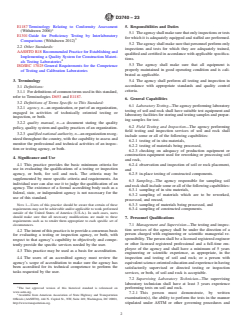
4.2 The intent of this practice is to provide a consensus basis for evaluating a testing or inspection agency, or both, with respect to that agency's capability to objectively and competently provide the specific services needed by the user.
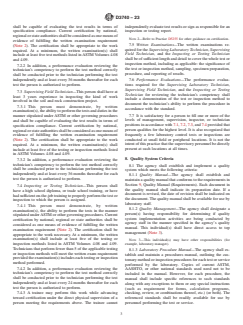
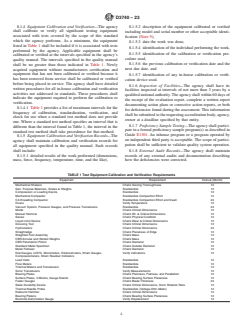
4.3 This practice may be used as a basis for accreditation.
4.4 The users of an accredited agency must review the agency's scope of accreditation to make sure the agency has been accredited for its technical competence to perform the tasks requested by the user.
SCOPE
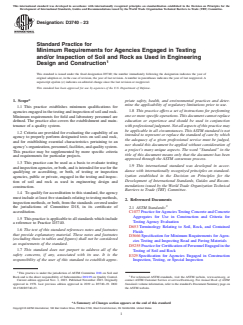
1.1 This practice establishes minimum qualifications for agencies engaged in the testing and inspection of soil and rock. Minimum requirements for field and laboratory personnel are defined. The practice also covers the establishment and maintenance of a quality system.
1.2 Criteria are provided for evaluating the capability of an agency to properly perform designated tests on soil and rock, and for establishing essential characteristics pertaining to an agency's organization, personnel, facilities, and quality system. This practice may be supplemented by more specific criteria and requirements for particular projects.
1.3 This practice can be used as a basis to evaluate testing and inspection agencies, or both, and is intended for use for the qualifying or accrediting, or both, of testing or inspection agencies, public or private, engaged in the testing and inspection of soil and rock as used in engineering design and construction.
1.4 To qualify for accreditation to this standard, the agency must include at least five standards relating to testing methods, inspection methods, or both, from the standards covered under the jurisdictions of Committee D18, in its certificate of accreditation.
1.5 This practice is applicable to all standards which include a reference to Practice D3740.
1.6 The text of this standard references notes and footnotes that provide explanatory material. These notes and footnotes (excluding those in tables and figures) shall not be considered as requirements of the standard.
1.7 This standard does not purport to address all of the safety concerns, if any, associated with its use. It is the responsibility of the user of this standard to establish appropriate safety, health, and environmental practices and determine the applicability of regulatory limitations prior to use.
1.8 This practice offers a set of instructions for performing one or more specific operations. This document cannot replace education or experience and should be used in conjunction with professional judgment. Not all aspects of this practice may be applicable in all circumstances. This ASTM standard is not intended to represent or replace the standard of care by which the adequacy of a given professional service must be judged, nor should this document be applied without consideration of a project's many unique aspects. The word “Standard” in the title of this document means only that the document has been approved through the ASTM consensus process.
1.9 This international standard was developed in accordance with internationally recognized principles on standardizat...
- Status
- Published
- Publication Date
- 31-Oct-2023
- Technical Committee
- D18 - Soil and Rock
- Drafting Committee
- D18.99 - Quality Control
Buy Documents
ASTM D3740-23 - Standard Practice for Minimum Requirements for Agencies Engaged in Testing and/or Inspection of Soil and Rock as Used in Engineering Design and Construction
REDLINE ASTM D3740-23 - Standard Practice for Minimum Requirements for Agencies Engaged in Testing and/or Inspection of Soil and Rock as Used in Engineering Design and Construction
Overview
ASTM D3740-23 sets the minimum requirements for agencies engaged in the testing and/or inspection of soil and rock in engineering design and construction. Developed by ASTM Committee D18, this standard practice provides essential criteria for evaluating and accrediting both public and private agencies that conduct soil and rock testing or inspection. It addresses qualifications for field and laboratory personnel, quality system requirements, record-keeping, and calibration of testing equipment-ensuring technical competence and reliable results in geotechnical investigations.
Adherence to ASTM D3740-23 promotes quality assurance, quality control, and technical proficiency, supporting the safety and integrity of construction projects where soil and rock assessments are fundamental.
Key Topics
- Agency Qualifications: Establishes the required credentials for personnel and management, such as education, experience, and certification, ensuring only qualified individuals conduct and supervise tests and inspections.
- Personnel Competency: Details the necessary training, written examinations, and performance evaluations for staff involved in soil and rock testing and inspection, including periodic reviews to maintain competency.
- Quality System: Requires agencies to implement and document a robust quality system, including a quality manual outlining policies, standard operating procedures, equipment calibration, and corrective actions.
- Equipment Calibration and Maintenance: Mandates regular calibration and maintenance of all critical testing equipment with detailed records maintained, supporting test accuracy and reliability.
- Record-Keeping and Reporting: Specifies requirements for test records, reports, and data retention to provide traceability and transparency, with clear procedures for report amendments and audit trails.
- Accreditation and Audit: Can be used as a framework for agency accreditation by specifying compliance with relevant ASTM or international standards, regular facility inspections by national authorities, and participation in proficiency testing programs.
Applications
ASTM D3740-23 is widely utilized by organizations seeking to demonstrate or assess competency in soil and rock testing and inspection services. Its main applications include:
- Geotechnical Investigations: Ensures agencies performing field and lab tests on soil and rock for construction projects are properly staffed, equipped, and follow recognized procedures.
- Construction Quality Control: Used by contractors, engineers, and project owners to select qualified agencies for soil and rock testing, helping mitigate project risks and ensure compliance with specifications.
- Accreditation Programs: Serves as a foundation for agency accreditation by federal, state, local, or independent bodies, aligning with quality management systems and international standards.
- Regulatory Compliance: Supports agencies in meeting regulatory or client-mandated requirements for competency, documentation, and quality assurance in materials testing.
- Project Qualification and Tendering: Agencies may use compliance with ASTM D3740-23 to bolster their credentials in competitive bids, demonstrating commitment to quality and technical rigor.
Related Standards
ASTM D3740-23 references and aligns with several key standards to further support agency competency and quality management:
- ASTM C1077 - Practice for Agencies Testing Concrete and Concrete Aggregates
- ASTM D653 - Terminology Relating to Soil, Rock, and Contained Fluids
- ASTM D3666 - Specification for Agencies Testing and Inspecting Road and Paving Materials
- ASTM D5255 - Practice for Certification of Personnel Engaged in Testing of Soil and Rock
- ASTM E329 - Specification for Agencies Engaged in Construction Inspection or Testing
- AASHTO R18 - Recommended Practice for Quality Systems in Construction Materials Testing Laboratories
- ISO/IEC 17025 - General Requirements for the Competence of Testing and Calibration Laboratories
Keywords: ASTM D3740-23, geotechnical testing, soil inspection, rock testing, quality assurance, quality control, testing agency accreditation, calibration, laboratory competency, construction materials testing, quality system, engineering standards, accreditation, proficiency testing.
By implementing ASTM D3740-23, agencies and stakeholders are equipped to foster trust, consistency, and accuracy in soil and rock testing, ultimately supporting safer and more reliable engineering and construction outcomes.
Relations
- Effective Date
- 01-Nov-2023
- Effective Date
- 01-Jan-2024
- Effective Date
- 01-May-2021
- Effective Date
- 01-Oct-2017
- Effective Date
- 01-Nov-2023
- Effective Date
- 01-Nov-2023
- Effective Date
- 01-Nov-2023
- Effective Date
- 01-Nov-2023
- Referred By
ASTM D5092/D5092M-16 - Standard Practice for Design and Installation of Groundwater Monitoring Wells - Effective Date
- 01-Nov-2023
- Effective Date
- 01-Nov-2023
- Effective Date
- 01-Nov-2023
- Effective Date
- 01-Nov-2023
- Referred By
ASTM D6128-22 - Standard Test Method for Shear Testing of Bulk Solids Using the Jenike Shear Tester - Effective Date
- 01-Nov-2023
- Effective Date
- 01-Nov-2023
- Effective Date
- 01-Nov-2023
Buy Documents
ASTM D3740-23 - Standard Practice for Minimum Requirements for Agencies Engaged in Testing and/or Inspection of Soil and Rock as Used in Engineering Design and Construction
REDLINE ASTM D3740-23 - Standard Practice for Minimum Requirements for Agencies Engaged in Testing and/or Inspection of Soil and Rock as Used in Engineering Design and Construction
Get Certified
Connect with accredited certification bodies for this standard

BSI Group
BSI (British Standards Institution) is the business standards company that helps organizations make excellence a habit.

Bureau Veritas
Bureau Veritas is a world leader in laboratory testing, inspection and certification services.

DNV
DNV is an independent assurance and risk management provider.
Sponsored listings
Frequently Asked Questions
ASTM D3740-23 is a standard published by ASTM International. Its full title is "Standard Practice for Minimum Requirements for Agencies Engaged in Testing and/or Inspection of Soil and Rock as Used in Engineering Design and Construction". This standard covers: SIGNIFICANCE AND USE 4.1 This practice provides the basic minimum criteria for use in evaluating the qualifications of a testing or inspection agency, or both, for soil and rock. The criteria may be supplemented by more specific criteria and requirements. An individual user can also use it to judge the qualification of an agency. The existence of a formal accrediting body such as a federal, state, or independent agency is not necessary for the use of this standard. Note 1: Users of this practice should be aware that certain of these requirements may not be achievable and/or applicable to work performed outside of the United States of America (U.S.A.). In such cases, users should make sure that all necessary modifications are made to these requirements such as to render them appropriate to each specific set of circumstances. 4.2 The intent of this practice is to provide a consensus basis for evaluating a testing or inspection agency, or both, with respect to that agency's capability to objectively and competently provide the specific services needed by the user. 4.3 This practice may be used as a basis for accreditation. 4.4 The users of an accredited agency must review the agency's scope of accreditation to make sure the agency has been accredited for its technical competence to perform the tasks requested by the user. SCOPE 1.1 This practice establishes minimum qualifications for agencies engaged in the testing and inspection of soil and rock. Minimum requirements for field and laboratory personnel are defined. The practice also covers the establishment and maintenance of a quality system. 1.2 Criteria are provided for evaluating the capability of an agency to properly perform designated tests on soil and rock, and for establishing essential characteristics pertaining to an agency's organization, personnel, facilities, and quality system. This practice may be supplemented by more specific criteria and requirements for particular projects. 1.3 This practice can be used as a basis to evaluate testing and inspection agencies, or both, and is intended for use for the qualifying or accrediting, or both, of testing or inspection agencies, public or private, engaged in the testing and inspection of soil and rock as used in engineering design and construction. 1.4 To qualify for accreditation to this standard, the agency must include at least five standards relating to testing methods, inspection methods, or both, from the standards covered under the jurisdictions of Committee D18, in its certificate of accreditation. 1.5 This practice is applicable to all standards which include a reference to Practice D3740. 1.6 The text of this standard references notes and footnotes that provide explanatory material. These notes and footnotes (excluding those in tables and figures) shall not be considered as requirements of the standard. 1.7 This standard does not purport to address all of the safety concerns, if any, associated with its use. It is the responsibility of the user of this standard to establish appropriate safety, health, and environmental practices and determine the applicability of regulatory limitations prior to use. 1.8 This practice offers a set of instructions for performing one or more specific operations. This document cannot replace education or experience and should be used in conjunction with professional judgment. Not all aspects of this practice may be applicable in all circumstances. This ASTM standard is not intended to represent or replace the standard of care by which the adequacy of a given professional service must be judged, nor should this document be applied without consideration of a project's many unique aspects. The word “Standard” in the title of this document means only that the document has been approved through the ASTM consensus process. 1.9 This international standard was developed in accordance with internationally recognized principles on standardizat...
SIGNIFICANCE AND USE 4.1 This practice provides the basic minimum criteria for use in evaluating the qualifications of a testing or inspection agency, or both, for soil and rock. The criteria may be supplemented by more specific criteria and requirements. An individual user can also use it to judge the qualification of an agency. The existence of a formal accrediting body such as a federal, state, or independent agency is not necessary for the use of this standard. Note 1: Users of this practice should be aware that certain of these requirements may not be achievable and/or applicable to work performed outside of the United States of America (U.S.A.). In such cases, users should make sure that all necessary modifications are made to these requirements such as to render them appropriate to each specific set of circumstances. 4.2 The intent of this practice is to provide a consensus basis for evaluating a testing or inspection agency, or both, with respect to that agency's capability to objectively and competently provide the specific services needed by the user. 4.3 This practice may be used as a basis for accreditation. 4.4 The users of an accredited agency must review the agency's scope of accreditation to make sure the agency has been accredited for its technical competence to perform the tasks requested by the user. SCOPE 1.1 This practice establishes minimum qualifications for agencies engaged in the testing and inspection of soil and rock. Minimum requirements for field and laboratory personnel are defined. The practice also covers the establishment and maintenance of a quality system. 1.2 Criteria are provided for evaluating the capability of an agency to properly perform designated tests on soil and rock, and for establishing essential characteristics pertaining to an agency's organization, personnel, facilities, and quality system. This practice may be supplemented by more specific criteria and requirements for particular projects. 1.3 This practice can be used as a basis to evaluate testing and inspection agencies, or both, and is intended for use for the qualifying or accrediting, or both, of testing or inspection agencies, public or private, engaged in the testing and inspection of soil and rock as used in engineering design and construction. 1.4 To qualify for accreditation to this standard, the agency must include at least five standards relating to testing methods, inspection methods, or both, from the standards covered under the jurisdictions of Committee D18, in its certificate of accreditation. 1.5 This practice is applicable to all standards which include a reference to Practice D3740. 1.6 The text of this standard references notes and footnotes that provide explanatory material. These notes and footnotes (excluding those in tables and figures) shall not be considered as requirements of the standard. 1.7 This standard does not purport to address all of the safety concerns, if any, associated with its use. It is the responsibility of the user of this standard to establish appropriate safety, health, and environmental practices and determine the applicability of regulatory limitations prior to use. 1.8 This practice offers a set of instructions for performing one or more specific operations. This document cannot replace education or experience and should be used in conjunction with professional judgment. Not all aspects of this practice may be applicable in all circumstances. This ASTM standard is not intended to represent or replace the standard of care by which the adequacy of a given professional service must be judged, nor should this document be applied without consideration of a project's many unique aspects. The word “Standard” in the title of this document means only that the document has been approved through the ASTM consensus process. 1.9 This international standard was developed in accordance with internationally recognized principles on standardizat...
ASTM D3740-23 is classified under the following ICS (International Classification for Standards) categories: 03.120.20 - Product and company certification. Conformity assessment. The ICS classification helps identify the subject area and facilitates finding related standards.
ASTM D3740-23 has the following relationships with other standards: It is inter standard links to ASTM D3740-19, ASTM C1077-24, ASTM E329-21, ASTM C1077-17, ASTM D5881-20, ASTM D4696-18, ASTM D6034-20, ASTM D6760-16, ASTM D5092/D5092M-16, ASTM D5850-20, ASTM D7262-23, ASTM D698-12(2021), ASTM D6128-22, ASTM D6467-21e1, ASTM D6758-18e1. Understanding these relationships helps ensure you are using the most current and applicable version of the standard.
ASTM D3740-23 is available in PDF format for immediate download after purchase. The document can be added to your cart and obtained through the secure checkout process. Digital delivery ensures instant access to the complete standard document.
Standards Content (Sample)
This international standard was developed in accordance with internationally recognized principles on standardization established in the Decision on Principles for the
Development of International Standards, Guides and Recommendations issued by the World Trade Organization Technical Barriers to Trade (TBT) Committee.
Designation: D3740 − 23
Standard Practice for
Minimum Requirements for Agencies Engaged in Testing
and/or Inspection of Soil and Rock as Used in Engineering
Design and Construction
This standard is issued under the fixed designation D3740; the number immediately following the designation indicates the year of
original adoption or, in the case of revision, the year of last revision. A number in parentheses indicates the year of last reapproval. A
superscript epsilon (´) indicates an editorial change since the last revision or reapproval.
This standard has been approved for use by agencies of the U.S. Department of Defense.
1. Scope* priate safety, health, and environmental practices and deter-
mine the applicability of regulatory limitations prior to use.
1.1 This practice establishes minimum qualifications for
1.8 This practice offers a set of instructions for performing
agencies engaged in the testing and inspection of soil and rock.
one or more specific operations. This document cannot replace
Minimum requirements for field and laboratory personnel are
education or experience and should be used in conjunction
defined. The practice also covers the establishment and main-
with professional judgment. Not all aspects of this practice may
tenance of a quality system.
be applicable in all circumstances. This ASTM standard is not
1.2 Criteria are provided for evaluating the capability of an
intended to represent or replace the standard of care by which
agency to properly perform designated tests on soil and rock,
the adequacy of a given professional service must be judged,
and for establishing essential characteristics pertaining to an
nor should this document be applied without consideration of
agency’s organization, personnel, facilities, and quality system.
a project’s many unique aspects. The word “Standard” in the
This practice may be supplemented by more specific criteria
title of this document means only that the document has been
and requirements for particular projects.
approved through the ASTM consensus process.
1.3 This practice can be used as a basis to evaluate testing
1.9 This international standard was developed in accor-
and inspection agencies, or both, and is intended for use for the
dance with internationally recognized principles on standard-
qualifying or accrediting, or both, of testing or inspection
ization established in the Decision on Principles for the
agencies, public or private, engaged in the testing and inspec-
Development of International Standards, Guides and Recom-
tion of soil and rock as used in engineering design and
mendations issued by the World Trade Organization Technical
construction.
Barriers to Trade (TBT) Committee.
1.4 To qualify for accreditation to this standard, the agency
must include at least five standards relating to testing methods,
2. Referenced Documents
inspection methods, or both, from the standards covered under
the jurisdictions of Committee D18, in its certificate of 2.1 ASTM Standards:
accreditation.
C1077 Practice for Agencies Testing Concrete and Concrete
Aggregates for Use in Construction and Criteria for
1.5 This practice is applicable to all standards which include
Testing Agency Evaluation
a reference to Practice D3740.
D653 Terminology Relating to Soil, Rock, and Contained
1.6 The text of this standard references notes and footnotes
Fluids
that provide explanatory material. These notes and footnotes
D3666 Specification for Minimum Requirements for Agen-
(excluding those in tables and figures) shall not be considered
cies Testing and Inspecting Road and Paving Materials
as requirements of the standard.
D5255 Practice for Certification of Personnel Engaged in the
1.7 This standard does not purport to address all of the
Testing of Soil and Rock
safety concerns, if any, associated with its use. It is the
E329 Specification for Agencies Engaged in Construction
responsibility of the user of this standard to establish appro-
Inspection, Testing, or Special Inspection
This practice is under the jurisdiction of ASTM Committee D18 on Soil and
Rock and is the direct responsibility of Subcommittee D18.99 on Quality Control. For referenced ASTM standards, visit the ASTM website, www.astm.org, or
Current edition approved Nov. 1, 2023. Published November 2023. Originally contact ASTM Customer Service at service@astm.org. For Annual Book of ASTM
approved in 1978. Last previous edition approved in 2019 as D3740–19. DOI: Standards volume information, refer to the standard’s Document Summary page on
10.1520/D3740-23. the ASTM website.
*A Summary of Changes section appears at the end of this standard
Copyright © ASTM International, 100 Barr Harbor Drive, PO Box C700, West Conshohocken, PA 19428-2959. United States
D3740 − 23
E1187 Terminology Relating to Conformity Assessment 5. Responsibilities and Duties
(Withdrawn 2006)
5.1 The agency shall make sure that only inspections or tests
E1301 Guide for Proficiency Testing by Interlaboratory
for which it is adequately equipped and staffed are performed.
Comparisons (Withdrawn 2012)
5.2 The agency shall make sure that personnel perform only
2.2 Other Standards:
inspections and tests for which they are adequately trained,
AASHTO R18 Recommended Practice for Establishing and
qualified and certified in accordance with applicable specifica-
Implementing a Quality System for Construction Materi-
tions.
als Testing Laboratories
5.3 The agency shall make sure that all equipment is
ISO/IEC 17025 General Requirements for the Competence
properly maintained in good operating condition and is cali-
of Testing and Calibration Laboratories
brated as applicable.
3. Terminology
5.4 The agency shall perform all testing and inspection in
accordance with appropriate standards and quality control
3.1 Definitions:
criteria.
3.1.1 For definitions of common terms used in this standard,
refer to Terminologies D653 and E1187.
6. General Capabilities
3.2 Definitions of Terms Specific to This Standard:
6.1 Laboratory Testing—The agency performing laboratory
3.2.1 agency, n—an organization, or part of an organization,
testing of soil and rock shall have suitable test equipment and
engaged in activities of technically oriented testing or
laboratory facilities for storing and testing samples and prepar-
inspection, or both.
ing samples for test.
3.2.2 quality manual, n—a document stating the quality
6.2 Field Testing and Inspection—The agency performing
policy, quality system and quality practices of an organization.
field testing and inspection services of soil and rock shall
3.2.3 qualified national authority, n—an organization recog-
include some or all of the following capabilities:
nized throughout the country, with the capability to assess and
6.2.1 testing of in situ materials,
monitor the professional and technical activities of an inspec-
6.2.2 testing of materials being processed,
tion or testing agency, or both.
6.2.3 checking on adequacy of production equipment or
construction equipment used for reworking or processing soil
4. Significance and Use
and rock,
4.1 This practice provides the basic minimum criteria for 6.2.4 observation and inspection of soil or rock placement,
use in evaluating the qualifications of a testing or inspection
and
agency, or both, for soil and rock. The criteria may be 6.2.5 in-place testing of constructed components.
supplemented by more specific criteria and requirements. An
6.3 Sampling—The agency responsible for sampling soil
individual user can also use it to judge the qualification of an
and rock shall include some or all of the following capabilities:
agency. The existence of a formal accrediting body such as a
6.3.1 sampling of in situ materials,
federal, state, or independent agency is not necessary for the
6.3.2 sampling of materials which are to be reworked,
use of this standard.
processed, and reused,
6.3.3 sampling of materials being processed, and
NOTE 1—Users of this practice should be aware that certain of these
requirements may not be achievable and/or applicable to work performed
6.3.4 sampling of constructed components.
outside of the United States of America (U.S.A.). In such cases, users
should make sure that all necessary modifications are made to these
7. Personnel Qualifications
requirements such as to render them appropriate to each specific set of
circumstances. 7.1 Management and Supervision—The testing and inspec-
tion services of the agency shall be under the direction of a
4.2 The intent of this practice is to provide a consensus basis
person charged with engineering or scientific managerial re-
for evaluating a testing or inspection agency, or both, with
sponsibility. The person shall be a licensed registered engineer
respect to that agency’s capability to objectively and compe-
or other licensed registered professional and a full-time em-
tently provide the specific services needed by the user.
ployee of the agency and shall have a minimum of 5 years
4.3 This practice may be used as a basis for accreditation.
engineering or scientific experience, as appropriate, in the
4.4 The users of an accredited agency must review the
inspection and testing of soil and rock; or a person with
agency’s scope of accreditation to make sure the agency has
equivalent science-oriented education and experience in having
been accredited for its technical competence to perform the
satisfactorily supervised or directed testing or inspection
tasks requested by the user.
services, or both, of soil and rock is acceptable.
7.2 Supervising Laboratory Technician—The supervising
laboratory technician shall have at least 3 years experience
The last approved version of this historical standard is referenced on
performing tests on soil and rock.
www.astm.org.
7.2.1 This person must demonstrate, by written
Available from American Association of State Highway and Transportation
examination(s), the ability to perform the tests in the manner
Officials (AASHTO), 444 N. Capitol St., NW, Suite 249, Washington, DC 20001,
http://www.transportation.org. stipulated under ASTM or other governing procedures and
D3740 − 23
shall be capable of evaluating the test results in terms of independently evaluate test results or sign as responsible for an
specification compliance. Current certification by national, inspection or testing report.
regional or state authorities shall be considered as one means of
NOTE 2—Refer to Practice D5255 for other guidance on certification.
evidence of fulfilling the written examination requirement
7.5 Written Examinations—The written examinations re-
(Note 2). The certification shall be appropriate to the work
quired for the Supervising Laboratory Technician, Supervising
required. At a minimum, the written examination(s) shall
Field Technician, and the Inspecting or Testing Technician
include at least five test methods listed in ASTM Volumes 4.08
shall be of sufficient length and detail to cover the whole test or
and 4.09.
inspection method, including as applicable: the significance of
7.2.2 In addition, a performance evaluation reviewing the
the test or inspection method, sampling, specimen preparation,
technician’s competency to perform the test method correctly
procedure, and reporting of results.
shall be conducted prior to the technician performing the test
independently and at least every 36 months thereafter for each
7.6 Performance Evaluations—The performance evalua-
test the person is authorized to perform.
tions required for the Supervising Laboratory Technician,
Supervising Field Technician, and the Inspecting or Testing
7.3 Supervising Field Technician—This person shall have at
Technician for reviewing the technician’s competency shall
least 3 years experience in inspecting the kind of work
include a demonstration of the test or inspection method to
involved in the soil and rock construction project.
document the technician’s ability to perform the procedure in
7.3.1 This person must demonstrate, by written
accordance with the standard.
examination(s), the ability to perform the tests and duties in the
7.7 It is satisfactory for a person to fill one or more of the
manner stipulated under ASTM or other governing procedures
levels of management, supervision, inspector, or technician
and shall be capable of evaluating the test results in terms of
positions in accordance with 7.1, 7.2, 7.3, and 7.4 provided that
specification compliance. Current certification by national,
person qualifies for the highest level. It is also recognized that
regional or state authorities shall be considered as one means of
frequently a few laboratory control tests or inspections are
evidence of fulfilling the written examination requirement
conducted at small field or peripheral locations. It is not the
(Note 2). The certification shall be appropriate to the work
intent of this practice that the supervisory personnel be directly
required. At a minimum, the written examination(s) shall
present at such locations at all times.
include at least five of the testing or inspection methods listed
in ASTM Volumes 4.08 and 4.09.
8. Quality System Criteria
7.3.2 In addition, a performance evaluation reviewing the
technician’s competency to perform the test method correctly
8.1 The agency shall establish and implement a quality
shall be conducted prior to the technician performing the test
system which meets the following criteria:
independently and at least every 36 months thereafter for each
8.1.1 Quality Manual—The agency shall establish and
test the person is authorized to perform.
maintain a quality manual that conforms to the requirements in
Section 9, Quality Manual (Requirements). Each document in
7.4 Inspecting or Testing Technician—This person shall
the quality manual shall indicate its preparation date. If a
have a high school diploma, or trade school training, or have
document is revised, the date of revision shall be indicated on
had sufficient on-the-job training to properly perform the test or
the document. The quality manual shall be available for use by
inspection to which the person is assigned.
laboratory staff.
7.4.1 This person must demonstrate, by written
8.1.2 Quality Management—The agency shall designate a
examination(s), the ability to perform the tests in the manner
person(s) having responsibility for determining if quality
stipulated under ASTM or other governing procedures. Current
system implementation activities are being conducted by
certification by national, regional or state authorities shall be
agency staff in the manner specified in the agency’s quality
considered as one means of evidence of fulfilling the written
manual. This individual(s) shall have direct access to top
examination requirement (Note 2). The certification shall be
management (Note 3).
appropriate to the work necessary. At a minimum, the written
examination(s) shall include at least five of the testing or
NOTE 3—This individual(s) may have other responsibilities (for
inspection methods listed in ASTM Volumes 4.08 and 4.09. example, laboratory manager).
Technicians that perform fewer than 5 of the applicable testing
8.1.3 Laboratory Procedure Manual—The agency shall es-
or inspection methods will meet the written exam requirement
tablish and maintain a procedures manual, outlining the cus-
provided the examination(s) includes each testing or inspection
tomary method or inspection procedures for each test or service
method performed.
performed by the laboratory. Copies of current ASTM,
7.4.2 In addition, a performance evaluation reviewing the
AASHTO, or other national standards used need not to be
technician’s competency to perform the test method correctly
included in the manual. However, for each procedure, the
shall be conducted prior to the technician performing the test
manual shall include specific references to such standards
independently and at least every 24 months thereafter for each
along with any exceptions to them or any special instructions
test the person is authorized to perform.
(such as requirement for forms, calculation programs,
7.4.3 A trainee may perform this work while advancing checking, review, or combinations thereof, etc.) (or both). The
toward certification under the direct physical supervision of a referenced standards shall be readily available for use by
person meeting the requirements above. The trainee cannot personnel performing the test or service.
D3740 − 23
8.1.4 Equipment Calibration and Verification—The agency 8.1.5.2 description of the equipment calibrated or verified
shall calibrate or verify all significant testing equipment including model and serial number or other acceptable identi-
associated with tests covered by the scope of this standard
fication (Note 9),
which the agency performs. As a minimum, the equipment
8.1.5.3 date the work was done,
listed in Table 1 shall be included if it is associated with tests
8.1.5.4 identification of the individual performing the work,
performed by the agency. Applicable equipment shall be
8.1.5.5 identification of the calibration or verification pro-
calibrated or verified at the intervals specified in the agency’s
cedure used,
quality manual. The intervals specified in the quality manual
8.1.5.6 the previous calibration or verification date and the
shall be no greater than those indicated in Table 1. Newly
next due date, and
acquired equipment without manufacturers certification and
equipment that has not been calibrated or verified because it
8.1.5.7 identification of any in-house calibration or verifi-
has been removed from service shall be calibrated or verified
cation device used.
before being placed in service. The agency shall have detailed
8.1.6 Inspection of Facilities—The agency shall have its
written procedures for all in-house calibration and verification
facilities inspected at intervals of not more than 3 years by a
activities not addressed in standards. These procedures shall
qualified national authority. The agency shall within 60 days of
indicate the equipment required to perform the calibration or
the receipt of the evaluation report, complete a written report
verification.
documenting action plans or corrective action reports, or both
8.1.4.1 Table 1 provides a list of maximum intervals for the
for deficiencies found during the assessment. This information
frequency of calibration, standardization, verification, and
shall be submitted to the requesting accreditation body, agency,
check for use when a standard t
...
This document is not an ASTM standard and is intended only to provide the user of an ASTM standard an indication of what changes have been made to the previous version. Because
it may not be technically possible to adequately depict all changes accurately, ASTM recommends that users consult prior editions as appropriate. In all cases only the current version
of the standard as published by ASTM is to be considered the official document.
Designation: D3740 − 19 D3740 − 23
Standard Practice for
Minimum Requirements for Agencies Engaged in Testing
and/or Inspection of Soil and Rock as Used in Engineering
Design and Construction
This standard is issued under the fixed designation D3740; the number immediately following the designation indicates the year of
original adoption or, in the case of revision, the year of last revision. A number in parentheses indicates the year of last reapproval. A
superscript epsilon (´) indicates an editorial change since the last revision or reapproval.
This standard has been approved for use by agencies of the U.S. Department of Defense.
1. Scope*
1.1 This practice establishes minimum qualifications for agencies engaged in the testing and inspection of soil and rock. Minimum
requirements for field and laboratory personnel are defined. The practice also covers the establishment and maintenance of a quality
system.
1.2 Criteria are provided for evaluating the capability of an agency to properly perform designated tests on soil and rock, and for
establishing essential characteristics pertaining to an agency’s organization, personnel, facilities, and quality system. This practice
may be supplemented by more specific criteria and requirements for particular projects.
1.3 This practice can be used as a basis to evaluate testing and inspection agencies, or both, and is intended for use for the
qualifying or accrediting, or both, of testing or inspection agencies, public or private, engaged in the testing and inspection of soil
and rock as used in engineering design and construction.
1.4 To qualify for accreditation to this standard, the agency must include at least five standards relating to testing methods,
inspection methods, or both, from the standards covered under the jurisdictions of Committee D18, in its certificate of
accreditation.
1.5 This practice is applicable to all standards which include a reference to Practice D3740.
1.6 The text of this standard references notes and footnotes that provide explanatory material. These notes and footnotes
(excluding those in tables and figures) shall not be considered as requirements of the standard.
1.7 This standard does not purport to address all of the safety concerns, if any, associated with its use. It is the responsibility
of the user of this standard to establish appropriate safety, health, and environmental practices and determine the applicability of
regulatory limitations prior to use.
1.8 This practice offers a set of instructions for performing one or more specific operations. This document cannot replace
education or experience and should be used in conjunction with professional judgment. Not all aspects of this practice may be
applicable in all circumstances. This ASTM standard is not intended to represent or replace the standard of care by which the
This practice is under the jurisdiction of ASTM Committee D18 on Soil and Rock and is the direct responsibility of Subcommittee D18.99 on Quality Control.
Current edition approved Oct. 1, 2019Nov. 1, 2023. Published October 2019November 2023. Originally approved in 1978. Last previous edition approved in 20122019
as D3740–12a. DOI: 10.1520/D3740-19.–19. DOI: 10.1520/D3740-23.
*A Summary of Changes section appears at the end of this standard
Copyright © ASTM International, 100 Barr Harbor Drive, PO Box C700, West Conshohocken, PA 19428-2959. United States
D3740 − 23
adequacy of a given professional service must be judged, nor should this document be applied without consideration of a project’s
many unique aspects. The word “Standard” in the title of this document means only that the document has been approved through
the ASTM consensus process.
1.9 This international standard was developed in accordance with internationally recognized principles on standardization
established in the Decision on Principles for the Development of International Standards, Guides and Recommendations issued
by the World Trade Organization Technical Barriers to Trade (TBT) Committee.
2. Referenced Documents
2.1 ASTM Standards:
C1077 Practice for Agencies Testing Concrete and Concrete Aggregates for Use in Construction and Criteria for Testing Agency
Evaluation
D653 Terminology Relating to Soil, Rock, and Contained Fluids
D3666 Specification for Minimum Requirements for Agencies Testing and Inspecting Road and Paving Materials
D5255 Practice for Certification of Personnel Engaged in the Testing of Soil and Rock
E329 Specification for Agencies Engaged in Construction Inspection, Testing, or Special Inspection
E1187 Terminology Relating to Conformity Assessment (Withdrawn 2006)
E1301 Guide for Proficiency Testing by Interlaboratory Comparisons (Withdrawn 2012)
2.2 Other Standards:
AASHTO R18 Recommended Practice for Establishing and Implementing a Quality System for Construction Materials Testing
Laboratories
ISO/IEC 17025 General Requirements for the Competence of Testing and Calibration Laboratories
3. Terminology
3.1 Definitions:
3.1.1 For definitions of common terms used in this standard, refer to Terminologies D653 and E1187.
3.2 Definitions of Terms Specific to This Standard:
3.2.1 agency, n—an organization, or part of an organization, engaged in activities of technically oriented testing or inspection, or
both.
3.2.2 quality manual, n—a document stating the quality policy, quality system and quality practices of an organization.
3.2.3 qualified national authority, n—an organization recognized throughout the country, with the capability to assess and monitor
the professional and technical activities of an inspection or testing agency, or both.
4. Significance and Use
4.1 This practice provides the basic minimum criteria for use in evaluating the qualifications of a testing or inspection agency, or
both, for soil and rock. The criteria may be supplemented by more specific criteria and requirements. An individual user can also
use it to judge the qualification of an agency. The existence of a formal accrediting body such as a federal, state, or independent
agency is not necessary for the use of this standard.
NOTE 1—Users of this practice should be aware that certain of these requirements may not be achievable and/or applicable to work performed outside
of the United States of America (U.S.A.). In such cases, users should make sure that all necessary modifications are made to these requirements such as
to render them appropriate to each specific set of circumstances.
4.2 The intent of this practice is to provide a consensus basis for evaluating a testing or inspection agency, or both, with respect
to that agency’s capability to objectively and competently provide the specific services needed by the user.
For referenced ASTM standards, visit the ASTM website, www.astm.org, or contact ASTM Customer Service at service@astm.org. For Annual Book of ASTM Standards
volume information, refer to the standard’s Document Summary page on the ASTM website.
The last approved version of this historical standard is referenced on www.astm.org.
Available from American Association of State Highway and Transportation Officials (AASHTO), 444 N. Capitol St., NW, Suite 249, Washington, DC 20001,
http://www.transportation.org.
D3740 − 23
4.3 This practice may be used as a basis for accreditation.
4.4 The users of an accredited agency must review the agency’s scope of accreditation to make sure the agency has been accredited
for its technical competence to perform the tasks requested by the user.
5. Responsibilities and Duties
5.1 The agency shall make sure that only inspections or tests for which it is adequately equipped and staffed are performed.
5.2 The agency shall make sure that personnel perform only inspections and tests for which they are adequately trained, qualified
and certified in accordance with applicable specifications.
5.3 The agency shall make sure that all equipment is properly maintained in good operating condition and is calibrated as
applicable.
5.4 The agency shall perform all testing and inspection in accordance with appropriate standards and quality control criteria.
6. General Capabilities
6.1 Laboratory Testing—The agency performing laboratory testing of soil and rock shall have suitable test equipment and
laboratory facilities for storing and testing samples and preparing samples for test.
6.2 Field Testing and Inspection—The agency performing field testing and inspection services of soil and rock shall include some
or all of the following capabilities:
6.2.1 testing of in situ materials,
6.2.2 testing of materials being processed,
6.2.3 checking on adequacy of production equipment or construction equipment used for reworking or processing soil and rock,
6.2.4 observation and inspection of soil or rock placement, and
6.2.5 in-place testing of constructed components.
6.3 Sampling—The agency responsible for sampling soil and rock shall include some or all of the following capabilities:
6.3.1 sampling of in situ materials,
6.3.2 sampling of materials which are to be reworked, processed, and reused,
6.3.3 sampling of materials being processed, and
6.3.4 sampling of constructed components.
7. Personnel Qualifications
7.1 Management and Supervision—The testing and inspection services of the agency shall be under the direction of a person
charged with engineering or scientific managerial responsibility. The person shall be a licensed registered engineer or other licensed
registered professional and a full-time employee of the agency and shall have a minimum of 5 years engineering or scientific
experience, as appropriate, in the inspection and testing of soil and rock; or a person with equivalent science-oriented education
and experience in having satisfactorily supervised or directed testing or inspection services, or both, of soil and rock is acceptable.
7.2 Supervising Laboratory Technician—The supervising laboratory technician shall have at least 3 years experience performing
tests on soil and rock.
D3740 − 23
7.2.1 This person must demonstrate, by written examination(s), the ability to perform the tests in the manner stipulated under
ASTM or other governing procedures and shall be capable of evaluating the test results in terms of specification compliance.
Current certification by national, regional or state authorities shall be considered as one means of evidence of fulfilling the written
examination requirement (Note 2). The certification shall be appropriate to the work required. At a minimum, the written
examination(s) shall include at least five test methods listed in ASTM Volumes 4.08 and 4.09.
7.2.2 In addition, a performance evaluation reviewing the technician’s competency to perform the test method correctly shall be
conducted prior to the technician performing the test independently and at least every 36 months thereafter for each test the person
is authorized to perform.
7.3 Supervising Field Technician—This person shall have at least 3 years experience in inspecting the kind of work involved in
the soil and rock construction project.
7.3.1 This person must demonstrate, by written examination(s), the ability to perform the tests and duties in the manner stipulated
under ASTM or other governing procedures and shall be capable of evaluating the test results in terms of specification compliance.
Current certification by national, regional or state authorities shall be considered as one means of evidence of fulfilling the written
examination requirement (Note 2). The certification shall be appropriate to the work required. At a minimum, the written
examination(s) shall include at least five of the testing or inspection methods listed in ASTM Volumes 4.08 and 4.09.
7.3.2 In addition, a performance evaluation reviewing the technician’s competency to perform the test method correctly shall be
conducted prior to the technician performing the test independently and at least every 36 months thereafter for each test the person
is authorized to perform.
7.4 Inspecting or Testing Technician—This person shall have a high school diploma, or trade school training, or have had sufficient
on-the-job training to properly perform the test or inspection to which the person is assigned.
7.4.1 This person must demonstrate, by written examination(s), the ability to perform the tests in the manner stipulated under
ASTM or other governing procedures. Current certification by national, regional or state authorities shall be considered as one
means of evidence of fulfilling the written examination requirement (Note 2). The certification shall be appropriate to the work
necessary. At a minimum, the written examination(s) shall include at least five of the testing or inspection methods listed in ASTM
Volumes 4.08 and 4.09. Technicians that perform fewer than 5 of the applicable testing or inspection methods will meet the written
exam requirement provided the examination(s) includes each testing or inspection method performed.
7.4.2 In addition, a performance evaluation reviewing the technician’s competency to perform the test method correctly shall be
conducted prior to the technician performing the test independently and at least every 24 months thereafter for each test the person
is authorized to perform.
7.4.3 A trainee may perform this work while advancing toward certification under the direct physical supervision of a person
meeting the requirements above. The trainee cannot independently evaluate test results or sign as responsible for an inspection or
testing report.
NOTE 2—Refer to Practice D5255 for other guidance on certification.
7.5 Written Examinations—The written examinations required for the Supervising Laboratory Technician,Supervising Field
Technician, and the Inspecting or Testing Technician shall be of sufficient length and detail to cover the whole test or inspection
method, including as applicable: the significance of the test or inspection method, sampling, specimen preparation, procedure, and
reporting of results.
7.6 Performance Evaluations—The performance evaluations required for the Supervising Laboratory Technician,Supervising
Field Technician, and the Inspecting or Testing Technician for reviewing the technician’s competency shall include a demonstration
of the test or inspection method to document the technician’s ability to perform the procedure in accordance with the standard.
7.7 It is satisfactory for a person to fill one or more of the levels of management, supervision, inspector, or technician positions
in accordance with 7.1, 7.2, 7.3, and 7.4 provided that person qualifies for the highest level. It is also recognized that frequently
D3740 − 23
a few laboratory control tests or inspections are conducted at small field or peripheral locations. It is not the intent of this practice
that the supervisory personnel be directly present at such locations at all times.
8. Quality System Criteria
8.1 The agency shall establish and implement a quality system which meets the following criteria:
8.1.1 Quality Manual—The agency shall establish and maintain a quality manual that conforms to the requirements in Section 9,
Quality Manual (Requirements). Each document in the quality manual shall indicate its preparation date. If a document is revised,
the date of revision shall be indicated on the document. The quality manual shall be available for use by laboratory staff.
8.1.2 Quality Management—The agency shall designate a person(s) having responsibility for determining if quality system
implementation activities are being conducted by agency staff in the manner specified in the agency’s quality manual. This
individual(s) shall have direct access to top management (Note 3).
NOTE 3—This individual(s) may have other responsibilities (for example, laboratory manager).
8.1.3 Laboratory Procedure Manual—The agency shall establish and maintain a procedures manual, outlining the customary
method or inspection procedures for each test or service performed by the laboratory. Copies of current ASTM, AASHTO, or other
national standards used need not to be included in the manual. However, for each procedure, the manual shall include specific
references to such standards along with any exceptions to them or any special instructions (such as requirement for forms,
calculation programs, checking, review, or combinations thereof, etc.) (or both). The referenced standards shall be readily available
for use by personnel performing the test or service.
8.1.4 Equipment Calibration and Verification—The agency shall calibrate or verify all significant testing equipment associated
with tests covered by the scope of this standard which the agency performs. As a minimum, the equipment listed in Table 1 shall
be included if it is associated with tests performed by the agency. Applicable equipment shall be calibrated or verified at the
intervals specified in the agency’s quality manual. The intervals specified in the quality manual shall be no greater than those
indicated in Table 1 (. Note 4). Newly acquired equipment without manufacturers certification and equipment that has not been
calibrated or verified because it has been removed from service shall be calibrated or verified before being placed in service. The
agency shall have detailed written procedures for all in-house calibration and verification activities not addressed in standards.
These procedures shall indicate the equipment required to perform the calibration or verification.
NOTE 4—When a maximum calibration or verification interval for a specific piece of test equipment is specified in a standard, the maximum interval
specified by this document is intended to be the same as the maximum interval specified by the standard.
8.1.4.1 Table 1 provides a list of maximum intervals for the frequency of calibration, standardization, verification, and check for
use when a standard test method does not provide one. Where a standard test method specifies an interval that is different than the
interval found in Table 1, the interval in the standard test method shall take precedence for that method.
8.1.5 Equipment Calibration and Verification Records—The agency shall maintain calibration and verification records for all
equipment specified in the quality manual. Such records shall include:
8.1.5.1 detailed results of the work performed (dimensions, mass, force, frequency, temperature, time, and the like),
8.1.5.2 description of the equipment calibrated or verified including model and serial number or other acceptable identification
(Note 109),
8.1.5.3 date the work was done,
8.1.5.4 identification of the individual performing the work,
8.1.5.5 identification of the calibration or verification procedure used,
8.1.5.6 the previous calibration or verification date and the next due date, and
8.1.5.7 identification of any in-house calibration or verification device used.
D3740 − 23
TABLE 1 Test Equipment Calibration and Verification Requirements
Equipment—Test MethodEquipment Requirement Interval (Month)
Mechanical Shakers Check Sieving Thoroughness 12
Gen. Purpose Balances, Scales & Weights Verify Measurements 12
Gen. Purpose Balances, Scales & Weights Standardize 12
Compression or Loading Device Verify Measurements 12
Compression or Loading Device Standardize 12
Mechanical Compactor Calibrate Compactive Effort 12
Mechanical Compactor Standardize Compaction Effort 12
CA Kneadin
...