

ASTM E860-22
(Practice)Standard Practice for Examining and Preparing Items That Are or May Become Involved in Criminal or Civil Litigation
General Information
- Abstract
SIGNIFICANCE AND USE
4.1 This practice establishes procedures to be followed by the forensic science practitioner to document the nature, state, or condition of items of evidence. It also describes specific actions that are required for destructive testing if planned testing, examination, disassembly, or other actions are likely to alter the nature, state, or condition of the evidence so as to preclude or adversely limit additional examination or testing.
4.2 Deviations from this practice are not necessarily wrong or inferior, but such deviations should be justified and documented.
SCOPE
1.1 This practice covers procedures for the examination and testing of evidence items or systems that may have been involved in a specific incident which are, or may be reasonably expected to be, the subject of civil or criminal litigation.
1.2 This practice is applicable when it is determined that examination or testing of evidence is required, and such examination is likely to change the nature, state, or condition of the evidence.
1.3 This practice is intended for use by competent forensic science practitioners with the requisite formal education, discipline-specific training (see Practice E2917), and demonstrated proficiency to perform forensic casework.
1.4 This standard does not purport to address all of the safety concerns, if any, associated with its use. It is the responsibility of the user of this standard to establish appropriate safety, health, and environmental practices and determine the applicability of regulatory limitations prior to use.
1.5 This international standard was developed in accordance with internationally recognized principles on standardization established in the Decision on Principles for the Development of International Standards, Guides and Recommendations issued by the World Trade Organization Technical Barriers to Trade (TBT) Committee.
- Status
- Published
- Publication Date
- 31-Aug-2022
- Technical Committee
- E30 - Forensic Sciences
- Drafting Committee
- E30.11 - Interdisciplinary Forensic Science Standards
Buy Documents
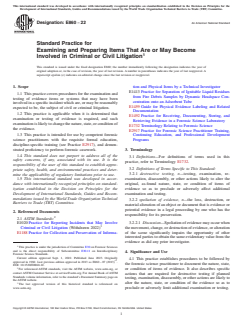
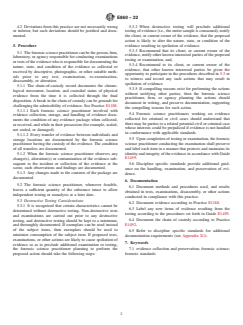
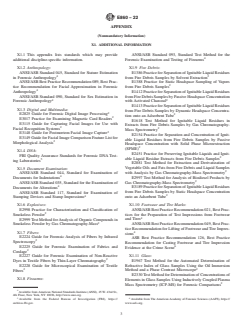

ASTM E860-22 - Standard Practice for Examining and Preparing Items That Are or May Become Involved in Criminal or Civil Litigation
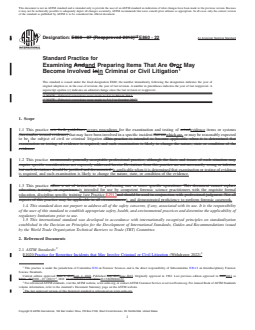
REDLINE ASTM E860-22 - Standard Practice for Examining and Preparing Items That Are or May Become Involved in Criminal or Civil Litigation
Overview
ASTM E860-22, titled Standard Practice for Examining and Preparing Items That Are or May Become Involved in Criminal or Civil Litigation, is a widely recognized standard developed by ASTM International. This standard specifies procedures for forensic science practitioners to document, examine, and test physical evidence items or systems that may become subject to legal proceedings. Its guidelines apply to situations where evidence examination or testing may change the nature, state, or condition of the evidence, and where discipline-specific expertise and documentation are essential for legal defensibility.
ASTM E860-22 supports the accurate recording of evidence condition, ensures proper handling during destructive and non-destructive testing, and outlines the chain-of-custody and notification requirements critical for both civil and criminal investigations. By promoting standardized forensic practices, this document helps maintain the integrity and admissibility of forensic evidence in legal contexts.
Key Topics
- Evidence Documentation: Establishes procedures for accurately recording the initial nature, state, and condition of evidence through descriptive, photographic, or other suitable methods.
- Destructive Testing Guidance: Details when and how destructive testing of evidence can be conducted, and mandates thorough documentation to prevent spoliation (loss or alteration) of evidence.
- Chain of Custody: Stresses rigorous documentation of every transfer and storage of evidence to uphold legal admissibility and evidentiary integrity.
- Notification and Participation: Recommends notifying relevant parties before conducting actions that could permanently alter evidence and providing opportunities for third-party observation, except in circumstances where notification could impede investigations.
- Deviation and Justification: Acknowledges that deviations from standard practice may occur but requires full documentation and justification for such variations.
- Safety and Compliance: Reminds users that it is their responsibility to maintain appropriate safety, health, and environmental practices, taking regulatory constraints into account.
Applications
ASTM E860-22 is primarily utilized in:
- Forensic Laboratories: Guides forensic scientists in the examination, documentation, storage, and transportation of physical evidence.
- Legal Investigations: Assists legal professionals, investigators, and technical experts when evidence forms the basis of current or potential litigation.
- Incident Response Teams: Supports technical personnel handling evidence from crime scenes, accidents, or disputed civil incidents, ensuring evidence is preserved in a manner suitable for legal scrutiny.
- Expert Witness Preparation: Provides documentation and procedural rigor to support the testimony of forensic experts in court.
- Accreditation and Training: Serves as a foundational document for forensic science practitioner training programs and laboratory quality management systems.
Following ASTM E860-22 ensures that examination and testing of evidence-especially when such actions are likely to be destructive-are defensible, reproducible, and align with best practices in the forensic community. This minimizes the risk of evidence being excluded or challenged during litigation.
Related Standards
Many other ASTM and industry standards complement or expand upon the procedures described in ASTM E860-22. Notable related standards include:
- ASTM E1188: Practice for Collection and Preservation of Information and Physical Items by a Technical Investigator.
- ASTM E1459: Guide for Physical Evidence Labeling and Related Documentation.
- ASTM E1492: Practice for Receiving, Documenting, Storing, and Retrieving Evidence in a Forensic Science Laboratory.
- ASTM E1732: Terminology Relating to Forensic Science.
- ASTM E2917: Practice for Forensic Science Practitioner Training, Continuing Education, and Professional Development.
- NFPA 921: Guide for Fire and Explosion Investigations.
Other discipline-specific standards referenced within ASTM E860-22 address areas such as DNA analysis, digital evidence, textile fibers, fire debris, trace evidence, document examination, and wildlife forensics. Referencing these related standards ensures a comprehensive and consistent approach to the examination and handling of all types of forensic evidence across diverse investigative fields.
Relations
- Effective Date
- 01-Feb-2024
- Effective Date
- 01-Feb-2024
- Effective Date
- 01-Sep-2023
- Effective Date
- 15-Feb-2019
- Effective Date
- 15-Jan-2019
- Effective Date
- 01-Nov-2018
- Effective Date
- 01-Jun-2018
- Effective Date
- 15-May-2018
- Effective Date
- 01-Sep-2017
- Effective Date
- 15-Aug-2013
- Effective Date
- 01-Jun-2013
- Effective Date
- 15-Feb-2013
- Effective Date
- 15-Jun-2012
- Effective Date
- 01-Oct-2011
- Effective Date
- 01-Oct-2011
Buy Documents
ASTM E860-22 - Standard Practice for Examining and Preparing Items That Are or May Become Involved in Criminal or Civil Litigation
REDLINE ASTM E860-22 - Standard Practice for Examining and Preparing Items That Are or May Become Involved in Criminal or Civil Litigation
Get Certified
Connect with accredited certification bodies for this standard

BSI Group
BSI (British Standards Institution) is the business standards company that helps organizations make excellence a habit.

Bureau Veritas
Bureau Veritas is a world leader in laboratory testing, inspection and certification services.

DNV
DNV is an independent assurance and risk management provider.
Sponsored listings
Frequently Asked Questions
ASTM E860-22 is a standard published by ASTM International. Its full title is "Standard Practice for Examining and Preparing Items That Are or May Become Involved in Criminal or Civil Litigation". This standard covers: SIGNIFICANCE AND USE 4.1 This practice establishes procedures to be followed by the forensic science practitioner to document the nature, state, or condition of items of evidence. It also describes specific actions that are required for destructive testing if planned testing, examination, disassembly, or other actions are likely to alter the nature, state, or condition of the evidence so as to preclude or adversely limit additional examination or testing. 4.2 Deviations from this practice are not necessarily wrong or inferior, but such deviations should be justified and documented. SCOPE 1.1 This practice covers procedures for the examination and testing of evidence items or systems that may have been involved in a specific incident which are, or may be reasonably expected to be, the subject of civil or criminal litigation. 1.2 This practice is applicable when it is determined that examination or testing of evidence is required, and such examination is likely to change the nature, state, or condition of the evidence. 1.3 This practice is intended for use by competent forensic science practitioners with the requisite formal education, discipline-specific training (see Practice E2917), and demonstrated proficiency to perform forensic casework. 1.4 This standard does not purport to address all of the safety concerns, if any, associated with its use. It is the responsibility of the user of this standard to establish appropriate safety, health, and environmental practices and determine the applicability of regulatory limitations prior to use. 1.5 This international standard was developed in accordance with internationally recognized principles on standardization established in the Decision on Principles for the Development of International Standards, Guides and Recommendations issued by the World Trade Organization Technical Barriers to Trade (TBT) Committee.
SIGNIFICANCE AND USE 4.1 This practice establishes procedures to be followed by the forensic science practitioner to document the nature, state, or condition of items of evidence. It also describes specific actions that are required for destructive testing if planned testing, examination, disassembly, or other actions are likely to alter the nature, state, or condition of the evidence so as to preclude or adversely limit additional examination or testing. 4.2 Deviations from this practice are not necessarily wrong or inferior, but such deviations should be justified and documented. SCOPE 1.1 This practice covers procedures for the examination and testing of evidence items or systems that may have been involved in a specific incident which are, or may be reasonably expected to be, the subject of civil or criminal litigation. 1.2 This practice is applicable when it is determined that examination or testing of evidence is required, and such examination is likely to change the nature, state, or condition of the evidence. 1.3 This practice is intended for use by competent forensic science practitioners with the requisite formal education, discipline-specific training (see Practice E2917), and demonstrated proficiency to perform forensic casework. 1.4 This standard does not purport to address all of the safety concerns, if any, associated with its use. It is the responsibility of the user of this standard to establish appropriate safety, health, and environmental practices and determine the applicability of regulatory limitations prior to use. 1.5 This international standard was developed in accordance with internationally recognized principles on standardization established in the Decision on Principles for the Development of International Standards, Guides and Recommendations issued by the World Trade Organization Technical Barriers to Trade (TBT) Committee.
ASTM E860-22 is classified under the following ICS (International Classification for Standards) categories: 03.120.20 - Product and company certification. Conformity assessment. The ICS classification helps identify the subject area and facilitates finding related standards.
ASTM E860-22 has the following relationships with other standards: It is inter standard links to ASTM E2917-24, ASTM E1732-24, ASTM E1188-23, ASTM E2917-19, ASTM E1732-19, ASTM E1732-18b, ASTM E1732-18a, ASTM E1732-18, ASTM E1732-17, ASTM E1413-13, ASTM E1020-13, ASTM E1459-13, ASTM E1732-12, ASTM E1732-11b, ASTM E1732-11a. Understanding these relationships helps ensure you are using the most current and applicable version of the standard.
ASTM E860-22 is available in PDF format for immediate download after purchase. The document can be added to your cart and obtained through the secure checkout process. Digital delivery ensures instant access to the complete standard document.
Standards Content (Sample)
This international standard was developed in accordance with internationally recognized principles on standardization established in the Decision on Principles for the
Development of International Standards, Guides and Recommendations issued by the World Trade Organization Technical Barriers to Trade (TBT) Committee.
Designation: E860 − 22 An American National Standard
Standard Practice for
Examining and Preparing Items That Are or May Become
Involved in Criminal or Civil Litigation
This standard is issued under the fixed designation E860; the number immediately following the designation indicates the year of
original adoption or, in the case of revision, the year of last revision. A number in parentheses indicates the year of last reapproval. A
superscript epsilon (´) indicates an editorial change since the last revision or reapproval.
1. Scope tion and Physical Items by a Technical Investigator
E1413 Practice for Separation of Ignitable Liquid Residues
1.1 This practice covers procedures for the examination and
from Fire Debris Samples by Dynamic Headspace Con-
testing of evidence items or systems that may have been
centration onto an Adsorbent Tube
involved in a specific incident which are, or may be reasonably
E1459 Guide for Physical Evidence Labeling and Related
expected to be, the subject of civil or criminal litigation.
Documentation
1.2 This practice is applicable when it is determined that
E1492 Practice for Receiving, Documenting, Storing, and
examination or testing of evidence is required, and such
Retrieving Evidence in a Forensic Science Laboratory
examination is likely to change the nature, state, or condition of
E1732 Terminology Relating to Forensic Science
the evidence.
E2917 Practice for Forensic Science Practitioner Training,
1.3 This practice is intended for use by competent forensic
Continuing Education, and Professional Development
science practitioners with the requisite formal education, Programs
discipline-specific training (see Practice E2917), and demon-
strated proficiency to perform forensic casework.
3. Terminology
1.4 This standard does not purport to address all of the
3.1 Definitions—For definitions of terms used in this
safety concerns, if any, associated with its use. It is the
practice, refer to Terminology E1732.
responsibility of the user of this standard to establish appro-
3.2 Definitions of Terms Specific to This Standard:
priate safety, health, and environmental practices and deter-
3.2.1 destructive testing, n—testing, examination, re-
mine the applicability of regulatory limitations prior to use.
examination, disassembly, or other actions likely to alter the
1.5 This international standard was developed in accor-
original, as-found nature, state, or condition of items of
dance with internationally recognized principles on standard-
ization established in the Decision on Principles for the evidence so as to preclude or adversely affect additional
examination and testing.
Development of International Standards, Guides and Recom-
mendations issued by the World Trade Organization Technical
3.2.2 spoliation of evidence, n—the loss, destruction, or
Barriers to Trade (TBT) Committee.
material alteration of an object or document that is evidence or
potential evidence in a legal proceeding by one who has the
2. Referenced Documents
responsibility for its preservation.
2.1 ASTM Standards:
3.2.2.1 Discussion—Spoliation of evidence may occur when
E1020 Practice for Reporting Incidents that May Involve
the movement, change, or destruction of evidence, or alteration
Criminal or Civil Litigation (Withdrawn 2022)
of the scene significantly impairs the opportunity of other
E1188 Practice for Collection and Preservation of Informa-
interested parties to obtain the same evidentiary value from the
evidence as did any prior investigator.
This practice is under the jurisdiction of Committee E30 on Forensic Sciences
and is the direct responsibility of Subcommittee E30.11 on Interdisciplinary
4. Significance and Use
Forensic Science Standards.
Current edition approved Sept. 1, 2022. Published June 2023. Originally
4.1 This practice establishes procedures to be followed by
ε2
approved in 1982. Last previous edition approved in 2013 as E860 – 07 (2013) .
the forensic science practitioner to document the nature, state,
DOI: 10.1520/E0860-22.
or condition of items of evidence. It also describes specific
For referenced ASTM standards, visit the ASTM website, www.astm.org, or
contact ASTM Customer Service at service@astm.org. For Annual Book of ASTM
actions that are required for destructive testing if planned
Standards volume information, refer to the standard’s Document Summary page on
testing, examination, disassembly, or other actions are likely to
the ASTM website.
alter the nature, state, or condition of the evidence so as to
The last approved version of this historical standard is referenced on
www.astm.org. preclude or adversely limit additional examination or testing.
Copyright © ASTM International, 100 Barr Harbor Drive, PO Box C700, West Conshohocken, PA 19428-2959. United States
E860 − 22
4.2 Deviations from this practice are not necessarily wrong 5.3.2 When destructive testing will preclude additional
or inferior, but such deviations should be justified and docu- testing of evidence (i.e., the entire sample is consumed), notify
mented. the client, or current owner of the evidence, that the proposed
action is likely to alter the nature, state, or condition of the
evidence resulting in spoliation of evidence.
5. Procedure
5.3.3 Recommend that its client, or current owner of the
5.1 The forensic science practitioner can be the person, firm,
evidence, notify other known interested parties of the proposed
laboratory, or agency responsible for conducting examinations
testing or examination, and,
or tests of the evidence who is responsible for documenting the
5.3.4 Recommend to its client, or current owner of the
nature, state, and condition of the evidence as collected or
evidence, that other known interested parties be given the
received by descriptive, photographic, or other suitable meth-
opportunity to participate in the procedures described in 5.3 or
ods prior to any test, examination, re-examination,
to witness and record any such actions that may result in
disassembly, or alteration.
spoliation of evidence.
5.1.1 The chain-of-custody record documents the chrono-
5.3.5 If compelling reasons exist for performing the actions
logical movement, location, and custodial status of physical
without notifying other parties, then the forensic science
evidence from the time it is collected through the final
practitioner, firm, or agency planning the actions should
disposition. A break in the chain of custody can be grounds for
document in writing, and preserve documentation, supporting
challenging the admissibility of evidence. See Practice E1188.
the compelling reasons for such action.
5.1.1.1 Each forensic science practitioner involved with
5.4 Forensic science practitioners working on evidence
evidence collection, storage, and handling of evidence docu-
collected for criminal or civil cases should understand that
ments the condition of any evidence package when collected,
there may be parties to a related potential civil or criminal case
or received, and while in their possession (for example, sealed,
whose interests could be prejudiced if evidence is not handled
not sealed, or damaged).
in conformance with applicable standards.
5.1.1.2 Every transfer of evidence between individuals and
5.5 Upon completion of testing or examination, the forensic
storage locations are documented by the forensic science
science practitioner conducting the examination shall preserve
practitioner having the custody of the evidence. The condition
of all transfers are documented. and label each item in a manner that protects and maintains its
identity and integrity of the evidence in accordance with Guide
5.1.2 When the forensic science practitioner observes any
E1459.
change(s), alteration(s) or contamination of the evidence sub-
sequent to the incident or collection of the evidence at the
5.6 Discipline specific standards provide additional guid-
scene, such observations and findings are documented.
ance on the handling, examination, and preservation of evi-
5.1.3 Any changes made to the contents of the package are
dence.
documented.
6. Documentation
5.2 The forensic science practitioner, whenever feasible,
6.1 Document methods and procedures used, and results
leaves a sufficient quantity of the substance intact to allow
obtained in tests, examinations, disassembly, or other actions
independent testing or reanalysis at a later date.
conducted in compliance with this practice.
5.3 Destructive Testing Considerations
6.2 Document evidence according to Practice E1188.
5.3.1 It is recognized that certain chara
...
This document is not an ASTM standard and is intended only to provide the user of an ASTM standard an indication of what changes have been made to the previous version. Because
it may not be technically possible to adequately depict all changes accurately, ASTM recommends that users consult prior editions as appropriate. In all cases only the current version
of the standard as published by ASTM is to be considered the official document.
´2
Designation: E860 − 07 (Reapproved 2013) E860 − 22 An American National Standard
Standard Practice for
Examining Andand Preparing Items That Are Oror May
Become Involved Inin Criminal or Civil Litigation
This standard is issued under the fixed designation E860; the number immediately following the designation indicates the year of
original adoption or, in the case of revision, the year of last revision. A number in parentheses indicates the year of last reapproval. A
superscript epsilon (´) indicates an editorial change since the last revision or reapproval.
ε NOTE—Editorial corrections were made to 5.4 in March 2014.
ε NOTE—Editorial corrections were made to 5.4.2 in October 2017.
1. Scope
1.1 This practice sets forth guidelines covers procedures for the examination and testing of actualevidence items or systems
(hereinafter termed evidence) that may have been involved in a specific incident that arewhich are, or may be reasonably expected
to be, the subject of civil or criminal litigation. This practice is intended to become applicable when it is determined that
examination or testing of evidence is required, and such examination is likely to change the nature, state or condition of the
evidence.
1.2 This practice recommends generally acceptable professional practice, although the facts and issues of each situation may
require specific considerations not expressly addressed herein. Deviations from this practice are not necessarily wrong or inferior,
but such deviations should be justified and documented. is applicable when it is determined that examination or testing of evidence
is required, and such examination is likely to change the nature, state, or condition of the evidence.
1.3 This practice offers a set of instructions for performing one or more specific operations. This document cannot replace
education, training, or experience is intended for use by competent forensic science practitioners with the requisite formal
education, discipline-specific training (see Practice E2917and should be used in conjunction with professional judgment. Not all
aspects of this practice may be applicable in all circumstances.), and demonstrated proficiency to perform forensic casework.
1.4 This standard does not purport to address all of the safety concerns, if any, associated with its use. It is the responsibility
of the user of this standard to establish appropriate safety, health, and environmental practices and determine the applicability of
regulatory limitations prior to use.
1.5 This international standard was developed in accordance with internationally recognized principles on standardization
established in the Decision on Principles for the Development of International Standards, Guides and Recommendations issued
by the World Trade Organization Technical Barriers to Trade (TBT) Committee.
2. Referenced Documents
2.1 ASTM Standards:
E1020 Practice for Reporting Incidents that May Involve Criminal or Civil Litigation (Withdrawn 2022)
This practice is under the jurisdiction of Committee E30 on Forensic Sciences and is the direct responsibility of Subcommittee E30.11 on Interdisciplinary Forensic
Science Standards.
Current edition approved June 1, 2013Sept. 1, 2022. Published July 2013June 2023. Originally approved in 1982. Last previous edition approved in 20072013 as
ε2
E860 – 07.E860 – 07 (2013) . DOI: 10.1520/E0860-07R13E02.10.1520/E0860-22.
For referenced ASTM standards, visit the ASTM website, www.astm.org, or contact ASTM Customer Service at service@astm.org. For Annual Book of ASTM Standards
volume information, refer to the standard’s Document Summary page on the ASTM website.
The last approved version of this historical standard is referenced on www.astm.org.
Copyright © ASTM International, 100 Barr Harbor Drive, PO Box C700, West Conshohocken, PA 19428-2959. United States
E860 − 22
E1188 Practice for Collection and Preservation of Information and Physical Items by a Technical Investigator
E1413 Practice for Separation of Ignitable Liquid Residues from Fire Debris Samples by Dynamic Headspace Concentration
onto an Adsorbent Tube
E1459 Guide for Physical Evidence Labeling and Related Documentation
E1492 Practice for Receiving, Documenting, Storing, and Retrieving Evidence in a Forensic Science Laboratory
E1732 Terminology Relating to Forensic Science
E1843E2917 Guide for Sexual Violence Investigation, Examination, and Evidence Collection ProtocolPractice for Forensic
Science Practitioner Training, Continuing Education, and Professional Development Programs
2.2 Other Documents:
NFPA 921 Guide for Fire and Explosion Investigations
3. Terminology
3.1 Definitions—For definitions of terms used in this practice, refer to Terminology E1732.
3.2 Definitions:Definitions of Terms Specific to This Standard:
3.2.1 destructive testing—testing, n—testing, examination, re-examination, disassembly, or other actions likely to alter the
original, as-found nature, state, or condition of items of evidence so as to preclude or adversely affect additional examination and
testing.
3.2.2 spoliation of evidence—evidence, n—the loss, destruction, or material alteration of an object or document that is evidence
or potential evidence in a legal proceeding by one who has the responsibility for its preservation. Spoliation of evidence may occur
when the movement, change or destruction of evidence, or alteration of the scene significantly impairs the opportunity of other
interested parties to obtain the same evidentiary value from the evidence as did any prior investigator.
3.2.2.1 Discussion—
Spoliation of evidence may occur when the movement, change, or destruction of evidence, or alteration of the scene significantly
impairs the opportunity of other interested parties to obtain the same evidentiary value from the evidence as did any prior
investigator.
4. Significance and Use
4.1 This practice establishes procedures to be followed by the forensic science practitioner to document the nature, state, or
condition of items of evidence. It also describes specific actions that are required for destructive testing if planned testing,
examination, disassembly, or other actions are likely to alter the nature, state, or condition of the evidence so as to preclude or
adversely limit additional examination or testing.
4.2 Deviations from this practice are not necessarily wrong or inferior, but such deviations should be justified and documented.
5. Procedure
5.1 The forensic science practitioner can be the person, firm, laboratory, or agency responsible for conducting examinations or
tests of the evidence should document who is responsible for documenting the nature, state, and condition of the evidence as
collected or received by descriptive, photographic, or other suitable methods prior to any test, examination, re-examination,
disassembly, or alteration.
5.1.1 The chain-of-custody record documents the chronological movement, location, and custodial status of physical evidence
from the time it is collected through the final disposition. A break in the chain of custody can be grounds for challenging the
admissibility of evidence. See Practice E1188.
5.1.1.1 Each forensic science practitioner involved with evidence collection, storage, and handling of evidence documents the
condition of any evidence package when collected, or received, and while in their possession (for example, sealed, not sealed, or
damaged).
5.1.1.2 Every transfer of evidence between individuals and storage locations are documented by the forensic science practitioner
having the custody of the evidence. The condition of all transfers are documented.
Available from American National Standards Institute (ANSI), 25 W. 43rd St., 4th Floor, New York, NY 10036, http://www.ansi.org.
E860 − 22
5.1.2 Attempt to determine When the forensic science practitioner observes any change(s), alteration(s) or contamination of the
evidence subsequent to the incident, and document those findings.incident or collection of the evidence at the scene, such
observations and findings are documented.
5.1.3 Any changes made to the contents of the package are documented.
5.2 The forensic science practitioner, whenever feasible, leaves a sufficient quantity of the substance intact to allow independent
testing or reanalysis at a later date.
5.3 It is recognized that certain characteristics cannot be determined without destructive testing. Non-destructive tests and
examinations should be carried out prior to any destructive testing, and destructive testing should be kept to a minimum, and
thoroughly documented. If exemplars can be used instead of the subject items, then exemplars should be used to minimize
consumption of the subject item. If proposed tests, examinations, or other actions are likely to alter the nature, state, or condition
of the evidence so as to preclude or limit additional examination or testing, the person, firm, or agency planning to perform the
proposed action should take the following steps:Destructive Testing Considerations
5.3.1 It is recognized that certain characteristics cannot be determined without destructive testing. Non-destructive tests and
examinations are carried out prior to any destructive testing, and destructive testing should be kept to a minimum, and thoroughly
documented. If exemplars can be used instead of the subject items, then exemplars should be used to minimize consumption of
the subject item. If proposed tests, examinations, or other actions are likely to cause spoliation of evidence so as to preclude
additional examination or testing, the forensic science practitioner planning to perform the proposed action should take the
following steps:
5.3.2 Notify its client When destructive testing will preclude additional testing of evidence (i.e., the entire sample is consumed),
notify the client, or current owner of the evidence, that the proposed action is likely to alter the nature, state, or condition of the
evidence so as to preclude or limit additional examination or testing of the resulting in spoliation of evidence.
5.3.3 Recommend that its client notify other client, or current owner of the evidence, notify other known interested parties of the
proposed action described intesting or examination, 5.2and,
5.3.4 Recommend to its client that other cl
...