

ASTM D6128-22
(Test Method)Standard Test Method for Shear Testing of Bulk Solids Using the Jenike Shear Tester
General Information
- Abstract
SIGNIFICANCE AND USE
5.1 Reliable, controlled flow of bulk solids from bins and hoppers is essential in almost every industrial facility. Unfortunately, flow stoppages due to arching and ratholing are common. Additional problems include uncontrolled flow (flooding) of powders, segregation of particle mixtures, useable capacity which is significantly less than design capacity, caking and spoilage of bulk solids in stagnant zones, and structural failures.
5.2 By measuring the flow properties of bulk solids, and designing bins and hoppers based on these flow properties, most flow problems can be prevented or eliminated.
5.3 For bulk solids with a significant percentage of particles (typically, one third or more) finer than about 6 mm, the cohesive strength is governed by the fines (-6-mm fraction). For such bulk solids, cohesive strength and wall friction tests may be performed on the fine fraction only.
Note 1: The quality of the result produced by this test method is dependent on the competence of the personnel performing it, and the suitability of the equipment and facilities used. Agencies that meet the criteria of Practice D3740 are generally considered capable of competent and objective testing/sampling/inspection/etc. Users of this test method are cautioned that compliance with Practice D3740 does not in itself assure reliable results. Reliable results depend on many factors; Practice D3740 provides a means of evaluating some of those factors. Practice D3740 was developed for agencies engaged in the testing and/or inspection of soil and rock. As such it is not totally applicable to agencies performing this test method. However, users of this test method should recognize that the framework of Practice D3740 is appropriate for evaluating the quality of an agency performing this test method. Currently there is no known qualifying national authority that inspects agencies that perform this test method.
SCOPE
1.1 This method 2covers the apparatus and procedures for measuring the cohesive strength of bulk solids during both continuous flow and after storage at rest. In addition, measurements of internal friction, bulk density, and wall friction on various wall surfaces are included.
1.2 This standard is not applicable to testing bulk solids that do not reach the steady state requirement within the travel limit of the shear cell. It is difficult to classify ahead of time which bulk solids cannot be tested, but one example may be those consisting of highly elastic particles.
1.3 The most common use of this information is in the design of storage bins and hoppers to prevent flow stoppages due to arching and ratholing, including the slope and smoothness of hopper walls to provide mass flow. Parameters for structural design of such equipment also may be derived from this data.
1.4 All observed and calculated values shall conform to the guidelines for significant digits and rounding established in Practice D6026.
1.4.1 The procedures used to specify how data are collected/recorded or calculated, in this standard are regarded as the industry standard. In addition, they are representative of the significant digits that generally should be retained. The procedures used do not consider material variation, purpose for obtaining the data, special purpose studies, or any considerations for the user's objectives; and it is common practice to increase or reduce significant digits of reported data to be commensurate with these considerations. It is beyond the scope of this standard to consider significant digits used in analysis methods for engineering design.
1.5 Units—The values stated in SI units are to be regarded as standard. No other units of measure are included in this standard
1.6 This standard does not purport to address all of the safety concerns, if any, associated with its use. It is the responsibility of the user of this standard to establish appropriate safety, health, and environmental pr...
- Status
- Published
- Publication Date
- 14-Oct-2022
- Technical Committee
- D18 - Soil and Rock
- Drafting Committee
- D18.24 - Characterization and Handling of Powders and Bulk Solids
Buy Documents
ASTM D6128-22 - Standard Test Method for Shear Testing of Bulk Solids Using the Jenike Shear Tester
REDLINE ASTM D6128-22 - Standard Test Method for Shear Testing of Bulk Solids Using the Jenike Shear Tester
Overview
ASTM D6128-22 is a widely recognized standard test method developed by ASTM International for shear testing of bulk solids using the Jenike Shear Tester. This method provides procedures and apparatus guidelines for measuring key flow properties of bulk solids, including cohesive strength, internal friction, wall friction, and bulk density. The standard is vital in ensuring reliable, controlled flow of powders and granular materials from bins, hoppers, and silos in industrial facilities.
Bulk solids’ flow reliability affects productivity, product quality, and equipment safety. Flow stoppages caused by arching, ratholing, uncontrolled flows, segregation, and caking are typical issues addressed by analyzing flow properties according to this standard.
Key Topics
- Jenike Shear Tester Use: Detailed instructions for specimen preparation, applying stresses, measuring shear forces, and maintaining precise test conditions.
- Cohesive Strength Assessment: Determines the force required for the material to begin flowing after being at rest or during continuous movement.
- Wall Friction Evaluation: Tests how various wall materials affect the flow and adhesion of bulk solids in hoppers and bins, informing the selection of lining or construction materials.
- Internal Friction and Bulk Density Measurements: Provides data critical for predicting material flow, storage design, and material handling system performance.
- Time Consolidation (Aging Tests): Assesses how stored conditions over time change the resistance to flow, simulating real-world resting periods in hoppers or silos.
- Significant Digits & Data Reporting: Ensures data collection and reporting adhere to geotechnical industry best practices for precision and accuracy.
Applications
The practical applications of ASTM D6128-22 span across industries handling bulk powders and granular solids, such as food processing, pharmaceuticals, chemicals, mining, and construction materials. Key uses include:
- Bin and Hopper Design: The flow properties measured help engineers design bins and hoppers that minimize flow problems like arching, ratholing, and flooding.
- Material Handling System Optimization: Enables the selection of appropriate storage and flow equipment, wall angles, and lining materials tailored to specific bulk solid behaviors.
- Quality Control and Process Safety: Regular testing supports ongoing quality assurance in production environments by detecting variations in material consistency.
- Troubleshooting: Provides actionable data to diagnose and resolve existing flow stoppages or irregularities in powder handling systems.
- Compliance and Specification: Often used as a reference in technical specifications, purchase agreements, and regulatory compliance documentation for powder and bulk solids handling.
Related Standards
Organizations implementing ASTM D6128-22 may find the following referenced standards beneficial:
- ASTM D653 - Terminology Relating to Soil, Rock, and Contained Fluids
- ASTM D2216 - Laboratory Determination of Water (Moisture) Content of Soil and Rock
- ASTM D3740 - Requirements for Agencies Engaged in Testing and/or Inspection of Soil and Rock
- ASTM D4753 - Guide for Evaluating, Selecting, and Specifying Balances and Standard Masses
- ASTM D6026 - Use of Significant Digits and Data Records in Geotechnical Data
- ASTM E177 - Use of the Terms Precision and Bias in ASTM Test Methods
- ASTM E691 - Conducting Interlaboratory Studies to Determine the Precision of a Test Method
Conclusion
ASTM D6128-22 serves as a crucial framework for the assessment of bulk solids flow characteristics using the Jenike Shear Tester. By enabling accurate measurement and interpretation of powder flow properties, this standard promotes safer, more efficient, and more predictable material handling across a wide range of bulk solids industries. For organizations dealing with bulk storage or powder flow, rigorous application of this standard supports robust process design and operational reliability.
Relations
- Effective Date
- 01-Feb-2024
- Effective Date
- 01-Nov-2023
- Effective Date
- 01-Oct-2019
- Effective Date
- 01-Mar-2019
- Effective Date
- 01-May-2015
- Effective Date
- 01-Aug-2014
- Effective Date
- 01-May-2014
- Effective Date
- 01-May-2013
- Effective Date
- 01-May-2013
- Effective Date
- 01-May-2012
- Effective Date
- 01-Mar-2012
- Effective Date
- 01-Nov-2011
- Effective Date
- 01-Sep-2011
- Effective Date
- 01-Sep-2011
- Effective Date
- 01-Oct-2010
Buy Documents
ASTM D6128-22 - Standard Test Method for Shear Testing of Bulk Solids Using the Jenike Shear Tester
REDLINE ASTM D6128-22 - Standard Test Method for Shear Testing of Bulk Solids Using the Jenike Shear Tester
Get Certified
Connect with accredited certification bodies for this standard

IMP NDT d.o.o.
Non-destructive testing services. Radiography, ultrasonic, magnetic particle, penetrant, visual inspection.
Inštitut za kovinske materiale in tehnologije
Institute of Metals and Technology. Materials testing, metallurgical analysis, NDT.
Q Techna d.o.o.
NDT and quality assurance specialist. 30+ years experience. NDT personnel certification per ISO 9712, nuclear and thermal power plant inspections, QA/
Sponsored listings
Frequently Asked Questions
ASTM D6128-22 is a standard published by ASTM International. Its full title is "Standard Test Method for Shear Testing of Bulk Solids Using the Jenike Shear Tester". This standard covers: SIGNIFICANCE AND USE 5.1 Reliable, controlled flow of bulk solids from bins and hoppers is essential in almost every industrial facility. Unfortunately, flow stoppages due to arching and ratholing are common. Additional problems include uncontrolled flow (flooding) of powders, segregation of particle mixtures, useable capacity which is significantly less than design capacity, caking and spoilage of bulk solids in stagnant zones, and structural failures. 5.2 By measuring the flow properties of bulk solids, and designing bins and hoppers based on these flow properties, most flow problems can be prevented or eliminated. 5.3 For bulk solids with a significant percentage of particles (typically, one third or more) finer than about 6 mm, the cohesive strength is governed by the fines (-6-mm fraction). For such bulk solids, cohesive strength and wall friction tests may be performed on the fine fraction only. Note 1: The quality of the result produced by this test method is dependent on the competence of the personnel performing it, and the suitability of the equipment and facilities used. Agencies that meet the criteria of Practice D3740 are generally considered capable of competent and objective testing/sampling/inspection/etc. Users of this test method are cautioned that compliance with Practice D3740 does not in itself assure reliable results. Reliable results depend on many factors; Practice D3740 provides a means of evaluating some of those factors. Practice D3740 was developed for agencies engaged in the testing and/or inspection of soil and rock. As such it is not totally applicable to agencies performing this test method. However, users of this test method should recognize that the framework of Practice D3740 is appropriate for evaluating the quality of an agency performing this test method. Currently there is no known qualifying national authority that inspects agencies that perform this test method. SCOPE 1.1 This method 2covers the apparatus and procedures for measuring the cohesive strength of bulk solids during both continuous flow and after storage at rest. In addition, measurements of internal friction, bulk density, and wall friction on various wall surfaces are included. 1.2 This standard is not applicable to testing bulk solids that do not reach the steady state requirement within the travel limit of the shear cell. It is difficult to classify ahead of time which bulk solids cannot be tested, but one example may be those consisting of highly elastic particles. 1.3 The most common use of this information is in the design of storage bins and hoppers to prevent flow stoppages due to arching and ratholing, including the slope and smoothness of hopper walls to provide mass flow. Parameters for structural design of such equipment also may be derived from this data. 1.4 All observed and calculated values shall conform to the guidelines for significant digits and rounding established in Practice D6026. 1.4.1 The procedures used to specify how data are collected/recorded or calculated, in this standard are regarded as the industry standard. In addition, they are representative of the significant digits that generally should be retained. The procedures used do not consider material variation, purpose for obtaining the data, special purpose studies, or any considerations for the user's objectives; and it is common practice to increase or reduce significant digits of reported data to be commensurate with these considerations. It is beyond the scope of this standard to consider significant digits used in analysis methods for engineering design. 1.5 Units—The values stated in SI units are to be regarded as standard. No other units of measure are included in this standard 1.6 This standard does not purport to address all of the safety concerns, if any, associated with its use. It is the responsibility of the user of this standard to establish appropriate safety, health, and environmental pr...
SIGNIFICANCE AND USE 5.1 Reliable, controlled flow of bulk solids from bins and hoppers is essential in almost every industrial facility. Unfortunately, flow stoppages due to arching and ratholing are common. Additional problems include uncontrolled flow (flooding) of powders, segregation of particle mixtures, useable capacity which is significantly less than design capacity, caking and spoilage of bulk solids in stagnant zones, and structural failures. 5.2 By measuring the flow properties of bulk solids, and designing bins and hoppers based on these flow properties, most flow problems can be prevented or eliminated. 5.3 For bulk solids with a significant percentage of particles (typically, one third or more) finer than about 6 mm, the cohesive strength is governed by the fines (-6-mm fraction). For such bulk solids, cohesive strength and wall friction tests may be performed on the fine fraction only. Note 1: The quality of the result produced by this test method is dependent on the competence of the personnel performing it, and the suitability of the equipment and facilities used. Agencies that meet the criteria of Practice D3740 are generally considered capable of competent and objective testing/sampling/inspection/etc. Users of this test method are cautioned that compliance with Practice D3740 does not in itself assure reliable results. Reliable results depend on many factors; Practice D3740 provides a means of evaluating some of those factors. Practice D3740 was developed for agencies engaged in the testing and/or inspection of soil and rock. As such it is not totally applicable to agencies performing this test method. However, users of this test method should recognize that the framework of Practice D3740 is appropriate for evaluating the quality of an agency performing this test method. Currently there is no known qualifying national authority that inspects agencies that perform this test method. SCOPE 1.1 This method 2covers the apparatus and procedures for measuring the cohesive strength of bulk solids during both continuous flow and after storage at rest. In addition, measurements of internal friction, bulk density, and wall friction on various wall surfaces are included. 1.2 This standard is not applicable to testing bulk solids that do not reach the steady state requirement within the travel limit of the shear cell. It is difficult to classify ahead of time which bulk solids cannot be tested, but one example may be those consisting of highly elastic particles. 1.3 The most common use of this information is in the design of storage bins and hoppers to prevent flow stoppages due to arching and ratholing, including the slope and smoothness of hopper walls to provide mass flow. Parameters for structural design of such equipment also may be derived from this data. 1.4 All observed and calculated values shall conform to the guidelines for significant digits and rounding established in Practice D6026. 1.4.1 The procedures used to specify how data are collected/recorded or calculated, in this standard are regarded as the industry standard. In addition, they are representative of the significant digits that generally should be retained. The procedures used do not consider material variation, purpose for obtaining the data, special purpose studies, or any considerations for the user's objectives; and it is common practice to increase or reduce significant digits of reported data to be commensurate with these considerations. It is beyond the scope of this standard to consider significant digits used in analysis methods for engineering design. 1.5 Units—The values stated in SI units are to be regarded as standard. No other units of measure are included in this standard 1.6 This standard does not purport to address all of the safety concerns, if any, associated with its use. It is the responsibility of the user of this standard to establish appropriate safety, health, and environmental pr...
ASTM D6128-22 is classified under the following ICS (International Classification for Standards) categories: 19.060 - Mechanical testing. The ICS classification helps identify the subject area and facilitates finding related standards.
ASTM D6128-22 has the following relationships with other standards: It is inter standard links to ASTM D4753-24, ASTM D3740-23, ASTM D3740-19, ASTM D2216-19, ASTM D4753-15, ASTM D653-14, ASTM E177-14, ASTM E177-13, ASTM E691-13, ASTM D3740-12a, ASTM D3740-12, ASTM E691-11, ASTM D653-11, ASTM D3740-11, ASTM E177-10. Understanding these relationships helps ensure you are using the most current and applicable version of the standard.
ASTM D6128-22 is available in PDF format for immediate download after purchase. The document can be added to your cart and obtained through the secure checkout process. Digital delivery ensures instant access to the complete standard document.
Standards Content (Sample)
This international standard was developed in accordance with internationally recognized principles on standardization established in the Decision on Principles for the
Development of International Standards, Guides and Recommendations issued by the World Trade Organization Technical Barriers to Trade (TBT) Committee.
Designation: D6128 − 22
Standard Test Method for
Shear Testing of Bulk Solids Using the Jenike Shear Tester
This standard is issued under the fixed designation D6128; the number immediately following the designation indicates the year of
original adoption or, in the case of revision, the year of last revision.Anumber in parentheses indicates the year of last reapproval.A
superscript epsilon (´) indicates an editorial change since the last revision or reapproval.
1. Scope* 1.5 Units—The values stated in SI units are to be regarded
as standard. No other units of measure are included in this
1.1 This method covers the apparatus and procedures for
standard
measuring the cohesive strength of bulk solids during both
1.6 This standard does not purport to address all of the
continuous flow and after storage at rest. In addition, measure-
safety concerns, if any, associated with its use. It is the
ments of internal friction, bulk density, and wall friction on
responsibility of the user of this standard to establish appro-
various wall surfaces are included.
priate safety, health, and environmental practices and deter-
1.2 Thisstandardisnotapplicabletotestingbulksolidsthat
mine the applicability of regulatory limitations prior to use.
donotreachthesteadystaterequirementwithinthetravellimit
1.7 This international standard was developed in accor-
of the shear cell. It is difficult to classify ahead of time which
dance with internationally recognized principles on standard-
bulk solids cannot be tested, but one example may be those
ization established in the Decision on Principles for the
consisting of highly elastic particles.
Development of International Standards, Guides and Recom-
mendations issued by the World Trade Organization Technical
1.3 The most common use of this information is in the
Barriers to Trade (TBT) Committee.
design of storage bins and hoppers to prevent flow stoppages
due to arching and ratholing, including the slope and smooth-
2. Referenced Documents
ness of hopper walls to provide mass flow. Parameters for
structural design of such equipment also may be derived from
2.1 ASTM Standards:
this data.
D653Terminology Relating to Soil, Rock, and Contained
Fluids
1.4 All observed and calculated values shall conform to the
D2216Test Methods for Laboratory Determination ofWater
guidelines for significant digits and rounding established in
(Moisture) Content of Soil and Rock by Mass
Practice D6026.
D3740Practice for Minimum Requirements for Agencies
1.4.1 Theproceduresusedtospecifyhowdataarecollected/
Engaged in Testing and/or Inspection of Soil and Rock as
recorded or calculated, in this standard are regarded as the
Used in Engineering Design and Construction
industry standard. In addition, they are representative of the
D4753Guide for Evaluating, Selecting, and Specifying Bal-
significant digits that generally should be retained. The proce-
ances and Standard Masses for Use in Soil, Rock, and
dures used do not consider material variation, purpose for
Construction Materials Testing
obtaining the data, special purpose studies, or any consider-
D6026Practice for Using Significant Digits and Data Re-
ations for the user’s objectives; and it is common practice to
cords in Geotechnical Data
increase or reduce significant digits of reported data to be
E177Practice for Use of the Terms Precision and Bias in
commensuratewiththeseconsiderations.Itisbeyondthescope
ASTM Test Methods
of this standard to consider significant digits used in analysis
E691Practice for Conducting an Interlaboratory Study to
methods for engineering design.
Determine the Precision of a Test Method
3. Terminology
This testing method is under the jurisdiction ofASTM Committee D18 on Soil
3.1 Definitions—For definitions of common technical terms
and Rock and is the direct responsibility of Subcommittee D18.24 on Character-
in this standard, refer to Terminology D653.
ization and Handling of Powders and Bulk Solids.
Current edition approved Oct. 15, 2022. Published January 2023. Originally
approved in 1997. Last previous edition approved in 2016 as D6128–16. DOI:
10.1520/D6128-22.
2 3
This test method is based on the “Standard Shear Testing Technique for For referenced ASTM standards, visit the ASTM website, www.astm.org, or
ParticulateSolidsUsingtheJenikeShearCell,”areportoftheEFCEWorkingParty contact ASTM Customer Service at service@astm.org. For Annual Book of ASTM
on the Mechanics of Particulate Solids. Copyright is held by the Institution of Standards volume information, refer to the standard’s Document Summary page on
Chemical Engineers and the European Federation of Chemical Engineering. the ASTM website.
*A Summary of Changes section appears at the end of this standard
Copyright © ASTM International, 100 Barr Harbor Drive, PO Box C700, West Conshohocken, PA 19428-2959. United States
D6128 − 22
NOTE 1—The quality of the result produced by this test method is
4. Summary of Test Method
dependent on the competence of the personnel performing it, and the
4.1 A representative specimen of bulk solid is placed in a
suitability of the equipment and facilities used. Agencies that meet the
shear cell of specific dimensions. This specimen is preconsoli-
criteria of Practice D3740 are generally considered capable of competent
and objective testing/sampling/inspection/etc. Users of this test method
dated by twisting the shear cell cover while applying a
are cautioned that compliance with Practice D3740 does not in itself
compressive load normal to the cover.
assure reliable results. Reliable results depend on many factors; Practice
4.2 When running an instantaneous or time shear test, a D3740 provides a means of evaluating some of those factors. Practice
D3740 was developed for agencies engaged in the testing and/or inspec-
normal load is applied to the cover, and the specimen is
tion of soil and rock. As such it is not totally applicable to agencies
presheared until a steady state shear value has been reached.
performing this test method. However, users of this test method should
4.3 An instantaneous test is run by shearing the specimen recognize that the framework of Practice D3740 is appropriate for
evaluatingthequalityofanagencyperformingthistestmethod.Currently
underareducednormalloaduntiltheshearforcegoesthrough
there is no known qualifying national authority that inspects agencies that
a maximum value and then begins to decrease.
perform this test method.
4.4 A time shear test is run similarly to an instantaneous
sheartest,exceptthatthespecimenisplacedinaconsolidation 6. Apparatus
bench between preshear and shear.
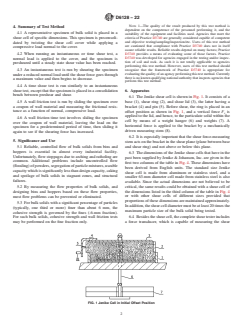
6.1 The Jenike shear cell is shown in Fig. 1. It consists of a
4.5 A wall friction test is run by sliding the specimen over
base (1), shear ring (2), and shear lid (3), the latter having a
a coupon of wall material and measuring the frictional resis-
bracket (4) and pin (5). Before shear, the ring is placed in an
tance as a function of normal, compressive load.
offset position as shown in Fig. 1, and a vertical force F is
v
applied to the lid, and hence, to the particulate solid within the
4.6 A wall friction time test involves sliding the specimen
cell by means of a weight hanger (6) and weights (7). A
over the coupon of wall material, leaving the load on the
horizontal force is applied to the bracket by a mechanically
specimen for a predetermined period of time, then sliding it
driven measuring stem (8).
again to see if the shearing force has increased.
6.2 It is especially important that the shear force-measuring
5. Significance and Use
stemactsonthebracketintheshearplane(planebetweenbase
and shear ring) and not above or below this plane.
5.1 Reliable, controlled flow of bulk solids from bins and
hoppers is essential in almost every industrial facility.
6.3 ThedimensionsoftheJenikeshearcellsthathaveinthe
Unfortunately, flow stoppages due to arching and ratholing are
past been supplied by Jenike & Johanson, Inc. are given in the
common. Additional problems include uncontrolled flow
firsttwocolumnsofthetableinFig.4.Thesedimensionshave
(flooding)ofpowders,segregationofparticlemixtures,useable
been derived from English units. The standard size Jenike
capacitywhichissignificantlylessthandesigncapacity,caking
shear cell is made from aluminum or stainless steel, and a
and spoilage of bulk solids in stagnant zones, and structural
smaller 63-mm diameter cell made from stainless steel is also
failures.
available. Since the actual dimensions are not believed to be
critical, the same results could be obtained with a shear cell of
5.2 By measuring the flow properties of bulk solids, and
designing bins and hoppers based on these flow properties, the dimensions listed in the third column of the table in Fig. 4
or with other shear cells of different sizes provided that
most flow problems can be prevented or eliminated.
proportionsofthesedimensionsaremaintainedapproximately.
5.3 Forbulksolidswithasignificantpercentageofparticles
Inaddition,theshearcelldiametermustbeatleast20timesthe
(typically, one third or more) finer than about 6 mm, the
maximum particle size of the bulk solid being tested.
cohesive strength is governed by the fines (-6-mm fraction).
6.4 Besidestheshearcell,thecompletesheartesterincludes
For such bulk solids, cohesive strength and wall friction tests
may be performed on the fine fraction only. a force transducer, which is capable of measuring the shear
FIG. 1 Jenike Cell in Initial Offset Position
D6128 − 22
FIG. 2 Jenike Cell in Final Offset Position
pushing it. When using any such alternative methods, it is
essential that the user make sure that no measurement devia-
tions are introduced.
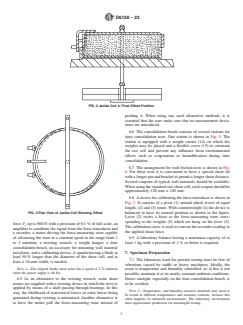
6.6 The consolidation bench consists of several stations for
time consolidation tests. One station is shown in Fig. 5. The
station is equipped with a weight carrier (14) on which the
weights may be placed and a flexible cover (15) to constrain
the test cell and prevent any influence from environmental
effects such as evaporation or humidification during time
consolidation.
6.7 The arrangement for wall friction tests is shown in Fig.
6. For these tests it is convenient to have a special shear lid
withalongerpinandbrackettopermitalongersheardistance.
Several coupons of typical wall materials should be available.
Whenusingthestandardsizeshearcell,eachcouponshouldbe
approximately 120 mm × 120 mm.
6.8 Adeviceforcalibratingtheforcetransducerisshownin
Fig. 7. It consists of a pivot (1) around which levers of equal
length, (2) and (3) rotate. With counterweight (4) the device is
FIG. 3 Plan View of Jenike Cell Showing Offset balanced to have its neutral position as shown in the figure.
Lever (2) exerts a force to the force-measuring stem corre-
sponding to the weights (5) which are hung on the lever (3).
force F up to 500 N with a precision of 0.1% of full scale, an
s
Thecalibrationcurveisusedtoconverttherecorderreadingto
amplifier to condition the signal from the force transducer and
the applied shear force.
a recorder, a motor driving the force-measuring stem capable
of advancing the stem at a constant speed in the range from 1 6.9 A laboratory balance having a maximum capacity of at
to 3 mm/min, a twisting wrench, a weight hanger, a time
least 1 kg with a precision of 1% or better is required.
consolidation bench, an accessory for mounting wall material
testplates,andacalibratingdevice.Aspatulahavingabladeat
7. Specimen Preparation
least 50% longer than the diameter of the shear cell, and at
7.1 The laboratory used for powder testing must be free of
least a 10-mm width, is needed.
vibrations caused by traffic or heavy machinery. Ideally, the
NOTE 2—The original Jenike shear tester has a speed of 2.72 mm/min
room is temperature and humidity controlled, or, if this is not
when the power supply is 60 Hz.
possible, maintain it at its nearly constant ambient conditions.
6.5 As an alternative to the twisting wrench, some shear Direct sunlight, especially on the time consolidation bench, is
testers are supplied with a twisting device in which the twist is to be avoided.
applied by means of a shaft passing through bearings. In this
NOTE 3—Temperature- and humidity-sensitive materials may need to
way, the likelihood of nonvertical forces or extra forces being
be tested at different temperatures and moisture contents, because this
generated during twisting is minimized.Another alternative is
often happens in industrial environments. The laboratory environment
to have the motor pull the force-measuring stem instead of must approximate production for meaningful testing.
D6128 − 22
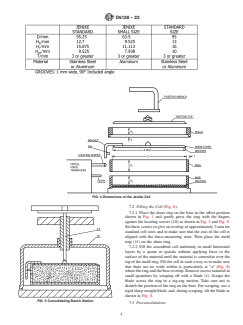
FIG. 4 Dimensions of the Jenike Cell
7.2 Filling the Cell (Fig. 8):
7.2.1 Place the shear ring on the base in the offset position
shown in Fig. 1 and gently press the ring with the fingers
against the locating screws (10) as shown in Fig. 3 and Fig. 9.
Set these screws to give an overlap of approximately 3 mm for
standard cell sizes and to make sure that the axis of the cell is
aligned with the force-measuring stem. Then place the mold
ring (11) on the shear ring.
7.2.2 Fill the assembled cell uniformly in small horizontal
layers by a spoon or spatula without applying force to the
surface of the material until the material is somewhat over the
topofthemoldring.Fillthecellinsuchawayastomakesure
that there are no voids within it, particularly at “a” (Fig. 8)
wheretheringandthebaseoverlap.Removeexcessmaterialin
small quantities by scraping off with a blade (1). Scrape the
blade across the ring in a zig-zag motion. Take care not to
disturb the position of the ring on the base. For scraping, use a
rigidsharpstraightblade,and,duringscraping,tiltthebladeas
shown in Fig. 8.
FIG. 5 Consolidating Bench Station
7.3 Preconsolidation:
D6128 − 22
FIG. 6 Wall Friction Test
FIG. 7 Calibration Device
FIG. 8 Scraping Off Excess Powder
7.3.1 Place the twisting or consolidation lid (12) shown in 7.3.2 Visually observe the vertical movement of the lid as
Fig. 9 on the leveled surface of the material in the mold, then
thematerialofthecelliscompressed.Waituntilthismovement
place the hanger (6) on the twisting lid with weights (7) of
appears to stop.
mass m being hung from the hanger. See Fig. 1. Lower the
Wtw
7.3.3 Remove the weights, hanger, and twisting lid. Fill and
lid, hanger, and weights as slowly as possible to minimize
levelthespaceabovethecompressedmaterialasduringfilling.
aerated material being ejected from the cell.
D6128 − 22
cell, sliding it in the direction of the force-measuring stem so
that the shear ring is kept pressed in position against the
locating screws.
7.4.4.1 The compacted material above the ring will be
evenly distributed if the filling has been satisfactory. The
materialremainingabovetheringaftertwistingshouldbefrom
1 to about 3 mm thick.
7.4.5 Discard the test specimen and prepare a new one if,
after twisting, the material surface is below the top of the ring.
7.4.6 Scrape off excess material in small quantities to be
flush with the top of the ring using a blade in the same way as
that shown in Fig. 8. Do not exert downward force by the
scraping blade.
7.4.6.1 If coarse particles are present, scraping may tear
them from the surface and alter the structure. In such cases, it
is better to attempt to fill the cell so that the material surface is
flush with the ring after consolidation. Care must again be
taken not to displace the shear ring from its original offset
position.
7.5 Bulk Density:
7.5.1 A preliminary estimate of the bulk density can be
made by placing the shear ring on a flat surface, packing the
FIG. 9 Jenike Cell With Mold Ring and Consolidation Lid
particulate solid in the ring with fingers, scraping the solid
level with the top, and weighing the contained solid. From the
massesandvolumeofthespecimen,calculatethebulkdensity.
NOTE4—Aswillbementionedlater,thisrefillingproceduremaynotbe
7.6 Wall Friction:
necessary at all or may need to be performed several times, depending on
7.6.1 When measuring the friction between the particulate
the compressibility of the powder being tested.This operation determines
what height of compacted material will have to be scraped off the ring solid and a coupon of silo wall material in a wall friction test,
after twisting.
replace the base of the shear cell by the coupon of wall
material. Shear the specimen contained in the upper part of the
7.4 Twisting:
shearcell(theringandshearlid)overthewallmaterialcoupon
7.4.1 Place the twisting lid (12) with a smooth bottom
under different wall normal stresses σ and measure the
surface on the leveled surface of material in the mold after
w
resulting wall shear stresses τ .
fillingorrefilling.Placethehangerwithweightsof m onthe
Wtw w
7.6.2 Selection of Wall Friction Normal Stress Levels—
twisting lid.The weights on the hanger should correspond to a
Select six wall friction normal stress levels, σ to σ , where
pressure of σ , approximately equal to σ .
tw p w1 w6
σ is the smallest normal stress. The largest normal stress,
7.4.2 Empty the cell and repeat the filling operation if the
w1
σ , should be approximately equal to the major consolidation
surface of material in the cell does not appear to the naked eye
w6
stress, σ , of the second preshear normal stress, σ . The
to be level.
1,2 p,2
smallest normal stress σ will normally include the hanger
7.4.3 Having filled the cell, the twisting lid is usually
w1
without weights.
twisted through 20 cycles by means of the twisting wrench
7.6.3 Wall Coupon and Material Specimen Preparation:
(spanner)(13)ortwistingdevice.Thetwistingisperformedby
7.6.3.1 Wash the wall material coupon and dry thoroughly
holding the wrench in one hand and using the thumb and
before the test. Do not touch the surface after washing by the
forefingeroftheothertomaintaintheringintheoffsetposition
against the locating screws (2) shown in Fig. 8. The twisting bare hands.
7.6.3.2 Shim (17) the wall coupons (16) (see Fig. 6) so that
operationmustbesmoothandcontinuous,withoutjerks,andat
the rate of about one twist per second. Each twisting cycle the top surface of the coupon is the horizontal plane of the
force-measuring stem. Place the ring on the wall coupon and
consists of a 90° rotation of the lid which is then reversed. It is
usefultomarktheshearcellortwistingdevicetomakesureof setitagainstthelocatingscrews.Adjustthepositionofthewall
coupon so that it just covers the inside of the shear ring on the
a 90° rotation. Take care not to apply vertical forces to the lid
during twisting. While twisting, press the ring against the stem side and permits maximum travel of the ring over the
couponduringthetest.Fixthepositionofthewallcoupon(18)
locatingscrewswiththefingerstopreventitfromslidingfrom
its original offset position. (see Fig. 6).
7.6.3.3 Place the mold ring on the shear ring, and fill the
7.4.3.1 Allow the mold and ring to rotate freely and inde-
pendently of each other. The rotation of the ring may be small shear ring and mold ring with the particulate solid. Scrape
excess material flush with the top of the mold ring.
but has an influence on the consolidation.
7.4.4 After twisting, carefully remove the weights and 7.6.3.4 Place the twisting lid on the leveled material, place
hanger,thenholdthelidinpositionbylightfingerpressureand the hanger on the lid, and place weights on the hanger,
carefully remove the mold. Slide the lid off the material in the corresponding to the normal stress, σ . Using the twisting
w6
D6128 − 22
wrench, twist the lid to homogenize the specimen. Do not
ρ (kg/m ) σ (kPa)
b p,1
< 300 approximately 1.5
apply vertical stress to the twisting lid by the twisting wrench.
300 to 800 approximately 2.0
During twisting allow the mold ring and the shear ring to
800 to 1600 approximately 2.5
rotate.Afterconsolidation,carefullyremovetheweighthanger
1600 to 2400 approximately 3.0
> 2400 approximately 4.0
and weights from the twisting lid. Hold the twisting lid down
8.1.1.3 Place the shearing lid centrally on the leveled
lightly with the fingers and remove the mold ring. Carefully
remove the twisting lid from the cell by sliding towards the surface of material with the pin of the bracket within 1 mm of
the ring. Make sure that the bracket of the shear lid is in line
locating screws, and scrape off the caked material level with
the top of the shear ring. Observe the same procedure and withtheforce-measuringstem.Placeweights m correspond-
Wp
ing to σ on the hanger, and gently lower the hanger with
precautions as for preparation of a specimen for shear testing.
p
7.6.3.5 If after consolidation, the level of the compressed weights as slowly as possible onto the shear lid so as to not jar
the specimen. Steady the hanger to prevent any visible swing-
material is below the top of the shear ring, refill the cell as
previously described prior to removing the mold ring. ing motion. Switch on the motor driving the force-measuring
stem.
7.6.3.6 Place the shear lid on the levelled material in the
shear ring, aligning the lid with the shear unit stem. Twist and 8.1.1.4 At the selected preshear normal stress prepare a
manually lift the ring slightly off the wall material coupon to nearly critically consolidated specimen and start preshear. The
prevent it from dragging on the wall coupon. shear stress rises (Fig. 10) and attains the steady state value τ .
p
7.6.3.7 Rub the particulate solid under test onto the surface Maintain this shear stress in the shear cell through a relatively
of the wall coupon by applying pressure less than or equal to short shear distance (about 0.5 mm) to ascertain this value.
σ by hand to the lid, and sliding the solid across the wall (1)The steady state shear stress τ may be attained after
p
w6
coupon by hand, away from the shear unit stem. Release the relatively little shear, even before the shear ring and base
pressure and push the cell back to the starting position. Repeat completely overlap. With some materials a greater amount of
twice. shear may be necessary to attain steady state shear. However,
the steady state shear stress should be attained after a maxi-
8. Procedure mum shear distance corresponding to three fourths of the total
available.
8.1 Shear Testing Procedure for Instantaneous Shear Test:
8.1.1 Preshear:
NOTE5—Thefullsheardistanceofapproximately6mmfromtheoffset
position in Fig. 1 to the offset position in Fig. 2 for standard cell sizes.
8.1.1.1 The first part of the shear test consists of preparing
a critically consolidated specimen by optimized twisting and
8.1.1.5 Record the shear force, F , for the whole shear
s
then preshearing the specimen with a selected weight, m ,to
Wp distance.
develop a shear zone in which steady state flow occurs.
NOTE 6—During shear, a shear zone develops in the specimen of
8.1.1.2 Select the first preshear normal stress, σ ,onthe
p,1
particulate solid in the cell. Since the stem advances at a steady rate, the
basisofthebulkdensityofthetestmaterial,inaccordancewith
record of shear force versus time can be transformed into a shear force –
the following table: shear strain plot.
FIG. 10 Stress-Strain Curves — Preshear and Shear
D6128 − 22
8.1.1.6 Inspect the shear force − shear strain plot. If the (2)Shear may be continued until the whole overlap dis-
specimen is found to be under-consolidated, or over- tance of the cell has been traversed in order to develop a
consolidated, remove the specimen and repeat the procedure distinct shear plane. The value τ is the shear stress at failure
s
beginning at 7.1. If the specimen is found to be under- peak (shear point) for the selected shear normal stress σ at the
s
consolidated, increase the number of twists applied to the lid, selected preshear normal stress σ .
p
thenincreasetheweight m inaccordancewithA3.10.Ifthe (3)When reducing the normal stress before shear, it is
Wtw
specimen is over-consolidated, decrease the number of twists, recommended that weights be removed from the hanger until
then reduce the weight m in accordance with A3.11. the required weight is left. If the test is to be carried out at low
Wtw
shear, and hence low normal stress levels, it may be necessary
NOTE 7—In such a manner, it is possible by trial and error, to find a
to remove the hanger and place the weights directly on the lid.
combination of weight, m , and the number of twists so that for the
Wtw
Whichever procedure is followed, remove and replace the
selected weight, m , the shear force − shear strain plot indicates the
Wp
presence of a critically consolidated specimen. This operation is called
weights in a gentle manner.
optimization. See Annex A3.
8.1.2.2 After each shear test, calculate the overall bulk
NOTE 8—Each shear test gives one point on a yield locus and consists
density of the specimen by determining the mass of the
of preshear and shear. Changes in the preconsolidation procedure may
specimen with the base, shear ring, and shear lid.
affect the yield locus derived from this test.
(1)Sincethemassofbase,ring,andlidareknownandalso
8.1.1.7 The force-measuring stem measures the shear force
the volume of the cell can be determined, the overall bulk
in the shear plane between the base and ring, and hence, the
density, ρ , of the specimen can be calculated.
b
corresponding normal force has to be determined in this plane.
IntheJenikeshearcellthisnormalforce, F ,isaverticalforce
v NOTE10—Thevalueofthebulkdensityofthespecimenaftertheshear
test gives an indication of the reproducibility of specimen preparation.
produced by the combined masses of:
Weights, m
8.1.2.3 After each shear test (and weighing), lift the shear
W
Hanger, m
H
ring with shear lid and material contained within the ring from
Shear Lid, m
L
the base and inspect the plane of failure.
Ring, m
R
Material in the shear ring above the shear plane, m
B
8.1.2.4 If the plane of failure cuts diagonally across the
particulatesolideitheruptotheshearlidordowntothebottom
NOTE 9—The shear ring is included in the vertical force since during
shearthematerialdilatesintheshearzone,asaresultofwhichallmaterial
of the base, the test is invalid and will have to be repeated.
abovetheshearplaneisliftedslightly.Sincethematerialisconstrainedin
(1)Ifaninvalidplaneoffailurepersists,furthertestsatthe
theshearring,anydilationofthecellcontentsbringsaboutaliftingofthe
givenandlowershearnormalstresslevelscannotbeperformed
ringsuchthattheweightoftheringissupportedbythematerialinthering
and shear tests can be made only at higher shear normal
rather than by the cell base. For preshear, this is not strictly so, because
part of the weight of the ring may be transferred to the base. Therefore, stresses. In such a case, the intervals between the shear normal
because during preshear that portion of the weight of the ring transferred
stress levels may have to be reduced to obtain the necessary
to the base is uncertain, the weight of the ring is included in the weights
minimum of three shear points on the yield locus.
contributing towards the total normal force when calculating the preshear
normal force. The influence of the ring-base contact on the shear and
NOTE11—Ifthematerialisfreeflowingitmaybeimpossibletoobserve
normal force can be avoided by carefully lifting the shear ring less than 1
the plane of failure.
mm and twisting it through a couple of degrees prior to shear while the
8.1.3 Additional Tests:
shear lid has a weight applied to it.
8.1.3.1 Repeat 7, 8.1.1 and 8.1.2.
8.1.1.8 Constancy of the values of the steady state shear
8.1.3.2 Select 3 to 5 shear normal stress levels σ within the
stress τ obtained after preshear is an indication of the s
p
range of 25 to 80% of the preshear normal stress level σ , and
reproducibility of consolidation. With correctly consolidated p
repeat 7, 8.1.1.4, 8.1.2, and 8.1.3.1.
specimens, individual values of the steady state shear stress
8.1.3.3 Select higher preshear normal stress levels so that:
shouldnotdeviatebymorethan 65%fromtheaveragesteady
state shear stress for the given preshear normal stress. With
σ =2σ
p,2 p,1
σ =4σ
some particulate solids, however, this tolerance cannot be p,3 p,1
σ =8σ
p,4 p,1
achieved. If this happens, it must be noted by the technician
(1)Some adjustment in preshear normal stress levels may
performing the test.
8.1.2 Shear: benecessaryinordertocovertherangeofmajorconsolidation
stresses σ necessary to accurately calculate critical arching
8.1.2.1 Having attained a steady state flow condition, re-
versetheforwardmotionoftheforce-measuringstemuntilthe and/or ratholing dimensions.
stemlosescontactwiththebracket,thatis,theshearforcefalls
8.1.3.4 Repeat 7, 8.1.1, 8.1.2, and 8.1.3.2 for each selected
to zero, (Fig. 10 ). For the second stage select a shear normal
preshear normal stress level.
stress level σ within the range of 25 to 80% of the preshear
s
8.2 Shear Testing Procedure for Time Consolidation:
normalstresslevelσ ,andreplacetheweight m byasmaller
p Wp
8.2.1 When a particulate solid is exposed to a normal or
weight m . Switch on the motor again to drive the measuring
Ws
compressive stress for some time it may gain strength. This
stem in the forward direction.
gain in strength may be measured in the Jenike shear cell, and
(1)When the stem touches the bracket, the shear force
the effect is called time consolidation.
rapidly increases, goes through a maximum representing the
yield shear force, and then begins to decrease. This part of the 8.2.2 Timeconsolidationiscarriedoutusingaconsolidating
test is called shear. bench, which consists of several shear cells that can be loaded
D6128 − 22
independently. The time that the specimens sit at rest is the shear cell on the consolidation bench to make sure that the
specified according to the application. weight carrier acts centrally on the shear lid or on a similarly
8.2.2.1 As an alternative to using a consolidation bench, sized compression plate when the weight carrier is lowered.
consider the following: a critically consolidated specimen is
8.2.4.2 Select the weight m in such a way that the stress
Wt
prepared by preshearing with weight m . After attaining
Wp state in the specimen during time consolidation is the same as
steady state flow the advance of the force-measuring stem is
during preshear (that is, steady state flow).
stopped but the stem is not retracted. The shear zone formed
(1)The Mohr circle shown in Fig. 11 is drawn through
thus remains under the normal and shear stresses correspond-
Point P (steady state flow) and is tangential to the yield locus.
ing to steady state flow and is kept in this state for a definite
During time consolidation, the specimen is loaded with the
time, t. If the stem is then retracted, the shear force will drop
major principal stress, σ , of that Mohr circle as shown in Fig.
tozero,andtheactualsheartestmaybeperformedintheusual
11.
way.
NOTE 14—During preshear a normal stress as well as a shear stress is
NOTE 12—If the effect of time consolidation in the Jenike shear cell
acting, although on the consolidating bench only normal stresses can be
were measured in this manner, one test would monopolize the shear cell
applied. Through nearly 40 years of industrial practice, it has been found
for a very long time.Also, creep of the specimen could cause a decrease
thatthestressstatedevelopedbytheapplicationofnormalstressalonecan
in the applied shear force during the resting phase.
successfully approximate that developed in steady state flow.
8.2.3 Specimen preparation and preshear time effects—
8.2.4.3 Calculatethemassoftheweightstobeplacedonthe
After completion of instantaneous testing and evaluation,
weight carrier from:
perform time tests at the same preshear normal stress levels.
A 3σ
m 5 2 m 2 m 2 m 2 m (1)
NOTE 13—For a selected preshear normal stress, specimen preparation Wt C R L B
g
and preshear are the same as for the instantaneous test.
where:
8.2.4 Time Consolidation:
m = mass of the weight carrier.
8.2.4.1 Perform the test for time consolidation in the fol- c
(1)Since the shear strength after time consolidation is not
lowing way. Using the shear tester, prepare and preshear
very sensitive to the force σ , it is sufficient to select m to
specimens with weight m in the normal manner and then 1 Wt
Wp
satisfy Eq 1 to within 65%.
retract the stem after preshear. Remove the hanger with
weights. Then transfer the shear cells (base, shear ring, shear
8.2.4.4 After the chosen time, t, has elapsed, remove the
lid, and material) to the consolidating bench. In order to
weights from the weight carrier, raise the flexible cover, raise
prevent the evaporation or take up of moisture from the
theweightcarrier,andtransfertheshearcelltothesheartester.
ambientenvironment,placeaflexiblecoverovereachcell,and
8.2.5 Shear of Specimen After Time Consolidation:
thenloadeachbyplacingaweight m eitherdirectlyonthelid
Wt
8.2.5.1 Select a weight m . Perform shear in the same
Ws
or by means of a loading rod.
mannerasforinstantaneousflow.Fortimetests,selectnomore
(1)When the shear cell is transferred from the shear tester
than three shear normal stress levels for each preshear stress.
totheconsolidatingbench,takecarethattheringisnotmoved
relative to the base. As the weight carrier is lowered on the
NOTE 15—Due to the scatter obtained in time shear tests, it is
shear lid, great care must be taken in adjusting the position of recommended that they be performed at least twice.
FIG. 11 Yield Locus Showing Valid Shear Points
D6128 − 22
8.3 Procedure for Wall Friction: value. Without stopping, remove shear weights to obtain the
8.3.1 Stackweightsonthehangercorrespondingtothewall stress σ . When the shear stress again reaches a constant
w5
friction normal stress σ . Include the weight of the hanger in value, stop and retract the stem.
w6
the calculation of σ . Place the hanger on the lid. Select the
w
NOTE19—Thisstepcanbeconsideredaswallfriction‘preshear’which
weights in such a way that by removing a weight (or weights)
gives the ‘initial’shear stress τ .
wp5
the normal stress is reduced stepwise from σ to σ .
w(i+1) wi
8.4.4 Remove the weights and hanger and very carefully
8.3.2 Check to make sure that the ring is not touching the
place the wall coupon with material specimen, shear ring, and
wall coupon. If it is, twist and manually lift the ring slightly to
shear lid onto the consolidating bench under the cover.
prevent it from dragging on the coupon. Then, switch on the
NOTE 20—At this time, the material specimen will have little or no
motor driving the force-measuring stem.
adhesiontothewallplateandmaymoveslightly.This,however,doesnot
NOTE 16—As the shear starts, the shear stress will begin to rise. It will
negate the test.
approach a steady state either directly or may pass through a maximum.
8.4.5 Using the weight carrier or hanger with appropriate
8.3.3 Determine by visual inspection of the recorder chart
weights, apply the normal stress, σ . If a weight carrier is
w5
when the shear stress τ has reached a constant value. Then
w6 used, calculate the appropriate weights required using Eq 1.
remove weight(s) until the normal stress is reduced to σ .
w5
8.4.6 After the chosen time, t, has elapsed, transfer the wall
Continue to advance the stem during removal of the weights.
couponwithmaterialspecimen,shearring,andshearlidtothe
When the shear stress has again reached a constant value,
shear tester. Take care not to bump the specimen during this
recordtheshearstress,τ ,andremovemoreweightstoreduce
w5
transfer as any break in the adhesive bond will nullify the test.
the normal stress to σ . When the shear stress has again
w4
Usingtheweighthangerandweights,loadtheshearlidtogive
becomeconstant,recordthestressτ .Continuethisprocedure
w4
a normal stress σ and perform shear in the normal way. The
w5
over the range of selected normal stresses.
shear stress will pass through a maximum, the ‘time’ wall
8.3.4 Ifthestemhasreachedthelimitofitstravelbeforethe
friction shear stress, and is given the symbol τ .
wt5
wholerangeofrequirednormalstresseshasbeentested(sayat
8.4.7 Thepairofstresses(σ ,τ )definePoint S .Using
w5 wt5 w5
normalstress σ ),retractthestem,removethenormalloadon
wi
the second wall coupon, obtain another point (σ , τ )by
w3 wt3
the cover, carefully push back the ring to the locating screws,
preshearingthespecimenundernormalstressesofσ andσ
w4 w3
increase the normal stress to σ and continue testing,
w(i+1)
and time consolidate it at σ as previously described. Obtain
w3
ignoring the first (repeated) reading of τ .
w(i+1)
athirdpoint(σ , τ )usingthenormalstresses, σ and σ ,
w1 wt1 w2 w1
8.3.5 On completion of the tests, weigh the specimen to
for preshear and σ for time consolidation. Further points
w1
determine m .
B
(σ , τ ) and (σ , τ ) can be measured using the same
w4 wt4 w2 wt2
8.3.6 Repeat wall friction tests two to three times with new
procedure.
specimens of the particulate solid.
9. Calculation or Interpretation of Results
NOTE 17—Sometimes there will be a rapid oscillation of the indicated
9.1 Data Processing for Instantaneous Shear Tests:
shear force because of slip-stick behavior. The shear stress maxima
recorded during shear will be used to evaluate the wall friction angle ϕ'.
9.1.1 Prorating:
NOTE 18—In many cases there is no distinct difference between static
NOTE21—Ideally,allvaluesofthepreshearshearstress, τ ,foragiven
and kinematic friction. However, the shear force may pass through a p
preshear normal stress would be identical. This would occur if the
maximum when starting a wall friction test, that is, there is a peak shear
specimen was perfectly homogeneous, and specimen preparation com-
stress at τ .
w6
pletely repeatable. However, because of unavoidable experimental varia-
8.3.7 If static friction is suspected, the static angle of wall
tion there is a scatter of τ values which affects the value of the shear
p
friction can be determined as follows: A test is performed as
stress, τ .
s
previously described, but when the shear force has passed
9.1.1.1 To minimize the scatter, all measured shear stresses,
through the maximum the stem is retracted. After the shear
τ ,maybecorrectedtotakeintoaccountscatterinthepreshear
s
force has fallen to zero, the weight on the hanger is reduced
shear stresses, τ . This empirical procedure is called prorating,
p
and the motor is started again. The shear force will again pass
and prorated values of τ' of the measured values τ are
s s
through a maximum, and the procedure of retracting the stem
evaluated using the following equation:
and reducing the weight is repeated.The peak values of τ are
w
¯τ
p
used to evaluate the static angle of wall friction.
τ' 5 τ (2)
s s
τ
p
8.4 Wall Friction Time Tests:
where ¯τ = average of the preshear, shear stresses, τ,ofthe
p p
8.4.1 Static wall friction tests with time consolidation are
corresponding preshear normal stress level (yield locus). Pro-
also known as adhesion tests.
rating assumes that variations in consolidation produce varia-
8.4.2 Cut three coupons of the same wall material to fit
tionsinshearstress, τ ,thatareproportionaltothecorrespond-
s
under the covers of the consolidating bench and wash and dry
ing variation in preshear shear stress, τ .
p
them thoroughly.
8.4.3 Perform a wall friction test using wall friction normal 9.1.2 Determination of Valid Shear Points:
stresses, σ to σ , to obtain a defined compaction of the 9.1.2.1 For each consolidation condition (σ ), plot prorated
w6 w1 p
particulate solid particles. Retract the stem and push back the and averaged shear points S(σ , τ' ) of repeated measurements
I s s
shear ring against the locating screws. Increase the load to σ and the averaged preshear point P(σ)ona σ,τ-diagram (Fig.
w6 i p
andperformasheartestuntiltheshearstressattainsaconstant 12).
D6128 − 22
FIG. 12 Yield Locus and Data Points
9.1.2.2 To determine whether a yield point is valid, the the preshear Point P and tangentially to the extrapolated yield
following procedure is adopted. locus (the point of tangency is shown on Fig. 11 as B and
9.1.2.3 Fit by means of a least squares fit a straight line definestheendpointoftheyieldlocus). AsecondMohrcircle,
calledtheyieldlocus, YL,tothethreehighestpoints S , S ,and 2, (the unconfined strength Mohr circle) is drawn, passing
2 3
S (Fig. 12). throughtheoriginandtangentialtotheextrapolatedyieldlocus
9.1.2.4 If the straight line passes through or above Point P, (thispointoftangencyisdenotedby AinFig.11).Yieldpoints
it can be used for further calculation. If, however, the straight tobeconsideredmustliebetweenthepointsoftangency Aand
line passes below Point P but the deviation in shear stress B. Points to the right of B may be valid or invalid; thus, for the
(between the steady state value and the extrapolated value purpose of this test method, they are ignored.
based on the yield locus YL) is less than 5% (Fig. 13), replot (2)Points to the left of Point A are ignored because they
it to pass through Point P and refitted to the points S , S , and represent a state where tensile stresses can occur in the shear
2 3
S (Fig. 14), and use this new straight line for further cell.This can be seen by considering the yield point on Fig. 11
calculations. If the deviation is more than 5%, either run marked by S , below Point A. If a Mohr circle 3 is drawn
(–)
additional shear points or redo the test at a different level of through this point, which is tangential to the extrapolated yield
consolidation. locus, part of that circle will lie to the left of the origin
(1)From an inspection of the σ,τ-diagram, it can be seen indicating negative normal stresses, that is, tensile stresses.
that the shear points on a yield locus are not equally spaced 9.1.3 Evaluate results separately for every chosen value of
from zero normal stress to preshear normal stress, but begin at the preshear normal stress, but show all points on one σ,τ-
a certain minimum value of normal stress and end some diagram.
distance before the preshear normal stress is reached. Consid-
eringthesituationinmoredetail,Fig.11showsoneyieldlocus
This method of constructing the steady state Mohr circle is specified by the
withapreshearpoint Pandfourvalidshearpoints, S –S .One
1 4
EFCE and Jenike.Alternative methods of construction have been proposed. See for
Mohr circle, 1, (the steady state Mohr circle) is drawn through
example, Peschl.
FIG. 13 End Point Above Fitted Line
D6128 − 22
FIG. 14 End Points on Fitted Line
particulate solids, then subsequent calculations are much simpler, but, in
9.1.4 Plotthepreshearpoint, P,andallvalidshearpointsfor
some cases, somewhat conservative results may be obtained, that is, a
onegivenpreshearnormalstresslevelinσ,τ-coordinates.Draw
higher f value will be determined than when using a fitted curve.
c
a smooth line through the valid points and extrapolate it to the
9.1.7 Determine to nearest 1° the angle of internal friction
preshear normal stress. If this line passes above or through
Point P, use it for further calculations. If it passes below Point oftheparticulatesolid,ϕ,atthemajorconsolidationstress,σ ,
i 1
by measuring the angle between a yield locus and the σ-axis.
P, plot a new line passing through Point P and fit it to all the
valid yield points.
9.1.7.1 Since this angle varies with σ when using a smooth
9.1.5 Draw a Mohr circle through the origin, tangential to
line yield locus, read its value from the linearized yield locus
this smooth line, the instantaneous yield locus (YLin Fig. 15).
(LYL), which is the tangent to the two Mohr circles character-
izing the major principal stresses σ and f (Fig. 15).
1 c
NOTE 22—The higher point of intersection of this Mohr circle with the
σ-axis is the unconfined yield strength, f . Calculate to three significant 9.1.8 Draw a straight line through the origin, tangential to
c
digits.
the major principal stress Mohr circle. This line, which is the
effective yield locus (EYL), forms an angle δ with the axis,
9.1.6 DrawasecondMohrcirclethroughPoint P,tangential
calledtheeffectiveangleoffriction.Determineittothenearest
to the smooth line in such a way that the point of tangency is
1°. For a given preshear normal stress and value of σ ,
to the left of the preshear Point P.
determi
...
This document is not an ASTM standard and is intended only to provide the user of an ASTM standard an indication of what changes have been made to the previous version. Because
it may not be technically possible to adequately depict all changes accurately, ASTM recommends that users consult prior editions as appropriate. In all cases only the current version
of the standard as published by ASTM is to be considered the official document.
Designation: D6128 − 16 D6128 − 22
Standard Test Method for
Shear Testing of Bulk Solids Using the Jenike Shear Tester
This standard is issued under the fixed designation D6128; the number immediately following the designation indicates the year of
original adoption or, in the case of revision, the year of last revision. A number in parentheses indicates the year of last reapproval. A
superscript epsilon (´) indicates an editorial change since the last revision or reapproval.
1. Scope*
1.1 This method covers the apparatus and procedures for measuring the cohesive strength of bulk solids during both continuous
flow and after storage at rest. In addition, measurements of internal friction, bulk density, and wall friction on various wall surfaces
are included.
1.2 This standard is not applicable to testing bulk solids that do not reach the steady state requirement within the travel limit of
the shear cell. It is difficult to classify ahead of time which bulk solids cannot be tested, but one example may be those consisting
of highly elastic particles.
1.3 The most common use of this information is in the design of storage bins and hoppers to prevent flow stoppages due to arching
and ratholing, including the slope and smoothness of hopper walls to provide mass flow. Parameters for structural design of such
equipment also may be derived from this data.
1.4 All observed and calculated values shall conform to the guidelines for significant digits and rounding established in Practice
D6026.
1.4.1 The procedures used to specify how data are collected/recorded or calculated, in this standard are regarded as the industry
standard. In addition, they are representative of the significant digits that generally should be retained. The procedures used do not
consider material variation, purpose for obtaining the data, special purpose studies, or any considerations for the user’s objectives;
and it is common practice to increase or reduce significant digits of reported data to be commensurate with these considerations.
It is beyond the scope of this standard to consider significant digits used in analysis methods for engineering design.
1.5 Units—The values stated in SI units are to be regarded as standard. No other units of measure are included in this standard
1.6 This standard does not purport to address all of the safety concerns, if any, associated with its use. It is the responsibility
of the user of this standard to establish appropriate safety safety, health, and healthenvironmental practices and determine the
applicability of regulatory limitations prior to use.
1.7 This international standard was developed in accordance with internationally recognized principles on standardization
established in the Decision on Principles for the Development of International Standards, Guides and Recommendations issued
by the World Trade Organization Technical Barriers to Trade (TBT) Committee.
This testing method is under the jurisdiction of ASTM Committee D18 on Soil and Rock and is the direct responsibility of Subcommittee D18.24 on Characterization
and Handling of Powders and Bulk Solids.
Current edition approved Feb. 1, 2016Oct. 15, 2022. Published March 2016January 2023. Originally approved in 1997. Last previous edition approved in 20142016 as
D6128 – 14.D6128 – 16. DOI: 10.1520/D6128-14.10.1520/D6128-22.
This test method is based on the “Standard Shear Testing Technique for Particulate Solids Using the Jenike Shear Cell,” a report of the EFCE Working Party on the
Mechanics of Particulate Solids. Copyright is held by the Institution of Chemical Engineers and the European Federation of Chemical Engineering.
*A Summary of Changes section appears at the end of this standard
Copyright © ASTM International, 100 Barr Harbor Drive, PO Box C700, West Conshohocken, PA 19428-2959. United States
D6128 − 22
2. Referenced Documents
2.1 ASTM Standards:
D653 Terminology Relating to Soil, Rock, and Contained Fluids
D2216 Test Methods for Laboratory Determination of Water (Moisture) Content of Soil and Rock by Mass
D3740 Practice for Minimum Requirements for Agencies Engaged in Testing and/or Inspection of Soil and Rock as Used in
Engineering Design and Construction
D4753 Guide for Evaluating, Selecting, and Specifying Balances and Standard Masses for Use in Soil, Rock, and Construction
Materials Testing
D6026 Practice for Using Significant Digits and Data Records in Geotechnical Data
E177 Practice for Use of the Terms Precision and Bias in ASTM Test Methods
E691 Practice for Conducting an Interlaboratory Study to Determine the Precision of a Test Method
3. Terminology
3.1 Definitions—For common definitions of common technical terms in this standard, refer to Terminology D653.
4. Summary of Test Method
4.1 A representative specimen of bulk solid is placed in a shear cell of specific dimensions. This specimen is preconsolidated by
twisting the shear cell cover while applying a compressive load normal to the cover.
4.2 When running an instantaneous or time shear test, a normal load is applied to the cover, and the specimen is presheared until
a steady state shear value has been reached.
4.3 An instantaneous test is run by shearing the specimen under a reduced normal load until the shear force goes through a
maximum value and then begins to decrease.
4.4 A time shear test is run similarly to an instantaneous shear test, except that the specimen is placed in a consolidation bench
between preshear and shear.
4.5 A wall friction test is run by sliding the specimen over a coupon of wall material and measuring the frictional resistance as
a function of normal, compressive load.
4.6 A wall friction time test involves sliding the specimen over the coupon of wall material, leaving the load on the specimen for
a predetermined period of time, then sliding it again to see if the shearing force has increased.
5. Significance and Use
5.1 Reliable, controlled flow of bulk solids from bins and hoppers is essential in almost every industrial facility. Unfortunately,
flow stoppages due to arching and ratholing are common. Additional problems include uncontrolled flow (flooding) of powders,
segregation of particle mixtures, useable capacity which is significantly less than design capacity, caking and spoilage of bulk
solids in stagnant zones, and structural failures.
5.2 By measuring the flow properties of bulk solids, and designing bins and hoppers based on these flow properties, most flow
problems can be prevented or eliminated.
5.3 For bulk solids with a significant percentage of particles (typically, one third or more) finer than about 6 mm, the cohesive
strength is governed by the fines (-6-mm fraction). For such bulk solids, cohesive strength and wall friction tests may be performed
on the fine fraction only.
NOTE 1—The quality of the result produced by this test method is dependent on the competence of the personnel performing it, and the suitability of the
equipment and facilities used. Agencies that meet the criteria of Practice D3740 are generally considered capable of competent and objective
For referenced ASTM standards, visit the ASTM website, www.astm.org, or contact ASTM Customer Service at service@astm.org. For Annual Book of ASTM Standards
volume information, refer to the standard’s Document Summary page on the ASTM website.
D6128 − 22
testing/sampling/inspection/etc. Users of this test method are cautioned that compliance with Practice D3740 does not in itself assure reliable results.
Reliable results depend on many factors; Practice D3740 provides a means of evaluating some of those factors. Practice D3740 was developed for
agencies engaged in the testing and/or inspection of soil and rock. As such it is not totally applicable to agencies performing this test method. However,
users of this test method should recognize that the framework of Practice D3740 is appropriate for evaluating the quality of an agency performing this
test method. Currently there is no known qualifying national authority that inspects agencies that perform this test method.
6. Apparatus
6.1 The Jenike shear cell is shown in Fig. 1. It consists of a base (1), shear ring (2), and shear lid (3), the latter having a bracket
(4) and pin (5). Before shear, the ring is placed in an offset position as shown in Fig. 1, and a vertical force F is applied to the
v
lid, and hence, to the particulate solid within the cell by means of a weight hanger (6) and weights (7). A horizontal force is applied
to the bracket by a mechanically driven measuring stem (8).
6.2 It is especially important that the shear force-measuring stem acts on the bracket in the shear plane (plane between base and
shear ring) and not above or below this plane.
6.3 The dimensions of the Jenike shear cells that have in the past been supplied by Jenike & Johanson, Inc. are given in the first
two columns of the table in Fig. 4. These dimensions have been derived from English units. The standard size Jenike shear cell
is made from aluminum or stainless steel, and a smaller 63-mm diameter cell made from stainless steel is also available. Since the
actual dimensions are not believed to be critical, the same results could be obtained with a shear cell of the dimensions listed in
the third column of the table in Fig. 4 or with other shear cells of different sizes provided that proportions of these dimensions are
maintained approximately. In addition, the shear cell diameter must be at least 20 times the maximum particle size of the bulk solid
being tested.
6.4 Besides the shear cell, the complete shear tester includes a force transducer, which is capable of measuring the shear force F
s
up to 500 N with a precision of 0.1 % of full scale, an amplifier to condition the signal from the force transducer and a recorder,
a motor driving the force-measuring stem capable of advancing the stem at a constant speed in the range from 1 to 3 mm/min, a
twisting wrench, a weight hanger, a time consolidation bench, an accessory for mounting wall material test plates, and a calibrating
device. A spatula having a blade at least 50 % longer than the diameter of the shear cell, and at least a 10-mm width, is needed.
NOTE 2—The original Jenike shear tester has a speed of 2.72 mm/min when the power supply is 60 Hz.
6.5 As an alternative to the twisting wrench, some shear testers are supplied with a twisting device in which the twist is applied
by means of a shaft passing through bearings. In this way, the likelihood of nonvertical forces or extra forces being generated
during twisting is minimized. Another alternative is to have the motor pull the force-measuring stem instead of pushing it. When
using any such alternative methods, it is essential that the user make sure that no measurement deviations are introduced.
6.6 The consolidation bench consists of several stations for time consolidation tests. One station is shown in Fig. 5. The station
is equipped with a weight carrier (14) on which the weights may be placed and a flexible cover (15) to constrain the test cell and
prevent any influence from environmental effects such as evaporation or humidification during time consolidation.
FIG. 1 Jenike Cell in Initial Offset Position
D6128 − 22
FIG. 2 Jenike Cell in Final Offset Position
FIG. 3 Plan View of Jenike Cell Showing Offset
6.7 The arrangement for wall friction tests is shown in Fig. 6. For these tests it is convenient to have a special shear lid with a
longer pin and bracket to permit a longer shear distance. Several coupons of typical wall materials should be available. When using
the standard size shear cell, each coupon should be approximately 120 mm × 120 mm.
6.8 A device for calibrating the force transducer is shown in Fig. 7. It consists of a pivot (1) around which levers of equal length,
(2) and (3) rotate. With counterweight (4) the device is balanced to have its neutral position as shown in the figure. Lever (2) exerts
a force to the force-measuring stem corresponding to the weights (5) which are hung on the lever (3). The calibration curve is used
to convert the recorder reading to the applied shear force.
6.9 A laboratory balance having a maximum capacity of at least 1 kg with a precision of 1 % or better is required.
7. Specimen Preparation
7.1 The laboratory used for powder testing shouldmust be free of vibrations caused by traffic or heavy machinery. Ideally, the room
D6128 − 22
FIG. 4 Dimensions of the Jenike Cell
FIG. 5 Consolidating Bench Station
D6128 − 22
FIG. 6 Wall Friction Test
FIG. 7 Calibration Device
should be is temperature and humidity controlled, or, if this is not possible, it should be maintained maintain it at its nearly constant
ambient conditions. Direct sunlight, especially on the time consolidation bench, is to be avoided.
NOTE 3—Temperature- and humidity-sensitive materials may need to be tested at different temperatures and moisture contents, because this often happens
in industrial environments. The laboratory environment must approximate production for meaningful testing.
7.2 Filling the Cell (Fig. 8):
FIG. 8 Scraping Off Excess Powder
D6128 − 22
7.2.1 Place the shear ring on the base in the offset position shown in Fig. 1 and gently press the ring with the fingers against the
locating screws (10) as shown in Fig. 3 and Fig. 9. Set these screws to give an overlap of approximately 3 mm for standard cell
sizes and to make sure that the axis of the cell is aligned with the force-measuring stem. Then place the mold ring (11) on the shear
ring.
7.2.2 Fill the assembled cell uniformly in small horizontal layers by a spoon or spatula without applying force to the surface of
the material until the material is somewhat over the top of the mold ring. The filling should be conducted Fill the cell in such a
way as to make sure that there are no voids within the cell, it, particularly at “a” (Fig. 8) where the ring and the base overlap.
Remove excess material in small quantities by scraping off with a blade (1). The blade should be scraped Scrape the blade across
the ring in a zig-zag motion. Take care not to disturb the position of the ring on the base. For scraping, use a rigid sharp straight
blade should be used, blade, and, during scraping, tilt the blade should be tilted as shown in Fig. 8.
7.3 Preconsolidation:
7.3.1 Place the twisting or consolidation lid (12) shown in Fig. 9 on the leveled surface of the material in the mold, then place
the hanger (6) on the twisting lid with weights (7) of mass m being hung from the hanger. See Fig. 1. Lower the lid, hanger,
Wtw
and weights as slowly as possible to minimize aerated material being ejected from the cell.
7.3.2 Visually observe the vertical movement of the lid as the material of the cell is compressed. Wait until this movement appears
to stop.
7.3.3 Remove the weights, hanger, and twisting lid. Fill and level the space above the compressed material as during filling.
NOTE 4—As will be mentioned later, this refilling procedure may not be necessary at all or may need to be performed several times, depending on the
compressibility of the powder being tested. This operation determines what height of compacted material will have to be scraped off the ring after twisting.
7.4 Twisting:
7.4.1 Place the twisting lid (12) with a smooth bottom surface on the leveled surface of material in the mold after filling or refilling.
Place the hanger with weights of m on the twisting lid. The weights on the hanger should correspond to a pressure of σ ,
Wtw tw
approximately equal to σ .
p
FIG. 9 Jenike Cell With Mold Ring and Consolidation Lid
D6128 − 22
7.4.2 Empty the cell and repeat the filling operation if the surface of material in the cell does not appear to the naked eye to be
level.
7.4.3 Having filled the cell, the twisting lid is usually twisted through 20 cycles by means of the twisting wrench (spanner) (13)
or twisting device. The twisting is performed by holding the wrench in one hand and using the thumb and forefinger of the other
to maintain the ring in the offset position against the locating screws (2) shown in Fig. 8. The twisting operation shouldmust be
smooth and continuous, without jerks, and at the rate of about one twist per second. Each twisting cycle consists of a 90° rotation
of the lid which is then reversed. It is useful to mark the shear cell or twisting device to make sure of a 90° rotation. Care must
be taken Take care not to apply vertical forces to the lid during twisting. While twisting, press the ring against the locating screws
with the fingers to prevent it from sliding from its original offset position.
7.4.3.1 The Allow the mold and ring should be allowed to rotate freely and independently of each other. The rotation of the ring
may be small but has an influence on the consolidation.
7.4.4 After twisting, carefully remove the weights and hanger, then hold the lid in position by light finger pressure and carefully
remove the mold. Slide the lid off the material in the cell, sliding it in the direction of the force-measuring stem so that the shear
ring is kept pressed in position against the locating screws.
7.4.4.1 The compacted material above the ring shouldwill be evenly distributed if the filling has been satisfactory. The material
remaining above the ring after twisting should be from 1 to about 3 mm thick.
7.4.5 Discard the test specimen and prepare a new one if, after twisting, the material surface is below the top of the ring.
7.4.6 Scrape off excess material in small quantities to be flush with the top of the ring using a blade in the same way as that shown
in Fig. 8. Do not exert downward force by the scraping blade.
7.4.6.1 If coarse particles are present, scraping may tear them from the surface and alter the structure. In such cases, it is better
to attempt to fill the cell so that the material surface is flush with the ring after consolidation. Care must again be taken not to
displace the shear ring from its original offset position.
7.5 Bulk Density:
7.5.1 A preliminary estimate of the bulk density can be made by placing the shear ring on a flat surface, packing the particulate
solid in the ring with fingers, scraping the solid level with the top, and weighing the contained solid. From the masses and volume
of the specimen, calculate the bulk density.
7.6 Wall Friction:
7.6.1 When measuring the friction between the particulate solid and a coupon of silo wall material in a wall friction test, replace
the base of the shear cell by the coupon of wall material. Shear the specimen contained in the upper part of the shear cell (the ring
and shear lid) over the wall material coupon under different wall normal stresses σ and measure the resulting wall shear stresses
w
τ .
w
7.6.2 Selection of Wall Friction Normal Stress Levels—Select six wall friction normal stress levels, σ to σ , where σ is the
w1 w6 w1
smallest normal stress. The largest normal stress, σ , should be approximately equal to the major consolidation stress, σ , of the
w6 1,2
second preshear normal stress, σ . The smallest normal stress σ will normally include the hanger without weights.
p,2 w1
7.6.3 Wall Coupon and Material Specimen Preparation:
7.6.3.1 Wash the wall material coupon and dry thoroughly before the test. Do not touch the surface after washing by the bare
hands.
7.6.3.2 Shim (17) the wall coupons (16) (see Fig. 6) so that the top surface of the coupon is the horizontal plane of the
force-measuring stem. Place the ring on the wall coupon and set it against the locating screws. Adjust the position of the wall
coupon so that it just covers the inside of the shear ring on the stem side and permits maximum travel of the ring over the coupon
during the test. Fix the position of the wall coupon (18) (see Fig. 6).
D6128 − 22
7.6.3.3 Place the mold ring on the shear ring, and fill the shear ring and mold ring with the particulate solid. Scrape excess material
flush with the top of the mold ring.
7.6.3.4 Place the twisting lid on the leveled material, place the hanger on the lid, and place weights on the hanger, corresponding
to the normal stress, σ . Using the twisting wrench, twist the lid to homogenize the specimen. Do not apply vertical stress to the
w6
twisting lid by the twisting wrench. During twisting allow the mold ring and the shear ring to rotate. After consolidation, carefully
remove the weight hanger and weights from the twisting lid. Hold the twisting lid down lightly with the fingers and remove the
mold ring. Carefully remove the twisting lid from the cell by sliding towards the locating screws, and scrape off the caked material
level with the top of the shear ring. Observe the same procedure and precautions as for preparation of a specimen for shear testing.
7.6.3.5 If after consolidation, the level of the compressed material is below the top of the shear ring, refill the cell as previously
described prior to removing the mold ring.
7.6.3.6 Place the shear lid on the levelled material in the shear ring, aligning the lid with the shear unit stem. Twist and manually
lift the ring slightly off the wall material coupon to prevent it from dragging on the wall coupon.
7.6.3.7 Rub the particulate solid under test onto the surface of the wall coupon by applying pressure less than or equal to σ by
w6
hand to the lid, and sliding the solid across the wall coupon by hand, away from the shear unit stem. Release the pressure and push
the cell back to the starting position. Repeat twice.
8. Procedure
8.1 Shear Testing Procedure for Instantaneous Shear Test:
8.1.1 Preshear:
8.1.1.1 The first part of the shear test consists of preparing a critically consolidated specimen by optimized twisting and then
preshearing the specimen with a selected weight, m , to develop a shear zone in which steady state flow occurs.
Wp
8.1.1.2 Select the first preshear normal stress, σ , on the basis of the bulk density of the test material, in accordance with the
p,1
following table:
ρ (kg/m ) σ (kPa)
b p,1
< 300 approximately 1.5
300 to 800 approximately 2.0
800 to 1600 approximately 2.5
1600 to 2400 approximately 3.0
> 2400 approximately 4.0
8.1.1.3 Place the shearing lid centrally on the leveled surface of material with the pin of the bracket within 1 mm of the ring. Make
sure that the bracket of the shear lid is in line with the force-measuring stem. Place weights m corresponding to σ on the hanger,
Wp p
and gently lower the hanger with weights as slowly as possible onto the shear lid so as to not jar the specimen. Steady the hanger
to prevent any visible swinging motion. Switch on the motor driving the force-measuring stem.
8.1.1.4 At the selected preshear normal stress prepare a nearly critically consolidated specimen and start preshear. The shear stress
rises (Fig. 10) and attains the steady state value τ . Maintain this shear stress in the shear cell through a relatively short shear
p
distance (about 0.5 mm) to ascertain this value.
(1) The steady state shear stress τ may be attained after relatively little shear, even before the shear ring and base completely
p
overlap. With some materials a greater amount of shear may be necessary to attain steady state shear. However, the steady state
shear stress should be attained after a maximum shear distance corresponding to three fourths of the total available.
NOTE 5—The full shear distance of approximately 6 mm from the offset position in Fig. 1 to the offset position in Fig. 2 for standard cell sizes.
8.1.1.5 Record the shear force, F , for the whole shear distance.
s
NOTE 6—During shear, a shear zone develops in the specimen of particulate solid in the cell. Since the stem advances at a steady rate, the record of shear
force versus time can be transformed into a shear force – shear strain plot.
D6128 − 22
FIG. 10 Stress-Strain Curves — Preshear and Shear
8.1.1.6 Inspect the shear force − shear strain plot. If the specimen is found to be under-consolidated, or over-consolidated, remove
the specimen and repeat the procedure beginning at 7.1. If the specimen is found to be under-consolidated, increase the number
of twists applied to the lid, then increase the weight m in accordance with A3.10. If the specimen is over-consolidated, decrease
Wtw
the number of twists, then reduce the weight m in accordance with A3.11.
Wtw
NOTE 7—In such a manner, it is possible by trial and error, to find a combination of weight, m , and the number of twists so that for the selected weight,
Wtw
m , the shear force − shear strain plot indicates the presence of a critically consolidated specimen. This operation is called optimization. See Annex A3.
Wp
NOTE 8—Each shear test gives one point on a yield locus and consists of preshear and shear. Changes in the preconsolidation procedure may affect the
yield locus derived from this test.
8.1.1.7 The force-measuring stem measures the shear force in the shear plane between the base and ring, and hence, the
corresponding normal force has to be determined in this plane. In the Jenike shear cell this normal force, F , is a vertical force
v
produced by the combined masses of:
Weights, m
W
Hanger, m
H
Shear Lid, m
L
Ring, m
R
Material in the shear ring above the shear plane, m
B
NOTE 9—The shear ring is included in the vertical force since during shear the material dilates in the shear zone, as a result of which all material above
the shear plane is lifted slightly. Since the material is constrained in the shear ring, any dilation of the cell contents brings about a lifting of the ring such
that the weight of the ring is supported by the material in the ring rather than by the cell base. For preshear, this is not strictly so, because part of the
weight of the ring may be transferred to the base. Therefore, because during preshear that portion of the weight of the ring transferred to the base is
uncertain, the weight of the ring is included in the weights contributing towards the total normal force when calculating the preshear normal force. The
influence of the ring-base contact on the shear and normal force can be avoided by carefully lifting the shear ring less than 1 mm and twisting it through
a couple of degrees prior to shear while the shear lid has a weight applied to it.
8.1.1.8 Constancy of the values of the steady state shear stress τ obtained after preshear is an indication of the reproducibility
p
of consolidation. With correctly consolidated specimens, individual values of the steady state shear stress should not deviate by
more than 65 % from the average steady state shear stress for the given preshear normal stress. With some particulate solids,
however, this tolerance cannot be achieved. If this happens, it shouldmust be noted by the technician performing the test.
8.1.2 Shear:
D6128 − 22
8.1.2.1 Having attained a steady state flow condition, reverse the forward motion of the force-measuring stem until the stem loses
contact with the bracket, that is, the shear force falls to zero, (Fig. 10 ). For the second stage select a shear normal stress level σ
s
within the range of 25 to 80 % of the preshear normal stress level σ , and replace the weight m by a smaller weight m . Switch
p Wp Ws
on the motor again to drive the measuring stem in the forward direction.
(1) When the stem touches the bracket, the shear force rapidly increases, goes through a maximum representing the yield shear
force, and then begins to decrease. This part of the test is called shear.
(2) Shear may be continued until the whole overlap distance of the cell has been traversed in order to develop a distinct shear
plane. The value τ is the shear stress at failure peak (shear point) for the selected shear normal stress σ at the selected preshear
s s
normal stress σ .
p
(3) When reducing the normal stress before shear, it is recommended that weights be removed from the hanger until the
required weight is left. If the test is to be carried out at low shear, and hence low normal stress levels, it may be necessary to remove
the hanger and place the weights directly on the lid. Whichever procedure is followed, the weights should be removed and replaced
remove and replace the weights in a gentle manner.
8.1.2.2 After each shear test, calculate the overall bulk density of the specimen by determining the mass of the specimen with the
base, shear ring, and shear lid.
(1) Since the mass of base, ring, and lid are known and also the volume of the cell can be determined, the overall bulk density,
ρ , of the specimen can be calculated.
b
NOTE 10—The value of the bulk density of the specimen after the shear test gives an indication of the reproducibility of specimen preparation.
8.1.2.3 After each shear test (and weighing), lift the shear ring with shear lid and material contained within the ring from the base
and inspect the plane of failure.
8.1.2.4 If the plane of failure cuts diagonally across the particulate solid either up to the shear lid or down to the bottom of the
base, the test is invalid and will have to be repeated.
(1) If an invalid plane of failure persists, further tests at the given and lower shear normal stress levels cannot be performed
and shear tests can be made only at higher shear normal stresses. In such a case, the intervals between the shear normal stress levels
may have to be reduced to obtain the necessary minimum of three shear points on the yield locus.
NOTE 11—If the material is free flowing it may be impossible to observe the plane of failure.
8.1.3 Additional Tests:
8.1.3.1 Repeat 7, 8.1.1 and 8.1.2.
8.1.3.2 Select 3 to 5 shear normal stress levels σ within the range of 25 to 80 % of the preshear normal stress level σ , and repeat
s p
7, 8.1.1.4, 8.1.2, and 8.1.3.1.
8.1.3.3 Select higher preshear normal stress levels so that:
σ = 2σ
p,2 p,1
σ = 4σ
p,3 p,1
σ = 8σ
p,4 p,1
(1) Some adjustment in preshear normal stress levels may be necessary in order to cover the range of major consolidation
stresses σ necessary to accurately calculate critical arching and/or ratholing dimensions.
8.1.3.4 Repeat 7, 8.1.1, 8.1.2, and 8.1.3.2 for each selected preshear normal stress level.
8.2 Shear Testing Procedure for Time Consolidation:
8.2.1 When a particulate solid is exposed to a normal or compressive stress for some time it may gain strength. This gain in
strength may be measured in the Jenike shear cell, and the effect is called time consolidation.
D6128 − 22
8.2.2 Time consolidation is carried out using a consolidating bench, which consists of several shear cells that can be loaded
independently. The time that the specimens sit at rest is specified according to the application.
8.2.2.1 As an alternative to using a consolidation bench, consider the following: a critically consolidated specimen is prepared by
preshearing with weight m . After attaining steady state flow the advance of the force-measuring stem is stopped but the stem
Wp
is not retracted. The shear zone formed thus remains under the normal and shear stresses corresponding to steady state flow and
is kept in this state for a definite time, t. If the stem is then retracted, the shear force will drop to zero, and the actual shear test
may be performed in the usual way.
NOTE 12—If the effect of time consolidation in the Jenike shear cell were measured in this manner, one test would monopolize the shear cell for a very
long time. Also, creep of the specimen could cause a decrease in the applied shear force during the resting phase.
8.2.3 Specimen preparation and preshear time effects—After completion of instantaneous testing and evaluation, perform time
tests at the same preshear normal stress levels.
NOTE 13—For a selected preshear normal stress, specimen preparation and preshear are the same as for the instantaneous test.
8.2.4 Time Consolidation:
8.2.4.1 Perform the test for time consolidation in the following way. Using the shear tester, prepare and preshear specimens with
weight m in the normal manner and then retract the stem after preshear. Remove the hanger with weights. Then transfer the shear
Wp
cells (base, shear ring, shear lid, and material) to the consolidating bench. In order to prevent the evaporation or take up of moisture
from the ambient environment, place a flexible cover over each cell, and then load each by placing a weight m either directly
Wt
on the lid or by means of a loading rod.
(1) When the shear cell is transferred from the shear tester to the consolidating bench, care should be taken take care that the
ring is not moved relative to the base. As the weight carrier is lowered on the shear lid, great care must be taken in adjusting the
position of the shear cell on the consolidation bench to make sure that the weight carrier acts centrally on the shear lid or on a
similarly sized compression plate when the weight carrier is lowered.
8.2.4.2 Select the weight m in such a way that the stress state in the specimen during time consolidation is the same as during
Wt
preshear (that is, steady state flow).
(1) The Mohr circle shown in Fig. 11 is drawn through Point P (steady state flow) and is tangential to the yield locus. During
time consolidation, the specimen is loaded with the major principal stress, σ , of that Mohr circle as shown in Fig. 11.
NOTE 14—During preshear a normal stress as well as a shear stress is acting, although on the consolidating bench only normal stresses can be applied.
FIG. 11 Yield Locus Showing Valid Shear Points
D6128 − 22
Through nearly 40 years of industrial practice, it has been found that the stress state developed by the application of normal stress alone can successfully
approximate that developed in steady state flow.
8.2.4.3 Calculate the mass of the weights to be placed on the weight carrier from:
A 3σ
m 5 2 m 2 m 2 m 2 m (1)
Wt C R L B
g
where:
m = mass of the weight carrier.
c
(1) Since the shear strength after time consolidation is not very sensitive to the force σ , it is sufficient to select m to satisfy
1 Wt
Eq 1 to within 65 %.
8.2.4.4 After the chosen time, t, has elapsed, remove the weights from the weight carrier, raise the flexible cover, raise the weight
carrier, and transfer the shear cell to the shear tester.
8.2.5 Shear of Specimen After Time Consolidation:
8.2.5.1 Select a weight m . Perform shear in the same manner as for instantaneous flow. For time tests, select no more than three
Ws
shear normal stress levels for each preshear stress.
NOTE 15—Due to the scatter obtained in time shear tests, it is recommended that they be performed at least twice.
8.3 Procedure for Wall Friction:
8.3.1 Stack weights on the hanger corresponding to the wall friction normal stress σ . Include the weight of the hanger in the
w6
calculation of σ . Place the hanger on the lid. Select the weights in such a way that by removing a weight (or weights) the normal
w
stress is reduced stepwise from σ to σ .
w(i+1) wi
8.3.2 Check to make sure that the ring is not touching the wall coupon. If it is, twist and manually lift the ring slightly to prevent
it from dragging on the coupon. Then, switch on the motor driving the force-measuring stem.
NOTE 16—As the shear starts, the shear stress will begin to rise. It will approach a steady state either directly or may pass through a maximum.
8.3.3 Determine by visual inspection of the recorder chart when the shear stress τ has reached a constant value. Then remove
w6
weight(s) until the normal stress is reduced to σ . Continue to advance the stem during removal of the weights. When the shear
w5
stress has again reached a constant value, record the shear stress, τ , and remove more weights to reduce the normal stress to σ .
w5 w4
When the shear stress has again become constant, record the stress τ . Continue this procedure over the range of selected normal
w4
stresses.
8.3.4 If the stem has reached the limit of its travel before the whole range of required normal stresses has been tested (say at normal
stress σ ), retract the stem, remove the normal load on the cover, carefully push back the ring to the locating screws, increase the
wi
normal stress to σ and continue testing, ignoring the first (repeated) reading of τ .
w(i+1) w(i+1)
8.3.5 On completion of the tests, weigh the specimen to determine m .
B
8.3.6 Repeat wall friction tests two to three times with new specimens of the particulate solid.
NOTE 17—Sometimes there will be a rapid oscillation of the indicated shear force because of slip-stick behavior. The shear stress maxima recorded during
shear will be used to evaluate the wall friction angle ϕ'.
NOTE 18—In many cases there is no distinct difference between static and kinematic friction. However, the shear force may pass through a maximum
when starting a wall friction test, that is, there is a peak shear stress at τ .
w6
8.3.7 If static friction is suspected, the static angle of wall friction can be determined as follows: A test is performed as previously
described, but when the shear force has passed through the maximum the stem is retracted. After the shear force has fallen to zero,
D6128 − 22
the weight on the hanger is reduced and the motor is started again. The shear force will again pass through a maximum, and the
procedure of retracting the stem and reducing the weight is repeated. The peak values of τ are used to evaluate the static angle
w
of wall friction.
8.4 Wall Friction Time Tests:
8.4.1 Static wall friction tests with time consolidation are also known as adhesion tests.
8.4.2 Cut three coupons of the same wall material to fit under the covers of the consolidating bench and wash and dry them
thoroughly.
8.4.3 Perform a wall friction test using wall friction normal stresses, σ to σ , to obtain a defined compaction of the particulate
w6 w1
solid particles. Retract the stem and push back the shear ring against the locating screws. Increase the load to σ and perform a
w6
shear test until the shear stress attains a constant value. Without stopping, remove shear weights to obtain the stress σ . When
w5
the shear stress again reaches a constant value, stop and retract the stem.
NOTE 19—This step can be considered as wall friction ‘preshear’ which gives the ‘initial’ shear stress τ .
wp5
8.4.4 Remove the weights and hanger and very carefully place the wall coupon with material specimen, shear ring, and shear lid
onto the consolidating bench under the cover.
NOTE 20—At this time, the material specimen will have little or no adhesion to the wall plate and may move slightly. This, however, does not negate the
test.
8.4.5 Using the weight carrier or hanger with appropriate weights, apply the normal stress, σ . If a weight carrier is used,
w5
calculate the appropriate weights required using Eq 1.
8.4.6 After the chosen time, t, has elapsed, transfer the wall coupon with material specimen, shear ring, and shear lid to the shear
tester. Take care not to bump the specimen during this transfer as any break in the adhesive bond will nullify the test. Using the
weight hanger and weights, load the shear lid to give a normal stress σ and perform shear in the normal way. The shear stress
w5
will pass through a maximum, the ‘time’ wall friction shear stress, and is given the symbol τ .
wt5
8.4.7 The pair of stresses (σ , τ ) define Point S . Using the second wall coupon, obtain another point (σ , τ ) by
w5 wt5 w5 w3 wt3
preshearing the specimen under normal stresses of σ and σ and time consolidate it at σ as previously described. Obtain a
w4 w3 w3
third point (σ , τ ) using the normal stresses, σ and σ , for preshear and σ for time consolidation. Further points (σ , τ )
w1 wt1 w2 w1 w1 w4 wt4
and (σ , τ ) can be measured using the same procedure.
w2 wt2
9. Calculation or Interpretation of Results
9.1 Data Processing for Instantaneous Shear Tests:
9.1.1 Prorating:
NOTE 21—Ideally, all values of the preshear shear stress, τ , for a given preshear normal stress would be identical. This would occur if the specimen was
p
perfectly homogeneous, and specimen preparation completely repeatable. However, because of unavoidable experimental variation there is a scatter of
τ values which affects the value of the shear stress, τ .
p s
9.1.1.1 To minimize the scatter, all measured shear stresses, τ , may be corrected to take into account scatter in the preshear shear
s
stresses, τ . This empirical procedure is called prorating, and prorated values of τ' of the measured values τ are evaluated using
p s s
the following equation:
¯τ
p
τ' 5 τ (2)
s s
τ
p
where ¯τ = average of the preshear, shear stresses, τ , of the corresponding preshear normal stress level (yield locus). Prorating
p
p
assumes that variations in consolidation produce variations in shear stress, τ , that are proportional to the corresponding variation
s
in preshear shear stress, τ .
p
D6128 − 22
9.1.2 Determination of Valid Shear Points:
9.1.2.1 For each consolidation condition (σ ), plot prorated and averaged shear points S (σ , τ' ) of repeated measurements and the
p I s s
averaged preshear point P (σ ) on a σ,τ-diagram (Fig. 12).
i p
9.1.2.2 To determine whether a yield point is valid, the following procedure is adopted.
9.1.2.3 Fit by means of a least squares fit a straight line called the yield locus, YL, to the three highest points S , S , and S (Fig.
2 3 4
12).
9.1.2.4 If the straight line passes through or above Point P, it can be used for further calculation. If, however, the straight line
passes below Point P but the deviation in shear stress (between the steady state value and the extrapolated value based on the yield
locus YL) is less than 5 % (Fig. 13), it should be replotted replot it to pass through Point P and refitted to the points S , S , and
2 3
S (Fig. 14), and use this new straight line should be used for further calculations. If the deviation is more than 5 %, either run
additional shear points should be run or the test should be redone or redo the test at a different level of consolidation.
(1) From an inspection of the σ,τ-diagram, it can be seen that the shear points on a yield locus are not equally spaced from
zero normal stress to preshear normal stress, but begin at a certain minimum value of normal stress and end some distance before
the preshear normal stress is reached. Considering the situation in more detail, Fig. 11 shows one yield locus with a preshear point
P and four valid shear points, S –S . One Mohr circle, 1, (the steady state Mohr circle) is drawn through the preshear Point P and
1 4
tangentially to the extrapolated yield locus (the point of tangency is shown on Fig. 11 as B and defines the end point of the yield
locus). A second Mohr circle, 2, (the unconfined strength Mohr circle) is drawn, passing through the origin and tangential to the
extrapolated yield locus (this point of tangency is denoted by A in Fig. 11). Yield points to be considered must lie between the
points of tangency A and B. Points to the right of B may be valid or invalid; thus, for the purpose of this test method, they are
ignored.
(2) Points to the left of Point A are ignored because they represent a state where tensile stresses can occur in the shear cell.
This can be seen by considering the yield point on Fig. 11 marked by S , below Point A. If a Mohr circle 3 is drawn through this
(–)
point, which is tangential to the extrapolated yield locus, part of that circle will lie to the left of the origin indicating negative
normal stresses, that is, tensile stresses.
9.1.3 Evaluate results separately for every chosen value of the preshear normal stress, although but show all points should be
shown on one σ,τ-diagram.
9.1.4 Plot the preshear point, P, and all valid shear points for one given preshear normal stress level in σ,τ-coordinates. Draw a
FIG. 12 Yield Locus and Data Points
This method of constructing the steady state Mohr circle is specified by the EFCE and Jenike. Alternative methods of construction have been propos
...