

ASTM D8081-17(2021)e1
(Guide)Standard Guide for Theory and Principles for Obtaining Reliable and Accurate Bulk Solids Flow Data Using a Direct Shear Cell
General Information
- Abstract
SIGNIFICANCE AND USE
5.1 A large number of industrial processes involve transfer and feeding of bulk solids, and the ability of such materials to flow in a controlled manner during these operations is critical to product quality.
5.2 Direct shear cells are among the most important methods for measuring the flow properties of bulk solids in industrial applications for bulk solids handling.
5.3 Direct shear cells have many advantages over simpler methods of measuring bulk solids flow properties, but their operation is more complex and the procedures for their use must be carefully controlled to produce accurate and reproducible data.
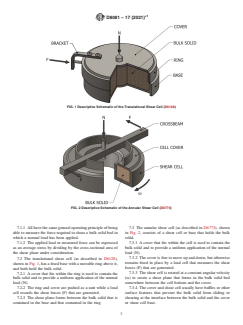
5.4 The three most popular direct shear cell types are: Translational (D6128), Annular (D6773), and Rotational (D6682 and D7891).
5.5 From shear cell data, a wide variety of parameters can be obtained, including the yield locus representing the shear stress to normal stress relationship at incipient flow, angle of internal friction, unconfined yield strength, cohesion, and a variety of related parameters such as the flow function.
5.6 In addition, these three direct shear cells can be set up with wall coupons to measure wall friction.
5.7 When the shear cell data are combined with unconfined yield strength, wall friction data, and bulk density data, they can be used for bin and hopper evaluation and design.
SCOPE
1.1 This guide covers theory and principles for obtaining reliable and accurate bulk solids flow data using a direct shear cell. It includes characteristics and limitations of the three most popular direct shear cell types: Translational (D6128), Annular (D6773), and Rotational (D6682 and D7891).
1.2 Units—The values stated in SI units are to be regarded as standard. No other units of measure are included in this standard.
1.3 This guide offers an organized collection of information or a series of options and does not recommend a specific course of action. This document cannot replace education or experience and should be used in conjunction with professional judgment. Not all aspects of this guide may be applicable in all circumstances. This ASTM standard is not intended to represent or replace the standard of care by which the adequacy of a given professional service must be judged, nor should this document be applied without consideration of a project’s many unique aspects. The word “Standard” in the title of this document means only that the document has been approved through the ASTM consensus process.
1.4 This guide offers an organized collection of information or a series of options and does not recommend a specific course of action. This document cannot replace education or experience and should be used in conjunction with professional judgment. Not all aspects of this guide may be applicable in all circumstances. This ASTM standard is not intended to represent or replace the standard of care by which the adequacy of a given professional service must be judged, nor should this document be applied without consideration of a project’s many unique aspects. The word “Standard” in the title of this document means only that the document has been approved through the ASTM consensus process.
1.5 This standard does not purport to address all of the safety concerns, if any, associated with its use. It is the responsibility of the user of this standard to establish appropriate safety, health, and environmental practices and determine the applicability of regulatory limitations prior to use.
1.6 This international standard was developed in accordance with internationally recognized principles on standardization established in the Decision on Principles for the Development of International Standards, Guides and Recommendations issued by the World Trade Organization Technical Barriers to Trade (TBT) Committee.
- Status
- Published
- Publication Date
- 31-Oct-2021
- Technical Committee
- D18 - Soil and Rock
- Drafting Committee
- D18.24 - Characterization and Handling of Powders and Bulk Solids
Overview
ASTM D8081-17(2021)e1 is the standard guide issued by ASTM International outlining the theory and principles for obtaining reliable and accurate bulk solids flow data using a direct shear cell. This standard is critical in industries where the controlled flow of bulk solids-such as powders, grains, pellets, and granular materials-is essential to operational efficiency and product quality. The guide provides an organized approach to using direct shear cells, discussing their types, advantages, limitations, and the interpretive value of the resulting data.
Key Topics
Bulk Solids Flow and Industrial Relevance
Bulk solids handling is a fundamental part of many industrial processes, from pharmaceuticals to food production and materials science. Understanding and measuring the flowability of these materials under controlled conditions enables effective feeding, storage, and discharge processes.Direct Shear Cell Types
The standard covers the three most widely used direct shear cell designs:- Translational Shear Cell (ASTM D6128)
- Annular Shear Cell (ASTM D6773)
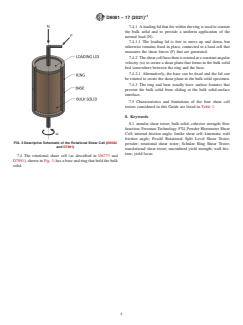
- Rotational Shear Cells (ASTM D6682 and D7891) Each has unique characteristics affecting sample size, ease of automation, training required, and suitability for various bulk solids.
Measurement Parameters
Using direct shear cells, users can determine:- Yield locus (shear stress/normal stress relationship at incipient flow)
- Angle of internal friction
- Unconfined yield strength
- Cohesion
- Flow function and wall friction (when combined with wall coupons)
- Bulk density (for bin and hopper design/evaluation)
Principles of Shear Testing
The guide details processes including sample preparation, application of normal and shear stress, and recording of flow initiation (yielding). Testing may be performed under varying environmental conditions and consolidation states to reflect actual process conditions.Operational Considerations
- Direct shear cell use is more complex than simpler bulk solid flow tests and requires careful control and trained operators for accurate, reproducible results.
- Data from these tests support critical engineering decisions in materials handling.
Applications
Industrial Process Design
Used to design reliable discharge systems for silos, bins, and hoppers by ensuring bulk solids flow as required, minimizing blockages, and preventing issues like arching and ratholing.Material Quality and Process Consistency
Flowability data informs decisions on ingredient/ feedstock selection, process control adjustments, and troubleshooting flow-related production issues.Optimization of Equipment Surfaces
Wall friction measurements assist in selecting optimal materials and finishes for contact surfaces in storage and transport equipment, further enhancing flow reliability.Regulatory Compliance and Safety
Conformance with ASTM D8081 supports adherence to industry standards, operational safety, and performance verification in quality management systems.
Related Standards
- ASTM D6128: Test Method for Shear Testing of Bulk Solids Using the Jenike Shear Tester
- ASTM D6682: Test Method for Measuring Shear Stresses of Powders Using Peschl Rotational Split Level Shear Tester
- ASTM D6773: Test Method for Shear Testing of Bulk Solids Using the Schulze Ring Shear Tester
- ASTM D7891: Test Method for Shear Testing of Powders Using the Freeman FT4 Powder Rheometer Shear Cell
- ASTM D653: Terminology Relating to Soil, Rock, and Contained Fluids
Keywords: bulk solids flow, direct shear cell, shear testing, flowability, annular shear tester, rotational shear tester, translational shear tester, yield locus, wall friction, unconfined yield strength, industrial powder handling, ASTM D8081
Relations
- Effective Date
- 15-Mar-2024
- Effective Date
- 01-Mar-2015
- Refers
ASTM D6128-14 - Standard Test Method for Shear Testing of Bulk Solids Using the Jenike Shear Cell - Effective Date
- 01-Sep-2014
- Effective Date
- 01-Aug-2014
- Effective Date
- 01-Sep-2011
- Effective Date
- 01-Jan-2009
- Effective Date
- 01-Dec-2008
- Effective Date
- 01-Nov-2008
- Effective Date
- 01-Oct-2008
- Refers
ASTM D6773-08 - Standard Shear Test Method for Bulk Solids Using the Schulze Ring Shear Tester - Effective Date
- 01-Oct-2008
- Effective Date
- 15-Dec-2007
- Effective Date
- 01-Nov-2007
- Effective Date
- 01-Aug-2007
- Effective Date
- 01-Jul-2007
- Effective Date
- 01-May-2007
Get Certified
Connect with accredited certification bodies for this standard

IMP NDT d.o.o.
Non-destructive testing services. Radiography, ultrasonic, magnetic particle, penetrant, visual inspection.
Inštitut za kovinske materiale in tehnologije
Institute of Metals and Technology. Materials testing, metallurgical analysis, NDT.
Q Techna d.o.o.
NDT and quality assurance specialist. 30+ years experience. NDT personnel certification per ISO 9712, nuclear and thermal power plant inspections, QA/
Sponsored listings
Frequently Asked Questions
ASTM D8081-17(2021)e1 is a guide published by ASTM International. Its full title is "Standard Guide for Theory and Principles for Obtaining Reliable and Accurate Bulk Solids Flow Data Using a Direct Shear Cell". This standard covers: SIGNIFICANCE AND USE 5.1 A large number of industrial processes involve transfer and feeding of bulk solids, and the ability of such materials to flow in a controlled manner during these operations is critical to product quality. 5.2 Direct shear cells are among the most important methods for measuring the flow properties of bulk solids in industrial applications for bulk solids handling. 5.3 Direct shear cells have many advantages over simpler methods of measuring bulk solids flow properties, but their operation is more complex and the procedures for their use must be carefully controlled to produce accurate and reproducible data. 5.4 The three most popular direct shear cell types are: Translational (D6128), Annular (D6773), and Rotational (D6682 and D7891). 5.5 From shear cell data, a wide variety of parameters can be obtained, including the yield locus representing the shear stress to normal stress relationship at incipient flow, angle of internal friction, unconfined yield strength, cohesion, and a variety of related parameters such as the flow function. 5.6 In addition, these three direct shear cells can be set up with wall coupons to measure wall friction. 5.7 When the shear cell data are combined with unconfined yield strength, wall friction data, and bulk density data, they can be used for bin and hopper evaluation and design. SCOPE 1.1 This guide covers theory and principles for obtaining reliable and accurate bulk solids flow data using a direct shear cell. It includes characteristics and limitations of the three most popular direct shear cell types: Translational (D6128), Annular (D6773), and Rotational (D6682 and D7891). 1.2 Units—The values stated in SI units are to be regarded as standard. No other units of measure are included in this standard. 1.3 This guide offers an organized collection of information or a series of options and does not recommend a specific course of action. This document cannot replace education or experience and should be used in conjunction with professional judgment. Not all aspects of this guide may be applicable in all circumstances. This ASTM standard is not intended to represent or replace the standard of care by which the adequacy of a given professional service must be judged, nor should this document be applied without consideration of a project’s many unique aspects. The word “Standard” in the title of this document means only that the document has been approved through the ASTM consensus process. 1.4 This guide offers an organized collection of information or a series of options and does not recommend a specific course of action. This document cannot replace education or experience and should be used in conjunction with professional judgment. Not all aspects of this guide may be applicable in all circumstances. This ASTM standard is not intended to represent or replace the standard of care by which the adequacy of a given professional service must be judged, nor should this document be applied without consideration of a project’s many unique aspects. The word “Standard” in the title of this document means only that the document has been approved through the ASTM consensus process. 1.5 This standard does not purport to address all of the safety concerns, if any, associated with its use. It is the responsibility of the user of this standard to establish appropriate safety, health, and environmental practices and determine the applicability of regulatory limitations prior to use. 1.6 This international standard was developed in accordance with internationally recognized principles on standardization established in the Decision on Principles for the Development of International Standards, Guides and Recommendations issued by the World Trade Organization Technical Barriers to Trade (TBT) Committee.
SIGNIFICANCE AND USE 5.1 A large number of industrial processes involve transfer and feeding of bulk solids, and the ability of such materials to flow in a controlled manner during these operations is critical to product quality. 5.2 Direct shear cells are among the most important methods for measuring the flow properties of bulk solids in industrial applications for bulk solids handling. 5.3 Direct shear cells have many advantages over simpler methods of measuring bulk solids flow properties, but their operation is more complex and the procedures for their use must be carefully controlled to produce accurate and reproducible data. 5.4 The three most popular direct shear cell types are: Translational (D6128), Annular (D6773), and Rotational (D6682 and D7891). 5.5 From shear cell data, a wide variety of parameters can be obtained, including the yield locus representing the shear stress to normal stress relationship at incipient flow, angle of internal friction, unconfined yield strength, cohesion, and a variety of related parameters such as the flow function. 5.6 In addition, these three direct shear cells can be set up with wall coupons to measure wall friction. 5.7 When the shear cell data are combined with unconfined yield strength, wall friction data, and bulk density data, they can be used for bin and hopper evaluation and design. SCOPE 1.1 This guide covers theory and principles for obtaining reliable and accurate bulk solids flow data using a direct shear cell. It includes characteristics and limitations of the three most popular direct shear cell types: Translational (D6128), Annular (D6773), and Rotational (D6682 and D7891). 1.2 Units—The values stated in SI units are to be regarded as standard. No other units of measure are included in this standard. 1.3 This guide offers an organized collection of information or a series of options and does not recommend a specific course of action. This document cannot replace education or experience and should be used in conjunction with professional judgment. Not all aspects of this guide may be applicable in all circumstances. This ASTM standard is not intended to represent or replace the standard of care by which the adequacy of a given professional service must be judged, nor should this document be applied without consideration of a project’s many unique aspects. The word “Standard” in the title of this document means only that the document has been approved through the ASTM consensus process. 1.4 This guide offers an organized collection of information or a series of options and does not recommend a specific course of action. This document cannot replace education or experience and should be used in conjunction with professional judgment. Not all aspects of this guide may be applicable in all circumstances. This ASTM standard is not intended to represent or replace the standard of care by which the adequacy of a given professional service must be judged, nor should this document be applied without consideration of a project’s many unique aspects. The word “Standard” in the title of this document means only that the document has been approved through the ASTM consensus process. 1.5 This standard does not purport to address all of the safety concerns, if any, associated with its use. It is the responsibility of the user of this standard to establish appropriate safety, health, and environmental practices and determine the applicability of regulatory limitations prior to use. 1.6 This international standard was developed in accordance with internationally recognized principles on standardization established in the Decision on Principles for the Development of International Standards, Guides and Recommendations issued by the World Trade Organization Technical Barriers to Trade (TBT) Committee.
ASTM D8081-17(2021)e1 is classified under the following ICS (International Classification for Standards) categories: 19.060 - Mechanical testing. The ICS classification helps identify the subject area and facilitates finding related standards.
ASTM D8081-17(2021)e1 has the following relationships with other standards: It is inter standard links to ASTM D7891-24, ASTM D7891-15, ASTM D6128-14, ASTM D653-14, ASTM D653-11, ASTM D653-09, ASTM D653-08a, ASTM D653-08, ASTM D6682-08, ASTM D6773-08, ASTM D653-07f, ASTM D653-07e, ASTM D653-07d, ASTM D653-07c, ASTM D653-07b. Understanding these relationships helps ensure you are using the most current and applicable version of the standard.
ASTM D8081-17(2021)e1 is available in PDF format for immediate download after purchase. The document can be added to your cart and obtained through the secure checkout process. Digital delivery ensures instant access to the complete standard document.
Standards Content (Sample)
This international standard was developed in accordance with internationally recognized principles on standardization established in the Decision on Principles for the
Development of International Standards, Guides and Recommendations issued by the World Trade Organization Technical Barriers to Trade (TBT) Committee.
´1
Designation: D8081 − 17 (Reapproved 2021)
Standard Guide for
Theory and Principles for Obtaining Reliable and Accurate
Bulk Solids Flow Data Using a Direct Shear Cell
This standard is issued under the fixed designation D8081; the number immediately following the designation indicates the year of
original adoption or, in the case of revision, the year of last revision. A number in parentheses indicates the year of last reapproval. A
superscript epsilon (´) indicates an editorial change since the last revision or reapproval.
ε NOTE—Reapproved with editorial changes in November 2021.
1. Scope* 1.5 This standard does not purport to address all of the
safety concerns, if any, associated with its use. It is the
1.1 This guide covers theory and principles for obtaining
responsibility of the user of this standard to establish appro-
reliable and accurate bulk solids flow data using a direct shear
priate safety, health, and environmental practices and deter-
cell. It includes characteristics and limitations of the three most
mine the applicability of regulatory limitations prior to use.
popular direct shear cell types: Translational (D6128),Annular
1.6 This international standard was developed in accor-
(D6773), and Rotational (D6682 and D7891).
dance with internationally recognized principles on standard-
1.2 Units—The values stated in SI units are to be regarded
ization established in the Decision on Principles for the
as standard. No other units of measure are included in this
Development of International Standards, Guides and Recom-
standard.
mendations issued by the World Trade Organization Technical
1.3 This guide offers an organized collection of information Barriers to Trade (TBT) Committee.
oraseriesofoptionsanddoesnotrecommendaspecificcourse
of action. This document cannot replace education or experi- 2. Referenced Documents
ence and should be used in conjunction with professional
2.1 ASTM Standards:
judgment. Not all aspects of this guide may be applicable in all
D653 Terminology Relating to Soil, Rock, and Contained
circumstances. This ASTM standard is not intended to repre-
Fluids
sent or replace the standard of care by which the adequacy of
D6128 Test Method for Shear Testing of Bulk Solids Using
a given professional service must be judged, nor should this
the Jenike Shear Tester
document be applied without consideration of a project’s many
D6682 Test Method for Measuring Shear Stresses of Pow-
unique aspects. The word “Standard” in the title of this
ders Using Peschl Rotational Split Level Shear Tester
document means only that the document has been approved
(Withdrawn 2017)
through the ASTM consensus process.
D6773 Test Method for Bulk Solids Using Schulze Ring
Shear Tester
1.4 This guide offers an organized collection of information
or a series of options and does not recommend a specific D7891 Test Method for Shear Testing of Powders Using the
Freeman Technology FT4 Powder Rheometer Shear Cell
course of action. This document cannot replace education or
experience and should be used in conjunction with professional
3. Terminology
judgment. Not all aspects of this guide may be applicable in all
circumstances. This ASTM standard is not intended to repre-
3.1 Definitions:
sent or replace the standard of care by which the adequacy of
3.1.1 For common definitions of technical terms in this
a given professional service must be judged, nor should this
standard, refer to Terminology D653.
document be applied without consideration of a project’s many
3.2 uniform bulk solid bed, n—in powders and bulk solids,
unique aspects. The word “Standard” in the title of this
a specimen in a direct shear cell that has a consistent bulk
document means only that the document has been approved
density throughout the bed.
through the ASTM consensus process.
1 2
This test method is under the jurisdiction ofASTM Committee D18 on Soil and For referenced ASTM standards, visit the ASTM website, www.astm.org, or
Rock and is the direct responsibility of Subcommittee D18.24 on Characterization contact ASTM Customer Service at service@astm.org. For Annual Book of ASTM
and Handling of Powders and Bulk Solids. Standards volume information, refer to the standard’s Document Summary page on
Current edition approved Nov. 1, 2021. Published November 2021. Originally the ASTM website.
approved in 2017. Last previous edition approved in 2017 as D8081 – 17. DOI: The last approved version of this historical standard is referenced on
10.1520/D8081-17R21E01. www.astm.org.
*A Summary of Changes section appears at the end of this standard
Copyright © ASTM International, 100 Barr Harbor Drive, PO Box C700, West Conshohocken, PA 19428-2959. United States
´1
D8081 − 17 (2021)
4. Summary of Guide 6.3 Bulk solids can sustain a shear stress without flowing
only up to a certain point. Once a bulk solid is subjected to
4.1 The three shear cell types covered by the guide are
stresses (whether by gravity or some mechanical means) that
categorized as direct shear tests in which a region of the bulk
reach or exceed its yield locus, the bulk solid flows.
solid is sheared under a series of controlled stresses.
6.4 Determining the yield locus for a given bulk solid under
4.2 This guide describes the theory and principles for
conditions representative of its manufacturing process is an
obtaining reliable and accurate bulk solids flow data using a
essential step in evaluating the flow behaviors for that process.
direct shear cell. It also provides characteristics and limitations
6.4.1 In some circumstances, this may involve testing under
of each direct shear cell type to guide the user in the selection
controlled environmental conditions, as well as holding the
of the shear cell for a particular test.
bulk solid under load for an extended period before shearing (a
time test).
5. Significance and Use
6.4.2 The yield locus for a given bulk solid is a function of
5.1 A large number of industrial processes involve transfer
many variables, including its composition, particle size and
and feeding of bulk solids, and the ability of such materials to
shape, moisture content, temperature, time stored at rest, and
flow in a controlled manner during these operations is critical
the state of consolidation.
to product quality.
6.5 Becausebulksolidpropertiesarehighlydependentupon
5.2 Direct shear cells are among the most important meth-
the degree of consolidation, the preparation of a uniform bulk
ods for measuring the flow properties of bulk solids in
solid bed (consistent bulk density throughout the bed) is the
industrial applications for bulk solids handling.
first critical step of shear cell testing.
5.3 Direct shear cells have many advantages over simpler
6.6 The next stage of testing is the application of a normal
methods of measuring bulk solids flow properties, but their
stress (σ) and shear stress (τ) to the bulk solid bed to achieve
operation is more complex and the procedures for their use
steady-state shear resulting in a known state of consolidation.
must be carefully controlled to produce accurate and reproduc-
6.7 The shear stress then is removed, and a reduced normal
ible data.
stress is applied.
5.4 The three most popular direct shear cell types are:
6.8 A shear stress then is applied and is progressively
Translational (D6128), Annular (D6773), and Rotational
increased until the bulk solid bed yields and begins to flow.
(D6682 and D7891).
6.9 This procedure is repeated at several different normal
5.5 From shear cell data, a wide variety of parameters can
stress conditions to create a yield locus plot.
be obtained, including the yield locus representing the shear
stress to normal stress relationship at incipient flow, angle of
6.10 To complete a full flow function analysis, the operator
internal friction, unconfined yield strength, cohesion, and a
must determine several yield loci, which requires that the
variety of related parameters such as the flow function.
unconfinedyieldstrengthbedeterminedunderseveraldifferent
levels of consolidation.
5.6 In addition, these three direct shear cells can be set up
with wall coupons to measure wall friction.
6.11 Although this guide focuses on the bulk solid (particle-
particle) properties, the wall (particle-wall) properties and bulk
5.7 When the shear cell data are combined with unconfined
density are also important.
yield strength, wall friction data, and bulk density data, they
6.11.1 Such properties are used for bin design and also are
can be used for bin and hopper evaluation and design.
essential when one compares different wall materials (for
example, different grades and finishes of stainless steel, or the
6. Theory and Principles
effect of plastic coatings on bulk solid flow behaviors).
6.1 The flow behavior of a bulk solid is fundamentally
6.11.2 The most fundamental property of a wall material in
different from the flow of a fluid.
this regard is ϕ’, the angle of friction between the bulk solid
6.1.1
...