

ASTM D5881-20
(Practice)Standard Practice for (Analytical Procedures) Determining Transmissivity of Confined Nonleaky Aquifers by Critically Damped Well Response to Instantaneous Change in Head (Slug)
General Information
- Abstract
SIGNIFICANCE AND USE
6.1 The assumptions of the physical system are given as follows:
6.1.1 The aquifer is of uniform thickness, with impermeable upper and lower confining boundaries.
6.1.2 The aquifer is of constant homogeneous porosity and matrix compressibility and constant homogeneous and isotropic hydraulic conductivity.
6.1.3 The origin of the cylindrical coordinate system is taken to be on the well-bore axis at the top of the aquifer.
6.1.4 The aquifer is fully screened.
6.1.5 The well is 100 % efficient, that is, the skin factor, f, and dimensionless skin factor, σ, are zero.
6.2 The assumptions made in defining the momentum balance are as follows:
6.2.1 The average water velocity in the well is approximately constant over the well-bore section.
6.2.2 Frictional head losses from flow in the well are negligible.
6.2.3 Flow through the well screen is uniformly distributed over the entire aquifer thickness.
6.2.4 Change in momentum from the water velocity changing from radial flow through the screen to vertical flow in the well are negligible.
Note 1: Slug and pumping tests implicitly assume a porous medium. Fractured rock and carbonate settings may not provide meaningful data and information.
Note 2: The function of wells in any unconfined setting in a fractured terrain might make the determination of k problematic because the wells might only intersect tributary or subsidiary channels or conduits. The problems determining the k of a channel or conduit notwithstanding, the partial penetration of tributary channels may make a determination of a meaningful number difficult. If plots of k in carbonates and other fractured settings are made and compared, they may show no indication that there are conduits or channels present, except when with the lowest probability one maybe intersected by a borehole and can be verified, such problems are described by (5) Smart (1999). Additional guidance can be found in Guide D5717.
Note 3: The quality of the resu...
SCOPE
1.1 This practice covers determination of transmissivity from the measurement of water-level response to a sudden change of water level in a well-aquifer system characterized as being critically damped or in the transition range from underdamped to overdamped. Underdamped response is characterized by oscillatory changes in water level; overdamped response is characterized by return of the water level to the initial static level in an approximately exponential manner. Overdamped response is covered in Guide D4043; underdamped response is covered in Practice D5785/D5785M, Guide D4043.
1.2 The analytical procedure in this practice is used in conjunction with Guide D4043 and the field procedure in Test Method D4044/D4044M for collection of test data.
1.3 Limitations—Slug tests are considered to provide an estimate of the transmissivity of an aquifer near the well screen. The method is applicable for systems in which the damping parameter, ζ, is within the range from 0.2 through 5.0. The assumptions of the method prescribe a fully penetrating well (a well open through the full thickness of the aquifer) in a confined, nonleaky aquifer.
1.4 All observed and calculated values shall conform to the guidelines for significant digits and rounding established in Practice D6026.
1.4.1 The procedures used to specify how data are collected/recorded and calculated in this standard are regarded as the industry standard. In addition, they are representative of the significant digits that should generally be retained. The procedures used do not consider material variation, purpose for obtaining the data, special purpose studies, or any considerations for the user’s objectives; and it is common practice to increase or reduce significant digits of reported data to commensurate with these considerations. It is beyond the scope of this standard to consider significant digits used in analysis methods for engineering design.
1.5 Un...
- Status
- Published
- Publication Date
- 31-May-2020
- Technical Committee
- D18 - Soil and Rock
- Drafting Committee
- D18.21 - Groundwater and Vadose Zone Investigations
Buy Documents
ASTM D5881-20 - Standard Practice for (Analytical Procedures) Determining Transmissivity of Confined Nonleaky Aquifers by Critically Damped Well Response to Instantaneous Change in Head (Slug)
REDLINE ASTM D5881-20 - Standard Practice for (Analytical Procedures) Determining Transmissivity of Confined Nonleaky Aquifers by Critically Damped Well Response to Instantaneous Change in Head (Slug)
Overview
ASTM D5881-20 establishes a standard practice for determining the transmissivity of confined, nonleaky aquifers based on the critically damped response of a well to an instantaneous change in head, commonly referred to as a slug test. This guideline is vital in hydrogeology for estimating aquifer properties near the well screen, specifically for conditions where the well response transitions between underdamped (oscillatory) and overdamped (exponential decay) behavior. The practice is primarily used with other ASTM standards that cover field procedures and the selection of suitable test methods.
Key Topics
- Transmissivity Determination: The standard focuses on calculating aquifer transmissivity from water-level changes after a sudden shift in the well’s water level.
- Critically Damped Well Response: Applicable for systems where the well’s response is neither fully oscillatory nor purely exponential, covering damping parameters (ζ) from 0.2 to 5.0.
- Confined, Nonleaky Aquifers: Assumes that the aquifer is confined above and below by impermeable boundaries and that water movement is horizontal.
- Uniform and Homogeneous Properties:
- The aquifer is of uniform thickness and homogeneity in porosity, matrix compressibility, and hydraulic conductivity.
- The well is fully screened (open through the entire thickness of the aquifer) and operates at 100% efficiency (zero skin effect).
- Simplifying Assumptions:
- Negligible frictional head losses in the well.
- Uniform flow distribution through the well screen.
- The system is best suited for porous media - not recommended for fractured rock or karst aquifers.
Applications
This standard is especially valuable in groundwater investigations and aquifer performance assessments where quick, small-scale testing is needed:
- Site Characterization: Provides rapid estimates of aquifer behavior and transmissivity around monitoring wells for engineering and environmental projects.
- Well Field Design: Helps inform the design and placement of production or monitoring wells based on local aquifer properties.
- Regulatory Compliance and Remediation: Supports hydrogeological assessments needed for permitting, remediation, and monitoring at contaminated sites.
- Data Quality Assurance: Specifies how test data should be reported, ensuring repeatability and transparency according to established guidelines for significant digits and industry best practices.
Limitations: The method offers transmissivity estimates limited to zones near the well screen and may not reflect broader aquifer properties in complex geological settings, particularly fractured rocks or highly heterogeneous systems. The standard should be used in conjunction with professional judgment and, where necessary, other testing methods.
Related Standards
ASTM D5881-20 is meant to be used alongside the following documents to ensure comprehensive aquifer testing and data interpretation:
- ASTM D4043: Guide for Selection of Aquifer Test Method in Determining Hydraulic Properties by Well Techniques.
- ASTM D4044/D4044M: Field procedure for slug tests in aquifers.
- ASTM D5785/D5785M: Practice for underdamped response methods for aquifer transmissivity determination.
- ASTM D6026: Guidelines for recording significant digits in geotechnical data.
- ASTM D653: Terminology relating to soil, rock, and contained fluids.
- ASTM D3740: Minimum requirements for agencies conducting testing and inspection of soil and rock.
- ASTM D5717 (for karst/fractured rock guidance, although withdrawn).
Keywords: aquifer transmissivity, slug test, confined aquifer, hydrogeology, groundwater, well response, hydraulic properties, ASTM D5881, field aquifer testing
Practical Value: By standardizing analytical procedures for slug tests, ASTM D5881-20 ensures reliable estimations of confined aquifer transmissivity, supports consistent project reporting, and provides practitioners a framework for interpreting well response data for water resource management and site assessment.
Relations
- Effective Date
- 01-Jun-2020
- Effective Date
- 01-Nov-2023
- Effective Date
- 01-Oct-2019
- Effective Date
- 01-Jan-2017
- Effective Date
- 01-Nov-2015
- Effective Date
- 01-Sep-2015
- Effective Date
- 01-Aug-2014
- Effective Date
- 01-May-2012
- Effective Date
- 01-Mar-2012
- Effective Date
- 01-Sep-2011
- Effective Date
- 01-Sep-2011
- Effective Date
- 01-Aug-2010
- Effective Date
- 01-Mar-2010
- Effective Date
- 01-Jan-2009
- Effective Date
- 01-Dec-2008
Buy Documents
ASTM D5881-20 - Standard Practice for (Analytical Procedures) Determining Transmissivity of Confined Nonleaky Aquifers by Critically Damped Well Response to Instantaneous Change in Head (Slug)
REDLINE ASTM D5881-20 - Standard Practice for (Analytical Procedures) Determining Transmissivity of Confined Nonleaky Aquifers by Critically Damped Well Response to Instantaneous Change in Head (Slug)
Frequently Asked Questions
ASTM D5881-20 is a standard published by ASTM International. Its full title is "Standard Practice for (Analytical Procedures) Determining Transmissivity of Confined Nonleaky Aquifers by Critically Damped Well Response to Instantaneous Change in Head (Slug)". This standard covers: SIGNIFICANCE AND USE 6.1 The assumptions of the physical system are given as follows: 6.1.1 The aquifer is of uniform thickness, with impermeable upper and lower confining boundaries. 6.1.2 The aquifer is of constant homogeneous porosity and matrix compressibility and constant homogeneous and isotropic hydraulic conductivity. 6.1.3 The origin of the cylindrical coordinate system is taken to be on the well-bore axis at the top of the aquifer. 6.1.4 The aquifer is fully screened. 6.1.5 The well is 100 % efficient, that is, the skin factor, f, and dimensionless skin factor, σ, are zero. 6.2 The assumptions made in defining the momentum balance are as follows: 6.2.1 The average water velocity in the well is approximately constant over the well-bore section. 6.2.2 Frictional head losses from flow in the well are negligible. 6.2.3 Flow through the well screen is uniformly distributed over the entire aquifer thickness. 6.2.4 Change in momentum from the water velocity changing from radial flow through the screen to vertical flow in the well are negligible. Note 1: Slug and pumping tests implicitly assume a porous medium. Fractured rock and carbonate settings may not provide meaningful data and information. Note 2: The function of wells in any unconfined setting in a fractured terrain might make the determination of k problematic because the wells might only intersect tributary or subsidiary channels or conduits. The problems determining the k of a channel or conduit notwithstanding, the partial penetration of tributary channels may make a determination of a meaningful number difficult. If plots of k in carbonates and other fractured settings are made and compared, they may show no indication that there are conduits or channels present, except when with the lowest probability one maybe intersected by a borehole and can be verified, such problems are described by (5) Smart (1999). Additional guidance can be found in Guide D5717. Note 3: The quality of the resu... SCOPE 1.1 This practice covers determination of transmissivity from the measurement of water-level response to a sudden change of water level in a well-aquifer system characterized as being critically damped or in the transition range from underdamped to overdamped. Underdamped response is characterized by oscillatory changes in water level; overdamped response is characterized by return of the water level to the initial static level in an approximately exponential manner. Overdamped response is covered in Guide D4043; underdamped response is covered in Practice D5785/D5785M, Guide D4043. 1.2 The analytical procedure in this practice is used in conjunction with Guide D4043 and the field procedure in Test Method D4044/D4044M for collection of test data. 1.3 Limitations—Slug tests are considered to provide an estimate of the transmissivity of an aquifer near the well screen. The method is applicable for systems in which the damping parameter, ζ, is within the range from 0.2 through 5.0. The assumptions of the method prescribe a fully penetrating well (a well open through the full thickness of the aquifer) in a confined, nonleaky aquifer. 1.4 All observed and calculated values shall conform to the guidelines for significant digits and rounding established in Practice D6026. 1.4.1 The procedures used to specify how data are collected/recorded and calculated in this standard are regarded as the industry standard. In addition, they are representative of the significant digits that should generally be retained. The procedures used do not consider material variation, purpose for obtaining the data, special purpose studies, or any considerations for the user’s objectives; and it is common practice to increase or reduce significant digits of reported data to commensurate with these considerations. It is beyond the scope of this standard to consider significant digits used in analysis methods for engineering design. 1.5 Un...
SIGNIFICANCE AND USE 6.1 The assumptions of the physical system are given as follows: 6.1.1 The aquifer is of uniform thickness, with impermeable upper and lower confining boundaries. 6.1.2 The aquifer is of constant homogeneous porosity and matrix compressibility and constant homogeneous and isotropic hydraulic conductivity. 6.1.3 The origin of the cylindrical coordinate system is taken to be on the well-bore axis at the top of the aquifer. 6.1.4 The aquifer is fully screened. 6.1.5 The well is 100 % efficient, that is, the skin factor, f, and dimensionless skin factor, σ, are zero. 6.2 The assumptions made in defining the momentum balance are as follows: 6.2.1 The average water velocity in the well is approximately constant over the well-bore section. 6.2.2 Frictional head losses from flow in the well are negligible. 6.2.3 Flow through the well screen is uniformly distributed over the entire aquifer thickness. 6.2.4 Change in momentum from the water velocity changing from radial flow through the screen to vertical flow in the well are negligible. Note 1: Slug and pumping tests implicitly assume a porous medium. Fractured rock and carbonate settings may not provide meaningful data and information. Note 2: The function of wells in any unconfined setting in a fractured terrain might make the determination of k problematic because the wells might only intersect tributary or subsidiary channels or conduits. The problems determining the k of a channel or conduit notwithstanding, the partial penetration of tributary channels may make a determination of a meaningful number difficult. If plots of k in carbonates and other fractured settings are made and compared, they may show no indication that there are conduits or channels present, except when with the lowest probability one maybe intersected by a borehole and can be verified, such problems are described by (5) Smart (1999). Additional guidance can be found in Guide D5717. Note 3: The quality of the resu... SCOPE 1.1 This practice covers determination of transmissivity from the measurement of water-level response to a sudden change of water level in a well-aquifer system characterized as being critically damped or in the transition range from underdamped to overdamped. Underdamped response is characterized by oscillatory changes in water level; overdamped response is characterized by return of the water level to the initial static level in an approximately exponential manner. Overdamped response is covered in Guide D4043; underdamped response is covered in Practice D5785/D5785M, Guide D4043. 1.2 The analytical procedure in this practice is used in conjunction with Guide D4043 and the field procedure in Test Method D4044/D4044M for collection of test data. 1.3 Limitations—Slug tests are considered to provide an estimate of the transmissivity of an aquifer near the well screen. The method is applicable for systems in which the damping parameter, ζ, is within the range from 0.2 through 5.0. The assumptions of the method prescribe a fully penetrating well (a well open through the full thickness of the aquifer) in a confined, nonleaky aquifer. 1.4 All observed and calculated values shall conform to the guidelines for significant digits and rounding established in Practice D6026. 1.4.1 The procedures used to specify how data are collected/recorded and calculated in this standard are regarded as the industry standard. In addition, they are representative of the significant digits that should generally be retained. The procedures used do not consider material variation, purpose for obtaining the data, special purpose studies, or any considerations for the user’s objectives; and it is common practice to increase or reduce significant digits of reported data to commensurate with these considerations. It is beyond the scope of this standard to consider significant digits used in analysis methods for engineering design. 1.5 Un...
ASTM D5881-20 is classified under the following ICS (International Classification for Standards) categories: 07.060 - Geology. Meteorology. Hydrology. The ICS classification helps identify the subject area and facilitates finding related standards.
ASTM D5881-20 has the following relationships with other standards: It is inter standard links to ASTM D5881-18, ASTM D3740-23, ASTM D3740-19, ASTM D4043-17, ASTM D5785/D5785M-15, ASTM D4044/D4044M-15, ASTM D653-14, ASTM D3740-12a, ASTM D3740-12, ASTM D653-11, ASTM D3740-11, ASTM D4043-96(2010)e1, ASTM D3740-10, ASTM D653-09, ASTM D653-08a. Understanding these relationships helps ensure you are using the most current and applicable version of the standard.
ASTM D5881-20 is available in PDF format for immediate download after purchase. The document can be added to your cart and obtained through the secure checkout process. Digital delivery ensures instant access to the complete standard document.
Standards Content (Sample)
This international standard was developed in accordance with internationally recognized principles on standardization established in the Decision on Principles for the
Development of International Standards, Guides and Recommendations issued by the World Trade Organization Technical Barriers to Trade (TBT) Committee.
Designation:D5881 −20
Standard Practice for
(Analytical Procedures) Determining Transmissivity of
Confined Nonleaky Aquifers by Critically Damped Well
Response to Instantaneous Change in Head (Slug)
This standard is issued under the fixed designation D5881; the number immediately following the designation indicates the year of
original adoption or, in the case of revision, the year of last revision.Anumber in parentheses indicates the year of last reapproval.A
superscript epsilon (´) indicates an editorial change since the last revision or reapproval.
1. Scope* this standard to consider significant digits used in analysis
methods for engineering design.
1.1 This practice covers determination of transmissivity
from the measurement of water-level response to a sudden 1.5 Units—The values stated in SI units are to be regarded
changeofwaterlevelinawell-aquifersystemcharacterizedas asstandard.Nootherunitsofmeasurementareincludedinthis
being critically damped or in the transition range from under- standard.ReportingofresultsinunitsotherthanSIshallnotbe
damped to overdamped. Underdamped response is character- regarded as nonconformance with this standard.
ized by oscillatory changes in water level; overdamped re-
1.6 This practice offers a set of instructions for performing
sponseischaracterizedbyreturnofthewaterleveltotheinitial
one or more specific operations.This document cannot replace
static level in an approximately exponential manner. Over-
educationorexperienceandshouldbeusedinconjunctionwith
damped response is covered in Guide D4043; underdamped
professional judgment. Not all aspects of the practice may be
responseiscoveredinPracticeD5785/D5785M,GuideD4043.
applicable in all circumstances. This ASTM standard is not
1.2 The analytical procedure in this practice is used in intended to represent or replace the standard of care by which
conjunction with Guide D4043 and the field procedure in Test the adequacy of a given professional service must be judged,
Method D4044/D4044M for collection of test data. nor should this document be applied without the consideration
ofaproject’smanyuniqueaspects.Theword“Standard”inthe
1.3 Limitations—Slug tests are considered to provide an
title of this document means only that the document has been
estimate of the transmissivity of an aquifer near the well
approved through he ASTM consensus process.
screen. The method is applicable for systems in which the
1.7 This standard does not purport to address all of the
dampingparameter, ζ,iswithintherangefrom0.2through5.0.
safety concerns, if any, associated with its use. It is the
The assumptions of the method prescribe a fully penetrating
responsibility of the user of this standard to establish appro-
well (a well open through the full thickness of the aquifer) in
priate safety, health, and environmental practices and deter-
a confined, nonleaky aquifer.
mine the applicability of regulatory limitations prior to use.
1.4 All observed and calculated values shall conform to the
1.8 This international standard was developed in accor-
guidelines for significant digits and rounding established in
dance with internationally recognized principles on standard-
Practice D6026.
ization established in the Decision on Principles for the
1.4.1 Theproceduresusedtospecifyhowdataarecollected/
Development of International Standards, Guides and Recom-
recorded and calculated in this standard are regarded as the
mendations issued by the World Trade Organization Technical
industry standard. In addition, they are representative of the
Barriers to Trade (TBT) Committee.
significant digits that should generally be retained. The proce-
dures used do not consider material variation, purpose for
2. Referenced Documents
obtaining the data, special purpose studies, or any consider-
2.1 ASTM Standards:
ations for the user’s objectives; and it is common practice to
D653Terminology Relating to Soil, Rock, and Contained
increase or reduce significant digits of reported data to com-
Fluids
mensurate with these considerations. It is beyond the scope of
D3740Practice for Minimum Requirements for Agencies
Engaged in Testing and/or Inspection of Soil and Rock as
ThistestmethodisunderthejurisdictionofASTMCommitteeD18onSoiland
Rock and is the direct responsibility of Subcommittee D18.21 on Groundwater and
Vadose Zone Investigations. For referenced ASTM standards, visit the ASTM website, www.astm.org, or
Current edition approved June 1, 2020. Published June 2020. Originally contact ASTM Customer Service at service@astm.org. For Annual Book of ASTM
approved in 1995. Last previous edition approved in 2018 as D5881–18. DOI: Standards volume information, refer to the standard’s Document Summary page on
10.1520/D5881-20. the ASTM website.
*A Summary of Changes section appears at the end of this standard
Copyright © ASTM International, 100 Barr Harbor Drive, PO Box C700, West Conshohocken, PA 19428-2959. United States
D5881−20
Used in Engineering Design and Construction 3.3.18 α—dimensionless storage parameter [nd].
D4043Guide for Selection of Aquifer Test Method in
3.3.19 β—dimensionless inertial parameter [nd].
Determining Hydraulic Properties by Well Techniques
−1
3.3.20 γ—damping constant [T ].
D4044/D4044MTest Method for (Field Procedure) for In-
3.3.21 τ—wavelength [T].
stantaneous Change in Head (Slug) Tests for Determining
−1
Hydraulic Properties of Aquifers 3.3.22 ω—angular frequency [T ].
D5717Guide for Design of Ground-Water Monitoring Sys-
3.3.23 ζ—dimensionless damping factor [nd].
tems in Karst and Fractured-Rock Aquifers (Withdrawn
2005)
4. Summary of Practice
D5785/D5785MPractice for (Analytical Procedure) for De-
4.1 This practice describes the analytical procedure for
termining Transmissivity of Confined Nonleaky Aquifers
analyzing data collected during an instantaneous head (slug)
by UnderdampedWell Response to Instantaneous Change
test for well and aquifer response at and near critical damping.
in Head (Slug Test)
Procedures in conducting a slug test are given in Test Method
D6026Practice for Using Significant Digits in Geotechnical
D4044/D4044M. The analytical procedure consists of analyz-
Data
ingtheresponseofwaterlevelinthewellfollowingthechange
in water level induced in the well.
3. Terminology
4.2 Theory—The equations that govern the response of well
3.1 Definitions—For definitions of common technical terms
to an instantaneous change in head are treated at length by
in this standard, refer to Terminology D653.
Kipp (1). Theflowintheaquiferisgovernedbythefollowing
3.2 Definitions of Terms Specific to This Standard:
equation for cylindrical flow:
3.2.1 aquifer, confined, n—in ground water, an aquifer
bounded above and below by confining beds and in which the S dh 1 d dh
5 r (1)
S D
static head is above the top of the aquifer. T dt r dr dr
3.2.2 critically damped well response, n—in ground water,
where:
characterized by the water level responding in a transitional
h = hydraulic head,
range between underdamped and overdamped following a
T = aquifer transmissivity, and
sudden change in water level.
S = storage coefficient.
3.2.3 observation well, n—in ground water, a well open to
4.2.1 The initial condition is at t =0 and h = h , and the
o
all or part of an aquifer.
outer boundary condition is as r − and h−h .
o
3.3 Symbols and Dimensions:
4.2.1.1 An equation is given by Kipp (1) for the skin factor,
2 −1
3.3.1 T—transmissivity [L T ]. that is, the effect of aquifer damage during drilling of the well.
However, this factor is not treated by Kipp (1) and is not
3.3.2 S—storage coefficient [nd].
considered in this procedure.
3.3.3 L—static water column length above top of aquifer
4.2.2 The flow rate balance on the well bore relates the
[L].
displacementofthewaterlevelinthewellrisertotheflowinto
3.3.4 L —effective length of water column in a well, equal
e
the well:
2 2
to L +(r /r )(b/2) [L].
c c s
dw dh
πr 5 2πr T (2)
3.3.5 L —length of water column within casing [L]. ?
c s r5rs
c
dt dr
3.3.6 L —length of water column within well screen [L].
s
where:
−2
3.3.7 g—acceleration of gravity [LT ].
r = radius of the well casing, and
c
3.3.8 h—hydraulic head in the aquifer [L].
w = displacement of the water level in the well from its
initial position.
3.3.9 h —initial hydraulic head in the aquifer [L].
o
3.3.10 h —hydraulic head in the well screen [L]. 4.2.3 The fourth equation describing the system relating h
s s
and w,comesfromamomentumbalanceequationofBirdetal
3.3.11 r —radius of well casing [L].
c
(2) as referenced in Kipp (1):
3.3.12 r —radius of well screen [L].
s
d
3.3.13 t—time [T].
2 2 2
πr pvdz 5 2pv 1p 2 p 2 ρgb πr (3)
*
~ !
s 2 1 2 s
dt
2b
3.3.14 t'—dimensionless time [nd].
ˆ
3.3.15 t—dimensionless time [nd]. where:
v = velocity in the well screen interval,
3.3.16 w—water level displacement from the initial static
b = aquifer thickness,
level [L].
p = pressure,
3.3.17 w —initial water level displacement [L].
o
3 4
The last approved version of this historical standard is referenced on The boldface numbers in parentheses refer to a list of references at the end of
www.astm.org. this standard.
D5881−20
at t 50, w 5 w (6)
o
dw/dt 5 w * (7)
o
h 5 L 5 h (8)
s o
5.2 Kipp (1) introduces dimensionless variables and param-
eters in converting these equations to dimensionless form,
solves the equations by Laplace transforms, and inverts the
solution by a Laplace-transform-inversion algorithm.
5.2.1 The following dimensionless parameters are among
those given by Kipp (1):
dimensionless water-level displacement:
w'52w/w (9)
o
dimensionless time:
t' 5 ~tT!/~r S! (10)
s
and:
½
ˆ
t 5 t'/β (11)
dimensionless storage:
2 2
α 5 r 2r S (12)
~ ! ~ !
c s
dimensionless inertial parameter:
2 2
β 5 Le/g T/ r S (13)
~ !~ ~ !!
s
dimensionless skin factor:
σ 5 f/r (14)
s
dimensionless frequency parameter:
2 ½
2d σ1¼ 1nβ 14β
@ ~ ! #
ω 5 (15)
2β
dimensionless decay parameter:
α σ1¼ 1nβ
~ !
γ 5 (16)
2β
FIG. 1 Well and Aquifer Geometry from Kipp (1)
and dimensionless damping factor:
α σ1¼ 1nβ
~ !
ζ 5 (17)
½
2β
ρ = fluid density,
g = gravitational acceleration, and
5.3 For ζ less than one, the system is underdamped; for ζ
r = well screen radius.
s greaterthanone,thesystemisoverdamped.For ζequaltoone,
thesystemiscriticallydamped,yettheinertialeffectsarequite
Thenumericalsubscriptsrefertotheplanesdescribedabove
important (1). For ζ greater than about five, the system
and shown in Fig. 1. Atmospheric pressure is taken as zero.
responds as if the inertial effects can be neglected and the
5. Solution
solution of Cooper et al. (3) (given in Guide D4043)is
applicable. For ζ about 0.2 or less, the approximate solution of
5.1 Kipp (1) derives the following differential equation to
van der Kamp (4) is valid (given in Practice D5785/D5785M).
representfortheresponseofthedisplacementofwaterlevelin
The solution of Kipp (1), the subject of this practice, is
the well:
applicable for the transition zone between systems that are
d w g g
underdamped and overdamped. Solutions are given here for ζ
1 w 5 /L (4)
2 S D
e
dt L h 2 h
~ !
e s o
ranging from 0.2 to 5.0.
where:
6. Significance and Use
L = effective water column length, defined as:
e
2 2
6.1 The assumptions of the physical system are given as
L 5 L1~r /r !~b/2! (5)
e c s
follows:
where:
6.1.1 Theaquiferisofuniformthickness,withimpermeable
b = aquifer thickness with initial conditions:
upper and lower confining boundaries.
D5881−20
6.1.2 The aquifer is of constant homogeneous porosity and
matrix compressibility and constant homogeneous and isotro-
pic hydraulic conductivity.
6.1.3 The origin of the cylindrical coordinate system is
taken to be on the well-bore axis at the top of the aquifer.
6.1.4 The aquifer is fully screened.
6.1.5 The well is 100% efficient, that is, the skin factor, f,
and dimensionless skin factor, σ, are zero.
6.2 The assumptions made in defining the momentum bal-
ance are as follows:
6.2.1 The average water velocity in the well is approxi-
mately constant over the well-bore section.
6.2.2 Frictional head losses from flow in the well are
negligible.
6.2.3 Flow through the well screen is uniformly distributed
over the entire aquifer thickness.
6.2.4 Change in momentum from the water velocity chang-
FIG. 2 Slug-Test Data Overlaid on Type Curves for Three Differ-
ing from radial flow through the screen to vertical flow in the
ent Damping Factors, Modified from Kipp (1)
well are negligible.
NOTE 1—Slug and pumping tests implicitly assume a porous medium.
TABLE 1 Values of the Dimensionless Water Level Displacement,
Fractured rock and carbonate settings may not provide meaningful data
w', Versus Dimensionless Time, t, for Construction of Type
and information.
Curves, ζ=0.1 and α=9988.1
NOTE 2—The function of wells in any unconfined setting in a fractured
tw' tw'
terrain might make the determination of k problematic because the wells
3.162278E−02 −9.994887E−01 3.162278E + 00 7.100277E−01
might only intersect tributary or subsidiary channels or conduits. The
3.636619E−02 −9.993281E−01 3.636619E + 00 6.204110E−01
problems determining the k of a channel or conduit notwithstanding, the
3.952847E−02 −9.992086E−01 3.952847E + 00 4.871206E−01
partial penetration of tributary channels may make a determination of a
4.269075E−02 −9.990793E−01 4.269075E + 00 3.138511E−01
meaningfulnumberdifficult.Ifplotsofkincarbonatesandotherfractured
4.743416E−02 −9.988666E−01 4.743416E + 00 2.218683E−02
settings are made and compared, they may show no indication that there
5.375872E−02 −9.985483E−01 5.375872E + 00 −3.226809E−01
are conduits or channels present, except when with the lowest probability
6.324555E−02 −9.979965E−01 6.324555E + 00 −5.191564E−01
one maybe intersected by a borehole and can be verified, such problems
7.115125E−02 −9.974688E−01 7.115125E + 00 −3.413663E−01
are described by (5) Smart (1999). Additional guidance can be found in
7.905694E−02 −9.968794E−01 7.905694E + 00 3.445623E−05
8.696264E−02 −9.962284E−01 8.696264E + 00 2.889492E−01
Guide D5717.
9.486833E−02 −9.955161E−01 9.486833E + 00 3.712172E−01
NOTE 3—The quality of the result produced by this standard is
1.106797E−01 −9.939077E−01 1.106797E + 01 −1.758246E−02
dependent on the competence of the personnel performing it, and the
1.264911E−01 −9.920552E−01 1.264911E + 01 −2.697976E−01
suitability of the equipment and facilities used. Agencies that meet the
1.423025E−01 −9.899599E−01 1.423025E + 01 2.109260E−02
criteria of Practice D3740 are generally considered capable of competent
1.581139E−01 −9.876230E−01 1.581139E + 01 1.919487E−01
and objective testing/sampling/inspection/etc. Users of this standard are
1.739253E−01 −9.850456E−01 1.739253E + 01 −2.455328E−02
cautioned that compliance with Practice D3740 does not in itself assure
1.897367E−01 −9.822293E−01 1.897367E + 00 −1.392019E−01
reliable results. Reliable results depend on many factors; Practice D3740
2.213594E−01 −9.758851E−01 2.213594E + 01 9.826209E−02
provides a means of evaluating some of those factors.
2.529822E−01 −9.686026E−01 2.529822E + 01 −7.129166E−02
2.846050E−01 −9.603946E−01 2.846050E + 01 4.976069E−02
3.162278E−01 −9.512748E−01 3.162278E + 01 −3.626029E−02
7. Procedure
3.636619E−01 −9.359183E−01 3.636619E + 01 −9.997386E−03
3.952847E−01 −9.259452E−01 3.952847E + 01 7.200932E−03
7.1 The overall procedure consists of conducting the slug
4.269075E−01 −9.084819E−01 4.743416E + 01 5.892951E−03
test field procedure (see Test Method D4044/D4044M) and
4.743416E−01 −8.947298E−01 5.375872E + 01 2.737128E−03
analysis of the field data using this practice.
5.375872E−01 −8.632514E−01 6.324555E + 01 −1.254582E−03
6.324555E−01 −8.135785E−01 7.115125E + 01 2.961127E−04
NOTE 4—The initial displacement of water level should not exceed 0.1
7.115125E−01 −7.673017E−01 7.905694E + 01 −5.757717E−05
or 0.2 of the static water column in the well, the measurement of
7.905694E−01 −7.169702E−01 8.696264E + 01 −2.991356E−04
displacement should be within 1% of the initial water-level displacement
8.696264E−01 −6.629659E−01 9.486833E + 01 −1.835296E−04
9.486833E−01 −6.056883E−01 1.106797E + 02 −1.426791E−04
and the water-level displacement needs to be calculated independently.
1.106797E + 00 −4.829810E−01 1.264911E + 02 −1.249977E−04
1.264911E + 00 −3.522848E−01 1.423025E + 02 −1.115579E−04
8. Calculation and Interpretation of Results
1.423025E + 00 −2.171309E−01 1.581139E + 02 −1.001696E−04
1.581139E + 00 −8.105198E−02 1.739253E + 02 −9.109389E−05
8.1 Plotthenormalizedwater-leveldisplacementinthewell
1.739253E + 00 5.974766E−02 1.897367E + 02 −8.347056E−05
versus the logarithm of time.
1.897367E + 00 1.802728E−01 2.213594E + 02 −7.152232E−05
2.213594E + 00 4.066508E−01 2.529822E + 02 −6.256450E−05
8.2 PrepareasetoftypecurvesfromTables1-10byplotting
2.529822E + 00 5.647406E−01 2.846050E + 02 −5.560200E−05
dimensionless water level displacement, w', versus dimension-
2.846050E + 00 6.811030E−01 . .
ˆ
less time, t, using the same scale as in plotting the observed
water-level displacement.
NOTE 5—Commercially available software can be used for the calcu-
8.3 Match the semilog plot of water-level displacement to
lationsandplotting.Theusershouldverifythecorrectnessofthesoftware
and results. the type curves by translation of the time axis.
D5881−20
TABLE 2 Values of the Dimensionless Water Level Displacement, TABLE 3 Values of the Dimensionless Water Level Displacement,
w', Versus Dimensionless Time, t, for Construction of Type w', Versus Dimensionless Time, t, for Construction of Type
Curves, ζ=0.2 and α=19976 Curves, ζ=0.5 and α=49940
tw' tw' tw' tw'
3.162278E−02 −9.994902E−01 3.162278E + 00 4.939368E− 3.162278E−02 −9.994990E−01 3.162278E + 00 9.492086E−02
3.636619E−02 −9.993263E−01 3.636619E + 00 4.349310E− 3.636619E−02 −9.993397E−01 3.636619E + 00 1.012577E−01
3.952847E−02 −9.992107E−01 3.952847E + 00 3.465758E− 3.952847E−02 −9.992213E−01 3.952847E + 00 8.820339E−02
4.269075E−02 −9.990815E−01 4.269075E + 00 2.343067E− 4.269075E−02 −9.990932E−01 4.269075E + 00 6.762111E−02
4.743416E−02 −9.988695E−01 4.743416E + 00 5.160353E− 4.743416E−02 −9.988829E−01 4.743416E + 00 3.217532E−02
5.375872E−02 −9.985520E−01 5.375872E + 00 −1.543438E− 5.375872E−02 −9.985688E−01 5.375872E + 00 −8.337546E−03
6.324555E−02 −9.980024E−01 6.324555E + 00 −2.671865E− 6.324555E−02 −9.980257E−01 6.324555E + 00 −3.647544E−02
7.115125E−02 −9.974810E−01 7.115125E + 00 −1.818502E− 7.115125E−02 −9.975079E−01 7.115125E + 00 −3.476092E−02
7.905694E−02 −9.968908E−01 7.905694E + 00 −2.600650E− 7.905694E−02 −9.969310E−01 7.905694E + 00 −2.373581E−02
8.696264E−02 −9.962437E−01 8.696264E + 00 9.764360E− 8.696264E−02 −9.962956E−01 8.696264E + 00 −1.338713E−02
9.486833E−02 −9.955360E−01 9.486833E + 00 1.324266E− 9.486833E−02 −9.956020E−01 9.486833E + 00 −7.681039E−03
1.106797E−01 −9.939399E−01 1.106797E + 01 3.871680E− 1.106797E−01 −9.940425E−01 1.106797E + 01 −6.737283E−03
1.264911E−01 −9.921040E−01 1.264911E + 01 −7.304361E− 1.264911E−01 −9.922559E−01 1.264911E + 01 −7.879678E−03
1.423025E−01 −9.900304E−01 1.423025E + 01 −3.623751E− 1.423025E−01 −9.902461E−01 1.423025E + 01 −6.928157E−03
1.581139E−01 −9.877207E−01 1.581139E + 01 3.430765E− 1.581139E−01 −9.880166E−01 1.581139E + 01 −5.770595E−03
1.739253E−01 −9.851770E−01 1.739253E + 01 −2.397516E− 1.739253E−01 −9.855713E−01 1.739253E + 01 −5.154381E−03
1.897367E−01 −9.824014E−01 1.897367E + 01 −2.051297E− 1.897367E−01 −9.829139E−01 1.897367E + 01 −4.740291E−03
2.213594E−01 −9.761622E−01 2.213594E + 01 8.187383E− 2.213594E−01 −9.769780E−01 2.213594E + 01 −3.991538E−03
2.529822E−01 −9.690205E−01 2.529822E + 01 −6.259136E− 2.529822E−01 −9.702398E−01 2.529822E + 01 −3.447316E−03
2.846050E−01 −9.609942E−01 2.846050E + 01 1.402892E− 2.846050E−01 −9.627300E−01 2.846050E + 01 −3.033006E−03
3.162278E−01 −9.521021E−01 3.162278E + 01 −2.331164E− 3.162278E−01 −9.544800E−01 3.162278E + 01 −2.706963E−03
3.636619E−01 −9.371834E−01 3.636619E + 01 −1.031248E− 3.636619E−01 −9.407848E−01 3.636619E + 01 −2.330656E−03
3.952847E−01 −9.262139E−01 3.952847E + 01 −7.347959E− 3.952847E−01 −9.321798E−01 3.952847E + 01 −2.132780E−03
4.269075E−01 −9.105352E−01 4.269075E + 01 −8.050596E− 4.743416E−01 −9.053980E−01 4.269075E + 01 −1.966362E−03
4.743416E−01 −8.975464E−01 4.743416E + 01 −6.352422E− 5.375872E−01 −8.786102E−01 4.743416E + 01 −1.759041E−03
5.375872E−01 −8.673412E−01 5.375872E + 01 −5.870822E− 6.324555E−01 −8.380771E−01 5.375872E + 01 −1.542575E−03
6.324555E−01 −8.201831E−01 6.324555E + 01 −5.087767E− 7.115125E−01 −8.014756E−01 6.324555E + 01 −1.302071E−03
7.115125E−01 −7.766091E−01 7.115125E + 01 −4.500425E− 7.905694E−01 −7.627801E−01 7.115125E + 01 −1.152281E−03
7.905694E−01 −7.295735E−01 7.905694E + 01 −4.046973E− 8.696264E−01 −7.224138E−01 7.905694E + 01 −1.033361E−03
8.696264E−01 −6.794859E−01 8.696264E + 01 −3.675505E− 9.486833E−01 −6.807796E−01 8.696264E + 01 −9.366315E−04
9.486833E−01 −6.267637E−01 9.486833E + 01 −3.366208E− 1.106797E + 00 −5.952065E−01 9.486833E + 01 −8.565071E−04
1.106797E + 00 −5.151022E−01 1.106797E + 02 −2.881191E− 1.264911E + 00 −5.088214E−01 1.106797E + 02 −7.312991E−04
1.264911E + 00 −3.979593E−01 1.264911E + 02 −2.518280E− 1.423025E + 00 −4.239899E−01 1.264911E + 02 −6.380141E−04
1.423025E + 00 −2.786373E−01 1.423025E + 02 −2.236385E− 1.581139E + 00 −3.426759E−01 1.423025E + 02 −5.658156E−04
1.581139E + 00 −1.602887E−01 1.581139E + 02 −2.011471E− 1.739253E + 00 −2.592066E−01 1.581139E + 02 −5.082956E−04
1.739253E + 00 −3.860371E−02 1.739253E + 02 −1.827551E− 1.897367E + 00 −1.964942E−01 1.739253E + 02 −4.613954E−04
1.897367E + 00 6.204784E−02 1.897367E + 02 −1.674534E− 2.213594E + 00 −7.843895E−02 1.897367E + 02 −4.198187E−04
2.213594E + 00 2.492937E−01 2.213594E + 02 −1.434090E− 2.529822E + 00 −4.874063E−03 2.213594E + 02 −3.613054E−04
2.529822E + 00 3.742380E−01 2.529822E + 02 −1.254123E− 2.846050E + 00 6.501678E−02 2.529822E + 02 −3.156807E−04
2.846050E + 00 4.694111E−01 2.846050E + 02 −1.113734E− . . 2.846050E + 02 −2.802644E−04
½ 2
T 5 @~βg!/L # r S (21)
e s
8.4 From the type curve, record the value of ζ; from the
ˆ
match point, record the values of t, and w' from the type curve.
8.7.1 Kipp (1) gives an example application of the method,
Fromthedataplot,recordthevaluesoftime, t,andwater-level
usingdatafromvanderKamp (4)forYorkPointwell6-2.This
displacement, w.
well has casing and screen. The well-bore (or casing) radii of
0.051m,awatercolumnabovetheaquiferof6.5m,anaquifer
8.5 Calculate the effective static water column length, L ,
e
thickness of 15 m, and an independently estimated storage
from the following:
−5
coefficient of 8×10 .
t
ˆ 8.7.2 A type curve of dimensionless water-level
t 5 (18)
1/2
L /g
~ !
e
displacement, w',plottedagainstthelogofdimensionlesstime,
ˆ ˆ
L 5 ~t/t! g (19)
t, for three values of the dimensionless damping factor, ζ, was
e
prepared. Water-level displacement was calculated using an
Theeffectivestaticwatercolumnlengthshouldagree,within
estimated initial displacement of 3.45 cm, and plotted against
20%, with the effective length calculated from the system
the log of elapsed time since maximum initial water-level
geometry (Eq 5).
displacement of paper of the same scale as the type curve.
8.6 Calculate the dimensionless inertial parameter, β, itera-
8.7.3 The data curve was overlain on the type curve, and
tively from the following expression:
shifted horizontally, with the water-level displacement axes
β 5 α 1n β /8ζ (20) coincident, until the best match with the type curve was found.
@~ ! #
The best fit was for a dimensionless damping factor of 0.25.A
where:
match point of t =7s for t =5 was selected. The resulting
ζ = damping parameter,
graph is shown in Fig. 2.
α = dimensionless storage parameter as given in Eq 12.
8.7.4 The effective water column length can be calculated
8.
...
This document is not an ASTM standard and is intended only to provide the user of an ASTM standard an indication of what changes have been made to the previous version. Because
it may not be technically possible to adequately depict all changes accurately, ASTM recommends that users consult prior editions as appropriate. In all cases only the current version
of the standard as published by ASTM is to be considered the official document.
Designation: D5881 − 18 D5881 − 20
Standard Practice for
(Analytical Procedure)Procedures) Determining
Transmissivity of Confined Nonleaky Aquifers by Critically
Damped Well Response to Instantaneous Change in Head
(Slug)
This standard is issued under the fixed designation D5881; the number immediately following the designation indicates the year of
original adoption or, in the case of revision, the year of last revision. A number in parentheses indicates the year of last reapproval. A
superscript epsilon (´) indicates an editorial change since the last revision or reapproval.
1. Scope*
1.1 This practice covers determination of transmissivity from the measurement of water-level response to a sudden change of
water level in a well-aquifer system characterized as being critically damped or in the transition range from underdamped to
overdamped. Underdamped response is characterized by oscillatory changes in water level; overdamped response is characterized
by return of the water level to the initial static level in an approximately exponential manner. Overdamped response is covered in
Guide D4043; underdamped response is covered in Practice D5785/D5785M, Guide D4043.
1.2 The analytical procedure in this practice is used in conjunction with Guide D4043 and the field procedure in Test Method
D4044/D4044M for collection of test data.
1.3 Limitations—Slug tests are considered to provide an estimate of the transmissivity of an aquifer near the well screen. The
method is applicable for systems in which the damping parameter, ζ, is within the range from 0.2 through 5.0. The assumptions
of the method prescribe a fully penetrating well (a well open through the full thickness of the aquifer) in a confined, nonleaky
aquifer.
1.4 All observed and calculated values shall conform to the guidelines for significant digits and rounding established in Practice
D6026.
1.4.1 The procedures used to specify how data are collected/recorded and calculated in this standard are regarded as the industry
standard. In addition, they are representative of the significant digits that should generally be retained. The procedures used do not
consider material variation, purpose for obtaining the data, special purpose studies, or any considerations for the user’s objectives;
and it is common practice to increase or reduce significant digits of reported data to commensurate with these considerations. It
is beyond the scope of this standard to consider significant digits used in analysis methods for engineering design.
1.5 Units—The values stated in SI units are to be regarded as standard. No other units of measurement are included in this
standard. Reporting of test results in units other than SI shall not be regarded as nonconformance with this standard.
1.6 This practice offers a set of instructions for performing one or more specific operations. This document cannot replace
education or experience and should be used in conjunction with professional judgment. Not all aspects of the practice may be
applicable in all circumstances. This ASTM standard is not intended to represent or replace the standard of care by which the
adequacy of a given professional service must be judged, nor should this document be applied without the consideration of a
project’s many unique aspects. The word “Standard” in the title of this document means only that the document has been approved
through he ASTM consensus process.
1.7 This standard does not purport to address all of the safety concerns, if any, associated with its use. It is the responsibility
of the user of this standard to establish appropriate safety, health, and environmental practices and determine the applicability of
regulatory limitations prior to use.
1.8 This international standard was developed in accordance with internationally recognized principles on standardization
established in the Decision on Principles for the Development of International Standards, Guides and Recommendations issued
by the World Trade Organization Technical Barriers to Trade (TBT) Committee.
This test method is under the jurisdiction of ASTM Committee D18 on Soil and Rock and is the direct responsibility of Subcommittee D18.21 on Groundwater and Vadose
Zone Investigations.
Current edition approved Dec. 1, 2018June 1, 2020. Published December 2018June 2020. Originally approved in 1995. Last previous edition approved in 20132018 as
D5881 – 13.D5881 – 18. DOI: 10.1520/D5881-18.10.1520/D5881-20.
*A Summary of Changes section appears at the end of this standard
Copyright © ASTM International, 100 Barr Harbor Drive, PO Box C700, West Conshohocken, PA 19428-2959. United States
D5881 − 20
2. Referenced Documents
2.1 ASTM Standards:
D653 Terminology Relating to Soil, Rock, and Contained Fluids
D3740 Practice for Minimum Requirements for Agencies Engaged in Testing and/or Inspection of Soil and Rock as Used in
Engineering Design and Construction
D4043 Guide for Selection of Aquifer Test Method in Determining Hydraulic Properties by Well Techniques
D4044/D4044M Test Method for (Field Procedure) for Instantaneous Change in Head (Slug) Tests for Determining Hydraulic
Properties of Aquifers
D5717 Guide for Design of Ground-Water Monitoring Systems in Karst and Fractured-Rock Aquifers (Withdrawn 2005)
D5785/D5785M Practice for (Analytical Procedure) for Determining Transmissivity of Confined Nonleaky Aquifers by
Underdamped Well Response to Instantaneous Change in Head (Slug Test)
D6026 Practice for Using Significant Digits in Geotechnical Data
3. Terminology
3.1 Definitions—For definitions of common technical terms in this standard, refer to Terminology D653.
3.2 Definitions of Terms Specific to This Standard:
3.2.1 aquifer, confined, n—in ground water, an aquifer bounded above and below by confining beds and in which the static head
is above the top of the aquifer.
3.2.2 critically damped well response, n—in ground water, characterized by the water level responding in a transitional range
between underdamped and overdamped following a sudden change in water level.
3.2.3 observation well, n—in ground water, a well open to all or part of an aquifer.
3.3 Symbols and Dimensions:
2 −1
3.3.1 T—transmissivity [L T ].
3.3.2 S—storage coefficient [nd].
3.3.3 L—static water column length above top of aquifer [L].
2 2
3.3.4 L —effective length of water column in a well, equal to L + (r /r ) (b/2) [L].
e c c s
3.3.5 L —length of water column within casing [L].
c
3.3.6 L —length of water column within well screen [L].
s
−2
3.3.7 g—acceleration of gravity [LT ].
3.3.8 h—hydraulic head in the aquifer [L].
3.3.9 h —initial hydraulic head in the aquifer [L].
o
3.3.10 h —hydraulic head in the well screen [L].
s
3.3.11 r —radius of well casing [L].
c
3.3.12 r —radius of well screen [L].
s
3.3.13 t—time [T].
3.3.14 t'—dimensionless time [nd].
3.3.15 tˆ—dimensionless time [nd].
3.3.16 w—water level displacement from the initial static level [L].
3.3.17 w —initial water level displacement [L].
o
3.3.18 α—dimensionless storage parameter [nd].
3.3.19 β—dimensionless inertial parameter [nd].
−1
3.3.20 γ—damping constant [T ].
3.3.21 τ—wavelength [T].
−1
3.3.22 ω—angular frequency [T ].
3.3.23 ζ—dimensionless damping factor [nd].
For referenced ASTM standards, visit the ASTM website, www.astm.org, or contact ASTM Customer Service at service@astm.org. For Annual Book of ASTM Standards
volume information, refer to the standard’s Document Summary page on the ASTM website.
The last approved version of this historical standard is referenced on www.astm.org.
D5881 − 20
4. Summary of Practice
4.1 This practice describes the analytical procedure for analyzing data collected during an instantaneous head (slug) test for well
and aquifer response at and near critical damping. Procedures in conducting a slug test are given in Test Method D4044/D4044M.
The analytical procedure consists of analyzing the response of water level in the well following the change in water level induced
in the well.
4.2 Theory—The equations that govern the response of well to an instantaneous change in head are treated at length by Kipp
(1). The flow in the aquifer is governed by the following equation for cylindrical flow:
S dh 1 d dh
5 r (1)
S D
T dt r dr dr
where:
h = hydraulic head,
T = aquifer transmissivity, and
S = storage coefficient.
4.2.1 The initial condition is at t = 0 and h = h , and the outer boundary condition is as r − and h − h .
o o
4.2.1.1 An equation is given by Kipp (1) for the skin factor, that is, the effect of aquifer damage during drilling of the well.
However, this factor is not treated by Kipp (1) and is not considered in this procedure.
4.2.2 The flow rate balance on the well bore relates the displacement of the water level in the well riser to the flow into the well:
dw dh
πr 5 2πr T (2)
c s ?r5rs
dt dr
where:
r = radius of the well casing, and
c
w = displacement of the water level in the well from its initial position.
4.2.3 The fourth equation describing the system relating h and w, comes from a momentum balance equation of Bird et al (2)
s
as referenced in Kipp (1):
d
2 2 2
πr pvdz 5 2pv 1p 2 p 2 ρgb πr (3)
* ~ !
s 2 1 2 s
dt
2b
where:
v = velocity in the well screen interval,
b = aquifer thickness,
p = pressure,
ρ = fluid density,
g = gravitational acceleration, and
r = well screen radius.
s
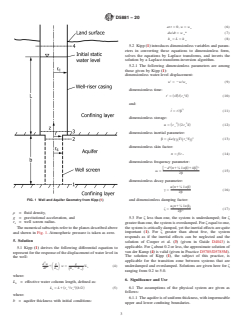
The numerical subscripts refer to the planes described above and shown in Fig. 1. Atmospheric pressure is taken as zero.
5. Solution
5.1 Kipp (1) derives the following differential equation to represent for the response of the displacement of water level in the
well:
d w g g
1 w 5 /L (4)
S D
2 e
dt L h 2 h
~ !
e s o
where:
L = effective water column length, defined as:
e
2 2
L 5 L1~r /r !~b/2! (5)
e c s
where:
b = aquifer thickness with initial conditions:
at t 5 0, w 5 w (6)
o
dw/dt 5 w * (7)
o
h 5 L 5 h (8)
s o
The boldface numbers in parentheses refer to a list of references at the end of this standard.
D5881 − 20
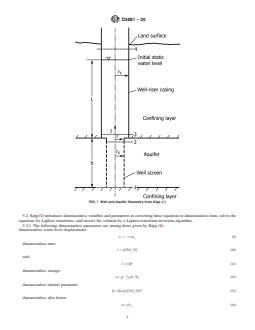
FIG. 1 Well and Aquifer Geometry from Kipp (1)
5.2 Kipp (1) introduces dimensionless variables and parameters in converting these equations to dimensionless form, solves the
equations by Laplace transforms, and inverts the solution by a Laplace-transform-inversion algorithm.
5.2.1 The following dimensionless parameters are among those given by Kipp (1):
dimensionless water-level displacement:
w'52w/w (9)
o
dimensionless time:
t'5 tT / r S (10)
~ ! ~ !
s
and:
½
ˆ
t 5 t'/β (11)
dimensionless storage:
2 2
α5 r ~2r S! (12)
~ !
c s
dimensionless inertial parameter:
2 2
β5 ~Le/g!~T/~r S!! (13)
s
dimensionless skin factor:
σ5 f/r (14)
s
D5881 − 20
dimensionless frequency parameter:
2 ½
@2d ~σ1¼ 1nβ!14β#
ω5 (15)
2β
dimensionless decay parameter:
α~σ1¼ 1nβ!
γ5 (16)
2β
and dimensionless damping factor:
α~σ1¼ 1nβ!
ζ5 (17)
½
2β
5.3 For ζ less than one, the system is underdamped; for ζ greater than one, the system is overdamped. For ζ equal to one, the
system is critically damped, yet the inertial effects are quite important (1). For ζ greater than about five, the system responds as
if the inertial effects can be neglected and the solution of Cooper et al. (3) (given in Guide D4043) is applicable. For ζ about 0.2
or less, the approximate solution of van der Kamp (4) is valid (given in Test Method Practice D5785/D5785M). The solution of
Kipp (1), the subject of this test method, practice, is applicable for the transition zone between systems that are underdamped and
overdamped. Solutions are given here for ζ ranging from 0.2 to 5.0.
6. Significance and Use
6.1 The assumptions of the physical system are given as follows:
6.1.1 The aquifer is of uniform thickness, with impermeable upper and lower confining boundaries.
6.1.2 The aquifer is of constant homogeneous porosity and matrix compressibility and constant homogeneous and isotropic
hydraulic conductivity.
6.1.3 The origin of the cylindrical coordinate system is taken to be on the well-bore axis at the top of the aquifer.
6.1.4 The aquifer is fully screened.
6.1.5 The well is 100 % efficient, that is, the skin factor, f, and dimensionless skin factor, σ, are zero.
6.2 The assumptions made in defining the momentum balance are as follows:
6.2.1 The average water velocity in the well is approximately constant over the well-bore section.
6.2.2 Frictional head losses from flow in the well are negligible.
6.2.3 Flow through the well screen is uniformly distributed over the entire aquifer thickness.
6.2.4 Change in momentum from the water velocity changing from radial flow through the screen to vertical flow in the well
are negligible.
NOTE 1—Slug and pumping tests implicitly assume a porous medium. Fractured rock and carbonate settings may not provide meaningful data and
information.
NOTE 2—The function of wells in any unconfined setting in a fractured terrain might make the determination of k problematic because the wells might
only intersect tributary or subsidiary channels or conduits. The problems determining the k of a channel or conduit notwithstanding, the partial penetration
of tributary channels may make a determination of a meaningful number difficult. If plots of k in carbonates and other fractured settings are made and
compared, they may show no indication that there are conduits or channels present, except when with the lowest probability one maybe intersected by
a borehole and can be verified, such problems are described by (5) Smart (1999). Additional guidance can be found in Guide D5717.
NOTE 3—The quality of the result produced by this standard is dependent on the competence of the personnel performing it, and the suitability of the
equipment and facilities used. Agencies that meet the criteria of Practice D3740 are generally considered capable of competent and objective
testing/sampling/inspection/etc. Users of this standard are cautioned that compliance with Practice D3740 does not in itself assure reliable results. Reliable
results depend on many factors; Practice D3740 provides a means of evaluating some of those factors.
7. Procedure
7.1 The overall procedure consists of conducting the slug test field procedure (see Test Method D4044/D4044M) and analysis
of the field data using this practice.
NOTE 4—The initial displacement of water level should not exceed 0.1 or 0.2 of the static water column in the well, the measurement of displacement
should be within 1 % of the initial water-level displacement and the water-level displacement needs to be calculated independently.
8. Calculation and Interpretation of Results
8.1 Plot the normalized water-level displacement in the well versus the logarithm of time.
8.2 Prepare a set of type curves from Tables 1-10 by plotting dimensionless water level displacement, w', versus dimensionless
time, tˆ, using the same scale as in plotting the observed water-level displacement.
NOTE 5—Commercially available software can be used for the calculations and plotting. The user should verify the correctness of the software and
results.
8.3 Match the semilog plot of water-level displacement to the type curves by translation of the time axis.
D5881 − 20
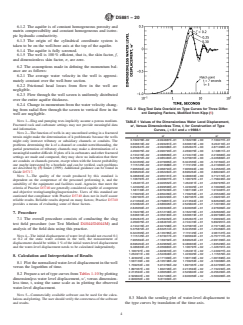
FIG. 2 Slug-Test Data Overlaid on Type Curves for Three Different Damping Factors, Modified from Kipp (1)
TABLE 1 Values of the Dimensionless Water Level Displacement,
w', Versus Dimensionless Time, t, for Construction of Type
Curves, ζ = 0.1 and α = 9988.1
t w' t w'
3.162278E−02 −9.994887E−01 3.162278E + 00 7.100277E−01
3.636619E−02 −9.993281E−01 3.636619E + 00 6.204110E−01
3.952847E−02 −9.992086E−01 3.952847E + 00 4.871206E−01
4.269075E−02 −9.990793E−01 4.269075E + 00 3.138511E−01
4.743416E−02 −9.988666E−01 4.743416E + 00 2.218683E−02
5.375872E−02 −9.985483E−01 5.375872E + 00 −3.226809E−01
6.324555E−02 −9.979965E−01 6.324555E + 00 −5.191564E−01
7.115125E−02 −9.974688E−01 7.115125E + 00 −3.413663E−01
7.905694E−02 −9.968794E−01 7.905694E + 00 3.445623E−05
8.696264E−02 −9.962284E−01 8.696264E + 00 2.889492E−01
9.486833E−02 −9.955161E−01 9.486833E + 00 3.712172E−01
1.106797E−01 −9.939077E−01 1.106797E + 01 −1.758246E−02
1.264911E−01 −9.920552E−01 1.264911E + 01 −2.697976E−01
1.423025E−01 −9.899599E−01 1.423025E + 01 2.109260E−02
1.581139E−01 −9.876230E−01 1.581139E + 01 1.919487E−01
1.739253E−01 −9.850456E−01 1.739253E + 01 −2.455328E−02
1.897367E−01 −9.822293E−01 1.897367E + 00 −1.392019E−01
2.213594E−01 −9.758851E−01 2.213594E + 01 9.826209E−02
2.529822E−01 −9.686026E−01 2.529822E + 01 −7.129166E−02
2.846050E−01 −9.603946E−01 2.846050E + 01 4.976069E−02
3.162278E−01 −9.512748E−01 3.162278E + 01 −3.626029E−02
3.636619E−01 −9.359183E−01 3.636619E + 01 −9.997386E−03
3.952847E−01 −9.259452E−01 3.952847E + 01 7.200932E−03
4.269075E−01 −9.084819E−01 4.743416E + 01 5.892951E−03
4.743416E−01 −8.947298E−01 5.375872E + 01 2.737128E−03
5.375872E−01 −8.632514E−01 6.324555E + 01 −1.254582E−03
6.324555E−01 −8.135785E−01 7.115125E + 01 2.961127E−04
7.115125E−01 −7.673017E−01 7.905694E + 01 −5.757717E−05
7.905694E−01 −7.169702E−01 8.696264E + 01 −2.991356E−04
8.696264E−01 −6.629659E−01 9.486833E + 01 −1.835296E−04
9.486833E−01 −6.056883E−01 1.106797E + 02 −1.426791E−04
1.106797E + 00 −4.829810E−01 1.264911E + 02 −1.249977E−04
1.264911E + 00 −3.522848E−01 1.423025E + 02 −1.115579E−04
1.423025E + 00 −2.171309E−01 1.581139E + 02 −1.001696E−04
1.581139E + 00 −8.105198E−02 1.739253E + 02 −9.109389E−05
1.739253E + 00 5.974766E−02 1.897367E + 02 −8.347056E−05
1.897367E + 00 1.802728E−01 2.213594E + 02 −7.152232E−05
2.213594E + 00 4.066508E−01 2.529822E + 02 −6.256450E−05
2.529822E + 00 5.647406E−01 2.846050E + 02 −5.560200E−05
2.846050E + 00 6.811030E−01 . .
8.4 From the type curve, record the value of ζ; from the match point, record the values of tˆ, and w' from the type curve. From
the data plot, record the values of time, t, and water-level displacement, w.
8.5 Calculate the effective static water column length, L , from the following:
e
D5881 − 20
TABLE 2 Values of the Dimensionless Water Level Displacement,
w', Versus Dimensionless Time, t, for Construction of Type
Curves, ζ = 0.2 and α = 19976
t w' t w'
3.162278E−02 −9.994902E−01 3.162278E + 00 4.939368E−•
3.636619E−02 −9.993263E−01 3.636619E + 00 4.349310E−•
3.952847E−02 −9.992107E−01 3.952847E + 00 3.465758E−•
4.269075E−02 −9.990815E−01 4.269075E + 00 2.343067E−•
4.743416E−02 −9.988695E−01 4.743416E + 00 5.160353E−•
5.375872E−02 −9.985520E−01 5.375872E + 00 −1.543438E−•
6.324555E−02 −9.980024E−01 6.324555E + 00 −2.671865E−•
7.115125E−02 −9.974810E−01 7.115125E + 00 −1.818502E−•
7.905694E−02 −9.968908E−01 7.905694E + 00 −2.600650E−•
8.696264E−02 −9.962437E−01 8.696264E + 00 9.764360E−•
9.486833E−02 −9.955360E−01 9.486833E + 00 1.324266E−•
1.106797E−01 −9.939399E−01 1.106797E + 01 3.871680E−•
1.264911E−01 −9.921040E−01 1.264911E + 01 −7.304361E−•
1.423025E−01 −9.900304E−01 1.423025E + 01 −3.623751E−•
1.581139E−01 −9.877207E−01 1.581139E + 01 3.430765E−•
1.739253E−01 −9.851770E−01 1.739253E + 01 −2.397516E−•
1.897367E−01 −9.824014E−01 1.897367E + 01 −2.051297E−•
2.213594E−01 −9.761622E−01 2.213594E + 01 8.187383E−•
2.529822E−01 −9.690205E−01 2.529822E + 01 −6.259136E−•
2.846050E−01 −9.609942E−01 2.846050E + 01 1.402892E−•
3.162278E−01 −9.521021E−01 3.162278E + 01 −2.331164E−•
3.636619E−01 −9.371834E−01 3.636619E + 01 −1.031248E−•
3.952847E−01 −9.262139E−01 3.952847E + 01 −7.347959E−•
4.269075E−01 −9.105352E−01 4.269075E + 01 −8.050596E−•
4.743416E−01 −8.975464E−01 4.743416E + 01 −6.352422E−•
5.375872E−01 −8.673412E−01 5.375872E + 01 −5.870822E−•
6.324555E−01 −8.201831E−01 6.324555E + 01 −5.087767E−•
7.115125E−01 −7.766091E−01 7.115125E + 01 −4.500425E−•
7.905694E−01 −7.295735E−01 7.905694E + 01 −4.046973E−•
8.696264E−01 −6.794859E−01 8.696264E + 01 −3.675505E−•
9.486833E−01 −6.267637E−01 9.486833E + 01 −3.366208E−•
1.106797E + 00 −5.151022E−01 1.106797E + 02 −2.881191E−•
1.264911E + 00 −3.979593E−01 1.264911E + 02 −2.518280E−•
1.423025E + 00 −2.786373E−01 1.423025E + 02 −2.236385E−•
1.581139E + 00 −1.602887E−01 1.581139E + 02 −2.011471E−•
1.739253E + 00 −3.860371E−02 1.739253E + 02 −1.827551E−•
1.897367E + 00 6.204784E−02 1.897367E + 02 −1.674534E−•
2.213594E + 00 2.492937E−01 2.213594E + 02 −1.434090E−•
2.529822E + 00 3.742380E−01 2.529822E + 02 −1.254123E−•
2.846050E + 00 4.694111E−01 2.846050E + 02 −1.113734E−•
t
ˆ
t 5 (18)
1/2
L /g
~ !
e
ˆ
L 5~t/t! g (19)
e
The effective static water column length should agree, within 20 %, with the effective length calculated from the system
geometry (Eq 5).
8.6 Calculate the dimensionless inertial parameter, β, iteratively from the following expression:
β5 α 1n β /8ζ (20)
@~ ! #
where:
ζ = damping parameter,
α = dimensionless storage parameter as given in Eq 12.
8.7 Calculate transmissivity from the following:
½ 2
T 5 βg /L r S (21)
@~ ! #
e s
8.7.1 Kipp (1) gives an example application of the method, using data from van der Kamp (4) for York Point well 6-2. This well
has casing and screen. The well-bore (or casing) radii of 0.051 m, a water column above the aquifer of 6.5 m, an aquifer thickness
−5
of 15 m, and an independently estimated storage coefficient of 8 × 10 .
8.7.2 A type curve of dimensionless water-level displacement, w', plotted against the log of dimensionless time, tˆ, for three
values of the dimensionless damping factor, ζ, was prepared. Water-level displacement was calculated using an estimated initial
displacement of 3.45 cm, and plotted against the log of elapsed time since maximum initial water-level displacement of paper of
the same scale as the type curve.
D5881 − 20
TABLE 3 Values of the Dimensionless Water Level Displacement,
w', Versus Dimensionless Time, t, for Construction of Type
Curves, ζ = 0.5 and α = 49940
t w' t w'
3.162278E−02 −9.994990E−01 3.162278E + 00 9.492086E−02
3.636619E−02 −9.993397E−01 3.636619E + 00 1.012577E−01
3.952847E−02 −9.992213E−01 3.952847E + 00 8.820339E−02
4.269075E−02 −9.990932E−01 4.269075E + 00 6.762111E−02
4.743416E−02 −9.988829E−01 4.743416E + 00 3.217532E−02
5.375872E−02 −9.985688E−01 5.375872E + 00 −8.337546E−03
6.324555E−02 −9.980257E−01 6.324555E + 00 −3.647544E−02
7.115125E−02 −9.975079E−01 7.115125E + 00 −3.476092E−02
7.905694E−02 −9.969310E−01 7.905694E + 00 −2.373581E−02
8.696264E−02 −9.962956E−01 8.696264E + 00 −1.338713E−02
9.486833E−02 −9.956020E−01 9.486833E + 00 −7.681039E−03
1.106797E−01 −9.940425E−01 1.106797E + 01 −6.737283E−03
1.264911E−01 −9.922559E−01 1.264911E + 01 −7.879678E−03
1.423025E−01 −9.902461E−01 1.423025E + 01 −6.928157E−03
1.581139E−01 −9.880166E−01 1.581139E + 01 −5.770595E−03
1.739253E−01 −9.855713E−01 1.739253E + 01 −5.154381E−03
1.897367E−01 −9.829139E−01 1.897367E + 01 −4.740291E−03
2.213594E−01 −9.769780E−01 2.213594E + 01 −3.991538E−03
2.529822E−01 −9.702398E−01 2.529822E + 01 −3.447316E−03
2.846050E−01 −9.627300E−01 2.846050E + 01 −3.033006E−03
3.162278E−01 −9.544800E−01 3.162278E + 01 −2.706963E−03
3.636619E−01 −9.407848E−01 3.636619E + 01 −2.330656E−03
3.952847E−01 −9.321798E−01 3.952847E + 01 −2.132780E−03
4.743416E−01 −9.053980E−01 4.269075E + 01 −1.966362E−03
5.375872E−01 −8.786102E−01 4.743416E + 01 −1.759041E−03
6.324555E−01 −8.380771E−01 5.375872E + 01 −1.542575E−03
7.115125E−01 −8.014756E−01 6.324555E + 01 −1.302071E−03
7.905694E−01 −7.627801E−01 7.115125E + 01 −1.152281E−03
8.696264E−01 −7.224138E−01 7.905694E + 01 −1.033361E−03
9.486833E−01 −6.807796E−01 8.696264E + 01 −9.366315E−04
1.106797E + 00 −5.952065E−01 9.486833E + 01 −8.565071E−04
1.264911E + 00 −5.088214E−01 1.106797E + 02 −7.312991E−04
1.423025E + 00 −4.239899E−01 1.264911E + 02 −6.380141E−04
1.581139E + 00 −3.426759E−01 1.423025E + 02 −5.658156E−04
1.739253E + 00 −2.592066E−01 1.581139E + 02 −5.082956E−04
1.897367E + 00 −1.964942E−01 1.739253E + 02 −4.613954E−04
2.213594E + 00 −7.843895E−02 1.897367E + 02 −4.198187E−04
2.529822E + 00 −4.874063E−03 2.213594E + 02 −3.613054E−04
2.846050E + 00 6.501678E−02 2.529822E + 02 −3.156807E−04
... ... 2.846050E + 02 −2.802644E−04
8.7.3 The data curve was overlain on the type curve, and shifted horizontally, with the water-level displacement axes coincident,
until the best match with the type curve was found. The best fit was for a dimensionless damping factor of 0.25. A match point
of t = 7s for t = 5 was selected. The resulting graph is shown in Fig. 2.
8.7.4 The effective water column length can be calculated from Eq 19 as follows:
2 2
ˆ
L 5~t/t! g 5 7s/5 9.80 m/s 5 19.2 m (22)
~ ! ~ !
e
and from the system geomet
...