


ASTM D5912-96(2004)
(Test Method)Standard Test Method for (Analytical Procedure) Determining Hydraulic Conductivity of an Unconfined Aquifer by Overdamped Well Response to Instantaneous Change in Head (Slug) (Withdrawn 2013)
Standard Test Method for (Analytical Procedure) Determining Hydraulic Conductivity of an Unconfined Aquifer by Overdamped Well Response to Instantaneous Change in Head (Slug) (Withdrawn 2013)
SIGNIFICANCE AND USE
Assumptions of Solution:
Drawdown (or mounding) of the water table around the well is negligible.
Flow above the water table can be ignored.
Head losses as the water enters or leaves the well are negligible.
The aquifer is homogeneous and isotropic.
Implications of Assumptions:
The mathematical equations applied ignore inertial effects and assume that the water level returns to the static level in an approximate exponential manner.
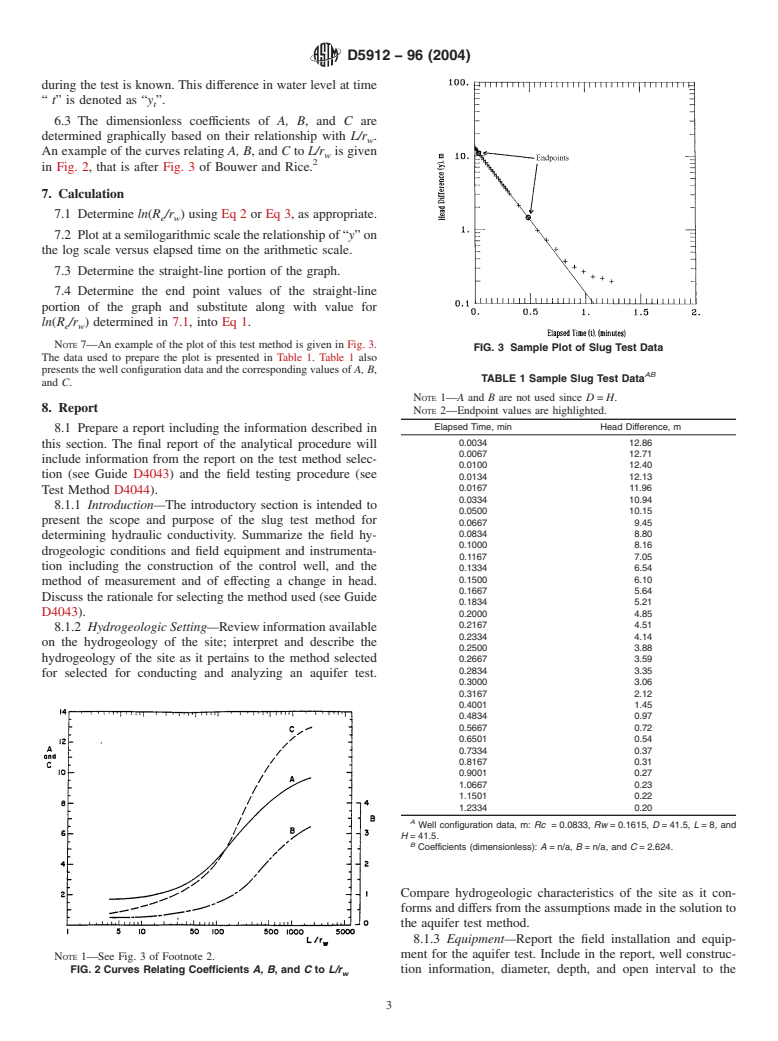
The geometric configuration of the well and aquifer are shown in Fig. 1, that is after Fig. 1 of Bouwer and Rice.
For filter-packed wells, Eq 1 applies to cases in which the filter pack remains saturated. If some of the filter pack is dewatered during testing, rc 2 should be replaced by the following:
where: n = short-term specific yield of the filter pack, ra = uncorrected well casing radius, and rw = borehole radius.
Note 6—Short term refers to the duration of the slug test.
Note—See Fig. 1 of Footnote 2. FIG. 1 Geometry and Symbols of a Partially Penetrating, Partially Perforated Well in Unconfined Aquifer with Gravel Pack or Developed Zone Around Perforated Section
SCOPE
1.1 This test method covers the determination of hydraulic conductivity from the measurement of inertial force free (overdamped) response of a well-aquifer system to a sudden change in water level in a well. Inertial force free response of the water level in a well to a sudden change in water level is characterized by recovery to initial water level in an approximate exponential manner with negligible inertial effects.
1.2 The analytical procedure in this test method is used in conjunction with the field procedure in Test Method D4044 for collection of test data.
1.3 Limitations—Slug tests are considered to provide an estimate of hydraulic conductivity. The determination of storage coefficient is not possible with this test method. Because the volume of aquifer material tested is small, the values obtained are representative of materials very near the open portion of the control well.
Note 1—Slug tests are usually considered to provide estimates of the lower limit of the actual hydraulic conductivity of an aquifer because the test results are so heavily influenced by well efficiency and borehole skin effects near the open portion of the well. The portion of the aquifer that is tested by the slug test is limited to an area near the open portion of the well where the aquifer materials may have been altered during well installation, and therefore may significantly effect the test results. In some cases the data may be misinterpreted and result in a higher estimate of hydraulic conductivity. This is due to the reliance on early time data that is reflective of the hydraulic conductivity of the filter pack surrounding the well. This effect was discussed by Bouwer. In addition, because of the reliance on early time data, in aquifers with medium to high hydraulic conductivity, the early time portion of the curve that is useful for this data analyses is too short (for example, 10 s) for accurate measurement; therefore, the test results begin to greatly underestimate the true hydraulic conductivity.
1.4 The values stated in SI units are to be regarded as the standard.
1.5 This standard does not purport to address all of the safety concerns, if any, associated with its use. It is the responsibility of the user of this standard to establish appropriate safety and health practices and determine the applicability of regulatory limitations prior to use.
WITHDRAWN RATIONALE
This test method covers the determination of hydraulic conductivity from the measurement of inertial force free (overdamped) response of a well-aquifer system to a sudden change in water level in a well.
Formerly under the jurisdiction of Committee D18 on Soil and Rock, this test method was withdrawn in July 2013 in accordance with section 10.5.3.1 of the Regulations Governin...
General Information
Relations
Buy Standard

Standards Content (Sample)
NOTICE: This standard has either been superseded and replaced by a new version or withdrawn.
Contact ASTM International (www.astm.org) for the latest information
Designation:D5912 −96(Reapproved 2004)
Standard Test Method for
(Analytical Procedure) Determining Hydraulic Conductivity
of an Unconfined Aquifer by Overdamped Well Response to
Instantaneous Change in Head (Slug)
This standard is issued under the fixed designation D5912; the number immediately following the designation indicates the year of
original adoption or, in the case of revision, the year of last revision. A number in parentheses indicates the year of last reapproval. A
superscript epsilon (´) indicates an editorial change since the last revision or reapproval.
1. Scope 1.5 This standard does not purport to address all of the
safety concerns, if any, associated with its use. It is the
1.1 This test method covers the determination of hydraulic
responsibility of the user of this standard to establish appro-
conductivity from the measurement of inertial force free
priate safety and health practices and determine the applica-
(overdamped) response of a well-aquifer system to a sudden
bility of regulatory limitations prior to use.
change in water level in a well. Inertial force free response of
the water level in a well to a sudden change in water level is
2. Referenced Documents
characterized by recovery to initial water level in an approxi-
2.1 ASTM Standards:
mate exponential manner with negligible inertial effects.
D653 Terminology Relating to Soil, Rock, and Contained
1.2 The analytical procedure in this test method is used in
Fluids
conjunction with the field procedure inTest Method D4044 for
D4043 Guide for Selection of Aquifer Test Method in
collection of test data.
Determining Hydraulic Properties by Well Techniques
1.3 Limitations—Slug tests are considered to provide an
D4044 Test Method for (Field Procedure) for Instantaneous
estimate of hydraulic conductivity. The determination of stor-
Change in Head (Slug) Tests for Determining Hydraulic
age coefficient is not possible with this test method. Because
Properties of Aquifers
the volume of aquifer material tested is small, the values
D4104 Test Method (Analytical Procedure) for Determining
obtained are representative of materials very near the open
Transmissivity of Nonleaky Confined Aquifers by Over-
portion of the control well.
damped Well Response to Instantaneous Change in Head
(Slug Tests)
NOTE 1—Slug tests are usually considered to provide estimates of the
lower limit of the actual hydraulic conductivity of an aquifer because the
test results are so heavily influenced by well efficiency and borehole skin 3. Terminology
effects near the open portion of the well. The portion of the aquifer that is
3.1 Definitions—For definitions of terms used in this test
testedbytheslugtestislimitedtoanareaneartheopenportionofthewell
method, see Terminology D653.
wheretheaquifermaterialsmayhavebeenalteredduringwellinstallation,
and therefore may significantly effect the test results. In some cases the
3.2 Symbols and Dimensions:
data may be misinterpreted and result in a higher estimate of hydraulic
3.2.1 A [nd]—coefficient that is a function of L/r and is
conductivity.Thisisdue to the reliance on early time data thatisreflective w
of the hydraulic conductivity of the filter pack surrounding the well. This determined graphically.
effect was discussed by Bouwer. In addition, because of the reliance on
3.2.2 B [nd]—coefficient that is a function of L/r and is
w
early time data, in aquifers with medium to high hydraulic conductivity,
determined graphically.
the early time portion of the curve that is useful for this data analyses is
too short (for example, <10 s) for accurate measurement; therefore, the
3.2.3 C [nd]—coefficient that is a function of L/r and is
w
test results begin to greatly underestimate the true hydraulic conductivity.
determined graphically.
1.4 The values stated in SI units are to be regarded as the
3.2.4 D [L]—aquifer thickness.
standard.
3.2.5 H [L]—distance between static water level and the
base of open interval of the well.
ThistestmethodisunderthejurisdictionofASTMCommitteeD18onSoiland
Rock and is the direct responsibility of Subcommittee D18.21 on Groundwater and
3.2.6 L [L]—length of well open to aquifer.
Vadose Zone Investigations.
Current edition approved Nov. 1, 2004. Published December 2004. Originally
e1
approved in 1996. Last previous edition approved in 1996 as D5912–96 . DOI:
10.1520/D5912-96R04. For referenced ASTM standards, visit the ASTM website, www.astm.org, or
Bouwer, H., and Rice, R. C., “A Slug Test for Determining Hydraulic contact ASTM Customer Service at service@astm.org. For Annual Book of ASTM
Conductivity of Unconfined Aquifers with Completely or Partially Penetrating Standards volume information, refer to the standard’s Document Summary page on
Wells,” Water Resources Research, Vol 12, No. 3, 1976, pp. 423–428. the ASTM website.
Copyright © ASTM International, 100 Barr Harbor Drive, PO Box C700, West Conshohocken, PA 19428-2959. United States
D5912−96 (2004)
3.2.7 rc [L]—inside diameter of the portion of the well 5.1.1 Drawdown (or mounding) of the water table around
casing in which the water level changes. the well is negligible.
5.1.2 Flow above the water table can be ignored.
3.2.8 R [L]—effectiveradius,determinedempiricallybased
e
5.1.3 Head losses as the water enters or leaves the well are
on the geometry of the well, over which y is dissipated.
negligible.
3.2.9 r [L]—radial distance from well center to original
w
5.1.4 The aquifer is homogeneous and isotropic.
undisturbed aquifer.
5.2 Implications of Assumptions :
3.2.10 t [T]—time at end point of straight-line portion of
f
5.2.1 The mathematical equations applied ignore inertial
graph.
effectsandassumethatthewaterlevelreturnstothestaticlevel
3.2.11 t [T]—time at beginning of straight-line portion of
in an approximate exponential manner.
graph.
5.2.2 The geometric configuration of the well and aquifer
3.2.12 y [L]—head difference at end point of straight-line
are shown in Fig. 1, that is after Fig. 1 of Bouwer and Rice.
f
portion of graph. 5.2.3 For filter-packed wells, Eq 1 applies to cases in which
the filter pack remains saturated. If some of the filter pack is
3.2.13 y [L]—head difference at beginning of straight-line
dewatered during testing, r should be replaced by the
portion of graph. c
following:
2 2 0.5
4. Summary of Test Method
r ~corrected!5 ~12n!r 1nr (4)
@ #
c a w
4.1 This test method describes the analytical procedure for
where:
analyzing data collected following an instantaneous change in
n = short-term specific yield of the filter pack,
head (slug) test in an overdamped well.The field procedures in
r = uncorrected well casing radius, and
a
conducting a slug test are given in Test Method D4044. The
r = borehole radius.
w
analytical procedure consists of analyzing the recovery of
NOTE 6—Short term refers to the duration of the slug test.
water level in the well following the change in water level
induced in the well.
6. Procedure
4.2 Solution—The solution given by Bouwer and Rice
6.1 The overall procedure consists of conducting the slug
follows:
test field procedure (see Test Method D4044) and analysis of
the field data that is addressed in this test method.
r ln R /r
~ ! 1 y
c e w
K5 ln (1)
2L ~t 2t yf 6.2 The water level data are corrected so that the difference
f 0
betwe
...
Questions, Comments and Discussion
Ask us and Technical Secretary will try to provide an answer. You can facilitate discussion about the standard in here.