

ASTM E746-23
(Practice)Standard Practice for Determining Relative Image Quality Response of Industrial Radiographic Imaging Systems below 4 MeV
General Information
- Abstract
SIGNIFICANCE AND USE
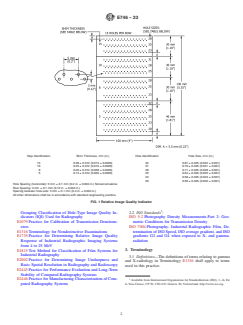
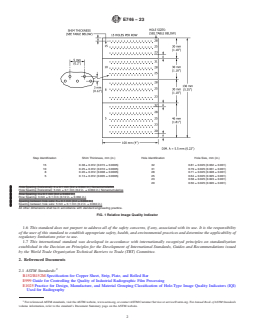
4.1 This standard provides a practice for RIQR evaluations of film and non-film imaging systems when exposed through an absorber material. Three alternate data evaluation methods are provided in Section 9. Determining RIQR requires the comparison of at least two radiographs or radiographic processes whereby the relative degree of image quality difference may be determined using the EPS plaque arrangement of Fig. 1 as a relative image quality indicator (RIQI). In conjunction with the RIQI, a specified radiographic technique or method must be established and carefully controlled for each radiographic process. This practice is designed to allow the determination of subtle changes in EPS that may arise to radiographic imaging system performance levels resultant from process improvements/changes or change of equipment attributes. This practice does not address relative unsharpness of a radiographic imaging system as provided in Practice E2002. The common element with any relative comparison is the use of the same RIQI arrangement for both processes under evaluation.
4.2 In addition to the standard evaluation method described in Section 9, there may be other techniques/methods in which the basic RIQR arrangement of Fig. 1 might be utilized to perform specialized assessments of relative image quality performance. For example, other radiographic variables can be altered to facilitate evaluations provided these differences are known and documented for both processes. Where multiple radiographic process variables are evaluated, it is incumbent upon the user of this practice to control those normal process attributes to the degree suitable for the application. Specialized RIQR techniques may also be useful with micro focus X-ray, isotope sources of radiation or with the use of non-film radiographic imaging systems. RIQR may also be useful in evaluating imaging systems with alternate materials (RIQI and base plate) such as plastic, copper-nickel, or aluminum. When using any ...
SCOPE
1.1 This standard covers a practice whereby industrial radiographic imaging systems or techniques may be comparatively assessed using the concept of relative image quality response (RIQR). Changes within a radiographic technique such as film/detector types, distances, or filtering/collimation can be comparatively assessed using this standard. The RIQR method presented within this practice is based upon the use of equivalent penetrameter sensitivity (EPS) described within Practice E1025 and subsection 5.4 of this practice. Fig. 1 illustrates a relative image quality indicator (RIQI) that has four different plaque thicknesses (0.38 mm, 0.25 mm, 0.20 mm, and 0.13 mm (0.015 in., 0.010 in., 0.008 in., and 0.005 in.)) sequentially positioned (from top to bottom) on an absorber plate of a specified material and thickness. The four plaques contain a total of 14 different arrays of penetrameter-type hole sizes designed to render varied conditions of threshold visibility when exposed to the appropriate radiation. Each “EPS” array consists of 30 identical holes; thus, providing the user with a quantity of threshold sensitivity levels suitable for relative image qualitative response comparisons. There are two standard materials (steel and plastic) specified herein for the RIQI and absorber. For special applications the user may design a non-standard RIQI-absorber configuration; however the RIQI configuration shall be controlled by a drawing similar to Fig. 1. Use of a non-standard RIQI-absorber configuration shall be described in the user’s written technique and approved by the CEO.
1.2 This practice is not intended to qualify the performance of a specific radiographic technique nor for assurance that a radiographic technique will detect specific discontinuities in a specimen undergoing radiographic examination.
1.3 This practice is not intended to be used to classify or derive performance classification categories for radiog...
- Status
- Published
- Publication Date
- 30-Nov-2023
- Technical Committee
- E07 - Nondestructive Testing
- Drafting Committee
- E07.01 - Radiography (X and Gamma) Method
Buy Documents
ASTM E746-23 - Standard Practice for Determining Relative Image Quality Response of Industrial Radiographic Imaging Systems below 4 MeV
REDLINE ASTM E746-23 - Standard Practice for Determining Relative Image Quality Response of Industrial Radiographic Imaging Systems below 4 MeV
Overview
ASTM E746-23: Standard Practice for Determining Relative Image Quality Response of Industrial Radiographic Imaging Systems below 4 MeV provides a standardized method to comparatively assess the relative image quality response (RIQR) of industrial radiographic imaging systems operating below 4 MeV. Developed by ASTM International, this standard is instrumental for both film and non-film radiographic imaging systems, ensuring consistent evaluations when exposed through absorber materials. By using a relative image quality indicator (RIQI), the standard enables users to detect subtle changes in system performance, supporting quality assurance and process improvement in industrial radiography.
Key Topics
Relative Image Quality Response (RIQR)
- Enables comparative assessment between different radiographic techniques or system setups.
- Utilizes equivalent penetrameter sensitivity (EPS) and a standardized RIQI arrangement for analysis.
- Focuses on detecting qualitative differences, not absolute performance classification or unsharpness.
Standardized Evaluation Methods
- Specifies three alternate data evaluation methods for RIQR determination.
- Involves analysis of at least two radiographs or processes using consistent tools and techniques.
- Includes data collection from multiple readers and exposures, with clear procedural steps.
RIQI and Absorber Materials
- RIQIs are constructed with plaques of varying thickness and feature precise hole arrays for sensitivity testing.
- Standard materials include steel and plastic; however, custom configurations are permitted for special applications as long as they are controlled and documented.
Process Control
- Emphasizes the necessity of keeping radiographic techniques consistent during comparative testing.
- Documents all process variables (e.g., film/detector types, geometric setup, filtering) to ensure reliable comparison.
Applications
ASTM E746-23 is widely applied to enhance the reliability and performance validation of industrial radiography, supporting critical activities in sectors such as manufacturing, aerospace, and energy. Typical applications include:
Comparative Assessment of Imaging Systems
- Evaluating the impact of equipment changes (such as new detectors or films) or process improvements on image quality.
- Comparing different radiographic techniques under controlled conditions to assess relative performance.
System Performance Monitoring
- Detecting and documenting subtle shifts in imaging capabilities due to wear, adjustment, or upgrades.
- Assisting in the validation of non-film radiographic imaging systems, including computed radiography and digital detector arrays.
Specialized Assessments
- Facilitating customized image quality evaluations when standard RIQI-absorber combinations are not suitable-as for micro focus X-ray, alternate radiation sources, or unique material requirements.
- Supporting research, development, and quality assurance efforts that require sensitive comparison of radiographic image quality.
Related Standards
ASTM E746-23 references and complements several other international standards relevant to industrial radiographic testing. Key related standards include:
- ASTM E1025 – Practice for Design, Manufacture, and Material Grouping Classification of Hole-Type Image Quality Indicators (IQI) Used for Radiography.
- ASTM E1735 – Practice for Determining Relative Image Quality Response of Industrial Radiographic Imaging Systems from 4 to 25 MeV (for higher energy systems).
- ASTM E2002 – Practice for Determining Image Unsharpness and Basic Spatial Resolution in Radiography and Radioscopy.
- ASTM E2445 & E2446 – Practices for the evaluation and manufacturing characterization of computed radiography systems.
- ISO 7004 – Determination of ISO speed and average gradient for industrial radiographic film exposed to X- and gamma-radiation.
By aligning with these standards, ASTM E746-23 ensures compatibility and supports comprehensive quality management in non-destructive testing.
Keywords: ASTM E746-23, relative image quality response, industrial radiographic imaging systems, radiographic technique comparison, RIQI, penetrameter sensitivity, non-film imaging systems, computed radiography, industrial radiography standards.
Relations
- Effective Date
- 01-Dec-2023
- Effective Date
- 01-Feb-2024
- Effective Date
- 01-Sep-2023
- Effective Date
- 01-Dec-2023
- Effective Date
- 01-Dec-2023
- Effective Date
- 01-Dec-2023
- Effective Date
- 01-Dec-2023
- Effective Date
- 01-Dec-2023
- Effective Date
- 01-Dec-2023
- Effective Date
- 01-Dec-2023
- Effective Date
- 01-Dec-2023
- Referred By
ASTM E2446-23 - Standard Practice for Manufacturing Characterization of Computed Radiography Systems - Effective Date
- 01-Dec-2023
- Effective Date
- 01-Dec-2023
- Effective Date
- 01-Dec-2023
- Referred By
ASTM E94/E94M-22 - Standard Guide for Radiographic Examination Using Industrial Radiographic Film - Effective Date
- 01-Dec-2023
Buy Documents
ASTM E746-23 - Standard Practice for Determining Relative Image Quality Response of Industrial Radiographic Imaging Systems below 4 MeV
REDLINE ASTM E746-23 - Standard Practice for Determining Relative Image Quality Response of Industrial Radiographic Imaging Systems below 4 MeV
Frequently Asked Questions
ASTM E746-23 is a standard published by ASTM International. Its full title is "Standard Practice for Determining Relative Image Quality Response of Industrial Radiographic Imaging Systems below 4 MeV". This standard covers: SIGNIFICANCE AND USE 4.1 This standard provides a practice for RIQR evaluations of film and non-film imaging systems when exposed through an absorber material. Three alternate data evaluation methods are provided in Section 9. Determining RIQR requires the comparison of at least two radiographs or radiographic processes whereby the relative degree of image quality difference may be determined using the EPS plaque arrangement of Fig. 1 as a relative image quality indicator (RIQI). In conjunction with the RIQI, a specified radiographic technique or method must be established and carefully controlled for each radiographic process. This practice is designed to allow the determination of subtle changes in EPS that may arise to radiographic imaging system performance levels resultant from process improvements/changes or change of equipment attributes. This practice does not address relative unsharpness of a radiographic imaging system as provided in Practice E2002. The common element with any relative comparison is the use of the same RIQI arrangement for both processes under evaluation. 4.2 In addition to the standard evaluation method described in Section 9, there may be other techniques/methods in which the basic RIQR arrangement of Fig. 1 might be utilized to perform specialized assessments of relative image quality performance. For example, other radiographic variables can be altered to facilitate evaluations provided these differences are known and documented for both processes. Where multiple radiographic process variables are evaluated, it is incumbent upon the user of this practice to control those normal process attributes to the degree suitable for the application. Specialized RIQR techniques may also be useful with micro focus X-ray, isotope sources of radiation or with the use of non-film radiographic imaging systems. RIQR may also be useful in evaluating imaging systems with alternate materials (RIQI and base plate) such as plastic, copper-nickel, or aluminum. When using any ... SCOPE 1.1 This standard covers a practice whereby industrial radiographic imaging systems or techniques may be comparatively assessed using the concept of relative image quality response (RIQR). Changes within a radiographic technique such as film/detector types, distances, or filtering/collimation can be comparatively assessed using this standard. The RIQR method presented within this practice is based upon the use of equivalent penetrameter sensitivity (EPS) described within Practice E1025 and subsection 5.4 of this practice. Fig. 1 illustrates a relative image quality indicator (RIQI) that has four different plaque thicknesses (0.38 mm, 0.25 mm, 0.20 mm, and 0.13 mm (0.015 in., 0.010 in., 0.008 in., and 0.005 in.)) sequentially positioned (from top to bottom) on an absorber plate of a specified material and thickness. The four plaques contain a total of 14 different arrays of penetrameter-type hole sizes designed to render varied conditions of threshold visibility when exposed to the appropriate radiation. Each “EPS” array consists of 30 identical holes; thus, providing the user with a quantity of threshold sensitivity levels suitable for relative image qualitative response comparisons. There are two standard materials (steel and plastic) specified herein for the RIQI and absorber. For special applications the user may design a non-standard RIQI-absorber configuration; however the RIQI configuration shall be controlled by a drawing similar to Fig. 1. Use of a non-standard RIQI-absorber configuration shall be described in the user’s written technique and approved by the CEO. 1.2 This practice is not intended to qualify the performance of a specific radiographic technique nor for assurance that a radiographic technique will detect specific discontinuities in a specimen undergoing radiographic examination. 1.3 This practice is not intended to be used to classify or derive performance classification categories for radiog...
SIGNIFICANCE AND USE 4.1 This standard provides a practice for RIQR evaluations of film and non-film imaging systems when exposed through an absorber material. Three alternate data evaluation methods are provided in Section 9. Determining RIQR requires the comparison of at least two radiographs or radiographic processes whereby the relative degree of image quality difference may be determined using the EPS plaque arrangement of Fig. 1 as a relative image quality indicator (RIQI). In conjunction with the RIQI, a specified radiographic technique or method must be established and carefully controlled for each radiographic process. This practice is designed to allow the determination of subtle changes in EPS that may arise to radiographic imaging system performance levels resultant from process improvements/changes or change of equipment attributes. This practice does not address relative unsharpness of a radiographic imaging system as provided in Practice E2002. The common element with any relative comparison is the use of the same RIQI arrangement for both processes under evaluation. 4.2 In addition to the standard evaluation method described in Section 9, there may be other techniques/methods in which the basic RIQR arrangement of Fig. 1 might be utilized to perform specialized assessments of relative image quality performance. For example, other radiographic variables can be altered to facilitate evaluations provided these differences are known and documented for both processes. Where multiple radiographic process variables are evaluated, it is incumbent upon the user of this practice to control those normal process attributes to the degree suitable for the application. Specialized RIQR techniques may also be useful with micro focus X-ray, isotope sources of radiation or with the use of non-film radiographic imaging systems. RIQR may also be useful in evaluating imaging systems with alternate materials (RIQI and base plate) such as plastic, copper-nickel, or aluminum. When using any ... SCOPE 1.1 This standard covers a practice whereby industrial radiographic imaging systems or techniques may be comparatively assessed using the concept of relative image quality response (RIQR). Changes within a radiographic technique such as film/detector types, distances, or filtering/collimation can be comparatively assessed using this standard. The RIQR method presented within this practice is based upon the use of equivalent penetrameter sensitivity (EPS) described within Practice E1025 and subsection 5.4 of this practice. Fig. 1 illustrates a relative image quality indicator (RIQI) that has four different plaque thicknesses (0.38 mm, 0.25 mm, 0.20 mm, and 0.13 mm (0.015 in., 0.010 in., 0.008 in., and 0.005 in.)) sequentially positioned (from top to bottom) on an absorber plate of a specified material and thickness. The four plaques contain a total of 14 different arrays of penetrameter-type hole sizes designed to render varied conditions of threshold visibility when exposed to the appropriate radiation. Each “EPS” array consists of 30 identical holes; thus, providing the user with a quantity of threshold sensitivity levels suitable for relative image qualitative response comparisons. There are two standard materials (steel and plastic) specified herein for the RIQI and absorber. For special applications the user may design a non-standard RIQI-absorber configuration; however the RIQI configuration shall be controlled by a drawing similar to Fig. 1. Use of a non-standard RIQI-absorber configuration shall be described in the user’s written technique and approved by the CEO. 1.2 This practice is not intended to qualify the performance of a specific radiographic technique nor for assurance that a radiographic technique will detect specific discontinuities in a specimen undergoing radiographic examination. 1.3 This practice is not intended to be used to classify or derive performance classification categories for radiog...
ASTM E746-23 is classified under the following ICS (International Classification for Standards) categories: 37.040.25 - Radiographic films. The ICS classification helps identify the subject area and facilitates finding related standards.
ASTM E746-23 has the following relationships with other standards: It is inter standard links to ASTM E746-18, ASTM E1316-24, ASTM E1316-23b, ASTM E592-20, ASTM E1735-19, ASTM E1025-18, ASTM E1441-19, ASTM E2033-17, ASTM E543-21, ASTM E1254-13(2023), ASTM E2445/E2445M-20, ASTM E2446-23, ASTM F2895-20, ASTM E2007-10(2023), ASTM E94/E94M-22. Understanding these relationships helps ensure you are using the most current and applicable version of the standard.
ASTM E746-23 is available in PDF format for immediate download after purchase. The document can be added to your cart and obtained through the secure checkout process. Digital delivery ensures instant access to the complete standard document.
Standards Content (Sample)
This international standard was developed in accordance with internationally recognized principles on standardization established in the Decision on Principles for the
Development of International Standards, Guides and Recommendations issued by the World Trade Organization Technical Barriers to Trade (TBT) Committee.
Designation: E746 − 23
Standard Practice for
Determining Relative Image Quality Response of Industrial
Radiographic Imaging Systems below 4 MeV
This standard is issued under the fixed designation E746; the number immediately following the designation indicates the year of
original adoption or, in the case of revision, the year of last revision. A number in parentheses indicates the year of last reapproval. A
superscript epsilon (´) indicates an editorial change since the last revision or reapproval.
1. Scope radiographic film systems may be found within Test Method
E1815, and manufacturer characterization of computed radiog-
1.1 This standard covers a practice whereby industrial
raphy (CR) systems may be found in Practice E2446. However,
radiographic imaging systems or techniques may be compara-
the RIQI and absorber described in this practice are used by
tively assessed using the concept of relative image quality
Practice E2446 for manufacturer characterization of computed
response (RIQR). Changes within a radiographic technique
radiography (CR) systems and by Practice E2445 to evaluate
such as film/detector types, distances, or filtering/collimation
performance and to monitor long term stability of CR systems.
can be comparatively assessed using this standard. The RIQR
method presented within this practice is based upon the use of 1.4 These tests are for applications below 4 MeV. When a
equivalent penetrameter sensitivity (EPS) described within gamma source or other high energy source is used, these tests
Practice E1025 and subsection 5.4 of this practice. Fig. 1 may still be used to characterize the system, but may need a
illustrates a relative image quality indicator (RIQI) that has modification of the absorber thickness to adjust the available
four different plaque thicknesses (0.38 mm, 0.25 mm, RIQR range as agreed between the user and cognizant engi-
0.20 mm, and 0.13 mm (0.015 in., 0.010 in., 0.008 in., and neering organization (CEO). For high-energy X-ray applica-
0.005 in.)) sequentially positioned (from top to bottom) on an tions (4 MV to 25 MV), Test Method E1735 provides a similar
absorber plate of a specified material and thickness. The four RIQR standard practice.
plaques contain a total of 14 different arrays of penetrameter-
1.5 The values stated in SI are to be regarded as the
type hole sizes designed to render varied conditions of thresh-
standard.
old visibility when exposed to the appropriate radiation. Each
1.6 This standard does not purport to address all of the
“EPS” array consists of 30 identical holes; thus, providing the
safety concerns, if any, associated with its use. It is the
user with a quantity of threshold sensitivity levels suitable for
responsibility of the user of this standard to establish appro-
relative image qualitative response comparisons. There are two
priate safety, health, and environmental practices and deter-
standard materials (steel and plastic) specified herein for the
mine the applicability of regulatory limitations prior to use.
RIQI and absorber. For special applications the user may
1.7 This international standard was developed in accor-
design a non-standard RIQI-absorber configuration; however
dance with internationally recognized principles on standard-
the RIQI configuration shall be controlled by a drawing similar
ization established in the Decision on Principles for the
to Fig. 1. Use of a non-standard RIQI-absorber configuration
Development of International Standards, Guides and Recom-
shall be described in the user’s written technique and approved
mendations issued by the World Trade Organization Technical
by the CEO.
Barriers to Trade (TBT) Committee.
1.2 This practice is not intended to qualify the performance
of a specific radiographic technique nor for assurance that a
2. Referenced Documents
radiographic technique will detect specific discontinuities in a
2.1 ASTM Standards:
specimen undergoing radiographic examination.
B152/B152M Specification for Copper Sheet, Strip, Plate,
1.3 This practice is not intended to be used to classify or
and Rolled Bar
derive performance classification categories for radiographic
E999 Guide for Controlling the Quality of Industrial Radio-
imaging systems. For example, performance classifications of
graphic Film Processing
E1025 Practice for Design, Manufacture, and Material
This practice is under the jurisdiction of ASTM Committee E07 on Nonde-
structive Testing and is the direct responsibility of Subcommittee E07.01 on
Radiology (X and Gamma) Method. For referenced ASTM standards, visit the ASTM website, www.astm.org, or
Current edition approved Dec. 1, 2023. Published January 2024. Originally contact ASTM Customer Service at service@astm.org. For Annual Book of ASTM
approved in 1980. Last previous edition approved in 2018 as E746 – 18. DOI: Standards volume information, refer to the standard’s Document Summary page on
10.1520/E0746-23. the ASTM website.
Copyright © ASTM International, 100 Barr Harbor Drive, PO Box C700, West Conshohocken, PA 19428-2959. United States
E746 − 23
Step Identification Shim Thickness, mm (in.) Hole Identification Hole Size, mm (in.)
15 0.38 ± 0.012 (0.015 ± 0.0005) 32 0.81 ± 0.025 (0.032 ± 0.001)
10 0.25 ± 0.012 (0.010 ± 0.0005) 31 0.79 ± 0.025 (0.031 ± 0.001)
8 0.20 ± 0.012 (0.008 ± 0.0005) 28 0.71 ± 0.025 (0.028 ± 0.001)
5 0.13 ± 0.012 (0.005 ± 0.0005) 25 0.64 ± 0.025 (0.025 ± 0.001)
23 0.58 ± 0.025 (0.023 ± 0.001)
20 0.50 ± 0.025 (0.020 ± 0.001)
Hole Spacing (horizontal): 5 mm ± 0.1 mm (0.2 in. ± 0.004 in.) Nonaccumulative
Row Spacing: 3 mm ± 0.1 mm (0.12 in. ± 0.004 in.)
Spacing between hole sets: 5 mm ± 0.1 mm (0.2 in. ± 0.004 in.)
All other dimensions shall be in accordance with standard engineering practice.
FIG. 1 Relative Image Quality Indicator
Grouping Classification of Hole-Type Image Quality In- 2.2 ISO Standards :
dicators (IQI) Used for Radiography ISO 5-2 Photography Density Measurements-Part 2: Geo-
E1079 Practice for Calibration of Transmission Densitom- metric Conditions for Transmission Density
eters ISO 7004 Photography- Industrial Radiographic Film, De-
E1316 Terminology for Nondestructive Examinations termination of ISO Speed, ISO average gradient, and ISO
E1735 Practice for Determining Relative Image Quality gradients G2 and G4 when exposed to X- and gamma-
Response of Industrial Radiographic Imaging Systems radiation
from 4 to 25 MeV
3. Terminology
E1815 Test Method for Classification of Film Systems for
Industrial Radiography
3.1 Definitions—The definitions of terms relating to gamma
E2002 Practice for Determining Image Unsharpness and
and X-radiology in Terminology E1316 shall apply to terms
Basic Spatial Resolution in Radiography and Radioscopy
used in this practice.
E2445 Practice for Performance Evaluation and Long-Term
Stability of Computed Radiography Systems
E2446 Practice for Manufacturing Characterization of Com-
Available from International Organization for Standardization (ISO), 1, ch. De
puted Radiography Systems la Voie-Creuse, CP 56, CH-1211 Geneva 20, Switzerland, http://www.iso.org.
E746 − 23
3.2 Definitions of Terms Specific to This Standard: same optical density (film) or PV (for CR/DDA) as the like
3.2.1 detector, n—an imaging device used to store a radio- material of the thickness used to calculate the EPS.
graphic latent image or directly convert ionizing radiation into
5.2 All absorber base plates shall be at least 200 mm by 250
electrical signals in proportion to the quantity of radiation
mm (8 in. by 10 in.) wide and long (for CR applications it may
absorbed.
be beneficial to use an absorber base plate that covers the entire
3.2.2 Relative Image Quality Indicator (RIQI), n—an image
CR imaging plate to prevent creation of a ghost image). The
quality measuring device that is capable of determining mean-
absorber base plate shall be made of mild steel for the 200 kV
ingful differences between two or more radiographic imaging
method and polymethylmethacrylate (PMMA) plastic for the
systems or changes of individual components of radiographic
30 kV method. The surface finish of absorber base plates shall
imaging systems.
be a maximum of 6.3 μm (250 μin.) Ra, ground finish (both
faces). The steel plate shall be 19 mm 6 0.12 mm (0.750 in. 6
4. Significance and Use
0.005 in.) thick and the plastic plate shall be 35 mm 6
4.1 This standard provides a practice for RIQR evaluations 0.12 mm (1.375 in. 6 0.005 in.) thick. If the EPS performance
of film and non-film imaging systems when exposed through of the chosen detector is outside of the ranges provided here,
an absorber material. Three alternate data evaluation methods use Eq 1 to determine the appropriate thickness of the absorber
are provided in Section 9. Determining RIQR requires the plate. Absorber base plate thickness X and EPS value scale
comparison of at least two radiographs or radiographic pro- inversely.
cesses whereby the relative degree of image quality difference
5.3 The RIQI steps may be fabricated as a single multi-step
may be determined using the EPS plaque arrangement of Fig.
unit or separately and taped together to form the penetrameter
1 as a relative image quality indicator (RIQI). In conjunction
type hole arrays shown in Fig. 1. If tape is used, the tape shall
with the RIQI, a specified radiographic technique or method
not cover or interfere with any of the holes in the RIQI. All
must be established and carefully controlled for each radio-
dimensions of the RIQI shall conform to Fig. 1.
graphic process. This practice is designed to allow the deter-
5.4 The RIQI shown in Fig. 1 consists of 14 arrays of 30
mination of subtle changes in EPS that may arise to radio-
holes where all hole diameters are the same for each array.
graphic imaging system performance levels resultant from
Hole diameters are based upon a “multiple” of each respective
process improvements/changes or change of equipment attri-
step thickness; therefore, each array of 30 holes has a unique
butes. This practice does not address relative unsharpness of a
“equivalent” penetrameter sensitivity (EPS) as defined by the
radiographic imaging system as provided in Practice E2002.
following relationship (Practice E1025):
The common element with any relative comparison is the use
of the same RIQI arrangement for both processes under
100 Th
evaluation. EPS, % 5 ׌ (1)
X 2
4.2 In addition to the standard evaluation method described
where:
in Section 9, there may be other techniques/methods in which
h = hole diameter, mm
the basic RIQR arrangement of Fig. 1 might be utilized to
T = step thickness of IQI, mm
perform specialized assessments of relative image quality
X = absorber plate thickness, mm
performance. For example, other radiographic variables can be
Hole diameters within each EPS array are progressively
altered to facilitate evaluations provided these differences are
smaller from the top to the bottom of Fig. 1; thus, providing
known and documented for both processes. Where multiple
descending EPS values ranging from 1.92 % to 0.94 % for the
radiographic process variables are evaluated, it is incumbent
19 mm (0.75 in.) thick absorber and 1.05 % to 0.51 % for the
upon the user of this practice to control those normal process
35 mm (1.375 in.) thick absorber. The surface finish of the
attributes to the degree suitable for the application. Specialized
RIQIs shall be a maximum of 6.3 μm (250 μin.) Ra, ground
RIQR techniques may also be useful with micro focus X-ray,
finish (both faces).
isotope sources of radiation or with the use of non-film
radiographic imaging systems. RIQR may also be useful in
5.5 The RIQI shown in Fig. 1 shall be placed on the
evaluating imaging systems with alternate materials (RIQI and
radiation source side and within the approximate center of the
base plate) such as plastic, copper-nickel, or aluminum. When
appropriate absorber base plate as illustrated in Fig. 2(B).
using any of these specialized applications, the specific method
or techniques used shall be as specified and approved by the
6. Calibration of X-Ray Source
cognizant engineering organization.
6.1 Use a source to detector distance at least 750 mm
(29.5 in.) for all exposures.
5. Relative Image Quality Indicator
5.1 The materials for the RIQI and absorber should be the 6.2 The voltage calibration of the X-ray source for 200 kV
same. For metals, use the same alloy and heat treat family; for (commonly used with steel absorber) is modified from ISO
non-metallic materials, use the same polymer system. When 7004. This standard recommends testing at 200 kV, which
situations arise which preclude the use of same or “like” deviates from ISO 7004 which recommends 220 kV. As the
materials (that is, excessive material grain variation affecting overall kV value may be altered, 200 kV was chosen as an
test results), alternate absorber base plate materials may be initial value; see ISO 7004 for additional information on
used, provided the alternate material and thickness produce the determining the correct kV values. With an 8 mm (0.32 in.)
E746 − 23
FIG. 2 (A) Setup for Energy Calibration (B) Setup for RIQR Exposures
copper filter at the X-ray tube, adjust the kilovoltage until the 7. Procedure
half value layer (HVL) in copper is 3.5 mm (0.14 in.) (see
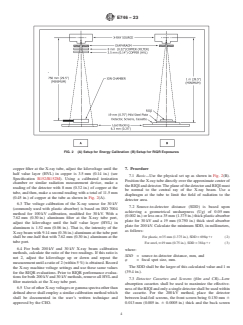
7.1 Basic—Use the physical set up as shown in Fig. 2(B).
Specification B152/B152M). Using a calibrated ionization
Position the X-ray tube directly over the approximate center of
chamber or similar radiation measurement device, make a
the RIQI and detector. The plane of the detector and RIQI must
reading of the detector with 8 mm (0.32 in.) of copper at the
be normal to the central ray of the X-ray beam. Use a
tube, and then, make a second reading with a total of 11.5 mm
diaphragm at the tube to limit the field of radiation to the
(0.45 in.) of copper at the tube as shown in Fig. 2(A).
detector area.
6.3 The voltage calibration of the X-ray source for 30 kV
7.2 Source-to-detector distance (SDD) is based upon
(commonly used with plastic absorber) is based on ISO 7004
achieving a geometrical unsharpness (Ug) of 0.05 mm
method for 100 kV calibration, modified for 30 kV. With a
(0.002 in.) or less on a 35 mm (1.375 in.) thick plastic absorber
7.62 mm (0.30 in.) aluminum filter at the X-ray tube port,
plate for 30 kV and a 19 mm (0.750 in.) thick steel absorber
adjust the kilovoltage until the half value layer (HVL) in
plate for 200 kV. Calculate the minimum SDD, in millimeters,
aluminum is 1.52 mm (0.06 in.). That is, the intensity of the
as follows:
X-ray beam with 9.14 mm (0.36 in.) aluminum at the tube port
For plastic, t=35 mm ~1.375 in.!, SDD = 698φ1t (2)
shall be one-half that with 7.62 mm (0.30 in.) aluminum at the
tube port.
For steel, t=19 mm ~0.75 in.!, SDD = 381φ1t (3)
6.4 For both 200 kV and 30 kV X-ray beam calibration
where:
methods, calculate the ratio of the two readings. If this ratio is
SDD = source-to-detector distance, mm, and
not 2, adjust the kilovoltage up or down and repeat the
φ = focal spot size, mm.
measurement until a ratio of 2 (within 5 %) is obtained. Record
The SDD shall be the larger of this calculated value and 1 m
the X-ray machine voltage settings and use these same values
(39.4 in.).
for the RIQR evaluations. Prior to RIQR performance evalua-
tions for both 200 kV and 30 kV methods, remove all HVL and
7.3 Detector Cassettes and Screens (film and CR)—Low
filter materials at the X-ray tube port.
absorption cassettes shall be used to maximize the effective-
6.5 Use of other X-ray voltages or gamma spectra other than ness of the RIQI and only a single detector shall be used within
defined above shall employ a similar calibration method which the cassette. For the 200 kV method, place the d
...
This document is not an ASTM standard and is intended only to provide the user of an ASTM standard an indication of what changes have been made to the previous version. Because
it may not be technically possible to adequately depict all changes accurately, ASTM recommends that users consult prior editions as appropriate. In all cases only the current version
of the standard as published by ASTM is to be considered the official document.
Designation: E746 − 18 E746 − 23
Standard Practice for
Determining Relative Image Quality Response of Industrial
Radiographic Imaging Systems below 4 MeV
This standard is issued under the fixed designation E746; the number immediately following the designation indicates the year of
original adoption or, in the case of revision, the year of last revision. A number in parentheses indicates the year of last reapproval. A
superscript epsilon (´) indicates an editorial change since the last revision or reapproval.
1. Scope
1.1 This standard providescovers a practice whereby industrial radiographic imaging systems or techniques may be comparatively
assessed using the concept of relative image quality response (RIQR). Changes within a radiographic technique such as
film/detector types, distances, or filtering/collimation can be comparatively assessed using this standard. The RIQR method
presented within this practice is based upon the use of equivalent penetrameter sensitivity (EPS) described within Practice E1025
and subsection 5.35.4 of this practice. Figure 1Fig. 1 illustrates a relative image quality indicator (RIQI) that has four different
plaque thicknesses (0.015, 0.010, 0.008, and 0.005 in.)(0.38 mm, 0.25 mm, 0.20 mm, and 0.13 mm (0.015 in., 0.010 in., 0.008 in.,
and 0.005 in.)) sequentially positioned (from top to bottom) on an absorber plate of a specified material and thickness. The four
plaques contain a total of 14 different arrays of penetrameter-type hole sizes designed to render varied conditions of threshold
visibility when exposed to the appropriate radiation. Each “EPS” array consists of 30 identical holes; thus, providing the user with
a quantity of threshold sensitivity levels suitable for relative image qualitative response comparisons. There are two standard
materials (steel and plastic) specified herein for the RIQI and absorber. For special applications the user may design a non-standard
RIQI-absorber configuration; however the RIQI configuration shall be controlled by a drawing similar to Fig. 1. Use of a
non-standard RIQI-absorber configuration shall be described in the user’s written technique and approved by the CEO.
1.2 This practice is not intended to qualify the performance of a specific radiographic technique nor for assurance that a
radiographic technique will detect specific discontinuities in a specimen undergoing radiographic examination.
1.3 This practice is not intended to be used to classify or derive performance classification categories for radiographic imaging
systems. For example, performance classifications of radiographic film systems may be found within Test Method E1815, and
manufacturer characterization of computed radiography (CR) systems may be found in Practice E2446. However, the RIQI and
absorber described in this practice are used by Practice E2446 for manufacturer characterization of computed radiography (CR)
systems and by Practice E2445 to evaluate performance and to monitor long term stability of CR systems.
1.4 These tests are for applications below 4 MeV. When a gamma source or other high energy source is used, these tests may still
be used to characterize the system, but may need a modification of the absorber thickness to adjust the available RIQR range as
agreed between the user and cognizant engineering organization (CEO). For high-energy X-ray applications (4(4 MV to 25
MeV),MV), Test Method E1735 provides a similar RIQR standard practice.
1.5 The values stated in SI are to be regarded as the standard.
This practice is under the jurisdiction of ASTM Committee E07 on Nondestructive Testing and is the direct responsibility of Subcommittee E07.01 on Radiology (X and
Gamma) Method.
Current edition approved Feb. 1, 2018Dec. 1, 2023. Published February 2018January 2024. Originally approved in 1980. Last previous edition approved in 20172018 as
E746E746 – 18. -17. DOI: 10.1520/E0746-18.10.1520/E0746-23.
Copyright © ASTM International, 100 Barr Harbor Drive, PO Box C700, West Conshohocken, PA 19428-2959. United States
E746 − 23
Step Identification Shim Thickness, mm (in.) Hole Identification Hole Size, mm (in.)
15 0.38 ± 0.012 (0.015 ± 0.0005) 32 0.81 ± 0.025 (0.032 ± 0.001)
10 0.25 ± 0.012 (0.010 ± 0.0005) 31 0.79 ± 0.025 (0.031 ± 0.001)
8 0.20 ± 0.012 (0.008 ± 0.0005) 28 0.71 ± 0.025 (0.028 ± 0.001)
5 0.13 ± 0.012 (0.005 ± 0.0005) 25 0.64 ± 0.025 (0.025 ± 0.001)
23 0.58 ± 0.025 (0.023 ± 0.001)
20 0.50 ± 0.025 (0.020 ± 0.001)
Hole Spacing (horizontal): 5 ± 0.1 mm (0.2 ± 0.004 in.) Nonaccumulative
Hole Spacing (horizontal): 5 mm ± 0.1 mm (0.2 in. ± 0.004 in.) Nonaccumulative
Row Spacing: 3 ± 0.1 mm (0.2 ± 0.004 in.)
Row Spacing: 3 mm ± 0.1 mm (0.12 in. ± 0.004 in.)
Spacing between hole sets: 5 ± 0.1 mm (0.2 ± 0.004 in.)
Spacing between hole sets: 5 mm ± 0.1 mm (0.2 in. ± 0.004 in.)
All other dimensions shall be in accordance with standard engineering practice.
FIG. 1 Relative Image Quality Indicator
1.6 This standard does not purport to address all of the safety concerns, if any, associated with its use. It is the responsibility
of the user of this standard to establish appropriate safety, health, and environmental practices and determine the applicability of
regulatory limitations prior to use.
1.7 This international standard was developed in accordance with internationally recognized principles on standardization
established in the Decision on Principles for the Development of International Standards, Guides and Recommendations issued
by the World Trade Organization Technical Barriers to Trade (TBT) Committee.
2. Referenced Documents
2.1 ASTM Standards:
B152/B152M Specification for Copper Sheet, Strip, Plate, and Rolled Bar
E999 Guide for Controlling the Quality of Industrial Radiographic Film Processing
E1025 Practice for Design, Manufacture, and Material Grouping Classification of Hole-Type Image Quality Indicators (IQI)
Used for Radiography
For referenced ASTM standards, visit the ASTM website, www.astm.org, or contact ASTM Customer Service at service@astm.org. For Annual Book of ASTM Standards
volume information, refer to the standard’s Document Summary page on the ASTM website.
E746 − 23
E1079 Practice for Calibration of Transmission Densitometers
E1316 Terminology for Nondestructive Examinations
E1735 Practice for Determining Relative Image Quality Response of Industrial Radiographic Imaging Systems from 4 to 25
MeV
E1815 Test Method for Classification of Film Systems for Industrial Radiography
E2002 Practice for Determining Image Unsharpness and Basic Spatial Resolution in Radiography and Radioscopy
E2445 Practice for Performance Evaluation and Long-Term Stability of Computed Radiography Systems
E2446 Practice for Manufacturing Characterization of Computed Radiography Systems
2.2 ANSI Standard :
ANSI PH2.19 Photography Density Measurements-Part 2: Geometric Conditions for Transmission Density
2.2 ISO Standards :
ISO 5-2 Photography Density Measurements-Part 2: Geometric Conditions for Transmission Density
ISO 7004 Photography- Industrial Radiographic Film, Determination of ISO Speed, ISO average gradient, and ISO gradients G2
and G4 when exposed to X- and gamma-radiation
3. Terminology
3.1 Definitions—The definitions of terms relating to gamma and X-radiology in Terminology E1316 shall apply to terms used in
this practice.
3.2 Definitions of Terms Specific to This Standard:
3.2.1 detector—detector, n—an imaging device used to store a radiographic latent image or directly convert ionizing radiation into
electrical signals in proportion to the quantity of radiation absorbed.
3.2.2 cassette—a device that is either flexible or rigid used to hold or protect a detector
3.2.2 Relative Image Quality Indicator (RIQI)—(RIQI), n—an image quality measuring device that is capable of determining
meaningful differences between two or more radiographic imaging systems or changes of individual components of radiographic
imaging systems.
4. Significance and Use
4.1 This standard provides a practice for RIQR evaluations of film and non-film imaging systems when exposed through an
absorber material. Three alternate data evaluation methods are provided in Section 9. Determining RIQR requires the comparison
of at least two radiographs or radiographic processes whereby the relative degree of image quality difference may be determined
using the EPS plaque arrangement of Fig. 1 as a relative image quality indicator (RIQI). In conjunction with the RIQI, a specified
radiographic technique or method must be established and carefully controlled for each radiographic process. This practice is
designed to allow the determination of subtle changes in EPS that may arise to radiographic imaging system performance levels
resultant from process improvements/changes or change of equipment attributes. This practice does not address relative
unsharpness of a radiographic imaging system as provided in Practice E2002. The common element with any relative comparison
is the use of the same RIQI arrangement for both processes under evaluation.
4.2 In addition to the standard evaluation method described in Section 9, there may be other techniques/methods in which the basic
RIQR arrangement of Fig. 1 might be utilized to perform specialized assessments of relative image quality performance. For
example, other radiographic variables can be altered to facilitate evaluations provided these differences are known and documented
for both processes. Where multiple radiographic process variables are evaluated, it is incumbent upon the user of this practice to
control those normal process attributes to the degree suitable for the application. Specialized RIQR techniques may also be useful
with micro focus X-ray, isotope sources of radiation or with the use of non-film radiographic imaging systems. RIQR may also
be useful in evaluating imaging systems with alternate materials (RIQI and base plate) such as plastic, copper-nickel, or aluminum.
When using any of these specialized applications, the specific method or techniques used shall be as specified and approved by
the cognizant engineering authority.organization.
5. Relative Image Quality Indicator
5.1 The materials for the RIQI and absorber should be the same. For metals, use the same alloy and heat treat family,family; for
Available from American National Standards Institute (ANSI), 25 W. 43rd St., 4th Floor, New York, NY 10036, http://www.ansi.org.International Organization for
Standardization (ISO), 1, ch. De la Voie-Creuse, CP 56, CH-1211 Geneva 20, Switzerland, http://www.iso.org.
E746 − 23
non-metallic materials, use the same polymer system. When situations arise which preclude the use of same or “like” materials
(i.e. (that is, excessive material grain variation affecting test results), alternate absorber base plate materials may be used, provided
the alternate material and thickness producesproduce the same optical density (film) or PV (for CR/DDA) as the like material of
the thickness used to calculate the EPS.
5.2 All absorber base plates shall be at least 200 mm by 250 mm (8 in. by 10 in.) wide and long (for CR applications it may be
beneficial to use an absorber base plate that covers the entire CR imaging plate to prevent creation of a ghost image). The absorber
base plate shall be made of mild steel for the 200 kV method and polymethylmethacrylate (PMMA) plastic for the 30 kV method.
The surface finish of absorber base plates shall be a maximum of 6.3 μm (250 μin.) Ra, ground finish (both faces). The steel plate
shall be 19 mm 6 0.12 mm (0.750 in. 6 0.005 in.) thick and the plastic plate shall be 35 mm 6 0.12 mm (1.375 in. 6 0.005 in.)
thick. If the EPS performance of the chosen detector is outside of the ranges provided here, use Eq 1 to determine the appropriate
thickness of the absorber plate. Absorber base plate thickness X and EPS value scale inversely.
5.3 The RIQI steps may be fabricated as a single multi-step unit or separately and taped together to form the penetrameter type
hole arrays shown in Fig. 1. If tape is used, the tape shall not cover or interfere with any of the holes in the RIQI. All dimensions
of the RIQI shall conform to Fig. 1.
5.4 The RIQI shown in Fig. 1 consists of 14 arrays of 30 holes where all hole diameters are the same for each array. Hole diameters
are based upon a “multiple” of each respective step thickness; therefore, each array of 30 holes has a unique “equivalent”
penetrameter sensitivity (EPS) as defined by the following relationship ((Practice E1025):
100 Th
EPS, %5 ׌ (1)
X 2
where:
h = hole diameter, mm
T = step thickness of IQI, mm
X = thickness of test object, mm
X = absorber plate thickness, mm
Hole diameters within each EPS array are progressively smaller from the top to the bottom of Fig. 1; thus, providing descending
EPS values ranging from 1.92 % to 0.94 % for the steel method using a 19 mm (0.75 in.) thick absorber and 1.05 % to 0.51 %
for the plastic method using a 35 mm (1.375 in.) thick absorber. The surface finish of the RIQIs shall be a maximum of 6.3 μm
(250 μin.) Ra, ground finish (both faces).
5.4 The absorber base plate shall be made of mild steel for the 200 kV method and polymethylmethacrylate (PMMA) plastic for
the 30 kV method. Both base plates shall be at least 200 by 250 mm (8 by 10 in.) wide and long (for CR applications it may be
beneficial to use an absorber that covers the entire CR imaging plate to prevent creation of a ghost image). The steel plate shall
be 19 6 0.12 mm (0.750 6 0.005 in.) thick and the plastic plate shall be 35 6 0.12 mm (1.375 6 0.005 in.) thick. The surface
finish of both absorber base plates shall be a maximum of 6.3 μm (250 μin.) Ra, ground finish (both faces).
5.5 The RIQI shown in Fig. 1 shall be placed on the radiation source side and within the approximate center of the appropriate
absorber base plate as illustrated in Fig. 2(B).
6. Calibration of X-Ray Source
6.1 Use a targetsource to detector distance at least 750 mm (29.5 in.) for all exposures.
6.2 The voltage calibration of the X-ray source for 200–kV200 kV (commonly used with steel absorber) is based on ISO 7004.
With an 8-mm (0.32-in.)modified from ISO 7004. This standard recommends testing at 200 kV, which deviates from ISO 7004
which recommends 220 kV. As the overall kV value may be altered, 200 kV was chosen as an initial value; see ISO 7004 for
additional information on determining the correct kV values. With an 8 mm (0.32 in.) copper filter at the X-ray tube, adjust the
kilovoltage until the half value layer (HVL) in copper is 3.5 mm (0.14 in.) (see Specification B152/B152M). Using a calibrated
ionization chamber or similar radiation measurement device, make a reading of the detector with 8 mm (0.32 in.) of copper at the
tube, and then, make a second reading with a total of 11.5 mm (0.45 in.) of copper at the tube as shown in Fig. 2(A).
6.3 The voltage calibration of the X-ray source for 30–kV30 kV (commonly used with plastic absorber) is based on ISO 7004
E746 − 23
FIG. 2 (A) Setup for Energy Calibration (B) Setup for RIQR Exposures
method for 100–kV100 kV calibration, modified for 30–kV.30 kV. With a 7.62-mm (0.30-in.)7.62 mm (0.30 in.) aluminum filter
at the X-ray tube port, adjust the kilovoltage until the half value layer (HVL) in aluminum is 1.52 mm (0.06 in.). That is, the
intensity of the X-ray beam with 9.14–mm (0.36–in.)9.14 mm (0.36 in.) aluminum at the tube port shall be one-half that with
7.62–mm (0.30–in.)7.62 mm (0.30 in.) aluminum at the tube port.
6.4 For both 200–kV and 30–kV200 kV and 30 kV X-ray beam calibration methods, calculate the ratio of the two readings. If this
ratio is not 2, adjust the kilovoltage up or down and repeat the measurement until a ratio of 2 (within 5 %) is obtained. Record
the X-ray machine voltage settings and use these same values for the RIQR evaluations. Prior to RIQR performance evaluations
for both 200–kV and 30–kV200 kV and 30 kV methods, remove all HVL and filter materials at the X-ray tube port.
6.5 Use of other X-ray voltages or gamma spectra other than defined above shall employ a similar calibration method which shall
be documented in the user’s written technique and approved by the CEO.
7. Procedure
7.1 Basic—Use the physical set up as shown in Fig. 2(B). Position the X-ray tube directly over the approximate center of the RIQI
and detector cassette. detector. The plane of the detector and RIQI must be normal to the central ray of the X-ray beam. Use a
diaphragm at the tube to limit the field of radiation to the filmdetector area.
7.2 Source-to-detector distance (SDD) is based upon achieving a geometrical unsharpness (Ug) of 0.05 mm (0.002 in.) 0.05 mm
(0
...