

ASTM E1441-19
(Guide)Standard Guide for Computed Tomography (CT)
General Information
- Abstract
SIGNIFICANCE AND USE
5.1 Computed tomography (CT) is a radiographic reconstruction method that provides a sensitive technique whenever the primary goal is to locate and size planar and volumetric detail in three dimensions.
5.2 CT provides quantitative volume images as a function of density and element number (attenuation coefficient) by means of computer-processed combinations of many X-ray measurements taken from different angles to produce cross-sectional images of specific areas of a scanned object, allowing the user to see inside the object without cutting. CT is considered much easier to interpret than conventional radiographic data due to the elimination of overlapping structures. The new user can learn quickly to read CT data because the images correspond more closely to the way the human mind visualizes three-dimensional structures than conventional projection radiography. Further, because CT slices and volumes are digital, they may be enhanced, analyzed, compressed, archived, input as data into performance calculations, compared with digital data from other NDE modalities, or transmitted to other locations for remote viewing.
SCOPE
1.1 CT is a radiographic examination technique that generates digital images in three dimensions of an object, including the interior structure. Because of the relatively good penetrability of X-rays, CT permits the nondestructive physical and, to a limited extent, chemical characterization of the internal structure of materials. Also, since the method is X-ray based, it applies equally well to metallic and non-metallic specimens, solid and fibrous materials, and smooth and irregularly surfaced objects.
1.2 This guide is intended to satisfy two general needs for users of industrial CT equipment: (1) the need for a tutorial guide addressing the general principles of X-ray CT as they apply to industrial imaging; and (2) the need for a consistent set of CT performance parameter definitions, including how these performance parameters relate to CT system specifications.
1.3 This guide does not specify CT examination techniques, such as the best selection of scan parameters, the preferred implementation of scan procedures, or the establishment of accept/reject criteria for a new object.
1.4 Units—No units are mentioned in this document. However, for CT, values are typically stated in SI units and are regarded as standard.
1.5 This standard does not purport to address all of the safety concerns, if any, associated with its use. It is the responsibility of the user of this standard to establish appropriate safety, health, and environmental practices and determine the applicability of regulatory limitations prior to use.
1.6 This international standard was developed in accordance with internationally recognized principles on standardization established in the Decision on Principles for the Development of International Standards, Guides and Recommendations issued by the World Trade Organization Technical Barriers to Trade (TBT) Committee.
- Status
- Published
- Publication Date
- 30-Jun-2019
- Technical Committee
- E07 - Nondestructive Testing
- Drafting Committee
- E07.01 - Radiography (X and Gamma) Method
Overview
ASTM E1441-19: Standard Guide for Computed Tomography (CT) provides comprehensive guidance on the application of computed tomography (CT) as a nondestructive testing (NDT) method for obtaining three-dimensional digital images of objects. Published by ASTM International, this standard is essential for users of industrial CT equipment who require both a tutorial introduction and a consistent framework for defining CT performance parameters. CT imaging leverages the penetrability of X-rays, enabling quantitative assessment of internal structures without damaging the object, regardless of whether the materials are metallic, non-metallic, solid, or composite. This guide emphasizes accuracy, interpretability, and the practical advantages of CT over conventional radiographic approaches.
Key Topics
- Principles of Computed Tomography: Describes the physical and mathematical basis for reconstructing volumetric images from X-ray measurements, resulting in high-resolution, quantitative maps of material density and attenuation coefficients.
- CT System Components: Outlines essential equipment components, including X-ray sources, detector arrays, mechanical scanning assemblies, computer systems, and operator interfaces.
- Performance Parameters: Defines key CT performance factors such as spatial resolution, contrast, noise, and artifact recognition. Establishes standardized terminology for effective communication between users and suppliers.
- Image Interpretation and Processing: Highlights the superior interpretability of CT images compared to conventional radiography, due to the elimination of overlapping features and the digital nature of CT datasets, which can be enhanced, analyzed, and archived.
- Limitations and Artifacts: Addresses common CT limitations such as object size and density, artifact formation (e.g., beam hardening, cupping, and partial volume effects), and the importance of understanding these factors for reliable imaging.
- Safety and Regulatory Considerations: Reminds users to establish appropriate safety, health, and environmental practices and to be aware of regulatory requirements when using CT systems.
Applications
ASTM E1441-19 is widely applicable across industries requiring nondestructive evaluation and inspection of internal features:
- Aerospace and Automotive: Inspecting critical components for internal defects and verifying dimensional accuracy to ensure safety and performance.
- Manufacturing: Quality assurance of complex parts, additive-manufactured objects, and advanced materials, enabling precise flaw detection and internal characterization.
- Research and Development: Supporting material analysis and failure investigations by providing detailed insights into structure, composition, and integrity.
- Electronics: Non-invasive investigation of assemblies, solder joints, and embedded features in circuit boards and devices.
- Medical Device Manufacturing: Ensuring internal compliance of implants, instruments, and assembled products without destructive sectioning.
The standard enables digital CT data to be compared with other NDT modalities (such as ultrasonic or digital radiography), integrated into automated evaluation processes, and transmitted for remote expert analysis.
Related Standards
ASTM E1441-19 is part of a broader network of standards guiding CT and radiographic testing. Important related documents include:
- ASTM E746: Practice for Determining Relative Image Quality Response of Industrial Radiographic Imaging Systems
- ASTM E1316: Terminology for Nondestructive Examinations
- ASTM E1570: Practice for Fan Beam Computed Tomographic (CT) Examination
- ASTM E1695: Test Method for Measurement of Computed Tomography (CT) System Performance
- ASTM E1935: Test Method for Calibrating and Measuring CT Density
- ASTM E2698: Practice for Radiographic Examination Using Digital Detector Arrays
ISO Standards:
- ISO 15708-1-4: Non-destructive Testing - Radiation Methods for Computed Tomography (covering terminology, principles, operation, and qualification)
Conclusion
By following ASTM E1441-19, organizations benefit from a robust, consistent approach to CT imaging, leading to improved internal inspection accuracy, streamlined communication, and enhanced confidence in nondestructive evaluation results. The digital, three-dimensional nature of CT images makes this guide indispensable for industries prioritizing safety, quality, and process efficiency.
Relations
- Effective Date
- 01-Feb-2024
- Effective Date
- 01-Dec-2023
- Effective Date
- 01-Dec-2019
- Effective Date
- 01-Dec-2019
- Effective Date
- 15-Jun-2019
- Effective Date
- 01-Mar-2019
- Effective Date
- 01-Feb-2018
- Effective Date
- 01-Feb-2018
- Effective Date
- 01-Jan-2018
- Effective Date
- 01-Nov-2017
- Effective Date
- 15-Jun-2017
- Effective Date
- 01-Feb-2017
- Effective Date
- 01-Aug-2016
- Effective Date
- 01-Feb-2016
- Effective Date
- 01-Dec-2015
Get Certified
Connect with accredited certification bodies for this standard

BSI Group
BSI (British Standards Institution) is the business standards company that helps organizations make excellence a habit.

NYCE
Mexican standards and certification body.
Sponsored listings
Frequently Asked Questions
ASTM E1441-19 is a guide published by ASTM International. Its full title is "Standard Guide for Computed Tomography (CT)". This standard covers: SIGNIFICANCE AND USE 5.1 Computed tomography (CT) is a radiographic reconstruction method that provides a sensitive technique whenever the primary goal is to locate and size planar and volumetric detail in three dimensions. 5.2 CT provides quantitative volume images as a function of density and element number (attenuation coefficient) by means of computer-processed combinations of many X-ray measurements taken from different angles to produce cross-sectional images of specific areas of a scanned object, allowing the user to see inside the object without cutting. CT is considered much easier to interpret than conventional radiographic data due to the elimination of overlapping structures. The new user can learn quickly to read CT data because the images correspond more closely to the way the human mind visualizes three-dimensional structures than conventional projection radiography. Further, because CT slices and volumes are digital, they may be enhanced, analyzed, compressed, archived, input as data into performance calculations, compared with digital data from other NDE modalities, or transmitted to other locations for remote viewing. SCOPE 1.1 CT is a radiographic examination technique that generates digital images in three dimensions of an object, including the interior structure. Because of the relatively good penetrability of X-rays, CT permits the nondestructive physical and, to a limited extent, chemical characterization of the internal structure of materials. Also, since the method is X-ray based, it applies equally well to metallic and non-metallic specimens, solid and fibrous materials, and smooth and irregularly surfaced objects. 1.2 This guide is intended to satisfy two general needs for users of industrial CT equipment: (1) the need for a tutorial guide addressing the general principles of X-ray CT as they apply to industrial imaging; and (2) the need for a consistent set of CT performance parameter definitions, including how these performance parameters relate to CT system specifications. 1.3 This guide does not specify CT examination techniques, such as the best selection of scan parameters, the preferred implementation of scan procedures, or the establishment of accept/reject criteria for a new object. 1.4 Units—No units are mentioned in this document. However, for CT, values are typically stated in SI units and are regarded as standard. 1.5 This standard does not purport to address all of the safety concerns, if any, associated with its use. It is the responsibility of the user of this standard to establish appropriate safety, health, and environmental practices and determine the applicability of regulatory limitations prior to use. 1.6 This international standard was developed in accordance with internationally recognized principles on standardization established in the Decision on Principles for the Development of International Standards, Guides and Recommendations issued by the World Trade Organization Technical Barriers to Trade (TBT) Committee.
SIGNIFICANCE AND USE 5.1 Computed tomography (CT) is a radiographic reconstruction method that provides a sensitive technique whenever the primary goal is to locate and size planar and volumetric detail in three dimensions. 5.2 CT provides quantitative volume images as a function of density and element number (attenuation coefficient) by means of computer-processed combinations of many X-ray measurements taken from different angles to produce cross-sectional images of specific areas of a scanned object, allowing the user to see inside the object without cutting. CT is considered much easier to interpret than conventional radiographic data due to the elimination of overlapping structures. The new user can learn quickly to read CT data because the images correspond more closely to the way the human mind visualizes three-dimensional structures than conventional projection radiography. Further, because CT slices and volumes are digital, they may be enhanced, analyzed, compressed, archived, input as data into performance calculations, compared with digital data from other NDE modalities, or transmitted to other locations for remote viewing. SCOPE 1.1 CT is a radiographic examination technique that generates digital images in three dimensions of an object, including the interior structure. Because of the relatively good penetrability of X-rays, CT permits the nondestructive physical and, to a limited extent, chemical characterization of the internal structure of materials. Also, since the method is X-ray based, it applies equally well to metallic and non-metallic specimens, solid and fibrous materials, and smooth and irregularly surfaced objects. 1.2 This guide is intended to satisfy two general needs for users of industrial CT equipment: (1) the need for a tutorial guide addressing the general principles of X-ray CT as they apply to industrial imaging; and (2) the need for a consistent set of CT performance parameter definitions, including how these performance parameters relate to CT system specifications. 1.3 This guide does not specify CT examination techniques, such as the best selection of scan parameters, the preferred implementation of scan procedures, or the establishment of accept/reject criteria for a new object. 1.4 Units—No units are mentioned in this document. However, for CT, values are typically stated in SI units and are regarded as standard. 1.5 This standard does not purport to address all of the safety concerns, if any, associated with its use. It is the responsibility of the user of this standard to establish appropriate safety, health, and environmental practices and determine the applicability of regulatory limitations prior to use. 1.6 This international standard was developed in accordance with internationally recognized principles on standardization established in the Decision on Principles for the Development of International Standards, Guides and Recommendations issued by the World Trade Organization Technical Barriers to Trade (TBT) Committee.
ASTM E1441-19 is classified under the following ICS (International Classification for Standards) categories: 35.240.80 - IT applications in health care technology. The ICS classification helps identify the subject area and facilitates finding related standards.
ASTM E1441-19 has the following relationships with other standards: It is inter standard links to ASTM E1316-24, ASTM E746-23, ASTM E1316-19b, ASTM E1935-97(2019), ASTM E1570-19, ASTM E1316-19, ASTM E746-18, ASTM E2698-18, ASTM E1316-18, ASTM E746-17, ASTM E1316-17a, ASTM E1316-17, ASTM E1316-16a, ASTM E1316-16, ASTM E1316-15a. Understanding these relationships helps ensure you are using the most current and applicable version of the standard.
ASTM E1441-19 is available in PDF format for immediate download after purchase. The document can be added to your cart and obtained through the secure checkout process. Digital delivery ensures instant access to the complete standard document.
Standards Content (Sample)
This international standard was developed in accordance with internationally recognized principles on standardization established in the Decision on Principles for the
Development of International Standards, Guides and Recommendations issued by the World Trade Organization Technical Barriers to Trade (TBT) Committee.
Designation: E1441 − 19
Standard Guide for
Computed Tomography (CT)
This standard is issued under the fixed designation E1441; the number immediately following the designation indicates the year of
original adoption or, in the case of revision, the year of last revision.Anumber in parentheses indicates the year of last reapproval.A
superscript epsilon (´) indicates an editorial change since the last revision or reapproval.
This standard has been approved for use by agencies of the U.S. Department of Defense.
1. Scope* 2. Referenced Documents
2.1 ASTM Standards:
1.1 CT is a radiographic examination technique that gener-
ates digital images in three dimensions of an object, including E746Practice for Determining Relative Image Quality Re-
sponse of Industrial Radiographic Imaging Systems
the interior structure. Because of the relatively good penetra-
bilityofX-rays,CTpermitsthenondestructivephysicaland,to E1316Terminology for Nondestructive Examinations
a limited extent, chemical characterization of the internal E1570Practice for Fan Beam Computed Tomographic (CT)
structureofmaterials.Also,sincethemethodisX-raybased,it Examination
applies equally well to metallic and non-metallic specimens, E1695Test Method for Measurement of Computed Tomog-
solid and fibrous materials, and smooth and irregularly sur- raphy (CT) System Performance
faced objects. E1935Test Method for Calibrating and Measuring CT
Density
1.2 This guide is intended to satisfy two general needs for
E2698Practice for Radiographic Examination Using Digital
users of industrial CT equipment: (1) the need for a tutorial
Detector Arrays
guide addressing the general principles of X-ray CT as they
E2736Guide for Digital Detector Array Radiography
applytoindustrialimaging;and(2)theneedforaconsistentset
2.2 ISO Standards:
of CT performance parameter definitions, including how these
ISO 15708-1:2017-02 International Standard for Non-
performance parameters relate to CT system specifications.
destructive Testing - Radiation Methods for Computed
1.3 ThisguidedoesnotspecifyCTexaminationtechniques,
Tomography - Part 1: Terminology
such as the best selection of scan parameters, the preferred
ISO 15708-2:2017-02 International Standard for Non-
implementation of scan procedures, or the establishment of
destructive Testing - Radiation Methods for Computed
accept/reject criteria for a new object.
Tomography - Part 2: Principles, Equipment and Samples
ISO 15708-3:2017-02 International Standard for Non-
1.4 Units—No units are mentioned in this document.
However,forCT,valuesaretypicallystatedinSIunitsandare destructive Testing - Radiation Methods for Computed
Tomography - Part 3: Operation and Interpretation
regarded as standard.
ISO 15708-4:2017-02 International Standard for Non-
1.5 This standard does not purport to address all of the
destructive Testing - Radiation Methods for Computed
safety concerns, if any, associated with its use. It is the
Tomography - Part 4: Qualification
responsibility of the user of this standard to establish appro-
priate safety, health, and environmental practices and deter-
3. Terminology
mine the applicability of regulatory limitations prior to use.
3.1 Definitions—In addition to terms defined in Terminol-
1.6 This international standard was developed in accor-
ogy E1316, the following terms are specific to this standard.
dance with internationally recognized principles on standard-
3.1.1 Throughout this guide, the term “X-ray” is used to
ization established in the Decision on Principles for the
denote penetrating electromagnetic radiation; however, elec-
Development of International Standards, Guides and Recom-
tromagnetic radiation may be either X-rays or gamma rays.
mendations issued by the World Trade Organization Technical
Barriers to Trade (TBT) Committee.
3.2 Definitions of Terms Specific to This Standard:
For referenced ASTM standards, visit the ASTM website, www.astm.org, or
This guide is under the jurisdiction of ASTM Committee E07 on Nondestruc- contact ASTM Customer Service at service@astm.org. For Annual Book of ASTM
tive Testing and is the direct responsibility of Subcommittee E07.01 on Radiology Standards volume information, refer to the standard’s Document Summary page on
(X and Gamma) Method. the ASTM website.
Current edition approved July 1, 2019. Published August 2019. Originally Available from International Organization for Standardization (ISO), ISO
approved in 1991. Last previous edition approved in 2011 as E1441–11. DOI: Central Secretariat, BIBC II, Chemin de Blandonnet 8, CP 401, 1214 Vernier,
10.1520/E1441-19. Geneva, Switzerland, http://www.iso.org.
*A Summary of Changes section appears at the end of this standard
Copyright © ASTM International, 100 Barr Harbor Drive, PO Box C700, West Conshohocken, PA 19428-2959. United States
E1441 − 19
3.2.1 CT detectability, n—the extent to which the presence Section 10 identifies some CT system processes for quantita-
of a feature or indication can be reliably inferred from a tive measurements to compare the relative performance of
tomographic examination image. different CT systems and calibrate for densitometric informa-
3.2.1.1 Discussion—CT detectability is dependent on the tion.NotethatISO15708Parts1-4havebeenupdatedandthis
spatialresolutionandcontrastresolutionoftheimage.Features guide has been harmonized with the recent publications.
may be detectable even if they are too small to be resolved,
5. Significance and Use
provided their contrast after blurring is still sufficient.
5.1 Computed tomography (CT) is a radiographic recon-
3.2.2 CT slice, n—a tomogram or the object cross-section
struction method that provides a sensitive technique whenever
corresponding to it.
the primary goal is to locate and size planar and volumetric
3.2.2.1 Discussion—Thesliceplaneistheplane,determined
detail in three dimensions.
by the focal spot and linear array of detectors or a single line
5.2 CTprovidesquantitativevolumeimagesasafunctionof
of an area array, around which each measurement of a planar
density and element number (attenuation coefficient) by means
tomographic scan is centered. Each such scan also has a slice
of computer-processed combinations of many X-ray measure-
thickness, which is the distance normal to the slice plane over
whichchangesinobjectopacitywillsignificantlyinfluencethe ments taken from different angles to produce cross-sectional
images of specific areas of a scanned object, allowing the user
measurements; typically, an average value based on the aper-
ture function is used to characterize this parameter. When toseeinsidetheobjectwithoutcutting.CTisconsideredmuch
easier to interpret than conventional radiographic data due to
three-dimensional CT-density maps have been reconstructed, a
slice may be formed on an arbitrary plane or other surface, not the elimination of overlapping structures. The new user can
learn quickly to read CT data because the images correspond
just on slice planes.
more closely to the way the human mind visualizes three-
3.2.3 CT view/projection, n—a set of X-ray opacity projec-
dimensional structures than conventional projection radiogra-
tion values (derived from measurements or by simulation)
phy. Further, because CT slices and volumes are digital, they
grouped together for processing purposes, especially for the
may be enhanced, analyzed, compressed, archived, input as
convolution and backprojection steps of computing a tomo-
data into performance calculations, compared with digital data
graph.
from other NDE modalities, or transmitted to other locations
3.2.3.1 Discussion—The set of line integrals resulting from
for remote viewing.
a scan of an object can be grouped conceptually into subsets
referred to as views. Each view corresponds to a set of ray
6. Computed Tomography (CT) Overview
paths through the object from a particular direction.The views
6.1 CT is a radiographic examination method that uses a
are also referred to as projections or profiles, while each
computer to reconstruct an image of one or more cross-
individual datum within a given projection is referred to as a
sectional plane (slice(s)) through an object. The result is a
sample or often simply a data point
quantitative map of the linear X-ray attenuation coefficient, µ,
3.2.4 detector aperture function, n—a three-dimensional
at each point in the plane. The linear attenuation coefficient
function centered on the axis from the radiation source to a
characterizes the local instantaneous rate at which X-ray
detector element, giving the sensitivity of the detector to the
photons are attenuated during the scan, by scatter or
presence of attenuating material at each position.
absorption,fromtheincidentradiationasitpropagatesthrough
the object.
3.2.4.1 Discussion—The detector aperture function gives
the extent and intensity distribution of each ray around and
6.2 One particularly important property of the total linear
along the length of its central line. The function is determined
attenuation coefficient is that it is dependent upon atomic
by the size and shape of the radiation source and of the active
number and is proportional to material density, which is a
region of the detector, and by relative distance to the source
fundamental physical property of all matter. The fact that CT
and the detector. The average width of this function in the
images are proportional to density is perhaps the principal
regionoftheobjectbeingexaminedisanimportantlimitonthe
virtue of the technology and the reason that image data are
spatial resolution of a CT scan.
often thought of as representing the distribution of material
3.2.5 sinogram, n—a two-dimensional array of position
density within the object being examined; however, the linear
within view versus view angle, which can be stacked into a
attenuationcoefficientalsocarriesanenergydependencethatis
volume for volumetric reconstruction techniques. a function of material composition (atomic number). This
feature of the attenuation coefficient may or may not (depend-
4. Summary of Guide ingonthematerialsandtheenergiesoftheX-raysinvolved)be
more important than the basic density dependence. In some
4.1 This guide provides a tutorial introduction to the tech-
instances, this effect can be detrimental, masking the density
nology and principles of CT and is divided into six main
differences in a CT image; in other instances, it can be used to
sections. Section 5 discusses the significance of CT compared
advantage, enhancing the contrast between different materials
to conventional radiography. Section 6 provides a brief over-
of similar density.
viewofCT.Section7describesthebasichardwareelementsof
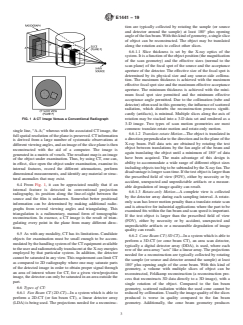
CT systems. Section 8 outlines the general principles of CT 6.3 The fundamental difference between CT and conven-
imaging. Section 9 outlines CT system performance factors tional radiography is shown in Fig. 1. In conventional
used in characterizing the system performance and images. radiography, information on the slice plane “P” projects into a
E1441 − 19
tion are typically collected by rotating the sample (or source
and detector around the sample) at least 180° plus opening
angleofthefanbeam.Withthiskindofgeometry,asingleslice
of object can be reconstructed. The object may be translated
along the rotation axis to collect other slices.
6.6.1.1 Slice thickness is set by the X-ray optics of the
system.Itisafunctionoftheobjectposition(themagnification
of the scan geometry) and the effective sizes (normal to the
scan plane) of the focal spot of the source and the acceptance
aperture of the detector. The effective size of the focal spot is
determined by its physical size and any source-side collima-
tion. The maximum thickness is achieved with the maximum
effectivefocalspotsizeandthemaximumeffectiveacceptance
aperture. The minimum thickness is achieved with the mini-
mum focal spot size permitted and the minimum effective
acceptance angle permitted. Due to the collimation (tube and
detector)oftenusedinthisgeometry,theinfluenceofscattered
radiation, which disturbs the reconstruction process signifi-
cantly (artifacts), is minimal. Multiple slices along the axis of
FIG. 1 A CT Image Versus a Conventional Radiograph rotation may be stacked into a 3-D data set and rendered as a
3-D image. Two types of scan motion geometries are most
common: translate-rotate motion and rotate-only motion.
single line, “A-A;” whereas with the associated CT image, the
6.6.1.2 Translate-rotate Motion—The object is translated in
fullspatialresolutionoftheplaneispreserved.CTinformation
adirectionperpendiculartothedirectionandintheplaneofthe
is derived from a large number of systematic observations at
X-ray beam. Full data sets are obtained by rotating the test
differentviewingangles,andanimageofthesliceplaneisthen
object between translations by the fan angle of the beam and
reconstructed with the aid of a computer. The image is
again translating the object until a minimum of 180° of data
generated in a matrix of voxels.The resultant map is an image
have been acquired. The main advantage of this design is
of the object under examination. Thus, by using CT, one can,
ability to accommodate a wide range of different object sizes
in effect, slice open the object under examination, examine its
includingobjectstoobigtobesubtendedbytheX-rayfan.The
internal features, record the different attenuations, perform
disadvantageislongerscantime.Ifthetestobjectislargerthan
dimensional measurements, and identify any material or struc-
the prescribed field of view (FOV), either by necessity or by
tural anomalies that may exist.
accident, unexpected and unpredictable artifacts or a measur-
6.4 From Fig. 1, it can be appreciated readily that if an
able degradation of image quality can result.
internal feature is detected in conventional projection
6.6.1.3 Rotate-only Motion—A complete view is collected
radiography, its position along the line-of-sight between the
by the detector array during each sampling interval. A rotate-
source and the film is unknown. Somewhat better positional
onlyscanhaslowermotionpenaltythanatranslate-rotatescan
information can be determined by making additional radio-
and is attractive for industrial applications where the part to be
graphs from several viewing angles and triangulating. This
examinedfitswithinthefanbeamandscanspeedisimportant.
triangulation is a rudimentary, manual form of tomographic
If the test object is larger than the prescribed field of view
reconstruction. In essence, a CT image is the result of trian-
(FOV), either by necessity or by accident, unexpected and
gulating every point in the plane from many different direc-
unpredictable artifacts or a measurable degradation of image
tions.
quality can result.
6.5 As with any modality, CT has its limitations. Candidate
6.6.2 Cone Beam CT (3D CT)—Inasystemwhichisableto
objects for examination must be small enough to be accom-
perform a 3D-CT (or cone beam CT), an area scan detector,
modatedbythehandlingsystemoftheCTequipmentavailable
typically a digital detector array (DDA), is used, where each
totheuserandradiometricallytranslucentattheX-rayenergies
row of the area array “acts” like a linear array.The projections
employed by that particular system. In addition, the detector
needed for a reconstruction are typically collected by rotating
cannotbesaturatedinanyview.ThisrequirementcanlimitCT
the sample (or source and detector around the sample) at least
as compared to 2D radiography where one may saturate parts
180° plus opening angle of the cone beam. With this kind of
of the detected image in order to obtain proper signal through
geometry, a volume with multiple slices of object can be
an area of interest where for CT, for a given view/projection
reconstructed, Feldkamp reconstruction (a reconstruction pro-
image, the detector can only be saturated in an area outside the
cess that reconstructs 3D data directly to a 3D image), with a
part.
single rotation of the object. Compared to the fan beam
6.6 Types of CT: geometry, scattered radiation within the used cone cannot be
6.6.1 Fan Beam CT (2D-CT)—In a system which is able to reduced by collimation. Usually the image quality of the slices
perform a 2D-CT (or fan beam CT), a linear detector array produced is worse in quality compared to the fan beam
(LDA) is being used. The projections needed for a reconstruc- geometry. Additionally, the cone beam geometry produces
E1441 − 19
another artifact, which depends on the opening angle of the toconebeamCT,HelicalCTavoidstheFeldkampconeartifact
cone parallel to the rotation axis.This artifact is widely known since all measured object details will pass the central plane.
asFeldkampartifact(see9.7.6).TheinfluenceoftheFeldkamp The acquisition process for larger volumes is less time con-
artifact can be reduced by minimizing the opening angle of the sumingthanfanbeamCT.HelicalCTcantheoreticallybeused
cone,whichshouldbenolargerthan11°intotalifFeldkamp’s
to measure infinitely long objects, like those produced in
reconstruction algorithm is used.The scanning and acquisition extrusion processes.
process for larger volumes is typically less time consuming
6.6.4 Computed Laminography (Planar CT, Tomosynthesis,
than fan beam CT.
Coplanar Translational, Coplanar Rotational
6.6.2.1 Mathematically only 180° plus the fan angle is
Laminography)—Laminography is a radiographic technique in
required for CT reconstruction of the described method. It is,
which the relative motion of the source, detector, and object
however, best practice to acquire a full 360° of data as this
show a specific plane more clearly. Some systems will utilize
provides redundant information which fills in for detector
a reconstruction algorithm to assist in the image development.
defects (for example, bad pixels) and reduces artifacts. This
This method is especially suitable for large or flat objects that
also allows for checking the first versus the last image as a
are either difficult to rotate or have geometries that make
check for object motion during the scan.
penetration from some angles impossible.
6.6.2.2 Extended Field of View/Offset Scanning—Another
6.6.5 Irregular (Optimized) Geometries for CT—The qual-
method for increasing the width of the FOV while using a
ity of a CTvolume is highly influenced by the geometry of the
smallerareadetectoristooffsetthepositionofthedetector(or
part. Due to the circular trajectories being used in most CT
shift rotation axis, or a combination of both), collimate the
geometries unfavorable transmission directions are produced
beamasymmetrically,andscantheobject.Eachprojectionwill
duringthescan.Lackofpenetrationinthesepositionscanlead
beviewingalittlemorethanhalfthetotaldiameterofthefield
to unwanted artifacts in the reconstruction. Collecting the
ofview.Foroffsetscanning,thecenterofrotationmustalways
projections on an arbitrary path (for example, optimized based
be within each projection (Fig. 2). This method requires 360°
on the object geometry) can avoid the unfavorable positions
of data for mathematical sufficiency.
and therefore reduce artifacts. To make use of the arbitrary
6.6.3 Helical CT—In a system which is able to perform
geometries, special reconstruction methods are necessary. In
Helical CT (or Spiral CT), a multi-row LDA or an area scan
most cases, algebraic reconstruction is used, which can deal
detectorisbeingused.Theprojectionsneededforareconstruc-
with any kind of geometry.
tion are typically collected by rotating the sample (or source
and detector around the sample) combined with a linear
7. Basic Hardware Configuration
movement along the rotation axis. With this kind of geometry,
a volume with multiple slices of object can be reconstructed 7.1 CT systems are composed of a number of subsystems,
withmultiplerotationsoftheobject.Comparedtothefanbeam typically those shown in Fig. 3. The choice of components for
thesesubsystemsdependsonthespecificapplicationforwhich
geometry, scattered radiation within the cone cannot be re-
duced by collimation. Usually the quality of the slices pro- thesystemwasdesigned;however,thefunctionservedbyeach
duced is worse in quality compared to the fan beam geometry subsystem is common in almost all CT scanners. These
but improved compared to the cone beam geometry. Contrary subsystems are:
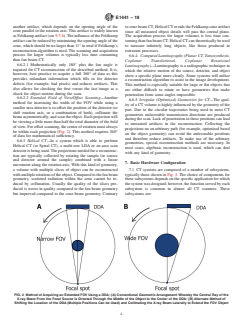
FIG. 2 Method of Acquiring an Extended FOV Using a DDA; (A) Conventional Geometric Arrangement Whereby the Central Ray of the
X-ray Beam From the Focal Source is Directed Through the Middle of the Object to the Center of the DDA; (B) Alternate Method of
Shifting the Location of the DDA (Multiple Positions Can be Used) and Collimating the X-ray Beam Laterally to Extend the FOV Object
E1441 − 19
FIG. 3 Typical Components of a Computed Tomography (CT) System
7.2 Source of Penetrating Radiation—Therearethreerather 7.2.2 Isotope Sources—Isotope sources are attractive for
broadtypesofradiationsourcesusedinindustrialCTscanners: someapplications.TheyofferanadvantageoverX-raysources
(1)X-raytubes,(2)accelerators,and(3)isotopes.Thefirsttwo in that problems associated with beam hardening are reduced
broad energy spectra are polychromatic (or Bremsstrahlung) or nonexistent for these monoenergetic/discrete energies type
electrical sources; the third is approximately monoenergetic sources. They have the additional advantages, which are
radioactive sources. The choice of radiation source is dictated important in some applications, that they do not require bulky
bythesamerulesthatgovernthechoiceofradiationsourcefor and energy-consuming power supplies, and they have an
conventional radiographic imaging applications. inherently more stable output intensity. The intensity of avail-
7.2.1 X-ray Sources—While the CT systems may utilize able isotopic sources, however, is limited by specific activity
either gamma-ray or X-ray generators, the latter is used for (decays per second per mass of 1 gram). The intensity affects
mostapplications.Foragivenfocalspotsize,X-raygenerators signal-to-noise ratio, and, even more importantly, the specific
(that is, X-ray tubes and linear accelerators) are several orders activitydeterminessourcespotsizeandthusspatialresolution.
of magnitude more intense than isotope sources. Most X-ray Both of these factors tend to limit the industrial application of
generatorsareadjustableinpeakenergyandintensityandhave isotopic scanners. Nevertheless, they can be used in some
the added safety feature of discontinued radiation production applicationsinwhichscanningtimeorresolutionisnotcritical.
when switched off; however, the polychromaticity of the 7.2.3 Source Setup—Caution is advised against applying
energy spectrum from an X-ray source causes artifacts such as practices developed for projection radiography. Except at very
beam hardening (the anomalous decreasing attenuation toward high energies, mass attenuation differences between materials
the center of a homogeneous object) in the image if uncor- (signal contrasts) tend to decrease as the mean X-ray energy is
rected. increased; whereas, X-ray production and penetrability (signal
E1441 − 19
levels) tend to increase under the same condition. Therefore, area of the DDAcan be used to reduce scattered radiation and
the optimum source energy for a given part is not determined good practice is to collimate to the FOV needed for a given
by the lowest possible X-ray energy that provides adequate
object. For uniform scintillator screens (Gd O S plastics, for
2 2
penetration but rather by the X-ray energy that produces the example), the thickness of the scintillator screen will reduce
maximum signal-to-noise ratio (SNR).When a part consists of
theresolutionwhenitexceedsthepixelsizeastheunsharpness
a single material or several materials with distinct physical
from internal light scatter becomes bigger than the pixel size.
density differences or different atomic numbers, or both, the
However, a thinner scintillator converts less X-ray quanta—
best SNR may be obtained at a high source energy. In such
especially for higher energies—which results in a much lower
cases, the decreased image noise at higher energies is more
SNR so use of a thicker scintillator or conversion screen, or
important than the increased contrast at lower energies. When
both, may be desirable even though it reduces resolution. It
chemically different components have the same or similar
should also be noted that in some instances a collimated 2D
physical densities, the best discrimination of materials may be
scintillator like CsI may mitigate this issue, particularly at
obtained at a low source energy. In such cases, the increased
lower energies. LDAs bypass this constraint by using single
contrast at lower energies may be more important than the
collimated pixels which allows for much thicker scintillators
decreased image noise at higher energies. Use of beam filters
without resolution reduction. A DDA creates an area view;
near the source is a common way of optimizing the beam,
after rotating of the object by 360° a 3D volume image is the
similar to 2D radiography
result.FormoreinformationaboutthepropertiesofDDAs,and
their constraints, refer to Guide E2736.
7.3 Radiation Detection Systems—Thedetectionsystemisa
transducer that converts the transmitted radiation containing 7.3.4 The application ranges of the three different technolo-
information about the test object into an electronic signal gies differ due to the pros and cons. For very high energies
suitableforprocessing.MostsystemsconvertX-raystovisible
(>>MeV) where a very high collimation is required for scatter
light in a scintillator and then detect the light with photo prevention, many high energy CT systems are equipped with
diodes. The detection system may consist of a single sensing
LDA detectors. Due to the higher scintillator efficiency and
element (single pixel detector), a linear detector array (LDA)
physical reduction of scatter by the fan beam and collimation
of sensing elements, or a digital detector array (DDA) of
slit, LDA CT systems usually offer a better image quality
sensing elements. The more detector pixels used at the same
compared to CT systems with DDAs; LDAs are commonly
time, the faster the required scan data can be collected; but
used in the energy range from 0.4 to 20 MeV. When possible,
there are important tradeoffs to be considered. Single pixel
DDAs are preferred because they deliver 3D scans within a
detectors are used for parallel and fan-beam geometry. LDAs
muchshortertime.Itisalsobecomingincreasinglycommonto
are used with fan-beam CT systems where the beam is
build a system with both an LDAand DDAto allow for either
collimated to a small slit to reduce scatter radiation. DDAs are
option.
used with cone-beam CT systems which can get a 3D volume
7.4 Mechanical Scanning Equipment—The mechanical
image much faster than parallel and fan-beam geometry
equipmentprovidestherelativemotionbetweenthetestobject,
systems but are prone to scatter radiation which can be
the source, and the detectors. It makes no difference, at least in
corrected by software.
principle, whether the test object is moved systematically
7.3.1 A single pixel detector provides the least efficient
relative to the source and detectors, or if the source and
method of collecting data but entails minimal complexity,
detectors are moved relative to the test object. Physical
eliminates detector cross talk and detector matching, and
considerations such as the weight or size of the test object
allows for collimation in two directions just to the active area.
should be the determining factors for the most appropriate
Avery efficient scintillator for very high energy can be used as
motion to use.
there is only a single pixel. This type of detector needs a
mechanical movement and an exposure for each pixel of a
7.5 Computer Systems—The computer system performs the
projection, whereas an LDA needs only one exposure per
tasks of Operator Interface, acquisition, reconstruction,
projection. The CT result is a one slice image of the object.
visualization, and storage.
7.3.2 Linear Detector Arrays (LDAs) have reasonable scan
7.5.1 The Operator Interface is the primary control of the
times at moderate complexity, acceptable cross talk and detec-
system and the test examination, including controls for
tor matching, and a flexible architecture (length of the detector
acquisition, reconstruction, visualization, and storage.
and width of the collimator slit) that typically accommodates a
7.5.1.1 Acquisition refers to the control of the mechanical
collimation in one direction.Ahighly efficient scintillator with
handling system and electronic controls for the data collection
a large thickness compared to the pixel size can be used.Also,
for the specific examination.This includes controlling the scan
forhighenergiessufficientX-rayquantaareconvertedtolight.
motion, source operation, and data acquisition functions.
An LDA generates one scanline per exposure. Rotating the
7.5.1.2 Reconstruction refers to the parameters and math-
object creates the sinogram.The CTresult is a one slice image
ematical operations for creation of the resultant slice or
of the object. A 3D image could be created by generating
volume.
multiple slices.
7.3.3 DDAsasareaimagingdevicescancapturemuchmore 7.5.1.3 Visualization includes the image display and pro-
cessingofthereconstructeddata.Imagedisplayandprocessing
information in a single exposure than an LDA using the cone
beam of the X-ray source. Collimation smaller than the active are subfunctions of the computer system that provide a degree
E1441 − 19
of image interaction not available with conventional radiogra- along a line corresponding to the direction in which the
phy. The mapping between the pixel linear attenuation coeffi- projection data were collected. The backprojections, when
cientandthedisplayedintensityofthepixelcanbechangedto enough views are employed, form a faithful reconstruction of
accommodate the best viewing conditions for a particular the object. Even in this simple example, with only four
feature. Image processing functions such as statistical and projections, the concentration of backprojected rays already
densitometricanalysescanbeperformedonanimageorgroup begins to show the relative size and position of features in the
of images. The digital nature of the image allows major original object.
advances in the way data are processed, analyzed, and stored.
8.2 Radon Transform—The theoretical mathematical foun-
7.5.1.4 Storage—Storage includes the archiving require- 4
dationunderlyingCTwasestablishedin1917byJ.Radon (1).
mentsfortheCTexamination.Informationsuchasimagedata,
Radon established that if the infinite set of line integrals of a
operating parameters, part identification, operator comments,
function, which is finite over some region of interest and zero
slice orientation, and other data is usually archived in a
outside it, is known for (parallel) ray paths through the region
computer-readable, digital format on some type of storage
alongallangles,thenthevalueofthefunctionoverthatregion
medium. An advantage of saving this material in computer-
can be uniquely determined. A particular function and its
readableformat(ratherthaninsimplehardcopy)isthatoldand
associated set of line integrals form a transform pair; the set of
new data sets can be compared directly, and subsequent
integrals is referred to as the Radon transform of the function.
changes in reconstruction or analysis procedures can be reap-
Radon demonstrated the existence of an inverse transform for
plied to saved data or images.
recovering a function from its Radon transform, providing an
important existence theorem for what later came to be called
8. General Principles of CT/Main CT Process Steps
CT.
8.1 Mathematical Basis of CT—CT is the science of recov-
8.2.1 Theessentialtechnologicalrequirementisthatasetof
ering an estimate of the internal structure of an object from a
systematically sampled line integrals of the parameter of
systematic indirect measurement of a physical property, such
interestaremeasuredoverthecross-sectionoftheobjectunder
as the linear attenuation coefficient by means of X-ray projec-
examination and that the geometrical relationship of these
tion images.This is performed by measuring a complete set of
measurements to one another be well known. Within this
line integrals involving the physical parameter of interest over
constraint, many different methods of collecting useful data
the designated cross-section and then using an algorithm to
exist. However, the quality of the resulting reconstruction
recover an estimate of the spatial variation of the parameter
depends on at least three major factors: (1) how finely the
over the desired slice.
object is sampled, (2) how accurately the individual measure-
8.1.1 A set of X-ray attenuation measurements is made
ments are made, and (3) how precisely each measurement can
along a set of paths projected at different locations around the
be related to an absolute frame of reference.
periphery of the test object. The first part of Fig. 4 illustrates a
8.2.2 Sampling the Radon Transform—For monoenergetic
set of measurements made on a test object containing two
X-rays, attenuation in matter is governed by Lambert’s law of
attenuating disks of different diameters. The X-ray attenuation
absorption (2), which holds that each layer of equal thickness
measurement made at a particular angle, φ , is referred to as a
attenuates an equal fraction of the radiation that traverses it.
single projection. It is shown as f (x'), where x' denotes the
φ1
Mathematically, this can be expressed as the following:
linear position of the measurement. The second part of Fig. 4
dI
shows measurements taken at several other angles f (x'). Each
φi 52µdx (1)
I
of the attenuation measurements within these projections is
digitized and stored in a computer, where it is subsequently
where:
conditioned (for example, normalized and corrected) and
I = the intensity of the incident radiation,
filtered (convolved). The next step in image processing is to dI
⁄I = the fraction of radiation removed from the flux as it
backproject the views, which is also shown in the second part
traverses a small thickness, dx, of material, and
ofFig.4.Backprojectionconsistsofprojectingeachviewback
µ = the constant of proportionality.
In the physics of X-ray attenuation, µ is referred to as the
linear attenuation coefficient. Eq 1 can be integrated easily to
describe X-ray attenuation in the following perhaps more
familiar form:
2µx
I 5 I e (2)
o
where:
I = the intensity of the unattenuated radiation, and
o
I = theintensityofthetransmittedfluxafterithastraversed
a layer of material of thickness x.
The boldface numbers in parentheses refer to a list of references at the end of
FIG. 4 Schematic Illustrations of How CT Works this standard.
E1441 − 19
8.2.2.1 IfX-rayspenetrateanon-homogeneousmaterial,Eq available that require only a limited set of views; however,
2 must be rewritten in the more general form: there is greater uncertainty in the resultant slice volume and
artifacts may be present in the data. Therefore, as with any
2*µ~s!ds
I 5 I e (3)
o
technique, the user must learn to recognize and be able to
where the line integral is taken along the direction of propa-
discount common artifacts subjectively.
gation and µ(s) is the linear absorption coefficient at each
point on the ray path. In CT, the fractional transmitted
(1)For Feldkamp based reconstruction algorithms, the
I
intensity, ⁄Io , is measured for a very large number of ray π
number of independent views (projections) should be V$ ·M
paths through the object being examined and then the loga-
rithm is applied to obtain a set of line integrals for input to
with an uneven number of projections for 360° to avoid star
the reconstruction algorithms. Specifically, the primary
artifacts (see 9.7.7). For practical applications the number of
measurements, I and I , are processed to obtain the neces-
o
π
views is typically reduced to V5 · M, since most algorithms
sary line integrals:
of filtered back projection have a smoothing effect at higher
I
µ s ds52ln (4)
* ~ ! S D
spatial frequencies
I
o
8.3 Reconstruction: Inverting the Radon Transform—The
8.2.3 Forthereconstructionproblemthesetoflineintegrals
reconstruction task can be defined as follows: given a set of
mustrepresentasystematicsamplingoftheentireobject.Ifthe
systematic transmission measurements corrupted by various
circle of reconstruction is inscribed in an M by M image
known and unknown sources of error, determine the best
matrix, this implies (π/4) M unknowns and a need for at least
estimate of the cross-section of the object associated with that
(π/4) M linearly independent measurements. Since the pres-
data. There are three broad classes of reconstruction algo-
ence of random noise corrupts the data, and due to strong
rithms: (1) matrix inversion methods, (2) finite series-
correlation between consecutive X-ray images with small
expansion methods, and (3) transform methods. Today, matrix
angular increment, the minimum sampling requirement is
inversion and finite series-expansion are not in typical usage;
greater than for noise-free data as well as to be sensitive to the
transform methods are conventionally used today in CT.
algorithm employed. Typically, data set sizes are on the order
8.3.1 Transform methods are based on analytical inversion
of one to three times the minimal amount, depending on the
systemandtheapplication.Arbitrarilycomplexobjectsrequire formulas. The two primary types of transform methods are (1)
the convolution-backprojection algorithm or filtered backpro-
more data than objects with simple geometrical shapes or
highlydevelopedsymmetries.Thenumberofsamplesperview jection algorithm and (2) the direct Fourier algorithm.
is generally more important than the number of views, and the 8.3.2 Backprojection Methods—Backprojection can be
relative proportion of views and samples should reflect this thought of as reversing the data collection process. Each
principle. In addition, each line integral must be accurately sample within a given projection represents the fractional
known, as well as referenced accurately to a known coordinate transmittance of a narrow beam of X-rays through the object,
system. This places strict requirements on the data acquisition which is assumed to be sufficiently well approximated by
and mechanical handling systems. small, discrete voxels of constant attenuation. Conceptually,
8.2.3.1 Sampling—Fan-Beam reconstruction algorithms, in backprojectioncanbethoughtofassmearingeachprofileback
generalrequireatleast180°ofrotationaldataplusfananglebe across the image in the direction of the radiation propagation.
collected by the scanner; however, there is the potential for Filtered backprojection is used to reduce the “smearing” effect
artifacts in the data. Cone beam reconstructions require 180° of each profile; a filter is applied (convolution with the data
plus fan angle but commonly acquire 360° of rotational data, profiles) that preserves the essential response of the detector to
and an uneven number of projections; the exact number of the presence of the point object but adds a negative tail to
projections needed depends on the shape of the object and the reduce the falloff that occurs with pure back-projection. See
reconstruction algorithm. There are reconstruction algorithms Fig. 5. Backprojection method is the method used by virtually
FIG. 5 Filtered Convolution Backprojection
E1441 − 19
all commercial CT systems. 9.2.1 Mathematically, the MTF is the modulus of the
8.3.3 Direct Fourier Algorithm—The direct Fourier algo- one-dimensional Fourier Transform (Magnitude) of the Line
rithm is based on the underlying fact that the one-dimensional Spread Function (LSF). The LSF may be described as the
Fourier transform of a CT projection of an object corresponds one-dimensional profile across the image of a line.This profile
toaspokeinFourierspaceofthetwo-dimensionaltransformof is not accessible to a direct measurement since there is no real
that object (the so-called Central-Section Theorem or physical implementation of such (one-dimensional) line.
Projection-Slice Theorem (3)). Thus, in theory, all that is However,theLSFisthefirstderivativeoftheone-dimensional
required in order to obtain an image by this method is to profile across the image of a sharp edge, the Edge Response
transform each projection as it is collected; place it along its Function (ERF). These three steps are illustrated in Fig. 6.
proper spoke in two-dimensional Fourier space; and when all
9.3 Contrast Discrimination Function (CDF)—The ability
the views have been processed, take the inverse two-
todiscriminateacontrastingfeatureofsize Dinmmorsize D*
dimensional Fourier transform to obtain the final image. This
in voxels from the base, at a certain noise level, can be
only works for parallel beam data.
described, approximately, by a single curve, called the CDF.
8.3.4 Feldkamp Reconstruction Algorithm—The Feldkamp
The CDF describes the influence of image noise on the
algorithm is applied to cone-beam generated datasets. The key
detectability (contrast sensitivity) of a feature in an elsewhere
to the Feldkamp algorithm is that all slices in the cone beam
homogeneous material neighborhood as a function of the size
geometry except the center one violates Tuy’s (4) sufficiency
D* of this feature in voxels. If it is multiplied by a physiologi-
condition that any plane through any voxel must intersect the
cal factor c it represents the ability of human observers to
source path. What Feldkamp observed was that if you do
recognize indications with larger than size D at a smaller
backprojection along a cone with shallow enough angle the
Contrast Noise Ratio (CNR), if the unsharpness can be
reconstruction works with minimal artifacts in spite of this.
neglected.
This angle is usually stated as a 5° or 6° half angle (10° or 12°
9.3.1 Calculation of CDF—To calculate the CDF, it is
fullangle)butslightartifactswillstillbeseenonsomepartsat
necessarytodeterminethenoiseintheimage.Theimagenoise
the top and bottom (5-7). The main advantages of this
at the center of a uniform cylinder of material is characterized
reconstruction algorithm are the possibility of using partial
by measuring the standard deviation in the mean σ , for
m
detection coverage and high computational efficiency.
different areas of interest. The process for determining σ
m
8.4 Reconstruction Matrix Size—The reconstruction matrix begins by selecting a Region of Interest (ROI). Each ROI is
size governs the number of views and data samples in each made of a series of tiles of squares of voxels from 1x1, 2x2,
view that must be acquired. The higher the resolution, the upto kxkvoxels.EachtilewithintheROIhasthemeanvalue
smallerthepixelsizeandthelargerthepixelmatrixforagiven of the voxel values within it. See Test Method E1695. First, a
region of interest on the test object. The reconstruction matrix tomographic slice image of a homogenous object (cylinder) is
sizeaffectsthenumberofscansandlengthoftimenecessaryto densely covered with m square tiles T of side length D*.
i
examine an object. Withineachtile,withintheROI,themeanvoxelvalue µ ofall
i
*2
n = D voxel values x{T is defined by:
i
9. CT System Performance Overview
*
µ ~D ! 5 Σ x (5)
i
9.1 CT System Performance—As a CT system can never
n
x{T
i
exactly duplicate the object that is scanned, the ability of a CT
where:
system to image thin cross-sectional areas of interest through
D = length in mm;
an object is dictated largely by the competing influences of the
∆v = voxel to voxel distance; and
spatial resolution, the statistical noise, and the artifacts of the
D
D* =
*
imaging system. This section will define and derive the issues
length in number of voxels D 5
∆v
associated with a CT system performance, including Modula-
9.3.2 The ROI is then moved to an adjacent non-
tion Transfer Function (MTF), Contrast Discrimination Func-
overlapping location and the measurement is repeated. This
tion (CDF), and Contrast-Detail-Diagram (CDD). The CDD is
procedureiscontinueduntilenoughindependentdatahasbeen
generated from the
...
This document is not an ASTM standard and is intended only to provide the user of an ASTM standard an indication of what changes have been made to the previous version. Because
it may not be technically possible to adequately depict all changes accurately, ASTM recommends that users consult prior editions as appropriate. In all cases only the current version
of the standard as published by ASTM is to be considered the official document.
Designation: E1441 − 11 E1441 − 19
Standard Guide for
Computed Tomography (CT) Imaging
This standard is issued under the fixed designation E1441; the number immediately following the designation indicates the year of
original adoption or, in the case of revision, the year of last revision. A number in parentheses indicates the year of last reapproval. A
superscript epsilon (´) indicates an editorial change since the last revision or reapproval.
This standard has been approved for use by agencies of the U.S. Department of Defense.
1. Scope*
1.1 Computed tomography (CT) CT is a radiographic method that provides an ideal examination technique whenever the
primary goal is to locate and size planar and volumetric detail in three dimensions. examination technique that generates digital
images in three dimensions of an object, including the interior structure. Because of the relatively good penetrability of X-rays,
as well as the sensitivity of absorption cross sections to atomic chemistry, CT permits the nondestructive physical and, to a limited
extent, chemical characterization of the internal structure of materials. Also, since the method is X-ray based, it applies equally
well to metallic and non-metallic specimens, solid and fibrous materials, and smooth and irregularly surfaced objects. When used
in conjunction with other nondestructive evaluation (NDE) methods, such as ultrasound, CT data can provide evaluations of
material integrity that cannot currently be provided nondestructively by any other means.
1.2 This guide is intended to satisfy two general needs for users of industrial CT equipment: ((1)1) the need for a tutorial guide
addressing the general principles of X-ray CT as they apply to industrial imaging; and ((2)2) the need for a consistent set of CT
performance parameter definitions, including how these performance parameters relate to CT system specifications. Potential users
and buyers, as well as experienced CT inspectors, will find this guide a useful source of information for determining the suitability
of CT for particular examination problems, for predicting CT system performance in new situations, and for developing and
prescribing new scan procedures.
1.3 This guide does not specify test objects and test procedures for comparing the relative performance of different CT systems;
nor does it treat CT inspection CT examination techniques, such as the best selection of scan parameters, the preferred
implementation of scan procedures, the analysis of image data to extract densitometric information, or the establishment of
accept/reject criteria for a new object.
1.4 Standard practices and methods are not within the purview of this guide. The reader is advised, however, that examination
practices are generally part and application specific, and industrial CT usage is new enough that in many instances a consensus
has not yet emerged. The situation is complicated further by the fact that CT system hardware and performance capabilities are
still undergoing significant evolution and improvement. Consequently, an attempt to address generic examination procedures is
eschewed in favor of providing a thorough treatment of the principles by which examination methods can be developed or existing
ones revised.
1.5 The principal advantage of CT is that it nondestructively provides quantitative densitometric (that is, density and geometry)
images of thin cross sections through an object. Because of the absence of structural noise from detail outside the thin plane of
inspection, images are much easier to interpret than conventional radiographic data. The new user can learn quickly (often upon
first exposure to the technology) to read CT data because the images correspond more closely to the way the human mind visualizes
three-dimensional structures than conventional projection radiography. Further, because CT images are digital, they may be
enhanced, analyzed, compressed, archived, input as data into performance calculations, compared with digital data from other NDE
modalities, or transmitted to other locations for remote viewing. Additionally, CT images exhibit enhanced contrast discrimination
over compact areas larger than 20 to 25 pixels. This capability has no classical analog. Contrast discrimination of better than 0.1 %
at three-sigma confidence levels over areas as small as one-fifth of one percent the size of the object of interest are common.
1.6 With proper calibration, dimensional inspections and absolute density determinations can also be made very accurately.
Dimensionally, virtually all CT systems provide a pixel resolution of roughly 1 part in 1000 , and metrological algorithms can often
measure dimensions to one-tenth of one pixel or so with three-sigma accuracies. For small objects (less than 100 mm (4 in.) in
This guide is under the jurisdiction of ASTM Committee E07 on Nondestructive Testing and is the direct responsibility of Subcommittee E07.01 on Radiology (X and
Gamma) Method.
Current edition approved July 1, 2011July 1, 2019. Published July 2011 August 2019. Originally approved in 1991. Last previous edition approved in 20052011 as
E1441 - 00E1441 – 11.(2005). DOI: 10.1520/E1441-11.10.1520/E1441-19.
*A Summary of Changes section appears at the end of this standard
Copyright © ASTM International, 100 Barr Harbor Drive, PO Box C700, West Conshohocken, PA 19428-2959. United States
E1441 − 19
diameter), this translates into accuracies of approximately 0.1 mm (0.003 to 0.005 in.) at three-sigma. For much larger objects, the
corresponding figure will be proportionally greater. Attenuation values can also be related accurately to material densities. If details
in the image are known to be pure homogeneous elements, the density values may still be sufficient to identify materials in some
cases. For the case in which no a priori information is available, CT densities cannot be used to identify unknown materials
unambiguously, since an infinite spectrum of compounds can be envisioned that will yield any given observed attenuation. In this
instance, the exceptional density sensitivity of CT can still be used to determine part morphology and highlight structural
irregularities.
1.7 In some cases, dual energy (DE) CT scans can help identify unknown components. DE scans provide accurate electron
density and atomic number images, providing better characterizations of the materials. In the case of known materials, the
additional information can be traded for improved conspicuity, faster scans, or improved characterization. In the case of unknown
materials, the additional information often allows educated guesses on the probable composition of an object to be made.
1.8 As with any modality, CT has its limitations. The most fundamental is that candidate objects for examination must be small
enough to be accommodated by the handling system of the CT equipment available to the user and radiometrically translucent at
the X-ray energies employed by that particular system. Further, CT reconstruction algorithms require that a full 180 degrees of data
be collected by the scanner. Object size or opacity limits the amount of data that can be taken in some instances. While there are
methods to compensate for incomplete data which produce diagnostically useful images, the resultant images are necessarily
inferior to images from complete data sets. For this reason, complete data sets and radiometric transparency should be thought of
as requirements. Current CT technology can accommodate attenuation ranges (peak-to-lowest-signal ratio) of approximately four
orders of magnitude. This information, in conjunction with an estimate of the worst-case chord through a new object and a
knowledge of the average energy of the X-ray flux, can be used to make an educated guess on the feasibility of scanning a part
that has not been examined previously.
1.9 Another potential drawback with CT imaging is the possibility of artifacts in the data. As used here, an artifact is anything
in the image that does not accurately reflect true structure in the part being inspected. Because they are not real, artifacts limit the
user’s ability to quantitatively extract density, dimensional, or other data from an image. Therefore, as with any technique, the user
must learn to recognize and be able to discount common artifacts subjectively. Some image artifacts can be reduced or eliminated
with CT by improved engineering practice; others are inherent in the methodology. Examples of the former include scattered
radiation and electronic noise. Examples of the latter include edge streaks and partial volume effects. Some artifacts are a little of
both. A good example is the cupping artifact, which is due as much to radiation scatter (which can in principle be largely
eliminated) as to the polychromaticity of the X-ray flux (which is inherent in the use of bremsstrahlung sources).
1.10 Depending on the technology of the CT system, complete three-dimensional CT examinations can be time consuming.
Thus, less than 100 % CT examinations are often necessary or must be accommodated by complementing the inspection process
with digital radiographic screening. One partial response to this problem is to use large slice thicknesses. This leads to reduced
axial resolution and can introduce partial volume artifacts in some cases; however, this is an acceptable tradeoff in many instances.
In principle, this drawback can be eliminated by resorting to full volumetric scans using planar detectors instead of linear detectors
(see (1) under 6.5.1.5).
1.11 Complete part examinations demand large storage capabilities or advanced display techniques, or both, and equipment to
help the operator review the huge volume of data generated. This can be compensated for by state-of-the-art graphics hardware
and automatic examination software to aid the user. However, automated accept/reject software is object dependent and to date has
been developed and employed in only a limited number of cases.
1.4 Units—The values No units are mentioned in this document. However, for CT, values are typically stated in SI units and
are to be regarded as standard. The values given in parentheses are mathematical conversions to inch-pound units that are provided
for information only and are not considered standard.
1.5 This standard does not purport to address all of the safety concerns, if any, associated with its use. It is the responsibility
of the user of this standard to establish appropriate safety safety, health, and healthenvironmental practices and determine the
applicability of regulatory limitations prior to use.
1.6 This international standard was developed in accordance with internationally recognized principles on standardization
established in the Decision on Principles for the Development of International Standards, Guides and Recommendations issued
by the World Trade Organization Technical Barriers to Trade (TBT) Committee.
2. Referenced Documents
2.1 ASTM Standards:
E746 Practice for Determining Relative Image Quality Response of Industrial Radiographic Imaging Systems
E1316 Terminology for Nondestructive Examinations
For referenced ASTM standards, visit the ASTM website, www.astm.org, or contact ASTM Customer Service at service@astm.org. For Annual Book of ASTM Standards
volume information, refer to the standard’s Document Summary page on the ASTM website.
E1441 − 19
E1570 Practice for Fan Beam Computed Tomographic (CT) Examination
E1695 Test Method for Measurement of Computed Tomography (CT) System Performance
E1935 Test Method for Calibrating and Measuring CT Density
E2698 Practice for Radiographic Examination Using Digital Detector Arrays
E2736 Guide for Digital Detector Array Radiography
2.2 ISO Standards:
ISO 15708-1:2017-02 International Standard for Non-destructive Testing - Radiation Methods for Computed Tomography - Part
1: Terminology
ISO 15708-2:2017-02 International Standard for Non-destructive Testing - Radiation Methods for Computed Tomography - Part
2: Principles, Equipment and Samples
ISO 15708-3:2017-02 International Standard for Non-destructive Testing - Radiation Methods for Computed Tomography - Part
3: Operation and Interpretation
ISO 15708-4:2017-02 International Standard for Non-destructive Testing - Radiation Methods for Computed Tomography - Part
4: Qualification
3. Terminology
3.1 Definitions—CT, being a radiographic modality, uses much the same vocabulary as other X-ray techniques. A number of
terms are not referenced, or are referenced without discussion, In addition to terms defined in Terminology E1316. Because they
have meanings or carry implications unique to CT, they appear with explanation in , Appendix X1. Throughout this guide, the term
“X-ray” is used to denote penetrating electromagnetic radiation; however, electromagnetic radiation may be either X-rays or
gamma rays.the following terms are specific to this standard.
3.1.1 Throughout this guide, the term “X-ray” is used to denote penetrating electromagnetic radiation; however, electromagnetic
radiation may be either X-rays or gamma rays.
3.2 Acronyms:Definitions of Terms Specific to This Standard:
3.2.1 BW—CT detectability, n—beam width.the extent to which the presence of a feature or indication can be reliably inferred
from a tomographic examination image.
3.2.1.1 Discussion—
CT detectability is dependent on the spatial resolution and contrast resolution of the image. Features may be detectable even if they
are too small to be resolved, provided their contrast after blurring is still sufficient.
3.2.2 CDD—CT slice, n—contrast-detail-dose.a tomogram or the object cross-section corresponding to it.
3.2.2.1 Discussion—
The slice plane is the plane, determined by the focal spot and linear array of detectors or a single line of an area array, around which
each measurement of a planar tomographic scan is centered. Each such scan also has a slice thickness, which is the distance normal
to the slice plane over which changes in object opacity will significantly influence the measurements; typically, an average value
based on the aperture function is used to characterize this parameter. When three-dimensional CT-density maps have been
reconstructed, a slice may be formed on an arbitrary plane or other surface, not just on slice planes.
3.2.3 CT—CT view/projection, n—computed tomography.a set of X-ray opacity projection values (derived from measurements
or by simulation) grouped together for processing purposes, especially for the convolution and backprojection steps of computing
a tomograph.
3.2.3.1 Discussion—
The set of line integrals resulting from a scan of an object can be grouped conceptually into subsets referred to as views. Each view
corresponds to a set of ray paths through the object from a particular direction. The views are also referred to as projections or
profiles, while each individual datum within a given projection is referred to as a sample or often simply a data point
3.2.4 CAT—detector aperture function, n—computerized axial tomography.a three-dimensional function centered on the axis
from the radiation source to a detector element, giving the sensitivity of the detector to the presence of attenuating material at each
position.
Available from International Organization for Standardization (ISO), ISO Central Secretariat, BIBC II, Chemin de Blandonnet 8, CP 401, 1214 Vernier, Geneva,
Switzerland, http://www.iso.org.
E1441 − 19
3.2.4.1 Discussion—
The detector aperture function gives the extent and intensity distribution of each ray around and along the length of its central line.
The function is determined by the size and shape of the radiation source and of the active region of the detector, and by relative
distance to the source and the detector. The average width of this function in the region of the object being examined is an
important limit on the spatial resolution of a CT scan.
3.2.5 DR—sinogram, n—digital radiography.a two-dimensional array of position within view versus view angle, which can be
stacked into a volume for volumetric reconstruction techniques.
3.2.6 ERF—edge response function.
3.2.7 LSF—line spread function.
3.2.8 MTF—modulation transfer function.
3.2.9 NDE—nondestructive evaluation.
3.2.10 PDF—probability distribution function.
3.2.11 PSF—point spread function.
4. Summary of Guide
4.1 This guide provides a tutorial introduction to the technology and terminology of CT. It deals extensively with the physical
and mathematical basis of CT, discusses the basic hardware configuration of all CT systems, defines a comprehensive set of
fundamental CT performance parameters, and presents a useful method of characterizing and predicting system performance. Also,
extensive descriptions of terms and references to publications relevant to the subject are provided.
4.1 This guide provides a tutorial introduction to the technology and principles of CT and is divided into threesix main sections.
SectionsSection 5 and discusses the significance of CT compared to conventional radiography. Section 6 provide an provides a
brief overview of CT: definingCT. Section 7the process, discussing the performance characteristics of CT systems, and describing
the basic elements of all describes the basic hardware elements of CT systems. Section 8 addresses the physical and mathematical
basis outlines the general principles of CT imaging. Section 89 addresses in more detail a number of important performance
parameters as well as their characterization and verification. This sectionoutlines CT system performance factors used in
characterizing the system performance and images. Section 10 is more technical than the other sections, but it is probably the most
important of all. It establishes a single, unified set of performance definitions and relates them to more basic system parameters
with a few carefully selected mathematical formulae.identifies some CT system processes for quantitative measurements to
compare the relative performance of different CT systems and calibrate for densitometric information. Note that ISO 15708 Parts
1-4 have been updated and this guide has been harmonized with the recent publications.
5. Significance and Use
5.1 This guide provides a tutorial introduction to the theory and use of computed tomography. This guide begins with a overview
intended for the interested reader with a general technical background. Subsequent, more technical sections describe the physical
and mathematical basis of CT technology, the hardware and software requirements of CT equipment, and the fundamental
measures of CT performance. This guide includes an extensive glossary (with discussion) of CT terminology and an extensive list
of references to more technical publications on the subject. Most importantly, this guide establishes consensus definitions for basic
measures of CT performance, enabling purchasers and suppliers of CT systems and services to communicate unambiguously with
reference to a recognized standard. This guide also provides a few carefully selected equations relating measures of CT
performance to key system parameters.
5.1 General Description of Computed Tomography—CT Computed tomography (CT) is a radiographic inspectionreconstruction
method that uses a computer to reconstruct an image of a cross-sectional plane (slice) through an object. The resulting
cross-sectional image is a quantitative map of the linear X-ray attenuation coefficient, μ, at each point in the plane. The linear
attenuation coefficient characterizes the local instantaneous rate at which X-rays are removed during the scan, by scatter or
absorption, from the incident radiation as it propagates through the object (See provides a sensitive technique whenever the primary
goal 7.5). The attenuation of the X-rays as they interact with matter is a well-studied problem is (1) and is the result of several
different interaction mechanisms. For industrial CT systems with peak X-ray energy below a few MeV, all but a few minor effects
can be accounted for in terms of the sum of just two interactions: photoelectric absorption and Compton scattering (1). The
photoelectric interaction is strongly dependent on the atomic number and density of the absorbing medium; the Compton scattering
is predominantly a function of the electron density of the material. Photoelectric attenuation dominates at lower energies and
becomes more important with higher atomic number, while Compton scattering dominates at higher energies and becomes more
important at lower atomic number. In special situations, these dependencies can be used to advantage (see to locate 7.6.2and
references therein).size planar and volumetric detail in three dimensions.
5.2.1 One particularly important property of the total linear attenuation coefficient is that it is proportional to material density,
which is of course a fundamental physical property of all matter. The fact that CT images are proportional to density is perhaps
E1441 − 19
the principal virtue of the technology and the reason that image data are often thought of as representing the distribution of material
density within the object being inspected. This is a dangerous oversimplification, however. The linear attenuation coefficient also
carries an energy dependence that is a function of material composition. This feature of the attenuation coefficient may or may not
(depending on the materials and the energies of the X-rays involved) be more important than the basic density dependence. In some
instances, this effect can be detrimental, masking the density differences in a CT image; in other instances, it can be used to
advantage, enhancing the contrast between different materials of similar density.
5.2.2 The fundamental difference between CT and conventional radiography is shown in Fig. 1. In conventional radiography,
information on the slice plane “P” projects into a single line, “A-A;” whereas with the associated CT image, the full spatial
information is preserved. CT information is derived from a large number of systematic observations at different viewing angles,
and an image is then reconstructed with the aid of a computer. The image is generated in a series of discrete picture elements or
pixels. A typical CT image might consist of a 512 by 512 or 1024 by 1024 array of attenuation values for a single cross-sectional
slice through a test specimen. This resultant two-dimensional map of the slice plane is an image of the test article. Thus, by using
CT, one can, in effect, slice open the test article, examine its internal features, record the different attenuations, perform
dimensional inspections, and identify any material or structural anomalies that may exist. Further, by stacking and comparing
adjacent CT slices of a test article, a three dimensional image of the interior can be constructed.
5.2.3 From Fig. 1, it can be appreciated readily that if an internal feature is detected in conventional projection radiography, its
position along the line-of-sight between the source and the film is unknown. Somewhat better positional information can be
determined by making additional radiographs from several viewing angles and triangulating. This triangulation is a rudimentary,
manual form of tomographic reconstruction. In essence, a CT image is the result of triangulating every point in the plane from
many different directions.
5.2.4 Because of the volume of data that must be collected and processed with CT, scans are usually made one slice at a time.
A set of X-ray attenuation measurements is made along a set of paths projected at different locations around the periphery of the
test article. The first part of Fig. 2 illustrates a set of measurements made on a test object containing two attenuating disks of
different diameters. The X-ray attenuation measurement made at a particular angle, φ , is referred to as a single view. It is shown
as f (x'), where x' denotes the linear position of the measurement. The second part of Fig. 2 shows measurements taken at several
φ1
other angles f (x'). Each of the attenuation measurements within these views is digitized and stored in a computer, where it is
φi
subsequently conditioned (for example, normalized and corrected) and filtered (convolved), as discussed in more detail in Section
7. The next step in image processing is to backproject the views, which is also shown in the second part of Fig. 2. Backprojection
consists of projecting each view back along a line corresponding to the direction in which the projection data were collected. The
backprojections, when enough views are employed, form a faithful reconstruction of the object. Even in this simple example, with
only four projections, the concentration of backprojected rays already begins to show the relative size and position of features in
the original object.
5.2 System Capabilities—The ability of a CT system to image thin cross-sectional areas of interest through an object makes it
a powerful complement to conventional radiographic inspections. Like any imaging system, a CT system can never duplicate
exactly the object that is scanned. The extent to which a CT image does reproduce the object is dictated largely by the competing
influences of the spatial resolution, the statistical noise, and the artifacts of the imaging system. Each of these aspects is discussed
briefly here. A more complete discussion will be found in SectionsCT provides quantitative volume images as a function of density
FIG. 1 A CT Image Versus a Conventional Radiograph
E1441 − 19
FIG. 2 Schematic Illustrations of How CT WorksMethod of Acquiring an Extended FOV Using a DDA; (A) Conventional Geometric Ar-
rangement Whereby the Central Ray of the X-ray Beam From the Focal Source is Directed Through the Middle of the Object to the Cen-
ter of the DDA; (B) Alternate Method of Shifting the Location of the DDA (Multiple Positions Can be Used) and Collimating the X-ray
Beam Laterally to Extend the FOV Object
and element number (attenuation coefficient) by means of computer-processed combinations of many X-ray measurements taken
from different angles to produce cross-sectional images of specific areas of a scanned object, allowing the user to see inside the
object without cutting. CT is considered much easier to interpret than conventional radiographic data due to the elimination of
overlapping structures. The new user can learn quickly to read CT data because the images correspond more closely to the way
the human mind visualizes three-dimensional structures than conventional projection radiography. Further, because CT slices and
volumes are digital, they may be enhanced, analyzed, compressed, archived, input as data into performance calculations, compared
with digital data from other NDE 8 andmodalities, or 9.transmitted to other locations for remote viewing.
5.3.1 Spatial Resolution—Radiographic imaging is possible because different materials have different X-ray attenuation
coefficients. In CT, these X-ray coefficients are represented on a display monitor as shades of gray, similar to a photographic image,
or in false color. The faithfulness of a CT image depends on a number of system-level performance factors, with one of the most
important being spatial resolution. Spatial resolution refers to the ability of a CT system to resolve small details or locate small
features with respect to some reference point.
5.3.1.1 Spatial resolution is generally quantified in terms of the smallest separation at which two points can be distinguished
as separate entities. The limiting value of the spatial resolution is determined by the design and construction of the system and by
the amount of data and sampling scheme used to interrogate the object of interest. The precision of the mechanical system
determines how accurately the views can be backprojected, and the X-ray optics determine the fineness of the detail that can be
resolved. The number of views and the number of single absorption measurements per view determine the size of the
reconstruction matrix that can be faithfully reconstructed. Reducing pixel size can improve spatial resolution in an image until the
inherent limit set by these constraints is reached. Beyond this limit, smaller pixels do not increase the spatial resolution and can
induce artifacts in the image. However, under certain circumstances, reconstructing with pixels smaller than would otherwise be
warranted can be a useful technique. For instance, when performing dimensional inspections, working from an image with pixels
as small as one-fourth the sample spacing can provide measurable benefit.
5.3.1.2 It can also be shown that a given CT image is equivalent to the blurring (convolution) of the ideal representation of the
object with a smooth, two-dimensional Gaussian-like function called the point-spread-function (PSF). The specification of the PSF
of a system is an important characterization of a CT system and can be derived fairly accurately from the parameters of the CT
system. The effect of the PSF is to blur the features in the CT image. This has two effects: (1) small objects appear larger and (2)
sharp boundaries appear diffuse. Blurring the image of small objects reduces resolution since the images of two small point-like
objects that are close together will overlap and may be indistinguishable from a single feature. Blurring sharp edges reduces the
perceptibility of boundaries of different materials for the same reason. This effect is especially important at interfaces between
materials, where the possibility of separations of one type or another are of the greatest concern. Thus, knowledge of the PSF of
a CT system is crucial to the quantitative specification of the maximum resolution and contrast achievable with that system.
5.3.1.3 It should be noted, since it is a common source of misunderstanding, that the smallest feature that can be detected in
a CT image is not the same as the smallest that can be resolved. A feature considerably smaller than a single pixel can affect the
pixel to which it corresponds to such an extent that it will appear with a visible contrast relative to adjacent pixels. This
E1441 − 19
phenomenon, the “partial-volume effect,” is discussed in 7.6. The difference between the resolution of a small feature and the
resolution of its substructure is of fundamental importance for CT.
5.3.2 Statistical Noise—All images made from physical interactions of some kind will exhibit intrinsic statistical noise. In
radiography, this noise arises from two sources: (1) intrinsic statistical variations due to the finite number of photons measured;
and (2) the particular form of instrumentation and processing used. A good example in conventional radiography is film that has
been underexposed. Even on a very uniform region of exposure, close examination of the film will reveal that only a small number
of grains per unit area have been exposed. An example of instrumentation induced noise is the selection of coarse- or fine-grain
film. If the films are exposed to produce an image with a given density, the fine-grain film will have lower statistical noise than
the coarse-grain film. In CT, statistical noise in the image appears as a random variation superimposed on the CT level of the object.
If a feature is small, it may be difficult to determine its median gray level and distinguish it from surrounding material. Thus,
statistical noise limits contrast discrimination in a CT image.
5.3.2.1 Although statistical noise is unavoidable, its magnitude with respect to the desired signal can be reduced to some extent
by attempting to increase the desired signal. This can be accomplished by increasing the scan time, the output of the X-ray source,
or the size of the X-ray source and detectors. Increasing the detector and source size, however, will generally reduce spatial
resolution. This tradeoff between spatial resolution and statistical noise is a fundamental characteristic of CT.
5.3.3 Artifacts—An artifact is something in an image that does not correspond to a physical feature in the test object. All imaging
systems, whether CT or conventional radiography, exhibit artifacts. Examples of artifacts common to conventional radiography are
blotches of underdevelopment on a film or scattering produced by high-density objects in the X-ray field. In both cases, familiarity
with these artifacts allows the experienced radiographer to discount their presence qualitatively.
5.3.3.1 CT artifacts manifest themselves in somewhat different ways, since the CT image is calculated from a series of
measurements. A common artifact is caused by beam hardening and manifests itself as cupping, that is, a false radial gradient in
the density that causes abnormally low values at the interior center of a uniform object and high values at the periphery. Artifacts
occurring at the interfaces between different density materials are more subtle. There is often an overshoot or undershoot in the
density profile at such a density boundary. The interface density profile must be well characterized so that delaminations or
separations are not obscured. If the interface profile is not well characterized, false positive indications of defects or, more
importantly, situations in which defects go undetected will result. Thus it is important to understand the class of artifacts pertinent
to the inspection and to put quantitative limits on particular types of artifacts. Some of the artifacts are inherent in the physics and
the mathematics of CT and cannot be eliminated (see 7.6). Others are due to hardware or software deficiencies in the design and
can be eliminated by improved engineering.
5.3.3.2 The type and severity of artifacts are two of the factors that distinguish one CT system from another with otherwise
identical specifications. The user must understand the differences in these artifacts and how they will affect the determination of
the variables to be measured. For instance, absolute density measurements will be affected severely by uncompensated cupping,
but radial cracks can be visible with no change in detectability.
6. Apparatus
6.1 Modern CT systems, both industrial and medical, are composed of a number of subsystems, typically those shown in Fig.
3. The choice of components for these subsystems depends on the specific application for which the system was designed; however,
the function served by each subsystem is common in almost all CT scanners. These subsystems are:
6.1.1 An operator interface,
6.1.2 A source of penetrating radiation,
6.1.3 A radiation detector or an array of detectors,
6.1.4 A mechanical scanning assembly,
6.1.5 A computer system,
6.1.6 A graphical display system, and
6.1.7 A data storage medium.
6.2 Operator Interface—The operator interface defines what control the operator has over the system. From the perspective of
the user, the operator interface is the single most important subsystem. The operator interface ultimately determines everything
from the ease of use to whether the system can perform repetitive scan sequences. In short, the operator interface determines how
the system is used.
6.3 Radiation Sources—There are three rather broad types of radiation sources used in industrial CT scanners: (1) X-ray tubes,
(2) linear accelerators, and (3) isotopes. The first two broad energy spectra are (polychromatic or bremsstrahlung) electrical
sources; the third is approximately monoenergetic radioactive sources. The choice of radiation source is dictated by precisely the
same rules that govern the choice of radiation source for conventional radiographic imaging applications. A majority of existing
CT scanners use electrical bremsstrahlung X-ray sources: X-ray tubes or linear accelerators. One of the primary advantages of
using an electrical X-ray source over a radioisotope source is the much higher photon flux possible with electrical radiation
generators, which in turn allows shorter scan times. The greatest disadvantage of using an X-ray source is the beam hardening
effect associated with polychromatic fluxes. Beam hardening results from the object preferentially absorbing low-energy photons
contained in the continuous X-ray spectrum. Most medical scanners use for a source an X-ray tube operating with a potential of
E1441 − 19
FIG. 3 Typical Components of a Computed Tomography (CT) System
120 to 140 kV. Industrial scanners designed for moderate penetrating ability also use X-ray tubes, but they usually operate at higher
potentials, typically 200 to 400 kV. Systems designed to scan very massive objects, such as large rocket motors, use high-energy
bremsstrahlung radiation produced by linear accelerators. These sources have both high flux and good penetration, but they also
have a broad continuous spectrum and the associated beam-hardening effect. Isotope sources are attractive for some applications.
They offer an advantage over X-ray sources in that problems associated with beam hardening are nonexistent for the monoenergetic
isotopes such as Cesium-137 and Cobalt-60. They have the additional advantages, which are important in some applications, that
they do not require bulky and energy-consuming power supplies, and they have an inherently more stable output intensity. The
intensity of available isotopic sources, however, is limited by specific activity (photons/second/gram of material). The intensity
affects signal-to-noise ratio, and, even more importantly, the specific activity determines source spot size and thus spatial
resolution. Both of these factors tend to limit the industrial application of isotopic scanners. Nevertheless, they can be used in some
applications in which scanning time or resolution is not critical.
6.4 Radiation Detectors—A radiation detector is used to measure the transmission of the X-rays through the object along the
different ray paths. The purpose of the detector is to convert the incident X-ray flux into an electrical signal, which can then be
handled by conventional electronic processing techniques. The number of ray sums in a projection should be comparable to the
number of elements on the side of the image matrix. Such considerations result in a tendency for modern scanners to use large
detector arrays that often contain several hundred to over a thousand sensors.
6.4.1 Scintillation Detectors—This type of transducer takes advantage of the fact that certain materials possess the useful
property of emitting visible radiation when exposed to X-rays. By selecting fluorescent materials that scintillate in proportion to
the incident flux and coupling them to some type of device that converts optical input to an electrical signal, sensors suitable for
CT can be engineered. The light-to-electrical converter is usually a photodiode or photomultiplier tube, but video-based approaches
E1441 − 19
are also widely employed. Like ionization detectors, scintillation detectors afford considerable design flexibility and are quite
robust. Scintillation detectors are often used when very high stopping power, very fast pulse counting, or areal sensors are needed.
Recently, for high-resolution CT applications, scintillation detectors with discrete sensors have been reported with array spacings
on the order of 25 μm. Both ionization and scintillation detectors require considerable technical expertise to achieve performance
levels acceptable for CT.
6.5 Mechanical Scanning Equipment—The mechanical equipment provides the relative motion between the test article, the
source, and the detectors. It makes no difference, at least in principle, whether the test object is moved systematically relative to
the source and detectors, or if the source and detectors are moved relative to the test object. Physical considerations such as the
weight or size of the test article should be the determining factors for the most appropriate motion to use.
6.5.1 The majority of scan geometries that have been employed can be classified as one of the following four generations. This
classification is a legacy of the early, rapid development of CT in the medical arena and is reviewed here because these terms are
still widely used. The distinctions between these early scan geometries are illustrated in Fig. 4.
6.5.1.1 First-generation CT systems are characterized by a single X-ray source and single detector that undergo both linear
translation and rotational motions. The source and detector assembly is translated in a direction perpendicular to the X-ray beam.
Each translation yields a single view, as shown in Fig. 2. Successive views are obtained by rotating the test article and translating
again. The advantages of this design are simplicity, good view-to-view detector matching, flexibility in the choice of scan
parameters (such as resolution and contrast), and ability to accommodate a wide range of different object sizes. The disadvantage
is a longer scanning time.
6.5.1.2 Second-generation CT systems use the same translate/rotate scan geometry as the first generation. The primary
difference is that second-generation systems use a fan beam of radiation and multiple detectors so that a series of views can be
acquired during each translation, which leads to correspondingly shorter scan times. Like first-generation systems, second-
generation scanners have the inherent flexibility to accommodate a wide range of different object sizes, which is an important
consideration for some industrial CT applications.
6.5.1.3 Third-generation CT systems normally use a rotate-only scan geometry, with a complete view being collected by the
detector array during each sampling interval. To accommodate objects larger than the field of view subtended by the X-ray fan,
it is possible to include part translations in the scan sequence, but data are not acquired during these translations as during first-
or second-generation scans. Typically, third-generation systems are faster than their second-generation counterparts; however,
because the spatial resolution in a third-generation system depends on the size and number of sensors in the detector array, this
improvement in speed is achieved at the expense of having to implement more sensors than with earlier generations. Since all
elements of a third-generation detector array contribute to each view, rotate-only scanners impose much more stringent
requirements on detector performance than do second-generation units, where each view is generated by a single detector.
6.5.1.4 Fourth-generation CT systems also employ a rotate-only scan motion. The difference between third-generation and
fourth-generation systems is that a fourth-generation CT system uses a stationary circular array of detectors and only the source
moves. The test specimen is placed within the circle of detectors and is irradiated with a wide fan beam which rotates around the
test article. A view is made by obtaining successive absorption measurements of a single detector at successive positions of the
X-ray source. The number of views is equal to the number of detectors. These scanners combine the artifact resistance of
second-generation systems with the speed of third-generation units, but they can be more complex and costly than first-, second-,
or third-generation machines, they require that the object fit within the fan of X-rays, and they are more susceptible to scattered
radiation.
6.5.1.5 Several other CT scanner geometries that have been developed and marketed do not precisely fit the above categories.
However, there is no agreed-upon generation designation for them.
FIG. 4 Four Sketches Illustrating the Evolution of Medical CT Scan Geometries. Each Embodiment is Representative of a Distinct Gen-
eration of InstrumentationSchematic Illustrations of How CT Works
E1441 − 19
(1) The cine CT system has no mechanical scanning motion. In this system both the X-ray detector and the X-ray tube anode
are stationary. The anode, however, is a very large semicircular ring that forms an arc around the Object scan circle, and is part
of a very large, non-conventional X-r
...