

ASTM E2699-23
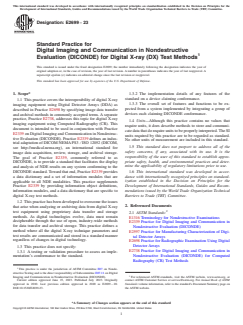
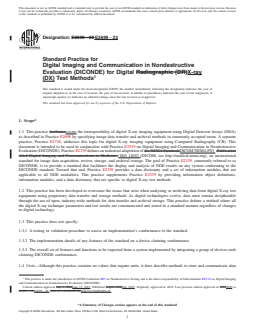
(Practice)Standard Practice for Digital Imaging and Communication in Nondestructive Evaluation (DICONDE) for Digital X-ray (DX) Test Methods
General Information
- Abstract
SIGNIFICANCE AND USE
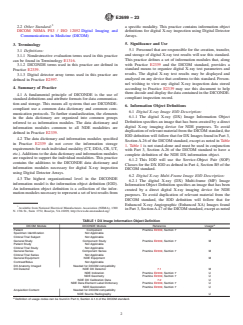
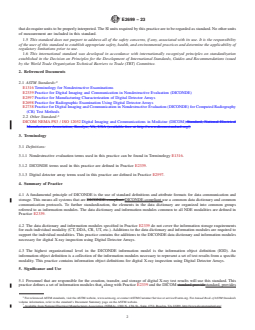
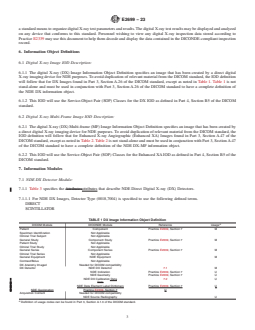
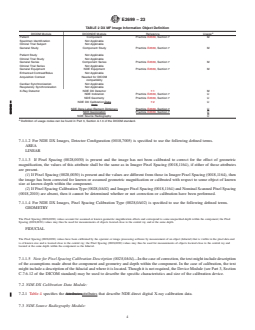
5.1 Personnel that are responsible for the creation, transfer, and storage of digital X-ray test results will use this standard. This practice defines a set of information modules that, along with Practice E2339 and the DICOM standard, provides a standard means to organize digital X-ray test parameters and results. The digital X-ray test results may be displayed and analyzed on any device that conforms to this standard. Personnel wishing to view any digital X-ray inspection data stored according to Practice E2339 may use this document to help them decode and display the data contained in the DICONDE-compliant inspection record.
SCOPE
1.1 This practice covers the interoperability of digital X-ray imaging equipment using Digital Detector Arrays (DDA) as described in Practice E2698 by specifying image data transfer and archival methods in commonly accepted terms. A separate practice, Practice E2738, addresses this topic for digital X-ray imaging equipment using Computed Radiography (CR). This document is intended to be used in conjunction with Practice E2339 on Digital Imaging and Communication in Nondestructive Evaluation (DICONDE). Practice E2339 defines an industrial adaptation of DICOM NEMA PS3 / ISO 12052 (DICOM, see http://medical.nema.org), an international standard for image data acquisition, review, storage, and archival storage. The goal of Practice E2339, commonly referred to as DICONDE, is to provide a standard that facilitates the display and analysis of NDE results on any system conforming to the DICONDE standard. Toward that end, Practice E2339 provides a data dictionary and a set of information modules that are applicable to all NDE modalities. This practice supplements Practice E2339 by providing information object definitions, information modules, and a data dictionary that are specific to digital X-ray test methods.
1.2 This practice has been developed to overcome the issues that arise when analyzing or archiving data from digital X-ray test equipment using proprietary data transfer and storage methods. As digital technologies evolve, data must remain decipherable through the use of open, industry-wide methods for data transfer and archival storage. This practice defines a method where all the digital X-ray technique parameters and test results are communicated and stored in a standard manner regardless of changes in digital technology.
1.3 This practice does not specify:
1.3.1 A testing or validation procedure to assess an implementation's conformance to the standard.
1.3.2 The implementation details of any features of the standard on a device claiming conformance.
1.3.3 The overall set of features and functions to be expected from a system implemented by integrating a group of devices each claiming DICONDE conformance.
1.4 Units—Although this practice contains no values that require units, it does describe methods to store and communicate data that do require units to be properly interpreted. The SI units required by this practice are to be regarded as standard. No other units of measurement are included in this standard.
1.5 This standard does not purport to address all of the safety concerns, if any, associated with its use. It is the responsibility of the user of this standard to establish appropriate safety, health, and environmental practices and determine the applicability of regulatory limitations prior to use.
1.6 This international standard was developed in accordance with internationally recognized principles on standardization established in the Decision on Principles for the Development of International Standards, Guides and Recommendations issued by the World Trade Organization Technical Barriers to Trade (TBT) Committee.
- Status
- Published
- Publication Date
- 14-Jun-2023
- Technical Committee
- E07 - Nondestructive Testing
Buy Documents
ASTM E2699-23 - Standard Practice for Digital Imaging and Communication in Nondestructive Evaluation (DICONDE) for Digital X-ray (DX) Test Methods
REDLINE ASTM E2699-23 - Standard Practice for Digital Imaging and Communication in Nondestructive Evaluation (DICONDE) for Digital X-ray (DX) Test Methods
Overview
ASTM E2699-23, titled Standard Practice for Digital Imaging and Communication in Nondestructive Evaluation (DICONDE) for Digital X-ray (DX) Test Methods, is issued by ASTM International. This standard addresses best practices for the creation, transfer, and storage of digital X-ray test results using Digital Detector Arrays (DDA) in the field of nondestructive evaluation (NDE). It ensures interoperability between digital X-ray imaging equipment and provides a standardized format for image data communication and archival based on the DICONDE framework.
By defining information modules and supplementing existing DICONDE and DICOM standards, ASTM E2699-23 allows digital X-ray data and related test parameters to remain accessible and compatible across evolving technologies and systems.
Key Topics
- Interoperability: Facilitates the seamless exchange and archiving of digital X-ray data among different systems, manufacturers, and formats, using common protocols and data dictionaries.
- Digital Detector Arrays (DDA): Specifies practices for managing data captured via DDAs, distinct from computed radiography (CR) which is covered under a separate standard.
- DICONDE Integration: Supplements ASTM E2339 and leverages the internationally recognized DICOM standard, ensuring digital radiography (DX) NDE data is organized, stored, and displayed consistently.
- Information Modules and Objects: Defines specific modules and object definitions tailored to the unique needs of digital X-ray testing, including detector and calibration data.
- Data Decoding and Analysis: Enables personnel to decode, display, and analyze DICONDE-compliant digital X-ray records on any compatible system, enhancing flexibility and accessibility.
- Open Standards: Promotes the use of open, industry-wide data transfer and storage methods, minimizing issues associated with proprietary formats.
Applications
ASTM E2699-23 has broad practical applications across industries where nondestructive testing and radiography are critical, such as aerospace, power generation, automotive, and manufacturing.
- Quality Assurance: Supports consistency and traceability in digital radiographic inspections, critical for regulatory compliance and safety-sensitive sectors.
- Data Management: Streamlines the storage, retrieval, and sharing of inspection data throughout the asset lifecycle, facilitating collaboration across teams and organizations.
- Vendor Neutrality: Ensures that digital X-ray data created today remains accessible in the future, regardless of changes in hardware or software solutions, providing future-proofing for archived NDE records.
- Equipment Integration: Allows facilities to integrate equipment from different manufacturers within a single DICONDE-compliant environment, reducing compatibility issues and operational disruption.
- Regulatory Compliance: Meets the requirements of recognized standards bodies and regulatory agencies, supporting organizations in fulfilling mandatory reporting and documentation practices.
Related Standards
For effective implementation and broader context, ASTM E2699-23 should be used in conjunction with the following standards:
- ASTM E2339 – Digital Imaging and Communication in Nondestructive Evaluation (DICONDE): Establishes the core framework and terminology for DICONDE in NDE.
- ASTM E2597 – Practice for Manufacturing Characterization of Digital Detector Arrays.
- ASTM E2698 – Practice for Radiographic Examination Using Digital Detector Arrays: Covers specific procedures for DDA-based imaging.
- ASTM E2738 – Practice for DICONDE for Computed Radiography (CR) Test Methods.
- DICOM NEMA PS3 / ISO 12052 – Digital Imaging and Communications in Medicine (DICOM): The internationally recognized standard upon which DICONDE is based.
Keywords: digital X-ray, DICONDE, DICOM, nondestructive evaluation, radiographic test methods, digital detector arrays, data interoperability, ASTM E2699-23, digital radiography, NDE data management, image data archiving.
Relations
- Effective Date
- 01-Feb-2024
- Effective Date
- 01-Dec-2019
- Effective Date
- 01-Mar-2019
- Effective Date
- 01-Feb-2018
- Effective Date
- 01-Jan-2018
- Effective Date
- 15-Jun-2017
- Effective Date
- 01-Feb-2017
- Effective Date
- 01-Aug-2016
- Effective Date
- 01-Feb-2016
- Effective Date
- 01-Dec-2015
- Effective Date
- 01-Sep-2015
- Effective Date
- 01-Jun-2014
- Effective Date
- 01-Jun-2014
- Effective Date
- 15-Dec-2013
- Effective Date
- 15-Dec-2013
Buy Documents
ASTM E2699-23 - Standard Practice for Digital Imaging and Communication in Nondestructive Evaluation (DICONDE) for Digital X-ray (DX) Test Methods
REDLINE ASTM E2699-23 - Standard Practice for Digital Imaging and Communication in Nondestructive Evaluation (DICONDE) for Digital X-ray (DX) Test Methods
Get Certified
Connect with accredited certification bodies for this standard

BSI Group
BSI (British Standards Institution) is the business standards company that helps organizations make excellence a habit.

NYCE
Mexican standards and certification body.
Sponsored listings
Frequently Asked Questions
ASTM E2699-23 is a standard published by ASTM International. Its full title is "Standard Practice for Digital Imaging and Communication in Nondestructive Evaluation (DICONDE) for Digital X-ray (DX) Test Methods". This standard covers: SIGNIFICANCE AND USE 5.1 Personnel that are responsible for the creation, transfer, and storage of digital X-ray test results will use this standard. This practice defines a set of information modules that, along with Practice E2339 and the DICOM standard, provides a standard means to organize digital X-ray test parameters and results. The digital X-ray test results may be displayed and analyzed on any device that conforms to this standard. Personnel wishing to view any digital X-ray inspection data stored according to Practice E2339 may use this document to help them decode and display the data contained in the DICONDE-compliant inspection record. SCOPE 1.1 This practice covers the interoperability of digital X-ray imaging equipment using Digital Detector Arrays (DDA) as described in Practice E2698 by specifying image data transfer and archival methods in commonly accepted terms. A separate practice, Practice E2738, addresses this topic for digital X-ray imaging equipment using Computed Radiography (CR). This document is intended to be used in conjunction with Practice E2339 on Digital Imaging and Communication in Nondestructive Evaluation (DICONDE). Practice E2339 defines an industrial adaptation of DICOM NEMA PS3 / ISO 12052 (DICOM, see http://medical.nema.org), an international standard for image data acquisition, review, storage, and archival storage. The goal of Practice E2339, commonly referred to as DICONDE, is to provide a standard that facilitates the display and analysis of NDE results on any system conforming to the DICONDE standard. Toward that end, Practice E2339 provides a data dictionary and a set of information modules that are applicable to all NDE modalities. This practice supplements Practice E2339 by providing information object definitions, information modules, and a data dictionary that are specific to digital X-ray test methods. 1.2 This practice has been developed to overcome the issues that arise when analyzing or archiving data from digital X-ray test equipment using proprietary data transfer and storage methods. As digital technologies evolve, data must remain decipherable through the use of open, industry-wide methods for data transfer and archival storage. This practice defines a method where all the digital X-ray technique parameters and test results are communicated and stored in a standard manner regardless of changes in digital technology. 1.3 This practice does not specify: 1.3.1 A testing or validation procedure to assess an implementation's conformance to the standard. 1.3.2 The implementation details of any features of the standard on a device claiming conformance. 1.3.3 The overall set of features and functions to be expected from a system implemented by integrating a group of devices each claiming DICONDE conformance. 1.4 Units—Although this practice contains no values that require units, it does describe methods to store and communicate data that do require units to be properly interpreted. The SI units required by this practice are to be regarded as standard. No other units of measurement are included in this standard. 1.5 This standard does not purport to address all of the safety concerns, if any, associated with its use. It is the responsibility of the user of this standard to establish appropriate safety, health, and environmental practices and determine the applicability of regulatory limitations prior to use. 1.6 This international standard was developed in accordance with internationally recognized principles on standardization established in the Decision on Principles for the Development of International Standards, Guides and Recommendations issued by the World Trade Organization Technical Barriers to Trade (TBT) Committee.
SIGNIFICANCE AND USE 5.1 Personnel that are responsible for the creation, transfer, and storage of digital X-ray test results will use this standard. This practice defines a set of information modules that, along with Practice E2339 and the DICOM standard, provides a standard means to organize digital X-ray test parameters and results. The digital X-ray test results may be displayed and analyzed on any device that conforms to this standard. Personnel wishing to view any digital X-ray inspection data stored according to Practice E2339 may use this document to help them decode and display the data contained in the DICONDE-compliant inspection record. SCOPE 1.1 This practice covers the interoperability of digital X-ray imaging equipment using Digital Detector Arrays (DDA) as described in Practice E2698 by specifying image data transfer and archival methods in commonly accepted terms. A separate practice, Practice E2738, addresses this topic for digital X-ray imaging equipment using Computed Radiography (CR). This document is intended to be used in conjunction with Practice E2339 on Digital Imaging and Communication in Nondestructive Evaluation (DICONDE). Practice E2339 defines an industrial adaptation of DICOM NEMA PS3 / ISO 12052 (DICOM, see http://medical.nema.org), an international standard for image data acquisition, review, storage, and archival storage. The goal of Practice E2339, commonly referred to as DICONDE, is to provide a standard that facilitates the display and analysis of NDE results on any system conforming to the DICONDE standard. Toward that end, Practice E2339 provides a data dictionary and a set of information modules that are applicable to all NDE modalities. This practice supplements Practice E2339 by providing information object definitions, information modules, and a data dictionary that are specific to digital X-ray test methods. 1.2 This practice has been developed to overcome the issues that arise when analyzing or archiving data from digital X-ray test equipment using proprietary data transfer and storage methods. As digital technologies evolve, data must remain decipherable through the use of open, industry-wide methods for data transfer and archival storage. This practice defines a method where all the digital X-ray technique parameters and test results are communicated and stored in a standard manner regardless of changes in digital technology. 1.3 This practice does not specify: 1.3.1 A testing or validation procedure to assess an implementation's conformance to the standard. 1.3.2 The implementation details of any features of the standard on a device claiming conformance. 1.3.3 The overall set of features and functions to be expected from a system implemented by integrating a group of devices each claiming DICONDE conformance. 1.4 Units—Although this practice contains no values that require units, it does describe methods to store and communicate data that do require units to be properly interpreted. The SI units required by this practice are to be regarded as standard. No other units of measurement are included in this standard. 1.5 This standard does not purport to address all of the safety concerns, if any, associated with its use. It is the responsibility of the user of this standard to establish appropriate safety, health, and environmental practices and determine the applicability of regulatory limitations prior to use. 1.6 This international standard was developed in accordance with internationally recognized principles on standardization established in the Decision on Principles for the Development of International Standards, Guides and Recommendations issued by the World Trade Organization Technical Barriers to Trade (TBT) Committee.
ASTM E2699-23 is classified under the following ICS (International Classification for Standards) categories: 35.240.80 - IT applications in health care technology. The ICS classification helps identify the subject area and facilitates finding related standards.
ASTM E2699-23 has the following relationships with other standards: It is inter standard links to ASTM E1316-24, ASTM E1316-19b, ASTM E1316-19, ASTM E2698-18, ASTM E1316-18, ASTM E1316-17a, ASTM E1316-17, ASTM E1316-16a, ASTM E1316-16, ASTM E1316-15a, ASTM E1316-15, ASTM E1316-14, ASTM E1316-14e1, ASTM E2738-13, ASTM E2738-13e1. Understanding these relationships helps ensure you are using the most current and applicable version of the standard.
ASTM E2699-23 is available in PDF format for immediate download after purchase. The document can be added to your cart and obtained through the secure checkout process. Digital delivery ensures instant access to the complete standard document.
Standards Content (Sample)
This international standard was developed in accordance with internationally recognized principles on standardization established in the Decision on Principles for the
Development of International Standards, Guides and Recommendations issued by the World Trade Organization Technical Barriers to Trade (TBT) Committee.
Designation: E2699 − 23
Standard Practice for
Digital Imaging and Communication in Nondestructive
Evaluation (DICONDE) for Digital X-ray (DX) Test Methods
This standard is issued under the fixed designation E2699; the number immediately following the designation indicates the year of
original adoption or, in the case of revision, the year of last revision. A number in parentheses indicates the year of last reapproval. A
superscript epsilon (´) indicates an editorial change since the last revision or reapproval.
This standard has been approved for use by agencies of the U.S. Department of Defense.
1. Scope* 1.3.2 The implementation details of any features of the
standard on a device claiming conformance.
1.1 This practice covers the interoperability of digital X-ray
1.3.3 The overall set of features and functions to be ex-
imaging equipment using Digital Detector Arrays (DDA) as
pected from a system implemented by integrating a group of
described in Practice E2698 by specifying image data transfer
devices each claiming DICONDE conformance.
and archival methods in commonly accepted terms. A separate
practice, Practice E2738, addresses this topic for digital X-ray
1.4 Units—Although this practice contains no values that
imaging equipment using Computed Radiography (CR). This
require units, it does describe methods to store and communi-
document is intended to be used in conjunction with Practice
cate data that do require units to be properly interpreted. The SI
E2339 on Digital Imaging and Communication in Nondestruc-
units required by this practice are to be regarded as standard.
tive Evaluation (DICONDE). Practice E2339 defines an indus-
No other units of measurement are included in this standard.
trial adaptation of DICOM NEMA PS3 ⁄ ISO 12052 (DICOM,
1.5 This standard does not purport to address all of the
see http://medical.nema.org), an international standard for
safety concerns, if any, associated with its use. It is the
image data acquisition, review, storage, and archival storage.
responsibility of the user of this standard to establish appro-
The goal of Practice E2339, commonly referred to as
priate safety, health, and environmental practices and deter-
DICONDE, is to provide a standard that facilitates the display
mine the applicability of regulatory limitations prior to use.
and analysis of NDE results on any system conforming to the
1.6 This international standard was developed in accor-
DICONDE standard. Toward that end, Practice E2339 provides
a data dictionary and a set of information modules that are dance with internationally recognized principles on standard-
ization established in the Decision on Principles for the
applicable to all NDE modalities. This practice supplements
Practice E2339 by providing information object definitions, Development of International Standards, Guides and Recom-
information modules, and a data dictionary that are specific to mendations issued by the World Trade Organization Technical
digital X-ray test methods. Barriers to Trade (TBT) Committee.
1.2 This practice has been developed to overcome the issues
2. Referenced Documents
that arise when analyzing or archiving data from digital X-ray
test equipment using proprietary data transfer and storage
2.1 ASTM Standards:
methods. As digital technologies evolve, data must remain
E1316 Terminology for Nondestructive Examinations
decipherable through the use of open, industry-wide methods
E2339 Practice for Digital Imaging and Communication in
for data transfer and archival storage. This practice defines a
Nondestructive Evaluation (DICONDE)
method where all the digital X-ray technique parameters and
E2597 Practice for Manufacturing Characterization of Digi-
test results are communicated and stored in a standard manner
tal Detector Arrays
regardless of changes in digital technology.
E2698 Practice for Radiographic Examination Using Digital
Detector Arrays
1.3 This practice does not specify:
E2738 Practice for Digital Imaging and Communication in
1.3.1 A testing or validation procedure to assess an imple-
Nondestructive Evaluation (DICONDE) for Computed
mentation’s conformance to the standard.
Radiography (CR) Test Methods
This practice is under the jurisdiction of ASTM Committee E07 on Nonde-
structive Testing and is the direct responsibility of Subcommittee E07.11 on Digital
Imaging and Communication in Nondestructive Evaluation (DICONDE). For referenced ASTM standards, visit the ASTM website, www.astm.org, or
Current edition approved June 15, 2023. Published July 2023. Originally contact ASTM Customer Service at service@astm.org. For Annual Book of ASTM
approved in 2010. Last previous edition approved in 2020 as E2699 – 20. Standards volume information, refer to the standard’s Document Summary page on
DOI:10.1520/E2699-23. the ASTM website.
*A Summary of Changes section appears at the end of this standard
Copyright © ASTM International, 100 Barr Harbor Drive, PO Box C700, West Conshohocken, PA 19428-2959. United States
E2699 − 23
2.2 Other Standard: a specific modality. This practice contains information object
DICOM NEMA PS3 / ISO 12052 Digital Imaging and definitions for digital X-ray inspection using Digital Detector
Communications in Medicine (DICOM) Arrays.
5. Significance and Use
3. Terminology
5.1 Personnel that are responsible for the creation, transfer,
3.1 Definitions:
and storage of digital X-ray test results will use this standard.
3.1.1 Nondestructive evaluation terms used in this practice
This practice defines a set of information modules that, along
can be found in Terminology E1316.
with Practice E2339 and the DICOM standard, provides a
3.1.2 DICONDE terms used in this practice are defined in
standard means to organize digital X-ray test parameters and
Practice E2339.
results. The digital X-ray test results may be displayed and
3.1.3 Digital detector array terms used in this practice are
analyzed on any device that conforms to this standard. Person-
defined in Practice E2597.
nel wishing to view any digital X-ray inspection data stored
4. Summary of Practice
according to Practice E2339 may use this document to help
them decode and display the data contained in the DICONDE-
4.1 A fundamental principle of DICONDE is the use of
compliant inspection record.
standard definitions and attribute formats for data communica-
tion and storage. This means all systems that are DICONDE-
6. Information Object Definitions
compliant use a common data dictionary and common com-
6.1 Digital X-ray Image IOD Description:
munication protocols. To further standardization, the elements
6.1.1 The digital X-ray (DX) Image Information Object
in the data dictionary are organized into common groups
Definition specifies an image that has been created by a direct
referred to as information modules. The data dictionary and
digital X-ray imaging device for NDE purposes. To avoid
information modules common to all NDE modalities are
duplication of relevant material from the DICOM standard, the
defined in Practice E2339.
IOD definition will follow that for DX Images found in Part 3,
4.2 The data dictionary and information modules specified
Section A.26 of the DICOM standard, except as noted in Table
in Practice E2339 do not cover the information storage
1. Table 1 is not stand-alone and must be used in conjunction
requirements for each individual modality (CT, DDA, CR, UT,
with Part 3, Section A.26 of the DICOM standard to have a
etc.). Additions to the data dictionary and information modules
complete definition of the NDE DX information object.
are required to support the individual modalities. This practice
6.1.2 This IOD will use the Service-Object Pair (SOP)
contains the additions to the DICONDE data dictionary and
Classes for the DX IOD as defined in Part 4, Section B5 of the
information modules necessary for digital X-ray inspection
DICOM standard.
using Digital Detector Arrays.
6.2 Digital X-ray Multi-Frame Image IOD Description:
4.3 The highest organizational level in the DICONDE
6.2.1 The digital X-ray (DX) Multi-frame (MF) Image
information model is the information object definition (IOD).
Information Object Definition specifies an image that has been
An information object definition is a collection of the infor-
created by a direct digital X-ray imaging device for NDE
mation modules necessary to represent a set of test results from
purposes. To avoid duplication of relevant material from the
DICOM standard, the IOD definition will follow that for
Enhanced X-ray Angiographic (Enhanced XA) Images found
Available from National Electrical Manufacturers Association (NEMA), 1300
in Part 3, Section A.47 of the DICOM standard, except as noted
N. 17th St., Suite 1752, Rosslyn, VA 22209, http://www.dicomstandard.org/
TABLE 1 DX Image Information Object Definition
A
DICOM Module DICONDE Module Reference Usage
Patient Component Practice E2339, Section 7 M
Specimen Identification Not Applicable
Clinical Trial Subject Not Applicable
General Study Component Study Practice E2339, Section 7 M
Patient Study Not Applicable
Clinical Trial Study Not Applicable
General Series Component Series Practice E2339, Section 7 M
Clinical Trial Series Not Applicable
General Equipment NDE Equipment M
Contrast/Bolus Not Applicable
DX Anatomy Imaged Needed for DICOM compatibility
DX Detector NDE DX Detector 7.1 M
NDE Indication Practice E2339, Section 7 U
NDE Geometry Practice E2339, Section 7 U
NDE DX Calibration Data 7.2 U
NDE Data Element Label Dictionary Practice E2339, Section 7 U
NDE Geolocation Practice E2339, Section 7 U
Acquisition Content Needed for DICOM compatibility
NDE Source Radiography U
A
Definition of usage codes can be found in Part 3, Section A.1.3 of the DICOM standard.
E2699 − 23
in Table 2. Table 2 is not stand-alone and must be used in 7.1.1.4 For NDE DX Images, Pixel Spacing Calibration
conjunction with Part 3, Section A.47 of the DICOM standard Type (0028,0A02) is specified to use the following defined
to have a complete definition of the NDE DX-MF information terms.
object. GEOMETRY
6.2.2 This IOD will use the Service-Object Pair (SOP)
The Pixel Spacing (0028,0030) values account for assumed or known geometric
magnification effects and correspond to some unspecified depth within the component;
Classes for the Enhanced XA IOD as defined in Part 4, Section
the Pixel Spacing (0028,0030) values may thus be used for measurements of objects
B5 of the DICOM standard.
located close to the central ray and at the same depth.
7. Information Modules FIDUCIAL
The Pixel Spacing (0028,0030) values have been calibrated by the operator or image
7.1 NDE DX Detector Module:
processing software by measurement of an object (fiducial) that is visible in the pixel
7.1.1 Table 3 specifies the attributes that describe NDE
data and is of known size and is located close to the central ray; the Pixel Spacing
Direct Digital X-ray (DX) Detectors.
(0028,0030) values may thus be used for measurements of objects located close to the
central ray and located at the same depth within the component as the fiducial.
7.1.1.1 For NDE DX Images, Detector Type (0018,7004) is
specified to use the following defined terms.
7.1.1.5 Note for Pixel Spacing Calibration Description
DIRECT
(0028,0A04)—In the case of correction, the text might include
SCINTILLATOR
description of the assumptions made about the component and
7.1.1.2 For NDE DX Images, Detector Configuration (0018,
geometry and depth within the component. In the case of
7005) is specified to use the following defined terms.
calibration, the text might include a description of the fiducial
AREA
and where it is located. Though it is not required, the Device
LINEAR
Module (see Part 3, Section C.7.6.12 of the DICOM standard)
7.1.1.3 If Pixel Spacing (0028,0030) is present and the
may be used to describe the specific characteristics and size of
image has not been calibrated to correct for the effect of
the calibration device.
geometric magnification, the values of this attribute shall be the
7.2 NDE DX Calibration Data Module:
same as in Imager Pixel Spacing (0018,1164), if either of those
7.2.1 Table 4 specifies the attributes that describe NDE
attributes are present.
direct digital X-ray calibration data.
(1) If Pixel Spacing (0028,0030) is present and the values
are different from those in Imager Pixel Spacing (0018,1164),
7.3 NDE Source Radiography Module:
then the image has been corrected for known or assumed
7.3.1 Table 5 specifies the attributes that describe NDE
geometric magnification or calibrated with respect to some
Source Radiography Module.
object of known size at known depth within the component.
(2) If Pixel Spacing Calibration Type (0028,0A02) and
8. Keywords
Imager Pixel Spacing (0018,1164) and Nominal Scanned Pixel
Spacing (0018,2010) are absent, then it cannot be determined 8.1 database; DICOM; DICONDE; digital data storage;
whether or not correction or calibration have been performed. digital data transmission; direct digital X-ray; DX; file format
TABLE 2 DX MF Image Information Object Definition
A
DICOM Module DICONDE Module Reference Usage
Patient Component Practice E2339, Section 7 M
Specimen Identification Not Applicable
Clinical Trial Subject Not Applicable
General Study Component Study Practice E2339, Section 7 M
Patient Study Not Applicable
Clinical Trial St
...
This document is not an ASTM standard and is intended only to provide the user of an ASTM standard an indication of what changes have been made to the previous version. Because
it may not be technically possible to adequately depict all changes accurately, ASTM recommends that users consult prior editions as appropriate. In all cases only the current version
of the standard as published by ASTM is to be considered the official document.
Designation: E2699 − 20 E2699 − 23
Standard Practice for
Digital Imaging and Communication in Nondestructive
Evaluation (DICONDE) for Digital Radiographic (DR)X-ray
(DX) Test Methods
This standard is issued under the fixed designation E2699; the number immediately following the designation indicates the year of
original adoption or, in the case of revision, the year of last revision. A number in parentheses indicates the year of last reapproval. A
superscript epsilon (´) indicates an editorial change since the last revision or reapproval.
This standard has been approved for use by agencies of the U.S. Department of Defense.
1. Scope*
1.1 This practice facilitatescovers the interoperability of digital X-ray imaging equipment using Digital Detector Arrays (DDA)
as described in Practice E2698 by specifying image data transfer and archival methods in commonly accepted terms. A separate
practice, Practice E2738, addresses this topic for digital X-ray imaging equipment using Computed Radiography (CR). This
document is intended to be used in conjunction with Practice E2339 on Digital Imaging and Communication in Nondestructive
Evaluation (DICONDE). Practice E2339 defines an industrial adaptation of the NEMA StandardsDICOM NEMA PS3 Publication
titled Digital Imaging and Communications in Medicine ⁄ ISO 12052 (DICOM, see http://medical.nema.org), an international
standard for image data acquisition, review, storage, and archival storage. The goal of Practice E2339, commonly referred to as
DICONDE, is to provide a standard that facilitates the display and analysis of NDE results on any system conforming to the
DICONDE standard. Toward that end, Practice E2339 provides a data dictionary and a set of information modules that are
applicable to all NDE modalities. This practice supplements Practice E2339 by providing information object definitions,
information modules, and a data dictionary that are specific to digital X-ray test methods.
1.2 This practice has been developed to overcome the issues that arise when analyzing or archiving data from digital X-ray test
equipment using proprietary data transfer and storage methods. As digital technologies evolve, data must remain decipherable
through the use of open, industry-wide methods for data transfer and archival storage. This practice defines a method where all
the digital X-ray technique parameters and test results are communicated and stored in a standard manner regardless of changes
in digital technology.
1.3 This practice does not specify:
1.3.1 A testing or validation procedure to assess an implementation’s conformance to the standard.
1.3.2 The implementation details of any features of the standard on a device claiming conformance.
1.3.3 The overall set of features and functions to be expected from a system implemented by integrating a group of devices each
claiming DICONDE conformance.
1.4 Units—Although this practice contains no values that require units, it does describe methods to store and communicate data
This practice is under the jurisdiction of ASTM Committee E07 on Nondestructive Testing and is the direct responsibility of Subcommittee E07.11 on Digital Imaging
and Communication in Nondestructive Evaluation (DICONDE).
Current edition approved July 1, 2020June 15, 2023. Published August 2020July 2023. Originally approved in 2010. Last previous edition approved in 20182020 as
E2699 – 18.E2699 – 20. DOI:10.1520/E2699-20.DOI:10.1520/E2699-23.
*A Summary of Changes section appears at the end of this standard
Copyright © ASTM International, 100 Barr Harbor Drive, PO Box C700, West Conshohocken, PA 19428-2959. United States
E2699 − 23
that do require units to be properly interpreted. The SI units required by this practice are to be regarded as standard. No other units
of measurement are included in this standard.
1.5 This standard does not purport to address all of the safety concerns, if any, associated with its use. It is the responsibility
of the user of this standard to establish appropriate safety, health, and environmental practices and determine the applicability of
regulatory limitations prior to use.
1.6 This international standard was developed in accordance with internationally recognized principles on standardization
established in the Decision on Principles for the Development of International Standards, Guides and Recommendations issued
by the World Trade Organization Technical Barriers to Trade (TBT) Committee.
2. Referenced Documents
2.1 ASTM Standards:
E1316 Terminology for Nondestructive Examinations
E2339 Practice for Digital Imaging and Communication in Nondestructive Evaluation (DICONDE)
E2597 Practice for Manufacturing Characterization of Digital Detector Arrays
E2698 Practice for Radiographic Examination Using Digital Detector Arrays
E2738 Practice for Digital Imaging and Communication in Nondestructive Evaluation (DICONDE) for Computed Radiography
(CR) Test Methods
2.2 Other Standard:
DICOM NEMA PS3 / ISO 12052 Digital Imaging and Communications in Medicine (DICOM) Standard, National Electrical
Manufacturers Association, Rosslyn, VA, USA (available free at http://www.dicomstandard.org/)
3. Terminology
3.1 Definitions:
3.1.1 Nondestructive evaluation terms used in this practice can be found in Terminology E1316.
3.1.2 DICONDE terms used in this practice are defined in Practice E2339.
3.1.3 Digital detector array terms used in this practice are defined in Practice E2597.
4. Summary of Practice
4.1 A fundamental principle of DICONDE is the use of standard definitions and attribute formats for data communication and
storage. This means all systems that are DICONDE compliant DICONDE-compliant use a common data dictionary and common
communication protocols. To further standardization, the elements in the data dictionary are organized into common groups
referred to as information modules. The data dictionary and information modules common to all NDE modalities are defined in
Practice E2339.
4.2 The data dictionary and information modules specified in Practice E2339 do not cover the information storage requirements
for each individual modality (CT, DDA, CR, UT, etc.). Additions to the data dictionary and information modules are required to
support the individual modalities. This practice contains the additions to the DICONDE data dictionary and information modules
necessary for digital X-ray inspection using Digital Detector Arrays.
4.3 The highest organizational level in the DICONDE information model is the information object definition (IOD). An
information object definition is a collection of the information modules necessary to represent a set of test results from a specific
modality. This practice contains information object definitions for digital X-ray inspection using Digital Detector Arrays.
5. Significance and Use
5.1 Personnel that are responsible for the creation, transfer, and storage of digital X-ray test results will use this standard. This
practice defines a set of information modules that, along with Practice E2339 and the DICOM standard providestandard, provides
For referenced ASTM standards, visit the ASTM website, www.astm.org, or contact ASTM Customer Service at service@astm.org. For Annual Book of ASTM Standards
volume information, refer to the standard’s Document Summary page on the ASTM website.
Available from National Electrical Manufacturers Association (NEMA), 1300 N. 17th St., Suite 1752, Rosslyn, VA 22209, http://www.dicomstandard.org/
E2699 − 23
a standard means to organize digital X-ray test parameters and results. The digital X-ray test results may be displayed and analyzed
on any device that conforms to this standard. Personnel wishing to view any digital X-ray inspection data stored according to
Practice E2339 may use this document to help them decode and display the data contained in the DICONDE-compliant inspection
record.
6. Information Object Definitions
6.1 Digital X-ray Image IOD Description:
6.1.1 The digital X-ray (DX) Image Information Object Definition specifies an image that has been created by a direct digital
X-ray imaging device for NDE purposes. To avoid duplication of relevant material from the DICOM standard, the IOD definition
will follow that for DX Images found in Part 3, Section A.26 of the DICOM standard, except as noted in Table 1. Table 1 is not
stand-alone and must be used in conjunction with Part 3, Section A.26 of the DICOM standard to have a complete definition of
the NDE DX information object.
6.1.2 This IOD will use the Service-Object Pair (SOP) Classes for the DX IOD as defined in Part 4, Section B5 of the DICOM
standard.
6.2 Digital X-ray Multi-Frame Image IOD Description:
6.2.1 The digital X-ray (DX) Multi-frame (MF) Image Information Object Definition specifies an image that has been created by
a direct digital X-ray imaging device for NDE purposes. To avoid duplication of relevant material from the DICOM standard, the
IOD definition will follow that for Enhanced X-ray Angiographic (Enhanced XA) Images found in Part 3, Section A.47 of the
DICOM standard, except as noted in Table 2. Table 2 is not stand-alone and must be used in conjunction with Part 3, Section A.47
of the DICOM standard to have a complete definition of the NDE DX-MF information object.
6.2.2 This IOD will use the Service-Object Pair (SOP) Classes for the Enhanced XA IOD as defined in Part 4, Section B5 of the
DICOM standard.
7. Information Modules
7.1 NDE DX Detector Module:
7.1.1 Table 3 specifies the Attributesattributes that describe NDE Direct Digital X-ray (DX) Detectors.
7.1.1.1 For NDE DX Images, Detector Type (0018,7004) is specified to use the following defined terms.
DIRECT
SCINTILLATOR
TABLE 1 DX Image Information Object Definition
A
DICOM Module DICONDE Module Reference Usage
Patient Component Practice E2339, Section 7 M
Specimen Identification Not Applicable
Clinical Trial Subject Not Applicable
General Study Component Study Practice E2339, Section 7 M
Patient Study Not Applicable
Clinical Trial Study Not Applicable
General Series Component Series Practice E2339, Section 7 M
Clinical Trial Series Not Applicable
General Equipment NDE Equipment M
Contrast/Bolus Not Applicable
DX Anatomy Imaged Needed for DICOM compatibility
DX Detector NDE DX Detector 7.1 M
NDE Indication Practice E2339, Section 7 U
NDE Geometry Practice E2339, Section 7 U
NDE DX Calibration Data 7.2 U
Data
NDE Data Element Label Dictionary Practice E2339, Section 7 U
NDE Geolocation Practice E2339, Section 7 U
Acquisition Content Needed for DICOM compatibility
NDE Source Radiography U
A
Definition of usage codes can be found in Part 3, Section A.1.3 of the DICOM standard.
E2699 − 23
TABLE 2 DX MF Image Information Object Definition
A
DICOM Module DICONDE Module Reference Usage
Patient Component Practice E2339, Section 7 M
Specimen Identification Not Applicable
Clinical Trial Subject Not Applicable
General Study Component Study Practice E2339, Section 7 M
Patient Study Not Applicable
Clinical Trial Study Not Applicable
General Series Component Series Practice E2339, Section 7 M
Clinical Trial Series Not Applicable
General Equipment NDE Equipment Practice E2339, Section 7 M
Enhanced Contrast/Bolus Not Applicable
Acquisition Context Needed for DICOM
compatibility
Cardiac Synchronization Not Applicable
Respiratory Synchronization Not Applicable
X-Ray Detector NDE DX Detector 7.1 M
NDE Indication Practice E2339, Section 7 U
NDE Geometry Practice E2339, Section 7 U
NDE DX Calibration Data 7.2 U
Data
NDE Data Label Element Dictionary Practice E2339, Section 7 U
NDE Geolocation Practice E2339, Section 7 U
NDE Source Radiography U
A
Definition of usage codes can be found in Part 3, Section A.1.3 of the DICOM standard.
7.1.1.2 For NDE DX Images, Detector Configuration (0018,7005) is specified to use the following defined terms.
AREA
LINEAR
7.1.1.3 If Pixel Spacing (0028,0030) is present and the image has not been calibrated to correct for the effect of geometric
magnification, the values of this attribute shall be the same as in Imager Pixel Spacing (0018,1164), if either of those attributes
are present.
(1) If Pixel Spacing (0028,0030) is present and the values are different from those in Imager Pixel Spacing (0018,1164), then
the image has been corrected for known or assumed geometric magnification or calibrated with respect to some object of known
size at known depth within the component.
(2) If Pixel Spacing Calibration Type (0028,0A02) and Imager Pixel Spacing (0018,1164) and Nominal Scanned Pixel Spacing
(0018,2010) are absent, then it cannot be determined whether or not correction or calibration have been performed.
7.1.1.4 For NDE DX Images, Pixel Spacing Calibration Type (0028,0A02) is specified to use the following defined terms.
GEOMETRY
The Pixel Spacing (0028,0030) values account for assumed or known geometric magnification effects and correspond to some unspecified depth within the component; the Pixel
Spacing (0028,0030) values may thus be used for measurements of objects located close to the central ray and at the same depth.
FIDUCIAL
The Pixel Spacing (0028,0030) values have been calibrated by the operator or image processing software by measurement of an object (fiducial) that is visible in the pixel data and
is of known size and is located close to the central ray; the Pixel Spacing (0028,0030) values may thus be used for measurements of objects located close to the central ray and
located at the same depth within the component as the fiducial.
7.1.1.5 Note for Pixel Spacing Calibration Description (0028,0A04)—In the case of correction, the text might include description
of the assumptions made about the component and geometry and depth within the component. In the case of calibration, the text
might include a description of the fiducial and where it is located. Though it is not required, the Device Module (see Part 3, Section
C.7.6.
...