

ASTM E2767-24
(Practice)Standard Practice for Digital Imaging and Communication in Nondestructive Evaluation (DICONDE) for X-ray Computed Tomography (CT) Test Methods
General Information
- Abstract
SIGNIFICANCE AND USE
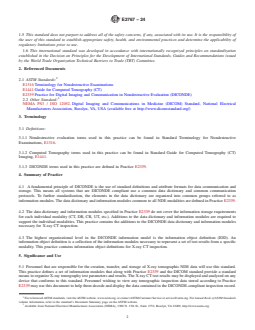
5.1 Personnel that are responsible for the creation, transfer, and storage of X-ray tomographic NDE data will use this standard. This practice defines a set of information modules that along with Practice E2339 and the DICOM standard provide a standard means to organize X-ray tomography test parameters and results. The X-ray CT test results may be displayed and analyzed on any device that conforms to this standard. Personnel wishing to view any tomographic inspection data stored according to Practice E2339 may use this document to help them decode and display the data contained in the DICONDE-compliant inspection record.
SCOPE
1.1 This practice facilitates the interoperability of X-ray computed tomography (CT) imaging equipment by specifying image data transfer and archival storage methods in commonly accepted terms. This document is intended to be used in conjunction with Practice E2339 on Digital Imaging and Communication in Nondestructive Evaluation (DICONDE). Practice E2339 defines an industrial adaptation of the NEMA Standards Publication titled Digital Imaging and Communications in Medicine (DICOM, see http://medical.nema.org), an international standard for image data acquisition, review, storage, and archival storage. The goal of Practice E2339, commonly referred to as DICONDE, is to provide a standard that facilitates the display and analysis of NDE test results on any system conforming to the DICONDE standard. Toward that end, Practice E2339 provides a data dictionary and a set of information modules that are applicable to all NDE modalities. This practice supplements Practice E2339 by providing information object definitions, information modules and a data dictionary that are specific to X-ray CT test methods.
1.2 This practice has been developed to overcome the issues that arise when analyzing or archiving data from tomographic test equipment using proprietary data transfer and storage methods. As digital technologies evolve, data must remain decipherable through the use of open, industry-wide methods for data transfer and archival storage. This practice defines a method where all the X-ray CT technique parameters and test results are communicated and stored in a standard manner regardless of changes in digital technology.
1.3 This practice does not specify:
1.3.1 A testing or validation procedure to assess an implementation's conformance to the standard.
1.3.2 The implementation details of any features of the standard on a device claiming conformance.
1.3.3 The overall set of features and functions to be expected from a system implemented by integrating a group of devices each claiming DICONDE conformance.
1.4 Units—Although this practice contains no values that require units, it does describe methods to store and communicate data that do require units to be properly interpreted. The values stated in SI units are to be regarded as standard. No other units of measurement are included in this standard.
1.5 This standard does not purport to address all of the safety concerns, if any, associated with its use. It is the responsibility of the user of this standard to establish appropriate safety, health, and environmental practices and determine the applicability of regulatory limitations prior to use.
1.6 This international standard was developed in accordance with internationally recognized principles on standardization established in the Decision on Principles for the Development of International Standards, Guides and Recommendations issued by the World Trade Organization Technical Barriers to Trade (TBT) Committee.
- Status
- Published
- Publication Date
- 31-Jan-2024
- Technical Committee
- E07 - Nondestructive Testing
Buy Documents
ASTM E2767-24 - Standard Practice for Digital Imaging and Communication in Nondestructive Evaluation (DICONDE) for X-ray Computed Tomography (CT) Test Methods
REDLINE ASTM E2767-24 - Standard Practice for Digital Imaging and Communication in Nondestructive Evaluation (DICONDE) for X-ray Computed Tomography (CT) Test Methods
Overview
ASTM E2767-24 is an internationally recognized standard practice from ASTM International focused on digital imaging and communication in nondestructive evaluation (NDE) for X-ray computed tomography (CT) test methods. Building upon Practice E2339 and the widely adopted DICOM (Digital Imaging and Communications in Medicine) standard, ASTM E2767-24 aims to ensure interoperability, consistency, and standardization in the creation, transfer, archiving, and decoding of digital X-ray CT data for NDE applications.
The standard is specifically designed for personnel responsible for organizing and managing X-ray tomographic data, enabling stakeholders across industries to store, retrieve, and analyze CT inspection data using any system that conforms to these protocols.
Key Topics
- Standardization of X-ray CT Data: Establishes a uniform methodology for encoding, transferring, and storing all relevant technique parameters, test results, and images produced by X-ray CT systems in the context of nondestructive testing.
- DICONDE Compliance: Supplements DICONDE (Digital Imaging and Communication in Nondestructive Evaluation) as adapted from the medical DICOM standard, enabling cross-platform compatibility and futureproof archiving of CT data.
- Information Modules and Data Dictionary: Provides specific object definitions and information modules extending the general DICONDE foundation to address the unique requirements of X-ray CT modalities.
- Interoperability: Facilitates seamless display and analysis of nondestructive inspection results on any hardware or software platform that adheres to the standard, avoiding vendor lock-in and data siloes.
- Open Format Support: Advocates the use of open, industry-wide digital imaging standards to overcome proprietary barriers and ensure data accessibility as technology evolves.
Applications
Adhering to ASTM E2767-24 delivers practical value across multiple nondestructive evaluation scenarios, including:
- Aerospace and Automotive: Ensures that X-ray CT results from inspection of complex parts can be shared, archived, and analyzed regardless of the original equipment source.
- Manufacturing Quality Control: Supports consistent digital traceability and record-keeping for product validation via CT imaging.
- Industrial R&D: Simplifies collaboration by enabling researchers to share fully documented CT inspection datasets using standardized metadata and image formats.
- Long-term Data Archival: Guarantees that as imaging technology changes, legacy CT data will remain accessible and interpretable.
- Regulatory Compliance: Assists organizations in meeting quality assurance requirements for digital imaging and communication practices in NDE, relevant to industry regulators and auditors.
- Multi-vendor Environments: Allows integration and interoperability of various brands of imaging hardware and software, reducing operational friction.
Related Standards
For organizations seeking to implement compliant digital imaging workflows for nondestructive testing, the following standards are closely related to ASTM E2767-24:
- ASTM E2339: Practice for Digital Imaging and Communication in Nondestructive Evaluation (DICONDE) - foundational standard adapting the DICOM model for industrial NDE.
- ASTM E1441: Guide for Computed Tomography (CT) Imaging - provides terminology and guidance for the CT inspection process.
- ASTM E1316: Terminology for Nondestructive Examinations - defines essential vocabulary for NDE professionals.
- NEMA PS3 / ISO 12052: Digital Imaging and Communications in Medicine (DICOM) Standard - the original international reference for digital medical imaging, forming the basis for DICONDE.
Conclusion
ASTM E2767-24 plays a crucial role in advancing digital imaging best practices for X-ray CT in nondestructive evaluation. Organizations that adopt this standard benefit from improved data interoperability, futureproof archiving, and streamlined analysis, making it an essential component in modern NDE digital workflows. For further information or implementation guidance, refer to ASTM E2339, related standards above, and consult with digital imaging professionals experienced in DICONDE and X-ray CT integration.
Keywords: ASTM E2767-24, DICONDE, X-ray computed tomography, CT, nondestructive evaluation, digital imaging, data interoperability, industrial standards, data archival, NDE digital standards, DICOM.
Relations
- Effective Date
- 01-Feb-2024
- Effective Date
- 01-Feb-2024
- Effective Date
- 01-Feb-2024
- Referred By
ASTM E1814-14(2022) - Standard Practice for Computed Tomographic (CT) Examination of Castings - Effective Date
- 01-Feb-2024
- Effective Date
- 01-Feb-2024
- Effective Date
- 01-Feb-2024
- Effective Date
- 01-Feb-2024
- Effective Date
- 01-Feb-2024
- Effective Date
- 01-Feb-2024
- Effective Date
- 01-Feb-2024
Buy Documents
ASTM E2767-24 - Standard Practice for Digital Imaging and Communication in Nondestructive Evaluation (DICONDE) for X-ray Computed Tomography (CT) Test Methods
REDLINE ASTM E2767-24 - Standard Practice for Digital Imaging and Communication in Nondestructive Evaluation (DICONDE) for X-ray Computed Tomography (CT) Test Methods
Get Certified
Connect with accredited certification bodies for this standard

BSI Group
BSI (British Standards Institution) is the business standards company that helps organizations make excellence a habit.

NYCE
Mexican standards and certification body.
Sponsored listings
Frequently Asked Questions
ASTM E2767-24 is a standard published by ASTM International. Its full title is "Standard Practice for Digital Imaging and Communication in Nondestructive Evaluation (DICONDE) for X-ray Computed Tomography (CT) Test Methods". This standard covers: SIGNIFICANCE AND USE 5.1 Personnel that are responsible for the creation, transfer, and storage of X-ray tomographic NDE data will use this standard. This practice defines a set of information modules that along with Practice E2339 and the DICOM standard provide a standard means to organize X-ray tomography test parameters and results. The X-ray CT test results may be displayed and analyzed on any device that conforms to this standard. Personnel wishing to view any tomographic inspection data stored according to Practice E2339 may use this document to help them decode and display the data contained in the DICONDE-compliant inspection record. SCOPE 1.1 This practice facilitates the interoperability of X-ray computed tomography (CT) imaging equipment by specifying image data transfer and archival storage methods in commonly accepted terms. This document is intended to be used in conjunction with Practice E2339 on Digital Imaging and Communication in Nondestructive Evaluation (DICONDE). Practice E2339 defines an industrial adaptation of the NEMA Standards Publication titled Digital Imaging and Communications in Medicine (DICOM, see http://medical.nema.org), an international standard for image data acquisition, review, storage, and archival storage. The goal of Practice E2339, commonly referred to as DICONDE, is to provide a standard that facilitates the display and analysis of NDE test results on any system conforming to the DICONDE standard. Toward that end, Practice E2339 provides a data dictionary and a set of information modules that are applicable to all NDE modalities. This practice supplements Practice E2339 by providing information object definitions, information modules and a data dictionary that are specific to X-ray CT test methods. 1.2 This practice has been developed to overcome the issues that arise when analyzing or archiving data from tomographic test equipment using proprietary data transfer and storage methods. As digital technologies evolve, data must remain decipherable through the use of open, industry-wide methods for data transfer and archival storage. This practice defines a method where all the X-ray CT technique parameters and test results are communicated and stored in a standard manner regardless of changes in digital technology. 1.3 This practice does not specify: 1.3.1 A testing or validation procedure to assess an implementation's conformance to the standard. 1.3.2 The implementation details of any features of the standard on a device claiming conformance. 1.3.3 The overall set of features and functions to be expected from a system implemented by integrating a group of devices each claiming DICONDE conformance. 1.4 Units—Although this practice contains no values that require units, it does describe methods to store and communicate data that do require units to be properly interpreted. The values stated in SI units are to be regarded as standard. No other units of measurement are included in this standard. 1.5 This standard does not purport to address all of the safety concerns, if any, associated with its use. It is the responsibility of the user of this standard to establish appropriate safety, health, and environmental practices and determine the applicability of regulatory limitations prior to use. 1.6 This international standard was developed in accordance with internationally recognized principles on standardization established in the Decision on Principles for the Development of International Standards, Guides and Recommendations issued by the World Trade Organization Technical Barriers to Trade (TBT) Committee.
SIGNIFICANCE AND USE 5.1 Personnel that are responsible for the creation, transfer, and storage of X-ray tomographic NDE data will use this standard. This practice defines a set of information modules that along with Practice E2339 and the DICOM standard provide a standard means to organize X-ray tomography test parameters and results. The X-ray CT test results may be displayed and analyzed on any device that conforms to this standard. Personnel wishing to view any tomographic inspection data stored according to Practice E2339 may use this document to help them decode and display the data contained in the DICONDE-compliant inspection record. SCOPE 1.1 This practice facilitates the interoperability of X-ray computed tomography (CT) imaging equipment by specifying image data transfer and archival storage methods in commonly accepted terms. This document is intended to be used in conjunction with Practice E2339 on Digital Imaging and Communication in Nondestructive Evaluation (DICONDE). Practice E2339 defines an industrial adaptation of the NEMA Standards Publication titled Digital Imaging and Communications in Medicine (DICOM, see http://medical.nema.org), an international standard for image data acquisition, review, storage, and archival storage. The goal of Practice E2339, commonly referred to as DICONDE, is to provide a standard that facilitates the display and analysis of NDE test results on any system conforming to the DICONDE standard. Toward that end, Practice E2339 provides a data dictionary and a set of information modules that are applicable to all NDE modalities. This practice supplements Practice E2339 by providing information object definitions, information modules and a data dictionary that are specific to X-ray CT test methods. 1.2 This practice has been developed to overcome the issues that arise when analyzing or archiving data from tomographic test equipment using proprietary data transfer and storage methods. As digital technologies evolve, data must remain decipherable through the use of open, industry-wide methods for data transfer and archival storage. This practice defines a method where all the X-ray CT technique parameters and test results are communicated and stored in a standard manner regardless of changes in digital technology. 1.3 This practice does not specify: 1.3.1 A testing or validation procedure to assess an implementation's conformance to the standard. 1.3.2 The implementation details of any features of the standard on a device claiming conformance. 1.3.3 The overall set of features and functions to be expected from a system implemented by integrating a group of devices each claiming DICONDE conformance. 1.4 Units—Although this practice contains no values that require units, it does describe methods to store and communicate data that do require units to be properly interpreted. The values stated in SI units are to be regarded as standard. No other units of measurement are included in this standard. 1.5 This standard does not purport to address all of the safety concerns, if any, associated with its use. It is the responsibility of the user of this standard to establish appropriate safety, health, and environmental practices and determine the applicability of regulatory limitations prior to use. 1.6 This international standard was developed in accordance with internationally recognized principles on standardization established in the Decision on Principles for the Development of International Standards, Guides and Recommendations issued by the World Trade Organization Technical Barriers to Trade (TBT) Committee.
ASTM E2767-24 is classified under the following ICS (International Classification for Standards) categories: 35.240.80 - IT applications in health care technology. The ICS classification helps identify the subject area and facilitates finding related standards.
ASTM E2767-24 has the following relationships with other standards: It is inter standard links to ASTM E2767-21, ASTM E3166-20e1, ASTM E2339-21, ASTM E1814-14(2022), ASTM E3147-18, ASTM E3169-18, ASTM E3267-21, ASTM E1672-12(2020), ASTM E1570-19, ASTM E3375-23. Understanding these relationships helps ensure you are using the most current and applicable version of the standard.
ASTM E2767-24 is available in PDF format for immediate download after purchase. The document can be added to your cart and obtained through the secure checkout process. Digital delivery ensures instant access to the complete standard document.
Standards Content (Sample)
This international standard was developed in accordance with internationally recognized principles on standardization established in the Decision on Principles for the
Development of International Standards, Guides and Recommendations issued by the World Trade Organization Technical Barriers to Trade (TBT) Committee.
Designation: E2767 − 24
Standard Practice for
Digital Imaging and Communication in Nondestructive
Evaluation (DICONDE) for X-ray Computed Tomography (CT)
Test Methods
This standard is issued under the fixed designation E2767; the number immediately following the designation indicates the year of
original adoption or, in the case of revision, the year of last revision. A number in parentheses indicates the year of last reapproval. A
superscript epsilon (´) indicates an editorial change since the last revision or reapproval.
This standard has been approved for use by agencies of the U.S. Department of Defense.
1. Scope* 1.3.2 The implementation details of any features of the
standard on a device claiming conformance.
1.1 This practice facilitates the interoperability of X-ray
1.3.3 The overall set of features and functions to be ex-
computed tomography (CT) imaging equipment by specifying
pected from a system implemented by integrating a group of
image data transfer and archival storage methods in commonly
devices each claiming DICONDE conformance.
accepted terms. This document is intended to be used in
conjunction with Practice E2339 on Digital Imaging and 1.4 Units—Although this practice contains no values that
Communication in Nondestructive Evaluation (DICONDE). require units, it does describe methods to store and communi-
Practice E2339 defines an industrial adaptation of the NEMA cate data that do require units to be properly interpreted. The
Standards Publication titled Digital Imaging and Communica- values stated in SI units are to be regarded as standard. No
tions in Medicine (DICOM, see http://medical.nema.org), an other units of measurement are included in this standard.
international standard for image data acquisition, review,
1.5 This standard does not purport to address all of the
storage, and archival storage. The goal of Practice E2339,
safety concerns, if any, associated with its use. It is the
commonly referred to as DICONDE, is to provide a standard
responsibility of the user of this standard to establish appro-
that facilitates the display and analysis of NDE test results on
priate safety, health, and environmental practices and deter-
any system conforming to the DICONDE standard. Toward
mine the applicability of regulatory limitations prior to use.
that end, Practice E2339 provides a data dictionary and a set of
1.6 This international standard was developed in accor-
information modules that are applicable to all NDE modalities.
dance with internationally recognized principles on standard-
This practice supplements Practice E2339 by providing infor-
ization established in the Decision on Principles for the
mation object definitions, information modules and a data
Development of International Standards, Guides and Recom-
dictionary that are specific to X-ray CT test methods.
mendations issued by the World Trade Organization Technical
1.2 This practice has been developed to overcome the issues
Barriers to Trade (TBT) Committee.
that arise when analyzing or archiving data from tomographic
test equipment using proprietary data transfer and storage
2. Referenced Documents
methods. As digital technologies evolve, data must remain
2.1 ASTM Standards:
decipherable through the use of open, industry-wide methods
E1316 Terminology for Nondestructive Examinations
for data transfer and archival storage. This practice defines a
E1441 Guide for Computed Tomography (CT)
method where all the X-ray CT technique parameters and test
E2339 Practice for Digital Imaging and Communication in
results are communicated and stored in a standard manner
Nondestructive Evaluation (DICONDE)
regardless of changes in digital technology.
2.2 Other Standard:
1.3 This practice does not specify:
NEMA PS3 / ISO 12052, Digital Imaging and Communica-
1.3.1 A testing or validation procedure to assess an imple-
tions in Medicine (DICOM) Standard, National Electrical
mentation’s conformance to the standard.
Manufacturers Association, Rosslyn, VA, USA (available
1 2
This practice is under the jurisdiction of ASTM Committee E07 on Nonde- For referenced ASTM standards, visit the ASTM website, www.astm.org, or
structive Testing and is the direct responsibility of Subcommittee E07.11 on Digital contact ASTM Customer Service at service@astm.org. For Annual Book of ASTM
Imaging and Communication in Nondestructive Evaluation (DICONDE). Standards volume information, refer to the standard’s Document Summary page on
Current edition approved Feb. 1, 2024. Published April 2024. Originally the ASTM website.
approved in 2010. Last previous edition approved in 2021 as E2767 – 21. Available from National Electrical Manufacturers Association (NEMA), 1300
DOI:10.1520/E2767-24. N. 17th St., Suite 1752, Rosslyn, VA 22209, http://www.nema.org.
*A Summary of Changes section appears at the end of this standard
Copyright © ASTM International, 100 Barr Harbor Drive, PO Box C700, West Conshohocken, PA 19428-2959. United States
E2767 − 24
free at http://www.dicomstandard.org/) of the DICOM standard except as noted below in Table 1.
Table 1 is not stand-alone and must be used in conjunction with
3. Terminology Part 3, Section A.3 of the DICOM standard to have a complete
definition of the DICONDE CT information object. In addition
3.1 Definitions:
to the DICONDE information modules specified in Practice
3.1.1 Nondestructive evaluation terms used in this practice
E2339 and this standard, the DICONDE CT IOD utilizes
can be found in Standard Terminology for Nondestructive
additional DICOM standard information modules as noted in
Examinations, E1316.
Table 1.
3.1.2 Computed Tomography terms used in this practice can
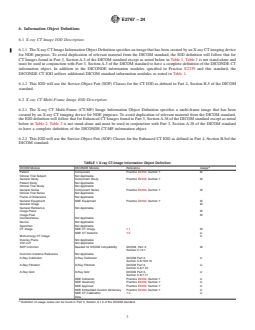
6.1.2 This IOD will use the Service-Object Pair (SOP)
be found in Standard Guide for Computed Tomography (CT)
Classes for the CT IOD as defined in Part 4, Section B.5 of the
Imaging, E1441.
DICOM standard.
3.1.3 DICONDE terms used in this practice are defined in
Practice E2339.
6.2 X-ray CT Multi-Frame Image IOD Description:
6.2.1 The X-ray CT Multi-Frame (CT-MF) Image Informa-
4. Summary of Practice
tion Object Definition specifies a multi-frame image that has
been created by an X-ray CT imaging device for NDE
4.1 A fundamental principle of DICONDE is the use of
purposes. To avoid duplication of relevant material from the
standard definitions and attribute formats for data communica-
DICOM standard, the IOD definition will follow that for
tion and storage. This means all systems that are DICONDE
Enhanced CT Images found in Part 3, Section A.38 of the
compliant use a common data dictionary and common com-
DICOM standard except as noted below in Table 2. Table 2 is
munication protocols. To further standardization, the elements
not stand-alone and must be used in conjunction with Part 3,
in the data dictionary are organized into common groups
Section A.38 of the DICOM standard to have a complete
referred to as information modules. The data dictionary and
definition of the DICONDE CT-MF information object.
information modules common to all NDE modalities are
6.2.2 This IOD will use the Service-Object Pair (SOP)
defined in Practice E2339.
Classes for the Enhanced CT IOD as defined in Part 4, Section
4.2 The data dictionary and information modules specified
B.5of the DICOM standard.
in Practice E2339 do not cover the information storage
requirements for each individual modality (CT, DR, CR, UT,
7. Information Modules
etc.). Additions to the data dictionary and information modules
7.1 NDE CT Image Module:
are required to support the individual modalities. This practice
7.1.1 Table 3 specifies the Attributes that describe the NDE
contains the additions to the DICONDE data dictionary and
X-ray CT image module.
information modules necessary for X-ray CT inspection.
7.2 NDE X-ray CT Detector Module:
4.3 The highest organizational level in the DICONDE
7.2.1 Table 4 specifies the Attributes that describe NDE
information model is the information object definition (IOD).
An information object definition is a collection of the infor- X-ray CT Detectors.
7.2.1.1 For X-ray CT Detector module, Detector Type
mation modules necessary to represent a set of test results from
a specific modality. This practice contains information object (0018,7004) is specified to use the following defined terms:
definitions for X-ray CT inspection. DIRECT
SCINTILLATOR
5. Significance and Use 7.2.1.2 For X-ray CT Detector module, Detector Configu-
ration (0018,7005) is specified to use the following defined
5.1 Personnel that are responsible for the creation, transfer,
terms:
and storage of X-ray tomographic NDE data will use this
AREA
standard. This practice defines a set of information modules
LINEAR
that along with Practice E2339 and the DICOM standard
provide a standard means to organize X-ray tomography test
7.3 NDE X-ray CT Calibration Data Module:
parameters and results. The X-ray CT test results may be
7.3.1 Table 5 specifies the Attributes that describe NDE
displayed and analyzed on any device that conforms to this
X-ray CT calibration data.
standard. Personnel wishing to view any tomographic inspec-
7.4 NDE Multi-Frame Functional Group Attributes:
tion data stored according to Practice E2339 may use this
7.4.1 Table 6 specifies the Attributes that describe the NDE
document to help them decode and display the data contained
Multi-Frame Functional Group Elements which are described
in the DICONDE-compliant inspection record.
in DICOM 7.4, DICOM, Part 3, Sections C.8.15.3.2-
C8.15.3.13.
6. Information Object Definitions
7.5 Table 7 specifies the attributes that describe the NDE
6.1 X-ray CT Image IOD Description:
Enhanced Multi-energy CT Acquisition Data Module which is
6.1.1 The X-ray CT Image Information Object Definition
described in DICOM, Part 3, Section C.8.15.4.
specifies an image that has been created by an X-ray CT
imaging device for NDE purposes. To avoid duplication of 7.6 NDE CT Multi-Frame Image Module:
relevant material from the DICOM standard, the IOD defini- 7.6.1 Table 8 specifies the attributes that describe the NDE
tion will follow that for CT Images found in Part 3, Section A.3 CT Multi-Frame Image Module.
E2767 − 24
TABLE 1 X-ray CT-Image Information Object Definition
A
DICOM Module DICONDE Module Reference Usage
Patient Component Practice E2339, Section 7 M
Clinical Trial Subject Not Applicable
General Study Component Study Practice E2339, Section 7 M
Patient Study Not Applicable
Clinical Trial Study Not Applicable
General Series Component Series Practice E2339, Section 7 M
Clinical Trial Series Not Applicable
Frame of Reference Not Applicable
General Equipment NDE Equipment Practice E2339, Section 7 M
General Image M
General Reference Not Applicable
Image Plane M
Image Pixel M
Contrast/bolus Not Applicable
Device Not Applicable
Specimen Not Applicable
CT Image NDE CT Image 7.1 M
NDE CT Detector 7.2 U
Multi-energy CT Image C
Overlay Plane Not Applicable
VOI LUT Not Applicable
SOP Common Needed for DICOM compatibility DICOM, Part 3, M
Section C.12.1
Common Instance Reference Not Applicable
X-Ray Collimator X-Ray Collimator DICOM Part 3, U
Section C.8.19.6.12
X-Ray Filtration X-Ray Filtration DICOM Part 3, U
Section C.8.7.10
X-Ray Grid X-Ray Grid DICOM Part 3, U
Section C.8.7.11
NDE Indication Practice E2339, Section 7 U
NDE Geometry Practice E2339, Section 7 U
NDE Approval Practice E2339, Section 7 U
NDE Embedded Custom Dictionary Practice E2339, Section 7 U
NDE CT Calibration 7.3 U
Data
A
Definition of usage codes can be found in Part 3, Section A.1.3 of the DICOM standard.
8. Keywords CONDE; digital data storage; digital data transmission; file
format; X-ray
8.1 CT; computed tomography; database; DICOM; DI-
E2767 − 24
TABLE 2 X-ray CT-MF Image Information Object Definition
A
DICOM Module DICONDE Module Reference Usage
Patient Component Practice E2339, Section 7 M
Specimen Identification Not Applicable
Clinical Trial Subject Not Applicable
General Study Component Study Practice E2339, Section 7 M
Patient Study Not Applicable
Clinical Trial Study Not Applicable
General Series Component Series Practice E2339, Section 7 M
CT Series CT Series DICOM, Part 3, M
Section C.8.15.1
Clinical Trial Series Not Applicable
Frame of Reference Not Applicable
Synchronization Not Applicable
General Equipment NDE Equipment Practice E2339, Section 7 M
Enhanced General Equipment Enhanced General Equipment DICOM, Part 3, M
Section C.7.5.2
Image Pixel Image Pixel DICOM, Part 3, M
Section C.7.6.3
Multi-frame Multi-frame DICOM, Part 3, M
Section C.7.6.6
Frame Pointers Frame Pointers DICOM, Part 3, M
Section C.7.6.9
Enhanced Contrast/Bolus Not Applicable
Multi-frame Functional Groups NDE Multi-frame Functional Groups 7.4 M
Cardiac Synchronization Not Applicable
Respiratory Synchronization Not Applicable
Supplemental Palette Lookup Table Not Applicable
Acquisition Context Needed for DICOM compatibility M
Device Not Applicable
Specimen Not Applicable
Enhanced CT Image NDE CT Multi-Frame Image 7.6 M
Enhanced Multi-Energy CT Acquisition NDE Enhanced Multi-Energy CT Acqui- 7.5 C – required if Multi-
sition energy CT Acquisition
(0018, 9361) is YES.
ICC Profile Not Applicable
SOP Common Needed for DICOM compatibility M
Common Instance Reference Not Applicable
NDE Indication Practice E2339, Section 7 U
NDE Geometry Practice E2339, Section 7 U
NDE Approval Practice E2339, Section 7 U
NDE Embedded Custom Dictionary Practice E2339, Section 7 U
NDE CT Calibration Data 7.3 U
Frame Extraction C – required if the SOP
Instance was created in
response to a Frame-Level
retrieve request.
A
Definition of usage codes can be found in Part 3, Section A.1.3 of the DICOM standard.
E2767 − 24
TABLE 3 NDE CT Image Module Attributes
A
Attribute Name Tag VR VM Type Description
Image Type (0008,0008) CS 2-n 1 Image identification characteristics.
Samples Per Pixel (0028,0002) US 1 1 Number of samples per pixel (planes) in this image.
Photometric Interpretation (0028,0004) CS 1 1 Specifies the intended interpretation of the pixel data.
Bits Allocated (0028,0100) US 1 1 Number of bits allocated for each pixel data.
Bits Stored (0028,0101) US 1 1 Number of bits stored for each pixel data.
High Bit (0028,0102) US 1 1 Most significant bit for pixel data.
Rescale Intercept (0028,1052) DS 1 1 The value b in relationship between stored values (SV) and the
output units. Output units = m*SV+b
Rescale Slope (0028,1053) DS 1 1 m in the equation specified in Rescale Intercept (0028,1052).
Rescale Type (0028,1054) LO 1 1 Specifies the output units of Rescale Slope (0028,1053) and
Rescale Intercept (0028,1052).
KVP (0018,0060) DS 1 2 Peak kilo voltage output of the X-ray generator used.
Acquisition Number (0020,0012) IS 1 2 A number identifying the single continuous gathering of data over a
period of time which resulted in this image.
Scan Options (0018,0022) CS 1-n 3 Parameters of the scanning sequence.
Data Collection Diameter (0018,0090) DS 1 3 The diameter in mm of the region over which data were collected.
Reconstruction Diameter (0018,1100) DS 1 3 Diameter in mm of the region from within which data were used in
creating the reconstruction of the image. Data may exist outside of
this portion of the region and portions of the component may exist
outside this region.
Distance Source to (0018,1110) DS 1 3 Distance in mm from source to detector center.
Detector
Distance Source to (0018,1111) DS 1 3 Distance in mm from source to isocenter (center of field of view).
Component
Gantry/Detector Tilt (0018,1120) DS 1 3 Nominal angle of tilt in degrees of the scanning gantry. Not
intended for mathematical calculations.
Table Height (0018,1130) DS 1 3 The distance in mm of the top of the part positioner table to the
center of rotation; below the center is positive.
Rotation Direction (0018,1140) CS 1 3 Direction of rotation of the source when relevant, about nearest
principal axis of equipment. Enumerated Values: CW = clockwise
CC = counterclockwise
Exposure Time (0018,1150) IS 1 3 Time of X-ray exposure in msec.
X-ray Tube Current (0018,1151) IS 1 3 X-ray Tube Current in mA.
Exposure (0018,1152) IS 1 3 The exposure expressed in mA, for example, calculated from
Exposure Time and X-ray Tube Current.
Exposure in μAs (0018,1153) IS 1 3 The exposure expressed in mμ, for example, calculated from
Exposure Time and X-ray Tube Current.
Filter Type (0018,1160) SH 1 3 Label for the type of filter inserted into the X-ray beam.
Generator Power (0018,1170) IS 1 3 Power in kW to the X-ray generator.
LINAC Energy (0014,5002) IS 1 3 The energy produced by the LINAC expressed in KeV.
LINAC Output (0014,5004) IS 1 3 The output of the LINAC expressed in total dose (Gys).
Focal Spot(s) (0018,1190) DS 1-n 3 Size of the focal spot in mm. For devices with variable focal spot or
multiple focal spots, small dimension followed by large dimension.
Convolution Kernel (0018,1210) SH 1-n 3 A label describing the convolution kernel or algorithm used to
reconstruct the data.
X-ray Tube Current in μA (0018,8151) DS 1 3 X-ray Tube Current in μA
Revolution Time (0018,9305) FD 1 3 The time in seconds of a complete revolution of the source around
the gantry orbit or the complete rotation of a component on a
turntable.
Single Collimation Width (0018,9306) FD 1 3 The width of a single row of acquired data (in mm).
Total Collimation Width (0018,9307) FD 1 3 The width of the total collimation (in mm) over the area of active
X-ray detection.
Table Speed (0018,9309) FD 1 3 The distance in mm that the table moves in one second during the
gathering of data.
Table Feed Per Rotation (0018,9310) FD 1 3 Motion of the table (in mm) during a complete revolution of the
object being inspected.
CT Pitch Factor (0018,9311) FD 1 3 Ratio of the Table Feed per Rotation (0018,9310) to the Total
Collimation Width (0018,9307).
Exposure Modulation Type (0018,9323) CS 1-n 3 A label describing the type of exposure modulation used for the
purpose of limiting the dose.
Defined Terms: NONE
Estimated Dose Savings (0018,9324) FD 1 3 This DICOM tag was retired in DICOM Part 3 (2020a). A percent
value of dose saving due to the use of Exposure Modulation Type
(0018,9323). A negative percent value of dose saving reflects an
increase in exposure. Required if lossy compression has been
performed on the image.
Image Quality Indicator (0014,40A0) LO 1-n 3 Description of the type of Image Quality Indicator used.
Type
Image Quality Indicator (0014,40A1) LO 1-n 3 Description of the material used to manufacture the Image Quality
Material Indicator.
Image Quality Indicator (0014,40A2) LO 1-n 3 Designation of the size of the Image Quality Indicator used. A
Size typical size designation is ‘2–2T’ where the first number indicates
that the IQI thickness is two percent of the test material thickness
and the second number defines the hole diameter as twice the IQI
thickness.
A
Definition of type codes can be found in Part 5, Section 7.4 of the DICOM standard.
E2767 − 24
TABLE 4 NDE X-ray CT Detector Module Attributes
A
Attribute Name Tag VR VM Type Description
Detector Type (0018,7004) CS 1 2 The type of detector used to acquire projection data.
Detector Configuration (0018,7005) CS 1 3 The physical configuration of the detector.
Detector Description (0018,7006) LT 1 3 Free-text description of the detector.
Detector Mode (0018,7008) LT 1 3 Text description of the operating mode of the detector.
Detector ID (0018,700A) SH 1 3 The ID or serial number of the detector used to acquire projection
data.
Date of Last Detector (0018,700C) DA 1 3 Date of the last calibration for the detector.
Calibration
Time of Last Detector (0018,700E) TM 1 3 Time of the last calibration for the equipment used to pulse the
Calibration transducer.
Detector Active Time (0018,7014) DS 1 3 Time in msec that the detector is active during acquisition of this
data.
Detector Activation (0018,7016) DS 1 3 Offset time in msec that the detector becomes active after the
Offset from Exposure X-ray beam is turned on during the acquisition of this data. May be
negative.
Detector Binning (0018,701A) DS 2 3 Number of active detectors used to generate a single pixel.
Specified as the number of row detectors per pixel followed by the
number of column detectors.
Internal Detector Frame (0014,3011) DS 1 3 The time in msec that the detector is acquiring an image.
Time
Number of Frames (0014,3012) DS 1 3 The number of frames to form an image.
Integrated
Detector Manufacturer’s (0018,702A) LO 1 3 Name of the manufacturer of the detector component of the
Name acquisition system.
Detector Manufacturer’s (0018,702B) LO 1 3 Model number of the detector component of the acquisition system.
Model Number
Detector Conditions (0018,7000) CS 1 3 A flag that indicates whether or not the detector is operating within
Nominal Flag normal tolerances during data acquisition. This flag is intended to
indicate whether there has been some compromise of the
diagnostic quality of the data due to some operating condition (for
example, overheating).
B
Sensitivity (0018,6000) DS 1 3 Detector sensitivity in manufacturer specific units.
Field of View Shape (0018,1147) CS 1 3 Shape of the Field of View, that is
...
This document is not an ASTM standard and is intended only to provide the user of an ASTM standard an indication of what changes have been made to the previous version. Because
it may not be technically possible to adequately depict all changes accurately, ASTM recommends that users consult prior editions as appropriate. In all cases only the current version
of the standard as published by ASTM is to be considered the official document.
Designation: E2767 − 21 E2767 − 24
Standard Practice for
Digital Imaging and Communication in Nondestructive
Evaluation (DICONDE) for X-ray Computed Tomography (CT)
Test Methods
This standard is issued under the fixed designation E2767; the number immediately following the designation indicates the year of
original adoption or, in the case of revision, the year of last revision. A number in parentheses indicates the year of last reapproval. A
superscript epsilon (´) indicates an editorial change since the last revision or reapproval.
This standard has been approved for use by agencies of the U.S. Department of Defense.
1. Scope Scope*
1.1 This practice facilitates the interoperability of X-ray computed tomography (CT) imaging equipment by specifying image data
transfer and archival storage methods in commonly accepted terms. This document is intended to be used in conjunction with
Practice E2339 on Digital Imaging and Communication in Nondestructive Evaluation (DICONDE). Practice E2339 defines an
industrial adaptation of the NEMA Standards Publication titled Digital Imaging and Communications in Medicine (DICOM, see
http://medical.nema.org), an international standard for image data acquisition, review, storage, and archival storage. The goal of
Practice E2339, commonly referred to as DICONDE, is to provide a standard that facilitates the display and analysis of NDE test
results on any system conforming to the DICONDE standard. Toward that end, Practice E2339 provides a data dictionary and a
set of information modules that are applicable to all NDE modalities. This practice supplements Practice E2339 by providing
information object definitions, information modules and a data dictionary that are specific to X-ray CT test methods.
1.2 This practice has been developed to overcome the issues that arise when analyzing or archiving data from tomographic test
equipment using proprietary data transfer and storage methods. As digital technologies evolve, data must remain decipherable
through the use of open, industry-wide methods for data transfer and archival storage. This practice defines a method where all
the X-ray CT technique parameters and test results are communicated and stored in a standard manner regardless of changes in
digital technology.
1.3 This practice does not specify:
1.3.1 A testing or validation procedure to assess an implementation’s conformance to the standard.
1.3.2 The implementation details of any features of the standard on a device claiming conformance.
1.3.3 The overall set of features and functions to be expected from a system implemented by integrating a group of devices each
claiming DICONDE conformance.
1.4 Units—Although this practice contains no values that require units, it does describe methods to store and communicate data
that do require units to be properly interpreted. The values stated in SI units are to be regarded as standard. No other units of
measurement are included in this standard.
This practice is under the jurisdiction of ASTM Committee E07 on Nondestructive Testing and is the direct responsibility of Subcommittee E07.11 on Digital Imaging
and Communication in Nondestructive Evaluation (DICONDE).
Current edition approved June 1, 2021Feb. 1, 2024. Published July 2021April 2024. Originally approved in 2010. Last previous edition approved in 20182021 as
E2767 – 13E2767 – 21.(2018). DOI:10.1520/E2767-21. DOI:10.1520/E2767-24.
*A Summary of Changes section appears at the end of this standard
Copyright © ASTM International, 100 Barr Harbor Drive, PO Box C700, West Conshohocken, PA 19428-2959. United States
E2767 − 24
1.5 This standard does not purport to address all of the safety concerns, if any, associated with its use. It is the responsibility of
the user of this standard to establish appropriate safety, health, and environmental practices and determine the applicability of
regulatory limitations prior to use.
1.6 This international standard was developed in accordance with internationally recognized principles on standardization
established in the Decision on Principles for the Development of International Standards, Guides and Recommendations issued
by the World Trade Organization Technical Barriers to Trade (TBT) Committee.
2. Referenced Documents
2.1 ASTM Standards:
E1316 Terminology for Nondestructive Examinations
E1441 Guide for Computed Tomography (CT)
E2339 Practice for Digital Imaging and Communication in Nondestructive Evaluation (DICONDE)
2.2 Other Standard:
NEMA PS3 / ISO 12052, Digital Imaging and Communications in Medicine (DICOM) Standard, National Electrical
Manufacturers Association, Rosslyn, VA, USA (available free at http://www.dicomstandard.org/)
3. Terminology
3.1 Definitions:
3.1.1 Nondestructive evaluation terms used in this practice can be found in Standard Terminology for Nondestructive
Examinations, E1316.
3.1.2 Computed Tomography terms used in this practice can be found in Standard Guide for Computed Tomography (CT)
Imaging, E1441.
3.1.3 DICONDE terms used in this practice are defined in Practice E2339.
4. Summary of Practice
4.1 A fundamental principle of DICONDE is the use of standard definitions and attribute formats for data communication and
storage. This means all systems that are DICONDE compliant use a common data dictionary and common communication
protocols. To further standardization, the elements in the data dictionary are organized into common groups referred to as
information modules. The data dictionary and information modules common to all NDE modalities are defined in Practice E2339.
4.2 The data dictionary and information modules specified in Practice E2339 do not cover the information storage requirements
for each individual modality (CT, DR, CR, UT, etc.). Additions to the data dictionary and information modules are required to
support the individual modalities. This practice contains the additions to the DICONDE data dictionary and information modules
necessary for X-ray CT inspection.
4.3 The highest organizational level in the DICONDE information model is the information object definition (IOD). An
information object definition is a collection of the information modules necessary to represent a set of test results from a specific
modality. This practice contains information object definitions for X-ray CT inspection.
5. Significance and Use
5.1 Personnel that are responsible for the creation, transfer, and storage of X-ray tomographic NDE data will use this standard.
This practice defines a set of information modules that along with Practice E2339 and the DICOM standard provide a standard
means to organize X-ray tomography test parameters and results. The X-ray CT test results may be displayed and analyzed on any
device that conforms to this standard. Personnel wishing to view any tomographic inspection data stored according to Practice
E2339 may use this document to help them decode and display the data contained in the DICONDE-compliant inspection record.
For referenced ASTM standards, visit the ASTM website, www.astm.org, or contact ASTM Customer Service at service@astm.org. For Annual Book of ASTM Standards
volume information, refer to the standard’s Document Summary page on the ASTM website.
Available from National Electrical Manufacturers Association (NEMA), 1300 N. 17th St., Suite 1752, Rosslyn, VA 22209, http://www.nema.org.
E2767 − 24
6. Information Object Definitions
6.1 X-ray CT Image IOD Description:
6.1.1 The X-ray CT Image Information Object Definition specifies an image that has been created by an X-ray CT imaging device
for NDE purposes. To avoid duplication of relevant material from the DICOM standard, the IOD definition will follow that for
CT Images found in Part 3, Section A.3 of the DICOM standard except as noted below in Table 1. Table 1 is not stand-alone and
must be used in conjunction with Part 3, Section A.3 of the DICOM standard to have a complete definition of the DICONDE CT
information object. In addition to the DICONDE information modules specified in Practice E2339 and this standard, the
DICONDE CT IOD utilizes additional DICOM standard information modules as noted in Table 1.
6.1.2 This IOD will use the Service-Object Pair (SOP) Classes for the CT IOD as defined in Part 4, Section B.5 of the DICOM
standard.
6.2 X-ray CT Multi-Frame Image IOD Description:
6.2.1 The X-ray CT Multi-Frame (CT-MF) Image Information Object Definition specifies a multi-frame image that has been
created by an X-ray CT imaging device for NDE purposes. To avoid duplication of relevant material from the DICOM standard,
the IOD definition will follow that for Enhanced CT Images found in Part 3, Section A.38 of the DICOM standard except as noted
below in Table 2. Table 2 is not stand-alone and must be used in conjunction with Part 3, Section A.38 of the DICOM standard
to have a complete definition of the DICONDE CT-MF information object.
6.2.2 This IOD will use the Service-Object Pair (SOP) Classes for the Enhanced CT IOD as defined in Part 4, Section B.5of the
DICOM standard.
TABLE 1 X-ray CT-Image Information Object Definition
A
DICOM Module DICONDE Module Reference Usage
Patient Component Practice E2339, Section 7 M
Clinical Trial Subject Not Applicable
General Study Component Study Practice E2339, Section 7 M
Patient Study Not Applicable
Clinical Trial Study Not Applicable
General Series Component Series Practice E2339, Section 7 M
Clinical Trial Series Not Applicable
Frame of Reference Not Applicable
General Equipment NDE Equipment Practice E2339, Section 7 M
General Image M
General Reference Not Applicable
Image Plane M
Image Pixel M
Contrast/bolus Not Applicable
Device Not Applicable
Specimen Not Applicable
CT Image NDE CT Image 7.1 M
NDE CT Detector 7.2 U
Multi-energy CT Image C
Overlay Plane Not Applicable
VOI LUT Not Applicable
SOP Common Needed for DICOM compatibility DICOM, Part 3, M
Section C.12.1
Common Instance Reference Not Applicable
X-Ray Collimator X-Ray Collimator DICOM Part 3, U
Section C.8.19.6.12
X-Ray Filtration X-Ray Filtration DICOM Part 3, U
Section C.8.7.10
X-Ray Grid X-Ray Grid DICOM Part 3, U
Section C.8.7.11
NDE Indication Practice E2339, Section 7 U
NDE Geometry Practice E2339, Section 7 U
NDE Approval Practice E2339, Section 7 U
NDE Embedded Custom Dictionary Practice E2339, Section 7 U
NDE CT Calibration 7.3 U
Data
A
Definition of usage codes can be found in Part 3, Section A.1.3 of the DICOM standard.
E2767 − 24
TABLE 2 X-ray CT-MF Image Information Object Definition
A
DICOM Module DICONDE Module Reference Usage
Patient Component Practice E2339, Section 7 M
Specimen Identification Not Applicable
Clinical Trial Subject Not Applicable
General Study Component Study Practice E2339, Section 7 M
Patient Study Not Applicable
Clinical Trial Study Not Applicable
General Series Component Series Practice E2339, Section 7 M
CT Series CT Series DICOM, Part 3, M
Section C.8.15.1
Clinical Trial Series Not Applicable
Frame of Reference Not Applicable
Synchronization Not Applicable
General Equipment NDE Equipment Practice E2339, Section 7 M
Enhanced General Equipment Enhanced General Equipment DICOM, Part 3, M
Section C.7.5.2
Image Pixel Image Pixel DICOM, Part 3, M
Section C.7.6.3
Multi-frame Multi-frame DICOM, Part 3, M
Section C.7.6.6
Frame Pointers Frame Pointers DICOM, Part 3, M
Section C.7.6.9
Enhanced Contrast/Bolus Not Applicable
Multi-frame Functional Groups NDE Multi-frame Functional Groups 7.4 M
Cardiac Synchronization Not Applicable
Respiratory Synchronization Not Applicable
Supplemental Palette Lookup Table Not Applicable
Acquisition Context Needed for DICOM compatibility M
Device Not Applicable
Specimen Not Applicable
Enhanced CT Image NDE CT Multi-Frame Image 7.6 M
Enhanced Multi-Energy CT Acquisition NDE Enhanced Multi-Energy CT Acqui- 7.5 C – required if Multi-
sition energy CT Acquisition
(0018, 9361) is YES.
ICC Profile Not Applicable
SOP Common Needed for DICOM compatibility M
Common Instance Reference Not Applicable
NDE Indication Practice E2339, Section 7 U
NDE Geometry Practice E2339, Section 7 U
NDE Approval Practice E2339, Section 7 U
NDE Embedded Custom Dictionary Practice E2339, Section 7 U
NDE CT Calibration Data 7.3 U
Frame Extraction C – required if the SOP
Instance was created in
response to a Frame-Level
retrieve request.
A
Definition of usage codes can be found in Part 3, Section A.1.3 of the DICOM standard.
7. Information Modules
7.1 NDE CT Image Module:
7.1.1 Table 3 specifies the Attributes that describe the NDE X-ray CT image module.
7.2 NDE X-ray CT Detector Module:
7.2.1 Table 4 specifies the Attributes that describe NDE X-ray CT Detectors.
7.2.1.1 For X-ray CT Detector module, Detector Type (0018,7004) is specified to use the following defined terms:
DIRECT
SCINTILLATOR
7.2.1.2 For X-ray CT Detector module, Detector Configuration (0018,7005) is specified to use the following defined terms:
AREA
LINEAR
7.3 NDE X-ray CT Calibration Data Module:
E2767 − 24
TABLE 3 NDE CT Image Module Attributes
A
Attribute Name Tag VR VM Type Description
Image Type (0008,0008) CS 1-n 1 Image identification characteristics.
Image Type (0008,0008) CS 2-n 1 Image identification characteristics.
Samples Per Pixel (0028,0002) US 1 1 Number of samples per pixel (planes) in this image.
Photometric Interpretation (0028,0004) CS 1 1 Specifies the intended interpretation of the pixel data.
Bits Allocated (0028,0100) US 1 1 Number of bits allocated for each pixel data.
Bits Stored (0028,0101) US 1 1 Number of bits stored for each pixel data.
High Bit (0028,0102) US 1 1 Most significant bit for pixel data.
Rescale Intercept (0028,1052) DS 1 1 The value b in relationship between stored values (SV) and the
output units. Output units = m*SV+b
Rescale Slope (0028,1053) DS 1 1 m in the equation specified in Rescale Intercept (0028,1052).
Rescale Type (0028,1054) LO 1 1 Specifies the output units of Rescale Slope (0028,1053) and
Rescale Intercept (0028,1052).
KVP (0018,0060) DS 1 2 Peak kilo voltage output of the X-ray generator used.
Acquisition Number (0020,0012) IS 1 2 A number identifying the single continuous gathering of data over a
period of time which resulted in this image.
Scan Options (0018,0022) CS 1-n 3 Parameters of the scanning sequence.
Data Collection Diameter (0018,0090) DS 1 3 The diameter in mm of the region over which data were collected.
Reconstruction Diameter (0018,1100) DS 1 3 Diameter in mm of the region from within which data were used in
creating the reconstruction of the image. Data may exist outside of
this portion of the region and portions of the component may exist
outside this region.
Distance Source to (0018,1110) DS 1 3 Distance in mm from source to detector center.
Detector
Distance Source to (0018,1111) DS 1 3 Distance in mm from source to isocenter (center of field of view).
Component
Gantry/Detector Tilt (0018,1120) DS 1 3 Nominal angle of tilt in degrees of the scanning gantry. Not
intended for mathematical calculations.
Table Height (0018,1130) DS 1 3 The distance in mm of the top of the part positioner table to the
center of rotation; below the center is positive.
Rotation Direction (0018,1140) DS 1 3 Direction of rotation of the source when relevant, about nearest
principal axis of equipment. Enumerated Values: CW = clockwise
CC = counterclockwise
Rotation Direction (0018,1140) CS 1 3 Direction of rotation of the source when relevant, about nearest
principal axis of equipment. Enumerated Values: CW = clockwise
CC = counterclockwise
Exposure Time (0018,1150) DS 1 3 Time of X-ray exposure in msec.
Exposure Time (0018,1150) IS 1 3 Time of X-ray exposure in msec.
X-ray Tube Current (0018,1151) DS 1 3 X-ray Tube Current in mA.
X-ray Tube Current (0018,1151) IS 1 3 X-ray Tube Current in mA.
Exposure (0018,1152) DS 1 3 The exposure expressed in mA, for example, calculated from
Exposure Time and X-ray Tube Current.
Exposure (0018,1152) IS 1 3 The exposure expressed in mA, for example, calculated from
Exposure Time and X-ray Tube Current.
Exposure in μAs (0018,1153) DS 1 3 The exposure expressed in mμ, for example, calculated from
Exposure Time and X-ray Tube Current.
Exposure in μAs (0018,1153) IS 1 3 The exposure expressed in mμ, for example, calculated from
Exposure Time and X-ray Tube Current.
Filter Type (0018,1160) DS 1 3 Label for the type of filter inserted into the X-ray beam.
Filter Type (0018,1160) SH 1 3 Label for the type of filter inserted into the X-ray beam.
Generator Power (0018,1170) DS 1 3 Power in kW to the X-ray generator.
Generator Power (0018,1170) IS 1 3 Power in kW to the X-ray generator.
LINAC Energy (0014,5002) IS 1 3 The energy produced by the LINAC expressed in KeV.
LINAC Output (0014,5004) IS 1 3 The output of the LINAC expressed in total dose (Gys).
Focal Spot (0018,1190) DS 1 3 Size of the focal spot in mm. For devices with variable focal spot or
multiple focal spots, small dimension followed by large dimension.
Focal Spot(s) (0018,1190) DS 1-n 3 Size of the focal spot in mm. For devices with variable focal spot or
multiple focal spots, small dimension followed by large dimension.
Convolution Kernel (0018,1210) DS 1 3 A label describing the convolution kernel or algorithm used to
reconstruct the data.
Convolution Kernel (0018,1210) SH 1-n 3 A label describing the convolution kernel or algorithm used to
reconstruct the data.
X-ray Tube Current in μA (0018,8151) DS 1 3 X-ray Tube Current in μA
Revolution Time (0018,9305) FD 1 3 The time in seconds of a complete revolution of the source around
the gantry orbit or the complete rotation of a component on a
turntable.
Single Collimation Width (0018,9306) FD 1 3 The width of a single row of acquired data (in mm).
Total Collimation Width (0018,9307) FD 1 3 The width of the total collimation (in mm) over the area of active
X-ray detection.
Table Speed (0018,9309) FD 1 3 The distance in mm that the table moves in one second during the
gathering of data.
Table Feed Per Rotation (0018,9310) FD 1 3 Motion of the table (in mm) during a complete revolution of the
object being inspected.
CT Pitch Factor (0018,9311) FD 1 3 Ratio of the Table Feed per Rotation (0018,9310) to the Total
Collimation Width (0018,9307).
E2767 − 24
Exposure Modulation Type (0018,9323) CS 1 3 A label describing the type of exposure modulation used for the
purpose of limiting the dose.
Defined Terms: NONE
Exposure Modulation Type (0018,9323) CS 1-n 3 A label describing the type of exposure modulation used for the
purpose of limiting the dose.
Defined Terms: NONE
Estimated Dose Savings (0018,9324) FD 1 3 This DICOM tag was retired in DICOM Part 3 (2020a). A percent
value of dose saving due to the use of Exposure Modulation Type
(0018,9323). A negative percent value of dose saving reflects an
increase in exposure. Required if lossy compression has been
performed on the image.
Image Quality Indicator (0014,40A0) LO 1-n 3 Description of the type of Image Quality Indicator used.
Type
Image Quality Indicator (0014,40A1) LO 1-n 3 Description of the material used to manufacture the Image Quality
Material Indicator.
Image Quality Indicator (0014,40A2) LO 1-n 3 Designation of the size of the Image Quality Indicator used. A
Size typical size designation is ‘2–2T’ where the first number indicates
that the IQI thickness is two percent of the test material thickness
and the second number defines the hole diameter as twice the IQI
thickness.
A
Definition of type codes can be found in Part 5, Section 7.4 of the DICOM standard.
7.3.1 Table 5 specifies the Attributes that describe NDE X-ray CT calibration data.
7.4 NDE Multi-Frame Functional Group Attributes:
7.4.1 Table 6 specifies the Attributes that describe the NDE Multi-Frame Functional Group Elements which are described in
DICOM 7.4, DICOM, Part 3, Sections C.8.15.3.2-C8.15.3.13.
7.5 Table 7 specifies the attributes that describe the NDE Enhanced Multi-energy CT Acquisition Data Module which is described
in DICOM, Part 3, Section C.8.15.4.
7.6 NDE CT Multi-Frame Image Module:
7.6.1 Table 8 specifies the attributes that describe the NDE CT Multi-Frame Image Module.
8. Keywords
8.1 CT; computed tomography; database; DICOM; DICONDE;DI-
E2767 − 24
TABLE 4 NDE X-ray CT Detector Module Attributes
A
Attribute Name Tag VR VM Type Description
Detector Type (0018,7004) CS 1 2 The type of detector used to acquire projection data.
Detector Configuration (0018,7005) CS 1 3 The physical configuration of the detector.
Detector Description (0018,7006) LT 1 3 Free-text description of the detector.
Detector Mode (0018,700A) LT 1 3 Text description of the operating mode of the detector.
Detector Mode (0018,7008) LT 1 3 Text description of the operating mode of the detector.
Detector ID (0018,7008) SH 1 3 The ID or serial number of the detector used to acquire projection
data.
Detector ID (0018,700A) SH 1 3 The ID or serial number of the detector used to acquire projection
data.
Date of Last Detector (0018,700C) DA 1-n 3 Date of the last calibration for the detector.
Calibration
Date of Last Detector (0018,700C) DA 1 3 Date of the last calibration for the detector.
Calibration
Time of Last Detector (0018,700E) TM 1-n 3 Time of the last calibration for the equipment used to pulse the
Calibration transducer.
Time of Last Detector (0018,700E) TM 1 3 Time of the last calibration for the equipment used to pulse the
Calibration transducer.
Detector Active Time (0018,7014) DS 1 3 Time in msec that the detector is active during acquisition of this
data.
Detector Activation (0018,7016) DS 1 3 Offset time in msec that the detector becomes active after the
Offset from Exposure X-ray beam is turned on during the acquisition of this data. May be
negative.
Detector Binning (0018,701A) DS 2 3 Number of active detectors used to generate a single pixel.
Specified as the number of row detectors per pixel followed by the
number of column detectors.
Internal Detector Frame (0014,3011) DS 1 3 The time in msec that the detector is acquiring an image.
Time
Number of Frames (0014,3012) DS 1 3 The number of frames to form an image.
Integrated
Detector Manufacturer’s (0018,702A) LO 1 3 Name of the manufacturer of the detector component of the
Name acquisition system.
Detector Manufacturer’s (0018,702B) LO 1 3 Model number of the detector component of the acquisition system.
Model Number
Detector Conditions (0018,7000) CS 1 3 A flag that indicates whether or not the detector is operating within
Nominal Flag normal tolerances during data acquisition. This flag is intended to
indicate whether there has been some compromise of the
diagnostic quality of the data due to some operating condition (for
example, overheating).
B
Sensitivity (0018,6000) DS 1 3 Detector sensitivity in manufacturer specific units.
Field of View Shape (0018,1147) CS 1 3 Shape of the Field of View, that is, the image pixels.
Field of View (0018,1149) IS 1-2 3 Dimensions in mm of the Field of View.
Dimension(s)
Field of View Origin (0018,7030) DS 2 1C Required if the Field of View has been rotated. Offset of the Top
Left Hand Corner (TLHC) of a rectangle circumscribing the Field of
View before rotation or flipping, from the TLHC of the physical
detector area measured in physical detector pixels as a row offset
followed by a column offset.
Field of View Rotation (0018,7032) DS 1 1C Required if the Field of View has been rotated Clockwise rotation in
degrees of the Field of View relative to the physical detector.
Field of View Horizontal (0018,7034) CS 1 1C Required if the Field of View has been rotated Whether or not a
Flip horizontal flip has been applied to the Field of View after rotation
relative to the physical detector as described in the Field of View
Rotation.
Imager Pixel Spacing (0018,1164) DS 2 1 Physical distance measured at the front plane of the detector
housing between the center of each image pixel specified by a
numeric pair – row spacing value followed by a column spacing
value in mm.
Detector Element (0018,7020) DS 2 3 Physical dimensions of each detector element in mm that
Physical Size comprises the detector matrix. Expressed as the row dimension
followed by the column dimension.
Detector Element (0018,7022) DS 2 3 Physical distance between the center of each detector element,
Spacing specified by a numeric pair – row spacing value in mm followed by
column spacing value in mm.
Detector Active Shape (0018,7024) CS 1 3 Shape of the active area.
Detector Active (0018,7026) DS 1-2 3 Dimension(s) in mm of the active area.
Dimension(s)
Detector Active Origin (0018,7028) DS 2 3 Offset of the TLHC of a rectangle circumscribing the active detector
area from the TLHC of a rectangle circumscribing the physical
detector area, measures in physical detector pixels as a row offset
followed by a column offset.
Detector Temperature (0014,3020) SQ 1 3 Sequence that contains detector temperature information.
Sequence
> Sensor Name (0014,3022) ST 1 3 The name of the sensor.
> Horizontal Offset of (0014,3024) DS 1 3 The horizontal offset in mm from the left position of the detector.
Sensor
E2767 − 24
> Vertical Offset of (0014,3026) DS 1 3 The horizontal offset in mm from the top position of the detector.
Sensor
> Sensor Temperature (0014,3028) DS 1 3 Temperature in Celsius of the sensor.
A
Definition of type codes can be found in Part 5, Section 7.4 of the DICOM standard.
B
This value is intended to provide a single location where the manufacturer specific information can be found for annotation on a display or film that has meaning to a
knowledgeable observer.
TABLE 5 NDE X-ray CT Calibration Data Module Attributes
A
Attribute Name Tag VR VM Type Description
Dark Current Sequence (0014,3040) SQ 1 2
> Photometric Interpretation (0028,0103) US 1 1C Required if Dark Current sequence is non-zero. Pixel
representation.
> Pixel representation (0028,0103) US 1 1C Required if Dark Current sequence is non-zero.
> Bits allocated (0028,0100) US 1 1 Required if Dark Current sequence is non-zero.
Number of bits allocated.
> Bits allocated (0028,0100) US 1 1C Required if Dark Current sequence is non-zero.
Number of bits allocated.
> Bits stored (0028,0101) US 1 1C Required if Dark Current sequence is non-zero.
Number of bits stored.
> High bit (0028,0102) US 1 1C Required if Dark Current sequence is non-zero. Most
significant bit.
> Dark Current counts (0014,3050) OW or OB 1 1C Required if Dark Current sequence is non-zero. A
data stream of the pixel samples which comprise the
dark current counts.
> Dark Current counts (0014,3050) OB or OW 1 1C Required if Dark Current sequence is non-zero. A
data stream of the pixel samples which comprise the
dark current counts.
Gain Correction Reference (0014,3060) SQ 1 2
Sequence
> Photometric Interpretation (0028,0103) US 1 1C Pixel representation.
> Pixel representation (0028,0103) US 1 1C Pixel representation.
> Bits allocated (0028,0100)) US 1 1C Number of bits allocated.
> Bits stored (0028,0101) US 1 1C Number of bits stored.
> High bit (0028,0102) US 1 1C Most significant bit.
> Air counts (0014,3070) OW or OB 1 1C A data stream of the pixel samples which comprise
the air counts.
> Air counts (0014,3070) OB or OW 1 1C A data stream of the pixel samples which comprise
the air counts.
> kV Used in Gain Calibration (0014,3071) DS 1 3 Kilovoltage Used in Gain Calibration.
> mA Used in Gain Calibration (0014,3072) DS 1 3 mA * Sec Used in Gain Calibration.
> Number of Frame Integrations (0014,3073) DS 1 3 Number of Frames Used for Integration.
> Filter Material Used in Gain (0014,3074) LO 1 3 Filter Material Used in Gain Calibration.
Calibration
> Filter Thickness Used in Gain (0014,3075) DS 1 3 Filter Material Used in Gain Calibration.
Calibration
> Date of Gain Calibration (0014,3076) DA 1 3 Date of Gain Calibration.
> Time of Gain Calibration (0014,3077) TM 1 3 Time of Gain Calibration.
Bad Pixel Image (0014,3080) OB 1 3 Byte image with the same number of rows and
columns as the Pixel Data (7FE0,0010). The pixel
data of this image will contain a 919 for a good pixel
and a 909 for a bad pixel.
Calibration notes (0014,3099) LT 1 3 User-generated notes on the calibration data.
A
Definition of type codes can be found in Part 5, Section 7.4 of the DICOM standard.
CONDE; digital data storage; digital data transmission; file format; X-ray
E2767 − 24
TABLE 6 NDE Multi-Frame Functional Group Attributes
A
Attribute Name Tag VR VM Type Description
CT Acquisition Type (0018,9301) SQ 1 1 Contains the attributes defining the CT Acquisition Type group.
Sequence Only a single item shall be included in this Sequence.
> Acquisition Type (0018,9302) CS 1 1C Description of the method used during acquisition of this frame.
Required if Frame Type (0008, 9007) Value 1 of this frame is ORIGINAL. May
be present otherwise.
> Tube Angle (0018,9303) FD 1 1C The constant angle at which the X-ray source is located during acquisition.
Zero degrees means that the source is located at the highest point of the
gantry orbit. Degrees increase from zero to positive 360 in a clockwise
direction as viewed when facing the gantry where the table enters the gantry.
Required if Frame Type (0018,9007) Value 1 of this frame is ORIGINAL and
Acquisition Type (0018,9302) is CONSTANT_ANGLE.
May be present otherwise if Frame Type (0018,9007) Value 1 of this frame is
DERIVED and Acquisition Type (0018,9302) is CONSTANT_ANGLE.
> Constant Volume Flag (0018,9333) CS 1 1C Identifies that the acquisition was performed by repetitively acquiring the same
volume set over a period of time.
Note: Acquisition Type (0018,9302) may be SEQUENCED, SPIRAL or
STATIONARY depending upon whether table movement is necessary to cover
the volume.
Enumerated Values:
YES
NO
Required if Frame Type (0018,9007) Value 1 of this frame is ORIGINAL. May
be present otherwise.
> Fluoroscopy Flag (0018,9334) CS 1 1C Identifies that near real-time display of a block of continuously acquired data
was performed, which may result in a lower than usual image quality.
Enumerated Values:
YES
NO
Required if Frame Type (0018,9007) Value 1 of this frame is ORIGINAL. May
be present otherwise.
CT Acquisition Details (0018,9304) SQ 1 1 Contains the attributes defining the details of the acquisition. If Multi-energy
Sequence CT Acquisition (0018,9361) is NO or is absent, only a single item shall be
permitted in this sequence.
If Multi-energy CT Acquisition (0018,9361) is YES, one or more items shall be
included in this Sequence
> Referenced Path Index (0018,9378) US 1-n 1C References the X-ray Path Index (0018,937A) in the Multi-energy CT Path
Sequence (0018,9379) for this exposure.
Note: This attribute may contain multiple values if this item describes multiple
paths.
Required if Multi-energy CT Acquisition (0018,9361) is YES
> Rotation Direction (0018,1140) CS 1 1C Direction of rotation of the source about the gantry, as viewed while facing the
gantry where the table enters the gantry.
Enumerated Values:
CW clockwise
CC counterclockwise
Required if Frame Type (0018,9007) Value 1 of this frame is ORIGINAL and
Acquisition Type (0018,9302) is other than CONSTANT_ANGLE.
Otherwise may be present if Frame Type (0018,9007) Value 1 of this frame is
DERIVED and Acquisition Type (0018,9302) is other than CONSTANT_
ANGLE.
> Revolution Time (0018,9305) FD 1 1C The time in seconds of a complete revolution of the source around the gantry
orbit. This value is independent of the Reconstruction Angle (0018,9319) of the
frame.
Required if Frame Type (0018,9007) Value 1 of this frame is ORIGINAL and
Acquisition Type (0018,9302) is other than CONSTANT_ANGLE.
Otherwise may be present if Frame Type (0018,9007) Value 1 of this frame is
DERIVED and Acquisition Type (0018,9302) is other than CONSTANT_
ANGLE.
> Single Collimation (0018,9306) FD 1 1C The width of a single row of acquired data (in mm).
Width Note: Adjacent physical detector rows may have been combined to form a
single effective acquisition row.
Required if Frame Type (0018,9007) Value 1 of this frame is ORIGINAL. May
be present otherwise.
> Total Collimation Width (0018,9307) FD 1 1C The width of the total collimation (in mm) over the area of active Xray
detection.
Note: The will be
...