

ASTM E1672-12(2020)
(Guide)Standard Guide for Computed Tomography (CT) System Selection
General Information
- Abstract
SIGNIFICANCE AND USE
5.1 This guide will aid the purchaser in generating a CT system specification. This guide covers the conversion of purchaser's requirements to system components that must occur for a useful CT system specification to be prepared.
5.2 Additional information can be gained in discussions with potential suppliers or with independent consultants.
5.3 This guide is applicable to purchasers seeking scan services.
5.4 This guide is applicable to purchasers needing to procure a CT system for a specific examination application.
SCOPE
1.1 This guide covers guidelines for translating application requirements into computed tomography (CT) system requirements/specifications and establishes a common terminology to guide both purchaser and supplier in the CT system selection process. This guide is applicable to the purchaser of both CT systems and scan services. Computed tomography systems are complex instruments, consisting of many components that must correctly interact in order to yield images that repeatedly reproduce satisfactory examination results. Computed tomography system purchasers are generally concerned with application requirements. Computed tomography system suppliers are generally concerned with the system component selection to meet the purchaser's performance requirements. This guide is not intended to be limiting or restrictive, but rather to address the relationships between application requirements and performance specifications that must be understood and considered for proper CT system selection.
1.2 Computed tomography (CT) may be used for new applications or in place of radiography or radioscopy, provided that the capability to disclose physical features or indications that form the acceptance/rejection criteria is fully documented and available for review. In general, CT has lower spatial resolution than film radiography and is of comparable spatial resolution with digital radiography or radioscopy unless magnification is used. Magnification can be used in CT or radiography/radioscopy to increase spatial resolution but concurrently with loss of field of view.
1.3 Computed tomography (CT) systems use a set of transmission measurements made along a set of paths projected through the object from many different directions. Each of the transmission measurements within these views is digitized and stored in a computer, where they are subsequently conditioned (for example, normalized and corrected) and reconstructed, typically into slices of the object normal to the set of projection paths by one of a variety of techniques. If many slices are reconstructed, a three dimensional representation of the object is obtained. An in-depth treatment of CT principles is given in Guide E1441.
1.4 Computed tomography (CT), as with conventional radiography and radioscopic examinations, is broadly applicable to any material or object through which a beam of penetrating radiation may be passed and detected, including metals, plastics, ceramics, metallic/nonmetallic composite material and assemblies. The principal advantage of CT is that it has the potential to provide densitometric (that is, radiological density and geometry) images of thin cross sections through an object. In many newer systems the cross-sections are now combined into 3D data volumes for additional interpretation. Because of the absence of structural superposition, images may be much easier to interpret than conventional radiological images. The new purchaser can quickly learn to read CT data because images correspond more closely to the way the human mind visualizes 3D structures than conventional projection radiology. Further, because CT images are digital, the images may be enhanced, analyzed, compressed, archived, input as data into performance calculations, compared with digital data from other nondestructive evaluation modalities, or transmitted to other locations for remote viewing. 3D data sets can be rendered ...
- Status
- Published
- Publication Date
- 30-Nov-2020
- Technical Committee
- E07 - Nondestructive Testing
- Drafting Committee
- E07.01 - Radiography (X and Gamma) Method
Overview
ASTM E1672-12(2020) - Standard Guide for Computed Tomography (CT) System Selection serves as a comprehensive guideline for translating specific application requirements into detailed computed tomography (CT) system specifications. Developed by ASTM Committee E07 on Nondestructive Testing, this standard aids purchasers in identifying technical and performance needs, enabling effective communication with system suppliers or scan service providers. The guide covers aspects critical to both hardware procurement and service-based CT examinations, making it valuable for a wide range of industries utilizing CT technologies for nondestructive evaluation.
Key Topics
- Requirement Translation: The guide provides a framework for converting application-level requirements-such as object size, weight, desired resolution, and examination criteria-into detailed CT system component specifications.
- Terminology: Establishes a shared vocabulary to facilitate clear communication between purchasers and suppliers.
- System Configuration Considerations:
- Beam Types: Explains differences and trade-offs between pencil-beam, fan-beam, and cone-beam CT system architectures.
- Object Handling: Addresses the importance of correct mechanical subsystems to accommodate sample size, weight, and positioning accuracy.
- Radiation Source Selection: Outlines criteria for choosing between X-ray generators, radioisotopes, and synchrotron radiation, with attention to penetrability and application goals.
- Detection and Image Quality: Discusses spatial resolution, contrast discrimination, and mitigation of artifacts for optimal image output.
- Trade-Off Analysis: Emphasizes balancing factors such as scan time, resolution, and system cost.
Applications
ASTM E1672 is applicable across a diverse set of industries requiring nondestructive internal examination and analysis of materials, components, or assemblies. Typical uses include:
- Aerospace and Automotive Manufacturing: Inspecting critical parts for defects, cracks, porosity, or dimensional accuracy.
- Materials Science & Research: Studying metals, composites, plastics, ceramics, and other advanced materials for internal features or structural validation.
- Electronics & Assemblies: Assessing the integrity of solder joints, connectors, and internal circuits.
- Industrial Quality Control: Supporting failure analysis, process evaluation, and acceptance testing by providing precise 2D cross-sectional and 3D volumetric images.
This guide is valuable for entities seeking to purchase CT hardware, as well as those contracting scanning services for specific inspection tasks. It ensures compatibility between application needs and system performance, streamlining procurement and service processes.
Related Standards
For comprehensive system selection and operation, ASTM E1672 references and aligns with several other important standards, including:
- ASTM E1316: Terminology for Nondestructive Examinations-defining key terms used across nondestructive testing.
- ASTM E1441: Guide for Computed Tomography (CT)-in-depth CT principles and methodologies.
- ASTM E1570: Practice for Fan Beam CT Examination.
- ASTM E2339/E2767: Practices for Digital Imaging and Communication in Nondestructive Evaluation (DICONDE), including CT-specific data handling.
- Additional Practices: Covering detector characteristics, data acquisition, and scan quality management.
By adopting ASTM E1672, organizations benefit from a standardized, internationally recognized approach to CT system selection, reducing barriers in procurement, improving inspection efficacy, and promoting best practices in nondestructive testing.
Keywords: ASTM E1672, CT system selection, computed tomography, nondestructive testing, industrial inspection, image quality, system specification, scan services, spatial resolution, contrast discrimination, radiological imaging, procurement guide.
Relations
- Effective Date
- 01-Feb-2024
- Effective Date
- 01-Feb-2024
- Effective Date
- 01-Dec-2019
- Effective Date
- 15-Jun-2019
- Effective Date
- 01-Mar-2019
- Effective Date
- 01-Jan-2018
- Effective Date
- 15-Jun-2017
- Effective Date
- 01-Feb-2017
- Effective Date
- 01-Aug-2016
- Effective Date
- 01-Feb-2016
- Effective Date
- 01-Dec-2015
- Effective Date
- 01-Sep-2015
- Effective Date
- 01-Jun-2014
- Effective Date
- 01-Jun-2014
- Effective Date
- 15-Dec-2013
Get Certified
Connect with accredited certification bodies for this standard

BSI Group
BSI (British Standards Institution) is the business standards company that helps organizations make excellence a habit.

TÜV Rheinland
TÜV Rheinland is a leading international provider of technical services.

TÜV SÜD
TÜV SÜD is a trusted partner of choice for safety, security and sustainability solutions.
Sponsored listings
Frequently Asked Questions
ASTM E1672-12(2020) is a guide published by ASTM International. Its full title is "Standard Guide for Computed Tomography (CT) System Selection". This standard covers: SIGNIFICANCE AND USE 5.1 This guide will aid the purchaser in generating a CT system specification. This guide covers the conversion of purchaser's requirements to system components that must occur for a useful CT system specification to be prepared. 5.2 Additional information can be gained in discussions with potential suppliers or with independent consultants. 5.3 This guide is applicable to purchasers seeking scan services. 5.4 This guide is applicable to purchasers needing to procure a CT system for a specific examination application. SCOPE 1.1 This guide covers guidelines for translating application requirements into computed tomography (CT) system requirements/specifications and establishes a common terminology to guide both purchaser and supplier in the CT system selection process. This guide is applicable to the purchaser of both CT systems and scan services. Computed tomography systems are complex instruments, consisting of many components that must correctly interact in order to yield images that repeatedly reproduce satisfactory examination results. Computed tomography system purchasers are generally concerned with application requirements. Computed tomography system suppliers are generally concerned with the system component selection to meet the purchaser's performance requirements. This guide is not intended to be limiting or restrictive, but rather to address the relationships between application requirements and performance specifications that must be understood and considered for proper CT system selection. 1.2 Computed tomography (CT) may be used for new applications or in place of radiography or radioscopy, provided that the capability to disclose physical features or indications that form the acceptance/rejection criteria is fully documented and available for review. In general, CT has lower spatial resolution than film radiography and is of comparable spatial resolution with digital radiography or radioscopy unless magnification is used. Magnification can be used in CT or radiography/radioscopy to increase spatial resolution but concurrently with loss of field of view. 1.3 Computed tomography (CT) systems use a set of transmission measurements made along a set of paths projected through the object from many different directions. Each of the transmission measurements within these views is digitized and stored in a computer, where they are subsequently conditioned (for example, normalized and corrected) and reconstructed, typically into slices of the object normal to the set of projection paths by one of a variety of techniques. If many slices are reconstructed, a three dimensional representation of the object is obtained. An in-depth treatment of CT principles is given in Guide E1441. 1.4 Computed tomography (CT), as with conventional radiography and radioscopic examinations, is broadly applicable to any material or object through which a beam of penetrating radiation may be passed and detected, including metals, plastics, ceramics, metallic/nonmetallic composite material and assemblies. The principal advantage of CT is that it has the potential to provide densitometric (that is, radiological density and geometry) images of thin cross sections through an object. In many newer systems the cross-sections are now combined into 3D data volumes for additional interpretation. Because of the absence of structural superposition, images may be much easier to interpret than conventional radiological images. The new purchaser can quickly learn to read CT data because images correspond more closely to the way the human mind visualizes 3D structures than conventional projection radiology. Further, because CT images are digital, the images may be enhanced, analyzed, compressed, archived, input as data into performance calculations, compared with digital data from other nondestructive evaluation modalities, or transmitted to other locations for remote viewing. 3D data sets can be rendered ...
SIGNIFICANCE AND USE 5.1 This guide will aid the purchaser in generating a CT system specification. This guide covers the conversion of purchaser's requirements to system components that must occur for a useful CT system specification to be prepared. 5.2 Additional information can be gained in discussions with potential suppliers or with independent consultants. 5.3 This guide is applicable to purchasers seeking scan services. 5.4 This guide is applicable to purchasers needing to procure a CT system for a specific examination application. SCOPE 1.1 This guide covers guidelines for translating application requirements into computed tomography (CT) system requirements/specifications and establishes a common terminology to guide both purchaser and supplier in the CT system selection process. This guide is applicable to the purchaser of both CT systems and scan services. Computed tomography systems are complex instruments, consisting of many components that must correctly interact in order to yield images that repeatedly reproduce satisfactory examination results. Computed tomography system purchasers are generally concerned with application requirements. Computed tomography system suppliers are generally concerned with the system component selection to meet the purchaser's performance requirements. This guide is not intended to be limiting or restrictive, but rather to address the relationships between application requirements and performance specifications that must be understood and considered for proper CT system selection. 1.2 Computed tomography (CT) may be used for new applications or in place of radiography or radioscopy, provided that the capability to disclose physical features or indications that form the acceptance/rejection criteria is fully documented and available for review. In general, CT has lower spatial resolution than film radiography and is of comparable spatial resolution with digital radiography or radioscopy unless magnification is used. Magnification can be used in CT or radiography/radioscopy to increase spatial resolution but concurrently with loss of field of view. 1.3 Computed tomography (CT) systems use a set of transmission measurements made along a set of paths projected through the object from many different directions. Each of the transmission measurements within these views is digitized and stored in a computer, where they are subsequently conditioned (for example, normalized and corrected) and reconstructed, typically into slices of the object normal to the set of projection paths by one of a variety of techniques. If many slices are reconstructed, a three dimensional representation of the object is obtained. An in-depth treatment of CT principles is given in Guide E1441. 1.4 Computed tomography (CT), as with conventional radiography and radioscopic examinations, is broadly applicable to any material or object through which a beam of penetrating radiation may be passed and detected, including metals, plastics, ceramics, metallic/nonmetallic composite material and assemblies. The principal advantage of CT is that it has the potential to provide densitometric (that is, radiological density and geometry) images of thin cross sections through an object. In many newer systems the cross-sections are now combined into 3D data volumes for additional interpretation. Because of the absence of structural superposition, images may be much easier to interpret than conventional radiological images. The new purchaser can quickly learn to read CT data because images correspond more closely to the way the human mind visualizes 3D structures than conventional projection radiology. Further, because CT images are digital, the images may be enhanced, analyzed, compressed, archived, input as data into performance calculations, compared with digital data from other nondestructive evaluation modalities, or transmitted to other locations for remote viewing. 3D data sets can be rendered ...
ASTM E1672-12(2020) is classified under the following ICS (International Classification for Standards) categories: 11.040.50 - Radiographic equipment. The ICS classification helps identify the subject area and facilitates finding related standards.
ASTM E1672-12(2020) has the following relationships with other standards: It is inter standard links to ASTM E1316-24, ASTM E2767-24, ASTM E1316-19b, ASTM E1570-19, ASTM E1316-19, ASTM E1316-18, ASTM E1316-17a, ASTM E1316-17, ASTM E1316-16a, ASTM E1316-16, ASTM E1316-15a, ASTM E1316-15, ASTM E1316-14, ASTM E1316-14e1, ASTM E2767-13. Understanding these relationships helps ensure you are using the most current and applicable version of the standard.
ASTM E1672-12(2020) is available in PDF format for immediate download after purchase. The document can be added to your cart and obtained through the secure checkout process. Digital delivery ensures instant access to the complete standard document.
Standards Content (Sample)
This international standard was developed in accordance with internationally recognized principles on standardization established in the Decision on Principles for the
Development of International Standards, Guides and Recommendations issued by the World Trade Organization Technical Barriers to Trade (TBT) Committee.
Designation: E1672 − 12 (Reapproved 2020)
Standard Guide for
Computed Tomography (CT) System Selection
This standard is issued under the fixed designation E1672; the number immediately following the designation indicates the year of
original adoption or, in the case of revision, the year of last revision. A number in parentheses indicates the year of last reapproval. A
superscript epsilon (´) indicates an editorial change since the last revision or reapproval.
This standard has been approved for use by agencies of the U.S. Department of Defense.
1. Scope* paths by one of a variety of techniques. If many slices are
reconstructed, a three dimensional representation of the object
1.1 This guide covers guidelines for translating application
is obtained.An in-depth treatment of CT principles is given in
requirements into computed tomography (CT) system
Guide E1441.
requirements/specifications and establishes a common termi-
nology to guide both purchaser and supplier in the CT system
1.4 Computed tomography (CT), as with conventional radi-
selection process. This guide is applicable to the purchaser of
ographyandradioscopicexaminations,isbroadlyapplicableto
both CT systems and scan services. Computed tomography
any material or object through which a beam of penetrating
systems are complex instruments, consisting of many compo-
radiation may be passed and detected, including metals,
nents that must correctly interact in order to yield images that
plastics, ceramics, metallic/nonmetallic composite material
repeatedly reproduce satisfactory examination results. Com-
and assemblies.The principal advantage of CTis that it has the
puted tomography system purchasers are generally concerned
potential to provide densitometric (that is, radiological density
with application requirements. Computed tomography system
and geometry) images of thin cross sections through an object.
suppliers are generally concerned with the system component
In many newer systems the cross-sections are now combined
selection to meet the purchaser’s performance requirements.
into 3D data volumes for additional interpretation. Because of
This guide is not intended to be limiting or restrictive, but
the absence of structural superposition, images may be much
rather to address the relationships between application require-
easier to interpret than conventional radiological images. The
ments and performance specifications that must be understood
new purchaser can quickly learn to read CT data because
and considered for proper CT system selection.
images correspond more closely to the way the human mind
1.2 Computed tomography (CT) may be used for new visualizes 3D structures than conventional projection radiol-
applications or in place of radiography or radioscopy, provided ogy.Further,becauseCTimagesaredigital,theimagesmaybe
that the capability to disclose physical features or indications
enhanced, analyzed, compressed, archived, input as data into
that form the acceptance/rejection criteria is fully documented performance calculations, compared with digital data from
and available for review. In general, CT has lower spatial
other nondestructive evaluation modalities, or transmitted to
resolution than film radiography and is of comparable spatial other locations for remote viewing. 3D data sets can be
resolution with digital radiography or radioscopy unless mag-
rendered by computer graphics into solid models. The solid
nification is used. Magnification can be used in CT or
models can be sliced or segmented to reveal 3D internal
radiography/radioscopy to increase spatial resolution but con-
information or output as CAD files. While many of the details
currently with loss of field of view.
are generic in nature, this guide implicitly assumes the use of
penetrating radiation, specifically X rays and gamma rays.
1.3 Computed tomography (CT) systems use a set of trans-
mission measurements made along a set of paths projected
1.5 Units—The values stated in SI units are to be regarded
through the object from many different directions. Each of the
as standard. The values given in parentheses are mathematical
transmission measurements within these views is digitized and
conversions to inch-pound units that are provided for informa-
stored in a computer, where they are subsequently conditioned
tion only and are not considered standard.
(for example, normalized and corrected) and reconstructed,
1.6 This standard does not purport to address all of the
typicallyintoslicesoftheobjectnormaltothesetofprojection
safety concerns, if any, associated with its use. It is the
responsibility of the user of this standard to establish appro-
priate safety, health, and environmental practices and deter-
This guide is under the jurisdiction of ASTM Committee E07 on Nondestruc-
mine the applicability of regulatory limitations prior to use.
tive Testing and is the direct responsibility of Subcommittee E07.01 on Radiology
(X and Gamma) Method.
1.7 This international standard was developed in accor-
Current edition approved Dec. 1, 2020. Published December 2020. Originally
dance with internationally recognized principles on standard-
approved in 1995. Last previous edition approved in 2012 as E1672 – 12. DOI:
10.1520/E1672-12R20. ization established in the Decision on Principles for the
*A Summary of Changes section appears at the end of this standard
Copyright © ASTM International, 100 Barr Harbor Drive, PO Box C700, West Conshohocken, PA 19428-2959. United States
E1672 − 12 (2020)
Development of International Standards, Guides and Recom- 4.2 Section 7 identifies typical purchaser’s examination
mendations issued by the World Trade Organization Technical requirements that must be met. These purchaser requirements
Barriers to Trade (TBT) Committee. factorintothesystemdesign,sincethesystemcomponentsthat
are selected for the CT system will have to meet the purchas-
2. Referenced Documents
er’s requirements. Some of the purchaser’s requirements are:
the ability to support the object under examination, that is, size
2.1 ASTM Standards:
and weight; detection capability for size of defects and flaws,
E1316 Terminology for Nondestructive Examinations
orboth,(spatialresolutionandcontrastdiscrimination);dimen-
E1441 Guide for Computed Tomography (CT)
sioning precision; artifact level; throughput; ease of use;
E1570 Practice for Fan Beam Computed Tomographic (CT)
archival procedures. Section 7 also describes the trade-offs
Examination
between the CT performance as required by the purchaser and
E2339 Practice for Digital Imaging and Communication in
the choice of system components and subsystems.
Nondestructive Evaluation (DICONDE)
E2767 Practice for Digital Imaging and Communication in
4.3 Section 8 covers some management cost considerations
Nondestructive Evaluation (DICONDE) for X-ray Com-
in CT system procurements.
puted Tomography (CT) Test Methods
4.4 Section 9 provides some recommendations for the
procurement of CT systems.
3. Terminology
3.1 Definitions—For definitions of terms used in this guide,
5. Significance and Use
refer to Terminology E1316 and Guide E1441, Appendix X1.
5.1 This guide will aid the purchaser in generating a CT
3.2 Definitions of Terms Specific to This Standard:
system specification. This guide covers the conversion of
3.2.1 purchaser—purchaser or customer of CT system or
purchaser’s requirements to system components that must
scan service.
occur for a useful CT system specification to be prepared.
3.2.2 scan service—use of a CT system, on a contract basis,
5.2 Additional information can be gained in discussions
for a specific examination application. A scan service acquisi-
with potential suppliers or with independent consultants.
tionrequiresthematchingofaspecificexaminationapplication
to an existing CT machine, resulting in the procurement of CT
5.3 This guide is applicable to purchasers seeking scan
system time to perform the examination. Results of scan services.
service are contractually determined but typically include
5.4 This guide is applicable to purchasers needing to pro-
some, all, or more than the following: meetings, reports,
cure a CT system for a specific examination application.
images, pictures, and data.
3.2.3 subsystem—one or more system components inte-
6. Basis of Application
grated together that make up a functional entity.
6.1 The following items should be agreed upon by the
3.2.4 supplier—suppliers/owners/builders of CT systems.
purchaser and supplier.
3.2.5 system component—generic term for a unit of equip-
6.1.1 Requirements—General system requirements are cov-
ment or hardware on the system.
ered in Section 7.
3.2.6 throughput—number of CT scans performed in a
given time frame. 7. Subsystems Capabilities and Limitations
7.1 Thissectiondescribeshowvariousexaminationrequire-
4. Summary of Guide
ments affect the CT system components and subsystems.
4.1 This guide provides guidelines for the translation of
Trade-offs between requirements and hardware are cited. Table
examination requirements to system components and specifi-
1 is a summary of these issues. Many different CT system
cations. Understanding the CT purchaser’s perspective as well
configurations are possible due to the wide range of system
as the CT equipment supplier’s perspective is critical to the
components available for integration into a single system. It is
successful acquisition of new CT hardware or implementation,
important to understand the capability and limitations of
or both, of a specific application on existing equipment. An
utilizing one system component over another as well as its role
understanding of the performance capabilities of the system
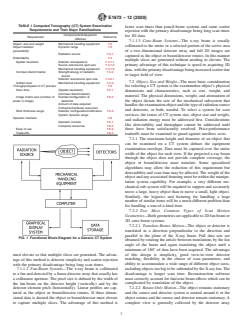
in the overall subsystem. Fig. 1 is a functional block diagram
components making up the CT system is needed in order for a
for a generic CT system.
CT system purchaser to prepare a CT system specification. A
7.1.1 Pencil-Beam, Fan-Beam and Cone-Beam Type Sys-
specification is required for acquisition of either CT system
tems:
hardware or scan services for a specific examination applica-
7.1.1.1 Pencil Beam Systems—Thex-raybeamiscollimated
tion.
to a pencil and the effective pixel size becomes the size of the
beam on the detector area. The beam is translated over the
object and the object rotated after each pass of the beam over
For referenced ASTM standards, visit the ASTM website, www.astm.org, or
the object or the beam and detector are translated and rotated
contact ASTM Customer Service at service@astm.org. For Annual Book of ASTM
around the object to build up linear slice profiles. If a three
Standards volume information, refer to the standard’s Document Summary page on
the ASTM website. dimensional data set is desired the object or beam/detector
E1672 − 12 (2020)
TABLE 1 Computed Tomography (CT) System Examination
faster scan times than pencil-beam systems and some scatter
Requirements and Their Major Ramifications
rejection with the primary disadvantage being long scan times
Components/Subsystems
for 3D data.
Requirement Reference
Affected
7.1.1.3 Cone-Beam Systems—The x-ray beam is usually
Object, size and weight Mechanical handling equipment 7.2
collimated to the entire or a selected portion of the active area
Object radiation Dynamic range 7.3
penetrability
of a two dimensional detector array and full 2D images are
Radiation source 7.3.1
captured as the object or beam/detector rotates. In this manner
Detectability 7.4
multiple slices are generated without needing to elevate. The
Spatial resolution Detector size/aperture 7.4.1.1
Source size/source spot size 7.4.1.2 primary advantage of this technique is speed or acquiring 3D
Mechanical handling equipment 7.4.1.5
data,withtheprimarydisadvantagebeingincreasedscatterdue
Contrast discrimination Strength/energy of radiation 7.4.2
to larger field of view.
source
Detector size/source spot size 7.4.2.1
7.2 Object, Size and Weight—The most basic consideration
Artifact level Mechanical handling equipment 7.4.3
Throughput/speed of CT process 7.5 for selecting a CT system is the examination object’s physical
Scan time (Spatial resolution) 7.5.1
dimensions and characteristics, such as size, weight, and
(Contrast discrimination)
material. The physical dimensions, weight, and attenuation of
Image matrix size (number of Number/configuration of 7.5.2
pixels in image) detectors the object dictate the size of the mechanical subsystem that
Amount of data acquired
handlestheexaminationobjectandthetypeofradiationsource
Computer/hardware resources
and detectors, or both, needed. To select a system for scan
Slice thickness range Detector configuration/collimators 7.5.3
System dynamic range
services, the issues of CT system size, object size and weight,
Operator interface 7.6
and radiation energy must be addressed first. Considerations
Operator console 7.6.1
like detectability and throughput cannot be addressed until
Computer resources 7.6.2
Ease of use 7.6.3 these have been satisfactorily resolved. Price-performance
Trade-offs 7.6.4
tradeoffs must be examined to guard against needless costs.
7.2.1 The maximum height and diameter of an object that
can be examined on a CT system defines the equipment
examination envelope. Data must be captured over the entire
width of the object for each view. If the projected x-ray beam
through the object does not provide complete coverage, the
object or beam/detector must translate. Some specialized
algorithms may allow the reduction of this requirement but
detectability and scan time may be affected. The weight of the
object and any associated fixturing must be within the manipu-
lation system capability. For example, a very different me-
chanical sub-system will be required to support and accurately
move a large, heavy object than to move a small, light object.
Similarly, the logistics and fixturing for handling a large
number of similar items will be a much different problem than
for handling a one-of-a-kind item.
7.2.2 Two Most Common Types of Scan Motion
Geometries—Bothgeometriesareapplicableto2Dfanbeamor
3D cone beam systems.
7.2.2.1 Translate-Rotate Motion—The object or detector is
translated in a direction perpendicular to the direction and
parallel to the plane of the X-ray beam. Full data sets are
FIG. 1 Functional Block Diagram for a Generic CT System
obtained by rotating the article between translations by the fan
angle of the beam and again translating the object until a
minimum of 180° of data have been acquired. The advantage
of this design is simplicity, good view-to-view detector
must elevate so that multiple slices are generated. The advan-
matching, flexibility in the choice of scan parameters, and
tage of this method is detector simplicity and scatter rejection
ability to accommodate a wide range of different object sizes,
with the primary disadvantage being long scan times.
includingobjectstoobigtobesubtendedbytheX-rayfan.The
7.1.1.2 Fan-Beam Systems—The x-ray beam is collimated
disadvantage is longer scan time. Reconstruction software
to a fan and detected by a linear detector array that usually has
must correctly account for fan/cone beam effects which can be
a collimator aperture. The pixel size is defined by the width of
complicated by translation of the object.
the fan-beam on the detector height (vertically) and by the
detector element pitch (horizontally). Linear profiles are cap- 7.2.2.2 Rotate-Only Motion—The object remains stationary
tured as the object or beam/detector rotates. If three dimen- and the source and detector system is rotated around it or the
sional data is desired the object or beam/detector must elevate object rotates and the source and detector remain stationary.A
to capture multiple slices. The advantage of this method is complete view is generally collected by the detector array
E1672 − 12 (2020)
during each sampling interval. A rotate-only scan has lower Filteringofthex-raybeamcan“Harden”thex-rayspectrumby
motion overhead than a translate-rotate scan, and is attractive reducing the amount of lower energies which can help reduce
for industrial applications where the object to be examined fits artifacts.Harderbeamspectrumresultsinlowerimagecontrast
within the fan beam, and scan speed is important. Irrespective and may need for higher primary beam exposure dose,
of whether the sample translates and rotates, or both, or the therefore, selection of the correct filtering is very important.
source/detector system rotates, the principles of CT are the X-ray tubes and linear accelerators (linacs) are typically
same. In 2D fan beam type systems, the sample/object may several orders of magnitude more intense than isotope sources.
also be elevated through the fan beam in order to build up a However, X-ray generators have the disadvantage that they are
three dimensional stack of cross-sectional views. In a cone inherently less stable than isotope sources. X rays produced
beam type system, the rows of the detector array provide the from electrical radiation generators have source spot sizes
third dimension.The sample/object may need to be elevated or ranging from a few millimetres down to a few micrometres.
translated in order to provide complete coverage if the sample/ Reducing the source spot size reduces geometric unsharpness,
object is larger than the cone beam (the projected area of the thereby enhancing detail sensitivity. However, the basic spatial
sample/object on the detector array area.) For some applica- resolution (SRb) of the detector must also be able to support
tions a rotate/translate combination, or helical, scan may be this increased spatial resolution. Smaller source spots permit
appropriate. higher spatial resolution but at the expense of reduced X-ray
beam intensity. Reduced X-ray beam intensity implies longer
7.2.3 The purchaser of CT equipment should be aware that
scan times or inspection of smaller or less dense objects. Also
important cost trade-offs may exist. For instance, the cost of a
to keep in mind, unlike radiography, CT can require extended,
mechanical subsystem with translate, rotate, and elevate func-
continuous usage of the X-ray generator. Therefore, an in-
tions incorporated in one integrally constructed piece of
creased cooling capacity of the X-ray generator should be
hardware is relatively cost invariant for vertical motions up to
considered in the design and purchase, in anticipation of the
some limit, but increases drastically above that point. The
extended usage requirements.
casual specification of an elevation could have severe cost
implications; whereas the simple expediency of turning the 7.3.2 Radioisotope Sources—A radioisotope source can
object over could effectively extend the examination envelope have the advantages of small physical size, portability, low-
with no cost impact. Similarly, the specification of a large field power requirements, simplicity, discrete spectral lines, and
of view could drive system size and cost soaring; whereas the stability of output. The disadvantages are limited intensity per
application of prior information or limited angle reconstruction unit area, limited peak energy, and increased regulatory con-
techniques, or both, could enable the examination with a much cerns.
smaller scanner.
7.3.3 Synchrotron Radiation (SR) Sources—Synchrotron ra-
7.2.4 Automatic material handling equipment is an option diation (SR) sources with special equipment (like monochro-
that can be acquired with a CT system for mounting and maters) produce very intense, naturally collimated, narrow
removing objects. The advantages are lower overhead and bandwidth, tunable radiation. Thus, CT systems using SR
greater throughput. The main disadvantages are added costs sources can employ essentially monochromatic radiation. With
and complexity to the system design. present technology, however, practical SR energies are re-
stricted to less than about 20 to 30 keV. Since any CT system
7.3 Object Radiation Penetrability—Next to examination
is limited to the examination of samples with radio-opacities
envelope and weight, the most basic consideration is radiation
consistent with the penetrating power of the X rays or gamma
penetrability. Object penetrability determines the minimum
rays employed, monochromatic SR systems can, in general,
effective energy and intensity for the radiation source. As in
image only small (1- to 5-mm) low density objects. Some
any radiological situation, penetrability is a function of object
synchrotron sources also have a polychromatic, or white, beam
material, density and morphology (shape and features/
line available allowing CT of higher density materials. It
geometry). The rules for selecting CT source energy are
should also be noted that synchrotrons produce a wide flat
approximately the same as those for conventional radiography,
beam, typically several centimeters wide by a few hundred
with the understanding that for CT, the incident radiation must
microns tall. This means an object is typically translated to
be able to penetrate the maximum absorption path length
obtain a full 3D. In addition to the above consideration a
through the object in the plane of the scan. The lowest signal
synchrotron beams are virtually parallel which means resolu-
value should be larger than the root-mean-square (RMS) of the
tion depends primarily on the detector’s effective pixel size.
electronic noise. The required flux is determined by how many
For this reason high end cameras and scintillators are typically
photons are needed for statistical considerations. The spot size
employed.
is determined by the spatial resolution and specimen geometry
7.3.4 Filters—Oftentimes, filters and compensators are used
requirements.
to tune the source to the desired output. The use of filters and
7.3.1 X-ray Sources—Electrical X-ray generators offer a
compensators will reduce the full capability of the source,
wider selection in peak energy and intensity and have the
causing additional limitations to source output.
addedsafetyfeatureofdiscontinuedradiationproductionwhen
switched off. The disadvantage is that the polychromaticity of 7.4 Detectability—Once the basic considerations of object
the Bremsstrahlung energy spectrum causes artifacts such as size, weight, and radiation penetrability have been addressed,
cupping (the anomalous decreasing attenuation toward the the specific examination requirements are handled. The most
center of a homogeneous object) in the image if uncorrected. important is the capability of the CT system to image the
E1672 − 12 (2020)
characteristics of concern in the object. This is a detectability sensing elements. The more detectors used, the faster the
issue. Detectability is an all-encompassing term that includes required scan data can be collected; but there are important
elements of spatial resolution, contrast discrimination, and trade-offs to be considered.
artifacts. Spatial resolution characterizes how faithfully the CT (1) A single detector provides the least efficient method of
system reproduces the features of the examination specimen in collecting data but entails minimal complexity, eliminates
an image. Contrast discrimination characterizes the amount of
concerns of scatter between elements, differences in detector
random noise in the CTimage and the ability to detect features response, and allows an arbitrary degree of collimation and
within noise, that is, the signal to noise ratio for a given feature
shielding. Translation motion is required for two dimensional
of interest. The former quantifies our knowledge of an object,
reconstructions and elevate motion is required to create three
thelatterouruncertainty.Together,theyformacomplementary dimensional reconstructions.
pair of variables that fully characterize any imaging system.
(2) An area detector provides the most efficient method of
Artifacts are reproducible features in an image that are not
collecting data but entails the transfer and storage of large
related to actual features in the object. The purchaser is
amounts of information, forces trade-offs between scatter,
normally interested in detecting geometrical (dimensional) and
elements, and detector efficiency, and creates serious collima-
material (density, porosity, inclusions, etc.) anomalies. From
tion and shielding challenges. However, using cone beam
experience, allowable variations are generally known and
reconstruction algorithms three dimensional renderings of the
codified. They usually take the form of simple declarative
object can be made. Guide E2736 contains information about
statements: For example: Critical dimensions must be accurate
area digital detector arrays.
to 625 µm (0.001 in.); Void diameters must be less than 1 mm
(3) Lineararrayshaveperformancecharacteristicsinterme-
(0.040 in.); Porosity must represent less than 1 % missing
diate between these two extremes, for example, reasonable
2 2
volume; Density variations over 1 cm (0.40 in. ) must be less
scan times at moderate complexity, acceptable scatter between
than 1 %; etc. These so-called application requirements are
elements, and differences in detector response. Linear arrays
often explicitly known. The system component engineer must
have a flexible architecture that typically accommodates good
determine the spatial resolution and contrast discrimination
collimation and shielding but require elevate motion for three
needed to obtain the specified dimensional accuracy and defect
dimensional reconstructions. In some cases several linear areas
sensitivity.This in turn sets upper limits on the amount or type,
are combined to allow faster scans while keeping some of the
or both, of artifacts that can be tolerated. Making this connec-
collimation benefits.
tion between specifications and performance requirements is
(4) An important aspect of the detection system is the
generally a difficult task that is best solved collaboratively
electronicssystemusedtoconverttheanalogsignalreceivedto
between purchaser and supplier.
a digital stream for processing. The front-end analog electron-
7.4.1 Spatial Resolution—All imaging systems, CT ics amplify the detector signal to a magnitude that can be
included, are limited in their ability to reproduce object digitized. Fast systems demand good fidelity of the amplified
morphology. Sometimes features can be detected but not signal.What makes the task especially demanding is that many
accurately measured. That is, an infinitely small, infinitely signals,differingbyseveralordersofmagnitude,arefrequently
dense point in the object will be imaged not as a point, but as multiplexed on the same line in rapid succession; intersignal
amplification rates are measured in microseconds. The analog-
a spot—possibly a very small spot, but a spot of finite size
nonetheless. Hence, the image of a real object will exhibit a to-digital (A/D) conversion is performed as close to the analog
certain amount of unsharpness (blurred edges). CT spatial amplification chain as possible. The accuracy requirement of
resolutionisameasureofthisunsharpnessandobeysmuchthe theA/Dmustbeconsistentwiththestatisticallimitationsofthe
same rules as any radiological imaging modality: it is limited largest and the smallest detectable signals.
by the effective size of the detectors (pixels), the size of the
7.4.1.2 Source Spot Size—The source spot is the source
source spot, and the relative position of the specimen with
region from which X rays or gamma rays emanate. In an
respect to the source and detector. Other factors, such as
electrical radiation generator, like an X-ray tube or linear
sampling, motion uncertainty, reconstruction matrix size, im-
accelerator, it is the area where the electrons strike the target.
age display matrix, and reconstruction algorithms, can degrade
In an isotopic source, it is the area from which the radiation
the inherent spatial resolution.
effectively emerges.The size and shape of the source spot is an
7.4.1.1 Radiation Detection—Thedetectionsystemconverts important determinant of the aperture function (see ASTM
the transmitted radiation into an electronic signal. The detector source focal spot standards). For instance, source spots in
element is typically a scintillation detector that is optically linear accelerators are typically shaped as Gaussian distribu-
coupled to a photo-conversion device such as a photodiode or tions; whereas source spots in X-ray tubes are often double-
photomultiplier tube. Alternatively, some systems use other peaked. Source spots associated with isotopic sources can be
types of detectors. For fan-beam type systems, the in-plane either more or less complex. Since source spots do not
detector width is determined in part by the spatial resolution generally have sharp edges—or even symmetric shapes, it is
requirement. This detector width is either designed in the common practice to define an effective size for convenience.
system or, for variable aperture systems, can be set by some The actual intensity distribution is important information, but
kind of shielding aperture plates that define the detector’s field is too complex to be readily useful. Consequently, reported
of view. The detection system may consist of a single sensing source spot sizes are a function of the definition and method
element, an area array of sensing elements, or a linear array of used to measure them. For example, the average radius of the
E1672 − 12 (2020)
region from which 99 % of the emissions emerge will be much be deemed a potential candidate for use. The lower the
larger than the standard deviation of the intensity distribution. contrast, the harder it will be to distinguish features. If the
application requires resolving low-contrast features, the accu-
In other words, source spot characteristics can be quantified in
different ways. For this reason, comparisons between sources, racywillbeworse,butpreciselyhowmuchworseisdifficultto
especially those provided by different suppliers, are difficult to quantify.Thepurchasershouldalsoappreciatethatiftheobject
make.Anothersourceselectionfactortoconsiderisstability.In is highly attenuating, the image may exhibit artifacts that could
limit or preclude measurements in the affected regions.
selecting an electrical source, appreciate that spot position can
wander over time, and changes in accelerating potential can
7.4.1.5 Accuracy of Mechanical Handling Equipment/
occur.
Motion Control/Manipulation Systems—The object manipula-
tion system has the function of holding the object and
7.4.1.3 Often, the in-plane source spot size and the in-plane
providing the necessary range of motion to position the object
detector width can be adjusted over a limited range of options,
area of interest between the radiation source and detector.
allowing spatial resolution to be engineered somewhat. Spatial
Since spatial resolution is limited by many things, including
resolution is a combination of geometrical and detector factors
therelativepositionoftheobjectwithrespecttothesourceand
with the geometrical contribution dependent on focal spot size.
detector, any problems with alignment or accuracy of the
In general, the smaller the source spot or detector size, or both,
mechanical system will show up as degraded resolution. It is
the better the spatial resolution. Since spatial resolution limits
typically more difficult to align hardware for translate-rotate
dimensional accuracy and resolving power (that is, the ability
motion machines, but the sampling rate is adjustable up to
to distinguish two nearby point objects as separate entities), it
some limit. In contrast, rotate-only motion machines typically
is desired to select the smallest possible source spot and
are not as difficult to align, but they do not give the option of
detector sizes. On the other hand, the accuracy of dimensional
adjustinglinearsamplingtosatisfytherequiredsamplingrates.
measurements also depends on the contrast discrimination of
In either case, artifacts occur and the resolution is degraded if
the system, which, in turn, depends on the number of detected
alignment is compromised.
photons. The smaller the selected source spot or detector size,
(1) Because the inherent resolution of a system can be
orboth,thefewerthenumberofphotonsdetectedperunitscan
degraded by the mechanical handling equipment, fine spatial
time, and the poorer the contrast discrimination. However,
resolution requirements can drive mechanical designs and
desire to maximize throughput or scanner limitations often
tolerances to extremely high costs. Typically, system designs
precludes arbitrarily long scan times. An evaluation of the
can accommodate spatial resolutions up to some limit. Beyond
trade-offs among spatial resolution, contrast discrimination,
that limit, redesign with different, more accurate system
and scan time usually comes after it is first determined that
components and different assembly procedures is required.
adequate spatial resolution can be achieved irrespective of any
7.4.1.6 Spatial Resolution Trade-offs— Spatial resolution
other considerations. The ultimate selection of the optimum
requirements can affect an entire range of system components
combination of performance parameters is a value judgment
andsubsystems.Spatialresolutionrequirementsplacelimitson
best made by the purchaser in conjunction with the supplier.
the accuracy and repeatability of the mechanical handling
7.4.1.4 The prospective purchaser can make a preliminary
equipment. Spatial resolution requirements also limit the
determination as to whether a given CT system has the
source spot size and detector aperture width and element
necessary spatial resolution for a given application using the
(pixel) size, and define the geometry between source and
following guidelines. First, if dimensioning is important, sharp
detector. The system configuration defines the effective beam
high-contrast edges free of artifacts typically can be located to
3,4
width at the object. Thus, a requirement for high spatial
about one tenth of the effective beam width associated with a
resolution at a certain frequency may require a microfocus
given system. Effective beam width is the x-ray beam size at
source or small detector apertures. It might require sampling at
the detector and could be defined by a fan-beam collimator,
smaller spatial intervals. It also might affect the speed of the
detector aperture, or by the pixel height. As long as the
data acquisition process. Use of reconstruction filters can also
estimated accuracy is within a factor of close to two of the
affect spatial resolution capability.
dimensional accuracy requirement set by the application, the
7.4.2 Contrast Discrimination—All imaging systems, CT
particular system being considered should be deemed a poten-
included, are limited in their ability to reproduce object
tial candidate for use. If the application requires dimensional
composition. That is, two regions of identical material will be
measurements of low-contrast features, the accuracy will be
imaged, not as smooth areas of equal CT value, but as grainy
worse, but precisely how much worse is difficult to quantify.
areas of statistically variable CT values. Hence, upon repeated
Second, if resolving fine features is important, two high-
examination,themeanvalueoftworegionswillvaryrandomly
contrast features in an image typically can be distinguished as
in relative magnitude. Contrast discrimination is a measure of
separate entities provided they are physically separated in the
object by at least the effective beam width. For example, if the
effective beam width is 1 mm (0.040 in.), it should be possible
to distinguish features like passageways or embedded wires, as
Bracewell, R. N., “Correction for Collimator Width in X-Ray Reconstructive
Tomography,” Journal of Computer Assisted Tomography, Vol 1, No. 2, 1977,
long as they are separated from each other by more than 1 mm
p. 251.
(0.040in.)center-to-center.Aslongastheeffectivebeamwidth
Yester, M. W. and Barnes, G. T., “Geometrical Limitations of Computed
is within 25 % or so of the resolving power requirement set by
Tomography Scanner Resolution,” SPIE Proceedings, Applications of Optical
the application, the particular system being considered should Instrumentation in Medicine, Vol 1, 27, 1977, pp. 296–303.
E1672 − 12 (2020)
this variability and obeys much the same rules as any radio- will need to have a contrast of at least 0.3 % (that is, 3 by
logicalimagingmodality:itdependsonthenumberofdetected 2 %⁄20) to be visible. As long as the expected or estimated
photons, which in turn, depends on all scan parameters image noise associated with a given system is within a factor
affecting the data collection process, such as sampling interval, of two or so of the noise requirement set by the application, the
particular system being considered should be deemed a poten-
source spot size and flux, detector size and stopping power,
linear and angular sample rates, etc. tial candidate for use. As above, if the object is highly
attenuating,theimagemayexhibitartifactsthatcouldmimicor
7.4.2.1 Often, many of these parameters can be adjusted
mask large low-contrast features in the affected regions.
over a limited range of options, allowing contrast sensitivity to
7.4.3 Artifact Content—Artifacts are reproducible features
be engineered somewhat. In general, the greater the number of
in an image that are not related to actual features in the object.
photons detected, the better the contrast sensitivity. Since
Artifacts can be considered correlated noise because they form
contrast sensitivity limits the low-contrast discrimination of
fixed patterns under given conditions yet carry no object
different materials and influences the accuracy of dimensional
information. Some artifacts are due to physical and mathemati-
measurements, it is desired to select scan parameters that
cal limitations of CT, for example beam hardening, radiation
maximize the number of detected photons. However, contrast
scatter, and partial volume effects. Some artifacts are due to
sensitivity improves as the square root of the detected flux, and
system deficiencies such as mechanical misalignment, insuffi-
significant improvements are difficult to achieve by simply
cient linear or angular sampling, or both, crosstalk between
scanning longer, because scan times rapidly become impracti-
detectors,etc.Artifactsarealwayspresentatsomelevel.Often,
cal. The one option for improving image quality at no expense
they are the limiting factor in image quality. In general,
in scan time is to increase source spot and detector sizes; but
artifacts become important when a CT system is used beyond
desire to maximize or maintain spatial resolution often pre-
its design envelope. A common instance is when object
cludes arbitrary adjustment of source spot and detector sizes.
attenuations cause minimum signals to be comparable to, or
An evaluation of the trade-offs among contrast discrimination,
less than, sensor offsets due to electronic noise and unwanted
spatial resolution, and scan time usually comes after it is first
scatter. Mitigating the effect of artifacts in the image is best
determined that adequate contrast discrimination can be
done by addressing the underlying problems at their origin. If
achieved irrespective of any other considerations. The ultimate
artifacts cannot be reduced or eliminated at their origin, the
selection of the optimum combination of performance param-
nextoptionistoattemptasoftwarefix.Asarule,mostartifacts
eters is a value judgment best made by the purchaser in
are best corrected before image formation by applying trans-
conjunction with the supplier.
formations to the data. In the end, if artifacts preclude the use
7.4.2.2 Rules of thumb can be given to help the prospective
of a given system for a particular application, the purchaser
purchaser make a preliminary determination as to whether a
must consider the use of another more capable system if one is
given CT system has the necessary contrast discrimination for
available, or the modification of the object specifications. That
a given application. First, if small-area high-contrast (that is,
failing, the purchaser must work with suppliers to determine if
inclusions) discrimination is important, small (approximately 4
the technology exists to satisfy the application at hand, or
pixels)regionstypicallycanbediscriminatedagainstauniform
conclude that CT is not presently a viable examination tech-
background when the relative contrast between feature and
nique for the object.
host is greater than 5 to 6 times the single-pixel image noise in
7.5 Throughput—The next step in specifying a CTsystem is
the vicinity. For example, if the image noise in the region of
theconsiderationofthroughput.Throughputgenerallyrefersto
interest is about 2 %, a small feature will need to have a
how many scans can be generated per unit time; it is usually
contrast of at least 10 % to be visible.As long as the expected
implied or taken for granted that any detailed analyses will be
or estimated image noise associated with a given system is
performed off-line in a noninterfering manner. The importance
within a factor of two or so of the noise requirement set by the
of throughput varies depending on the circumstance. For an
application, the particular system being considered should be
applicationstudy,spatialresolutionandcontrastdiscrimination
deemed a potential candidate for use. As a point of reference,
1 % image noise is considered excellent, a few percent is are usually of primary concern and throughput is an issue only
insofar as it affects the amount of scan time that must be
considered good, 5 % is considered mediocre, greater than
budgeted. On the other hand, for routine examination use,
10 % is considered poor. The purchaser should also appreciate
throughputisusuallyamajorconcern,sinceitisintimatelytied
that if the object is highly attenuating, the image may exhibit
to financial considerations.
artifacts that could mimic or mask small high-contrast features
in affected regions. 7.5.1 Scan Time—The purchaser should recognize that scan
time is intimately related to spatial resolution and contrast
7.4.2.3 Second, if density (that is, large-area low-contrast)
discrimination.Foragivensystem,thespecificationofanytwo
discrimination is important, large (greater than 400 pixels)
fixes the third. For a new system, the specification of all three
regions typically can be discriminated against a uniform
mayormaynotbetechnicallypossible,andifadesignsolution
background when the relative contrast between feature and
does exist, it may not be economically practical. Ideally, these
host is greater than about three times the single-pixel image
issues are addressed jointly by purchaser and supplier.
noise in the vicinity divided by the square root of the number
of pixels, i.e., larger features with smaller contrast can be 7.5.1.1 For an existing system, the purchaser can normally
detected. For example, if the image noise in the region of influence scan time by judicious selection of available scan
interest is about 2 %, a compact feature 20 by 20 pixels in size parameters. Though it must be recognized that it may not be
E1672 − 12 (2020)
possible to satisfy simultaneously the throughput, spatial
resolution, and contrast discrimination requirements of an
application for which the system was not designed. Typically,
the purchaser selects source and detector parameters yielding
the minimum spatial resolution (that is, the largest effective
beam width that the application can tolerate). If spatial reso-
lution is unimportant, then the purchaser should select the
largest possible effective beam width that the scanner can
accommodate. Next, the purchaser should select scan param-
eters yielding the minimum contrast discrimination that the
application can tolerate. If contrast discrimination is
unimportant, then the purchaser should select the fastest
possible scan time that the scanner can accommodate. Key
parameters affecting scan time are: image matrix size, slice
NOTE 1—These are the maximum fields of view that can be imaged at
thickness, field of view, and sampling interval. The first two
full resolution with number of pixels available.
warrant further discussion and are covered in 7.5.2 and 7.5.3.
FIG. 2 Effect of Re
...