

ASTM E1695-20e1
(Test Method)Standard Test Method for Measurement of Computed Tomography (CT) System Performance
General Information
- Abstract
SIGNIFICANCE AND USE
4.1 The major factors affecting the quality of a CT image are total image unsharpness (UTimage), contrast (Δµ), and random noise (σ). Geometrical and detector unsharpness limit the spatial resolution of a CT system, that is, its ability to image fine structural detail in an object. Random noise and contrast response limit the contrast sensitivity of a CT system, that is, its ability to detect the presence or absence of features in an object. Spatial resolution and contrast sensitivity may be measured in various ways. In this test method, spatial resolution is quantified in terms of the modulation transfer function (MTF), and contrast sensitivity is quantified in terms of the contrast discrimination function (CDF). The relationship between contrast sensitivity and spatial resolution describing the resolving and detecting capabilities is given by the contrast-detail-diagram (CDD metric, see also Guide E1441 and Practice E1570). This test method allows the purchaser or the provider of CT systems or services, or both, to measure and specify spatial resolution and contrast sensitivity and is a measure for system stability over time and performance acceptability.
SCOPE
1.1 This test method provides instruction for determining the spatial resolution and contrast sensitivity in X-ray and γ-ray computed tomography (CT) volumes. The determination is based on examination of the CT volume of a uniform cylinder of material. The spatial resolution measurement (Modulation Transfer Function) is derived from an image analysis of the sharpness at the edges of the reconstructed cylinder slices. The contrast sensitivity measurement (Contrast Discrimination Function) is derived from an image analysis of the contrast and the statistical noise at the center of the cylinder slices.
1.2 This test method is more quantitative and less susceptible to interpretation than alternative approaches because the required cylinder is easy to fabricate and the analysis easy to perform.
1.3 This test method is not to predict the detectability of specific object features or flaws in a specific application. This is subject of IQI and RQI standards and standard practices.
1.4 This method tests and describes overall CT system performance. Performance tests of systems components such as X-ray tubes, gamma sources, and detectors are covered by separate documents, namely Guide E1000, Practice E2737, and Practice E2002; c.f. 2.1, which should be consulted for further system analysis.
1.5 Units—The values stated in SI units are to be regarded as standard. The values given in parentheses after SI units are provided for information only and are not considered standard.
1.6 This standard does not purport to address all of the safety concerns, if any, associated with its use. It is the responsibility of the user of this standard to establish appropriate safety, health, and environmental practices and determine the applicability of regulatory limitations prior to use.
1.7 This international standard was developed in accordance with internationally recognized principles on standardization established in the Decision on Principles for the Development of International Standards, Guides and Recommendations issued by the World Trade Organization Technical Barriers to Trade (TBT) Committee.
- Status
- Published
- Publication Date
- 31-May-2020
- Technical Committee
- E07 - Nondestructive Testing
- Drafting Committee
- E07.01 - Radiography (X and Gamma) Method
Overview
ASTM E1695-20e1 is a standardized test method from ASTM International dedicated to the measurement of computed tomography (CT) system performance for both X-ray and γ-ray systems. This standard provides quantitative procedures to determine two crucial factors governing CT image quality: spatial resolution and contrast sensitivity. By focusing on measurable metrics such as the modulation transfer function (MTF) and contrast discrimination function (CDF), it supports purchasers, providers, and operators in evaluating and specifying CT system stability and performance over time.
This standard ensures consistency and comparability of CT system assessments, aligning with internationally recognized standardization principles, and is applicable in laboratories, industrial inspection, quality control, and research environments.
Key Topics
- Image Quality Factors: Evaluates total image unsharpness, contrast, and random noise, all of which directly impact CT imaging performance.
- Spatial Resolution and MTF: Measures the system's capacity to display fine structural details, quantified through MTF, which is determined from the analysis of sharpness at the edges of reconstructed cylinder slices.
- Contrast Sensitivity and CDF: Assesses the ability of a CT system to distinguish between features of different densities, calculated via CDF based on statistical noise and image contrast in the center of the cylinder slices.
- Contrast-Detail-Diagram (CDD): Provides a graphical representation combining contrast sensitivity and spatial resolution, useful for visualizing resolving and detecting capabilities.
- Phantom Design and Testing Procedures: Standards for the cylinder phantom’s geometry and material to ensure the test is reproducible and representative. The procedure outlines phantom alignment, scanning parameters, and analytical methods for proper system assessment.
- Measurement Reporting: Specifies documentation requirements, including reporting MTF and CDF curves, relevant setup parameters, and any data processing applied during the procedure.
- Precision and Bias: Addresses the standard's quantitative accuracy, including repeatability and trueness of the MTF and CDF measurements.
Applications
The ASTM E1695-20e1 standard is vital in several practical settings, ensuring high-quality results in:
- System Acceptance Testing: For new or upgraded CT installations, use this method to verify that systems meet spatial resolution and contrast sensitivity requirements.
- Routine Quality Assurance: Perform periodic checks to monitor changes in performance, enabling prompt maintenance and consistent imaging quality.
- Comparative Performance Evaluation: Provides a basis for objectively comparing different CT systems, system configurations, or after component replacements.
- Industrial Inspection and Nondestructive Testing (NDT): Supports industries using CT for flaw detection, dimensional measurements, and material analysis by confirming that imaging systems are functioning within specified parameters.
- Research and Development: Provides a robust framework for evaluating novel CT technologies or image reconstruction algorithms.
- Service Provider and Purchaser Documentation: Enables clear communication of CT system specifications and performance in contractual agreements.
It is important to note that this standard is not intended to determine the detectability of specific features or flaws within particular objects; other standards such as IQI (Image Quality Indicator) and RQI (Resolution Quality Indicator) should be consulted for application-specific performance evaluation.
Related Standards
ASTM E1695-20e1 references and complements several key standards for CT and radiology systems, including:
- ASTM E1000 - Guide for Radioscopy
- ASTM E1316 - Terminology for Nondestructive Examinations
- ASTM E1441 - Guide for Computed Tomography (CT)
- ASTM E1570 - Practice for Fan Beam Computed Tomographic (CT) Examination
- ASTM E2002 - Practice for Determining Image Unsharpness and Basic Spatial Resolution in Radiography and Radioscopy
- ASTM E2737 - Practice for Digital Detector Array Performance Evaluation and Long-Term Stability
- ISO 15708 - Non-Destructive Testing – Radiation Methods – Computed Tomography (Parts 1-4)
By conforming to ASTM E1695-20e1 and its related documents, users can ensure consistent, reliable, and internationally recognized CT system performance measurement and reporting.
Keywords: computed tomography, CT system performance, spatial resolution, contrast sensitivity, MTF, CDF, image quality, ASTM E1695, nondestructive testing, quality assurance, industrial CT.
Relations
- Effective Date
- 01-Feb-2024
- Effective Date
- 01-Dec-2019
- Effective Date
- 15-Jun-2019
- Effective Date
- 01-Mar-2019
- Effective Date
- 01-Jan-2018
- Effective Date
- 15-Jun-2017
- Effective Date
- 01-Feb-2017
- Effective Date
- 01-Dec-2016
- Effective Date
- 01-Aug-2016
- Effective Date
- 01-Feb-2016
- Effective Date
- 01-Dec-2015
- Effective Date
- 01-Sep-2015
- Effective Date
- 01-Jun-2014
- Effective Date
- 01-Jun-2014
- Effective Date
- 01-May-2014
Get Certified
Connect with accredited certification bodies for this standard

BSI Group
BSI (British Standards Institution) is the business standards company that helps organizations make excellence a habit.

TÜV Rheinland
TÜV Rheinland is a leading international provider of technical services.

TÜV SÜD
TÜV SÜD is a trusted partner of choice for safety, security and sustainability solutions.
Sponsored listings
Frequently Asked Questions
ASTM E1695-20e1 is a standard published by ASTM International. Its full title is "Standard Test Method for Measurement of Computed Tomography (CT) System Performance". This standard covers: SIGNIFICANCE AND USE 4.1 The major factors affecting the quality of a CT image are total image unsharpness (UTimage), contrast (Δµ), and random noise (σ). Geometrical and detector unsharpness limit the spatial resolution of a CT system, that is, its ability to image fine structural detail in an object. Random noise and contrast response limit the contrast sensitivity of a CT system, that is, its ability to detect the presence or absence of features in an object. Spatial resolution and contrast sensitivity may be measured in various ways. In this test method, spatial resolution is quantified in terms of the modulation transfer function (MTF), and contrast sensitivity is quantified in terms of the contrast discrimination function (CDF). The relationship between contrast sensitivity and spatial resolution describing the resolving and detecting capabilities is given by the contrast-detail-diagram (CDD metric, see also Guide E1441 and Practice E1570). This test method allows the purchaser or the provider of CT systems or services, or both, to measure and specify spatial resolution and contrast sensitivity and is a measure for system stability over time and performance acceptability. SCOPE 1.1 This test method provides instruction for determining the spatial resolution and contrast sensitivity in X-ray and γ-ray computed tomography (CT) volumes. The determination is based on examination of the CT volume of a uniform cylinder of material. The spatial resolution measurement (Modulation Transfer Function) is derived from an image analysis of the sharpness at the edges of the reconstructed cylinder slices. The contrast sensitivity measurement (Contrast Discrimination Function) is derived from an image analysis of the contrast and the statistical noise at the center of the cylinder slices. 1.2 This test method is more quantitative and less susceptible to interpretation than alternative approaches because the required cylinder is easy to fabricate and the analysis easy to perform. 1.3 This test method is not to predict the detectability of specific object features or flaws in a specific application. This is subject of IQI and RQI standards and standard practices. 1.4 This method tests and describes overall CT system performance. Performance tests of systems components such as X-ray tubes, gamma sources, and detectors are covered by separate documents, namely Guide E1000, Practice E2737, and Practice E2002; c.f. 2.1, which should be consulted for further system analysis. 1.5 Units—The values stated in SI units are to be regarded as standard. The values given in parentheses after SI units are provided for information only and are not considered standard. 1.6 This standard does not purport to address all of the safety concerns, if any, associated with its use. It is the responsibility of the user of this standard to establish appropriate safety, health, and environmental practices and determine the applicability of regulatory limitations prior to use. 1.7 This international standard was developed in accordance with internationally recognized principles on standardization established in the Decision on Principles for the Development of International Standards, Guides and Recommendations issued by the World Trade Organization Technical Barriers to Trade (TBT) Committee.
SIGNIFICANCE AND USE 4.1 The major factors affecting the quality of a CT image are total image unsharpness (UTimage), contrast (Δµ), and random noise (σ). Geometrical and detector unsharpness limit the spatial resolution of a CT system, that is, its ability to image fine structural detail in an object. Random noise and contrast response limit the contrast sensitivity of a CT system, that is, its ability to detect the presence or absence of features in an object. Spatial resolution and contrast sensitivity may be measured in various ways. In this test method, spatial resolution is quantified in terms of the modulation transfer function (MTF), and contrast sensitivity is quantified in terms of the contrast discrimination function (CDF). The relationship between contrast sensitivity and spatial resolution describing the resolving and detecting capabilities is given by the contrast-detail-diagram (CDD metric, see also Guide E1441 and Practice E1570). This test method allows the purchaser or the provider of CT systems or services, or both, to measure and specify spatial resolution and contrast sensitivity and is a measure for system stability over time and performance acceptability. SCOPE 1.1 This test method provides instruction for determining the spatial resolution and contrast sensitivity in X-ray and γ-ray computed tomography (CT) volumes. The determination is based on examination of the CT volume of a uniform cylinder of material. The spatial resolution measurement (Modulation Transfer Function) is derived from an image analysis of the sharpness at the edges of the reconstructed cylinder slices. The contrast sensitivity measurement (Contrast Discrimination Function) is derived from an image analysis of the contrast and the statistical noise at the center of the cylinder slices. 1.2 This test method is more quantitative and less susceptible to interpretation than alternative approaches because the required cylinder is easy to fabricate and the analysis easy to perform. 1.3 This test method is not to predict the detectability of specific object features or flaws in a specific application. This is subject of IQI and RQI standards and standard practices. 1.4 This method tests and describes overall CT system performance. Performance tests of systems components such as X-ray tubes, gamma sources, and detectors are covered by separate documents, namely Guide E1000, Practice E2737, and Practice E2002; c.f. 2.1, which should be consulted for further system analysis. 1.5 Units—The values stated in SI units are to be regarded as standard. The values given in parentheses after SI units are provided for information only and are not considered standard. 1.6 This standard does not purport to address all of the safety concerns, if any, associated with its use. It is the responsibility of the user of this standard to establish appropriate safety, health, and environmental practices and determine the applicability of regulatory limitations prior to use. 1.7 This international standard was developed in accordance with internationally recognized principles on standardization established in the Decision on Principles for the Development of International Standards, Guides and Recommendations issued by the World Trade Organization Technical Barriers to Trade (TBT) Committee.
ASTM E1695-20e1 is classified under the following ICS (International Classification for Standards) categories: 11.040.50 - Radiographic equipment. The ICS classification helps identify the subject area and facilitates finding related standards.
ASTM E1695-20e1 has the following relationships with other standards: It is inter standard links to ASTM E1316-24, ASTM E1316-19b, ASTM E1570-19, ASTM E1316-19, ASTM E1316-18, ASTM E1316-17a, ASTM E1316-17, ASTM E1000-16, ASTM E1316-16a, ASTM E1316-16, ASTM E1316-15a, ASTM E1316-15, ASTM E1316-14e1, ASTM E1316-14, ASTM E177-14. Understanding these relationships helps ensure you are using the most current and applicable version of the standard.
ASTM E1695-20e1 is available in PDF format for immediate download after purchase. The document can be added to your cart and obtained through the secure checkout process. Digital delivery ensures instant access to the complete standard document.
Standards Content (Sample)
This international standard was developed in accordance with internationally recognized principles on standardization established in the Decision on Principles for the
Development of International Standards, Guides and Recommendations issued by the World Trade Organization Technical Barriers to Trade (TBT) Committee.
´1
Designation: E1695 − 20
Standard Test Method for
Measurement of Computed Tomography (CT) System
Performance
This standard is issued under the fixed designation E1695; the number immediately following the designation indicates the year of
original adoption or, in the case of revision, the year of last revision. A number in parentheses indicates the year of last reapproval. A
superscript epsilon (´) indicates an editorial change since the last revision or reapproval.
This standard has been approved for use by agencies of the U.S. Department of Defense.
ε NOTE—Added research report footnote to Section 10 editorially in June 2022.
1. Scope responsibility of the user of this standard to establish appro-
priate safety, health, and environmental practices and deter-
1.1 This test method provides instruction for determining
mine the applicability of regulatory limitations prior to use.
thespatialresolutionandcontrastsensitivityinX-rayand γ-ray
1.7 This international standard was developed in accor-
computed tomography (CT) volumes. The determination is
dance with internationally recognized principles on standard-
based on examination of the CT volume of a uniform cylinder
ization established in the Decision on Principles for the
of material. The spatial resolution measurement (Modulation
Development of International Standards, Guides and Recom-
Transfer Function) is derived from an image analysis of the
mendations issued by the World Trade Organization Technical
sharpness at the edges of the reconstructed cylinder slices. The
Barriers to Trade (TBT) Committee.
contrast sensitivity measurement (Contrast Discrimination
Function) is derived from an image analysis of the contrast and
2. Referenced Documents
the statistical noise at the center of the cylinder slices.
2.1 ASTM Standards:
1.2 This test method is more quantitative and less suscep-
E177 Practice for Use of the Terms Precision and Bias in
tible to interpretation than alternative approaches because the
ASTM Test Methods
required cylinder is easy to fabricate and the analysis easy to
E691 Practice for Conducting an Interlaboratory Study to
perform.
Determine the Precision of a Test Method
1.3 This test method is not to predict the detectability of E1000 Guide for Radioscopy
specific object features or flaws in a specific application. This
E1316 Terminology for Nondestructive Examinations
is subject of IQI and RQI standards and standard practices. E1441 Guide for Computed Tomography (CT)
E1570 Practice for Fan Beam Computed Tomographic (CT)
1.4 This method tests and describes overall CT system
Examination
performance. Performance tests of systems components such
E2002 Practice for Determining Image Unsharpness and
as X-ray tubes, gamma sources, and detectors are covered by
Basic Spatial Resolution in Radiography and Radioscopy
separatedocuments,namelyGuideE1000,PracticeE2737,and
E2737 Practice for Digital Detector Array Performance
Practice E2002; c.f. 2.1, which should be consulted for further
Evaluation and Long-Term Stability
system analysis.
2.2 ISO Standard:
1.5 Units—The values stated in SI units are to be regarded
15708 NDT – Radiation Methods – Computed Tomography
as standard. The values given in parentheses after SI units are
– Part 1: Terminology, Part 2: Principles, Equipment and
provided for information only and are not considered standard.
Samples, Part 3: Operation and Interpretation, Part 4:
1.6 This standard does not purport to address all of the
Qualification
safety concerns, if any, associated with its use. It is the
For referenced ASTM standards, visit the ASTM website, www.astm.org, or
This test method is under the jurisdiction of ASTM Committee E07 on contact ASTM Customer Service at service@astm.org. For Annual Book of ASTM
Nondestructive Testing and is the direct responsibility of Subcommittee E07.01 on Standards volume information, refer to the standard’s Document Summary page on
Radiology (X and Gamma) Method. the ASTM website.
Current edition approved June 1, 2020. Published August 2020. Originally Available from International Organization for Standardization (ISO), ISO
approved in 1995. Last previous edition approved in 2013 as E1695 – 95(2013). Central Secretariat, BIBC II, Chemin de Blandonnet 8, CP 401, 1214 Vernier,
DOI: 10.1520/E1695-20E01. Geneva, Switzerland, http://www.iso.org.
Copyright © ASTM International, 100 Barr Harbor Drive, PO Box C700, West Conshohocken, PA 19428-2959. United States
´1
E1695 − 20
3. Terminology design and material requirements in Table 1 and Fig. 1. For fan
beam CT apparatus with LDA, a disk-shaped phantom as
3.1 Definitions—The definitions of terms relating to
described in the precedented version of this standard (cf. Test
Gamma- and X-Radiology, which appear in Terminology
Method E1695-95) is sufficient. Standard ISO 15708-2, Table
E1316 and Guide E1441, shall apply to the terms used in this
1, provides recommendations for X-ray voltages depending on
test method.
material and thickness.
3.2 Definitions of Terms Specific to This Standard:
3.2.1 examination object, n—a part or specimen being
6. Procedure of Measurement
subjected to CT examination.
6.1 The phantom shall be mounted on the CT system with
3.2.2 phantom, n—a part or item being used to quantify CT
the orientation of the axis of revolution of the cylinder parallel
system performance.
to the scan axis. The alignment shall not compromise the
3.3 Acronyms: measurement of unsharpness. The phantom shall be placed at
the center of the field of view used for the examination object.
3.3.1 CDD—contrast-detail-diagram; see Guide E1441 for
details. It may also be placed off center at defined and documented
positions.
3.3.2 CDF—contrast discrimination function; describes the
influence of image noise on the detectability of a feature in an
6.2 The data acquisition parameters shall be similar to those
elsewhere homogeneous material neighborhood as a function
used for examination object scans, whereas strong cupping
of the size of this feature in voxels.
artifacts near the surface shall be avoided by using enough
3.3.2.1 Discussion—It intentionally does not pay regard to
pre-filtermaterial(twohalf-valuelayersmaybeappropriate)or
unsharpness effects, as these are covered by the MTF. See
numeric corrections, or both, during the reconstruction.
Guide E1441 for details.
6.2.1 For fan beam CT, one slice shall be acquired and
analyzed.
3.3.3 ERF—edge response function.
6.2.2 ThecylinderheightshallbechosenaccordingtoTable
3.3.4 LSF—line spread function.
1.
3.3.5 MTF—modulation transfer function; describes the
6.2.3 For cone beam CT, three slice planes shall intercept
transfer of a spatial modulation in an image signal (relative
the phantom cylinder at different positions of the detector. The
intensity variation, here by a CT system) as function of the
first shall be positioned at the center of the reconstructed
modulation’s spatial frequency.
volume, the second and third at 15 % from the top and bottom
3.3.5.1 Discussion—Intentionally, it does not include noise
of the reconstructed volume under investigation. MTF and
effects, as those strongly depend on scan parameters and
CDF shall be computed on each plane individually.Additional
sample materials. Noise effects are covered by the CDF. See
slice locations may be added.
Guide E1441 for details.
NOTE 1—The opening angle of the cone beam may contribute to lower
MTF values, which in turn may result in lower spatial resolution in the
4. Significance and Use
object under examination at these opening angles.
4.1 ThemajorfactorsaffectingthequalityofaCTimageare
image
total image unsharpness (U ), contrast (∆µ), and random 7. Procedure of Analysis
T
noise (σ). Geometrical and detector unsharpness limit the
7.1 Spatial Resolution—From the CT image data, generate
spatial resolution of a CT system, that is, its ability to image
the composite profile of the edge of each individual cylinder
fine structural detail in an object. Random noise and contrast
slice to obtain the edge response function (ERF), as discussed
response limit the contrast sensitivity of a CT system, that is,
below in this section. Calculate the first derivative of the ERF
its ability to detect the presence or absence of features in an
to obtain the line spread function (LSF). Calculate the magni-
object. Spatial resolution and contrast sensitivity may be
tude of the Fourier Transform of the LSF and normalize the
measured in various ways. In this test method, spatial resolu-
results to unity at zero frequency to obtain the modulation
tion is quantified in terms of the modulation transfer function
transfer function (MTF). In detail:
(MTF), and contrast sensitivity is quantified in terms of the
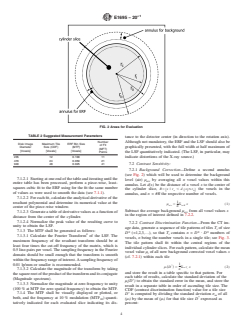
7.1.1 The ERF shall be generated as follows; cf. Fig. 2:
contrast discrimination function (CDF). The relationship be-
7.1.1.1 Find the 50 % iso-surface of the disk and fit a circle
tween contrast sensitivity and spatial resolution describing the
to it. Its radius is r . Other, more advanced methods of surface
c
resolving and detecting capabilities is given by the contrast-
detection are permitted and shall be documented.
detail-diagram (CDD metric, see also Guide E1441 and Prac-
7.1.1.2 Select the inner and outer radii, r and r of the
i o
tice E1570). This test method allows the purchaser or the
evaluation annulus with respect to the center of the circle
provider of CT systems or services, or both, to measure and
resulting from 7.1.1.1 that comfortably bracket the edge, that
specify spatial resolution and contrast sensitivity and is a
is, it should extend from top plateau level to background level.
measure for system stability over time and performance
7.1.1.3 Compute the distance to the center of mass for all
acceptability.
voxels between the inner and outer radii.
5. Apparatus
5.1 Cylinder Phantom—The cylinder phantom shall be a
Bracewell, R. M., The Fourier Transform and Its Applications, McGraw-Hill,
right circular cylinder of uniform material conforming to the NY, ISBN 0-07-007013-X.
´1
E1695 − 20
TABLE1aDisk Phantom Design Requirements
NOTE 1—The cupping effect due to beam hardening should be reduced by prefilters in front of the X-ray tube or in front of the detector or by numeric
corrections in the reconstruction algorithm, or both.
Material The material, in conjunction with the diameter of the cylinder,
shall be such that the phantom approximates the attenua-
tion range of the examination object. The material should
preferably be the same as that of the examination object.
Diameter The diameter shall be such that the reconstruction of the cyl-
inder occupies at least 250 voxels in diameter of the result-
ing image. In conjunction with the material, the diameter
shall be such that the phantom approximates the attenua-
tion range of the examination object, provided the beam
hardening effects are acceptable.
Height The height of the cylinder should cover 80 % the detector
height symmetrical to the middle line at the magnification
used to inspect the examination object. It may be shorter if
there are means to move it across the field of view.
Shape The perpendicularity of the axis of revolution with respect to
the surface used to mount the phantom on the CT system
shall not compromise the measurement of geometrical un-
sharpness. The reconstructed image may be realigned by
software for evaluation.
Finish The surface texture roughness of the curved surface shall not
affect the measurement of geometrical unsharpness.
TABLE 1 b Cylinder Phantom Suggestions
NOTE 1—The circularity is recommended, assuming the diameter covers up to 1000 voxels.
Cylinder Diameter [mm] Circularity [mm]
1 0.001
3 0.003
10 0.010
30 0.030
100 0.10
Materials Diameters [mm]
Plastic (for example, Delrin) 1-100
Aluminum 1-100
Steel 1-30
Inconel 1-30
7.1.1.4 Generate a table of voxel values in order of their
voxel distance from the circle center.
7.1.1.5 Segregate the values into equal bins sized to a small
fraction of one voxel. The bin size should be as small as
practical without causing some bins to be empty. Recom-
mended sizes are given in Table 2.
7.1.1.6 Averagethemembersofeachbintoobtainatableof
values at constant increments from the inner r to outer radius
i
r .
o
7.1.1.7 Starting at one end of the table and iterating until the
entire table has been processed, smooth the voxel values by
performing a piece-wise, least-squares cubic fit to an odd
number of table values and replacing the center value with that
predicted by the fit. The number of values to include in the fit
should be large compared to the order of the polynomial and
small compared to the fine ERF structure. Recommended
guidelines for the number of values to use in the fit are given
in Table 2.
7.1.1.8 Determine how much of the table is needed to be
includedintheanalysisanddeletetheunwantedportionsofthe
leading and trailing tails to obtain the ERF.
7.1.2 The LSF shall be generated as follows:
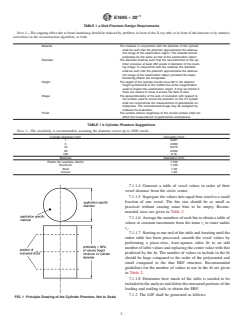
FIG. 1 Principle Drawing of the Cylinder Phantom, Not to Scale
´1
E1695 − 20
FIG. 2 Areas for Evaluation
TABLE 2 Suggested Measurement Parameters
tance to the detector center (in direction to the rotation axis).
Number
Although not mandatory, the ERF and the LSF should also be
Disk Image Maximum Tile ERF Bin Size
of Fit
graphically presented, with the full width at half maximum of
Diameter Size (CDF) (MTF)
(MFT)
[Voxels] [Voxels] [Voxels]
the LSF quantitatively indicated. (The LSF, in particular, may
Points
indicate distortions of the X-ray source.)
235 12 0.100 11
470 24 0.050 21
940 48 0.025 41 7.2 Contrast Sensitivity:
7.2.1 Background Correction—Define a second annulus
(see Fig. 2) which will be used to determine the background
7.1.2.1 Starting at one end of the table and iterating until the
level (air) µ by averaging all n voxel values within this
air
entire table has been processed, perform a piece-wise, least-
annulus. Let d(x) be the distance of a voxel x to the center of
squares cubic fit to the ERF using for the fit the same number
the cylinder slice, R5$x|r , d ~x!#r % the voxels in the
o b
of values as were used to smooth the data (see 7.1.1).
annulus, and n=#R the respective number of voxels.
7.1.2.2 For each fit, calculate the analytical derivative of the
resultant polynomial and determine its numerical value at the
µ 5 Σ x (1)
air xϵR
n
center of the piece-wise window.
Subtract the average background µ from all voxel values x
air
7.1.2.3 Generate a table of derivative values as a function of
in the region of interest defined in 7.2.2.
distance from the center of the cylinder.
7.1.2.4 Normalize the peak value of the resulting curve to
7.2.2 Contrast Discrimination Function—From the CT im-
unity to obtain the LSF.
age data, generate a sequence of tile patterns of tiles T of size
i
7.1.3 The MTF shall be generated as follows:
D* (=1,2,3,…), so that T contains n = D* · D* numbers of
i
7.1.3.1 Calculate the Fourier Transform of the LSF. The
voxels, n being the number voxels in a single tile; see Fig. 3.
maximum frequency of the resultant transform should be at
The tile
...