

ASTM E2597/E2597M-22
(Practice)Standard Practice for Manufacturing Characterization of Digital Detector Arrays
General Information
- Abstract
SIGNIFICANCE AND USE
4.1 This practice provides a means to compare DDAs on a common set of technical measurements, realizing that in practice, adjustments can be made to achieve similar results even with disparate DDAs, given geometric magnification, or other industrial radiologic settings that may compensate for one shortcoming of a device.
4.2 A user should understand the definitions and corresponding performance parameters used in this practice in order to make an informed decision on how a given DDA can be used in the target application.
4.3 The factors that will be evaluated for each DDA are: interpolated basic spatial resolution (iSRbdetector), efficiency (normalized Detector SNR (SNRN) at 1 mGy, for different energies and beam qualities), achievable contrast sensitivity (CSa), specific material thickness range (SMTR) and ISO-MTL , image lag, burn-in, bad pixels distribution and statistics and internal scatter ratio (ISR).
4.4 Given that each of these parameters are discussed together in many of the following sections, the following list will be helpful in selecting the key sections for a given test as follows. It should be noted that other sections of the document are needed to establish the appropriate technique for the parameter under test. Note that for each parameter (test), the first section listed is typically an apparatus or gauge (if required), the second section listed are the standardized measurements, and the third section listed involves the analysis or computations:
4.4.1 For iSRbdetector, see 5.1, 7.7, 8.2.
4.4.2 For Detector Efficiency, see 5.3, 7.8, 8.3.
4.4.3 For CSa, see 5.2, 7.9, 8.4.
4.4.4 For SMTR, see 5.2 (or 7.9, if already completed), 7.10, 8.5.
4.4.5 For ISO-MTL, see 5.2 (or 7.9, if already completed), 7.10, 8.6.
4.4.6 For Image Lag, see 7.11.1, 8.7.1.
4.4.7 For Burn-in, see 5.4, 7.11.2, 8.7.2.
4.4.8 For Bad Pixel Tests, see 6.2, 7.12, 8.8.
4.4.9 For ISR, see 5.4, 7.13, 8.9.
SCOPE
1.1 This practice describes the evaluation of Digital Detector Arrays (DDAs), and assures that one common standard exists for quantitative comparison of DDAs so that an appropriate DDA is selected to meet NDT requirements.
1.2 This practice is intended for use by manufacturers or integrators of DDAs to provide quantitative results of DDA characteristics for NDT user or purchaser consumption. Some of these tests require specialized test phantoms to assure consistency among results among suppliers or manufacturers. These tests are not intended for users to complete, nor are they intended for long term stability tracking and lifetime measurements. However, they may be used for this purpose, if so desired.
Note 1: Further information on application of DDAs is contained in Guide E2736 and Practices E2698 and E2737.
1.3 The results reported based on this practice should be based on a group of at least three individual detectors for a particular model number.
1.4 Units—The values stated in either SI units or inch-pound units are to be regarded separately as standard. The values stated in each system are not necessarily exact equivalents; therefore, to ensure conformance with the standard, each system shall be used independently of the other, and values from the two systems shall not be combined.
1.5 This standard does not purport to address all of the safety concerns, if any, associated with its use. It is the responsibility of the user of this standard to establish appropriate safety, health, and environmental practices and determine the applicability of regulatory limitations prior to use.
1.6 This international standard was developed in accordance with internationally recognized principles on standardization established in the Decision on Principles for the Development of International Standards, Guides and Recommendations issued by the World Trade Organization Technical Barriers to Trade (TBT) Committee.
- Status
- Published
- Publication Date
- 31-Dec-2021
- Technical Committee
- E07 - Nondestructive Testing
- Drafting Committee
- E07.01 - Radiography (X and Gamma) Method
Buy Documents
ASTM E2597/E2597M-22 - Standard Practice for Manufacturing Characterization of Digital Detector Arrays

REDLINE ASTM E2597/E2597M-22 - Standard Practice for Manufacturing Characterization of Digital Detector Arrays
Overview
ASTM E2597/E2597M-22 is the Standard Practice for Manufacturing Characterization of Digital Detector Arrays (DDAs). Developed by ASTM, this international standard provides a unified method to quantitatively evaluate and compare the performance of DDAs, especially for applications in non-destructive testing (NDT). By establishing consistent measurement criteria, the standard ensures manufacturers and system integrators can accurately characterize DDAs, enabling end users to choose the most suitable detector for specific industrial radiographic requirements.
Key Topics
This standard addresses several critical technical measurements and procedures for DDA evaluation:
- Spatial Resolution: Interpolated basic spatial resolution (iSRb) is assessed using a duplex wire gauge, enabling accurate measurement of the smallest resolvable feature in a digital image.
- Detector Efficiency: Detector signal-to-noise ratio (SNR) normalized to 1 mGy for different X-ray energies and beam qualities is used to benchmark detector sensitivity and performance.
- Contrast Sensitivity: Achievable contrast sensitivity (CSa) measures the ability to distinguish between slight differences in material thickness or composition in the captured image.
- Material Thickness Range: Specific material thickness range (SMTR) and ISO material thickness limit (ISO-MTL) indicate the usable range of thicknesses that the DDA can reliably image.
- Image Quality Degradation: Parameters such as image lag, burn-in, and internal scatter ratio (ISR) are evaluated to understand how the detector maintains image quality over repeated use and over time.
- Pixel Defects: The standard defines classification and statistical analysis of bad pixel types (dead, over/under responding, noisy, non-uniform, persistent/lag) and clusters, addressing the correction and reporting methodology for defective pixels.
All measurements are to be reported for a group of at least three detectors per model, ensuring reliable comparison and minimizing outlier effects.
Applications
The ASTM E2597/E2597M-22 standard is primarily intended for use by:
- Manufacturers and Integrators: To document and certify quantitative performance of DDAs for commercial distribution and customer acceptance.
- Procurement and Quality Assurance Teams: To compare DDA offerings and select appropriate systems for NDT or other industrial x-ray imaging applications.
- NDT System Developers: To ensure that the digital radiography system meets international benchmarks for spatial resolution, efficiency, and image integrity.
- Regulatory and Certification Bodies: To verify compliance with established criteria and support accreditation or regulatory approval of DDA-based inspection systems.
While the practices described are not designed for end-users to perform operational checks or track long-term stability, the tests can support such purposes if needed.
Common practical applications include:
- Industrial radiography for weld inspection
- Quality control in manufacturing processes involving castings, forgings, or composite materials
- Digital replacement of film-based X-ray systems for higher reliability and data analytics
Related Standards
ASTM E2597/E2597M-22 references and aligns with several other key standards, including:
- ASTM E2002: Practice for determining basic spatial resolution in radiography.
- ASTM E2698: Practice for radiographic examination using digital detector arrays.
- ASTM E2736: Guide for DDA radiography.
- ASTM E2737: Practice for DDA performance evaluation and long-term stability.
- ISO 7004: Industrial radiographic films - determination of ISO speed and gradients.
- IEC 62220-1: Medical electrical equipment - characteristics of digital X-ray imaging.
- ISO 10893-7: Non-destructive testing of steel tubes using digital radiographic techniques.
These related standards ensure compatibility with international practice and regulatory requirements, promoting interoperability and global acceptance of DDA-based radiographic systems.
By following ASTM E2597/E2597M-22, manufacturers and users of digital detector arrays gain confidence in DDA performance data, support efficient procurement decisions, and enhance overall NDT reliability.
Relations
- Effective Date
- 01-Feb-2024
- Effective Date
- 01-Dec-2019
- Effective Date
- 01-Mar-2019
- Effective Date
- 01-Feb-2018
- Effective Date
- 01-Jan-2018
- Effective Date
- 15-Jun-2017
- Effective Date
- 01-Feb-2017
- Effective Date
- 01-Aug-2016
- Effective Date
- 01-Feb-2016
- Effective Date
- 01-Dec-2015
- Effective Date
- 01-Sep-2015
- Effective Date
- 01-Jun-2014
- Effective Date
- 01-Jun-2014
- Effective Date
- 01-Dec-2013
- Effective Date
- 15-Jun-2013
Buy Documents
ASTM E2597/E2597M-22 - Standard Practice for Manufacturing Characterization of Digital Detector Arrays
REDLINE ASTM E2597/E2597M-22 - Standard Practice for Manufacturing Characterization of Digital Detector Arrays
Get Certified
Connect with accredited certification bodies for this standard

BSI Group
BSI (British Standards Institution) is the business standards company that helps organizations make excellence a habit.

TÜV Rheinland
TÜV Rheinland is a leading international provider of technical services.

TÜV SÜD
TÜV SÜD is a trusted partner of choice for safety, security and sustainability solutions.
Sponsored listings
Frequently Asked Questions
ASTM E2597/E2597M-22 is a standard published by ASTM International. Its full title is "Standard Practice for Manufacturing Characterization of Digital Detector Arrays". This standard covers: SIGNIFICANCE AND USE 4.1 This practice provides a means to compare DDAs on a common set of technical measurements, realizing that in practice, adjustments can be made to achieve similar results even with disparate DDAs, given geometric magnification, or other industrial radiologic settings that may compensate for one shortcoming of a device. 4.2 A user should understand the definitions and corresponding performance parameters used in this practice in order to make an informed decision on how a given DDA can be used in the target application. 4.3 The factors that will be evaluated for each DDA are: interpolated basic spatial resolution (iSRbdetector), efficiency (normalized Detector SNR (SNRN) at 1 mGy, for different energies and beam qualities), achievable contrast sensitivity (CSa), specific material thickness range (SMTR) and ISO-MTL , image lag, burn-in, bad pixels distribution and statistics and internal scatter ratio (ISR). 4.4 Given that each of these parameters are discussed together in many of the following sections, the following list will be helpful in selecting the key sections for a given test as follows. It should be noted that other sections of the document are needed to establish the appropriate technique for the parameter under test. Note that for each parameter (test), the first section listed is typically an apparatus or gauge (if required), the second section listed are the standardized measurements, and the third section listed involves the analysis or computations: 4.4.1 For iSRbdetector, see 5.1, 7.7, 8.2. 4.4.2 For Detector Efficiency, see 5.3, 7.8, 8.3. 4.4.3 For CSa, see 5.2, 7.9, 8.4. 4.4.4 For SMTR, see 5.2 (or 7.9, if already completed), 7.10, 8.5. 4.4.5 For ISO-MTL, see 5.2 (or 7.9, if already completed), 7.10, 8.6. 4.4.6 For Image Lag, see 7.11.1, 8.7.1. 4.4.7 For Burn-in, see 5.4, 7.11.2, 8.7.2. 4.4.8 For Bad Pixel Tests, see 6.2, 7.12, 8.8. 4.4.9 For ISR, see 5.4, 7.13, 8.9. SCOPE 1.1 This practice describes the evaluation of Digital Detector Arrays (DDAs), and assures that one common standard exists for quantitative comparison of DDAs so that an appropriate DDA is selected to meet NDT requirements. 1.2 This practice is intended for use by manufacturers or integrators of DDAs to provide quantitative results of DDA characteristics for NDT user or purchaser consumption. Some of these tests require specialized test phantoms to assure consistency among results among suppliers or manufacturers. These tests are not intended for users to complete, nor are they intended for long term stability tracking and lifetime measurements. However, they may be used for this purpose, if so desired. Note 1: Further information on application of DDAs is contained in Guide E2736 and Practices E2698 and E2737. 1.3 The results reported based on this practice should be based on a group of at least three individual detectors for a particular model number. 1.4 Units—The values stated in either SI units or inch-pound units are to be regarded separately as standard. The values stated in each system are not necessarily exact equivalents; therefore, to ensure conformance with the standard, each system shall be used independently of the other, and values from the two systems shall not be combined. 1.5 This standard does not purport to address all of the safety concerns, if any, associated with its use. It is the responsibility of the user of this standard to establish appropriate safety, health, and environmental practices and determine the applicability of regulatory limitations prior to use. 1.6 This international standard was developed in accordance with internationally recognized principles on standardization established in the Decision on Principles for the Development of International Standards, Guides and Recommendations issued by the World Trade Organization Technical Barriers to Trade (TBT) Committee.
SIGNIFICANCE AND USE 4.1 This practice provides a means to compare DDAs on a common set of technical measurements, realizing that in practice, adjustments can be made to achieve similar results even with disparate DDAs, given geometric magnification, or other industrial radiologic settings that may compensate for one shortcoming of a device. 4.2 A user should understand the definitions and corresponding performance parameters used in this practice in order to make an informed decision on how a given DDA can be used in the target application. 4.3 The factors that will be evaluated for each DDA are: interpolated basic spatial resolution (iSRbdetector), efficiency (normalized Detector SNR (SNRN) at 1 mGy, for different energies and beam qualities), achievable contrast sensitivity (CSa), specific material thickness range (SMTR) and ISO-MTL , image lag, burn-in, bad pixels distribution and statistics and internal scatter ratio (ISR). 4.4 Given that each of these parameters are discussed together in many of the following sections, the following list will be helpful in selecting the key sections for a given test as follows. It should be noted that other sections of the document are needed to establish the appropriate technique for the parameter under test. Note that for each parameter (test), the first section listed is typically an apparatus or gauge (if required), the second section listed are the standardized measurements, and the third section listed involves the analysis or computations: 4.4.1 For iSRbdetector, see 5.1, 7.7, 8.2. 4.4.2 For Detector Efficiency, see 5.3, 7.8, 8.3. 4.4.3 For CSa, see 5.2, 7.9, 8.4. 4.4.4 For SMTR, see 5.2 (or 7.9, if already completed), 7.10, 8.5. 4.4.5 For ISO-MTL, see 5.2 (or 7.9, if already completed), 7.10, 8.6. 4.4.6 For Image Lag, see 7.11.1, 8.7.1. 4.4.7 For Burn-in, see 5.4, 7.11.2, 8.7.2. 4.4.8 For Bad Pixel Tests, see 6.2, 7.12, 8.8. 4.4.9 For ISR, see 5.4, 7.13, 8.9. SCOPE 1.1 This practice describes the evaluation of Digital Detector Arrays (DDAs), and assures that one common standard exists for quantitative comparison of DDAs so that an appropriate DDA is selected to meet NDT requirements. 1.2 This practice is intended for use by manufacturers or integrators of DDAs to provide quantitative results of DDA characteristics for NDT user or purchaser consumption. Some of these tests require specialized test phantoms to assure consistency among results among suppliers or manufacturers. These tests are not intended for users to complete, nor are they intended for long term stability tracking and lifetime measurements. However, they may be used for this purpose, if so desired. Note 1: Further information on application of DDAs is contained in Guide E2736 and Practices E2698 and E2737. 1.3 The results reported based on this practice should be based on a group of at least three individual detectors for a particular model number. 1.4 Units—The values stated in either SI units or inch-pound units are to be regarded separately as standard. The values stated in each system are not necessarily exact equivalents; therefore, to ensure conformance with the standard, each system shall be used independently of the other, and values from the two systems shall not be combined. 1.5 This standard does not purport to address all of the safety concerns, if any, associated with its use. It is the responsibility of the user of this standard to establish appropriate safety, health, and environmental practices and determine the applicability of regulatory limitations prior to use. 1.6 This international standard was developed in accordance with internationally recognized principles on standardization established in the Decision on Principles for the Development of International Standards, Guides and Recommendations issued by the World Trade Organization Technical Barriers to Trade (TBT) Committee.
ASTM E2597/E2597M-22 is classified under the following ICS (International Classification for Standards) categories: 11.040.50 - Radiographic equipment. The ICS classification helps identify the subject area and facilitates finding related standards.
ASTM E2597/E2597M-22 has the following relationships with other standards: It is inter standard links to ASTM E1316-24, ASTM E1316-19b, ASTM E1316-19, ASTM E2698-18, ASTM E1316-18, ASTM E1316-17a, ASTM E1316-17, ASTM E1316-16a, ASTM E1316-16, ASTM E1316-15a, ASTM E1316-15, ASTM E1316-14e1, ASTM E1316-14, ASTM E1316-13d, ASTM E1316-13c. Understanding these relationships helps ensure you are using the most current and applicable version of the standard.
ASTM E2597/E2597M-22 is available in PDF format for immediate download after purchase. The document can be added to your cart and obtained through the secure checkout process. Digital delivery ensures instant access to the complete standard document.
Standards Content (Sample)
This international standard was developed in accordance with internationally recognized principles on standardization established in the Decision on Principles for the
Development of International Standards, Guides and Recommendations issued by the World Trade Organization Technical Barriers to Trade (TBT) Committee.
Designation: E2597/E2597M − 22
Standard Practice for
Manufacturing Characterization of Digital Detector Arrays
ThisstandardisissuedunderthefixeddesignationE2597/E2597M;thenumberimmediatelyfollowingthedesignationindicatestheyear
of original adoption or, in the case of revision, the year of last revision.Anumber in parentheses indicates the year of last reapproval.
A superscript epsilon (´) indicates an editorial change since the last revision or reapproval.
1. Scope 2. Referenced Documents
1.1 This practice describes the evaluation of Digital Detec- 2.1 ASTM Standards:
tor Arrays (DDAs), and assures that one common standard E1316Terminology for Nondestructive Examinations
exists for quantitative comparison of DDAs so that an appro- E1815Test Method for Classification of Film Systems for
priate DDA is selected to meet NDT requirements. Industrial Radiography
E2002Practice for Determining Total Image Unsharpness
1.2 This practice is intended for use by manufacturers or
and Basic Spatial Resolution in Radiography and Radios-
integrators of DDAs to provide quantitative results of DDA
copy
characteristics for NDT user or purchaser consumption. Some
E2445Practice for Performance Evaluation and Long-Term
of these tests require specialized test phantoms to assure
Stability of Computed Radiography Systems
consistency among results among suppliers or manufacturers.
E2446Practice for Manufacturing Characterization of Com-
These tests are not intended for users to complete, nor are they
puted Radiography Systems
intended for long term stability tracking and lifetime measure-
E2698Practice for Radiographic Examination Using Digital
ments. However, they may be used for this purpose, if so
Detector Arrays
desired.
E2736Guide for Digital Detector Array Radiography
NOTE 1—Further information on application of DDAs is contained in
E2737Practice for Digital Detector Array Performance
Guide E2736 and Practices E2698 and E2737.
Evaluation and Long-Term Stability
1.3 The results reported based on this practice should be
2.2 ISO Standards:
based on a group of at least three individual detectors for a
ISO7004 Photography—Industrial Radiographic Films—
particular model number.
Determination of ISO Speed, ISO Average Gradient and
ISO Gradients G2 and G4 When Exposed to X- and
1.4 Units—The values stated in either SI units or inch-
Gamma-Radiation
pound units are to be regarded separately as standard. The
ISO 17636-2Non-destructive Testing of Welds — Radio-
values stated in each system are not necessarily exact equiva-
lents; therefore, to ensure conformance with the standard, each graphic Testing — Part 2: X- and Gamma-ray Techniques
With Digital detectors
system shall be used independently of the other, and values
from the two systems shall not be combined. ISO 10893-7Non-destructiveTesting of SteelTubes — Part
7: Digital Radiographic Testing of the Weld Seam of
1.5 This standard does not purport to address all of the
Welded Steel Tubes for the Detection of Imperfections
safety concerns, if any, associated with its use. It is the
2.3 Other Standards:
responsibility of the user of this standard to establish appro-
EN 12681-2Founding — Radiographic Testing — Part 2:
priate safety, health, and environmental practices and deter-
Techniques With Digital Detectors
mine the applicability of regulatory limitations prior to use.
IEC 62220-1Medical Electrical Equipment Characteristics
1.6 This international standard was developed in accor-
ofDigitalX-rayImagingDevicesPart1:Determinationof
dance with internationally recognized principles on standard-
ization established in the Decision on Principles for the
Development of International Standards, Guides and Recom-
mendations issued by the World Trade Organization Technical
Barriers to Trade (TBT) Committee.
For referenced ASTM standards, visit the ASTM website, www.astm.org, or
contact ASTM Customer Service at service@astm.org. For Annual Book of ASTM
This practice is under the jurisdiction of ASTM Committee E07 on Nonde- Standards volume information, refer to the standard’s Document Summary page on
structive Testing and is the direct responsibility of Subcommittee E07.01 on the ASTM website.
Radiology (X and Gamma) Method. Available from International Organization for Standardization (ISO), ISO
Current edition approved Jan. 1, 2022. Published February 2022. Originally Central Secretariat, Chemin de Blandonnet 8, CP 401, 1214 Vernier, Geneva,
approved in 2007. Last previous edition approved in 2014 as E2597/E2597M– 14. Switzerland, https://www.iso.org.
DOI: 10.1520/E2597_E2597M-22. Available from https://www.en-standard.eu/.
Copyright © ASTM International, 100 Barr Harbor Drive, PO Box C700, West Conshohocken, PA 19428-2959. United States
E2597/E2597M − 22
the Detective Quantum Efficiency 3.1.16 normalized signal-to-noise ratio of the detector–
(SNR ), n—the SNR is normalized by the interpolated basic
N
detector
3. Terminology spatial resolution iSR as measured directly on the
b
detector without any object other than beam filters in the beam
3.1 Definitions of Terms Specific to This Standard:
path.
3.1.1 achievable contrast sensitivity (CSa), n—optimum
3.1.17 pixel value, n—the numeric value of a pixel in the
contrast sensitivity (see Terminology E1316 for a definition of
DDA image; this is typically interchangeable with the terms
contrast sensitivity) obtainable using a standard phantom with
gray value, detector response, Analog-to-Digital Unit,or
an X-ray technique that has little contribution from scatter.
detector signal.
3.1.2 active DDA area, n—thesizeandlocationoftheDDA,
3.1.18 phantom, n—a part or item being used to quantify
which is recommended by the manufacturer as usable.
DDA characterization metrics.
3.1.3 bad pixel, n—a DDApixel that does not conform to a
3.1.19 saturation pixel value, n—the maximum possible
specified performance as defined in 6.2.
pixel value of the DDA after offset correction.
3.1.4 burn-in, n—change in gain of the scintillator that
3.1.20 specific material thickness range (SMTR), n—the
persists well beyond the exposure.
penetrated material thickness range within a given minimum
3.1.5 DDA correction, n—the process of subtracting the
SNR in the image is achieved. The wall thickness range of a
response of each pixel in absence of ionizing radiation (DDA
DDA is limited for the thinner wall thickness by 80% of the
offsetimage)andnormalizationofthegainofeachpixelinthe
saturation pixel value at this thickness and the thicker wall
presence of ionizing radiation and the absence of a specimen
thickness by a SNR of 130 (basic contrast sensitivity) or 250
(DDAgainimage)andfinallythereplacementofthebadpixels
for (enhanced contrast sensitivity).
by corrected values (bad pixel correction). The result is a
NOTE2—Thisisnotrelatedtotheimagequalityrequirementof1-2Tor
corrected digital radiograph.
2-2T, because the spatial resolution is not considered.
3.1.6 DDA gain image, n—image obtained with no struc-
3.1.21 total image acquisition time, n—completeacquisition
tured object in the X-ray beam to correct the pixel response in
timeofaDDAimage,consistingoftheeffectiveexposuretime
a DDA.
of the integrated frames and the image transfer time between
3.1.7 DDA offset image, n—image of the DDA in the
detector and computer including the detector read-out time,
absence of X-rays providing the background signal of all
that is, from start of the exposure until storage of the final
pixels.
image on the computer.
3.1.8 effıciency, n—SNR (see 3.1.16) divided by the square
N
4. Significance and Use
root of the dose (in mGy), this is used to measure the response
4.1 This practice provides a means to compare DDAs on a
of the detector at different beam energies and qualities.
common set of technical measurements, realizing that in
3.1.9 frame rate, n—number of frames acquired per second.
practice, adjustments can be made to achieve similar results
3.1.10 GlobalLag1f (global lag 1st frame), n—the ratio of
even with disparate DDAs, given geometric magnification, or
mean signal value of the first frame of the DDA where the
other industrial radiologic settings that may compensate for
X-raysarecompletelyofftothemeansignalvalueofanimage
one shortcoming of a device.
wheretheX-raysarefullyon.Thisparameterisspecificallyfor
4.2 A user should understand the definitions and corre-
the integration time used during data acquisition.
spondingperformanceparametersusedinthispracticeinorder
3.1.11 GlobalLag1s (global lag 1 s), n—the projected value
tomakeaninformeddecisiononhowagivenDDAcanbeused
of GlobalLag1f for an integration time of 1s.
in the target application.
3.1.12 GlobalLag60s (global lag 60 s), n—theratiobetween
4.3 TheparametersthatwillbeevaluatedforeachDDAare:
meanpixelvalueofanimageacquiredwiththeDDAafter60s detector
interpolated basic spatial resolution (iSR ), efficiency
b
where the X-rays are completely off, to same of an image
(normalized Detector SNR (SNR ) at 1 mGy, for different
N
where the X-rays are fully on.
energies and beam qualities), achievable contrast sensitivity
3.1.13 internal scatter ratio (ISR), n—ratio of external
(CSa),specificmaterialthicknessrange(SMTR)andISO-MTL
primary radiation to scattered radiation within the detector.
, image lag, burn-in, bad pixels distribution and statistics and
internal scatter ratio (ISR).
3.1.14 ISO material thickness limit (ISO-MTL), n—limit
determined similar to SMTR, but using as thicker wall thick-
4.4 Given that each of these parameters are discussed
ness limit the value where the normalized SNR (SNR )is
together in many of the following sections, the following list
N
above 70 (basic technique) or 100 (enhanced technique).
will be helpful in selecting the key sections for a given test as
follows. It should be noted that other sections of the document
3.1.15 lag, n—residualsignalintheDDAthatoccursshortly
are needed to establish the appropriate technique for the
after the exposure is completed.
parameter under test. Note that for each parameter (test), the
first section listed is typically an apparatus or gauge (if
required), the second section listed are the standardized
Available from International Electrotechnical Commission (IEC), 3, rue de
measurements,andthethirdsectionlistedinvolvestheanalysis
Varembé, 1st floor, P.O. Box 131, CH-1211, Geneva 20, Switzerland, https://
www.iec.ch. or computations:
E2597/E2597M − 22
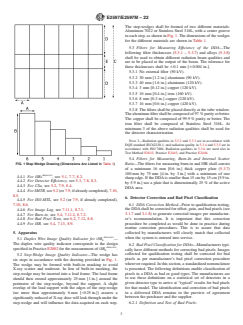
The step-wedges shall be formed of two different materials:
Aluminum 7022 or Stainless Steel 316L, with a center groove
ineachstep,asshowninFig.1.Thedimensionsofthewedges
for the different materials are shown in Table 1.
5.3 Filters for Measuring Effıciency of the DDA—The
following filter thicknesses (5.3.1 – 5.3.7) and alloys (5.3.8)
shall be used to obtain different radiation beam qualities and
are to be placed at the output of the beam. The tolerance for
these thicknesses shall be 60.1 mm [60.004 in.].
5.3.1 No external filter (50 kV).
5.3.2 30 mm [1.2 in.] aluminum (90 kV).
5.3.3 40 mm [1.6 in.] aluminum (120 kV).
5.3.4 3 mm [0.12 in.] copper (120 kV).
5.3.5 10 mm [0.4 in.] iron (160 kV).
5.3.6 8 mm [0.3 in.] copper (220 kV).
5.3.7 16 mm [0.6 in.] copper (420 kV).
5.3.8 The filters shall be placed directly at the tube window.
Thealuminumfiltershallbecomposedof97%purityorbetter.
The copper shall be composed of 99.9% purity or better. The
iron filter shall be composed of Stainless Steel 316L. At
minimum 3 of the above radiation qualities shall be used for
the detector characterization.
NOTE 3—Radiation qualities in 5.3.2 and 5.3.3 are in accordance with
DQE standard IEC62220-1, and radiation quality in 5.3.4 and 5.3.5 are in
accordance with ISO7004. Radiation qualities in 5.3.6 are used also in
Test Method E1815, Practice E2445, and Practice E2446.
5.4 Filters for Measuring, Burn-In and Internal Scatter
Ratio—The filters for measuring burn-in and ISR shall consist
FIG. 1 Step-Wedge Drawing (Dimensions Are Listed in Table 1)
of a minimum 16 mm [0.6 in.] thick copper plate (5.3.7)
100mm by 75mm [4in. by 3in.] with a minimum of one
detector
4.4.1 For iSR , see 5.1, 7.7, 8.2.
b
sharpedge.IftheDDAissmallerthan15cmby15cm[5.9in.
4.4.2 For Detector Effıciency, see 5.3, 7.8, 8.3.
by 5.9 in.] use a plate that is dimensionally 25% of the active
4.4.3 For CSa, see 5.2, 7.9, 8.4.
DDA area.
4.4.4 For SMTR,see5.2(or7.9,ifalreadycompleted),7.10,
8.5.
6. Detector Correction and Bad Pixel Classification
4.4.5 For ISO-MTL, see 5.2 (or 7.9, if already completed),
6.1 DDA Correction Method—Prior to qualification testing,
7.10, 8.6.
the DDAshall be corrected for offset, gain, and bad pixels (see
4.4.6 For Image Lag, see 7.11.1, 8.7.1.
3.1.7 and 3.1.8) to generate corrected images per manufactur-
4.4.7 For Burn-in, see 5.4, 7.11.2, 8.7.2.
er’s recommendation. It is important that this correction
4.4.8 For Bad Pixel Tests, see 6.2, 7.12, 8.8.
procedure be completed as would be done in practice during
4.4.9 For ISR, see 5.4, 7.13, 8.9.
routine correction procedures. This is to assure that data
5. Apparatus
collected by manufacturers will closely match that collected
detector
when the system is entered into service.
5.1 Duplex Wire Image Quality Indicator for iSR —
b
The duplex wire quality indicator corresponds to the design
6.2 Bad Pixel Classification for DDAs—Manufacturerstypi-
detector
specifiedinPracticeE2002forthemeasurementof iSR .
b cally have different methods for correcting bad pixels. Images
collected for qualification testing shall be corrected for bad
5.2 Step-Wedge Image Quality Indicator—The wedge has
pixels as per manufacturer’s bad pixel correction procedure
six steps in accordance with the drawing provided in Fig. 1.
whereverrequired.Inthissection,astandardizednomenclature
The wedge may be formed with built-in masking to avoid
is presented. The following definitions enable classification of
X-ray scatter and undercut. In lieu of built-in masking, the
pixels in a DDA as bad or good types. The manufacturers are
step-wedge may be inserted into a lead frame. The lead frame
to use these definitions on a statistical set of detectors in a
should then extend approximately 25mm [1in.] around the
given detector type to arrive at “typical” results for bad pixels
perimeter of the step-wedge, beyond the support. A slight
for that model. The identification and correction of bad pixels
overlap of the lead support with the edges of the step-wedge
in a delivered DDA remains in the purview of agreement
(no more than approximately 6mm [~0.25in.]) assures a
between the purchaser and the supplier.
significantlyreducedofX-raydosewillleakthroughunderthe
step-wedge and will influence the data acquired on each step. 6.2.1 Definition and Test of Bad Pixels:
E2597/E2597M − 22
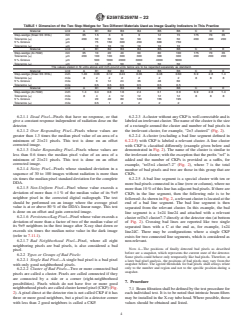
TABLE 1 Dimension of the Two Step-Wedges for Two Different Materials Used as Image Quality Indicators In This Practice
Material Unit A B1 B2 B3 B4 B5 B6 C D E
Step-wedge (Steel SS 316L) mm 35 1.5 3 6 9 12 15 175 70 35
Tolerance (±) µm 200 50 50 50 50 50 50 200 200 200
5 % Groove µm 75 150 300 450 600 750
Tolerance (±) µm 10 10 10 10 10 10
Material Unit A B1 B2 B3 B4 B5 B6 C D E
Step-wedge (Al-7022) mm 35 10 20 40 60 80 100 175 70 35
Tolerance (±) µm 200 100 100 300 300 300 300 200 200 200
5 % Groove µm 500 1000 2000 3000 4000 5000
Tolerance (±) µm 13 25 50 50 50 50
The values stated in SI units above and inch-pound units below are to be regarded separately as standard.
Material Unit A B1 B2 B3 B4 B5 B6 C D E
Step-wedge (Steel SS 316L) inch 1.40 0.06 0.12 0.24 0.36 0.48 0.60 6.9 2.8 1.4
Tolerance (±) mils 8222 2 2 2 8 88
5 % Groove mils 6 12 24 36 48 60
Tolerance (±) mils 0.5 0.5 0.5 0.5 0.5 0.5
Material Unit A B1 B2 B3 B4 B5 B6 C D E
Step-wedge (Al-7022) inch 1.4 0.4 0.8 1.6 2.4 3.1 3.9 6.9 2.8 1.4
Tolerance (±) mils 8 4 4 12 12 12 12 8 8 8
5 % Groove mils 20 40 80 120 155 195
Tolerance (±) mils 0.5 1 2 2 2 2
6.2.1.1 Dead Pixel—Pixels that have no response, or that 6.2.2.3 Acluster without any CKPis well correctable and is
give a constant response independent of radiation dose on the labeledanirrelevantcluster.Thenameoftheclusteristhesize
of a rectangle around the cluster and number of bad pixels in
detector.
6.2.1.2 Over Responding Pixel—Pixels whose values are the irrelevant cluster, for example, “2×3 cluster4” (Fig. 2).
greater than 1.3 times the median pixel value of an area of a
6.2.2.4 A cluster (excluding a bad line segment defined in
minimum of 21×21 pixels. This test is done on an offset
6.2.2.5) with CKP is labeled a relevant cluster. A line cluster
corrected image.
with CKP is classified differently (example given below and
6.2.1.3 Under Responding Pixel—Pixels whose values are
demonstrated in Fig. 2). The name of the cluster is similar to
less than 0.6 times the median pixel value of an area of a
the irrelevant cluster; with the exception that the prefix “rel” is
minimum of 21×21 pixels. This test is done on an offset
added and the number of CKPs is provided as a suffix, for
corrected image.
example, “rel3×4 cluster7-2” (Fig. 2), where 7 is the total
6.2.1.4 Noisy Pixel—Pixels whose standard deviation in a
number of bad pixels and two are those in this group that are
sequence of 30 to 100 images without radiation is more than
CKPs.
six times the median pixel standard deviation for the complete
6.2.2.5 A bad line segment is a special cluster with ten or
DDA.
morebadpixelsconnectedinaline(roworcolumn),whereno
6.2.1.5 Non-Uniform Pixel—Pixel whose value exceeds a
morethan10%ofthislinehasadjacentbadpixels.Ifthereare
deviation of more than 61% of the median value of its 9×9
CKPs in the line segment, then the following rule is to be
neighbor pixel in the corrected digital radiograph. The test
followed:AsshowninFig.2,arelevantclusterislocatedatthe
should be performed on an image where the average pixel
end of a bad line segment. The bad line segment is then
value is at or above 80% of the DDA’s linear range. This test
separated from the relevant cluster. In this example, the bad
is done on an offset and gain corrected image.
line segment is a 1×24 line24 and attached with a relevant
6.2.1.6 Persistence/Lag Pixel—Pixelwhosevalueexceedsa
cluster rel3x3 cluster7-7 directly at the detector rim (at bottom
deviation of more than a factor of two of the median value of
of Fig. 2). Crossing bad lines are reported like two single
its 9×9 neighbors in the first image after X-ray shut down or
separated lines withaCattheendas,for example, 1x24
exceeds six times the median noise value in the dark image
line24C. There may be configurations where a single CKP
(refer to 7.11.1).
exists for two connected line segments, which is considered as
6.2.1.7 Bad Neighborhood Pixel—Pixel, where all eight
non-relevant.
neighboring pixels are bad pixels, is also considered a bad
NOTE 4—The positions of finally detected bad pixels as described
pixel.
before are a snapshot, which represents the current state of the detector.
6.2.2 Types or Groups of Bad Pixels:
Some pixels could behave only temporarily like bad pixels. Therefore, at
6.2.2.1 Single Bad Pixel—A single bad pixel is a bad pixel
a later bad pixel analysis, the positions of bad pixels may vary from the
with only good neighborhood pixels. snapshot before. The agreed thresholds for bad pixels shall always relate
only to the number and region and not to the specific position during a
6.2.2.2 Cluster of Bad Pixels—Two or more connected bad
snapshot.
pixels are called a cluster. Pixels are called connected if they
are connected by a side or a corner (eight-neighborhood
7. Procedure
possibilities). Pixels which do not have five or more good
neighborhoodpixelsarecalledclusterkernelpixel(CKP)(Fig. 7.1 Beamfiltrationshallbedefinedbythetestprocedurefor
2).Apixel direct at the detector rim is not called CKPif it has each individual test. It is to be noted that intrinsic beam filters
three or more good neighbors, but a pixel in a detector corner may be installed in the X-ray tube head.Where possible, those
with less than 2 good neighbors is called a CKP. values should be obtained and listed.
E2597/E2597M − 22
FIG. 2 Different Types of Bad Pixel Groups: Small Clusters, A Relevant Cluster And Bad Lines; At Bottom An Example of A Bad Line
Segment Attached To A Relevant Cluster At The Detector Rim is Shown; The Line Segment Is A 1x24 line24 (Not Relevant), But Con-
nected To A Relevant Cluster rel3x3 cluster7-7
obtained by any combination of extended single exposures or multiple
7.2 For all measurements, the X-ray source to detector
frames as available from the DDA. However, whichever is used, that
distance (SDD) shall be ≥1000mm [~ 40in.], unless specifi-
information shall be recorded in the test report and the same DDA
cally mentioned. The beam shall not interact with any other
integration time (per frame) shall be used for all tests, the total image
interfering object other than that intended, and shall not be
acquisition time (including the read-out and image transfer time) should
considerably larger than the detector area through the use of
be noted too. In the following sections, where an image is required, this
collimation at the source.
image shall be stored in a format that contains the full bit depth of the
acquisition for later analysis.
7.3 Thegeometricunsharpnessshallbelessthanorequalto
detector
5% of the total unsharpness for the iSR measurements.
7.5 All images shall be corrected for offset and gain
b
This avoids additional unsharpness due to the finite size of the
variations of the DDAs unless otherwise mentioned. Bad pixel
detector
X-ray focal spot on the measurement of iSR . See
b correction using the manufacturer’s correction algorithms also
example below.
needstobecompletedforalltestswiththeexclusionofthebad
detector
e.g. 100 µm pixel size (equal to iSR ) and focal spot size:
b pixel identification testing (see 7.12 and 8.7).
2mm
7.6 All tests specified for a given DDA type need to be
Duplex wire to active sensor area distance: 2.5 mm
performed at the same internal detector settings such as gain
Source-to-Object distance: 1000 mm
and analog-digital conversion.
Maximum expected unsharpness: 2 mm / 1000 mm × 2.5 mm =
0.005 mm=5µm
7.7 Measurement Procedure for Interpolated Basic Spatial
Maximum unsharpness due to the limited focal spot size detector
Resolution (iSR ):
detector b
relative to iSR :5%
b
detector
7.7.1 Thetestobjecttomeasurethe iSR istheduplex
b
7.4 Measurement parameters for each test shall be recorded
wire gage (Practice E2002). It should be placed directly on the
using the data-sheet template provided in Appendix X1, Data
detector with an angle between 2° and 5° to the rows/columns
Sheet (Input).
ofthedetector. If aDDAhasanon-isotropicpixel,twoimages
NOTE 5—The effective exposure times listed in this procedure can be shall be made, one with the duplex wire near parallel to the
E2597/E2597M − 22
columns and one near parallel to the rows. No image process- 7.8.5 For each dose, two images are collected. These are
ing shall be used other than gain/offset and bad pixel correc- used to acquire the noise without fixed patterns or other
potential anomalies through a difference image.
tions.
7.7.2 The exposure shall be performed at a distance of ≥ 1 7.9 Measurement Procedure for Achievable Contrast Sensi-
m[≥ 40 in.] using geometric unsharpness levels as specified in
tivity:
7.3. 7.9.1 The step-wedge image quality indicators of two dif-
ferentmaterialsshallbeusedforthistest,asdefinedin5.2.The
7.7.3 The measurement of the interpolated basic spatial
full range of thickness of these shall be used as described in
resolution of the detector may depend on the radiation quality.
5.2. The step-wedge shall be placed for all these tests at a
For DDAs that can operate above 160 kV, the test shall be
minimum of 600mm [24in.] from the detector (while SDD is
performed with 220 kV. A filter of up to 0.5 mm Copper in
≥1000mm [40in.]). The pre-filter should be placed directly in
frontofthetubeportshallbeused.ForallotherDDAs,thetest
frontofthetube.Thebeamshallbecollimatedtoanareawhere
shallbecompletedat90kV(withnoaddedpre-filter).ThemA
only the step-wedge is exposed. The pre-filter used shall be
of the X-ray tube shall be selected such that the pixel value of
recorded in the data sheet (input).
the object (the duplex wire gage) is between 50% and 80% of
7.9.2 If the area of the detector is too small to capture the
full saturation for that DDA. If this cannot be achieved, a SNR
complete step-wedge within one image, two or more images
of ≥ 100 shall be obtained. Frame integration is recommended
with identical X-ray and DDA settings may be captured to
to achieve the required SNR. If the pixel value of 80% of full
cover the complete step-wedge.
saturation is exceeded, the source to DDA distance shall be
7.9.3 The energy for this measurement shall be set to 160
increased until the required pixel value is reached.
kV, with a 0.5 mm [0.02 in.] copper filter. If the DDA is not
specified to such high energy, the maximum allowed energy
NOTE 6—The intent of this test is to determine the achievable
detector
iSR obtainable from the DDA under test. In this regard, it is
shall be used; in that case, the energy used shall be printed in
b
important that the quantum noise of the measurement be significantly
the data sheet (output) “C” and “D” (see appendix X1.2 for
reduced. This may involve capturing multiple frames at the pixel values
details). The X-ray tube current (mA) under this beam spec-
listed above to provide robust measurements.
trum shall be determined such that the DDA is not saturated
7.8 Measurement Procedure for Effıciency:
under the thinnest step for the integration time selected for all
tests. Images shall be generated by averaging frames to obtain,
7.8.1 The measurement shall be performed at a few points
as minimum, 1 s, 4 s, 16 s, and 64 s effective exposure times.
where the dose is above and below 1 mGy. The efficiency at 1
The total image acquisition time including the read-out time
mGy can then be computed from the series of measured points
should be given too. The manufacturer can provide data at
bychangingtheeffectiveexposuretimeoftheDDA.Theseries
other exposure times if required.
of points measured during the tests also provides additional
information on the linear response (relative to the effective
7.10 Measurement Procedure for Specific Material Thick-
exposure time) of the detector. A few data points near the top
ness Range and ISO-MTL:
of the response of the DDA is also recommended to obtain
7.10.1 No further measurements are needed for these tests,
maximum levels of SNR .
if the procedure in 7.9 was already completed. If these tests
N
need to be completed independent of the CS test, then the
7.8.2 An offset image (without radiation) shall be collected
procedure in 7.9 shall be followed. If these tests shall be
using the same integration time as the images described in
performed with the extended quality level (larger than 15), the
7.8.4.
procedure in 7.9 shall be followed with the additional plate
7.8.3 The radiation qualities to be used for this measure-
specified in theTable 2 note; the X-ray and DDAsettings shall
ment are defined in 5.3.
be the same as specified in 7.9.3; the X-ray tube current (mA)
7.8.4 Toachievetheefficiencymeasurement,theX-raytube
under this beam spectrum shall be determined such that the
settings shall be as those listed in 5.3, with the filters located
DDA is not saturated under the thinnest step without the
immediatelyadjacenttotheportoftheX-raytube,suchthatno
additional plate for the integration time selected for all tests.
unfiltered radiation is reaching the DDA.The beam current, or
7.11 Measurement Procedure of Lag and Burn-In:
time of exposure, or both, shall be adjusted such that a certain
7.11.1 Procedure for Lag—For this measurement, no addi-
knowndoseisobtainedatthelocationoftheDDAasmeasured
tional gain or bad pixel correction shall be applied in the final
withacalibratedionizationchamber.Themeasurementofdose
computation.
rate shall be made without any interference from scatter, so it
7.11.1.1 The lag of the detector shall be measured using a
is best to complete this measurement prior to placing the
sequence of images. The DDA shall be powered ON and not
detector. The dose is obtained by multiplying the dose rate by
exposedforasuitabletimetowarmupthedetectorandremove
theeffectiveexposuretimeinseconds(orfractionsthereof).To
prior lag before the measurement is acquired. An offset frame
arrive at the 1 mGy dose, it is recommended to measure all of
(image0) shall be captured (without radiation).
the data points (few points below and above 1 mGy dose) and
7.11
...
This document is not an ASTM standard and is intended only to provide the user of an ASTM standard an indication of what changes have been made to the previous version. Because
it may not be technically possible to adequately depict all changes accurately, ASTM recommends that users consult prior editions as appropriate. In all cases only the current version
of the standard as published by ASTM is to be considered the official document.
Designation: E2597/E2597M − 14 E2597/E2597M − 22
Standard Practice for
Manufacturing Characterization of Digital Detector Arrays
This standard is issued under the fixed designation E2597/E2597M; the number immediately following the designation indicates the year
of original adoption or, in the case of revision, the year of last revision. A number in parentheses indicates the year of last reapproval.
A superscript epsilon (´) indicates an editorial change since the last revision or reapproval.
1. Scope
1.1 This practice describes the evaluation of Digital Detector Arrays (DDAs), and assures that one common standard exists for
quantitative comparison of DDAs so that an appropriate DDA is selected to meet NDT requirements.
1.2 This practice is intended for use by manufacturers or integrators of DDAs to provide quantitative results of DDA
characteristics for NDT user or purchaser consumption. Some of these tests require specialized test phantoms to assure consistency
among results among suppliers or manufacturers. These tests are not intended for users to complete, nor are they intended for long
term stability tracking and lifetime measurements. However, they may be used for this purpose, if so desired.
NOTE 1—Further information on application of DDAs is contained in Guide E2736 and Practices E2698 and E2737.
1.3 The results reported based on this standardpractice should be based on a group of at least three individual detectors for a
particular model number.
1.4 Units—The values stated in either SI units or inch-pound units are to be regarded separately as standard. The values stated in
each system are not necessarily exact equivalents; therefore, to ensure conformance with the standard, each system shall be used
independently of the other, and values from the two systems shall not be combined.
1.5 This standard does not purport to address all of the safety concerns, if any, associated with its use. It is the responsibility
of the user of this standard to establish appropriate safety safety, health, and healthenvironmental practices and determine the
applicability of regulatory limitations prior to use.
1.6 This international standard was developed in accordance with internationally recognized principles on standardization
established in the Decision on Principles for the Development of International Standards, Guides and Recommendations issued
by the World Trade Organization Technical Barriers to Trade (TBT) Committee.
2. Referenced Documents
2.1 ASTM Standards:
E1316 Terminology for Nondestructive Examinations
E1815 Test Method for Classification of Film Systems for Industrial Radiography
E2002 Practice for Determining Total Image Unsharpness and Basic Spatial Resolution in Radiography and Radioscopy
E2445 Practice for Performance Evaluation and Long-Term Stability of Computed Radiography Systems
This practice is under the jurisdiction of ASTM Committee E07 on Nondestructive Testing and is the direct responsibility of Subcommittee E07.01 on Radiology (X and
Gamma) Method.
Current edition approved Jan. 1, 2014Jan. 1, 2022. Published February 2014February 2022. Originally approved in 2007. Last previous edition approved in 20072014 as
ε1
E2597E2597/E2597M- 07 – 14. . DOI: 10.1520/E2597_E2597M-14.10.1520/E2597_E2597M-22.
For referenced ASTM standards, visit the ASTM website, www.astm.org, or contact ASTM Customer Service at service@astm.org. For Annual Book of ASTM Standards
volume information, refer to the standard’s Document Summary page on the ASTM website.
Copyright © ASTM International, 100 Barr Harbor Drive, PO Box C700, West Conshohocken, PA 19428-2959. United States
E2597/E2597M − 22
E2446 Practice for Manufacturing Characterization of Computed Radiography Systems
E2698 Practice for Radiographic Examination Using Digital Detector Arrays
E2736 Guide for Digital Detector Array Radiography
E2737 Practice for Digital Detector Array Performance Evaluation and Long-Term Stability
2.2 OtherISO Standards:
ISO 7004 Photography—Industrial Radiographic Films—Determination of ISO Speed, ISO Average Gradient and ISO
Gradients G2 and G4 When Exposed to X- and Gamma-Radiation
IEC 62220-1ISO 17636-2 Medical Electrical Equipment Characteristics of Digital X-ray Imaging Devices Part 1: Determination
of the Detective Quantum EfficiencyNon-destructive Testing of Welds — Radiographic Testing — Part 2: X- and Gamma-ray
Techniques With Digital detectors
ISO 10893-7 Non-destructive Testing of Steel Tubes — Part 7: Digital Radiographic Testing of the Weld Seam of Welded Steel
Tubes for the Detection of Imperfections
2.3 Other Standards:
EN 12681-2 Founding — Radiographic Testing — Part 2: Techniques With Digital Detectors
IEC 62220-1 Medical Electrical Equipment Characteristics of Digital X-ray Imaging Devices Part 1: Determination of the
Detective Quantum Efficiency
3. Terminology
3.1 Definitions of Terms Specific to This Standard:
3.1.1 achievable contrast sensitivity (CSa)—(CSa), n—optimum contrast sensitivity (see Terminology E1316 for a definition of
contrast sensitivity) obtainable using a standard phantom with an X-ray technique that has little contribution from scatter.
3.1.2 active DDA area—area, n—the size and location of the DDA, which is recommended by the manufacturer as usable.
3.1.3 bad pixel—pixel, n—a pixel identified with a performance outside of the specification range for a pixel of a DDA DDA pixel
that does not conform to a specified performance as defined in 6.2.
3.1.4 burn-in—burn-in, n—change in gain of the scintillator that persists well beyond the exposure.
3.1.5 calibration—correction applied for the offset signal, and the non-uniformity of response of any or all of the X-ray beam,
scintillator and the read-out structure.
3.1.6 contrast-to-noise ratio (CNR)—quotient of the difference of the mean signal levels between two image areas and the standard
deviation of the signal levels. As applied here, the two image areas are the step-wedge groove and base material. The standard
deviation of the intensity of the base material is a measure of the noise. The CNR depends on the radiation dose and the DDA
system properties.
3.1.7 detector signal-to-noise ratio–normalized (dSNRn)—the SNR is normalized for basic spatial resolution SRb as measured
directly on the detector without any object other than beam filters in the beam path.
3.1.5 digital detectorDDA correction, array n—(DDA) system—an electronic device that converts ionizing or penetrating radiation
into a discrete array of analog signals which are subsequently digitized and transferred to a computer for display as a digital image
corresponding to the radiologic energy pattern imparted upon the input region of the device. The conversion of the ionizing or
penetrating radiation into an electronic signal may transpire by first converting the ionizing or penetrating radiation into visible
light through the use of a scintillating material. These devices can range in speed from many seconds per image to many images
per second, up to and in excess of real-time radioscopy rates (usually 30 frames per seconds).the process of subtracting the
response of each pixel in absence of ionizing radiation (DDA offset image) and normalization of the gain of each pixel in the
presence of ionizing radiation and the absence of a specimen (DDA gain image) and finally the replacement of the bad pixels by
corrected values (bad pixel correction). The result is a corrected digital radiograph.
Available from American National Standards Institute (ANSI), 25 W. 43rd St., 4th Floor, New York, NY 10036, http://www.ansi.org.International Organization for
Standardization (ISO), ISO Central Secretariat, Chemin de Blandonnet 8, CP 401, 1214 Vernier, Geneva, Switzerland, https://www.iso.org.
Available from https://www.en-standard.eu/.
Available from International Electrotechnical Commission (IEC), 3, rue de Varembé, Case postale 1st floor, P.O. Box 131, CH-1211, Geneva 20, Switzerland,
http://www.iec.ch. https://www.iec.ch.
E2597/E2597M − 22
3.1.6 DDA gain image—image, n—image obtained with no structured object in the X-ray beam to calibrate correct the pixel
response in a DDA.
3.1.7 DDA offset image—image, n—image of the DDA in the absence of X-rays providing the background signal of all pixels.
3.1.8 effıciency—effıciency, n—dSNRnSNR (see 3.1.73.1.16) divided by the square root of the dose (in mGy) andmGy), this is
N
used to measure the response of the detector at different beam energies and qualities.
3.1.9 frame rate—rate, n—number of frames acquired per second.
3.1.10 GlobalLag1f (global lag 1st frame)—frame), n—the ratio of mean signal value of the first frame of the DDA where the
X-rays are completely off to the mean signal value of an image where the X-rays are fully on. This parameter is specifically for
the integration time used during data acquisition.
3.1.11 GlobalLag1s (global lag 1 s)—s), n—the projected value of GlobalLag1f for an integration time of 1 se.1 s.
3.1.12 GlobalLag60s (global lag 60 s)—s), n—the ratio between mean graypixel value of an image acquired with the DDA after
60 s 60 s where the X-rays are completely off, to same of an image where the X-rays are fully on.
3.1.16 gray value—the numeric value of a pixel in a DDA image. This is typically interchangeable with the terms pixel value,
detector response, Analog-to-Digital Unit, and detector signal.
3.1.13 internal scatter radiation (ISR)—ratio (ISR), n—ratio of external primary radiation to scattered radiation within the
detector.
detector
3.1.14 iSRbISO — material thickness limit (ISO-MTL), n—the interpolated basic spatial resolution of the detector indicates
thelimit determined similar to SMTR, but using as thicker wall thickness limit the value where the normalized SNR (SNR
N
smallest geometric detail, which can be resolved spatially using a digital detector array with no geometric magnification.) is above
70 (basic technique) or 100 (enhanced technique).
NOTE 1—It is equal to 1⁄2 of the measured detector unsharpness and it is determined from a digital image of the duplex wire IQI (Practice E2002), directly
detector
placed on the DDA without object. The iSRb value is determined from the interpolated or approximated modulation depth of two, or several,
neighbor wire pairs at 20 % modulation depth.
3.1.15 lag—lag, n—residual signal in the DDA that occurs shortly after the exposure is completed.
3.1.16 normalized signal-to-noise ratio of the detector– (SNR ), n—the SNR is normalized by the interpolated basic spatial
N
detector
resolution iSR as measured directly on the detector without any object other than beam filters in the beam path.
b
3.1.17 pixel value, n—the numeric value of a pixel in the DDA image; this is typically interchangeable with the terms gray
value,detector response,Analog-to-Digital Unit, or detector signal.
3.1.18 phantom—phantom, n—a part or item being used to quantify DDA characterization metrics.
3.1.21 pixel value—the numeric value of a pixel in a DDA image. This is typically interchangeable with the term gray value.
3.1.19 saturation gray value—pixel value, n—the maximum possible graypixel value of the DDA after offset correction.
3.1.23 signal-to-noise ratio (SNR)—quotient of mean value of the intensity (signal) and standard deviation of the intensity (noise).
The SNR depends on the radiation dose and the DDA system properties.
3.1.20 specific material thickness range (SMTR)—(SMTR), n—the penetrated material thickness range within which a given image
quality is achieved. As applied here, theminimum SNR in the image is achieved. The wall thickness range of a DDA, whereby
E2597/E2597M − 22
DDA is limited for the thinner wall thickness is limited by 80 % of the maximum gray value of the DDAsaturation pixel value
at this thickness and the thicker wall thickness by a SNR of 130:1 for 2 % contrast sensitivity and SNR of 250:1 for 1 % contrast
sensitivity. Note that SNR values of 130:1 and 250:1 do not guarantee that 2 % and 1 % contrast sensitivity values will be achieved,
but are being used to designate a moderate quality image, and a higher quality image respectively.130 (basic contrast sensitivity)
or 250 for (enhanced contrast sensitivity).
NOTE 2—This is not related to the image quality requirement of 1-2T or 2-2T, because the spatial resolution is not considered.
3.1.21 step-wedge—total image acquisition time, n—a stepped block of a single metallic alloy with a thickness range that is to be
manufactured in accordance withcomplete acquisition time of a DDA image, consisting of the effective exposure time of the
integrated frames and the image transfer time between detector and computer including the detector read-out time, that is, from
start of the exposure until 5.2.storage of the final image on the computer.
4. Significance and Use
4.1 This practice provides a means to compare DDAs on a common set of technical measurements, realizing that in practice,
adjustments can be made to achieve similar results even with disparate DDAs, given geometric magnification, or other industrial
radiologic settings that may compensate for one shortcoming of a device.
4.2 A user mustshould understand the definitions and corresponding performance parameters used in this practice in order to make
an informed decision on how a given DDA can be used in the target application.
detector
4.3 The factorsparameters that will be evaluated for each DDA are: interpolated basic spatial resolution (iSR ), efficiency
b
(Detector (normalized Detector SNR-normalized (dSNRnSNR ) at 1 mGy, for different energies and beam qualities), achievable
N
contrast sensitivity (CSa), specific material thickness range (SMTR), ) and ISO-MTL , image lag, burn-in, bad pixels distribution
and statistics and internal scatter radiationratio (ISR).
4.4 Given that each of these parameters are discussed together in many of the following sections, the following list will be helpful
in selecting the key sections for a given test as follows. It should be noted that other sections of the document are needed to
establish the appropriate technique for the parameter under test. Note that for each parameter (test), the first section listed is
typically an apparatus or gauge (if required), the second section listed are the standardized measurements, and the third section
listed involves the analysis or computations:
detector
4.4.1 For iSR , see 5.1, 7.7, 8.2.
b
4.4.2 For Detector Effıciency, see 5.3, 7.8, 8.3.
4.4.3 For CSa, see 5.2, 7.9, 8.4.
4.4.4 For SMTR, see 5.2 (or 7.9, if already completed), 7.10, 8.5.
4.4.5 For ISO-MTL, see 5.2 (or 7.9, if already completed), 7.10, 8.6.
4.4.6 For Image Lag, see 7.11.1, 8.7.1.
4.4.7 For Burn-in, see 5.4, 7.11.2, 8.7.2.
4.4.8 For Bad Pixel Tests, see 6.2, 7.12, 8.8.
4.4.9 For ISR, see 5.4, 7.13, 8.9.
5. Apparatus
detector
5.1 Duplex Wire Image Quality Indicator for iSRbiSR —The duplex wire quality indicator corresponds to the design
b
detector
specified in Practice E2002 for the measurement of iSRbiSR . and not unsharpness.
b
5.2 Step-Wedge Image Quality Indicator—The wedge has six steps in accordance with the drawing provided in Fig. 1. The wedge
E2597/E2597M − 22
FIG. 1 Step-Wedge Drawing (dimensions are listed(Dimensions Are Listed in Table 1)
may be formed with built-in masking to avoid X-ray scatter and undercut. In lieu of built-in masking, the step-wedge may be
inserted into a lead frame. The lead frame canshould then extend another 25.4 mm [1 in.] about approximately 25 mm [1 in.]
around the perimeter of the step-wedge, beyond the support. TheA slight overlap of the lead support with the edges of the
step-wedge (no more than 6 mm [~0.25 in.] approximately 6 mm [~0.25 in.]) assures a significantly reduced number of X-rays to
leak-through of X-ray dose will leak through under the step-wedge thatand will contaminateinfluence the data acquired on each
step. The step-wedges shall be formed of threetwo different materials: Aluminum 6061, Titanium Ti-6Al-4V, and Inconel 718 7022
or Stainless Steel 316L, with a center groove in each step, as shown in Fig. 1. The dimensions of the wedges for the different
materials are shown in Table 1.
5.3 Filters for Measuring Effıciency of the DDA—The following filter thicknesses (5.3.1 – 5.3.75.3.1 – 5.3.7) and alloys (5.3.8)
shall be used to obtain different radiation beam qualities and are to be placed at the output of the beam. The tolerance for these
thicknesses shall be 60.1 mm [60.004 in.].
5.3.1 No external filter (50 kV).
5.3.2 30 mm [1.2 in.] aluminum (90 kV).
5.3.3 40 mm [1.6 in.] aluminum (120 kV).
5.3.4 3 mm [0.12 in.] copper (120 kV).
5.3.5 10 mm [0.4 in.] iron (160 kV).
5.3.6 8 mm [0.3 in.] copper (220 kV).
5.3.7 16 mm [0.6 in.] copper (420 kV].kV).
E2597/E2597M − 22
TABLE 1 Dimension of the ThreeTwo Step-Wedges for ThreeTwo Different Materials Used as Image Quality Indicators in thisIn This
Practice
Material Unit A B1 B2 B3 B4 B5 B6 C D E
Step-wedge (Inconel 718) mm 35.0 1.25 2.5 5.0 7.5 10.0 12.5 175.0 70.0 35.0
Step-wedge (Steel SS 316L) mm 35 1.5 3 6 9 12 15 175 70 35
Tolerance (±) microns 200 25 25 38 38 38 38 200 200 200
5 % Groove microns 63 125 250 375 500 625
Tolerance (±) microns 10 10 10 10 10 10
Material Unit A B1 B2 B3 B4 B5 B6 C D E
Step-wedge (Ti-6Al-4V) mm 35.0 2.5 5.0 7.5 10.0 20.0 30.0 175.0 70.0 35.0
Tolerance (±) microns 200 50 50 50 50 50 50 200 200 200
Tolerance (±) μm 200 50 50 50 50 50 50 200 200 200
5 % Groove microns 125 250 375 500 1000 1500
5 % Groove μm 75 150 300 450 600 750
Tolerance (±) microns 10 10 10 10 10 10
Tolerance (±) μm 10 10 10 10 10 10
Material Unit A B1 B2 B3 B4 B5 B6 C D E
Step-wedge (Al-6061) mm 35.0 10.0 20.0 40.0 60.0 80.0 100.0 175.0 70.0 35.0
Step-wedge (Al-7022) mm 35 10 20 40 60 80 100 175 70 35
Tolerance (±) microns 200 100 100 300 300 300 300 200 200 200
Tolerance (±) μm 200 100 100 300 300 300 300 200 200 200
5 % Groove microns 500 1000 2000 3000 4000 5000
5 % Groove μm 500 1000 2000 3000 4000 5000
Tolerance (±) microns 13 25 50 50 50 50
Tolerance (±) μm 13 25 50 50 50 50
The values stated in SI units above and inch-pound units below are to be regarded separately as standard.
Material Unit A B1 B2 B3 B4 B5 B6 C D E
Step-wedge (Inconel 718) inch 1.4 0.05 0.1 0.2 0.3 0.4 0.5 6.9 2.8 1.4
Step-wedge (Steel SS 316L) inch 1.40 0.06 0.12 0.24 0.36 0.48 0.60 6.9 2.8 1.4
Tolerance (±) mils 8.0 1.0 1.0 1.5 1.5 1.5 1.5 8.0 8.0 8.0
Tolerance (±) mils 8 2 2 2 2 2 2 8 8 8
5 % Groove mils 2.5 4.9 9.8 14.8 19.7 24.6
5 % Groove mils 6 12 24 36 48 60
Tolerance (±) mils 0.5 0.5 0.5 0.5 0.5 0.5
Material Unit A B1 B2 B3 B4 B5 B6 C D E
Step-wedge (Ti-6Al-4V) inch 1.4 0.1 0.2 0.3 0.4 0.8 1.2 6.9 2.8 1.4
Tolerance (±) mils 8.0 2.0 2.0 2.0 2.0 2.0 2.0 8.0 8.0 8.0
5 % Groove mils 4.9 9.8 14.8 19.7 39.4 59.1
Tolerance (±) mils 0.5 0.5 0.5 0.5 0.5 0.5
Material Unit A B1 B2 B3 B4 B5 B6 C D E
Step-wedge (Al-6061) inch 1.4 0.4 0.8 1.6 2.4 3.1 3.9 6.9 2.8 1.4
Step-wedge (Al-7022) inch 1.4 0.4 0.8 1.6 2.4 3.1 3.9 6.9 2.8 1.4
Tolerance (±) mils 8.0 4.0 4.0 12.0 12.0 12.0 12.0 8.0 8.0 8.0
Tolerance (±) mils 8 4 4 12 12 12 12 8 8 8
5 % Groove mils 19.7 39.4 78.7 118.1 157.5 196.9
5 % Groove mils 20 40 80 120 155 195
Tolerance (±) mils 0.5 1.0 2.0 2.0 2.0 2.0
Tolerance (±) mils 0.5 1 2 2 2 2
5.3.8 The filters shall be placed directly at the tube window. The aluminum filter shall be composed of aAluminum 6061. 97 %
purity or better. The copper shall be composed of 99.9 % purity or better. The iron filter shall be composed of Stainless Steel
304.316L. At minimum 3 of the above radiation qualities shall be used for the detector characterization.
NOTE 3—Radiation qualities in 5.3.2 and 5.3.3 are in accordance with DQE standard IEC62220-1, and radiation quality in 5.3.4 and 5.3.5 are in
accordance with ISO 7004. Radiation qualityqualities in 5.3.6 isare used also in Test Method E1815, Practice E2445, and Practice E2446.
5.4 Filters for Measuring, Burn-In and Internal Scatter Radiation—Ratio—The filters for measuring burn-in and ISR shall consist
of a minimum 16 mm [0.6 in.] thick copper plate (5.3.7) 100 by 75 mm [4 by 3 in.] 100 mm by 75 mm [4 in. by 3 in.] with a
minimum of one sharp edge. If the DDA is smaller than 1515 cm by 15 cm 15 cm [5.9 in. by 5.9 in.] use a plate that is
dimensionally 25 % of the active DDA area.
6. Calibration Detector Correction and Bad Pixel StandardizationClassification
6.1 DDA CalibrationCorrection Method—Prior to qualification testing, the DDA shall be calibratedcorrected for offset, or gain,
or both, gain, and bad pixels (see 3.1.103.1.7 and 3.1.93.1.8) to generate corrected images per manufacturer’s recommendation.
E2597/E2597M − 22
It is important that the calibrationthis correction procedure be completed as would be done in practice during routine
calibrationcorrection procedures. This is to assure that data collected by manufacturers will closely match that collected when the
system is entered into service.
6.2 Bad Pixel StandardizationClassification for DDAs—Manufacturers typically have different methods for correcting bad pixels.
Images collected for qualification testing shall be corrected for bad pixels as per manufacturer’s bad pixel correction procedure
wherever required. In this section, a standardized nomenclature is presented. The following definitions enable classification of
pixels in a DDA as bad or good types. The manufacturers are to use these definitions on a statistical set of detectors in a given
detector type to arrive at “typical” results for bad pixels for that model. The identification and correction of bad pixels in a delivered
DDA remains in the purview of agreement between the purchaser and the supplier.
6.2.1 Definition and Test of Bad Pixels:
6.2.1.1 Dead Pixel—Pixels that have no response, or that give a constant response independent of radiation dose on the detector.
6.2.1.2 Over Responding Pixel—Pixels whose gray values are greater than 1.3 times the median graypixel value of an area of a
minimum of 21×21 pixels. This test is done on an offset corrected image.
6.2.1.3 Under Responding Pixel—Pixels whose gray values are less than 0.6 times the median graypixel value of an area of a
minimum of 21×21 pixels. This test is done on an offset corrected image.
6.2.1.4 Noisy Pixel—Pixels whose standard deviation in a sequence of 30 to 100 images without radiation is more than six times
the median pixel standard deviation for the complete DDA.
6.2.1.5 Non-Uniform Pixel—Pixel whose value exceeds a deviation of more than 61 % of the median value of its 9×9 neighbor
pixel. pixel in the corrected digital radiograph. The test should be performed on an image where the average graypixel value is
at or above 75 %80 % of the DDA’s linear range. This test is done on an offset and gain corrected image.
6.2.1.6 Persistence/Lag Pixel—Pixel whose value exceeds a deviation of more than a factor of two of the median value of its 9×9
neighbors in the first image after X-ray shut down and are or exceeds six times the median noise value in the dark image (refer
to 7.11.1).
6.2.1.7 Bad Neighborhood Pixel—Pixel, where all eight neighboring pixels are bad pixels, is also considered a bad pixel.
6.2.2 Types or Groups of Bad Pixels:
6.2.2.1 Single Bad Pixel—A single bad pixel is a bad pixel with only good neighborhood pixels.
6.2.2.2 Cluster of Bad Pixels—Two or more connected bad pixels are called a cluster. Pixels are called connected if they are
connected by a side or a corner (eight-neighborhood possibilities). Pixels which do not have five or more good neighborhood pixels
are called cluster kernel pixel (CKP) (Fig. 2). A pixel direct at the detector rim is not called CKP if it has three or more good
neighbors, but a pixel in a detector corner with less than 2 good neighbors is called a CKP.
6.2.2.3 A cluster without any CKP is well correctable and is labeled an irrelevant cluster. The name of the cluster is the size of
a rectangle around the cluster and number of bad pixels in the irrelevant cluster, for example, “2×3 cluster4” (Fig. 2).
6.2.2.4 A cluster (excluding a bad line segment defined in 6.2.2.5) with CKP is labeled a relevant cluster. A line cluster with CKP
is classified differently (example given below and demonstrated in Fig. 2). The name of the cluster is similar to the irrelevant
cluster; with the exception that the prefix “rel” is added and the number of CKPs is provided as a suffix, for example, “rel3×4
cluster7-2”, cluster7-2” (Fig. 2), where 7 is the total number of bad pixels and two are those in this group that are CKPs.
6.2.2.5 A bad line segment is a special cluster with ten or more bad pixels connected in a line (row or column)column), where
no more than 10 % of this line has adjacent bad pixels. If there are CKPs in the line segment, then the following rule is to be
followed: As shown in Fig. 2b, a relevant cluster is located at the end of a bad line segment. The bad line segment is then separated
from the relevant cluster. In this example, the bad line segment is a 1×51 Line511×24 line24 and attached with a relevant cluster
Rel4×3 cluster 8-5. rel3x3 cluster7-7 directly at the detector rim (at bottom of Fig. 2). Crossing bad lines are reported like two
single separated lines with a C at the end as, for example, 1x24 line24C. There may be configurations where a single CKP exists
for two connected line segments, which is considered as non-relevant.
E2597/E2597M − 22
FIG. 2 (2) Different Types of Bad Pixel Groups: Cluster, Relevant Cluster, and Bad Line. (b) Example of aSmall Clusters, A Relevant
Cluster And Bad Lines; At Bottom An Example of A Bad Line Segment Separated from aAttached To A Relevant Cluster at the End. The
line Segment is a 1x51 Line51 and Attached to a Relevant Cluster rel 4x4 cluster 8-5.At The Detector Rim is Shown; The Line Segment
Is A 1x24 line24 (Not Relevant), But Connected To A Relevant Cluster rel3x3 cluster7-7
NOTE 4—The positions of finally detected bad pixels as described before are a snapshot, which represents the current state of the detector. Some pixels
could behave only temporarily like bad pixels. Therefore, at a later bad pixel analysis, the positions of bad pixels may vary from the snapshot before.
The agreed thresholds for bad pixels shall always relate only to the number and region and not to the specific position during a snapshot.
7. Procedure
7.1 Beam filtration shall be defined by the test procedure for each individual test. It is to be noted that intrinsic beam filters may
be installed in the X-ray tube head. Where possible, those values should be obtained and listed.
7.2 For all measurements, the X-ray source to detector distance (SDD) shall be ≥1000 mm [~ 40 in.], ≥1000 mm [~ 40 in.], unless
specifically mentioned. The beam shall not interact with any other interfering object other than that intended, and shall not be
considerably larger than the detector area through the use of collimation at the source.
NOTE 3—The exposure times listed in this procedure can be obtained by any combination of extended exposures or multiple frames as available from
the DDA. However, whichever is used, that information shall be recorded in the test report and the same DDA integration time (per frame) shall be used
for all tests. In the following sections, where an image is required, this image shall be stored in a format that contains the full bit depth of the acquisition
for later analysis.
E2597/E2597M − 22
detector
7.3 The geometric unsharpness shall be less than or equal to 5 % of the total unsharpness for the iSR measurements. This
b
detector
avoids additional unsharpness due to the finite size of the X-ray focal spot on the measurement of iSR . See example below.
b
detector
e.g. 100 μm pixel size→ (equal to iSR ) and focal spot size maximum size: 2 mm
b
Duplex wire to active sensor area distance : distance: 2.5 mm
Source to Object distance : 1 000 Source-to-Object distance: 1000 mm
Maximum expected unsharpness : unsharpness: 2 mm / 1 000 1000 mm × 2.5 mm = 0.005 mm = 5 μm
detector
Maximum unsharpness due to the limited focal spot size in percent relative to iSR : 5 %
b
7.4 Measurement parameters for each test shall be recorded using the data-sheet template provided in Appendix X1, Data Sheet
(Input).
NOTE 5—The effective exposure times listed in this procedure can be obtained by any combination of extended single exposures or multiple frames as
available from the DDA. However, whichever is used, that information shall be recorded in the test report and the same DDA integration time (per frame)
shall be used for all tests, the total image acquisition time (including the read-out and image transfer time) should be noted too. In the following sections,
where an image is required, this image shall be stored in a format that contains the full bit depth of the acquisition for later analysis.
7.5 All images shall be calibratedcorrected for offset and gain variations of the DDAs unless otherwise mentioned. Bad pixel
correction using the manufacturer’s correction algorithms also needs to be completed for all tests with the exclusion of the bad
pixel identification testing (see 7.12 and 8.7).
7.6 All tests specified for a given DDA type need to be performed at the same internal detector settings such as gain and
analog-digital conversion.
detector
7.7 Measurement Procedure for Interpolated Basic Spatial Resolution (iSR ):
b
detector
7.7.1 The test object to measure the iSR is the duplex wire gage (Practice E2002). It should be placed directly on the
b
detector with an angle between 2° and 5° to the rows/columns of the detector. If a DDA has a non-isotropic pixel, two images shall
be made, one with the duplex wire near parallel to the columns and one near parallel to the rows. No image processing shall be
used other than gain/offset and bad pixel corrections.
NOTE 4—For the extended quality numbers (> 15) listed in Table 2 as discussed in Section 9 there are no duplex wires defined in Practice E2002. A special
gage will be needed with wire pairs smaller than 50 μm to report in this extended quality regime. Any other gages used to perform the measurement shall
be documented along with the test results
7.7.2 The exposure shall be performed at a distance of ≥of ≥ 1 m [≥ 40 in.] using geometric unsharpness levels as specified in
7.3.
7.7.3 The measurement of the interpolated basic spatial resolution of the detector may depend on the radiation quality. For DDAs
that can operate above 160 kV, the test shall be performed with 220 kV. A filter of up to 0.5 mm Copper in front of the tube port
shall be used. For all other DDAs, the test shall be completed at 90 kV (no pre-filtering or a filter of up to 0.5 mm Copper in front
of the tube port). (with no added pre-filter). The mA of the X-ray tube shall be selected such that the graypixel value of the object
(the duplex wire gage) is between 50 % and 80 % of full saturation for that DDA. If this cannot be achieved, a SNR of ≥ 100 shall
be obtained. Frame integration is recommended to achieve the required SNR. If the graypixel value of 80 % of full saturation is
exceeded, the source to DDA distance shall be increased until the required grey levelpixel value is reached.
detector
NOTE 6—The intent of this test is to determine the achievable iSR obtainable from the DDA under test. In this regard, it is important that the
b
quantum noise of the measurement be significantly reduced. This may involve capturing multiple frames at the graypixel values listed above to fall within
the procedure listed in provide robust measurements.7.7.
E2597/E2597M − 22
TABLE 2 Quality Numbers for ThreeTwo Different Materials
Inconel Quality Number Quality Number Extended
Stainless Steel 316L Quality Number Quality Number Extended
Parameter Unit High Low Condition 0 1 2 3 4 5 6 7 8 9 10 11 12 13 14 15 16 17 18 19 20 21 22 23 24 25
detector
iSR
B
(basic spatial μm 3,2 1000 220 kV no filter 1000 800 630 500 400 320 250 200 160 130 100 80 63 50 40 32 25 20 16 13 10 8 6,3 5 4 3,2
resolution)
detector
iSR
b
(interp. basic
μm 3.2 1000 220 kV no filter 1000 800 630 500 400 320 250 200 160 130 100 80 63 50 40 32 25 20 16 13 10 8 6.3 5 4 3.2
spatial
resolution)
In, 160 kV, 4 s,
CS (contrast
% 0,010 3,2 (% Σ 1.25 to 12.5 3,2 2,5 2 1,6 1,3 1 0,8 0,63 0,5 0,4 0,32 0,25 0,2 0,16 0,13 0,1 0,080 0,053 0,050 0,040 0,032 0,025 0,020 0,016 0,013 0,010
sensitivity)
mm)/6
SS, 160 kV, 4 s,
CSa (contrast
% 0.010 3.2 (% Σ 1.5 to 15 3.2 2.5 2 1.6 1.3 1 0.8 0.63 0.5 0.4 0.32 0.25 0.2 0.16 0.13 0.1 0.080 0.063 0.050 0.040 0.032 0.025 0.020 0.016 0.013 0.010
sensitivity)
mm)/6
1st frame,
Image Lag % 0,010 3,2 3,2 2,5 2 1,6 1,3 1 0,8 0,63 0,5 0,4 0,32 0,25 0,2 0,16 0,13 0,1 0,080 0,053 0,050 0,040 0,032 0,025 0,020 0,016 0,013 0,010
normalized to [1 s]
1st frame,
Image Lag % 0.010 3.2 3.2 2.5 2 1.6 1.3 1 0.8 0.63 0.5 0.4 0.32 0.25 0.2 0.16 0.13 0.1 0.080 0.063 0.050 0.040 0.032 0.025 0.020 0.016 0.013 0.010
normalized to [1 s]
Efficiency =
@ 160 kV, 10 mm
dSNRn @ 1 – 1200 200 200 240 280 320 360 400 440 480 520 560 600 640 680 720 760 800 840 880 920 960 1000 1040 1080 1120 1160 1200
Fe
mGy
Efficiency = @ 160 kV, 10 mm
– 1200 200 200 240 280 320 360 400 440 480 520 560 600 640 680 720 760 800 840 880 920 960 1000 1040 1080 1120 1160 1200
SNR @ 1 mGy Fe
N
Specific Material In, 160 kV, 4 s, SNR
mm 12,5 2,5 2,5 3,17 3,83 4,5 5,17 5,83 6,5 7,17 7,83 8,5 9,17 9,83 10,5 11,2 11,8 12,5 13,2 13,8 14,5 15,2 15,8 16,5 17,2 17,8 18,5 19,2
Thickness Range > 130
Titanium Quality Number Quality Number Extended
Parameter Unit High Low Condition 0 1 2 3 4 5 6 7 8 9 10 11 12 13 14 15 16 17 18 19 20 21 22 23 24 25
Specific Material SS, 160 kV, 4 s,
mm 28 3 3 4 5 6 7 8 9 10 11 12 13 14 15 16 17 18 19 20 21 22 23 24 25 26 27 28
Thickness Range SNR > 130
detector
iSR
B
(basic spatial μm 3,2 1000 220 kV no filter 1000 800 630 500 400 320 250 200 160 130 100 80 63 50 40 32 25 20 16 13 10 8 6,3 5 4 3,2
resolution)
Ti, 160 kV, 4 s,
CS (contrast
% 0,010 3,2 (% Σ 2.5 to 30 3,2 2,5 2 1,6 1,3 1 0,8 0,63 0,5 0,4 0,32 0,25 0,2 0,16 0,13 0,1 0,080 0,053 0,050 0,040 0,032 0,025 0,020 0,016 0,013 0,010
sensitivity)
mm)/6
1st frame,
Image Lag % 0,010 3,2 3,2 2,5 2 1,6 1,3 1 0,8 0,63 0,5 0,4 0,32 0,25 0,2 0,16 0,13 0,1 0,080 0,053 0,050 0,040 0,032 0,025 0,020 0,016 0,013 0,010
normalized to [1 s]
Efficiency =
dSNRn @ 1 – 1200 200 @ 160 kV, 10 mm ln 200 240 280 320 360 400 440 480 520 560 600 640 680 720 760 800 840 880 920 960 1000 1040 1080 1120 1160 1200
mGy
Specific Material Ti, 160 kV, 4 s, SNR
mm 38 5 5 6,33 7,67 9 10,3 11,7 13 14,3 15,7 17 18,3 19,7 21 22,3 23,7 25 26,3 27,7 29 30 31,7 33 34,3 35,7 37 38,3
Thickness Range > 130
ISO Material SS, 160 kV, 4 s,
mm 28 3 3 4 5 6 7 8 9 10 11 12 13 14 15 16 17 18 19 20 21 22 23 24 25 26 27 28
Thickness Limit SNR > 70
N
Aluminum 7022 Quality Number Quality Number Extended
Parameter Unit High Low Condition 0 1 2 3 4 5 6 7 8 9 10 11 12 13 14 15 16 17 18 19 20 21 22 23 24 25
detector
iSR
B
(basic spatial μm 3,2 1000 220 kV no filter 1000 800 630 500 400 320 250 200 160 130 100 80 63 50 40 32 25 20 16 13 10 8 6,3 5 4 3,2
resolution)
detector
iSR
b
(interp. basic
μm 3.2 1000 220 kV no filter 1000 800 630 500 400 320 250 200 160 130 100 80 63 50 40 32 25 20 16 13 10 8 6.3 5 4 3.2
spatial
resolution)
Al, 160 kV, 4 s,
CS (contrast
% 0,010 3,2 (% Σ 10 to 100 3,2 2,5 2 1,6 1,3 1 0,8 0,63 0,5 0,4 0,32 0,25 0,2 0,16 0,13 0,1 0,080 0,053 0,050 0,040 0,032 0,025 0,020 0,016 0,013 0,010
sensitivity)
mm)/6
E2597/E2597M − 22
TABLE 2 Continued
Al, 160 kV, 4 s,
CSa (contrast
% 0.010 3.2 (% Σ 10 to 100 3.2 2.5 2 1.6 1.3 1 0.8 0.63 0.5 0.4 0.32 0.25 0.2 0.16 0.13 0.1 0080 0.063 0.050 0.040 0.032 0.025 0.020 0.016 0.013 0.010
sensitivity)
mm)/6
1st frame,
Image Lag % 0,010 3,2 3,2 2,5 2 1,6 1,3 1 0,8 0,63 0,5 0,4 0,32 0,25 0,2 0,16 0,13 0,1 0,080 0,053 0,050 0,040 0,032 0,025 0,020 0,016 0,013 0,010
normalized to [1 s]
1st frame,
Image Lag % 0.010 3.2 3.2 2.5 2 1.6 1.3 1 0.8 0.63 0.5 0.4 0.32 0.25 0.2 0.16 0.13 0.1 0.080 0.063 0.050 0.040 0.032 0.025 0.020 0.016 0.013 0.010
normalized to [1 s]
Efficiency =
dSNRn @ 1 – 1500 250 @ 120 kV, 40 mm Al 250 300 350 400 450 500 550 600 650 700 750 800 850 900 950 1000 1050 1100 1150 1200 1250 1300 1350 1400 1450 1500
mGy
Efficiency =
– 1500 250 @ 120 kV, 40 mm Al 250 300 350 400 450 500 550 600 650 700 750 800 850 900 950 1000 1050 1100 1150 1200 1250 1300 1350 1400 1450 1500
SNR @ 1 mGy
N
Specific Material Al, 160 kV, 4 s,
mm 150 20 25 30 35 40 45 50 55 60 65 70 75 80 85 90 95 100 105 110 115 120 125 130 135 140 145 150
Thickness Range SNR > 130
ISO Material Al, 160 kV, 4 s,
mm 150 20 25 30 35 40 45 50 55 60 65 70 75 80 85 90 95 100 105 110 115 120 125 130 135 140 145 150
Thickness Limit SNR > 70
N
NOTE 1—
1. For extended Quality Numbers, beyond 16 additional plates below the step wedge step-wedge shall be used for measurement of Specific Material Thickness Range.
1. For Inconel measurement 2. For Stainless Steel 316L measurement, the thickness of the Inconel plate shall be 7.5 mm to extend the wedge for the scale by 10 quality values.SS 316L
2. For Titanium measurement the thickness of the titanium plate shall be 10 mm to extend the wedge for the scale by 10 quality values.
3. For Aluminum measurement, the thickness of the aluminum plate shall be 50 mm to extend the wedge for the scale by 10 quality values.
4. Instead of the Stainless Steel wedges also the Titanium or Inconel wedges of the older versions of Practice E2597/E2597M could be used together with their quality numbers. They are radiographic
equivalent.
5. For SMTR measurement and ISO-MTL measurements in the extended range, the X-ray dose (mA) still shall be set that no saturation occurs on the thinnest step without the extension plate.
E2597/E2597M − 22
7.8 Measurement Procedure for Effıciency:
7.8.1 The measurement shall be performed at a few points where the dose is above and below 1 mGy. The efficiency at 1 mGy
can then be computed from the series of measured points. points by changing the effective exposure time of the DDA. The series
of points measured during the tests also provides additional information on the linear response (relative to the effective exposure
time) of the detector. A few data points atnear the top of the response of the DDA is also recommended to obtain maximum levels
of dSNRn.SNR .
N
7.8.2 An offset image (without radiation) shall be collected using the same integration time as the images described in 7.8.4.
7.8.3 The radiation qualities to be used for this measurement are defined in 5.3.
7.8.4 To achieve the efficiency measurement, the X-ray tube settings shall be as those listed in 5.3, with the filters located
immediately adjacent to the port of the X-ray tube, such that no unfiltered radiation is reaching the DDA. The beam current, or
time of exposure, or both, shall be adjusted such that a certain known dose is obtained at the location of the DDA as measured
with an a calibrated ionization gage.chamber. The measurement of dose rate shall be made without any interference from scatter,
so it is best to complete this measurement prior to placing the detector. The dose is obtained by multiplying the dose rate by the
effective exposure time in seconds (or fractions thereof). To arrive at the 1 mGy dose, it is recommended to measure all of the data
points (few points below and above 1 mGy dose) and record the mAs values required to achieve these dose levels prior to placing
the detector.
NOTE 7—The ionization gagechamber used for measuring the dose rate should be calibrated as per the recommendation by its manufacturer.
7.8.5 For each dose, two images are collected. These are used to acquire the noise without fixed patterns or other potential
anomalies through a difference image.
7.9 Measurement Procedure for Achievable Contrast Sensitivity:
7.9.1 The step-wedge image quality indicators of threetwo different materials shall be used for this test, as defined in 5.2. The full
range of thickness of these shall be used as described in 5.2. The step-wedge shall be placed for all these tests at a minimum of
600 mm [24 in.] 600 mm [24 in.] from the detector (while SDD is ≥1000 mm [40 in.]). ≥1000 mm [40 in.]). The pre-filter should
be placed directly in front of the tube. The beam shall be collimated to an area where only the step-wedge is exposed. The pre-filter
used shall be recorded in the data sheet (input).
7.9.2 If the area of the detector is too small to capture the complete stepwedgestep-wedge within one image, two or more images
with identical X-ray and DDA settings may be captured to cover the complete step-wedge.
7.9.3 The energy for this measurement shall be set to 160 kV, with a 0.5 mm [0.02 in.] copper filter. If the DDA is not specified
to such high energy, the maximum allowed energy shall be used; in that case, the energy used shall be printed in the data sheet
(output) “C” and “D” (see appendix X1.2 for details). The X-ray tube current (mA) under this beam spectrum shall be determined
such that the DDA is not saturated under the thinnest step for the integration time selected for all tests. Images shall be generated
by averaging frames to obtain, as minimum, 1 s, 4 s, 16 s, and 64 s effective exposure times. The total image acquisition time
including the read-out time should be given too. The manufacturer can provide data at other exposure times if required.
7.10 Measurement Procedure for Specific Material Thickness Range: Range and ISO-MTL:
7.10.1 No further measurements are needed for this test,these tests, if the procedure in 7.9 was already completed. If this test
needsthese tests need to be completed independent of the CS test, then the procedure in 7.9 shall be followed. If this testthese tests
shall be performed with the extended quality level (larger than 15), the procedure in 7.9 shall be followed with the additional plate
specified in Table 2; the the Table 2 note; the X-ray and DDA settings shall be the same as specified in 7.9.3; the X-ray tube current
(mA) under this beam spectrum shall be determined such that the DDA is not saturated under the thinnest step without the
additional plate for the integration time selected for all tests.
7.11 Measurement Procedure of Lag and Burn-In:
E2597/E2597M − 22
7.11.1 Procedure for Lag—For this measurement, no additional gain or bad pixel correction shall be applied in the final
computation.
7.11.1.1 The lag of the detector shall be measured using a sequence of images. The DDA shall be powered ON and not exposed
for a suitable time to warm up the detector and remove prior lag before the measurement is acquired. An offset frame (image0)
shall be captured (without radiation).
7.11.1.2 The DDA shall be exposed with a constant dose rate using a 120 kV 120 kV beam with a 0.5-mm [0.020-in.]0.5 mm
[0.020 in.] copper filter to 80 % of saturation graypixel value for a minimum of 5 min. Immediately following this, imagery shall
be captured leading to a single image for a total exposure image acquisition time of 4 s.4 s.
7.11.1.3 A sequence of images shall then be captured for about 70 s while shutting down the X-rays after approximately 5 s.5 s.
7.11.2 Procedure for Burn-In:
7.11.2.1 For this measurement offset, gain, and bad pixel corrections shall be applied to the final image that will be used for the
burn-in computation. Burn-in shall be measured at 120 kV 120 kV with a 16 mm 16 mm copper plate directly on the surface of
the DDA and covering one half of the DDA. The DDA shall be exposed for 5 min 5 min with 80 % of saturation graypixel value
of the DDA in the area not covered by the copper plate. The X-rays shall be switched off and the copper plate shall be removed
from the beam. The DDA shall be exposed at the same kV but at a tenth of the original exposure dose. An image with 30 s effective
exposure30 s total image acquisition time shall be captured. A shadow in the area where the copper plate was previously located
may be slightly visible.
7.11.
...