


ASTM E2339-21
(Practice)Standard Practice for Digital Imaging and Communication in Nondestructive Evaluation (DICONDE)
Standard Practice for Digital Imaging and Communication in Nondestructive Evaluation (DICONDE)
SIGNIFICANCE AND USE
5.1 Personnel that are responsible for the transfer of NDE data between systems will use this standard. This practice will define a set of NDE information object definitions that along with the DICOM standard will provide a standard means to organize image data. Once conformance statements have been generated, the NDE image data may be displayed on any imaging/analysis device that conforms to the standard. This process of developing conformance statements with both the NDE specific object definitions and the DICOM accepted definitions, will provide a means to automatically and transparently communicate between compliant equipment without loss of information.
Note 1: Knowledge and understanding of the existing DICOM standard will be required to generate conformance statements and thereby facilitate the data transfer.
SCOPE
1.1 This practice facilitates the interoperability of NDE imaging and data acquisition equipment by specifying the image data in commonly accepted terms. This practice represents a harmonization of NDE imaging systems, or modalities, with the NEMA Standards Publication titled Digital Imaging and Communications in Medicine (DICOM, see http://medical.nema.org), an international standard for image data acquisition, review, storage and archival. In addition, this practice will provide a standard set of industrial NDE specific information object definitions, which travel beyond the scope of standard DICOM modalities. The goal of this practice is to provide a standard by which NDE image/signal data may be displayed on by any system conforming to the ASTM DICONDE format, regardless of which NDE modality was used to acquire the data.
1.2 This practice has been developed to overcome the issues that arise when archiving or analyzing the data from a variety of NDE techniques, each using proprietary data acquisition systems. As data acquisition modalities evolve, data acquired in the past must remain decipherable. This practice proposes an image data file format in such a way that all the technique parameters, along with the image file, are preserved, regardless of changes in NDE technology. This practice will also permit the viewing of a variety of image types (CT, CR, Ultrasonic, Infrared, and Eddy Current) on a single workstation, maintaining all of the pertinent technique parameters along with the image file. This practice addresses the exchange of digital information between NDE imaging equipment.
1.3 This practice does not specify:
1.3.1 A complete description of all the information necessary to implement the DICONDE standard for an imaging modality. This document must be used in conjunction with one of the method-specific DICONDE Standard Practice documents and the DICOM Standard to completely describe all the requirements necessary to implement the DICONDE standard for an imaging modality. See 2.1 of this document for a current list of the method-specific standard practice documents.
1.3.2 A testing or validation procedure to assess an implementation's conformance to the standard. Best practices for demonstrating conformance can be found in Practice E3147.
1.3.3 The implementation details of any features of the standard on a device claiming conformance.
1.3.4 The overall set of features and functions to be expected from a system implemented by integrating a group of devices each claiming DICONDE or DICOM conformance.
1.4 Units—Although this practice contains no values that require units, it does describe methods to store and communicate data that do require units to be properly interpreted. The SI units required by this practice are to be regarded as standard. No other units of measurement are included in this standard.
1.5 This standard does not purport to address all of the safety concerns, if any, associated with its use. It is the responsibility of the user of this standard to establish appropriate safety, health, and environmental practices and de...
General Information
- Status
- Published
- Publication Date
- 30-Nov-2021
- Technical Committee
- E07 - Nondestructive Testing
Relations
- Effective Date
- 01-Feb-2024
- Effective Date
- 01-Feb-2024
- Effective Date
- 01-Dec-2019
- Effective Date
- 01-Mar-2019
- Effective Date
- 01-Nov-2018
- Effective Date
- 15-Jun-2018
- Effective Date
- 01-Feb-2018
- Effective Date
- 01-Jan-2018
- Effective Date
- 15-Jun-2017
- Effective Date
- 01-Feb-2017
- Effective Date
- 01-Aug-2016
- Effective Date
- 01-Feb-2016
- Effective Date
- 01-Dec-2015
- Effective Date
- 01-Sep-2015
- Effective Date
- 15-Nov-2014
Overview
ASTM E2339-21: Standard Practice for Digital Imaging and Communication in Nondestructive Evaluation (DICONDE) sets out a framework for achieving interoperability between nondestructive evaluation (NDE) imaging systems. Developed by ASTM International, this standard harmonizes industrial NDE imaging data management with the widely adopted DICOM (Digital Imaging and Communications in Medicine) standard, enabling consistent acquisition, storage, review, and archival of NDE image data. By defining NDE-specific information object definitions, ASTM E2339-21 ensures that imaging and data from varied acquisition modalities can be transferred and displayed across compliant devices, regardless of the original system or technology used for data capture.
Key Topics
- Interoperability for NDE Imaging: ASTM E2339-21 provides a standardized approach to organize and transfer image and signal data from NDE systems, overcoming the challenges of proprietary data formats and facilitating long-term accessibility and compatibility.
- Harmonization with DICOM: The practice bridges industrial NDE imaging with medical imaging standards, reusing DICOM’s robust model while adapting terminology and modules for industrial applications (for example, replacing 'Patient' with 'Component').
- Conformance Statements: Implementers generate conformance statements describing the supported information objects and protocols. This transparent specification allows different systems to communicate without loss of critical data.
- Adaptable to Multiple Modalities: The standard supports varied image types (Computed Tomography [CT], Computed Radiography [CR], Ultrasonic, Infrared, Eddy Current, and more) and ensures that essential technique parameters are retained and accessible.
- Preservation of Legacy Data: E2339-21 addresses backward compatibility, allowing images and associated parameters from legacy NDE technologies to remain interpretable as systems evolve.
- Industrial-Specific Extensions: Where industrial needs differ from medical standards, the practice defines new modules and attributes (such as 'Component Manufacturer' or 'Material Thickness') to capture unique NDE requirements.
Applications
ASTM E2339-21 is crucial for organizations involved in digital NDE imaging, including:
- Aerospace, Energy, and Manufacturing: Enables standardized digital imaging workflows for component inspection, defect analysis, and regulatory compliance documentation.
- NDE Data Management: Facilitates easy exchange, archiving, and retrieval of inspection data across differing hardware and software platforms, reducing vendor lock-in.
- Equipment Integration: Supports integration of multiple NDE modalities into unified review and analysis environments, improving efficiency in inspection processes.
- Quality Assurance and Long-Term Archival: Ensures that NDE imaging data, along with inspection parameters and environmental conditions, are retained in non-proprietary, accessible formats for audit, certification, and historical reference.
- Regulated Environments: Assures conformance to industry and government mandates for digital data traceability and interoperability, as required by sectors such as defense and infrastructure.
Related Standards
ASTM E2339-21 is intended to be used together with additional method-specific and foundational standards, including:
- ASTM E1316: Terminology for Nondestructive Examinations
- ASTM E2663: DICONDE for Ultrasonic Test Methods
- ASTM E2699: DICONDE for Digital Radiographic Test Methods
- ASTM E2738: DICONDE for Computed Radiography Test Methods
- ASTM E2767: DICONDE for X-ray Computed Tomography Test Methods
- ASTM E2934: DICONDE for Eddy Current Test Methods
- ASTM E3147: Practice for Evaluating DICONDE Interoperability
- ASTM E3169: Guide for DICONDE Implementation
- NEMA DICOM (PS3/ISO 12052): Digital Imaging and Communications in Medicine
Summary
ASTM E2339-21 plays a pivotal role in digitalizing nondestructive evaluation workflows, promoting data interoperability, and ensuring the integrity and longevity of industrial inspection records. By aligning industrial imaging with proven medical imaging standards and adding NDE-specific elements, it enables seamless communication, enhances efficiency, and supports compliance in critical sectors.
Buy Documents
ASTM E2339-21 - Standard Practice for Digital Imaging and Communication in Nondestructive Evaluation (DICONDE)
REDLINE ASTM E2339-21 - Standard Practice for Digital Imaging and Communication in Nondestructive Evaluation (DICONDE)
Get Certified
Connect with accredited certification bodies for this standard

BSI Group
BSI (British Standards Institution) is the business standards company that helps organizations make excellence a habit.

IMP NDT d.o.o.
Non-destructive testing services. Radiography, ultrasonic, magnetic particle, penetrant, visual inspection.
Inštitut za kovinske materiale in tehnologije
Institute of Metals and Technology. Materials testing, metallurgical analysis, NDT.
Sponsored listings
Frequently Asked Questions
ASTM E2339-21 is a standard published by ASTM International. Its full title is "Standard Practice for Digital Imaging and Communication in Nondestructive Evaluation (DICONDE)". This standard covers: SIGNIFICANCE AND USE 5.1 Personnel that are responsible for the transfer of NDE data between systems will use this standard. This practice will define a set of NDE information object definitions that along with the DICOM standard will provide a standard means to organize image data. Once conformance statements have been generated, the NDE image data may be displayed on any imaging/analysis device that conforms to the standard. This process of developing conformance statements with both the NDE specific object definitions and the DICOM accepted definitions, will provide a means to automatically and transparently communicate between compliant equipment without loss of information. Note 1: Knowledge and understanding of the existing DICOM standard will be required to generate conformance statements and thereby facilitate the data transfer. SCOPE 1.1 This practice facilitates the interoperability of NDE imaging and data acquisition equipment by specifying the image data in commonly accepted terms. This practice represents a harmonization of NDE imaging systems, or modalities, with the NEMA Standards Publication titled Digital Imaging and Communications in Medicine (DICOM, see http://medical.nema.org), an international standard for image data acquisition, review, storage and archival. In addition, this practice will provide a standard set of industrial NDE specific information object definitions, which travel beyond the scope of standard DICOM modalities. The goal of this practice is to provide a standard by which NDE image/signal data may be displayed on by any system conforming to the ASTM DICONDE format, regardless of which NDE modality was used to acquire the data. 1.2 This practice has been developed to overcome the issues that arise when archiving or analyzing the data from a variety of NDE techniques, each using proprietary data acquisition systems. As data acquisition modalities evolve, data acquired in the past must remain decipherable. This practice proposes an image data file format in such a way that all the technique parameters, along with the image file, are preserved, regardless of changes in NDE technology. This practice will also permit the viewing of a variety of image types (CT, CR, Ultrasonic, Infrared, and Eddy Current) on a single workstation, maintaining all of the pertinent technique parameters along with the image file. This practice addresses the exchange of digital information between NDE imaging equipment. 1.3 This practice does not specify: 1.3.1 A complete description of all the information necessary to implement the DICONDE standard for an imaging modality. This document must be used in conjunction with one of the method-specific DICONDE Standard Practice documents and the DICOM Standard to completely describe all the requirements necessary to implement the DICONDE standard for an imaging modality. See 2.1 of this document for a current list of the method-specific standard practice documents. 1.3.2 A testing or validation procedure to assess an implementation's conformance to the standard. Best practices for demonstrating conformance can be found in Practice E3147. 1.3.3 The implementation details of any features of the standard on a device claiming conformance. 1.3.4 The overall set of features and functions to be expected from a system implemented by integrating a group of devices each claiming DICONDE or DICOM conformance. 1.4 Units—Although this practice contains no values that require units, it does describe methods to store and communicate data that do require units to be properly interpreted. The SI units required by this practice are to be regarded as standard. No other units of measurement are included in this standard. 1.5 This standard does not purport to address all of the safety concerns, if any, associated with its use. It is the responsibility of the user of this standard to establish appropriate safety, health, and environmental practices and de...
SIGNIFICANCE AND USE 5.1 Personnel that are responsible for the transfer of NDE data between systems will use this standard. This practice will define a set of NDE information object definitions that along with the DICOM standard will provide a standard means to organize image data. Once conformance statements have been generated, the NDE image data may be displayed on any imaging/analysis device that conforms to the standard. This process of developing conformance statements with both the NDE specific object definitions and the DICOM accepted definitions, will provide a means to automatically and transparently communicate between compliant equipment without loss of information. Note 1: Knowledge and understanding of the existing DICOM standard will be required to generate conformance statements and thereby facilitate the data transfer. SCOPE 1.1 This practice facilitates the interoperability of NDE imaging and data acquisition equipment by specifying the image data in commonly accepted terms. This practice represents a harmonization of NDE imaging systems, or modalities, with the NEMA Standards Publication titled Digital Imaging and Communications in Medicine (DICOM, see http://medical.nema.org), an international standard for image data acquisition, review, storage and archival. In addition, this practice will provide a standard set of industrial NDE specific information object definitions, which travel beyond the scope of standard DICOM modalities. The goal of this practice is to provide a standard by which NDE image/signal data may be displayed on by any system conforming to the ASTM DICONDE format, regardless of which NDE modality was used to acquire the data. 1.2 This practice has been developed to overcome the issues that arise when archiving or analyzing the data from a variety of NDE techniques, each using proprietary data acquisition systems. As data acquisition modalities evolve, data acquired in the past must remain decipherable. This practice proposes an image data file format in such a way that all the technique parameters, along with the image file, are preserved, regardless of changes in NDE technology. This practice will also permit the viewing of a variety of image types (CT, CR, Ultrasonic, Infrared, and Eddy Current) on a single workstation, maintaining all of the pertinent technique parameters along with the image file. This practice addresses the exchange of digital information between NDE imaging equipment. 1.3 This practice does not specify: 1.3.1 A complete description of all the information necessary to implement the DICONDE standard for an imaging modality. This document must be used in conjunction with one of the method-specific DICONDE Standard Practice documents and the DICOM Standard to completely describe all the requirements necessary to implement the DICONDE standard for an imaging modality. See 2.1 of this document for a current list of the method-specific standard practice documents. 1.3.2 A testing or validation procedure to assess an implementation's conformance to the standard. Best practices for demonstrating conformance can be found in Practice E3147. 1.3.3 The implementation details of any features of the standard on a device claiming conformance. 1.3.4 The overall set of features and functions to be expected from a system implemented by integrating a group of devices each claiming DICONDE or DICOM conformance. 1.4 Units—Although this practice contains no values that require units, it does describe methods to store and communicate data that do require units to be properly interpreted. The SI units required by this practice are to be regarded as standard. No other units of measurement are included in this standard. 1.5 This standard does not purport to address all of the safety concerns, if any, associated with its use. It is the responsibility of the user of this standard to establish appropriate safety, health, and environmental practices and de...
ASTM E2339-21 is classified under the following ICS (International Classification for Standards) categories: 19.100 - Non-destructive testing; 35.140 - Computer graphics; 37.040.99 - Other standards related to photography. The ICS classification helps identify the subject area and facilitates finding related standards.
ASTM E2339-21 has the following relationships with other standards: It is inter standard links to ASTM E2767-24, ASTM E1316-24, ASTM E1316-19b, ASTM E1316-19, ASTM E2699-18, ASTM E3169-18, ASTM E3147-18, ASTM E1316-18, ASTM E1316-17a, ASTM E1316-17, ASTM E1316-16a, ASTM E1316-16, ASTM E1316-15a, ASTM E1316-15, ASTM E2663-14. Understanding these relationships helps ensure you are using the most current and applicable version of the standard.
ASTM E2339-21 is available in PDF format for immediate download after purchase. The document can be added to your cart and obtained through the secure checkout process. Digital delivery ensures instant access to the complete standard document.
Standards Content (Sample)
This international standard was developed in accordance with internationally recognized principles on standardization established in the Decision on Principles for the
Development of International Standards, Guides and Recommendations issued by the World Trade Organization Technical Barriers to Trade (TBT) Committee.
Designation: E2339 − 21
Standard Practice for
Digital Imaging and Communication in Nondestructive
Evaluation (DICONDE)
This standard is issued under the fixed designation E2339; the number immediately following the designation indicates the year of
original adoption or, in the case of revision, the year of last revision. A number in parentheses indicates the year of last reapproval. A
superscript epsilon (´) indicates an editorial change since the last revision or reapproval.
This standard has been approved for use by agencies of the U.S. Department of Defense.
1. Scope* ments and the DICOM Standard to completely describe all the
requirements necessary to implement the DICONDE standard
1.1 This practice facilitates the interoperability of NDE
for an imaging modality. See 2.1 of this document for a current
imaging and data acquisition equipment by specifying the
list of the method-specific standard practice documents.
image data in commonly accepted terms. This practice repre-
1.3.2 A testing or validation procedure to assess an imple-
sents a harmonization of NDE imaging systems, or modalities,
mentation’s conformance to the standard. Best practices for
with the NEMA Standards Publication titled Digital Imaging
demonstrating conformance can be found in Practice E3147.
and Communications in Medicine (DICOM, see http://
1.3.3 The implementation details of any features of the
medical.nema.org), an international standard for image data
standard on a device claiming conformance.
acquisition, review, storage and archival. In addition, this
1.3.4 The overall set of features and functions to be ex-
practice will provide a standard set of industrial NDE specific
pected from a system implemented by integrating a group of
information object definitions, which travel beyond the scope
devices each claiming DICONDE or DICOM conformance.
of standard DICOM modalities. The goal of this practice is to
provide a standard by which NDE image/signal data may be 1.4 Units—Although this practice contains no values that
displayed on by any system conforming to the ASTM DI- require units, it does describe methods to store and communi-
CONDE format, regardless of which NDE modality was used catedatathatdorequireunitstobeproperlyinterpreted.TheSI
to acquire the data. units required by this practice are to be regarded as standard.
No other units of measurement are included in this standard.
1.2 Thispracticehasbeendevelopedtoovercometheissues
1.5 This standard does not purport to address all of the
that arise when archiving or analyzing the data from a variety
safety concerns, if any, associated with its use. It is the
of NDE techniques, each using proprietary data acquisition
responsibility of the user of this standard to establish appro-
systems. As data acquisition modalities evolve, data acquired
priate safety, health, and environmental practices and deter-
inthepastmustremaindecipherable.Thispracticeproposesan
mine the applicability of regulatory limitations prior to use.
image data file format in such a way that all the technique
1.6 This international standard was developed in accor-
parameters, along with the image file, are preserved, regardless
dance with internationally recognized principles on standard-
of changes in NDE technology. This practice will also permit
ization established in the Decision on Principles for the
the viewing of a variety of image types (CT, CR, Ultrasonic,
Development of International Standards, Guides and Recom-
Infrared, and Eddy Current) on a single workstation, maintain-
mendations issued by the World Trade Organization Technical
ing all of the pertinent technique parameters along with the
Barriers to Trade (TBT) Committee.
image file. This practice addresses the exchange of digital
information between NDE imaging equipment.
2. Referenced Documents
1.3 This practice does not specify:
2.1 ASTM Standards:
1.3.1 A complete description of all the information neces-
E1316 Terminology for Nondestructive Examinations
sary to implement the DICONDE standard for an imaging
E2663 Practice for Digital Imaging and Communication in
modality. This document must be used in conjunction with one
Nondestructive Evaluation (DICONDE) for Ultrasonic
of the method-specific DICONDE Standard Practice docu-
Test Methods
This practice is under the jurisdiction of ASTM Committee E07 on Nonde-
structive Testing and is the direct responsibility of Subcommittee E07.11 on Digital
Imaging and Communication in Nondestructive Evaluation (DICONDE). For referenced ASTM standards, visit the ASTM website, www.astm.org, or
Current edition approved Dec. 1, 2021. Published May 2022. Originally contact ASTM Customer Service at service@astm.org. For Annual Book of ASTM
approved in 2004. Last previous edition approved in 2015 as E2339 – 15. DOI: Standards volume information, refer to the standard’s Document Summary page on
10.1520/E2339-21. the ASTM website.
*A Summary of Changes section appears at the end of this standard
Copyright © ASTM International, 100 Barr Harbor Drive, PO Box C700, West Conshohocken, PA 19428-2959. United States
E2339 − 21
E2699 Practice for Digital Imaging and Communication in value (Type 1), required but may have a zero value (Type 2),
Nondestructive Evaluation (DICONDE) for Digital Ra- required only under certain conditions (Type 1C and 2C), or
diographic (DR) Test Methods optional (Type 3). See Part 5, Section 7.4 of the DICOM
E2738 Practice for Digital Imaging and Communication in standard for additional details.
Nondestructive Evaluation (DICONDE) for Computed
3.2.9 DICONDE version identifier, n—unique string placed
Radiography (CR) Test Methods
in the DICONDE object to identify the version of DICONDE
E2767 Practice for Digital Imaging and Communication in
used to create the object.
Nondestructive Evaluation (DICONDE) for X-ray Com-
3.2.10 element number, n—the second number in the or-
puted Tomography (CT) Test Methods
dered pair of numbers that make up a data element tag.
E2934 Practice for Digital Imaging and Communication in
3.2.11 group number, n—the first number in the ordered pair
Nondestructive Evaluation (DICONDE) for Eddy Current
of numbers that makes up a data element tag.
(EC) Test Methods
E3147 PracticeforEvaluatingDICONDEInteroperabilityof
3.2.12 information object definition (IOD), n—a data ab-
Nondestructive Testing and Inspection Systems
straction of a class of similar real-world objects which defines
E3169 Guide for Digital Imaging and Communication in
the nature and attributes relevant to the class of real-world
Nondestructive Evaluation (DICONDE)
object represented.
2.2 Other Documentation:
3.2.13 module, n—a set of attributes with an Information
NEMA PS3 / ISO 12052, Digital Imaging and Communica-
Object Definition.
tions in Medicine (DICOM) Standard, National Electrical
3.2.14 private data element, n—additional data element,
Manufacturers Association, Rosslyn, VA, USA (available
defined by an implementer, to communicate information that is
free at http://www.dicomstandard.org/)
not contained in standard data elements. Private data elements
ACR-NEMA 300–1998 Digital Imaging and Communica-
have odd group numbers.
tion in Medicine
3.2.15 service-object pair class (SOP class), n—the union
3. Terminology of a service class and an information object definition. SOP
Classes are the building blocks that support the interaction
3.1 Definitions:
between two DICOM application entities.
3.1.1 Nondestructive evaluation terms used in this practice
can be found in Terminology E1316. 3.2.16 unique identifier (UID), n—a numeric identifier that
is guaranteed to be unique among all DICOM numeric identi-
3.2 Definitions of Terms Specific to This Standard:
fiers.
3.2.1 AE, n—application entity
3.2.17 usage, n—used to specify whether an information
3.2.2 attribute, n—a property of an information object. An
attribute has a name and a value, which are independent of any module is Mandatory (M), Conditional (C), or User Optional
(U). See Part 3, Section A.1.3 of the DICOM standard for
encoding scheme.
additional details.
3.2.3 attribute tag, n—a unique identifier for an attribute of
3.2.18 value, n—a component of a value field.A value field
an information object composed of an ordered pair (gggg,
eeee), where gggg represents the group number and eeee may consist of one or more of these components.
represents the data element.
3.2.19 value field, n—the field within a data element that
3.2.4 conformance statement, n—a formal statement associ- contains the value(s) of that data element.
ated with a specific implementation of the standard, specifying
3.2.20 value length, n—the field within a data element that
the service class, information objects, and communications
contains the length of the value field of the data element.
protocols supported by the implementations.
3.2.21 value multiplicity (VM), n—specifies the number of
3.2.5 data dictionary, n—a registry of data elements, which
values contained in the value field of a data element.
assigns a unique tag, a name, value characteristics, and
3.2.22 value representation (VR), n—specifies the data type
semantics to each data element.
and format of the value(s) contained in the value field of a data
3.2.6 data element, n—a unit of information as defined by a
element.Acomplete list of all the VR’s can be found in Part 5,
single entry in the data dictionary. An encoded IOD attribute
subsection 6.2 of the DICOM standard.
that is composed of, at a minimum, three fields: a data element
tag,a value length, and a value field.
4. Summary of Practice
3.2.7 data element tag, n—a unique identifier for a data
4.1 Guide E3169 provides an overview of the ASTM
element composed of an ordered pair of numbers (a group
International standard practices that address DICONDE and
number followed by an element number).
assistance in identifying the correct standard practices needed
3.2.8 data element type (type), n—used to specify whether
to implement specific use cases. That document should be the
an attribute of an IOD is required and must have a non-zero
first document utilized for any DICONDE application.
4.2 The basic concept of DICOM and DICONDE is the use
of standardized data identifiers. This means all participants are
Available from National Electrical Manufacturers Association (NEMA), 1300
N. 17th St., Suite 1752, Rosslyn, VA 22209, http://www.nema.org. using the standardized data identifiers to represent the same
E2339 − 21
information and have a common understanding of communi- CONDEobject,uniquelyidentifyeachimageandallowforthe
cation protocols for mutual use. grouping of images into series and study groups. This is a
4.2.1 DICOM was developed in liaison with ACR (the major advantage for datasets with large numbers of individual
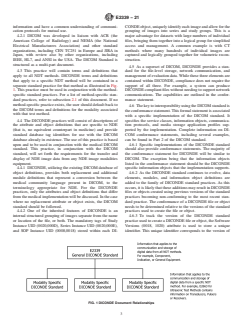
American College of Radiology) and NEMA (the National files, bringing them together into a logical group for simplified
Electrical Manufacturers Association) and other standard access and management. A common example is with CT
organizations, including CEN TC251 in Europe and JIRA in methods where many hundreds of individual images are
Japan, with review also by other organizations, including captured and logically grouped together for volumetric recon-
IEEE, HL7, and ANSI in the USA. The DICOM Standard is struction.
structured as a multi-part document.
4.5 As a superset of DICOM, DICONDE provides a stan-
4.3 This practice will contain terms and definitions that dard for the file-level storage, network communication, and
apply to all NDT methods. DICONDE terms and definitions management of evaluation data.While these three elements are
that apply to a specific NDT method will be contained in a contained within DICONDE, compliance does not require the
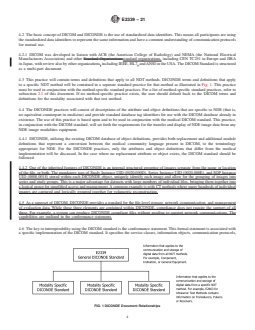
separate standard practice for that method as illustrated in Fig. support of all three. For example, a system can produce
1. This practice must be used in conjunction with the method- DICONDE compliant files without needing to support network
specific standard practices. For a list of method-specific stan- communications. The capabilities are outlined in the confor-
dard practices, refer to subsection 2.1 of this document. If no mance statement.
method-specific practice exists, the user should default back to
4.6 ThekeytointeroperabilityusingtheDICOMstandardis
the DICOM terms and definitions for the modality associated
theconformancestatement.Thisformalstatementisassociated
with that test method.
with a specific implementation of the DICOM standard. It
4.4 The DICONDE practices will consist of descriptions of specifies the service classes, information objects, communica-
the attribute and object definitions that are specific to NDE tion protocols, and media storage application profiles sup-
(that is, no equivalent counterpart in medicine) and provide ported by the implementation. Complete information on DI-
standard database tag identifiers for use with the DICOM COM conformance statements, including several examples,
database already in existence. The use of this practice is based can be found in Part 2 of the DICOM standard.
upon and to be used in conjunction with the medical DICOM 4.6.1 Specific implementations of the DICONDE standard
standard. This practice, in conjunction with the DICOM should also provide conformance statements. The majority of
standard, will set forth the requirements for the transfer and the conformance statement for DICONDE will be similar to
display of NDE image data from any NDE image modalities DICOM. The exception being that the information objects
equipment. listed in the conformance statement should be the DICONDE
4.4.1 DICONDE, utilizing the existing DICOM database of specific information objects that the implementation supports.
object definitions, provides both replacement and additional 4.6.2 As the DICONDE standard continues to evolve, data
module definitions that represent a conversion between the elements, modules, and information object definitions are
medical community language present in DICOM, to the added to the family of DICONDE standard practices. As this
terminology appropriate for NDE. For the DICONDE occurs, it is likely that these additions may result in DICONDE
practices, only the attributes and object definitions that differ files or objects created using previous versions of the standard
from the medical implementation will be discussed. In the case practices becoming non-conforming to the most recent stan-
where no replacement attribute or object exists, the DICOM dard practice. The conformance of a DICONDE file or object
standard should be followed. needs to be determined relative to the versions of the standard
4.4.2 One of the inherited features of DICONDE is an practices used to create the file or object.
internal structured grouping of images separate from the name 4.6.3 To track the version of the DICONDE standard
or location of the file, or both. The mandatory tags of Study practice used to create a DICONDE file or object, the Software
Instance UID (0020,000D), Series Instance UID (0020,000E), Versions (0018, 1020) attribute is used to store a unique
and SOP Instance UID (0008,0018) stored within each DI- identifier. This unique identifier corresponds to the version of
FIG. 1 DICONDE Document Relationships
E2339 − 21
the DICONDE standard practice used to create the file or medical information modules will be reused when possible.
object. For more information, see subsection 7.2.5 of this For example, a Component information module will be as-
document. signed to the Patient information module.
6.2.3 In some cases, there will exist no equivalent medical
4.7 Practice E3147 provides methods for determining if the
information module for a required set of industrial data. When
practices defined in this and other DICONDE practices are
no equivalent DICOM information module exists, an industrial
implemented correctly. It also provides methods for assuring
specific data module will be created as part of that object.
that multiple DICONDE implementations can successfully
interoperate together.
6.3 Service-Object Pair (SOP) Class Definitions:
6.3.1 Details of the DICOM SOP Class Definitions can be
5. Significance and Use
found in the DICOM Standard, Part 4, Section 6.
5.1 Personnel that are responsible for the transfer of NDE
6.4 DICOM to DICONDE SOP Class Definitions:
data between systems will use this standard. This practice will
define a set of NDE information object definitions that along 6.4.1 The DICOM standard defines Standard, Standard
with the DICOM standard will provide a standard means to
Extended, Specialized Extended and Private SOP Classes in
organize image data. Once conformance statements have been Part 2, Section 3.11.
generated, the NDE image data may be displayed on any
6.4.2 To maintain compatibility with standard DICOM
imaging/analysis device that conforms to the standard. This
devices, the DICONDE standard will be based on Standard
process of developing conformance statements with both the
Extended DICOM SOP Classes as described in Part 2, Section
NDE specific object definitions and the DICOM accepted
3.11.3 of the DICOM Standard except as noted below.
definitions, will provide a means to automatically and trans-
6.4.3 Some nondestructive testing methods do not have an
parently communicate between compliant equipment without
equivalent medical imaging modality. An example of such a
loss of information.
testmethodisEddyCurrenttesting.Forthesetestmethods,the
DICONDE standard will define DICONDE Standard SOP
NOTE 1—Knowledge and understanding of the existing DICOM stan-
dard will be required to generate conformance statements and thereby
Classes instead of using DICOM Standard Extended SOP
facilitate the data transfer.
Classes.
6. Information Object and Service-Object Pair Class
6.5 Conformance:
Definitions
6.5.1 Since the DICONDE standard is based on Standard
6.1 Information Object Definitions Extended DICOM SOP Classes, only DICOM devices with
Level 2 (Full) conformance should be used in DICONDE
6.1.1 Details of the DICOM Information Object Definitions
can be found in the DICOM Standard Part 3,AnnexesAand B. applications. Level 2 (Full) conformance ensures that all Type
1, 2 and 3 as well as Private attributes will be stored and may
6.1.2 DICONDE Information Object Definitions are found
in the method-specific standard practices (Practices E2663, be accessed by the device. See DICOM Part 4, Section B.4 for
more information.
E2699, E2738, E2767, and E2934). For a list of current
method-specific standard practices, refer to subsection 2.1 of
6.5.2 Note that test data that use DICONDE Standard SOP
this document.
Classes may not be accepted or displayed by many standard
6.1.3 The Information Object Definition is composed of a
DICOM image display and storage tools since these SOP
table of Information Modules included in the IOD. This table
classes are not used in medical applications.
includes a usage for each module. Usage is used to specify
6.6 For network communication, DICOM Standard PS 3,
whether an information module is Mandatory (M), Conditional
part 4, section C.6 defines both a Patient Root Query/Retrieve
(C), or User Optional (U). The usage of the information
Information Model and a Study Root Query/Retrieve Informa-
module takes precedence over the type of the data element. For
tionModel.WithspecificregardtoDICONDE,theComponent
example, a data element of type 1 in an information module
ID is not a central reference point as it is in the medical field,
whose usage is U need only be present with a value if the user
and due to the varied industries and NDE procedures, recon-
chooses to include that information module in the DICONDE
ciling evaluation data to a single field can be problematic. For
file or object. If that information module is not included in the
example, Component Name variations could be overwritten
file or object that data element is not required to be included
becauseofreconciliationagainstComponentID.AsthePatient
with a value.
Root is specifically aimed at a reconciled master index around
6.2 DICOM to DICONDE Information Object Definition
the Patient ID (Component ID), it is therefore not included in
6.2.1 The DICOM standard specifies mandatory,
the DICONDE standard. Non-inclusion of this model in the
conditional, and user optional information modules for each
DICONDE standard in no way breaks or prevents the imple-
DICOM IOD.The relationship between the IODs and modules
mentation and use of that model.
is found in the DICOM Standard Part 3. The DICONDE
standard will follow that relationship except as noted.
7. DICONDE Information Modules
6.2.2 The terminology associated with certain modules of
7.1 Information Module Definitions
the DICOM information objects must be changed for use in an
industrial context. For instance, industry deals with compo- 7.1.1 Details of the DICOM Information Module Defini-
nents not patients. In the industrial objects, the equivalent tions can be found in the DICOM Standard Part 3, Annex C.
E2339 − 21
7.1.2 All data elements in the information modules must be modules and, if appropriate, the medical modules that they
described by an attribute name, a data element tag,a value supersede.
representation (VR),a value multiplicity (VM), and a data
7.4 Component Module
element type.
7.4.1 Table 2 specifies the attributes that describe compo-
7.2 DICOM to DICONDE Information Module Definition
nents.
7.2.1 The terminology associated with certain elements of
7.4.1.1 For information objects using the component
the DICOM information modules must be changed for use in
module, Component Shape (0014,0050) is specified to use the
an industrial context. For instance, industry deals with
values in Table 3.
components, not patients. The DICONDE standard defines
7.4.1.2 For information objects using the component
industrial information modules that are equivalent to those
module, Curvature Type (0014,0052) is specified to use the
found in the DICOM standard. In the industrial modules, the
following values:
equivalentmedicaldataelementswillbereusedwhenpossible.
CONCAVE CONVEX COMPOUND
For example, a component ID number or serial number will be
assigned to the Patient ID attribute. 7.5 Component Summary Module
7.2.2 In some cases, there will exist no equivalent medical
7.5.1 Table 4 summarizes the attributes that describe com-
data element for a required industrial data element. There is no
ponents. This module has been retired from DICONDE but is
equivalent of Component Manufacturer in the current DICOM
left for reference.
data model. When no equivalent DICOM data element exists,
7.6 Component Study Module
anindustrialspecificdataelementwillbecreatedaspartofthat
7.6.1 Table5summarizestheattributesthatdescribeastudy
module.
or set of inspections on a given component.
7.2.3 When a logical correspondence exists, an existing
DICOM data element with an associated NDE meaning will be
7.7 Component Series Module
used for industrial data. For example, the Patient Name data
7.7.1 Table 6 summarizes the attributes that identify and
element (0010, 0010) is used to store Component Name for
describe information within a component series.
NDE applications.
7.7.1.1 For information objects using the component series
7.2.4 Some industrial data element tags are unique and do
module, Modality (0008, 0060) is specified to use the follow-
not duplicate any existing medical tags. These NDE data
ing values:
elements are stored as DICOM Private Data Element Tags.
CR = Computed Radiography CT = Computed Tomography
Private data elements tags are defined in Part 5, Section 7.8 of
CT_MF = Multiframe CT US-MF = Multiframe Ultrasound
the DICOM standard.
(Retired)
US = Ultrasound US_MF = Multiframe Ultrasound
7.2.5 The version identifier of the DICONDE file will be
DX = Digital Radiography TG = Thermography
stored in the Software Versions data element (0018, 1020) in
ES = Borescope PR = Presentation State
the NDE Equipment Module. The Software Versions data
SC = Secondary Capture XA = Real Time Digital Radiography
element is multi-valued. If additional software versions are
7.8 NDE Equipment Module
stored in this data element, the DICONDE version must be the
7.8.1 Table 7 summarizes the attributes that describe infor-
first value stored in the data element. The current DICONDE
mation regarding the NDE equipment used to acquire the
version identifier is “DICONDE21”. No changes in capitaliza-
image.
tion or spacing is allowed in the DICONDE version identifier.
7.8.1.1 Date of Last Calibration (0018,1200) and Time of
7.3 DICONDE Information Modules
Last Calibration (0018,1201) are used to convey the date and
7.3.1 The DICONDE practice contains the common mod-
time of calibration. TheAttribute Date of Last Calibration may
ules that are needed for every technique. Any technique
be supported alone, however, Time of Last Calibration Attri-
specific modules for NDE will have information modules,
bute has no meaning unless Attribute Date of Last Calibration
attributes, and data elements identified in a technique specific
is also supported. The order of each attribute shall be from the
practice.
oldest date/time to the most recent date/time. When the
7.3.2 Table 1 summarizes the current list of industrial
attributes are both supported, they shall be provided as pairs.
7.8.1.2 Pixel Padding Value (0028,0120) is used to pad
images to rectangular format. The native format of some
TABLE 1 DICONDE Modules with Medical Equivalents
images is not rectangular. It is common for devices with this
DICOM Module DICONDE Module
format to pad the images to the rectangular format required by
Patient Component
the DICOM standard with a specific pixel value that is not
Patient Summary (Retired) Component Summary (Retired)
General Study Component Study
contained in the native image. Further, when resampling, such
General Series Component Series
as after spatial registration, padding may be needed to fill
General Equipment NDE Equipment
previously non-existent pixels.
VL Photographic Geolocation NDE Geolocation Module
Module
7.9 NDE Indication Module
NDE Indication
NDE Geometry
7.9.1 Table 8 summarizes the attributes that identify and
NDE Approval
describe information regarding the indications found by a
NDE Tag Label Dictionary
reviewer of the acquired image.
E2339 − 21
TABLE 2 Component Module
Attribute Name Tag VR VM Type Description
Component Name (0010,0010) PN 1 2 Component Name or Part name
Component ID Number (0010,0020) LO 1 2 Component ID or Part ID
Other Component IDs (0010,1000) LO 1-N 3 Retired
Other Component IDs Sequence (0010,1002) SQ 1 3 Additional Component IDs when multiple parts
in one image.
> Other Component Names (0010,1001) PN 1-N 3 Additional Component names when multiple
parts in one image
> Component Manufacturing Date (0010,0030) DA 1 2
> Patient Sex (0010,0040) CS 1
...
This document is not an ASTM standard and is intended only to provide the user of an ASTM standard an indication of what changes have been made to the previous version. Because
it may not be technically possible to adequately depict all changes accurately, ASTM recommends that users consult prior editions as appropriate. In all cases only the current version
of the standard as published by ASTM is to be considered the official document.
Designation: E2339 − 15 E2339 − 21
Standard Practice for
Digital Imaging and Communication in Nondestructive
Evaluation (DICONDE)
This standard is issued under the fixed designation E2339; the number immediately following the designation indicates the year of
original adoption or, in the case of revision, the year of last revision. A number in parentheses indicates the year of last reapproval. A
superscript epsilon (´) indicates an editorial change since the last revision or reapproval.
This standard has been approved for use by agencies of the U.S. Department of Defense.
1. Scope*
1.1 This practice facilitates the interoperability of NDE imaging and data acquisition equipment by specifying the image data in
commonly accepted terms. This practice represents a harmonization of NDE imaging systems, or modalities, with the NEMA
Standards Publication titled Digital Imaging and Communications in Medicine (DICOM, see http://medical.nema.org), an
international standard for image data acquisition, review, storage and archival. In addition, this practice will provide a standard set
of industrial NDE specific information object definitions, which travel beyond the scope of standard DICOM modalities. The goal
of this practice is to provide a standard by which NDE image/signal data may be displayed on by any system conforming to the
ASTM DICONDE format, regardless of which NDE modality was used to acquire the data.
1.2 This practice has been developed to overcome the issues that arise when archiving or analyzing the data from a variety of NDE
techniques, each using proprietary data acquisition systems. As data acquisition modalities evolve, data acquired in the past must
remain decipherable. This practice proposes an image data file format in such a way that all the technique parameters, along with
the image file, are preserved, regardless of changes in NDE technology. This practice will also permit the viewing of a variety of
image types (CT, CR, Ultrasonic, Infrared, and Eddy Current) on a single workstation, maintaining all of the pertinent technique
parameters along with the image file. This practice addresses the exchange of digital information between NDE imaging
equipment.
1.3 This practice does not specify:
1.3.1 A complete description of all the information necessary to implement the DICONDE standard for an imaging modality. This
document must be used in conjunction with one of the method-specific DICONDE Standard Practice documents and the DICOM
Standard to completely describe all the requirements necessary to implement the DICONDE standard for an imaging modality. See
Section 2.1 of this document for a current list of the method-specific standard practice documents.
1.3.2 A testing or validation procedure to assess an implementation’s conformance to the standard. Best practices for
demonstrating conformance can be found in Practice E3147.
1.3.3 The implementation details of any features of the standard on a device claiming conformance.
1.3.4 The overall set of features and functions to be expected from a system implemented by integrating a group of devices each
claiming DICONDE or DICOM conformance.
This practice is under the jurisdiction of ASTM Committee E07 on Nondestructive Testing and is the direct responsibility of Subcommittee E07.11 on Digital Imaging
and Communication in Nondestructive Evaluation (DICONDE).
Current edition approved Dec. 1, 2015Dec. 1, 2021. Published December 2015May 2022. Originally approved in 2004. Last previous edition approved in 20112015 as
E2339 - 11.E2339 – 15. DOI: 10.1520/E2339-15.10.1520/E2339-21.
*A Summary of Changes section appears at the end of this standard
Copyright © ASTM International, 100 Barr Harbor Drive, PO Box C700, West Conshohocken, PA 19428-2959. United States
E2339 − 21
1.4 Units—Although this practice contains no values that require units, it does describe methods to store and communicate data
that do require units to be properly interpreted. The SI units required by this practice are to be regarded as standard. No other units
of measurement are included in this standard.
1.5 This standard does not purport to address all of the safety concerns, if any, associated with its use. It is the responsibility
of the user of this standard to establish appropriate safety safety, health, and healthenvironmental practices and determine the
applicability of regulatory limitations prior to use.
1.6 This international standard was developed in accordance with internationally recognized principles on standardization
established in the Decision on Principles for the Development of International Standards, Guides and Recommendations issued
by the World Trade Organization Technical Barriers to Trade (TBT) Committee.
2. Referenced Documents
2.1 ASTM Standards:
E1316 Terminology for Nondestructive Examinations
E2663 Practice for Digital Imaging and Communication in Nondestructive Evaluation (DICONDE) for Ultrasonic Test Methods
E2699 Practice for Digital Imaging and Communication in Nondestructive Evaluation (DICONDE) for Digital Radiographic
(DR) Test Methods
E2738 Practice for Digital Imaging and Communication in Nondestructive Evaluation (DICONDE) for Computed Radiography
(CR) Test Methods
E2767 Practice for Digital Imaging and Communication in Nondestructive Evaluation (DICONDE) for X-ray Computed
Tomography (CT) Test Methods
E2934 Practice for Digital Imaging and Communication in Nondestructive Evaluation (DICONDE) for Eddy Current (EC) Test
Methods
E3147 Practice for Evaluating DICONDE Interoperability of Nondestructive Testing and Inspection Systems
E3169 Guide for Digital Imaging and Communication in Nondestructive Evaluation (DICONDE)
2.2 Other Documentation:
NEMA Standards Publication PS3.1, Version 3:PS3 / ISO 12052, Digital Imaging and Communications in Medicine (DICOM)
Standard, National Electrical Manufacturers Association, Rosslyn, VA, USA (available free at http://www.dicomstandard.org/)
ACR-NEMA 300–1998 Digital Imaging and Communication in Medicine
3. Terminology
3.1 Definitions:
3.1.1 Nondestructive evaluation terms used in this practice can be found in Terminology E1316.
3.2 Definitions of Terms Specific to This Standard:
3.2.1 AE—AE, n—application entity
3.2.2 attribute—attribute, n—a property of an information object. An attribute has a name and a value, which are independent of
any encoding scheme.
3.2.3 attribute tag, —n—a unique identifier for an attribute of an information object composed of an ordered pair (gggg,
eeee)(gggg,eeee), where gggg represents the group number and eeee represents the data element.
3.2.4 conformance statement—statement, n—a formal statement associated with a specific implementation of the standard,
specifying the service class, information objects, and communications protocols supported by the implementations.
3.2.5 data dictionary—dictionary, n—a registry of data elements, which assigns a unique tag, a name, value characteristics, and
semantics to each data element.
3.2.6 data element—element, n—a unit of information as defined by a single entry in the data dictionary. An encoded IOD attribute
that is composed of, at a minimum, three fields: a data element tag, a value length, and a value field.
For referenced ASTM standards, visit the ASTM website, www.astm.org, or contact ASTM Customer Service at service@astm.org. For Annual Book of ASTM Standards
volume information, refer to the standard’s Document Summary page on the ASTM website.
Available from National Electrical Manufacturers Association (NEMA), 1300 N. 17th St., Suite 1752, Rosslyn, VA 22209, http://www.nema.org.
E2339 − 21
3.2.7 data element tag—tag, n—a unique identifier for a data element composed of an ordered pair of numbers (a group number
followed by an element number).
3.2.8 data element type (type)—(type), n—used to specify whether an attribute of an IOD is required and must have a non-zero
value (Type 1), required but may have a zero value (Type 2), required only under certain conditions (Type 1C and 2C), or optional
(Type 3). See Part 5, Section 7.4 of the DICOM standard for additional details.
3.2.9 DICONDE version identifier, n—unique string placed in the DICONDE object to identify the version of DICONDE used to
create the object.
3.2.10 element number—number, n—the second number in the ordered pair of numbers that make up a data element tag.
3.2.11 group number—number, n—the first number in the ordered pair of numbers that makes up a data element tag.
3.2.12 information object definition (IOD)—(IOD), n—a data abstraction of a class of similar real-world objects which defines the
nature and attributes relevant to the class of real-world object represented.
3.2.13 module—module, n—a set of attributes with an Information Object Definition.
3.2.14 private data element—element, n—additional data element, defined by an implementer, to communicate information that
is not contained in standard data elements. Private data elements have odd group numbers.
3.2.15 service-object pair class (SOP class)—class), n—the union of a service class and an information object definition. SOP
Classes are the building blocks that support the interaction between two DICOM application entities.
3.2.16 unique identifier (UID)—(UID), n—a numeric identifier that is guaranteed to be unique among all DICOM numeric
identifiers.
3.2.17 usage—usage, n—used to specify whether an information module is Mandatory (M), Conditional (C), or User
OptionOptional (U). See Part 3, Section A.1.3 of the DICOM standard for additional details.
3.2.18 value—value, n—a component of a value field. A value field may consist of one or more of these components.
3.2.19 value field—field, n—the field within a data element that contains the value(s) of that data element.
3.2.20 value length—length, n—the field within a data element that contains the length of the value field of the data element.
3.2.21 value multiplicity (VM)—(VM), n—specifies the number of values contained in the value field of a data element.
3.2.22 value representation (VR)—(VR), n—specifies the data type and format of the value(s) contained in the value field of a data
element. A complete list of all the VR’s can be found in Part 5, subsection 6.2 of the DICOM standard.
3.2.22 DICONDE version identifier—unique string placed in the DICONDE object to identify the version of DICONDE used to
create the object.
4. Summary of Practice
4.1 Guide E3169 provides an overview of the ASTM International standard practices that address DICONDE and assistance in
identifying the correct standard practices needed to implement specific use cases. That document should be the first document
utilized for any DICONDE application.
E2339 − 21
4.2 The basic concept of DICOM and DICONDE is the use of standardized data identifiers. This means all participants are using
the standardized data identifiers to represent the same information and have a common understanding of communication protocols
for mutual use.
4.2.1 DICOM was developed in liaison with ACR (the American College of Radiology) and NEMA (the National Electrical
Manufacturers Association) and other Standard Organizationsstandard organizations, including CEN TC251 in Europe and JIRA
in Japan, with review also by other organizations, including IEEE, HL7, and ANSI in the USA. The DICOM Standard is structured
as a multi-part document.
4.3 This practice will contain terms and definitions that apply to all NDT methods. DICONDE terms and definitions that apply
to a specific NDT method will be contained in a separate standard practice for that method as illustrated in Fig. 1. This practice
must be used in conjunction with the method-specific standard practices. For a list of method-specific standard practices, refer to
subsection 2.1 of this document. If no method-specific practice exists, the user should default back to the DICOM terms and
definitions for the modality associated with that test method.
4.4 The DICONDE practices will consist of descriptions of the attribute and object definitions that are specific to NDE (that is,
no equivalent counterpart in medicine) and provide standard database tag identifiers for use with the DICOM database already in
existence. The use of this practice is based upon and to be used in conjunction with the medical DICOM standard. This practice,
in conjunction with the DICOM standard, will set forth the requirements for the transfer and display of NDE image data from any
NDE image modalities equipment.
4.4.1 DICONDE, utilizing the existing DICOM database of object definitions, provides both replacement and additional module
definitions that represent a conversion between the medical community language present in DICOM, to the terminology
appropriate for NDE. For the DICONDE practices, only the attributes and object definitions that differ from the medical
implementation will be discussed. In the case where no replacement attribute or object exists, the DICOM standard should be
followed.
4.4.2 One of the inherited features of DICONDE is an internal structured grouping of images separate from the name or location
of the file, or both. The mandatory tags of Study Instance UID (0020,000D), Series Instance UID (0020,000E), and SOP Instance
UID (0008,0018) stored within each DICONDE object, uniquely identify each image and allow for the grouping of images into
series and study groups. This is a major advantage for datasets with large numbers of individual files, bringing them together into
a logical group for simplified access and management. A common example is with CT methods where many hundreds of individual
images are captured and logically grouped together for volumetric reconstruction.
4.5 As a superset of DICOM, DICONDE provides a standard for the file-level storage, network communication, and management
of evaluation data. While these three elements are contained within DICONDE, compliance does not require the support of all
three. For example, a system can produce DICONDE compliant files without needing to support network communications. The
capabilities are outlined in the conformance statement.
4.6 The key to interoperability using the DICOM standard is the conformance statement. This formal statement is associated with
a specific implementation of the DICOM standard. It specifies the service classes, information objects, communication protocols,
FIG. 1 DICONDE Document Relationships
E2339 − 21
and media storage application profiles supported by the implementation. Complete information on DICOM conformance
statements, including several examples, can be found in Part 2 of the DICOM standard.
4.6.1 Specific implementations of the DICONDE standard should also provide conformance statements. The majority of the
conformance statement for DICONDE will be similar to DICOM. The exception being that the information objects listed in the
conformance statement should be the DICONDE specific information objects that the implementation supports.
4.6.2 As the DICONDE standard continues to evolve, data elements, modules, and information object definitions are added to the
family of DICONDE standard practices. As this occurs, it is likely that these additions may result in DICONDE files or objects
created using previous versions of the standard practices becoming non-conforming to the most recent standard practice. The
conformance of a DICONDE file or object needs to be determined relative to the versions of the standard practices used to create
the file or object.
4.6.3 To track the version of the DICONDE standard practice used to create a DICONDE file or object, the Software Versions
(0018, 1020) attribute is used to store a unique identifier. This unique identifier corresponds to the version of the DICONDE
standard practice used to create the file or object. For more information, see subsection 7.2.5 of this document.
4.7 Practice E3147 provides methods for determining if the practices defined in this and other DICONDE practices are
implemented correctly. It also provides methods for assuring that multiple DICONDE implementations can successfully
interoperate together.
5. Significance and Use
5.1 Personnel that are responsible for the transfer of NDE data between systems will use this standard. This practice will define
a set of NDE information object definitions that along with the DICOM standard will provide a standard means to organize image
data. Once conformance statements have been generated, the NDE image data may be displayed on any imaging/analysis device
that conforms to the standard. This process of developing conformance statements with both the NDE specific object definitions
and the DICOM accepted definitions, will provide a means to automatically and transparently communicate between compliant
equipment without loss of information.
NOTE 1—Knowledge and understanding of the existing DICOM standard will be required to generate conformance statements and thereby facilitate the
data transfer.
6. Information Object and Service-Object Pair Class Definitions
6.1 Information Object Definitions
6.1.1 Details of the DICOM Information Object Definitions can be found in the DICOM Standard Part 3, Annexes A and B.
6.1.2 DICONDE Information Object Definitions are found in the method-specific standard practices. practices (Practices E2663,
E2699, E2738, E2767, and E2934). For a list of current method-specific standard practices, refer to subsection 2.1 of this
document.
6.1.3 The Information Object Definition is composed of a table of Information Modules included in the IOD. This table includes
a usage for each module. Usage is used to specify whether an information module is Mandatory (M), Conditional (C), or User
Optional (U). The usage of the information module takes precedence over the type of the data element. For example, a data element
of type 1 in an information module whose usage is U need only be present with a value if the user chooses to include that
information module in the DICONDE file or object. If that information module is not included in the file or object that data element
is not required to be included with a value.
6.2 DICOM to DICONDE Information Object Definition
6.2.1 The DICOM standard specifies mandatory, conditional, and user optional information modules for each DICOM IOD. The
relationship between the IODs and modules is found in the DICOM Standard Part 3. The DICONDE standard will follow that
relationship except as noted.
6.2.2 The terminology associated with certain modules of the DICOM information objects must be changed for use in an industrial
E2339 − 21
context. For instance, industry deals with components not patients. In the industrial objects, the equivalent medical information
modules will be reused when possible. For example, a Component information module will be assigned to the Patient information
module.
6.2.3 In some cases, there will exist no equivalent medical information module for a required set of industrial data. When no
equivalent DICOM information module exists, an industrial specific data module will be created as part of that object.
6.3 Service-Object Pair (SOP) Class Definitions:
6.3.1 Details of the DICOM SOP Class Definitions can be found in the DICOM Standard, Part 4, Section 6.
6.4 DICOM to DICONDE SOP Class Definitions:
6.4.1 The DICOM standard defines Standard, Standard Extended, Specialized Extended and Private SOP Classes in Part 2, Section
3.11.
6.4.2 To maintain compatibility with standard DICOM devices, the DICONDE standard will be based on Standard Extended
DICOM SOP Classes as described in Part 2, Section 3.11.3 of the DICOM Standard except as noted below.
6.4.3 Some nondestructive testing methods do not have an equivalent medical imaging modality. An example of such a test method
is Eddy Current testing. For these test methods, the DICONDE standard will define DICONDE Standard SOP Classes instead of
using DICOM Standard Extended SOP Classes.
6.5 Conformance:
6.5.1 Since the DICONDE standard is based on Standard Extended DICOM SOP Classes, only DICOM devices with Level 2
(Full) conformance should be used in DICONDE applications. Level 2 (Full) conformance ensures that all Type 1, 2 and 3 as well
as Private attributes will be stored and may be accessed by the device. See DICOM Part 4, Section B.4 for more information.
6.5.2 Note that test data that use DICONDE Standard SOP Classes may not be accepted or displayed by many standard DICOM
image display and storage tools since these SOP classes are not used in medical applications.
6.6 For network communication, DICOM Standard PS 3, part 4, section C.6 defines both a Patient Root Query/Retrieve
Information Model and a Study Root Query/Retrieve Information Model. With specific regard to DICONDE, the Component ID
is not a central reference point as it is in the medical field, and due to the varied industries and NDE procedures, reconciling
evaluation data to a single field can be problematic. For example, Component Name variations could be overwritten because of
reconciliation against Component ID. As the Patient Root is specifically aimed at a reconciled master index around the Patient ID
(Component ID), it is therefore not included in the DICONDE standard. Non-inclusion of this model in the DICONDE standard
in no way breaks or prevents the implementation and use of that model.
7. DICONDE Information Modules
7.1 Information Module Definitions
7.1.1 Details of the DICOM Information Module Definitions can be found in the DICOM Standard Part 3, Annex C.
7.1.2 All data elements in the information modules must be described by an attribute name, a data element tag, a value
representation (VR), a value multiplicity (VM), and a data element type.
7.2 DICOM to DICONDE Information Module Definition
7.2.1 The terminology associated with certain elements of the DICOM information modules must be changed for use in an
industrial context. For instance, industry deals with partscomponents, not patients. The DICONDE standard defines industrial
information modules that are equivalent to those found in the DICOM standard. In the industrial modules, the equivalent medical
data elements will be reused when possible. For example, a component ID number or serial number will be assigned to the Patient
ID attribute.
E2339 − 21
7.2.2 In some cases, there will exist no equivalent medical data element for a required industrial data element. There is no
equivalent of Component Manufacturer in the current DICOM data model. When no equivalent DICOM data element exists, an
industrial specific data element will be created as part of that module.
7.2.3 When a logical correspondence exists, an existing DICOM data element,element with an associated NDE meaning
associated with them, will be used for industrial data. For example, the Patient Name data element (0010, 0010) is used to store
Component Name for NDE applications.
7.2.4 Some industrial data element tags are unique and do not duplicate any existing medical tags. These NDE data elements are
stored as DICOM Private Data Element Tags. Private data elements tags are defined in Part 5, Section 7.8 of the DICOM standard.
7.2.5 The version identifier of the DICONDE file will be stored in the Software Versions data element (0018, 1020) in the NDE
Equipment Module. The Software Versions data element is multi-valued. If additional software versions are stored in this data
element, the DICONDE version must be the first value stored in the data element. The current DICONDE version identifier is
“DICONDE15”.“DICONDE21”. No changes in capitalization or spacing is allowed in the DICONDE version identifier.
7.3 DICONDE Information Modules
7.3.1 The DICONDE practice contains the common modules that are needed for every technique. Any technique specific modules
for NDE will have information modules, attributes, and data elements identified in a technique specific practice.
7.3.2 Table 1 summarizes the current list of industrial modules and, if appropriate, the medical modules that they supersede.
7.4 Component Module
7.4.1 Table 2 specifies the attributes that describe components.
7.4.1.1 For information objects using the component module, Component Shape (0014, 0050) (0014,0050) is specified to use the
values in Table 3.
7.4.1.2 For information objects using the component module, Curvature Type (0014, 0052) (0014,0052) is specified to use the
following values:
CONCAVE CONVEX COMPOUND
7.5 Component Summary Module
7.5.1 Table 4 summarizes the attributes that describe components. This module has been retired from DICONDE but is left for
reference.
7.6 Component Study Module
TABLE 1 DICONDE Modules with Medical Equivalents
DICOM Module DICONDE Module
Patient Component
Patient Summary (Retired) Component Summary (Retired)
General Study Component Study
General Study Component Study
General Series Component Series
General Equipment NDE Equipment
VL Photographic Geolocation NDE Geolocation Module
Module
NDE Indication
NDE Geometry
NDE Approval
NDE Approval
NDE Tag Label Dictionary
E2339 − 21
TABLE 2 Component Module
Attribute Name Tag VR VM Type Description
Component
Component Name (0010,0010) PN 1 2 Component Name or Part name
Component ID Number (0010,0020) LO 1-N 2 Component ID or Part ID
Component ID Number (0010,0020) LO 1 2 Component ID or Part ID
Other Component IDs (0010,1000) LO 1-N 3 Retired
Other Component IDs (0010,1000) LO 1-N 3 Additional Component IDs when multiple parts
in one image
Other Component IDs Sequence (0010,1002) SQ 1 3 Additional Component IDs when multiple parts
in one image.
Other Component Names (0010,1001) PN 1 3 Additional Component IDs when multiple parts
in one image
> Other Component Names (0010,1001) PN 1-N 3 Additional Component names when multiple
parts in one image
Component Manufacturing Date (0010,0030) DA 1 2
> Component Manufacturing Date (0010,0030) DA 1 2
Patient Sex (0010,0040) CS 1 2 Required for DICOM compliance. Should either
contain zero value or the enumerated value of
“O” for OTHER.
> Patient Sex (0010,0040) CS 1 2 Required for DICOM compliance. Should either
contain zero value or the enumerated value of
“O” for OTHER.
Component Notes (0010,4000) LT 1 3
> Component Notes (0010,4000) LT 1 3
Component Manufacturing Procedure (0014,0025) ST 1 3
> Component Manufacturing Procedure (0014,0025) ST 1 3
Component Manufacturer (0014,0028) ST 1 3
> Component Manufacturer (0014,0028) ST 1 3
Component Welder IDs (0014,0100) LO 1-N 3 A text string identifying the individual or
machine performing welding operations on the
component.
> Component Welder IDs (0014,0100) LO 1-N 3 A text string identifying the individual or
machine performing welding operations on the
component.
Material
Material Name (0010,2160) SH 1 2 Steel, copper, etc. (16 char. max.)
Material Grade (0014,0042) ST 1 3
Material Properties Description (0014,0044) ST 1 3
Material Notes (0014,0046) LT 1 3
Geometry
Material Thickness (0014,0030) DS 1-N 3 Wall/material thickness in mm
Material Pipe Diameter (0014,0032) DS 1-N 3 Retired
Material Pipe Diameter (0014,0032) DS 1-N 3 (Retired)
Material Isolation Diameter (0014,0034) DS 1-N 3 Retired
Material Isolation Diameter (0014,0034) DS 1-N 3 (Retired)
Component Shape (0014,0050) CS 1 3 General description of the shape of the test
piece. See 7.4.1.1for additional information.
Curvature Type (0014,0052) CS 1 3 Type of curvature present in the test piece. See
7.4.1.2 for additional information.
Outer Diameter (0014,0054) DS 1 3 Outer diameter of curved test specimen in mm
Inner Diameter (0014,0056) DS 1 3 Inner diameter of curved test specimen in mm
TABLE 3 Values for the Component Shape (0014,0050) Attribute
Shape Description Shape Value
Flat FLAT
Hollow Cylinder CYLH
Solid Cylinder CYLS
Hollow Sphere SPHEREH
Solid Sphere SPHERES
Compound Curvature COMPOUND
7.6.1 Table 5 summarizes the attributes that describe a study or set of inspections on a given component.
7.7 Component Series Module
7.7.1 Table 6 summarizes the attributes that identify and describe information within a component series.
E2339 − 21
TABLE 4 Component Summary Module (Retired)
Attribute Name Tag VR VM Type Description
Component
Component Name (0010,0010) PN 1 2 Component Name or Part name
Component ID Number (0010,0020) LO 1 2 Component ID or Part ID
TABLE 5 Component Study Module
Attribute Name Tag VR VM Type Description
Study Instance UID (0020,000D) UI 1 1 Unique study ID generated by the system
Study Instance UID (0020,000D) UI 1 1 Unique identifier of the study
Study Date (0008,0020) DA 1 1 Date the study started
Study Time (0008,0030) TM 1 1 Time the study started
Study ID (0020,0010) SH 1 2 User or equipment generated study identifier
Accession Number (0008,0050) SH 1 2 Inspection order number
Component Owner Name (0008,0090) PN 1 2 Company that owns the component being tested
Inspecting Company Name (0008, 1048) PN 1-N 2 Company responsible for the inspection
Inspecting Company Name (0008,1048) PN 1-N 2 Company responsible for the inspection
Certifying Inspector Name (0008, 1060) PN 1-N 2 Name of inspector certifying
Certifying Inspector Name (0008,1060) PN 1-N 2 Name of inspector certifying
Study Description (0008,1030) LO 1 2 User generated description or classification of the study
Reference Study Sequence (0008,1110) SQ 1 3 Identification of a study that is significantly related to this study.
May have zero or more items.
NOTES:
1. For example, series may be related if for data acquisition or
storage efficiency, the NDE Geometry data for this series is
stored in a related series.
Referenced Study Sequence (0008,1110) SQ 1 3 Identification of a study that is significantly related to this study.
May have zero or more items.
NOTES:
1. For example, series may be related if for data acquisition or
storage efficiency, the NDE Geometry data for this series is
stored in a related series.
> Study Instance UID (0020,000D) UI 1 1 Instance UID of the study to which the related series belongs
> Series Instance UID (0020,000E) UI 1 1 Instance UID of the related series
> Purpose of Reference Code (0040,A170) SQ 1 2 Describes the purpose for which the reference is made
Sequence
Examination Notes (0032,4000) LT 1 2 User defined notes on the examination
Expiry Date (0014,1020) DA 1 2 Date on which the validation expires.
TABLE 6 Component Series Module
Attribute Name Tag VR VM Type Description
Modality (0008,0060) CS 1 1 Type of equipment that originally acquired the data used to
create the images in this series. See 7.7.1.1 for defined terms.
Series Instance UID (0020,000E) UI 1 1 Unique identifier of the series
Series Number (0020,0011) IS 1 2 A number that identifies this series
Serie
...
Questions, Comments and Discussion
Ask us and Technical Secretary will try to provide an answer. You can facilitate discussion about the standard in here.
Loading comments...