


ASTM E3147-18
(Practice)Standard Practice for Evaluating DICONDE Interoperability of Nondestructive Testing and Inspection Systems
Standard Practice for Evaluating DICONDE Interoperability of Nondestructive Testing and Inspection Systems
SIGNIFICANCE AND USE
5.1 This practice describes the recommended procedure for NDE system manufacturers and NDE system purchasers to assess the system’s level of compliance and conformance to the DICONDE standard.
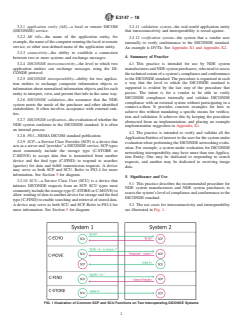
5.2 The use cases for interconnectivity and interoperability are illustrated in Fig. 1.
FIG. 1 Illustration of Common SCP and SCU Functions on Two Interoperating DICONDE Systems
SCOPE
1.1 This practice describes procedures for evaluating DICONDE compliance of radiographic, ultrasonic and eddy current examination instruments and systems.
1.2 This practice establishes no performance limits for examination systems; if such acceptance criteria are required, these must be specified by the using parties. Where acceptance criteria are implied herein they are for example only and are subject to more or less restrictive limits imposed by customer’s and end user’s controlling documents.
1.3 The specific parameters to be evaluated, conditions and frequency of test, and report data required, must also be determined by the user.
1.4 This practice may be used for the evaluation of a complete examination system, including search unit, instrument, interconnections, scanner fixtures and connected alarm and auxiliary devices, primarily in cases where such a system is used repetitively without change or substitution. This practice is not intended to be used as a substitute for calibration or standardization of an instrument or system to inspect any given material.
1.5 Alternate procedures, such as examples described in this practice, or others, may only be used with customer approval.
1.6 It is expected that the customer sets the requirements for the level to which this practice be conformed, including the requirements for which functionality and DICONDE interoperability be incorporated for testing.
1.7 Two customer types are targeted for usage: a high-level purchaser wishing to quickly assess results and a low-level systems developer wishing to understand the details about the extent of the results, as discussed in Section 5.
1.8 The values stated in SI units are to be regarded as standard. No other units of measurement are included in this standard.
1.9 This standard does not purport to address all of the safety concerns, if any, associated with its use. It is the responsibility of the user of this standard to establish appropriate safety, health, and environmental practices and determine the applicability of regulatory limitations prior to use.
1.10 This international standard was developed in accordance with internationally recognized principles on standardization established in the Decision on Principles for the Development of International Standards, Guides and Recommendations issued by the World Trade Organization Technical Barriers to Trade (TBT) Committee.
General Information
- Status
- Published
- Publication Date
- 31-Jan-2018
- Technical Committee
- E07 - Nondestructive Testing
Relations
- Effective Date
- 01-Feb-2024
- Effective Date
- 01-Feb-2024
- Effective Date
- 01-Dec-2019
- Effective Date
- 01-Mar-2019
- Effective Date
- 01-Nov-2018
- Effective Date
- 01-Jan-2018
- Effective Date
- 15-Jun-2017
- Effective Date
- 01-Feb-2017
- Effective Date
- 01-Aug-2016
- Effective Date
- 01-Feb-2016
- Effective Date
- 01-Dec-2015
- Effective Date
- 01-Sep-2015
- Effective Date
- 15-Nov-2014
- Effective Date
- 01-Oct-2014
- Effective Date
- 01-Jun-2014
Overview
ASTM E3147-18: Standard Practice for Evaluating DICONDE Interoperability of Nondestructive Testing and Inspection Systems provides a comprehensive framework for assessing the compliance and interoperability of nondestructive evaluation (NDE) systems with the DICONDE (Digital Imaging and Communication in Nondestructive Evaluation) standard. Developed by ASTM International, this practice serves both system manufacturers and purchasers, guiding them through procedures to verify and validate that NDE instruments and their digital communications meet standardized requirements for data exchange and interoperability.
This standard applies to various NDE technologies, including radiographic, ultrasonic, and eddy current systems, supporting the consistent use and integration of digital inspection data across platforms. ASTM E3147-18 is aligned with internationally recognized principles of standardization, making it suitable for organizations seeking harmonization and reliability in NDT system procurement and deployment.
Key Topics
Scope of Evaluation
- Procedures for assessing DICONDE compliance in radiographic, ultrasonic, and eddy current NDE systems
- Recommendations for evaluating entire examination systems, including instruments, interconnections, and auxiliary devices
- No specific performance limits are mandated; acceptance criteria are set by the user or customer
Conformance and Verification
- Steps for vendors to prepare and provide a DICOM Conformance Statement
- Verification of media and file compatibility per DICOM Part 10 requirements
- Evaluation of network transfer, query/retrieve, and media import/export services
Interoperability Testing
- Use of validation systems and tools (e.g., DVTk) to check interoperability between Service Class Providers (SCP) and Service Class Users (SCU)
- Structured procedures for storage, query, and retrieval operations using standard DICONDE commands (C-STORE, C-FIND, C-MOVE)
- Methods for documenting results in DICONDE interoperability tables
User Roles and Responsibilities
- Guidance for both high-level system purchasers and detailed-oriented system developers
- Flexibility to address customer-specific requirements and alternative procedures when approved
Applications
ASTM E3147-18 is intended for the following practical uses:
Procurement and Acceptance Testing:
Purchasers of NDE systems can apply this practice to ensure new or upgraded equipment meets interoperability requirements for digital inspection data, reducing integration risk and improving system reliability.Vendor Self-Assessment:
NDE equipment manufacturers can internally verify that their systems adhere to the DICONDE standard, preparing for customer acceptance tests or regulatory compliance.System Integration:
Organizations managing fleets of inspection equipment can use these procedures to ensure devices from different manufacturers work seamlessly together, promoting unified data storage, access, and retrieval across their operations.Regulatory and Quality Assurance:
Implementation of this standard supports compliance with international trade requirements and industry best practices, making it a valuable tool for quality audits and third-party evaluations.Interoperability Troubleshooting:
The documented procedures for C-ECHO, C-STORE, C-FIND, and C-MOVE help isolate and resolve communication issues between networked NDE systems, reducing downtime and facilitating troubleshooting.
Related Standards
For a comprehensive digital NDT approach, refer to these related ASTM standards:
- ASTM E2339: Digital Imaging and Communication in Nondestructive Evaluation (DICONDE) - General practice for DICONDE implementation.
- ASTM E2738: DICONDE for Computed Radiography (CR) Test Methods.
- ASTM E2663: DICONDE for Ultrasonic Test Methods.
- ASTM E2699: DICONDE for Digital Radiographic (DR) Test Methods.
- ASTM E2767: DICONDE for X-ray Computed Tomography (CT) Test Methods.
- ASTM E2934: DICONDE for Eddy Current (EC) Test Methods.
Adopting these standards alongside ASTM E3147-18 ensures consistent, standards-based digital communication and interoperability for nondestructive testing systems across industries.
Keywords: ASTM E3147-18, DICONDE, nondestructive evaluation, NDT systems, interoperability, digital imaging, conformance testing, inspection data, networked NDT, systems integration, ASTM standards.
Get Certified
Connect with accredited certification bodies for this standard

BSI Group
BSI (British Standards Institution) is the business standards company that helps organizations make excellence a habit.

NYCE
Mexican standards and certification body.
Sponsored listings
Frequently Asked Questions
ASTM E3147-18 is a standard published by ASTM International. Its full title is "Standard Practice for Evaluating DICONDE Interoperability of Nondestructive Testing and Inspection Systems". This standard covers: SIGNIFICANCE AND USE 5.1 This practice describes the recommended procedure for NDE system manufacturers and NDE system purchasers to assess the system’s level of compliance and conformance to the DICONDE standard. 5.2 The use cases for interconnectivity and interoperability are illustrated in Fig. 1. FIG. 1 Illustration of Common SCP and SCU Functions on Two Interoperating DICONDE Systems SCOPE 1.1 This practice describes procedures for evaluating DICONDE compliance of radiographic, ultrasonic and eddy current examination instruments and systems. 1.2 This practice establishes no performance limits for examination systems; if such acceptance criteria are required, these must be specified by the using parties. Where acceptance criteria are implied herein they are for example only and are subject to more or less restrictive limits imposed by customer’s and end user’s controlling documents. 1.3 The specific parameters to be evaluated, conditions and frequency of test, and report data required, must also be determined by the user. 1.4 This practice may be used for the evaluation of a complete examination system, including search unit, instrument, interconnections, scanner fixtures and connected alarm and auxiliary devices, primarily in cases where such a system is used repetitively without change or substitution. This practice is not intended to be used as a substitute for calibration or standardization of an instrument or system to inspect any given material. 1.5 Alternate procedures, such as examples described in this practice, or others, may only be used with customer approval. 1.6 It is expected that the customer sets the requirements for the level to which this practice be conformed, including the requirements for which functionality and DICONDE interoperability be incorporated for testing. 1.7 Two customer types are targeted for usage: a high-level purchaser wishing to quickly assess results and a low-level systems developer wishing to understand the details about the extent of the results, as discussed in Section 5. 1.8 The values stated in SI units are to be regarded as standard. No other units of measurement are included in this standard. 1.9 This standard does not purport to address all of the safety concerns, if any, associated with its use. It is the responsibility of the user of this standard to establish appropriate safety, health, and environmental practices and determine the applicability of regulatory limitations prior to use. 1.10 This international standard was developed in accordance with internationally recognized principles on standardization established in the Decision on Principles for the Development of International Standards, Guides and Recommendations issued by the World Trade Organization Technical Barriers to Trade (TBT) Committee.
SIGNIFICANCE AND USE 5.1 This practice describes the recommended procedure for NDE system manufacturers and NDE system purchasers to assess the system’s level of compliance and conformance to the DICONDE standard. 5.2 The use cases for interconnectivity and interoperability are illustrated in Fig. 1. FIG. 1 Illustration of Common SCP and SCU Functions on Two Interoperating DICONDE Systems SCOPE 1.1 This practice describes procedures for evaluating DICONDE compliance of radiographic, ultrasonic and eddy current examination instruments and systems. 1.2 This practice establishes no performance limits for examination systems; if such acceptance criteria are required, these must be specified by the using parties. Where acceptance criteria are implied herein they are for example only and are subject to more or less restrictive limits imposed by customer’s and end user’s controlling documents. 1.3 The specific parameters to be evaluated, conditions and frequency of test, and report data required, must also be determined by the user. 1.4 This practice may be used for the evaluation of a complete examination system, including search unit, instrument, interconnections, scanner fixtures and connected alarm and auxiliary devices, primarily in cases where such a system is used repetitively without change or substitution. This practice is not intended to be used as a substitute for calibration or standardization of an instrument or system to inspect any given material. 1.5 Alternate procedures, such as examples described in this practice, or others, may only be used with customer approval. 1.6 It is expected that the customer sets the requirements for the level to which this practice be conformed, including the requirements for which functionality and DICONDE interoperability be incorporated for testing. 1.7 Two customer types are targeted for usage: a high-level purchaser wishing to quickly assess results and a low-level systems developer wishing to understand the details about the extent of the results, as discussed in Section 5. 1.8 The values stated in SI units are to be regarded as standard. No other units of measurement are included in this standard. 1.9 This standard does not purport to address all of the safety concerns, if any, associated with its use. It is the responsibility of the user of this standard to establish appropriate safety, health, and environmental practices and determine the applicability of regulatory limitations prior to use. 1.10 This international standard was developed in accordance with internationally recognized principles on standardization established in the Decision on Principles for the Development of International Standards, Guides and Recommendations issued by the World Trade Organization Technical Barriers to Trade (TBT) Committee.
ASTM E3147-18 is classified under the following ICS (International Classification for Standards) categories: 35.040.01 - Information coding in general. The ICS classification helps identify the subject area and facilitates finding related standards.
ASTM E3147-18 has the following relationships with other standards: It is inter standard links to ASTM E1316-24, ASTM E2767-24, ASTM E1316-19b, ASTM E1316-19, ASTM E2699-18, ASTM E1316-18, ASTM E1316-17a, ASTM E1316-17, ASTM E1316-16a, ASTM E1316-16, ASTM E1316-15a, ASTM E1316-15, ASTM E2663-14, ASTM E2934-14, ASTM E1316-14. Understanding these relationships helps ensure you are using the most current and applicable version of the standard.
ASTM E3147-18 is available in PDF format for immediate download after purchase. The document can be added to your cart and obtained through the secure checkout process. Digital delivery ensures instant access to the complete standard document.
Standards Content (Sample)
This international standard was developed in accordance with internationally recognized principles on standardization established in the Decision on Principles for the
Development of International Standards, Guides and Recommendations issued by the World Trade Organization Technical Barriers to Trade (TBT) Committee.
Designation: E3147 − 18
Standard Practice for
Evaluating DICONDE Interoperability of Nondestructive
Testing and Inspection Systems
This standard is issued under the fixed designation E3147; the number immediately following the designation indicates the year of
original adoption or, in the case of revision, the year of last revision. A number in parentheses indicates the year of last reapproval. A
superscript epsilon (´) indicates an editorial change since the last revision or reapproval.
1. Scope 1.9 This standard does not purport to address all of the
safety concerns, if any, associated with its use. It is the
1.1 This practice describes procedures for evaluating DI-
responsibility of the user of this standard to establish appro-
CONDE compliance of radiographic, ultrasonic and eddy
priate safety, health, and environmental practices and deter-
current examination instruments and systems.
mine the applicability of regulatory limitations prior to use.
1.2 This practice establishes no performance limits for
1.10 This international standard was developed in accor-
examination systems; if such acceptance criteria are required,
dance with internationally recognized principles on standard-
these must be specified by the using parties. Where acceptance
ization established in the Decision on Principles for the
criteria are implied herein they are for example only and are
Development of International Standards, Guides and Recom-
subject to more or less restrictive limits imposed by customer’s
mendations issued by the World Trade Organization Technical
and end user’s controlling documents.
Barriers to Trade (TBT) Committee.
1.3 The specific parameters to be evaluated, conditions and
2. Referenced Documents
frequency of test, and report data required, must also be
determined by the user.
2.1 ASTM Standards:
E1316 Terminology for Nondestructive Examinations
1.4 This practice may be used for the evaluation of a
E2339 Practice for Digital Imaging and Communication in
complete examination system, including search unit,
Nondestructive Evaluation (DICONDE)
instrument, interconnections, scanner fixtures and connected
E2663 Practice for Digital Imaging and Communication in
alarm and auxiliary devices, primarily in cases where such a
Nondestructive Evaluation (DICONDE) for Ultrasonic
system is used repetitively without change or substitution.This
Test Methods
practiceisnotintendedtobeusedasasubstituteforcalibration
E2699 Practice for Digital Imaging and Communication in
or standardization of an instrument or system to inspect any
Nondestructive Evaluation (DICONDE) for Digital Ra-
given material.
diographic (DR) Test Methods
1.5 Alternateprocedures,suchasexamplesdescribedinthis
E2738 Practice for Digital Imaging and Communication
practice, or others, may only be used with customer approval.
Nondestructive Evaluation (DICONDE) for Computed
1.6 It is expected that the customer sets the requirements for
Radiography (CR) Test Methods
the level to which this practice be conformed, including the
E2767 Practice for Digital Imaging and Communication in
requirements for which functionality and DICONDE interop-
Nondestructive Evaluation (DICONDE) for X-ray Com-
erability be incorporated for testing.
puted Tomography (CT) Test Methods
E2934 Practice for Digital Imaging and Communication in
1.7 Two customer types are targeted for usage: a high-level
Nondestructive Evaluation (DICONDE) for Eddy Current
purchaser wishing to quickly assess results and a low-level
(EC) Test Methods
systems developer wishing to understand the details about the
2.2 DICOM Standards
extent of the results, as discussed in Section 5.
NEMA Standards Publication PS3, Version 3 Digital Imag-
1.8 The values stated in SI units are to be regarded as
ing and Communications in Medicine (DICOM)
standard. No other units of measurement are included in this
ACR-NEMA 300-1998 Digital Imaging and Communica-
standard.
tions in Medicine
3. Terminology
This practice is under the jurisdiction of ASTM Committee E07 on Nonde-
structive Testing and is the direct responsibility of Subcommittee E07.11 on Digital 3.1 Refer to Terminology E1316 for definitions of terms in
Imaging and Communication in Nondestructive Evaluation (DICONDE).
this practice.
Current edition approved Feb. 1, 2018. Published February 2018. DOI: 10.1520/
E3147–18. 3.2 Definitions:
Copyright © ASTM International, 100 Barr Harbor Drive, PO Box C700, West Conshohocken, PA 19428-2959. United States
E3147 − 18
3.2.1 application entity (AE)—a local or remote DICOM 3.2.11 validation system—the real-world application entity
(DICONDE) service. that interconnectivity and interoperability is tested against.
3.2.2 AE title—the name of the application entity, for
3.2.12 verification system—the system that a vendor uses
example, the name of the computer running the local or remote
internally to verify conformance to the DICONDE standard.
service, or other user-defined name of the application entity.
An example is DVTk: See Appendix X1 and Appendix X2.
3.2.3 connectivity—the ability to establish a connection
4. Summary of Practice
between two or more systems and exchange messages.
3.2.4 DICONDE interconnectivity—the level to which two
4.1 This practice is intended for use by NDE system
application entities can exchange messages using the DI-
manufacturersandNDEsystempurchasers,whoneedtoassess
CONDE protocol.
the technical extent of a system’s compliance and conformance
to the DICONDE standard. The procedure is organized in such
3.2.5 DICONDE interoperability—ability for two applica-
a way that the level to which the DICONDE standard is
tion entities to exchange composite information objects or
supported is evident by the last step of the procedure that
information about normalized information objects and for each
passes. The intent is for a vendor to be able to verify
entity to interpret, view, and present that info in the same way.
DICONDE compliance internally and validate DICONDE
3.2.6 DICONDE validation—the assurance that the NDE
compliance with an external system without participating in a
system meets the needs of the purchaser and other identified
connect-a-thon. It provides concrete examples for how to
stakeholders. It often involves acceptance with external enti-
achieve this without mandating a specific means for verifica-
ties.
tion and validation. It achieves this by keeping the procedure
3.2.7 DICONDE verification—the evaluation of whether the
abstracted from an implementation, and placing an example
NDE system conforms to the DICONDE standard. It is often
implementation suggestion in Appendix X1.
an internal process.
4.2 The practice is intended to verify and validate all the
3.2.8 PS3—NEMA DICOM standard publication.
Application Entities of interest to the user for the system under
3.2.9 SCP—a Service Class Provider (SCP) is a device that
evaluation when performing the DICONDE networking evalu-
actsasaserverand“provides”aDICONDEservice.SCPtypes
ation. For example, a system under evaluation for DICONDE
most commonly include the storage type (C-STORE or
networking interoperability may have more than one Applica-
C-MOVE) to accept data that is transmitted from another
tion Entity: One may be dedicated to responding to search
device and the find type (C-FIND) to respond to searches
requests, and another may be dedicated to receiving image
(queries) for data and fulfill transmission requests. A device
data.
may serve as both SCP and SCU. Refer to PS3.4 for more
information. See Section 5 for diagram.
5. Significance and Use
3.2.10 SCU—a Service Class User (SCU) is a device that
5.1 This practice describes the recommended procedure for
initiates DICONDE requests from an SCP. SCU types most
NDE system manufacturers and NDE system purchasers to
commonlyincludethestoragetype(C-STOREorC-MOVE)to
assessthesystem’slevelofcomplianceandconformancetothe
allow sending of data to another device for storage and the find
DICONDE standard.
type (C-FIND) to enable searching and retrieval of stored data.
A device may serve as both SCU and SCP. Refer to PS3.4 for 5.2 The use cases for interconnectivity and interoperability
more information. See Section 5 for diagram. are illustrated in Fig. 1.
FIG. 1 Illustration of Common SCP and SCU Functions on Two Interoperating DICONDE Systems
E3147 − 18
6. Procedure (1) Type 1 attributes must be present with a value defined.
(2) Type1Cattributesmustbepresentwithavaluedefined,
6.1 Requirements for DICONDE Conformance—The ven-
given that the specified condition is met.
dor being evaluated under this practice shall submit their
(3) Type 2 attributes must be present with at least a
DICOM Conformance Statement (conforming to DICOM
0-length value defined.
PS3.2 - Conformance) to the user evaluating the system. The
(4) Type 2C attributes must be present with at least a
vendor shall list the following information from the vendor’s
DICOM conformance statement. 0-length value defined, given that the specified condition is
6.1.1 Relevant Network Transfer Services—List the relevant met.
Network Transfer services, that is, NDE modalities, that the
6.2.4 The software shall perform the media operations
user is interested in evaluating in A1.1.1 of Annex A1
defined in PS3.10, Section 8.Verify that these requirements are
(Relevant NetworkTransfer Services) of this practice. DICOM
met. Specifically, as defined in the conformance statement, the
Conformance Statement reference: DICOM Conformance
AE may take one or more of the following roles:
Statement Overview.
6.2.4.1 File Set Creator—Implements the M-WRITE opera-
6.1.2 Relevant Query / Retrieve Network Services—List the
tions to create the DICOMDIR file and DICONDE files.
relevant Query / Retrieve Network Transfer services that the
6.2.4.2 File Set Reader—Implements the M-READ opera-
user is interested in evaluating in A1.1 of AnnexA1, Relevant
tions to access files from a DICONDE file set.
Query / Retrieve Network Services. DICOM Conformance
Statement reference: DICOM Conformance Statement Over-
6.2.4.3 File Set Updater—Implements the M-READ,
view.
M-WRITE, and M-DELETE operations. Note that if an AE
6.1.3 Relevant Media Services (Import/Export)—List the
needs to change values in a DICONDE file, this is considered
relevant Media services that the user is interested in evaluating
a M-DELETE operation followed by a M-WRITE operation.
in A1.1.1 (Relevant Media Services) of Annex A1 of this
6.2.5 The software shall support the DICOMDIR file with
practice. DICOM Conformance Statement reference: DICOM
content specified in the Media Storage Directory SOP Class in
Conformance Statement Overview.
PS3.3, Section 4.The DICOMDIR is a reserved file ID and the
6.1.4 Relevant Implementation Identifying Information—
softwaremustgenerateitforallDICONDEfilesetsresidingon
List every relevantApplication Entity that the user is interested
storage media. PS3.10,Annex 1 contains an example DICOM-
in evaluating in A1.1.4 (Relevant Implementation identifying
DIR construction.
information) of Annex A1 of this practice. DICOM Confor-
6.2.6 To ensure these conformances are met, the system
mance Statement reference: Heading 4.2 (AE Specification),
shall be evaluated against its ability to store all the attributes
section 4.2.x (Application entity x), sub-section 4.2.x.2 (Asso-
ciation policies), point 4.2.x.2.4 (Implementation identifying and attribute values and be compared to the required and
information); where “x” refers to the Application Entity optional values for all supported SOP classes by the product.
identifier listed in the DICOM Conformance Statement.
This functionality shall be tested using a validation tool that
6.1.5 Relevant Configuration—List relevant configuration
can evaluate the completeness of DICONDE metadata based
parameters for the system being evaluated in A1.2 of Annex
on the information object definitions presented in the Standard
A1 of this practice. DICOM Conformance Statement refer-
Practices specified for the required NDTinspection modalities.
ence: Heading 4.4 (Configuration) and section 4.4.2 (Param-
6.2.7 The system shall be evaluated against its ability to
eters)
read and store all metadata and imagery associated with an
6.2 DICONDE Verification—DICONDE media files shall
instance of an SOP Class on storage media per PS3.10. This
also conform to DICOM media file requirements. In accor-
functionality shall be tested by generating specific media and
dance with Part 10 of the DICOM standard, DICONDE file
examining its contents using a DICONDE verification tool
verification shall ensure the following conformances:
chosen by the individual or individuals tasked with verifying
6.2.1 The software shall have a conformance statement
that the system under evaluation and has the following capa-
based on Part 11 of the DICOM standard in accordance with
bilities:
6.1 of this practice.
6.2.7.1 Lists all the attributes and attribute values in a
6.2.2 The software shall support the file service as specified
DICOM Part 10 file ordered by ascending tag number.
in PS3.10, Section 8. Verify that this is listed in the confor-
6.2.7.2 Compares those values to the required and optional
mance statement.
values for the SOP Class.
6.2.3 The software shall meet the requirements of the
DICOM file formats specified in PS3.10, Section 7. Verify that 6.2.7.3 Reports missing or incorrect attributes based on
these requirements are met. Specifically, the file shall:
DICONDE elements for the SOP Class.
6.2.3.1 Start with a 128-byte preamble followed by a 4-byte
6.2.7.4 Displays a formatted report of all attributes ordered
DICOM prefix containing the character string “DICM”.
by information module.
6.2.3.2 Contain the Group 2 required meta information tags
6.3 DICONDE Import—To test an imaging system’s com-
as defined in PS3.10, Section 7.
pliance with Part 10 of the DICOM standard, DICONDE files
6.2.3.3 Contain all other attribute requirements outlined in
may be acquired from the ASTM web site. DICONDE file
the DICONDE Service Object Pair (SOP) Class, or imaging
modality, for the file. verification shall ensure the following conformances:
E3147 − 18
6.3.1 SOP Class definitions for DICONDE shall be down- tant for both general and technical users to understand. The
loaded from ASTM to be used by the verification software to C-ECHO DICONDE message type provides the easiest and
ensure that correct information object definitions (IODs) are
simplest first step for evaluation of a proper configuration
employed and tested in accordance with 6.2.6 and 6.2.7 of this
between the system under evaluation and the evaluating
practice.
system.This has practical implications not only for testing, but
6.3.2 Sample data files shall be downloaded fromASTM to
for troubleshooting in production system communications
be used by the verification software to test the importation of
issues. The implementation of the C-ECHO message type is
a Part 10 file by the validation system. The software must
mandatory for all systems that claim DICONDE conformance
supportthefileserviceasspecifiedinPS3.10,Section8.Verify
for network-based communications.
that this is listed in the conformance statement.
6.5.2.1 C-ECHO Interconnectivity Evaluation as SCU—The
6.3.3 Test files can be acquired from the ASTM Interna-
system under evaluation shall send a C-ECHO Request com-
tional website by logging into the site, selecting the “My
mand to an evaluating system and properly handle the
Collaboration Areas,” and entering “AC15 E07.11 DICONDE
C-ECHO Response command. The operation is only consid-
Task Group on Interoperability” area.The user may then select
ered successful if both the system under evaluation and the
the “File Repository” tab and search for the “DVTk Def Files”
evaluating system report the operation successful. Record the
area.Theappropriate.deffilescanthenbedownloadforuseby
results of this evaluation in Item 0 in Table A1.2.
a validation tool. See Appendix X1 for an example using
6.5.2.2 C-ECHO Interconnectivity Evaluation as SCP—The
DVTk.
system under evaluation shall receive a C-ECHO Request
6.3.4 Sample data files can be acquired in a similar fashion
command from an evaluating system and properly handle the
from the file repository by selecting and downloading the
C-ECHO Response command. The operation is only consid-
.DCM files under the tabs with the respective DICONDE
ered successful if both the system under evaluation and the
modality codes: CR, DX, CT, US, or EC. These definition files
evaluating system report the operation successful. Record the
are meant to replace their medical counterparts in the DVTk
results of this evaluation in Item 0 in Table A1.2.
SOP Class definitions as described in Appendix X2.
6.5.3 Interoperability:
6.4 Application Entity Verification and Validation:
6.5.3.1 Interoperability Evaluation SCU:
6.4.1 Perform this section, its other referenced sections and
(1) Storage (C-STORE) Interoperability Evaluation as
their related results for every relevant Application Entity
SCU:
evaluated under this practice.
6.4.2 Perform DICONDE Networking Verification by fol- (a) This section evaluates
...
Questions, Comments and Discussion
Ask us and Technical Secretary will try to provide an answer. You can facilitate discussion about the standard in here.
Loading comments...