

ASTM E1735-19
(Practice)Standard Practice for Determining Relative Image Quality Response of Industrial Radiographic Imaging Systems from 4 to 25 MeV
General Information
- Abstract
SIGNIFICANCE AND USE
4.1 This standard provides a practice for determining the relative image quality response of a radiographic detector (film, CR imaging plate, or DDA) when exposed to 4 to 25 MeV X-rays as any single component of the total X-ray system (for example, screens) is varied.
4.2 The practice is not intended to be used to compare two different systems or imaging types.
4.3 The approach uses RIQR evaluations of film and non-film imaging systems when exposed through an absorber material. Three alternate data evaluation methods are provided in Section 8. Determining RIQR requires the comparison of at least two radiographs or radiographic processes whereby the relative degree of image quality difference may be determined using the EPS plaque arrangement of Fig. 1 as a relative image quality indicator (RIQI). In conjunction with the RIQI, a specified radiographic technique or method must be established and carefully controlled for each radiographic process. This practice is designed to allow the determination of subtle changes in EPS that may arise to radiographic imaging system performance levels resultant from process improvements/changes, technique changes, or change of equipment attributes. This practice does not address relative unsharpness of a radiographic imaging system as provided in Practice E2002. The common element with any relative comparison is the use of the same RIQI arrangement for both processes under evaluation.
4.4 In addition to the standard evaluation method described in Section 8, there may be other techniques/methods in which the basic RIQR arrangement of Fig. 1 might be utilized to perform specialized assessments of relative image quality performance. For example, other radiographic variables can be altered to facilitate evaluations provided these differences are known and documented for both processes. Where multiple radiographic process variables are evaluated, it is incumbent upon the user of this practice to control those normal process attr...
SCOPE
1.1 This standard provides a practice whereby industrial radiographic imaging systems or specific factors that affect image quality (that is, hardware, techniques, etc.) may be comparatively assessed using the concept of relative image quality response (RIQR) when exposed to X-radiation sources having photon energies from 4 to 25 MeV. The RIQR method presented within this practice is based upon the use of equivalent penetrameter sensitivity (EPS) described within Practice E1025 and Section 5 of this practice. For special applications, the user may design a non-standard RIQI-absorber configuration; however, the RIQI configuration shall be controlled by a drawing similar to Fig. 1. Use of a non-standard RIQI-absorber configuration shall be described in the user’s written technique and approved by the RT Level III.
1.2 This practice is not intended to qualify the performance of a specific radiographic technique nor for assurance that a radiographic technique will detect specific discontinuities in a specimen undergoing radiographic examination.
1.3 This practice is not intended to be used to classify or derive performance classification categories for radiographic imaging systems. For example, performance classifications of radiographic film systems may be found within Test Method E1815, manufacturer characterization of computed radiography (CR) systems may be found in Practice E2446, and manufacturer characterization of digital Detector Array (DDA) systems may be found in Practice E2597.
1.4 This standard is not intended to be used with Cobalt 60 sources or X-ray sources below 4 MeV. For low energy X-ray applications (below 4 MeV), Test Method E746 provides a similar RIQR standard practice.
1.5 The values stated in either SI or inch-pound units are to be regarded as the standard. The values given in parentheses are for information only.
1.6 This standard does not purport to address all of the safety concer...
- Status
- Published
- Publication Date
- 30-Nov-2019
- Technical Committee
- E07 - Nondestructive Testing
- Drafting Committee
- E07.01 - Radiography (X and Gamma) Method
Buy Documents
ASTM E1735-19 - Standard Practice for Determining Relative Image Quality Response of Industrial Radiographic Imaging Systems from 4 to 25 MeV
REDLINE ASTM E1735-19 - Standard Practice for Determining Relative Image Quality Response of Industrial Radiographic Imaging Systems from 4 to 25 MeV
Overview
ASTM E1735-19: Standard Practice for Determining Relative Image Quality Response of Industrial Radiographic Imaging Systems from 4 to 25 MeV provides a methodology to evaluate the relative image quality response (RIQR) of industrial radiographic imaging systems. The standard is applicable to detectors such as X-ray film, computed radiography (CR) imaging plates, and digital detector array (DDA) systems when exposed to X-rays in the range of 4 to 25 MeV.
This practice focuses on assessing the effects of changes in system components or techniques (such as screens or processing conditions) rather than directly comparing different systems or qualifying their performance. By using an established arrangement of relative image quality indicators (RIQIs) and equivalent penetrameter sensitivity (EPS), users can observe subtle variations in the imaging process.
Key Topics
Relative Image Quality Response (RIQR):
- Measures the perceptible difference in image quality due to changes in a single component (e.g., hardware or technique) of the X-ray imaging system.
- Not intended for system-to-system or modality comparisons.
Applicable Imaging Detectors:
- Radiographic film
- Computed radiography (CR) imaging plates
- Digital detector arrays (DDA)
X-ray Energy Range:
- Strictly for photon energies from 4 MeV to 25 MeV
- Not intended for use with X-rays below 4 MeV or Cobalt 60 sources
Relative Image Quality Indicator (RIQI) and EPS:
- Utilizes RIQIs following ASTM E1025 to detect and quantify changes in image quality based on visibility of holes in penetrameter arrays.
- EPS methodology establishes sensitivity benchmarks for image evaluation.
Controlled Test Conditions:
- Requires constant technique parameters and careful documentation of exposure and processing variables.
- Assessments must be replicated and observed independently to ensure consistency.
Applications
ASTM E1735-19 is widely used in nondestructive testing environments where the optimization and maintenance of industrial radiographic imaging processes are critical. Key practical applications include:
Process Control:
- Monitoring and verifying the effects of equipment upgrades, technique changes, or material substitutions on image quality.
- Detecting subtle performance shifts due to changes in screens, cassettes, or processing chemistry.
Quality Assurance:
- Establishing and maintaining traceable quality benchmarks in radiographic inspection workflows.
- Validating imaging system consistency after routine maintenance or component replacement.
Technique Evaluation:
- Assessing the impact of newly introduced radiographic methods on detectable image features.
- Suitable for film and digital radiography where compliance with strict imaging standards is required.
Not for Classification or Discontinuity Detection:
- Does not qualify absolute system performance or ensure the detectability of specific flaws.
- Intended for relative, not absolute, image quality comparisons within the same system or process.
Related Standards
For enhanced radiographic imaging quality and system assessment, the following standards are closely associated with ASTM E1735-19:
- ASTM E1025 – Practice for Design, Manufacture, and Material Grouping Classification of Hole-Type Image Quality Indicators (IQI) Used for Radiography
- ASTM E999 – Guide for Controlling the Quality of Industrial Radiographic Film Processing
- ASTM E1316 – Terminology for Nondestructive Examinations
- ASTM E1815 – Test Method for Classification of Film Systems for Industrial Radiography
- ASTM E2446 – Practice for Manufacturing Characterization of Computed Radiography Systems
- ASTM E2597 – Practice for Manufacturing Characterization of Digital Detector Arrays
- ASTM E2002 – Practice for Determining Total Image Unsharpness and Basic Spatial Resolution in Radiography and Radioscopy
- ASTM E746 – Practice for Determining Relative Image Quality Response of Industrial Radiographic Imaging Systems (for X-ray below 4 MeV)
- ISO 17636 – Non-destructive Testing of Welds-Radiographic Testing-Part 2: X- and Gamma-Ray Techniques with Digital Detectors
By following ASTM E1735-19 and referencing these related standards, users can ensure consistent evaluation and process control of industrial radiographic imaging quality, supporting high standards in nondestructive testing and inspection applications.
Relations
- Effective Date
- 01-Dec-2019
- Effective Date
- 01-Feb-2024
- Effective Date
- 01-Dec-2023
- Effective Date
- 01-Dec-2019
- Effective Date
- 01-Mar-2019
- Effective Date
- 01-Feb-2018
- Effective Date
- 01-Feb-2018
- Effective Date
- 01-Feb-2018
- Effective Date
- 01-Jan-2018
- Effective Date
- 01-Nov-2017
- Effective Date
- 15-Jun-2017
- Effective Date
- 01-Feb-2017
- Effective Date
- 01-Aug-2016
- Effective Date
- 01-Feb-2016
- Effective Date
- 01-Dec-2015
Buy Documents
ASTM E1735-19 - Standard Practice for Determining Relative Image Quality Response of Industrial Radiographic Imaging Systems from 4 to 25 MeV
REDLINE ASTM E1735-19 - Standard Practice for Determining Relative Image Quality Response of Industrial Radiographic Imaging Systems from 4 to 25 MeV
Frequently Asked Questions
ASTM E1735-19 is a standard published by ASTM International. Its full title is "Standard Practice for Determining Relative Image Quality Response of Industrial Radiographic Imaging Systems from 4 to 25 MeV". This standard covers: SIGNIFICANCE AND USE 4.1 This standard provides a practice for determining the relative image quality response of a radiographic detector (film, CR imaging plate, or DDA) when exposed to 4 to 25 MeV X-rays as any single component of the total X-ray system (for example, screens) is varied. 4.2 The practice is not intended to be used to compare two different systems or imaging types. 4.3 The approach uses RIQR evaluations of film and non-film imaging systems when exposed through an absorber material. Three alternate data evaluation methods are provided in Section 8. Determining RIQR requires the comparison of at least two radiographs or radiographic processes whereby the relative degree of image quality difference may be determined using the EPS plaque arrangement of Fig. 1 as a relative image quality indicator (RIQI). In conjunction with the RIQI, a specified radiographic technique or method must be established and carefully controlled for each radiographic process. This practice is designed to allow the determination of subtle changes in EPS that may arise to radiographic imaging system performance levels resultant from process improvements/changes, technique changes, or change of equipment attributes. This practice does not address relative unsharpness of a radiographic imaging system as provided in Practice E2002. The common element with any relative comparison is the use of the same RIQI arrangement for both processes under evaluation. 4.4 In addition to the standard evaluation method described in Section 8, there may be other techniques/methods in which the basic RIQR arrangement of Fig. 1 might be utilized to perform specialized assessments of relative image quality performance. For example, other radiographic variables can be altered to facilitate evaluations provided these differences are known and documented for both processes. Where multiple radiographic process variables are evaluated, it is incumbent upon the user of this practice to control those normal process attr... SCOPE 1.1 This standard provides a practice whereby industrial radiographic imaging systems or specific factors that affect image quality (that is, hardware, techniques, etc.) may be comparatively assessed using the concept of relative image quality response (RIQR) when exposed to X-radiation sources having photon energies from 4 to 25 MeV. The RIQR method presented within this practice is based upon the use of equivalent penetrameter sensitivity (EPS) described within Practice E1025 and Section 5 of this practice. For special applications, the user may design a non-standard RIQI-absorber configuration; however, the RIQI configuration shall be controlled by a drawing similar to Fig. 1. Use of a non-standard RIQI-absorber configuration shall be described in the user’s written technique and approved by the RT Level III. 1.2 This practice is not intended to qualify the performance of a specific radiographic technique nor for assurance that a radiographic technique will detect specific discontinuities in a specimen undergoing radiographic examination. 1.3 This practice is not intended to be used to classify or derive performance classification categories for radiographic imaging systems. For example, performance classifications of radiographic film systems may be found within Test Method E1815, manufacturer characterization of computed radiography (CR) systems may be found in Practice E2446, and manufacturer characterization of digital Detector Array (DDA) systems may be found in Practice E2597. 1.4 This standard is not intended to be used with Cobalt 60 sources or X-ray sources below 4 MeV. For low energy X-ray applications (below 4 MeV), Test Method E746 provides a similar RIQR standard practice. 1.5 The values stated in either SI or inch-pound units are to be regarded as the standard. The values given in parentheses are for information only. 1.6 This standard does not purport to address all of the safety concer...
SIGNIFICANCE AND USE 4.1 This standard provides a practice for determining the relative image quality response of a radiographic detector (film, CR imaging plate, or DDA) when exposed to 4 to 25 MeV X-rays as any single component of the total X-ray system (for example, screens) is varied. 4.2 The practice is not intended to be used to compare two different systems or imaging types. 4.3 The approach uses RIQR evaluations of film and non-film imaging systems when exposed through an absorber material. Three alternate data evaluation methods are provided in Section 8. Determining RIQR requires the comparison of at least two radiographs or radiographic processes whereby the relative degree of image quality difference may be determined using the EPS plaque arrangement of Fig. 1 as a relative image quality indicator (RIQI). In conjunction with the RIQI, a specified radiographic technique or method must be established and carefully controlled for each radiographic process. This practice is designed to allow the determination of subtle changes in EPS that may arise to radiographic imaging system performance levels resultant from process improvements/changes, technique changes, or change of equipment attributes. This practice does not address relative unsharpness of a radiographic imaging system as provided in Practice E2002. The common element with any relative comparison is the use of the same RIQI arrangement for both processes under evaluation. 4.4 In addition to the standard evaluation method described in Section 8, there may be other techniques/methods in which the basic RIQR arrangement of Fig. 1 might be utilized to perform specialized assessments of relative image quality performance. For example, other radiographic variables can be altered to facilitate evaluations provided these differences are known and documented for both processes. Where multiple radiographic process variables are evaluated, it is incumbent upon the user of this practice to control those normal process attr... SCOPE 1.1 This standard provides a practice whereby industrial radiographic imaging systems or specific factors that affect image quality (that is, hardware, techniques, etc.) may be comparatively assessed using the concept of relative image quality response (RIQR) when exposed to X-radiation sources having photon energies from 4 to 25 MeV. The RIQR method presented within this practice is based upon the use of equivalent penetrameter sensitivity (EPS) described within Practice E1025 and Section 5 of this practice. For special applications, the user may design a non-standard RIQI-absorber configuration; however, the RIQI configuration shall be controlled by a drawing similar to Fig. 1. Use of a non-standard RIQI-absorber configuration shall be described in the user’s written technique and approved by the RT Level III. 1.2 This practice is not intended to qualify the performance of a specific radiographic technique nor for assurance that a radiographic technique will detect specific discontinuities in a specimen undergoing radiographic examination. 1.3 This practice is not intended to be used to classify or derive performance classification categories for radiographic imaging systems. For example, performance classifications of radiographic film systems may be found within Test Method E1815, manufacturer characterization of computed radiography (CR) systems may be found in Practice E2446, and manufacturer characterization of digital Detector Array (DDA) systems may be found in Practice E2597. 1.4 This standard is not intended to be used with Cobalt 60 sources or X-ray sources below 4 MeV. For low energy X-ray applications (below 4 MeV), Test Method E746 provides a similar RIQR standard practice. 1.5 The values stated in either SI or inch-pound units are to be regarded as the standard. The values given in parentheses are for information only. 1.6 This standard does not purport to address all of the safety concer...
ASTM E1735-19 is classified under the following ICS (International Classification for Standards) categories: 37.040.20 - Photographic paper, films and plates. Cartridges. The ICS classification helps identify the subject area and facilitates finding related standards.
ASTM E1735-19 has the following relationships with other standards: It is inter standard links to ASTM E1735-07(2014), ASTM E1316-24, ASTM E746-23, ASTM E1316-19b, ASTM E1316-19, ASTM E2698-18, ASTM E746-18, ASTM E1025-18, ASTM E1316-18, ASTM E746-17, ASTM E1316-17a, ASTM E1316-17, ASTM E1316-16a, ASTM E1316-16, ASTM E1316-15a. Understanding these relationships helps ensure you are using the most current and applicable version of the standard.
ASTM E1735-19 is available in PDF format for immediate download after purchase. The document can be added to your cart and obtained through the secure checkout process. Digital delivery ensures instant access to the complete standard document.
Standards Content (Sample)
This international standard was developed in accordance with internationally recognized principles on standardization established in the Decision on Principles for the
Development of International Standards, Guides and Recommendations issued by the World Trade Organization Technical Barriers to Trade (TBT) Committee.
Designation: E1735 − 19
Standard Practice for
Determining Relative Image Quality Response of Industrial
Radiographic Imaging Systems from 4 to 25 MeV
This standard is issued under the fixed designation E1735; the number immediately following the designation indicates the year of
original adoption or, in the case of revision, the year of last revision.Anumber in parentheses indicates the year of last reapproval.A
superscript epsilon (´) indicates an editorial change since the last revision or reapproval.
1. Scope 1.6 This standard does not purport to address all of the
safety concerns, if any, associated with its use. It is the
1.1 This standard provides a practice whereby industrial
responsibility of the user of this standard to establish appro-
radiographic imaging systems or specific factors that affect
priate safety, health, and environmental practices and deter-
image quality (that is, hardware, techniques, etc.) may be
mine the applicability of regulatory limitations prior to use.
comparatively assessed using the concept of relative image
1.7 This international standard was developed in accor-
quality response (RIQR) when exposed to X-radiation sources
dance with internationally recognized principles on standard-
having photon energies from 4 to 25 MeV. The RIQR method
ization established in the Decision on Principles for the
presented within this practice is based upon the use of
Development of International Standards, Guides and Recom-
equivalent penetrameter sensitivity (EPS) described within
mendations issued by the World Trade Organization Technical
Practice E1025 and Section 5 of this practice. For special
Barriers to Trade (TBT) Committee.
applications, the user may design a non-standard RIQI-
absorber configuration; however, the RIQI configuration shall
2. Referenced Documents
be controlled by a drawing similar to Fig. 1. Use of a
2.1 ASTM Standards:
non-standardRIQI-absorberconfigurationshallbedescribedin
E746Practice for Determining Relative Image Quality Re-
the user’s written technique and approved by the RT Level III.
sponse of Industrial Radiographic Imaging Systems
1.2 This practice is not intended to qualify the performance
E999Guide for Controlling the Quality of Industrial Radio-
of a specific radiographic technique nor for assurance that a
graphic Film Processing
radiographic technique will detect specific discontinuities in a
E1025 Practice for Design, Manufacture, and Material
specimen undergoing radiographic examination.
Grouping Classification of Hole-Type Image Quality In-
1.3 This practice is not intended to be used to classify or
dicators (IQI) Used for Radiography
derive performance classification categories for radiographic
E1079Practice for Calibration of Transmission Densitom-
imaging systems. For example, performance classifications of eters
radiographic film systems may be found within Test Method
E1316Terminology for Nondestructive Examinations
E1815, manufacturer characterization of computed radiogra- E1815Test Method for Classification of Film Systems for
phy (CR) systems may be found in Practice E2446, and
Industrial Radiography
manufacturercharacterizationofdigitalDetectorArray(DDA) E2002Practice for Determining Total Image Unsharpness
systems may be found in Practice E2597.
and Basic Spatial Resolution in Radiography and Radios-
copy
1.4 This standard is not intended to be used with Cobalt 60
E2033Practice for Radiographic Examination Using Com-
sources or X-ray sources below 4 MeV. For low energy X-ray
puted Radiography (Photostimulable Luminescence
applications (below 4 MeV), Test Method E746 provides a
Method)
similar RIQR standard practice.
E2446Practice for Manufacturing Characterization of Com-
1.5 The values stated in either SI or inch-pound units are to
puted Radiography Systems
be regarded as the standard. The values given in parentheses
E2597Practice for Manufacturing Characterization of Digi-
are for information only.
tal Detector Arrays
E2698Practice for Radiographic Examination Using Digital
Detector Arrays
This practice is under the jurisdiction of ASTM Committee E07 on Nonde-
structive Testing and is the direct responsibility of Subcommittee E07.01 on
Radiology (X and Gamma) Method. For referenced ASTM standards, visit the ASTM website, www.astm.org, or
Current edition approved Dec. 1, 2019. Published January 2020. Originally contact ASTM Customer Service at service@astm.org. For Annual Book of ASTM
approved in 1995. Last previous edition approved in 2014 as E1735–07(2014). Standards volume information, refer to the standard’s Document Summary page on
DOI: 10.1520/E1735-19. the ASTM website.
Copyright © ASTM International, 100 Barr Harbor Drive, PO Box C700, West Conshohocken, PA 19428-2959. United States
E1735 − 19
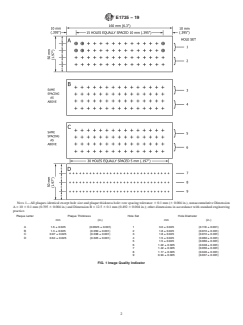
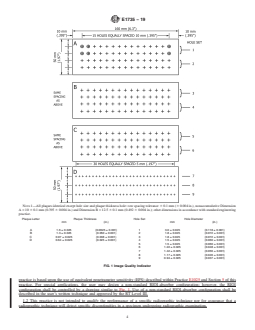
NOTE1—Allplaquesidenticalexceptholesizeandplaquethicknesshole:rowspacingtolerance 60.1mm(60.004in.),nonaccumulativeDimension
A=10 60.1mm(0.395 60.004in.)andDimensionB=12.5 60.1mm(0.492 60.004in.);otherdimensionsinaccordancewithstandardengineering
practice.
Plaque Letter Plaque Thickness Hole Set Hole Diameter
mm (in.) mm (in.)
A 1.6 ± 0.025 (0.0625 ± 0.001) 1 3.0 ± 0.025 (0.118 ± 0.001)
B 1.3 ± 0.025 (0.050 ± 0.001) 2 1.8 ± 0.025 (0.072 ± 0.001)
C 0.97 ± 0.025 (0.038 ± 0.001) 3 1.8 ± 0.025 (0.072 ± 0.001)
D 0.64 ± 0.025 (0.025 ± 0.001) 4 1.5 ± 0.025 (0.060 ± 0.001)
5 1.5 ± 0.025 (0.060 ± 0.001)
6 1.22 ± 0.025 (0.048 ± 0.001)
7 1.42 ± 0.025 (0.056 ± 0.001)
8 1.17 ± 0.025 (0.046 ± 0.001)
9 0.94 ± 0.025 (0.037 ± 0.001)
FIG. 1 Image Quality Indicator
E1735 − 19
2.2 ISO Standards: the basic RIQR arrangement of Fig. 1 might be utilized to
ISO 5-2Photography Density Measurements-Part 2: Geo- perform specialized assessments of relative image quality
metric Conditions for Transmission Density
performance. For example, other radiographic variables can be
ISO 17636 Non-destructive Testing of Welds—
altered to facilitate evaluations provided these differences are
Radiographic Testing—Part 2: X- and Gamma-Ray Tech-
known and documented for both processes. Where multiple
niques With Digital Detectors
radiographic process variables are evaluated, it is incumbent
upon the user of this practice to control those normal process
3. Terminology
attributes to the degree suitable for the application. RIQR may
3.1 Definitions—The definitions of terms relating to gamma
also be useful in evaluating imaging systems with alternate
and X-radiology in Terminology E1316 shall apply to terms
materials (RIQI and base plate). When using any of these
used in this practice.
specialized applications, the specific method or techniques
used shall be as specified and approved by the RT Level III.
3.2 Definitions of Terms Specific to This Standard:
3.2.1 detector, n—an imaging device used to store a radio-
graphic latent image or directly convert ionizing radiation into 5. Relative Image Quality Indicator
electrical signals in proportion to the quantity of radiation
5.1 Fig. 1 illustrates a relative image quality indicator
absorbed(thatis,film,imagingplate,ordigitaldetectorarray).
(RIQI)thathasfourdifferentplaquethicknesses(1.6,1.3,0.97,
3.2.2 cassette, n—a device that is either flexible or rigid
and 0.64 mm (0.063, 0.050, 0.038, and 0.025 in.)) sequentially
used to hold or protect a detector.
positioned (from top to bottom) on an absorber plate of carbon
3.2.3 relative image quality indicator (RIQI), n—an image
steel or Type 300 stainless steel with a thickness of 15cm
quality measuring device that is capable of determining mean-
(6in.). The four plaques contain a total of 9 different arrays of
ingful differences between two or more radiographic imaging
penetrameter-type hole sizes designed to render varied condi-
systems or changes of individual components of radiographic
tions of threshold visibility when exposed to the appropriate
imaging systems.
radiation.Each“EPS”arrayconsistsof30identicalholes,thus
providing the user with a quantity of threshold sensitivity
4. Significance and Use
levels suitable for relative image qualitative response compari-
4.1 This standard provides a practice for determining the
sons.
relative image quality response of a radiographic detector
5.2 The materials for the RIQI and absorber should be the
(film, CR imaging plate, or DDA) when exposed to 4 to
same. For metals, use the same alloy and heat treat family.
25MeV X-rays as any single component of the total X-ray
Whensituationsarisewhichprecludetheuseofsameor“like”
system (for example, screens) is varied.
materials (that is, excessive material grain variation affecting
4.2 The practice is not intended to be used to compare two
testresults),alternateabsorbermaterialsmaybeused,provided
different systems or imaging types.
the alternate material and thickness produces the same optical
4.3 The approach uses RIQR evaluations of film and non-
density (film) or pixel value (PV) (for CR/DDA) as the like
film imaging systems when exposed through an absorber
material of the thickness used to calculate the EPS.
material.Three alternate data evaluation methods are provided
5.3 The RIQI steps, identified as plaques A-D, may be
in Section 8. Determining RIQR requires the comparison of at
fabricated as a single multi-step unit or separately and taped
least two radiographs or radiographic processes whereby the
together to form the penetrameter type hole arrays shown in
relative degree of image quality difference may be determined
Fig. 1. If tape is used, the tape shall not cover or interfere with
usingtheEPSplaquearrangementofFig.1asarelativeimage
any of the holes in the RIQI.All dimensions of the RIQI shall
quality indicator (RIQI). In conjunction with the RIQI, a
conformtoFig.1.ThesurfacefinishoftheIQItopandbottom
specifiedradiographictechniqueormethodmustbeestablished
and carefully controlled for each radiographic process. This surfaces shall be a maximum of 6.3µm (250µin.) R ground
a
practice is designed to allow the determination of subtle finish.
changes in EPS that may arise to radiographic imaging system
5.4 The RIQI shown in Fig. 1 consists of 9 groups of 30
performance levels resultant from process improvements/
holes where all hole diameters are the same for each array.
changes,techniquechanges,orchangeofequipmentattributes.
Hole diameters are based upon a “multiple” of each respective
This practice does not address relative unsharpness of a
step thickness; therefore, each group of 30 holes has a unique
radiographic imaging system as provided in Practice E2002.
“equivalent” penetrameter sensitivity (EPS) as defined by the
The common element with any relative comparison is the use
following relationship (Practice E1025):
of the same RIQI arrangement for both processes under
evaluation.
100 Th
EPS,%2 3Π(1)
X 2
4.4 In addition to the standard evaluation method described
in Section 8, there may be other techniques/methods in which
where:
h = hole diameter, mm,
Available from International Organization for Standardization (ISO), ISO
T = step thickness of IQI, mm, and
Central Secretariat, BIBC II, Chemin de Blandonnet 8, CP 401, 1214 Vernier,
X = thickness of test object, mm.
Geneva, Switzerland, http://www.iso.org.
E1735 − 19
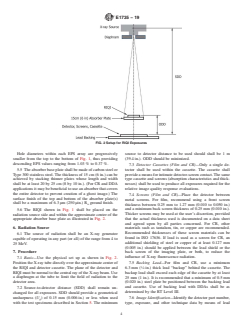
FIG. 2 Setup for RIQI Exposures
Hole diameters within each EPS array are progressively source to detector distance to be used should shall be 1 m
smaller from the top to the bottom of Fig. 1, thus providing (39.4in.). ODD should be minimized.
descending EPS values ranging from 1.03 % to 0.37 %.
7.3 Detector Cassettes (Film and CR)—Only a single de-
tector shall be used within the cassette. The cassette shall
5.5 Theabsorberbaseplateshallbemadeofcarbonsteelor
Type 300 stainless steel. The thickness of 15 cm (6 in.) can be provideameansforintimatedetector-screencontact.Thesame
...
This document is not an ASTM standard and is intended only to provide the user of an ASTM standard an indication of what changes have been made to the previous version. Because
it may not be technically possible to adequately depict all changes accurately, ASTM recommends that users consult prior editions as appropriate. In all cases only the current version
of the standard as published by ASTM is to be considered the official document.
Designation: E1735 − 07 (Reapproved 2014) E1735 − 19
Standard Test Method Practice for
Determining Relative Image Quality Response of Industrial
Radiographic Film Exposed to X-Radiation Imaging Systems
from 4 to 25 MeV
This standard is issued under the fixed designation E1735; the number immediately following the designation indicates the year of
original adoption or, in the case of revision, the year of last revision. A number in parentheses indicates the year of last reapproval. A
superscript epsilon (´) indicates an editorial change since the last revision or reapproval.
1. Scope
1.1 This test method covers determination of the relative image quality response of industrial radiographic film when exposed
to X-radiation sources having photon energies from 4 to 25 MeV. Evaluation of the film is based on the visibility of holes in a
special image quality indicator (IQI). Since results for a given film type may vary, depending on the particular processing system
and processing conditions used, it is essential to state the exposure parameters and achieved density, processing chemistry,
processing cycle, and processing temperature. For the purposes of this test method, it is assumed that all components of the X-ray
system are operating properly and are capable of producing a given image quality. This test method is not intended to be used for
films exposed with Cobalt 60 sources or X-ray sources below 4 MeV.
1.2 The values stated in either SI or inch-pound units are to be regarded as the standard. The values given in parentheses are
for information only.
1.3 This standard does not purport to address all of the safety concerns, if any, associated with its use. It is the responsibility
of the user of this standard to establish appropriate safety and health practices and determine the applicability of regulatory
limitations prior to use.
2. Referenced Documents
2.1 ASTM Standards:
E999 Guide for Controlling the Quality of Industrial Radiographic Film Processing
E1025 Practice for Design, Manufacture, and Material Grouping Classification of Hole-Type Image Quality Indicators (IQI)
Used for Radiography
E1079 Practice for Calibration of Transmission Densitometers
E1316 Terminology for Nondestructive Examinations
E1815 Test Method for Classification of Film Systems for Industrial Radiography
3. Terminology
3.1 Definitions—Definitions of terms relating to gamma and X-radiology are found in Terminology E1316.
4. Significance and Use
4.1 This test method provides a test for determining the relative image quality response of radiographic film when exposed to
4 to 25 MeV X rays as any single component of the total X-ray system (for example, screens) is varied. By holding the technique
parameters (except exposure time) and processing parameters constant, the image quality response of radiographic film may be
evaluated on a relative basis.
4.2 Alternately, this test method provides a test for measuring the image quality of the X-ray system or any component of the
system.
5. Test Specimen
5.1 The test specimen will consist of a 15-cm (6-in.) steel absorber with a special IQI placed on the radiation (source) side of
the absorber.
This test method practice is under the jurisdiction of ASTM Committee E07 on Nondestructive Testing and is the direct responsibility of Subcommittee E07.01 on
Radiology (X and Gamma) Method.
Current edition approved June 1, 2014Dec. 1, 2019. Published July 2014January 2020. Originally approved in 1995. Last previous edition approved in 20072014 as
E1735 - 07.E1735 – 07(2014). DOI: 10.1520/E1735-07R14.10.1520/E1735-19.
Copyright © ASTM International, 100 Barr Harbor Drive, PO Box C700, West Conshohocken, PA 19428-2959. United States
E1735 − 19
5.1.1 Absorber—The absorber shall be made of carbon steel or Type 300 stainless steel. The thickness of 15 cm (6 in.) can be
achieved by stacking thinner plates whose length and width shall be at least 20 by 25 cm (8 by 10 in.). The surface finish of the
top and bottom of the absorber shall be a maximum of 6.3-μm (250-μin.) R ground finish.
a
5.1.2 Image Quality Indicator—The IQI shall be fabricated of carbon steel or Type 300 stainless steel and shall conform to Fig.
1. The IQI steps, identified as Plaques A-D, may be fabricated separately and then taped together, as shown in Fig. 1, using suitable
tape to form the array as shown. The tape shall not cover any of the holes in the IQI. The surface finish of the IQI top and bottom
surfaces shall be a maximum of 6.3-μm (250-μin.) R ground finish.
a
6. Radiation Source
6.1 The source of radiation shall be an X-ray generator capable of operating in any part (or all) of the range from 4 to 25 MeV.
7. Film Holder and Screens
7.1 Film Holder—The film holder shall be a medical-type, hard-backed cassette or a flexible film holder with a vacuum or
mechanical means for providing good film-screen contact.
7.2 Screens—Lead foil screens with a front thickness of 0.010 to 0.050 in. (0.25 mm to 1.27 mm) and back thickness of 0.010
in., minimum, shall be used. Thicker screens may be used at the user’s discretion, provided that the actual thickness used is
documented on the data sheet (Fig. 2) and agreed upon by all parties concerned.
8. Test Procedure
8.1 Source to Film Distance—The source to film distance is based on achieving a geometrical unsharpness (U ) of 0.15 mm
g
(0.006 in.) or less when used with the test specimens described in Section 5. The minimum source to film distance to be used shall
be 1 m (39.4 in.).
8.2 Film/Test Specimen: Source Relationship and Film Placement—The plane of the film and test specimen shall be normal to
the central ray of the radiation source. Collimate the source so as to limit the radiation source to the film. Place the film
holder/cassette opposite the source side and in contact with the absorber.
8.3 Film Identification—Identify the film number and source energy used by means of lead numbers and letters placed on the
corner of the plate so as not to interfere with the images of the holes in the IQI. Note that the letters and numbers will be magnified
when placed on the source side of the absorber.
8.4 Exposure—Adjust the exposure time to provide a film density of 2.00 6 0.1 in the center of the film, as measured with a
densitometer calibrated in accordance with Practice E1079. Make three exposures using the same film holder/cassette in
accordance with 7.1.
8.5 Film Processing—In order to minimize any effects caused by the latent image instability, process the exposed film not more
than 4 hours after exposure. Either manual or automatic processing may be used, in accordance with Guide E999 and as follows:
8.5.1 Automatic Processing—Use industrial X-ray film automatic processing solutions. Maintain a record on the data sheet of
the following:
8.5.1.1 The brand name and type of processor;
8.5.1.2 The length of time (61 s) that the film is in the developer, that is, leading edge in to leading edge out;
8.5.1.3 The brand name of the processing chemicals, including the starter, processing temperature to within 0.5°C, and
replenishment rate; and
8.5.1.4 The total quantity of film used in seasoning fresh developer solutions. With fresh developer solutions, process a
minimum of ten films (360 by 430 mm (14 by 17 in.))/gal of developer. Each film should be half-flashed to a density of 4.0 or
greater using white light or, alternatively, fully flash alternate sheets.
8.5.2 Manual Processing—Use industrial X-ray film processing solutions in the tests. Maintain a record on the data sheet of the
following:
8.5.2.1 The time of development (6 2 s);
8.5.2.2 The temperature of the developer within 0.5°C;
8.5.2.3 The total quantity of films used in seasoning fresh developer solutions. With fresh developer solutions, process a
minimum of ten films (360 by 430 mm (14 by 17 in.))/gal of developer. Each film should be half-flashed to a density of 4.0 or
greater using white light or, alternatively, fully flash alternate sheets;
8.5.2.4 The replenishment system used; and
8.5.2.5 The brand name of the processing chemicals.
8.5.3 Dry Processing—Use the manufacturer’s recommended processing procedures. Maintain a record on the data sheet of the
following:
8.5.3.1 The brand name of the processor; and
8.5.3.2 The length of time that the film is in the processor, that is, leading edge in to leading edge out.
E1735 − 19
9. Data Collection and Evaluation
9.1 The three test films for any one film type should be read independently by three readers. Each reader shall record the number
of holes of a given size visible at each step of the IQI. A magnifier up to 3× is permitted for viewing the film. A sample data sheet
is shown in Fig. 2.
9.2 The data are evaluated by averaging the number of holes of a given size (hole set) visible on each plaque image of the IQI
for each film type. This average is based on the evaluation of three readers of three radiographs for each film type. This averaging
procedure is repeated for each film type and is a measure of the relative image quality response of a given film type.
9.2.1 The relative image quality response for different film types is illustrated in Table 1. The visibility index shown in Table
1 is the sum of the total number of holes detected and can be used as a measure of image quality under the conditions employed
and tabulated in accordance with Fig. 2.
9.3 First Alternate (Optional) Method of Evaluation—Each hole set is converted to equivalent image quality sensitivity (EPS),
as prescribed in the Appendix of Practice E1025. Plot the number of visible holes after averaging versus the EPS values for each
hole set. This gives a set of points on a graph through which a continuous smooth curve is drawn. The image quality response is
determined at the point where 50 % of the holes are visible. This value is the classification index for the film under testing. Fig.
3 is an idealized illustration of this curve plotting method.
9.4 Second Alternate (Optional) Method of Evaluation:
9.4.1 In addition to the two methods previously described, the classification index may be calculated mathematically between
two adjacent hole sets by interpolating between the EPS values of the hole set with more than 15 visible holes and the set with
less than 15 visible holes by use of the following formula:
15 2 N Q 2 Q
~ !~ !
b a b
C 5 Q 1 (1)
b
N 2 N
a b
where:
C = classification index (the midpoint or 50 % point on the graph in 9.3),
N = total number of visible holes in the hole set immediately above the midpoint, and Q = corresponding EPS value, and
a a
N = total number of visible holes in the hole set immediately below the midpoint, and Q = corresponding EPS value.
b b
9.4.2 The following example is given for illustration. A set having 23 visible holes has an EPS value of 1.57. An adjacent set
has 12 visible holes and an EPS value of 1.49. Inserting these values into the formula yields the following:
15 2 12 1.57 2 1.49
~ ! ~ !
C 5 1.491 (2)
23 2 12
C 5 1.51
10. Precision and Bias
10.1 No statement is made about the precision and bias for indicating the quality of radiographs since the results state merely
whether there is conformance to the criteria for success specified in this test method.
11. Keywords
11.1 EPS; film; IQI; radiation; radiographic; X-ray
ASTM International takes no position respecting the validity of any patent rights asserted in connection with any item mentioned
in this standard. Users of this standard are expressly advised that determination of the validity of any such patent rights, and the risk
of infringement of such rights, are entirely their own responsibility.
This standard is subject to revision at any time by the responsible technical committee and must be reviewed every five years and
if not revised, either reapproved or withdrawn. Your comments are invited either for revision of this standard or for additional standards
and should be addressed to ASTM International Headquarters. Your comments will receive careful consideration at a meeting of the
responsible technical committee, which you may attend. If you feel that your comments have not received a fair hearing you should
make your views known to the ASTM Committee on Standards, at the address shown below.
This standard is copyrighted by ASTM International, 100 Barr Harbor Drive, PO Box C700, West Conshohocken, PA 19428-2959,
United States. Individual reprints (single or multiple copies) of this standard may be obtained by contacting ASTM at the above
address or at 610-832-9585 (phone), 610-832-9555 (fax), or service@astm.org (e-mail); or through the ASTM website
(www.astm.org). Permission rights to photocopy the standard may also be secured from the Copyright Clearance Center, 222
Rosewood Drive, Danvers, MA 01923, Tel: (978) 646-2600; http://www.copyright.com/
1. Scope
1.1 This standard provides a practice whereby industrial radiographic imaging systems or specific factors that affect image
quality (that is, hardware, techniques, etc.) may be comparatively assessed using the concept of relative image quality response
(RIQR) when exposed to X-radiation sources having photon energies from 4 to 25 MeV. The RIQR method presented within this
E1735 − 19
NOTE 1—All plaques identical except hole size and plaque thickness hole: row spacing tolerance 6 0.1 mm (6 0.004 in.), nonaccumulative Dimension
A = 10 6 0.1 mm (0.395 6 0.004 in.) and Dimension B = 12.5 6 0.1 mm (0.492 6 0.004 in.); other dimensions in accordance with standard engineering
practice.
Plaque Letter Plaque Thickness Hole Set Hole Diameter
mm (in.) mm (in.)
A 1.6 ± 0.025 (0.0625 ± 0.001) 1 3.0 ± 0.025 (0.118 ± 0.001)
B 1.3 ± 0.025 (0.050 ± 0.001) 2 1.8 ± 0.025 (0.072 ± 0.001)
C 0.97 ± 0.025 (0.038 ± 0.001) 3 1.8 ± 0.025 (0.072 ± 0.001)
D 0.64 ± 0.025 (0.025 ± 0.001) 4 1.5 ± 0.025 (0.060 ± 0.001)
5 1.5 ± 0.025 (0.060 ± 0.001)
6 1.22 ± 0.025 (0.048 ± 0.001)
7 1.42 ± 0.025 (0.056 ± 0.001)
8 1.17 ± 0.025 (0.046 ± 0.001)
9 0.94 ± 0.025 (0.037 ± 0.001)
FIG. 1 Image Quality Indicator
practice is based upon the use of equivalent penetrameter sensitivity (EPS) described within Practice E1025 and Section 5 of this
practice. For special applications, the user may design a non-standard RIQI-absorber configuration; however, the RIQI
configuration shall be controlled by a drawing similar to Fig. 1. Use of a non-standard RIQI-absorber configuration shall be
described in the user’s written technique and approved by the RT Level III.
1.2 This practice is not intended to qualify the performance of a specific radiographic technique nor for assurance that a
radiographic technique will detect specific discontinuities in a specimen undergoing radiographic examination.
E1735 − 19
1.3 This practice is not intended to be used to classify or derive performance classification categories for radiographic imaging
systems. For example, performance classifications of radiographic film systems may be found within Test Method E1815,
manufacturer characterization of computed radiography (CR) systems may be found in Practice E2446, and manufacturer
characterization of digital Detector Array (DDA) systems may be found in Practice E2597.
1.4 This standard is not intended to be used with Cobalt 60 sources or X-ray sources below 4 MeV. For low energy X-ray
applications (below 4 MeV), Test Method E746 provides a similar RIQR standard practice.
1.5 The values stated in either SI or inch-pound units are to be regarded as the standard. The values given in parentheses are
for information only.
1.6 This standard does not purport to address all of the safety concerns, if any, associated with its use. It is the responsibility
of the user of this standard to establish appropriate safety, health, and environmental practices and determine the applicability of
regulatory limitations prior to use.
1.7 This international standard was developed in accordance with internationally recognized principles on standardization
established in the Decision on Principles for the Development of International Standards, Guides and Recommendations issued
by the World Trade Organization Technical Barriers to Trade (TBT) Committee.
2. Referenced Documents
2.1 ASTM Standards:
E746 Practice for Determining Relative Image Quality Response of Industrial Radiographic Imaging Systems
E999 Guide for Controlling the Quality of Industrial Radiographic Film Processing
E1025 Practice for Design, Manufacture, and Material Grouping Classification of Hole-Type Image Quality Indicators (IQI)
Used for Radiography
E1079 Practice for Calibration of Transmission Densitometers
E1316 Terminology for Nondestructive Examinations
E1815 Test Method for Classification of Film Systems for Industrial Radiography
E2002 Practice for Determining Total Image Unsharpness and Basic Spatial Resolution in Radiography and Radioscopy
E2033 Practice for Radiographic Examination Using Computed Radiography (Photostimulable Luminescence Method)
E2446 Practice for Manufacturing Characterization of Computed Radiography Systems
E2597 Practice for Manufacturing Characterization of Digital Detector Arrays
E2698 Practice for Radiographic Examination Using Digital Detector Arrays
2.2 ISO Standards:
ISO 5-2 Photography Density Measurements-Part 2: Geometric Conditions for Transmission Density
ISO 17636 Non-destructive Testing of Welds—Radiographic Testing—Part 2: X- and Gamma-Ray Techniques With Digital
Detectors
3. Terminology
3.1 Definitions—The definitions of terms relating to gamma and X-radiology in Terminology E1316 shall apply to terms used
in this practice.
3.2 Definitions of Terms Specific to This Standard:
3.2.1 detector, n—an imaging device used to store a radiographic latent image or directly convert ionizing radiation into
electrical signals in proportion to the quantity of radiation absorbed (that is, film, imaging plate, or digital detector array).
3.2.2 cassette, n—a device that is either flexible or rigid used to hold or protect a detector.
3.2.3 relative
...