

ASTM E2445/E2445M-20
(Practice)Standard Practice for Performance Evaluation and Long-Term Stability of Computed Radiography Systems
General Information
- Abstract
SIGNIFICANCE AND USE
4.1 This practice is intended to be used by the NDT using organization to measure baseline performance of the CR system and to monitor its performance throughout its service as an NDT imaging system. For purposes of this document, the CR System is defined as:
4.1.1 Storage phosphor imaging plate (IP) type and manufacturer,
4.1.2 Read out unit (scanner or reader) manufacturer and model, including applicable scanner settings (for example, sampling resolution, PMT gain, pixel value (PV) look up table, etc.),
4.1.3 Image acquisition and processing software, and
4.1.4 Image display monitor.
4.2 It is to be understood that the CR system has already been selected and purchased by the user from a manufacturer based on the inspection needs at hand. The user shall accept the CR scanner based on manufacturer’s results of Practice E2446 on the specific CR scanner as provided in a data sheet for that serialized CR scanner or other acceptance test agreed to between the user and manufacturer (not covered in this practice). This practice is not intended to be used as an “acceptance test” of the CR system, but rather to establish a performance baseline that will enable tracking while in-service.
4.3 Although many of the properties listed in this standard have similar metrics to those found in Practice E2446, data collection methods are not identical, and comparisons among values acquired with each standard should not be made.
4.4 This practice defines the tests to be performed and required intervals. Also defined are the methods of tabulating results that CR users will complete following the baseline of the CR system. These tests will also be performed periodically at the stated required intervals to evaluate the CR system to determine if the system remains within acceptable operational limits as established in this practice.
4.5 There are several factors that affect the image quality of a CR image. Factors which are dependent on the CR system performance inc...
SCOPE
1.1 This practice describes the evaluation of Computed Radiography (CR) systems for industrial radiography. It is intended to ensure that the evaluation of image quality, as far as this is influenced by the CR system, meets the needs of users of this standard, and their customers, and enables process control and long-term stability of the CR system.
1.2 This practice specifies the fundamental parameters of CR systems to be measured to determine baseline performance, and to track the long term stability of the system. These tests are for applications up to 320 kV. When greater than 320 kV or when a gamma source is used, these tests may still be used to characterize a system, but may need to be modified as agreed between the user and cognizant engineering organization (CEO).
1.3 The CR system performance tests specified in this practice shall be completed upon acceptance of the system from the manufacturer and at intervals specified in this practice to monitor long term stability of the system. The intent of these tests is to monitor the system performance degradation and to identify when an action needs to be taken when the system degrades by a certain level.
1.4 The use of gauges provided in this standard is mandatory for each test. In the event these tests or gauges are not sufficient, the user, in coordination with the CEO shall develop additional or modified tests, test objects, gauges, or image quality indicators to evaluate the CR system. Acceptance levels for these ALTERNATE tests shall be determined by agreement between the user and CEO.
1.5 Units—The values stated in either SI units or inch-pound units are to be regarded separately as standard. The values stated in each system are not necessarily exact equivalents; therefore, to ensure conformance with the standard, each system shall be used independently of the other, and values from the two systems shall not be combined.
1.6 This standard does no...
- Status
- Published
- Publication Date
- 14-Jun-2020
- Technical Committee
- E07 - Nondestructive Testing
- Drafting Committee
- E07.01 - Radiography (X and Gamma) Method
Buy Documents
ASTM E2445/E2445M-20 - Standard Practice for Performance Evaluation and Long-Term Stability of Computed Radiography Systems
REDLINE ASTM E2445/E2445M-20 - Standard Practice for Performance Evaluation and Long-Term Stability of Computed Radiography Systems
Overview
ASTM E2445/E2445M-20: Standard Practice for Performance Evaluation and Long-Term Stability of Computed Radiography Systems provides practical guidance for users of Computed Radiography (CR) systems in industrial radiography. Developed by ASTM International, this standard establishes robust methods for measuring the baseline and ongoing performance of CR systems. The focus is on ensuring image quality and long-term stability as required for nondestructive testing (NDT) processes.
ASTM E2445/E2445M-20 is not an equipment acceptance standard, but is meant to guide organizations in monitoring CR system performance throughout its service life. The practice is applicable to systems used up to 320 kV, or higher/gamma sources with agreed modifications.
Key Topics
- Baseline Performance Evaluation:
Establishes methods to benchmark CR system quality at the start of service life, focusing on critical components such as imaging plates, scanners, acquisition software, and display monitors. - Long-Term Stability Monitoring:
Specifies periodic tests and criteria to detect system degradation over time, supporting consistent NDT image quality. - Performance Metrics:
Includes tests for contrast sensitivity, spatial resolution, geometric distortion, noise, laser jitter, and process artifacts, ensuring comprehensive image quality assessment. - Testing Intervals & Reporting:
Outlines test intervals (at least quarterly) and mandatory documentation of test results for process control and traceability. - Test Apparatus and Indicators:
Utilizes standardized phantoms and image quality indicators (IQIs) for consistent evaluation across different systems and configurations. - Supplemental and Custom Tests:
Allows for the development of additional or modified tests (with engineering oversight) when standard methods may not suffice.
Applications
- Nondestructive Testing (NDT):
Ensures that computed radiography systems used in industrial NDT applications deliver reliable and repeatable image quality, critical for inspection and quality control in aerospace, automotive, energy, construction, and manufacturing sectors. - Process Control:
Enables organizations to monitor CR systems, detect trends in performance changes, and address issues before they affect inspection reliability. - Regulatory & Customer Compliance:
Provides objective evidence of CR system performance, supporting auditing, certification, and meeting customer or regulatory requirements in quality-sensitive industries. - Lifecycle Management:
Supports decision-making on equipment maintenance, upgrades, or replacement by quantifying system performance over time. - Adaptation to Changing Needs:
Facilitates the introduction of new CR hardware or software by establishing updated baselines, ensuring continued compliance with internal or contractual standards.
Related Standards
For a comprehensive quality assurance program in computed radiography, reference the following ASTM standards:
- ASTM E746: Practice for Determining Relative Image Quality Response of Industrial Radiographic Imaging Systems
- ASTM E1316: Terminology for Nondestructive Examinations
- ASTM E1647: Practice for Determining Contrast Sensitivity in Radiology
- ASTM E2002: Practice for Determining Total Image Unsharpness and Basic Spatial Resolution in Radiography and Radioscopy
- ASTM E2007: Guide for Computed Radiography
- ASTM E2033: Practice for Radiographic Examination Using Computed Radiography (Photostimulable Luminescence Method)
- ASTM E2446: Practice for Manufacturing Characterization of Computed Radiography Systems
Practical Value
Implementing ASTM E2445/E2445M-20 ensures that industrial computed radiography systems are consistently performing at optimal levels, reducing the risk of undetected defects, increasing reliability of NDT inspections, and supporting traceable, documented process control. This standard is a vital tool for NDT professionals, quality managers, and service providers invested in sustaining high standards of radiographic imaging and operational excellence.
Relations
- Effective Date
- 01-Feb-2024
- Effective Date
- 01-Dec-2023
- Effective Date
- 01-Dec-2019
- Effective Date
- 01-Mar-2019
- Effective Date
- 01-Feb-2018
- Effective Date
- 01-Jan-2018
- Effective Date
- 01-Nov-2017
- Effective Date
- 15-Jun-2017
- Effective Date
- 01-Feb-2017
- Effective Date
- 01-Aug-2016
- Effective Date
- 01-Feb-2016
- Effective Date
- 01-Dec-2015
- Effective Date
- 01-Sep-2015
- Effective Date
- 01-Jul-2014
- Effective Date
- 01-Jun-2014
Buy Documents
ASTM E2445/E2445M-20 - Standard Practice for Performance Evaluation and Long-Term Stability of Computed Radiography Systems
REDLINE ASTM E2445/E2445M-20 - Standard Practice for Performance Evaluation and Long-Term Stability of Computed Radiography Systems
Get Certified
Connect with accredited certification bodies for this standard

IMP NDT d.o.o.
Non-destructive testing services. Radiography, ultrasonic, magnetic particle, penetrant, visual inspection.
Inštitut za kovinske materiale in tehnologije
Institute of Metals and Technology. Materials testing, metallurgical analysis, NDT.
Q Techna d.o.o.
NDT and quality assurance specialist. 30+ years experience. NDT personnel certification per ISO 9712, nuclear and thermal power plant inspections, QA/
Sponsored listings
Frequently Asked Questions
ASTM E2445/E2445M-20 is a standard published by ASTM International. Its full title is "Standard Practice for Performance Evaluation and Long-Term Stability of Computed Radiography Systems". This standard covers: SIGNIFICANCE AND USE 4.1 This practice is intended to be used by the NDT using organization to measure baseline performance of the CR system and to monitor its performance throughout its service as an NDT imaging system. For purposes of this document, the CR System is defined as: 4.1.1 Storage phosphor imaging plate (IP) type and manufacturer, 4.1.2 Read out unit (scanner or reader) manufacturer and model, including applicable scanner settings (for example, sampling resolution, PMT gain, pixel value (PV) look up table, etc.), 4.1.3 Image acquisition and processing software, and 4.1.4 Image display monitor. 4.2 It is to be understood that the CR system has already been selected and purchased by the user from a manufacturer based on the inspection needs at hand. The user shall accept the CR scanner based on manufacturer’s results of Practice E2446 on the specific CR scanner as provided in a data sheet for that serialized CR scanner or other acceptance test agreed to between the user and manufacturer (not covered in this practice). This practice is not intended to be used as an “acceptance test” of the CR system, but rather to establish a performance baseline that will enable tracking while in-service. 4.3 Although many of the properties listed in this standard have similar metrics to those found in Practice E2446, data collection methods are not identical, and comparisons among values acquired with each standard should not be made. 4.4 This practice defines the tests to be performed and required intervals. Also defined are the methods of tabulating results that CR users will complete following the baseline of the CR system. These tests will also be performed periodically at the stated required intervals to evaluate the CR system to determine if the system remains within acceptable operational limits as established in this practice. 4.5 There are several factors that affect the image quality of a CR image. Factors which are dependent on the CR system performance inc... SCOPE 1.1 This practice describes the evaluation of Computed Radiography (CR) systems for industrial radiography. It is intended to ensure that the evaluation of image quality, as far as this is influenced by the CR system, meets the needs of users of this standard, and their customers, and enables process control and long-term stability of the CR system. 1.2 This practice specifies the fundamental parameters of CR systems to be measured to determine baseline performance, and to track the long term stability of the system. These tests are for applications up to 320 kV. When greater than 320 kV or when a gamma source is used, these tests may still be used to characterize a system, but may need to be modified as agreed between the user and cognizant engineering organization (CEO). 1.3 The CR system performance tests specified in this practice shall be completed upon acceptance of the system from the manufacturer and at intervals specified in this practice to monitor long term stability of the system. The intent of these tests is to monitor the system performance degradation and to identify when an action needs to be taken when the system degrades by a certain level. 1.4 The use of gauges provided in this standard is mandatory for each test. In the event these tests or gauges are not sufficient, the user, in coordination with the CEO shall develop additional or modified tests, test objects, gauges, or image quality indicators to evaluate the CR system. Acceptance levels for these ALTERNATE tests shall be determined by agreement between the user and CEO. 1.5 Units—The values stated in either SI units or inch-pound units are to be regarded separately as standard. The values stated in each system are not necessarily exact equivalents; therefore, to ensure conformance with the standard, each system shall be used independently of the other, and values from the two systems shall not be combined. 1.6 This standard does no...
SIGNIFICANCE AND USE 4.1 This practice is intended to be used by the NDT using organization to measure baseline performance of the CR system and to monitor its performance throughout its service as an NDT imaging system. For purposes of this document, the CR System is defined as: 4.1.1 Storage phosphor imaging plate (IP) type and manufacturer, 4.1.2 Read out unit (scanner or reader) manufacturer and model, including applicable scanner settings (for example, sampling resolution, PMT gain, pixel value (PV) look up table, etc.), 4.1.3 Image acquisition and processing software, and 4.1.4 Image display monitor. 4.2 It is to be understood that the CR system has already been selected and purchased by the user from a manufacturer based on the inspection needs at hand. The user shall accept the CR scanner based on manufacturer’s results of Practice E2446 on the specific CR scanner as provided in a data sheet for that serialized CR scanner or other acceptance test agreed to between the user and manufacturer (not covered in this practice). This practice is not intended to be used as an “acceptance test” of the CR system, but rather to establish a performance baseline that will enable tracking while in-service. 4.3 Although many of the properties listed in this standard have similar metrics to those found in Practice E2446, data collection methods are not identical, and comparisons among values acquired with each standard should not be made. 4.4 This practice defines the tests to be performed and required intervals. Also defined are the methods of tabulating results that CR users will complete following the baseline of the CR system. These tests will also be performed periodically at the stated required intervals to evaluate the CR system to determine if the system remains within acceptable operational limits as established in this practice. 4.5 There are several factors that affect the image quality of a CR image. Factors which are dependent on the CR system performance inc... SCOPE 1.1 This practice describes the evaluation of Computed Radiography (CR) systems for industrial radiography. It is intended to ensure that the evaluation of image quality, as far as this is influenced by the CR system, meets the needs of users of this standard, and their customers, and enables process control and long-term stability of the CR system. 1.2 This practice specifies the fundamental parameters of CR systems to be measured to determine baseline performance, and to track the long term stability of the system. These tests are for applications up to 320 kV. When greater than 320 kV or when a gamma source is used, these tests may still be used to characterize a system, but may need to be modified as agreed between the user and cognizant engineering organization (CEO). 1.3 The CR system performance tests specified in this practice shall be completed upon acceptance of the system from the manufacturer and at intervals specified in this practice to monitor long term stability of the system. The intent of these tests is to monitor the system performance degradation and to identify when an action needs to be taken when the system degrades by a certain level. 1.4 The use of gauges provided in this standard is mandatory for each test. In the event these tests or gauges are not sufficient, the user, in coordination with the CEO shall develop additional or modified tests, test objects, gauges, or image quality indicators to evaluate the CR system. Acceptance levels for these ALTERNATE tests shall be determined by agreement between the user and CEO. 1.5 Units—The values stated in either SI units or inch-pound units are to be regarded separately as standard. The values stated in each system are not necessarily exact equivalents; therefore, to ensure conformance with the standard, each system shall be used independently of the other, and values from the two systems shall not be combined. 1.6 This standard does no...
ASTM E2445/E2445M-20 is classified under the following ICS (International Classification for Standards) categories: 19.100 - Non-destructive testing. The ICS classification helps identify the subject area and facilitates finding related standards.
ASTM E2445/E2445M-20 has the following relationships with other standards: It is inter standard links to ASTM E1316-24, ASTM E746-23, ASTM E1316-19b, ASTM E1316-19, ASTM E746-18, ASTM E1316-18, ASTM E746-17, ASTM E1316-17a, ASTM E1316-17, ASTM E1316-16a, ASTM E1316-16, ASTM E1316-15a, ASTM E1316-15, ASTM E746-07(2014), ASTM E1316-14. Understanding these relationships helps ensure you are using the most current and applicable version of the standard.
ASTM E2445/E2445M-20 is available in PDF format for immediate download after purchase. The document can be added to your cart and obtained through the secure checkout process. Digital delivery ensures instant access to the complete standard document.
Standards Content (Sample)
This international standard was developed in accordance with internationally recognized principles on standardization established in the Decision on Principles for the
Development of International Standards, Guides and Recommendations issued by the World Trade Organization Technical Barriers to Trade (TBT) Committee.
Designation: E2445/E2445M − 20
Standard Practice for
Performance Evaluation and Long-Term Stability of
Computed Radiography Systems
ThisstandardisissuedunderthefixeddesignationE2445/E2445M;thenumberimmediatelyfollowingthedesignationindicatestheyear
of original adoption or, in the case of revision, the year of last revision.Anumber in parentheses indicates the year of last reapproval.
A superscript epsilon (´) indicates an editorial change since the last revision or reapproval.
1. Scope 1.6 This standard does not purport to address all of the
safety concerns, if any, associated with its use. It is the
1.1 This practice describes the evaluation of Computed
responsibility of the user of this standard to establish appro-
Radiography (CR) systems for industrial radiography. It is
priate safety, health, and environmental practices and deter-
intended to ensure that the evaluation of image quality, as far
mine the applicability of regulatory limitations prior to use.
asthisisinfluencedbytheCRsystem,meetstheneedsofusers
1.7 This international standard was developed in accor-
of this standard, and their customers, and enables process
dance with internationally recognized principles on standard-
control and long-term stability of the CR system.
ization established in the Decision on Principles for the
1.2 This practice specifies the fundamental parameters of
Development of International Standards, Guides and Recom-
CRsystemstobemeasuredtodeterminebaselineperformance,
mendations issued by the World Trade Organization Technical
and to track the long term stability of the system. These tests
Barriers to Trade (TBT) Committee.
areforapplicationsupto320kV.Whengreaterthan320kVor
when a gamma source is used, these tests may still be used to 2. Referenced Documents
characterize a system, but may need to be modified as agreed
2.1 ASTM Standards:
between the user and cognizant engineering organization
E746Practice for Determining Relative Image Quality Re-
(CEO).
sponse of Industrial Radiographic Imaging Systems
1.3 The CR system performance tests specified in this E1316Terminology for Nondestructive Examinations
E1647Practice for Determining Contrast Sensitivity in Ra-
practice shall be completed upon acceptance of the system
fromthemanufacturerandatintervalsspecifiedinthispractice diology
E2002Practice for Determining Total Image Unsharpness
tomonitorlongtermstabilityofthesystem.Theintentofthese
tests is to monitor the system performance degradation and to and Basic Spatial Resolution in Radiography and Radios-
identify when an action needs to be taken when the system copy
E2007Guide for Computed Radiography
degrades by a certain level.
E2033Practice for Radiographic Examination Using Com-
1.4 The use of gauges provided in this standard is manda-
puted Radiography (Photostimulable Luminescence
tory for each test. In the event these tests or gauges are not
Method)
sufficient,theuser,incoordinationwiththeCEOshalldevelop
E2446Practice for Manufacturing Characterization of Com-
additional or modified tests, test objects, gauges, or image
puted Radiography Systems
qualityindicatorstoevaluatetheCRsystem.Acceptancelevels
for theseALTERNATE tests shall be determined by agreement
3. Terminology
between the user and CEO.
3.1 Definitions—The definition of terms relating to gamma-
1.5 Units—The values stated in either SI units or inch-
and X-radiology, which appear in Terminology E1316, Guide
pound units are to be regarded separately as standard. The
E2007,andPracticeE2033shallapplytothetermsusedinthis
values stated in each system are not necessarily exact equiva-
practice.
lents; therefore, to ensure conformance with the standard, each
3.2 Definitions of Terms Specific to This Standard:
system shall be used independently of the other, and values
3.2.1 aliasing, n—artifactsthatappearinanimagewhenthe
from the two systems shall not be combined.
spatial frequency of the input is higher than the output is
capable of reproducing.
This practice is under the jurisdiction of ASTM Committee E07 on Nonde-
structive Testing and is the direct responsibility of Subcommittee E07.01 on
Radiology (X and Gamma) Method. For referenced ASTM standards, visit the ASTM website, www.astm.org, or
Current edition approved June 15, 2020. Published July 2020. Originally contact ASTM Customer Service at service@astm.org. For Annual Book of ASTM
approved in 2005. Last previous edition approved in 2014 as E2445/E2445M–14. Standards volume information, refer to the standard’s Document Summary page on
DOI:10.1520/E2445_E2445M-20. the ASTM website.
Copyright © ASTM International, 100 Barr Harbor Drive, PO Box C700, West Conshohocken, PA 19428-2959. United States
E2445/E2445M − 20
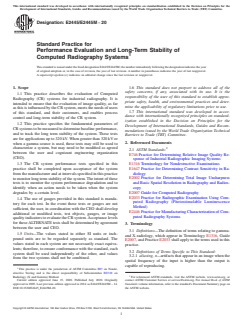
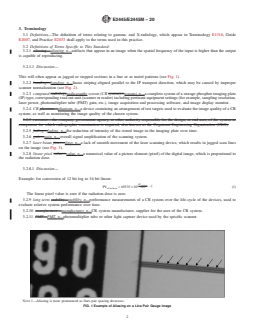
3.2.1.1 Discussion—This will often appear as jagged or 3.2.11 PMT, n—photomultiplier tube or other light capture
stepped sections in a line or as moiré patterns (see Fig. 1). device used by the specific scanner.
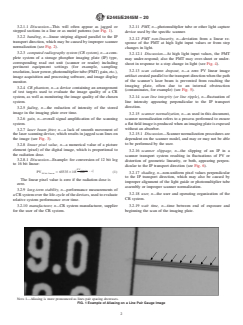
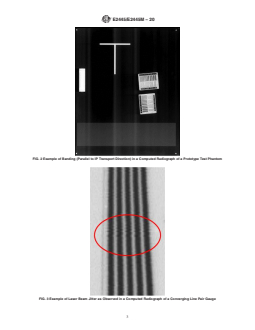
3.2.2 banding, n—linear striping aligned parallel to the IP
3.2.12 PMT non-linearity, n—deviation from a linear re-
transport direction, which may be caused by improper scanner
sponse of the PMT at high light input values or from step
normalization (see Fig. 2).
changes in light.
3.2.3 computed radiography system (CR system), n—acom-
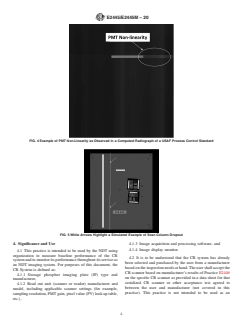
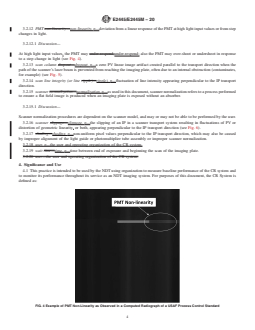
3.2.12.1 Discussion—At high light input values, the PMT
plete system of a storage phosphor imaging plate (IP) type,
may under-respond; also the PMT may over-shoot or under-
corresponding read out unit (scanner or reader) including
shoot in response to a step change in light (see Fig. 4).
pertinent equipment settings (for example, sampling
3.2.13 scan column dropout, n—a zero PV linear image
resolution,laserpower,photomultipliertube(PMT)gain,etc.),
artifactcreatedparalleltothetransportdirectionwhenthepath
image acquisition and processing software, and image display
of the scanner’s laser beam is prevented from reaching the
monitor.
imaging plate, often due to an internal obstruction
3.2.4 CR phantom, n—a device containing an arrangement
(contaminates, for example) (see Fig. 5).
of test targets used to evaluate the image quality of a CR
system, as well as monitoring the image quality of the chosen 3.2.14 scan line integrity (or line ripple), n—fluctuation of
system.
line intensity appearing perpendicular to the IP transport
direction.
3.2.5 fading, n—the reduction of intensity of the stored
image in the imaging plate over time.
3.2.15 scanner normalization, n—as used in this document,
3.2.6 gain, n—overall signal amplification of the scanning scanner normalization refers to a process performed to ensure
system.
aflatfieldimageisproducedwhenanimagingplateisexposed
without an absorber.
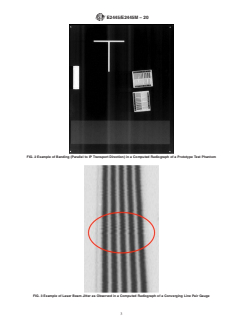
3.2.7 laser beam jitter, n—a lack of smooth movement of
thelaserscanningdevice,whichresultsinjaggedscanlineson 3.2.15.1 Discussion—Scanner normalization procedures are
the image (see Fig. 3). dependent on the scanner model, and may or may not be able
to be performed by the user.
3.2.8 linear pixel value, n—a numerical value of a picture
element (pixel) of the digital image, which is proportional to
3.2.16 scanner slippage, n—the slipping of an IP in a
the radiation dose.
scanner transport system resulting in fluctuations of PV or
3.2.8.1 Discussion—Example: for conversion of 12 bit log
distortion of geometric linearity, or both, appearing perpen-
to 16 bit linear:
dicular to the IP transport direction (see Fig. 6).
PV
12 bit log
S D
2 4
PV 5 65535 310 1024 (1) 3.2.17 shading, n—non-uniform pixel values perpendicular
16 bit linear
to the IP transport direction, which may also be caused by
The linear pixel value is zero if the radiation dose is
improper alignment of the light guide or photomultiplier tube
zero.
assembly or improper scanner normalization.
3.2.9 long-term stability, n—performance measurements of
3.2.18 user, n—the user and operating organization of the
aCRsystemoverthelife-cycleofthedevices,usedtoevaluate
CR system.
relative system performance over time.
3.2.10 manufacturer, n—CR system manufacturer, supplier 3.2.19 wait time, n—time between end of exposure and
for the user of the CR system. beginning the scan of the imaging plate.
NOTE 1—Aliasing is more pronounced as lines pair spacing decreases.
FIG. 1 Example of Aliasing on a Line Pair Gauge Image
E2445/E2445M − 20
FIG. 2 Example of Banding (Parallel to IP Transport Direction) in a Computed Radiograph of a Prototype Test Phantom
FIG. 3 Example of Laser Beam Jitter as Observed in a Computed Radiograph of a Converging Line Pair Gauge
E2445/E2445M − 20
FIG. 4 Example of PMT Non-Linearity as Observed in a Computed Radiograph of a USAF Process Control Standard
FIG. 5 White Arrows Highlight a Simulated Example of Scan Column Dropout
4. Significance and Use 4.1.3 Image acquisition and processing software, and
4.1.4 Image display monitor.
4.1 This practice is intended to be used by the NDT using
organization to measure baseline performance of the CR
4.2 It is to be understood that the CR system has already
systemandtomonitoritsperformancethroughoutitsserviceas
been selected and purchased by the user from a manufacturer
an NDT imaging system. For purposes of this document, the
basedontheinspectionneedsathand.Theusershallacceptthe
CR System is defined as:
CR scanner based on manufacturer’s results of Practice E2446
4.1.1 Storage phosphor imaging plate (IP) type and
on the specific CR scanner as provided in a data sheet for that
manufacturer,
serialized CR scanner or other acceptance test agreed to
4.1.2 Read out unit (scanner or reader) manufacturer and
between the user and manufacturer (not covered in this
model, including applicable scanner settings (for example,
practice). This practice is not intended to be used as an
samplingresolution,PMTgain,pixelvalue(PV)lookuptable,
etc.),
E2445/E2445M − 20
FIG. 6 Example of Scanner Slippage (Parallel to Laser Scan Direction) in a Computed Radiograph of a Prototype Process
Control Standard
“acceptance test” of the CR system, but rather to establish a scribed in Section 7. When greater than 320kV or when a
performance baseline that will enable tracking while in- gamma source is used, these tests may still be used to
service. characterize a system, but may need to be modified as agreed
by the user and CEO. The CR phantoms incorporate many of
4.3 Although many of the properties listed in this standard
thebasicimagequalityassessmenttesttargetsintoasingletest
have similar metrics to those found in Practice E2446, data
device, but some tests cannot be performed with both phan-
collection methods are not identical, and comparisons among
toms. See Table 1 to see which tests can be performed by each
values acquired with each standard should not be made.
phantom.
4.4 This practice defines the tests to be performed and
5.2 To ensure consistent PVs for calculation of test results,
required intervals. Also defined are the methods of tabulating
the wait time between end of exposure and scanning of the
results that CR users will complete following the baseline of
imaging plate should be a consistent time of at least 5 min.
the CR system.These tests will also be performed periodically
at the stated required intervals to evaluate the CR system to
5.3 Tests are divided into two categories: (1) Core Image
determine if the system remains within acceptable operational
Quality Tests, and (2) Supplemental (optional) Tests.
limits as established in this practice.
5.3.1 Core Image Quality Tests shall be performed on each
4.5 There are several factors that affect the image quality of CR scanner. If more than one combination of CR system
components and scanner settings are used in production, the
a CR image. Factors which are dependent on the CR system
performance include basic spatial resolution, relative contrast, usershallselectonecombinationtobeusedfortheCoreImage
Quality Tests.
and signal-to-noise ratio (SNR) which yield the contrast
sensitivity (CS) and Equivalent Penetrameter Sensitivity
5.3.2 Supplemental (optional) Tests may be performed at
(EPS). There are several additional factors that are dependent
the discretion of the user and may provide useful information
on how well the CR system is functioning (that is, resulting
for some applications.
from normal wear and tear, inadequate maintenance, improper
5.4 The technique shall be established for each test and
setup/calibration, etc.), such as slippage, laser jitter, geometric
documented. The technique information shall include, at a
distortion, etc. Other factors which are related to the specific
minimum where applicable:
applications(forexample,geometricunsharpness,scatter,etc.)
5.4.1 Drawing sketch or photograph of the setups, showing
are not evaluated in these tests.
the location and orientation of the phantom or test target with
respect to the x-ray source, and imaging plate (IP),
5. General Testing Procedures
5.4.2 Kilovoltage (kV),
5.1 The tests performed herein can be completed either by
5.4.3 Tube current (mA or microA),
the use of the Type I CR Phantom (Appendix X1) for
5.4.4 Exposure time,
applicationsupto320kV,TypeIICRPhantom(AppendixX2)
for applications up to 160kV, or individual test targets de- 5.4.5 Wait time,
E2445/E2445M − 20
TABLE 1 System Performance Tests and Process Checks of the CR System
System Performance Test Test Type Test Target
Alternate No Test
Unit Acceptance Criteria
Long-term Type I Type II
Parameter Baseline Test Target Target
Stability Phantom Phantom
Required Required
Core Image Quality Tests
Contrast Sensitivity CS % xxxx 2% contrast step
Basic Spatial Resolution SR µm xxxx ±onewire/line pair from baseline
b
Geometric Distortion xxxx <2%distortion
Laser Jitter xxxx straightand continued edges
PMT Non-linearity xxxx notbevisibleattypicalwindow
width settings
Laser Beam Scan Line Integrity xxxx none visible
Scan Column Dropout xxxx none visible
Scanner Slippage xxxx
(Type II)
B
Shading x x x x (Type II) ± 15 % or none visible
B
Banding x x x ± 15 % or none visible
B
Erasure x x see 8.3.1 x # 2 % PV or none visible
C
Equivalent Penetrameter EPS % x x see ± one hole set from baseline
A
Sensitivity Appendix
X3
A D
Signal-to-Noise Ratio SNR x x x SPC
Supplemental Tests (optional)
B
Burn-In x x see 8.3.2 # 2 % PV or none visible
Spatial Linearity x x x # 2 % distortion
Central Beam Alignment x x x regularly spaced spiral
Image Plate Artifacts x x x n/a
Image Plate Response Variation x x < 10 % PV variation
Image Plate Fading x x n/a
A
Only EPS or SNR is required (not both).
B
Acceptance criteria depends on evaluation method selected in Section 9.
C
For the Practice E746 configuration, ± one hole set on a plaque IQI equates to approximately 15 % total variation.
D
Statistical Process Control (SPC) is required to establish acceptance criteria limits and tolerances.
5.4.6 X-ray tube manufacturer, model, and focal spot size 6.1.2 Acceptance values, and tolerances thereof, obtained
used (includes variable focal spot size settings), from these tests shall be established by this practice.
5.4.7 Source to Detector Distance (SDD),
6.1.3 When the test produces a result outside the require-
5.4.8 Source to Object Distance (SOD),
ment tolerances, the CR scanner is not to be placed in service
5.4.9 Geometric unsharpness (Ug),
unless it is repaired, replaced, or some other change is
5.4.10 Detector screens and filters and usage,
institutedthatwillassuretheimagequalityoftheinspectionas
5.4.11 Imaging plate manufacturer and type/size,
stated in the agreement between contracting parties. This
5.4.12 Cassette type,
assumes that the other elements of the CR system are within
5.4.13 CR scanner settings (for example, gain setting, reso-
their tolerances including the X-ray source/generator, the
lution setting, and other parameters if available), and
imaging plates, the image acquisition and processing software,
5.4.14 X-raybeamfiltration(attube),collimator,diaphragm
the image display monitor, and the inspection itself (for
and part masking.
example, severe X-ray scatter in the inspection is controlled).
6.1.4 Theresultsofthebaselineperformancetestofthenew
6. Application of Baseline Performance Tests and Test
CR system shall be documented as delineated in Table 2 and
Methods
taken as reference values “Results (baseline)” for further use.
6.1 CR System Baseline Performance Tests:
6.1.5 Maximum deviations from “Results (baseline)” as
6.1.1 The user shall baseline the CR scanner along with the
tolerances and limits are established in this document, docu-
completeCRsystem(asdefinedin4.1)byperformingtheCore
mented in Table 2, and taken as reference values “Limit” for
Image Quality Tests listed in Table 1. Supplemental Tests may
further use.
be used to baseline the system if desired. Additional tests
6.1.6 When any CR system component is changed, by
beyond those defined in this practice are to be defined by the
definition the “CR system” has changed (see 4.1); therefore,
usingorganizationintermsofspecificteststoperform,howthe
the Core Image Quality Tests shall be performed to establish
data are presented, and the frequency of the testing. This
the baseline for this new CR system.
approach does the following:
6.2 User Tests for Long Term Stability—Image quality
6.1.1.1 Provides a quantitative baseline of performance.
assurancerequiresperiodictestsoftheCRsystemtoensurethe
6.1.1.2 Providesresultsinadefinedformthatcanbeviewed
proper performance of the system.
by the CEO.
6.1.1.3 Offers a means to perform process checking of 6.2.1 Test Intervals—The frequency shall be at least quar-
performance on a continuing basis. terly unless otherwise approved by the CEO.
E2445/E2445M − 20
TABLE 2 Test Report of CR System
System Information
Test Component Manufacturer/Model/Serial Number
IP Type
Software
Viewing Monitor
Scanner
Sampling Resolution (µm)
CR System
PMT Gain (if applicable)
Scanner Settings
Other (specify):
Manufacturer/Model
Radiation Source
Focal Point (mm)
Exposure Conditions
Core Image
Erasure Test Burn-In Test IPArtifacts IP Response IP Fading
Exposure Conditions Quality Tests
(8.3.1) (8.3.2) (8.5.4) (8.5.5) (8.5.6)
(8.2)
Date
Tube Filter Material
Tube Filter Thickness
kV
mA
Time (sec)
SDD (specify units)
Test EPS (8.4.1) SNR (8.4.2)
Date
Tube Filter Material
Tube Filter Thickness
kV
mA
SDD (specify units)
Exposure # 12345678
Time (sec)
EPS
SQRT (1/SNR)
Results
Baseline Test
Test Test after Repair or New Software
Long Term Stability
Test Phantom Type
Test Evaluation Procedure Section
Result
Procedure Test Metric Test Target (Method) Type I Type II Limit Result Remarks
Other (baseline)
Section Phantom Phantom
Core Image Quality Tests
Contrast Sensitivity E1647 gauge (line profile) 9.2.1 9.3.1 2 % contrast step
Basic Spatial Resolu- Duplex Wire E2002 (line profile) 9.2.2 ± one wire/line pair
tion Parallel Line Pairs (line profile) 9.3.2 from baseline
Linear Quality Indicator (linear
9.2.3
measurement)
Geometric Distortion # 2 % distortion
Point Measurement Target (lin-
9.3.3
ear measurement)
T-target (visual) 9.2.4 straight and continu-
Laser Jitter
Long Strip Target (visual) 9.3.4 ous edges
T-target (visual) 9.2.5 not visible at typical
PMT Non-Linearity
Short Strip Target (visual) 9.3.5 window width settings
Scan Line Integrity Image Background (visual) 9.2.6 9.3.6
none visible
Scan Column Dropout Image Background (visual) 9.2.7 9.3.7
8.2
Homogeneous Strip (line pro-
9.2.8 # noise
file)
Scanner Slippage
Point Measurement Target (lin-
9.3.8 # 2 % distortion
ear measurement)
Shading Image Quality Targets
9.2.9.1 ± 15 % of target EC
(PV measurement)
Image Background (visual) 9.2.9.2 none visible
Shading
Image Background (PV mea- ± 15 % of center mea-
9.3.9.1
surement) surement
Image Background (visual) 9.3.9.2 none visible
Image Background (PV mea-
9.2.10.1 9.3.10 ± 15 % of background
Banding surement)
Image Background (visual) 9.2.10.2 9.3.10 none visible
Image Background (PV mea-
9.2.11.1 9.3.11 #2%PV
surement)
8.3.1 Erasure
no residual image vi-
Image Background (visual) 9.2.11.2 9.3.11
sual
8.4 Sensitivity Tests (only one of the following methods is required: EPS or SNR)
E2445/E2445M − 20
TABLE 2 Continued
EPS Test Standard – Appendix ± one hole set from
8.4.1 EPS 9.4
X3 (visual) baseline
Image Background (SNR
8.4.2 SNR 9.5 (by SPC)
calculation)
Supplemental Tests (optional)
Image Background (PV
9.2.12.1 9.3.12 #2%PV
measurement)
8.3.2 Burn-In
no residual image
Image Background (visual) 9.2.12.2 9.3.12
visual
Linear Quality Indicator (linear
8.5.2 Spatial Linearity 9.2.12 # 2 % distortion
measurement)
Central Beam
8.5.3 BAM snail (visual) 9.2.13 regularly spaced spiral
Alignment
8.5.4 IPArtifacts n/a 9.6.4 n/a
Image Background (PV
8.5.5 IP Response 9.6.5 < 10 % PV variation
measurement)
Image Background (PV
8.5.6 IP Fading 9.6.6 n/a
measurement)
Date of Tests
Conclusion
Operator
6.2.2 Acceptance Criteria and Tolerances—Table 1 lists the is implemented in both the Type I (aluminum, copper, and
minimum acceptance criteria for all long-term stability tests. stainless) and Type II (aluminum only) CR Phantoms (Fig.
For SNR, limits and tolerances shall be established using X1.1 and Fig. X2.1).
statistical process control (SPC) per 9.5.
7.2.2 Duplex Wire Image Quality Indicator—The descrip-
tion of the duplex wire image quality indicator corresponds to
6.3 Supplemental (Optional) Tests—Supplemental (op-
Practice E2002. The gauge shall be oriented at approximately
tional) tests may be performed at the user’s discretion in
2°–5° angle to the laser scan direction and at approximately
addition to the tests in 6.1 and 6.2. Where applicable, recom-
2°–5°angletotheIPtransportdirection.Thistesttargetmaybe
mendedacceptancecriteriaareprovidedinTable1andSection
evaluated visually or with software tools to measure basic
9.
spatial resolution and is implemented in one orientation in the
6.4 Retesting Requirements:
Type I CR Phantom (Fig. X1.1).
6.4.1 New CR System Baseline Performance Tests should
7.2.3 Converging Line Pair Image Quality Indicator—This
be performed when any system hardware or software compo-
test target is contained in the Type I CR Phantom (Fig. X1.1),
nent is repaired, replaced, or upgraded.
but is not used in this standard.
6.4.2 Long Term Stability Tests should be performed after
7.2.4 Parallel Line Pair Image Quality Indicators—Thetest
routine maintenance.
target consists of multiple pairs of parallel slits cut into lead
foil (0.05 mm [0.002 in.] thickness), which is used to measure
7. Apparatus
basic spatial resolution. It shall cover a range from 1.5 to 10
7.1 The tests described in Table 1 and in Section 6 require
line pairs per mm (lp/mm) as a minimum. The gauge shall be
the usage of either the Type I CR Phantom (see Appendix X1)
oriented at approximately 2°–5° angle to the laser scan
or the Type II CR Phantom (see Appendix X2). However, this
direction and at approximately 2°–5° angle to the IP transport
document does not preclude the use of alternate gauges or
direction. Two of these test targets are arranged in each scan
phantoms which can measure the same parameters listed in
direction and implemented in the Type II CR Phantom (Fig.
Table 1. The use of alternate gauges must be approved by the
X2.1).
CEO.
7.2.5 Linearity Image Quality Indicators—Rulers of high-
absorbingmaterialsarelocatedontheperimeterofthescanned
7.2 Description of CR Image Quality Indicators for User
range and may be used to measure spatial linearity, geometric
Tests—The following is a description of CR image quality
distortion, and scanner slippage. Two image quality indicators
indicators, which will be identified by reference to this prac-
shall be used, one parallel with the scanned lines and the other
tice.
one oriented in the perpendicular direction.The scaling should
7.2.1 Contrast Sensitivity Image Quality Indicator—The
be at least in mm or tenths of inches. These test targets are
description of the contrast sensitivity test target corresponds to
implemented in the Type I CR Phantom (Fig. X1.1).
PracticeE1647.Forusewiththispractice,threetesttargetsare
made from aluminum (Material Group 2), copper (Material 7.2.6 Point Measurement Test Targets—Small spherical test
Group4),andstainlesssteel(MaterialGroup1).Thetesttarget targets made of high density material (for example, 1.5mm
thickness is 12.5 mm [0.50 in.] aluminum, 6.3 mm [0.25 in.] [0.06in.] diameter steel or lead balls), placed at known
copper and stainless steel. Each test target contains a contrast locations at the four corners of the scanned image. These test
area for 1, 2, 3, and 4 % wall-thickness contrast sensitivity and targets may be used for evaluation of overall image geometric
E2445/E2445M − 20
distortion or scanner slippage, or both, and are implemented in 8.1.1.2 Basic Spatial Resolution (by duplex wire gauge in
the Type II CR Phantom (Fig. X2.1). Type I CRTest Phantom or parallel line pair gauges inType II
CR Test Phantom).
7.2.7 T-target—This CR image quality indicator consists of
8.1.1.3 Geometric Distortion (by spatial linearity image
a thin plate of brass or copper ≥2mm[≥0.08 in.] thick with
quality indicators in Type I CR Test Phantom or point
sharp edges. This plate is manufactured in a T-shape. The T
measurement targets in Type II CR Test Phantom).
should have a size of at least 114 by 5 mm [4.5 by 0.2 in.] for
eachleg.ItshallbealignedperpendicularandparalleltotheIP 8.1.1.4 Laser Jitter (by T-target in Type I CR Test Phantom
or long strip target in Type II CR Test Phantom).
transport direction and is used to check for laser jitter and may
be used to measure a Modulation Transfer Function (MTF) of 8.1.1.5 PMT Non-linearity (by T-target in Type I CR Test
Phantom or short strip target in Type II CR Test Phantom).
the complete system. This test target is implemented in the
Type I CR Phantom (Fig. X1.1). 8.1.1.6 Laser Beam Scan Line Integrity (no test object
required).
7.2.8 Strip Targets—These CR image quality indicators
8.1.1.7 Scan Column Dropout (no test object required).
consists of two thin plates of brass or copper (≥0.5mm
8.1.1.8 Scanner Slippage (by homogeneous strip slippage
[≥0.02in.]thick)withsharpedges.Eachplateis5mm[0.2in.]
targetinTypeICRTestPhantomorpointmeasurementtargets
wide, one plate being at least 50 mm [2 in.], and one being
and visual evaluation in Type II CR Test Phantom).
nearly the full length of the image to be scanned [16 in.]. The
short plate shall be aligned perpendicular to the transport 8.1.1.9 Shading (by three shading image quality targets in
TypeICRTestPhantomorthreemeasurementsinbackground
direction and is used to check for PMTnon-linearity, while the
long plate is aligned parallel to the transport direction and is of Type II CR Test Phantom).
8.1.1.10 Banding (no test object required).
used to check laser jitter.These test targets are implemented in
the Type II CR Phantom (Fig. X2.1). 8.1.1.11 Erasure (high absorption object per 8.3.1).
8.1.1.12 Sensitivity Tests Considering Image Noise:
7.2.9 Homogeneous Strip Target—The image quality indi-
(1)EPS (EPS Test Standard per 7.2.11), or
cator consists of a homogeneous strip of aluminum 0.5 mm
(2)SNR (no test object required).
[0.02 in.] in thickness. The image quality indicator has the
shape of a rectangle and shall be aligned parallel to the 8.1.2 Optional Tests:
8.1.2.1 Burn-In (high absorption object per 8.3.1).
transport direction and is implemented in the Type I CR
Phantom (Fig. X1.1). 8.1.2.2 Spatial Linearity (by spatial linearity image quality
indicators in Type I CR Test Phantom).
7.2.10 Shading Image Quality Indicator—A series of three
8.1.2.3 Central Beam Alignment (by BAM-snail target in
holes, measuring 19 mm [0.75 in.] in diameter and 0.3 mm
Type I CR Test Phantom).
[0.01in.]deep.Thesetesttargetsareimplemented(labeledEL,
8.1.2.4 Imaging Plate Artifacts (no test object required).
ER, and EC) in the Type I CR Phantom (Fig. X1.1).
8.1.2.5 Imaging Plate Response Variation (no test object
7.2.11 Equivalent Penetrameter Sensitivity (EPS) Test
required).
Standard—The EPS test standard is built to the dimensional
8.1.2.6 Imaging Plate Fading (no test object required).
specifications of the Practice E746 Relative Image Quality
Indicator(RIQI),butmaybemadeofsteel,aluminum,orother
8.2 Procedure for Core Image Quality Tests (except EPS
materials. See Appendix X3 for details of the EPS test
and SNR)—For the tests involving the phantoms of this
standard.
practice, either theType I orType II CRTest Phantom shall be
7.2.12 Central Beam Alignment Image Quality Indicator
placed on the cassette, which contains an imaging plate. The
(BAM-snail)—The alignment image quality indicator consists
radiationsourceshallbesetatadistanceofatleast1m[39in.]
of a roll 1.5 to 2.0 mm high [0.06 to 0.08 in.] of thin lead foil
or greater and the beam aligned with the center of the plate.
separated by a spacer of 0.1 to 0.2 mm [0.004 to 0.008 in.] of
Testing of the Type I CR phantom shall be performed at
low-absorbing material. This test target is implemented in the
220kV for applications >160kV, or 90kV for applications
Type I CR Phantom (Figs. X1.1 and X1.2).
≤160kV;TestingofTypeIICRphantomshallbeperformedat
50kV.Above radiation energy of 100kV, use of a front screen
7.3 Application Procedures for CR Image Quality
is recommended (such as lead ≥0.1 mm [0.005 in.] or steel
Indicators—The CR system image quality indicators provide
≥0.5mm [0.02in.]) to reduce scattered radiation. Background
anevaluationoftheimagequalityofaCRsystemaswellasfor
pixel value shall not be saturated, to avoid “burning” edges of
aperiodicqualitycontrol.SelectionandarrangementoftheCR
the test targets and producing erroneous data. The final image
image quality indicators shall be in accordance with this
forevaluationshallhavethePVofalltargetsofinterestwithin
practice, or as specified by the CEO.
the EPS or SQRT(1/SNR) plateau as defined in 9.4.2 and
9.5.2.2.
8. Test Procedures
8.2.1 Note that for tracking performance of the CR system,
8.1 The tests listed in this section shall be performed with
the same technique, CR scanner settings, and CR system
the listed phantom and corresponding IQIs at specified inter-
components shall be used during long term stability or process
vals as established in this practice.
checking.
8.1.1 Core Image Quality Tests:
8.2.2 Beforethecaptureofimagesforevaluationbegins,the
8.1.1.1 Contrast Sensitivity (by contrast sensitivity gauges CR system shall have the scanner normalization performed in
in either Type I or Type II CR Test Phantom). accordance with the manufacturer’s recommendations.
E2445/E2445M − 20
8.3 Procedure for Erasure and Burn-In Test: exposed. The IP shall be positioned with an SDD of 1 m
8.3.1 Erasure: [39in.]. Leave free space of at least 1 m [39 in.] behind the
cassettes or use a steel screen of about 0.5 mm [0.02 in.] and
8.3.1.1 Using an IP that has been erased, an exposure shall
a lead plate of>2mm [0.08 in.] just behind the cassette (steel
be taken at 220 kV or a typical kV for the application range.
screen is positioned between cassette and lead) and in eight
This shall be accomplished using an absorber plate that covers
exposures using similar technique parameters (that is, the only
approximately one half of the imaging plate and results in
technique variable is exposure, mA× time) for a range of dose
5-10% maximum achievable mean linear PV in the region
covered by the absorber plate. In the free beam area, the sufficient to produce approximately 10-90% of the maximum
linear pixel value (PV) of the system in approximately equal
exposure shall result in 80-90% of the maximum achievable
mean linear PV. increments(thatis,fora16bitsystem,100%maxPV=65535;
10-90% max PV=6554-58982, PV increments ~6500-8000).
8.3.1.2 Erase the IP. Scan the IP after erasure.
The SNR shall be measured per 9.5.
8.3.1.3 Document the orientation of the IP during exposure
8.4.2.2 For high-energy applications, the kilovoltage setting
andprocessingonthetechnique.Ensurethesameorientationis
shallbe220kVandthefiltershallbeofco
...
This document is not an ASTM standard and is intended only to provide the user of an ASTM standard an indication of what changes have been made to the previous version. Because
it may not be technically possible to adequately depict all changes accurately, ASTM recommends that users consult prior editions as appropriate. In all cases only the current version
of the standard as published by ASTM is to be considered the official document.
Designation: E2445/E2445M − 14 E2445/E2445M − 20
Standard Practice for
Performance Evaluation and Long-Term Stability of
Computed Radiography Systems
This standard is issued under the fixed designation E2445/E2445M; the number immediately following the designation indicates the year
of original adoption or, in the case of revision, the year of last revision. A number in parentheses indicates the year of last reapproval.
A superscript epsilon (´) indicates an editorial change since the last revision or reapproval.
1. Scope
1.1 This practice describes the evaluation of Computed RadiologyRadiography (CR) systems for industrial radiology.radiog-
raphy. It is intended to ensure that the evaluation of image quality, as far as this is influenced by the CR system, meets the needs
of users of this standard, and their customers, and enables process control and long-term stability of the CR system.
1.2 This practice specifies the fundamental parameters of CR systems to be measured to determine baseline performance, and
to track the long term stability of the system. These tests are for applications up to 320kV.320 kV. When greater than 320kV320 kV
or when a gamma source is used, these tests may still be used to characterize a system, but may need to be modified as agreed
between the user and cognizant engineering organization (CEO).
1.3 The CR system performance tests specified in this practice shall be completed upon acceptance of the system from the
manufacturer and at intervals specified in this practice to monitor long term stability of the system. The intent of these tests is to
monitor the system performance degradation and to identify when an action needs to be taken when the system degrades by a
certain level.
1.4 The use of gauges provided in this standard is mandatory for each test. In the event these tests or gauges are not sufficient,
the user, in coordination with the CEO shall develop additional or modified tests, test objects, gauges, or image quality indicators
to evaluate the CR system. Acceptance levels for these ALTERNATE tests shall be determined by agreement between the user and
CEO.
1.5 Units—The values stated in either SI units or inch-pound units are to be regarded separately as standard. The values stated
in each system are not necessarily exact equivalents; therefore, to ensure conformance with the standard, each system shall be used
independently of the other, and values from the two systems shall not be combined.
1.6 This standard does not purport to address all of the safety concerns, if any, associated with its use. It is the responsibility
of the user of this standard to establish appropriate safety safety, health, and healthenvironmental practices and determine the
applicability of regulatory limitations prior to use.
1.7 This international standard was developed in accordance with internationally recognized principles on standardization
established in the Decision on Principles for the Development of International Standards, Guides and Recommendations issued
by the World Trade Organization Technical Barriers to Trade (TBT) Committee.
2. Referenced Documents
2.1 ASTM Standards:
E746 Practice for Determining Relative Image Quality Response of Industrial Radiographic Imaging Systems
E1316 Terminology for Nondestructive Examinations
E1647 Practice for Determining Contrast Sensitivity in Radiology
E2002 Practice for Determining Total Image Unsharpness and Basic Spatial Resolution in Radiography and Radioscopy
E2007 Guide for Computed Radiography
E2033 Practice for Radiographic Examination Using Computed Radiography (Photostimulable Luminescence Method)
E2446 Practice for Manufacturing Characterization of Computed Radiography Systems
This practice is under the jurisdiction of ASTM Committee E07 on Nondestructive Testing and is the direct responsibility of Subcommittee E07.01 on Radiology (X and
Gamma) Method.
Current edition approved Oct. 1, 2014June 15, 2020. Published October 2014July 2020. Originally approved in 2005. Last previous edition approved in 20102014 as
E2445/E2445M-05(2010).E2445/E2445M – 14. DOI:10.1520/E2445_E2445M-14.DOI:10.1520/E2445_E2445M-20.
For referenced ASTM standards, visit the ASTM website, www.astm.org, or contact ASTM Customer Service at service@astm.org. For Annual Book of ASTM Standards
volume information, refer to the standard’s Document Summary page on the ASTM website.
Copyright © ASTM International, 100 Barr Harbor Drive, PO Box C700, West Conshohocken, PA 19428-2959. United States
E2445/E2445M − 20
3. Terminology
3.1 Definitions—The definition of terms relating to gamma- and X-radiology, which appear in Terminology E1316, Guide
E2007, and Practice E2033 shall apply to the terms used in this practice.
3.2 Definitions of Terms Specific to This Standard:
3.2.1 aliasing—aliasing, n—artifacts that appear in an image when the spatial frequency of the input is higher than the output
is capable of reproducing.
3.2.1.1 Discussion—
This will often appear as jagged or stepped sections in a line or as moiré patterns (see Fig. 1).
3.2.2 banding—banding, n—linear striping aligned parallel to the IP transport direction, which may be caused by improper
scanner normalization (see Fig. 2).
3.2.3 computed radiologyradiography system (CR system)—system), n—a complete system of a storage phosphor imaging plate
(IP) type, corresponding read out unit (scanner or reader) including pertinent equipment settings (for example, sampling resolution,
laser power, photomultiplier tube (PMT) gain, etc.), image acquisition and processing software, and image display monitor.
3.2.4 CR phantom—phantom, n—a device containing an arrangement of test targets used to evaluate the image quality of a CR
system, as well as monitoring the image quality of the chosen system.
3.2.5 customer—the company, government agency, or other authority responsible for the design, or end user, of the system or
component for which radiographic examination is required, also known as the Cognizant Engineering Organization (CEO).
3.2.5 fading—fading, n—the reduction of intensity of the stored image in the imaging plate over time.
3.2.6 gain—gain, n—overall signal amplification of the scanning system.
3.2.7 laser beam jitter—jitter, n—a lack of smooth movement of the laser scanning device, which results in jagged scan lines
on the image (see Fig. 3).
3.2.8 linear pixel value—value, n—a numerical value of a picture element (pixel) of the digital image, which is proportional to
the radiation dose.
3.2.8.1 Discussion—
Example: for conversion of 12 bit log to 16 bit linear:
PV
12 bit log
S 2 4D
PV 5 65535 310 1024 (1)
16 bit linear
The linear pixel value is zero if the radiation dose is zero.
3.2.9 long-term stability—stability, n—performance measurements of a CR system over the life-cycle of the devices, used to
evaluate relative system performance over time.
3.2.10 manufacturer—manufacturer, n—CR system manufacturer, supplier for the user of the CR system.
3.2.11 PMT—PMT, n—photomultiplier tube or other light capture device used by the specific scanner.
NOTE 1—Aliasing is more pronounced as lines pair spacing decreases.
FIG. 1 Example of Aliasing on a Line Pair Gauge Image
E2445/E2445M − 20
FIG. 2 Example of Banding (Parallel to IP Transport Direction) in a Computed Radiograph of a Prototype Test Phantom
FIG. 3 Example of Laser Beam Jitter as Observed in a Computed Radiograph of a Converging Line Pair Gauge
E2445/E2445M − 20
3.2.12 PMT non-linearity—non-linearity, n—deviation from a linear response of the PMT at high light input values or from step
changes in light.
3.2.12.1 Discussion—
At high light input values, the PMT may under-respond,under-respond; also the PMT may over-shoot or undershoot in response
to a step change in light (see Fig. 4).
3.2.13 scan column dropout—dropout, n—a zero PV linear image artifact created parallel to the transport direction when the
path of the scanner’s laser beam is prevented from reaching the imaging plate, often due to an internal obstruction (contaminates,
for example) (see Fig. 5).
3.2.14 scan line integrity (or line ripple)—ripple), n—fluctuation of line intensity appearing perpendicular to the IP transport
direction.
3.2.15 scanner normalization—normalization, n—as used in this document, scanner normalization refers to a process performed
to ensure a flat field image is produced when an imaging plate is exposed without an absorber.
3.2.15.1 Discussion—
Scanner normalization procedures are dependent on the scanner model, and may or may not be able to be performed by the user.
3.2.16 scanner slippage—slippage, n—the slipping of an IP in a scanner transport system resulting in fluctuations of PV or
distortion of geometric linearity, or both, appearing perpendicular to the IP transport direction (see Fig. 6).
3.2.17 shading—shading, n—non-uniform pixel values perpendicular to the IP transport direction, which may also be caused
by improper alignment of the light guide or photomultiplier tube assembly or improper scanner normalization.
3.2.18 user, n—the user and operating organization of the CR system.
3.2.19 wait time—time, n—time between end of exposure and beginning the scan of the imaging plate.
3.2.20 user—the user and operating organization of the CR system.
4. Significance and Use
4.1 This practice is intended to be used by the NDT using organization to measure baseline performance of the CR system and
to monitor its performance throughout its service as an NDT imaging system. For purposes of this document, the CR System is
defined as:
FIG. 4 Example of PMT Non-Linearity as Observed in a Computed Radiograph of a USAF Process Control Standard
E2445/E2445M − 20
FIG. 5 White Arrows Highlight a Simulated Example of Scan Column Dropout
FIG. 6 Example of Scanner Slippage (Parallel to Laser Scan Direction) in a Computed Radiograph of a Prototype Process
Control Standard
4.1.1 Storage phosphor imaging plate (IP) type and manufacturer,
4.1.2 Read out unit (scanner or reader) manufacturer and model, including applicable scanner settings (e.g., (for example,
sampling resolution, PMT gain, pixel value (PV) look up table, etc.),
4.1.3 Image acquisition and processing software, and
4.1.4 Image display monitor.
4.2 It is to be understood that the CR system has already been selected and purchased by the user from a manufacturer based
on the inspection needs at hand. The user shall accept the CR scanner based on manufacturer’s results of Practice E2446 on the
specific CR scanner as provided in a data sheet for that serialized CR scanner or other acceptance test agreed to between the user
and manufacturer (not covered in this practice). This practice is not intended to be used as an “acceptance test” of the CR system,
but rather to establish a performance baseline that will enable tracking while in-service.
4.3 Although many of the properties listed in this standard have similar metrics to those found in Practice E2446, data collection
methods are not identical, and comparisons among values acquired with each standard should not be made.
E2445/E2445M − 20
4.4 This practice defines the tests to be performed and required intervals. Also defined are the methods of tabulating results that
CR users will complete following the baseline of the CR system. These tests will also be performed periodically at the stated
required intervals to evaluate the CR system to determine if the system remains within acceptable operational limits as established
in this practice.
4.5 There are several factors that affect the image quality of a CR image. Factors which are dependent on the CR system
performance include basic spatial resolution, relative contrast, and signal-to-noise ratio (SNR) which yield the contrast sensitivity
(CS),(CS) and Equivalent Penetrameter Sensitivity (EPS). There are several additional factors that are dependent on how well the
CR system is functioning (i.e., (that is, resulting from normal wear and tear, inadequate maintenance, improper setup/calibration,
etc.), such as slippage, laser jitter, geometric distortion, etc. Other factors which are related to the specific applications (e.g., (for
example, geometric unsharpness, scatter, etc.) are not evaluated in these tests.
5. General Testing Procedures
5.1 The tests performed herein can be completed either by the use of the Type I CR Phantom (Appendix X1) for applications
up to 320kV,320 kV, Type II CR Phantom (Appendix X2) for applications up to 160kV,160 kV, or individual test targets described
in Section 7. When greater than 320kV320 kV or when a gamma source is used, these tests may still be used to characterize a
system, but may need to be modified as agreed by the user and CEO. The CR phantoms incorporate many of the basic image quality
assessment test targets into a single test device, but some tests cannot be performed with both phantoms. See Table 1 to see which
tests can be performed by each phantom.
5.2 To ensure consistent PVs for calculation of test results, the wait time between end of exposure and scanning of the imaging
plate should be a consistent time of at least 5 minutes.min.
5.3 Tests are divided into two categories: (1) Core Image Quality Tests, and (2) Supplemental (optional) Tests.
TABLE 1 System Performance Tests and Process Checks of the CR System
SysytemSystem Performance Test Test Type Test Target
Alternate No Test
Unit Acceptance Criteria
Long-term Type I Type II
Parameter Baseline Test Target Target
Stability Phantom Phantom
Required Required
Core Image Quality Tests
Contrast Sensitivity CS % x x x x 2% contrast step
Contrast Sensitivity CS % x x x x 2 % contrast step
Basic Spatial Resolution SR μm x x x x ± one wire/line pair from baseline
b
Geometric Distortion x x x x < 2% distortion
Geometric Distortion x x x x < 2 % distortion
Laser Jitter x x x x straight and continued edges
PMT Non-linearity x x x x not be visible at typical window
width settings
Laser Beam Scan Line Integrity x x x x none visible
Scan Column Dropout x x x x none visible
Scanner Slippage x x x x < noise (Type I) < 2% distortion
(Type II)
Scanner Slippage x x x x < noise (Type I) < 2 % distortion
(Type II)
B
Shading x x x x (Type II) ± 15% or none visible
B
Shading x x x x (Type II) ± 15 % or none visible
B
Banding x x x ± 15% or none visible
B
Banding x x x ± 15 % or none visible
B
Erasure x x see 8.3.1 x # 2% PV or none visible
B
Erasure x x see 8.3.1 x # 2 % PV or none visible
C
Equivalent Penetrameter EPS % x x see ± one hole set from baseline
A
Sensitivity Appendix
X3
A D
Signal-to-Noise Ratio SNR x x x SPC
Supplemental Tests (optional)
B
Burn-In x x see 8.3.2 # 2% PV or none visible
B
Burn-In x x see 8.3.2 # 2 % PV or none visible
Spatial Linearity x x x # 2% distortion
Spatial Linearity x x x # 2 % distortion
Central Beam Alignment x x x regularly spaced spiral
Image Plate Artifacts x x x n/a
Image Plate Response Variation x x < 10% PV variation
Image Plate Response Variation x x < 10 % PV variation
Image Plate Fading x x n/a
A
Only EPS or SNR is required (not both).
B
Acceptance criteria depends on evaluation method selected in Section 9.
C
For the Practice E746 configuration, ± one hole set on a plaque IQI equates to approximately 15%15 % total variation.
D
Statistical Process Control (SPC) is required to establish acceptance criteria limits and tolerances.
E2445/E2445M − 20
5.3.1 Core Image Quality Tests shall be performed on each CR scanner. If more than one combination of CR system components
and scanner settings are used in production, the user shall select one combination to be used for the Core Image Quality Tests.
5.3.2 Supplemental (optional) Tests may be performed at the discretion of the user and may provide useful information for some
applications.
5.4 The technique shall be established for each test and documented. The technique information shall include, at a minimum
where applicable:
5.4.1 Drawing sketch or photograph of the setups, showing the location and orientation of the phantom or test target with respect
to the x-ray source, and imaging plate (IP),
5.4.2 Kilovoltage (kV),
5.4.3 Tube current (mA or microA),
5.4.4 Exposure time,
5.4.5 Wait time,
5.4.6 X-ray tube manufacturer, model, and focal spot size used (includes variable focal spot size settings),
5.4.7 Focal Spot Source to Detector Distance (FDD),(SDD),
5.4.8 Focal Spot Source to Object Distance (FOD),(SOD),
5.4.9 Geometric unsharpness (Ug),
5.4.10 Detector screens and filters and usage,
5.4.11 Imaging plate manufacturer and type/size,
5.4.12 Cassette type,
5.4.13 CR scanner settings (for example, gain setting, resolution setting, and other parameters if available), and
5.4.14 X-ray beam filtration (at tube), collimator, diaphragm and part masking.
6. Application of Baseline Performance Tests and Test Methods
6.1 CR System Baseline Performance Tests:
6.1.1 The user shall baseline the CR scanner along with the complete CR system (as defined in 4.1) by performing the Core
Image Quality Tests listed in Table 1. Supplemental Tests may be used to baseline the system if desired. Additional tests beyond
those defined in this practice are to be defined by the using organization in terms of specific tests to perform, how the data are
presented, and the frequency of the testing. This approach does the following:
6.1.1.1 Provides a quantitative baseline of performance.
6.1.1.2 Provides results in a defined form that can be viewed by the CEO.
6.1.1.3 Offers a means to perform process checking of performance on a continuing basis.
6.1.2 Acceptance values, and tolerances thereof, obtained from these tests shall be established by this practice.
6.1.3 When the test produces a result belowoutside the requirements, requirement tolerances, the CR scanner is not to be placed
in service unless it is repaired, replaced, or some other change is instituted that will assure the image quality of the inspection as
stated in the agreement between contracting parties. This assumes that the other elements of the CR system are within their
tolerances including the x-rayX-ray source/generator, the imaging plates, the image acquisition and processing software, the image
display monitor, and the inspection itself (for example, severe x-rayX-ray scatter in the inspection is controlled).
6.1.4 The results of the baseline performance test of the new CR system shall be documented as delineated in Table 2 and taken
as reference values “Results (baseline)” for further use.
6.1.5 Maximum deviations from “Results (baseline)” as tolerances and limits are established in this document, documented in
Table 2, and taken as reference values “Limit” for further use.
6.1.6 When any CR system component is changed, by definition the “CR system” has changed (see 4.1); therefore, the Core
Image Quality Tests shall be performed to establish the baseline for this new CR system.
6.2 User Tests for Long Term Stability—Image quality assurance requires periodic tests of the CR system to ensure the proper
performance of the system.
6.2.1 Test Intervals—The frequency shall be at least quarterly unless otherwise approved by the CEO.
6.2.2 Acceptance Criteria and Tolerances—Table 1 lists the minimum acceptance criteria for all long-term stability tests. For
SNR, limits and tolerances shall be established using statistical process control (SPC) per 9.5.
6.3 Supplemental (optional)(Optional) Tests—Supplemental (optional) tests may be performed at the user’s discretion in
addition to the tests in 6.1 and 6.2. Where applicable, recommended acceptance criteria are provided in Table 1 and Section 9.
6.4 Retesting Requirements:
6.4.1 New CR System Baseline Performance Tests should be performed when any system hardware or software component is
repaired, replaced, or upgraded.
6.4.2 Long Term Stability Tests should be performed after routine maintenance.
E2445/E2445M − 20
TABLE 2 Test Report of CR System
System Information
Test Component Manufacturer/Model/Serial Number
IP Type
Software
Viewing Monitor
Scanner
Sampling Resolution (μm)
CR System
PMT Gain (if applicable)
Scanner Settings
Other (specify):
Manufacturer/Model
Radiation Source
Focal Point (mm)
Exposure Conditions
Core Image
Erasure Test Burn-In Test IP Artifacts IP Response IP Fading
Exposure Conditions Quality Tests
(8.3.1) (8.3.2) (8.5.4) (8.5.5) (8.5.6)
(8.2)
Date
Tube Filter Material
Tube Filter Thickness
kV
mA
Time (sec)
SDD (specify units)
Test EPS (8.4.1) SNR (8.4.2)
Date
Tube Filter Material
Tube Filter Thickness
kV
mA
SDD (specify units)
Exposure # 1 2 3 4 5 6 7 8
Time (sec)
EPS
SQRT (1/SNR)
Results
Baseline Test
Test Test after Repair or New Software
Long Term Stability
Test Phantom Type
Test Evaluation Procedure Section
Result
Procedure Test Metric Test Target (Method) Type I Type II Limit Result Remarks
Other (baseline)
Section Phantom Phantom
Core Image Quality Tests
7. Apparatus
7.1 The tests described in Table 1 and in Section 6 require the usage of either the Type I CR Phantom (see Appendix X1) or
the Type II CR Phantom (see Appendix X2). However, this document does not preclude the use of otheralternate gauges or
phantoms which can measure the same parameters listed in Table 1. The use of alternate gauges must be approved by the CEO.
7.2 Description of CR Image Quality Indicators for User Tests—The following is a description of CR image quality indicators,
which will be identified by reference to this practice.
7.2.1 Contrast Sensitivity Image Quality Indicator—The description of the contrast sensitivity test target corresponds to Practice
E1647. For use with this practice, three test targets are made from aluminum (Material Group 2), copper (Material Group 4)4),
and stainless steel (Material Group 1). The test target thickness is 12.5 mm [0.50 in.] aluminum, 6.3 mm [0.25 in.] copper and
stainless steel. Each test target contains a contrast area for 1, 2, 3, and 4 % wall-thickness contrast sensitivity and is implemented
in both the Type I (aluminum, copper, and stainless) and Type II (aluminum only) CR Phantoms (Fig. X1.1 and Fig. X2.1).
7.2.2 Duplex Wire Image Quality Indicator—The description of the duplex wire image quality indicator corresponds to Practice
E2002. The gauge shall be oriented at aapproximately 2°–5° angle to the laser scan direction and at aapproximately 2°–5° angle
to the IP transport direction. This test target may be evaluated visually or with software tools to measure basic spatial resolution
and is implemented in one orientation in the Type I CR Phantom (Fig. X1.1).
7.2.3 Converging Line Pair Image Quality Indicator—This test target is contained in the Type I CR Phantom (Fig. X1.1), but
is not used in this standard.
7.2.4 Parallel Line Pair Image Quality Indicators—The test target consists of multiple pairs of parallel slits cut into lead foil
(0.05 mm [0.002 in.] thickness), which can be used for a basic spatial resolution test by reading the limit of recognizable line pairs.
is used to measure basic spatial resolution. It shall cover a range from 1.5 to 10 line pairs per mm (lp/mm) as a minimum. The
E2445/E2445M − 20
TABLE 2 Continued
Contrast Sensitivity E1647 gauge (line profile) 9.2.1 9.3.1 2% contrast step
E1647
2 % con-
Contrast Sensitivity gauge (line 9.2.1 9.3.1
trast step
profile)
Duplex
Wire
9.2.2
E2002 (line ± one wire/
profile) line pair
Basic Spatial Resolution
Parallel from base-
Line Pairs line
9.3.2
(line pro-
file)
Linear
Quality In-
dicator (lin- 9.2.3
ear mea-
surement) # 2% dis-
Geometric Distortion
Linear tortion
Quality In-
dicator (lin- 9.2.3
Geometric
ear mea- # 2 % distortion
Distortion
surement)
Point Measurement Target (lin-
9.3.3
ear measurement)
T-target
9.2.4 straight
(visual)
and con-
Laser Jitter Long Strip
tinuous
Target (vi- 9.3.4
edges
sual)
T-target not visible
9.2.5
(visual) at typical
PMT Non-Linearity Short Strip window
Target (vi- 9.3.5 width set-
sual) tings
8.2 Image
Back-
Scan Line Integrity 9.2.6 9.3.6
ground (vi-
8.2 sual) none vis-
Image ible
Back-
Scan Column Dropout 9.2.7 9.3.7
ground (vi-
sual)
Homoge-
neous Strip
9.2.8 # noise
(line pro-
file)
Scanner Slippage Point Mea-
surement
# 2% dis-
Target (lin- 9.3.8
tortion
ear mea-
surement)
Point Measurement Target (lin-
9.3.8 # 2 % distortion
ear measurement)
Shading
Image
Quality Tar- ± 15% of
9.2.9.1
gets (PV target EC
measure-
ment)
Shading
Image
Quality Tar- ± 15 % of
9.2.9.1
gets (PV target EC
Shading measure-
ment)
Image
Back-
9.2.9.2 none visible
ground (vi-
sual)
Shading
Image
± 15% of
Back-
center
ground (PV 9.3.9.1
measure-
measure-
ment
ment)
Image
± 15 % of
Back-
center
ground (PV 9.3.9.1
measure-
measure-
ment
ment)
E2445/E2445M − 20
TABLE 2 Continued
Image
none
Background 9.3.9.2
visible
(visual)
Image Background ± 15% of
9.2.10.1 9.3.10
(PV measurement) background
Banding
Image Background (PV
9.2.10.1 9.3.10 ± 15 % of background
measurement)
Image Banding
none
Background 9.2.10.2 9.3.10
visible
(visual)
Image Background (PV
9.2.11.1 9.3.11 # 2% PV
measurement)
Image
8.3.1 Erasure
Background
9.2.11.1 9.3.11 # 2 % PV
(PV
8.3.1 Erasure measurement)
Image
no residual image
Background 9.2.11.2 9.3.11
visual
(visual)
8.4 Sensitivity Tests (only one of the following methods is required: EPS or SNR)
EPS Test Standard – Appendix ± one hole set from
8.4.1 EPS 9.4
X3 (visual) baseline
Image Background (SNR
8.4.2 SNR 9.5 (by SPC)
calculation)
Supplemental Tests (optional)
Image Background (PV
9.2.12.1 9.3.12 # 2% PV
measurement)
Image
8.3.2 Burn-In
Background
9.2.12.1 9.3.12 # 2 % PV
(PV
8.3.2 Burn-In measurement)
Image
no residual image
Background 9.2.12.2 9.3.12
visual
(visual)
Linear Quality Indicator (linear
8.5.2 Spatial Linearity 9.2.12 # 2% distortion
measurement)
Linear Quality Indicator (linear
8.5.2 Spatial Linearity 9.2.12 # 2 % distortion
measurement)
Central Beam
8.5.3 BAM snail (visual) 9.2.13 regularly spaced spiral
Alignment
8.5.4 IP Artifacts n/a 9.6.4 n/a
Image Background (PV
8.5.5 IP Response 9.6.5 < 10% PV variation
measurement)
Image Background (PV
8.5.5 IP Response 9.6.5 < 10 % PV variation
measurement)
Image Background (PV
8.5.6 IP Fading 9.6.6 n/a
measurement)
Date of Tests
Conclusion
Operator
gauge shall be oriented at aapproximately 2°–5° angle to the laser scan direction and at aapproximately 2°–5° angle to the IP
transport direction. Two of these test targets are arranged in each scan direction and implemented in the Type II CR Phantom (Fig.
X2.1).
7.2.5 Linearity Image Quality Indicators—Rulers of high-absorbing materials are located on the perimeter of the scanned range
and may be used to measure spatial linearity, geometric distortion, and scanner slippage. Two image quality indicators shall be
used, one parallel with the scanned lines and the other one oriented in the perpendicular direction. The scaling should be at least
in mm or tenths of inches. ThisThese test target istargets are implemented in the Type I CR Phantom (Fig. X1.1).
7.2.6 Point Measurement Test Targets—Small spherical test targets made of high density material (e.g., 1.5 mm [0.06 in.](for
example, 1.5 mm [0.06 in.] diameter steel or lead balls), placed at known locations at the four corners of the scanned image. These
test targets may be used for evaluation of overall image geometric distortion or scanner slippage, or both, and are implemented
in the Type II CR Phantom (Fig. X2.1).
7.2.7 T-target—This CR image quality indicator consists of a thin plate of brass or copper ≥2 mm [≥0.08 in.] thick with sharp
edges. This plate is manufactured in a T-shape. The T should have a size of at least 114 by 5 mm [4.5 by 0.2 in.] for each leg.
It shall be aligned perpendicular and parallel to the IP transport direction and is used to check for laser jitter and may be used to
measure a Modulation Transfer Function (MTF) of the complete system. This test target is implemented in the Type I CR Phantom
(Fig. X1.1).
E2445/E2445M − 20
7.2.8 Strip Targets—These CR image quality indicators consists of two thin plates of brass or copper (≥0.5 mm [≥0.02 in.]
(≥0.5 mm [≥0.02 in.] thick) with sharp edges. Each plate is manufactured in 5 mm [0.2 in.] wide segments, wide, one plate being
at least 50 mm [2 in.], and one being nearly the full length of the image to be scanned [16 in.]. The short plate shall be aligned
perpendicular to the transport direction and is used to check for PMT non-linearity, while the long plate is aligned parallel to the
transport direction and is used to check laser jitter. These test targets are implemented in the Type II CR Phantom (Fig. X2.1).
7.2.9 Homogeneous Strip Target—The image quality indicator consists of a homogeneous strip of aluminum 0.5 mm [0.02 in.]
in thickness. The image quality indicator has the shape of a rectangle and shall be aligned parallel to the transport direction and
is implemented in the Type I CR Phantom (Fig. X1.1).
7.2.10 Shading Image Quality Indicator—A series of three holes, measuring 19 mm [0.75 in.] in diameter and 0.3 mm [0.01
in.] deep. These test targets are implemented (labeled EL, ER, and EC) in the Type I CR Phantom (Fig. X1.1).
7.2.11 Equivalent Penetrameter Sensitivity (EPS) Test Standard—The EPS test standard is built to the dimensional
specifications of the Practice E746 Relative Image Quality Indicator (RIQI), but may be made of steel, aluminum, or other
materials. See Appendix X3 for details of the EPS test standard.
7.2.12 Central Beam Alignment Image Quality Indicator (BAM-snail)—The alignment image quality indicator consists of a roll
1.5 to 2.0 mm high [0.06 to 0.08 in.] of thin lead foil separated by a spacer of 0.1 to 0.2 mm [0.004 to 0.008 in.] of low-absorbing
material. This test target is implemented in the Type I CR Phantom (Figs. X1.1 and X1.2).
7.3 Application Procedures for CR Image Quality Indicators—The CR system image quality indicators provide an evaluation
of the image quality of a CR system as well as for a periodic quality control. Selection and arrangement of the CR image quality
indicators shall be in accordance with this practice, or as specified by the CEO.
8. Test Procedures
8.1 The tests listed in this section shall be performed with the listed phantom and corresponding IQIs at specified intervals as
established in this practice.
8.1.1 Core Image Quality Tests:
8.1.1.1 Contrast Sensitivity (by contrast sensitivity gauges in either Type I or Type II CR Test Phantom).
8.1.1.2 Basic Spatial Resolution (by duplex wire gauge in Type I CR Test Phantom or parallel line pair gauges in Type II CR
Test Phantom).
8.1.1.3 Geometric Distortion (by spatial linearity image quality indicators in Type I CR Test Phantom or point measurement
targets in Type II CR Test Phantom).
8.1.1.4 Laser Jitter (by T-target in Type I CR Test Phantom or long strip target in Type II CR Test Phantom).
8.1.1.5 PMT Non-linearity (by T-target in Type I CR Test Phantom or short strip target in Type II CR Test Phantom).
8.1.1.6 Laser Beam Scan Line Integrity (no test object required).
8.1.1.7 Scan Column Dropout (no test object required).
8.1.1.8 Scanner Slippage (by homogeneous strip slippage target in Type I CR Test Phantom or point measurement targets and
visual evaluation in Type II CR Test Phantom).
8.1.1.9 Shading (by three shading image quality targets in Type I CR Test Phantom or three measurements in background of
Type II CR Test Phantom).
8.1.1.10 Banding (no test object required).
8.1.1.11 Erasure (high absorption object per 8.3.1).
8.1.1.12 Sensitivity Tests considering image noise:Considering Image Noise:
(1) EPS (EPS Test Standard per 7.2.11), or
(2) SNR (no test object required).
8.1.2 Optional Tests:
8.1.2.1 Burn-In (high absorption object per 8.3.1).
8.1.2.2 Spatial Linearity (by spatial linearity image quality indicators in Type I CR Test Phantom).
8.1.2.3 Central Beam Alignment (by BAM-snail target in Type I CR Test Phantom).
8.1.2.4 Imaging Plate Artifacts (no test object required).
8.1.2.5 Imaging Plate Response Variation (no test object required).
8.1.2.6 Imaging Plate Fading (no test object required).
8.2 Procedure for Core Image Quality Tests (except EPS and SNR)—For the tests involving the phantoms of this practice, either
the Type I or Type II CR Test Phantom shall be placed on the cassette, which contains an imaging plate. The radiation source shall
be set at a distance of at least 1 m [39 in.] or greater and the beam aligned with the center of the plate. Testing of the Type I CR
phantom shall be performed at 220kV220 kV for applications >160kV,>160 kV, or 90kV90 kV for applications ≤160kV;≤160 kV;
Testing of Type II CR phantom shall be performed at 50kV.50 kV. Above radiation energy of 100kV,100 kV, use of a front screen
is recommended (such as lead ≥0.1 mm [0.005 in.] or steel ≥0.5 mm [0.02 in.]) ≥0.5 mm [0.02 in.]) to reduce scattered radiation.
Background pixel value shall not be saturated, to avoid “burning” edges of the test targets and producing erroneous data. The final
image for evaluation shall have the PV of all targets of interest within the EPS or SQRT(1/SNR) plateau as defined in 9.4.2 and
9.5.2.2.
E2445/E2445M − 20
8.2.1 Note that for tracking performance of the CR system, the same technique, CR scanner settings, and CR system
components shall be used during long term stability or process checking.
8.2.2 Before the capture of images for evaluation begins, the CR system shall have the scanner normalization performed in
accordance with the manufacturer’s recommendations.
8.3 Procedure for Erasure and Burn-In Test:
8.3.1 Erasure:
8.3.1.1 Using an IP that has been erased, an exposure shall be taken at 220 kV or a typical kV for the application range. This
shall be accomplished using an absorber plate that covers approximately one half of the imaging plate and results in 5-10%5-10 %
maximum achievable mean linear PV in the region covered by the absorber plate. In the free beam area, the exposure shall result
in 80-90%80-90 % of the maximum achievable mean linear PV.
8.3.1.2 Erase the IP. Scan the IP after erasure.
8.3.1.3 Document the orientation of the IP during exposure and processing on the technique. Ensure the same orientation is
maintained for subsequent tests.
8.3.2 Burn-In (optional):(Optional):
8.3.2.1 The burn-in test shall only be performed on an IP that has successfully met the acceptance criteria for the erasure test
(9.2.10). Prior to exposure, wait approximately 20 minutesmin from completion of the erasure test (8.3.1). Expose the IP without
an absorber plate in such a way as to achieve a PV within the plateau as defined in 9.4.2 or 9.5.2.2 with the same kV as used in
the erasure test.
8.3.2.2 The burn-in test may be repeated after a longer wait time to determine if the burn-in fades.
8.4 Procedure for Sensitivity Tests consideringConsidering Image Noise (only one(Only One of the following methodsFollowing
Methods is required:Required: EPS or SNR):
8.4.1 Procedure for EPS Test:
8.4.1.1 For CR system baseline performance testing, place the EPS Test Standard (Appendix X3) on the IP and align an
X-radiation source in the approximate center of the EPS Test Standard between the #8 and #10 EPS plaques (plaques may be
slightly separated for this purpose). If the EPS Test Standard does not cover the entire IP, the IP should be masked with lead around
the absorber plate. The Source-to-Detector Distance (SDD) shall be at least 1 m [39 in.]. The geometric unsharpness, Ug, shall not
exceed 50 μm and Ug should not exceed 50%50 % of SR detector. A collimator should be used which provides a beam projection
b
that approximately matches the area of the EPS Test Standard. The kilovoltage setting shall be 220 kV if using steel, or 65kV65 kV
if using aluminum. Backing materials of 1 mm [0.04 in] steel and a minimum of 4 mm [0.1 in.] [0.1 in.] lead should be placed
beneath the IP with the steel being placed nearest the IP. Radiograph the EPS Test Standard with a minimum of eight exposures
with similar technique parameters (i.e., (that is, the only technique variable is exposure, mA × time) for a range of dose sufficient
to produce approximately 10-90%10-90 % of the maximum pixel value (PV) of the system in approximately equal increments (i.e.,
(that is, for a 16 bit system, 100%100 % max PV=65535; 10-90%10-90 % max PV 6554-58982, PV increments ~6500-8000). The
%EPS shall be determined per 9.4.
8.4.1.2 For long-term stability tests, %EPS only needs to be verified at a selected dose in the “plateau” region (i.e. (that is, only
one exposure required).
8.4.2 Procedure for SNR Tests:
8.4.2.1 For CR system baseline performance testing, a system consisting of a cassette and IP shall be uniformly exposed. The
IP shall be positioned with an SDD of 1 m [39 in.]. [39 in.]. Leave free space of at least 1 m [39 in.] behind the cassettes or use
a steel screen of about 0.5 mm [0.02 in.] and a lead plate of > 2 mm [0.08 in.] just behind the cassette (steel screen is positioned
between cassette and lead) and in eight exposures using similar technique parameters (i.e., (that is, the only technique variable is
exposure, mA × time) for a range of dose sufficient to produce approximately 10-90%10-90 % of the maximum linear pixel value
(PV) of the system in approximately equal increments (i.e., (that is, for a 16 bit system, 100%100 % max PV=65535;
10-90%10-90 % max PV=6554-58982, PV increments ~6500-8000). The SNR shall be measured per 9.5.
8.4.2.2 For high-energy applications, the kilovoltage setting shall be 220kV220 kV and the filter shall be of copper 8 mm [0.32
in.] in thickness. A front lead screen of 0.1 mm [0.005 in.] thickness may be used in the exposure cassette.
8.4.2.3 For low-energy applications, the kilovoltage setting shall be 90 kV and the filter shall be of aluminum 2 mm [0.08 in.]
[0.08 in.] in thickness. No front and back screens of lead are required.
8.4.2.4 For long-term stability tests, SNR or SQRT(1/SNR) only needs to be verified at a selected dose in the plateau region
(i.e., (that is, only one exposure is required).
8.5 Procedures for Supplemental (optional)(Optional) Tests:
8.5.1 Burn-In—See 8.3.2.
8.5.2 Spatial Linearity (optional)—(Optional)—Same as 8.2 using Type I CR Test Phantom.
8.5.3 Central Beam Alignment (optional)—(Optional)—The radiation beam shall be aligned perpendicular to the center of the
alignment image quality indicator (BAM-snail) within the Type I CR Test Phantom (Appendix X1).
8.5.4 Imaging Plate Artifacts (optional):(Optional):
8.5.4.1 All IPs in inventory should be serialized.
E2445/E2445M − 20
8.5.4.2 Prior to testing for artifacts, each IP should be cleaned in accordance with manufacturer instructions, recommended
cleaner and lint-free cloth.
8.5.4.3 Expose each IP to the lowest kV used in examination. Use sufficient exposure conditions to achieve a PV within the
plateau as defined in 9.4.2 or 9.5.2.2. Scan the IP and store the corresponding image file.
8.5.5 Imaging Plate Response Variation (optional)—(Optional)—In some instances, performance of the same type imaging
plate may vary by lot, resulting in differing image intensities when exposed to the same exposure parameters. The following
evaluation may be performed as an initial acceptance test of imaging plate lots.
8.5.5.1 Expose each IP to the lowest kV used in examination. Use sufficient exposure conditions to achieve a PV within the
plateau as defined in 9.4.2 or 9.5.2.2. Scan the IP and store the corresponding image file.
8.5.5.2 Set the linear pixel value of this measurement as reference for the specific imaging plate type.
8.5.5.3 Using the same X-ray parameters (kV, mAs, and distance), evaluate same imaging plate types from other lots.
8.5.6 Imaging Plate Fading (optional)—(Optional)—The fading effect needs to be considered to ensure correct exposure
conditions. To enable reproducible test results, it is important to consider fading effects, which influence the required exposure
time. The time between IP exposure and IP scanning for all tests shall correspond to the application of the CR system. The
measurement of fading characteristic shall be done by performing the following steps:
8.5.6.1 Expose an imaging plate homogeneously using typical exposure conditions. For documentation, the following
parameters shall be recorded: kV, mAs, SDD, pre-filter material and thickness, and imaging plate type. The exposed image shall
have a mean linear pixel value between 70 and 90 % of the maximum possible PV of the CR reader at lowest gain and under
linearized conditions.
8.5.6.2 Scan the IP as soon as practical after exposure (i.e., (that is, using a short wait time) and establish a baseline mean linear
PV using an ROI that covers a majority of the IP image. Subsequent tests should use a similar short wait time to achieve consistent
results.
8.5.6.3 Set the linearized read-out intensity of this measurement as reference (=100 %).
8.5.6.4 Subsequent exposures shall have increasing time intervals between IP exposure and IP scanning. Suggested steps are 5
min and 1 h, or as needed to match application requirement.
9. Calculation of the Results, Acceptance Criteria, and Report
9.1 All test results shall be documented using thedocumented. An example data sheet format asis shown in Table 2.
9.2 The results using the Type I CR Test Phantom shall be calculated as follows:
9.2.1 Determination of Contrast Sensitivity:
9.2.1.1 A line profile (with line profile width to cover half of the width of the contrast step) shall be taken through the steps on
at least one of the three Practice E1647 contrast sensitivity gauges (7.2.1) as selected by the user.
9.2.1.2 The average noise of the profile shall be less than the difference in the intensity between the full and reduced wall
thickness at the 2%2 % step (see Fig. 7). The same gauge material(s) shall be used for subsequent periodic tests and shall be
recorded with the result.
9.2.2 Determination of Basic Spatial Resolution:
FIG. 7 Radiographic Image of Contrast Sensitivity Gauge With Line Profile Data Illustrating <1%<1 % Contrast Sensitivity
E2445/E2445M − 20
9.2.2.1 The first unresolved wire pair element shall be taken for determination of the unsharpness value corresponding to
Practice E2002. This is the first wire pair, pair element, which is projected with a dip between the wires of less than 20 % (see
Fig. 8), as measured with a line profile. The line profile width should be approximately 30-60%30-60 % of the length of the wires
(see Fig. 9) in order to obtain a robust repeatable value, but shall use a minimum of 11 pixel width line profile (or average of 11
single pixel width line profiles). The basic spatial resolution (SR ) corresponds to one half of the measured unsharpness as defined
b
in E2002.
9.2.2.2 The SR measurement shall be determined from the largest of the readings of both the laser scan and IP transport
b
directions. (A second exposure must be acquired with the phantom rotated 90 degrees to obtain both measurements using this
phantom.)
9.2.2.3 For long-term stability tests, SR readings shall be no more than 6 one wire pair element of the baseline reading.
b
9.2.3 Geometric Distortions:Distortion:
9.2.3.1 The overall geometric distortion of the CR image shall be checked by exposing a spatial linearity image quality indicator
(mm-scale or finer, 7.2.5), in x- and y-directions.
9.2.3.2 Calibrate the resident software distance measurement tool on either the x- or y-scale, and then check the accuracy of the
overall length of the scale not used for calibration. Measured geometric distortion shall be less than or equal to 2%.2 %.
9.2.4 Laser Jitter:
9.2.4.1 Using a T-target (7.2.7), evaluate for laser beam jitter by examining the edges of the “T” on the image. View the “T”
edges with 100%100 % (1:1 pixel mapping) up to a maximum of the monitor display megapixels (MP) × 50% (i.e., 50 % (that
is, max magnification of 100%100 % (2MP), 150%150 % (3MP), 250%250 % (5MP), 400%400 % (8MP)) magnification on the
image di
...