

ASTM E1901-23
(Guide)Standard Guide for Detection and Evaluation of Discontinuities by Contact Pulse-Echo Straight-Beam Ultrasonic Methods
General Information
- Abstract
SIGNIFICANCE AND USE
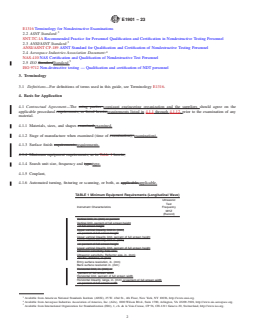
6.1 This guide provides procedures for the application of contact straight-beam examination for the detection and quantitative evaluation of discontinuities in materials.
6.2 Although not all requirements of this guide can be applied universally to all examinations, situations, and materials, it does provide basis for establishing contractual criteria between the users, and may be used as a general guide for preparing detailed specifications for a particular application.
6.3 This guide is directed towards the evaluation of discontinuities detectable with the beam normal to the entry surface. If discontinuities or other orientations are of concern, alternate scanning techniques are required.
SCOPE
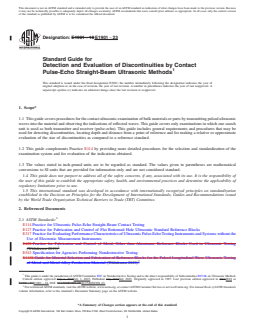
1.1 This guide covers procedures for the contact ultrasonic examination of bulk materials or parts by transmitting pulsed ultrasonic waves into the material and observing the indications of reflected waves. This guide covers only examinations in which one search unit is used as both transmitter and receiver (pulse-echo). This guide includes general requirements and procedures that may be used for detecting discontinuities, locating depth and distance from a point of reference and for making a relative or approximate evaluation of the size of discontinuities as compared to a reference standard.
1.2 This guide complements Practice E114 by providing more detailed procedures for the selection and standardization of the examination system and for evaluation of the indications obtained.
1.3 The values stated in inch-pound units are to be regarded as standard. The values given in parentheses are mathematical conversions to SI units that are provided for information only and are not considered standard.
1.4 This guide does not purport to address all of the safety concerns, if any, associated with its use. It is the responsibility of the user of this guide to establish the appropriate safety, health, and environmental practices and determine the applicability of regulatory limitations prior to use.
1.5 This international standard was developed in accordance with internationally recognized principles on standardization established in the Decision on Principles for the Development of International Standards, Guides and Recommendations issued by the World Trade Organization Technical Barriers to Trade (TBT) Committee.
- Status
- Published
- Publication Date
- 30-Jun-2023
- Technical Committee
- E07 - Nondestructive Testing
- Drafting Committee
- E07.06 - Ultrasonic Method
Buy Documents
ASTM E1901-23 - Standard Guide for Detection and Evaluation of Discontinuities by Contact Pulse-Echo Straight-Beam Ultrasonic Methods
REDLINE ASTM E1901-23 - Standard Guide for Detection and Evaluation of Discontinuities by Contact Pulse-Echo Straight-Beam Ultrasonic Methods
Overview
ASTM E1901-23, titled Standard Guide for Detection and Evaluation of Discontinuities by Contact Pulse-Echo Straight-Beam Ultrasonic Methods, provides comprehensive guidelines for the application of contact ultrasonic pulse-echo straight-beam techniques. This standard is maintained by ASTM International and is primarily focused on procedures for detecting and quantitatively assessing discontinuities in bulk materials or components through the use of ultrasonic waves. It outlines methods for standardized examination, evaluation, and reporting, ensuring consistent non-destructive testing (NDT) processes across diverse industries.
With its focus on contract straight-beam ultrasonic methods, this standard supports reliable quality assurance, allows for establishing contractual criteria between users, and serves as a valuable foundation for creating detailed test specifications tailored to specific materials and applications.
Key Topics
- Contact Pulse-Echo Straight-Beam Examination: Procedures for transmitting and receiving pulsed ultrasonic waves through one search unit to identify, locate, and evaluate material discontinuities.
- System Selection and Standardization: Guidance on choosing appropriate ultrasonic equipment, search units, couplants, and reference standards for the examination process.
- Reference Standards and Calibration: Recommendations for the use of reference blocks and artificial reflectors (such as flat-bottomed holes) to standardize equipment sensitivity and ensure reliable comparison of reflection amplitudes.
- Evaluation of Indications: Processes for interpreting signal responses to determine the size, depth, and significance of detected discontinuities using comparison to reference standards.
- Operational Documentation: Requirements for detailed written procedures, documentation of qualification, and reporting of examination results, supporting traceability and repeatability.
- Personnel Qualification: Recommendations for qualification and certification of testing personnel according to nationally or internationally recognized standards.
- Surface and Material Considerations: Importance of material surface condition, roughness, and appropriate couplant selection for dependable ultrasonic transmission and consistent results.
Applications
ASTM E1901-23 is widely utilized in industries relying on non-destructive evaluation of bulk materials and manufactured components, including but not limited to:
- Metals and Alloys Manufacturing: Detection of internal flaws such as cracks, voids, and inclusions in production and quality control.
- Aerospace and Automotive: Assurance of material integrity in critical components subject to safety and performance requirements.
- Construction and Civil Engineering: Inspection of structural components for embedded defects before and after installation.
- Energy Sector: Examination of pipes, forgings, bars, and similar products in power generation and petrochemical industries.
- Research and Development: Evaluation of new materials and processes using standardized ultrasonic NDT techniques.
By providing clear guidance on implementing pulse-echo straight-beam ultrasonic testing, the standard enhances defect detection capabilities, reduces the risk of in-service failure, and helps organizations meet regulatory and contractual obligations.
Related Standards
Leveraging ASTM E1901-23 ensures compatibility and consistency with other key NDT standards, including:
- ASTM E114: Practice for Ultrasonic Pulse-Echo Straight-Beam Contact Testing.
- ASTM E127: Practice for Fabrication and Control of Flat Bottomed Hole Ultrasonic Standard Reference Blocks.
- ASTM E317: Practice for Evaluating Performance Characteristics of Ultrasonic Pulse-Echo Testing Instruments and Systems.
- ASTM E543: Specification for Agencies Performing Nondestructive Testing.
- ASTM E1316: Terminology for Nondestructive Examinations.
- ASNT SNT-TC-1A, ANSI/ASNT CP-189, NAS-410, ISO 9712: Standards for qualification and certification of NDT personnel.
Implementing ASTM E1901-23 alongside these references promotes robust, repeatable, and industry-accepted ultrasonic NDT practices for superior material assessment and reliable detection of discontinuities.
Relations
- Effective Date
- 01-Feb-2024
- Effective Date
- 01-Dec-2019
- Effective Date
- 01-Mar-2019
- Effective Date
- 01-Jan-2018
- Effective Date
- 15-Jun-2017
- Effective Date
- 01-Feb-2017
- Effective Date
- 01-Aug-2016
- Effective Date
- 01-Feb-2016
- Effective Date
- 01-Dec-2015
- Effective Date
- 01-Sep-2015
- Effective Date
- 01-Jun-2014
- Effective Date
- 01-Jun-2014
- Effective Date
- 01-Dec-2013
- Effective Date
- 15-Jun-2013
- Effective Date
- 01-Jun-2013
Buy Documents
ASTM E1901-23 - Standard Guide for Detection and Evaluation of Discontinuities by Contact Pulse-Echo Straight-Beam Ultrasonic Methods
REDLINE ASTM E1901-23 - Standard Guide for Detection and Evaluation of Discontinuities by Contact Pulse-Echo Straight-Beam Ultrasonic Methods
Get Certified
Connect with accredited certification bodies for this standard

IMP NDT d.o.o.
Non-destructive testing services. Radiography, ultrasonic, magnetic particle, penetrant, visual inspection.
Inštitut za kovinske materiale in tehnologije
Institute of Metals and Technology. Materials testing, metallurgical analysis, NDT.
Q Techna d.o.o.
NDT and quality assurance specialist. 30+ years experience. NDT personnel certification per ISO 9712, nuclear and thermal power plant inspections, QA/
Sponsored listings
Frequently Asked Questions
ASTM E1901-23 is a guide published by ASTM International. Its full title is "Standard Guide for Detection and Evaluation of Discontinuities by Contact Pulse-Echo Straight-Beam Ultrasonic Methods". This standard covers: SIGNIFICANCE AND USE 6.1 This guide provides procedures for the application of contact straight-beam examination for the detection and quantitative evaluation of discontinuities in materials. 6.2 Although not all requirements of this guide can be applied universally to all examinations, situations, and materials, it does provide basis for establishing contractual criteria between the users, and may be used as a general guide for preparing detailed specifications for a particular application. 6.3 This guide is directed towards the evaluation of discontinuities detectable with the beam normal to the entry surface. If discontinuities or other orientations are of concern, alternate scanning techniques are required. SCOPE 1.1 This guide covers procedures for the contact ultrasonic examination of bulk materials or parts by transmitting pulsed ultrasonic waves into the material and observing the indications of reflected waves. This guide covers only examinations in which one search unit is used as both transmitter and receiver (pulse-echo). This guide includes general requirements and procedures that may be used for detecting discontinuities, locating depth and distance from a point of reference and for making a relative or approximate evaluation of the size of discontinuities as compared to a reference standard. 1.2 This guide complements Practice E114 by providing more detailed procedures for the selection and standardization of the examination system and for evaluation of the indications obtained. 1.3 The values stated in inch-pound units are to be regarded as standard. The values given in parentheses are mathematical conversions to SI units that are provided for information only and are not considered standard. 1.4 This guide does not purport to address all of the safety concerns, if any, associated with its use. It is the responsibility of the user of this guide to establish the appropriate safety, health, and environmental practices and determine the applicability of regulatory limitations prior to use. 1.5 This international standard was developed in accordance with internationally recognized principles on standardization established in the Decision on Principles for the Development of International Standards, Guides and Recommendations issued by the World Trade Organization Technical Barriers to Trade (TBT) Committee.
SIGNIFICANCE AND USE 6.1 This guide provides procedures for the application of contact straight-beam examination for the detection and quantitative evaluation of discontinuities in materials. 6.2 Although not all requirements of this guide can be applied universally to all examinations, situations, and materials, it does provide basis for establishing contractual criteria between the users, and may be used as a general guide for preparing detailed specifications for a particular application. 6.3 This guide is directed towards the evaluation of discontinuities detectable with the beam normal to the entry surface. If discontinuities or other orientations are of concern, alternate scanning techniques are required. SCOPE 1.1 This guide covers procedures for the contact ultrasonic examination of bulk materials or parts by transmitting pulsed ultrasonic waves into the material and observing the indications of reflected waves. This guide covers only examinations in which one search unit is used as both transmitter and receiver (pulse-echo). This guide includes general requirements and procedures that may be used for detecting discontinuities, locating depth and distance from a point of reference and for making a relative or approximate evaluation of the size of discontinuities as compared to a reference standard. 1.2 This guide complements Practice E114 by providing more detailed procedures for the selection and standardization of the examination system and for evaluation of the indications obtained. 1.3 The values stated in inch-pound units are to be regarded as standard. The values given in parentheses are mathematical conversions to SI units that are provided for information only and are not considered standard. 1.4 This guide does not purport to address all of the safety concerns, if any, associated with its use. It is the responsibility of the user of this guide to establish the appropriate safety, health, and environmental practices and determine the applicability of regulatory limitations prior to use. 1.5 This international standard was developed in accordance with internationally recognized principles on standardization established in the Decision on Principles for the Development of International Standards, Guides and Recommendations issued by the World Trade Organization Technical Barriers to Trade (TBT) Committee.
ASTM E1901-23 is classified under the following ICS (International Classification for Standards) categories: 19.100 - Non-destructive testing. The ICS classification helps identify the subject area and facilitates finding related standards.
ASTM E1901-23 has the following relationships with other standards: It is inter standard links to ASTM E1316-24, ASTM E1316-19b, ASTM E1316-19, ASTM E1316-18, ASTM E1316-17a, ASTM E1316-17, ASTM E1316-16a, ASTM E1316-16, ASTM E1316-15a, ASTM E1316-15, ASTM E1316-14, ASTM E1316-14e1, ASTM E1316-13d, ASTM E1316-13c, ASTM E1316-13b. Understanding these relationships helps ensure you are using the most current and applicable version of the standard.
ASTM E1901-23 is available in PDF format for immediate download after purchase. The document can be added to your cart and obtained through the secure checkout process. Digital delivery ensures instant access to the complete standard document.
Standards Content (Sample)
This international standard was developed in accordance with internationally recognized principles on standardization established in the Decision on Principles for the
Development of International Standards, Guides and Recommendations issued by the World Trade Organization Technical Barriers to Trade (TBT) Committee.
Designation: E1901 − 23
Standard Guide for
Detection and Evaluation of Discontinuities by Contact
Pulse-Echo Straight-Beam Ultrasonic Methods
This standard is issued under the fixed designation E1901; the number immediately following the designation indicates the year of
original adoption or, in the case of revision, the year of last revision. A number in parentheses indicates the year of last reapproval. A
superscript epsilon (´) indicates an editorial change since the last revision or reapproval.
1. Scope* 2. Referenced Documents
1.1 This guide covers procedures for the contact ultrasonic 2.1 ASTM Standards:
examination of bulk materials or parts by transmitting pulsed E114 Practice for Ultrasonic Pulse-Echo Straight-Beam
ultrasonic waves into the material and observing the indica- Contact Testing
tions of reflected waves. This guide covers only examinations E127 Practice for Fabrication and Control of Flat Bottomed
in which one search unit is used as both transmitter and Hole Ultrasonic Standard Reference Blocks
receiver (pulse-echo). This guide includes general require- E317 Practice for Evaluating Performance Characteristics of
ments and procedures that may be used for detecting Ultrasonic Pulse-Echo Testing Instruments and Systems
discontinuities, locating depth and distance from a point of without the Use of Electronic Measurement Instruments
reference and for making a relative or approximate evaluation E543 Specification for Agencies Performing Nondestructive
of the size of discontinuities as compared to a reference Testing
standard. E1316 Terminology for Nondestructive Examinations
2.2 ASNT Standard:
1.2 This guide complements Practice E114 by providing
SNT-TC-1A Recommended Practice for Personnel Qualifi-
more detailed procedures for the selection and standardization
cation and Certification in Nondestructive Testing Person-
of the examination system and for evaluation of the indications
nel
obtained.
2.3 ANSI/ASNT Standard:
1.3 The values stated in inch-pound units are to be regarded
ANSI/ASNT CP-189 ASNT Standard for Qualification and
as standard. The values given in parentheses are mathematical
Certification of Nondestructive Testing Personnel
conversions to SI units that are provided for information only 4
2.4 Aerospace Industries Association Document:
and are not considered standard.
NAS-410 NAS Certification and Qualification of Nonde-
1.4 This guide does not purport to address all of the safety
structive Test Personnel
concerns, if any, associated with its use. It is the responsibility 2.5 ISO Standard:
of the user of this guide to establish the appropriate safety,
ISO 9712 Non-destructive testing — Qualification and cer-
health, and environmental practices and determine the appli- tification of NDT personnel
cability of regulatory limitations prior to use.
3. Terminology
1.5 This international standard was developed in accor-
dance with internationally recognized principles on standard-
3.1 Definitions—For definitions of terms used in this guide,
ization established in the Decision on Principles for the
see Terminology E1316.
Development of International Standards, Guides and Recom-
mendations issued by the World Trade Organization Technical
For referenced ASTM standards, visit the ASTM website, www.astm.org, or
Barriers to Trade (TBT) Committee.
contact ASTM Customer Service at service@astm.org. For Annual Book of ASTM
Standards volume information, refer to the standard’s Document Summary page on
the ASTM website.
Available from American National Standards Institute (ANSI), 25 W. 43rd St.,
This guide is under the jurisdiction of ASTM Committee E07 on Nondestruc- 4th Floor, New York, NY 10036, http://www.ansi.org.
tive Testing and is the direct responsibility of Subcommittee E07.06 on Ultrasonic Available from Aerospace Industries Association of America, Inc. (AIA), 1000
Method. Wilson Blvd., Suite 1700, Arlington, VA 22209-3928, http://www.aia-aerospace.org.
Current edition approved July 1, 2023. Published July 2023. Originally approved
in 1997. Last previous edition approved in 2018 as E1901 – 18. DOI: 10.1520/ Available from International Organization for Standardization (ISO), 1, ch. de
E1901-23. la Voie-Creuse, CP 56, CH-1211 Geneva 20, Switzerland, http://www.iso.org.
*A Summary of Changes section appears at the end of this standard
Copyright © ASTM International, 100 Barr Harbor Drive, PO Box C700, West Conshohocken, PA 19428-2959. United States
E1901 − 23
4. Basis for Application 6.3 This guide is directed towards the evaluation of discon-
tinuities detectable with the beam normal to the entry surface.
4.1 Contractual Agreement—The cognizant engineering or-
If discontinuities or other orientations are of concern, alternate
ganization and the suppliers should agree on the applicable
scanning techniques are required.
procedural requirements listed in 4.1.1 through 4.1.12, prior to
the examination of any material.
7. Apparatus
4.1.1 Materials, sizes, and shapes examined.
7.1 Apparatus should include the following:
4.1.2 Stage of manufacture when examined (time of exami-
7.1.1 Electronic Equipment—The electronic equipment
nation).
should be capable of producing and processing electronic
4.1.3 Surface finish requirements.
signals at frequencies in the range of the search unit frequen-
4.1.4 Search unit size, frequency and type.
cies being used. The equipment and its display should provide
4.1.5 Couplant,
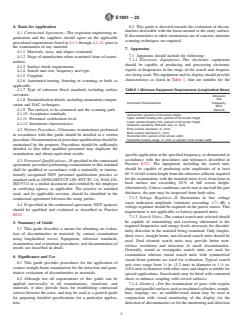
characteristics as listed in Table 1, that are suitable for the
4.1.6 Automated turning, fixturing or scanning, or both, as
applicable.
4.1.7 Type of reference block standards including surface TABLE 1 Minimum Equipment Requirements (Longitudinal Wave)
curvature.
Ultrasonic
Test
4.1.8 Standardization details, including attenuation compen-
Instrument Characteristics Frequency
sation and DAC techniques.
MHZ
4.1.9 The surfaces to be examined and the scanning path.
(Record)
4.1.10 Acceptance standards.
Vertical limit, percent of full screen height
Upper vertical linearity limit, percent of full screen height
4.1.11 Personnel certification level.
Lower vertical linearity limit, percent of full screen height
4.1.12 Instrument characteristics.
Ultrasonic sensitivity, Reflector size, in. (mm)
Entry surface resolution, in. (mm)
4.2 Written Procedure—Ultrasonic examinations performed
Back surface resolution in. (mm)
in accordance with this guide should be detailed in a written
Horizontal limit, percent of full screen width
procedure. Documentation of procedure qualification should be Horizontal linearity range, in. (mm) or percent of full screen width
maintained by the preparer. Procedures should be sufficiently
detailed so that other qualified personnel may duplicate the
examination and obtain equivalent results.
specific application at the specified frequency, as determined in
accordance with the procedures and tolerances described in
4.3 Personnel Qualifications—If specified in the contractual
Practice E317. The equipment, including the search unit,
agreement, personnel performing examinations to this standard
should be capable of producing echo amplitudes of at least
shall be qualified in accordance with a nationally or interna-
60 % of full screen height from the reference reflector required
tionally recognized NDT personnel qualification practice or
for the examination, with the material noise level, from front to
standard such as ANSI/ASNT-CP-189, SNT-TC-1A, NAS-410,
back surface not exceeding 20 % of full screen height.
ISO 9712 or a similar document and certified by the employer
Alternatively, if these conditions can be met at one half the part
or certifying agency, as applicable. The practice or standard
thickness, the part may be inspected from both sides.
used, and its applicable revision, should be identified in the
7.1.2 Voltage Regulator—If fluctuations in line voltage
contractual agreement between the using parties.
cause indication amplitude variations exceeding 6 ⁄2 dB, a
4.4 If specified in the contractual agreement, NDT agencies
voltage regulator should be required on the power source. This
should be qualified and evaluated as described in Practice
requirement is not applicable to battery-operated units.
E543.
7.1.3 Search Units—The contact search unit selected should
be capable of transmitting and receiving ultrasound at the
5. Summary of Guide
required frequencies and energy levels necessary for disconti-
5.1 This guide describes a means for obtaining an evalua-
nuity detection in the material being examined. Only longitu-
tion of discontinuities in materials by contact examination
dinal wave, straight beam, non-focused search units should be
using longitudinal waves. Equipment, reference standards,
used. Dual element search units may provide better near-
examination and evaluation procedures, and documentation of
surface resolution and detection of small discontinuities.
results are described in detail.
Generally, round or rectangular search units are used for
examination whereas round search units with symmetrical
6. Significance and Use
sound beam patterns are used for evaluation. Typical search
6.1 This guide provides procedures for the application of
1 1
unit sizes range from ⁄8 in. (3.2 mm) in diameter to 1 ⁄8 in.
contact straight-beam examination for the detection and quan-
(28.6 mm) in diameter with other sizes and shapes available for
titative evaluation of discontinuities in materials.
special applications. Search units may be fitted with contoured
6.2 Although not all requirements of this guide can be shoes to enhance coupling with curved surfaces.
applied universally to all examinations, situations, and 7.1.4 Alarm(s)—For the examination of parts with regular
materials, it does provide basis for establishing contractual shape and parallel surfaces such as machined cylinders, rounds,
criteria between the users, and may be used as a general guide bars, forgings, etc. an audible/visual alarm may be used in
for preparing detailed specifications for a particular applica- conjunction with visual monitoring of the display for the
tion. detection of discontinuities or for the monitoring and detection
E1901 − 23
of loss of back surface reflection, or both. The alarm should be search unit may be necessary to avoid temperature changes that
adjustable to allow triggering at commonly required indication affect the ultrasonic characteristics of the search unit. At higher
amplitudes, back-echo heights, and depths. During examina- temperatures, certain couplants based on inorganic salts or
tion the audible visual alarm should be easily detectable by the thermoplastic organic materials, high-temperature delay mate-
operator. rials (shoes) and search units that are not affected by high
7.1.4.1 When reduction in the amplitude of back-surface temperatures may be required.
reflection is monitored simultaneously with the detection of 7.2.3 Where constant coupling over large areas is required,
lower amplitude signals from small, discrete discontinuities, as in automated examination, or where severe changes in
two separate gate/alarm systems are required. The negative surface roughness are found, other methods of coupling such as
slaved alarm system may also provide for a significantly lower liquid gap coupling will usually provide a better examination.
receiver gain at the gated depth to avoid back-echo saturation. In this case, the search unit does not contact the examination
See 10.1 and 10.4. surface, but is separated by a distance of about 0.02 in.
7.1.4.2 For some applications it may be advantageous to (0.5 mm) filled with couplant. Liquid flowing through the
utilize a flaw gate system in which the echo-amplitude alarm search unit mechanism fills the gap. The flowing liquid
level can be varied as a function of target depth. Refer to provides the coupling path and has the additional advantage of
distance/amplitude gate (DAG) in 9.3.2.1.
cooling the search unit if the examination surface is warm.
7.2.4 Another means of direct contact coupling is provided
7.2 Couplant—A couplant, usually a liquid or semi-liquid, is
by the wheel search unit. The search unit is mounted at the
required between the face of the search unit and the examina-
correct angle to a stationary axle about which rotates a
tion surface to permit transmittance of ultrasound from the
liquid-filled flexible tire. A minimum amount of couplant
search unit into the material under examination unless the
provides for ultrasonic transmission into the examination
transducer is specially designed for “dry” coupling by the
surface since the elastic tire material is in rolling contact and
manufacturer. Typical couplants include water, cellulose gel,
conforms closely to the surface.
oil, and grease. Corrosion inhibitors or wetting agents or both
may be used. Couplants selected must not be detrimental to the
7.3 Reference Standards—The production item itself may
product or the process. The same couplant used for standard- be an adequate standard using the height of the back-wall echo
ization should be used for the examination. During the perfor-
for reference. For more quantitative information, charts such as
mance of a contact ultrasonic examination, the couplant layer Distance Gain Size (DGS, also known as AVG in German
between search unit and examination material must be main-
translation), representing distance-amplitude relationships of
tained such that the contact area is held constant while known reflector sizes for a particular search unit, frequency
maintaining adequate couplant thickness. Lack of couplant that
and material may be used for standardization and evaluation of
will reduce the effective contact area, or excess couplant, will discontinuities.
reduce the amount of energy transferred between the search
7.3.1 Reference Blocks—Ultrasonic reference blocks, often
unit and the examination surface. These couplant variations, in called test blocks, are used to standardize the ultrasonic
turn, result in examination sensitivity variations.
equipment and to evaluate the indications received from
7.2.1 The couplant should be selected such that its viscosity
discontinuities within the part. The ultrasonic characteristics of
is appropriate for the surface finish of the material to be
the reference blocks such as attenuation, noise level, surface
examined. The examination of rough surfaces generally re-
condition, and sound velocity, should be similar to the material
quires a high-viscosity couplant and will result in some
to be examined. Standardization verifies that the instrument
deterioration of near-surface discontinuity detection. The tem-
search unit is performing as required and establishes a detec-
perature of the material surface can change the couplant’s
tion level for discontinuities.
viscosity as in the case of oil and grease. See Table 2 for the
7.3.2 Flat Blocks—The three most commonly used sets of
suggested viscosity of oil couplants for given surface rough-
reference block are area-amplitude set, containing blocks with
nesses.
the same material path and various sizes of reference reflectors;
7.2.2 At elevated temperatures as conditions warrant, heat-
distance-amplitude set, containing blocks with one size refer-
resistant coupling materials such as silicone oils, gels, or
ence reflector at various material distances; and a combination
greases should be used. Further, intermittent contact of the
including both area-amplitude and distance-amplitude blocks
search unit with the part surface or auxiliary cooling of the
in one set. These sets are described in Practice E127.
7.3.3 Curved Surfaces—Reference blocks with flat surfaces
may be used for establishing gain settings for examinations on
TABLE 2 Suggested Viscosities-Oil Couplants
concave surfaces and convex surfaces with radii of curvature
NOTE 1—This table is a guide and is not meant to exclude the use of a 4 in. (101.6 mm) or greater. For convex surfaces with radii of
particular couplant that is found to work satisfactorily on a surface.
curvature less than 4 in. (101.6 mm) it is recommended that
Approximate Surface Roughness Average Equivalent Couplant Viscosity
reference blocks with approximately the same nominal radius
(Ra) μin. (μm) Weight Motor Oil
of curvature should be used.
5-100 (0.1 to 2.5) SAE 10
50-200 (1.3 to 5.1) SAE 20 7.4 Reference Reflectors—Flat-bottomed holes, (FBH), or
100-400 (2.5 to 10.2) SAE 30
other artificial discontinuities, located directly in the material,
250-700 (6.4 to 17.8) SAE 40
in a representative sample of the part or material, or in
Over 700 (18+) Cup Grease
reference blocks, should be used to reference echo amplitude
E1901 − 23
or to perform distance-amplitude correction (DAC), or both. difference between signals received from the back surfaces of
For most examinations, the bottom surface of a suitable the reference block and the production material having equal
flat-bottom hole is the common reference reflector. However, thickness, and correcting for this difference.
other types of artificial discontinuities (notches, side-drilled
9.3 Initial Standardization:
holes, areas of unbond or lack of fusion, etc.) may be used.
9.3.1 Standardization using the production part as the ref-
erence standard. Examinations may be conducted using the
8. General Examination Requirements
production part as the reference standard. This technique
8.1 Material Condition—Unless otherwise agreed upon, the
generally applies to simple solid shapes with parallel or
surface finish of the article under examination should not
diametrically opposing surfaces. Using the gain control, the
exceed 250 μin. (6.4 μm) rms and should be free from waviness
amplitude of the initial back echo reflection is established as a
that may affect the examination. Ultrasonic examination should
percent of full screen height, normally 80 %, and this setting is
be performed in the simplest configuration possible and after
used to examine the part. This technique is suitable for the
all operations that may cause a discontinuity. Examinations of
detection of planar discontinuities generally parallel to the
parts or material prior to machining is acceptable provided
entry surface and having a minimum extent equal to an
surface roughness and part geometry are within the tolerance
appreciable fraction of the cross sectional area of the trans-
specified in the written procedure. When it is determined that
ducer beam.
surface roughness or waviness, or both, precludes adequate
9.3.1.1 For some materials, attenuation curves on overlays
detection and evaluation of subsurface discontinuities, smooth
that fit over the display, and charts, such as (AVG/DGS)
the areas in question by machining, grinding, or other means
showing distance-amplitude relationships of known reflectors
prior to the examination. During examination and evaluation
are available. These techniques utilize information derived
ensure that entry surface free from loos
...
This document is not an ASTM standard and is intended only to provide the user of an ASTM standard an indication of what changes have been made to the previous version. Because
it may not be technically possible to adequately depict all changes accurately, ASTM recommends that users consult prior editions as appropriate. In all cases only the current version
of the standard as published by ASTM is to be considered the official document.
Designation: E1901 − 18 E1901 − 23
Standard Guide for
Detection and Evaluation of Discontinuities by Contact
Pulse-Echo Straight-Beam Ultrasonic Methods
This standard is issued under the fixed designation E1901; the number immediately following the designation indicates the year of
original adoption or, in the case of revision, the year of last revision. A number in parentheses indicates the year of last reapproval. A
superscript epsilon (´) indicates an editorial change since the last revision or reapproval.
1. Scope*
1.1 This guide covers procedures for the contact ultrasonic examination of bulk materials or parts by transmitting pulsed ultrasonic
waves into the material and observing the indications of reflected waves. This guide covers only examinations in which one search
unit is used as both transmitter and receiver (pulse-echo). This guide includes general requirements and procedures that may be
used for detecting discontinuities, locating depth and distance from a point of reference and for making a relative or approximate
evaluation of the size of discontinuities as compared to a reference standard.
1.2 This guide complements Practice E114 by providing more detailed procedures for the selection and standardization of the
examination system and for evaluation of the indications obtained.
1.3 The values stated in inch-pound units are to be regarded as standard. The values given in parentheses are mathematical
conversions to SI units that are provided for information only and are not considered standard.
1.4 This guide does not purport to address all of the safety concerns, if any, associated with its use. It is the responsibility of
the user of this guide to establish the appropriate safety, health, and environmental practices and determine the applicability of
regulatory limitations prior to use.
1.5 This international standard was developed in accordance with internationally recognized principles on standardization
established in the Decision on Principles for the Development of International Standards, Guides and Recommendations issued
by the World Trade Organization Technical Barriers to Trade (TBT) Committee.
2. Referenced Documents
2.1 ASTM Standards:
E114 Practice for Ultrasonic Pulse-Echo Straight-Beam Contact Testing
E127 Practice for Fabrication and Control of Flat Bottomed Hole Ultrasonic Standard Reference Blocks
E317 Practice for Evaluating Performance Characteristics of Ultrasonic Pulse-Echo Testing Instruments and Systems without the
Use of Electronic Measurement Instruments
E428 Practice for Fabrication and Control of Metal, Other than Aluminum, Reference Blocks Used in Ultrasonic Testing
(Withdrawn 2019)
E543 Specification for Agencies Performing Nondestructive Testing
E1158 Guide for Material Selection and Fabrication of Reference Blocks for the Pulsed Longitudinal Wave Ultrasonic Testing
of Metal and Metal Alloy Production Material (Withdrawn 2019)
This guide is under the jurisdiction of ASTM Committee E07 on Nondestructive Testing and is the direct responsibility of Subcommittee E07.06 on Ultrasonic Method.
Current edition approved July 1, 2018July 1, 2023. Published July 2018July 2023. Originally approved in 1997. Last previous edition approved in 20132018 as
E1901 - 13.E1901 – 18. DOI: 10.1520/E1901-18.10.1520/E1901-23.
For referenced ASTM standards, visit the ASTM website, www.astm.org, or contact ASTM Customer Service at service@astm.org. For Annual Book of ASTM Standards
volume information, refer to the standard’s Document Summary page on the ASTM website.
*A Summary of Changes section appears at the end of this standard
Copyright © ASTM International, 100 Barr Harbor Drive, PO Box C700, West Conshohocken, PA 19428-2959. United States
E1901 − 23
E1316 Terminology for Nondestructive Examinations
2.2 ASNT Standard:
SNT-TC-1A Recommended Practice for Personnel Qualification and Certification in Nondestructive Testing Personnel
2.3 ANSI/ASNT Standard:
ANSI/ASNT CP-189 ASNT Standard for Qualification and Certification of Nondestructive Testing Personnel
2.4 Aerospace Industries Association Document:
NAS-410 NAS Certification and Qualification of Nondestructive Test Personnel
2.5 ISO StandardStandard:
ISO 9712 Non-destructive testing — Qualification and certification of NDT personnel
3. Terminology
3.1 Definitions—For definitions of terms used in this guide, see Terminology E1316.
4. Basis for Application
4.1 Contractual Agreement—The using parties cognizant engineering organization and the suppliers should agree on the
applicable procedural requirements, as listed herein,requirements listed in 4.1.1 through 4.1.12, prior to the examination of any
material.
4.1.1 Materials, sizes, and shapes examined,examined.
4.1.2 Stage of manufacture when examined (time of examination), examination).
4.1.3 Surface finish requirements,requirements.
4.1.4 Minimum equipment requirements, as in Table 1 herein,
4.1.4 Search unit size, frequency and type,type.
4.1.5 Couplant,
4.1.6 Automated turning, fixturing or scanning, or both, as applicable,applicable.
TABLE 1 Minimum Equipment Requirements (Longitudinal Wave)
Ultrasonic
Test
Instrument Characteristics Frequency
MHZ
(Record)
Vertical limit, in. (mm) or percent
Vertical limit, percent of full screen height
of full screen height
Upper vertical linearity limit in. (mm)
or percent of full screen height
Upper vertical linearity limit, percent of full screen height
Lower vertical linearity limit in. (mm)
or percent of full screen height
Lower vertical linearity limit, percent of full screen height
Ultrasonic sensitivity, hole size,
Ultrasonic sensitivity, Reflector size, in. (mm)
64 ths, distance, in (mm)
Entry surface resolution, in. (mm)
Back surface resolution in. (mm)
Horizontal limit, in. (mm) or
percent of full screen width
Horizontal limit, percent of full screen width
Horizontal linearity range, in. (mm) or percent of full screen width
or percent of full screen width
Available from American National Standards Institute (ANSI), 25 W. 43rd St., 4th Floor, New York, NY 10036, http://www.ansi.org.
Available from Aerospace Industries Association of America, Inc. (AIA), 1000 Wilson Blvd., Suite 1700, Arlington, VA 22209-3928, http://www.aia-aerospace.org.
Available from International Organization for Standardization (ISO), 1, ch. de la Voie-Creuse, CP 56, CH-1211 Geneva 20, Switzerland, http://www.iso.org.
E1901 − 23
4.1.7 Type of reference block standards including surface curvature,curvature.
4.1.8 Standardization details, including attenuation compensation and DAC techniques,techniques.
4.1.9 The surfaces to be examined and the scanning path, path.
4.1.10 Acceptance standards,standards.
4.1.11 Personnel certification level, andlevel.
4.1.12 Instrument characteristics.
4.2 Written Procedure—Ultrasonic examinations performed in accordance with this guide should be detailed in a written
procedure. Documentation of procedure qualification should be maintained by the preparer. Procedures should be sufficiently
detailed so that other qualified personnel may duplicate the examination and obtain equivalent results.
4.3 Personnel Qualifications—If specified in the contractual agreement, personnel performing examinations to this standard shall
be qualified in accordance with a nationally or internationally recognized NDT personnel qualification practice or standard such
as ANSI/ASNT-CP-189, SNT-TC-1A, NAS-410, ISO 9712 or a similar document and certified by the employer or certifying
agency, as applicable. The practice or standard used, and its applicable revision, should be identified in the contractual agreement
between the using parties.
4.4 If specified in the contractual agreement, NDT agencies should be qualified and evaluated as described in Practice E543.
5. Summary of Guide
5.1 This guide describes a means for obtaining an evaluation of discontinuities in materials by contact examination using
longitudinal waves. Equipment, reference standards, examination and evaluation procedures, and documentation of results are
described in detail.
6. Significance and Use
6.1 This guide provides procedures for the application of contact straight-beam examination for the detection and quantitative
evaluation of discontinuities in materials.
6.2 Although not all requirements of this guide can be applied universally to all examinations, situations, and materials, it does
provide basis for establishing contractual criteria between the users, and may be used as a general guide for preparing detailed
specifications for a particular application.
6.3 This guide is directed towards the evaluation of discontinuities detectable with the beam normal to the entry surface. If
discontinuities or other orientations are of concern, alternate scanning techniques are required.
7. Apparatus
7.1 Apparatus should include the following:
7.1.1 Electronic Equipment—The electronic equipment should be capable of producing and processing electronic signals at
frequencies in the range of the search unit frequencies being used. The equipment and its display should provide characteristics
as listed in Table 1, that are suitable for the specific application at the specified frequency, as determined in accordance with the
procedures and tolerances described in Practice E317. The equipment, including the search unit, should be capable of producing
echo amplitudes of at least 60 % of full screen height from the reference reflector required for the examination, with the material
noise level, from front to back surface not exceeding 20 % of full screen height. Alternatively, if these conditions can be met at
one half the part thickness, the part may be inspected from both sides.
NOTE 1—The using parties should agree on the minimum instrument characteristics prior to conducting an examination.
E1901 − 23
7.1.2 Voltage Regulator—If fluctuations in line voltage cause indication amplitude variations exceeding 6 ⁄2 dB, a voltage
regulator should be required on the power source. This requirement is not applicable to battery-operated units.
7.1.3 Search Units—The contact search unit selected should be capable of transmitting and receiving ultrasound at the required
frequencies and energy levels necessary for discontinuity detection in the material being examined. Only longitudinal wave,
straight beam, non-focused search units should be used. Dual element search units may provide better near-surface resolution and
detection of small discontinuities. Generally, round or rectangular search units are used for examination whereas round search units
with symmetrical sound beam patterns are used for evaluation. Typical search unit sizes range from ⁄8 in. (3.2 mm) in diameter
to 1-1 ⁄8 in. (28.6 mm) in diameter with other sizes and shapes available for special applications. Search units may be fitted with
contoured shoes to enhance coupling with curved surfaces.
7.1.4 Alarm(s)—For the examination of parts with regular shape and parallel surfaces such as machined cylinders, rounds, bars,
forgings, etc. an audible/visual alarm may be used in conjunction with visual monitoring of the display for the detection of
discontinuities or for the monitoring and detection of loss of back surface reflection, or both. The alarm should be adjustable to
allow triggering at commonly required indication amplitudes, back-echo heights, and depths. During examination the audible
visual alarm should be easily detectable by the operator.
7.1.4.1 When reduction in the amplitude of back-surface reflection is monitored simultaneously with the detection of lower
amplitude signals from small, discrete discontinuities, two separate gate/alarm systems are required. The negative slaved alarm
system may also provide for a significantly lower receiver gain at the gated depth to avoid back-echo saturation. See 10.1 and 10.4.
7.1.4.2 For some applications it may be advantageous to utilize a flaw gate system in which the echo-amplitude alarm level can
be varied as a function of target depth. Refer to distance/amplitude gate (DAG) in 9.3.2.1.
7.2 Couplant—A couplant, usually a liquid or semi-liquid, is required between the face of the search unit and the examination
surface to permit transmittance of ultrasound from the search unit into the material under examination unless the transducer is
specially designed for “dry” coupling by the manufacturer. Typical couplants include water, cellulose gel, oil, and grease.
Corrosion inhibitors or wetting agents or both may be used. Couplants selected must not be detrimental to the product or the
process. The same couplant used for standardization should be used for the examination. During the performance of a contact
ultrasonic examination, the couplant layer between search unit and examination material must be maintained such that the contact
area is held constant while maintaining adequate couplant thickness. Lack of couplant that will reduce the effective contact area,
or excess couplant, will reduce the amount of energy transferred between the search unit and the examination surface. These
couplant variations, in turn, result in examination sensitivity variations.
7.2.1 The couplant should be selected such that its viscosity is appropriate for the surface finish of the material to be examined.
The examination of rough surfaces generally requires a high-viscosity couplant and will result in some deterioration of near-surface
discontinuity detection. The temperature of the material surface can change the couplant’s viscosity as in the case of oil and grease.
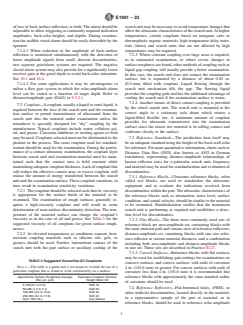
See Table 2 for the suggested viscosity of oil couplants for given surface roughnesses.
7.2.2 At elevated temperatures as conditions warrant, heat-resistant coupling materials such as silicone oils, gels, or greases should
be used. Further, intermittent contact of the search unit with the part surface or auxiliary cooling of the search unit may be
necessary to avoid temperature changes that affect the ultrasonic characteristics of the search unit. At higher temperatures, certain
couplants based on inorganic salts or thermoplastic organic materials, high-temperature delay materials (shoes) and search units
that are not affected by high temperatures may be required.
7.2.3 Where constant coupling over large areas is required, as in automated examination, or where severe changes in surface
TABLE 2 Suggested Viscosities-Oil Couplants
NOTE 1—This table is a guide and is not meant to exclude the use of a
particular couplant that is found to work satisfactorily on a surface.
Approximate Surface Roughness Average Equivalent Couplant Viscosity
(Ra) μin. (μm) Weight Motor Oil
5-100 (0.1 to 2.5) SAE 10
50-200 (1.3 to 5.1) SAE 20
100-400 (2.5 to 10.2) SAE 30
250-700 (6.4 to 17.8) SAE 40
Over 700 (18+) Cup Grease
E1901 − 23
roughness are found, other methods of coupling such as liquid gap coupling will usually provide a better examination. In this case,
the search unit does not contact the examination surface, but is separated by a distance of about 0.02 in. (0.5 mm) (0.5 mm) filled
with couplant. Liquid flowing through the search unit mechanism fills the gap. The flowing liquid provides the coupling path and
has the additional advantage of cooling the search unit if the examination surface is warm.
7.2.4 Another means of direct contact coupling is provided by the wheel search unit. The search unit is mounted at the correct
angle to a stationary axle about which rotates a liquid-filled flexible tire. A minimum amount of couplant provides for ultrasonic
transmission into the examination surface since the elastic tire material is in rolling contact and conforms closely to the surface.
7.3 Reference Standards—The production item itself may be an adequate standard using the height of the back-wall echo for
reference. For more quantitative information, charts such as Distance Gain Size (DGS, also known as AVG in German translation),
representing distance-amplitude relationships of known reflector sizes for a particular search unit, frequency and material may be
used for standardization and evaluation of discontinuities.
7.3.1 Reference Blocks—Ultrasonic reference blocks, often called test blocks, are used to standardize the ultrasonic equipment and
to evaluate the indications received from discontinuities within the part. The ultrasonic characteristics of the reference blocks such
as attenuation, noise level, surface condition, and sound velocity, should be similar to the material to be examined. Standardization
verifies that the instrument search unit is performing as required and establishes a detection level for discontinuities.
7.3.2 Flat Blocks—The three most commonly used sets of reference block are area-amplitude set, containing blocks with the same
material path and various sizes of reference reflectors; distance-amplitude set, containing blocks with one size reference reflector
at various material distances; and a combination including both area-amplitude and distance-amplitude blocks in one set. These
sets are described in PracticesPractice E127 and E428.
7.3.3 Curved Surfaces—Reference blocks with flat surfaces may be used for establishing gain settings for examinations on
concave surfaces and convex surfaces with radii of curvature 4 in. 4 in. (101.6 mm) or greater. For convex surfaces with radii of
curvature less than 4 in. 4 in. (101.6 mm) it is recommended that reference blocks with approximately the same nominal radius
of curvature should be used. Guide E1158 illustrates typical curved entry surface blocks.
7.4 Reference Reflectors—Flat-bottomed holes, (FBH), or other artificial discontinuities, located directly in the material, in a
representative sample of the part or material, or in reference blocks, should be used to reference echo amplitude or to perform
distance-amplitude correction (DAC), or both. For most examinations, the bottom surface of a suitable flat-bottom hole is the
common reference reflector. However, other types of artificial discontinuities (notches, side-drilled holes, areas of unbond or lack
of fusion, etc.) may be used.
8. General Examination Requirements
8.1 Material Condition—Unless otherwise agreed upon, the surface finish of the article under examination should not exceed 250
μin. (6.4 μm) rms and should be free from waviness that may affect the examination. Ultrasonic examination should be performed
in the simplest configuration possible and after all operations that may cause a discontinuity. Examinations of parts or material prior
to machining is acceptable provided surface roughness and part geometry are within the tolerance specified in the written
procedure. When it is determined that surface roughness or waviness, or both, precludes adequate detection and evaluation of
subsurface discontinuities, smooth the areas in question by machining, grinding, or other means prior to the examination. During
examination and evaluation ensure that entry surface free from loose scale, grinding particles, or other loose matter.
8.2 Coverage—In all examinations, perform scanning to locate discontinuities that are oriented parallel with the entry surface, or
plane, or both, approximately normal to the major propagation direction that is parallel to the grain flow of the part.
8.3 Resolution and Penetration—When the complete standardization cannot be accomplished due to excessive noise levels (based
on 3:1 signal-to-noise ratio) or material thicknesses, the examinations should be performed from opposite sides. Examinations
conducted from opposite sides should provide for examination of a minimum of one-half material thickness and should provide
for the resolution and penetration necessary to detect the minimum size reflector at the minimum and maximum metal path
distance.
8.4 Ultra
...