

oSIST prEN ISO/IEC 2382-37:2026
(Main)Information technology - Vocabulary - Part 37: Biometrics (ISO/IEC DIS 2382-37:2026)
- Abstract
This document establishes a systematic description of the concepts in the field of biometrics pertaining to recognition of human beings. This document also reconciles variant terms in use in pre-existing International Standards on biometrics against the preferred terms, thereby clarifying the use of terms in this field.
This document does not cover concepts (represented by terms) from information technology, pattern recognition, biology, mathematics, etc. Biometrics uses such fields of knowledge as a basis.
In principle, mode-specific terms are outside of scope of this document.
- Status
- Not Published
- Public Enquiry End Date
- 22-Dec-2026
- Technical Committee
- ITC - Information technology
- Current Stage
- 4020 - Public enquire (PE) (Adopted Project)
- Start Date
- 28-Oct-2026
- Due Date
- 17-Mar-2027
- Completion Date
- 10-Nov-2026


oSIST prEN ISO/IEC 2382-37:2026 is a vocabulary standard for biometrics in information technology, issued under ISO/IEC and adopted in the CEN system as oSIST prEN ISO/IEC 2382-37:2026. It defines and harmonizes the terms used for human biometric recognition, so standardizers, system owners, operators and users can speak about capture, enrolment, comparison, verification and identification in the same way.
What does oSIST prEN ISO/IEC 2382-37:2026 specify?
oSIST prEN ISO/IEC 2382-37:2026 specifies a systematic description of the concepts used in biometrics for the recognition of human beings. It also reconciles variant terms used in earlier biometric standards with preferred terms, which matters in practice because the same process, record or score is often named differently across products and documents.
The document is organized as follows:
- Clause 1 - Scope
- Clause 2 - Normative references
- Clause 3 - Terms and definitions, arranged in subclauses from general concepts through systems, data, devices, functioning, interaction, personnel, application, performance and mode-specific terms
- Bibliography
- Alphabetical index
The scope limits the vocabulary to biometric recognition and says that supporting fields such as information technology, pattern recognition, biology and mathematics are not themselves the subject of the vocabulary. It also says that mode-specific terms are, in principle, outside the scope statement, while Clause 3.10 still groups audio and speech-related terms for biometric use cases.
What are the key requirements of oSIST prEN ISO/IEC 2382-37:2026?
oSIST prEN ISO/IEC 2382-37:2026 is mainly a terminology document, so its core value is conceptual discipline rather than product requirements. In practice, it tells readers which terms to use, how to distinguish similar terms, and how to interpret biometric processes and performance measures consistently.
It centers the vocabulary on biometric recognition
Clause 3.1 defines biometric recognition as automated recognition of individuals based on biological and behavioural characteristics. The same subclause prefers biometric recognition over using authentication as a synonym, and it treats biometric as an adjective rather than a noun. That matters because it prevents vague use of words that can blur whether a system is doing capture, verification, identification or something else.
It separates system structure from operating modes
Clause 3.2 defines the biometric system, biometric capture subsystem, biometric comparison subsystem and biometric system policy. It also distinguishes monobiometric, multibiometric, multi-modal and multipresentation systems, and introduces biometric fusion. In practice, this helps a buyer or integrator state whether a system uses one or several characteristic types, one or several instances, and what policy governs its operation.
It standardizes the data objects used in biometric processing
Clause 3.3 defines biometric data, biometric sample, biometric feature, biometric template, biometric reference, biometric probe, biometric database and the associated records and identifiers. It also defines biometric candidate, biometric candidate list, comparison score, threshold, match and non-match. This is important because database design, template storage, search logic and acceptance decisions all depend on knowing exactly which data object is being discussed.
It distinguishes capture, enrolment, comparison and search
Clauses 3.5 and 3.6 separate biometric capture, biometric acquisition, biometric feature extraction, comparison, biometric search, enrolment and re-enrolment. They also distinguish transaction, capture attempt, verification attempt and capture transaction. That distinction matters operationally because a failed capture is not the same as a failed comparison, and a rejected transaction may be caused by policy, quality or system behavior rather than by the biometric comparison itself.
It defines the human roles around the system
Clause 3.7 defines biometric capture subject, biometric data subject, biometric enrollee, biometric applicant, biometric system owner, biometric system operator, biometric data controller and biometric data processor. It also defines cooperative, uncooperative, subversive, habituated and non-habituated capture subjects, plus biometric attendant and biometric characteristics examiner. In practice, these terms help assign responsibility for collection, control, policy, review and data handling.
It standardizes verification, identification and error terminology
Clause 3.8 defines biometric identification, biometric verification, identify, verify, biometric service and remote biometric application. Clause 3.9 then defines performance terms such as FTA, FTC, FTE, FMR, FNMR, FAR, FRR, FPIR, FNIR and EER, along with quality, biometric utility and biometric performance assessment. This matters because performance claims only make sense when the trial type, threshold and search setting are clear.
It includes attack and presentation concepts used in security work
Clause 3.6 defines biometric presentation attack, presentation attack detection (PAD), presentation attack instrument (PAI), bona fide presentation and live capture. It also defines overt, covert, cognizant, non-cognizant, cooperative and uncooperative presentations. These terms matter for anti-spoofing design, operator training and incident analysis because they distinguish normal use from deliberate interference.
What terms does oSIST prEN ISO/IEC 2382-37:2026 define?
- Biometric recognition - Automated recognition of individuals based on their biological and behavioural characteristics.
- Biometric system - A system used for biometric recognition of individuals and made up of both biometric and non-biometric components.
- Biometric sample - An analog or digital representation of biometric characteristics before biometric feature extraction.
- Biometric reference - Stored biometric samples, biometric templates or biometric models attributed to a biometric data subject and used for comparison.
- Biometric probe - The biometric sample or feature set fed into a biometric algorithm for comparison against biometric references.
- Biometric claim - A claim that a biometric capture subject is or is not the source of a specified or unspecified biometric reference.
- Biometric verification - The process of confirming a biometric claim through comparison.
Who uses oSIST prEN ISO/IEC 2382-37:2026?
oSIST prEN ISO/IEC 2382-37:2026 is addressed to biometric standardizers and to users of biometric standards. It is also relevant to system owners, system operators, biometric attendants, biometric characteristics examiners, biometric data controllers, biometric data processors and data protection officers because these roles appear directly in the terminology.
It is useful in identity management, access control, enrolment operations, border and travel-document contexts, and speaker or voice recognition work. The examples in the document mention passports, national ID cards, immigration-style handling, duplicate enrolment checks and speech-based recognition, so the vocabulary is meant to support both technical design and operational use.
What changed in oSIST prEN ISO/IEC 2382-37:2026 from the previous edition?
oSIST prEN ISO/IEC 2382-37:2026 cancels and replaces ISO/IEC 2382-37:2022. The foreword states that minor changes were made to some published terms and that 51 new terms were added.
Which standards are used with oSIST prEN ISO/IEC 2382-37:2026?
The document’s Clause 2 does not add normative references, but the text points to related standards and terminology works that support how the vocabulary is structured and used:
- ISO 704 - gives principles and methods for terminology work.
- ISO 860 - supports harmonization of concepts and terms.
- ISO 1087-1 - provides terminology vocabulary and theory/application background.
- ISO 10241 - gives preparation and layout rules for international terminology standards.
- ISO 10241-1:2011 - is cited for the idea of systematic order used in the term numbering scheme.
- ISO/IEC 19794 and ISO/IEC 39794 - are referenced in a note on biometric representation used in biometric data interchange formats.
- ISO/IEC 19795-1 - is referenced in the performance section when discussing false match rate and related comparison protocols.
What does the oSIST prEN ISO/IEC 2382-37:2026 document contain?
oSIST prEN ISO/IEC 2382-37:2026 contains a structured set of preferred, admitted and deprecated terms, each with a definition and, where needed, examples and notes to entry. The terms are arranged by topic, starting with general biometric concepts and moving through systems, data, devices, functioning, interaction, personnel, applications and performance.
The document includes terms for capture processes, capture subjects, biometric databases, references, probes, claims, transactions, search and comparison decisions, as well as security-related language such as presentation attacks and PAD. It also covers performance language such as FMR, FNMR, FAR, FRR, FTER, FTAR and EER, which are the terms used when reporting test results and system behavior.
Clause 3.10 adds mode-specific terms for audio and speech, including speaker identification, speaker verification, speaker recognition and voice recognition. The bibliography and alphabetical index support navigation and cross-checking of the vocabulary, which helps readers find terms quickly and use the preferred wording consistently.
Relations
- Effective Date
- 29-Jan-2025
Get Certified
Connect with accredited certification bodies for this standard

BSI Group
BSI (British Standards Institution) is the business standards company that helps organizations make excellence a habit.

NYCE
Mexican standards and certification body.
Sponsored listings
Frequently Asked Questions
oSIST prEN ISO/IEC 2382-37:2026 is a draft published by the Slovenian Institute for Standardization (SIST). Its full title is "Information technology - Vocabulary - Part 37: Biometrics (ISO/IEC DIS 2382-37:2026)". This standard covers: This document establishes a systematic description of the concepts in the field of biometrics pertaining to recognition of human beings. This document also reconciles variant terms in use in pre-existing International Standards on biometrics against the preferred terms, thereby clarifying the use of terms in this field. This document does not cover concepts (represented by terms) from information technology, pattern recognition, biology, mathematics, etc. Biometrics uses such fields of knowledge as a basis. In principle, mode-specific terms are outside of scope of this document.
This document establishes a systematic description of the concepts in the field of biometrics pertaining to recognition of human beings. This document also reconciles variant terms in use in pre-existing International Standards on biometrics against the preferred terms, thereby clarifying the use of terms in this field. This document does not cover concepts (represented by terms) from information technology, pattern recognition, biology, mathematics, etc. Biometrics uses such fields of knowledge as a basis. In principle, mode-specific terms are outside of scope of this document.
oSIST prEN ISO/IEC 2382-37:2026 is classified under the following ICS (International Classification for Standards) categories: 01.040.35 - Information technology (Vocabularies); 35.240.15 - Identification cards. Chip cards. Biometrics. The ICS classification helps identify the subject area and facilitates finding related standards.
oSIST prEN ISO/IEC 2382-37:2026 has the following relationships with other standards: It is inter standard links to SIST EN ISO/IEC 2382-37:2024. Understanding these relationships helps ensure you are using the most current and applicable version of the standard.
oSIST prEN ISO/IEC 2382-37:2026 is available in PDF format for immediate download after purchase. The document can be added to your cart and obtained through the secure checkout process. Digital delivery ensures instant access to the complete standard document.
Standards Content (Sample)
Contents
- Introduction
- 1 Scope
- 2 Normative references
- 3 Terms and definitions
- 3.1 Terms related to general concept terms
- 37.01.01 biometric (adj)
- 37.01.02 biometric characteristic
- 37.01.03 biometric recognition
- 37.01.04 biometric person of interest
- 37.01.05 biometric surveillance
- 37.01.06 biometric capture at a distance
- 37.01.07 overt biometric capture
- 37.01.08 contactless biometric capture (n)
- 37.01.09 contactless fingerprint / palm print capture (n)
- 37.01.10 covert biometric capture
- 37.01.11 real-time biometric recognition
- 37.01.12 remote biometric recognition
- 3.2 Terms related to biometric systems
- 37.02.01 biometric capture subsystem
- 37.02.02 biometric identification system
- 37.02.03 biometric system
- 37.02.04 biometric verification system
- 37.02.05 mode
- 37.02.06 multi-modal
- 37.02.07 system participation ratio
- 37.02.08 biometric fusion
- 37.02.09 monobiometric system
- 37.02.10 multibiometric system
- 37.02.11 multipresentation system
- 37.02.12 multibiometric, adj
- 37.02.13 biometric comparison subsystem
- 37.02.14 biometric system policy
- 3.3 Terms related to data in biometric systems
- 37.03.02 biometric application database
- 37.03.03 biometric application decision
- 37.03.04 biometric candidate
- 37.03.05 biometric candidate list
- 37.03.06 biometric data
- 37.03.07 biometric database
- 37.03.08 biometric data record
- 37.03.09 biometric enrolment database
- 37.03.10 biometric enrolment data record
- 37.03.11 biometric feature
- 37.03.12 biometric identification decision
- 37.03.13 biometric model
- 37.03.14 biometric probe
- 37.03.15 biometric property
- 37.03.16 biometric reference
- 37.03.17 biometric reference database
- 37.03.18 biometric reference data record
- 37.03.19 biometric reference identifier
- 37.03.20 biometric representation
- 37.03.21 biometric sample
- 37.03.22 biometric template
- 37.03.23 biometric verification decision
- 37.03.24 biometric candidate score
- 37.03.25 captured biometric sample
- 37.03.26 comparison decision
- 37.03.27 comparison score
- 37.03.28 dissimilarity score
- 37.03.29 fraudulent biometric enrolment data record
- 37.03.30 intermediate biometric sample
- 37.03.31 match (n)
- 37.03.32 mated (adj)
- 37.03.33 non-match (n)
- 37.03.34 non-mated (adj)
- 37.03.35 similarity score
- 37.03.36 threshold (n)
- 37.03.37 unidentified biometric data
- 37.03.40 enrolment eligibility ratio
- 37.03.41 reference ageing
- 37.03.42 acquired biometric sample
- 37.03.43 acquisition profile
- 37.03.44 biometric application conformance profile
- 37.03.45 biometric data breach
- 37.03.46 biometric instance
- 37.03.47 multi-instance
- 37.03.49 pseudonymized biometric data record
- 37.03.51 biometric claim acceptance
- 37.03.52 biometric claim rejection
Introduction
The main purpose of this document is to provide a systematic description of the concepts in the subject field of biometrics and to clarify the use of the terms in this subject field. The subject field of biometrics is broken down into sub-fields.
This document is addressed to biometrics standardizers and to users of these standards. The terms defined in this document are to be understood within the context of the subject field of biometrics. When terms exist in various subject fields, the relevant subject field is indicated in angle brackets.
Words that are written in italics are defined in this document. Words that are written in upright font are to be understood in their natural language sense. The authority for natural language use of terms in this document is the Concise Oxford English Dictionary (COED), Thumb Index Edition (tenth edition, revised, 2002).
The numbering of all terms in this document begins with “37” to indicate the Subcommittee of Joint Technical Committee ISO/IEC JTC 1 that created the terms. This is consistent will all other parts of the ISO/IEC 2382 series. The subsequent numerical heading for each entry within this document (37.xx) represents the number of the highest-level category in the concept map in which the term primarily falls. This is consistent with “Systematic Order” as described in ISO 10241-1:2011, 5.1.2, in which the heading reflects the concept system. In the first edition of this document (ISO/IEC 2382-37:2012), the third numerical designator (37.xx.yy) was also consistent with “Systematic Order”, moving from most general to more specific terms within each highest-level category of the concept map. With the development of revision of this document, the decision was made to append the new terms in each category such that the numbering of the earlier terms inherited from the 2012 edition would not change. This implies that the third numerical designator is now in “Mixed Order” as described in ISO 10241-1:2011, 5.1.3. So, terms are added to this document in batches for each updated version. These terms are added in alphabetical order. This ensures that the numbers allocated to a term remain the same and that they can be referred to consistently.
The terms in this document are listed under a number of general headings. The layout follows the directions given in ISO 10241:1992. Thus, the elements of an entry appear in the following order:
- Entry number (mandatory)
- Preferred term (mandatory)
- Admitted term(s) (mandatory)
- Deprecated term(s)
- Definition (mandatory)
- Example(s)
- Note(s) to entry The alphabetical index includes preferred and admitted terms.
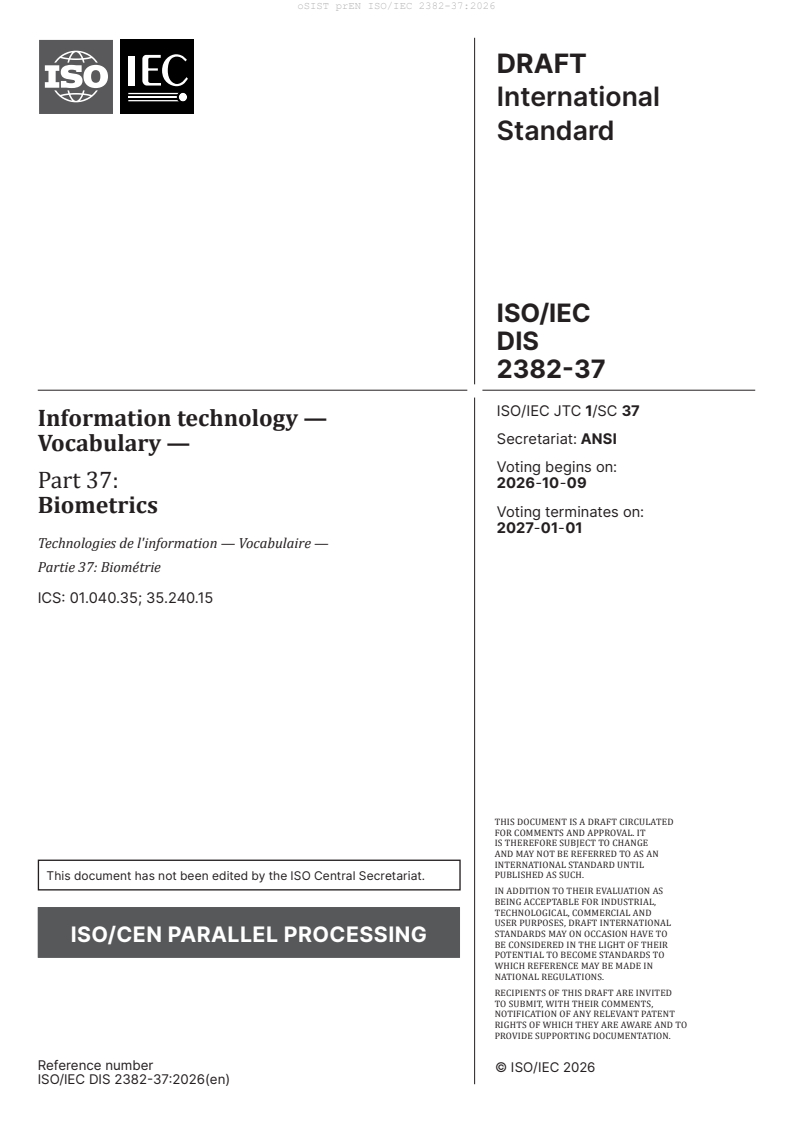
oSIST prEN ISO/IEC 2382-37:2026 DRAFT International Standard ISO/IEC DIS 2382-37:2026(en)
Information Technology – Vocabulary – Part 37:
Biometrics
1 Scope
This document establishes a systematic description of the concepts in the field of biometrics pertaining to recognition of human beings. This document also reconciles variant terms in use in pre-existing International Standards on biometrics against the preferred terms, thereby clarifying the use of terms in this field.
This document does not cover concepts (represented by terms) from information technology, pattern recognition, biology, mathematics, etc. Biometrics uses such fields of knowledge as a basis.
2 Normative references
There are no normative references in this document.
3 Terms and definitions
ISO and IEC maintain terminology databases for use in standardization at the following addresses:
- ISO Online browsing platform: available at https://www.iso.org/obp
- IEC Electropedia: available at https://www.electropedia.org/
3.1 Terms related to general concept terms
37.01.01 biometric (adj)
of or having to do with biometric recognition (37.01.03) Note 1 to entry: The use of biometric as a noun, to mean for example, biometric characteristic (37.01.02), is deprecated.
- EXAMPLE 1 Incorrect usage #1: ICAO resolved that face is the biometric most suited to the practicalities of travel documents.
- EXAMPLE 2 Correct usage #1: ICAO resolved that face recognition is the biometric mode (37.02.05) most suited to the practicalities of travel documents.
th Note 2 to entry: Since the late 19 Century the terms biometrics and biometry have been used with the general meaning of counting, measuring and statistical analysis of any kind of data in the biological sciences including the relevant medical sciences.
oSIST prEN ISO/IEC 2382-37:2026 ISO/IEC DIS 2382-37:2026(en)
37.01.02 biometric characteristic
DEPRECATED biometric, noun biological and behavioural characteristic of an individual from which distinguishing, repeatable biometric features (37.03.11) can be extracted for the purpose of biometric recognition (37.01.03) EXAMPLE Examples of biometric characteristics are: friction ridge structure, face topography, facial skin texture, hand topography, finger topography, iris structure, vein structure of the palm, ridge structure of the palm, retinal pattern, handwritten signature dynamics, etc.
Note 1 to entry: the term trait is sometimes used in the literature
37.01.03 biometric recognition
biometrics automated recognition of individuals based on their biological and behavioural characteristics Note 1 to entry: In the field of biometrics (as defined in this document), “Individual" is restricted in scope to refer only to humans.
Note 2 to entry: The general meaning of biometrics encompasses counting, measuring and statistical analysis of any kind of data in the biological sciences including the relevant medical sciences. Note 3 to entry: Biometric recognition encompasses biometric verification (37.08.03) and biometric identification (37.08.02).
Note 4 to entry: Automated recognition implies that a machine based system is used for the recognition either for the full process or assisted by a human being.
Note 5 to entry: Behavioural and biological characteristics cannot be completely separated which is why the definition uses ‘and ’instead of ‘and/or’. For example, a fingerprint image results from the biological characteristics of the finger ridge patterns and the behavioural act of presenting the finger. Note 6 to entry: Use of 'authentication' as a synonym for “biometric verification (37.08.03) or biometric identification (37.08.02)” is deprecated; the term biometric recognition is preferred. Note 7 to entry: Biometric recognition can involve components and subsystems that are not temporally or geographically co-located.
37.01.04 biometric person of interest
individual with a biometric enrolment data record (37.03.10) in a biometric surveillance (37.01.05) system
37.01.05 biometric surveillance
act of watching for an individual(s) using a biometric system (37.02.03) for the purposes of recognition Note 1 to entry: Watching may be for the purpose of tracking, identification or verification of claims.
37.01.06 biometric capture at a distance
biometric capture (37.06.03) with a significant separation between the biometric capture subject (37.07.03) and biometric capture subsystem (37.02.01) Note 1 to entry: Biometric capture at a distance is not necessarily surveillance. Note 2 to entry: Non-contact or touchless biometrics are not necessarily biometric capture at a distance. Note 3 to entry: Capture may be controlled.
oSIST prEN ISO/IEC 2382-37:2026 ISO/IEC DIS 2382-37:2026(en)
37.01.07 overt biometric capture
biometric recognition (37.01.03) that is obvious and where the possibility for biometric comparison is apparent
37.01.08 contactless biometric capture (n)
touchless biometric capture (n) method of capturing a finger / palm characteristic without physical contact between the biometric characteristic and the biometric capture subsystem (37.02.01) Note 1 to entry: May include contact with other body parts for positioning and steadying. Note 2 to entry: Contactless capture may include verbal contact, instructions, interaction, etc. with the biometric capture subject (37.07.03).
37.01.09 contactless fingerprint / palm print capture (n)
touchless fingerprint / palm print capture (n) method of capturing a finger characteristic without physical contact between the finger characteristic and the biometric capture subsystem (37.02.01) Note 1 to Entry: May include contact with other body parts for positioning and steadying. Note 2 to Entry: Contactless capture may include verbal contact, instructions, interaction, etc. with the biometric capture subject (37.07.03).
37.01.10 covert biometric capture
biometric capture that hidden and does not attract attention
37.01.11 real-time biometric recognition
biometric recognition (37.01.03) where the biometric comparison decision (37.03.26) immediately follows the biometric capture
37.01.12 remote biometric recognition
biometric recognition (37.01.03) with the comparison decision not in direct proximity to the biometric capture subsystem (37.02.01) Note 1 to entry: may be supervised or unsupervised.
3.2 Terms related to biometric systems
37.02.01 biometric capture subsystem
biometric capture devices (37.04.01) and any sub-processes required to execute a biometric capture process (37.05.02)
oSIST prEN ISO/IEC 2382-37:2026 ISO/IEC DIS 2382-37:2026(en) Note 1 to entry: In some biometric systems (37.02.03), converting a signal from a biometric characteristic (37.01.02) to a captured biometric sample (37.03.25) can include multiple components such as a camera, photographic paper, printer, digital scanner, ink and paper.
Note 2 to entry: A biometric capture subsystem (37.02.01) can consist of only a single biometric capture device (37.04.01).
37.02.02 biometric identification system
system that aims to perform biometric identification (37.08.02)
37.02.03 biometric system
system for the purpose of the biometric recognition (37.01.03) of individuals based on their behavioural and biological characteristics Note 1 to entry: A biometric system (37.02.03) will contain both biometric (37.01.01) and non-biometric components.
37.02.04 biometric verification system
system that aims to perform biometric verification (37.08.03)
37.02.05 mode
DEPRECATED biometric, noun combination of a biometric characteristic (37.01.02) type, a sensor type and a processing method Note 1 to entry: The processing algorithm may contain multiple methods, details of which are not necessarily externally apparent. Thus, a biometric system (37.02.03) is considered as using one processing method, until it is otherwise specified.
Note 2 to entry: Determining what constitutes a single type of sensor, processing method or biometric characteristic (37.01.02) will depend on convention. For example, current convention is that images of ridge patterns from both thumbs and fingers represent a single biometric characteristic type, i.e. fingerprints. With respect to sensors, infrared and optical bandwidth sensors are considered different types, but optical bandwidth sensors are considered a single type despite imaging red, green and blue bandwidths.
37.02.06 multi-modal
multiple in at least two out of three constituents of a mode (37.02.05) in a single biometric system (37.02.03) Note 1 to entry: Multiple implies difference in type.
37.02.07 system participation ratio
proportion of individuals eligible to use the system who do use the system Note 1 to entry: Enrolled (37.05.08) individuals are a subset of eligible individuals. Note 2 to entry: This term is used to express the extent of take-up and use of a biometric system (37.02.03).
oSIST prEN ISO/IEC 2382-37:2026 ISO/IEC DIS 2382-37:2026(en)
37.02.08 biometric fusion
combination of biometric (37.01.01) information from different sources to inform a comparison decision (37.03.26) within a biometric transaction (37.06.45) Note 1 to entry: The sources might be at the signal, feature, score, rank or decision level.
37.02.09 monobiometric system
biometric system (37.02.03) of which all of the following components are required to be singular:
biometric capture subsystem (37.02.01), biometric instance (37.03.46), biometric characteristic (37.01.02) type, biometric algorithm (37.04.02) and biometric presentation (37.06.07) Note 1 to entry: This term is needed for completeness. It may well be the case that few systems are monobiometric, as multiple instances and multipresentations are normally allowed.
37.02.10 multibiometric system
biometric system (37.02.03) of which at least one of the following components are required to be multiple:
biometric capture subsystem (37.02.01), biometric instance (37.03.46), biometric characteristic (37.01.02) type, biometric algorithm (37.04.02) and biometric presentation (37.06.07)
37.02.11 multipresentation system
system that accepts multiple interactions of the biometric capture subject (37.07.03) with the biometric capture subsystem (37.02.01) to obtain signals from a biometric characteristic (37.01.02) needed for a single transaction (37.06.45) Note 1 to entry: The interaction is seen from the perspective of the biometric capture subject.
37.02.12 multibiometric, adj
based on multiple types of biometric characteristics (37.01.02) EXAMPLE A biometric system (37.02.03) that is based on two or more biometric characteristic types such as two or more of face, voice, finger, palm, iris, retina, hand geometry, signature/sign, keystroke, lip movement, gait, vein, DNA, ear, foot, scent, etc.
37.02.13 biometric comparison subsystem
biometric comparator biometric subsystem that compares biometric probes to biometric references and returns comparison scores Note 1 to entry: The subsystem operates on a platform – hardware and operating system.
37.02.14 biometric system policy
procedures and rules about who, when, where and how a biometric system (37.02.03) is intended to be used and operated
oSIST prEN ISO/IEC 2382-37:2026 ISO/IEC DIS 2382-37:2026(en) Note 1 to entry: biometric system policies include procedures and rules to be followed by presentation subjects, operators and administrators.
Note 2 to entry: policies and procedures may address biometric (37.01.01) and non-biometric factors.
3.3 Terms related to data in biometric systems
37.03.01: term deleted
37.03.02 biometric application database
database of biometric data (37.03.06) and associated metadata developed from and supporting the operation of a biometric (37.01.01) application Note 1 to entry: The metadata may include transaction history; authorizations (e.g. age) of biometric data subject (37.07.05); and archived biometric data.
Note 2 to entry: The term application includes the policies that govern the operation of the system and evidence of that operation.
37.03.03 biometric application decision
decision to perform an action at the application level based on the results of a biometric (37.01.01) process Note 1 to entry: The biometric application decision may include more than a comparison (37.05.07) process. For example, a biometric capture process (37.05.02) may show that there are no characteristics to capture, and a decision can be made on this before any biometric characteristics (37.01.02) are compared. Note 2 to entry: Biometric application decisions can be made on the basis of complex policies involving both biometric and non-biometric data.
37.03.04 biometric candidate
biometric reference identifier (37.03.19) of a biometric reference (37.03.16) in the biometric reference database (37.03.17) determined to be sufficiently similar to the biometric probe (37.03.14) to warrant further analysis Note 1 to entry: Identification systems can be configured to return a fixed number of the most similar candidates and, in other cases, the system could be configured to return candidates with biometric candidate scores (37.03.24) that exceed a threshold (37.03.36).
37.03.05 biometric candidate list
set of zero, one or more biometric candidates (37.03.04) that may be intermediate or final Note 1 to entry: The biometric candidate list can be tentative if it is to be reduced by further processing.
37.03.06 biometric data
biometric sample (37.03.21) or aggregation of biometric samples at any stage of processing Note 1 to entry: Biometric data need not be attributable to a specific individual, e.g. Universal Background Models.
37.03.07 biometric database
database of a biometric data record(s) (37.03.08)
oSIST prEN ISO/IEC 2382-37:2026 ISO/IEC DIS 2382-37:2026(en)
37.03.08 biometric data record
data record containing biometric data (37.03.06) Note 1 to entry: A biometric data record may include non-biometric data.
37.03.09 biometric enrolment database
database of a biometric enrolment data record(s) (37.03.10) Note 1 to entry: A database of biometric data (37.03.06) not attributable to biometric data subjects (37.07.05) is a biometric database (37.03.07), but not a biometric enrolment database, e.g. data for Universal Background Models. Note 2 to entry: The biometric enrolment database can optionally contain the biometric reference database (37.03.17). Separation of the databases can be required due to security, privacy, legislation, architecture, performance, etc.
Note 3 to entry: A single biometric reference (37.03.16) (e.g. a fingerprint on a storage card) can be considered as a biometric enrolment database in some transactions (37.06.45).
37.03.10 biometric enrolment data record
data record attributed to a biometric data subject (37.07.05), containing non-biometric data and associated with a biometric reference identifier(s) (37.03.19) Note 1 to entry: Data can be updated after enrolment.
Note 2 to entry: The biometric enrolment data record will either contain a biometric reference data record(s) (37.03.18) or pointer(s) to a biometric reference data record(s). Note 3 to entry: The associated biometric reference (37.03.16) may be null (for example, the biometric enrollee (37.07.06) lacks the biometric characteristic (37.01.02) or biometric capture process (37.05.02) is pending).
37.03.11 biometric feature
numbers or labels extracted from biometric samples (37.03.21) and used for comparison (37.05.07) Note 1 to entry: The set of numbers or labels are the output of a completed biometric feature extraction (37.05.04). Note 2 to entry: The use of this term should be consistent with its use by the pattern recognition and mathematics communities.
Note 3 to entry: A biometric feature set can also be considered a processed biometric sample. Note 4 to entry: Biometric features can be extracted from an intermediate biometric sample (37.03.30). Note 5 to entry: Filters applied to biometric samples are not themselves biometric features. However, the output of the filter applied to these samples can be. Therefore, eigenfaces are not biometric features, for example.
37.03.12 biometric identification decision
comparison decision (37.03.26) as to whether a biometric reference(s) (37.03.16) of a particular biometric data subject (37.07.05) is in a biometric reference database (37.03.17) Note 1 to entry: Return of a biometric candidate list (37.03.05) is not considered a biometric identification decision. Note 2 to entry: A positive biometric identification (37.08.02) process is inferred from the output of a biometric reference identifier (37.03.19).
oSIST prEN ISO/IEC 2382-37:2026 ISO/IEC DIS 2382-37:2026(en)
37.03.13 biometric model
stored function generated from biometric data (37.03.06) EXAMPLE: Examples of biometric models could be a Hidden Markov Model, Gaussian Mixture Model or an Artificial Neural Network.
Note 1 to entry: In most occasions the biometric model is a stored function which is dependent on the biometric data subject (37.07.05).
...