

SIST ISO 30011:2026
(Main)Workplace air - Determination of metals and metalloids in airborne particulate matter by inductively coupled plasma mass spectrometry
- Abstract
This document specifies a procedure for the use of quadrupole inductively coupled plasma mass spectrometry (ICP-MS), including single-quadrupole instruments and tandem ICP-MS/MS, for analysing test solutions prepared from samples of airborne particulate matter collected as specified in ISO 15202-1. Method development, performance checks and a routine analysis method are specified in this document
NOTE 1 Other types of ICP-MS (e.g. magnetic sector) are outside of the scope of this document.
Test solutions for analysis by this document are prepared as specified in ISO 15202-2.
This document is applicable to the assessment of workplace exposure to metals and metalloids for comparison with limit values (e.g. see EN 689[10] and ASTM E1370[8]).
This document is not applicable to the determination of elemental mercury, since mercury vapour is not collected using the sampling method specified in ISO 15202-1.
The procedure specified in this document is suitable for the assessment of exposure against the long-term exposure limits for most of the metals and metalloids for which occupational exposure limit values have been set, when sampling at a typical flow rate of at least 2 l min−1 for sampling times in the range 0,25 h to 8 h and for the assessment of exposure against the short-term exposure limits, where applicable.
NOTE 2 The procedure is subject to no significant spectral interferences (see Clause A.3), provided that suitable analytical isotopes are used. However, inadequate matrix-matching can adversely affect results.
- Status
- Published
- Public Enquiry End Date
- 02-Aug-2026
- Publication Date
- 13-Sep-2026
- Technical Committee
- KAZ - Air quality
- Current Stage
- 6060 - National Implementation/Publication (Adopted Project)
- Start Date
- 06-Aug-2026
- Due Date
- 11-Oct-2026
- Completion Date
- 14-Sep-2026
Buy Documents




ISO 30011:2025 - Workplace air — Determination of metals and metalloids in airborne particulate matter by inductively coupled plasma mass spectrometry Released:8. 08. 2025


ISO 30011:2025 - Air des lieux de travail — Détermination des métaux et métalloïdes dans les particules en suspension dans l'air par spectrométrie de masse avec plasma à couplage inductif/10/2026
REDLINE ISO 30011:2025 - Air des lieux de travail — Détermination des métaux et métalloïdes dans les particules en suspension dans l'air par spectrométrie de masse avec plasma à couplage inductif/10/2026
SIST ISO 30011:2026 is the Slovenian identical adoption of ISO 30011:2025. It specifies an inductively coupled plasma mass spectrometry (ICP-MS) procedure for determining metals and metalloids in airborne particulate matter from workplace air samples. The document is intended for exposure assessment against limit values and for laboratories, industrial hygienists, public health professionals and others who prepare, analyse and report those measurements.
What does SIST ISO 30011:2026 specify?
SIST ISO 30011:2026 specifies how to analyse test solutions from workplace air particulate samples for metals and metalloids using quadrupole ICP-MS, including single-quadrupole instruments and tandem ICP-MS/MS. It covers method development, performance checks and routine analysis, so the document is useful both when setting up the method and when running day-to-day samples.
The scope is tied to the sampling and sample-preparation parts of the ISO 15202 series. Airborne particulate matter is collected as specified in ISO 15202-1, and the test solutions are prepared as specified in ISO 15202-2.
The document is organized into clauses on scope, references, terms, principle, requirements, reagents, apparatus, procedure, expression of results, method performance and the test report. It also includes informative annexes on ICP-MS principles and interferences, example operating parameters, maintenance guidance, recalculation to reference conditions, and validation data for different substrates.
| Annex | What it covers |
|---|---|
| Annex A | ICP-MS principles and interferences |
| Annex B | Examples of instrument operating parameters |
| Annex C | Guidance on maintenance of ICP-MS instrumentation |
| Annex D | Recalculation of metal and metalloid in air concentrations to reference conditions |
| Annex E | Method validation data for LOD and LOQ on various substrates |
What are the key requirements of SIST ISO 30011:2026?
SIST ISO 30011:2026 is a measurement method standard, so the key requirements are about choosing the right ICP-MS setup, controlling contamination and interferences, and proving that the method performs well enough for workplace exposure assessment.
Sampling, scope and applicability
Clause 4 links the analysis step to ISO 15202-1 for sampling and ISO 15202-2 for sample dissolution. In practice, that means the analyst does not invent a separate sample-preparation route for this standard - the analysis is designed to work with the ISO 15202 workflow.
The procedure applies to workplace exposure assessment for comparison with limit values. It is also stated to be suitable for many long-term exposure limits and, where applicable, short-term exposure limits, when sampling is done at a typical flow rate of at least 2 l/min for 0.25 h to 8 h.
Instrument type and interferences
The document applies to quadrupole ICP-MS, including single-quadrupole and tandem ICP-MS/MS. Other ICP-MS types such as magnetic sector instruments are outside the scope, so users need to confirm that their instrument matches the stated principle.
Clause 8.2 requires the analyst to consider matrix and spectral interferences before choosing analytical masses. The standard points readers to collision cells or collision reaction cells as preferred tools for removing many interferences, because these can improve selectivity without relying on a less sensitive alternative mass.
Reagents, calibration and matrix matching
Clause 6 requires ultrapure water and sufficiently pure acids and standard solutions. Calibration solutions need to be made from certified stock standards traceable to national standards, and fresh calibration solutions are prepared daily unless stability work justifies a different storage period.
A central requirement is matrix matching: the calibration solutions should match the test solutions as closely as possible. That matters because differences in acid content and other matrix components can shift signal response, especially in ICP-MS.
Table 1 links the chosen sample-dissolution method to the acids needed for matrix-matched calibration solutions. If hydrofluoric acid is present in test solutions, the document advises avoiding it in calibration solutions where possible and using nitric acid as a safer substitute when acceptable.
Internal standards and instrument setup
Clause 8.2.11 requires internal standards to correct for drift, physical interferences and ion-transport changes. For full mass-range scans, at least three internal standards are used, and five are recommended. In practice, this means the laboratory must choose internal standards that are not present at problematic levels in the samples and that behave similarly to the analytes.
Clause 8.3 and Annex C emphasize routine performance checks, visual inspection and maintenance. That matters because ICP-MS sensitivity can be affected by worn tubing, dirty cones, leaks, clogged nebulizers and similar faults.
Routine analysis and mercury
Clause 8.4 sets out the routine sequence: dilute if needed, add the same internal-standard concentration to all solutions, calibrate in increasing concentration order, and then analyse blanks and samples. The calibration should be recalculated if the fit is not adequate, and the document says not to force the calibration through zero.
If mercury is being determined, Clause 8.4.3 requires addition of gold in hydrochloric acid to all solutions and a waiting time before analysis. In practice, this is used to reduce mercury memory effects, but it also means the laboratory must check compatibility with the other analytes.
Quality control, limits and uncertainty
Clause 8.4 and Clause 8.6 require continuing calibration checks, blank monitoring, quality control samples and internal-standard acceptance criteria. This is what keeps a run under control during batches of samples rather than only at the start.
Clause 8.5 requires estimation of the instrumental detection limit, limit of detection and limit of quantification under the actual working conditions. Clause 8.7 recommends estimating measurement uncertainty in accordance with ISO 21832 and ISO/IEC Guide 98-3:2008, because exposure results are only useful if the uncertainty is known and reported.
What terms does SIST ISO 30011:2026 define?
- blank solution - A solution made by taking a reagent blank, laboratory blank or field blank through the same dissolution route as the samples.
- calibration solution - A solution prepared from stock or working standards and used to calibrate the analytical instrument.
- sample solution - The solution obtained after dissolving the sample so that the analytes are in liquid form.
- test solution - A blank solution or sample solution that has been brought to the state ready for analysis, including any dilution or internal-standard addition.
- internal standard - A non-analyte element added to all solutions to correct for matrix effects, drift or signal changes.
- matrix-matching - The practice of matching the acids and other major components of calibration solutions to those in the test solutions.
- collision reaction cell - A cell used in ICP-MS to remove interfering ions by ion-neutral reactions and related processes.
- tandem ICP-MS/MS - An ICP-MS system with an additional quadrupole before the collision reaction cell; it is also known as triple-quadrupole ICP-MS (ICP-QQQ).
Who uses SIST ISO 30011:2026?
SIST ISO 30011:2026 is used by agencies concerned with health and safety at work, industrial hygienists, public health professionals, analytical laboratories, industrial users of metals and metalloids, and workers whose exposure is being assessed.
In practice, it supports workplace air monitoring, exposure comparison with limit values, method validation, routine laboratory analysis, quality control and reporting for occupational hygiene and compliance work.
What changed in SIST ISO 30011:2026 from the previous edition?
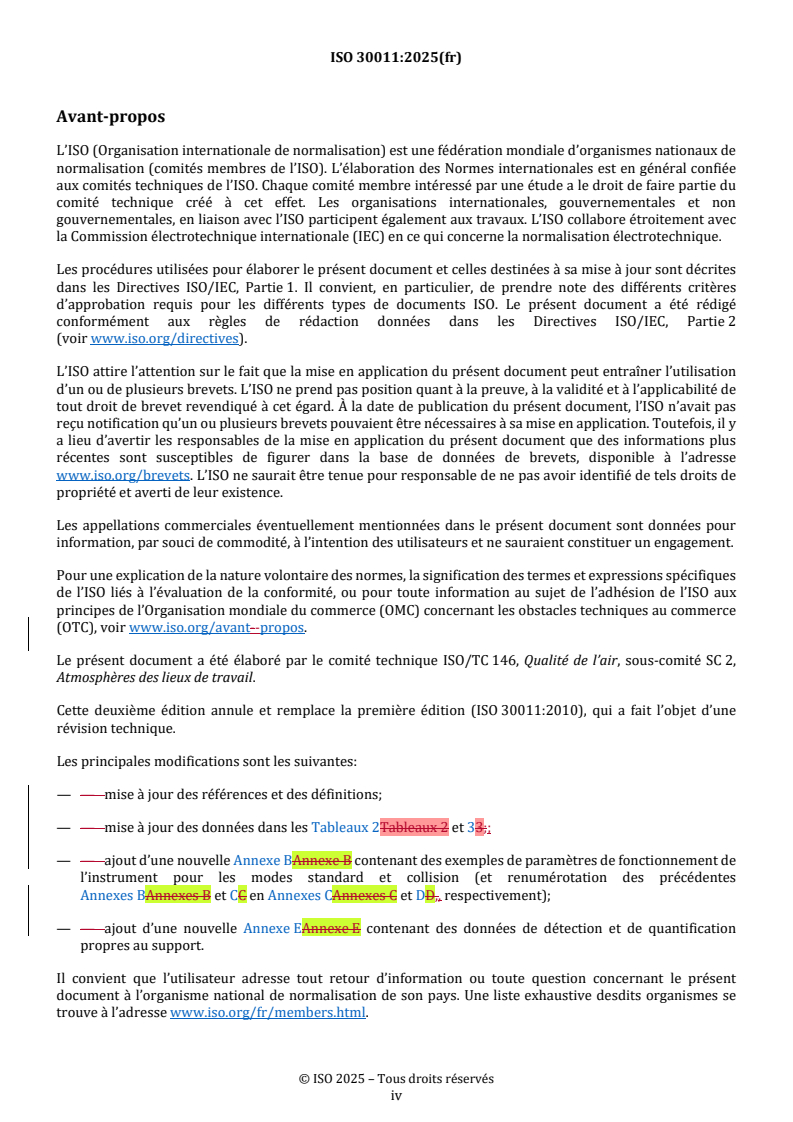
SIST ISO 30011:2026 is the same document as ISO 30011:2025, and the ISO second edition cancels and replaces ISO 30011:2010.
The stated changes are:
- references and definitions have been updated
- data in Tables 2 and 4 have been updated
- a new Annex B has been added with example instrument operating parameters for standard and collision modes
- the former Annexes B and C have been renumbered as Annexes C and D
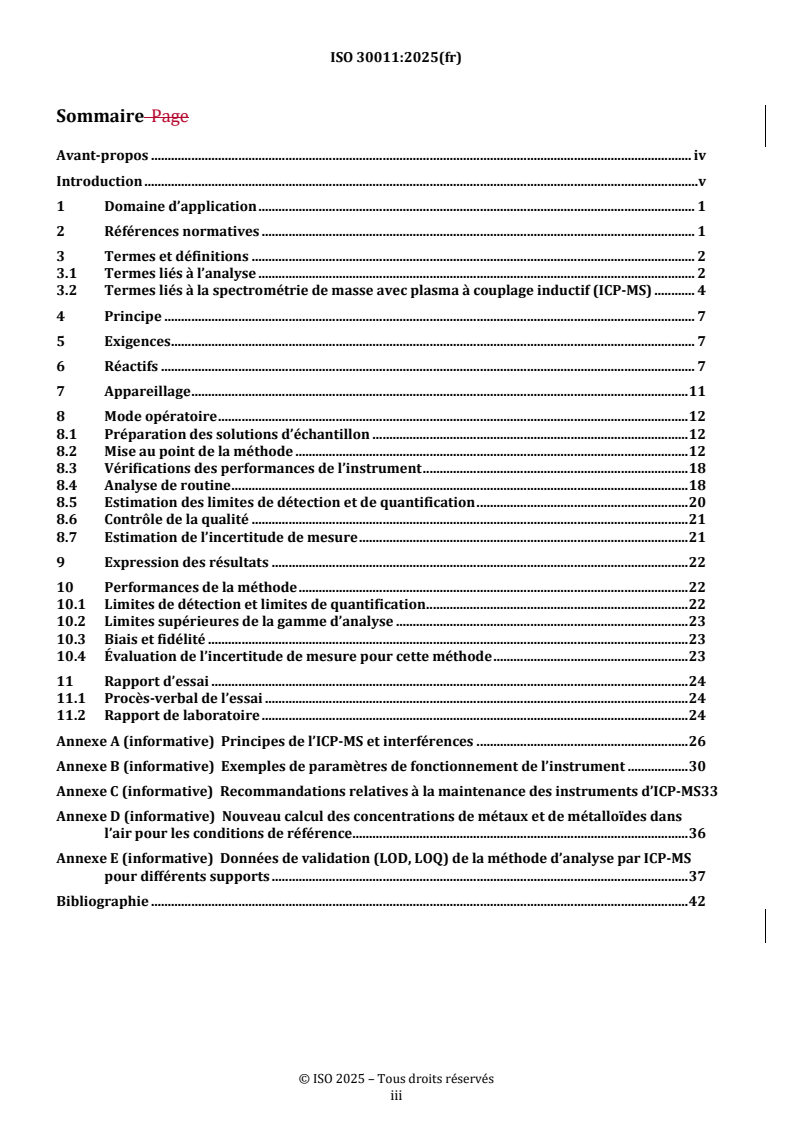
- a new Annex E has been added with substrate-specific detection and quantification data
Which standards are used with SIST ISO 30011:2026?
SIST ISO 30011:2026 relies on several referenced standards that provide the sampling, sample-preparation, laboratory and uncertainty framework around the ICP-MS analysis.
| Standard | What it contributes |
|---|---|
| ISO 1042 | Requirements for one-mark volumetric flasks |
| ISO 3585 | Properties of borosilicate glass 3.3 used for volumetric flasks |
| ISO 8655-1 | Terminology and general requirements for piston-operated volumetric apparatus |
| ISO 8655-2 | Requirements for pipettes |
| ISO 8655-5 | Requirements for dispensers |
| ISO 8655-6 | Gravimetric reference procedure for volume determination |
| ISO 15202-1 | Sampling of airborne particulate matter in workplace air |
| ISO 15202-2:2020 | Sample preparation and dissolution of the collected particulate matter |
| ISO 18158 | Workplace air terminology |
| ISO 20581 | General performance requirements for measuring chemical agents in workplace air |
| ISO 21832:2018 | Evaluation of measuring procedures for workplace air metals and metalloids |
What does the SIST ISO 30011:2026 document contain?
SIST ISO 30011:2026 contains the full analytical workflow, from reagent selection and glassware requirements to calibration, quality control, uncertainty and reporting. Clause 8 is the core of the document and explains method development, interferences, operating conditions, carryover control and ongoing calibration checks.
It also contains Table 1 for matrix-matching acids by sample-dissolution method, Table 2 for recommended analytical isotopes and typical instrumental detection limits, and Table 3 for internal standards and their limitations. Annex A explains the main ICP-MS interferences, Annex B gives example operating parameters, Annex C gives maintenance guidance, Annex D gives the temperature and pressure correction to reference conditions, and Annex E gives example LOD and LOQ data on different filter substrates.
For reporting, Clause 11 lists the information that should appear in the test records and laboratory report, including the sample preparation route, dilution factors, analytical results, instrument identification, uncertainty and quality control data.
Relations
- Effective Date
- 01-Jul-2026
Buy Documents
ISO 30011:2025 - Workplace air — Determination of metals and metalloids in airborne particulate matter by inductively coupled plasma mass spectrometry Released:8. 08. 2025
ISO 30011:2025 - Air des lieux de travail — Détermination des métaux et métalloïdes dans les particules en suspension dans l'air par spectrométrie de masse avec plasma à couplage inductif/10/2026
REDLINE ISO 30011:2025 - Air des lieux de travail — Détermination des métaux et métalloïdes dans les particules en suspension dans l'air par spectrométrie de masse avec plasma à couplage inductif/10/2026
Get Certified
Connect with accredited certification bodies for this standard

ECOCERT
Organic and sustainability certification.

CIS Institut d.o.o.
Personal Protective Equipment (PPE) certification body. Notified Body NB-2890 for EU Regulation 2016/425 PPE.

Eurofins Food Testing Global
Global leader in food, environment, and pharmaceutical product testing.
Sponsored listings
Frequently Asked Questions
SIST ISO 30011:2026 is a standard published by the Slovenian Institute for Standardization (SIST). Its full title is "Workplace air - Determination of metals and metalloids in airborne particulate matter by inductively coupled plasma mass spectrometry". This standard covers: This document specifies a procedure for the use of quadrupole inductively coupled plasma mass spectrometry (ICP-MS), including single-quadrupole instruments and tandem ICP-MS/MS, for analysing test solutions prepared from samples of airborne particulate matter collected as specified in ISO 15202-1. Method development, performance checks and a routine analysis method are specified in this document NOTE 1 Other types of ICP-MS (e.g. magnetic sector) are outside of the scope of this document. Test solutions for analysis by this document are prepared as specified in ISO 15202-2. This document is applicable to the assessment of workplace exposure to metals and metalloids for comparison with limit values (e.g. see EN 689[10] and ASTM E1370[8]). This document is not applicable to the determination of elemental mercury, since mercury vapour is not collected using the sampling method specified in ISO 15202-1. The procedure specified in this document is suitable for the assessment of exposure against the long-term exposure limits for most of the metals and metalloids for which occupational exposure limit values have been set, when sampling at a typical flow rate of at least 2 l min−1 for sampling times in the range 0,25 h to 8 h and for the assessment of exposure against the short-term exposure limits, where applicable. NOTE 2 The procedure is subject to no significant spectral interferences (see Clause A.3), provided that suitable analytical isotopes are used. However, inadequate matrix-matching can adversely affect results.
This document specifies a procedure for the use of quadrupole inductively coupled plasma mass spectrometry (ICP-MS), including single-quadrupole instruments and tandem ICP-MS/MS, for analysing test solutions prepared from samples of airborne particulate matter collected as specified in ISO 15202-1. Method development, performance checks and a routine analysis method are specified in this document NOTE 1 Other types of ICP-MS (e.g. magnetic sector) are outside of the scope of this document. Test solutions for analysis by this document are prepared as specified in ISO 15202-2. This document is applicable to the assessment of workplace exposure to metals and metalloids for comparison with limit values (e.g. see EN 689[10] and ASTM E1370[8]). This document is not applicable to the determination of elemental mercury, since mercury vapour is not collected using the sampling method specified in ISO 15202-1. The procedure specified in this document is suitable for the assessment of exposure against the long-term exposure limits for most of the metals and metalloids for which occupational exposure limit values have been set, when sampling at a typical flow rate of at least 2 l min−1 for sampling times in the range 0,25 h to 8 h and for the assessment of exposure against the short-term exposure limits, where applicable. NOTE 2 The procedure is subject to no significant spectral interferences (see Clause A.3), provided that suitable analytical isotopes are used. However, inadequate matrix-matching can adversely affect results.
SIST ISO 30011:2026 is classified under the following ICS (International Classification for Standards) categories: 13.040.30 - Workplace atmospheres; 71.040.50 - Physicochemical methods of analysis. The ICS classification helps identify the subject area and facilitates finding related standards.
SIST ISO 30011:2026 has the following relationships with other standards: It is inter standard links to oSIST ISO 30011:2010. Understanding these relationships helps ensure you are using the most current and applicable version of the standard.
SIST ISO 30011:2026 is available in PDF format for immediate download after purchase. The document can be added to your cart and obtained through the secure checkout process. Digital delivery ensures instant access to the complete standard document.
Standards Content (Sample)
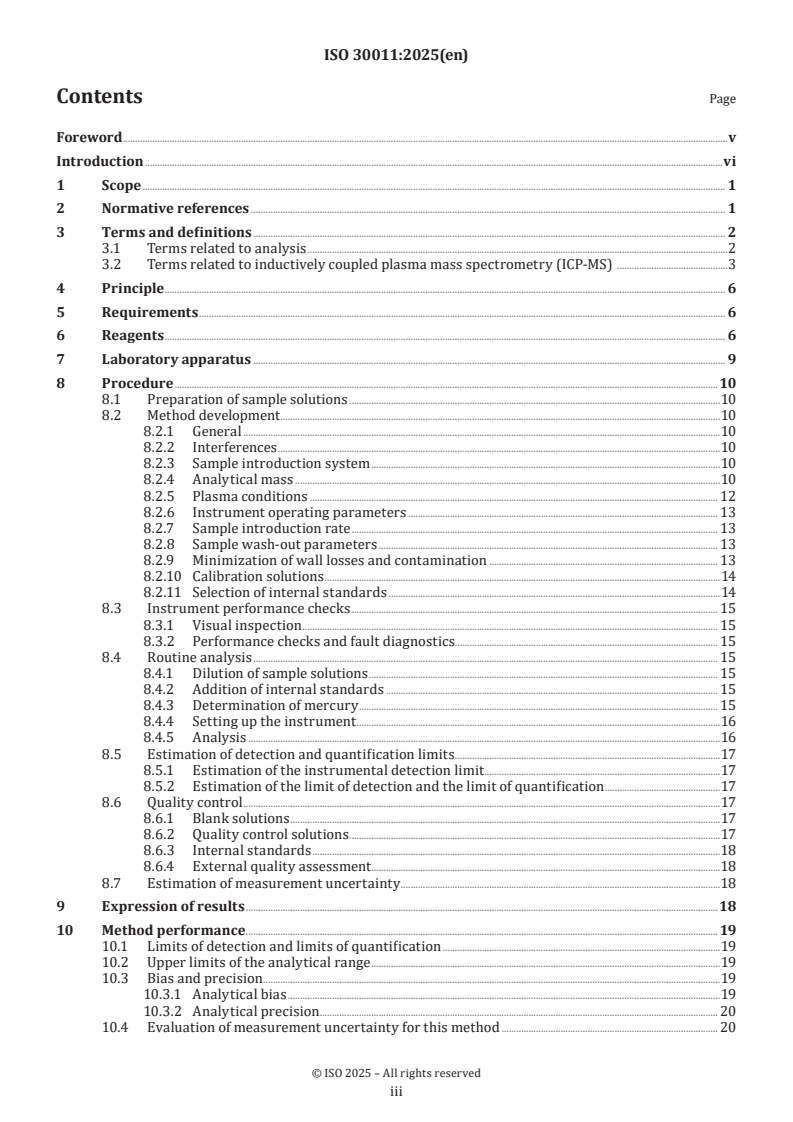
Contents
- Introduction
- 1 Scope
- 2 Normative references
- 3 Terms and definitions
- 3.1 Terms related to analysis
- 3.1.1 blank solution
- 3.1.2 calibration blank solution
- 3.1.3 calibration curve
- 3.1.4 calibration solution
- 3.1.5 linear dynamic range
- 3.1.6 reagent blank
- 3.1.7 sample dissolution
- 3.1.8 sample solution
- 3.1.9 spiked media blank
- 3.1.10 stock standard solution
- 3.1.11 test solution
- 3.1.12 working standard solution
- 3.2 Terms related to inductively coupled plasma mass spectrometry (ICP-MS)
- 3.2.1 collision cell
- 3.2.2 collision reaction cell
- 3.2.3 corrosion-resistant sample introduction system
- 3.2.4 inductively coupled plasma torch
- 3.2.5 inductively coupled plasma
- 3.2.6 injector
- 3.2.7 inner argon flow
- 3.2.8 intermediate argon flow
- 3.2.9 internal standard
- 3.2.10 load coil
- 3.2.11 matrix interference
- 3.2.12 matrix-matching
- 3.2.13 nebulizer
- 3.2.14 outer argon flow
- 3.2.15 spectral interference
- 3.2.16 spray chamber
- 3.2.17 tandem ICP-MS/MS
- 3.2.18 tuning
- 4 Principle
- 5 Requirements
- 6 Reagents
- 6.5 Working standard solutions and calibration solutions
- 6.6 Internal standard stock solutions
- 7 Laboratory apparatus
- 7.2 One-mark volumetric flasks, conforming with the requirements of ISO 1042 class A, made of
- 7.4 Piston-operated volumetric instruments, conforming with the requirements of ISO 8655-1 and
- 8 Procedure
- 8.1 Preparation of sample solutions
- 8.2 Method development
- 8.3 Instrument performance checks
- 8.4 Routine analysis
- 8.5 Estimation of detection and quantification limits
- 8.6 Quality control
- 8.7 Estimation of measurement uncertainty
- 9 Expression of results
- 10 Method performance
- 10.1 Limits of detection and limits of quantification
- 10.2 Upper limits of the analytical range
- 10.3 Bias and precision
- 10.4 Evaluation of measurement uncertainty for this method
- 11 Test report
- 11.1 Test records
- 11.2 Laboratory report
- Annex A
- Annex B
- Annex C
- Annex D
- Annex E
- Bibliography
Introduction
The health of workers in many industries is at risk through exposure by inhalation of toxic metals and metalloids. Industrial hygienists and other public health professionals need to determine the effectiveness of measures taken to control workers' exposure, and this is generally achieved by taking workplace air measurements. This document has been published in order to make available a method for making valid ultra-trace exposure measurements for a wide range of metals and metalloids in use in industry. It is intended for:
- agencies concerned with health and safety at work;
- industrial hygienists and other public health professionals;
- analytical laboratories;
- industrial users of metals and metalloids and their workers. This document specifies a method for the determination of the mass concentration of metals and metalloids in workplace air using quadrupole inductively coupled plasma mass spectrometry (ICP-MS). For many metals and metalloids, analysis by ICP-MS is advantageous when compared to methods such as inductively coupled plasma atomic emission spectrometry, due to its sensitivity and the presence of fewer spectral interferences.
The execution of the provisions of this document and the interpretation of the results obtained is assumed to be entrusted to appropriately qualified and experienced people.
SIST ISO 30011:2026 International Standard ISO 30011:2025(en) Workplace air — Determination of metals and metalloids in airborne particulate matter by inductively coupled plasma mass spectrometry
1 Scope
This document specifies a procedure for the use of quadrupole inductively coupled plasma mass spectrometry (ICP-MS), including single-quadrupole instruments and tandem ICP-MS/MS, for analysing test solutions prepared from samples of airborne particulate matter collected as specified in ISO 15202-1. Method development, performance checks and a routine analysis method are specified in this document NOTE 1 Other types of ICP-MS (e.g. magnetic sector) are outside of the scope of this document. Test solutions for analysis by this document are prepared as specified in ISO 15202-2. This document is applicable to the assessment of workplace exposure to metals and metalloids for [10] [8] comparison with limit values (e.g. see EN 689 and ASTM E1370 ). This document is not applicable to the determination of elemental mercury, since mercury vapour is not collected using the sampling method specified in ISO 15202-1.
The procedure specified in this document is suitable for the assessment of exposure against the long-term exposure limits for most of the metals and metalloids for which occupational exposure limit values have −1 been set, when sampling at a typical flow rate of at least 2 l min for sampling times in the range 0,25 h to 8 h and for the assessment of exposure against the short-term exposure limits, where applicable. NOTE 2 The procedure is subject to no significant spectral interferences (see Clause A.3), provided that suitable analytical isotopes are used. However, inadequate matrix-matching can adversely affect results.
2 Normative references
The following documents are referred to in the text in such a way that some or all of their content constitutes requirements of this document. For dated references, only the edition cited applies. For undated references, the latest edition of the referenced document (including any amendments) applies. ISO 1042, Laboratory glassware — One-mark volumetric flasks ISO 3585, Borosilicate glass 3.3 — Properties ISO 8655-1, Piston-operated volumetric apparatus — Part 1: Terminology, general requirements and user recommendations ISO 8655-2, Piston-operated volumetric apparatus — Part 2: Pipettes ISO 8655-5, Piston-operated volumetric apparatus — Part 5: Dispensers ISO 8655-6, Piston-operated volumetric apparatus — Part 6: Gravimetric reference measurement procedure for the determination of volume ISO 15202-1, Workplace air — Determination of metals and metalloids in airborne particulate matter by inductively coupled plasma atomic emission spectrometry — Part 1: Sampling ISO 15202-2:2020, Workplace air — Determination of metals and metalloids in airborne particulate matter by inductively coupled plasma atomic emission spectrometry — Part 2: Sample preparation
SIST ISO 30011:2026 ISO 30011:2025(en) ISO 18158, Workplace air — Terminology ISO 20581, Workplace air — General requirements for the performance of procedures for the measurement of chemical agents ISO 21832:2018, Workplace air — Metals and metalloids in airborne particles — Requirements for evaluation of measuring procedures
3 Terms and definitions
For the purposes of this document, the terms and definitions given in ISO 18158 and the following apply. ISO and IEC maintain terminology databases for use in standardization at the following addresses:
- ISO Online browsing platform: available at https:// www .iso .org/ obp
- IEC Electropedia: available at https:// www .electropedia .org/
3.1 Terms related to analysis
3.1.1 blank solution
solution prepared by taking a reagent blank (3.1.6), laboratory blank or field blank through the same procedure used for sample dissolution Note 1 to entry: A blank solution can require undergoing further operations, such as addition of an internal standard (3.2.9), if the sample solutions (3.1.8) are subjected to such operations in order to produce test solutions (3.1.11) that are ready for analysis.
3.1.2 calibration blank solution
calibration solution (3.1.4) prepared without the addition of any stock standard solution (3.1.10) or working standard solution (3.1.12) Note 1 to entry: The concentration of the analyte(s) of interest in the calibration blank solution is taken to be zero. [11] [SOURCE: EN 14902:2005, 3.1.3, modified — “without addition” has been replaced with “without the addition” and “for which the concentration of the analyte(s) of interest is considered to be zero” has been deleted from the definition.]
3.1.3 calibration curve
plot of instrument response versus concentration of standards [13] [SOURCE: United States Environmental Protection Agency, Document Number EPA 540-R-04-004 , modified — “A” has been deleted.]
3.1.4 calibration solution
solution prepared by dilution of the stock standard solution(s) (3.1.10) or working standard solution(s) (3.1.12), containing the analyte(s) of interest at a concentration(s) that is suitable for use in calibration of the analytical instrument Note 1 to entry: The matrix-matching (3.2.12) technique is normally used when preparing calibration solutions.
3.1.5 linear dynamic range
range of concentrations over which the calibration curve (3.1.3) for an analyte is linear Note 1 to entry: The linear dynamic range extends from the detection limit to the onset of calibration curvature.
SIST ISO 30011:2026 ISO 30011:2025(en)
3.1.6 reagent blank
reagents used in sample dissolution (3.1.7), in the same quantities used for preparation of the blank solution (3.1.1) and sample solutions (3.1.8) Note 1 to entry: The reagent blank is used to assess contamination from the laboratory environment and to characterize spectral background from the reagents used in sample preparation.
3.1.7 sample dissolution
process of obtaining a solution containing all analytes of interest from a sample, which can involve complete dissolution of the sample [11] [SOURCE: EN 14902:2005, 3.1.25, modified — the definition has been structurally revised and “the analytes” has been changed to “all analytes”.]
3.1.8 sample solution
solution prepared from a sample by the process of sample dissolution (3.1.7) Note 1 to entry: A sample solution (3.1.8) can require undergoing further operations, e.g. dilution or addition of an internal standard(s) (3.2.9), in order to produce a test solution (3.1.11). [11] [SOURCE: EN 14902:2005, 3.1.22, modified — Note 1 to entry has been replaced.]
3.1.9 spiked media blank
media blank that is spiked with a known amount of the analyte(s) of interest
3.1.10 stock standard solution
solution used for preparation of working standard solutions (3.1.11) or calibration solutions (3.1.4), containing the analyte(s) of interest at a certified concentration(s) traceable to national standards
3.1.11 test solution
blank solution (3.1.1) or sample solution (3.1.8) that has been subjected to all operations required to bring it into a state in which it is ready for analysis Note 1 to entry: “Ready for analysis” includes any required dilution or addition of an internal standard (3.2.9). If a blank solution or sample solution is not subject to any further operations before analysis, it is a test solution.
3.1.12 working standard solution
solution, prepared by dilution of the stock standard solution(s) (3.1.10), that contains the analyte(s) of interest at a concentration(s) better suited for preparation of calibration solutions (3.1.4) than the concentration(s) of the analyte(s) in the stock standard solution(s) (3.1.10) [11] [SOURCE: EN 14902:2005, 3.1.32, modified — “than the concentration(s) of the analyte(s) in the stock standard solution(s)” has been added.]
3.2 Terms related to inductively coupled plasma mass spectrometry (ICP-MS)
3.2.1 collision cell
chamber in the ion path between mass-to-charge ratio (m/z) separation elements, or between ion source acceleration region and the first analyser, in tandem mass spectrometry in space configurations Note 1 to entry: See Reference [14] for a more detailed description of collision cells and their function.
SIST ISO 30011:2026 ISO 30011:2025(en)
3.2.2 collision reaction cell
collision cell (3.2.1) for removal of interfering ions by ion/neutral reactions in inductively coupled plasma mass spectrometry (ICP-MS) Note 1 to entry: Collision reaction cells make use of kinetic energy dispersion, reaction chemistry or a combination of both, to remove interfering species. A variety of applications of collision reaction cell technology are available. Note 2 to entry: See Reference [14] for a more detailed description of collision reaction cells and their function.
3.2.3 corrosion-resistant sample introduction system
sample introduction system that features a nebulizer (3.2.13), spray chamber (3.2.16) and ICP torch (3.2.4) injector tube (3.2.6) that are resistant to corrosion by hydrofluoric acid (6.2.6)
3.2.4 inductively coupled plasma torch
ICP torch device used to support and introduce a sample into an ICP discharge Note 1 to entry: An ICP torch usually consists of three concentric tubes, the outer two usually made from quartz.
3.2.5 inductively coupled plasma
ICP high-temperature discharge generated in flowing argon by an alternating magnetic field induced by a radio frequency (RF) load coil that surrounds the tube carrying the gas
3.2.6 injector
injector tube centre tube innermost tube of an ICP torch (3.2.4), through which the sample aerosol is introduced to the plasma Note 1 to entry: The injector is usually made of quartz, ceramic material or platinum.
3.2.7 inner argon flow
nebulizer argon flow sample argon flow flow of argon gas that is directed through the nebulizer (3.2.13) and carries the sample aerosol through the injector (3.2.6) and into the plasma −1 −1 Note 1 to entry: The inner argon flow rate is typically 0,5 l min to 2 l min .
3.2.8 intermediate argon flow
auxiliary argon flow flow of argon gas that is contained between the intermediate and centre [injector (3.2.6)] tubes of an ICP torch (3.2.4) −1 −1 Note 1 to entry: The intermediate argon flow rate is typically 0 l min to 2 l min .
3.2.9 internal standard
non-analyte element, present in all solutions analysed, the signal from which is used to correct for matrix interferences (3.2.11) or improve analytical precision
3.2.10 load coil
length of metal tubing wound around the end of an ICP torch (3.2.4) and connected to the radio frequency (RF) generator, used to inductively couple energy from the RF generator to the plasma discharge
SIST ISO 30011:2026 ISO 30011:2025(en)
3.2.11 matrix interference
matrix effect non-spectral interference interference of a non-spectral nature caused by a difference between the matrix of the calibration solutions (3.1.4) and test solutions (3.1.11)
3.2.12 matrix-matching
technique used to minimize the effect of matrix interferences (3.2.11) on the analytical results, involving the preparation of calibration solutions (3.1.4) in which the concentrations of acids and other major solvents and solutes are matched with those in the test solutions (3.1.11)
3.2.13 nebulizer
device used to create an aerosol from a liquid
3.2.14 outer argon flow
plasma argon flow coolant argon flow flow of argon gas that is contained between the outer and intermediate tubes of an ICP torch (3.2.4) −1 −1 Note 1 to entry: The outer argon flow rate is typically 7 l min to 15 l min .
3.2.15 spectral interference
interference caused by a species other than the analyte of interest Note 1 to entry: A spectral interference can be atomic, polyatomic or doubly charged ion species. 40 + 40 + EXAMPLE 1 An atomic interference is Ar on Ca .
40 16 + 56 + EXAMPLE 2 A polyatomic interference is Ar O on Fe .
48 2+ 24 + EXAMPLE 3 A doubly charged ion interference is Ti on Mg (see Reference [14]).
3.2.16 spray chamber
device placed between a nebulizer (3.2.13) and an ICP torch (3.2.4) whose function is to separate out aerosol droplets according to their size, so that only very fine droplets pass into the plasma and large droplets are drained or pumped to waste
3.2.17 tandem ICP-MS/MS
tandem inductively coupled plasma mass spectrometry/mass spectrometry ICP-MS system with an additional quadrupole prior to the collision reaction cell (3.2.2) Note 1 to entry: Tandem ICP-MS/MS is also known as triple-quadrupole ICP-MS (ICP-QQQ). Note 2 to entry: See Reference [22] for additional information regarding tandem ICP-MS/MS.
3.2.18 tuning
analysis of a solution containing a range of isotopic masses to establish ICP-MS mass-scale accuracy, mass resolution, signal intensity and precision prior to calibration Note 1 to entry: See Reference [14] for a more detailed description of the tuning process.
SIST ISO 30011:2026 ISO 30011:2025(en)
4 Principle
4.1 Airborne particles containing metals and metalloids are collected using the method specified in ISO 15202-1.
4.2 The collected sample and the filter are then treated to dissolve the metals and metalloids of interest using one of the sample dissolution methods specified in ISO 15202-2. 4.3 The resultant solutions are analysed for the metals and metalloids of interest using single-quadrupole ICP-MS or tandem ICP-MS/MS.
5 Requirements
The measuring procedure as a whole (specified in ISO 15202-1, ISO 15202-2 and this document) shall conform with applicable requirements of ISO 20581 and ISO 21832 and with any relevant national standard that specifies performance requirements for procedures for measuring chemical agents in workplace air.
6 Reagents
6.1 Water, from a purification system that delivers ultrapure water having a resistivity greater than 0,18 MΩ·m (usually expressed by manufacturers of water purification systems as 18 MΩ·cm). 6.2 Mineral acids, concentrated. Various types of mineral acid (6.2.2 to 6.2.6) are required for the preparation of matrix-matched calibration solutions (see 6.4.2). −1 The concentration of the metals and metalloids of interest shall be less than 0,1 mg l . Mineral acids of higher purity can be required in order to obtain adequate detection limits for some metals and metalloids, e.g. beryllium.
−1 6.2.1 Nitric acid, concentrated, ρ ≈1,42 g ml , with a mass fraction of w ≈ 70 %. HNO HNO 3 3 WARNING — Concentrated nitric acid is corrosive and oxidizing and nitric acid fumes are irritant. Avoid exposure by contact with the skin or eyes, or by inhalation of fumes. Use suitable personal protective equipment (including suitable gloves, face shield or safety glasses, etc.) when working with concentrated or dilute nitric acid.
−1 6.2.2 Perchloric acid, concentrated, ρ ≈ 1,67 g ml , with a mass fraction of w ≈ 70 %. HCIO HCIO 4 4 WARNING — Concentrated perchloric acid is corrosive and oxidizing and perchloric acid fumes are irritant. Avoid exposure by contact with the skin or eyes, or by inhalation of fumes. Use suitable personal protective equipment (including suitable gloves, face shield or safety glasses, etc.) when working with concentrated or dilute perchloric acid. For safety reasons, use perchloric acid in limited quantities.
For analysis of metals and metalloids that are subject to interference from polyatomic ions containing chlorine, the use of perchloric acid is not recommended unless a collision reaction cell is used. −1 6.2.3 Hydrochloric acid, concentrated, ρ ≈ 1,18 g ml , with a mass fraction of w ≈ 36 %. HCl HCl WARNING — Concentrated hydrochloric acid is corrosive and oxidizing and hydrochloric acid fumes are irritant. Avoid exposure by contact with the skin or eyes, or by inhalation of fumes. Use suitable personal protective equipment (including suitable gloves, face shield or safety glasses, etc.) when working with concentrated or dilute hydrochloric acid. Handle open vessels containing concentrated hydrochloric acid under a fume hood. The vapour pressure of hydrochloric acid is high; therefore, beware of pressure build-up in stoppered flasks when preparing mixtures of hydrochloric acid and water.
SIST ISO 30011:2026 ISO 30011:2025(en) For analysis of metals and metalloids that are subject to interference from polyatomic ions containing chlorine, the use of hydrochloric acid is not recommended unless a collision reaction cell is used. −1 6.2.4 Sulfuric acid, concentrated, ρ ≈ 1,84 g ml , with a mass fraction of w ≈ 98 %. HSO HSO 24 24 WARNING — Concentrated sulfuric acid is corrosive and causes burns. Avoid exposure by contact with the skin or eyes. Use suitable personal protective equipment (including suitable gloves, face shield or safety glasses, etc.) when working with concentrated or dilute sulfuric acid. Exercise great caution when diluting sulfuric acid with water, since this process is very exothermic. Do not add water to sulfuric acid, since it reacts violently when mixed in this manner. Prepare mixtures by adding sulfuric acid to water.
...
Contents
- Introduction
- 1 Scope
- 2 Normative references
- 3 Terms and definitions
- 3.1 Terms related to analysis
- 3.1.1 blank solution
- 3.1.2 calibration blank solution
- 3.1.3 calibration curve
- 3.1.4 calibration solution
- 3.1.5 linear dynamic range
- 3.1.6 reagent blank
- 3.1.7 sample dissolution
- 3.1.8 sample solution
- 3.1.9 spiked media blank
- 3.1.10 stock standard solution
- 3.1.11 test solution
- 3.1.12 working standard solution
- 3.2 Terms related to inductively coupled plasma mass spectrometry (ICP-MS)
- 3.2.1 collision cell
- 3.2.2 collision reaction cell
- 3.2.3 corrosion-resistant sample introduction system
- 3.2.4 inductively coupled plasma torch
- 3.2.5 inductively coupled plasma
- 3.2.6 injector
- 3.2.7 inner argon flow
- 3.2.8 intermediate argon flow
- 3.2.9 internal standard
- 3.2.10 load coil
- 3.2.11 matrix interference
- 3.2.12 matrix-matching
- 3.2.13 nebulizer
- 3.2.14 outer argon flow
- 3.2.15 spectral interference
- 3.2.16 spray chamber
- 3.2.17 tandem ICP-MS/MS
- 3.2.18 tuning
- 4 Principle
- 5 Requirements
- 6 Reagents
- 6.5 Working standard solutions and calibration solutions
- 6.6 Internal standard stock solutions
- 7 Laboratory apparatus
- 7.2 One-mark volumetric flasks, conforming with the requirements of ISO 1042 class A, made of
- 7.4 Piston-operated volumetric instruments, conforming with the requirements of ISO 8655-1 and
- 8 Procedure
- 8.1 Preparation of sample solutions
- 8.2 Method development
- 8.3 Instrument performance checks
- 8.4 Routine analysis
- 8.5 Estimation of detection and quantification limits
- 8.6 Quality control
- 8.7 Estimation of measurement uncertainty
- 9 Expression of results
- 10 Method performance
- 10.1 Limits of detection and limits of quantification
- 10.2 Upper limits of the analytical range
- 10.3 Bias and precision
- 10.4 Evaluation of measurement uncertainty for this method
- 11 Test report
- 11.1 Test records
- 11.2 Laboratory report
- Annex A
- Annex B
- Annex C
- Annex D
- Annex E
- Bibliography
Introduction
The health of workers in many industries is at risk through exposure by inhalation of toxic metals and metalloids. Industrial hygienists and other public health professionals need to determine the effectiveness of measures taken to control workers' exposure, and this is generally achieved by taking workplace air measurements. This document has been published in order to make available a method for making valid ultra-trace exposure measurements for a wide range of metals and metalloids in use in industry. It is intended for:
- agencies concerned with health and safety at work;
- industrial hygienists and other public health professionals;
- analytical laboratories;
- industrial users of metals and metalloids and their workers. This document specifies a method for the determination of the mass concentration of metals and metalloids in workplace air using quadrupole inductively coupled plasma mass spectrometry (ICP-MS). For many metals and metalloids, analysis by ICP-MS is advantageous when compared to methods such as inductively coupled plasma atomic emission spectrometry, due to its sensitivity and the presence of fewer spectral interferences.
The execution of the provisions of this document and the interpretation of the results obtained is assumed to be entrusted to appropriately qualified and experienced people.
International Standard ISO 30011:2025(en) Workplace air — Determination of metals and metalloids in airborne particulate matter by inductively coupled plasma mass spectrometry
1 Scope
This document specifies a procedure for the use of quadrupole inductively coupled plasma mass spectrometry (ICP-MS), including single-quadrupole instruments and tandem ICP-MS/MS, for analysing test solutions prepared from samples of airborne particulate matter collected as specified in ISO 15202-1. Method development, performance checks and a routine analysis method are specified in this document NOTE 1 Other types of ICP-MS (e.g. magnetic sector) are outside of the scope of this document. Test solutions for analysis by this document are prepared as specified in ISO 15202-2. This document is applicable to the assessment of workplace exposure to metals and metalloids for [10] [8] comparison with limit values (e.g. see EN 689 and ASTM E1370 ). This document is not applicable to the determination of elemental mercury, since mercury vapour is not collected using the sampling method specified in ISO 15202-1.
The procedure specified in this document is suitable for the assessment of exposure against the long-term exposure limits for most of the metals and metalloids for which occupational exposure limit values have −1 been set, when sampling at a typical flow rate of at least 2 l min for sampling times in the range 0,25 h to 8 h and for the assessment of exposure against the short-term exposure limits, where applicable. NOTE 2 The procedure is subject to no significant spectral interferences (see Clause A.3), provided that suitable analytical isotopes are used. However, inadequate matrix-matching can adversely affect results.
2 Normative references
The following documents are referred to in the text in such a way that some or all of their content constitutes requirements of this document. For dated references, only the edition cited applies. For undated references, the latest edition of the referenced document (including any amendments) applies. ISO 1042, Laboratory glassware — One-mark volumetric flasks ISO 3585, Borosilicate glass 3.3 — Properties ISO 8655-1, Piston-operated volumetric apparatus — Part 1: Terminology, general requirements and user recommendations ISO 8655-2, Piston-operated volumetric apparatus — Part 2: Pipettes ISO 8655-5, Piston-operated volumetric apparatus — Part 5: Dispensers ISO 8655-6, Piston-operated volumetric apparatus — Part 6: Gravimetric reference measurement procedure for the determination of volume ISO 15202-1, Workplace air — Determination of metals and metalloids in airborne particulate matter by inductively coupled plasma atomic emission spectrometry — Part 1: Sampling ISO 15202-2:2020, Workplace air — Determination of metals and metalloids in airborne particulate matter by inductively coupled plasma atomic emission spectrometry — Part 2: Sample preparation
ISO 30011:2025(en) ISO 18158, Workplace air — Terminology ISO 20581, Workplace air — General requirements for the performance of procedures for the measurement of chemical agents ISO 21832:2018, Workplace air — Metals and metalloids in airborne particles — Requirements for evaluation of measuring procedures
3 Terms and definitions
For the purposes of this document, the terms and definitions given in ISO 18158 and the following apply. ISO and IEC maintain terminology databases for use in standardization at the following addresses:
- ISO Online browsing platform: available at https:// www .iso .org/ obp
- IEC Electropedia: available at https:// www .electropedia .org/
3.1 Terms related to analysis
3.1.1 blank solution
solution prepared by taking a reagent blank (3.1.6), laboratory blank or field blank through the same procedure used for sample dissolution Note 1 to entry: A blank solution can require undergoing further operations, such as addition of an internal standard (3.2.9), if the sample solutions (3.1.8) are subjected to such operations in order to produce test solutions (3.1.11) that are ready for analysis.
3.1.2 calibration blank solution
calibration solution (3.1.4) prepared without the addition of any stock standard solution (3.1.10) or working standard solution (3.1.12) Note 1 to entry: The concentration of the analyte(s) of interest in the calibration blank solution is taken to be zero. [11] [SOURCE: EN 14902:2005, 3.1.3, modified — “without addition” has been replaced with “without the addition” and “for which the concentration of the analyte(s) of interest is considered to be zero” has been deleted from the definition.]
3.1.3 calibration curve
plot of instrument response versus concentration of standards [13] [SOURCE: United States Environmental Protection Agency, Document Number EPA 540-R-04-004 , modified — “A” has been deleted.]
3.1.4 calibration solution
solution prepared by dilution of the stock standard solution(s) (3.1.10) or working standard solution(s) (3.1.12), containing the analyte(s) of interest at a concentration(s) that is suitable for use in calibration of the analytical instrument Note 1 to entry: The matrix-matching (3.2.12) technique is normally used when preparing calibration solutions.
3.1.5 linear dynamic range
range of concentrations over which the calibration curve (3.1.3) for an analyte is linear Note 1 to entry: The linear dynamic range extends from the detection limit to the onset of calibration curvature.
ISO 30011:2025(en)
3.1.6 reagent blank
reagents used in sample dissolution (3.1.7), in the same quantities used for preparation of the blank solution (3.1.1) and sample solutions (3.1.8) Note 1 to entry: The reagent blank is used to assess contamination from the laboratory environment and to characterize spectral background from the reagents used in sample preparation.
3.1.7 sample dissolution
process of obtaining a solution containing all analytes of interest from a sample, which can involve complete dissolution of the sample [11] [SOURCE: EN 14902:2005, 3.1.25, modified — the definition has been structurally revised and “the analytes” has been changed to “all analytes”.]
3.1.8 sample solution
solution prepared from a sample by the process of sample dissolution (3.1.7) Note 1 to entry: A sample solution (3.1.8) can require undergoing further operations, e.g. dilution or addition of an internal standard(s) (3.2.9), in order to produce a test solution (3.1.11). [11] [SOURCE: EN 14902:2005, 3.1.22, modified — Note 1 to entry has been replaced.]
3.1.9 spiked media blank
media blank that is spiked with a known amount of the analyte(s) of interest
3.1.10 stock standard solution
solution used for preparation of working standard solutions (3.1.11) or calibration solutions (3.1.4), containing the analyte(s) of interest at a certified concentration(s) traceable to national standards
3.1.11 test solution
blank solution (3.1.1) or sample solution (3.1.8) that has been subjected to all operations required to bring it into a state in which it is ready for analysis Note 1 to entry: “Ready for analysis” includes any required dilution or addition of an internal standard (3.2.9). If a blank solution or sample solution is not subject to any further operations before analysis, it is a test solution.
3.1.12 working standard solution
solution, prepared by dilution of the stock standard solution(s) (3.1.10), that contains the analyte(s) of interest at a concentration(s) better suited for preparation of calibration solutions (3.1.4) than the concentration(s) of the analyte(s) in the stock standard solution(s) (3.1.10) [11] [SOURCE: EN 14902:2005, 3.1.32, modified — “than the concentration(s) of the analyte(s) in the stock standard solution(s)” has been added.]
3.2 Terms related to inductively coupled plasma mass spectrometry (ICP-MS)
3.2.1 collision cell
chamber in the ion path between mass-to-charge ratio (m/z) separation elements, or between ion source acceleration region and the first analyser, in tandem mass spectrometry in space configurations Note 1 to entry: See Reference [14] for a more detailed description of collision cells and their function.
ISO 30011:2025(en)
3.2.2 collision reaction cell
collision cell (3.2.1) for removal of interfering ions by ion/neutral reactions in inductively coupled plasma mass spectrometry (ICP-MS) Note 1 to entry: Collision reaction cells make use of kinetic energy dispersion, reaction chemistry or a combination of both, to remove interfering species. A variety of applications of collision reaction cell technology are available. Note 2 to entry: See Reference [14] for a more detailed description of collision reaction cells and their function.
3.2.3 corrosion-resistant sample introduction system
sample introduction system that features a nebulizer (3.2.13), spray chamber (3.2.16) and ICP torch (3.2.4) injector tube (3.2.6) that are resistant to corrosion by hydrofluoric acid (6.2.6)
3.2.4 inductively coupled plasma torch
ICP torch device used to support and introduce a sample into an ICP discharge Note 1 to entry: An ICP torch usually consists of three concentric tubes, the outer two usually made from quartz.
3.2.5 inductively coupled plasma
ICP high-temperature discharge generated in flowing argon by an alternating magnetic field induced by a radio frequency (RF) load coil that surrounds the tube carrying the gas
3.2.6 injector
injector tube centre tube innermost tube of an ICP torch (3.2.4), through which the sample aerosol is introduced to the plasma Note 1 to entry: The injector is usually made of quartz, ceramic material or platinum.
3.2.7 inner argon flow
nebulizer argon flow sample argon flow flow of argon gas that is directed through the nebulizer (3.2.13) and carries the sample aerosol through the injector (3.2.6) and into the plasma −1 −1 Note 1 to entry: The inner argon flow rate is typically 0,5 l min to 2 l min .
3.2.8 intermediate argon flow
auxiliary argon flow flow of argon gas that is contained between the intermediate and centre [injector (3.2.6)] tubes of an ICP torch (3.2.4) −1 −1 Note 1 to entry: The intermediate argon flow rate is typically 0 l min to 2 l min .
3.2.9 internal standard
non-analyte element, present in all solutions analysed, the signal from which is used to correct for matrix interferences (3.2.11) or improve analytical precision
3.2.10 load coil
length of metal tubing wound around the end of an ICP torch (3.2.4) and connected to the radio frequency (RF) generator, used to inductively couple energy from the RF generator to the plasma discharge
ISO 30011:2025(en)
3.2.11 matrix interference
matrix effect non-spectral interference interference of a non-spectral nature caused by a difference between the matrix of the calibration solutions (3.1.4) and test solutions (3.1.11)
3.2.12 matrix-matching
technique used to minimize the effect of matrix interferences (3.2.11) on the analytical results, involving the preparation of calibration solutions (3.1.4) in which the concentrations of acids and other major solvents and solutes are matched with those in the test solutions (3.1.11)
3.2.13 nebulizer
device used to create an aerosol from a liquid
3.2.14 outer argon flow
plasma argon flow coolant argon flow flow of argon gas that is contained between the outer and intermediate tubes of an ICP torch (3.2.4) −1 −1 Note 1 to entry: The outer argon flow rate is typically 7 l min to 15 l min .
3.2.15 spectral interference
interference caused by a species other than the analyte of interest Note 1 to entry: A spectral interference can be atomic, polyatomic or doubly charged ion species. 40 + 40 + EXAMPLE 1 An atomic interference is Ar on Ca .
40 16 + 56 + EXAMPLE 2 A polyatomic interference is Ar O on Fe .
48 2+ 24 + EXAMPLE 3 A doubly charged ion interference is Ti on Mg (see Reference [14]).
3.2.16 spray chamber
device placed between a nebulizer (3.2.13) and an ICP torch (3.2.4) whose function is to separate out aerosol droplets according to their size, so that only very fine droplets pass into the plasma and large droplets are drained or pumped to waste
3.2.17 tandem ICP-MS/MS
tandem inductively coupled plasma mass spectrometry/mass spectrometry ICP-MS system with an additional quadrupole prior to the collision reaction cell (3.2.2) Note 1 to entry: Tandem ICP-MS/MS is also known as triple-quadrupole ICP-MS (ICP-QQQ). Note 2 to entry: See Reference [22] for additional information regarding tandem ICP-MS/MS.
3.2.18 tuning
analysis of a solution containing a range of isotopic masses to establish ICP-MS mass-scale accuracy, mass resolution, signal intensity and precision prior to calibration Note 1 to entry: See Reference [14] for a more detailed description of the tuning process.
ISO 30011:2025(en)
4 Principle
4.1 Airborne particles containing metals and metalloids are collected using the method specified in ISO 15202-1.
4.2 The collected sample and the filter are then treated to dissolve the metals and metalloids of interest using one of the sample dissolution methods specified in ISO 15202-2. 4.3 The resultant solutions are analysed for the metals and metalloids of interest using single-quadrupole ICP-MS or tandem ICP-MS/MS.
5 Requirements
The measuring procedure as a whole (specified in ISO 15202-1, ISO 15202-2 and this document) shall conform with applicable requirements of ISO 20581 and ISO 21832 and with any relevant national standard that specifies performance requirements for procedures for measuring chemical agents in workplace air.
6 Reagents
6.1 Water, from a purification system that delivers ultrapure water having a resistivity greater than 0,18 MΩ·m (usually expressed by manufacturers of water purification systems as 18 MΩ·cm). 6.2 Mineral acids, concentrated. Various types of mineral acid (6.2.2 to 6.2.6) are required for the preparation of matrix-matched calibration solutions (see 6.4.2). −1 The concentration of the metals and metalloids of interest shall be less than 0,1 mg l . Mineral acids of higher purity can be required in order to obtain adequate detection limits for some metals and metalloids, e.g. beryllium.
−1 6.2.1 Nitric acid, concentrated, ρ ≈1,42 g ml , with a mass fraction of w ≈ 70 %. HNO HNO 3 3 WARNING — Concentrated nitric acid is corrosive and oxidizing and nitric acid fumes are irritant. Avoid exposure by contact with the skin or eyes, or by inhalation of fumes. Use suitable personal protective equipment (including suitable gloves, face shield or safety glasses, etc.) when working with concentrated or dilute nitric acid.
−1 6.2.2 Perchloric acid, concentrated, ρ ≈ 1,67 g ml , with a mass fraction of w ≈ 70 %. HCIO HCIO 4 4 WARNING — Concentrated perchloric acid is corrosive and oxidizing and perchloric acid fumes are irritant. Avoid exposure by contact with the skin or eyes, or by inhalation of fumes. Use suitable personal protective equipment (including suitable gloves, face shield or safety glasses, etc.) when working with concentrated or dilute perchloric acid. For safety reasons, use perchloric acid in limited quantities.
For analysis of metals and metalloids that are subject to interference from polyatomic ions containing chlorine, the use of perchloric acid is not recommended unless a collision reaction cell is used. −1 6.2.3 Hydrochloric acid, concentrated, ρ ≈ 1,18 g ml , with a mass fraction of w ≈ 36 %. HCl HCl WARNING — Concentrated hydrochloric acid is corrosive and oxidizing and hydrochloric acid fumes are irritant. Avoid exposure by contact with the skin or eyes, or by inhalation of fumes. Use suitable personal protective equipment (including suitable gloves, face shield or safety glasses, etc.) when working with concentrated or dilute hydrochloric acid. Handle open vessels containing concentrated hydrochloric acid under a fume hood. The vapour pressure of hydrochloric acid is high; therefore, beware of pressure build-up in stoppered flasks when preparing mixtures of hydrochloric acid and water.
ISO 30011:2025(en) For analysis of metals and metalloids that are subject to interference from polyatomic ions containing chlorine, the use of hydrochloric acid is not recommended unless a collision reaction cell is used. −1 6.2.4 Sulfuric acid, concentrated, ρ ≈ 1,84 g ml , with a mass fraction of w ≈ 98 %. HSO HSO 24 24 WARNING — Concentrated sulfuric acid is corrosive and causes burns. Avoid exposure by contact with the skin or eyes. Use suitable personal protective equipment (including suitable gloves, face shield or safety glasses, etc.) when working with concentrated or dilute sulfuric acid. Exercise great caution when diluting sulfuric acid with water, since this process is very exothermic. Do not add water to sulfuric acid, since it reacts violently when mixed in this manner. Prepare mixtures by adding sulfuric acid to water.
For analysis of metals and metalloids that are subject to interference from polyatomic ions containing sulfur, the use of sulfuric acid is not recommended unless a collision reaction cell is used. −1 6.2.5 Hydrofluoric acid, concentrated, ρ ≈ 1,16 g ml , with a mass fraction of w ≈ 48 %. HF HF WARNING — Concentrated hydrofluoric acid is very toxic in contact with the skin and if inhaled or swallowed. It is corrosive and causes severe burns. Take extreme care when using hydrofluoric acid. Avoid contact with the skin or eyes, or inhalation of the vapour. It is essential that suitable personal protective equipment (including suitable gloves, face shield, etc.) is used when working with concentrated or dilute hydrofluoric acid. Handle open vessels containing concentrated hydrofluoric acid under a fume hood. Ensure that the nature and seriousness of hydrofluoric acid burns is understood before commencing work with this substance. Carry hydrofluoric acid burn cream (containing calcium gluconate) at all times while working with hydrofluoric acid and for 24 h afterwards. Apply the cream to any contaminated skin, after washing the affected area with copious amounts of water. Obtain medical advice immediately in case of an accident. NOTE The burning sensation associated with many concentrated acid burns is not immediately apparent on exposure to hydrofluoric acid and can be felt only several hours later. Relatively dilute solutions of hydrofluoric acid can also be absorbed through the skin, with serious effects similar to those resulting from exposure to the concentrated acid.
...
Contents
- Introduction
- 1 Domaine d’application
- 2 Références normatives
- 3 Termes et définitions
- 3.1 Termes liés à l’analyse
- 3.1.1 solution de blanc
- 3.1.2 solution de blanc d’étalonnage
- 3.1.3 courbe d’étalonnage
- 3.1.4 solution d’étalonnage
- 3.1.5 domaine dynamique linéaire
- 3.1.6 blanc de réactifs
- 3.1.7 mise en solution de l’échantillon
- 3.1.8 solution d’échantillon
- 3.1.9 blanc de support dopé
- 3.1.10 solution étalon mère
- 3.1.11 solution d’essai
- 3.1.12 solution étalon de travail
- 3.2 Termes liés à la spectrométrie de masse avec plasma à couplage inductif (ICP-MS)
- 3.2.1 cellule de collision
- 3.2.2 cellule de collision/réaction
- 3.2.3 système d’introduction de l’échantillon résistant à la corrosion
- 3.2.4 torche à plasma à couplage inductif
- 3.2.5 plasma à couplage inductif
- 3.2.6 injecteur
- 3.2.7 flux d’argon intérieur
- 3.2.8 flux d’argon intermédiaire
- 3.2.9 étalon interne
- 3.2.10 bobine de charge
- 3.2.11 interférence de matrice
- 3.2.12 appariement des matrices
- 3.2.13 nébuliseur
- 3.2.14 flux d’argon extérieur
- 3.2.15 interférence spectrale
- 3.2.16 chambre de nébulisation
- 3.2.17 ICP-MS en tandem (ICP-MS/MS)
- 3.2.18 accord
- 4 Principe
- 5 Exigences
- 6 Réactifs
- 7 Appareillage
- 7.4 Instruments volumétriques à piston, conformes aux exigences de l’ISO 8655-1 et soumis à
- 7.5 Gants à usage unique, imperméables et non poudrés, pour empêcher toute possibilité de
- 8 Mode opératoire
- 8.1 Préparation des solutions d’échantillon
- 8.2 Mise au point de la méthode
- 8.3 Vérifications des performances de l’instrument
- 8.4 Analyse de routine
- 8.5 Estimation des limites de détection et de quantification
- 8.6 Contrôle de la qualité
- 8.7 Estimation de l’incertitude de mesure
- 9 Expression des résultats
- 9.3 Calculer la concentration massique, ρ , en milligrammes par mètre cube, de chaque métal ou
- 10 Performances de la méthode
- 10.1 Limites de détection et limites de quantification
- 10.2 Limites supérieures de la gamme d’analyse
- 10.3 Biais et fidélité
- 10.4 Évaluation de l’incertitude de mesure pour cette méthode
- 11 Rapport d’essai
- 11.1 Procès-verbal de l’essai
- 11.2 Rapport de laboratoire
- Annexe A
- Annexe B
- Annexe C
- Annexe D
- Annexe E
- Bibliographie
Introduction
Dans de nombreuses industries, la santé des travailleurs est menacée en raison de l’exposition par inhalation aux métaux et métalloïdes toxiques. Les hygiénistes industriels et autres professionnels de la santé publique ont besoin de déterminer l’efficacité des mesures prises pour contrôler l’exposition des travailleurs, ce qui se traduit en général par la réalisation de mesurages de l’air des lieux de travail. Le présent document a été publié afin de fournir une méthode permettant d’effectuer des mesurages d’exposition aux ultra-traces, valides pour une vaste gamme de métaux et de métalloïdes utilisés dans l’industrie. Il est destiné:
- aux agences concernées par l’hygiène et la sécurité au travail;
- aux hygiénistes industriels et aux autres professionnels de la santé publique;
- aux laboratoires d’analyse;
- aux industriels utilisateurs de métaux et métalloïdes et à leurs employés. Le présent document spécifie une méthode de détermination de la concentration massique en métaux et métalloïdes dans l’air des lieux de travail par spectrométrie de masse quadripolaire avec plasma à couplage inductif (ICP-MS). Pour de nombreux métaux et métalloïdes, l’analyse par ICP-MS est plus avantageuse que des méthodes telles que la spectrométrie d’émission atomique avec plasma à couplage inductif, en raison de sa sensibilité et de la présence de moins d’interférences spectrales. La mise en œuvre des dispositions du présent document et l’interprétation des résultats obtenus sont présumées être confiées à des personnes justifiant d’une qualification et d’une expérience appropriées.
Norme internationale ISO 30011:2025(fr) Air des lieux de travail — Détermination des métaux et métalloïdes dans les particules en suspension dans l'air par spectrométrie de masse avec plasma à couplage inductif
1 Domaine d’application
Le présent document spécifie un mode opératoire permettant d’utiliser la spectrométrie de masse quadripolaire avec plasma à couplage inductif (ICP-MS), incluant les instruments à simple quadripôle et de spectrométrie de masse en tandem ICP-MS/MS, pour l’analyse de solutions d’essai préparées à partir d’échantillons de particules en suspension dans l’air prélevés comme spécifié dans l’ISO 15202-1. Le présent document spécifie la mise au point de la méthode, les vérifications de performances et une méthode d’analyse de routine.
NOTE 1 Les autres types d’ICP-MS (par exemple, à secteur magnétique) ne sont pas couverts par le domaine d’application du présent document.
Les solutions d’essai en vue d’une analyse conformément au présent document sont préparées comme spécifié dans l’ISO 15202-2.
Le présent document est applicable pour l’évaluation de l’exposition professionnelle sur lieux de travail [10] aux métaux et métalloïdes aux fins de comparaison à des valeurs limites (voir par exemple l’EN 689 et [8] l’ASTM E1370 ).
Le présent document n’est pas applicable à la détermination du mercure élémentaire, car la vapeur de mercure n’est pas recueillie en utilisant la méthode de prélèvement spécifiée dans l’ISO 15202-1. Le mode opératoire spécifié dans le présent document est adapté à l’évaluation de l’exposition par rapport aux limites d’exposition à long terme pour la plupart des métaux et métalloïdes pour lesquels des valeurs limites d’exposition professionnelle ont été fixées, lorsque le prélèvement est effectué à un débit type −1 d’au moins 2 l min pendant une durée de prélèvement comprise entre 0,25 h et 8 h, et à l’évaluation de l’exposition par rapport aux limites d’exposition à court terme, le cas échéant. NOTE 2 Le mode opératoire ne subit aucune interférence spectrale significative (voir l’Article A.3), à condition d’utiliser des isotopes appropriés lors de l’analyse. Néanmoins, un appariement inadéquat des matrices peut altérer les résultats.
2 Références normatives
Les documents suivants sont cités dans le texte de sorte qu’ils constituent, pour tout ou partie de leur contenu, des exigences du présent document. Pour les références datées, seule l’édition citée s’applique. Pour les références non datées, la dernière édition du document de référence s'applique (y compris les éventuels amendements).
ISO 1042, Verrerie de laboratoire — Fioles jaugées à un trait ISO 3585, Verre borosilicaté 3.3 — Propriétés (disponible en anglais seulement) ISO 8655-1, Appareils volumétriques à piston — Partie 1: Définitions, exigences générales et recommandations pour l'utilisateur ISO 8655-2, Appareils volumétriques à piston — Partie 2: Pipettes ISO 8655-5, Appareils volumétriques à piston — Partie 5: Distributeurs
ISO 30011:2025(fr) ISO 8655-6, Appareils volumétriques à piston — Partie 6: Mode opératoire de mesure gravimétrique de référence pour la détermination de volumes ISO 15202-1, Air des lieux de travail — Détermination des métaux et métalloïdes dans les particules en suspension dans l'air par spectrométrie d'émission atomique avec plasma à couplage inductif — Partie 1: Prélèvement d’échantillons ISO 15202-2:2020, Air des lieux de travail — Détermination des métaux et métalloïdes dans les particules en suspension dans l'air par spectrométrie d'émission atomique avec plasma à couplage inductif — Partie 2:
Préparation des échantillons ISO 18158, Qualité de l'air — Terminologie ISO 20581, Air des lieux de travail — Exigences générales concernant les performances des procédures de mesure des agents chimiques (disponible en anglais seulement) ISO 21832:2018, Air des lieux de travail — Métaux et métalloïdes dans les particules en suspension dans l'air — Exigences relatives à l'évaluation des procédures de mesure
3 Termes et définitions
Pour les besoins du présent document, les termes et les définitions de l’ISO 18158 ainsi que les suivants s’appliquent.
L’ISO et l’IEC tiennent à jour des bases de données terminologiques destinées à être utilisées en normalisation, consultables aux adresses suivantes:
- ISO Online browsing platform: disponible à l’adresse https:// www .iso .org/ obp
- IEC Electropedia: disponible à l’adresse https:// www .electropedia .org/
3.1 Termes liés à l’analyse
3.1.1 solution de blanc
solution préparée à partir d’un blanc de réactifs (3.1.6), d’un blanc de laboratoire ou d’un blanc de terrain en utilisant le même mode opératoire que pour la mise en solution de l’échantillon Note 1 à l'article: Une solution de blanc peut devoir subir d’autres opérations, par exemple l’ajout d’un étalon interne (3.2.9), si ces opérations sont appliquées aux solutions d’échantillons (3.1.8) pour produire des solutions d’essai (3.1.11) prêtes pour analyse.
3.1.2 solution de blanc d’étalonnage
solution d’étalonnage (3.1.4) préparée sans l’ajout d’une solution étalon mère (3.1.10) ou d’une solution étalon de travail (3.1.12) Note 1 à l'article: La concentration du ou des analytes étudiés dans la solution de blanc d’étalonnage est considérée comme nulle.
[11] [SOURCE: EN 14902:2005, 3.1.3 , modifié — «sans ajout» a été remplacé par «sans l’ajout» et «pour laquelle la concentration du ou des analyte(s) étudié(s) est considérée comme nulle» a été enlevé de la définition.]
3.1.3 courbe d’étalonnage
tracé de la réponse d’un instrument en fonction de la concentration d’étalons [13] [SOURCE: United States Environmental Protection Agency, Document Number EPA 540-R-04-004 , modifié — l’article indéfini «A» a été supprimé.]
ISO 30011:2025(fr)
3.1.4 solution d’étalonnage
solution obtenue par dilution de la ou des solutions étalons mères (3.1.10) ou de la ou des solutions étalons de travail (3.1.12), contenant l’analyte ou les analytes étudiés à une ou des concentrations appropriées à l’étalonnage de l’instrument d’analyse Note 1 à l'article: La technique d’appariement des matrices (3.2.12) est normalement utilisée lors de la préparation des solutions d’étalonnage.
3.1.5 domaine dynamique linéaire
gamme de concentrations sur laquelle la courbe d’étalonnage (3.1.3) d’un analyte est linéaire Note 1 à l'article: Le domaine dynamique linéaire est compris entre la limite de détection et le début de courbure de la courbe d’étalonnage.
3.1.6 blanc de réactifs
réactifs utilisés pendant la mise en solution de l’échantillon (3.1.7), en quantités équivalentes à celles utilisées pour la préparation de la solution de blanc (3.1.1) et des solutions d’échantillon (3.1.8) Note 1 à l'article: Le blanc de réactifs est utilisé pour évaluer la contamination par l’environnement du laboratoire et pour caractériser le fond spectral dû aux réactifs utilisés pour la préparation des échantillons.
3.1.7 mise en solution de l’échantillon
processus permettant d’obtenir à partir d’un échantillon une solution contenant tous les analytes étudiés, qui peut impliquer la mise en solution complète de l’échantillon [11] [SOURCE: EN 14902:2005, 3.1.25 , modifié — la définition a été structurellement revue et «les constituants» a été remplacé par «tous les analytes».]
3.1.8 solution d’échantillon
solution préparée à partir d’un échantillon au moyen du processus de mise en solution de l’échantillon (3.1.7) Note 1 à l'article: Une solution d’échantillon (3.1.8) peut devoir subir des traitements supplémentaires, par exemple une dilution ou l’ajout d’un ou plusieurs étalons internes (3.2.9), afin d’obtenir une solution d’essai (3.1.11). [11] [SOURCE: EN 14902:2005, 3.1.22 , modifié — la Note 1 à l’article a été remplacée.]
3.1.9 blanc de support dopé
blanc de support dopé avec une quantité connue de l’analyte ou des analytes étudiés
3.1.10 solution étalon mère
solution utilisée dans la préparation des solutions étalons de travail (3.1.11) ou des solutions d’étalonnage (3.1.4), contenant l’analyte ou les analytes étudiés à une ou des concentrations certifiées dont la traçabilité aux étalons nationaux est établie
3.1.11 solution d’essai
solution de blanc (3.1.1) ou solution d’échantillon (3.1.8) ayant été soumise à toutes les opérations permettant de la préparer à l’analyse Note 1 à l'article: La «préparation à l’analyse» inclut toute dilution requise ou tout ajout d’un étalon interne (3.2.9). Si une solution de blanc ou une solution d’échantillon n’est pas soumise à des traitements supplémentaires avant l’analyse, il s’agit d’une solution d’essai.
ISO 30011:2025(fr)
3.1.12 solution étalon de travail
solution préparée par dilution de la ou des solutions étalons mères (3.1.10), qui contient l’analyte ou les analytes étudiés à une ou des concentrations qui conviennent mieux à la préparation des solutions d’étalonnage (3.1.4) que la ou les concentrations de l’analyte ou des analytes dans la ou les solutions étalons mères (3.1.10) [11] [SOURCE: EN 14902:2005, 3.1.32 , modifié — «que la ou les concentrations de l’analyte ou des analytes dans la ou les solutions étalons mères» a été ajouté.]
3.2 Termes liés à la spectrométrie de masse avec plasma à couplage inductif (ICP-MS)
3.2.1 cellule de collision
chambre située dans le trajet ionique entre les éléments de séparation en fonction du rapport masse sur charge (m/z), ou entre la région d’accélération de la source ionique et le premier analyseur, dans les configurations spatiales de spectrométrie de masse en tandem Note 1 à l'article: Voir la Référence [14] pour une description plus détaillée des cellules de collision et de leur fonction.
3.2.2 cellule de collision/réaction
cellule de collision (3.2.1) permettant d’éliminer les ions interférents par des réactions entre ions et molécules neutres en spectrométrie de masse avec plasma à couplage inductif (ICP-MS) Note 1 à l'article: Les cellules de collision/réaction utilisent la dispersion de l’énergie cinétique, la chimie réactionnelle ou une combinaison des deux pour éliminer les espèces interférentes. Diverses applications de technologie de cellules de collision/réaction sont disponibles.
Note 2 à l'article: Voir la Référence [14] pour une description plus détaillée des cellules de collision/réaction et de leur fonction.
3.2.3 système d’introduction de l’échantillon résistant à la corrosion
système d’introduction de l’échantillon comprenant un nébuliseur (3.2.13), une chambre de nébulisation (3.2.16) et un tube injecteur (3.2.6) de torche ICP (3.2.4) qui sont résistants à la corrosion par l’acide fluorhydrique (6.2.5)
3.2.4 torche à plasma à couplage inductif
torche ICP dispositif utilisé pour contenir et introduire un échantillon dans une décharge ICP Note 1 à l'article: Une torche ICP est généralement constituée de trois tubes concentriques, les deux tubes extérieurs étant habituellement en quartz.
3.2.5 plasma à couplage inductif
ICP décharge à haute température générée dans un flux d’argon par un champ magnétique alternatif induit par une bobine de charge à fréquences radioélectriques (RF) qui entoure le tube transportant le gaz
3.2.6 injecteur
tube injecteur tube central tube le plus intérieur d’une torche ICP (3.2.4) par lequel l’aérosol échantillon est introduit dans le plasma Note 1 à l'article: L’injecteur est généralement en quartz, en céramique ou en platine.
ISO 30011:2025(fr)
3.2.7 flux d’argon intérieur
flux d’argon du nébuliseur flux d’argon de l’échantillon flux d’argon gazeux qui est dirigé à travers le nébuliseur (3.2.13) et transporte l’aérosol échantillon vers l’injecteur (3.2.6) puis dans le plasma −1 −1 Note 1 à l'article: Le débit d’argon intérieur est généralement compris entre 0,5 l min et 2 l min .
3.2.8 flux d’argon intermédiaire
flux d’argon auxiliaire flux d’argon gazeux qui est contenu entre les tubes intermédiaire et central [injecteur (3.2.6)] d’une torche ICP (3.2.4) −1 −1 Note 1 à l'article: Le flux d’argon intermédiaire est généralement compris entre 0 l min et 2 l min .
3.2.9 étalon interne
élément autre que l’analyte, présent dans toutes les solutions analysées, dont le signal est utilisé pour corriger les interférences de matrice (3.2.11) ou améliorer la fidélité analytique
3.2.10 bobine de charge
longueur de tube métallique enroulée autour de l’extrémité d’une torche ICP (3.2.4) et raccordée au générateur radiofréquence (RF), utilisée pour assurer le couplage inductif de l’énergie produite par le générateur RF avec la décharge de plasma
3.2.11 interférence de matrice
effet de matrice interférence non spectrale interférence de nature non spectrale provoquée par une différence entre les matrices des solutions d’étalonnage (3.1.4) et des solutions d’essai (3.1.11)
3.2.12 appariement des matrices
technique utilisée pour réduire au minimum l’effet des interférences de matrice (3.2.11) sur les résultats d’analyse, impliquant la préparation de solutions d’étalonnage (3.1.4) dans lesquelles les concentrations d’acides et des autres solvants principaux et solutés correspondent à celles des solutions d’essai (3.1.11)
3.2.13 nébuliseur
dispositif utilisé pour produire un aérosol à partir d’un liquide
3.2.14 flux d’argon extérieur
flux d’argon plasmagène flux d’argon réfrigérant flux d’argon gazeux qui est contenu entre les tubes extérieur et intermédiaire d’une torche ICP (3.2.4) −1 −1 Note 1 à l'article: Le débit d’argon extérieur est généralement compris entre 7 l min et 15 l min .
3.2.15 interférence spectrale
interférence provoquée par une espèce autre que l’analyte étudié Note 1 à l'article: Une interférence spectrale peut mettre en jeu des espèces atomiques, polyatomiques ou ioniques à double charge.
40 + 40 + EXEMPLE 1 Un exemple d’interférence atomique est Ar sur Ca .
ISO 30011:2025(fr) 40 16 + 56 + EXEMPLE 2 Un exemple d’interférence polyatomique est Ar O sur Fe . 48 2+ 24 + EXEMPLE 3 Un exemple d’interférence ionique à double charge est Ti sur Mg (voir la Référence [14]).
3.2.16 chambre de nébulisation
dispositif placé entre un nébuliseur (3.2.13) et une torche ICP (3.2.4) dont la fonction est de séparer les gouttelettes d’aérosol selon leur taille, afin que seules les très fines gouttelettes passent dans le plasma et que les grosses gouttelettes soient drainées ou pompées et rejetées
3.2.17 ICP-MS en tandem (ICP-MS/MS)
spectrométrie de masse en tandem avec plasma à couplage inductif système d’ICP-MS disposant d’un quadripôle supplémentaire en amont de la cellule de collision/réaction (3.2.2) Note 1 à l'article: L’ICP-MS/MS est également appelée ICP-MS à triple quadripôle (ICP-QQQ). Note 2 à l'article: Voir la Référence [22] pour des informations supplémentaires concernant l’ICP-MS/MS.
3.2.18 accord
analyse d’une solution contenant une gamme de masses isotopiques afin de déterminer la justesse de l’échelle des masses, la résolution en masse, l’intensité du signal et la fidélité de l’ICP-MS avant l’étalonnage Note 1 à l'article: Voir la Référence [14] pour une description plus détaillée du processus d’accord.
4 Principe
4.1 Des particules en suspension dans l’air contenant des métaux et des métalloïdes sont recueillies en utilisant la méthode spécifiée dans l’ISO 15202-1.
4.2 L’échantillon prélevé et le filtre sont ensuite traités pour dissoudre les métaux et les métalloïdes étudiés en utilisant l’une des méthodes de mise en solution de l’échantillon spécifiées dans l’ISO 15202-2. 4.3 Les solutions obtenues sont analysées par ICP-MS à simple quadripôle ou ICP-MS/MS pour les métaux et les métalloïdes étudiés.
5 Exigences
Le mode opératoire de mesurage dans son intégralité (spécifié dans l’ISO 15202-1, l’ISO 15202-2 et le présent document) doit être conforme aux exigences applicables de l’ISO 20581 et de l’ISO 21832 ainsi qu’à toute norme nationale pertinente qui spécifie des exigences de performance en matière de modes opératoires de mesurage des agents chimiques dans l’air des lieux de travail.
6 Réactifs
6.1 Eau, obtenue au moyen d’un système de purification produisant une eau ultrapure de résistivité supérieure à 0,18 MΩ·m (18 MΩ·cm comme généralement exprimé par les fabricants des systèmes de purification d’eau).
6.2 Acides minéraux, concentrés. Différents types d’acides minéraux (6.2.2 à 6.2.5) sont nécessaires pour la préparation de solutions d’étalonnage à matrices appariées (voir 6.4.2). La concentration des métaux −1 et métalloïdes étudiés doit être inférieure à 0,1 mg l . Il peut se révéler nécessaire d’utiliser des acides
ISO 30011:2025(fr) minéraux de plus grande pureté afin d’obtenir des limites de détection adéquates pour certains métaux et métalloïdes, par exemple le béryllium.
−1 6.2.1 Acide nitrique, concentré, ρ ≈1,42 g ml , avec une fraction massique de w ≈ 70 %. HNO HNO 3 3 AVERTISSEMENT — L’acide nitrique concentré est corrosif et oxydant et les vapeurs d’acide nitrique sont irritantes. Éviter tout contact avec la peau ou les yeux ou l’inhalation des vapeurs. Utiliser un équipement de protection individuelle approprié (y compris des gants, écrans ou lunettes de sécurité, etc.) pour manipuler l’acide nitrique concentré ou dilué. −1 6.2.2 Acide perchlorique, concentré, ρ ≈ 1,67 g ml , avec une fraction massique de w ≈ 70 %. HCIO HCIO 4 4 AVERTISSEMENT — L’acide perchlorique concentré est corrosif et oxydant et les vapeurs d’acide perchlorique sont irritantes. Éviter tout contact avec la peau ou les yeux ou l’inhalation des vapeurs. Utiliser un équipement de protection individuelle approprié (y compris des gants, écrans ou lunettes de sécurité, etc.) pour manipuler l’acide perchlorique concentré ou dilué. Pour des raisons de sécurité, utiliser l’acide perchlorique en quantités limitées. Pour l’analyse des métaux et métalloïdes subissant l’interférence d’ions polyatomiques contenant du chlore, l’utilisation d’acide perchlorique est déconseillée, à moins qu’une cellule de collision/réaction ne soit employée.
...
Contents
- Introduction
- 1 Domaine d’application
- 2 Références normatives
- 3 Termes et définitions
- 3.1 Termes liés à l’analyse
- 3.2 Termes liés à la spectrométrie de masse avec plasma à couplage inductif (ICP-MS)
- 4 Principe
- 5 Exigences
- 6 Réactifs
- Annexe B
- Annexe C chauffante (6.2.4(6.2.4))
- Annexe D
- Annexe E chauffante (6.2.4(6.2.4)) et peroxyde d’hydrogène (6.3(6.3))
- Annexe F chauffante
- Annexe H chauffant (95 °C) (6.2.4(6.2.4))
- 7 Appareillage
- 8 Mode opératoire
- 8.1 Préparation des solutions d’échantillon
- 8.2 Mise au point de la méthode
- 8.3 Vérifications des performances de l’instrument
- 8.4 Analyse de routine
- 8.5 Estimation des limites de détection et de quantification
- 8.6 Contrôle de la qualité
- 8.7 Estimation de l’incertitude de mesure
- 9 Expression des résultats
- 10 Performances de la méthode
- 10.1 Limites de détection et limites de quantification
- 10.2 Limites supérieures de la gamme d’analyse
- 10.3 Biais et fidélité
- 10.4 Évaluation de l’incertitude de mesure pour cette méthode
- 11 Rapport d’essai
- 11.1 Procès-verbal de l’essai
- 11.2 Rapport de laboratoire
- Annexe A
- Annexe B
- Annexe C
- Annexe D
- Annexe E
- Bibliographie
Introduction
Dans de nombreuses industries, la santé des travailleurs est menacée en raison de l’exposition par inhalation aux métaux et métalloïdes toxiques. Les hygiénistes industriels et autres professionnels de la santé publique ont besoin de déterminer l’efficacité des mesures prises pour contrôler l’exposition des travailleurs, ce qui se traduit en général par la réalisation de mesurages de l’air des lieux de travail. Le présent document a été publié afin de fournir une méthode permettant d’effectuer des mesurages d’exposition aux ultra-traces, valides pour une vaste gamme de métaux et de métalloïdes utilisés dans l’industrie. Il est destiné:
- — aux agences concernées par l’hygiène et la sécurité au travail;
- — aux hygiénistes industriels et aux autres professionnels de la santé publique;
- — aux laboratoires d’analyse;
- — aux industriels utilisateurs de métaux et métalloïdes et à leurs employés. Le présent document spécifie une méthode de détermination de la concentration massique en métaux et métalloïdes dans l’air des lieux de travail par spectrométrie de masse quadripolaire avec plasma à couplage inductif (ICP-MS). Pour de nombreux métaux et métalloïdes, l’analyse par ICP-MS est plus avantageuse que des méthodes telles que la spectrométrie d’émission atomique avec plasma à couplage inductif, en raison de sa sensibilité et de la présence de moins d’interférences spectrales. La mise en œuvre des dispositions du présent document et l’interprétation des résultats obtenus sont présumées être confiées à des personnes justifiant d’une qualification et d’une expérience appropriées.
ISO 30011:2025(fr) Air des lieux de travail — Détermination des métaux et métalloïdes dans les particules en suspension dans l’airl'air par spectrométrie de masse avec plasma à couplage inductif
1 Domaine d’application
Le présent document spécifie un mode opératoire permettant d’utiliser la spectrométrie de masse quadripolaire avec plasma à couplage inductif (ICP-MS), incluant les instruments à simple quadripôle et de spectrométrie de masse en tandem ICP-MS/MS, pour l’analyse de solutions d’essai préparées à partir d’échantillons de particules en suspension dans l’air prélevés comme spécifié dans l’ISO 15202--1. Le présent document spécifie la mise au point de la méthode, les vérifications de performances et une méthode d’analyse de routine.
NOTE 1 Les autres types d’ICP-MS (par exemple, à secteur magnétique) ne sont pas couverts par le domaine d’application du présent document.
Les solutions d’essai en vue d’une analyse conformément au présent document sont préparées comme spécifié dans l’ISO 15202--2.
Le présent document est applicable pour l’évaluation de l’exposition professionnelle sur lieux de travail aux [10[10]] métaux et métalloïdes aux fins de comparaison à des valeurs limites (voir par exemple l’EN 689 et [8[8] ] l’ASTM E1370 ). ).
Le présent document n’est pas applicable à la détermination du mercure élémentaire, car la vapeur de mercure n’est pas recueillie en utilisant la méthode de prélèvement spécifiée dans l’ISO 15202--1. Le mode opératoire spécifié dans le présent document est adapté à l’évaluation de l’exposition par rapport aux limites d’exposition à long terme pour la plupart des métaux et métalloïdes pour lesquels des valeurs limites d’exposition professionnelle ont été fixées, lorsque le prélèvement est effectué à un débit type d’au −1 moins 2 l min pendant une durée de prélèvement comprise entre 0,25 h et 8 h, et à l’évaluation de l’exposition par rapport aux limites d’exposition à court terme, le cas échéant. NOTE 2 Le mode opératoire ne subit aucune interférence spectrale significative (voir l’Article A.3l’Article A.3),), à condition d’utiliser des isotopes appropriés lors de l’analyse. Néanmoins, un appariement inadéquat des matrices peut altérer les résultats.
2 Références normatives
Les documents suivants sont cités dans le texte de sorte qu’ils constituent, pour tout ou partie de leur contenu, des exigences du présent document. Pour les références datées, seule l’édition citée s’applique. Pour les références non datées, la dernière édition du document de référence s'applique (y compris les éventuels amendements).
ISO 1042, Verrerie de laboratoire — Fioles jaugées à un trait ISO 3585, Verre borosilicaté 3.3 — Propriétés (disponible en anglais seulement) ISO 8655--1, Appareils volumétriques à piston — Partie 1: Définitions, exigences générales et recommandations pour l'utilisateur ISO 8655--2, Appareils volumétriques à piston — Partie 2: Pipettes ISO 8655--5, Appareils volumétriques à piston — Partie 5: Distributeurs
ISO 30011:2025(fr) ISO 8655--6, Appareils volumétriques à piston — Partie 6: Mode opératoire de mesure gravimétrique de référence pour la détermination de volumes ISO 15202--1, Air des lieux de travail — Détermination des métaux et métalloïdes dans les particules en suspension dans l'air par spectrométrie d'émission atomique avec plasma à couplage inductif — Partie 1:
Prélèvement d’échantillons ISO 15202--2:2020, Air des lieux de travail — Détermination des métaux et métalloïdes dans les particules en suspension dans l'air par spectrométrie d'émission atomique avec plasma à couplage inductif — Partie 2:
Préparation des échantillons ISO 18158, Qualité de l'air — Terminologie ISO 20581, Air des lieux de travail — Exigences générales concernant les performances des procédures de mesure des agents chimiques (disponible en anglais seulement) ISO 21832:2018, Air des lieux de travail — Métaux et métalloïdes dans les particules en suspension dans l'air — Exigences relatives à l'évaluation des procédures de mesure
3 Termes et définitions
Pour les besoins du présent document, les termes et les définitions de l’ISO 18158 ainsi que les suivants s’appliquent.
L’ISO et l’IEC tiennent à jour des bases de données terminologiques destinées à être utilisées en normalisation, consultables aux adresses suivantes:
- — ISO Online browsing platform: disponible à l’adresse https://www.iso.org/obp
- — IEC Electropedia: disponible à l’adresse https://www.electropedia.org/
3.1 Termes liés à l’analyse
3.1.1 3.1.1 solution de blanc solution préparée à partir d’un blanc de réactifs (3.1.6(3.1.6),), d’un blanc de laboratoire ou d’un blanc de terrain en utilisant le même mode opératoire que pour la mise en solution de l’échantillon Note 1 à l’article l'article: Une solution de blanc peut devoir subir d’autres opérations, par exemple l’ajout d’un étalon interne (3.2.9 (3.2.9),), si ces opérations sont appliquées aux solutions d’échantillons (3.1.8(3.1.8)) pour produire des solutions d’essai (3.1.11 (3.1.11)) prêtes pour analyse.
3.1.2 3.1.2 solution de blanc d’étalonnage solution d’étalonnage (3.1.4(3.1.4)) préparée sans l’ajout d’une solution étalon mère (3.1.10(3.1.10)) ou d’une solution étalon de travail (3.1.12(3.1.12)) Note 1 à l’article l'article: La concentration du ou des analytes étudiés dans la solution de blanc d’étalonnage est considérée comme nulle.
[11[11] ] [SOURCE: EN 14902:2005, 3.1.3 , , modifié — «sans ajout» a été remplacé par «sans l’ajout» et «pour laquelle la concentration du ou des analyte(s) étudié(s) est considérée comme nulle» a été enlevé de la définition.]
ISO 30011:2025(fr) 3.1.3 3.1.3 courbe d’étalonnage tracé de la réponse d’un instrument en fonction de la concentration d’étalons [13[13] ] [SOURCE: United States Environmental Protection Agency, Document Number EPA 540-R-04-004 , , modifié — l’article indéfini «A» a été supprimé.] 3.1.4 3.1.4 solution d’étalonnage solution obtenue par dilution de la ou des solutions étalons mères (3.1.10(3.1.10)) ou de la ou des solutions étalons de travail (3.1.12(3.1.12),), contenant l’analyte ou les analytes étudiés à une ou des concentrations appropriées à l’étalonnage de l’instrument d’analyse Note 1 à l’article l'article: La technique d’appariement des matrices (3.2.12(3.2.12)) est normalement utilisée lors de la préparation des solutions d’étalonnage.
3.1.5 3.1.5 domaine dynamique linéaire gamme de concentrations sur laquelle la courbe d’étalonnage (3.1.3(3.1.3)) d’un analyte est linéaire Note 1 à l’article l'article: Le domaine dynamique linéaire est compris entre la limite de détection et le début de courbure de la courbe d’étalonnage.
3.1.6 3.1.6 blanc de réactifs réactifs utilisés pendant la mise en solution de l’échantillon (3.1.7(3.1.7),), en quantités équivalentes à celles utilisées pour la préparation de la solution de blanc (3.1.1(3.1.1)) et des solutions d’échantillon (3.1.8(3.1.8)) Note 1 à l’article l'article: Le blanc de réactifs est utilisé pour évaluer la contamination par l’environnement du laboratoire et pour caractériser le fond spectral dû aux réactifs utilisés pour la préparation des échantillons. 3.1.7 3.1.7 mise en solution de l’échantillon processus permettant d’obtenir à partir d’un échantillon une solution contenant tous les analytes étudiés, qui peut impliquer la mise en solution complète de l’échantillon [11[11] ] [SOURCE: EN 14902:2005, 3.1.25 , , modifié — la définition a été structurellement revue et «les constituants» a été remplacé par «tous les analytes».] 3.1.8 3.1.8 solution d’échantillon solution préparée à partir d’un échantillon au moyen du processus de mise en solution de l’échantillon (3.1.7(3.1.7)) Note 1 à l’article l'article: Une solution d’échantillon (3.1.8(3.1.8)) peut devoir subir des traitements supplémentaires, par exemple une dilution ou l’ajout d’un ou plusieurs étalons internes (3.2.9(3.2.9),), afin d’obtenir une solution d’essai (3.1.11(3.1.11).).
[11[11] ] [SOURCE: EN 14902:2005, 3.1.22 , , modifié — la Note 1 à l’article a été remplacée.] 3.1.9 3.1.9 blanc de support dopé blanc de support dopé avec une quantité connue de l’analyte ou des analytes étudiés
ISO 30011:2025(fr) 3.1.10 3.1.10 solution étalon mère solution utilisée dans la préparation des solutions étalons de travail (3.1.11(3.1.11)) ou des solutions d’étalonnage (3.1.4 (3.1.4),), contenant l’analyte ou les analytes étudiés à une ou des concentrations certifiées dont la traçabilité aux étalons nationaux est établie 3.1.11 3.1.11 solution d’essai solution de blanc (3.1.1(3.1.1)) ou solution d’échantillon (3.1.8(3.1.8)) ayant été soumise à toutes les opérations permettant de la préparer à l’analyse Note 1 à l’article l'article: La «préparation à l’analyse» inclut toute dilution requise ou tout ajout d’un étalon interne (3.2.9(3.2.9).). Si une solution de blanc ou une solution d’échantillon n’est pas soumise à des traitements supplémentaires avant l’analyse, il s’agit d’une solution d’essai.
3.1.12 3.1.12 solution étalon de travail solution préparée par dilution de la ou des solutions étalons mères (3.1.10(3.1.10),), qui contient l’analyte ou les analytes étudiés à une ou des concentrations qui conviennent mieux à la préparation des solutions d’étalonnage (3.1.4(3.1.4)) que la ou les concentrations de l’analyte ou des analytes dans la ou les solutions étalons mères (3.1.10(3.1.10)) [11[11] ] [SOURCE: EN 14902:2005, 3.1.32 , , modifié — «que la ou les concentrations de l’analyte ou des analytes dans la ou les solutions étalons mères» a été ajouté.]
3.2 Termes liés à la spectrométrie de masse avec plasma à couplage inductif (ICP-MS)
3.2.1 3.2.1 cellule de collision chambre située dans le trajet ionique entre les éléments de séparation en fonction du rapport masse sur charge (m/z), ou entre la région d’accélération de la source ionique et le premier analyseur, dans les configurations spatiales de spectrométrie de masse en tandem Note 1 à l’article l'article: Voir la Référence [14[14]] pour une description plus détaillée des cellules de collision et de leur fonction.
3.2.2 3.2.2 cellule de collision/réaction cellule de collision (3.2.1(3.2.1)) permettant d’éliminer les ions interférents par des réactions entre ions et molécules neutres en spectrométrie de masse avec plasma à couplage inductif (ICP-MS) Note 1 à l’articlel'article: Les cellules de collision/réaction utilisent la dispersion de l’énergie cinétique, la chimie réactionnelle ou une combinaison des deux pour éliminer les espèces interférentes. Diverses applications de technologie de cellules de collision/réaction sont disponibles.
Note 2 à l’articlel'article: Voir la Référence [14[14]] pour une description plus détaillée des cellules de collision/réaction et de leur fonction.
3.2.3 3.2.3 système d’introduction de l’échantillon résistant à la corrosion système d’introduction de l’échantillon comprenant un nébuliseur (3.2.13(3.2.13),), une chambre de nébulisation (3.2.16 (3.2.16)) et un tube injecteur (3.2.6(3.2.6)) de torche ICP (3.2.4(3.2.4)) qui sont résistants à la corrosion par l’acide fluorhydrique (6.2.5(6.2.5))
ISO 30011:2025(fr) 3.2.4 3.2.4 torche à plasma à couplage inductif torche ICP dispositif utilisé pour contenir et introduire un échantillon dans une décharge ICP Note 1 à l’article l'article: Une torche ICP est généralement constituée de trois tubes concentriques, les deux tubes extérieurs étant habituellement en quartz.
3.2.5 3.2.5 plasma à couplage inductif ICP décharge à haute température générée dans un flux d’argon par un champ magnétique alternatif induit par une bobine de charge à fréquences radioélectriques (RF) qui entoure le tube transportant le gaz 3.2.6 3.2.6 injecteur tube injecteur tube central tube le plus intérieur d’une torche ICP (3.2.4(3.2.4)) par lequel l’aérosol échantillon est introduit dans le plasma Note 1 à l’article l'article: L’injecteur est généralement en quartz, en céramique ou en platine. 3.2.7 3.2.7 flux d’argon intérieur flux d’argon du nébuliseur flux d’argon de l’échantillon flux d’argon gazeux qui est dirigé à travers le nébuliseur (3.2.13(3.2.13)) et transporte l’aérosol échantillon vers l’injecteur (3.2.6(3.2.6)) puis dans le plasma −1 −1 Note 1 à l’article l'article: Le débit d’argon intérieur est généralement compris entre 0,5 l min et 2 l min . 3.2.8 3.2.8 flux d’argon intermédiaire flux d’argon auxiliaire flux d’argon gazeux qui est contenu entre les tubes intermédiaire et central [injecteur (3.2.6(3.2.6)])] d’une torche ICP (3.2.4 (3.2.4)) −1 −1 Note 1 à l’article l'article: Le flux d’argon intermédiaire est généralement compris entre 0 l min et 2 l min . 3.2.9 3.2.9 étalon interne élément autre que l’analyte, présent dans toutes les solutions analysées, dont le signal est utilisé pour corriger les interférences de matrice (3.2.11(3.2.11)) ou améliorer la fidélité analytique 3.2.10 3.2.10 bobine de charge longueur de tube métallique enroulée autour de l’extrémité d’une torche ICP (3.2.4(3.2.4)) et raccordée au générateur radiofréquence (RF), utilisée pour assurer le couplage inductif de l’énergie produite par le générateur RF avec la décharge de plasma
ISO 30011:2025(fr) 3.2.11 3.2.11 interférence de matrice effet de matrice interférence non spectrale interférence de nature non spectrale provoquée par une différence entre les matrices des solutions d’étalonnage (3.1.4(3.1.4)) et des solutions d’essai (3.1.11(3.1.11)) 3.2.12 3.2.12 appariement des matrices technique utilisée pour réduire au minimum l’effet des interférences de matrice (3.2.11(3.2.11)) sur les résultats d’analyse, impliquant la préparation de solutions d’étalonnage (3.1.4(3.1.4)) dans lesquelles les concentrations d’acides et des autres solvants principaux et solutés correspondent à celles des solutions d’essai (3.1.11(3.1.11)) 3.2.13 3.2.13 nébuliseur dispositif utilisé pour produire un aérosol à partir d’un liquide 3.2.14 3.2.14 flux d’argon extérieur flux d’argon plasmagène flux d’argon réfrigérant flux d’argon gazeux qui est contenu entre les tubes extérieur et intermédiaire d’une torche ICP (3.2.4(3.2.4)) −1 −1 Note 1 à l’article l'article: Le débit d’argon extérieur est généralement compris entre 7 l min et 15 l min . 3.2.15 3.2.15 interférence spectrale interférence provoquée par une espèce autre que l’analyte étudié Note 1 à l’article l'article: Une interférence spectrale peut mettre en jeu des espèces atomiques, polyatomiques ou ioniques à double charge.
40 + 40 + EXEMPLE 1 Un exemple d’interférence atomique est Ar sur Ca .
40 16 + 56 + EXEMPLE 2 Un exemple d’interférence polyatomique est Ar O sur Fe . 48 2+ 24 + EXEMPLE 3 Un exemple d’interférence ionique à double charge est Ti sur Mg (voir la Référence [14[14]).]). 3.2.16 3.2.16 chambre de nébulisation dispositif placé entre un nébuliseur (3.2.13(3.2.13)) et une torche ICP (3.2.4(3.2.4)) dont la fonction est de séparer les gouttelettes d’aérosol selon leur taille, afin que seules les très fines gouttelettes passent dans le plasma et que les grosses gouttelettes soient drainées ou pompées et rejetées 3.2.17 3.2.17 ICP-MS en tandem (ICP-MS/MS) spectrométrie de masse en tandem avec plasma à couplage inductif système d’ICP-MS disposant d’un quadripôle supplémentaire en amont de la cellule de collision/réaction (3.2.2 (3.2.2)) Note 1 à l’articlel'article: L’ICP-MS/MS est également appelée ICP-MS à triple quadripôle (ICP-QQQ). Note 2 à l’articlel'article: Voir la Référence [22[22]] pour des informations supplémentaires concernant l’ICP-MS/MS.
ISO 30011:2025(fr) 3.2.18 3.2.18 accord analyse d’une solution contenant une gamme de masses isotopiques afin de déterminer la justesse de l’échelle des masses, la résolution en masse, l’intensité du signal et la fidélité de l’ICP-MS avant l’étalonnage Note 1 à l’article l'article: Voir la Référence [14[14]] pour une description plus détaillée du processus d’accord.
4 Principe
4.1 4.1 Des particules en suspension dans l’air contenant des métaux et des métalloïdes sont recueillies en utilisant la méthode spécifiée dans l’ISO 15202--1. 4.2 4.2 L’échantillon prélevé et le filtre sont ensuite traités pour dissoudre les métaux et les métalloïdes étudiés en utilisant l’une des méthodes de mise en solution de l’échantillon spécifiées dans l’ISO 15202--2.
4.3 4.3 Les solutions obtenues sont analysées par ICP-MS à simple quadripôle ou ICP-MS/MS pour les métaux et les métalloïdes étudiés.
5 Exigences
Le mode opératoire de mesurage dans son intégralité (spécifié dans l’ISO 15202--1, l’ISO 15202--2 et le présent document) doit être conforme aux exigences applicables de l’ISO 20581 et de l’ISO 21832 ainsi qu’à toute norme nationale pertinente qui spécifie des exigences de performance en matière de modes opératoires de mesurage des agents chimiques dans l’air des lieux de travail.
6 Réactifs
6.1 6.1 Eau, obtenue au moyen d’un système de purification produisant une eau ultrapure de résistivité supérieure à 0,18 MΩ·m (18 MΩ·cm comme généralement exprimé par les fabricants des systèmes de purification d’eau).
6.2 6.2 Acides minéraux, concentrés. Différents types d’acides minéraux (6.2.2(6.2.2 à 6.2.56.2.5)) sont nécessaires pour la préparation de solutions d’étalonnage à matrices appariées (voir −1 6.4.26.4.2).). La concentration des métaux et métalloïdes étudiés doit être inférieure à 0,1 mg l . Il peut se révéler nécessaire d’utiliser des acides minéraux de plus grande pureté afin d’obtenir des limites de détection adéquates pour certains métaux et métalloïdes, par exemple le béryllium. −1 6.2.1 6.2.1 Acide nitrique, concentré, 𝝆𝝆 ≈1,42 g ml , avec une fraction massique de 𝒘𝒘 ≈ 70 %. HNO HNO 3 3 AVERTISSEMENT — L’acide nitrique concentré est corrosif et oxydant et les vapeurs d’acide nitrique sont irritantes. Éviter tout contact avec la peau ou les yeux ou l’inhalation des vapeurs. Utiliser un équipement de protection individuelle approprié (y compris des gants, écrans ou lunettes de sécurité, etc.) pour manipuler l’acide nitrique concentré ou dilué.
−1 6.2.2 6.2.2 Acide perchlorique, concentré, 𝝆𝝆 ≈ 1,67 g ml , avec une fraction massique de HCIO
𝒘𝒘 ≈ 70 %.
HCIO
...