

SIST ISO 17734-1:2026
(Main)Workplace air - Determination of organonitrogen compounds in air using liquid chromatography and mass spectrometry - Part 1: Isocyanates using dibutylamine derivatives
- Abstract
This document specifies a method for the determination of organic isocyanates in workplace air using derivatization with di-n-butylamine (DBA) and chromatographic analysis.
This document is applicable to the determination of a wide range of organic isocyanates present in both the gas phase and the particle phase in workplace atmospheres, including monofunctional isocyanates such as isocyanic acid (ICA), methyl isocyanate (MIC), ethyl isocyanate (EIC), propyl isocyanate (PIC), butyl isocyanate (BIC) and phenyl isocyanate (PhI); monomeric diisocyanates, including 1,6-hexamethylene diisocyanate (HDI), 2,4- and 2,6-toluene diisocyanate (TDI), 4,4′-methylenediphenyl diisocyanate (MDI), 1,5-naphthyl diisocyanate (NDI), isophorone diisocyanate (IPDI) and 4,4′-dicyclohexylmethane diisocyanate (H12MDI); and multifunctional isocyanates, including oligomeric, prepolymeric and polymeric forms such as biuret-, isocyanurate- and allophanate-adducts.
The method covers air sampling using impingers, filters or combinations thereof, and analysis by liquid chromatography with mass spectrometric detection.
The useful analytical range is approximately 2,5 ng to 500 ng of isocyanate per sample. For a nominal air sample volume of 15 l, this corresponds to approximately 0,2 µg/m3 to 33 µg/m3. These values can vary depending on the isocyanate analysed.
This document does not apply to the determination of amines or aminoisocyanates. For the determination of amines and aminoisocyanates, the method specified in ISO 17734-2[11].
- Status
- Published
- Public Enquiry End Date
- 02-Aug-2026
- Publication Date
- 13-Sep-2026
- Technical Committee
- KAZ - Air quality
- Current Stage
- 6060 - National Implementation/Publication (Adopted Project)
- Start Date
- 06-Aug-2026
- Due Date
- 11-Oct-2026
- Completion Date
- 14-Sep-2026
Buy Documents

ISO 17734-1:2026 - Workplace air — Determination of organonitrogen compounds in air using liquid chromatography and mass spectrometry — Part 1: Isocyanates using dibutylamine derivatives
SIST ISO 17734-1:2026 is an ISO standard for workplace air analysis of organic isocyanates using di-n-butylamine (DBA) derivatization followed by liquid chromatography and mass spectrometry. It is aimed at occupational air monitoring in workplaces where isocyanates may be present in the gas phase, the particle phase, or both.
SIST ISO 17734-1:2026 specifies how to sample, prepare, identify and quantify isocyanates in workplace atmospheres, and how to evaluate the measurement uncertainty. It is useful for laboratories and occupational hygiene teams that need a defined method for exposure assessment, source checking or method validation.
What does SIST ISO 17734-1:2026 specify?
SIST ISO 17734-1:2026 specifies a method for determining organic isocyanates in workplace air by derivatization with DBA and chromatographic analysis. The method covers a wide range of isocyanates, including monofunctional compounds, monomeric diisocyanates and multifunctional isocyanates.
The standard applies to air sampling with impingers, filters or combinations of both, and to analysis by liquid chromatography with mass spectrometric detection. It also gives a useful analytical range of about 2.5 ng to 500 ng per sample, which helps users judge whether the method suits their expected exposure levels.
SIST ISO 17734-1:2026 does not apply to amines or aminoisocyanates. For those, ISO 17734-2 is the companion method.
| Annex | What it covers |
|---|---|
| Annex A | Performance characteristics and uncertainty estimates |
| Annex B | Examples, including workplace applications and mass spectra |
| Annex C | Commercially available products |
What are the key requirements of SIST ISO 17734-1:2026?
SIST ISO 17734-1:2026 is built around derivatizing isocyanates during or immediately after sampling, then separating and detecting the derivatives by LC-MS. That matters in practice because isocyanates are reactive, and the method is designed to capture them before they change.
Sampling and capture
Clause 4 specifies two capture routes: a midget impinger followed by a filter, or a solvent-free sampler based on DBA-impregnated glass fibre filters. The impinger route uses DBA in toluene, while the solvent-free route uses DBA and acetic acid on the sampler to reduce volatility and support longer sampling.
Clause 8 describes personal sampling in the workers’ breathing zone and stationary sampling at emission points or background locations. In practice, this means the user can monitor exposure, identify hot spots, and check emissions during normal work, maintenance or unusual tasks.
Standards and internal standards
Clause 6 requires suitable reference compounds and uses deuterium-labelled isocyanate-DBA derivatives as internal standards. This matters because internal standards compensate for losses during work-up and for instrument drift, improving confidence in the reported concentration.
Clause 6 also allows calibration materials to be prepared from commercially available isocyanates, bulk technical isocyanates, or thermal decomposition products of PUR or urea-based resins. This is important where pure standards are not available, which is common for complex mixtures and thermal degradation products.
Instrumentation and detection
Clause 7 specifies the apparatus, including the sampling pump, flow meter, liquid chromatographic system, detector and vapour trap. The LC-MS route uses electrospray detection in positive ion mode, while LC-CLND is used for nitrogen-specific characterization and some higher-concentration work.
For practical use, the standard allows conventional LC where needed, but the described micro-LC setup is intended to improve sensitivity and reduce solvent consumption. That makes the method more suitable for low-level workplace measurements.
Sample preparation and calibration
Clause 9 sets out the work-up sequence: add internal standards, extract or transfer the sample, evaporate the solvent and reconstitute in acetonitrile. Clause 11 then identifies peaks by retention time and quantifies them from the ratio of analyte to internal-standard peak areas.
This means users need a calibration sequence with blanks and calibration standards in every batch. The standard also notes that the calibration curve may be linear or, in some cases, quadratic, so the laboratory must check the fit rather than assume one curve shape.
Reporting and performance
Clause 13 lists the minimum test report contents, including the laboratory identity, sample details, the method reference, deviations, unusual observations and the test date. Clause 14 then requires uncertainty assessment, covering sampling, analysis, blanks, calibration and between-laboratory variation.
For day-to-day use, this is the part that links the method to quality assurance. It tells the laboratory what to evaluate so the result can be defended in audits, exposure assessments or disputes.
What terms does SIST ISO 17734-1:2026 define?
- Isocyanate - A chemical compound containing one or more –N=C=O functional groups.
- Monomer - A compound that can join with identical molecules to form dimers, trimers, oligomers or polymers.
- Diisocyanate - A compound with two isocyanate functional groups.
- Oligomer - A low-relative-molecular-mass compound with multiple isocyanate functional groups formed by combination of monomeric isocyanates.
- Prepolymer - An isocyanato-terminated reaction product of a di- or poly-isocyanate with a hydroxyl-terminated polyol under stoichiometric deficiency.
- Technical isocyanate - Isocyanates produced by manufacturers and used as supplied or with other components in industry.
Who uses SIST ISO 17734-1:2026?
SIST ISO 17734-1:2026 is used by workplace air laboratories, industrial hygienists, occupational safety teams and quality managers who measure isocyanate exposure. It is also relevant to buyers and laboratory managers choosing a validated analytical route for routine monitoring or special investigations.
The standard is practical for sectors where PUR, resins or coated materials can release isocyanates, including car repair, welding on coated materials, foundry work, and thermal degradation studies of PUR or urea-based resins. It is also used when a site needs to compare personal exposure data with occupational exposure limit values, or to characterize raw materials suspected of releasing isocyanates.
What changed in SIST ISO 17734-1:2026 from the previous edition?
SIST ISO 17734-1:2026 is the third edition and cancels and replaces ISO 17734-1:2013. The foreword states that the document was extensively revised to align with current ISO/IEC Directives, Part 2, including updates to structure, terminology and drafting style.
The foreword also states that the references were reviewed and updated, obsolete references were removed or replaced where appropriate, the Scope was revised for clearer applicability, and an error in the presentation of analytical performance was corrected.
Which standards are used with SIST ISO 17734-1:2026?
- ISO 3696 - Provides the water quality requirement for analytical laboratory use.
- ISO 5725-2 - Supports the interlaboratory comparison work used in the uncertainty assessment.
- ISO 13137 - Sets the requirements and test methods for the sampling pumps used in personal sampling.
- ISO 16200-1 - Is cited for the approach to measuring flow before and after sampling when calculating sampled volume.
- ISO 17734-2 - Covers the companion method for amines and aminoisocyanates using DBA and ethyl chloroformate derivatives.
What does the SIST ISO 17734-1:2026 document contain?
SIST ISO 17734-1:2026 contains a full sampling-and-analysis procedure, not just a short test principle. It includes the principle, reagents and materials, preparation of standard solutions, apparatus, air sampling, laboratory sample preparation, instrumental settings, data handling, interferences, reporting and performance characteristics.
It also includes a flow diagram for the whole procedure, a sampling setup figure, a solvent-free sampler figure, and uncertainty formulas used in the performance section. Annex A gives uncertainty estimates, Annex B provides worked examples and chromatographic or mass-spectral illustrations, and Annex C lists example commercial products that users can source for sampling or standards preparation.
Relations
- Effective Date
- 01-Oct-2026
Buy Documents
ISO 17734-1:2026 - Workplace air — Determination of organonitrogen compounds in air using liquid chromatography and mass spectrometry — Part 1: Isocyanates using dibutylamine derivatives
Get Certified
Connect with accredited certification bodies for this standard

ECOCERT
Organic and sustainability certification.

CIS Institut d.o.o.
Personal Protective Equipment (PPE) certification body. Notified Body NB-2890 for EU Regulation 2016/425 PPE.

Eurofins Food Testing Global
Global leader in food, environment, and pharmaceutical product testing.
Sponsored listings
Frequently Asked Questions
SIST ISO 17734-1:2026 is a standard published by the Slovenian Institute for Standardization (SIST). Its full title is "Workplace air - Determination of organonitrogen compounds in air using liquid chromatography and mass spectrometry - Part 1: Isocyanates using dibutylamine derivatives". This standard covers: This document specifies a method for the determination of organic isocyanates in workplace air using derivatization with di-n-butylamine (DBA) and chromatographic analysis. This document is applicable to the determination of a wide range of organic isocyanates present in both the gas phase and the particle phase in workplace atmospheres, including monofunctional isocyanates such as isocyanic acid (ICA), methyl isocyanate (MIC), ethyl isocyanate (EIC), propyl isocyanate (PIC), butyl isocyanate (BIC) and phenyl isocyanate (PhI); monomeric diisocyanates, including 1,6-hexamethylene diisocyanate (HDI), 2,4- and 2,6-toluene diisocyanate (TDI), 4,4′-methylenediphenyl diisocyanate (MDI), 1,5-naphthyl diisocyanate (NDI), isophorone diisocyanate (IPDI) and 4,4′-dicyclohexylmethane diisocyanate (H12MDI); and multifunctional isocyanates, including oligomeric, prepolymeric and polymeric forms such as biuret-, isocyanurate- and allophanate-adducts. The method covers air sampling using impingers, filters or combinations thereof, and analysis by liquid chromatography with mass spectrometric detection. The useful analytical range is approximately 2,5 ng to 500 ng of isocyanate per sample. For a nominal air sample volume of 15 l, this corresponds to approximately 0,2 µg/m3 to 33 µg/m3. These values can vary depending on the isocyanate analysed. This document does not apply to the determination of amines or aminoisocyanates. For the determination of amines and aminoisocyanates, the method specified in ISO 17734-2[11].
This document specifies a method for the determination of organic isocyanates in workplace air using derivatization with di-n-butylamine (DBA) and chromatographic analysis. This document is applicable to the determination of a wide range of organic isocyanates present in both the gas phase and the particle phase in workplace atmospheres, including monofunctional isocyanates such as isocyanic acid (ICA), methyl isocyanate (MIC), ethyl isocyanate (EIC), propyl isocyanate (PIC), butyl isocyanate (BIC) and phenyl isocyanate (PhI); monomeric diisocyanates, including 1,6-hexamethylene diisocyanate (HDI), 2,4- and 2,6-toluene diisocyanate (TDI), 4,4′-methylenediphenyl diisocyanate (MDI), 1,5-naphthyl diisocyanate (NDI), isophorone diisocyanate (IPDI) and 4,4′-dicyclohexylmethane diisocyanate (H12MDI); and multifunctional isocyanates, including oligomeric, prepolymeric and polymeric forms such as biuret-, isocyanurate- and allophanate-adducts. The method covers air sampling using impingers, filters or combinations thereof, and analysis by liquid chromatography with mass spectrometric detection. The useful analytical range is approximately 2,5 ng to 500 ng of isocyanate per sample. For a nominal air sample volume of 15 l, this corresponds to approximately 0,2 µg/m3 to 33 µg/m3. These values can vary depending on the isocyanate analysed. This document does not apply to the determination of amines or aminoisocyanates. For the determination of amines and aminoisocyanates, the method specified in ISO 17734-2[11].
SIST ISO 17734-1:2026 is classified under the following ICS (International Classification for Standards) categories: 13.040.30 - Workplace atmospheres; 71.040.50 - Physicochemical methods of analysis. The ICS classification helps identify the subject area and facilitates finding related standards.
SIST ISO 17734-1:2026 has the following relationships with other standards: It is inter standard links to SIST ISO 17734-1:2015. Understanding these relationships helps ensure you are using the most current and applicable version of the standard.
SIST ISO 17734-1:2026 is available in PDF format for immediate download after purchase. The document can be added to your cart and obtained through the secure checkout process. Digital delivery ensures instant access to the complete standard document.
Standards Content (Sample)
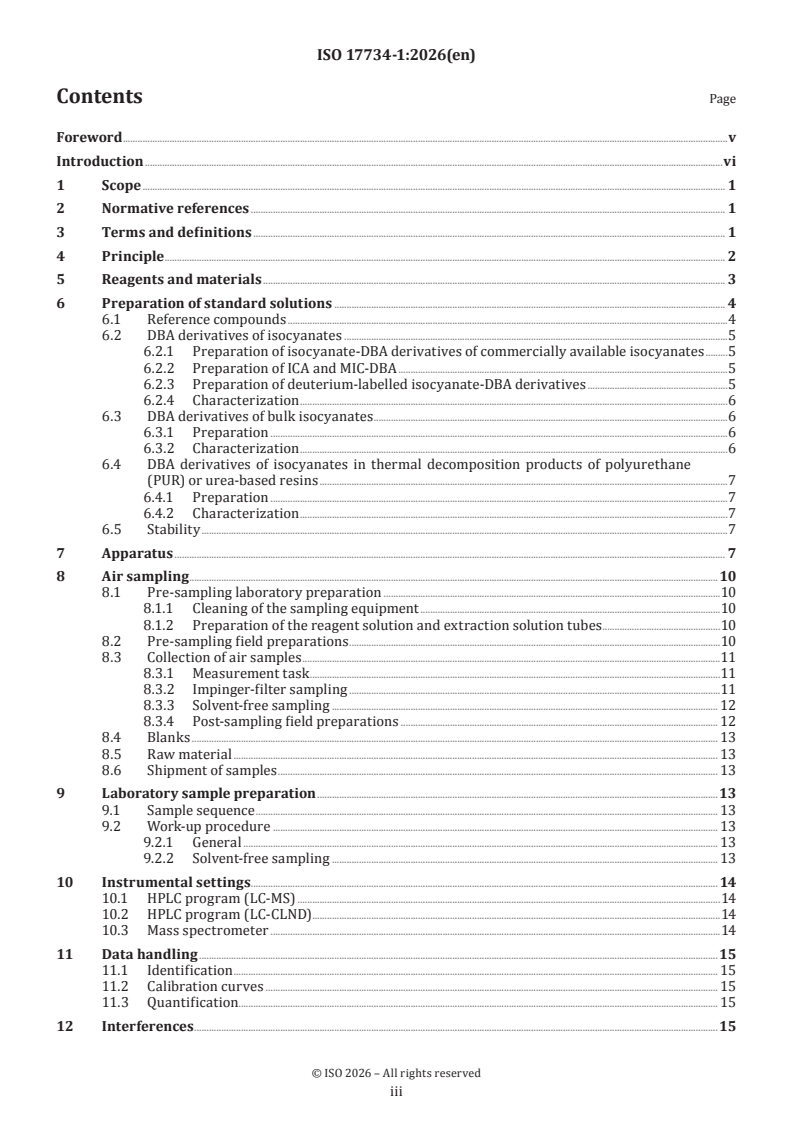
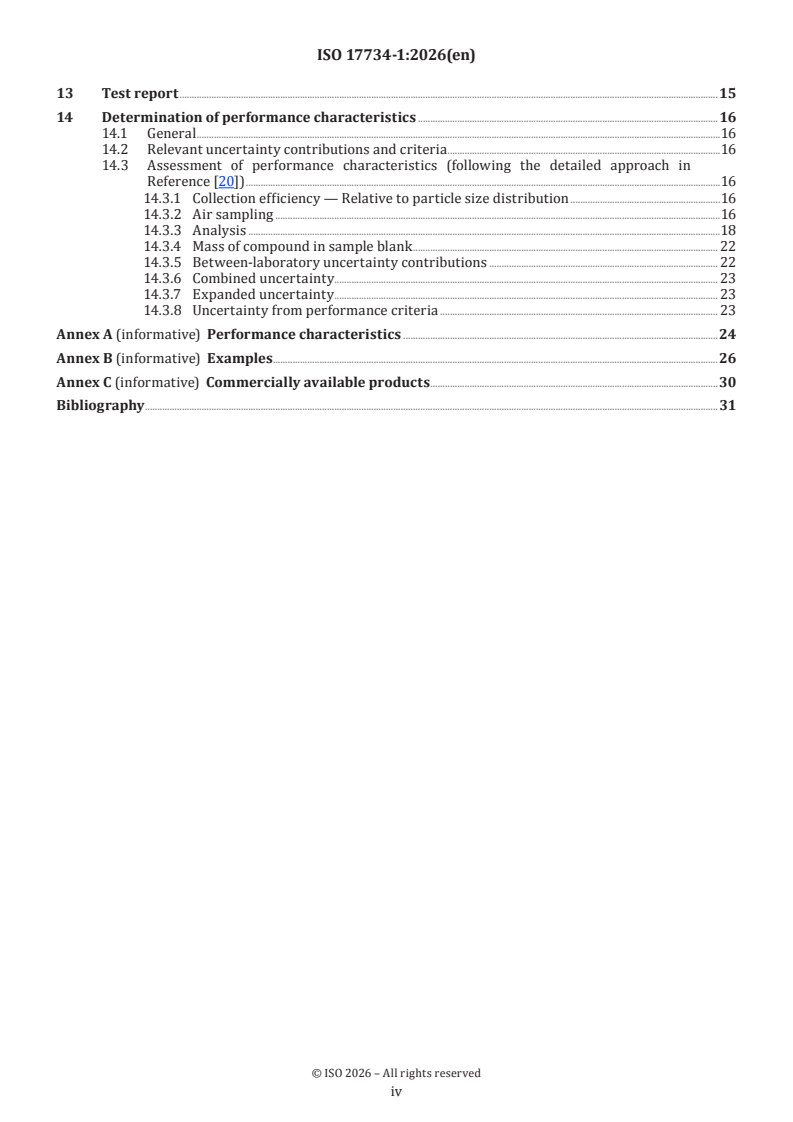
Contents
- Introduction
- 1 Scope
- 2 Normative references
- 3 Terms and definitions
- 3.1 isocyanate
- 3.2 monomer
- 3.3 diisocyanate
- 3.4 oligomer
- 3.5 prepolymer
- 3.6 technical isocyanate
- 4 Principle
- 5 Reagents and materials
- 6 Preparation of standard solutions
- 6.1 Reference compounds
- 6.2 DBA derivatives of isocyanates
- 6.3 DBA derivatives of bulk isocyanates
- 6.4 DBA derivatives of isocyanates in thermal decomposition products of polyurethane
- 6.5 Stability
- 7 Apparatus
- 7.6 Glassware, glass beakers and volumetric flasks (volumetric flasks should conform to
- 8 Air sampling
- 8.1 Pre-sampling laboratory preparation
- 8.2 Pre-sampling field preparations
- 8.3 Collection of air samples
- 8.4 Blanks
- 8.5 Raw material
- 8.6 Shipment of samples
- 9 Laboratory sample preparation
- 9.1 Sample sequence
- 9.2 Work-up procedure
- 10 Instrumental settings
- 10.1 HPLC program (LC-MS)
- 10.2 HPLC program (LC-CLND)
- 10.3 Mass spectrometer
- 11 Data handling
- 11.1 Identification
- 11.2 Calibration curves
- 11.3 Quantification
- 12 Interferences
- 13 Test report
- 14 Determination of performance characteristics
- 14.1 General
- 14.2 Relevant uncertainty contributions and criteria
- 14.3 Assessment of performance characteristics (following the detailed approach in
- Annex A
- Annex B
- 1. Breathing zone, worker 1 6 50 —
- 2. Breathing zone, worker 1 6 60 —
- 3. Breathing zone, worker 2 5 300 —
- 4. Breathing zone, worker 2 5 300 —
- 7. Above the mould 3 300 —
- 8. Above the mould 3 300 —
- Annex C
- Bibliography
Introduction
Isocyanates are organic compounds containing the isocyanate functional group (–N=C=O) and have been used in industry for about 50 years. They are commercially important chemicals mainly used for the production of polyurethane (PUR). In spite of controls to limit exposures, there are adverse health effects such as asthma, contact dermatitis and hypersensitivity pneumonitis as consequences of exposure to isocyanates in some industrial sectors.
The analytical method for the determination of isocyanates in workplace air must be sensitive due to the high irritation and sensitization properties of isocyanates. Extremely low occupational exposure limits (OELs) exist in many countries, and concentrations well below the OEL, often less than one hundredth of the limit, are often to be determined. Isocyanates are very reactive and therefore cannot be analysed directly. Derivatization during sampling is required in order to prevent interfering reactions. Hundreds of different isocyanates are used in industry, and many more are formed during thermal degradation of PUR. Therefore, high selectivity of the analytical method is required for accurate results. The determination of isocyanates in the work environment using di-n-butylamine (DBA) as a reagent and liquid chromatography-mass spectrometric detection (LC-MS) has been demonstrated to be a robust method. The development of the method was initiated when difficulties using the “older” methods during [1][2] sampling of isocyanates in complex atmospheres were encountered (e.g. thermal decomposition of PUR). [3] The reaction rate between DBA and isocyanates was found to be fast, and high concentrations can be used [4][5] to secure instantaneous reactions and eliminate problems with interfering compounds. Using impinger flasks containing a reagent solution and a filter in series efficiently collects and derivatizes isocyanates in [6] both the gas and the particle phase. LC-MS/MS of the isocyanate-DBA derivatives enables highly selective −6 [7] and precise determinations down to levels below 10 of the OEL . Solvent-free sampling can also be performed by using a tube coated with a DBA-impregnated glass fibre filter followed by an impregnated filter. An impregnation solution containing DBA together with an acid is [8] used, and the formed ion pair reduces volatility. DBA remains on the filter even after 8 h of sampling . Monomeric isocyanates that are formed during thermal decomposition of polymers [typically PUR and phenol-formaldehyde urea (PFU) resins], such as isocyanic acid and methyl isocyanate, can also be [6][7][8][9][10] determined. Volatile isocyanate-DBA derivatives can be determined using gas chromatography- [9] mass spectrometric detection (GC-MS). Using the DBA method and derivatization with ethyl chloroformate makes simultaneous determinations of amine, aminoisocyanates and isocyanates possible, as described in [11] the companion method in ISO 17734-2 .
For quantification, reference compounds are necessary but are only available for a few monomeric isocyanates. Most of the isocyanates that are used in industry for the production of PUR can only be obtained in technical grade mixtures. Many isocyanates that are formed during thermal degradation are not available and are not easily synthesized. In this method, a nitrogen-sensitive detector has been used for quantifying isocyanates in reference solutions. This technique has been demonstrated to be a useful tool, together with [10][12][13] MS characterization, in greatly facilitating the production of reference solutions . For quantifying isocyanates in complex mixtures, MS detection appears to be the current best available detection technique and provides a unique possibility of identifying unknown compounds. This method has enabled assessment of new areas for which exposure to isocyanates was not known previously and has [6][7][8][9][10][12][13] identified new kinds of isocyanates in the work environment .
SIST ISO 17734-1:2026 International Standard ISO 17734-1:2026(en) Workplace air — Determination of organonitrogen compounds in air using liquid chromatography and mass spectrometry — Part 1:
Isocyanates using dibutylamine derivatives
1 Scope
This document specifies a method for the determination of organic isocyanates in workplace air using derivatization with di-n-butylamine (DBA) and chromatographic analysis. This document is applicable to the determination of a wide range of organic isocyanates present in both the gas phase and the particle phase in workplace atmospheres, including monofunctional isocyanates such as isocyanic acid (ICA), methyl isocyanate (MIC), ethyl isocyanate (EIC), propyl isocyanate (PIC), butyl isocyanate (BIC) and phenyl isocyanate (PhI); monomeric diisocyanates, including 1,6-hexamethylene diisocyanate (HDI), 2,4- and 2,6-toluene diisocyanate (TDI), 4,4′-methylenediphenyl diisocyanate (MDI), 1,5-naphthyl diisocyanate (NDI), isophorone diisocyanate (IPDI) and 4,4′-dicyclohexylmethane diisocyanate (H12MDI); and multifunctional isocyanates, including oligomeric, prepolymeric and polymeric forms such as biuret-, isocyanurate- and allophanate-adducts.
The method covers air sampling using impingers, filters or combinations thereof, and analysis by liquid chromatography with mass spectrometric detection.
The useful analytical range is approximately 2,5 ng to 500 ng of isocyanate per sample. For a nominal air 3 3 sample volume of 15 l, this corresponds to approximately 0,2 µg/m to 33 µg/m . These values can vary depending on the isocyanate analysed.
This document does not apply to the determination of amines or aminoisocyanates. For the determination of [11] amines and aminoisocyanates, the method specified in ISO 17734-2 .
2 Normative references
The following documents are referred to in the text in such a way that some or all of their content constitutes requirements of this document. For dated references, only the edition cited applies. For undated references, the latest edition of the referenced document (including any amendments) applies. ISO 3696, Water for analytical laboratory use — Specification and test methods ISO 5725-2, Accuracy (trueness and precision) of measurement methods and results — Part 2: Basic method for the determination of repeatability and reproducibility of a standard measurement method ISO 13137, Workplace atmospheres — Pumps for personal sampling of chemical and biological agents — Requirements and test methods
3 Terms and definitions
For the purposes of this document, the following terms and definitions apply.
SIST ISO 17734-1:2026 ISO 17734-1:2026(en) ISO and IEC maintain terminology databases for use in standardization at the following addresses:
- ISO Online browsing platform: available at https:// www .iso .org/ obp
- IEC Electropedia: available at https:// www .electropedia .org/
3.1 isocyanate
chemical compound containing one or more –N=C=O functional groups
3.2 monomer
chemical compound that joins with other identical compounds to form dimers, trimers, oligomers or polymers Note 1 to entry: Classes of isocyanate monomers (include: monoisocyanates, containing one isocyanate functional group (e.g. methyl isocyanate), diisocyanates [e.g. di(4-isocyanatophenyl)methane (MDI)] and triisocyanates [e.g. tri(4-isocyanatophenyl)methane].
3.3 diisocyanate
chemical compound with two isocyanate functional groups
3.4 oligomer
compound of low relative molecular mass with multiple isocyanate functional groups, formed by the combination of isocyanate monomers
3.5 prepolymer
isocyanato-terminated reaction product of a di- or poly-isocyanate that has a stochiometric deficiency, with a hydroxyl-terminated polyol Note 1 to entry: These compounds are further reacted to form polyurethanes or similar compounds.
3.6 technical isocyanate
isocyanates produced by isocyanate manufacturers and used as is or with other components according to its use in the industry
4 Principle
Samples are collected by drawing a known volume of air through a midget impinger flask followed by a
filter. The impinger contains 10 ml of 0,01 mol·l of DBA in toluene and the filter is a glass fibre filter with no binder.
Solvent-free sampling can also be performed by drawing air through a tube coated with a DBA-impregnated glass fibre filter followed by an impregnated filter. An impregnation solution containing DBA together with acetic acid is used, the ion pair so formed reduces the volatility and enables long-time sampling. After sampling, deuterium-labelled isocyanate-DBA derivatives (used as internal standard) are added to the sample solutions. The excess reagent and solvent are evaporated, and the samples are dissolved in acetonitrile. The samples are analysed using reversed-phase LC and electrospray (ESP)-MS detection, monitoring positive ions. Quantification is made by monitoring selected ions. See Figure 1. Quantification and qualitative determinations can be performed using different LC-MS or LC-MS/ MS techniques. Liquid chromatography-chemiluminescent nitrogen detection (LC-CLND) or liquid chromatography-ultraviolet detection (LC-UV) for aromatic isocyanates, can be used for the determination of higher concentrations of isocyanates.
Reference materials can be characterized using LC-MS/CLND. For characterization of volatile compounds, gas chromatography-thermionic specific detector (GC-TSD) can also be used.
SIST ISO 17734-1:2026 ISO 17734-1:2026(en) Figure 1 — Example of a flow diagram of the whole procedure for sampling, sample preparation, analysis and reporting
5 Reagents and materials
5.1 DBA reagent.
Analytical grade di-n-butylamine is commercially available.
5.2 Solvents.
The reagent solvent, typically toluene and other solvents, such as acetonitrile, isooctane and methanol, should be of liquid chromatographic quality.
5.3 Formic acid, concentrated formic acid, analytical grade.
5.4 Acetic acid, concentrated acetic acid, analytical grade.
5.5 Pyridine, analytical grade.
SIST ISO 17734-1:2026 ISO 17734-1:2026(en) 5.6 Sodium hydroxide, reagent grade.
5.7 Ethyl chloroformate, analytical grade.
5.8 Urea, analytical grade.
5.9 1,3 dimethyl urea, analytical grade.
5.10 Water, in accordance with ISO 3696, grade 2 water (electrical conductivity less than 0,1 mS/m and resistivity greater than 0,01 MΩ·m at 25 °C).
5.11 Sulfuric acid 5 mM, 0,27 ml of concentrated sulfuric acid (98 %) analytical grade is added to 1 000 ml of water.
5.12 Reagent solution.
In a 1 l volumetric flask, dilute 1,69 ml of DBA in toluene and make up to the mark. The solution is stable and no special care during storage is necessary.
5.13 Reagent solution, for solvent-free sampler.
5.13.1 Solution 1: 0,74 mol·l DBA.
Mix 80 ml methanol and 12,5 ml DBA in a 100 ml volumetric flask. Then while stirring, slowly add 4,16 ml of acetic acid to the flask. Finally, add methanol to the flask, and make up to the mark.
5.13.2 Solution 2: 1,5 mol·l DBA.
Mix 60 ml methanol and 25 ml DBA in a 100 ml volumetric flask. Then while stirring, slowly add 8,32 ml of acetic acid to the flask. Finally, add methanol to the flask, and make up to the mark. 5.14 HPLC mobile phases.
5.14.1 LC-MS.
The weak mobile phase (mobile phase A) consists of water and acetonitrile at a volume fraction of 95 % water and 5 % acetonitrile, with 0,05 % formic acid. The strong mobile phase (mobile phase B) consists of water and acetonitrile at a volume fraction of 5 % water and 95 % acetonitrile, with 0,05 % formic acid. The mobile phases are degassed prior to use. The mobile phases are degassed prior to use. 5.14.2 LC-CLND.
The weak mobile phase (mobile phase C) consists of water and methanol at a volume fraction of 95 % water and 5 % methanol, with 0,05 % formic acid. The strong mobile phase (mobile phase D) consists of water and methanol at a volume fraction of 5 % water and 95 % methanol, with 0,05 % formic acid. The mobile phases are degassed prior to use.
6 Preparation of standard solutions
6.1 Reference compounds
Reference compounds are necessary for LC-MS determination of isocyanate derivatives. For the commercially available isocyanates, the DBA derivatives are easily prepared by direct derivatization with DBA. DBA derivatives for the isocyanates not commercially available can be made from the bulk material or
SIST ISO 17734-1:2026 ISO 17734-1:2026(en) from the thermal decomposition of PUR or urea-based resins used at the work place. Alternatively, standard solutions can be purchased (see Annex C).
6.2 DBA derivatives of isocyanates
6.2.1 Preparation of isocyanate-DBA derivatives of commercially available isocyanates
Many frequently used isocyanates are commercially available from companies supplying laboratory chemicals such as HDI, 2,4-TDI, 2,6-TDI, 4,4’-MDI, 4,4’-HMDI, 1,5-NDI, IPDI, PhI, MIC, EIC, PIC and BIC. The purity of the isocyanates varies and some contain isomers.
Calibration standards are made by spiking accurately weighed amounts or volumes (approximately 0,1 mmol) of isocyanates in 100 ml of isooctane. A 1 ml volume is added to 100 ml of toluene containing –1 –1 0,01 mol∙l of DBA (approximately 0,01 µmol∙ml of the DBA derivative). The procedure for the synthesis of derivatives is as follows:
a) Dilute 6 mmol of isocyanate in 2 ml of isooctane.
b) Dissolve 60 mmol of DBA in 20 ml of isooctane.
c) Add the isocyanate solution to the DBA solution dropwise under continuous stirring. d) Evaporate the reaction mixture to dryness in a rotating evaporator. e) Dry the residue under vacuum to remove excess DBA.
It is also possible to prepare the isocyanate-DBA derivatives by collecting the thermal degradation products of the corresponding carbamate esters in an impinger flask containing a DBA solution (as specified in 6.2.3.3).
6.2.2 Preparation of ICA and MIC-DBA
When urea is thermally degraded, ICA is formed.
Heat an amount of urea (20 mg) to about 300 °C in a glass tube. Collect the degradation products in an
impinger flask containing DBA in toluene (0,5 mol∙l ). Wash the toluene solution containing the ICA-DBA derivatives with water, whereupon the organic phase is evaporated in a vacuum centrifuge and the residue is dissolved in methanol. Characterize the solution, as described in 6.2.4. The same procedure can be applied for preparation of MIC-DBA derivatives, by collecting thermal degradation products of 1,3-dimethyl urea.
6.2.3 Preparation of deuterium-labelled isocyanate-DBA derivatives
6.2.3.1 Internal standards
For accurate LC-MS quantifications, internal standards shall be used, not only to compensate for variations during the work-up procedure, but also to compensate for fluctuation in the MS instrument response. Ideally, each analyte should have its own deuterium-labelled analogue. For isocyanate-DBA determinations, it is possible to use DBA derivatives of deuterium-labelled isocyanates or d - and d -DBA derivatives of the 9 18 isocyanates as internal standards.
The quality of the quantification is influenced by the number of deuterium substitutions in the internal standard (less deuterium in the molecule result in higher precision). Having the deuterium on the isocyanate, and not on the DBA, has advantages when performing structural identification using MS and MS/MS. It is then possible to distinguish between labelled and non-labelled fragments that originate from the isocyanate itself. Therefore, the ideal internal standards are the DBA derivatives of the deuterium-labelled isocyanates. However, they are labour intensive to prepare and they are only available for a few isocyanates.
SIST ISO 17734-1:2026 ISO 17734-1:2026(en) The deuterium-labelled d - and d -DBA derivatives are easy to prepare, and any technical isocyanate or 9 18 thermal degradation product can be derivatized and used as internal standard.
6.2.3.2 DBA derivatives of deuterium-labelled isocyanates
Dissolve a 10 mmol aliquot of the deuterium-labelled corresponding amine in 20 ml of toluene. Thereafter,
add 150 µl pyridine and 40 ml of 5 mol∙l sodium hydroxide. Then add 1,5 ml of ethyl chloroformate dropwise under continuous stirring. After 10 min, the toluene phase is separated, and the solvent is evaporated. Place the residue containing the formed amine carbamate ester (10 µl) in a glass tube. Heat the tube to
about 300 °C. By connecting the tube to an impinger flask, containing 0,5 mol∙l DBA in toluene, the formed deuterium-labelled isocyanate is collected as a DBA derivative. Evaporate the solvent and dissolve the residue in methanol to an appropriate concentration. Characterize the solution, as described in 6.2.4. 6.2.3.3 d -DBA and d -DBA derivatives of the isocyanates 9 18 Prepare the deuterium-labelled d - and d -DBA derivatives by dissolving accurately weighed amounts of 9 18
the isocyanates in 10 ml of 0,1 mol∙l d -DBA or d -DBA in toluene. 9 18 Prepare the deuterium-labelled derivatives of ICA and MIC by placing 20 mg of urea for ICA and 1,3-dimethyl urea for MIC in a glass tube. Heat the tube to about 300 °C and collect the formed ICA and MIC in impinger
flasks containing 0,1 mol∙l d -DBA or d -DBA in toluene. Evaporate the solutions containing the isocyanate 9 18 d -DBA or d -DBA derivatives to dryness and dissolve the residues in methanol. Characterize the solution, 9 18 as described in 6.2.4.
6.2.4 Characterization
The solutions are diluted in methanol to appropriate concentrations and characterized on the LC-MS and quantified on the LC-CLND. This technique is nitrogen specific and any nitrogen-containing compound [14][15][16] can be used as an external standard, e.g. caffeine. The technique is used in several applications. Quantification of volatile isocyanate-DBA derivatives can also be made by using GC-TSD.
6.3 DBA derivatives of bulk isocyanates
6.3.1 Preparation
Technical isocyanates are produced by isocyanate manufacturers and are used as is or with other components according to its use in the industry. These isocyanates are typically multifunctional. If product data sheets are available and correct, standard solutions for the technical isocyanates can be prepared in the same way as described in 6.2.1, by adding a known amount of bulk isocyanate to a toluene solution of DBA. If data regarding the composition and concentrations of different isocyanates are of poor quality or missing, the bulk material shall be characterized.
The procedure for the technical-grade isocyanate is as follows:
a) Add an aliquot of 10 mg of the isocyanate product to a 10 ml vial containing 0,5 mol∙l DBA. b) Sonicate the solution and evaporate it to dryness and then dissolve it in methanol. c) Further dilute the solution with methanol to appropriate concentrations. d) Characterize the solution, as described in 6.3.2.
6.3.2 Characterization
If the isocyanates that are present in the bulk are known or reference compounds are available, calibration standards can be prepared as described in 6.2.1.
...
Contents
- Introduction
- 1 Scope
- 2 Normative references
- 3 Terms and definitions
- 3.1 isocyanate
- 3.2 monomer
- 3.3 diisocyanate
- 3.4 oligomer
- 3.5 prepolymer
- 3.6 technical isocyanate
- 4 Principle
- 5 Reagents and materials
- 6 Preparation of standard solutions
- 6.1 Reference compounds
- 6.2 DBA derivatives of isocyanates
- 6.3 DBA derivatives of bulk isocyanates
- 6.4 DBA derivatives of isocyanates in thermal decomposition products of polyurethane
- 6.5 Stability
- 7 Apparatus
- 7.6 Glassware, glass beakers and volumetric flasks (volumetric flasks should conform to
- 8 Air sampling
- 8.1 Pre-sampling laboratory preparation
- 8.2 Pre-sampling field preparations
- 8.3 Collection of air samples
- 8.4 Blanks
- 8.5 Raw material
- 8.6 Shipment of samples
- 9 Laboratory sample preparation
- 9.1 Sample sequence
- 9.2 Work-up procedure
- 10 Instrumental settings
- 10.1 HPLC program (LC-MS)
- 10.2 HPLC program (LC-CLND)
- 10.3 Mass spectrometer
- 11 Data handling
- 11.1 Identification
- 11.2 Calibration curves
- 11.3 Quantification
- 12 Interferences
- 13 Test report
- 14 Determination of performance characteristics
- 14.1 General
- 14.2 Relevant uncertainty contributions and criteria
- 14.3 Assessment of performance characteristics (following the detailed approach in
- Annex A
- Annex B
- 1. Breathing zone, worker 1 6 50 —
- 2. Breathing zone, worker 1 6 60 —
- 3. Breathing zone, worker 2 5 300 —
- 4. Breathing zone, worker 2 5 300 —
- 7. Above the mould 3 300 —
- 8. Above the mould 3 300 —
- Annex C
- Bibliography
Introduction
Isocyanates are organic compounds containing the isocyanate functional group (–N=C=O) and have been used in industry for about 50 years. They are commercially important chemicals mainly used for the production of polyurethane (PUR). In spite of controls to limit exposures, there are adverse health effects such as asthma, contact dermatitis and hypersensitivity pneumonitis as consequences of exposure to isocyanates in some industrial sectors.
The analytical method for the determination of isocyanates in workplace air must be sensitive due to the high irritation and sensitization properties of isocyanates. Extremely low occupational exposure limits (OELs) exist in many countries, and concentrations well below the OEL, often less than one hundredth of the limit, are often to be determined. Isocyanates are very reactive and therefore cannot be analysed directly. Derivatization during sampling is required in order to prevent interfering reactions. Hundreds of different isocyanates are used in industry, and many more are formed during thermal degradation of PUR. Therefore, high selectivity of the analytical method is required for accurate results. The determination of isocyanates in the work environment using di-n-butylamine (DBA) as a reagent and liquid chromatography-mass spectrometric detection (LC-MS) has been demonstrated to be a robust method. The development of the method was initiated when difficulties using the “older” methods during [1][2] sampling of isocyanates in complex atmospheres were encountered (e.g. thermal decomposition of PUR). [3] The reaction rate between DBA and isocyanates was found to be fast, and high concentrations can be used [4][5] to secure instantaneous reactions and eliminate problems with interfering compounds. Using impinger flasks containing a reagent solution and a filter in series efficiently collects and derivatizes isocyanates in [6] both the gas and the particle phase. LC-MS/MS of the isocyanate-DBA derivatives enables highly selective −6 [7] and precise determinations down to levels below 10 of the OEL . Solvent-free sampling can also be performed by using a tube coated with a DBA-impregnated glass fibre filter followed by an impregnated filter. An impregnation solution containing DBA together with an acid is [8] used, and the formed ion pair reduces volatility. DBA remains on the filter even after 8 h of sampling . Monomeric isocyanates that are formed during thermal decomposition of polymers [typically PUR and phenol-formaldehyde urea (PFU) resins], such as isocyanic acid and methyl isocyanate, can also be [6][7][8][9][10] determined. Volatile isocyanate-DBA derivatives can be determined using gas chromatography- [9] mass spectrometric detection (GC-MS). Using the DBA method and derivatization with ethyl chloroformate makes simultaneous determinations of amine, aminoisocyanates and isocyanates possible, as described in [11] the companion method in ISO 17734-2 .
For quantification, reference compounds are necessary but are only available for a few monomeric isocyanates. Most of the isocyanates that are used in industry for the production of PUR can only be obtained in technical grade mixtures. Many isocyanates that are formed during thermal degradation are not available and are not easily synthesized. In this method, a nitrogen-sensitive detector has been used for quantifying isocyanates in reference solutions. This technique has been demonstrated to be a useful tool, together with [10][12][13] MS characterization, in greatly facilitating the production of reference solutions . For quantifying isocyanates in complex mixtures, MS detection appears to be the current best available detection technique and provides a unique possibility of identifying unknown compounds. This method has enabled assessment of new areas for which exposure to isocyanates was not known previously and has [6][7][8][9][10][12][13] identified new kinds of isocyanates in the work environment .
International Standard ISO 17734-1:2026(en) Workplace air — Determination of organonitrogen compounds in air using liquid chromatography and mass spectrometry — Part 1:
Isocyanates using dibutylamine derivatives
1 Scope
This document specifies a method for the determination of organic isocyanates in workplace air using derivatization with di-n-butylamine (DBA) and chromatographic analysis. This document is applicable to the determination of a wide range of organic isocyanates present in both the gas phase and the particle phase in workplace atmospheres, including monofunctional isocyanates such as isocyanic acid (ICA), methyl isocyanate (MIC), ethyl isocyanate (EIC), propyl isocyanate (PIC), butyl isocyanate (BIC) and phenyl isocyanate (PhI); monomeric diisocyanates, including 1,6-hexamethylene diisocyanate (HDI), 2,4- and 2,6-toluene diisocyanate (TDI), 4,4′-methylenediphenyl diisocyanate (MDI), 1,5-naphthyl diisocyanate (NDI), isophorone diisocyanate (IPDI) and 4,4′-dicyclohexylmethane diisocyanate (H12MDI); and multifunctional isocyanates, including oligomeric, prepolymeric and polymeric forms such as biuret-, isocyanurate- and allophanate-adducts.
The method covers air sampling using impingers, filters or combinations thereof, and analysis by liquid chromatography with mass spectrometric detection.
The useful analytical range is approximately 2,5 ng to 500 ng of isocyanate per sample. For a nominal air 3 3 sample volume of 15 l, this corresponds to approximately 0,2 µg/m to 33 µg/m . These values can vary depending on the isocyanate analysed.
This document does not apply to the determination of amines or aminoisocyanates. For the determination of [11] amines and aminoisocyanates, the method specified in ISO 17734-2 .
2 Normative references
The following documents are referred to in the text in such a way that some or all of their content constitutes requirements of this document. For dated references, only the edition cited applies. For undated references, the latest edition of the referenced document (including any amendments) applies. ISO 3696, Water for analytical laboratory use — Specification and test methods ISO 5725-2, Accuracy (trueness and precision) of measurement methods and results — Part 2: Basic method for the determination of repeatability and reproducibility of a standard measurement method ISO 13137, Workplace atmospheres — Pumps for personal sampling of chemical and biological agents — Requirements and test methods
3 Terms and definitions
For the purposes of this document, the following terms and definitions apply.
ISO 17734-1:2026(en) ISO and IEC maintain terminology databases for use in standardization at the following addresses:
- ISO Online browsing platform: available at https:// www .iso .org/ obp
- IEC Electropedia: available at https:// www .electropedia .org/
3.1 isocyanate
chemical compound containing one or more –N=C=O functional groups
3.2 monomer
chemical compound that joins with other identical compounds to form dimers, trimers, oligomers or polymers Note 1 to entry: Classes of isocyanate monomers (include: monoisocyanates, containing one isocyanate functional group (e.g. methyl isocyanate), diisocyanates [e.g. di(4-isocyanatophenyl)methane (MDI)] and triisocyanates [e.g. tri(4-isocyanatophenyl)methane].
3.3 diisocyanate
chemical compound with two isocyanate functional groups
3.4 oligomer
compound of low relative molecular mass with multiple isocyanate functional groups, formed by the combination of isocyanate monomers
3.5 prepolymer
isocyanato-terminated reaction product of a di- or poly-isocyanate that has a stochiometric deficiency, with a hydroxyl-terminated polyol Note 1 to entry: These compounds are further reacted to form polyurethanes or similar compounds.
3.6 technical isocyanate
isocyanates produced by isocyanate manufacturers and used as is or with other components according to its use in the industry
4 Principle
Samples are collected by drawing a known volume of air through a midget impinger flask followed by a
filter. The impinger contains 10 ml of 0,01 mol·l of DBA in toluene and the filter is a glass fibre filter with no binder.
Solvent-free sampling can also be performed by drawing air through a tube coated with a DBA-impregnated glass fibre filter followed by an impregnated filter. An impregnation solution containing DBA together with acetic acid is used, the ion pair so formed reduces the volatility and enables long-time sampling. After sampling, deuterium-labelled isocyanate-DBA derivatives (used as internal standard) are added to the sample solutions. The excess reagent and solvent are evaporated, and the samples are dissolved in acetonitrile. The samples are analysed using reversed-phase LC and electrospray (ESP)-MS detection, monitoring positive ions. Quantification is made by monitoring selected ions. See Figure 1. Quantification and qualitative determinations can be performed using different LC-MS or LC-MS/ MS techniques. Liquid chromatography-chemiluminescent nitrogen detection (LC-CLND) or liquid chromatography-ultraviolet detection (LC-UV) for aromatic isocyanates, can be used for the determination of higher concentrations of isocyanates.
Reference materials can be characterized using LC-MS/CLND. For characterization of volatile compounds, gas chromatography-thermionic specific detector (GC-TSD) can also be used.
ISO 17734-1:2026(en) Figure 1 — Example of a flow diagram of the whole procedure for sampling, sample preparation, analysis and reporting
5 Reagents and materials
5.1 DBA reagent.
Analytical grade di-n-butylamine is commercially available.
5.2 Solvents.
The reagent solvent, typically toluene and other solvents, such as acetonitrile, isooctane and methanol, should be of liquid chromatographic quality.
5.3 Formic acid, concentrated formic acid, analytical grade.
5.4 Acetic acid, concentrated acetic acid, analytical grade.
5.5 Pyridine, analytical grade.
ISO 17734-1:2026(en) 5.6 Sodium hydroxide, reagent grade.
5.7 Ethyl chloroformate, analytical grade.
5.8 Urea, analytical grade.
5.9 1,3 dimethyl urea, analytical grade.
5.10 Water, in accordance with ISO 3696, grade 2 water (electrical conductivity less than 0,1 mS/m and resistivity greater than 0,01 MΩ·m at 25 °C).
5.11 Sulfuric acid 5 mM, 0,27 ml of concentrated sulfuric acid (98 %) analytical grade is added to 1 000 ml of water.
5.12 Reagent solution.
In a 1 l volumetric flask, dilute 1,69 ml of DBA in toluene and make up to the mark. The solution is stable and no special care during storage is necessary.
5.13 Reagent solution, for solvent-free sampler.
5.13.1 Solution 1: 0,74 mol·l DBA.
Mix 80 ml methanol and 12,5 ml DBA in a 100 ml volumetric flask. Then while stirring, slowly add 4,16 ml of acetic acid to the flask. Finally, add methanol to the flask, and make up to the mark.
5.13.2 Solution 2: 1,5 mol·l DBA.
Mix 60 ml methanol and 25 ml DBA in a 100 ml volumetric flask. Then while stirring, slowly add 8,32 ml of acetic acid to the flask. Finally, add methanol to the flask, and make up to the mark. 5.14 HPLC mobile phases.
5.14.1 LC-MS.
The weak mobile phase (mobile phase A) consists of water and acetonitrile at a volume fraction of 95 % water and 5 % acetonitrile, with 0,05 % formic acid. The strong mobile phase (mobile phase B) consists of water and acetonitrile at a volume fraction of 5 % water and 95 % acetonitrile, with 0,05 % formic acid. The mobile phases are degassed prior to use. The mobile phases are degassed prior to use. 5.14.2 LC-CLND.
The weak mobile phase (mobile phase C) consists of water and methanol at a volume fraction of 95 % water and 5 % methanol, with 0,05 % formic acid. The strong mobile phase (mobile phase D) consists of water and methanol at a volume fraction of 5 % water and 95 % methanol, with 0,05 % formic acid. The mobile phases are degassed prior to use.
6 Preparation of standard solutions
6.1 Reference compounds
Reference compounds are necessary for LC-MS determination of isocyanate derivatives. For the commercially available isocyanates, the DBA derivatives are easily prepared by direct derivatization with DBA. DBA derivatives for the isocyanates not commercially available can be made from the bulk material or
ISO 17734-1:2026(en) from the thermal decomposition of PUR or urea-based resins used at the work place. Alternatively, standard solutions can be purchased (see Annex C).
6.2 DBA derivatives of isocyanates
6.2.1 Preparation of isocyanate-DBA derivatives of commercially available isocyanates
Many frequently used isocyanates are commercially available from companies supplying laboratory chemicals such as HDI, 2,4-TDI, 2,6-TDI, 4,4’-MDI, 4,4’-HMDI, 1,5-NDI, IPDI, PhI, MIC, EIC, PIC and BIC. The purity of the isocyanates varies and some contain isomers.
Calibration standards are made by spiking accurately weighed amounts or volumes (approximately 0,1 mmol) of isocyanates in 100 ml of isooctane. A 1 ml volume is added to 100 ml of toluene containing –1 –1 0,01 mol∙l of DBA (approximately 0,01 µmol∙ml of the DBA derivative). The procedure for the synthesis of derivatives is as follows:
a) Dilute 6 mmol of isocyanate in 2 ml of isooctane.
b) Dissolve 60 mmol of DBA in 20 ml of isooctane.
c) Add the isocyanate solution to the DBA solution dropwise under continuous stirring. d) Evaporate the reaction mixture to dryness in a rotating evaporator. e) Dry the residue under vacuum to remove excess DBA.
It is also possible to prepare the isocyanate-DBA derivatives by collecting the thermal degradation products of the corresponding carbamate esters in an impinger flask containing a DBA solution (as specified in 6.2.3.3).
6.2.2 Preparation of ICA and MIC-DBA
When urea is thermally degraded, ICA is formed.
Heat an amount of urea (20 mg) to about 300 °C in a glass tube. Collect the degradation products in an
impinger flask containing DBA in toluene (0,5 mol∙l ). Wash the toluene solution containing the ICA-DBA derivatives with water, whereupon the organic phase is evaporated in a vacuum centrifuge and the residue is dissolved in methanol. Characterize the solution, as described in 6.2.4. The same procedure can be applied for preparation of MIC-DBA derivatives, by collecting thermal degradation products of 1,3-dimethyl urea.
6.2.3 Preparation of deuterium-labelled isocyanate-DBA derivatives
6.2.3.1 Internal standards
For accurate LC-MS quantifications, internal standards shall be used, not only to compensate for variations during the work-up procedure, but also to compensate for fluctuation in the MS instrument response. Ideally, each analyte should have its own deuterium-labelled analogue. For isocyanate-DBA determinations, it is possible to use DBA derivatives of deuterium-labelled isocyanates or d - and d -DBA derivatives of the 9 18 isocyanates as internal standards.
The quality of the quantification is influenced by the number of deuterium substitutions in the internal standard (less deuterium in the molecule result in higher precision). Having the deuterium on the isocyanate, and not on the DBA, has advantages when performing structural identification using MS and MS/MS. It is then possible to distinguish between labelled and non-labelled fragments that originate from the isocyanate itself. Therefore, the ideal internal standards are the DBA derivatives of the deuterium-labelled isocyanates. However, they are labour intensive to prepare and they are only available for a few isocyanates.
ISO 17734-1:2026(en) The deuterium-labelled d - and d -DBA derivatives are easy to prepare, and any technical isocyanate or 9 18 thermal degradation product can be derivatized and used as internal standard.
6.2.3.2 DBA derivatives of deuterium-labelled isocyanates
Dissolve a 10 mmol aliquot of the deuterium-labelled corresponding amine in 20 ml of toluene. Thereafter,
add 150 µl pyridine and 40 ml of 5 mol∙l sodium hydroxide. Then add 1,5 ml of ethyl chloroformate dropwise under continuous stirring. After 10 min, the toluene phase is separated, and the solvent is evaporated. Place the residue containing the formed amine carbamate ester (10 µl) in a glass tube. Heat the tube to
about 300 °C. By connecting the tube to an impinger flask, containing 0,5 mol∙l DBA in toluene, the formed deuterium-labelled isocyanate is collected as a DBA derivative. Evaporate the solvent and dissolve the residue in methanol to an appropriate concentration. Characterize the solution, as described in 6.2.4. 6.2.3.3 d -DBA and d -DBA derivatives of the isocyanates 9 18 Prepare the deuterium-labelled d - and d -DBA derivatives by dissolving accurately weighed amounts of 9 18
the isocyanates in 10 ml of 0,1 mol∙l d -DBA or d -DBA in toluene. 9 18 Prepare the deuterium-labelled derivatives of ICA and MIC by placing 20 mg of urea for ICA and 1,3-dimethyl urea for MIC in a glass tube. Heat the tube to about 300 °C and collect the formed ICA and MIC in impinger
flasks containing 0,1 mol∙l d -DBA or d -DBA in toluene. Evaporate the solutions containing the isocyanate 9 18 d -DBA or d -DBA derivatives to dryness and dissolve the residues in methanol. Characterize the solution, 9 18 as described in 6.2.4.
6.2.4 Characterization
The solutions are diluted in methanol to appropriate concentrations and characterized on the LC-MS and quantified on the LC-CLND. This technique is nitrogen specific and any nitrogen-containing compound [14][15][16] can be used as an external standard, e.g. caffeine. The technique is used in several applications. Quantification of volatile isocyanate-DBA derivatives can also be made by using GC-TSD.
6.3 DBA derivatives of bulk isocyanates
6.3.1 Preparation
Technical isocyanates are produced by isocyanate manufacturers and are used as is or with other components according to its use in the industry. These isocyanates are typically multifunctional. If product data sheets are available and correct, standard solutions for the technical isocyanates can be prepared in the same way as described in 6.2.1, by adding a known amount of bulk isocyanate to a toluene solution of DBA. If data regarding the composition and concentrations of different isocyanates are of poor quality or missing, the bulk material shall be characterized.
The procedure for the technical-grade isocyanate is as follows:
a) Add an aliquot of 10 mg of the isocyanate product to a 10 ml vial containing 0,5 mol∙l DBA. b) Sonicate the solution and evaporate it to dryness and then dissolve it in methanol. c) Further dilute the solution with methanol to appropriate concentrations. d) Characterize the solution, as described in 6.3.2.
6.3.2 Characterization
If the isocyanates that are present in the bulk are known or reference compounds are available, calibration standards can be prepared as described in 6.2.1.
...