

ISO 30011:2025
(Main)Workplace air — Determination of metals and metalloids in airborne particulate matter by inductively coupled plasma mass spectrometry
General Information
- Abstract
This document specifies a procedure for the use of quadrupole inductively coupled plasma mass spectrometry (ICP-MS), including single-quadrupole instruments and tandem ICP-MS/MS, for analysing test solutions prepared from samples of airborne particulate matter collected as specified in ISO 15202-1. Method development, performance checks and a routine analysis method are specified in this document NOTE 1 Other types of ICP-MS (e.g. magnetic sector) are outside of the scope of this document. Test solutions for analysis by this document are prepared as specified in ISO 15202-2. This document is applicable to the assessment of workplace exposure to metals and metalloids for comparison with limit values (e.g. see EN 689[10] and ASTM E1370[8]). This document is not applicable to the determination of elemental mercury, since mercury vapour is not collected using the sampling method specified in ISO 15202-1. The procedure specified in this document is suitable for the assessment of exposure against the long-term exposure limits for most of the metals and metalloids for which occupational exposure limit values have been set, when sampling at a typical flow rate of at least 2 l min−1 for sampling times in the range 0,25 h to 8 h and for the assessment of exposure against the short-term exposure limits, where applicable. NOTE 2 The procedure is subject to no significant spectral interferences (see Clause A.3), provided that suitable analytical isotopes are used. However, inadequate matrix-matching can adversely affect results.
- Status
- Published
- Publication Date
- 07-Aug-2025
- Technical Committee
- ISO/TC 146/SC 2 - Workplace atmospheres
- Drafting Committee
- ISO/TC 146/SC 2 - Workplace atmospheres
- Current Stage
- 6060 - International Standard published
- Start Date
- 08-Aug-2025
- Due Date
- 05-Aug-2025
- Completion Date
- 08-Aug-2025
Buy Documents




ISO 30011:2025 - Workplace air — Determination of metals and metalloids in airborne particulate matter by inductively coupled plasma mass spectrometry Released:8. 08. 2025


ISO 30011:2025 - Air des lieux de travail — Détermination des métaux et métalloïdes dans les particules en suspension dans l'air par spectrométrie de masse avec plasma à couplage inductif/10/2026
REDLINE ISO 30011:2025 - Air des lieux de travail — Détermination des métaux et métalloïdes dans les particules en suspension dans l'air par spectrométrie de masse avec plasma à couplage inductif/10/2026
Overview
ISO 30011:2025 - Workplace air: Determination of metals and metalloids in airborne particulate matter by ICP‑MS specifies a validated procedure for analysing airborne particulate samples using quadrupole inductively coupled plasma mass spectrometry (ICP‑MS), including single‑quadrupole and tandem ICP‑MS/MS systems. It covers method development, instrument performance checks and routine analysis of test solutions prepared from samples collected according to ISO 15202‑1 (with sample preparation per ISO 15202‑2). The standard is focused on workplace exposure assessment to metals and metalloids and is not applicable to elemental mercury (vapour) or other ICP‑MS types such as magnetic‑sector instruments.
Key topics and technical requirements
- Scope of instrumentation: Quadrupole ICP‑MS and ICP‑MS/MS only; magnetic sector ICP‑MS excluded.
- Sampling and sample preparation: Test solutions must come from sampling defined in ISO 15202‑1 and prepared per ISO 15202‑2.
- Method development: Guidance on analytical mass selection, plasma and instrument operating parameters, sample introduction and wash‑out, and minimization of contamination and wall losses.
- Interferences: Spectral interference guidance and advice to use suitable analytical isotopes; matrix‑matching is required to avoid biased results.
- Performance checks and routine operation: Visual inspection, instrument diagnostics, calibration, internal standards and sample dilution procedures.
- Detection capability: Procedures for estimating instrumental detection limit (IDL), limit of detection (LOD) and limit of quantification (LOQ).
- Quality assurance: Blank solutions, quality control solutions, internal standards, external quality assessment and measurement uncertainty estimation.
- Operational envelope: Suitable for long‑term exposure limits (and short‑term where applicable) when sampling at typical flow rates ≥ 2 L·min−1 for sampling durations from 0.25 h to 8 h.
Applications and users
ISO 30011:2025 is intended for:
- Occupational hygienists and workplace health & safety practitioners assessing inhalation exposure to metals and metalloids.
- Analytical and environmental laboratories performing trace metal analysis of workplace air.
- Regulatory bodies and employers comparing airborne metal concentrations to occupational exposure limits (e.g., EN 689, ASTM E1370).
Practical applications include routine workplace monitoring, exposure control verification, compliance testing and occupational risk assessment for industries that use or generate metal particulates.
Related standards
- ISO 15202‑1 (sampling of airborne particulate matter)
- ISO 15202‑2 (preparation of test solutions)
- EN 689, ASTM E1370 (exposure limit guidance)
- Normative lab equipment references in the standard (e.g., ISO 1042, ISO 3585, ISO 8655‑1)
ISO 30011:2025 provides standardized ICP‑MS procedures to deliver reliable, sensitive workplace air measurements of metals and metalloids for informed occupational exposure assessment.
Relations
- Effective Date
- 06-Jun-2022
Buy Documents
ISO 30011:2025 - Workplace air — Determination of metals and metalloids in airborne particulate matter by inductively coupled plasma mass spectrometry Released:8. 08. 2025
ISO 30011:2025 - Air des lieux de travail — Détermination des métaux et métalloïdes dans les particules en suspension dans l'air par spectrométrie de masse avec plasma à couplage inductif/10/2026
REDLINE ISO 30011:2025 - Air des lieux de travail — Détermination des métaux et métalloïdes dans les particules en suspension dans l'air par spectrométrie de masse avec plasma à couplage inductif/10/2026
Get Certified
Connect with accredited certification bodies for this standard

CIS Institut d.o.o.
Personal Protective Equipment (PPE) certification body. Notified Body NB-2890 for EU Regulation 2016/425 PPE.

Kiwa BDA Testing
Building and construction product certification.
Kmetijski inštitut Slovenije
Agricultural Institute of Slovenia. Soil testing, plant health, agricultural product analysis.
Sponsored listings
Frequently Asked Questions
ISO 30011:2025 is a standard published by the International Organization for Standardization (ISO). Its full title is "Workplace air — Determination of metals and metalloids in airborne particulate matter by inductively coupled plasma mass spectrometry". This standard covers: This document specifies a procedure for the use of quadrupole inductively coupled plasma mass spectrometry (ICP-MS), including single-quadrupole instruments and tandem ICP-MS/MS, for analysing test solutions prepared from samples of airborne particulate matter collected as specified in ISO 15202-1. Method development, performance checks and a routine analysis method are specified in this document NOTE 1 Other types of ICP-MS (e.g. magnetic sector) are outside of the scope of this document. Test solutions for analysis by this document are prepared as specified in ISO 15202-2. This document is applicable to the assessment of workplace exposure to metals and metalloids for comparison with limit values (e.g. see EN 689[10] and ASTM E1370[8]). This document is not applicable to the determination of elemental mercury, since mercury vapour is not collected using the sampling method specified in ISO 15202-1. The procedure specified in this document is suitable for the assessment of exposure against the long-term exposure limits for most of the metals and metalloids for which occupational exposure limit values have been set, when sampling at a typical flow rate of at least 2 l min−1 for sampling times in the range 0,25 h to 8 h and for the assessment of exposure against the short-term exposure limits, where applicable. NOTE 2 The procedure is subject to no significant spectral interferences (see Clause A.3), provided that suitable analytical isotopes are used. However, inadequate matrix-matching can adversely affect results.
This document specifies a procedure for the use of quadrupole inductively coupled plasma mass spectrometry (ICP-MS), including single-quadrupole instruments and tandem ICP-MS/MS, for analysing test solutions prepared from samples of airborne particulate matter collected as specified in ISO 15202-1. Method development, performance checks and a routine analysis method are specified in this document NOTE 1 Other types of ICP-MS (e.g. magnetic sector) are outside of the scope of this document. Test solutions for analysis by this document are prepared as specified in ISO 15202-2. This document is applicable to the assessment of workplace exposure to metals and metalloids for comparison with limit values (e.g. see EN 689[10] and ASTM E1370[8]). This document is not applicable to the determination of elemental mercury, since mercury vapour is not collected using the sampling method specified in ISO 15202-1. The procedure specified in this document is suitable for the assessment of exposure against the long-term exposure limits for most of the metals and metalloids for which occupational exposure limit values have been set, when sampling at a typical flow rate of at least 2 l min−1 for sampling times in the range 0,25 h to 8 h and for the assessment of exposure against the short-term exposure limits, where applicable. NOTE 2 The procedure is subject to no significant spectral interferences (see Clause A.3), provided that suitable analytical isotopes are used. However, inadequate matrix-matching can adversely affect results.
ISO 30011:2025 is classified under the following ICS (International Classification for Standards) categories: 13.040.30 - Workplace atmospheres. The ICS classification helps identify the subject area and facilitates finding related standards.
ISO 30011:2025 has the following relationships with other standards: It is inter standard links to ISO 30011:2010. Understanding these relationships helps ensure you are using the most current and applicable version of the standard.
ISO 30011:2025 is available in PDF format for immediate download after purchase. The document can be added to your cart and obtained through the secure checkout process. Digital delivery ensures instant access to the complete standard document.
Standards Content (Sample)
SLOVENSKI STANDARD
01-oktober-2026
Zrak na delovnem mestu - Določanje kovin in polkovin v lebdečih delcih z masno
spektrometrijo z induktivno sklopljeno plazmo
Workplace air - Determination of metals and metalloids in airborne particulate matter by
inductively coupled plasma mass spectrometry
Air des lieux de travail - Détermination des métaux et métalloïdes dans les particules en
suspension dans l'air par spectrométrie de masse avec plasma à couplage inductif
Ta slovenski standard je istoveten z: ISO 30011:2025
ICS:
13.040.30 Kakovost zraka na delovnem Workplace atmospheres
mestu
71.040.50 Fizikalnokemijske analitske Physicochemical methods of
metode analysis
2003-01.Slovenski inštitut za standardizacijo. Razmnoževanje celote ali delov tega standarda ni dovoljeno.
International
Standard
ISO 30011
Second edition
Workplace air — Determination of
2025-08
metals and metalloids in airborne
particulate matter by inductively
coupled plasma mass spectrometry
Air des lieux de travail — Détermination des métaux et
métalloïdes dans les particules en suspension dans l'air par
spectrométrie de masse avec plasma à couplage inductif
Reference number
© ISO 2025
All rights reserved. Unless otherwise specified, or required in the context of its implementation, no part of this publication may
be reproduced or utilized otherwise in any form or by any means, electronic or mechanical, including photocopying, or posting on
the internet or an intranet, without prior written permission. Permission can be requested from either ISO at the address below
or ISO’s member body in the country of the requester.
ISO copyright office
CP 401 • Ch. de Blandonnet 8
CH-1214 Vernier, Geneva
Phone: +41 22 749 01 11
Email: copyright@iso.org
Website: www.iso.org
Published in Switzerland
ii
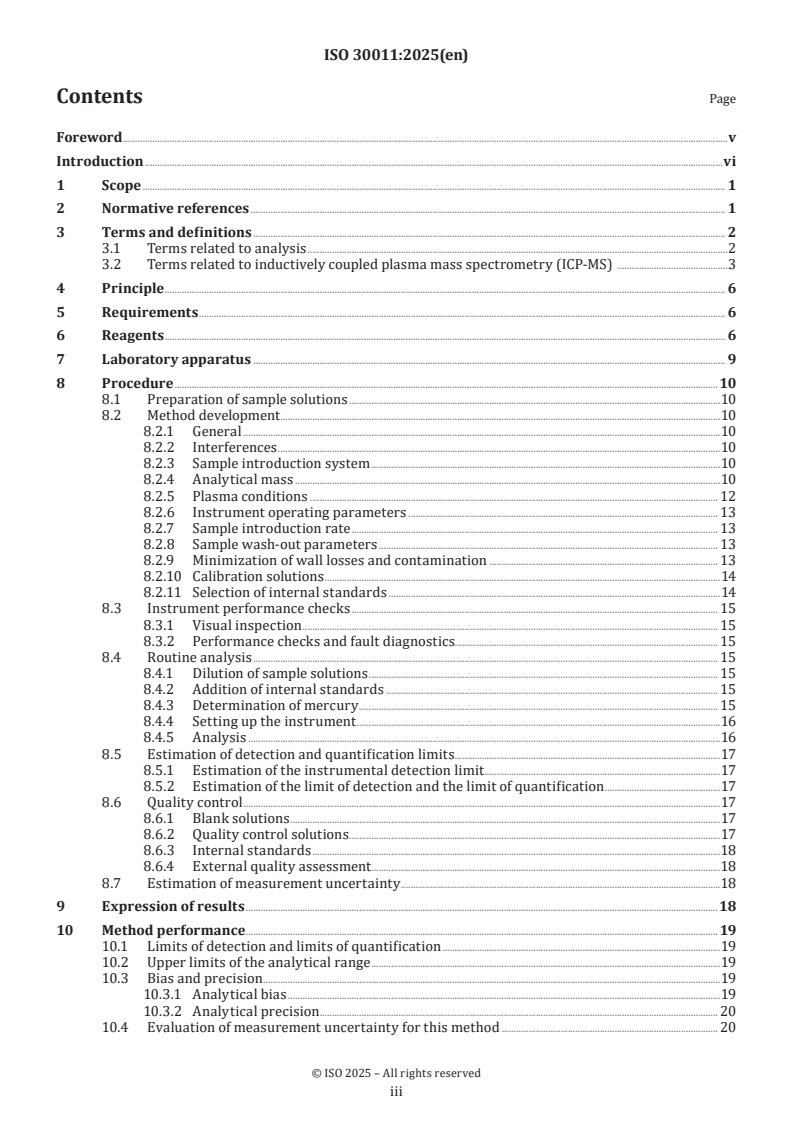
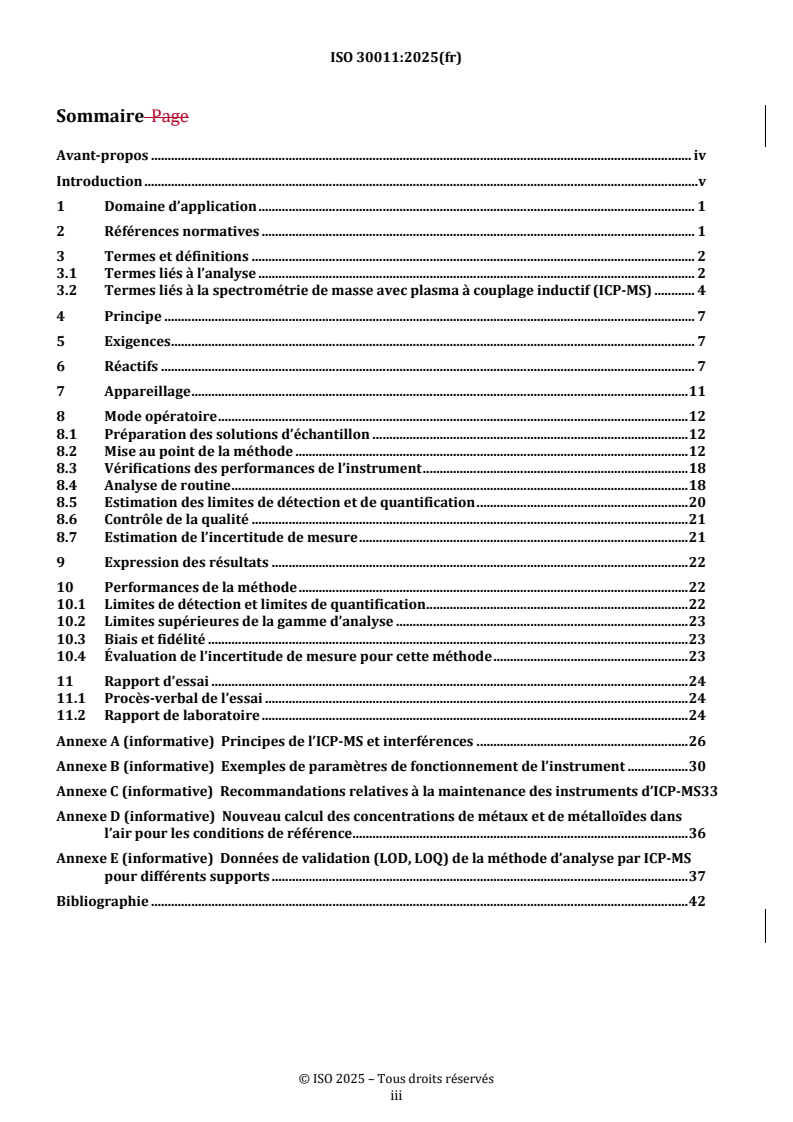
Contents Page
Foreword .v
Introduction .vi
1 Scope . 1
2 Normative references . 1
3 Terms and definitions . 2
3.1 Terms related to analysis .2
3.2 Terms related to inductively coupled plasma mass spectrometry (ICP-MS) .3
4 Principle . 6
5 Requirements . 6
6 Reagents . 6
7 Laboratory apparatus . 9
8 Procedure .10
8.1 Preparation of sample solutions .10
8.2 Method development . .10
8.2.1 General .10
8.2.2 Interferences .10
8.2.3 Sample introduction system .10
8.2.4 Analytical mass .10
8.2.5 Plasma conditions . 12
8.2.6 Instrument operating parameters . 13
8.2.7 Sample introduction rate . 13
8.2.8 Sample wash-out parameters . 13
8.2.9 Minimization of wall losses and contamination . 13
8.2.10 Calibration solutions .14
8.2.11 Selection of internal standards .14
8.3 Instrument performance checks . 15
8.3.1 Visual inspection . 15
8.3.2 Performance checks and fault diagnostics. 15
8.4 Routine analysis . 15
8.4.1 Dilution of sample solutions . 15
8.4.2 Addition of internal standards . 15
8.4.3 Determination of mercury . 15
8.4.4 Setting up the instrument .16
8.4.5 Analysis .16
8.5 Estimation of detection and quantification limits .17
8.5.1 Estimation of the instrumental detection limit .17
8.5.2 Estimation of the limit of detection and the limit of quantification .17
8.6 Quality control .17
8.6.1 Blank solutions .17
8.6.2 Quality control solutions .17
8.6.3 Internal standards .18
8.6.4 External quality assessment .18
8.7 Estimation of measurement uncertainty .18
9 Expression of results .18
10 Method performance . 19
10.1 Limits of detection and limits of quantification .19
10.2 Upper limits of the analytical range .19
10.3 Bias and precision .19
10.3.1 Analytical bias .19
10.3.2 Analytical precision . . . 20
10.4 Evaluation of measurement uncertainty for this method . 20
iii
11 Test report .20
11.1 Test records . 20
11.2 Laboratory report .21
Annex A (informative) ICP-MS principles and interferences .22
Annex B (informative) Examples of instrument operating parameters .25
Annex C (informative) Guidance on maintenance of ICP-MS instrumentation .27
Annex D (informative) Recalculation of metal and metalloid in air concentrations to reference
conditions .29
Annex E (informative) Method validation data (LOD, LOQ) for ICP-MS using various substrates .30
Bibliography .33
iv
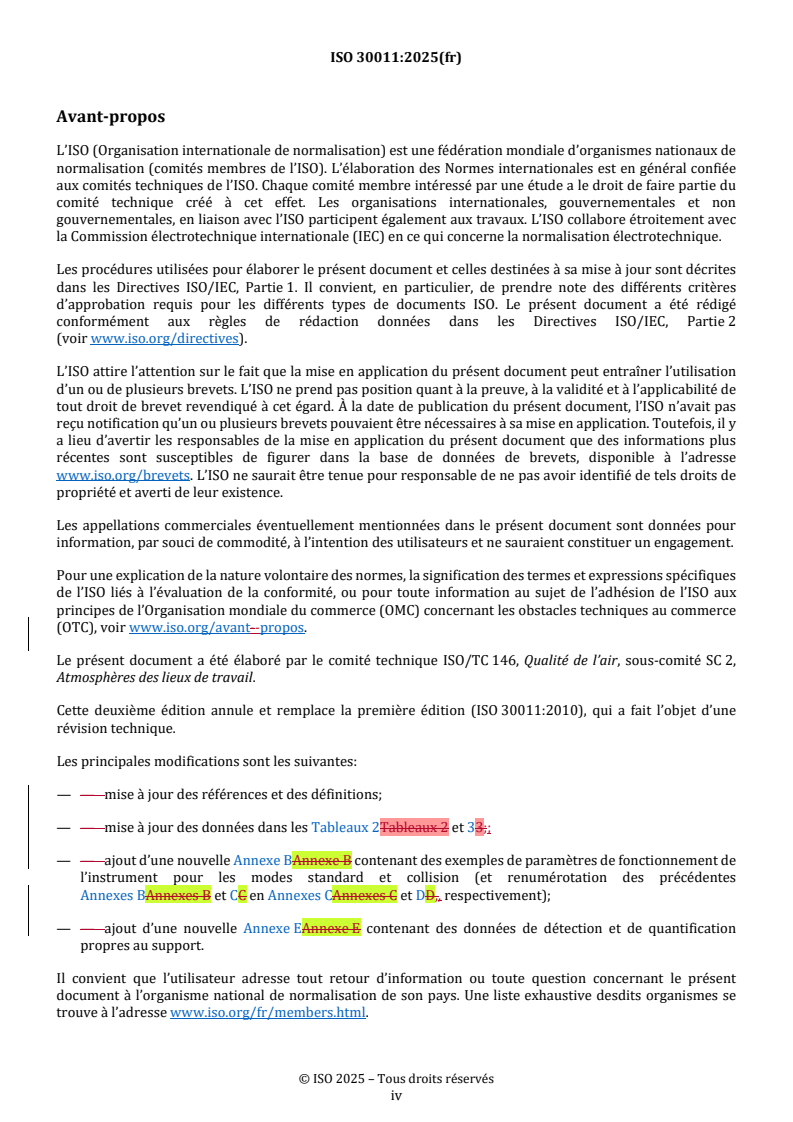
Foreword
ISO (the International Organization for Standardization) is a worldwide federation of national standards
bodies (ISO member bodies). The work of preparing International Standards is normally carried out through
ISO technical committees. Each member body interested in a subject for which a technical committee
has been established has the right to be represented on that committee. International organizations,
governmental and non-governmental, in liaison with ISO, also take part in the work. ISO collaborates closely
with the International Electrotechnical Commission (IEC) on all matters of electrotechnical standardization.
The procedures used to develop this document and those intended for its further maintenance are described
in the ISO/IEC Directives, Part 1. In particular, the different approval criteria needed for the different types
of ISO document should be noted. This document was drafted in accordance with the editorial rules of the
ISO/IEC Directives, Part 2 (see www.iso.org/directives).
ISO draws attention to the possibility that the implementation of this document may involve the use of (a)
patent(s). ISO takes no position concerning the evidence, validity or applicability of any claimed patent
rights in respect thereof. As of the date of publication of this document, ISO had not received notice of (a)
patent(s) which may be required to implement this document. However, implementers are cautioned that
this may not represent the latest information, which may be obtained from the patent database available at
www.iso.org/patents. ISO shall not be held responsible for identifying any or all such patent rights.
Any trade name used in this document is information given for the convenience of users and does not
constitute an endorsement.
For an explanation of the voluntary nature of standards, the meaning of ISO specific terms and expressions
related to conformity assessment, as well as information about ISO's adherence to the World Trade
Organization (WTO) principles in the Technical Barriers to Trade (TBT), see www.iso.org/iso/foreword.html.
This document was prepared by Technical Committee ISO/TC 146, Air quality, Subcommittee SC 2, Workplace
atmospheres.
This second edition cancels and replaces the first edition (ISO 30011:2010), which has been technically
revised.
The main changes are as follows:
— references and definitions have been updated;
— data in Tables 2 and 4 have been updated;
— a new Annex B has been added containing example instrument operating parameters for standard and
collision modes (the previous Annexes B and C have been renumbered as Annexes C and D, respectively);
— a new Annex E has been added containing substrate-specific detection and quantification data.
Any feedback or questions on this document should be directed to the user’s national standards body. A
complete listing of these bodies can be found at www.iso.org/members.html.
v
Introduction
The health of workers in many industries is at risk through exposure by inhalation of toxic metals and
metalloids. Industrial hygienists and other public health professionals need to determine the effectiveness
of measures taken to control workers' exposure, and this is generally achieved by taking workplace air
measurements. This document has been published in order to make available a method for making valid
ultra-trace exposure measurements for a wide range of metals and metalloids in use in industry. It is
intended for:
— agencies concerned with health and safety at work;
— industrial hygienists and other public health professionals;
— analytical laboratories;
— industrial users of metals and metalloids and their workers.
This document specifies a method for the determination of the mass concentration of metals and metalloids
in workplace air using quadrupole inductively coupled plasma mass spectrometry (ICP-MS). For many
metals and metalloids, analysis by ICP-MS is advantageous when compared to methods such as inductively
coupled plasma atomic emission spectrometry, due to its sensitivity and the presence of fewer spectral
interferences.
The execution of the provisions of this document and the interpretation of the results obtained is assumed
to be entrusted to appropriately qualified and experienced people.
vi
International Standard ISO 30011:2025(en)
Workplace air — Determination of metals and metalloids in
airborne particulate matter by inductively coupled plasma
mass spectrometry
1 Scope
This document specifies a procedure for the use of quadrupole inductively coupled plasma mass
spectrometry (ICP-MS), including single-quadrupole instruments and tandem ICP-MS/MS, for analysing
test solutions prepared from samples of airborne particulate matter collected as specified in ISO 15202-1.
Method development, performance checks and a routine analysis method are specified in this document
NOTE 1 Other types of ICP-MS (e.g. magnetic sector) are outside of the scope of this document.
Test solutions for analysis by this document are prepared as specified in ISO 15202-2.
This document is applicable to the assessment of workplace exposure to metals and metalloids for
[10] [8]
comparison with limit values (e.g. see EN 689 and ASTM E1370 ).
This document is not applicable to the determination of elemental mercury, since mercury vapour is not
collected using the sampling method specified in ISO 15202-1.
The procedure specified in this document is suitable for the assessment of exposure against the long-term
exposure limits for most of the metals and metalloids for which occupational exposure limit values have
−1
been set, when sampling at a typical flow rate of at least 2 l min for sampling times in the range 0,25 h to
8 h and for the assessment of exposure against the short-term exposure limits, where applicable.
NOTE 2 The procedure is subject to no significant spectral interferences (see Clause A.3), provided that suitable
analytical isotopes are used. However, inadequate matrix-matching can adversely affect results.
2 Normative references
The following documents are referred to in the text in such a way that some or all of their content constitutes
requirements of this document. For dated references, only the edition cited applies. For undated references,
the latest edition of the referenced document (including any amendments) applies.
ISO 1042, Laboratory glassware — One-mark volumetric flasks
ISO 3585, Borosilicate glass 3.3 — Properties
ISO 8655-1, Piston-operated volumetric apparatus — Part 1: Terminology, general requirements and user
recommendations
ISO 8655-2, Piston-operated volumetric apparatus — Part 2: Pipettes
ISO 8655-5, Piston-operated volumetric apparatus — Part 5: Dispensers
ISO 8655-6, Piston-operated volumetric apparatus — Part 6: Gravimetric reference measurement procedure for
the determination of volume
ISO 15202-1, Workplace air — Determination of metals and metalloids in airborne particulate matter by
inductively coupled plasma atomic emission spectrometry — Part 1: Sampling
ISO 15202-2:2020, Workplace air — Determination of metals and metalloids in airborne particulate matter by
inductively coupled plasma atomic emission spectrometry — Part 2: Sample preparation
ISO 18158, Workplace air — Terminology
ISO 20581, Workplace air — General requirements for the performance of procedures for the measurement of
chemical agents
ISO 21832:2018, Workplace air — Metals and metalloids in airborne particles — Requirements for evaluation of
measuring procedures
3 Terms and definitions
For the purposes of this document, the terms and definitions given in ISO 18158 and the following apply.
ISO and IEC maintain terminology databases for use in standardization at the following addresses:
— ISO Online browsing platform: available at https:// www .iso .org/ obp
— IEC Electropedia: available at https:// www .electropedia .org/
3.1 Terms related to analysis
3.1.1
blank solution
solution prepared by taking a reagent blank (3.1.6), laboratory blank or field blank through the same
procedure used for sample dissolution
Note 1 to entry: A blank solution can require undergoing further operations, such as addition of an internal standard
(3.2.9), if the sample solutions (3.1.8) are subjected to such operations in order to produce test solutions (3.1.11) that
are ready for analysis.
3.1.2
calibration blank solution
calibration solution (3.1.4) prepared without the addition of any stock standard solution (3.1.10) or working
standard solution (3.1.12)
Note 1 to entry: The concentration of the analyte(s) of interest in the calibration blank solution is taken to be zero.
[11]
[SOURCE: EN 14902:2005, 3.1.3, modified — “without addition” has been replaced with “without the
addition” and “for which the concentration of the analyte(s) of interest is considered to be zero” has been
deleted from the definition.]
3.1.3
calibration curve
plot of instrument response versus concentration of standards
[13]
[SOURCE: United States Environmental Protection Agency, Document Number EPA 540-R-04-004 ,
modified — “A” has been deleted.]
3.1.4
calibration solution
solution prepared by dilution of the stock standard solution(s) (3.1.10) or working standard solution(s)
(3.1.12), containing the analyte(s) of interest at a concentration(s) that is suitable for use in calibration of the
analytical instrument
Note 1 to entry: The matrix-matching (3.2.12) technique is normally used when preparing calibration solutions.
3.1.5
linear dynamic range
range of concentrations over which the calibration curve (3.1.3) for an analyte is linear
Note 1 to entry: The linear dynamic range extends from the detection limit to the onset of calibration curvature.
3.1.6
reagent blank
reagents used in sample dissolution (3.1.7), in the same quantities used for preparation of the blank solution
(3.1.1) and sample solutions (3.1.8)
Note 1 to entry: The reagent blank is used to assess contamination from the laboratory environment and to
characterize spectral background from the reagents used in sample preparation.
3.1.7
sample dissolution
process of obtaining a solution containing all analytes of interest from a sample, which can involve complete
dissolution of the sample
[11]
[SOURCE: EN 14902:2005, 3.1.25, modified — the definition has been structurally revised and “the
analytes” has been changed to “all analytes”.]
3.1.8
sample solution
solution prepared from a sample by the process of sample dissolution (3.1.7)
Note 1 to entry: A sample solution (3.1.8) can require undergoing further operations, e.g. dilution or addition of an
internal standard(s) (3.2.9), in order to produce a test solution (3.1.11).
[11]
[SOURCE: EN 14902:2005, 3.1.22, modified — Note 1 to entry has been replaced.]
3.1.9
spiked media blank
media blank that is spiked with a known amount of the analyte(s) of interest
3.1.10
stock standard solution
solution used for preparation of working standard solutions (3.1.11) or calibration solutions (3.1.4), containing
the analyte(s) of interest at a certified concentration(s) traceable to national standards
3.1.11
test solution
blank solution (3.1.1) or sample solution (3.1.8) that has been subjected to all operations required to bring it
into a state in which it is ready for analysis
Note 1 to entry: “Ready for analysis” includes any required dilution or addition of an internal standard (3.2.9). If a
blank solution or sample solution is not subject to any further operations before analysis, it is a test solution.
3.1.12
working standard solution
solution, prepared by dilution of the stock standard solution(s) (3.1.10), that contains the analyte(s) of interest
at a concentration(s) better suited for preparation of calibration solutions (3.1.4) than the concentration(s) of
the analyte(s) in the stock standard solution(s) (3.1.10)
[11]
[SOURCE: EN 14902:2005, 3.1.32, modified — “than the concentration(s) of the analyte(s) in the stock
standard solution(s)” has been added.]
3.2 Terms related to inductively coupled plasma mass spectrometry (ICP-MS)
3.2.1
collision cell
chamber in the ion path between mass-to-charge ratio (m/z) separation elements, or between ion source
acceleration region and the first analyser, in tandem mass spectrometry in space configurations
Note 1 to entry: See Reference [14] for a more detailed description of collision cells and their function.
3.2.2
collision reaction cell
collision cell (3.2.1) for removal of interfering ions by ion/neutral reactions in inductively coupled plasma
mass spectrometry (ICP-MS)
Note 1 to entry: Collision reaction cells make use of kinetic energy dispersion, reaction chemistry or a combination of
both, to remove interfering species. A variety of applications of collision reaction cell technology are available.
Note 2 to entry: See Reference [14] for a more detailed description of collision reaction cells and their function.
3.2.3
corrosion-resistant sample introduction system
sample introduction system that features a nebulizer (3.2.13), spray chamber (3.2.16) and ICP torch (3.2.4)
injector tube (3.2.6) that are resistant to corrosion by hydrofluoric acid (6.2.6)
3.2.4
inductively coupled plasma torch
ICP torch
device used to support and introduce a sample into an ICP discharge
Note 1 to entry: An ICP torch usually consists of three concentric tubes, the outer two usually made from quartz.
3.2.5
inductively coupled plasma
ICP
high-temperature discharge generated in flowing argon by an alternating magnetic field induced by a radio
frequency (RF) load coil that surrounds the tube carrying the gas
3.2.6
injector
injector tube
centre tube
innermost tube of an ICP torch (3.2.4), through which the sample aerosol is introduced to the plasma
Note 1 to entry: The injector is usually made of quartz, ceramic material or platinum.
3.2.7
inner argon flow
nebulizer argon flow
sample argon flow
flow of argon gas that is directed through the nebulizer (3.2.13) and carries the sample aerosol through the
injector (3.2.6) and into the plasma
−1 −1
Note 1 to entry: The inner argon flow rate is typically 0,5 l min to 2 l min .
3.2.8
intermediate argon flow
auxiliary argon flow
flow of argon gas that is contained between the intermediate and centre [injector (3.2.6)] tubes of an ICP
torch (3.2.4)
−1 −1
Note 1 to entry: The intermediate argon flow rate is typically 0 l min to 2 l min .
3.2.9
internal standard
non-analyte element, present in all solutions analysed, the signal from which is used to correct for matrix
interferences (3.2.11) or improve analytical precision
3.2.10
load coil
length of metal tubing wound around the end of an ICP torch (3.2.4) and connected to the radio frequency
(RF) generator, used to inductively couple energy from the RF generator to the plasma discharge
3.2.11
matrix interference
matrix effect
non-spectral interference
interference of a non-spectral nature caused by a difference between the matrix of the calibration solutions
(3.1.4) and test solutions (3.1.11)
3.2.12
matrix-matching
technique used to minimize the effect of matrix interferences (3.2.11) on the analytical results, involving the
preparation of calibration solutions (3.1.4) in which the concentrations of acids and other major solvents and
solutes are matched with those in the test solutions (3.1.11)
3.2.13
nebulizer
device used to create an aerosol from a liquid
3.2.14
outer argon flow
plasma argon flow
coolant argon flow
flow of argon gas that is contained between the outer and intermediate tubes of an ICP torch (3.2.4)
−1 −1
Note 1 to entry: The outer argon flow rate is typically 7 l min to 15 l min .
3.2.15
spectral interference
interference caused by a species other than the analyte of interest
Note 1 to entry: A spectral interference can be atomic, polyatomic or doubly charged ion species.
40 + 40 +
EXAMPLE 1 An atomic interference is Ar on Ca .
40 16 + 56 +
EXAMPLE 2 A polyatomic interference is Ar O on Fe .
48 2+ 24 +
EXAMPLE 3 A doubly charged ion interference is Ti on Mg (see Reference [14]).
3.2.16
spray chamber
device placed between a nebulizer (3.2.13) and an ICP torch (3.2.4) whose function is to separate out aerosol
droplets according to their size, so that only very fine droplets pass into the plasma and large droplets are
drained or pumped to waste
3.2.17
tandem ICP-MS/MS
tandem inductively coupled plasma mass spectrometry/mass spectrometry
ICP-MS system with an additional quadrupole prior to the collision reaction cell (3.2.2)
Note 1 to entry: Tandem ICP-MS/MS is also known as triple-quadrupole ICP-MS (ICP-QQQ).
Note 2 to entry: See Reference [22] for additional information regarding tandem ICP-MS/MS.
3.2.18
tuning
analysis of a solution containing a range of isotopic masses to establish ICP-MS mass-scale accuracy, mass
resolution, signal intensity and precision prior to calibration
Note 1 to entry: See Reference [14] for a more detailed description of the tuning process.
4 Principle
4.1 Airborne particles containing metals and metalloids are collected using the method specified in
ISO 15202-1.
4.2 The collected sample and the filter are then treated to dissolve the metals and metalloids of interest
using one of the sample dissolution methods specified in ISO 15202-2.
4.3 The resultant solutions are analysed for the metals and metalloids of interest using single-quadrupole
ICP-MS or tandem ICP-MS/MS.
5 Requirements
The measuring procedure as a whole (specified in ISO 15202-1, ISO 15202-2 and this document) shall
conform with applicable requirements of ISO 20581 and ISO 21832 and with any relevant national standard
that specifies performance requirements for procedures for measuring chemical agents in workplace air.
6 Reagents
6.1 Water, from a purification system that delivers ultrapure water having a resistivity greater than
0,18 MΩ·m (usually expressed by manufacturers of water purification systems as 18 MΩ·cm).
6.2 Mineral acids, concentrated. Various types of mineral acid (6.2.2 to 6.2.6) are required for the
preparation of matrix-matched calibration solutions (see 6.4.2).
−1
The concentration of the metals and metalloids of interest shall be less than 0,1 mg l .
Mineral acids of higher purity can be required in order to obtain adequate detection limits for some metals
and metalloids, e.g. beryllium.
−1
6.2.1 Nitric acid, concentrated, ρ ≈1,42 g ml , with a mass fraction of w ≈ 70 %.
HNO HNO
3 3
WARNING — Concentrated nitric acid is corrosive and oxidizing and nitric acid fumes are irritant.
Avoid exposure by contact with the skin or eyes, or by inhalation of fumes. Use suitable personal
protective equipment (including suitable gloves, face shield or safety glasses, etc.) when working
with concentrated or dilute nitric acid.
−1
6.2.2 Perchloric acid, concentrated, ρ ≈ 1,67 g ml , with a mass fraction of w ≈ 70 %.
HCIO HCIO
4 4
WARNING — Concentrated perchloric acid is corrosive and oxidizing and perchloric acid fumes are
irritant. Avoid exposure by contact with the skin or eyes, or by inhalation of fumes. Use suitable
personal protective equipment (including suitable gloves, face shield or safety glasses, etc.) when
working with concentrated or dilute perchloric acid. For safety reasons, use perchloric acid in
limited quantities.
For analysis of metals and metalloids that are subject to interference from polyatomic ions containing
chlorine, the use of perchloric acid is not recommended unless a collision reaction cell is used.
−1
6.2.3 Hydrochloric acid, concentrated, ρ ≈ 1,18 g ml , with a mass fraction of w ≈ 36 %.
HCl HCl
WARNING — Concentrated hydrochloric acid is corrosive and oxidizing and hydrochloric acid fumes are
irritant. Avoid exposure by contact with the skin or eyes, or by inhalation of fumes. Use suitable personal
protective equipment (including suitable gloves, face shield or safety glasses, etc.) when working with
concentrated or dilute hydrochloric acid. Handle open vessels containing concentrated hydrochloric
acid under a fume hood. The vapour pressure of hydrochloric acid is high; therefore, beware of pressure
build-up in stoppered flasks when preparing mixtures of hydrochloric acid and water.
For analysis of metals and metalloids that are subject to interference from polyatomic ions containing
chlorine, the use of hydrochloric acid is not recommended unless a collision reaction cell is used.
−1
6.2.4 Sulfuric acid, concentrated, ρ ≈ 1,84 g ml , with a mass fraction of w ≈ 98 %.
HSO HSO
24 24
WARNING — Concentrated sulfuric acid is corrosive and causes burns. Avoid exposure by contact
with the skin or eyes. Use suitable personal protective equipment (including suitable gloves, face
shield or safety glasses, etc.) when working with concentrated or dilute sulfuric acid. Exercise great
caution when diluting sulfuric acid with water, since this process is very exothermic. Do not add
water to sulfuric acid, since it reacts violently when mixed in this manner. Prepare mixtures by
adding sulfuric acid to water.
For analysis of metals and metalloids that are subject to interference from polyatomic ions containing sulfur,
the use of sulfuric acid is not recommended unless a collision reaction cell is used.
−1
6.2.5 Hydrofluoric acid, concentrated, ρ ≈ 1,16 g ml , with a mass fraction of w ≈ 48 %.
HF HF
WARNING — Concentrated hydrofluoric acid is very toxic in contact with the skin and if inhaled
or swallowed. It is corrosive and causes severe burns. Take extreme care when using hydrofluoric
acid. Avoid contact with the skin or eyes, or inhalation of the vapour. It is essential that suitable
personal protective equipment (including suitable gloves, face shield, etc.) is used when working
with concentrated or dilute hydrofluoric acid. Handle open vessels containing concentrated
hydrofluoric acid under a fume hood. Ensure that the nature and seriousness of hydrofluoric acid
burns is understood before commencing work with this substance. Carry hydrofluoric acid burn
cream (containing calcium gluconate) at all times while working with hydrofluoric acid and for 24 h
afterwards. Apply the cream to any contaminated skin, after washing the affected area with copious
amounts of water. Obtain medical advice immediately in case of an accident.
NOTE The burning sensation associated with many concentrated acid burns is not immediately apparent on
exposure to hydrofluoric acid and can be felt only several hours later. Relatively dilute solutions of hydrofluoric
acid can also be absorbed through the skin, with serious effects similar to those resulting from exposure to the
concentrated acid.
When using hydrofluoric acid, it is recommended that a pair of disposable gloves be worn underneath
suitable rubber gloves to provide added protection for the hands.
For analysis of metals and metalloids that are subject to interference from polyatomic ions containing
fluorine, the use of hydrofluoric acid is not recommended unless a collision reaction cell is used.
6.3 Hydrogen peroxide (H O ), with a mass fraction of w ≈ 30 %.
2 2 HO
6.4 Stock standard solutions, for the preparation of calibration solutions.
6.4.1 Use commercial single-element or multi-element standard solutions with certified concentrations
traceable to national standards to prepare calibration solutions. The range of standard solutions used shall
include all the metals and metalloids of interest at a suitable concentration. Observe the manufacturer’s
expiration date or recommended shelf life.
NOTE Commercially available stock standard solutions for metals and metalloids have nominal concentrations of
−1 −1 −1 −1
100 mg l to 10 000 mg l for single element standards and 10 mg l to 1 000 mg l for multi-element standards.
6.4.2 Alternatively, prepare stock standard solutions from high-purity metals and metalloids or their salts.
The procedure used to prepare the solutions shall be fit for purpose and the calibration of any apparatus
used shall be traceable to national standards. Store in a suitable container, e.g. a polypropylene bottle (7.5).
The shelf life of stock solutions should be evaluated (e.g. during validation of the measurement method).
6.5 Working standard solutions and calibration solutions
6.5.1 Prepare a working standard solution or solutions, if desired, to include all the metals and metalloids
of interest at suitable concentrations. Accurately pipette an appropriate volume of each single-element stock
standard solution, or of multi-element stock standard solution (6.4), into a labelled, one-mark volumetric
flask (7.1). Add an appropriate volume of a suitable mineral acid (6.2) to ensure analyte stability. Dilute
almost to the mark with water (6.1), stopper, and swirl to mix. Allow to cool to room temperature, make up
to the mark with water, stopper and mix thoroughly.
Analytes that are grouped together in working standard solutions should be chosen carefully to ensure
chemical compatibility and to avoid spectral and physical interferences. The type and volume of each acid
added should be selected carefully to ensure analyte stability.
6.5.2 From the working standard solutions, prepare a set of calibration solutions, covering the range of
−1 −1
concentrations for each of the metals and metalloids of interest, typically between 1 µg l and 100 µg l . It is
recommended that a minimum of three calibration solutions be prepared. Also, prepare a calibration blank
solution (see 3.2.2). For each set of calibration solutions, accurately pipette appropriate volumes of working
standard solution (6.5.1) or stock standard solution (6.3), into individual, labelled volumetric flasks (7.2).
Add reagents, as required (see the next two paragraphs), to match the calibration solutions with that of
the test solutions (see 8.2.10.1). Dilute almost to the mark with water (6.1), stopper and swirl to mix. Allow
to cool to room temperature, make up to the mark with water, stopper and mix thoroughly. Prepare fresh
calibration solutions daily.
The type(s) and volume(s) of reagents required to matrix-match the calibration and test solutions depend
upon the sample dissolution method used. Table 1 presents information on which acids are used in the various
sample dissolution methods specified in ISO 15202-2. However, it is also necessary to take into account the
contribution to the overall acid concentration from acids present in the stock standard solution(s) used to
prepare the calibration solutions. Isobaric and physical interferences (see A.3.3 and A.3.4) should also be
considered in preparing these solutions.
Table 1 — Reagents required to prepare matrix-matched calibration solutions
Description of dissolution Acid(s) required to prepare matrix-matched
Sample dissolution method
method calibration solutions
Leaching for soluble metal
ISO 15202-2:2020, Annex B nitric acid (6.2.2)
and metalloid compounds
ISO 15202-2:2020, Annex C Hotplate dissolution nitric acid (6.2.2) and hydrochloric acid (6.2.4)
ISO 15202-2:2020, Annex D Ultrasonic agitation nitric acid (6.2.2)
sulfuric acid (6.2.5), hydrochloric acid (6.2.4) and
ISO 15202-2:2020, Annex E Hotplate dissolution
hydrogen peroxide (6.3)
nitric acid (6.2.2), perchloric acid (6.2.3), hydrochloric
ISO 15202-2:2020, Annex F Hotplate dissolution
acid (6.2.4) and hydrogen peroxide (6.3)
nitric acid (6.2.2), hydrofluoric acid (6.2.6) and optional
ISO 15202-2:2020, G.6.1 Closed vessel microwave
hydrochloric acid (6.2.4)
nitric acid (6.2.2), perchloric acid (6.2.3), hydrofluoric
ISO 15202-2:2020, G.6.2 Closed vessel microwave
acid (6.2.6) and optional hydrochloric acid (6.2.4)
nitric acid (6.2.2), or nitric acid (6.2.2) and perchloric
ISO 15202-2:2020, G.6.3 Closed vessel microwave acid (6.2.3) – can optionally include hydrochloric acid
(6.2.4)
ISO 15202-2:2020, Annex H Hot block (95 °C) dissolution nitric acid (6.2.2) and hydrochloric acid (6.2.4)
NOTE Sample dissolution methods using sulfuric acid or perchloric acid would not typically be used for
measurements by ICP-MS.
Consideration should be given to the need to matrix-match the calibration with respect to hydrofluoric
acid (6.2.6) if the test solutions are prepared from samples collected on quartz fibre filters using a sample
dissolution method that uses hydrofluoric acid. In general, matrix-matching with hydrofluoric acid is best
avoided (see WARNING in 6.2.6), but can be necessary in cases where its action on quartz fibre filters results
in high concentrations of silicon (and possibly other elements, such as aluminium, calcium and sodium)
in the test solutions. In these cases, the calibration solutions can be prepared by addition of appropriate
volumes of working standard solution (6.5.1) or stock standard solution(s) (6.4) to unused quartz fibre
filters carried through the sample dissolution method described in the relevant annex of ISO 15202-2. Under
such circumstances, plastic volumetric labware compatible with hydrofluoric acid and a corrosion-resistant
sample introduction system have to be used.
Additional information on sample preparation can be found in References [24] and [25].
6.6 Internal standard stock solutions
6.6.1 Use a commercially available single-element standard solution or solutions. The standard solution(s)
shall include the element(s) to be used as inter
...
International
Standard
ISO 30011
Second edition
Workplace air — Determination of
2025-08
metals and metalloids in airborne
particulate matter by inductively
coupled plasma mass spectrometry
Air des lieux de travail — Détermination des métaux et
métalloïdes dans les particules en suspension dans l'air par
spectrométrie de masse avec plasma à couplage inductif
Reference number
© ISO 2025
All rights reserved. Unless otherwise specified, or required in the context of its implementation, no part of this publication may
be reproduced or utilized otherwise in any form or by any means, electronic or mechanical, including photocopying, or posting on
the internet or an intranet, without prior written permission. Permission can be requested from either ISO at the address below
or ISO’s member body in the country of the requester.
ISO copyright office
CP 401 • Ch. de Blandonnet 8
CH-1214 Vernier, Geneva
Phone: +41 22 749 01 11
Email: copyright@iso.org
Website: www.iso.org
Published in Switzerland
ii
Contents Page
Foreword .v
Introduction .vi
1 Scope . 1
2 Normative references . 1
3 Terms and definitions . 2
3.1 Terms related to analysis .2
3.2 Terms related to inductively coupled plasma mass spectrometry (ICP-MS) .3
4 Principle . 6
5 Requirements . 6
6 Reagents . 6
7 Laboratory apparatus . 9
8 Procedure .10
8.1 Preparation of sample solutions .10
8.2 Method development . .10
8.2.1 General .10
8.2.2 Interferences .10
8.2.3 Sample introduction system .10
8.2.4 Analytical mass .10
8.2.5 Plasma conditions . 12
8.2.6 Instrument operating parameters . 13
8.2.7 Sample introduction rate . 13
8.2.8 Sample wash-out parameters . 13
8.2.9 Minimization of wall losses and contamination . 13
8.2.10 Calibration solutions .14
8.2.11 Selection of internal standards .14
8.3 Instrument performance checks . 15
8.3.1 Visual inspection . 15
8.3.2 Performance checks and fault diagnostics. 15
8.4 Routine analysis . 15
8.4.1 Dilution of sample solutions . 15
8.4.2 Addition of internal standards . 15
8.4.3 Determination of mercury . 15
8.4.4 Setting up the instrument .16
8.4.5 Analysis .16
8.5 Estimation of detection and quantification limits .17
8.5.1 Estimation of the instrumental detection limit .17
8.5.2 Estimation of the limit of detection and the limit of quantification .17
8.6 Quality control .17
8.6.1 Blank solutions .17
8.6.2 Quality control solutions .17
8.6.3 Internal standards .18
8.6.4 External quality assessment .18
8.7 Estimation of measurement uncertainty .18
9 Expression of results .18
10 Method performance . 19
10.1 Limits of detection and limits of quantification .19
10.2 Upper limits of the analytical range .19
10.3 Bias and precision .19
10.3.1 Analytical bias .19
10.3.2 Analytical precision . . . 20
10.4 Evaluation of measurement uncertainty for this method . 20
iii
11 Test report .20
11.1 Test records . 20
11.2 Laboratory report .21
Annex A (informative) ICP-MS principles and interferences .22
Annex B (informative) Examples of instrument operating parameters .25
Annex C (informative) Guidance on maintenance of ICP-MS instrumentation .27
Annex D (informative) Recalculation of metal and metalloid in air concentrations to reference
conditions .29
Annex E (informative) Method validation data (LOD, LOQ) for ICP-MS using various substrates .30
Bibliography .33
iv
Foreword
ISO (the International Organization for Standardization) is a worldwide federation of national standards
bodies (ISO member bodies). The work of preparing International Standards is normally carried out through
ISO technical committees. Each member body interested in a subject for which a technical committee
has been established has the right to be represented on that committee. International organizations,
governmental and non-governmental, in liaison with ISO, also take part in the work. ISO collaborates closely
with the International Electrotechnical Commission (IEC) on all matters of electrotechnical standardization.
The procedures used to develop this document and those intended for its further maintenance are described
in the ISO/IEC Directives, Part 1. In particular, the different approval criteria needed for the different types
of ISO document should be noted. This document was drafted in accordance with the editorial rules of the
ISO/IEC Directives, Part 2 (see www.iso.org/directives).
ISO draws attention to the possibility that the implementation of this document may involve the use of (a)
patent(s). ISO takes no position concerning the evidence, validity or applicability of any claimed patent
rights in respect thereof. As of the date of publication of this document, ISO had not received notice of (a)
patent(s) which may be required to implement this document. However, implementers are cautioned that
this may not represent the latest information, which may be obtained from the patent database available at
www.iso.org/patents. ISO shall not be held responsible for identifying any or all such patent rights.
Any trade name used in this document is information given for the convenience of users and does not
constitute an endorsement.
For an explanation of the voluntary nature of standards, the meaning of ISO specific terms and expressions
related to conformity assessment, as well as information about ISO's adherence to the World Trade
Organization (WTO) principles in the Technical Barriers to Trade (TBT), see www.iso.org/iso/foreword.html.
This document was prepared by Technical Committee ISO/TC 146, Air quality, Subcommittee SC 2, Workplace
atmospheres.
This second edition cancels and replaces the first edition (ISO 30011:2010), which has been technically
revised.
The main changes are as follows:
— references and definitions have been updated;
— data in Tables 2 and 4 have been updated;
— a new Annex B has been added containing example instrument operating parameters for standard and
collision modes (the previous Annexes B and C have been renumbered as Annexes C and D, respectively);
— a new Annex E has been added containing substrate-specific detection and quantification data.
Any feedback or questions on this document should be directed to the user’s national standards body. A
complete listing of these bodies can be found at www.iso.org/members.html.
v
Introduction
The health of workers in many industries is at risk through exposure by inhalation of toxic metals and
metalloids. Industrial hygienists and other public health professionals need to determine the effectiveness
of measures taken to control workers' exposure, and this is generally achieved by taking workplace air
measurements. This document has been published in order to make available a method for making valid
ultra-trace exposure measurements for a wide range of metals and metalloids in use in industry. It is
intended for:
— agencies concerned with health and safety at work;
— industrial hygienists and other public health professionals;
— analytical laboratories;
— industrial users of metals and metalloids and their workers.
This document specifies a method for the determination of the mass concentration of metals and metalloids
in workplace air using quadrupole inductively coupled plasma mass spectrometry (ICP-MS). For many
metals and metalloids, analysis by ICP-MS is advantageous when compared to methods such as inductively
coupled plasma atomic emission spectrometry, due to its sensitivity and the presence of fewer spectral
interferences.
The execution of the provisions of this document and the interpretation of the results obtained is assumed
to be entrusted to appropriately qualified and experienced people.
vi
International Standard ISO 30011:2025(en)
Workplace air — Determination of metals and metalloids in
airborne particulate matter by inductively coupled plasma
mass spectrometry
1 Scope
This document specifies a procedure for the use of quadrupole inductively coupled plasma mass
spectrometry (ICP-MS), including single-quadrupole instruments and tandem ICP-MS/MS, for analysing
test solutions prepared from samples of airborne particulate matter collected as specified in ISO 15202-1.
Method development, performance checks and a routine analysis method are specified in this document
NOTE 1 Other types of ICP-MS (e.g. magnetic sector) are outside of the scope of this document.
Test solutions for analysis by this document are prepared as specified in ISO 15202-2.
This document is applicable to the assessment of workplace exposure to metals and metalloids for
[10] [8]
comparison with limit values (e.g. see EN 689 and ASTM E1370 ).
This document is not applicable to the determination of elemental mercury, since mercury vapour is not
collected using the sampling method specified in ISO 15202-1.
The procedure specified in this document is suitable for the assessment of exposure against the long-term
exposure limits for most of the metals and metalloids for which occupational exposure limit values have
−1
been set, when sampling at a typical flow rate of at least 2 l min for sampling times in the range 0,25 h to
8 h and for the assessment of exposure against the short-term exposure limits, where applicable.
NOTE 2 The procedure is subject to no significant spectral interferences (see Clause A.3), provided that suitable
analytical isotopes are used. However, inadequate matrix-matching can adversely affect results.
2 Normative references
The following documents are referred to in the text in such a way that some or all of their content constitutes
requirements of this document. For dated references, only the edition cited applies. For undated references,
the latest edition of the referenced document (including any amendments) applies.
ISO 1042, Laboratory glassware — One-mark volumetric flasks
ISO 3585, Borosilicate glass 3.3 — Properties
ISO 8655-1, Piston-operated volumetric apparatus — Part 1: Terminology, general requirements and user
recommendations
ISO 8655-2, Piston-operated volumetric apparatus — Part 2: Pipettes
ISO 8655-5, Piston-operated volumetric apparatus — Part 5: Dispensers
ISO 8655-6, Piston-operated volumetric apparatus — Part 6: Gravimetric reference measurement procedure for
the determination of volume
ISO 15202-1, Workplace air — Determination of metals and metalloids in airborne particulate matter by
inductively coupled plasma atomic emission spectrometry — Part 1: Sampling
ISO 15202-2:2020, Workplace air — Determination of metals and metalloids in airborne particulate matter by
inductively coupled plasma atomic emission spectrometry — Part 2: Sample preparation
ISO 18158, Workplace air — Terminology
ISO 20581, Workplace air — General requirements for the performance of procedures for the measurement of
chemical agents
ISO 21832:2018, Workplace air — Metals and metalloids in airborne particles — Requirements for evaluation of
measuring procedures
3 Terms and definitions
For the purposes of this document, the terms and definitions given in ISO 18158 and the following apply.
ISO and IEC maintain terminology databases for use in standardization at the following addresses:
— ISO Online browsing platform: available at https:// www .iso .org/ obp
— IEC Electropedia: available at https:// www .electropedia .org/
3.1 Terms related to analysis
3.1.1
blank solution
solution prepared by taking a reagent blank (3.1.6), laboratory blank or field blank through the same
procedure used for sample dissolution
Note 1 to entry: A blank solution can require undergoing further operations, such as addition of an internal standard
(3.2.9), if the sample solutions (3.1.8) are subjected to such operations in order to produce test solutions (3.1.11) that
are ready for analysis.
3.1.2
calibration blank solution
calibration solution (3.1.4) prepared without the addition of any stock standard solution (3.1.10) or working
standard solution (3.1.12)
Note 1 to entry: The concentration of the analyte(s) of interest in the calibration blank solution is taken to be zero.
[11]
[SOURCE: EN 14902:2005, 3.1.3, modified — “without addition” has been replaced with “without the
addition” and “for which the concentration of the analyte(s) of interest is considered to be zero” has been
deleted from the definition.]
3.1.3
calibration curve
plot of instrument response versus concentration of standards
[13]
[SOURCE: United States Environmental Protection Agency, Document Number EPA 540-R-04-004 ,
modified — “A” has been deleted.]
3.1.4
calibration solution
solution prepared by dilution of the stock standard solution(s) (3.1.10) or working standard solution(s)
(3.1.12), containing the analyte(s) of interest at a concentration(s) that is suitable for use in calibration of the
analytical instrument
Note 1 to entry: The matrix-matching (3.2.12) technique is normally used when preparing calibration solutions.
3.1.5
linear dynamic range
range of concentrations over which the calibration curve (3.1.3) for an analyte is linear
Note 1 to entry: The linear dynamic range extends from the detection limit to the onset of calibration curvature.
3.1.6
reagent blank
reagents used in sample dissolution (3.1.7), in the same quantities used for preparation of the blank solution
(3.1.1) and sample solutions (3.1.8)
Note 1 to entry: The reagent blank is used to assess contamination from the laboratory environment and to
characterize spectral background from the reagents used in sample preparation.
3.1.7
sample dissolution
process of obtaining a solution containing all analytes of interest from a sample, which can involve complete
dissolution of the sample
[11]
[SOURCE: EN 14902:2005, 3.1.25, modified — the definition has been structurally revised and “the
analytes” has been changed to “all analytes”.]
3.1.8
sample solution
solution prepared from a sample by the process of sample dissolution (3.1.7)
Note 1 to entry: A sample solution (3.1.8) can require undergoing further operations, e.g. dilution or addition of an
internal standard(s) (3.2.9), in order to produce a test solution (3.1.11).
[11]
[SOURCE: EN 14902:2005, 3.1.22, modified — Note 1 to entry has been replaced.]
3.1.9
spiked media blank
media blank that is spiked with a known amount of the analyte(s) of interest
3.1.10
stock standard solution
solution used for preparation of working standard solutions (3.1.11) or calibration solutions (3.1.4), containing
the analyte(s) of interest at a certified concentration(s) traceable to national standards
3.1.11
test solution
blank solution (3.1.1) or sample solution (3.1.8) that has been subjected to all operations required to bring it
into a state in which it is ready for analysis
Note 1 to entry: “Ready for analysis” includes any required dilution or addition of an internal standard (3.2.9). If a
blank solution or sample solution is not subject to any further operations before analysis, it is a test solution.
3.1.12
working standard solution
solution, prepared by dilution of the stock standard solution(s) (3.1.10), that contains the analyte(s) of interest
at a concentration(s) better suited for preparation of calibration solutions (3.1.4) than the concentration(s) of
the analyte(s) in the stock standard solution(s) (3.1.10)
[11]
[SOURCE: EN 14902:2005, 3.1.32, modified — “than the concentration(s) of the analyte(s) in the stock
standard solution(s)” has been added.]
3.2 Terms related to inductively coupled plasma mass spectrometry (ICP-MS)
3.2.1
collision cell
chamber in the ion path between mass-to-charge ratio (m/z) separation elements, or between ion source
acceleration region and the first analyser, in tandem mass spectrometry in space configurations
Note 1 to entry: See Reference [14] for a more detailed description of collision cells and their function.
3.2.2
collision reaction cell
collision cell (3.2.1) for removal of interfering ions by ion/neutral reactions in inductively coupled plasma
mass spectrometry (ICP-MS)
Note 1 to entry: Collision reaction cells make use of kinetic energy dispersion, reaction chemistry or a combination of
both, to remove interfering species. A variety of applications of collision reaction cell technology are available.
Note 2 to entry: See Reference [14] for a more detailed description of collision reaction cells and their function.
3.2.3
corrosion-resistant sample introduction system
sample introduction system that features a nebulizer (3.2.13), spray chamber (3.2.16) and ICP torch (3.2.4)
injector tube (3.2.6) that are resistant to corrosion by hydrofluoric acid (6.2.6)
3.2.4
inductively coupled plasma torch
ICP torch
device used to support and introduce a sample into an ICP discharge
Note 1 to entry: An ICP torch usually consists of three concentric tubes, the outer two usually made from quartz.
3.2.5
inductively coupled plasma
ICP
high-temperature discharge generated in flowing argon by an alternating magnetic field induced by a radio
frequency (RF) load coil that surrounds the tube carrying the gas
3.2.6
injector
injector tube
centre tube
innermost tube of an ICP torch (3.2.4), through which the sample aerosol is introduced to the plasma
Note 1 to entry: The injector is usually made of quartz, ceramic material or platinum.
3.2.7
inner argon flow
nebulizer argon flow
sample argon flow
flow of argon gas that is directed through the nebulizer (3.2.13) and carries the sample aerosol through the
injector (3.2.6) and into the plasma
−1 −1
Note 1 to entry: The inner argon flow rate is typically 0,5 l min to 2 l min .
3.2.8
intermediate argon flow
auxiliary argon flow
flow of argon gas that is contained between the intermediate and centre [injector (3.2.6)] tubes of an ICP
torch (3.2.4)
−1 −1
Note 1 to entry: The intermediate argon flow rate is typically 0 l min to 2 l min .
3.2.9
internal standard
non-analyte element, present in all solutions analysed, the signal from which is used to correct for matrix
interferences (3.2.11) or improve analytical precision
3.2.10
load coil
length of metal tubing wound around the end of an ICP torch (3.2.4) and connected to the radio frequency
(RF) generator, used to inductively couple energy from the RF generator to the plasma discharge
3.2.11
matrix interference
matrix effect
non-spectral interference
interference of a non-spectral nature caused by a difference between the matrix of the calibration solutions
(3.1.4) and test solutions (3.1.11)
3.2.12
matrix-matching
technique used to minimize the effect of matrix interferences (3.2.11) on the analytical results, involving the
preparation of calibration solutions (3.1.4) in which the concentrations of acids and other major solvents and
solutes are matched with those in the test solutions (3.1.11)
3.2.13
nebulizer
device used to create an aerosol from a liquid
3.2.14
outer argon flow
plasma argon flow
coolant argon flow
flow of argon gas that is contained between the outer and intermediate tubes of an ICP torch (3.2.4)
−1 −1
Note 1 to entry: The outer argon flow rate is typically 7 l min to 15 l min .
3.2.15
spectral interference
interference caused by a species other than the analyte of interest
Note 1 to entry: A spectral interference can be atomic, polyatomic or doubly charged ion species.
40 + 40 +
EXAMPLE 1 An atomic interference is Ar on Ca .
40 16 + 56 +
EXAMPLE 2 A polyatomic interference is Ar O on Fe .
48 2+ 24 +
EXAMPLE 3 A doubly charged ion interference is Ti on Mg (see Reference [14]).
3.2.16
spray chamber
device placed between a nebulizer (3.2.13) and an ICP torch (3.2.4) whose function is to separate out aerosol
droplets according to their size, so that only very fine droplets pass into the plasma and large droplets are
drained or pumped to waste
3.2.17
tandem ICP-MS/MS
tandem inductively coupled plasma mass spectrometry/mass spectrometry
ICP-MS system with an additional quadrupole prior to the collision reaction cell (3.2.2)
Note 1 to entry: Tandem ICP-MS/MS is also known as triple-quadrupole ICP-MS (ICP-QQQ).
Note 2 to entry: See Reference [22] for additional information regarding tandem ICP-MS/MS.
3.2.18
tuning
analysis of a solution containing a range of isotopic masses to establish ICP-MS mass-scale accuracy, mass
resolution, signal intensity and precision prior to calibration
Note 1 to entry: See Reference [14] for a more detailed description of the tuning process.
4 Principle
4.1 Airborne particles containing metals and metalloids are collected using the method specified in
ISO 15202-1.
4.2 The collected sample and the filter are then treated to dissolve the metals and metalloids of interest
using one of the sample dissolution methods specified in ISO 15202-2.
4.3 The resultant solutions are analysed for the metals and metalloids of interest using single-quadrupole
ICP-MS or tandem ICP-MS/MS.
5 Requirements
The measuring procedure as a whole (specified in ISO 15202-1, ISO 15202-2 and this document) shall
conform with applicable requirements of ISO 20581 and ISO 21832 and with any relevant national standard
that specifies performance requirements for procedures for measuring chemical agents in workplace air.
6 Reagents
6.1 Water, from a purification system that delivers ultrapure water having a resistivity greater than
0,18 MΩ·m (usually expressed by manufacturers of water purification systems as 18 MΩ·cm).
6.2 Mineral acids, concentrated. Various types of mineral acid (6.2.2 to 6.2.6) are required for the
preparation of matrix-matched calibration solutions (see 6.4.2).
−1
The concentration of the metals and metalloids of interest shall be less than 0,1 mg l .
Mineral acids of higher purity can be required in order to obtain adequate detection limits for some metals
and metalloids, e.g. beryllium.
−1
6.2.1 Nitric acid, concentrated, ρ ≈1,42 g ml , with a mass fraction of w ≈ 70 %.
HNO HNO
3 3
WARNING — Concentrated nitric acid is corrosive and oxidizing and nitric acid fumes are irritant.
Avoid exposure by contact with the skin or eyes, or by inhalation of fumes. Use suitable personal
protective equipment (including suitable gloves, face shield or safety glasses, etc.) when working
with concentrated or dilute nitric acid.
−1
6.2.2 Perchloric acid, concentrated, ρ ≈ 1,67 g ml , with a mass fraction of w ≈ 70 %.
HCIO HCIO
4 4
WARNING — Concentrated perchloric acid is corrosive and oxidizing and perchloric acid fumes are
irritant. Avoid exposure by contact with the skin or eyes, or by inhalation of fumes. Use suitable
personal protective equipment (including suitable gloves, face shield or safety glasses, etc.) when
working with concentrated or dilute perchloric acid. For safety reasons, use perchloric acid in
limited quantities.
For analysis of metals and metalloids that are subject to interference from polyatomic ions containing
chlorine, the use of perchloric acid is not recommended unless a collision reaction cell is used.
−1
6.2.3 Hydrochloric acid, concentrated, ρ ≈ 1,18 g ml , with a mass fraction of w ≈ 36 %.
HCl HCl
WARNING — Concentrated hydrochloric acid is corrosive and oxidizing and hydrochloric acid fumes are
irritant. Avoid exposure by contact with the skin or eyes, or by inhalation of fumes. Use suitable personal
protective equipment (including suitable gloves, face shield or safety glasses, etc.) when working with
concentrated or dilute hydrochloric acid. Handle open vessels containing concentrated hydrochloric
acid under a fume hood. The vapour pressure of hydrochloric acid is high; therefore, beware of pressure
build-up in stoppered flasks when preparing mixtures of hydrochloric acid and water.
For analysis of metals and metalloids that are subject to interference from polyatomic ions containing
chlorine, the use of hydrochloric acid is not recommended unless a collision reaction cell is used.
−1
6.2.4 Sulfuric acid, concentrated, ρ ≈ 1,84 g ml , with a mass fraction of w ≈ 98 %.
HSO HSO
24 24
WARNING — Concentrated sulfuric acid is corrosive and causes burns. Avoid exposure by contact
with the skin or eyes. Use suitable personal protective equipment (including suitable gloves, face
shield or safety glasses, etc.) when working with concentrated or dilute sulfuric acid. Exercise great
caution when diluting sulfuric acid with water, since this process is very exothermic. Do not add
water to sulfuric acid, since it reacts violently when mixed in this manner. Prepare mixtures by
adding sulfuric acid to water.
For analysis of metals and metalloids that are subject to interference from polyatomic ions containing sulfur,
the use of sulfuric acid is not recommended unless a collision reaction cell is used.
−1
6.2.5 Hydrofluoric acid, concentrated, ρ ≈ 1,16 g ml , with a mass fraction of w ≈ 48 %.
HF HF
WARNING — Concentrated hydrofluoric acid is very toxic in contact with the skin and if inhaled
or swallowed. It is corrosive and causes severe burns. Take extreme care when using hydrofluoric
acid. Avoid contact with the skin or eyes, or inhalation of the vapour. It is essential that suitable
personal protective equipment (including suitable gloves, face shield, etc.) is used when working
with concentrated or dilute hydrofluoric acid. Handle open vessels containing concentrated
hydrofluoric acid under a fume hood. Ensure that the nature and seriousness of hydrofluoric acid
burns is understood before commencing work with this substance. Carry hydrofluoric acid burn
cream (containing calcium gluconate) at all times while working with hydrofluoric acid and for 24 h
afterwards. Apply the cream to any contaminated skin, after washing the affected area with copious
amounts of water. Obtain medical advice immediately in case of an accident.
NOTE The burning sensation associated with many concentrated acid burns is not immediately apparent on
exposure to hydrofluoric acid and can be felt only several hours later. Relatively dilute solutions of hydrofluoric
acid can also be absorbed through the skin, with serious effects similar to those resulting from exposure to the
concentrated acid.
When using hydrofluoric acid, it is recommended that a pair of disposable gloves be worn underneath
suitable rubber gloves to provide added protection for the hands.
For analysis of metals and metalloids that are subject to interference from polyatomic ions containing
fluorine, the use of hydrofluoric acid is not recommended unless a collision reaction cell is used.
6.3 Hydrogen peroxide (H O ), with a mass fraction of w ≈ 30 %.
2 2 HO
6.4 Stock standard solutions, for the preparation of calibration solutions.
6.4.1 Use commercial single-element or multi-element standard solutions with certified concentrations
traceable to national standards to prepare calibration solutions. The range of standard solutions used shall
include all the metals and metalloids of interest at a suitable concentration. Observe the manufacturer’s
expiration date or recommended shelf life.
NOTE Commercially available stock standard solutions for metals and metalloids have nominal concentrations of
−1 −1 −1 −1
100 mg l to 10 000 mg l for single element standards and 10 mg l to 1 000 mg l for multi-element standards.
6.4.2 Alternatively, prepare stock standard solutions from high-purity metals and metalloids or their salts.
The procedure used to prepare the solutions shall be fit for purpose and the calibration of any apparatus
used shall be traceable to national standards. Store in a suitable container, e.g. a polypropylene bottle (7.5).
The shelf life of stock solutions should be evaluated (e.g. during validation of the measurement method).
6.5 Working standard solutions and calibration solutions
6.5.1 Prepare a working standard solution or solutions, if desired, to include all the metals and metalloids
of interest at suitable concentrations. Accurately pipette an appropriate volume of each single-element stock
standard solution, or of multi-element stock standard solution (6.4), into a labelled, one-mark volumetric
flask (7.1). Add an appropriate volume of a suitable mineral acid (6.2) to ensure analyte stability. Dilute
almost to the mark with water (6.1), stopper, and swirl to mix. Allow to cool to room temperature, make up
to the mark with water, stopper and mix thoroughly.
Analytes that are grouped together in working standard solutions should be chosen carefully to ensure
chemical compatibility and to avoid spectral and physical interferences. The type and volume of each acid
added should be selected carefully to ensure analyte stability.
6.5.2 From the working standard solutions, prepare a set of calibration solutions, covering the range of
−1 −1
concentrations for each of the metals and metalloids of interest, typically between 1 µg l and 100 µg l . It is
recommended that a minimum of three calibration solutions be prepared. Also, prepare a calibration blank
solution (see 3.2.2). For each set of calibration solutions, accurately pipette appropriate volumes of working
standard solution (6.5.1) or stock standard solution (6.3), into individual, labelled volumetric flasks (7.2).
Add reagents, as required (see the next two paragraphs), to match the calibration solutions with that of
the test solutions (see 8.2.10.1). Dilute almost to the mark with water (6.1), stopper and swirl to mix. Allow
to cool to room temperature, make up to the mark with water, stopper and mix thoroughly. Prepare fresh
calibration solutions daily.
The type(s) and volume(s) of reagents required to matrix-match the calibration and test solutions depend
upon the sample dissolution method used. Table 1 presents information on which acids are used in the various
sample dissolution methods specified in ISO 15202-2. However, it is also necessary to take into account the
contribution to the overall acid concentration from acids present in the stock standard solution(s) used to
prepare the calibration solutions. Isobaric and physical interferences (see A.3.3 and A.3.4) should also be
considered in preparing these solutions.
Table 1 — Reagents required to prepare matrix-matched calibration solutions
Description of dissolution Acid(s) required to prepare matrix-matched
Sample dissolution method
method calibration solutions
Leaching for soluble metal
ISO 15202-2:2020, Annex B nitric acid (6.2.2)
and metalloid compounds
ISO 15202-2:2020, Annex C Hotplate dissolution nitric acid (6.2.2) and hydrochloric acid (6.2.4)
ISO 15202-2:2020, Annex D Ultrasonic agitation nitric acid (6.2.2)
sulfuric acid (6.2.5), hydrochloric acid (6.2.4) and
ISO 15202-2:2020, Annex E Hotplate dissolution
hydrogen peroxide (6.3)
nitric acid (6.2.2), perchloric acid (6.2.3), hydrochloric
ISO 15202-2:2020, Annex F Hotplate dissolution
acid (6.2.4) and hydrogen peroxide (6.3)
nitric acid (6.2.2), hydrofluoric acid (6.2.6) and optional
ISO 15202-2:2020, G.6.1 Closed vessel microwave
hydrochloric acid (6.2.4)
nitric acid (6.2.2), perchloric acid (6.2.3), hydrofluoric
ISO 15202-2:2020, G.6.2 Closed vessel microwave
acid (6.2.6) and optional hydrochloric acid (6.2.4)
nitric acid (6.2.2), or nitric acid (6.2.2) and perchloric
ISO 15202-2:2020, G.6.3 Closed vessel microwave acid (6.2.3) – can optionally include hydrochloric acid
(6.2.4)
ISO 15202-2:2020, Annex H Hot block (95 °C) dissolution nitric acid (6.2.2) and hydrochloric acid (6.2.4)
NOTE Sample dissolution methods using sulfuric acid or perchloric acid would not typically be used for
measurements by ICP-MS.
Consideration should be given to the need to matrix-match the calibration with respect to hydrofluoric
acid (6.2.6) if the test solutions are prepared from samples collected on quartz fibre filters using a sample
dissolution method that uses hydrofluoric acid. In general, matrix-matching with hydrofluoric acid is best
avoided (see WARNING in 6.2.6), but can be necessary in cases where its action on quartz fibre filters results
in high concentrations of silicon (and possibly other elements, such as aluminium, calcium and sodium)
in the test solutions. In these cases, the calibration solutions can be prepared by addition of appropriate
volumes of working standard solution (6.5.1) or stock standard solution(s) (6.4) to unused quartz fibre
filters carried through the sample dissolution method described in the relevant annex of ISO 15202-2. Under
such circumstances, plastic volumetric labware compatible with hydrofluoric acid and a corrosion-resistant
sample introduction system have to be used.
Additional information on sample preparation can be found in References [24] and [25].
6.6 Internal standard stock solutions
6.6.1 Use a commercially available single-element standard solution or solutions. The standard solution(s)
shall include the element(s) to be used as internal standard(s) at a suitable concentration and the matrix of
the single-element standard solution(s) used for addition of internal standard(s) shall be compatible with
the metals and metalloids of interest. See 8.2.11 for selection of internal standard elements.
6.6.2 Alternatively, prepare single-element stock standard solution(s) from high purity metals or their salts.
6.7 Argon, suitable for use in ICP-MS.
7 Laboratory apparatus
Usual laboratory equipment and in particular the following.
7.1 One-mark centrifuge tubes, single-use, low density polyethylene, typically 50 ml, conforming with
the requirements of ISO 1042 class A.
7.2 One-mark volumetric flasks, conforming with the requirements of ISO 1042 class A, made of
borosilicate glass 3,3 conforming with the requirements of ISO 3585, cleaned before use by soaking in nitric
acid, diluted 1 + 9, for at least 24 h and then rinsed thoroughly with water (6.1).
NOTE Either one-mark centrifuge tubes (7.1) or one-mark volumetric flasks (7.2) can be used.
7.3 Disposable tubes, plastic, compatible with the autosampler tube racks of the ICP-MS instrument.
NOTE See 8.2.9 for guidance on the use of tubes to minimize the potential for wall losses and contamination.
7.4 Piston-operated volumetric instru
...
Norme
internationale
ISO 30011
Deuxième édition
Air des lieux de travail —
2025-08
Détermination des métaux et
métalloïdes dans les particules
en suspension dans l'air par
spectrométrie de masse avec
plasma à couplage inductif
Workplace air — Determination of metals and metalloids in
airborne particulate matter by inductively coupled plasma mass
spectrometry
Numéro de référence
DOCUMENT PROTÉGÉ PAR COPYRIGHT
© ISO 2025
Tous droits réservés. Sauf prescription différente ou nécessité dans le contexte de sa mise en œuvre, aucune partie de cette
publication ne peut être reproduite ni utilisée sous quelque forme que ce soit et par aucun procédé, électronique ou mécanique,
y compris la photocopie, ou la diffusion sur l’internet ou sur un intranet, sans autorisation écrite préalable. Une autorisation peut
être demandée à l’ISO à l’adresse ci-après ou au comité membre de l’ISO dans le pays du demandeur.
ISO copyright office
Case postale 401 • Ch. de Blandonnet 8
CH-1214 Vernier, Genève
Tél.: +41 22 749 01 11
E-mail: copyright@iso.org
Web: www.iso.org
Publié en Suisse
ii
Sommaire Page
Avant-propos .v
Introduction .vi
1 Domaine d’application . 1
2 Références normatives . 1
3 Termes et définitions . 2
3.1 Termes liés à l’analyse .2
3.2 Termes liés à la spectrométrie de masse avec plasma à couplage inductif (ICP-MS) .4
4 Principe. 6
5 Exigences . 6
6 Réactifs . 6
7 Appareillage . 10
8 Mode opératoire .11
8.1 Préparation des solutions d’échantillon .11
8.2 Mise au point de la méthode .11
8.2.1 Généralités .11
8.2.2 Interférences .11
8.2.3 Système d’introduction de l’échantillon .11
8.2.4 Masse analytique . 12
8.2.5 Conditions du plasma . 13
8.2.6 Paramètres de fonctionnement de l’instrument .14
8.2.7 Débit d’introduction de l’échantillon .14
8.2.8 Paramètres de rinçage de l’échantillon .14
8.2.9 Réduction des pertes au niveau des parois et de la contamination .14
8.2.10 Solutions d’étalonnage . 15
8.2.11 Sélection des étalons internes . 15
8.3 Vérifications des performances de l’instrument .16
8.3.1 Contrôle visuel.16
8.3.2 Vérifications des performances et diagnostic des pannes .16
8.4 Analyse de routine .16
8.4.1 Dilution des solutions d’échantillon .16
8.4.2 Ajout des étalons internes.16
8.4.3 Dosage du mercure .17
8.4.4 Réglage de l’instrument .17
8.4.5 Analyse .17
8.5 Estimation des limites de détection et de quantification .18
8.5.1 Estimation de la limite de détection instrumentale .18
8.5.2 Estimation de la limite de détection et de la limite de quantification .18
8.6 Contrôle de la qualité .19
8.6.1 Solutions de blanc .19
8.6.2 Solutions de contrôle qualité .19
8.6.3 Étalons internes .19
8.6.4 Évaluation externe de la qualité .19
8.7 Estimation de l’incertitude de mesure .19
9 Expression des résultats .20
10 Performances de la méthode .20
10.1 Limites de détection et limites de quantification . 20
10.2 Limites supérieures de la gamme d’analyse .21
10.3 Biais et fidélité .21
10.3.1 Biais d’analyse .21
10.3.2 Fidélité analytique .21
10.4 Évaluation de l’incertitude de mesure pour cette méthode .21
iii
11 Rapport d’essai .22
11.1 Procès-verbal de l’essai . 22
11.2 Rapport de laboratoire . 22
Annexe A (informative) Principes de l’ICP-MS et interférences .23
Annexe B (informative) Exemples de paramètres de fonctionnement de l’instrument .27
Annexe C (informative) Recommandations relatives à la maintenance des instruments d’ICP-MS .29
Annexe D (informative) Nouveau calcul des concentrations de métaux et de métalloïdes dans
l’air pour les conditions de référence .32
Annexe E (informative) Données de validation (LOD, LOQ) de la méthode d’analyse par ICP-MS
pour différents supports .33
Bibliographie .36
iv
Avant-propos
L’ISO (Organisation internationale de normalisation) est une fédération mondiale d’organismes nationaux
de normalisation (comités membres de l’ISO). L’élaboration des Normes internationales est en général
confiée aux comités techniques de l’ISO. Chaque comité membre intéressé par une étude a le droit de faire
partie du comité technique créé à cet effet. Les organisations internationales, gouvernementales et non
gouvernementales, en liaison avec l’ISO participent également aux travaux. L’ISO collabore étroitement avec
la Commission électrotechnique internationale (IEC) en ce qui concerne la normalisation électrotechnique.
Les procédures utilisées pour élaborer le présent document et celles destinées à sa mise à jour sont
décrites dans les Directives ISO/IEC, Partie 1. Il convient, en particulier, de prendre note des différents
critères d’approbation requis pour les différents types de documents ISO. Le présent document
a été rédigé conformément aux règles de rédaction données dans les Directives ISO/IEC, Partie 2
(voir www.iso.org/directives).
L’ISO attire l’attention sur le fait que la mise en application du présent document peut entraîner l’utilisation
d’un ou de plusieurs brevets. L’ISO ne prend pas position quant à la preuve, à la validité et à l’applicabilité de
tout droit de brevet revendiqué à cet égard. À la date de publication du présent document, l’ISO n’avait pas
reçu notification qu’un ou plusieurs brevets pouvaient être nécessaires à sa mise en application. Toutefois,
il y a lieu d’avertir les responsables de la mise en application du présent document que des informations
plus récentes sont susceptibles de figurer dans la base de données de brevets, disponible à l’adresse
www.iso.org/brevets. L’ISO ne saurait être tenue pour responsable de ne pas avoir identifié de tels droits de
propriété et averti de leur existence.
Les appellations commerciales éventuellement mentionnées dans le présent document sont données pour
information, par souci de commodité, à l’intention des utilisateurs et ne sauraient constituer un engagement.
Pour une explication de la nature volontaire des normes, la signification des termes et expressions
spécifiques de l’ISO liés à l’évaluation de la conformité, ou pour toute information au sujet de l’adhésion de
l’ISO aux principes de l’Organisation mondiale du commerce (OMC) concernant les obstacles techniques au
commerce (OTC), voir www.iso.org/avant-propos.
Le présent document a été élaboré par le comité technique ISO/TC 146, Qualité de l’air, sous-comité SC 2,
Atmosphères des lieux de travail.
Cette deuxième édition annule et remplace la première édition (ISO 30011:2010), qui a fait l’objet d’une
révision technique.
Les principales modifications sont les suivantes:
— mise à jour des références et des définitions;
— mise à jour des données dans les Tableaux 2 et 3;
— ajout d’une nouvelle Annexe B contenant des exemples de paramètres de fonctionnement de l’instrument
pour les modes standard et collision (et renumérotation des précédentes Annexes B et C en Annexes C
et D, respectivement);
— ajout d’une nouvelle Annexe E contenant des données de détection et de quantification propres au
support.
Il convient que l’utilisateur adresse tout retour d’information ou toute question concernant le présent
document à l’organisme national de normalisation de son pays. Une liste exhaustive desdits organismes se
trouve à l’adresse www.iso.org/fr/members.html.
v
Introduction
Dans de nombreuses industries, la santé des travailleurs est menacée en raison de l’exposition par inhalation
aux métaux et métalloïdes toxiques. Les hygiénistes industriels et autres professionnels de la santé publique
ont besoin de déterminer l’efficacité des mesures prises pour contrôler l’exposition des travailleurs, ce qui
se traduit en général par la réalisation de mesurages de l’air des lieux de travail. Le présent document a
été publié afin de fournir une méthode permettant d’effectuer des mesurages d’exposition aux ultra-traces,
valides pour une vaste gamme de métaux et de métalloïdes utilisés dans l’industrie. Il est destiné:
— aux agences concernées par l’hygiène et la sécurité au travail;
— aux hygiénistes industriels et aux autres professionnels de la santé publique;
— aux laboratoires d’analyse;
— aux industriels utilisateurs de métaux et métalloïdes et à leurs employés.
Le présent document spécifie une méthode de détermination de la concentration massique en métaux et
métalloïdes dans l’air des lieux de travail par spectrométrie de masse quadripolaire avec plasma à couplage
inductif (ICP-MS). Pour de nombreux métaux et métalloïdes, l’analyse par ICP-MS est plus avantageuse que
des méthodes telles que la spectrométrie d’émission atomique avec plasma à couplage inductif, en raison de
sa sensibilité et de la présence de moins d’interférences spectrales.
La mise en œuvre des dispositions du présent document et l’interprétation des résultats obtenus sont
présumées être confiées à des personnes justifiant d’une qualification et d’une expérience appropriées.
vi
Norme internationale ISO 30011:2025(fr)
Air des lieux de travail — Détermination des métaux et
métalloïdes dans les particules en suspension dans l'air par
spectrométrie de masse avec plasma à couplage inductif
1 Domaine d’application
Le présent document spécifie un mode opératoire permettant d’utiliser la spectrométrie de masse
quadripolaire avec plasma à couplage inductif (ICP-MS), incluant les instruments à simple quadripôle et
de spectrométrie de masse en tandem ICP-MS/MS, pour l’analyse de solutions d’essai préparées à partir
d’échantillons de particules en suspension dans l’air prélevés comme spécifié dans l’ISO 15202-1. Le présent
document spécifie la mise au point de la méthode, les vérifications de performances et une méthode d’analyse
de routine.
NOTE 1 Les autres types d’ICP-MS (par exemple, à secteur magnétique) ne sont pas couverts par le domaine
d’application du présent document.
Les solutions d’essai en vue d’une analyse conformément au présent document sont préparées comme
spécifié dans l’ISO 15202-2.
Le présent document est applicable pour l’évaluation de l’exposition professionnelle sur lieux de travail
[10]
aux métaux et métalloïdes aux fins de comparaison à des valeurs limites (voir par exemple l’EN 689 et
[8]
l’ASTM E1370 ).
Le présent document n’est pas applicable à la détermination du mercure élémentaire, car la vapeur de
mercure n’est pas recueillie en utilisant la méthode de prélèvement spécifiée dans l’ISO 15202-1.
Le mode opératoire spécifié dans le présent document est adapté à l’évaluation de l’exposition par rapport
aux limites d’exposition à long terme pour la plupart des métaux et métalloïdes pour lesquels des valeurs
limites d’exposition professionnelle ont été fixées, lorsque le prélèvement est effectué à un débit type
−1
d’au moins 2 l min pendant une durée de prélèvement comprise entre 0,25 h et 8 h, et à l’évaluation de
l’exposition par rapport aux limites d’exposition à court terme, le cas échéant.
NOTE 2 Le mode opératoire ne subit aucune interférence spectrale significative (voir l’Article A.3), à condition
d’utiliser des isotopes appropriés lors de l’analyse. Néanmoins, un appariement inadéquat des matrices peut altérer les
résultats.
2 Références normatives
Les documents suivants sont cités dans le texte de sorte qu’ils constituent, pour tout ou partie de leur
contenu, des exigences du présent document. Pour les références datées, seule l’édition citée s’applique. Pour
les références non datées, la dernière édition du document de référence s'applique (y compris les éventuels
amendements).
ISO 1042, Verrerie de laboratoire — Fioles jaugées à un trait
ISO 3585, Verre borosilicaté 3.3 — Propriétés (disponible en anglais seulement)
ISO 8655-1, Appareils volumétriques à piston — Partie 1: Définitions, exigences générales et recommandations
pour l'utilisateur
ISO 8655-2, Appareils volumétriques à piston — Partie 2: Pipettes
ISO 8655-5, Appareils volumétriques à piston — Partie 5: Distributeurs
ISO 8655-6, Appareils volumétriques à piston — Partie 6: Mode opératoire de mesure gravimétrique de référence
pour la détermination de volumes
ISO 15202-1, Air des lieux de travail — Détermination des métaux et métalloïdes dans les particules en suspension
dans l'air par spectrométrie d'émission atomique avec plasma à couplage inductif — Partie 1: Prélèvement
d’échantillons
ISO 15202-2:2020, Air des lieux de travail — Détermination des métaux et métalloïdes dans les particules
en suspension dans l'air par spectrométrie d'émission atomique avec plasma à couplage inductif — Partie 2:
Préparation des échantillons
ISO 18158, Qualité de l'air — Terminologie
ISO 20581, Air des lieux de travail — Exigences générales concernant les performances des procédures de mesure
des agents chimiques (disponible en anglais seulement)
ISO 21832:2018, Air des lieux de travail — Métaux et métalloïdes dans les particules en suspension dans l'air —
Exigences relatives à l'évaluation des procédures de mesure
3 Termes et définitions
Pour les besoins du présent document, les termes et les définitions de l’ISO 18158 ainsi que les suivants
s’appliquent.
L’ISO et l’IEC tiennent à jour des bases de données terminologiques destinées à être utilisées en normalisation,
consultables aux adresses suivantes:
— ISO Online browsing platform: disponible à l’adresse https:// www .iso .org/ obp
— IEC Electropedia: disponible à l’adresse https:// www .electropedia .org/
3.1 Termes liés à l’analyse
3.1.1
solution de blanc
solution préparée à partir d’un blanc de réactifs (3.1.6), d’un blanc de laboratoire ou d’un blanc de terrain en
utilisant le même mode opératoire que pour la mise en solution de l’échantillon
Note 1 à l'article: Une solution de blanc peut devoir subir d’autres opérations, par exemple l’ajout d’un étalon interne
(3.2.9), si ces opérations sont appliquées aux solutions d’échantillons (3.1.8) pour produire des solutions d’essai (3.1.11)
prêtes pour analyse.
3.1.2
solution de blanc d’étalonnage
solution d’étalonnage (3.1.4) préparée sans l’ajout d’une solution étalon mère (3.1.10) ou d’une solution étalon
de travail (3.1.12)
Note 1 à l'article: La concentration du ou des analytes étudiés dans la solution de blanc d’étalonnage est considérée
comme nulle.
[11]
[SOURCE: EN 14902:2005, 3.1.3 , modifié — «sans ajout» a été remplacé par «sans l’ajout» et «pour laquelle
la concentration du ou des analyte(s) étudié(s) est considérée comme nulle» a été enlevé de la définition.]
3.1.3
courbe d’étalonnage
tracé de la réponse d’un instrument en fonction de la concentration d’étalons
[13]
[SOURCE: United States Environmental Protection Agency, Document Number EPA 540-R-04-004 ,
modifié — l’article indéfini «A» a été supprimé.]
3.1.4
solution d’étalonnage
solution obtenue par dilution de la ou des solutions étalons mères (3.1.10) ou de la ou des solutions étalons
de travail (3.1.12), contenant l’analyte ou les analytes étudiés à une ou des concentrations appropriées à
l’étalonnage de l’instrument d’analyse
Note 1 à l'article: La technique d’appariement des matrices (3.2.12) est normalement utilisée lors de la préparation des
solutions d’étalonnage.
3.1.5
domaine dynamique linéaire
gamme de concentrations sur laquelle la courbe d’étalonnage (3.1.3) d’un analyte est linéaire
Note 1 à l'article: Le domaine dynamique linéaire est compris entre la limite de détection et le début de courbure de la
courbe d’étalonnage.
3.1.6
blanc de réactifs
réactifs utilisés pendant la mise en solution de l’échantillon (3.1.7), en quantités équivalentes à celles utilisées
pour la préparation de la solution de blanc (3.1.1) et des solutions d’échantillon (3.1.8)
Note 1 à l'article: Le blanc de réactifs est utilisé pour évaluer la contamination par l’environnement du laboratoire et
pour caractériser le fond spectral dû aux réactifs utilisés pour la préparation des échantillons.
3.1.7
mise en solution de l’échantillon
processus permettant d’obtenir à partir d’un échantillon une solution contenant tous les analytes étudiés,
qui peut impliquer la mise en solution complète de l’échantillon
[11]
[SOURCE: EN 14902:2005, 3.1.25 , modifié — la définition a été structurellement revue et «les constituants»
a été remplacé par «tous les analytes».]
3.1.8
solution d’échantillon
solution préparée à partir d’un échantillon au moyen du processus de mise en solution de l’échantillon (3.1.7)
Note 1 à l'article: Une solution d’échantillon (3.1.8) peut devoir subir des traitements supplémentaires, par exemple une
dilution ou l’ajout d’un ou plusieurs étalons internes (3.2.9), afin d’obtenir une solution d’essai (3.1.11).
[11]
[SOURCE: EN 14902:2005, 3.1.22 , modifié — la Note 1 à l’article a été remplacée.]
3.1.9
blanc de support dopé
blanc de support dopé avec une quantité connue de l’analyte ou des analytes étudiés
3.1.10
solution étalon mère
solution utilisée dans la préparation des solutions étalons de travail (3.1.11) ou des solutions d’étalonnage
(3.1.4), contenant l’analyte ou les analytes étudiés à une ou des concentrations certifiées dont la traçabilité
aux étalons nationaux est établie
3.1.11
solution d’essai
solution de blanc (3.1.1) ou solution d’échantillon (3.1.8) ayant été soumise à toutes les opérations permettant
de la préparer à l’analyse
Note 1 à l'article: La «préparation à l’analyse» inclut toute dilution requise ou tout ajout d’un étalon interne (3.2.9).
Si une solution de blanc ou une solution d’échantillon n’est pas soumise à des traitements supplémentaires avant
l’analyse, il s’agit d’une solution d’essai.
3.1.12
solution étalon de travail
solution préparée par dilution de la ou des solutions étalons mères (3.1.10), qui contient l’analyte ou
les analytes étudiés à une ou des concentrations qui conviennent mieux à la préparation des solutions
d’étalonnage (3.1.4) que la ou les concentrations de l’analyte ou des analytes dans la ou les solutions étalons
mères (3.1.10)
[11]
[SOURCE: EN 14902:2005, 3.1.32 , modifié — «que la ou les concentrations de l’analyte ou des analytes
dans la ou les solutions étalons mères» a été ajouté.]
3.2 Termes liés à la spectrométrie de masse avec plasma à couplage inductif (ICP-MS)
3.2.1
cellule de collision
chambre située dans le trajet ionique entre les éléments de séparation en fonction du rapport masse
sur charge (m/z), ou entre la région d’accélération de la source ionique et le premier analyseur, dans les
configurations spatiales de spectrométrie de masse en tandem
Note 1 à l'article: Voir la Référence [14] pour une description plus détaillée des cellules de collision et de leur fonction.
3.2.2
cellule de collision/réaction
cellule de collision (3.2.1) permettant d’éliminer les ions interférents par des réactions entre ions et molécules
neutres en spectrométrie de masse avec plasma à couplage inductif (ICP-MS)
Note 1 à l'article: Les cellules de collision/réaction utilisent la dispersion de l’énergie cinétique, la chimie réactionnelle
ou une combinaison des deux pour éliminer les espèces interférentes. Diverses applications de technologie de cellules
de collision/réaction sont disponibles.
Note 2 à l'article: Voir la Référence [14] pour une description plus détaillée des cellules de collision/réaction et de leur
fonction.
3.2.3
système d’introduction de l’échantillon résistant à la corrosion
système d’introduction de l’échantillon comprenant un nébuliseur (3.2.13), une chambre de nébulisation
(3.2.16) et un tube injecteur (3.2.6) de torche ICP (3.2.4) qui sont résistants à la corrosion par l’acide
fluorhydrique (6.2.5)
3.2.4
torche à plasma à couplage inductif
torche ICP
dispositif utilisé pour contenir et introduire un échantillon dans une décharge ICP
Note 1 à l'article: Une torche ICP est généralement constituée de trois tubes concentriques, les deux tubes extérieurs
étant habituellement en quartz.
3.2.5
plasma à couplage inductif
ICP
décharge à haute température générée dans un flux d’argon par un champ magnétique alternatif induit par
une bobine de charge à fréquences radioélectriques (RF) qui entoure le tube transportant le gaz
3.2.6
injecteur
tube injecteur
tube central
tube le plus intérieur d’une torche ICP (3.2.4) par lequel l’aérosol échantillon est introduit dans le plasma
Note 1 à l'article: L’injecteur est généralement en quartz, en céramique ou en platine.
3.2.7
flux d’argon intérieur
flux d’argon du nébuliseur
flux d’argon de l’échantillon
flux d’argon gazeux qui est dirigé à travers le nébuliseur (3.2.13) et transporte l’aérosol échantillon vers
l’injecteur (3.2.6) puis dans le plasma
−1 −1
Note 1 à l'article: Le débit d’argon intérieur est généralement compris entre 0,5 l min et 2 l min .
3.2.8
flux d’argon intermédiaire
flux d’argon auxiliaire
flux d’argon gazeux qui est contenu entre les tubes intermédiaire et central [injecteur (3.2.6)] d’une torche
ICP (3.2.4)
−1 −1
Note 1 à l'article: Le flux d’argon intermédiaire est généralement compris entre 0 l min et 2 l min .
3.2.9
étalon interne
élément autre que l’analyte, présent dans toutes les solutions analysées, dont le signal est utilisé pour
corriger les interférences de matrice (3.2.11) ou améliorer la fidélité analytique
3.2.10
bobine de charge
longueur de tube métallique enroulée autour de l’extrémité d’une torche ICP (3.2.4) et raccordée au
générateur radiofréquence (RF), utilisée pour assurer le couplage inductif de l’énergie produite par le
générateur RF avec la décharge de plasma
3.2.11
interférence de matrice
effet de matrice
interférence non spectrale
interférence de nature non spectrale provoquée par une différence entre les matrices des solutions
d’étalonnage (3.1.4) et des solutions d’essai (3.1.11)
3.2.12
appariement des matrices
technique utilisée pour réduire au minimum l’effet des interférences de matrice (3.2.11) sur les résultats
d’analyse, impliquant la préparation de solutions d’étalonnage (3.1.4) dans lesquelles les concentrations
d’acides et des autres solvants principaux et solutés correspondent à celles des solutions d’essai (3.1.11)
3.2.13
nébuliseur
dispositif utilisé pour produire un aérosol à partir d’un liquide
3.2.14
flux d’argon extérieur
flux d’argon plasmagène
flux d’argon réfrigérant
flux d’argon gazeux qui est contenu entre les tubes extérieur et intermédiaire d’une torche ICP (3.2.4)
−1 −1
Note 1 à l'article: Le débit d’argon extérieur est généralement compris entre 7 l min et 15 l min .
3.2.15
interférence spectrale
interférence provoquée par une espèce autre que l’analyte étudié
Note 1 à l'article: Une interférence spectrale peut mettre en jeu des espèces atomiques, polyatomiques ou ioniques à
double charge.
40 + 40 +
EXEMPLE 1 Un exemple d’interférence atomique est Ar sur Ca .
40 16 + 56 +
EXEMPLE 2 Un exemple d’interférence polyatomique est Ar O sur Fe .
48 2+ 24 +
EXEMPLE 3 Un exemple d’interférence ionique à double charge est Ti sur Mg (voir la Référence [14]).
3.2.16
chambre de nébulisation
dispositif placé entre un nébuliseur (3.2.13) et une torche ICP (3.2.4) dont la fonction est de séparer les
gouttelettes d’aérosol selon leur taille, afin que seules les très fines gouttelettes passent dans le plasma et
que les grosses gouttelettes soient drainées ou pompées et rejetées
3.2.17
ICP-MS en tandem (ICP-MS/MS)
spectrométrie de masse en tandem avec plasma à couplage inductif
système d’ICP-MS disposant d’un quadripôle supplémentaire en amont de la cellule de collision/réaction
(3.2.2)
Note 1 à l'article: L’ICP-MS/MS est également appelée ICP-MS à triple quadripôle (ICP-QQQ).
Note 2 à l'article: Voir la Référence [22] pour des informations supplémentaires concernant l’ICP-MS/MS.
3.2.18
accord
analyse d’une solution contenant une gamme de masses isotopiques afin de déterminer la justesse de
l’échelle des masses, la résolution en masse, l’intensité du signal et la fidélité de l’ICP-MS avant l’étalonnage
Note 1 à l'article: Voir la Référence [14] pour une description plus détaillée du processus d’accord.
4 Principe
4.1 Des particules en suspension dans l’air contenant des métaux et des métalloïdes sont recueillies en
utilisant la méthode spécifiée dans l’ISO 15202-1.
4.2 L’échantillon prélevé et le filtre sont ensuite traités pour dissoudre les métaux et les métalloïdes
étudiés en utilisant l’une des méthodes de mise en solution de l’échantillon spécifiées dans l’ISO 15202-2.
4.3 Les solutions obtenues sont analysées par ICP-MS à simple quadripôle ou ICP-MS/MS pour les métaux
et les métalloïdes étudiés.
5 Exigences
Le mode opératoire de mesurage dans son intégralité (spécifié dans l’ISO 15202-1, l’ISO 15202-2 et le présent
document) doit être conforme aux exigences applicables de l’ISO 20581 et de l’ISO 21832 ainsi qu’à toute
norme nationale pertinente qui spécifie des exigences de performance en matière de modes opératoires de
mesurage des agents chimiques dans l’air des lieux de travail.
6 Réactifs
6.1 Eau, obtenue au moyen d’un système de purification produisant une eau ultrapure de résistivité
supérieure à 0,18 MΩ·m (18 MΩ·cm comme généralement exprimé par les fabricants des systèmes de
purification d’eau).
6.2 Acides minéraux, concentrés. Différents types d’acides minéraux (6.2.2 à 6.2.5) sont nécessaires
pour la préparation de solutions d’étalonnage à matrices appariées (voir 6.4.2). La concentration des métaux
−1
et métalloïdes étudiés doit être inférieure à 0,1 mg l . Il peut se révéler nécessaire d’utiliser des acides
minéraux de plus grande pureté afin d’obtenir des limites de détection adéquates pour certains métaux et
métalloïdes, par exemple le béryllium.
−1
6.2.1 Acide nitrique, concentré, ρ ≈1,42 g ml , avec une fraction massique de w ≈ 70 %.
HNO HNO
3 3
AVERTISSEMENT — L’acide nitrique concentré est corrosif et oxydant et les vapeurs d’acide nitrique
sont irritantes. Éviter tout contact avec la peau ou les yeux ou l’inhalation des vapeurs. Utiliser
un équipement de protection individuelle approprié (y compris des gants, écrans ou lunettes de
sécurité, etc.) pour manipuler l’acide nitrique concentré ou dilué.
−1
6.2.2 Acide perchlorique, concentré, ρ ≈ 1,67 g ml , avec une fraction massique de w ≈ 70 %.
HCIO HCIO
4 4
AVERTISSEMENT — L’acide perchlorique concentré est corrosif et oxydant et les vapeurs d’acide
perchlorique sont irritantes. Éviter tout contact avec la peau ou les yeux ou l’inhalation des vapeurs.
Utiliser un équipement de protection individuelle approprié (y compris des gants, écrans ou lunettes
de sécurité, etc.) pour manipuler l’acide perchlorique concentré ou dilué. Pour des raisons de
sécurité, utiliser l’acide perchlorique en quantités limitées.
Pour l’analyse des métaux et métalloïdes subissant l’interférence d’ions polyatomiques contenant du chlore,
l’utilisation d’acide perchlorique est déconseillée, à moins qu’une cellule de collision/réaction ne soit
employée.
−1
6.2.3 Acide chlorhydrique, concentré, ρ ≈ 1,18 g ml , avec une fraction massique de w ≈ 36 %.
HCl HCl
AVERTISSEMENT — L’acide chlorhydrique concentré est corrosif et oxydant et les vapeurs d’acide
chlorhydrique sont irritantes. Éviter tout contact avec la peau ou les yeux ou l’inhalation des vapeurs.
Utiliser un équipement de protection individuelle approprié (y compris des gants, écrans ou lunettes
de sécurité, etc.) pour manipuler l’acide chlorhydrique concentré ou dilué. Manipuler les récipients
ouverts contenant de l’acide chlorhydrique concentré dans une sorbonne. La pression de vapeur de
l’acide chlorhydrique est élevée; par conséquent, prendre garde à l’augmentation de pression dans
les fioles bouchées lors de la préparation de mélanges d’acide chlorhydrique et d’eau.
Pour l’analyse des métaux et métalloïdes subissant l’interférence d’ions polyatomiques contenant du chlore,
l’utilisation d’acide chlorhydrique est déconseillée, à moins qu’une cellule de collision/réaction ne soit
employée.
−1
6.2.4 Acide sulfurique, concentré, ρ ≈ 1,84 g ml , avec une fraction massique de w ≈ 98 %.
HSO HSO
24 24
AVERTISSEMENT — L’acide sulfurique concentré est corrosif et provoque des brûlures. Éviter
tout contact avec la peau ou les yeux. Utiliser un équipement de protection individuelle approprié
(y compris des gants, écrans ou lunettes de sécurité, etc.) pour manipuler l’acide sulfurique concentré
ou dilué. Prendre de grandes précautions lors de la dilution de l’acide sulfurique avec de l’eau, car ce
processus est très exothermique. Ne pas ajouter l’eau à l’acide sulfurique, car la réaction est violente
lorsque le mélange est effectué de cette manière. Préparer les mélanges d’acide sulfurique et d’eau
en ajoutant l’acide sulfurique à l’eau.
Pour l’analyse des métaux et métalloïdes subissant l’interférence d’ions polyatomiques contenant du soufre,
l’utilisation d’acide sulfurique est déconseillée, à moins qu’une cellule de collision/réaction ne soit employée.
−1
6.2.5 Acide fluorhydrique, concentré, ρ ≈ 1,16 g ml , avec une fraction massique de w ≈ 48 %.
HF HF
AVERTISSEMENT — L’acide fluorhydrique concentré est très toxique en cas de contact avec la peau,
d’inhalation ou d’ingestion. Il est corrosif et provoque de graves brûlures. Faire extrêmement
attention lors de l’utilisation d’acide fluorhydrique. Éviter tout contact avec la peau ou les yeux ou
l’inhalation de la vapeur. Il est indispensable d’utiliser un équipement de protection individuelle
approprié (y compris des gants, écrans, etc.) pour manipuler l’acide fluorhydrique concentré ou dilué.
Manipuler les récipients ouverts contenant de l’acide fluorhydrique concentré dans une sorbonne.
S’assurer que la nature et la gravité des brûlures provoquées par l’acide fluorhydrique sont bien
comprises avant de commencer à travailler avec cette substance. Avoir une crème de protection
contre les brûlures dues à l’acide fluorhydrique (contenant du gluconate de calcium) à portée de
main pendant toute la durée du travail avec l’acide fluorhydrique et pendant les 24 h qui suivent.
Appliquer la crème sur toute peau contaminée, après avoir lavé à grande eau la zone touchée. En cas
d’accident, consulter immédiatement un médecin.
NOTE La sensation de brûlure associée à de nombreuses brûlures provoquées par les acides concentrés n’apparaît
pas immédiatement après l’exposition à l’acide fluorhydrique et peut n’être ressentie que plusieurs heures plus tard.
Des solutions relativement diluées d’acide fluorhydrique peuvent être absorbées par la peau de la même façon, avec
des effets graves, similaires à ceux provoqués par une exposition à l’acide concentré.
Lors de l’utilisation d’acide fluorhydrique, il est recommandé de porter une paire de gants à usage unique
sous des gants en caoutchouc appropriés afin d’obtenir une protection supplémentaire des mains.
Pour l’analyse des métaux et métalloïdes subissant l’interférence d’ions polyatomiques contenant du fluor,
l’utilisation d’acide fluorhydrique est déconseillée, à moins qu’une cellule de collision/réaction ne soit
employée.
6.3 Peroxyde d’hydrogène (H O ), avec une fraction massique de w ≈ 30 %.
2 2
HO
6.4 Solutions étalons mères, pour la préparation des solutions d’étalonnage.
6.4.1 Pour préparer les solutions d’étalonnage, utiliser des solutions étalons mono-élément ou multi-
éléments du commerce ayant des concentrations certifiées dont la traçabilité aux étalons nationaux est
établie. La gamme des solutions étalons utilisées doit contenir tous les métaux et métalloïdes étudiés à une
concentration appropriée. Respecter la date d’expiration fixée par le fabricant ou la durée de conservation
recommandée.
NOTE Pour les métaux et métalloïdes, les solutions étalons mères disponibles dans le commerce ont des
−1 −1 −1
concentrations nominales allant de 100 mg l à 10 000 mg l pour les étalons mono-élément et de 10 mg l
−1
à 1 000 mg l pour les étalons multi-éléments.
6.4.2 Il est également possible de préparer des solutions étalons mères à partir de métaux et de métalloïdes
de grande pureté ou de leurs sels. Le mode opératoire utilisé pour préparer les solutions doit être adapté à
l’usage prévu et l’étalonnage des appareillages utilisés doit être traçable par rapport à des étalons nationaux.
Conserver les solutions dans un récipient approprié, par exemple un flacon en polypropylène (7.5). Il convient
d’évaluer la durée de conservation des solutions mères (par exemple lors de la validation de la méthode de
mesurage).
6.5 Solutions étalons de travail et solutions d’étalonnage.
6.5.1 Préparer une ou plusieurs solutions étalons de travail, si nécessaire, de manière à inclure tous
les métaux et métalloïdes étudiés à des concentrations appropriées. Introduire précisément à la pipette
un volume approprié de chaque solution étalon mère mono-élément ou d’une solution étalon mère multi-
éléments (6.4), dans une fiole jaugée à un trait (7.1) étiquetée. Ajouter un volume approprié d’un acide
minéral adéquat (6.2) pour assurer la stabilité des analytes. Compléter presque jusqu’au trait avec de l’eau
(6.1), boucher et remuer pour mélanger. Laisser refroidir à température ambiante, compléter au trait avec de
l’eau, boucher et bien mélanger.
Lorsque des analytes sont regroupés dans les solutions étalons de travail, il convient de les choisir
soigneusement afin de garantir leur compatibilité chimique et d’éviter les interférences physiques et
spectrales. Il convient de sélectionner avec soin le type et le volume de chaque acide ajouté afin de garantir
la stabilité des analytes.
6.5.2 À partir des solutions étalons de travail, préparer un ensemble de solutions d’étalonnage
couvrant la gamme de concentrations de chacun des métaux et des métalloïdes étudiés, généralement
−1 −1
comprise entre 1 µg l et 100 µg l . Il est recommandé de préparer au moins trois solutions d’étalonnage.
Préparer également une solution de blanc d’étalonnage (voir 3.2.2). Pour chaque ensemble de solutions
d’étalonnage, introduire précisément à la pipette des volumes appropriés de la solution étalon de travail
(6.5.1) ou de la solution étalon mère (6.3), dans différentes fioles jaugées (7.2) étiquetées. Ajouter les réactifs
requis (voir les deux alinéas suivants) pour apparier les matrices des solutions d’étalonnage aux matrices
des solutions d’essai (voir 8.2.10.1). Compléter presque jusqu’au trait avec de l’eau (6.1), boucher et remuer
pour mélanger. Laisser refroidir à température ambiante, compléter au trait avec de l’eau, boucher et bien
mélanger. Préparer des solutions d’étalonnage fraîches chaque jour.
Le ou les types et le ou les volumes de réactifs requis pour apparier les matrices des solutions d’étalonnage
et d’essai dépendent de la m
...
ISO/TC 146/SC 2Deuxième édition
2025-08
Air des lieux de travail — Détermination des métaux et métalloïdes
dans les particules en suspension dans l’airl'air par spectrométrie de
masse avec plasma à couplage inductif
Workplace air — Determination of metals and metalloids in airborne particulate matter by inductively coupled
plasma mass spectrometry
Deuxième édition
2026-02
ICS: 13.040.30
All rights reserved. Unless otherwise specified, or required in the context of its implementation, no part of this publication
may be reproduced or utilized otherwise in any form or by any means, electronic or mechanical, including photocopying,
or posting on the internet or an intranet, without prior written permission. Permission can be requested from either ISO
at the address below or ISO's member body in the country of the requester.
ISO Copyright Office
Tous droits réservés. Sauf prescription différente ou nécessité dans le contexte de sa mise en oeuvre, aucune partie de
cette publication ne peut être reproduite ni utilisée sous quelque forme que ce soit et par aucun procédé, électronique
ou mécanique, y compris la photocopie, ou la diffusion sur l’internet ou sur un intranet, sans autorisation écrite préalable.
Une autorisation peut être demandée à l’ISO à l’adresse ci-après ou au comité membre de l’ISO dans le pays du
demandeur.
ISO copyright office
CP 401 • Ch. de Blandonnet 8
CH-1214 Vernier, Geneva
Phone: + 41 22 749 01 11
Email: E-mail: copyright@iso.org
Website: www.iso.org
Published in Switzerland.
Publié en Suisse
ii
Sommaire Page
Avant-propos . iv
Introduction . v
1 Domaine d’application . 1
2 Références normatives . 1
3 Termes et définitions . 2
3.1 Termes liés à l’analyse . 2
3.2 Termes liés à la spectrométrie de masse avec plasma à couplage inductif (ICP-MS) . 4
4 Principe . 7
5 Exigences . 7
6 Réactifs . 7
7 Appareillage . 11
8 Mode opératoire . 12
8.1 Préparation des solutions d’échantillon . 12
8.2 Mise au point de la méthode . 12
8.3 Vérifications des performances de l’instrument . 18
8.4 Analyse de routine . 18
8.5 Estimation des limites de détection et de quantification . 20
8.6 Contrôle de la qualité . 21
8.7 Estimation de l’incertitude de mesure . 21
9 Expression des résultats . 22
10 Performances de la méthode . 22
10.1 Limites de détection et limites de quantification . 22
10.2 Limites supérieures de la gamme d’analyse . 23
10.3 Biais et fidélité . 23
10.4 Évaluation de l’incertitude de mesure pour cette méthode . 23
11 Rapport d’essai . 24
11.1 Procès-verbal de l’essai . 24
11.2 Rapport de laboratoire . 24
Annexe A (informative) Principes de l’ICP-MS et interférences . 26
Annexe B (informative) Exemples de paramètres de fonctionnement de l’instrument . 30
Annexe C (informative) Recommandations relatives à la maintenance des instruments d’ICP-MS33
Annexe D (informative) Nouveau calcul des concentrations de métaux et de métalloïdes dans
l’air pour les conditions de référence . 36
Annexe E (informative) Données de validation (LOD, LOQ) de la méthode d’analyse par ICP-MS
pour différents supports . 37
Bibliographie . 42
iii
Avant-propos
L’ISO (Organisation internationale de normalisation) est une fédération mondiale d’organismes nationaux de
normalisation (comités membres de l’ISO). L’élaboration des Normes internationales est en général confiée
aux comités techniques de l’ISO. Chaque comité membre intéressé par une étude a le droit de faire partie du
comité technique créé à cet effet. Les organisations internationales, gouvernementales et non
gouvernementales, en liaison avec l’ISO participent également aux travaux. L’ISO collabore étroitement avec
la Commission électrotechnique internationale (IEC) en ce qui concerne la normalisation électrotechnique.
Les procédures utilisées pour élaborer le présent document et celles destinées à sa mise à jour sont décrites
dans les Directives ISO/IEC, Partie 1. Il convient, en particulier, de prendre note des différents critères
d’approbation requis pour les différents types de documents ISO. Le présent document a été rédigé
conformément aux règles de rédaction données dans les Directives ISO/IEC, Partie 2
(voir www.iso.org/directives).
L’ISO attire l’attention sur le fait que la mise en application du présent document peut entraîner l’utilisation
d’un ou de plusieurs brevets. L’ISO ne prend pas position quant à la preuve, à la validité et à l’applicabilité de
tout droit de brevet revendiqué à cet égard. À la date de publication du présent document, l’ISO n’avait pas
reçu notification qu’un ou plusieurs brevets pouvaient être nécessaires à sa mise en application. Toutefois, il y
a lieu d’avertir les responsables de la mise en application du présent document que des informations plus
récentes sont susceptibles de figurer dans la base de données de brevets, disponible à l’adresse
www.iso.org/brevets. L’ISO ne saurait être tenue pour responsable de ne pas avoir identifié de tels droits de
propriété et averti de leur existence.
Les appellations commerciales éventuellement mentionnées dans le présent document sont données pour
information, par souci de commodité, à l’intention des utilisateurs et ne sauraient constituer un engagement.
Pour une explication de la nature volontaire des normes, la signification des termes et expressions spécifiques
de l’ISO liés à l’évaluation de la conformité, ou pour toute information au sujet de l’adhésion de l’ISO aux
principes de l’Organisation mondiale du commerce (OMC) concernant les obstacles techniques au commerce
(OTC), voir www.iso.org/avant--propos.
Le présent document a été élaboré par le comité technique ISO/TC 146, Qualité de l’air, sous-comité SC 2,
Atmosphères des lieux de travail.
Cette deuxième édition annule et remplace la première édition (ISO 30011:2010), qui a fait l’objet d’une
révision technique.
Les principales modifications sont les suivantes:
— — mise à jour des références et des définitions;
— — mise à jour des données dans les Tableaux 2Tableaux 2 et 33;;
— — ajout d’une nouvelle Annexe BAnnexe B contenant des exemples de paramètres de fonctionnement de
l’instrument pour les modes standard et collision (et renumérotation des précédentes
Annexes BAnnexes B et CC en Annexes CAnnexes C et DD,, respectivement);
— — ajout d’une nouvelle Annexe EAnnexe E contenant des données de détection et de quantification
propres au support.
Il convient que l’utilisateur adresse tout retour d’information ou toute question concernant le présent
document à l’organisme national de normalisation de son pays. Une liste exhaustive desdits organismes se
trouve à l’adresse www.iso.org/fr/members.html.
iv
Introduction
Dans de nombreuses industries, la santé des travailleurs est menacée en raison de l’exposition par inhalation
aux métaux et métalloïdes toxiques. Les hygiénistes industriels et autres professionnels de la santé publique
ont besoin de déterminer l’efficacité des mesures prises pour contrôler l’exposition des travailleurs, ce qui se
traduit en général par la réalisation de mesurages de l’air des lieux de travail. Le présent document a été publié
afin de fournir une méthode permettant d’effectuer des mesurages d’exposition aux ultra-traces, valides pour
une vaste gamme de métaux et de métalloïdes utilisés dans l’industrie. Il est destiné:
— — aux agences concernées par l’hygiène et la sécurité au travail;
— — aux hygiénistes industriels et aux autres professionnels de la santé publique;
— — aux laboratoires d’analyse;
— — aux industriels utilisateurs de métaux et métalloïdes et à leurs employés.
Le présent document spécifie une méthode de détermination de la concentration massique en métaux et
métalloïdes dans l’air des lieux de travail par spectrométrie de masse quadripolaire avec plasma à couplage
inductif (ICP-MS). Pour de nombreux métaux et métalloïdes, l’analyse par ICP-MS est plus avantageuse que
des méthodes telles que la spectrométrie d’émission atomique avec plasma à couplage inductif, en raison de
sa sensibilité et de la présence de moins d’interférences spectrales.
La mise en œuvre des dispositions du présent document et l’interprétation des résultats obtenus sont
présumées être confiées à des personnes justifiant d’une qualification et d’une expérience appropriées.
v
Air des lieux de travail — Détermination des métaux et métalloïdes
dans les particules en suspension dans l’airl'air par spectrométrie de
masse avec plasma à couplage inductif
1 Domaine d’application
Le présent document spécifie un mode opératoire permettant d’utiliser la spectrométrie de masse
quadripolaire avec plasma à couplage inductif (ICP-MS), incluant les instruments à simple quadripôle et de
spectrométrie de masse en tandem ICP-MS/MS, pour l’analyse de solutions d’essai préparées à partir
d’échantillons de particules en suspension dans l’air prélevés comme spécifié dans l’ISO 15202--1. Le présent
document spécifie la mise au point de la méthode, les vérifications de performances et une méthode d’analyse
de routine.
NOTE 1 Les autres types d’ICP-MS (par exemple, à secteur magnétique) ne sont pas couverts par le domaine
d’application du présent document.
Les solutions d’essai en vue d’une analyse conformément au présent document sont préparées comme spécifié
dans l’ISO 15202--2.
Le présent document est applicable pour l’évaluation de l’exposition professionnelle sur lieux de travail aux
[10[10]]
métaux et métalloïdes aux fins de comparaison à des valeurs limites (voir par exemple l’EN 689 et
[8[8] ]
l’ASTM E1370 ). ).
Le présent document n’est pas applicable à la détermination du mercure élémentaire, car la vapeur de mercure
n’est pas recueillie en utilisant la méthode de prélèvement spécifiée dans l’ISO 15202--1.
Le mode opératoire spécifié dans le présent document est adapté à l’évaluation de l’exposition par rapport
aux limites d’exposition à long terme pour la plupart des métaux et métalloïdes pour lesquels des valeurs
limites d’exposition professionnelle ont été fixées, lorsque le prélèvement est effectué à un débit type d’au
−1
moins 2 l min pendant une durée de prélèvement comprise entre 0,25 h et 8 h, et à l’évaluation de
l’exposition par rapport aux limites d’exposition à court terme, le cas échéant.
NOTE 2 Le mode opératoire ne subit aucune interférence spectrale significative (voir l’Article A.3l’Article A.3),), à
condition d’utiliser des isotopes appropriés lors de l’analyse. Néanmoins, un appariement inadéquat des matrices peut
altérer les résultats.
2 Références normatives
Les documents suivants sont cités dans le texte de sorte qu’ils constituent, pour tout ou partie de leur contenu,
des exigences du présent document. Pour les références datées, seule l’édition citée s’applique. Pour les
références non datées, la dernière édition du document de référence s'applique (y compris les éventuels
amendements).
ISO 1042, Verrerie de laboratoire — Fioles jaugées à un trait
ISO 3585, Verre borosilicaté 3.3 — Propriétés (disponible en anglais seulement)
ISO 8655--1, Appareils volumétriques à piston — Partie 1: Définitions, exigences générales et recommandations
pour l'utilisateur
ISO 8655--2, Appareils volumétriques à piston — Partie 2: Pipettes
ISO 8655--5, Appareils volumétriques à piston — Partie 5: Distributeurs
ISO 8655--6, Appareils volumétriques à piston — Partie 6: Mode opératoire de mesure gravimétrique de
référence pour la détermination de volumes
ISO 15202--1, Air des lieux de travail — Détermination des métaux et métalloïdes dans les particules en
suspension dans l'air par spectrométrie d'émission atomique avec plasma à couplage inductif — Partie 1:
Prélèvement d’échantillons
ISO 15202--2:2020, Air des lieux de travail — Détermination des métaux et métalloïdes dans les particules en
suspension dans l'air par spectrométrie d'émission atomique avec plasma à couplage inductif — Partie 2:
Préparation des échantillons
ISO 18158, Qualité de l'air — Terminologie
ISO 20581, Air des lieux de travail — Exigences générales concernant les performances des procédures de mesure
des agents chimiques (disponible en anglais seulement)
ISO 21832:2018, Air des lieux de travail — Métaux et métalloïdes dans les particules en suspension dans l'air —
Exigences relatives à l'évaluation des procédures de mesure
3 Termes et définitions
Pour les besoins du présent document, les termes et les définitions de l’ISO 18158 ainsi que les suivants
s’appliquent.
L’ISO et l’IEC tiennent à jour des bases de données terminologiques destinées à être utilisées en normalisation,
consultables aux adresses suivantes:
— — ISO Online browsing platform: disponible à l’adresse https://www.iso.org/obp
— — IEC Electropedia: disponible à l’adresse https://www.electropedia.org/
3.1 Termes liés à l’analyse
3.1.1 3.1.1
solution de blanc
solution préparée à partir d’un blanc de réactifs (3.1.6(3.1.6),), d’un blanc de laboratoire ou d’un blanc de
terrain en utilisant le même mode opératoire que pour la mise en solution de l’échantillon
Note 1 à l’article l'article: Une solution de blanc peut devoir subir d’autres opérations, par exemple l’ajout d’un étalon
interne (3.2.9 (3.2.9),), si ces opérations sont appliquées aux solutions d’échantillons (3.1.8(3.1.8)) pour produire des
solutions d’essai (3.1.11 (3.1.11)) prêtes pour analyse.
3.1.2 3.1.2
solution de blanc d’étalonnage
solution d’étalonnage (3.1.4(3.1.4)) préparée sans l’ajout d’une solution étalon mère (3.1.10(3.1.10)) ou d’une
solution étalon de travail (3.1.12(3.1.12))
Note 1 à l’article l'article: La concentration du ou des analytes étudiés dans la solution de blanc d’étalonnage est
considérée comme nulle.
[11[11] ]
[SOURCE: EN 14902:2005, 3.1.3 , , modifié — «sans ajout» a été remplacé par «sans l’ajout» et
«pour laquelle la concentration du ou des analyte(s) étudié(s) est considérée comme nulle» a été enlevé de la
définition.]
3.1.3 3.1.3
courbe d’étalonnage
tracé de la réponse d’un instrument en fonction de la concentration d’étalons
[13[13] ]
[SOURCE: United States Environmental Protection Agency, Document Number EPA 540-R-04-004 , ,
modifié — l’article indéfini «A» a été supprimé.]
3.1.4 3.1.4
solution d’étalonnage
solution obtenue par dilution de la ou des solutions étalons mères (3.1.10(3.1.10)) ou de la ou des solutions
étalons de travail (3.1.12(3.1.12),), contenant l’analyte ou les analytes étudiés à une ou des concentrations
appropriées à l’étalonnage de l’instrument d’analyse
Note 1 à l’article l'article: La technique d’appariement des matrices (3.2.12(3.2.12)) est normalement utilisée lors de la
préparation des solutions d’étalonnage.
3.1.5 3.1.5
domaine dynamique linéaire
gamme de concentrations sur laquelle la courbe d’étalonnage (3.1.3(3.1.3)) d’un analyte est linéaire
Note 1 à l’article l'article: Le domaine dynamique linéaire est compris entre la limite de détection et le début de courbure
de la courbe d’étalonnage.
3.1.6 3.1.6
blanc de réactifs
réactifs utilisés pendant la mise en solution de l’échantillon (3.1.7(3.1.7),), en quantités équivalentes à celles
utilisées pour la préparation de la solution de blanc (3.1.1(3.1.1)) et des solutions d’échantillon (3.1.8(3.1.8))
Note 1 à l’article l'article: Le blanc de réactifs est utilisé pour évaluer la contamination par l’environnement du
laboratoire et pour caractériser le fond spectral dû aux réactifs utilisés pour la préparation des échantillons.
3.1.7 3.1.7
mise en solution de l’échantillon
processus permettant d’obtenir à partir d’un échantillon une solution contenant tous les analytes étudiés, qui
peut impliquer la mise en solution complète de l’échantillon
[11[11] ]
[SOURCE: EN 14902:2005, 3.1.25 , , modifié — la définition a été structurellement revue et
«les constituants» a été remplacé par «tous les analytes».]
3.1.8 3.1.8
solution d’échantillon
solution préparée à partir d’un échantillon au moyen du processus de mise en solution de l’échantillon
(3.1.7(3.1.7))
Note 1 à l’article l'article: Une solution d’échantillon (3.1.8(3.1.8)) peut devoir subir des traitements supplémentaires, par
exemple une dilution ou l’ajout d’un ou plusieurs étalons internes (3.2.9(3.2.9),), afin d’obtenir une solution d’essai
(3.1.11(3.1.11).).
[11[11] ]
[SOURCE: EN 14902:2005, 3.1.22 , , modifié — la Note 1 à l’article a été remplacée.]
3.1.9 3.1.9
blanc de support dopé
blanc de support dopé avec une quantité connue de l’analyte ou des analytes étudiés
3.1.10 3.1.10
solution étalon mère
solution utilisée dans la préparation des solutions étalons de travail (3.1.11(3.1.11)) ou des solutions
d’étalonnage (3.1.4 (3.1.4),), contenant l’analyte ou les analytes étudiés à une ou des concentrations certifiées
dont la traçabilité aux étalons nationaux est établie
3.1.11 3.1.11
solution d’essai
solution de blanc (3.1.1(3.1.1)) ou solution d’échantillon (3.1.8(3.1.8)) ayant été soumise à toutes les opérations
permettant de la préparer à l’analyse
Note 1 à l’article l'article: La «préparation à l’analyse» inclut toute dilution requise ou tout ajout d’un étalon interne
(3.2.9(3.2.9).). Si une solution de blanc ou une solution d’échantillon n’est pas soumise à des traitements supplémentaires
avant l’analyse, il s’agit d’une solution d’essai.
3.1.12 3.1.12
solution étalon de travail
solution préparée par dilution de la ou des solutions étalons mères (3.1.10(3.1.10),), qui contient l’analyte ou
les analytes étudiés à une ou des concentrations qui conviennent mieux à la préparation des solutions
d’étalonnage (3.1.4(3.1.4)) que la ou les concentrations de l’analyte ou des analytes dans la ou les solutions
étalons mères (3.1.10(3.1.10))
[11[11] ]
[SOURCE: EN 14902:2005, 3.1.32 , , modifié — «que la ou les concentrations de l’analyte ou des analytes
dans la ou les solutions étalons mères» a été ajouté.]
3.2 Termes liés à la spectrométrie de masse avec plasma à couplage inductif (ICP-MS)
3.2.1 3.2.1
cellule de collision
chambre située dans le trajet ionique entre les éléments de séparation en fonction du rapport masse sur
charge (m/z), ou entre la région d’accélération de la source ionique et le premier analyseur, dans les
configurations spatiales de spectrométrie de masse en tandem
Note 1 à l’article l'article: Voir la Référence [14[14]] pour une description plus détaillée des cellules de collision et de leur
fonction.
3.2.2 3.2.2
cellule de collision/réaction
cellule de collision (3.2.1(3.2.1)) permettant d’éliminer les ions interférents par des réactions entre ions et
molécules neutres en spectrométrie de masse avec plasma à couplage inductif (ICP-MS)
Note 1 à l’articlel'article: Les cellules de collision/réaction utilisent la dispersion de l’énergie cinétique, la chimie
réactionnelle ou une combinaison des deux pour éliminer les espèces interférentes. Diverses applications de technologie
de cellules de collision/réaction sont disponibles.
Note 2 à l’articlel'article: Voir la Référence [14[14]] pour une description plus détaillée des cellules de collision/réaction
et de leur fonction.
3.2.3 3.2.3
système d’introduction de l’échantillon résistant à la corrosion
système d’introduction de l’échantillon comprenant un nébuliseur (3.2.13(3.2.13),), une chambre de
nébulisation (3.2.16 (3.2.16)) et un tube injecteur (3.2.6(3.2.6)) de torche ICP (3.2.4(3.2.4)) qui sont résistants
à la corrosion par l’acide fluorhydrique (6.2.5(6.2.5))
3.2.4 3.2.4
torche à plasma à couplage inductif
torche ICP
dispositif utilisé pour contenir et introduire un échantillon dans une décharge ICP
Note 1 à l’article l'article: Une torche ICP est généralement constituée de trois tubes concentriques, les deux tubes
extérieurs étant habituellement en quartz.
3.2.5 3.2.5
plasma à couplage inductif
ICP
décharge à haute température générée dans un flux d’argon par un champ magnétique alternatif induit par
une bobine de charge à fréquences radioélectriques (RF) qui entoure le tube transportant le gaz
3.2.6 3.2.6
injecteur
tube injecteur
tube central
tube le plus intérieur d’une torche ICP (3.2.4(3.2.4)) par lequel l’aérosol échantillon est introduit dans le
plasma
Note 1 à l’article l'article: L’injecteur est généralement en quartz, en céramique ou en platine.
3.2.7 3.2.7
flux d’argon intérieur
flux d’argon du nébuliseur
flux d’argon de l’échantillon
flux d’argon gazeux qui est dirigé à travers le nébuliseur (3.2.13(3.2.13)) et transporte l’aérosol échantillon
vers l’injecteur (3.2.6(3.2.6)) puis dans le plasma
−1 −1
Note 1 à l’article l'article: Le débit d’argon intérieur est généralement compris entre 0,5 l min et 2 l min .
3.2.8 3.2.8
flux d’argon intermédiaire
flux d’argon auxiliaire
flux d’argon gazeux qui est contenu entre les tubes intermédiaire et central [injecteur (3.2.6(3.2.6)])] d’une
torche ICP (3.2.4 (3.2.4))
−1 −1
Note 1 à l’article l'article: Le flux d’argon intermédiaire est généralement compris entre 0 l min et 2 l min .
3.2.9 3.2.9
étalon interne
élément autre que l’analyte, présent dans toutes les solutions analysées, dont le signal est utilisé pour corriger
les interférences de matrice (3.2.11(3.2.11)) ou améliorer la fidélité analytique
3.2.10 3.2.10
bobine de charge
longueur de tube métallique enroulée autour de l’extrémité d’une torche ICP (3.2.4(3.2.4)) et raccordée au
générateur radiofréquence (RF), utilisée pour assurer le couplage inductif de l’énergie produite par le
générateur RF avec la décharge de plasma
3.2.11 3.2.11
interférence de matrice
effet de matrice
interférence non spectrale
interférence de nature non spectrale provoquée par une différence entre les matrices des solutions
d’étalonnage (3.1.4(3.1.4)) et des solutions d’essai (3.1.11(3.1.11))
3.2.12 3.2.12
appariement des matrices
technique utilisée pour réduire au minimum l’effet des interférences de matrice (3.2.11(3.2.11)) sur les
résultats d’analyse, impliquant la préparation de solutions d’étalonnage (3.1.4(3.1.4)) dans lesquelles les
concentrations d’acides et des autres solvants principaux et solutés correspondent à celles des solutions d’essai
(3.1.11(3.1.11))
3.2.13 3.2.13
nébuliseur
dispositif utilisé pour produire un aérosol à partir d’un liquide
3.2.14 3.2.14
flux d’argon extérieur
flux d’argon plasmagène
flux d’argon réfrigérant
flux d’argon gazeux qui est contenu entre les tubes extérieur et intermédiaire d’une torche ICP (3.2.4(3.2.4))
−1 −1
Note 1 à l’article l'article: Le débit d’argon extérieur est généralement compris entre 7 l min et 15 l min .
3.2.15 3.2.15
interférence spectrale
interférence provoquée par une espèce autre que l’analyte étudié
Note 1 à l’article l'article: Une interférence spectrale peut mettre en jeu des espèces atomiques, polyatomiques ou
ioniques à double charge.
40 + 40 +
EXEMPLE 1 Un exemple d’interférence atomique est Ar sur Ca .
40 16 + 56 +
EXEMPLE 2 Un exemple d’interférence polyatomique est Ar O sur Fe .
48 2+ 24 +
EXEMPLE 3 Un exemple d’interférence ionique à double charge est Ti sur Mg (voir la Référence [14[14]).]).
3.2.16 3.2.16
chambre de nébulisation
dispositif placé entre un nébuliseur (3.2.13(3.2.13)) et une torche ICP (3.2.4(3.2.4)) dont la fonction est de
séparer les gouttelettes d’aérosol selon leur taille, afin que seules les très fines gouttelettes passent dans le
plasma et que les grosses gouttelettes soient drainées ou pompées et rejetées
3.2.17 3.2.17
ICP-MS en tandem (ICP-MS/MS)
spectrométrie de masse en tandem avec plasma à couplage inductif
système d’ICP-MS disposant d’un quadripôle supplémentaire en amont de la cellule de collision/réaction
(3.2.2 (3.2.2))
Note 1 à l’articlel'article: L’ICP-MS/MS est également appelée ICP-MS à triple quadripôle (ICP-QQQ).
Note 2 à l’articlel'article: Voir la Référence [22[22]] pour des informations supplémentaires concernant l’ICP-MS/MS.
3.2.18 3.2.18
accord
analyse d’une solution contenant une gamme de masses isotopiques afin de déterminer la justesse de l’échelle
des masses, la résolution en masse, l’intensité du signal et la fidélité de l’ICP-MS avant l’étalonnage
Note 1 à l’article l'article: Voir la Référence [14[14]] pour une description plus détaillée du processus d’accord.
4 Principe
4.1 4.1 Des particules en suspension dans l’air contenant des métaux et des métalloïdes sont
recueillies en utilisant la méthode spécifiée dans l’ISO 15202--1.
4.2 4.2 L’échantillon prélevé et le filtre sont ensuite traités pour dissoudre les métaux et les
métalloïdes étudiés en utilisant l’une des méthodes de mise en solution de l’échantillon spécifiées dans
l’ISO 15202--2.
4.3 4.3 Les solutions obtenues sont analysées par ICP-MS à simple quadripôle ou ICP-MS/MS pour les
métaux et les métalloïdes étudiés.
5 Exigences
Le mode opératoire de mesurage dans son intégralité (spécifié dans l’ISO 15202--1, l’ISO 15202--2 et le
présent document) doit être conforme aux exigences applicables de l’ISO 20581 et de l’ISO 21832 ainsi qu’à
toute norme nationale pertinente qui spécifie des exigences de performance en matière de modes opératoires
de mesurage des agents chimiques dans l’air des lieux de travail.
6 Réactifs
6.1 6.1 Eau, obtenue au moyen d’un système de purification produisant une eau ultrapure de
résistivité supérieure à 0,18 MΩ·m (18 MΩ·cm comme généralement exprimé par les fabricants des systèmes
de purification d’eau).
6.2 6.2 Acides minéraux, concentrés. Différents types d’acides minéraux (6.2.2(6.2.2 à
6.2.56.2.5)) sont nécessaires pour la préparation de solutions d’étalonnage à matrices appariées (voir
−1
6.4.26.4.2).). La concentration des métaux et métalloïdes étudiés doit être inférieure à 0,1 mg l . Il peut se
révéler nécessaire d’utiliser des acides minéraux de plus grande pureté afin d’obtenir des limites de détection
adéquates pour certains métaux et métalloïdes, par exemple le béryllium.
−1
6.2.1 6.2.1 Acide nitrique, concentré, 𝝆𝝆 ≈1,42 g ml , avec une fraction massique de 𝒘𝒘 ≈ 70 %.
HNO HNO
3 3
AVERTISSEMENT — L’acide nitrique concentré est corrosif et oxydant et les vapeurs d’acide nitrique
sont irritantes. Éviter tout contact avec la peau ou les yeux ou l’inhalation des vapeurs. Utiliser un
équipement de protection individuelle approprié (y compris des gants, écrans ou lunettes de sécurité,
etc.) pour manipuler l’acide nitrique concentré ou dilué.
−1
6.2.2 6.2.2 Acide perchlorique, concentré, 𝝆𝝆 ≈ 1,67 g ml , avec une fraction massique de
HCIO
𝒘𝒘 ≈ 70 %.
HCIO
AVERTISSEMENT — L’acide perchlorique concentré est corrosif et oxydant et les vapeurs d’acide
perchlorique sont irritantes. Éviter tout contact avec la peau ou les yeux ou l’inhalation des vapeurs.
Utiliser un équipement de protection individuelle approprié (y compris des gants, écrans ou lunettes
de sécurité, etc.) pour manipuler l’acide perchlorique concentré ou dilué. Pour des raisons de sécurité,
utiliser l’acide perchlorique en quantités limitées.
Pour l’analyse des métaux et métalloïdes subissant l’interférence d’ions polyatomiques contenant du chlore,
l’utilisation d’acide perchlorique est déconseillée, à moins qu’une cellule de collision/réaction ne soit
employée.
−1
6.2.3 6.2.3 Acide chlorhydrique, concentré, ρ ≈ 1,18 g ml , avec une fraction massique de w ≈ 36 %.
HCl HCl
AVERTISSEMENT — L’acide chlorhydrique concentré est corrosif et oxydant et les vapeurs d’acide
chlorhydrique sont irritantes. Éviter tout contact avec la peau ou les yeux ou l’inhalation des vapeurs.
Utiliser un équipement de protection individuelle approprié (y compris des gants, écrans ou lunettes
de sécurité, etc.) pour manipuler l’acide chlorhydrique concentré ou dilué. Manipuler les récipients
ouverts contenant de l’acide chlorhydrique concentré dans une sorbonne. La pression de vapeur de
l’acide chlorhydrique est élevée; par conséquent, prendre garde à l’augmentation de pression dans les
fioles bouchées lors de la préparation de mélanges d’acide chlorhydrique et d’eau.
Pour l’analyse des métaux et métalloïdes subissant l’interférence d’ions polyatomiques contenant du chlore,
l’utilisation d’acide chlorhydrique est déconseillée, à moins qu’une cellule de collision/réaction ne soit
employée.
−1
6.2.4 6.2.4 Acide sulfurique, concentré, 𝝆𝝆 ≈ 1,84 g ml , avec une fraction massique de
H SO
2 4
𝒘𝒘 ≈ 98 %.
H SO
2 4
AVERTISSEMENT — L’acide sulfurique concentré est corrosif et provoque des brûlures. Éviter tout
contact avec la peau ou les yeux. Utiliser un équipement de protection individuelle approprié
(y compris des gants, écrans ou lunettes de sécurité, etc.) pour manipuler l’acide sulfurique concentré
ou dilué. Prendre de grandes précautions lors de la dilution de l’acide sulfurique avec de l’eau, car ce
processus est très exothermique. Ne pas ajouter l’eau à l’acide sulfurique, car la réaction est violente
lorsque le mélange est effectué de cette manière. Préparer les mélanges d’acide sulfurique et d’eau en
ajoutant l’acide sulfurique à l’eau.
Pour l’analyse des métaux et métalloïdes subissant l’interférence d’ions polyatomiques contenant du soufre,
l’utilisation d’acide sulfurique est déconseillée, à moins qu’une cellule de collision/réaction ne soit employée.
−1
6.2.5 6.2.5 Acide fluorhydrique, concentré, ρ ≈ 1,16 g ml , avec une fraction massique de w ≈ 48 %.
HF HF
AVERTISSEMENT — L’acide fluorhydrique concentré est très toxique en cas de contact avec la peau,
d’inhalation ou d’ingestion. Il est corrosif et provoque de graves brûlures. Faire extrêmement
attention lors de l’utilisation d’acide fluorhydrique. Éviter tout contact avec la peau ou les yeux ou
l’inhalation de la vapeur. Il est indispensable d’utiliser un équipement de protection individuelle
approprié (y compris des gants, écrans, etc.) pour manipuler l’acide fluorhydrique concentré ou dilué.
Manipuler les récipients ouverts contenant de l’acide fluorhydrique concentré dans une sorbonne.
S’assurer que la nature et la gravité des brûlures provoquées par l’acide fluorhydrique sont bien
comprises avant de commencer à travailler avec cette substance. Avoir une crème de protection contre
les brûlures dues à l’acide fluorhydrique (contenant du gluconate de calcium) à portée de main
pendant toute la durée du travail avec l’acide fluorhydrique et pendant les 24 h qui suivent. Appliquer
la crème sur toute peau contaminée, après avoir lavé à grande eau la zone touchée. En cas d’accident,
consulter immédiatement un médecin.
NOTE La sensation de brûlure associée à de nombreuses brûlures provoquées par les acides concentrés n’apparaît
pas immédiatement après l’exposition à l’acide fluorhydrique et peut n’être ressentie que plusieurs heures plus tard. Des
solutions relativement diluées d’acide fluorhydrique peuvent être absorbées par la peau de la même façon, avec des effets
graves, similaires à ceux provoqués par une exposition à l’acide concentré.
Lors de l’utilisation d’acide fluorhydrique, il est recommandé de porter une paire de gants à usage unique sous
des gants en caoutchouc appropriés afin d’obtenir une protection supplémentaire des mains.
Pour l’analyse des métaux et métalloïdes subissant l’interférence d’ions polyatomiques contenant du fluor,
l’utilisation d’acide fluorhydrique est déconseillée, à moins qu’une cellule de collision/réaction ne soit
employée.
6.3 6.3 Peroxyde d’hydrogène (H O ), avec une fraction massique de 𝒘𝒘 ≈ 30 %.
2 2
H O
2 2
6.4 6.4 Solutions étalons mères, pour la préparation des solutions d’étalonnage.
6.4.1 6.4.1 Pour préparer les solutions d’étalonnage, utiliser des solutions étalons mono-élément ou
multi-éléments du commerce ayant des concentrations certifiées dont la traçabilité aux étalons nationaux est
établie. La gamme des solutions étalons utilisées doit contenir tous les métaux et métalloïdes étudiés à une
concentration appropriée. Respecter la date d’expiration fixée par le fabricant ou la durée de conservation
recommandée.
NOTE Pour les métaux et métalloïdes, les solutions étalons mères disponibles dans le commerce ont des
−1 −1 −1
concentrations nominales allant de 100 mg l à 10 000 mg l pour les étalons mono-élément et de 10 mg l
−1
à 1 000 mg l pour les étalons multi-éléments.
6.4.2 6.4.2 Il est également possible de préparer des solutions étalons mères à partir de métaux et de
métalloïdes de grande pureté ou de leurs sels. Le mode opératoire utilisé pour préparer les solutions doit être
adapté à l’usage prévu et l’étalonnage des appareillages utilisés doit être traçable par rapport à des étalons
nationaux. Conserver les solutions dans un récipient approprié, par exemple un flacon en polypropylène
(7.5(7.5).). Il convient d’évaluer la durée de conservation des solutions mères (par exemple lors de la
validation de la méthode de mesurage).
6.5 6.5 Solutions étalons de travail et solutions d’étalonnage.
6.5.1 6.5.1 Préparer une ou plusieurs solutions étalons de travail, si nécessaire, de manière à inclure tous
les métaux et métalloïdes étudiés à des concentrations appropriées. Introduire précisément à la pipette un
volume approprié de chaque solution étalon mère mono-élément ou d’une solution étalon mère multi-
éléments (6.4(6.4),), dans une fiole jaugée à un trait (7.1(7.1)) étiquetée. Ajouter un volume approprié d’un
acide minéral adéquat (6.2(6.2)) pour assurer la stabilité des analytes. Compléter presque jusqu’au trait avec
de l’eau (6.1(6.1),), boucher et remuer pour mélanger. Laisser refroidir à température ambiante, compléter
au trait avec de l’eau, boucher et bien mélanger.
Lorsque des analytes sont regroupés dans les solutions étalons de travail, il convient de les choisir
soigneusement afin de garantir leur compatibilité chimique et d’éviter les interférences physiques et
spectrales. Il convient de sélectionner avec soin le type et le volume de chaque acide ajouté afin de garantir la
stabilité des analytes.
6.5.2 6.5.2 À partir des solutions étalons de travail, préparer un ensemble de solutions d’étalonnage
couvrant la gamme de concentrations de chacun des métaux et des métalloïdes étudiés, généralement
−1 −1
comprise entre 1 µg l et 100 µg l . Il est recommandé de préparer au moins trois solutions d’étalonnage.
Préparer également une solution de blanc d’étalonnage (voir 3.2.23.2.2).). Pour chaque ensemble de solutions
d’étalonnage, introduire précisément à la pipette des volumes appropriés de la solution étalon de travail
(6.5.1(6.5.1)) ou de la solution étalon mère (6.3(6.3),), dans différentes fioles jaugées (7.2(7.2)) étiquetées.
Ajouter les réactifs requis (voir les deux alinéas suivants) pour apparier les matrices des solutions
d’étalonnage aux matrices des solutions d’essai (voir 8.2.10.18.2.10.1).). Compléter presque jusqu’au trait
avec de l’eau (6.1(6.1),), boucher et remuer pour mélanger. Laisser refroidir à température ambiante,
compléter au trait avec de l’eau, boucher et bien mélanger. Préparer des solutions d’étalonnage fraîches
chaque jour.
Le ou les types et le ou les volumes de réactifs requis pour apparier les matrices des solutions d’étalonnage et
d’essai dépendent de la méthode utilisée pour la mise en solution de l’échantillon. Le Tableau 1Tableau 1
fournit des informations sur les acides utilisés dans les différentes méthodes de mise en solution de
l’échantillon spécifiées dans l’ISO 15202--2. Néanmoins, il est également nécessaire de tenir compte de la
contribution à la concentration totale d’acide des acides présents dans la ou les solutions étalons mères
utilisées pour préparer les solutions d’étalonnage. Il convient également de tenir compte des interférences
isobariques et physiques (voir A.3.3A.3.3 et A.3.4A.3.4)) lors de la préparation de ces solutions.
Tableau 1 — Réactifs requis pour préparer des solutions d’étalonnage à matrices appariées
Méthode de mise en Description de la méthode Acide(s) requis pour préparer des solutions
solution de l’échantillon de mise en solution d’étalonnage à matrices appariées
Lixiviation des composés
ISO 15202--2:2020,
solubles de métaux et Acide nitrique (6.2.2(6.2.2))
Annexe B
métalloïdes
ISO 15202--2:2020, Mise en solution sur plaque Acide nitrique (6.2.2(6.2.2)) et acide chlorhydrique
Annexe C chauffante (6.2.4(6.2.4))
ISO 15202--2:2020,
Agitation par ultrasons Acide nitrique (6.2.2(6.2.2))
Annexe D
ISO 15202--2:2020, Mise en solution sur plaque Acide sulfurique (6.2.5(6.2.5),), acide chlorhydrique
Annexe E chauffante (6.2.4(6.2.4)) et peroxyde d’hydrogène (6.3(6.3))
Acide nitrique (6.2.2(6.2.2),), acide perchlorique
ISO 15202--2:2020, Mise en solution sur plaque
(6.2.3(6.2.3),), acide chlorhydrique (6.2.4(6.2.4)) et
Annexe F chauffante
peroxyde d’hydrogène (6.3(6.3))
Acide nitrique (6.2.2(6.2.2),), acide fluorhydrique
Micro-ondes en récipient
ISO 15202--2:2020, G.6.1 (6.2.5(6.2.5)) et facultativement acide
fermé
chlorhydrique (6.2.4(6.2.4))
Acide nitrique (6.2.2(6.2.2),), acide perchlorique
Micro-ondes en récipient
ISO 15202--2:2020, G.6.2 (6.2.3(6.2.3),), acide fluorhydrique (6.2.5(6.2.5)) et
fermé
facultativement acide chlorhydrique (6.2.4(6.2.4))
Acide nitrique (6.2.2(6.2.2),), ou acide nitrique
Micro-ondes en récipient (6.2.2(6.2.2)) et acide perchlorique (6.2.3(6.2.3)) —
ISO 15202--2:2020, G.6.3
fermé peut facultativement inclure de l’acide
chlorhydrique (6.2.4(6.2.4))
ISO 15202--2:2020, Mise en solution sur bloc Acide nitrique (6.2.2(6.2.2)) et acide chlorhydrique
Annexe H chauffant (95 °C) (6.2.4(6.2.4))
NOTE Les méthodes de mise en solution de l’échantillon faisant appel à l’acide sulfurique ou à l’acide perchlorique
ne sont généralement pas utilisées pour les mesurages par ICP-MS.
Il convient de tenir compte de la nécessité d’apparier les matrices des solutions d’étalonnage en ce qui
concerne l’acide fluorhydrique (6.2.5(6.2.5)) si les solutions d’essai ont été préparées à partir d’échantillons
recueillis sur des filtres en fibres de quartz en utilisant une méthode de mise en solution de l’échantillon faisant
appel à l’acide fluorhydrique. En général, il est préférable d’éviter un appariement des matrices avec l’acide
fluorhydrique (voir l’AVERTISSEMENT en (6.2.5(6.2.5),), mais il peut se révéler nécessaire lorsque son action
sur les filtres en fibres de quartz engendre des concentrations élevées de silicium (et éventuellement d’autres
éléments tels que l’aluminium, le calcium et le sodium) dans les solutions d’essai. Dans ce cas, les solutions
d’étalonnage peuvent être préparées par l’ajout de volumes appropriés de la solution étalon de travail
(6.5.1(6.5.1)) ou de la ou des solutions étalons mères (6.4(6.4)) à des filtres vierges en fibres de quartz ayant
subi la méthode de mise en solution de l’échantillon décrite à l’annexe pertinente de l’ISO 15202--2. Dans ces
circonstances, il est nécessaire d’utiliser une verrerie de laboratoire jaugée en plastique compatible avec
l’acide fluorhydrique et un système d’introduction de l’échantillon résistant à la corrosion.
Des informations supplémentaires sur la préparation de l’échantillon sont disponibles dans les Références
[24[24]] et [25[25].].
6.6 6.6 Solutions étalons mères internes.
6.6.1 6.6.1 Utiliser une ou des solutions étalons mono-élément disponibles dans le commerce. La ou les
solutions étalons doivent contenir l’élément ou les éléments devant être utilisés comme étalon(s) interne(s),
à une concentration appropriée, et la matrice de la ou des sol
...