

SIST EN 1034-1:2021
(Main)Safety of machinery - Safety requirements for the design and construction of paper making and finishing machines - Part 1: Common requirements
General Information
- Abstract
This document specifies safety requirements.
This document is applicable to paper making and paper finishing machines. It contains definitions and requirements which apply to all paper making and paper finishing machines listed in Annex A and is intended to be used in connection with the specific part applicable for the respective machine listed in Annex A. Specific parts can contain additional requirements or deviations from EN 1034-1 in which case the specific stipulations take precedence over the specification made in EN 1034-1. The standard deals with the hazards listed in Annex B.
This document deals with all significant hazards, hazardous situations or hazardous events relevant to paper making and paper finishing machines, when they are used as intended and under conditions of misuse which are reasonably foreseeable by the manufacturer.
This document does not apply to machines used in paper converting. See EN 1010-1 to EN 1010-5.
This document applies to machines produced after the date of publication of this standard.
- Status
- Published
- Public Enquiry End Date
- 29-Sep-2019
- Publication Date
- 09-Jun-2021
- Technical Committee
- GRT - Graphical technology
- Current Stage
- 6060 - National Implementation/Publication (Adopted Project)
- Start Date
- 27-May-2021
- Due Date
- 01-Aug-2021
- Completion Date
- 10-Jun-2021


Overview
EN 1034-1:2021 - published by CEN - is the Part 1, common requirements for the safety of machinery used in paper making and paper finishing machines. It specifies safety requirements, definitions and general measures that apply to the machine types listed in Annex A and addresses the significant hazards listed in Annex B. EN 1034-1:2021 supersedes earlier editions and is intended to be used together with the machine‑specific parts of the EN 1034 series. It applies to machines manufactured after the publication date and does not cover paper converting machines (see EN 1010‑1 to EN 1010‑5).
Key topics and technical requirements
EN 1034-1:2021 provides a structured set of design and construction requirements focused on risk reduction and safe use:
- Risk assessment and common definitions for paper machinery (aligned with EN ISO 12100)
- List of significant hazards (Annex B) and general safety measures to address them
- Guarding and safety devices for power transmission elements, rollers, wrapping points and in‑running nips
- Start-up warning and emergency stop provisions, including isolation and prevention of unexpected restart
- Requirements for access, walkways and guard‑rails (reference to ISO 14122 series)
- Provisions for maintenance, make‑ready, cleaning and waste removal
- Safety for knives, pumps, hydraulic and pneumatic systems
- Control system requirements and validation of safety functions (references EN ISO 13849‑1/2)
- Noise, ergonomics, hot surfaces, fire, explosion protection and hazardous emissions
- Verification of compliance, marking and extended information for use (instruction handbook, sales literature)
- Relationship to EU machinery directives (Annex ZA)
Applications and who uses it
This standard is used by:
- Machine manufacturers designing and building paper making and finishing equipment
- Safety engineers performing risk assessments and functional safety validation
- Regulators and market surveillance bodies assessing conformity with EU Directive 2006/42/EC
- Plant owners, maintenance teams and integrators implementing safe operation, maintenance and training procedures
Benefits include clearer compliance paths, harmonized safety measures across the paper industry, and practical guidance for integrating safety devices and control systems.
Related standards
EN 1034-1:2021 is part of a series (machine-specific Parts 2–27, etc.) and references key standards such as:
- EN ISO 12100 (risk assessment)
- EN ISO 13849‑1/2 (control systems)
- ISO 14122 series (access and walkways)
- EN 1010 (paper converting - for excluded machines)
Keywords: EN 1034-1:2021, safety of machinery, paper making machines, paper finishing machines, machine safety standard, CEN standard, EU Directive 2006/42/EC.
Relations
- Effective Date
- 01-Jul-2021
- Effective Date
- 09-Feb-2026
- Effective Date
- 09-Feb-2026
- Effective Date
- 09-Feb-2026
- Effective Date
- 09-Feb-2026
- Effective Date
- 09-Feb-2026
- Effective Date
- 09-Feb-2026
- Effective Date
- 09-Feb-2026
- Effective Date
- 09-Feb-2026
- Effective Date
- 09-Feb-2026
- Effective Date
- 09-Feb-2026
- Effective Date
- 09-Feb-2026
- Effective Date
- 09-Feb-2026
- Effective Date
- 09-Feb-2026
- Refers
SIST EN 60825-1:2014 - Safety of laser products - Part 1: Equipment classification and requirements - Effective Date
- 09-Feb-2026
Get Certified
Connect with accredited certification bodies for this standard

Control Union Certifications
Global certification for agriculture and sustainability.

CIS Institut d.o.o.
Personal Protective Equipment (PPE) certification body. Notified Body NB-2890 for EU Regulation 2016/425 PPE.
Gozdarski inštitut Slovenije
Slovenian Forestry Institute. Forest management certification support, timber testing.
Sponsored listings
Frequently Asked Questions
SIST EN 1034-1:2021 is a standard published by the Slovenian Institute for Standardization (SIST). Its full title is "Safety of machinery - Safety requirements for the design and construction of paper making and finishing machines - Part 1: Common requirements". This standard covers: This document specifies safety requirements. This document is applicable to paper making and paper finishing machines. It contains definitions and requirements which apply to all paper making and paper finishing machines listed in Annex A and is intended to be used in connection with the specific part applicable for the respective machine listed in Annex A. Specific parts can contain additional requirements or deviations from EN 1034-1 in which case the specific stipulations take precedence over the specification made in EN 1034-1. The standard deals with the hazards listed in Annex B. This document deals with all significant hazards, hazardous situations or hazardous events relevant to paper making and paper finishing machines, when they are used as intended and under conditions of misuse which are reasonably foreseeable by the manufacturer. This document does not apply to machines used in paper converting. See EN 1010-1 to EN 1010-5. This document applies to machines produced after the date of publication of this standard.
This document specifies safety requirements. This document is applicable to paper making and paper finishing machines. It contains definitions and requirements which apply to all paper making and paper finishing machines listed in Annex A and is intended to be used in connection with the specific part applicable for the respective machine listed in Annex A. Specific parts can contain additional requirements or deviations from EN 1034-1 in which case the specific stipulations take precedence over the specification made in EN 1034-1. The standard deals with the hazards listed in Annex B. This document deals with all significant hazards, hazardous situations or hazardous events relevant to paper making and paper finishing machines, when they are used as intended and under conditions of misuse which are reasonably foreseeable by the manufacturer. This document does not apply to machines used in paper converting. See EN 1010-1 to EN 1010-5. This document applies to machines produced after the date of publication of this standard.
SIST EN 1034-1:2021 is classified under the following ICS (International Classification for Standards) categories: 13.110 - Safety of machinery; 21.020 - Characteristics and design of machines, apparatus, equipment; 85.100 - Equipment for the paper industry. The ICS classification helps identify the subject area and facilitates finding related standards.
SIST EN 1034-1:2021 has the following relationships with other standards: It is inter standard links to SIST EN 1034-1:2000+A1:2010, SIST EN 62061:2005/A1:2013, SIST EN 60529:1997/A1:2000, SIST EN 60529:1997, SIST EN 62061:2005/A2:2016, SIST EN 61496-1:2014, SIST EN IEC 61496-3:2019, SIST EN 62061:2005, SIST EN 61511-1:2017/A1:2018, SIST EN 60204-1:2018, SIST EN 60529:1997/A2:2014, SIST EN 61511-1:2017, SIST EN 61496-2:2014, SIST EN IEC 62046:2018, SIST EN 60825-1:2014. Understanding these relationships helps ensure you are using the most current and applicable version of the standard.
SIST EN 1034-1:2021 is associated with the following European legislation: EU Directives/Regulations: 2006/42/EC, 2023/1230; Standardization Mandates: M/396, M/605. When a standard is cited in the Official Journal of the European Union, products manufactured in conformity with it benefit from a presumption of conformity with the essential requirements of the corresponding EU directive or regulation.
SIST EN 1034-1:2021 is available in PDF format for immediate download after purchase. The document can be added to your cart and obtained through the secure checkout process. Digital delivery ensures instant access to the complete standard document.
Standards Content (Sample)
SLOVENSKI STANDARD
01-julij-2021
Nadomešča:
SIST EN 1034-1:2000+A1:2010
Varnost strojev - Varnostne zahteve za načrtovanje in izdelavo strojev in naprav za
izdelavo in dodelavo papirja - 1. del: Splošne zahteve
Safety of machinery - Safety requirements for the design and construction of paper
making and finishing machines - Part 1: Common requirements
Sicherheit von Maschinen - Sicherheitstechnische Anforderungen an Konstruktion und
Bau von Maschinen der Papierherstellung und Ausrüstung - Teil 1: Gemeinsame
Anforderungen
Sécurité des machines - Prescriptions de sécurité pour la conception et la construction
de machines de fabrication et de finition du papier - Partie 1: Prescriptions communes
Ta slovenski standard je istoveten z: EN 1034-1:2021
ICS:
13.110 Varnost strojev Safety of machinery
21.020 Značilnosti in načrtovanje Characteristics and design of
strojev, aparatov, opreme machines, apparatus,
equipment
85.100 Oprema za papirno industrijo Equipment for the paper
industry
2003-01.Slovenski inštitut za standardizacijo. Razmnoževanje celote ali delov tega standarda ni dovoljeno.
EN 1034-1
EUROPEAN STANDARD
NORME EUROPÉENNE
May 2021
EUROPÄISCHE NORM
ICS 85.100; C Supersedes EN 1034-1:2000+A1:2010
English Version
Safety of machinery - Safety requirements for the design
and construction of paper making and finishing machines -
Part 1: Common requirements
Sécurité des machines - Exigences de sécurité pour la Sicherheit von Maschinen - Sicherheitstechnische
conception et la construction de machines de Anforderungen an Konstruktion und Bau von
fabrication et de finition du papier - Partie 1 : Maschinen der Papierherstellung und Ausrüstung - Teil
Exigences communes 1: Gemeinsame Anforderungen
This European Standard was approved by CEN on 12 April 2021.
CEN members are bound to comply with the CEN/CENELEC Internal Regulations which stipulate the conditions for giving this
European Standard the status of a national standard without any alteration. Up-to-date lists and bibliographical references
concerning such national standards may be obtained on application to the CEN-CENELEC Management Centre or to any CEN
member.
This European Standard exists in three official versions (English, French, German). A version in any other language made by
translation under the responsibility of a CEN member into its own language and notified to the CEN-CENELEC Management
Centre has the same status as the official versions.
CEN members are the national standards bodies of Austria, Belgium, Bulgaria, Croatia, Cyprus, Czech Republic, Denmark, Estonia,
Finland, France, Germany, Greece, Hungary, Iceland, Ireland, Italy, Latvia, Lithuania, Luxembourg, Malta, Netherlands, Norway,
Poland, Portugal, Republic of North Macedonia, Romania, Serbia, Slovakia, Slovenia, Spain, Sweden, Switzerland, Turkey and
United Kingdom.
EUROPEAN COMMITTEE FOR STANDARDIZATION
COMITÉ EUROPÉEN DE NORMALISATION
EUROPÄISCHES KOMITEE FÜR NORMUNG
CEN-CENELEC Management Centre: Rue de la Science 23, B-1040 Brussels
© 2021 CEN All rights of exploitation in any form and by any means reserved Ref. No. EN 1034-1:2021 E
worldwide for CEN national Members.
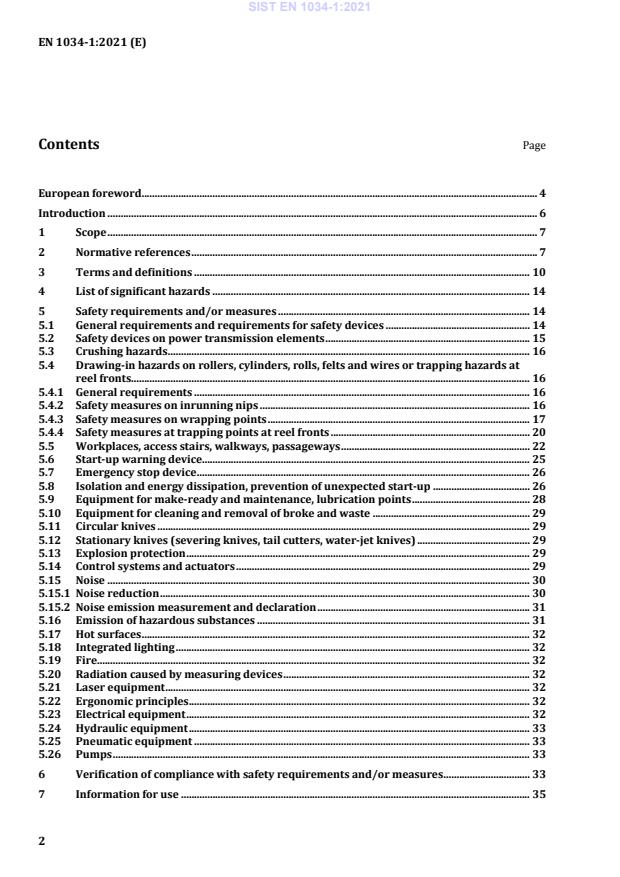
Contents Page
European foreword . 4
Introduction . 6
1 Scope . 7
2 Normative references . 7
3 Terms and definitions . 10
4 List of significant hazards . 14
5 Safety requirements and/or measures . 14
5.1 General requirements and requirements for safety devices . 14
5.2 Safety devices on power transmission elements . 15
5.3 Crushing hazards . 16
5.4 Drawing-in hazards on rollers, cylinders, rolls, felts and wires or trapping hazards at
reel fronts. 16
5.4.1 General requirements . 16
5.4.2 Safety measures on inrunning nips . 16
5.4.3 Safety measures on wrapping points . 17
5.4.4 Safety measures at trapping points at reel fronts . 20
5.5 Workplaces, access stairs, walkways, passageways . 22
5.6 Start-up warning device. 25
5.7 Emergency stop device . 26
5.8 Isolation and energy dissipation, prevention of unexpected start-up . 26
5.9 Equipment for make-ready and maintenance, lubrication points . 28
5.10 Equipment for cleaning and removal of broke and waste . 29
5.11 Circular knives . 29
5.12 Stationary knives (severing knives, tail cutters, water-jet knives) . 29
5.13 Explosion protection . 29
5.14 Control systems and actuators . 29
5.15 Noise . 30
5.15.1 Noise reduction . 30
5.15.2 Noise emission measurement and declaration . 31
5.16 Emission of hazardous substances . 31
5.17 Hot surfaces . 32
5.18 Integrated lighting . 32
5.19 Fire. 32
5.20 Radiation caused by measuring devices . 32
5.21 Laser equipment . 32
5.22 Ergonomic principles . 32
5.23 Electrical equipment . 32
5.24 Hydraulic equipment . 33
5.25 Pneumatic equipment . 33
5.26 Pumps . 33
6 Verification of compliance with safety requirements and/or measures . 33
7 Information for use . 35
7.1 General . 35
7.2 Marking . 35
7.3 Instruction handbook . 35
7.4 Sales literature . 37
Annex A (informative) Trilingual alphabetical list of paper making and paper finishing
machines . 38
Annex B (informative) List of Significant Hazards . 40
Annex ZA (informative) Relationship between this European Standard and the essential
requirements of EU Directive 2006/42/EC aimed to be covered . 43
Bibliography . 46
European foreword
This document (EN 1034-1:2021) has been prepared by Technical Committee CEN/TC 198 “Printing and
paper machinery - Safety”, the secretariat of which is held by DIN.
This European Standard shall be given the status of a national standard, either by publication of an
identical text or by endorsement, at the latest by May 2021, and conflicting national standards shall be
withdrawn at the latest by May 2021.
Attention is drawn to the possibility that some of the elements of this document may be the subject of
patent rights. CEN shall not be held responsible for identifying any or all such patent rights.
This document supersedes EN 1034-1:2000+A1:2010.
In comparison with the previous edition, the following technical modifications have been made:
a) In Clause 3, the term “Paper converting machines” was defined;
b) In 3.4, a tolerance for crawl speed was specified;
c) In Clause 3, the term “running machine” has been deleted;
d) In 3.6.3, addition of a definition for trapping points;
e) In 5.1.2, clarification on the use of signal colours;
f) In 5.4.4, addition of safety requirements for trapping points at reel fronts;
g) In 5.5, requirements for means of access, walkways and guard-rails adapted to the revised
EN ISO 14122 (all parts), sector-specific deviations will still to be taken into account;
h) In 7.3, the requirements for the instruction handbook have been extended: all requirements
previously contained in Clause 5 in relation to the instruction handbook have been transferred to
7.3;
i) In 5.9.5, addition of requirements for crawl speed;
j) In 5.14.1, addition of requirements for positioning of control devices;
k) In 5.14.2, amendment of Table 5: Determination of approximate SIL or PL;
l) In 5.14.6, reference to EN ISO 13849-2:2012 for validation of safety functions added;
m) In 7.3, Addition of information regarding noise emission values and hearing protection equipment in
the instruction handbook;
n) In 5.23, Deletion of the notice on standards for high-voltage equipment;
o) Review of Annex ZA.
This document has been prepared under a mandate given to CEN by the European Commission and the
European Free Trade Association and supports essential requirements of EU Directives.
For relationship with EU Directives, see informative Annex ZA, which is an integral part of this document.
This document is part 1 of a standard for the technical safety requirements for the design and
construction of paper making and finishing machines which consists of the following parts:
— Part 1: Common requirements
— Part 2: Barking drums
— Part 3: Rereelers and winders
— Part 4: Pulpers and their loading facilities
— Part 5: Sheeters
— Part 6: Calenders
— Part 7: Chests
— Part 8: Refining plants
— Part 13: Machines for de-wiring bales and units
— Part 14: Reel splitter
— Part 16: Paper and board making machines
— Part 17: Tissue making machines
— Part 21: Coating machines
— Part 22: Wood grinders
— Part 26: Roll packaging machines
— Part 27: Roll handling systems
CEN/TC 198 intends to prepare further parts to cover the paper making and finishing machines listed in
Annex A.
Requirements in this document with reference to ISO 14122-2, ISO 14122-3 and ISO 14122-4 are
applicable in conjunction with ISO 14122-1.
According to the CEN-CENELEC Internal Regulations, the national standards organisations of the
following countries are bound to implement this European Standard: Austria, Belgium, Bulgaria, Croatia,
Cyprus, Czech Republic, Denmark, Estonia, Finland, France, Germany, Greece, Hungary, Iceland, Ireland,
Italy, Latvia, Lithuania, Luxembourg, Malta, Netherlands, Norway, Poland, Portugal, Republic of North
Macedonia, Romania, Serbia, Slovakia, Slovenia, Spain, Sweden, Switzerland, Turkey and the United
Kingdom.
Introduction
This document is a type-C standard as stated in EN ISO 12100.
This document is of relevance, in particular, for the following stakeholder groups representing the market
players with regard to machinery safety:
— machine manufacturers (small, medium and large enterprises);
— health and safety bodies (regulators, accident prevention organizations, market surveillance etc.).
Others can be affected by the level of machinery safety achieved with the means of the document by the
above-mentioned stakeholder groups:
— machine users/employers (small, medium and large enterprises);
— machine users/employees (e.g. trade unions, organizations for people with special needs);
— service providers, e.g. for maintenance (small, medium and large enterprises);
— consumers (in case of machinery intended for use by consumers).
The above-mentioned stakeholder groups have been given the possibility to participate at the drafting
process of this document.
The machinery concerned and the extent to which hazards, hazardous situations or hazardous events are
covered are indicated in the scope of this document.
When requirements of this type-C standard are different from those which are stated in type-A or type-B
standards, the requirements of this type-C standard take precedence over the requirements of the other
standards for machines that have been designed and built according to the requirements of this type-C
standard.
1 Scope
This document specifies safety requirements.
This document is applicable to paper making and paper finishing machines. It contains definitions and
requirements that apply to all paper making and paper finishing machines listed in Annex A and is
intended to be used in connection with the specific part applicable for the respective machine listed in
Annex A. Specific parts can contain additional requirements or deviations from EN 1034-1 in which case
the specific stipulations take precedence over the specification made in EN 1034-1. This document deals
with the hazards listed in Annex B.
This document deals with all significant hazards, hazardous situations or hazardous events relevant to
paper making and paper finishing machines, when they are used as intended and under conditions of
misuse that are reasonably foreseeable by the manufacturer.
This document does not apply to machines used in paper converting. See EN 1010-1 to EN 1010-5.
This document is not applicable to paper making and paper finishing machines manufactured before the
date of its publication.
2 Normative references
The following documents are referred to in the text in such a way that some or all of their content
constitute requirements of this document. For dated references, only the edition cited applies. For
undated references, the latest edition of the referenced document (including any amendments) applies.
EN ISO 4413:2010, Hydraulic fluid power - General rules and safety requirements for systems and their
components (ISO 4413:2010)
EN ISO 4414:2010, Pneumatic fluid power - General rules and safety requirements for systems and their
components (ISO 4414:2010)
EN ISO 7731:2008, Ergonomics - Danger signals for public and work areas - Auditory danger signals (ISO
7731:2003)
EN ISO 11688-1:2009, Acoustics - Recommended practice for the design of low-noise machinery and
equipment - Part 1: Planning (ISO/TR 11688-1:1995)
EN ISO 12100:2010, Safety of machinery - General principles for design - Risk assessment and risk reduction
(ISO 12100:2010)
EN ISO 13732-1:2008, Ergonomics of the thermal environment - Methods for the assessment of human
responses to contact with surfaces - Part 1: Hot surfaces (ISO 13732-1:2006)
EN ISO 13849-1:2015, Safety of machinery - Safety-related parts of control systems - Part 1: General
principles for design (ISO 13849-1:2015)
EN ISO 13849-2:2012, Safety of machinery - Safety-related parts of control systems - Part 2: Validation (ISO
13849-2:2012)
EN ISO 13850:2015, Safety of machinery - Emergency stop function - Principles for design (ISO 13850:2015)
EN ISO 13854:2019, Safety of machinery - Minimum gaps to avoid crushing of parts of the human body (ISO
13854:2017)
EN ISO 13856-1:2013, Safety of machinery - Pressure-sensitive protective devices - Part 1: General
principles for design and testing of pressure-sensitive mats and pressure-sensitive floors (ISO 13856-1:2013)
EN ISO 13856-2:2013, Safety of machinery - Pressure-sensitive protective devices - Part 2: General
principles for design and testing of pressure-sensitive edges and pressure-sensitive bars (ISO 13856-2:2013)
EN ISO 13856-3:2013, Safety of machinery - Pressure-sensitive protective devices - Part 3: General
principles for design and testing of pressure-sensitive bumpers, plates, wires and similar devices (ISO 13856-
3:2013)
EN ISO 13857:2019, Safety of machinery - Safety distances to prevent hazard zones being reached by upper
and lower limbs (ISO 13857:2019)
EN ISO 14118:2018, Safety of machinery - Prevention of unexpected start-up (ISO 14118:2017)
EN ISO 14119:2013, Safety of machinery - Interlocking devices associated with guards - Principles for
design and selection (ISO 14119:2013)
EN ISO 14120:2015, Safety of machinery - Guards - General requirements for the design and construction
of fixed and movable guards (ISO 14120:2015)
EN ISO 14122-1:2016, Safety of machinery - Permanent means of access to machinery - Part 1: Choice of
fixed means and general requirements of access (ISO 14122-1:2016)
EN ISO 14122-2:2016, Safety of machinery - Permanent means of access to machinery - Part 2: Working
platforms and walkways (ISO 14122-2:2016)
EN ISO 14122-3:2016, Safety of machinery - Permanent means of access to machinery - Part 3: Stairs,
stepladders and guard-rails (ISO 14122-3:2016)
EN ISO 14122-4:2016, Safety of machinery - Permanent means of access to machinery - Part 4: Fixed
ladders (ISO 14122-4:2016)
EN ISO 14123-1:2015, Safety of machinery - Reduction of risks to health resulting from hazardous
substances emitted by machinery - Part 1: Principles and specifications for machinery manufacturers (ISO
14123-1:2015)
EN ISO 14123-2:2015, Safety of machinery - Reduction of risks to health resulting from hazardous
substances emitted by machinery - Part 2: Methodology leading to verification procedures (ISO 14123-
2:2015)
EN ISO 19353:2019, Safety of machinery - Fire prevention and fire protection (ISO 19353:2019)
EN 614-1:2006+A1:2009, Safety of machinery - Ergonomic design principles - Part 1: Terminology and
general principles
EN 614-2:2000+A1:2008, Safety of machinery - Ergonomic design principles - Part 2: Interactions between
the design of machinery and work tasks
EN 809:1998+A1:2009, Pumps and pump units for liquids - Common safety requirements
EN 1127-1:2019, Explosive atmospheres - Explosion prevention and protection - Part 1: Basic concepts and
methodology
EN 1837:1999+A1:2009, Safety of machinery - Integral lighting of machines
EN 12198-1:2000+A1:2008, Safety of machinery - Assessment and reduction of risks arising from radiation
emitted by machinery - Part 1: General principles
EN 13023:2003+A1:2010, Noise measurement methods for printing, paper converting, paper making
machines and auxiliary equipment - Accuracy grades 2 and 3
EN 60529:1991, Degrees of protection provided by enclosures (IP code) (IEC 60529:1989)
EN 60204-1:2018, Safety of machinery - Electrical equipment of machines - Part 1: General requirements
(IEC 60204-1:2016)
EN 60825-1:2014, Safety of laser products - Part 1: Equipment classification and requirements
(IEC 60825:2014)
EN 61496-1:2013, Safety of machinery - Electro-sensitive protective equipment - Part 1: General
requirements and tests (IEC 61496-1:2012)
EN 61496-2:2013, Safety of machinery - Electro-sensitive protective equipment - Part 2: Particular
requirements for equipment using active opto-electronic protective devices (AOPDs) (IEC 61496-2:2013)
EN 61511-1:2017, Functional safety — Safety instrumented systems for the process industry sector —
Part 1: Framework, definitions, system, hardware and application programming (IEC 61511-1:2016)
EN 62061:2005, Safety of machinery — Functional safety of safety-related electrical, electronic and
programmable electronic control systems (IEC 62061:2005)
EN IEC 61496-3:2019, Safety of machinery - Electro-sensitive protective equipment - Part 3: Particular
requirements for active opto-electronic protective devices responsive to diffuse Reflection (AOPDDR)
(IEC 61496-3:2018)
EN IEC 62046:2018, Safety of machinery - Application of protective equipment to detect the presence of
persons (IEC 62046:2018)
IEC/TR 61496-4:2007, Safety of machinery. — Electro-sensitive protective equipment — Part 4: Particular
requirements for equipment using vision based protective devices (VBPD)
IEC/TS 61496-4-2:2014, Safety of machinery — Electro-sensitive protective equipment — Part 4-2:
Particular requirements for equipment using vision based protective devices (VBPD) — Additional
requirements when using reference pattern techniques (VBPDPP)
IEC/TS 61496-4-3:2015, Safety of machinery — Electro-sensitive protective equipment — Part 4-3:
Particular requirements for equipment using vision based protective devices (VBPD) — Additional
requirements when using stereo vision techniques (VBPDST)
1 This document is impacted by the amendments EN 60529:1991/A1:2000, EN 60529:1991/A2:2013 and the corrigenda
EN 60529:1991/AC:2016-12 and EN 60529:1991/A2:2013/AC:2019-02.
2 This document is impacted by the amendment EN 61511-1:2017/A1:2017.
3 This document is impacted by the amendments EN 62061:2005/A1:2013, EN 62061:2005/A2:2015 and the
corrigendum EN 62061:2005/Cor.:2010.
3 Terms and definitions
For the purposes of this document, the terms and definitions given in EN ISO 12100:2010 and the
following apply.
ISO and IEC maintain terminological databases for use in standardization at the following addresses:
— IEC Electropedia: available at http://www.electropedia.org/
— ISO online browsing platform: available at https://iso.org./obp
3.1
paper making and finishing machine
machine with which pulp or paper fibres are obtained, processed, joined together to form and also to
finish paper, board, tissue and fibreboard
3.2
paper converting machine
machine which are downstream of paper making and finishing machines
EXAMPLE cutting machines (guillotine cutters), corrugated board making and processing machines
Note 1 to entry: Safety requirements for paper converting machines are dealt with in the EN 1010 series
(EN ISO 12643 series).
3.3
machine section
functional unit of a paper making machine
EXAMPLE wire section, press section, dryer section, smoothing unit, coater, winding unit
3.4
crawl speed
speed as low as possible, but a set value of not more than 0,25 m/s (15 m/min)
Note 1 to entry: For drives of machine groups (multi-motor drive/ sectional drives) applies: Variations caused
by the process can lead to increases of up to 5 m/min for a maximum of 10 s (dynamic tolerance). Diameter changes
- e.g. from roll grinding - may require monitoring tolerances of up to 10 % or 1,5 m/min (static tolerance). These
tolerances apply to the motor speed being monitored for safety purposes.
Note 2 to entry: The crawl speed may differ depending on the type of machine. Machine-specific deviations from
the defined values are described in the subsequent parts of this standard.
3.5
hold-to-run control
operation of the machine by means of a hold-to-run control device as defined in EN ISO 12100:2010,
3.28.3
3.6
inrunning nips, wrapping and trapping points
3.6.1
inrunning nip
danger point caused by rotating roll, cylinder or roller nips where persons, parts of the body or clothing
can be drawn in
Note 1 to entry: Such nips arise between:
— counter-rotating part (see Figure 1a and 1c);
— a rotating part and an adjacent fixed part (see Figure 1b and 1d);
— parts rotating in the same direction, but with different peripheral speeds and/or surface properties, if
adequate safety distances are not maintained (see Figure 1e).
Examples of inrunning nips are illustrated in Figure 1.
1a) inrunning nip created by counter-rotating 1b) inrunning nip created by a rotating part and
parts an adjacent fixed part
1c) inrunning nip created by counter-rotating 1d) inrunning nip created by a rotating part and
parts adjacent fixed parts (machine frame, floor)
1e) inrunning nip created by parts rotating in the
same direction, but with different peripheral
speeds and/or surface properties
Key
v circumferential d minimum distance s distance, 0 < s < d
speed
NOTE Prevention of drawing-in hazard during whole-body access if d ≥ 500 mm or during arm access if d ≥
120 mm (see 5.4.2).
Figure 1 — Examples of inrunning nips
3.6.2
wrapping point
danger point where moving materials, such as felts or screens and wires, aprons or ropes or strong board
webs, are fed onto moving parts, such as rolls, cylinders or discs, which can draw in persons, parts of the
body or clothing
Note 1 to entry: Examples of wrapping points are given in Figure 2.
Key
A wrapping point
E inrunning nip
1 roll, cylinder
2 rope
3 felt, screen
Figure 2 — Examples of wrapping points
3.6.3
trapping point
danger point where the body or parts of the body, hair or clothing can get entangled
Note 1 to entry: Hazards due to trapping points may occur in situations when the body and parts of the body are
entangled, but also in situations when the body does not have any chance to get free from a hazardous situation.
3.7
paper
material which include board, cardboard or tissue, essentially made of fibres of mostly vegetable origin
and formed on wires (screens) by dewatering a fibre suspension
3.8
broke
scraps of paper, paper breaks and paper with imperfections
3.9
perimeter fence
distance guard preventing access to a hazard zone with a minimum height of 1,4 m and a clearance
between floor and lower edge of the fence of 0,4 m maximum
Note 1 to entry: This definition does not relate to fall-off protections.
Note 2 to entry: When access is required, perimeter fences have doors that are electrically or mechanically
interlocked, taking into account the access frequency, equipped with guard locking where required.
3.10
nip bar
guard arranged directly on the nip of a pair of rollers or some other nip
Note 1 to entry: For examples of nip bars, see Figure 3.
4 List of significant hazards
For a list of all the significant hazards as far as they are dealt with in this document, see Annex B, Table B.1.
5 Safety requirements and/or measures
5.1 General requirements and requirements for safety devices
5.1.1 Machinery shall comply with the safety requirements and/or protective measures/risk reduction
measures of Clause 5. This Clause specifies the types of guards required for paper making and finishing
machines.
When required, further specification will be given in the machine-specific parts as listed in Annex A of
this document.
In addition, the machine shall be designed according to the principles of EN ISO 12100:2010 for relevant
but not significant hazards that are not dealt with in this document.
5.1.2 Safety devices shall comply with the requirements specified in EN ISO 12100:2010, 6.3.
Guards shall be designed and selected in accordance with EN ISO 14120:2015. Interlocking devices
associated with guards shall be in accordance with EN ISO 14119:2013. Pressure-sensitive protective
devices (PSPD) shall be in accordance with the requirements of the applicable parts of the following
standards: EN ISO 13856-1:2013, EN ISO 13856-2:2013, EN ISO 13856-3:2013. Electro-sensitive
protective equipment shall be in accordance with all applicable parts of the following standards:
EN 61496-1:2013, EN 61496-2:2013, EN IEC 61496-3:2019, IEC/TR 61496-4:2007,
IEC/TS 61496-4-2:2014, IEC/TS 61496-4-3:2015. The specific applications of the electro-sensitive
protective equipment shall be in accordance with all the applicable subclauses of EN IEC 62046:2018.
In compliance with EN ISO 14120:2015, signal colours for the guards should not be used.
Fixed guards that have to be removed periodically for maintenance (e.g. the guards on wrapping points
of rolls for changing clothing) shall be constructed in such a way that their fixing systems remain attached
to the guards or to the machinery when the guards are removed. An example is shown in Figure 11 of
EN ISO 14120:2015.
Where possible, guards should be constructed in such a way that they also protect against ejected or
falling materials and objects.
Where possible, guards should be constructed in such a way that they also protect against emissions
generated by the machinery, for example against noise.
5.1.3 Movable guards for safeguarding danger points shall be designed as interlocking guards with
guard locking or as interlocking guard without guard locking (see 3.5.2 or 3.5 of EN ISO 14120:2015).
5.1.4 On perimeter fences equipped with interlocking doors, it shall be possible to open the doors from
inside the enclosed area at any time so that persons locked-in can escape from the hazard zone.
5.1.5 Nip bars shall be so designed and mounted that they are able to maintain their safeguarding
function even under mechanical stresses, vibration and heat. When forces of 1 000 N are applied in the
middle, the gap ‘a’ in Figure 3 shall not be wider than 8 mm.
5.2 Safety devices on power transmission elements
Danger points on power transmission elements shall be protected by fixed guards or interlocking guards
with or without guard locking. Guards shall be arranged as close to the danger point as possible such as
to prevent access from all sides. Where this is not possible, perimeter fences shall be arranged at a safety
distance in accordance with EN ISO 13857:2019, Table 2 and Table B.1.
Table 1 of this document shall be taken into account when selecting the proper type of guarding for power
transmission elements.
Table 1 — Type of guarding for power transmission elements
Power transmission element Type of guarding
Individual shafts, universal-joint fixed guard according to 3.2.1 of EN ISO 14120:2015
shafts, belt drives, chain drives
Line transmissions perimeter fence according to 3.2.2 and Clause 6 of
EN ISO 14120:2015; enclosing guard
Gear drives housing; fixed guard according to 3.2.1 of
EN ISO 14120:2015
Spoke wheels fixed guard according to 3.2.1 of EN ISO 14120:2015;
perimeter fence
Clutches housing; fixed guard according to 3.2.1 of
EN ISO 14120:2015; perimeter fences according to 3.2.2
of EN ISO 14120:2015; interlocking guard with guard
locking
5.3 Crushing hazards
In order to avoid crushing hazards between fixed and moving or between moving machine parts, the
minimum distances specified in EN ISO 13854:2019 shall be applied. Crushing hazards can also be
avoided by limiting the forces applied at the crushing point to a non-hazardous level such that the
movement can be stopped by reactive body force.
NOTE As long as there is no relevant standard to refer to, it is taken that forces of less or equal 150 N generally
do not present a risk of injury if it is a low-impulse movement and the contact surfaces are even or padded.
5.4 Drawing-in hazards on rollers, cylinders, rolls, felts and wires or trapping hazards at
reel fronts
5.4.1 General requirements
Where drawing-in hazards exists on inrunning nips, wrapping points or trapping points at reel fronts, the
related hazard points should preferably be safeguarded by one or a combination of the following
protective measures:
a) Safety distances according to EN ISO 13854:2019
b) Fixed guards in accordance with EN ISO 14120:2015 and Table 2 as well as Table 4 of
EN ISO 13857:2019. If access is frequently necessary: Interlocking guards in accordance with
EN ISO 14119:2013.
5.4.2 Safety measures on inrunning nips
The drawing-in hazards existing on inrunning nips of cylinders, rollers and rolls shall be avoided,
wherever possible without restraining machine function, by providing adequate distance between
rotating parts and fixed parts.
The hazard of the whole body being drawn in is prevented if there is a safety distance of 500 mm between
machine parts at the inrunning nip. See Figure 1.
The hazard of an arm being drawn in is prevented if there is a safe distance of at least 120 mm between
machine parts at the inrunning nip. Applying the safety distance for the arm is only allowed if the
inrunning nip cannot be reached by the body.
Inrunning nips where drawing-in hazards cannot be avoided shall be protected by guards.
NOTE This applies, for example, in press sections.
Suitable guards are:
— fixed or interlocking guards (e.g. nip bars) with guard locking according to EN ISO 14120:2015 and
EN ISO 14119:2013;
— fixed or interlocking distance guards with guard locking according to EN ISO 14120:2015 and
EN ISO 14119:2013;
— fixed or interlocking perimeter fences with guard locking according to EN ISO 14120:2015 and
EN ISO 14119:2013.
Fixed machine parts such as housings and frames which prevent access to a danger point can also partly
or completely function as guarding element. Fixed guards are selected where access to an inrunning nip
is not required.
Round sections shall not be considered suitable as nip guards as they create new inrunning nips.
The gap between the guard and rotating machine parts should be as small as possible and shall not be
more than 8 mm. The corner between the outer surface of the guard protecting the inrunning nip and the
tangent line of the roller surface shall be obtuse or right angled, i.e ≥ 90°. See Figure 3.
For guards that are not arranged directly on the inrunning nip, the distances listed in Table 2 of
EN ISO 13857:2019 shall apply. The following points shall be taken account of: The relevant distance “c”
between the guarding element and the danger area according to Figure 2 of EN ISO 13857:2019 is, when
applied to inrunning nips, identical with the distance between guarding element and that plane in the
inrunning nip where the distance “e” is equal or more than 25 mm between the roller surfaces or between
roller surface and fixed part. See Figure 4.
Information on inrunning nips shall be given in the instruction handbook, see 7.3.
5.4.3 Safety measures on wrapping points
Due to drawing-in hazards, wrapping points of felts, wires, ropes and tapes which are within the
operator's reach shall be safeguarded by fixed guards. Guards can be installed directly in front of the
wrapping points or at a distance in compliance with the safety distances according to EN ISO 13857:2019.
Where this is not possible or feasible, guards shall be mounted with safety distances according to
EN ISO 13857:2019, Table 2, Table 4 and Table B.1.
Wrapping points which are accessible from passageways in the machine shall be protected by fixed
guards machine-wide (see Figure 5).
Information about the wrapping points shall be given in the instruction handbook, see 7.3.
Figure 3 — Examples of guards (nip bars) at inrunning nip (a ≤ 8mm)
Figure 4 — Example of a protective structure at inrunning nips For values of a, b, c see Figure 2
and Table 2 of EN ISO 13857:2019; e ≥ 25 mm
a) front access b) side access
c) on felt guide roller d) on rope pulley
Key
f fixed guard
Figure 5 — Example of fixed guards at wrapping point
5.4.4 Safety measures at trapping points at reel fronts
Where trapping hazards exists on unwinding or rewinding devices or reel turning devices, the trapping
points (see 3.6.3) shall be safeguarded between the front sides of rotating paper reel and fixed parts of
the environment, as e.g. parts of the machine frame, by means of one or a combination of the following
protective measures.
— Minimum distances according to EN ISO 13854:2019 taking into consideration the access
possibilities for the body, the head and/or human arm.
— Fixed guards or perimeter fence in accordance with EN ISO 14120:2015 and Table 2 as well as
Table 4 of EN ISO 13857:2019.
NOTE 1 Often, compliance with the safety distance according to EN ISO 13854:2019 or complete fencing of
an unwinding device is not possible for technical reasons during production.
— If access is frequently necessary: Interlocking guards with guard locking in accordance with
EN ISO 14120:2015 and EN ISO 14119:2013 which are interlocked with the power supply of the
winding or unwinding drive and comply with 5.1.4 of this document. Access doors shall be designed
and arranged such that safe access to the workplaces required for web threading is guaranteed. The
related control system shall at least fulfil Performance level PL c of EN ISO 13849-1:2015 or Safety
Integrity Level SIL 1 of EN 62061:2005.
NOTE 2 Deviating requirements for safety related parts of control systems are defined in the machine-
specific parts of the EN 1034 series.
— electro-sensitive protective equipment of type 2 in accordance with the applicable standard parts of
the following standards: EN 61496-1:2013, EN 61496-2:2013, EN IEC 61496-3:2019,
IEC/TR 61496-4:2007, IEC/TS 61496-4-2:2014, IEC/TS 61496-4-3:2015 as well as with the
applicable subclauses of EN IEC 62046:2018;
— electro-sensitive protective equipment with approach reaction of type 2 in accordance with the
applicable standard parts of the following standards: EN 61496-1:2013, EN 61496-2:2013, EN
IEC 61496-3:2019, IEC/TR 61496-4:2007, IEC/TS 61496-4-2:2014, IEC/TS 61496-4-3:2015 as well
as with the applicable subclauses of EN IEC 62046:2018;
NOTE 3 Electro-sensitive protective devices or sensors with approach reaction normally cannot be
positioned in compliance with EN ISO 13855:2010 in a reasonable manner due to the existing machine speed
and the mass of the rolls; however, they have the effect that the operators abstain from carrying out manual
operations.
— Devices that prevent access to respectively stepping inside and standing in the hazard zone between
the front side of the reel and fixed surrounding parts, e.g. the machine frame. (See Example in
Figure 6b)
NOTE 4 This can be achieved, e.g. by geometry-dependent installations preventing persons from standing,
deflectors, floor markings.
Dimensions in millimetres
6a) Minimum distances according to 6b) geometry-dependent installations
EN ISO 13854:2019 preventing persons from standing
Key
1 reel front
2 concrete base
3 geometry-dependent installations preventing persons from standing
Figure 6 — Examples for risk reduction measures at trapping points between front side of the
reel and fixed parts of the environment
Where such devices do not prevent access or entry and standing, they should at least make it more
difficult and draw attention to the hazard zone.
NOTE 5 Smooth surfaces or smooth claddings at the machine frame can reduce the risk of being drawn in.
Information about the trapping points shall be given in the instruction handbook, see 7.3.
5.5 Workplaces, access stairs, walkways, passageways
5.5.1 For operating, make-ready, trouble-shooting as well as maintenance operations, work platforms
including their access stairs and passageways in accordance with EN ISO 14122-2:2016 shall be
provided. Work platforms shall be resistant to the existing environmental conditions, i.e. they shall not
corrode in wet sections and withstand vibration stresses. Adequate protection against persons falling off
shall be provided. Platforms shall be designed for a surface loa
...