

SIST EN 1034-16:2012
(Main)Safety of machinery - Safety requirements for the design and construction of paper making and finishing machines - Part 16: Paper and board making machines
General Information
- Abstract
This European Standard applies to machines for the production of paper and board, including head box, wire section (former), press section, drying section, film size press, coating unit, flotation and infrared dryer, smoothing unit, integrated calender, measuring device, reel-up, integrated sheeter, drives and control system (paper and board making machines) and applies together with EN 1034-1:2000+A1:2010. It deals with all significant hazards, hazardous situations and hazard events relevant to machines for the production of paper and board, when used as intended and under the conditions foreseen by the manufacturer (see Clause 4).
This document does not deal with pressure hazards in steam-heated drying cylinders.
NOTE Directive 97/23/EC gives essential safety requirements for equipment under pressure.
This document does not apply to:
tissue making machines,
cardboard making machines,
coating machines,
machines for the production of corrugated board,
integrated conveyors and cranes designed for transporting reels/shells (reel spools) and for machine maintenance, and
integrated fire extinguishing equipment.
This European Standard is not applicable to paper and board making machines which are manufactured before the date of publication of this European Standard by CEN.
- Status
- Published
- Publication Date
- 27-Mar-2012
- Technical Committee
- GRT - Graphical technology
- Current Stage
- 6060 - National Implementation/Publication (Adopted Project)
- Start Date
- 21-Mar-2012
- Due Date
- 26-May-2012
- Completion Date
- 28-Mar-2012
- Directive
- 2006/42/EC - Directive 2006/42/EC of the European Parliament and of the Council of 17 May 2006 on machinery, and amending Directive 95/16/EC (recast)OJ Ref: C 220, TIP C, L 7.9.2026 UMIK 20.1.2027 OJ Date: 11-Jul-2014 Conflicting Date: 20-Jan-2027



Overview
EN 1034-16:2012 is a CEN Type C European standard that specifies safety requirements for the design and construction of paper and board making machines. It covers the full machine line for paper and board production - including head box, wire (former) section, press section, drying section, film size press, flotation and infrared dryers, coating units, calenders, measuring devices, reel-up and integrated sheeters - and is intended to be used together with EN 1034-1:2000+A1:2010 (common requirements). The standard addresses all significant hazards relevant to these machines when used as intended and under conditions foreseen by the manufacturer. EN 1034-16:2012 does not cover pressure hazards in steam-heated drying cylinders (see pressure equipment directives) and excludes tissue machines, corrugated-board machines, coating machines, integrated conveyors/cranes for reel handling, integrated fire extinguishing equipment and machines manufactured before its publication.
Key topics and requirements
EN 1034-16:2012 organizes safety requirements around machine sections and key risk areas. Main technical topics include:
- Risk identification and significant hazards specific to paper and board making machinery.
- Mechanical protections and guarding (fixed and movable guards; access openings).
- Control systems and actuators, including start-up warnings, emergency stop, prevention of unexpected start-up and drive isolation.
- Power transmission, electrical, hydraulic and pneumatic equipment safety requirements.
- Special sections: head box/wire former, press, drying, film size presses, flotation and infrared dryers, calenders, measuring units, reel-up and sheeter interfaces.
- Workplace ergonomics, access, maintenance, cleaning and make-ready safety measures.
- Hazards from hot surfaces, noise, chemicals, fire and rolls handling.
- Verification and validation procedures for safety functions and conformity testing.
- Information for use: instruction handbooks, marking and user information required for safe operation.
The standard references and aligns with other machine safety standards (e.g., EN 1034-1, EN 349, EN 953, EN 1037) and links to EU requirements (informative Annex ZA for Directive 2006/42/EC).
Practical applications
Use EN 1034-16:2012 to:
- Design and build compliant paper and board making machines.
- Develop machine guarding, emergency stop and isolation strategies.
- Prepare technical documentation, user instructions and safety markings.
- Verify safety functions and perform conformity assessments for CE marking.
- Guide risk assessments and safety measures for specific machine sections (drying, press, reel-up).
Who should use this standard
- Machine designers and OEMs in the paper industry
- Safety and compliance engineers responsible for Machinery Directive (2006/42/EC) conformity
- Plant engineers and maintenance teams specifying safe access, lockout/tagout and guarding
- Certification bodies and testing laboratories evaluating machine safety
Related standards (examples)
- EN 1034-1:2000+A1:2010 (Common requirements)
- EN 349, EN 953 (guards and minimum gaps)
- EN 1037 (prevention of unexpected start-up)
For regulatory compliance and implementation details, consult the full EN 1034-16:2012 document and associated EN 1034 series parts.
Relations
- Effective Date
- 09-Feb-2026
- Effective Date
- 09-Feb-2026
- Effective Date
- 09-Feb-2026
- Effective Date
- 09-Feb-2026
- Effective Date
- 09-Feb-2026
- Effective Date
- 09-Feb-2026
- Effective Date
- 09-Feb-2026
- Effective Date
- 28-Jan-2026
- Effective Date
- 28-Jan-2026
- Effective Date
- 28-Jan-2026
- Effective Date
- 28-Jan-2026
- Effective Date
- 28-Jan-2026
- Effective Date
- 28-Jan-2026
- Effective Date
- 28-Jan-2026
- Effective Date
- 28-Jan-2026
Get Certified
Connect with accredited certification bodies for this standard

Control Union Certifications
Global certification for agriculture and sustainability.

CIS Institut d.o.o.
Personal Protective Equipment (PPE) certification body. Notified Body NB-2890 for EU Regulation 2016/425 PPE.
Gozdarski inštitut Slovenije
Slovenian Forestry Institute. Forest management certification support, timber testing.
Sponsored listings
Frequently Asked Questions
SIST EN 1034-16:2012 is a standard published by the Slovenian Institute for Standardization (SIST). Its full title is "Safety of machinery - Safety requirements for the design and construction of paper making and finishing machines - Part 16: Paper and board making machines". This standard covers: This European Standard applies to machines for the production of paper and board, including head box, wire section (former), press section, drying section, film size press, coating unit, flotation and infrared dryer, smoothing unit, integrated calender, measuring device, reel-up, integrated sheeter, drives and control system (paper and board making machines) and applies together with EN 1034-1:2000+A1:2010. It deals with all significant hazards, hazardous situations and hazard events relevant to machines for the production of paper and board, when used as intended and under the conditions foreseen by the manufacturer (see Clause 4). This document does not deal with pressure hazards in steam-heated drying cylinders. NOTE Directive 97/23/EC gives essential safety requirements for equipment under pressure. This document does not apply to: tissue making machines, cardboard making machines, coating machines, machines for the production of corrugated board, integrated conveyors and cranes designed for transporting reels/shells (reel spools) and for machine maintenance, and integrated fire extinguishing equipment. This European Standard is not applicable to paper and board making machines which are manufactured before the date of publication of this European Standard by CEN.
This European Standard applies to machines for the production of paper and board, including head box, wire section (former), press section, drying section, film size press, coating unit, flotation and infrared dryer, smoothing unit, integrated calender, measuring device, reel-up, integrated sheeter, drives and control system (paper and board making machines) and applies together with EN 1034-1:2000+A1:2010. It deals with all significant hazards, hazardous situations and hazard events relevant to machines for the production of paper and board, when used as intended and under the conditions foreseen by the manufacturer (see Clause 4). This document does not deal with pressure hazards in steam-heated drying cylinders. NOTE Directive 97/23/EC gives essential safety requirements for equipment under pressure. This document does not apply to: tissue making machines, cardboard making machines, coating machines, machines for the production of corrugated board, integrated conveyors and cranes designed for transporting reels/shells (reel spools) and for machine maintenance, and integrated fire extinguishing equipment. This European Standard is not applicable to paper and board making machines which are manufactured before the date of publication of this European Standard by CEN.
SIST EN 1034-16:2012 is classified under the following ICS (International Classification for Standards) categories: 13.110 - Safety of machinery; 21.020 - Characteristics and design of machines, apparatus, equipment; 85.100 - Equipment for the paper industry. The ICS classification helps identify the subject area and facilitates finding related standards.
SIST EN 1034-16:2012 has the following relationships with other standards: It is inter standard links to SIST EN 60204-11:2001, SIST EN 62061:2005, SIST EN 61000-6-2:2005, SIST EN 61511-1:2007, SIST EN 61800-3:2005, SIST EN 61496-1:2005, SIST EN 61511-2:2007, SIST EN 1034-4:2006+A1:2010, SIST EN 1034-1:2000+A1:2010, SIST EN 746-1:2000+A1:2009, SIST EN ISO 14122-4:2005, SIST EN 1760-2:2002+A1:2009, SIST EN 894-1:2000+A1:2008, SIST EN ISO 14122-1:2002, SIST EN 614-1:2006+A1:2009. Understanding these relationships helps ensure you are using the most current and applicable version of the standard.
SIST EN 1034-16:2012 is associated with the following European legislation: EU Directives/Regulations: 2006/42/EC; Standardization Mandates: M/396. When a standard is cited in the Official Journal of the European Union, products manufactured in conformity with it benefit from a presumption of conformity with the essential requirements of the corresponding EU directive or regulation.
SIST EN 1034-16:2012 is available in PDF format for immediate download after purchase. The document can be added to your cart and obtained through the secure checkout process. Digital delivery ensures instant access to the complete standard document.
Standards Content (Sample)
2003-01.Slovenski inštitut za standardizacijo. Razmnoževanje celote ali delov tega standarda ni dovoljeno.Sicherheit von Maschinen - Sicherheitsanforderungen an Konstruktion und Bau von Maschinen der Papierherstellung und Ausrüstung - Teil 16: Papier- und KartonmaschinenSécurité des machines - Prescriptions de sécurité pour la conception et la construction de machines de fabrication et de finition du papier - Partie 16: Machines à papier et cartonSafety of machinery - Safety requirements for the design and construction of paper making and finishing machines - Part 16: Paper and board making machines85.100Oprema za papirno industrijoEquipment for the paper industry21.020Characteristics and design of machines, apparatus, equipment13.110Varnost strojevSafety of machineryICS:Ta slovenski standard je istoveten z:EN 1034-16:2012SIST EN 1034-16:2012en,fr01-maj-2012SIST EN 1034-16:2012SLOVENSKI
STANDARD
EUROPEAN STANDARD NORME EUROPÉENNE EUROPÄISCHE NORM
EN 1034-16
March 2012 ICS 85.100 English Version
Safety of machinery - Safety requirements for the design and construction of paper making and finishing machines - Part 16: Paper and board making machines
Sécurité des machines - Prescriptions de sécurité pour la conception et la construction de machines de fabrication et de finition du papier - Partie 16: Machines à papier et carton
Sicherheit von Maschinen - Sicherheitstechnischeanforderungen an Konstruktion und Bau von Maschinen der Papierherstellung und Ausrüstung -Teil 16: Papier- und Kartonmaschinen This European Standard was approved by CEN on 8 January 2012.
CEN members are bound to comply with the CEN/CENELEC Internal Regulations which stipulate the conditions for giving this European Standard the status of a national standard without any alteration. Up-to-date lists and bibliographical references concerning such national standards may be obtained on application to the CEN-CENELEC Management Centre or to any CEN member.
This European Standard exists in three official versions (English, French, German). A version in any other language made by translation under the responsibility of a CEN member into its own language and notified to the CEN-CENELEC Management Centre has the same status as the official versions.
CEN members are the national standards bodies of Austria, Belgium, Bulgaria, Croatia, Cyprus, Czech Republic, Denmark, Estonia, Finland, France, Germany, Greece, Hungary, Iceland, Ireland, Italy, Latvia, Lithuania, Luxembourg, Malta, Netherlands, Norway, Poland, Portugal, Romania, Slovakia, Slovenia, Spain, Sweden, Switzerland, Turkey and United Kingdom.
EUROPEAN COMMITTEE FOR STANDARDIZATION
COMITÉ EUROPÉEN DE NORMALISATION EUROPÄISCHES KOMITEE FÜR NORMUNG
Management Centre:
Avenue Marnix 17,
B-1000 Brussels © 2012 CEN All rights of exploitation in any form and by any means reserved worldwide for CEN national Members. Ref. No. EN 1034-16:2012: ESIST EN 1034-16:2012
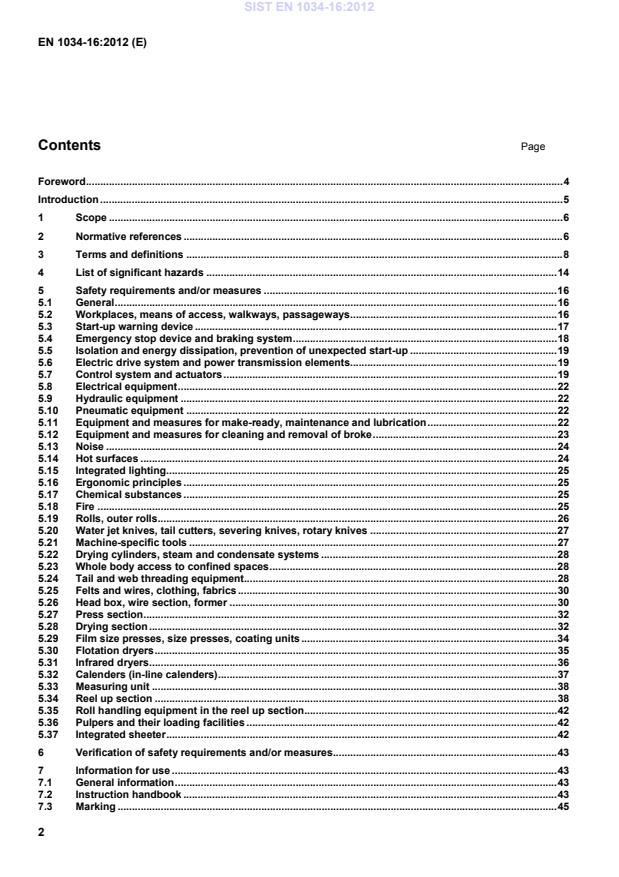
Relationship between this European Standard and the Essential Requirements of EU Directive 2006/42/EC . 46Bibliography . 47 Figures Figure 1 — Example for paper and board making machines (safety devices are not shown) . 9Figure 2 — Example for a wire section (safety devices are not shown) . 10Figure 3 — Example for a press section (safety devices are not shown) . 11Figure 4 — Example for a drying section (safety devices are not shown) . 12Figure 5 — Example for a reel up section (safety devices are not shown) . 13Figure 6 — Safety distance ≥ 2,70 m on drum reeler . 39Figure 7 — Safety distance ≥≥≥≥ 500 mm to prevent crushing by reels behind the drum reeler . 41 Tables Table 1 — List of significant hazards . 14Table 1 (continued) . 15Table 1 (continued) . 16Table 2 — List of safety functions, Performance Level and Safety Integrity Level specified in this European Standard . 21Table 3 — Methods used to verify safety requirements and/or measures . 43SIST EN 1034-16:2012
— Requirements EN 13023:2003+A1:2010, Noise measurement methods for printing, paper converting, paper making machines and auxiliary equipment — Accuracy grades 2 and 3 EN 60204-1:2006, Safety of machinery — Electrical equipment of machines — Part 1: General requirements
(IEC 60204-1:2005, modified) EN 60204-11:2000, Safety of machinery — Electrical equipment of machines — Part 11: Requirements for HV equipment for voltages above 1 000 V a.c. or 1500 V d.c and not exceeding 36 kV (IEC 60204-11:2000) EN 61000-6-2:2005, Electromagnetic compatibility (EMC) — Part 6-2: Generic standards — Immunity for industrial environment (IEC 61000-6-2:2005) EN 61496-1:2004, Safety of machinery — Electro-sensitive protective equipment — Part 1: General requirements and tests (IEC 61496-1:2004, modified) EN 61511-1:2004, Functional safety — Safety instrumented systems for the process industry sector — Part 1: Framework, definitions, system, hardware and software requirements (IEC 61511-1:2003 + Corrigendum 2004) SIST EN 1034-16:2012
EN ISO 12100:2010 and the following apply. 3.1 paper and board making machines the basic principle is, that fibre suspended in water is spread onto a wire screen or belt, pressed and dried to form an endless web Note 1 to entry: The machine is an assembly of sections with drive and control systems extending from the short circulation pump system to the head box, to the reel up and reel stand and including a wire section (former), press section, dryer section, SIST EN 1034-16:2012
Key 1 wire section 2 press section 3 drying section 4 coating unit and air turn 5 flotation dryer 6 calender 7 reel up section Figure 1 — Example for paper and board making machines (safety devices are not shown) 3.2 head box unit that keeps the fibres dispersed and delivers the stock uniformly onto the wire Note 1 to entry: There are many types including an open flow box (commonly known as a breast box), hydraulic flow box, pressurised flow box and vacuum flow box. 3.3 wire section moving wire, where water drains away into a pit below (known as a hog or couch pit) leaving the fibres to form a sheet on the surface Note 1 to entry: Machines may be single or twin wire. Synthetic wires (woven plastic) are commonly used. Water is also removed by the use of hydrofoils, suction units and a couch or wire suction roll. Equipment, such as guides and tension rollers and spraying pipes are also included in this section. A Dandy roll, which is a hollow roll with a variety of coverings, may be used to compact the fibres and apply a watermark or wove. Round wires may also be used, to form a web. In Figure 2, an example for a wire section is shown schematically. SIST EN 1034-16:2012
Key 1 head box 2 brest roll 3 wire 4 suction roll 5 wire drive roll 6 wire guide roll 7 foil 8 doctor 9 spray bar Figure 2 — Example for a wire section (safety devices are not shown) 3.4 press section consists of a number of heavy rollers and a felt and acts like a mangle. Moisture in the sheet is squeezed out and drawn out by suction; the section extends from the sheet pick up to the first dryer section and includes the pick up cylinder, pressure rolls, shoe press, lead rolls, spraying pipes, high pressure needle shower, suction boxes and roll stretch equipment Note 1 to entry: In Figure 3 an example for a press section is shown schematically. SIST EN 1034-16:2012
Key 1 shoe press 2 felt 3 wire 4 tension roll 5 outer roll 6 doctor 7 uhle box 8 pulper 9 hopper
Figure 3 — Example for a press section (safety devices are not shown) 3.5 drying section textends from the first drying cylinder to the reel up. The web passes through a number of steam-heated cylinders, which are pressure vessels, that gradually rise in temperature or suction rolls; the web is supported through this section by synthetic dryer fabrics, until the sheet is completely dry. Flotation dryers, infra-red dryers and MG cylinders are includes in this European Standard Note 1 to entry: In Figure 4 an example for a drying section is shown schematically. SIST EN 1034-16:2012
Key 1 hood 2 drying cylinder 3 fabric 4 guide roll 5 cleaning device 6 pulper
Figure 4 — Example for a drying section (safety devices are not shown) 3.6 size press purpose of the size press is to add a solution of water and starch or other application media like pigment coating. This improves the surface of the paper for printing purposes; the size press can be a simple pond or bath arrangement with two rollers, but more commonly consists of a series of rollers and resembles coating heads in design, delivering a pre-metered film of starch on either side of a web 3.7 coating unit units applying pigments, inks or fillers Note 1 to entry: Included are applicator rolls, jet applicators, spray nozzles and metering devices, such as blades or rods. There are a variety of methods, such as roll coating, blade coating, air-knife coating or cast coating. 3.8 flotation dryer convection dryers where a system of jets is used to create a stream of hot air on both sides along the paper web; the air stream keeps the web in suspension and carries it through the dryer; flotation dryers are commonly used in combination with coating units for drying the coating applied 3.9 infrared dryer equipment for drying the web by heating with infrared radiation. Infrared radiators are gas-heated or electrically heated Note 1 to entry: They are commonly used in combination with coating units for drying the coat applied. 3.10 calender/smoothing unit paper is smoothed using an ironing method, which consists of a stack of hot rollers mounted in pairs; this action consolidates, polishes and glazes the surface of the paper; the rollers may be steel, rubber or fibre packed or a combination of these 3.11 measuring unit measuring devices consisting of an ionising and/or non-ionising radiation source to gauge weight, moisture content and other characteristics SIST EN 1034-16:2012
Key 1 drum 2 reel 3 paper guide roll
4 reel spool magazine 5 centre drive 6 stopper/damper Figure 5 — Example for a reel up section (safety devices are not shown) 3.12.1 drum reeler reeler, where the paper web is wound onto a reel which rests on and is driven by a supporting cylinder (drum) whose peripheral speed is equal to that of the paper web Note 1 to entry: There are reeler types where the reel is not only driven on its periphery but also on its centre drive (shell, winding shaft). The reel stand and the reel spool magazine are also included in this section. 3.12.2 "open" reel section reel up section without automatic roll handling, the parent rolls are handled with a crane 3.12.3 "closed" reel section reel up section with automatic roll handling equipment in the vicinity of the reeler 3.12.4 centre-driven reel up reel up section where the web is wound onto a reel spool by a centre drive (shell, winding shaft) 3.13 integrated sheeter machine section for cutting the finished paper web into sheets in cross direction Note 1 to entry: This includes equipment for pulling and cutting the web as well as gathering and stacking of sheets. SIST EN 1034-16:2012
Table 1 — List of significant hazards (1 of 3) No Hazards subclause of this European Standard EN 1034-1: 2000 +A1:2009 Origin (source) Potential consequences
Mechanical hazards
1 Inadequate design of workplaces, means of access, walkways, passageways Slipping, tripping and falling 5.2.1; 5.2.2; 5.2.5; 5.2.7; 5.2.8; 5.11.1; 5.11.3; 5.11.4; 5.12.4; 5.12.9; 5.25.6; 5.26.4; 5.27.7; 5.28.7; 5.28.8; 5.32.1; 5.34.14; 5.36.1; 5.36.2; 5.36.3; 5.37.1 5.5 2 Obstacles in the area of workplaces, means of access, walkways, passageways Impact hazards for the head 5.2.3; 5.8.4 5.5.9 3 Inrunning nips on rotating rolls, reels, cylinders;
Wrapping points of fabrics, wires, ropes, power transmissions elements Drawing-in or trapping, amputation, death 5.2.6; 5.2.7; 5.2.8; 5.3; 5.4; 5.6.1; 5.6.2; 5.11.2; 5.11.3; 5.12.1, 5.12.3; 5.12.9; 5.19.2; 5.19.3; 5.19.4; 5.22.4; 5.24.1; 5.24.2; 5.24.3; 5.24.8; 5.25.5; 5.25.6; 5.26.6; 5.26.7; 5.26.8; 5.27.1; 5.27.2; 5.27.3; 5.27.4; 5.28.1, 5.28.2; 5.28.4; 5.29.1; 5.29.2; 5.29.3; 5.29.4; 5.30.1, 5.30.2; 5.30.3; 5.32.1; 5.32.2; 5.34.1; 5.34.2; 5.34.6; 5.34.7; 5.34.8; 5.34.12; 5.37.1; 5.37.2 5.1; 5.4; 5.7 4 Outer rolls Drawing-in or trapping, amputation, death 5.19.3
10 Hydraulic and pneumatic equipment Injuries by ejection of high-pressure fluids 5.9; 5.10; 5.12.8; 5.20.1; 5.34.45.24 11 Ejection and falling of machinery parts Crushing, impact of persons 5.24.5; 5.24.6; 5.25.1; 5.26.2; 5.28.8.4; 5.28.8.6; 5.30.4; 5.34.5; 5.34.10; 5.34.11 5.2
Electrical hazards
12 Electrical equipment Electric shock 5.6.1; 5.8.1; 5.8.2 5.23 13 Electrical equipment Outside effects on electrical equipment 5.6.1; 5.8.3 5.23
Thermal hazards :
14 Hot surfaces of machinery parts Burning and scalds by contact of persons 5.14; 5.22.2; 5.28.9.1; 5.28.8.5; 5.30.6; 5.31.1; 5.31.4; 5.31.8 5.13; 5.17
Noise hazards
15 Running machine, drives, power transmission elements, hydraulic aggregate, ventilation system hearing loss or other physical disorders, interference with speech communication and acoustic signals 5.6.1; 5.13; 5.28.8.1 5.15
Radiation hazards
16 Measuring unit with radioactive source Ionising radiation, cancer causing 5.33.2; 5.33.3 5.20 17 Infrared dryer Irritating or burning to the skin by infrared radiation 5.31.2
Hazards generated by material and substances
18 Chemical substances Loss of health, injuries of the skin or eyes 5.17 5.16 19 Paper, drying section, flotation dryer, infrared dryer, hydraulic oil Fire
5.8; 5.18; 5.28.5; 5.28.6; 5.28.8.2; 5.28.8.3; 5.30.6; 5.30.8; 5.31.2; 5.31.3; 5.31.6; 5.31.7; 5.31.9 5.13; 5.18; 5.19; 5.23
Hazards generated by neglecting ergonomic principles
20 Neglect of ergonomic principles Discomfort, fatigue, stress, overload 5.2.4; 5.2.8; 5.12.2; 5.16; 5.21; 5.26.11; 5.26.12; 5.27.7; 5.34.11; 5.34.14 5.22 21 Inadequate lighting of the workplace Blinding, falling, stress 5.15 5.18
Hazards caused by failure of energy supply, control system and other functional disorders 22 Unexpected start-up Crushing, shearing, impact, drawing-in or trapping 5.3; 5.5; 5.9; 5.10; 5.22.3 5.6; 5.8 23 Malfunction in the control system Crushing, shearing, impact, drawing-in or trapping, overturn, falling or ejection of objects 5.2.6; 5.3.5; 5.4.3; 5.5.2; 5.6.3; 5.6.4; 5.7; 5.12.6; 5.19.2; 5.20.1; 5.24.8; 5.26.1; 5.27.5; 5.28.2; 5.28.3; 5.28.8.7; 5.29.2; 5.29.5; 5.30; 5.31.4; 5.32.2; 5.32.3; 5.33.1; 5.34.2; 5.34.3; 5.34.4; 5.34.10; 5.34.15; 5.35; 5.36.2 5.14
Combination of hazards
24 Work in confined spaces
Asphyxiate, inhalation of chemical substances, crushing, shearing, impact, electric shock, stress 5.22.1; 5.23
5 Safety requirements and/or measures 5.1 General The machine shall comply with the safety requirements and/or protective measures of Clause 5 and the requirements of EN 1034-1:2000+A1:2010. For guidance in connection with risk reduction by design, see EN ISO 12100:2010, Clause 4, and for safeguarding measures, see EN ISO 12100:2010, Clause 5. In addition, the machine shall be designed in accordance with the principles of EN ISO 12100:2010 for hazards relevant but not significant, which are not dealt with by this document (e.g. sharp edges of the machine frame). 5.2 Workplaces, means of access, walkways, passageways 5.2.1 The requirements of EN 1034-1:2000+A1:2010, 5.5, and of EN ISO 14122-1:2001, EN ISO 14122-2:2001, EN ISO 14122-3:2001 and EN ISO 14122-4:2004 shall be satisfied. 5.2.2 Doctor blades and blades in the coating unit shall be accessible from floor level as far as possible. Where this is not possible for constructional reasons, working platforms and machine walkways, also cross walkways, shall be provided for cleaning, adjustment and maintenance and repair operations, including their means of access according to 5.2.1. 5.2.3 The clear passage height over platforms and walkways shall be at least 2,10 m, in deviation from 5.5.9 of EN 1034-1:2000+A1:2010. Where this requirement can exceptionally not be satisfied for constructional reasons, all danger areas shall be provided with padding with black/yellow danger marking. 5.2.4 The clear walking width of walkways and working platforms shall when possible be at least 0,80 m in accordance with EN ISO 14122-2:2001. If this is not achievable, the clear walking width shall be at least 0,60 m. SIST EN 1034-16:2012
EN 1034-1:2000+A1:2010, 5.5.6 shall be satisfied. 5.2.5 Where pulpers are provided for removal of broke, the requirements of EN 1034-4:2005+A1:2009 shall be satisfied. 5.2.6 Cross walkways shall be designed in such a way that inrunning nips or crushing points with adjacent moving parts of the machine, for example rollers, are avoided. If this requirement is not achievable, the danger area shall be safeguarded by: safety distances according to EN 1034-1:2000+A1:2010, 5.4.1 and/or minimum gaps in accordance with EN 349:1993+A1:2008 and safety distances in accordance with
EN ISO 13857:2008, Tables 2 and 4 and/or protective structures in accordance with EN ISO 13857:2008, Tables 2 and 4 and/or fixed guards or movable interlocking guards with guard locking in accordance with
EN 1034-1:2000+A1:2010, 5.4 and EN 953:1997+A1:2009. The safety distances of EN ISO 13857:2008, Table 2 for distance guards and the safety distances of EN ISO 13857:2008, Table 3 and Table 4 for guards with openings shall be taken into account. Movable interlocking guards with guard locking shall be provided, if frequent access or access to the danger area for removal of broke or cleaning is required. Interlocking and guard locking devices shall be in compliance with
EN 1088:1996+A2:2008. The control system of the interlocking shall comply with at least Performance Level PL d of EN ISO 13849-1:2008 or Safety Integrity Level SIL 2 of EN 62061:2005. 5.2.7 Adjustment, cleaning and changing of nozzles for spraying water and chemical substances shall be safe. The spray devices should be capable of being moved out of the danger area. Working platforms, walkways and means of access shall be provided and their design shall accord with EN 1034-1:2000+A1:2010, 5.5. 5.2.8 When changing wires and felts, means of access and fall-off protection shall be capable of remaining on the machine as far as possible in order to prevent the hazard of falling. On cantilever machines this can be achieved by providing working platforms, means of access and fall-off protection at the points of introduction of the wire screens of split design or with hinged elements. Adjustable hand-rails and walkway elements which can be swung out of their normal position for wire changing shall be designed in such a way that their safeguarding function is active also when in the position for wire changing. They shall be provided with a latching mechanism to secure them in their safeguarding position, for example folding bars or latches, and shall be easy to handle. 5.3 Start-up warning device 5.3.1 Prior to the start-up of the sectional drives a start-up warning shall be given in accordance with
EN 1034-1:2000+A1:2010, 5.6. For some machine assemblies which are temporarily taken out of the production run, for example large smoothing cylinders, it may be important that they do not remain stationary for a long period, but that they can continue running at a low speed. A start-up warning shall be given before they can start up to production speed from the low speed. 5.3.2 A sufficient number of warning devices shall be provided to make sure that every person within or close to the machine can be reached by the warning signal. 5.3.3 The start-up warning device shall comply with category A of 5.6.2 of EN 1034-1:2000+A1:2010. 5.3.4 The timer function of the start-up warning sequence and the interlocking with the start–up function shall comply with at least Performance Level PL c of EN ISO 13849-1:2008 or Safety Integrity Level SIL 1 according to EN 62061:2005. SIST EN 1034-16:2012
EN 1034-1:2000+A1:2010, 5.7, EN ISO 13850:2008 and EN 60204-1:2006 and EN 60204-1:2006/A1:2008, 10.7. The emergency stop function shall act on all hazards of the entire machine including the machine pulper and measuring device. Steam and condensate system and burners shall be included in the emergency stop function. The emergency stop system shall act on the whole machine. The emergency stop function shall be available and operational at all times, regardless of the operating mode. Emergency stop devices shall be a back-up to other safeguarding measures and not a substitute for them. 5.4.2 Also if the roll nips are separated in the course of emergency stop the guarding of the roll nips shall remain effective. NOTE The coating and calendar rolls should be separated before standstill in order to protect the surface of the rolls. 5.4.3 The emergency stop control system of the sectional drives shall comply with at least Performance Level PL d of EN ISO 13849-1:2008 or Safety Integrity Level SIL 2 according to EN 62061:2005. Those parts of emergency stop control system relating to machinery parts with hydraulic, pneumatic or electrical drives for linear or swivelling movements, i.e.: headbox; rolls; suction box; doctors; belt conveyors for tail and web threading; movement of lifting gates on the dryer-hood; traversing measuring device; movable centre-drive of reel up; primary and secondary arms of the reel up; rail gates in the reel stand; roll handling equipment in the reel section (conveyor, automatic crane) shall comply with at least Performance Level PL c of EN ISO 13849-1:2008 or Safety Integrity Level SIL 1 of EN 62061:2005. 5.4.4 Machines shall be fitted with braking devices which operate on the actuation of the emergency stop device, for example mechanical or electro-dynamic brakes. Braking devices shall operate in such a way that the stopping time following actuation of the emergency stop is as short as possible without causing additional hazards. The requirement "as short as possible" implies that the stopping time normally is less than the shortest possible start-up time. On electrical braking systems, the emergency stop function shall comply with stop category 1 in accordance with EN 60204-1:2006 and EN 60204-1:2006/A1:2008, 9.2.2. Emergency stop principles shall be made in accordance with EN 60204-1:2006 and EN 60204-1:2006/A1:2008, 9.2.5.4.2. Where the stop is ensured by a timer function, it shall act as the second channel to ensure the removal of the power. 5.4.5 For placement of emergency stop actuators, the requirements of EN 1034-1:2000+A1:2010, 5.7 shall be complied with. SIST EN 1034-16:2012
...