

SIST EN 18306:2026
(Main)Provision of services - Guidance for organizations which provide lists of prequalified, qualified or shortlisted service providers
- Abstract
This document provides guidance for setting up and operating a service providers prequalification, qualification, or shortlisting process.
This document is applicable to:
a) organizations which provide list of prequalified, qualified or shortlisted service providers;
b) any interested parties who are directly or indirectly involved in or affected by a service providers prequalification, qualification, or shortlisting process.
This document is not applicable to business-to-consumer (B2C) service contracts or for works contracts.
NOTE 1 “Works contracts” are contracts that have as their object the execution, or both the design and execution, of a work and are not covered in this document. Contracts having as their object only the design of a work are covered.
NOTE 2 “Work” means the outcome of building or civil engineering works taken as a whole which is sufficient in itself to fulfil an economic or technical function.
This document is also not applicable for contracts covering employment arrangements (be they of formal or informal nature).
- Status
- Published
- Public Enquiry End Date
- 14-Apr-2026
- Publication Date
- 27-Oct-2026
- Technical Committee
- I13 - Imaginarni 13
- Current Stage
- 6060 - National Implementation/Publication (Adopted Project)
- Start Date
- 26-Oct-2026
- Due Date
- 31-Dec-2026
- Completion Date
- 28-Oct-2026


SIST EN 18306:2026 is the Slovenian adoption of prEN 18306, a draft European Standard prepared by CEN/TC 447. It gives guidance for organizations that set up and operate lists of prequalified, qualified or shortlisted service providers, and for parties involved in or affected by those processes. In practice, it specifies how a service provider qualification system should be organized, assessed, monitored, reviewed and governed.
What does SIST EN 18306:2026 specify?
SIST EN 18306:2026 provides guidance for creating and running a service providers prequalification, qualification or shortlisting process. The standard is aimed at organizations that issue such lists, and at other parties that take part in or are affected by the process.
The scope is limited to service contracts. SIST EN 18306:2026 is not applicable to business-to-consumer (B2C) service contracts, works contracts, or employment arrangements. That matters because the document is meant for organizational service procurement and qualification, not for consumer contracts or employment relationships.
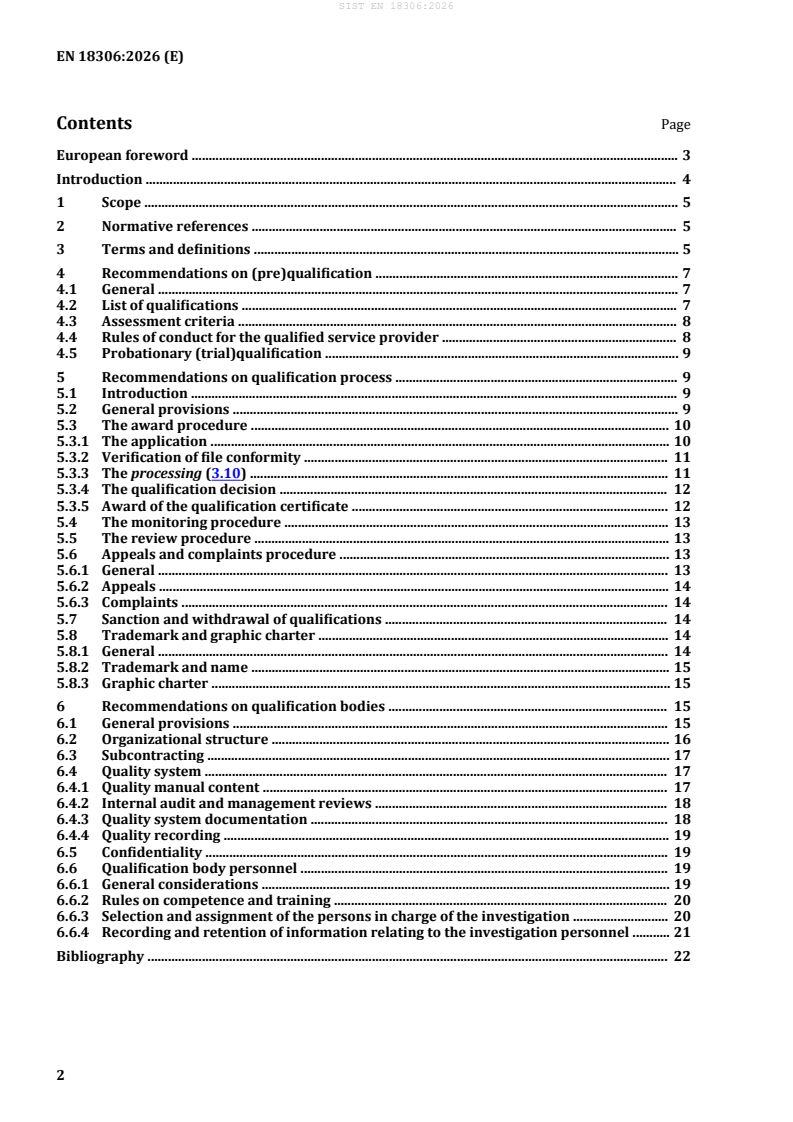
The document is organized into a short front matter and six main technical clauses, followed by a bibliography:
- Clause 1 - Scope
- Clause 2 - Normative references
- Clause 3 - Terms and definitions
- Clause 4 - Recommendations on (pre)qualification
- Clause 5 - Recommendations on qualification process
- Clause 6 - Recommendations on qualification bodies
- Bibliography
What are the key requirements of SIST EN 18306:2026?
SIST EN 18306:2026 is a guidance document, so its main content is written as recommendations for how a qualification system should work. The practical message is that the organization running the system needs clear rules, documented processes, and impartial decision-making.
1. Define the qualification field and the list of qualifications
Clause 4.1 and 4.2 call for a qualification body to define the qualifications it issues and to publish a list that groups the field by professions, activities, techniques and missions. Each heading or sub-heading should be described in plain language and updated when the scope of services changes. In practice, this helps applicants understand exactly what they are being qualified for.
2. Use clear assessment criteria
Clause 4.3 says qualification should be assessed against the criteria in EN 17371-1:2021:
- Legal capacity
- Economic and financial capacity
- Human resources
- Materials, equipment and infrastructure
- Reference-related criteria
- Credential-related criteria
The clause also allows other criteria where relevant, such as sustainability, accessibility, information and physical security, data protection, and document and data retention. For a buyer or qualification body, this means the system can be tailored to the service field while still keeping a structured basis for assessment.
3. Set rules for qualified service providers
Clause 4.4 asks the qualification body to document the rules of conduct for qualified service providers. These rules cover continued compliance, truthful use of the qualification, subcontracting, notice to service buyers when subcontractors are used, and proper use of certificates, marks and references to qualification. This matters because the qualification is not just an entry check - the provider must keep meeting the rules while qualified.
4. Allow trial qualification where references are limited
Clause 4.5 describes probationary or trial qualification. It can be used when an applicant has no references yet, for example when starting an activity or extending into a new area, or when the references provided are not yet sufficient. The trial qualification is limited to selected criteria and should not normally last more than 2 years, with a possible extension of 1 year according to the body’s procedure. This gives a controlled way to qualify new providers without treating them exactly like fully established ones.
5. Run a structured qualification process
Clause 5.1 to 5.5 set out the process steps:
- application
- verification of file conformity
- processing
- qualification decision
- award of the qualification certificate
- monitoring
- review
The body should provide applicants with complete information, including the list of qualifications, the reference specifications, the procedures, and the appeal and complaint routes. The application must be complete, in the language of the qualification body, and supported by a commitment from the applicant. The practical effect is that the process is traceable from the first request to the final decision.
6. Make decisions through balanced and documented bodies
Clause 5.3.4 requires the qualification decision to be taken by a qualification authority whose members represent the interests concerned, including service providers, buyers and, if possible, institutional organizations. The decision is based on the processing report and any additional information. If the file is complete, the body has 6 months to decide. This is important because the standard tries to keep qualification decisions both technically grounded and balanced between stakeholder interests.
7. Monitor, review and enforce the qualification
Clause 5.4 requires annual monitoring of qualified parties for legal, administrative, judicial and financial criteria, as well as human resources. Clause 5.5 requires periodic review, with a frequency and content set by the body but not exceeding 4 years. Clauses 5.6 and 5.7 cover appeals, complaints, sanctions and withdrawal. In practice, the qualification must be maintained over time, not just awarded once.
8. Keep the qualification body independent and controlled
Clause 6 requires the qualification body to be impartial, independent, transparent and non-discriminatory. It should not provide services similar to those of applicants, and it should not act as an advisory or training body for applicants and qualified parties. It also needs a quality system, confidentiality controls, competence rules for personnel, and documented procedures for subcontracting, audits, records and complaints. This is the governance side of the standard: the body itself must be trustworthy enough for its certificates to carry weight.
What terms does SIST EN 18306:2026 define?
SIST EN 18306:2026 defines the key terms used to run the qualification system consistently.
- appeal - a challenge by an applicant against a qualification decision concerning that applicant.
- (pre)qualification certificate - the document that confirms a service provider meets the requirements in the list of qualifications and the qualification reference specifications.
- service buyer - the organization that runs a service procurement process and contracts with a service provider.
- applicant - a service provider requesting one or more (pre)qualifications, or a qualified party seeking renewal or extension.
- service provider - an organization that offers or supplies one or more services.
- (pre)qualification authority - the competent authority that grants, maintains, extends, reduces, suspends or withdraws a (pre)qualification.
- processing - the analysis of evidence showing whether the applicant’s activities meet the (pre)qualification specifications.
- (pre)qualification - recognition, based on defined criteria, that a service provider has the ability to provide the entrusted services.
Who uses SIST EN 18306:2026?
SIST EN 18306:2026 is used by organizations that maintain lists of qualified, prequalified or shortlisted service providers, especially in service procurement. It is also relevant to service buyers who rely on those lists when selecting providers for projects or contracts.
The document is useful for:
- qualification bodies and qualification authorities
- processors, investigators and experts involved in assessment
- appeal authorities and complaints handlers
- service providers seeking qualification or renewal
- buyers and third parties who need a fair and traceable qualification process
The standard is aimed at services for companies, which matches its ICS classification 03.080.20.
Which standards are used with SIST EN 18306:2026?
SIST EN 18306:2026 names one normative reference and one companion document in the bibliography.
- EN 17371-1:2021, Provision of services - Part 1: Service procurement - Guidance for the assessment of the capacity of service providers and evaluation of service proposals - this is the main reference for the assessment criteria used in Clause 4.3.
- EN ISO 9000, Quality management systems - Fundamentals and vocabulary (ISO 9000:2015) - this is cited in the qualification body section as background for quality management terminology and practice.
What does the SIST EN 18306:2026 document contain?
SIST EN 18306:2026 contains detailed guidance on the full life cycle of a service provider qualification system. The document covers list design, eligibility criteria, the application file, document checks, processing, decision-making, certificate issuance, monitoring, review, appeals, complaints, sanctions and withdrawal.
It also includes requirements for the qualification body’s structure, impartiality, subcontracting, quality manual, internal audits, records, confidentiality and personnel competence. The text is procedural rather than numerical, so it is mainly used to design a system, run assessments, and document decisions in a consistent way.
Get Certified
Connect with accredited certification bodies for this standard

Great Wall Tianjin Quality Assurance Center
Established 1993, first batch to receive national accreditation with IAF recognition.
Hong Kong Quality Assurance Agency (HKQAA)
Hong Kong's leading certification body.

Innovative Quality Certifications Pvt. Ltd. (IQCPL)
Known for integrity, providing ethical & impartial Assessment & Certification. CMMI Institute Partner.
Sponsored listings
Frequently Asked Questions
SIST EN 18306:2026 is a standard published by the Slovenian Institute for Standardization (SIST). Its full title is "Provision of services - Guidance for organizations which provide lists of prequalified, qualified or shortlisted service providers". This standard covers: This document provides guidance for setting up and operating a service providers prequalification, qualification, or shortlisting process. This document is applicable to: a) organizations which provide list of prequalified, qualified or shortlisted service providers; b) any interested parties who are directly or indirectly involved in or affected by a service providers prequalification, qualification, or shortlisting process. This document is not applicable to business-to-consumer (B2C) service contracts or for works contracts. NOTE 1 “Works contracts” are contracts that have as their object the execution, or both the design and execution, of a work and are not covered in this document. Contracts having as their object only the design of a work are covered. NOTE 2 “Work” means the outcome of building or civil engineering works taken as a whole which is sufficient in itself to fulfil an economic or technical function. This document is also not applicable for contracts covering employment arrangements (be they of formal or informal nature).
This document provides guidance for setting up and operating a service providers prequalification, qualification, or shortlisting process. This document is applicable to: a) organizations which provide list of prequalified, qualified or shortlisted service providers; b) any interested parties who are directly or indirectly involved in or affected by a service providers prequalification, qualification, or shortlisting process. This document is not applicable to business-to-consumer (B2C) service contracts or for works contracts. NOTE 1 “Works contracts” are contracts that have as their object the execution, or both the design and execution, of a work and are not covered in this document. Contracts having as their object only the design of a work are covered. NOTE 2 “Work” means the outcome of building or civil engineering works taken as a whole which is sufficient in itself to fulfil an economic or technical function. This document is also not applicable for contracts covering employment arrangements (be they of formal or informal nature).
SIST EN 18306:2026 is classified under the following ICS (International Classification for Standards) categories: 03.080.20 - Services for companies. The ICS classification helps identify the subject area and facilitates finding related standards.
SIST EN 18306:2026 is available in PDF format for immediate download after purchase. The document can be added to your cart and obtained through the secure checkout process. Digital delivery ensures instant access to the complete standard document.
Standards Content (Sample)
SLOVENSKI STANDARD
01-december-2026
Zagotavljanje storitev - Smernice za organizacije, ki zagotavljajo sezname
predhodno kvalificiranih, kvalificiranih ali izbranih ponudnikov storitev
Provision of services - Guidance for organizations which provide lists of prequalified,
qualified or shortlisted service providers
Erbringung von Dienstleistungen - Leitfaden für Organisationen, die Listen von
präqualifizierten, qualifizierten oder in die engere Wahl gezogenen Dienstleistern
bereitstellen
Prestation de services - Recommandations pour les organismes qui fournissent des
listes de prestataires préqualifiés, qualifiés ou présélectionnés
Ta slovenski standard je istoveten z: EN 18306:2026
ICS:
03.080.20 Storitve za podjetja Services for companies
2003-01.Slovenski inštitut za standardizacijo. Razmnoževanje celote ali delov tega standarda ni dovoljeno.
EN 18306
EUROPEAN STANDARD
NORME EUROPÉENNE
October 2026
EUROPÄISCHE NORM
ICS 03.080.20
English Version
Provision of services - Guidance for organizations which
provide lists of prequalified, qualified or shortlisted
service providers
Prestation de services - Recommandations pour les Erbringung von Dienstleistungen - Leitfaden für
organismes qui fournissent des listes de prestataires Organisationen, die Listen von präqualifizierten,
préqualifiés, qualifiés ou présélectionnés qualifizierten oder in die engere Wahl gezogenen
Dienstleistern bereitstellen
This European Standard was approved by CEN on 14 July 2026.
CEN members are bound to comply with the CEN/CENELEC Internal Regulations which stipulate the conditions for giving this
European Standard the status of a national standard without any alteration. Up-to-date lists and bibliographical references
concerning such national standards may be obtained on application to the CEN-CENELEC Management Centre or to any CEN
member.
This European Standard exists in three official versions (English, French, German). A version in any other language made by
translation under the responsibility of a CEN member into its own language and notified to the CEN-CENELEC Management
Centre has the same status as the official versions.
CEN members are the national standards bodies of Austria, Belgium, Bulgaria, Croatia, Cyprus, Czech Republic, Denmark, Estonia,
Finland, France, Germany, Greece, Hungary, Iceland, Ireland, Italy, Latvia, Lithuania, Luxembourg, Malta, Netherlands, Norway,
Poland, Portugal, Republic of North Macedonia, Romania, Serbia, Slovakia, Slovenia, Spain, Sweden, Switzerland, Türkiye and
United Kingdom.
EUROPEAN COMMITTEE FOR STANDARDIZATION
COMITÉ EUROPÉEN DE NORMALISATION
EUROPÄISCHES KOMITEE FÜR NORMUNG
CEN-CENELEC Management Centre: Rue de la Science 23, B-1040 Brussels
© 2026 CEN All rights of exploitation in any form and by any means reserved Ref. No. EN 18306:2026 E
worldwide for CEN national Members.
Contents Page
European foreword . 3
Introduction . 4
1 Scope . 5
2 Normative references . 5
3 Terms and definitions . 5
4 Recommendations on (pre)qualification . 7
4.1 General . 7
4.2 List of qualifications . 7
4.3 Assessment criteria . 8
4.4 Rules of conduct for the qualified service provider . 8
4.5 Probationary (trial)qualification . 9
5 Recommendations on qualification process . 9
5.1 Introduction . 9
5.2 General provisions . 9
5.3 The award procedure . 10
5.3.1 The application . 10
5.3.2 Verification of file conformity . 11
5.3.3 The processing (3.10) . 11
5.3.4 The qualification decision . 12
5.3.5 Award of the qualification certificate . 12
5.4 The monitoring procedure . 13
5.5 The review procedure . 13
5.6 Appeals and complaints procedure . 13
5.6.1 General . 13
5.6.2 Appeals . 14
5.6.3 Complaints . 14
5.7 Sanction and withdrawal of qualifications . 14
5.8 Trademark and graphic charter . 14
5.8.1 General . 14
5.8.2 Trademark and name . 15
5.8.3 Graphic charter . 15
6 Recommendations on qualification bodies . 15
6.1 General provisions . 15
6.2 Organizational structure . 16
6.3 Subcontracting . 17
6.4 Quality system . 17
6.4.1 Quality manual content . 17
6.4.2 Internal audit and management reviews . 18
6.4.3 Quality system documentation . 18
6.4.4 Quality recording . 19
6.5 Confidentiality . 19
6.6 Qualification body personnel . 19
6.6.1 General considerations . 19
6.6.2 Rules on competence and training . 20
6.6.3 Selection and assignment of the persons in charge of the investigation . 20
6.6.4 Recording and retention of information relating to the investigation personnel . 21
Bibliography . 22
European foreword
This document (EN 18306:2026) has been prepared by Technical Committee CEN/TC 447 "Horizontal
standards for the provision of services", the secretariat of which is held by BSI.
This European Standard shall be given the status of a national standard, either by publication of an
identical text or by endorsement, at the latest by April 2027, and conflicting national standards shall be
withdrawn at the latest by April 2027.
Attention is drawn to the possibility that some of the elements of this document may be the subject of
patent rights. CEN shall not be held responsible for identifying any or all such patent rights.
Any feedback and questions on this document should be directed to the users’ national standards body.
A complete listing of these bodies can be found on the CEN website.
According to the CEN-CENELEC Internal Regulations, the national standards organisations of the
following countries are bound to implement this European Standard: Austria, Belgium, Bulgaria, Croatia,
Cyprus, Czech Republic, Denmark, Estonia, Finland, France, Germany, Greece, Hungary, Iceland, Ireland,
Italy, Latvia, Lithuania, Luxembourg, Malta, Netherlands, Norway, Poland, Portugal, Republic of North
Macedonia, Romania, Serbia, Slovakia, Slovenia, Spain, Sweden, Switzerland, Tu�rkiyé and the United
Kingdom.
Introduction
Pré-qualification or qualification systems exist to help buyers select service providers capable of
meeting their needs and carrying out their projects.
These systems can be established and managed internally by buyers, but buyers can also use systems
for pre qualifying or qualifying service providers that are established and managed by third parties.
The purpose of this document is to provide recommendations to harmonize:
— the service providers pré-qualification or qualification process
— the operation of organizations that provide lists of pré-qualifiéd or qualifiéd service providers.
It complements the recommendations of EN 17371-1:2021 [1].
1 Scope
This document provides guidance for setting up and operating a service providers pré-qualification,
qualification, or shortlisting process.
This document is applicable to:
a) organizations which provide list of pré-qualifiéd, qualifiéd or shortlisted service providers;
b) any interested parties who are directly or indirectly involved in or affected by a service providers
pré-qualification, qualification, or shortlisting process.
This document is not applicable to business-to-consumer (B2C) service contracts or works contracts.
NOTE 1 “Works contracts” are contracts that have as their object the execution, or both the design and
execution, of a work and are not covered in this document. Contracts having as their object only the design of a
work are covered.
NOTE 2 “Work” means the outcome of building or civil engineering works taken as a whole which is sufficiént
in itself to fulfil an economic or technical function.
This document is also not applicable for contracts covering employment arrangements (whether formal
or informal in nature).
2 Normative references
There are no normative references in this document.
3 Terms and definitions
For the purposes of this document, the following terms and définitions apply.
ISO and IEC maintain terminology databases for use in standardization at the following addresses:
• ISO Online browsing platform: available at http://www.iso.org/obp
• IEC Electropedia: available at http://www.electropedia.org/
3.1
appeal
contestation on behalf of the applicant against a qualification decision concerning it
3.2
(pre)qualification certificate
document attesting that a service provider meets all the requirements définéd in the list of qualifications
and in the qualification reference spécifications
Note 1 to entry: In the document, the term (pré)qualification has been simplifiéd to qualification.
3.3
service buyer
organization that implements a service procurement process and contracts with a service provider
Note 1 to entry: In public procurement, the service buyer may also be known as the contracting authority/
entityEN 17371-1:2021 [1]
3.4
code of ethics
document specifying the rules of conduct and the values which its personnel undertake to abide by
3.5
applicant
service provider requesting one or more (pré)qualifications, or (pré)qualifiéd party which wishes to
renew its (pré)qualification or to extend it to new sectors
3.6
service provider
organization that offers or supplies one or more services
3.7
appeal authority
competent authority for handling appeals and complaints
3.8
(pre)qualification authority
competent authority for granting, maintaining, extending, reducing, suspending or withdrawing a
(pré)qualification
Note 1 to entry: In the document, the term (pré)qualification has been simplifiéd to qualification.
3.9
processor
person who evaluates the applicants' dossiers with regard to the (pré)qualification granting criteria; in
this capacity, he/she is led to be in contact with the applicant
3.10
processing
analysis of the proof that the applicant's activities meet the requirements of the (pré)qualification
spécifications in view of submitting it to the decision-making authority
3.11
list of qualifications
technical document which segments and lists under headings, even sub-headings, the (pré)qualification
fiéld on the basis of the nature of the professions, activities, techniques, missions, taking into account
the level of their technicity or complexity
3.12
service provider (pre) qualification body qualification body (shorten)
body which, whatever its status, conducts the (pré)qualification of service providers according to the
conditions and criteria of a (pré)qualification system
3.13
service provider (pre)qualification body personnel
personnel of organization providing pré-qualification services or internal to an organization pre-
qualifying service providers, the employees, the persons appointed to intervene within the organization
Note 1 to entry: In the document, the term (pré)qualification has been simplifiéd to qualification.
3.14
(pre)qualification process
activities on completion of which the service provider (pré)qualification body attests that a service
provider meets the spécifiéd requirements, including the candidature, the processing, the
(pré)qualification decision, the follow-up
Note 1 to entry: In the document, the term (pré)qualification has been simplifiéd to qualification
3.15
qualifier
person, organization providing (pré)qualification services or internal to an organization (pre)qualifying
service providers taking part in the decision-making process or an appeal process
3.16
(pre)qualification
recognition of the ability of a service provider, on the basis of définéd criteria, to demonstrate its capacity
to provide the services that are entrusted to it
Note 1 to entry: In the document, the term (pré)qualification has been simplifiéd to qualification.
Note 2 to entry: (Pré)qualification and qualification can be used interchangeably depending on the context of
usage in countries.
3.17
(pre)qualified service provider
service provider who holds one or more (pré)qualifications
Note 1 to entry: In the document, the term (pré)qualification has been simplifiéd to qualification.
3.18
complaint
contestation filéd by a service buyer or a third party with regard to a (pré)qualifiéd service provider
3.19
(pre)qualification reference specifications
document drawn up by the service provider (pré)qualification body describing all of the criteria and
requirements applicable to the applicant.
Note 1 to entry: In the document, the term (pré)qualification has been simplifiéd to qualification.
3.20
rules of the conduct of the (pre)qualified service provider
document drawn up by the service provider (pré)qualification body specifying the obligations which
commit the (pré)qualifiéd service provider with regard to its buyers and with regard to the service
provider (pré)qualification body
Note 1 to entry: In the document, the term (pré)qualification has been simplifiéd to qualification.
3.21
(pre)qualification system
collection of procedures, reference systems and means intended to implement the (pré)qualification
process according to a pre-established criterion resulting in the issue of one or more (pré)qualifications,
including the follow-up
Note 1 to entry: In the document, the term (pré)qualification has been simplifiéd to qualification.
4 Recommendations on (pre)qualification
4.1 General
The qualification body should draw up within its sector of activity a list of the (pré)qualifications it
issues and définé the requirements applicable to the applicant.
4.2 List of qualifications
The qualification body should draw up a list of the qualifications that segments and lists under headings,
even sub-headings, its fiéld of qualification based on the nature of the professions, activities, techniques
and missions. It should take into account the level of their technicity or complexity (skills, levels etc.)
Each heading, or sub-heading of the list comprises a text in plain language and is accompanied by a
detailed description of its contents. The list should be periodically updated in order to take into account
changes in the professions, technical activities, scope of services.
Each heading or sub-heading can result in separate qualifications.
Certain qualifications can concern several sub-headings.
4.3 Assessment criteria
The qualification should be assessed at least according to the criteria définéd inEN 17371-1:2021 [1] :
a) Legal capacity criteria;
b) Economic and financial capacity criteria;
c) Human resources criteria;
d) Materials, equipment and infrastructure criteria;
e) Reference-related criteria;
f) Credential related criteria;
Depending on the fiéld of services other criteria can be définéd for example:
g) Sustainability criteria;
h) Accessibility criteria;
i) Criteria related to information and physical security, data protection and confidéntiality, document
and data retention.
4.4 Rules of conduct for the qualified service provider
The qualification body should establish and document the rules of conduct for the qualifiéd service
provider (3.6) to follow:
a) to comply at all times with the qualification criteria and requirements;
b) to only declare that it is qualifiéd only for those activities for which it has been qualifiéd;
c) when it uses subcontractors in the activity for which it has been qualifiéd,
1) to subcontract to either a qualifiéd service provider for the relevant activity or to a service
provider with appropriate competences and resources recognized by the qualifiéd service
provider;
2) to verify that the service provider to which it has subcontracted its activity is insured for the
services provided;
3) to inform the service buyers (3.3) of the use of subcontractors;
d) not to refer to its qualification in a manner which can damage the reputation of the qualification
body, and not to make any declaration concerning its qualification that can be considered abusive
and unauthorized by the qualification body;
e) to immediately cease, upon suspension or withdrawal of the qualification, all publicity referencing
it;
f) to ensure that documents, qualification marks and cértificatés are not used in any abusive or
fraudulent manner;
g) to comply with the requirements of the qualification body when it mentions its qualification in
communication means such as documents, brochures or advertisements.
4.5 Probationary (trial)qualification
A trial qualification can be issued when the applicant (3.5) does not yet have any references, in particular
for the creation or extension of activity.
The assignment of a trial qualification can be applied in cases where the references presented are
considered to be insufficiént.
This provision cannot apply once the applicant meets all the requirements and produces references
that are quantitatively and qualitatively sufficiént.
The trial qualification should be granted on condition that the applicant meets the following criteria:
a) Legal capacity criteria;
b) Human resources criteria;
c) Materials, equipment and infrastructure criteria.
The period during which a service provider (3.6) can conserve the trial qualification should not exceed
2 years.
NOTE This duration can be extended by an additional year according to the procedures définéd by the
qualification body.
If the references presented by the applicant (3.5) do not allow a trial qualification to be transformed
into a qualification, the qualification body may decide on a waiting period before a new trial qualification
may be assigned.
5 Recommendations on qualification process
5.1 Introduction
The qualification body should définé the qualification process.
This process should include at least the following steps:
a) application,
b) vérification of the conformity of the filé,
c) investigation,
d) qualification decision,
e) award of the qualification cértificaté,
f) monitoring and review of the qualification.
5.2 General provisions
The qualification body should définé and communicate the procedures for the award, maintenance,
extension and reduction of the qualification, as well as the conditions governing the partial or total
suspension or withdrawal of the qualification(s).
In particular, the qualification body should require the applicant (3.5) or qualifiéd provider to notify it
of any significant change affecting in whole or in part its compliance with the qualification criteria.
NOTE A significant change can be, for example, a change of owners or managers, changes in key personnel
(executive leadership team) , equipment, etc.
The qualification body should require the applicant (3.5) or qualifiéd provider to provide evidence
corresponding to the fulfilmént and maintenance of the qualification criteria.
The qualification body should have procedures to :
a) award, maintain, suspend or withdraw the qualification(s);éxténd or reduce the scope of the
qualification(s);
b) conduct a reassessment if changes significantly affect the activity and operation of the qualifiéd
provider or if the analysis of a complaint or of any other information indicates that the qualifiéd
provider no longer meets the requirements of the qualification body.
The qualification body should have and make permanently available documents describing :
c) the requirements applicable to the applicant (3.5) described in qualification reference
spécifications;
d) the procedures for awarding and monitoring the qualification on a periodic and continual basis, to
ensure continued compliance with the applicable requirements;
e) the conditions under which the applicant (3.5) can refer to its qualification and the procedures
applicable in the event of incorrect or improper use of the information relating to the qualification.
5.3 The award procedure
5.3.1 The application
5.3.1.1 Information for applicants
To ensure that the applicant (3.5) has access to complete information, the qualification body should
make permanently available to them any document providing a precise description of its system.
This description should include at least the following elements:
a) the professional fiéld covered by the qualification body;
b) the list of qualifications (3.11);
c) the complementary information system, if applicable, established by means of classification;
d) the qualification criteria and requirements;
e) the body’s commitment to confidéntiality with respect to the information provided by the applicant
(3.5);
f) the cost of qualification, if applicable.
5.3.1.2 Submission of the application
The qualification body should send the applicant (3.5) the qualification filé(s) accompanied by the list
of qualifications (3.11) and the qualification reference spécifications défining the requirements
applicable to them. It should also provide all elements necessary to understand the procedures for the
investigation (such as steps, financial conditions, investigation periods, etc.), award, monitoring and
review, as well as the procedures for appeals, complaints and any sanctions.
The applicant (3.5) should submit the completed qualification request filé accompanied by a letter of
commitment, dated and signed by its legal or mandated representative, recognizing that it:
a) has received and examined all the documents necessary for its qualification or review request;
b) undertakes to comply with the administrative and financial conditions of the qualification body;
c) undertakes to comply with and ensure compliance by its stakeholders, partners and its personnel
with, the rules of conduct for the qualifiéd service provider (3.6) définéd in 4.4;
d) undertakes to inform the qualification body of any modification liable to affect the qualification(s)
obtained;
e) authorizes the publication of information concerning itself in accordance with the rules spécifiéd
by the qualification body;
f) attests to the accuracy of the information provided and the authenticity of the documents produced;
g) undertakes, once qualifiéd, to comply with the provisions concerning use of the trademark and the
graphic charter définéd by the qualification body in accordance with 5.7, if applicable.
The request and the application should be written in the language of the country of the qualification
body.
The qualification body should acknowledge receipt of the application by return and record it.
5.3.2 Verification of file conformity
The qualification body should examine the application in order to verify the conformity of the
information and documents with respect to the list of qualifications (3.11) and the qualification reference
spécifications, in particular that:
a) the application filé is complete;
b) the language of the application is that of the qualification body;
c) the applicant (3.5)’s area of activity is in accordance with the list of qualifications (3.11);
d) the response to the requirements of the list of qualifications (3.11) and the qualification reference
spécifications is precise and documented.
If the filé is incomplete, the qualification body should inform the applicant (3.5) within a period not
exceeding three months and request the necessary supplements.
5.3.3 The processing (3.10)
The purpose of the processing (3.10) is to assess the applicant (3.5)’s professionalism and competence
in the area(s) of activity that is (are) the subject of the requested qualification(s), in relation to the list
of qualifications (3.11) and qualification reference spécifications.
For each area of activity, the qualification body appoints a processor (3.9) to assess the suitability of the
elements collected from the applicant (3.5).
If necessary, the qualification body can call upon an expert to obtain a technical opinion. The conditions
for the expert’s intervention should be définéd by the qualification body in compliance with the rules
on subcontracting.
The processing (3.10) is based on a document review. The qualification body can supplement this
documentation review with other measures, including: an interview with the applicant (3.5), a customer
satisfaction survey, on-site controls, expert appraisals, audits, etc.
The qualification body should draw up a dated processing (3.10) report which should be submitted to
the qualification authority. This report should specify the name(s) of the processor (3.9)(s), and any
experts, thei
...