

SIST EN 18144:2026
(Main)Online Gambling - Markers of harm in support of identification and prevention of risky and problem gambling behaviour
General Information
- Abstract
This document defines markers of harm in online gambling. It is a minimum set of markers to analyse. The individual indicators can be analysed over additional time spans as well as in excess of those re-quired, and other markers can be added to the analysis as well.
In the event that the collection or analysis of data for a limited set of markers is prohibited within a spe-cific jurisdiction (for example, where legislation prevents it), operators can still be compliant with the standard provided that only these markers are omitted, and only for players who fall under that specific jurisdiction.
This document does not provide guidelines regarding the interventions to be employed when addressing individuals with gambling issues, nor does it establish predefined thresholds for intervention.
- Status
- Published
- Public Enquiry End Date
- 18-Feb-2025
- Publication Date
- 08-Dec-2025
- Technical Committee
- I13 - Imaginarni 13
- Current Stage
- 6060 - National Implementation/Publication (Adopted Project)
- Start Date
- 04-Dec-2025
- Due Date
- 08-Feb-2026
- Completion Date
- 09-Dec-2025

Overview
EN 18144:2025 (CEN) - "Online gambling - Markers of harm in support of identification and prevention of risky and problem gambling behaviour" defines a minimum, evidence-informed set of markers of harm for online gambling. The standard specifies which behavioural indicators operators should analyse (and how to characterise them) to support safer gambling and consumer protection. It is a framework for behavioural analytics; it does not prescribe interventions, trigger thresholds, or clinical definitions of addiction.
Key Topics
- Markers defined (minimum set):
- Volume of stakes (amounts wagered/turnover)
- Speed of play (time between wagers)
- Depositing behaviour (frequency, source of funds)
- Cancelled withdrawals
- Player-initiated contact (support or complaints)
- Gambling time (session/duration metrics)
- Gambling products (product mix and risk features)
- Responsible gambling tools (use or changes to limits, self-exclusion)
- Losses (net loss metrics)
- Characterisation: For each marker the standard describes recommended time spans and measurements to enable consistent analysis (e.g., short vs. long-term windows).
- Flexibility: Markers can be analysed over additional time spans or augmented with further indicators. If local law prohibits collecting specific markers, operators may omit only those markers for affected players and still be compliant.
- Evidence base: Annex A provides a literature overview supporting marker selection and relationships between markers.
Applications
- For online gambling operators: integrate EN 18144 into in‑house behavioural analytics or when contracting external analytics suppliers to identify risky patterns and support safer‑gambling strategies.
- For analytics vendors and software developers: use the standard as a specification to design data models, metrics, dashboards, and alerts aligned with accepted markers of harm.
- For regulators and compliance teams: adopt the standard as a voluntary benchmark for reporting expectations, audits, or supervisory guidance while respecting national regulation.
- For researchers and public‑health stakeholders: use the documented markers and Annex A literature as a basis for studies on harm prevalence and intervention impact.
Related standards and context
- Produced by CEN/TC 456, EN 18144 complements national online‑gambling regulations and reporting requirements. It is intended as a voluntary technical framework to harmonise behavioural analytics, responsible gambling measures, and cross‑jurisdictional reporting while leaving clinical assessment and intervention design to healthcare and regulatory policy.
Get Certified
Connect with accredited certification bodies for this standard

BSI Group
BSI (British Standards Institution) is the business standards company that helps organizations make excellence a habit.

NYCE
Mexican standards and certification body.
Sponsored listings
Frequently Asked Questions
SIST EN 18144:2026 is a standard published by the Slovenian Institute for Standardization (SIST). Its full title is "Online Gambling - Markers of harm in support of identification and prevention of risky and problem gambling behaviour". This standard covers: This document defines markers of harm in online gambling. It is a minimum set of markers to analyse. The individual indicators can be analysed over additional time spans as well as in excess of those re-quired, and other markers can be added to the analysis as well. In the event that the collection or analysis of data for a limited set of markers is prohibited within a spe-cific jurisdiction (for example, where legislation prevents it), operators can still be compliant with the standard provided that only these markers are omitted, and only for players who fall under that specific jurisdiction. This document does not provide guidelines regarding the interventions to be employed when addressing individuals with gambling issues, nor does it establish predefined thresholds for intervention.
This document defines markers of harm in online gambling. It is a minimum set of markers to analyse. The individual indicators can be analysed over additional time spans as well as in excess of those re-quired, and other markers can be added to the analysis as well. In the event that the collection or analysis of data for a limited set of markers is prohibited within a spe-cific jurisdiction (for example, where legislation prevents it), operators can still be compliant with the standard provided that only these markers are omitted, and only for players who fall under that specific jurisdiction. This document does not provide guidelines regarding the interventions to be employed when addressing individuals with gambling issues, nor does it establish predefined thresholds for intervention.
SIST EN 18144:2026 is classified under the following ICS (International Classification for Standards) categories: 35.240.95 - Internet applications; 97.200.99 - Other equipment for entertainment. The ICS classification helps identify the subject area and facilitates finding related standards.
SIST EN 18144:2026 is available in PDF format for immediate download after purchase. The document can be added to your cart and obtained through the secure checkout process. Digital delivery ensures instant access to the complete standard document.
Standards Content (Sample)
SLOVENSKI STANDARD
01-januar-2026
Spletne igre na srečo - Kazalniki škode v podporo prepoznavanju in preprečevanju
tveganega ter problematičnega vedenja pri igrah na srečo
Online Gambling - Markers of harm in support of identification and prevention of risky
and problem gambling behaviour
Online-Glücksspiel - Risikoindikatoren zur Unterstützung bei der Erkennung und
Prävention von riskantem und problematischem Glücksspielverhalten
Jeux d'argent et de hasard en ligne - Indicateurs de dommage à l'appui de l'identification
et de la prévention des comportements dangereux et problématiques de jeu
Ta slovenski standard je istoveten z: EN 18144:2025
ICS:
35.240.95 Spletne uporabniške rešitve Internet applications
97.200.99 Druga oprema za razvedrilo Other equipment for
entertainment
2003-01.Slovenski inštitut za standardizacijo. Razmnoževanje celote ali delov tega standarda ni dovoljeno.
EN 18144
EUROPEAN STANDARD
NORME EUROPÉENNE
November 2025
EUROPÄISCHE NORM
ICS 97.200.99; 35.240.95
English Version
Online gambling - Markers of harm in support of
identification and prevention of risky and problem
gambling behaviour
Jeux d'argent et de hasard en ligne - Indicateurs de Online-Glücksspiel - Risikoindikatoren zur
dommage à l'appui de l'identification et de la Unterstützung bei der Erkennung und Prävention von
prévention des comportements dangereux et riskantem und problematischem Glücksspielverhalten
problématiques de jeu
This European Standard was approved by CEN on 26 October 2025.
CEN members are bound to comply with the CEN/CENELEC Internal Regulations which stipulate the conditions for giving this
European Standard the status of a national standard without any alteration. Up-to-date lists and bibliographical references
concerning such national standards may be obtained on application to the CEN-CENELEC Management Centre or to any CEN
member.
This European Standard exists in three official versions (English, French, German). A version in any other language made by
translation under the responsibility of a CEN member into its own language and notified to the CEN-CENELEC Management
Centre has the same status as the official versions.
CEN members are the national standards bodies of Austria, Belgium, Bulgaria, Croatia, Cyprus, Czech Republic, Denmark, Estonia,
Finland, France, Germany, Greece, Hungary, Iceland, Ireland, Italy, Latvia, Lithuania, Luxembourg, Malta, Netherlands, Norway,
Poland, Portugal, Republic of North Macedonia, Romania, Serbia, Slovakia, Slovenia, Spain, Sweden, Switzerland, Türkiye and
United Kingdom.
EUROPEAN COMMITTEE FOR STANDARDIZATION
COMITÉ EUROPÉEN DE NORMALISATION
EUROPÄISCHES KOMITEE FÜR NORMUNG
CEN-CENELEC Management Centre: Rue de la Science 23, B-1040 Brussels
© 2025 CEN All rights of exploitation in any form and by any means reserved Ref. No. EN 18144:2025 E
worldwide for CEN national Members.
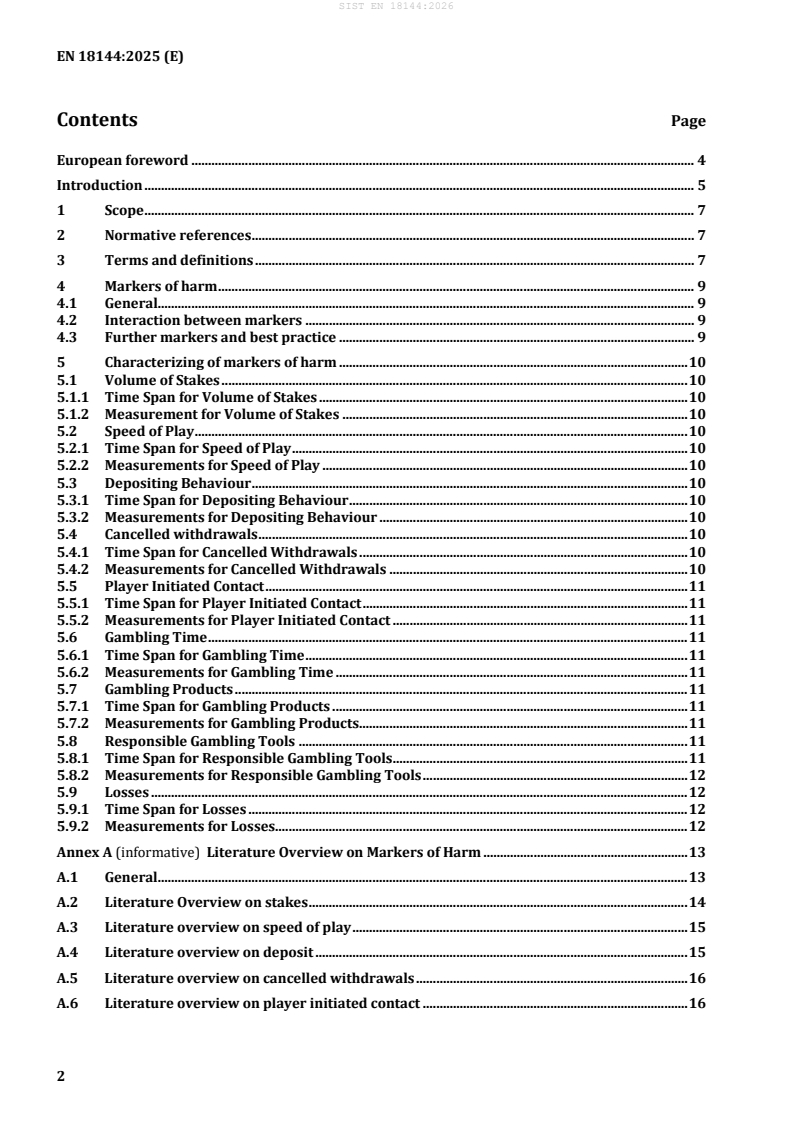
Contents Page
European foreword . 4
Introduction . 5
1 Scope . 7
2 Normative references . 7
3 Terms and definitions . 7
4 Markers of harm . 9
4.1 General. 9
4.2 Interaction between markers . 9
4.3 Further markers and best practice . 9
5 Characterizing of markers of harm . 10
5.1 Volume of Stakes . 10
5.1.1 Time Span for Volume of Stakes . 10
5.1.2 Measurement for Volume of Stakes . 10
5.2 Speed of Play . 10
5.2.1 Time Span for Speed of Play . 10
5.2.2 Measurements for Speed of Play . 10
5.3 Depositing Behaviour . 10
5.3.1 Time Span for Depositing Behaviour . 10
5.3.2 Measurements for Depositing Behaviour . 10
5.4 Cancelled withdrawals . 10
5.4.1 Time Span for Cancelled Withdrawals . 10
5.4.2 Measurements for Cancelled Withdrawals . 10
5.5 Player Initiated Contact . 11
5.5.1 Time Span for Player Initiated Contact . 11
5.5.2 Measurements for Player Initiated Contact . 11
5.6 Gambling Time . 11
5.6.1 Time Span for Gambling Time . 11
5.6.2 Measurements for Gambling Time . 11
5.7 Gambling Products . 11
5.7.1 Time Span for Gambling Products . 11
5.7.2 Measurements for Gambling Products. 11
5.8 Responsible Gambling Tools . 11
5.8.1 Time Span for Responsible Gambling Tools. 11
5.8.2 Measurements for Responsible Gambling Tools . 12
5.9 Losses . 12
5.9.1 Time Span for Losses . 12
5.9.2 Measurements for Losses. 12
Annex A (informative) Literature Overview on Markers of Harm . 13
A.1 General. 13
A.2 Literature Overview on stakes . 14
A.3 Literature overview on speed of play . 15
A.4 Literature overview on deposit . 15
A.5 Literature overview on cancelled withdrawals . 16
A.6 Literature overview on player initiated contact . 16
A.7 Literature overview on time . 16
A.8 Literature overview on gambling products . 16
A.9 Literature overview on changing responsible gambling tools . 17
A.10 Literature overview on losses . 18
Bibliography . 19
European foreword
This document (EN 18144:2025) has been prepared by Technical Committee CEN/TC 456 “Reporting in
support of online gambling supervision”, the secretariat of which is held by AFNOR.
This European Standard shall be given the status of a national standard, either by publication of an iden-
tical text or by endorsement, at the latest by May 2026, and conflicting national standards shall be with-
drawn at the latest by May 2026.
Attention is drawn to the possibility that some of the elements of this document may be the subject of
patent rights. CEN shall not be held responsible for identifying any or all such patent rights.
Any feedback and questions on this document should be directed to the users’ national standards body.
A complete listing of these bodies can be found on the CEN website.
According to the CEN-CENELEC Internal Regulations, the national standards organisations of the follow-
ing countries are bound to implement this European Standard: Austria, Belgium, Bulgaria, Croatia, Cy-
prus, Czech Republic, Denmark, Estonia, Finland, France, Germany, Greece, Hungary, Iceland, Ireland, It-
aly, Latvia, Lithuania, Luxembourg, Malta, Netherlands, Norway, Poland, Portugal, Republic of North Mac-
edonia, Romania, Serbia, Slovakia, Slovenia, Spain, Sweden, Switzerland, Türkiye and the United King-
dom.
Introduction
This document outlines the essential set of markers of harm that are considered by online gambling op-
erators for detecting players with problematic gambling behaviour for the purpose of promoting safer
gambling. This document seeks to enhance consumer protection. The term “markers of harm” in this doc-
ument refer to individual behavioural variables that can help identify and assess the risk of gambling-
related harm. These markers can be used to analyse and to understand the patterns and behaviours of
individuals engaged in online gambling and to develop strategies for minimizing harm. Several studies
have explored different markers of harm and their relationship to each other, as well as their potential
for harm reduction in online gambling. A list of these studies can be found in Annex A.
Online gambling operators are afforded the opportunity to incorporate this document into their individ-
ual behavioural analytics systems. Consequently, it serves as a foundational framework applicable both
to in-house technological solution development by operators and when they opt to engage external ser-
vice providers for analytical purposes. This document refrains from dictating specific trigger points,
thresholds, or the intervention mechanisms that online gambling operators can employ when engaging
with players identified as being at risk. Adherence to this document does not in itself ensure a good re-
sponsible gambling policy. Furthermore, the introduction of such a standard makes it possible for gam-
bling regulatory authorities to make demands about following the standard or parts hereof.
The proposal for a standard on markers of harm does not aim to function as a medical evaluation of gam-
bling addiction, nor does it seek to establish a new behavioural model for defining harm. Then, this doc-
ument is not intended to replace or contradict the public health perspective on gambling-related harms
which define markers of harm in a holistic, multidimensional approach as “the adverse impacts from
gambling on the health and wellbeing of individuals, families, communities and society” (Wardle et al.
2018). These harms affect resources, relationships and health. The impact from them may be short-lived
but can be durable, having enduring consequences and exacerbating existing inequalities. The impact of
these harms can be felt by individuals, families and communities. The markers of harm in this document
exclusively concern objective measures drawn from customer tracking to capture individual’s behav-
ioural signs which could be indicative of risky patterns.
Moreover, it is recalled that scientific research highlights that certain social categories are more at risk
than other of developing excessive or pathological gambling. Furthermore, scientific research provides
solid evidence that specific categories, subcategories and features of gambling products exhibits stronger
associations with behavioural markers of harm than others (Håkansson & Widinghoff 2020; Delfabbro et
al 2023).
It signifies a commitment on the part of users of the standard to consider and actively examine all perti-
nent parameters and markers. This ensures that they cannot assert a lack of analysis of the data or a
failure to identify and respond to potential issues. Moreover, it serves as an intrinsic objective for opera-
tors to engage with this document, integrating the latest knowledge and insights into their practices. This
proactive engagement is crucial, particularly as the standard undergoes periodic evaluation, with poten-
tial updates contemplated as part of the routine standard review process.
This document can support CEN Member jurisdictions where duty of care rules are few or do not yet
exist. Indeed, among the CEN Member countries there are jurisdictions with very different gambling reg-
ulatory frameworks, some of which have very strict duty of care rules.
Then, given the divergent regulation of all forms of gambling, it is the responsibility of the operators and
suppliers to ensure compliance with the requirements of each Member State.
This document will provide a voluntary tool to the gambling regulatory authorities in the Member States,
without prejudice to the competence of Member States in the regulation of online gambling. It does not
impose any obligation on them to introduce or alter requirements related to the markers of harm that
are considered by online gambling operators for detecting players with problematic gambling behaviour
for the purpose of promoting safer gambling or to authorise or deny authorisation to any operators or
suppliers for example where the national gambling legislation imposes other rules. Member States re-
main competent to define which games reporting should take place.
1 Scope
This document defines markers of harm in online gambling. It is a minimum set of markers to analyse.
The individual indicators can be analysed over additional time spans as well as in excess of those re-
quired, and other markers can be added to the analysis as well.
In the event that the collection or analysis of data for a limited set of markers is prohibited within a spe-
cific jurisdiction (for example, where legislation prevents it), operators can still be compliant with the
standard provided that only these markers are omitted, and only for players who fall under that specific
jurisdiction.
This document does not provide guidelines regarding the interventions to be employed when addressing
individuals with gambling issues, nor does it establish predefined thresholds for intervention.
2 Normative references
There are no normative references in this document.
3 Terms and definitions
For the purposes of this document, the following terms and definitions apply.
ISO and IEC maintain terminology databases for use in standardization at the following addresses:
— ISO Online browsing platform: available at https://www.iso.org/obp/
— IEC Electropedia: available at https://www.electropedia.org/
3.1
stakes
financial value, that a player voluntarily places at risk during their gambling activities
Note 1 to entry: The magnitude should be the potential gains or losses that a player can encounter, contingent upon
the outcomes of their respective bets or wagers.
Note 2 to entry: It should be noted that the language used to describe stakes may vary contingent upon the specific
gambling product under consideration. For instance, amount wagered, price of the ticket bet amount, or the turno-
ver when seen from the perspective of the operator.
Note 3 to entry: Financial value either from their own money or money obtained through the gambling operator
such as bonus.
3.2
speed of play
time elapsed between placing wagers
Note 1 to entry: This exhibits significant variation based on the nature of the online gambling activity in question.
For instance, rapid games like slot machines exhibit a swift tempo, while slower-paced activities such as poker ex-
hibit more extended intervals between wagers and outcomes.
3.3
deposit
transfer of funds to an online gambling account
Note 1 to entry: The primary objective of this is to allocate the funds for the purpose of engaging in betting, wager-
ing, or partaking in diverse gambling activities provided by the online gambling operator.
Note 2 to entry: A successful deposit is a deposit which has reached the online gambling account. A declined de-
posit is a deposit which has not reached the online gambling account.
3.4
cancelled withdrawal
request made by the player to transfer funds out of the gambling account which is then cancelled before
it takes effect
3.5
player initiated contact
communication with the operator started by the user, participant, wagerer or customer
Note 1 to entry: This can include inquiries about player account management, game rules, payment concerns, or
responsible gambling support. It involves communication via communication channels such as live chat, email, or
phone
3.6
gambling session
continuous time span during which betting occurs
Note 1 to entry: Its extent can be determined by two methods:
— The first method involves using time stamps of bets. In this approach, two bets are considered part of
the same session if at no time, between the two bets 5 minutes passes without a bet being placed. The extent is then
calculated from the time the first bet is placed to the time the last bet is placed.
— The second method utilizes time intervals. Under this method, two bets are considered part of the same
period if there are no consecutive time intervals of at least 5 minutes without a bet between the two-time intervals
of the bets. The extent is calculated from the start of the first-time interval containing bet(s) to the end of the last
time interval containing bet(s).
3.7
gambling products
online wagering activity
Note 1 to entry: Examples include casino games such as slots, roulettes, poker, sports betting platforms, online lot-
tery, scratch cards and more.
3.8
responsible gambling tool
RG tool
tool implemented by gambling operators to assist individuals in controlling their gambling behaviour and
mitigating the risks of developing harmful gambling habits
Note 1 to entry: Examples include deposit limits, time limits, self-exclusion options, reality checks, and access to
support and counselling services.
3.9
loss
financial cost incurred by the player as a result of participating in wagering activities
3.10
withdrawal
transfer of funds out of the gambling account
3.11
net deposit
total amount deposited by a player minus the total amount withdrawn
4 Markers of harm
4.1 General
In the context of these markers, both absolute values and deviations from a player's typical pattern over
a period shall be analysed. It should compare both to the population and to the player themself. Certain
levels for each marker in isolation can indicate potential issues. Certain levels of changes for each marker
can also indicate potential issues, as they can signify a loss of control. Additionally, such changes signify
a change in a pattern which could have already undergone investigation.
Any prescribed limit, whether established for an individual marker or combinations thereof, and whether
explicit or implicit methods have been used, will inevitably yield false positives. There are individuals
who possess significant financial resources and engage in high-stakes gambling, while others can experi-
ence substantial increases in income and subsequently augment their gambling expenditures, among
other scenarios. If some markers only give trivial information - whether this is due to regulation in a
certain jurisdiction or due to a choice of the operator (for instance not offering cancellation of withdraw-
als), there is no requirement to store and superficially analyse data that is known to be trivial. The pro-
posal for a standard on markers of harm cannot serve as a clinical assessment of gambling disorder.
4.2 Interaction between markers
Markers of harm shall be considered together rather than in isolation and any model should incorporate
the interactions between them. Any explicit method should be point-based or incorporate a similar ap-
proach. In the case of implicit methods, such as machine learning, it is essential to ensure that all the
different markers are accessible to the machine. This does not mean that it should be ensured that all
markers are used in the implicit weighing which the machine concludes is best from the given data. It is
acknowledged that implicit weighting of data will be contingent upon the patterns and relationships dis-
cerned within the data itself. Whether explicit or implicit methods are used, the obligation to incorporate
interactions does not rule out the possibility of additional individual triggers based on specific parame-
ters to detect at risk behaviour.
4.3 Further markers and best practice
This list of markers of harm is not comprehensive. Operators are strongly encouraged to explore and
...