

oSIST prEN IEC 63203-302-1:2026
(Main)IEC 63203-302-1: Wearable electronic devices and technologies - Part 302-1: Materials - Test method for torsion of conductive stretchable films
- Status
- Not Published
- Public Enquiry End Date
- 30-Nov-2026
- Technical Committee
- I09 - Imaginarni 09
- Current Stage
- 4020 - Public enquire (PE) (Adopted Project)
- Start Date
- 07-Oct-2026
- Due Date
- 24-Feb-2027
- Completion Date
- 26-Nov-2026

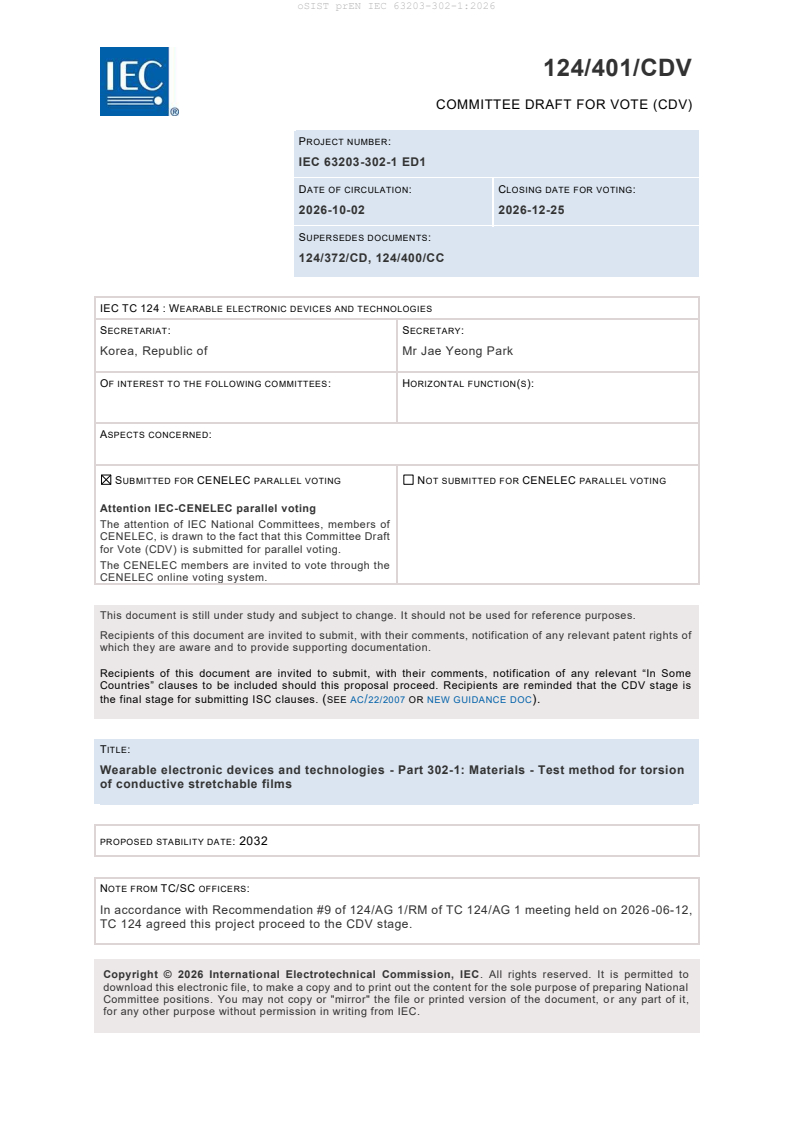
oSIST prEN IEC 63203-302-1:2026 is a Slovenian standard identical to prEN IEC 63203-302-1:2026 from the International Electrotechnical Commission (IEC). It specifies a torsion test method for conductive stretchable films used in wearable electronic devices, so users can measure how twisting changes electrical resistance and how the material behaves under use-like deformation.
The document is aimed at people who need repeatable test data for material screening, design guidance, or reliability evaluation of stretchable circuit materials.
What does oSIST prEN IEC 63203-302-1:2026 specify?
oSIST prEN IEC 63203-302-1:2026 specifies a test method for ribbon-shaped conductive stretchable films on stretchable substrates. The method is intended to determine changes in electrical properties and practical robustness during torsion, especially for wearable products worn on skin directly or attached to clothing.
The scope covers torsion conditions likely to occur around the arm, wrist, and neck. It explicitly frames the test as a practical use-oriented method rather than a direct material property rating for twisting durability.
The document is organized into:
- Scope
- Normative references
- Terms and definitions
- Standard atmospheric conditions for test
- Test conditions
- Single torsion test
- Cyclic torsion test
What are the key requirements of oSIST prEN IEC 63203-302-1:2026?
Test setup and specimen preparation
Clause 4 sets the standard atmospheric conditions for conditioning and measurement, using temperature, humidity, and pressure ranges aligned with IEC 62715-6-1. In practice, this matters because electrical resistance can shift with environment, so test results need consistent ambient conditions.
Clause 5.1 requires torsion test equipment that can apply and maintain the required twist angle, at least ±90°, and accept specimens from 80 mm to 240 mm long and up to 200 mm wide. The specimen must be electrically insulated from the machine frame so resistance can be measured in situ during motion.
Clause 5.2 calls for a rectangular or square strip specimen, with the conductive film on a stretchable substrate. The test length is the exposed length between the grips, not the clamped zones, and the length-to-width ratio is recommended to be greater than 1.
Clause 5.3 requires secure clamping without pre-stressing, wrinkling, slack, or slip. This is important because unwanted mechanical disturbance can hide the real torsion behavior or damage the specimen.
Torsion modes and electrical measurement
Clause 5.1.2 describes tension-released torsion, where the stationary side can move axially to avoid unwanted axial tension. Clause 5.1.3 describes tension-held torsion, where the stationary side is fixed so torsion is combined with axial tension. Together, these two modes let users compare twisting alone with twisting plus stretch.
Clause 5.4 requires resistance measurement in a region of nearly uniform strain, using 2-wire or 4-wire measurement as appropriate. A 4-wire method is required when contact and lead resistance would affect the result, and the clamp contact must not measurably influence the measured resistance.
The clause also gives a way to convert measured resistance to sheet resistance. In practice, this lets labs report results in a form that is easier to compare between specimens and designs.
Single torsion test
Clause 6 defines the single torsion test for measuring the range of resistance change during one torsion cycle. Recommended torsion angles are 15°, 30°, 45°, and 90°, with oscillation velocities of 10, 20, and 30 cycles per minute.
The procedure measures initial resistance, twists clockwise and counterclockwise, returns to the starting state, and records resistance in real time. At least 20 data points per cycle are required, so the resistance trace captures transient changes that a start-end measurement would miss.
Cyclic torsion test and reporting
Clause 7 defines the cyclic torsion test for repeated torsion over time. Recommended cycle counts include 1 000, 10 000, and 100 000 cycles, which helps users assess longer-term resistance drift under repeated twisting.
Both test reports require specimen identification, specimen count, atmospheric conditions, torsion type, torsion angle, oscillation velocity, recording interval, and unusual observations or deviations. This makes the results traceable and usable for comparison between laboratories or product designs.
What terms does oSIST prEN IEC 63203-302-1:2026 define?
- Torsion test - deformation that twists the film plane by rotating both ends in opposite directions.
- Conductive stretchable film - a stretchable substrate with a conductor layer formed on it.
- Stretchable substrate - a substrate or film that returns to its original size and shape after the extending force is removed.
- Tension-released torsion test - a torsion setup that allows axial movement so extra tension is released during twisting.
- Tension-held torsion test - a torsion setup with the stationary side fixed so torsion occurs together with axial tension.
Who uses oSIST prEN IEC 63203-302-1:2026?
oSIST prEN IEC 63203-302-1:2026 is used by laboratories, materials engineers, and product developers working on wearable electronic devices and smart textiles. It is relevant for test planning, specimen preparation, resistance measurement, and reliability comparison of conductive stretchable films used in circuit patterns.
It also supports quality and supplier evaluation when a buyer or manufacturer needs a common torsion test method for comparing candidate materials or checking production consistency.
Which standards are used with oSIST prEN IEC 63203-302-1:2026?
- IEC 63203-101-1:2021 - provides wearable-electronics terminology, including the definition used for stretchable substrate.
- IEC 62899-502-1:2017 - contributes torsion-test terminology and related mechanical stress test context.
- IEC 62715-6-1:2018 - provides the standard atmospheric conditions used for testing.
- IEC 62951-1:2017 - provides a comparable specimen shape referenced for the test specimen layout.
What does the oSIST prEN IEC 63203-302-1:2026 document contain?
The document contains two test procedures, one for single torsion and one for cyclic torsion, each with step-by-step execution and a required report content. It also includes equipment arrangements for tension-released and tension-held torsion, specimen shape guidance, clamping guidance, and a resistance measurement setup.
Figures show the torsion equipment, the two torsion modes, the specimen shape, the clamping process, and the resistance-measurement arrangement. Clause 5.4 also includes the equation used to relate measured resistance to sheet resistance.
For practical use, this gives labs a repeatable way to set up the specimen, run the twist motion, record resistance in real time, and document the test conditions needed for later comparison, design work, or reliability modelling.
Get Certified
Connect with accredited certification bodies for this standard

Control Union Certifications
Global certification for agriculture and sustainability.

Hohenstein Institut
Textile testing and certification.

Bureau Veritas Bangladesh
Bureau Veritas certification services in Bangladesh.
Sponsored listings
Frequently Asked Questions
oSIST prEN IEC 63203-302-1:2026 is a draft published by the Slovenian Institute for Standardization (SIST). Its full title is "IEC 63203-302-1: Wearable electronic devices and technologies - Part 302-1: Materials - Test method for torsion of conductive stretchable films". This standard covers: IEC 63203-302-1: Wearable electronic devices and technologies - Part 302-1: Materials - Test method for torsion of conductive stretchable films
IEC 63203-302-1: Wearable electronic devices and technologies - Part 302-1: Materials - Test method for torsion of conductive stretchable films
oSIST prEN IEC 63203-302-1:2026 is classified under the following ICS (International Classification for Standards) categories: 19.080 - Electrical and electronic testing; 59.080.80 - Smart textiles. The ICS classification helps identify the subject area and facilitates finding related standards.
oSIST prEN IEC 63203-302-1:2026 is available in PDF format for immediate download after purchase. The document can be added to your cart and obtained through the secure checkout process. Digital delivery ensures instant access to the complete standard document.
Standards Content (Sample)
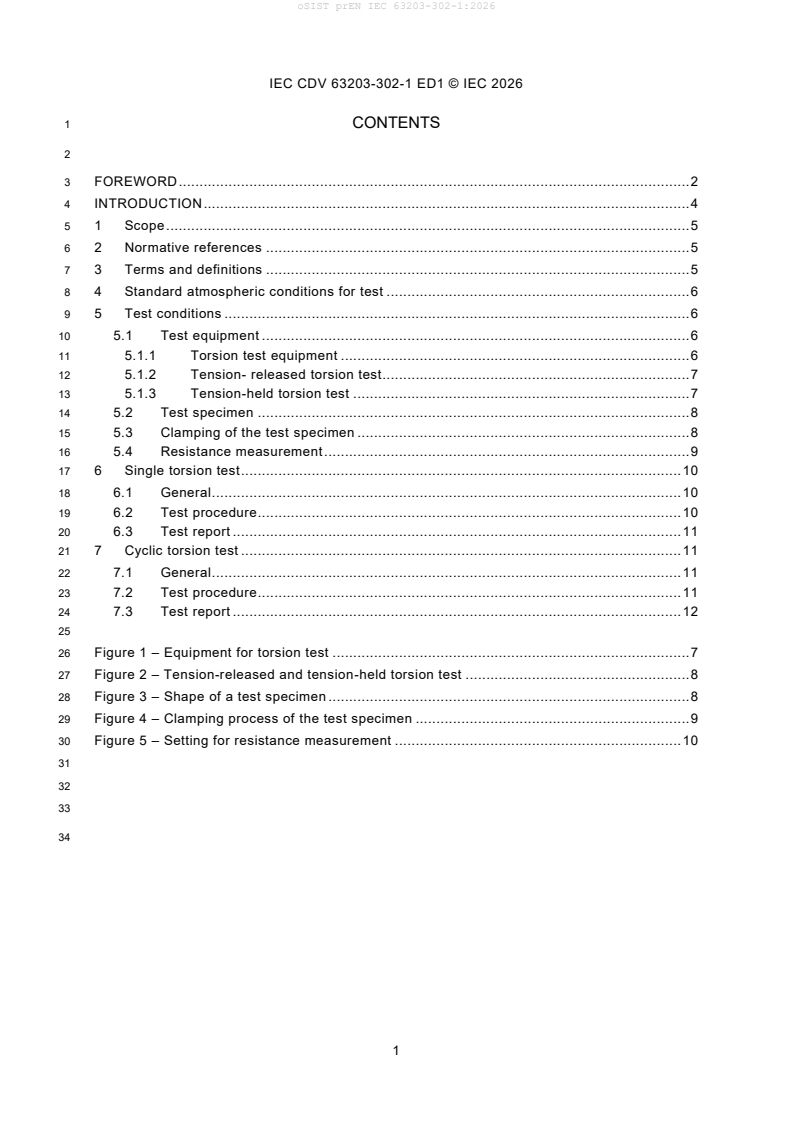
Contents
- 3 FOREWORD
- 4 INTRODUCTION
- 5 1 Scope
- 6 2 Normative references
- 7 3 Terms and definitions
- 8 4 Standard atmospheric conditions for test
- 9 5 Test conditions
- 10 5.1 Test equipment
- 11 5.1.1 Torsion test equipment
- 12 5.1.2 Tension- released torsion test
- 13 5.1.3 Tension-held torsion test
- 14 5.2 Test specimen
- 15 5.3 Clamping of the test specimen
- 16 5.4 Resistance measurement
- 17 6 Single torsion test
- 18 6.1 General
- 19 6.2 Test procedure
- 20 6.3 Test report
- 21 7 Cyclic torsion test
- 22 7.1 General
- 23 7.2 Test procedure
- 24 7.3 Test report
- 26 Figure 1 – Equipment for torsion test
- 27 Figure 2 – Tension-released and tension-held torsion test
- 28 Figure 3 – Shape of a test specimen
- 29 Figure 4 – Clamping process of the test specimen
- 30 Figure 5 – Setting for resistance measurement
100 INTRODUCTION 101 Wearable electronic devices bend naturally with the human body, but around wrists, elbows and 102 necks they twist, exposing conductive films to torsional shear that pure tensile tests cannot 103 replicate. Existing IEC 62899-202-4 rigorously measures changes in resistance under 104 incremental and cyclic stretch but its specimen geometry, loading mode and failure criteria are 105 limited to uniaxial tension and thus overlook the mixed-mode cracks, interfacial slip and local 106 buckling triggered by twist.
107 Finite-element studies show that the maximum shear strain in a twisted strip is proportional to 108 the twist angle, producing delamination at roughly half the tensile strain required in stretch tests, 109 while real-time resistance drifts reveal transient open circuits long before a two-point break 110 would be detected in tension. To fill this gap IEC 63203-302-1 introduces a dedicated torsion 111 method that grips a conductive stretchable film and rotates the ends through defined clockwise 112 and counter-clockwise angles, both with and without axial restraint, capturing the combined 113 pull-and-twist conditions seen during everyday wear.
114 Single-cycle measurements establish the immediate resistance excursion that limits signal 115 fidelity, whereas accelerated cyclic testing compresses months of arm-swing into hours to 116 predict service life. The protocol provides designers with critical torsional metrics needed to 117 properly size line widths, pitches, and encapsulation. Without these data manufacturers are 118 forced to overspecify conductors, sacrificing flexibility and comfort; with them they can certify 119 reliability confidently while maintaining the lightweight, skin-conformal form factors that define 120 next-generation wearables.
121 The value of this standard is that it provides baseline data on how the material layer withstands 122 the combined shear and tension that arise during twisting. For that reason, the test specimen 123 is designed as a wide rectangular conductive film. Using a broad film creates a continuous 124 gradient of shear, tensile and compressive stresses from the twist axis to the edges; this quickly 125 reveals intrinsic weak points such as delamination, cracking or resistance drift. The results can 126 therefore be used to material screening, design guidance and/or reliability modelling.
...