

prEN IEC 63203-302-1:2026
(Main)IEC 63203-302-1: Wearable electronic devices and technologies - Part 302-1: Materials - Test method for torsion of conductive stretchable films
- Status
- Not Published
- Publication Date
- 09-Mar-2028
- Technical Committee
- CLC/SR 124 - Wearable Electronic Devices and Technologies
- Current Stage
- 4020 - Enquiry circulated - Enquiry
- Start Date
- 02-Oct-2026
- Due Date
- 30-Jun-2026
- Completion Date
- 30-Jun-2026
prEN IEC 63203-302-1:2026 is an IEC document prepared for wearable electronic devices and technologies. It specifies a torsion test method for conductive stretchable films so users can measure how twisting affects electrical resistance and material robustness.
The document is aimed at people who need to compare film designs, check twisting performance, or report torsion test results in a repeatable way. It covers both single torsion and cyclic torsion testing, with tension-released and tension-held conditions.
What does prEN IEC 63203-302-1:2026 specify?
prEN IEC 63203-302-1:2026 specifies a test method for ribbon-shaped conductive stretchable films used in wearable electronic devices. The method measures change in electrical properties under torsion and is intended for films used on skin or attached to clothing that contacts skin, excluding e-textile types.
The document is organized into:
- Scope
- Normative references
- Terms and definitions
- Standard atmospheric conditions for test
- Test conditions
- Single torsion test
- Cyclic torsion test
What are the key requirements of prEN IEC 63203-302-1:2026?
The document defines a controlled torsion test setup, specimen preparation, electrical measurement method, and reporting content. In practice, these points determine whether two laboratories will get comparable resistance-change results from the same film.
Test environment and equipment
Clause 4 sets standard atmospheric conditions for testing unless customer and supplier agree otherwise: 25 °C ± 3 °C, 25 % RH to 85 % RH, and 86 kPa to 106 kPa. Clause 5.1 also requires equipment that can reach at least ±90° twist, accept specimens from 80 mm to 240 mm long and up to 200 mm wide, keep the specimen insulated from the machine frame, and align the twist axis with the film center. This matters because temperature, humidity, alignment, and unwanted friction can change resistance readings.
Tension-released and tension-held torsion
Clause 5.1.2 describes tension-released torsion, where the stationary side can move along the torsion axis to remove unwanted axial tension. Clause 5.1.3 describes tension-held torsion, where the stationary side is fixed so twisting occurs together with axial tension. This gives two different use cases: one for twist alone and one for twist combined with stretch.
Specimen shape and clamping
Clause 5.2 uses a rectangular or square strip made from conductive thin film on a stretchable substrate, with the exposed length between grips treated as the test length. A length-to-width ratio greater than 1 is recommended, and the specimen size is agreed between user and supplier. Clause 5.3 requires secure clamping without pre-stress, wrinkling, slacking, slip, or damage, because poor gripping can hide or create failure modes.
Resistance measurement
Clause 5.4 requires resistance measurement in a region of nearly uniform strain. The document allows 2-wire or 4-wire measurement, but requires 4-wire measurement when contact resistance or lead resistance would affect the result. It also gives a conversion from measured resistance to sheet resistance. In practice, this means the electrical setup must be stable enough that the clamp contacts do not dominate the result.
Single torsion test
Clause 6 evaluates the immediate resistance change during one torsion cycle. The procedure uses clockwise and counterclockwise twisting, return to the initial state between steps, and real-time resistance recording with at least 20 data points per cycle. Recommended torsion angles are 15°, 30°, 45°, and 90°, and recommended oscillation velocities are 10, 20, and 30 cycles per minute.
Cyclic torsion test
Clause 7 evaluates resistance change after repeated torsion over time. It uses the same test directions, angles, and velocities as the single torsion test, with recommended cycle counts of 1 000, 10 000, and 100 000. The result shows how the film behaves under repeated twisting, which is useful for durability screening and reliability assessment.
Test reports
Clauses 6.3 and 7.3 list the reporting items: test date, specimen identification, number of specimens, atmospheric conditions, torsion type, angle and velocity, time interval for recording resistance, the resistance result or degree of change, and any unusual observations or deviations. This is what makes results traceable and comparable.
What terms does prEN IEC 63203-302-1:2026 define?
- Torsion test - deformation that twists the conductive stretchable film plane by rotating both ends in opposite directions.
- Conductive stretchable film - a stretchable substrate on which a conductor layer is formed.
- Stretchable substrate - a substrate or film that returns to its original size and shape after the extending force is removed.
- Tension-released torsion test - a torsion test condition where unwanted axial tension is allowed to relax during twisting.
- Tension-held torsion test - a torsion test condition where axial tension is kept on the specimen while torsion is applied.
- Sheet resistance - the resistance value derived from the measured specimen resistance and its geometry, used to compare films independent of size.
Who uses prEN IEC 63203-302-1:2026?
prEN IEC 63203-302-1:2026 is used by wearable device manufacturers, materials engineers, test laboratories, and quality teams working on stretchable conductors. It is also useful for suppliers and buyers who need an agreed method for screening materials, checking design choices, or documenting reliability under twisting.
The document is relevant where conductors must survive movement around the wrist, arm, neck, or other body areas. It supports material selection, design guidance, and reliability modeling.
Which standards are used with prEN IEC 63203-302-1:2026?
Clause 2 names these normative references:
- IEC 63203-101-1:2021 - provides terminology for wearable electronic devices and technologies.
- IEC 62899-502-1:2017 - contributes the source definition for torsion test and is referenced for the tension-released torsion test.
- IEC 62715-6-1:2018 - provides the standard atmospheric conditions used for testing.
- IEC 62951-1:2017 - is referenced for the specimen shape used as the model for the test piece.
What does the prEN IEC 63203-302-1:2026 document contain?
The document contains five figures showing the equipment, the two torsion modes, the specimen shape, the clamping process, and the resistance-measurement setup. It also includes one equation that converts measured resistance into sheet resistance.
Its procedures define how to prepare, clamp, twist, and measure conductive stretchable films, and how to report the results for single and cyclic torsion testing. That makes it suitable for laboratory testing, comparative material evaluation, and reliability work on wearable electronics.
Get Certified
Connect with accredited certification bodies for this standard

Control Union Certifications
Global certification for agriculture and sustainability.

Hohenstein Institut
Textile testing and certification.

Bureau Veritas Bangladesh
Bureau Veritas certification services in Bangladesh.
Sponsored listings
Frequently Asked Questions
prEN IEC 63203-302-1:2026 is a draft published by CLC. Its full title is "IEC 63203-302-1: Wearable electronic devices and technologies - Part 302-1: Materials - Test method for torsion of conductive stretchable films". This standard covers: IEC 63203-302-1: Wearable electronic devices and technologies - Part 302-1: Materials - Test method for torsion of conductive stretchable films
IEC 63203-302-1: Wearable electronic devices and technologies - Part 302-1: Materials - Test method for torsion of conductive stretchable films
prEN IEC 63203-302-1:2026 is classified under the following ICS (International Classification for Standards) categories: 19.080 - Electrical and electronic testing; 59.080.80 - Smart textiles. The ICS classification helps identify the subject area and facilitates finding related standards.
prEN IEC 63203-302-1:2026 is available in PDF format for immediate download after purchase. The document can be added to your cart and obtained through the secure checkout process. Digital delivery ensures instant access to the complete standard document.
Standards Content (Sample)
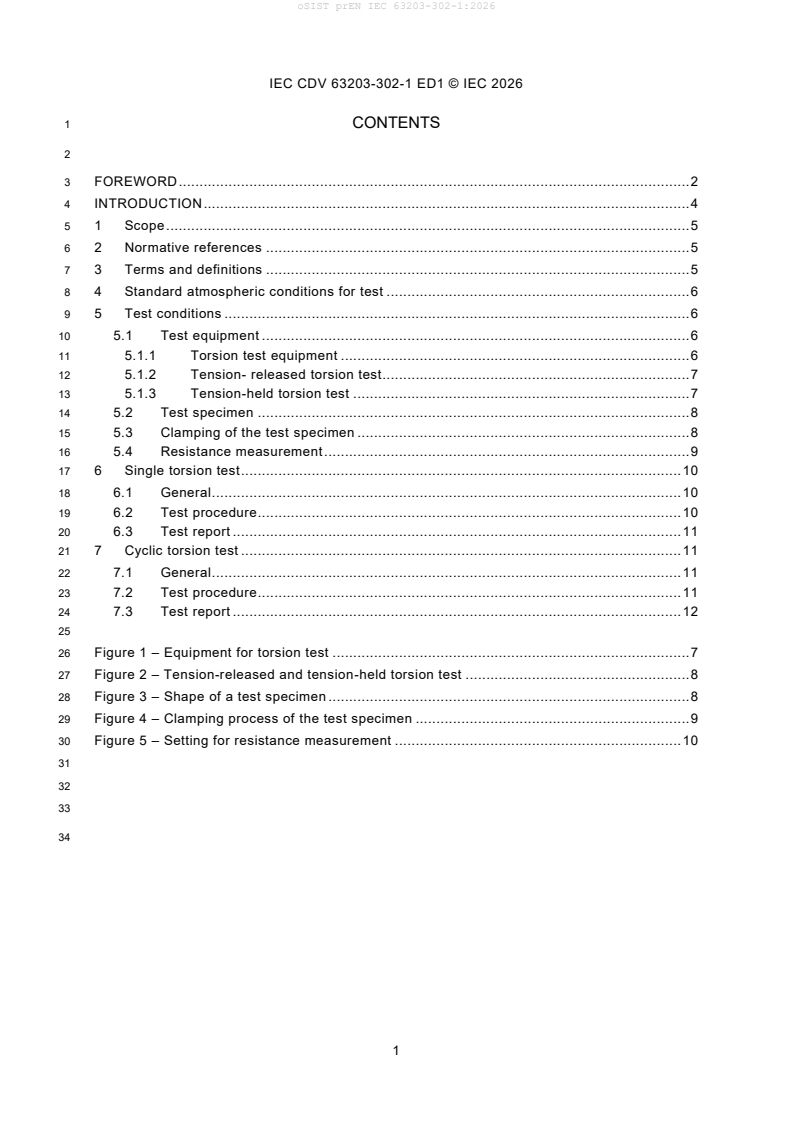
Contents
- 3 FOREWORD
- 4 INTRODUCTION
- 5 1 Scope
- 6 2 Normative references
- 7 3 Terms and definitions
- 8 4 Standard atmospheric conditions for test
- 9 5 Test conditions
- 10 5.1 Test equipment
- 11 5.1.1 Torsion test equipment
- 12 5.1.2 Tension- released torsion test
- 13 5.1.3 Tension-held torsion test
- 14 5.2 Test specimen
- 15 5.3 Clamping of the test specimen
- 16 5.4 Resistance measurement
- 17 6 Single torsion test
- 18 6.1 General
- 19 6.2 Test procedure
- 20 6.3 Test report
- 21 7 Cyclic torsion test
- 22 7.1 General
- 23 7.2 Test procedure
- 24 7.3 Test report
- 26 Figure 1 – Equipment for torsion test
- 27 Figure 2 – Tension-released and tension-held torsion test
- 28 Figure 3 – Shape of a test specimen
- 29 Figure 4 – Clamping process of the test specimen
- 30 Figure 5 – Setting for resistance measurement
100 INTRODUCTION 101 Wearable electronic devices bend naturally with the human body, but around wrists, elbows and 102 necks they twist, exposing conductive films to torsional shear that pure tensile tests cannot 103 replicate. Existing IEC 62899-202-4 rigorously measures changes in resistance under 104 incremental and cyclic stretch but its specimen geometry, loading mode and failure criteria are 105 limited to uniaxial tension and thus overlook the mixed-mode cracks, interfacial slip and local 106 buckling triggered by twist.
107 Finite-element studies show that the maximum shear strain in a twisted strip is proportional to 108 the twist angle, producing delamination at roughly half the tensile strain required in stretch tests, 109 while real-time resistance drifts reveal transient open circuits long before a two-point break 110 would be detected in tension. To fill this gap IEC 63203-302-1 introduces a dedicated torsion 111 method that grips a conductive stretchable film and rotates the ends through defined clockwise 112 and counter-clockwise angles, both with and without axial restraint, capturing the combined 113 pull-and-twist conditions seen during everyday wear.
114 Single-cycle measurements establish the immediate resistance excursion that limits signal 115 fidelity, whereas accelerated cyclic testing compresses months of arm-swing into hours to 116 predict service life. The protocol provides designers with critical torsional metrics needed to 117 properly size line widths, pitches, and encapsulation. Without these data manufacturers are 118 forced to overspecify conductors, sacrificing flexibility and comfort; with them they can certify 119 reliability confidently while maintaining the lightweight, skin-conformal form factors that define 120 next-generation wearables.
121 The value of this standard is that it provides baseline data on how the material layer withstands 122 the combined shear and tension that arise during twisting. For that reason, the test specimen 123 is designed as a wide rectangular conductive film. Using a broad film creates a continuous 124 gradient of shear, tensile and compressive stresses from the twist axis to the edges; this quickly 125 reveals intrinsic weak points such as delamination, cracking or resistance drift. The results can 126 therefore be used to material screening, design guidance and/or reliability modelling.
...