

SIST EN 18007-5:2024
(Main)Electromagnetic pulse welding - Part 5: Quality and inspection requirements
General Information
- Abstract
This document specifies a method to determine the capability of a manufacturer to use the electromagnetic pulse welding process for production of products of the specified quality. It specifies quality requirements but does not assign those requirements to any specific product or product group.
In this document, the term “aluminium” refers to aluminium and its alloys.
- Status
- Published
- Public Enquiry End Date
- 19-Nov-2023
- Publication Date
- 18-Aug-2024
- Technical Committee
- VAR - Welding
- Current Stage
- 6060 - National Implementation/Publication (Adopted Project)
- Start Date
- 14-Aug-2024
- Due Date
- 19-Oct-2024
- Completion Date
- 19-Aug-2024

Overview
EN 18007-5:2024 - Electromagnetic pulse welding - Part 5: Quality and inspection requirements (CEN) defines how manufacturers demonstrate capability to produce electromagnetic pulse welded parts that meet specified quality. The standard focuses on process control, personnel competence, equipment suitability and maintenance, inspection and testing, and traceability. It applies to electromagnetic pulse welding of aluminium and its alloys and sets requirements for production-stage quality assurance without assigning those requirements to any specific product group.
Key topics and technical requirements
- Scope and purpose
- Establishes a method to determine a manufacturer’s capability to produce welds of specified quality using electromagnetic pulse welding.
- Clarifies that “aluminium” means aluminium and its alloys.
- Personnel competence
- Welding operators must be qualified in accordance with EN 18007-3.
- NDT/visual inspectors follow EN ISO 9712 or EN ISO 20807; alternative methods require equivalent training and written practice.
- Destructive-test personnel must be trained for the test methods used.
- Equipment and tooling
- Equipment must be suitable for the application and capable of meeting the acceptance levels (see clause 4.8.4).
- New or refurbished equipment requires verification tests after installation.
- Reproducibility/validation tests are required after installation, repair, movement, or failure; a minimum of 3 test welds must be made and documented using the production WPS.
- Welding tools (coils, field shapers, clamping parts) must be permanently identified, inspected for wear, kept clean, and have a documented useful life recorded on the WPS.
- Maintenance and pre-weld controls
- Documented maintenance plan targeting WPS-controlled variables (guides, meters, cables, clamps, control systems, etc.).
- Pre-weld cleaning and faying-surface preparation must follow the WPS.
- Welding Procedure and inspection
- All welding performed in accordance with a qualified Welding Procedure Specification (WPS) - see EN 18007-4.
- Inspection requirements cover pre-weld, during-weld, and post-weld checks; locations/frequencies depend on product standard and construction type.
- Identification and traceability of parts and weld data are required.
- Defect handling
- Procedures for failed, damaged, or non-conforming welds and proof testing are included.
Applications and who uses this standard
- Manufacturers producing electromagnetic pulse welded aluminium components - for process validation, production control and supplier qualification.
- Quality managers / inspectors establishing inspection regimes, maintenance plans and traceability systems.
- Welding engineers and operators using WPS validation, reproducibility testing and tooling life management.
- Equipment suppliers and installers for acceptance testing after delivery or repair.
- Certification bodies and procurement teams requiring compliance evidence for production capability.
Related standards
- EN 18007-1 (terminology)
- EN 18007-3 (qualification of operators)
- EN 18007-4 (WPS specification & qualification)
- EN ISO 9712 / EN ISO 20807 (NDT personnel qualification)
Keywords: electromagnetic pulse welding, EN 18007-5, quality and inspection requirements, WPS, aluminium welding, reproducibility tests, equipment maintenance, non-destructive testing.
Relations
- Effective Date
- 28-Jan-2026
- Effective Date
- 28-Jan-2026
- Effective Date
- 28-Jan-2026
- Effective Date
- 28-Jan-2026
- Effective Date
- 28-Jan-2026
- Effective Date
- 28-Jan-2026
Get Certified
Connect with accredited certification bodies for this standard

DVS-ZERT GmbH
German welding certification society.
CARES (UK Certification Authority for Reinforcing Steels)
UK certification for reinforcing steels and construction.
EWF/IIW (European/International Welding Federation)
International welding personnel certification.
Sponsored listings
Frequently Asked Questions
SIST EN 18007-5:2024 is a standard published by the Slovenian Institute for Standardization (SIST). Its full title is "Electromagnetic pulse welding - Part 5: Quality and inspection requirements". This standard covers: This document specifies a method to determine the capability of a manufacturer to use the electromagnetic pulse welding process for production of products of the specified quality. It specifies quality requirements but does not assign those requirements to any specific product or product group. In this document, the term “aluminium” refers to aluminium and its alloys.
This document specifies a method to determine the capability of a manufacturer to use the electromagnetic pulse welding process for production of products of the specified quality. It specifies quality requirements but does not assign those requirements to any specific product or product group. In this document, the term “aluminium” refers to aluminium and its alloys.
SIST EN 18007-5:2024 is classified under the following ICS (International Classification for Standards) categories: 25.160.10 - Welding processes. The ICS classification helps identify the subject area and facilitates finding related standards.
SIST EN 18007-5:2024 has the following relationships with other standards: It is inter standard links to SIST EN 18007-1:2024, SIST EN 18007-3:2024, SIST EN ISO 9712:2022, SIST EN 14588:2010, SIST EN 18007-2:2024, SIST EN 18007-4:2024. Understanding these relationships helps ensure you are using the most current and applicable version of the standard.
SIST EN 18007-5:2024 is available in PDF format for immediate download after purchase. The document can be added to your cart and obtained through the secure checkout process. Digital delivery ensures instant access to the complete standard document.
Standards Content (Sample)
SLOVENSKI STANDARD
01-september-2024
Elektromagnetno utripno varjenje - 5. del: Zahteve za kakovost in kontrolo
Electromagnetic pulse welding - Part 5: Quality and inspection requirements
Schweißen und verwandte Verfahren - Elektromagnetisches Pulsschweißen - Teil 5:
Qualitäts- und Prüfanforderungen
Soudage par impulsion électromagnétique - Partie 5 : Exigences de qualité et de
contrôle
Ta slovenski standard je istoveten z: EN 18007-5:2024
ICS:
25.160.10 Varilni postopki in varjenje Welding processes
2003-01.Slovenski inštitut za standardizacijo. Razmnoževanje celote ali delov tega standarda ni dovoljeno.
EN 18007-5
EUROPEAN STANDARD
NORME EUROPÉENNE
July 2024
EUROPÄISCHE NORM
ICS 25.160.10
English Version
Electromagnetic pulse welding - Part 5: Quality and
inspection requirements
Soudage par impulsion électromagnétique - Partie 5 : Elektromagnetisches Pulsschweißen - Teil 5: Qualitäts-
Exigences de qualité et de contrôle und Prüfanforderungen
This European Standard was approved by CEN on 7 June 2024.
CEN members are bound to comply with the CEN/CENELEC Internal Regulations which stipulate the conditions for giving this
European Standard the status of a national standard without any alteration. Up-to-date lists and bibliographical references
concerning such national standards may be obtained on application to the CEN-CENELEC Management Centre or to any CEN
member.
This European Standard exists in three official versions (English, French, German). A version in any other language made by
translation under the responsibility of a CEN member into its own language and notified to the CEN-CENELEC Management
Centre has the same status as the official versions.
CEN members are the national standards bodies of Austria, Belgium, Bulgaria, Croatia, Cyprus, Czech Republic, Denmark, Estonia,
Finland, France, Germany, Greece, Hungary, Iceland, Ireland, Italy, Latvia, Lithuania, Luxembourg, Malta, Netherlands, Norway,
Poland, Portugal, Republic of North Macedonia, Romania, Serbia, Slovakia, Slovenia, Spain, Sweden, Switzerland, Türkiye and
United Kingdom.
EUROPEAN COMMITTEE FOR STANDARDIZATION
COMITÉ EUROPÉEN DE NORMALISATION
EUROPÄISCHES KOMITEE FÜR NORMUNG
CEN-CENELEC Management Centre: Rue de la Science 23, B-1040 Brussels
© 2024 CEN All rights of exploitation in any form and by any means reserved Ref. No. EN 18007-5:2024 E
worldwide for CEN national Members.
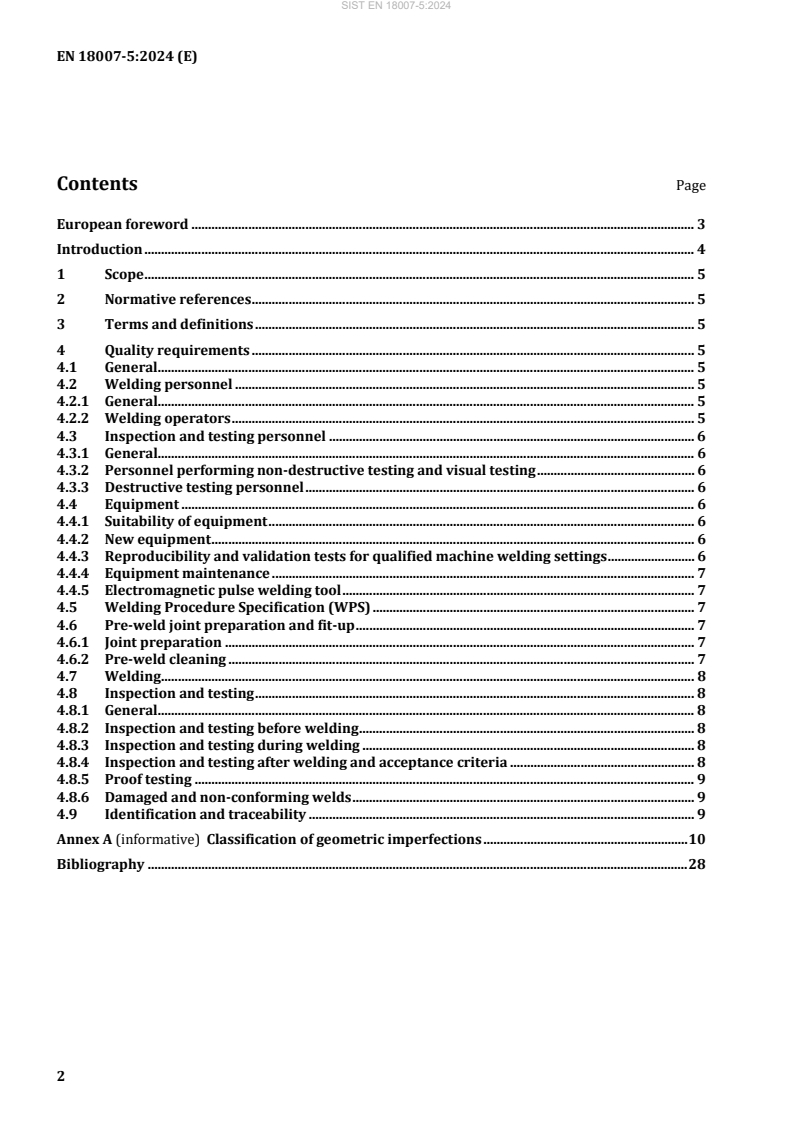
Contents Page
European foreword . 3
Introduction . 4
1 Scope . 5
2 Normative references . 5
3 Terms and definitions . 5
4 Quality requirements . 5
4.1 General. 5
4.2 Welding personnel . 5
4.2.1 General. 5
4.2.2 Welding operators . 5
4.3 Inspection and testing personnel . 6
4.3.1 General. 6
4.3.2 Personnel performing non-destructive testing and visual testing . 6
4.3.3 Destructive testing personnel . 6
4.4 Equipment . 6
4.4.1 Suitability of equipment . 6
4.4.2 New equipment . 6
4.4.3 Reproducibility and validation tests for qualified machine welding settings . 6
4.4.4 Equipment maintenance . 7
4.4.5 Electromagnetic pulse welding tool . 7
4.5 Welding Procedure Specification (WPS) . 7
4.6 Pre-weld joint preparation and fit-up . 7
4.6.1 Joint preparation . 7
4.6.2 Pre-weld cleaning . 7
4.7 Welding . 8
4.8 Inspection and testing . 8
4.8.1 General. 8
4.8.2 Inspection and testing before welding . 8
4.8.3 Inspection and testing during welding . 8
4.8.4 Inspection and testing after welding and acceptance criteria . 8
4.8.5 Proof testing . 9
4.8.6 Damaged and non-conforming welds . 9
4.9 Identification and traceability . 9
Annex A (informative) Classification of geometric imperfections . 10
Bibliography . 28
European foreword
This document (EN 18007-5:2024) has been prepared by Technical Committee CEN/TC 121 “Welding
and allied processes”, the secretariat of which is held by AFNOR.
This European Standard shall be given the status of a national standard, either by publication of an
identical text or by endorsement, at the latest by January 2025, and conflicting national standards shall
be withdrawn at the latest by January 2025.
Attention is drawn to the possibility that some of the elements of this document may be the subject of
patent rights. CEN shall not be held responsible for identifying any or all such patent rights.
The EN 18007 series of standards, under the general title Electromagnetic pulse welding, consists of the
following parts:
— Part 1: Welding knowledge, terminology and vocabulary,
— Part 2: Design of welded joints,
— Part 3: Qualification of welding operators and weld setters,
— Part 4: Specification and qualification of welding procedures,
— Part 5: Quality and inspection requirements.
Any feedback and questions on this document should be directed to the users’ national standards body.
A complete listing of these bodies can be found on the CEN website.
According to the CEN-CENELEC Internal Regulations, the national standards organisations of the
following countries are bound to implement this European Standard: Austria, Belgium, Bulgaria, Croatia,
Cyprus, Czech Republic, Denmark, Estonia, Finland, France, Germany, Greece, Hungary, Iceland, Ireland,
Italy, Latvia, Lithuania, Luxembourg, Malta, Netherlands, Norway, Poland, Portugal, Republic of North
Macedonia, Romania, Serbia, Slovakia, Slovenia, Spain, Sweden, Switzerland, Türkiye and the United
Kingdom.
Introduction
Electromagnetic pulse welding is an innovative solid-state welding technology that belongs to the group
of pressure welding processes and is based on the use of electromagnetic forces to deform, accelerate
and weld workpieces. No external heat source is used, the connection is only created by a high-velocity
impact.
The increasing use of the electromagnetic pulse welding process has created the need for a standard, to
ensure that the welding operations are carried out in the most effective manner and that appropriate
controls are performed on all aspects of the implementation.
To be effective, welded products should be free from problems in production and in service. To achieve
this goal, it is recommended to provide controls from the design phase through material selection, choice
of parameters, the fabrication itself, and inspection. For example, poor design can create serious and
costly difficulties in the workshop or in service. Incorrect process parameters and/or material selection
can result in welding defects. Welding procedures should be correctly formulated and approved to avoid
weld discontinuities. To ensure the manufacture of a quality product, management should understand
the causes of potential problems and implement appropriate inspection procedures and subsequent
quality measures. Supervision should be implemented to ensure that the specified quality is achieved.
1 Scope
This document specifies a method to determine the capability of a manufacturer to use the
electromagnetic pulse welding process for production of products of the specified quality. It specifies
quality requirements but does not assign those requirements to any specific product or product group.
In this document, the term “aluminium” refers to aluminium and its alloys.
2 Normative references
The following documents are referred to in the text in such a way that some or all of their content
constitutes requirements of this document. For dated references, only the edition cited applies. For
undated references, the latest edition of the referenced document (including any amendments) applies.
EN 18007-1, Electromagnetic pulse welding — Part 1: Welding knowledge, terminology and vocabulary
EN 18007-3, Electromagnetic pulse welding — Part 3: Qualification of welding operators and weld setters
EN ISO 9712, Non-destructive testing — Qualification and certification of NDT personnel
EN ISO 20807, Non-destructive testing — Qualification of personnel for limited application of non-
destructive testing
3 Terms and definitions
For the purposes of this document, the terms and definitions given in EN 18007-1 apply.
ISO and IEC maintain terminology databases for use in standardization at the following addresses:
— ISO Online browsing platform: available at https://www.iso.org/obp
— IEC Electropedia: available at https://www.electropedia.org/
4 Quality requirements
4.1 General
These requirements relate only to those aspects of product quality that can be influenced by
electromagnetic pulse welding.
4.2 Welding personnel
4.2.1 General
Manufacturers shall have at their disposal sufficient and competent personnel for the planning,
performing and supervising of the electromagnetic pulse welding production operations in accordance
with specified requirements.
4.2.2 Welding operators
Welding operators shall be qualified in accordance with the specifications detailed in EN 18007-3.
Qualification records shall be kept up to date.
4.3 Inspection and testing personnel
4.3.1 General
The manufacturer shall have sufficient and competent personnel for the planning, performing, and
supervising of inspecting and testing operations during the production of electromagnetic pulse welded
parts, in accordance with specified requirements.
4.3.2 Personnel performing non-destructive testing and visual testing
Non-destructive and visual testing personnel shall be qualified in accordance with EN ISO 9712 or
EN ISO 20807. When the use of an examination method not presently incorporated in these
EN ISO standards is specified, the manufacturer shall be responsible for developing the training program,
written practice, examination, and practical demonstrations equivalent to the requirements of these
EN ISO standard(s). These shall establish the capability of the personnel performing the required
examination.
4.3.3 Destructive testing personnel
Personnel performing destructive testing shall be trained for those test methods.
4.4 Equipment
4.4.1 Suitability of equipment
The equipment shall be adequate for the concerned application. Welding equipment shall be capable of
producing welds that meet the acceptance levels specified in 4.8.4. Welding equipment shall be
maintained in good condition and shall be repaired or adjusted when a welding operator, inspector or
welding coordinator is concerned about the capability of the equipment to operate satisfactorily.
4.4.2 New equipment
After installation of new or refurbished equipment, appropriate tests of the equipment shall be
performed. Such tests shall verify that the equipment functions correctly.
4.4.3 Reproducibility and validation tests for qualified machine welding settings
Reproducibility tests shall be performed to demonstrate that the welding equipment can repeatedly
produce welds that meet the acceptance levels in 4.8.4. Reproducibility tests shall be carried out when
any of the following occurs:
— after installation of a new or refurbished welding equipment,
— a critical component of the equipment is damaged, repaired, or replaced; or after failing to operate
properly,
— equipment is dislodged or moved in a manner for which it was not designed,
— stationary equipment is moved from one location to another.
The reproducibility test shall be performed in accordance with a WPS that is used in production for that
machine.
A minimum of 3 test welds shall be made and documented.
4.4.4 Equipment maintenance
The manufacturer shall have a documented plan for equipment maintenance. The plan shall ensure that
maintenance checks are performed on the equipment that controls variables listed in the relevant WPS’s.
The maintenance plan may be limited to those items that are essential for producing welds that meet the
quality requirements of this document.
Examples of these items are as follows:
— condition of guides and mechanised fixtures,
— condition of meters and gages that are used for the operation of the welding equipment,
— condition of cables, hoses, and connectors,
— condition of the control systems in mechanised and/or automatic welding equipment,
— condition of thermocouples and other temperature measurement instruments,
— condition of clamps, jigs, insulations and fixtures.
Before welding, clamps, jigs, and fixtures that contact the workpieces shall be clean and sufficiently free
of contaminants (for example, oil, grease, and dirt) that could have a detrimental effect on the weld.
Defective equipment shall not be used.
4.4.5 Electromagnetic pulse welding tool
4.4.5.1 Identification
The tools (coil, field shaper and clamping parts) that are used in production shall be permanently marked
with its drawing or part number.
4.4.5.2 Tool inspection
Before welding, the tool (coil, field shaper and clamping parts) shall be sufficiently free of contaminants
(e.g. oil, grease or dirt) that could have a detrimental effect on weld quality. The correct tool geometry is
critical for producing quality welds. Because a tool wears with use, it shall be inspected for wear at
appropriate intervals and in accordance with a written procedure.
The manufacturer shall determine the useful life-time of the electromagnetic pulse welding tool, i.e.
maximum number of welds at a certain maximum current amplitude, which shall be recorded on the WPS.
4.5 Welding Procedure Specification (WPS)
The manufacturer shall ensure that the WPS is used correctly in production. See EN 18007-4.
4.6 Pre-weld joint preparation and fit-up
4.6.1 Joint preparation
The faying surface shall be prepared in accordance with the WPS.
4.6.2 Pre-weld cleaning
Pre-weld cleaning shall be carried out in accordance with the WPS. The base material shall be sufficiently
free of surface oxides, protective finishes, adhesives, oils, grease, dirt, and any other contaminants that
could have a detrimental effect on weld quality.
4.7 Welding
All welding shall be performed in accordance with a qualified WPS.
4.8 Inspection and testing
4.8.1 General
The location and frequency of applicable inspections and tests will depend on the product standard and
the type of construction. The testing standards referenced below are not specific to the electromagnetic
pulse welding process. Deviations may be required when applied to electromagnetic pulse welding.
4.8.2 Inspection and testing before welding
Before the start of welding, the following shall be verified:
— suitability and validity of the operator’s qualification certificate,
— suitability of the WPS,
— parent and flyer material alloy and temper,
— joint preparation (for example, shape and dimensions),
— joint fit-up, jigging, and tacking,
— welding parameters set in accordance with the WPS.
4.8.3 Inspection and testing during welding
During welding, the welding sequence shall be checked at suitable intervals or by continuous monitoring.
4.8.4 Inspection and testing after welding and acceptance criteria
4.8.4.1 General
The required tests and acceptance levels shall be established before production is initiated. Compliance
with the relevant application standard or relevant requirements shall be verified.
Examples of conformance methods are the following and are detailed in EN 18007-4:2024, Annex A:
— visual testing,
— non-destructive testing,
— destructive testing,
— form, shape, and dimensions of the weldment,
— results and records of post-weld operations (for example, post-weld heat treatment, ageing).
Examples of common imperfections are detailed in Annex A.
4.8.4.2 Non-destructive testing
Prior to testing, permissible and non-permissible characteristics and imperfections shall be specified in
the test specifications.
Each testing method has its restrictions which are dependent on the welding process variant, materials
and the component geometry. It is therefore sometimes necessary to determine a suitable test procedure
to be used for a particular welded assembly.
See also EN 18007-4:2024, A.2.
4.8.4.3 Destructive testing
Destructive testing shall be applied to production welds or, where appropriate, to welded test specimens
representative of the actual weldment.
Each specimen should be representative. Attention should be paid to any possible changes in the material
characteristics. Methods of cutting which seriously affect the metallurgical structure of the specimen shall
not be used.
See also EN 18007-4:2024, A.3.
4.8.5 Proof testing
Where practical considerations allow it and when specified in the test specification, an approved method
of proof testing can be applied to an agreed percentage of production welds. Where such methods are
employed, the applied loads should be greater than those expected in service. The component tested shall
subsequently show no damage likely to cause failure in service.
4.8.6 Damaged and non-conforming welds
If the repair of a damaged weld involves welding, then the repair shall be performed in accordance with
a qualified WPS. Repair shall bring the weld into full conformance with the requirements of this
specification.
4.9 Identification and traceability
Identification and traceability of a weld to a WPS and welding operator or operators shall be maintained.
Annex A
(informative)
Classification of geometric imperfections
The possible welding imperfections were investigated, inventoried and described. The EN ISO 6520-2
standard served as the basis for this. EN ISO 6520-2 defines the possible geometric imperfections for
pressure welding processes.
EN ISO 6520-2 classifies the possible imperfections in welds made with pressure. A unifo
...