

oSIST prEN 18356-1:2026
(Main)Customer Data Access and Portability in the Insurance Sector - Part 1: Semantic interface and data model
- Abstract
Article 20 GDPR and Article 4 and 5 the proposed FIDA Regulation require the data access and portability of customer data. To support this demand CEN/TC 445 will organise the standardisation project with its Working Group 1 in which the following European standardisation deliverable will be developed.
European Standard (EN) for the semantic specification of the interfaces
The scope of this EN for customer (natural or legal person) data access and portability in the insurance sector should be based on the insurance-specific part of the proposed FIDA Regulation and therefore should contain:
• Semantic specifications for the processes to support the data access and portability. These specifications define on the business level the functions and the behaviour for the following process interfaces:
- Request of the customer to the data holder for an actual transfer of the customer data (Article 4 FIDA).
- Transfer of the requested customer data from the data holder to the requesting customer (Article 4 FIDA).
- Request of a data user to a data holder for an actual transfer of customer data under a permission of the customer (Article 5 FIDA).
- Transfer of the requested customer data from the data holder to the requesting data user (Article 5 FIDA).
• Sematic specifications for the customer data to be transferred by the above processes. The scope of the customer data will be limited to the insurance-specific part of the FIDA proposal defined in the Article 2 (1) and Article 3 (3) of FIDA. These specifications define on the business level each element of the customer data with identification, name, precise definition, and value type (text, number, amount, quantity, percentage, date, etc.). The composition of these data elements forms a semantic data model for the insurance-specific customer data. The data model will consist of the following parts:
- General data of the policy holder (including address, contact details, profession, payment means, etc.).
- General data of the insurance policy (including policy number, insurance product and coverages, insured period, premium amounts, etc.).
- Data specific to the consumers’ insured assets which are collected for the purposes of a demands and needs test.
- Data depending on class of business, such as
- Motor insurance (details about vehicle, usage, drivers),
- Property insurance (details about building, household or other objects),
- Liability insurance (details about insured persons and their activities),
- Accident insurance (details about insured persons and their activities),
- Insurance-based investment products (details about insured persons and the savings, investments, pension rights, etc.).
The EN specifies the processes and the data model on the semantic level in a syntax-neutral format, independent from its representation in a concrete implementation syntax.
- Status
- Not Published
- Public Enquiry End Date
- 31-Jul-2026
- Technical Committee
- I11 - Imaginarni 11
- Current Stage
- 4020 - Public enquire (PE) (Adopted Project)
- Start Date
- 10-Jun-2026
- Due Date
- 28-Oct-2026
- Completion Date
- 03-Aug-2026

oSIST prEN 18356-1:2026 is the Slovenian publication of the draft European Standard prEN 18356-1 from CEN. It specifies the semantic interface and data model for customer data access and portability in the insurance sector, so insurers, insurance intermediaries, data holders, and data users can exchange insurance customer data in a common, syntax-neutral way.
What does oSIST prEN 18356-1:2026 specify?
oSIST prEN 18356-1:2026 specifies the insurance-specific semantic rules for customer data access and portability based on the proposed FIDA Regulation. It covers both the process of requesting and transferring customer data and the semantic data model for the insurance data that is exchanged.
The document focuses on the semantic level, not the technical API syntax. In practice, that means it defines what the data means and how the process behaves, while the technical implementation is handled in separate CEN Technical Specifications.
| Annex | What it covers |
|---|---|
| A, informative | Digital Attachments |
Clause 1 gives the scope, Clause 2 lists the normative references, Clause 3 defines key terms, Clause 4 lists symbols and abbreviations, Clause 5 describes the business process, and Clause 6 defines the data models for customer data access. A bibliography closes the document.
What are the key requirements of oSIST prEN 18356-1:2026?
The access process is defined as a business workflow
oSIST prEN 18356-1:2026 combines the customer request flow and the data user request flow into one business process because the functionality is similar. The same process is used whether the requester is the customer or a data user acting with customer permission.
The process is defined for access to a single insurance policy. If several policies are to be accessed, the process is repeated for each policy. That matters in practice because integrations need to treat each policy number as one separate access case.
The standard also requires the current status of the requested insurance policy to be provided at the time of access. In coinsurance situations, the lead insurer is treated as the relevant data holder.
Preconditions must be in place before access starts
Before the access flow begins, the data holder must be able to identify the customer and, if relevant, the data user. The data holder must also authenticate and authorise the party requesting access.
If the requester is a data user, the data user must have a customer permission that covers the requested purpose, and that permission must be identified and shared with the data holder. The requester must also know the unique identifier of the insurance policy, usually the policy number. In practice, this means the access process depends on identity, permission, and policy reference data being available up front.
The request and validation steps are explicit
For a customer data access request, the standard requires the policy number. If the request goes through a service that handles multiple data holders, the data holder identifier is also included. If the request comes from a data user, the permission identifier and the purpose of access are also required.
When the data holder receives the request, it validates the requested policy number, checks any data holder identifier, confirms whether the requester is the customer or is covered by valid permission, and checks that the stated purpose is within scope. The data holder also has to comply with legal requirements, including GDPR and FIDA, and only provide data from insurance policies that are in force.
If any validation fails, the data holder returns an appropriate error message. If the validations succeed, the data holder selects only the customer data that falls within the requested purpose and prepares it according to the standard. This matters because implementations must filter data, not simply dump a full policy record.
The response is split between general data and product data
The response for general policy access includes the general insurance policy data and a list of line-specific product links. The requester can decide after seeing the general data whether to continue to product-level access or stop there.
If product data is requested, the requester follows one of the product links and the data holder returns the product data in the specific data model for that insurance line. This staged design keeps the general policy response smaller and makes implementation easier because each line of business has its own model.
The semantic data model is built from UN/CEFACT Core Components
Clause 6 says the data models are based on the UN/CEFACT Core Components Library and use the Core Component types ACC, BCC, and ASCC. The document states that the naming of these core components is decisive and must not be changed or translated, because the same names are used in the companion implementation specification.
That is important for interoperability. If a system renames the core components, it can break mapping between this semantic standard and the technical API definition.
Data types and code lists are standardized where needed, but not everywhere
Clause 6.2 defines the data types used by BCCs, including amount, code, date, dateTime, identifier, indicator, measure, numeric, percent, and quantity. The data types use supplemental components such as currency, code list identifiers, unit IDs, and format fields.
The standard ties some values to external code systems. It uses ISO 4217 for currencies, ISO 8601 for dates and date-times, ISO 3166-1 alpha-2 for country codes, ISO 639-3 for language codes, and UN/CEFACT Recommendation 20 for certain units of measure. At the same time, it leaves market-specific code lists open where insurance markets differ.
Separate product models are defined for each line of business
Clause 6 provides separate data models for the insurance policy and party data and for specific product lines. The line-specific models cover motor insurance, private property insurance, commercial property insurance, liability insurance, personal accident insurance, legal expenses insurance, travel insurance, financial loss insurance, and life insurance.
In practice, this means one generic policy model is not enough. Implementers need product-specific models for the actual data content of each line, such as vehicles for motor insurance, buildings for property insurance, activities for liability insurance, travel and equipment for travel insurance, and savings or pension rights for life insurance.
What terms does oSIST prEN 18356-1:2026 define?
- customer - A natural person or a legal person that is a micro, small or medium-sized enterprise, using financial products and services, excluding third-party beneficiaries.
- insurance client - A customer who requests insurance coverage and pays the premium; the standard notes that this is a synonym for policyholder.
- insured person - The party covered by an insurance policy.
- data holder - The financial institution that collects, stores, and otherwise processes the data listed in FIDA Article 2(1).
- data user - An entity listed in FIDA Article 2(2) that has lawful access to customer data after customer permission.
- insurance policy - A contract between an insurance client and one or more insurance companies that provides coverage to one or more insured persons.
- insurance product - A contract that provides coverage against specified risks in a specific line of business.
- BPMN - Business Process Model and Notation, used here in version 2.0 to show the customer data access process as a workflow diagram.
Who uses oSIST prEN 18356-1:2026?
oSIST prEN 18356-1:2026 is used by insurers, insurance intermediaries, and other financial institutions that act as data holders or data users. It is also relevant to software teams that design insurance APIs, data models, and portability workflows.
Quality managers, compliance teams, and procurement teams use it to check whether a solution supports the required insurance data elements, policy access steps, and permission-driven transfers. It is particularly relevant in motor, property, liability, personal accident, legal expenses, travel, financial loss, and life insurance environments where customer data must be exchanged in a structured way.
Which standards are used with oSIST prEN 18356-1:2026?
- ISO 639-3 - Provides language codes for language identifiers used in coded text values.
- ISO 3166-1 - Provides country codes used for addresses, locations, nationality, and geographic limits.
- ISO 4217 - Provides currency codes used for amounts and premiums.
- ISO 8601 - Provides the date and date-time formats used in the data types.
- FprCEN/TS 18356-2 - The introduction identifies this as the companion technical specification for API implementation in Open API Technology.
What does the oSIST prEN 18356-1:2026 document contain?
The document contains a BPMN-based description of the customer data access process, including the request, validation, preparation, and response steps. It also contains the semantic data models for general policy and party data and for each insurance line covered by the standard.
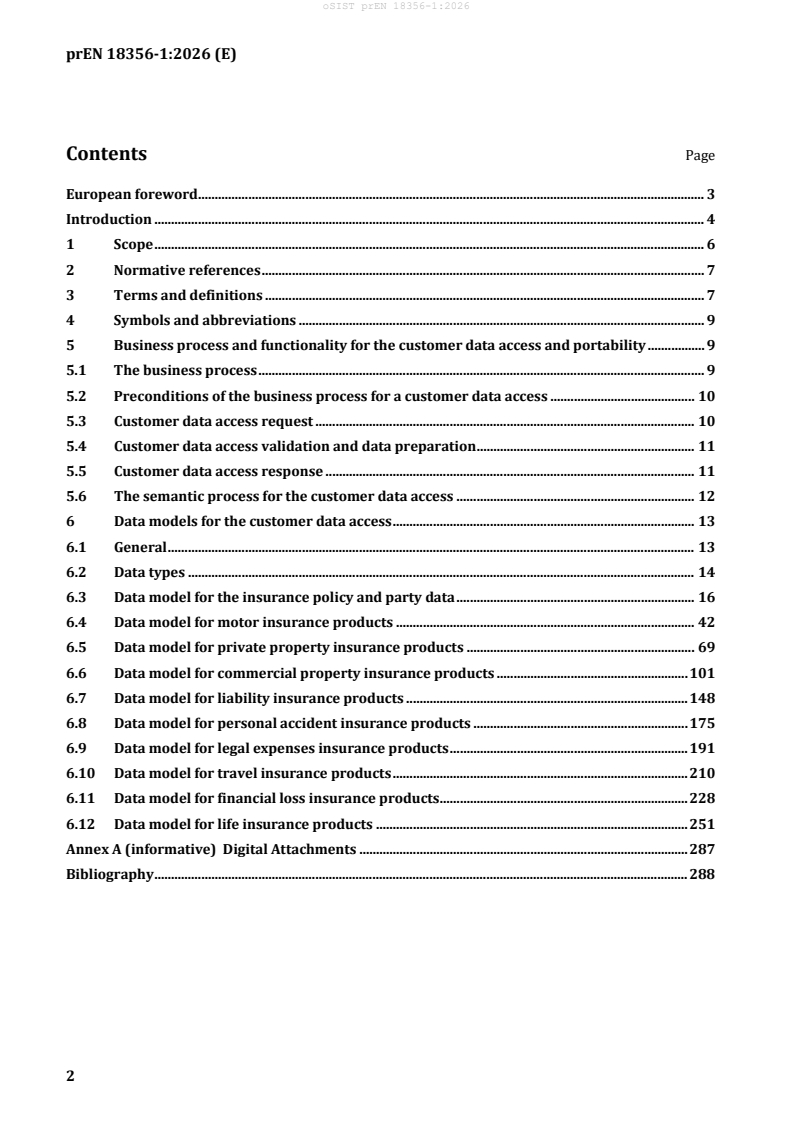
Clause 6 includes the Core Component structures that define the models, while Table 1 defines the data types used by the BCCs. The figures illustrate the overall policy structure, party data, and the product-specific structures for the different insurance lines.
The product chapters cover both product data and claims-related structures where relevant. Several of the later sections also introduce linked objects such as vehicles, buildings, business locations, insured persons, insured objects, travel equipment, incidents, and service providers.
Annex A provides digital attachments as an informative annex.
Relations
- Effective Date
- 28-Jan-2026
Get Certified
Connect with accredited certification bodies for this standard

BSI Group
BSI (British Standards Institution) is the business standards company that helps organizations make excellence a habit.

Great Wall Tianjin Quality Assurance Center
Established 1993, first batch to receive national accreditation with IAF recognition.

Hong Kong Quality Assurance Agency (HKQAA)
Hong Kong's leading certification body.
Sponsored listings
Frequently Asked Questions
oSIST prEN 18356-1:2026 is a draft published by the Slovenian Institute for Standardization (SIST). Its full title is "Customer Data Access and Portability in the Insurance Sector - Part 1: Semantic interface and data model". This standard covers: Article 20 GDPR and Article 4 and 5 the proposed FIDA Regulation require the data access and portability of customer data. To support this demand CEN/TC 445 will organise the standardisation project with its Working Group 1 in which the following European standardisation deliverable will be developed. European Standard (EN) for the semantic specification of the interfaces The scope of this EN for customer (natural or legal person) data access and portability in the insurance sector should be based on the insurance-specific part of the proposed FIDA Regulation and therefore should contain: • Semantic specifications for the processes to support the data access and portability. These specifications define on the business level the functions and the behaviour for the following process interfaces: - Request of the customer to the data holder for an actual transfer of the customer data (Article 4 FIDA). - Transfer of the requested customer data from the data holder to the requesting customer (Article 4 FIDA). - Request of a data user to a data holder for an actual transfer of customer data under a permission of the customer (Article 5 FIDA). - Transfer of the requested customer data from the data holder to the requesting data user (Article 5 FIDA). • Sematic specifications for the customer data to be transferred by the above processes. The scope of the customer data will be limited to the insurance-specific part of the FIDA proposal defined in the Article 2 (1) and Article 3 (3) of FIDA. These specifications define on the business level each element of the customer data with identification, name, precise definition, and value type (text, number, amount, quantity, percentage, date, etc.). The composition of these data elements forms a semantic data model for the insurance-specific customer data. The data model will consist of the following parts: - General data of the policy holder (including address, contact details, profession, payment means, etc.). - General data of the insurance policy (including policy number, insurance product and coverages, insured period, premium amounts, etc.). - Data specific to the consumers’ insured assets which are collected for the purposes of a demands and needs test. - Data depending on class of business, such as - Motor insurance (details about vehicle, usage, drivers), - Property insurance (details about building, household or other objects), - Liability insurance (details about insured persons and their activities), - Accident insurance (details about insured persons and their activities), - Insurance-based investment products (details about insured persons and the savings, investments, pension rights, etc.). The EN specifies the processes and the data model on the semantic level in a syntax-neutral format, independent from its representation in a concrete implementation syntax.
Article 20 GDPR and Article 4 and 5 the proposed FIDA Regulation require the data access and portability of customer data. To support this demand CEN/TC 445 will organise the standardisation project with its Working Group 1 in which the following European standardisation deliverable will be developed. European Standard (EN) for the semantic specification of the interfaces The scope of this EN for customer (natural or legal person) data access and portability in the insurance sector should be based on the insurance-specific part of the proposed FIDA Regulation and therefore should contain: • Semantic specifications for the processes to support the data access and portability. These specifications define on the business level the functions and the behaviour for the following process interfaces: - Request of the customer to the data holder for an actual transfer of the customer data (Article 4 FIDA). - Transfer of the requested customer data from the data holder to the requesting customer (Article 4 FIDA). - Request of a data user to a data holder for an actual transfer of customer data under a permission of the customer (Article 5 FIDA). - Transfer of the requested customer data from the data holder to the requesting data user (Article 5 FIDA). • Sematic specifications for the customer data to be transferred by the above processes. The scope of the customer data will be limited to the insurance-specific part of the FIDA proposal defined in the Article 2 (1) and Article 3 (3) of FIDA. These specifications define on the business level each element of the customer data with identification, name, precise definition, and value type (text, number, amount, quantity, percentage, date, etc.). The composition of these data elements forms a semantic data model for the insurance-specific customer data. The data model will consist of the following parts: - General data of the policy holder (including address, contact details, profession, payment means, etc.). - General data of the insurance policy (including policy number, insurance product and coverages, insured period, premium amounts, etc.). - Data specific to the consumers’ insured assets which are collected for the purposes of a demands and needs test. - Data depending on class of business, such as - Motor insurance (details about vehicle, usage, drivers), - Property insurance (details about building, household or other objects), - Liability insurance (details about insured persons and their activities), - Accident insurance (details about insured persons and their activities), - Insurance-based investment products (details about insured persons and the savings, investments, pension rights, etc.). The EN specifies the processes and the data model on the semantic level in a syntax-neutral format, independent from its representation in a concrete implementation syntax.
oSIST prEN 18356-1:2026 is classified under the following ICS (International Classification for Standards) categories: 03.060 - Finances. Banking. Monetary systems. Insurance; 35.240.01 - Application of information technology in general; 35.240.20 - IT applications in office work. The ICS classification helps identify the subject area and facilitates finding related standards.
oSIST prEN 18356-1:2026 has the following relationships with other standards: It is inter standard links to SIST EN ISO 7142:2023. Understanding these relationships helps ensure you are using the most current and applicable version of the standard.
oSIST prEN 18356-1:2026 is associated with the following European legislation: EU Directives/Regulations: 2016/679. When a standard is cited in the Official Journal of the European Union, products manufactured in conformity with it benefit from a presumption of conformity with the essential requirements of the corresponding EU directive or regulation.
oSIST prEN 18356-1:2026 is available in PDF format for immediate download after purchase. The document can be added to your cart and obtained through the secure checkout process. Digital delivery ensures instant access to the complete standard document.
Standards Content (Sample)
Contents
- Introduction
- 1 Scope
- 2 Normative references
- 3 Terms and definitions
- 3.1 customer
- 3.2 insurance client
- 3.3 insured person
- 3.4 insurance intermediary
- 3.5 insurance company
- 3.6 customer data
- 3.7 data holder
- 3.8 data user
- 3.9 insurance policy
- 3.10 insurance product
- 3.11 identifier
- 4 Symbols and abbreviations
- 5 Business process and functionality for the customer data access and portability
- 5.1 The business process
- 5.2 Preconditions of the business process for a customer data access
- 5.3 Customer data access request
- 5.4 Customer data access validation and data preparation
- 5.5 Customer data access response
- 5.6 The semantic process for the customer data access
- 6 Data models for the customer data access
- 6.1 General
- 6.2 Data types
- 6.3 Data model for the insurance policy and party data
- 6.4 Data model for motor insurance products
- 6.5 Data model for private property insurance products
- 6.6 Data model for commercial property insurance products
- 6.7 Data model for liability insurance products
- 6.8 Data model for personal accident insurance products
- 6.9 Data model for legal expenses insurance products
- 6.10 Data model for travel insurance products
- 6.11 Data model for financial loss insurance products
- 6.12 Data model for life insurance products
- Annex A
- Bibliography
Introduction
The objective of this European Standard for customer data access and portability in the insurance sector is to support the implementation of the EU General Data Protection Regulation 2016/679 (GDPR) Article 20 and of the proposed EU Regulation on a Framework for Financial Data Access (FIDA) Articles 2(1), 4 and 5.
The EU Commission referenced this European standardisation priority as Action 12 in the 2024 Annual Union Work Programme for Standardisation, as well as in the Rolling Plan for ICT Standardisation 2024 as part of the requested actions for “Fintech and Regtech Standardisation” fostering innovation for the Digital Single market (Action 5).
This document contains the semantic specification of the interfaces for the required access to customer insurance data. In addition, CEN Technical Specifications describe the application programming interfaces (API) at the technical implementation level, such as FprCEN/TS 18356-2, in the Open API Technology.
The European standard for APIs and data formats is in demand in the insurance sector to support the right of the consumer for the data portability on the basis of GDPR Article 20 and the right of customers and data users for the customer data access to data holders on the basis of the proposed EU FIDA Regulation.
Consumers will benefit from - more effective control over their personal data with the ability to control how their data is shared and used; - standardised portability of their personal data from a data holder to a data user. Insurance customers, consumers as well as companies, will benefit from - standardised APIs which will result in a better flexibility to select the best products on the market; - standardised data access supporting more choice and more individualised, data-driven products and services in the insurance sector; - products that are better targeted to their demands and needs, including through more valuable advice; - improved customer choice by enabling them to switch providers more easily; - more optimal insurance coverage and increased financial inclusion of otherwise underserved customers; - digital data entry at insurers and insurance intermediaries which will reduce their costs and will likely reduce the insurance premiums for the customers; - better risk and claims management and analysis resulting in improved loss prevention. The insurance industry, insurers and insurance intermediaries, will benefit from - standardised APIs for data access and portability which will boost the digitalisation and will have significant efficiency gains in the data economy of the insurance sector; - standardised customer data that will allow for the development of personalised tools for customers, such as insurance dashboards; - digital data entry at insurers and insurance intermediaries which will reduce their costs; - standardised customer data resulting in better advice to the customers; - standardised customer data that will enable tailored offers for customer-specific and data-driven products, coverages, and services; - increased cross-selling due to a better overview over the insurance status of the customers; - better risk and claims management and analysis resulting in improved loss prevention for the customers.
oSIST prEN 18356-1:2026 prEN 18356-1:2026 (E) Moreover, the European API standard is an important prerequisite for enabling efficient and costeffective customer data access and portability (“plug-and-play communication”). Only a well-accepted open standard ensures a level playing field for all market participants, especially for SMEs, and protects consumers from lock-in effects.
Finally, the European API standard for customer data access and portability is an important step towards a European digital single market for the insurance sector, which is currently still focused on national markets. The standard will facilitate cross-border and cross-sector cooperation, supporting the development of market innovations and the platform economy.
oSIST prEN 18356-1:2026 prEN 18356-1:2026 (E)
1 Scope
This document specifies the customer (natural or legal person) data access and portability in the insurance sector based on the insurance-specific part of the proposed EU FIDA Regulation and therefore contains:
- Semantic specifications for the processes to support the data access and portability. These specifications define on the business level the functions and the behaviour for the following process interfaces:
Request of the customer to the data holder for an actual transfer of the customer data (FIDA Article 4).
Transfer of the requested customer data from the data holder to the requesting customer (FIDA Article 4).
Request of a data user to a data holder for an actual transfer of customer data under a permission of the customer (FIDA Article 5).
Transfer of the requested customer data from the data holder to the requesting data user (FIDA Article 5).
- Semantic specifications for the customer data to be transferred by the above processes. The scope of the customer data is limited to the insurance-specific part defined in the proposed FIDA Regulation Article 2 (1) and Article 3 (3). These specifications define on the business level each element of the customer data with unique name, precise definition, and value type (text, number, amount, quantity, percentage, date, etc.). The composition of these data elements forms a semantic data model for the insurance-specific customer data. The data model consists of the following parts:
General data of the insurance client (including personal details, address, contact information, payment means, etc.).
General data of the insurance policy (including policy number, insurance product and coverages, insured period, premium amounts, etc.).
Data specific to the insurance client’s assets and risks, collected in an assessment for the purposes of a demands and needs test.
Data depending on line of business, such as Motor insurance (details about vehicle, usage, drivers), Property insurance (details about building, household, or other objects), Liability insurance (details about insured parties and their activities), Personal accident insurance (details about insured persons and their activities), Legal expenses insurance (details about insured parties and objects), Travel insurance (details about insured parties and objects), Financial loss insurance (details about insured parties and risks), Insurance-based investment products and private and occupational pension products (details about insured persons and the savings, investments, pension rights, etc.). This document defines the semantic process specifications for the data access from a customer or a data user to the data holder for the customer, policy, and claims data. The processes for the identification, authentication, and authorisation of customers and data users and the processes for the handling of customer permissions are not in the scope of this standard.
oSIST prEN 18356-1:2026 prEN 18356-1:2026 (E) This document specifies the processes and the data models on the semantic level in a syntax-neutral format, independent from its representation in a concrete implementation syntax. Separate CEN Technical Specifications describe the application programming interfaces (API) at the technical implementation level, such as FprCEN/TS 18356-2, in the Open API Technology. The focus of this document is on the data elements usually required for the customer data access in European insurance markets. For a concrete implementation of the customer data access in a specific market, this standard could be extended by market-specific data elements. Many data elements in this standard utilize coded value lists, some of which are based on ISO or other internationally standardised code value lists, such as country or currency code values. Other code value lists are implemented on a market-specific basis, as the requirements for the value lists are very different due to diverse market conditions. This document makes no attempt to standardise these code value lists.
2 Normative references
The following documents are referred to in the text in such a way that some or all of their content constitutes requirements of this document. For dated references, only the edition cited applies. For undated references, the latest edition of the referenced document (including any amendments) applies. ISO 639-3, Codes for the representation of names of languages — Part 3: Alpha-3 code for comprehensive coverage of languages ISO 3166-1, Codes for the representation of names of countries and their subdivisions — Part 1: Country codes ISO 4217, Codes for the representation of currencies ISO 8601, Date and time format
3 Terms and definitions
For the purposes of this document, the following terms and definitions apply. ISO and IEC maintain terminology databases for use in standardization at the following addresses:
- ISO Online browsing platform: available at https://www.iso.org/obp
- IEC Electropedia: available at https://www.electropedia.org/
3.1 customer
natural person or a legal person who is a micro, small or medium-sized enterprise, who makes use of financial products and services, and it means insurance clients or insured persons, excluding third-party beneficiaries Note 1 to entry: Definition in accordance with proposed EU Regulation on a Framework for Financial Data Access (FIDA).
3.2 insurance client
customer that requests insurance coverage and pays the premium to an insurance company in exchange for the coverage provided by an insurance policy Note 1 to entry: Insurance client is a synonym for the term “policyholder”.
oSIST prEN 18356-1:2026 prEN 18356-1:2026 (E)
3.3 insured person
party that is covered by an insurance policy
3.4 insurance intermediary
party that offers advice and arranges policies for clients Note 1 to entry: Definition in accordance with IDD: Directive (EU) 2016/97 of the European Parliament and of the Council of 20 January 2016 on insurance distribution (recast) (OJ L 26, 2.2.2016).
3.5 insurance company
organization that covers an insurance client against a financial loss on receipt of a premium Note 1 to entry: Definition in accordance with Solvency II: Directive 2009/138/EC of the European Parliament and of the Council of 25 November 2009 on the taking-up and pursuit of the business of Insurance and Reinsurance (Solvency II) (recast) (OJ L 335, 17.12.2009).
3.6 customer data
personal and non-personal data that is collected, stored and otherwise processed by a financial institution as part of their normal course of business with customers which covers both data provided by a customer and data generated as a result of customer interaction with the financial institution Note 1 to entry: Definition in accordance with proposed EU Regulation on a Framework for Financial Data Access (FIDA).
Note 2 to entry: Customer data includes data from the customer's insurance policies.
3.7 data holder
financial institution that collects, stores and otherwise processes the data listed in FIDA Article 2(1) Note 1 to entry: Definition in accordance with proposed EU Regulation on a Framework for Financial Data Access (FIDA).
3.8 data user
entity listed in FIDA Article 2(2) who, following the permission of a customer, has lawful access to customer data listed in Article 2(1) Note 1 to entry: Definition in accordance with proposed EU Regulation on a Framework for Financial Data Access (FIDA).
3.9 insurance policy
contract between an insurance client and one or more insurance companies to provide the insured person or persons with one or more insurance products
3.10 insurance product
contract between an insurance client and one or more insurance companies to provide the insured person or persons with coverage against certain specified risks in a specific insurance line of business
oSIST prEN 18356-1:2026 prEN 18356-1:2026 (E)
3.11 identifier
character string used to identify and distinguish uniquely one instance of an object in an identification scheme from all other objects within the same scheme
4 Symbols and abbreviations
UN/CEFACT - The United Nations Centre for Trade Facilitation and Electronic Business (UN/CEFACT) is a subsidiary of the United Nations Economic and Social Council and serves as intergovernmental body for trade facilitation recommendations and electronic business standards [unece.org/trade/uncefact].
UN/CCL - The data models specified in this standard are based on the UN/CEFACT Core Components Library (UN/CCL) containing syntax-neutral and technologyindependent building blocks for data modelling [unece.org/trade/uncefact/unccl]. BPMN - BPMN stands for Business Process Model and Notation which is a standard to visualize business processes as a kind of flowchart. Within this standard BPMN in version 2.0 is used which itself is developed and maintained by the Object Management Group (OMG) [ISO/IEC 19510].
Figure 1 shows all BPMN-symbols used in the process BPMN-diagram of this document.
Figure 1 — BPMN-symbols used in the use case BPMN-diagrams
5 Business process and functionality for the customer data access and portability
5.1 The business process
The business process for the customer data access and portability is defined in the Articles 4 and 5 of the proposed EU FIDA Regulation on a Framework for Financial Data Access:
- Request of a customer to a data holder for an actual transfer of customer data (FIDA Article 4).
- Transfer of the requested customer data from the data holder to the requesting customer (FIDA Article 4).
oSIST prEN 18356-1:2026 prEN 18356-1:2026 (E) - Request of a data user to a data holder for an actual transfer of customer data under a permission of the customer (FIDA Article 5).
- Transfer of the requested customer data from the data holder to the requesting data user (FIDA Article 5).
Due to the similar functionality required by FIDA Articles 4 and 5, the customer data access for the requesting party, a customer or a data user, is combined in this standard into one business process:
Request of a customer or data user to a data holder for an actual transfer of customer data. Transfer of the requested customer data from the data holder to the requesting party, i.e. the customer or data user.
The business process in this standard is defined for a data access to a single insurance policy. If several policies are to be accessed, the process must be executed several times. Based on the FIDA Regulation, the current status of the requested insurance policy shall be provided at the time of the data access.
It is assumed that in the case of coinsurance, only the lead insurer is relevant as data holder in accordance with the FIDA Regulation.
5.2 Preconditions of the business process for a customer data access
Before starting the process for the customer data access, some preconditions shall be fulfilled. The processes for fulfilling these preconditions are not in the scope of this document. The preconditions are:
The data holder shall uniquely identify the customer whose data is being accessed. If the customer data is accessed by a data user, the data holder shall uniquely identify the data user.
The data holder shall authenticate and authorise the party accessing the data, i.e. the customer or data user, to ensure data protection and security.
If the customer data is accessed by a data user, the data user shall be in possession of the customer's permission for a purpose that covers the scope of the data. The permission shall have an identification identifier. And the data user shall have shared the customer's permission with the data holder.
The party accessing the data shall know the unique identifier of the insurance policy, i.e. the policy number, whose data is to be accessed.
5.3 Customer data access request
The request to access customer data from a service provided by a data holder shall consist of the following data elements:
An identification identifier, the policy number, shall be provided to identify the insurance policy. If the data access request is sent to a service that processes the requests for more than one data holder, an identification identifier shall be provided to identify the data holder from whom the data is requested, otherwise this data element is unnecessary. If the data access request is sent from a data user, the identification identifier of the customer permission for the data access shall be provided. If the data access request is sent from a customer, this data element is not relevant.
If the data access request is sent from a data user, the purpose for the data access shall be provided. If the data access request is sent from a customer, this data element is not relevant.
oSIST prEN 18356-1:2026 prEN 18356-1:2026 (E)
5.4 Customer data access validation and data preparation
When a data holder receives a customer data access request, the data holder must perform the following validations:
If the request contains an identification identifier of a data holder, the data holder shall validate the correctness of the identification.
The policy number uniquely identifies an insurance policy in the portfolio of insurance policies of the data holder.
If the request is sent from a customer, this customer is the insurance client or an insured person of the requested insurance policy.
If the request is sent from a data user, the data holder shall validate the existence and validity of the identified permission given from the customer to this data user for the requested insurance policy and the data holder shall validate that the provided purpose for the data access is in the scope of this customer permission.
The data holder shall comply with all legal requirements, in particular the GDPR and FIDA regulations, such as the FIDA requirement to only provide data from insurance policies that are in force.
If at least one of these validations fails, the data holder shall return an appropriate error message to the requestor.
If all validations are successful, the data holder shall select the customer data of the insurance policy which is in the scope of the requested purpose, and if the customer is not the insurance client, but an insured person, and the insurance policy covers more than one insured person, then the data holder shall select only the customer data with relevance to this insured person, and the data holder shall prepare the selected customer data of the insurance policy in the standard of this document.
5.5 Customer data access response
The response from a data holder to an access request for customer data shall include all data elements within the legal framework and within the scope of the requested purpose. Clause 1 explains the different parts of the data model for customer data access. The general data on the insurance policy and the insurance client is largely independent of the insurance line. In contrast, there are different data requirements for the insurance products, coverages, and insured risks in each individual line of business.
Application programming interfaces (APIs) in current digital technologies should be as simple as possible. Simple means that the structure of the interface data model should be as simple as possible. Therefore, the response for the customer data access should not be implemented by only one interface with one large data model, but should consist of several interfaces with specific data models according the general data and according to each insurance line.
...