

ISO 24596:2024
(Main)Drinking water, wastewater and stormwater systems and services — Guidelines for the planning and implementation of infrastructure hardening for water and wastewater systems
General Information
- Abstract
This document provides guidelines for the planning and implementation of hardening of different water and wastewater infrastructures aiming to improve the resilience of water and wastewater services provided by water utilities through security measures. It applies to the determination of measures for the protection of water supply systems and sewer collection systems from unwanted or unplanned access, as part of risk management. This document is applicable to all water and/or wastewater utilities. This document does not include guidelines for the protection of large water sources such as lakes or rivers.
- Status
- Published
- Publication Date
- 14-Feb-2024
- Technical Committee
- ISO/TC 224 - Drinking water, wastewater and stormwater systems and services
- Current Stage
- 6060 - International Standard published
- Start Date
- 15-Feb-2024
- Due Date
- 05-Aug-2024
- Completion Date
- 15-Feb-2024

Overview
ISO 24596:2024 - Drinking water, wastewater and stormwater systems and services - provides guidelines for planning and implementing infrastructure hardening for water and wastewater systems. Published in 2024, this international standard helps water utilities improve the resilience and security of water supply and sewer collection assets by defining risk-based protective measures. It applies to all water and/or wastewater utilities and covers electronic, physical, personnel and organizational hardening measures. (It does not cover protection of large water sources such as lakes or rivers.)
Key topics and requirements
- Risk-based approach: Hardening decisions should be informed by organizational and operational risk assessments and evolving national security guidance.
- Protection principles: Continuity of service, community and staff safety, and staged protection measures that combine physical, electronic, human and organizational controls.
- Risk assessment and vulnerability investigation: Includes guidance on vulnerability investigations, site security plans and all‑hazards risk assessments.
- Asset risk categorization: Prioritization of assets and recommended security treatment schedules based on criticality.
- Protective measures:
- Physical/property protection (e.g., fences, buildings, barriers).
- Electronic systems (e.g., alarms, cameras, integrated detection systems).
- Monitoring and detection (including links to event detection and water quality monitoring technologies).
- Human measures (access control, patrolling, alarm response).
- Organizational controls (policies, staffing, incident exercises).
- Defined security zones and validation of protection measures.
- Assessment and documentation: Protection assessment, ongoing review, corrective measures and mandatory documentation for implementation and auditability.
- Illustrative examples: Annexes provide practice-based configurations from several countries (e.g., Israel, Australia, Germany) for practical reference.
Applications
ISO 24596:2024 is intended for practical use in:
- Planning and prioritizing site hardening projects for treatment plants, pumping stations, reservoir sites and sewer assets.
- Developing site security plans, alarm response protocols and asset protection schedules.
- Selecting combinations of physical, electronic and organizational controls to reduce unauthorized access and deliberate disruption.
- Supporting business continuity, emergency preparedness and regulatory compliance programs for water utilities.
Who should use this standard
- Water utility managers and infrastructure planners
- Security and risk managers in the water sector
- Asset protection engineers and facility operators
- Regulators, consultants and emergency planners
Related standards
- ISO 24513 (vocabulary for water services)
- ISO/TS 24522 (event detection systems) and ISO/TS 24541 (monitoring guidance) - referenced for complementary technical detail.
Keywords: ISO 24596:2024, infrastructure hardening, water and wastewater systems, risk assessment, protective measures, water utility resilience.
Get Certified
Connect with accredited certification bodies for this standard

CIS Institut d.o.o.
Personal Protective Equipment (PPE) certification body. Notified Body NB-2890 for EU Regulation 2016/425 PPE.
Great Wall Tianjin Quality Assurance Center
Established 1993, first batch to receive national accreditation with IAF recognition.
Hong Kong Quality Assurance Agency (HKQAA)
Hong Kong's leading certification body.
Sponsored listings
Frequently Asked Questions
ISO 24596:2024 is a standard published by the International Organization for Standardization (ISO). Its full title is "Drinking water, wastewater and stormwater systems and services — Guidelines for the planning and implementation of infrastructure hardening for water and wastewater systems". This standard covers: This document provides guidelines for the planning and implementation of hardening of different water and wastewater infrastructures aiming to improve the resilience of water and wastewater services provided by water utilities through security measures. It applies to the determination of measures for the protection of water supply systems and sewer collection systems from unwanted or unplanned access, as part of risk management. This document is applicable to all water and/or wastewater utilities. This document does not include guidelines for the protection of large water sources such as lakes or rivers.
This document provides guidelines for the planning and implementation of hardening of different water and wastewater infrastructures aiming to improve the resilience of water and wastewater services provided by water utilities through security measures. It applies to the determination of measures for the protection of water supply systems and sewer collection systems from unwanted or unplanned access, as part of risk management. This document is applicable to all water and/or wastewater utilities. This document does not include guidelines for the protection of large water sources such as lakes or rivers.
ISO 24596:2024 is classified under the following ICS (International Classification for Standards) categories: 03.080.30 - Services for consumers; 13.060.20 - Drinking water; 13.060.30 - Sewage water. The ICS classification helps identify the subject area and facilitates finding related standards.
ISO 24596:2024 is available in PDF format for immediate download after purchase. The document can be added to your cart and obtained through the secure checkout process. Digital delivery ensures instant access to the complete standard document.
Standards Content (Sample)
International
Standard
ISO 24596
First edition
Drinking water, wastewater and
2024-02
stormwater systems and services —
Guidelines for the planning and
implementation of infrastructure
hardening for water and
wastewater systems
Systèmes et services relatifs à l’eau potable, à l’assainissement
et à la gestion des eaux pluviales — Lignes directrices pour
la planification et la mise en œuvre du renforcement des
infrastructures des services de l'eau et de l'assainissement
Reference number
© ISO 2024
All rights reserved. Unless otherwise specified, or required in the context of its implementation, no part of this publication may
be reproduced or utilized otherwise in any form or by any means, electronic or mechanical, including photocopying, or posting on
the internet or an intranet, without prior written permission. Permission can be requested from either ISO at the address below
or ISO’s member body in the country of the requester.
ISO copyright office
CP 401 • Ch. de Blandonnet 8
CH-1214 Vernier, Geneva
Phone: +41 22 749 01 11
Email: copyright@iso.org
Website: www.iso.org
Published in Switzerland
ii
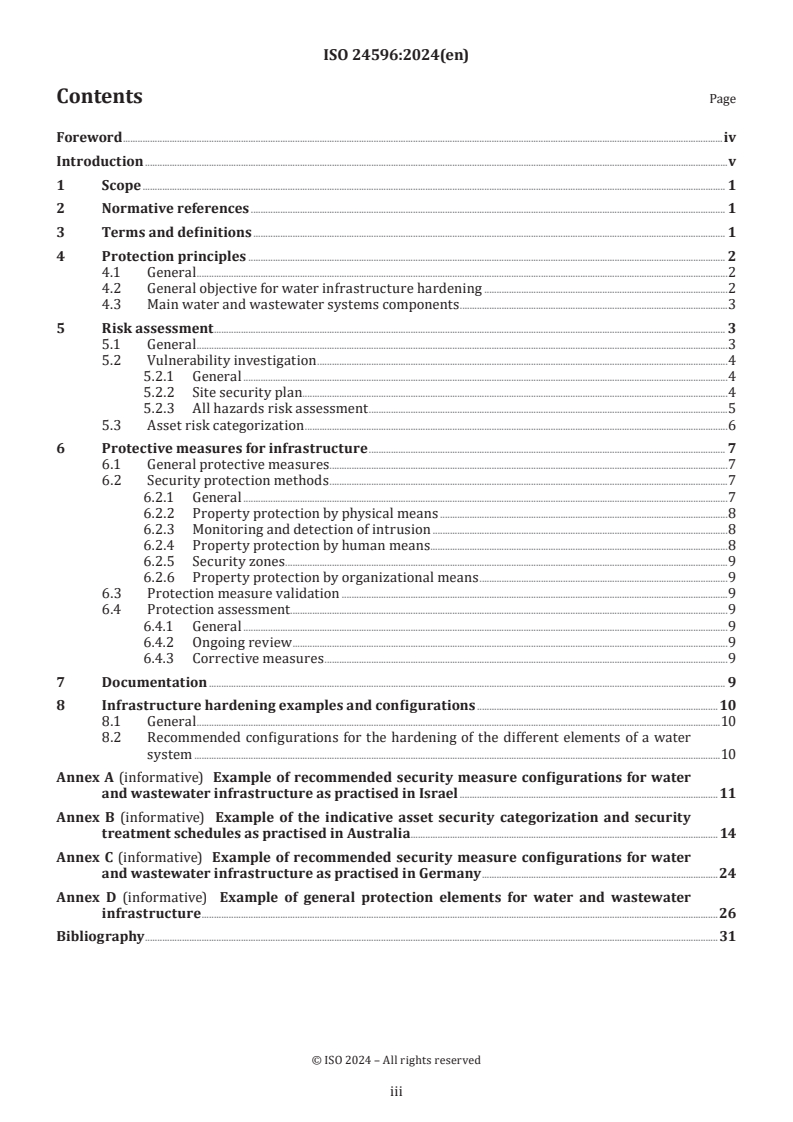
Contents Page
Foreword .iv
Introduction .v
1 Scope . 1
2 Normative references . 1
3 Terms and definitions . 1
4 Protection principles . 2
4.1 General .2
4.2 General objective for water infrastructure hardening .2
4.3 Main water and wastewater systems components .3
5 Risk assessment . 3
5.1 General .3
5.2 Vulnerability investigation .4
5.2.1 General .4
5.2.2 Site security plan.4
5.2.3 All hazards risk assessment .5
5.3 Asset risk categorization .6
6 Protective measures for infrastructure . 7
6.1 General protective measures.7
6.2 Security protection methods .7
6.2.1 General .7
6.2.2 Property protection by physical means .8
6.2.3 Monitoring and detection of intrusion .8
6.2.4 Property protection by human means.8
6.2.5 Security zones .9
6.2.6 Property protection by organizational means .9
6.3 Protection measure validation .9
6.4 Protection assessment . .9
6.4.1 General .9
6.4.2 Ongoing review .9
6.4.3 Corrective measures .9
7 Documentation . 9
8 Infrastructure hardening examples and configurations .10
8.1 General .10
8.2 Recommended configurations for the hardening of the different elements of a water
system .10
Annex A (informative) Example of recommended security measure configurations for water
and wastewater infrastructure as practised in Israel .11
Annex B (informative) Example of the indicative asset security categorization and security
treatment schedules as practised in Australia . 14
Annex C (informative) Example of recommended security measure configurations for water
and wastewater infrastructure as practised in Germany .24
Annex D (informative) Example of general protection elements for water and wastewater
infrastructure .26
Bibliography .31
iii
Foreword
ISO (the International Organization for Standardization) is a worldwide federation of national standards
bodies (ISO member bodies). The work of preparing International Standards is normally carried out through
ISO technical committees. Each member body interested in a subject for which a technical committee
has been established has the right to be represented on that committee. International organizations,
governmental and non-governmental, in liaison with ISO, also take part in the work. ISO collaborates closely
with the International Electrotechnical Commission (IEC) on all matters of electrotechnical standardization.
The procedures used to develop this document and those intended for its further maintenance are described
in the ISO/IEC Directives, Part 1. In particular, the different approval criteria needed for the different types
of ISO documents should be noted. This document was drafted in accordance with the editorial rules of the
ISO/IEC Directives, Part 2 (see www.iso.org/directives).
ISO draws attention to the possibility that the implementation of this document may involve the use of (a)
patent(s). ISO takes no position concerning the evidence, validity or applicability of any claimed patent
rights in respect thereof. As of the date of publication of this document, ISO had not received notice of (a)
patent(s) which may be required to implement this document. However, implementers are cautioned that
this may not represent the latest information, which may be obtained from the patent database available at
www.iso.org/patents. ISO shall not be held responsible for identifying any or all such patent rights.
Any trade name used in this document is information given for the convenience of users and does not
constitute an endorsement.
For an explanation of the voluntary nature of standards, the meaning of ISO specific terms and expressions
related to conformity assessment, as well as information about ISO's adherence to the World Trade
Organization (WTO) principles in the Technical Barriers to Trade (TBT), see www.iso.org/iso/foreword.html.
This document was prepared by Technical Committee ISO/TC 224, Drinking water, wastewater and
stormwater systems and services.
Any feedback or questions on this document should be directed to the user’s national standards body. A
complete listing of these bodies can be found at www.iso.org/members.html.
iv
Introduction
Hardening of water and wastewater infrastructure is one of the most crucial issues to address when
formulating and implementing a plan for assuring the security of water and wastewater systems. The
delivery of strong safety and security outcomes is essential to protect employees, the public and the assets
of the water utility. Securing the assets and operations, where these facilities constitute an essential element
of water service continuity or contain hazards or risks to the public, should be central to each water utility’s
safety and security programme and demonstrated through applied risk management principles, business
activities and associated corporate documentation. These assets are crucial to ensure service continuity
and minimize risks to the community.
Over the past few years there has been an increase in water and wastewater supply crisis events associated
with:
— climate change;
— cyberattacks on water infrastructure;
— civil disruption;
— terrorist-related physical attacks on civil targets.
There has also been an increase in public awareness of water and wastewater incidents.
Under these circumstances, the protection of water and wastewater infrastructure is of critical importance.
Hardening of water and wastewater infrastructures has the aim of enhancing the protection of these
infrastructures. Hardening consists of construction and creation of barriers, that can include physical and
electronic elements, personnel and organizational measures, with the purpose of making it difficult to
intentionally or unintentionally disrupt service continuity, supply and quality.
Examples of such barriers include fences, buildings, electronic alarms and cameras connected to control
rooms, remote valves, both manual and remote controlled, backflow preventers, analysis software, such
[1]
as event detection systems (EDS, as described in ISO/TS 24522) and software designed to prevent
cyberattacks.
Another type of protective system is the installation of monitoring equipment for water quality and
operational parameters. This document only briefly refers to this type of protection. For more information,
[2]
see ISO/TS 24541 .
v
International Standard ISO 24596:2024(en)
Drinking water, wastewater and stormwater systems and
services — Guidelines for the planning and implementation
of infrastructure hardening for water and wastewater
systems
1 Scope
This document provides guidelines for the planning and implementation of hardening of different water and
wastewater infrastructures aiming to improve the resilience of water and wastewater services provided by
water utilities through security measures.
It applies to the determination of measures for the protection of water supply systems and sewer collection
systems from unwanted or unplanned access, as part of risk management. This document is applicable to all
water and/or wastewater utilities.
This document does not include guidelines for the protection of large water sources such as lakes or rivers.
2 Normative references
The following documents are referred to in the text in such a way that some or all of their content constitutes
requirements of this document. For dated references, only the edition cited applies. For undated references,
the latest edition of the referenced document (including any amendments) applies.
ISO 24513, Service activities relating to drinking water supply, wastewater and stormwater systems —
Vocabulary
3 Terms and definitions
For the purposes of this document, the terms and definitions given in ISO 24513 and the following apply.
ISO and IEC maintain terminology databases for use in standardization at the following addresses:
— ISO Online browsing platform: available at https:// www .iso .org/ obp
— IEC Electropedia: available at https:// www .electropedia .org/
3.1
access point
opening or accessible opening in the perimeter of a site, building, structure or cabinet
3.2
alarm
audible and visual signal alerting a condition requiring immediate attention or user action
[3]
[SOURCE: ISO 8468:2007, 3.1.3 ]
3.3
alarm response
type and timeframe of physical response to a designated site to enable an informed management decision in
response to an alarm (3.2) or other alert
3.4
detector
item of electronic hardware which transmits designated signals (e.g. fire or movement) under specified
environmental conditions to a control panel
3.5
integrate
conceptual and physical linkage between the planning aspects of protective monitoring systems
EXAMPLE Fire systems linked to intruder alarm systems and access control systems, with common interphase
and signalling under prescribed conditions.
3.6
security
resistance to intentional acts designed to cause harm or damage
[4]
[SOURCE: ISO 28001:2007, 3.20, modified — the phrase “to or by the supply chain” was removed .]
4 Protection principles
4.1 General
Hardening of assets should be based on the following principles:
— risk-based approach;
— continuity and integration of water services;
— security and safety of the community and employees;
— assurance that appropriate standards and controls have mitigated risks inherent to water and wastewater
infrastructure.
Hardening of water and wastewater infrastructure is divided into electronic and non-electronic, personnel
and organizational measures, with the purpose of making it difficult to intentionally or unintentionally
disrupt the service supply and cause the quality to deteriorate.
For initial security measures, a combination of physical measures (i.e. non-electronic measures) are often
used – e.g. fencing or other entry barriers. Where the physical protection measures do not meet the required
level of protection, electronic security measures should be used. In particular, physical property protective
measures primarily refer to buildings and above-ground facilities or to buildings with above-ground access.
As a rule, personnel and organizational measures are required for the property protection of underground
assets.
The property protective measures should be based on a risk assessment approach and may also be staged
based on the level of hardening required. Basic protective measures in the event of increasing danger
should be supplemented by additional prevention measures, depending on the situation. These preventive
measures may consist of personnel or organizational measures. Personnel measures are related to access
control, patrolling and guarding. Organizational controls relate to, for example, employment and periodic
safety visits and the conduct of exercises and post-security incident analysis.
4.2 General objective for water infrastructure hardening
Measures used to harden a water or wastewater facility should be conceived and revised in line with
evolving national security risk advice, national security guidelines, legal risk determinations and local and
regional risk conditions, as well as organizational and operational risk assessments.
The general objectives for the hardening of water infrastructure should be:
— preventing or delaying unauthorized access to water and wastewater assets, to avoid destruction or
interference, creating the conditions for conveying to the relevant bodies immediate knowledge that
someone may have accessed a water infrastructure without authorization;
— allowing the detention or identification of intruders and the initiation, if necessary, of subsequent
prosecution by law enforcement.
4.3 Main water and wastewater systems components
The main water and wastewater systems components which should be considered for hardening purposes
are:
— treatment plants and their components;
— water and wastewater reservoirs and tanks (open and closed);
— water abstraction and bulk water storage facilities, such as dams and groundwater wells;
— water supply off-takes and diversions;
— water and wastewater supply network infrastructure.
The application of risk-based benchmarked security and public safety principles and standards to the water
and wastewater assets should be applied to achieve a cohesive protective security effect. The following key
principles should be considered:
a) The levels of risk control should be determined using evidenced-based risk assessments.
b) Risk assessments should be benchmarked against infrastructure, community security and public safety
risk experience.
Water utility managers should:
— identify the risk to public safety and security;
— monitor conformity with safety and security standards;
— operate and maintain assets in accordance with corporate requirements;
— ensure the applied public safety and security treatments are appropriate to the risk environment.
5 Risk assessment
5.1 General
To formulate a plan for the hardening of water system infrastructure, risk assessment of the system should
be performed to decide which elements of the water system will be hardened and to what extent, and to
establish a priority order of implementation.
[5]
The risk management plan should be developed in a manner consistent with ISO 31000. In the development
of a risk management plan, all stakeholders, including external regulators and institutions, should be
identified. Accountability for the risk management plan development, delivery and review should be clearly
designated.
To assist in developing the risk management plan, a system vulnerability investigation should be performed
on all the elements of the system mentioned in 5.2.
5.2 Vulnerability investigation
5.2.1 General
A vulnerability investigation requires the development of a site security plan and undertaking of an “all
hazards” review (see 5.2.2 and 5.2.3).
5.2.2 Site security plan
The site security plan should document the current conditions of the installation in relation to security.
The site security plan should:
[6] [7]
a) document the layout (see ISO 24518 and ISO/TS 24520 ) and site security aspects of the system or
facility being secured, including items such as:
— water wells;
— tanks or reservoirs and other storage facilities;
— hydrants, accessories, pipelines and connections;
— open channels;
— water treatment plant components;
— wastewater treatment plant components;
b) note the requirements of relevant, occupational health and safety, environmental and security
legislation;
c) identify specific requirements of the water utility, including provision for future expansion of the system
and/or required augmentation to the existing system;
d) include critical details related to the “all hazards” risk management plan, including:
[6] [7]
— impacts on the community (see ISO 24518 and ISO/TS 24520 );
— alternative drinking water, wastewater, stormwater and non-drinking water services;
— product quality performance requirements;
— quantity and reliability requirements;
— outcomes from the asset risk classification;
e) document the security profile of the system, including an assessment of the local environment and
general area of influence, including:
— geography;
— meteorology;
— demography;
— emergency, police, security and medical response services;
— asset categorization of the site and its individual components;
— operations of the site;
— other equipment and assets;
— visible deterrence level required, versus the detection and response capacity available for the subject
site;
— total loss effect, redundancy capacity, depth of contingency planning and repair capacity;
f) document engagement with key stakeholders, including government officials and the police, as deemed
necessary by the water utility.
5.2.3 All hazards risk assessment
During the planning, concept and design phases of new, extended, upgraded and renewed water systems, a
practical and appropriately documented “all hazards” risk assessment should be undertaken in accordance
[5]
with ISO 31000. To ensure effective property protection, a precise analysis and evaluation of hazards of
both the individual infrastructure and the entirety of the water supply systems in accordance with risk
management practices should be carried out on the basis of the protection objectives described in 4.2. This
should include recurring and event-related hazards and consider the nature and extent of the hazard and its
potential impact on the infrastructure (see Annex C).
Risk should be defined by the components of likelihood (plausibility) and consequence. In determining the
consequence, the vulnerability of the infrastructure, including functional susceptibility and replaceability,
should be taken into account.
The functional susceptibility includes aspects such as the dependence or effect on other internal and
external infrastructure and the intrinsic robustness of the water infrastructure against external influences.
Replaceability includes aspects such as redundancy and the expected effort to restore services. In addition
to the direct effects on the infrastructure, the effects on the whole or parts of the water supply system
should be determined and taken into account in the risk classification.
The “all hazards” risk assessment should qualitatively and quantitatively identify and assess the following
risk areas, as a minimum:
a) environmental hazards;
b) external and internal human environment:
1) natural hazards, e.g. fires or floods;
2) human induced, e.g. vandalism, sabotage, terrorism (noting that this can require engagement with
authorities such as the police to determine effectively);
3) geographic environmental risks:
— proximity to population centres' direct and indirect risks to the population;
— number of people served by the relevant system element;
— supply to special type of users (e.g. hospitals, schools, key factories);
4) collateral systems and operational effects:
— physical conditions of the system, e.g. accessibility, level of protection;
— hydraulic nature of the system, e.g. gravity, pressure, open channel;
— digital connectivity, e.g. manual operation, on-site automation, networked automation, centralized
or distributed data collection;
— operational, essential and emergency services and security response capabilities;
— contingency bypass, replacement or recovery capability.
Following risk assessment, an appropriate and cost-effective level of hardening and asset protection should
be determined for each asset category within the system using the asset risk categorization (see 5.3). These
appropriate protection components or required design features should in turn be incorporated into the final
design of the infrastructure and reflected in the site security plan.
NOTE This approach assumes that consequence is the dominant variable in determining whether to harden a
facility. The likelihood of an event can be of lesser significance than the consequence and is used to determine the
aspects of the facility that require hardening. The reasoning is that if the potential consequence component of the
risk is deemed high or medium, then even though the likelihood of an event is low, consideration must be given to
hardening the installation. This is because the current environment of rapidly evolving threats, particularly terrorism
and cyberattacks, coupled with customer expectations and reputational damage from successful attacks on this
infrastructure area, means that compromise of the system is an unacceptable outcome.
5.3 Asset risk categorization
Asset risk categorization relates to the consequences of asset function loss. It provides a basis for selection
of appropriate infrastructure protection treatments relevant to the impact on downstream water services
during a period of disruption, taking account of the intrinsic ability to bypass the asset functionality and
continue to deliver water services to achieve the required goals.
The water utility should define the asset categorization and the operational environment based on the risk
[8]
assessment (implementing criticality analysis methods).
A complex site (multiple functions and assets) may have an overall high rating with specific components
receiving differing ratings, dependent on their criticality. In such cases, security of specific assets within a
site perimeter should be considered as more practicable than treating the entire site.
Table 1 provides guidance on assigning the level of hardening relative to the impacts of loss of asset
functionality.
Table 1 — Generic infrastructure protection guidance
Asset Suggested
risk Description Loss effect (impact) hardening
level level
Critical operational site or component.
Identified by external and internal
Community, commercial and industrial
stakeholders as critical for operation,
loss. Major contingency effort to
loss effect, community perception and
A continue operations. Major media and High
national defence or strategic
government attention, regulator
requirements.
investigation and potential action.
Critical to the control and operational
integrity of the integrated services or supply.
Key operational site.
Potential commercial and
Key link in the integrated supply system.
industrial loss for the community.
Significant or single source.
Significant contingency effort to
May be remote with extended travel
B continue operations. Medium
times or no local community.
Media and ministerial attention.
Located close to high-density population
Regulator investigation and
area. Essential supply link to important na-
potential action.
tional defence or strategic asset.
Minimal or zero commercial loss
Operational site. Short effect.
in the community.
C Low
Or non-essential site. Minimal or no loss
Limited or zero media attention.
effect.
Regulator routine investigation.
Once the desired level of security is determined, the outcomes from the risk assessment should be used to
determine the necessity and priority for implementation of individual protective measures (see Annex A,
Annex B and Annex C for examples).
6 Protective measures for infrastructure
6.1 General protective measures
The following provide general guidance for design treatments in relation to site hardening.
a) For properties adjacent to high-volume roads and sites subject to sustained construction, robust
security detection equipment should be adequate; in some instances, seismic detection equipment or
smoke detection apparatus can be considered.
b) For agricultural, semi-rural and high crime areas, ballistically tolerant lighting fixtures, closed-circuit
television (CCTV) enclosures and detection apparatus should be adequate.
c) For assets located near schools and places of mass gathering, greater levels of security treatment should
be adequate.
d) For urban high-density population areas with evidence of repeated site intrusion vandal-resistant
external lighting, CCTV and detection apparatus fixtures should be adequate.
e) All external and internal infrastructure should take into account the extremes of weather over a longer
time period appropriate to each country, e.g. 50 or 100 years. Considerations could include:
— water and flood levels, frequency and severity;
— temperature extremes and ranges;
— UV (ultraviolet) levels;
— wind (prevailing, seasonal and maximal);
— dust levels;
— salinity levels;
— condensation, cyclic, mist and ambient moisture levels;
— fire hazards;
— seismic movement, volcanic activity or tsunamis.
The installations should also consider adjacent foliage and fauna, including:
— trees;
— insects;
— birds and bats;
— large and small burrowing animals;
— animals with the potential to scale, burrow under or cross fences.
6.2 Security protection methods
6.2.1 General
Security protection requires physical, personnel or organizational measures aimed at reducing risks to
acceptable levels. Specific risk-control measures should be prioritized, with a preference for those measures
that demonstrate high reliability and operational stability (e.g. low false reporting rate).
An integrated combination of physical, personnel and organizational measures offers the most effective
property protection.
When defining the measures to be implemented, responsibilities and deadlines for their implementation
should be clarified.
It is advisable to employ suitably certified security officers in order to support the selection and
implementation of appropriate protective measures.
For examples of general protective elements for water and wastewater infrastructure, see Annex D.
6.2.2 Property protection by physical means
Property protection by physical means should include structural (e.g. building materials), mechanical (door
chains, box locks) and electronic security measures that increase the time to penetrate the infrastructure
by intrusion attempts. These measures are required to provide early and timely warning to the water utility
and may include the following:
— maximizing the structural integrity of external building surfaces (hardening the outer skin) to minimize
injury to personnel and equipment within the structure;
— delaying intrusion by making access difficult or preventing unauthorised access to the site, buildings and
facilities.
For further information on physical property protection measures and a comparison of mechanical burglary
protection security levels, see Annex A, Annex B and Annex C.
Where mechanical protection is not sufficient or cannot be achieved, additional electronic safety systems
should be used.
Particular attention should be paid to intercoupling the mechanical and electronic safety systems such that
all mechanical and electronic protective elements are coordinated with each other and work effectively
together, considering that the weakest link determines the security level for the overall system.
6.2.3 Monitoring and detection of intrusion
Detection of intrusion or compromise of the facility and its associated water supply can occur in the
following ways:
a) Direct detection of the intruder or trespasser, which can be of a physical or virtual nature. The intruder
or trespasser is observed and then the appropriate countermeasures engaged, to delay, detain or remove
them.
b) Indirect detection, where a disruption to the normal performance of the system is detected through the
use of sentinel monitoring systems, such as the following:
— Part of the electronic cyber security system, whereby digital detection systems track, delay, decoy,
detail, identify and remove the intrusion or report it to a relevant authority for manual intervention.
[9] [10]
ISO/IEC 27000 and the IEC 62443 series provide guidance on the relevant approaches.
— Part of the water quality monitoring network, whereby online sensors or intermittent sampling detects
[2]
a system change requiring further investigation. ISO/TS 24541 provides guidance on the use of these
measures.
6.2.4 Property protection by human means
Property protection using personnel essentially includes the patrolling of the area, buildings and facilities
by the water utility's own personnel, a commissioned security service or the police.
It may also include the preparation and implementation of standard operational procedures (SOPs) in
password management and two-factor authentication (2FA), i.e. use of a password and code sent to a mobile
phone to allow access.
6.2.5 Security zones
Plant-related security zones and the appropriate protection levels should be considered by the water utility
during planning for water and wastewater infrastructure using the appropriate risk management criteria.
Annex A, Annex B and Annex C provide some examples of detailed description of and proposals for the
elements that provide physical protection for the different infrastructure of water and wastewater systems.
6.2.6 Property protection by organizational means
Organizational infrastructure protection includes:
— access authorizations;
— action plans for alarm response;
— agreements with the local police authorities and/or the fire brigade on joint procedures when alarms are
raised.
6.3 Protection measure validation
All measures installed for protection purposes should be validated by a qualified person within the water
utility or a suitably qualified third-party organization. When undertaking the validation, the following
should be considered:
— theoretical approaches and calculations;
— simulation of specific hazard conditions;
— valuation of data or records collected from measures implemented during normal operation.
6.4 Protection assessment
6.4.1 General
For reliable property protection, all recommended property protective security measures should be
implemented. Once installed, their effectiveness in operation should be monitored, tested and audited.
In addition, the effective interaction of each security measure should be assessed critically and for
interdependencies with other measures, confirmed and, if necessary, modified and optimized.
6.4.2 Ongoing review
The audit should be repeated periodically. The frequency of the auditing depends on the condition of the
water system in relation to its environmental conditions (e.g. the need for protection or threats to the
infrastructure). If critical changes occur in water and wastewater systems regarding legal requirements,
technical regulation or environmental threats, then the frequency of revision should change accordingly.
6.4.3 Corrective measures
If the protection level required is not achieved, appropriate corrective measures should be taken.
7 Documentation
The evaluation of water supply systems, the selected measures for risk control, the validation, the
implementation and operational monitoring of measures, the definition and implementation of corrective
[6]
measures and verification should be documented in a comprehensive manner (see ISO 24518 and
[7]
ISO/TS 24520 ).
8 Infrastructure hardening examples and configurations
8.1 General
The hardening of an element in a water system may be achieved in a basic configuration or in a configuration
that includes additional hardening elements.
The decision on which configuration to choose should depend on:
— the level of risk to the specific water system being considered, as discovered during the investigation
described in 5.2 and 5.3;
— the budget and assets allocated to the water utility for the hardening of the water system.
8.2 Recommended configurations for the hardening of the different elements of a water
system
Annex A provides an example of recommended configurations for water and wastewater infrastructure, as
practiced in Israel.
Annex B provides an example of the indicative asset security categorization and security treatment
schedules as practiced in Australia.
Annex C provides an example of recommended configurations for water and wastewater infrastructure, as
practiced in Germany.
NOTE Security treatments can be permanent or temporary. Permanent security treatments are installed to form
an integral component of the ultimate asset infrastructure. Temporary security treatments do not form an integral
component of the ultimate asset infrastructure and can be considered during construction periods or following
emergency events.
Annex A
(informative)
Example of recommended security measure configurations for water
and wastewater infrastructure as practised in Israel
A.1 General
This annex details recommended configurations for basic and additional security measures for the different
components of water and wastewater systems.
A.2 Water and wastewater treatment plants
The basic configuration consists of:
— peripheral physical fence or electronic fence and gates;
— magnetic sensors on all doors and openings;
— automatic outlet valves shut off when the sensors are tripped;
— volume detector;
— video cameras (drones can be considered);
[10] [9]
— cyber security protection, hardened according to the IEC 62443 series and ISO/IEC 27000 ;
— online water quality analysers.
All sensors should be monitored through a centralised SCADA (supervisory control and data acquisition)
system or any other system that can receive the data and control the actions that have to be taken.
A.3 Closed water reservoir or tank
The basic configuration consists of:
— peripheral physical fence or electronic fence and gates;
— magnetic sensors on all tank openings;
— sensors on ladders;
— automatic outlet valves on the tank that shuts off when the sensors are tripped.
All sensors should be monitored through a central SCADA system or any other system that can receive the
data and control the actions that have to be taken.
Additional site security measures configuration options may include:
— volume detector;
— video cameras (drones can be considered);
— peripheral beam detectors;
— automatic operation of lighting system.
A.4 Water reservoir
The basic configuration consists of:
— peripheral physical fence or electronic fence and gates;
— automatic peripheral lighting that is activated when a sensor is tripped;
— video cameras (drones can be considered).
All sensors should be monitored through a central SCADA system or any other system that can receive the
data and control the actions that have to be taken.
Additional site security measure configuration options include:
— volume detectors;
— human guards.
A.5 Open channels
The basic configuration consists of:
— physical or electronic fence with hardened locked gates throughout the length of the channel;
— volumetric sensors for detecting unauthorized activity along the channel;
— automatic peripheral lighting that is activated when a sensor is tripped;
— video cameras (drones can be considered).
All sensors should be monitored through a central SCADA system or any other system that can receive the
data and control the actions that have to be taken.
A.6 Water pipeline
The basic configuration consists of:
— burying the pipeline 0,6 m to 1 m underground;
— in the sectors of the pipeline that have to be above ground, the protection should include a physical fence
with a hardened locked gate;
— continuous monitoring system and an EDS (to be considered).
A.7 Air release valves, drain pipes, fire hydrants and other above-ground devices
The basic configuration consists of:
— the device should be surrounded by a physical fence with a hardened locked gate;
— optional: in vulnerable areas, the air release valve is enclosed in a special locked metal box;
— optional: in highly vulnerable areas, the air release valve is enclosed in a special locked metal box with
magnetic sensors.
A.8 Dosing pumps
The basic configuration consists of:
— dosing pumps installed in a locked room while the chemical tank is installed in a separate ventilated
locked room;
— the entire system located in a fenced site with magnetic sensors on the doors and/or volume detectors.
A.9 Wells, water and wastewater pumping stations
The basic configuration consists of:
— the water wells and water and wastewater pumping stations site enclosed in a fence with a peripheral
beam alarm;
— openings that allow access to the water or wastewater body, for level measurement and other purposes,
locked and strengthened;
— optional: the water well or pumping station enclosed in a conventional concrete building with hardened
locks and magnetic sensors on the doors a
...