


ISO/TR 9272:2005
(Main)Rubber and rubber products — Determination of precision for test method standards
Rubber and rubber products — Determination of precision for test method standards
ISO/TR 9272:2005 presents guidelines for determining, by means of interlaboratory test programmes (ITPs), precision for test method standards used in the rubber manufacturing and the carbon black industries. It uses the basic one-way analysis of variance calculation algorithms of ISO 5725 and as many of the terms and definitions of ISO 5725 as possible that do not conflict with the past history and procedures for precision determination in these two industries. Although bias is not determined in this Technical Report, it is an essential concept in understanding precision determination. The ISO 5725 concepts of accuracy and trueness are not determined in this Technical Report. Two precision determination methods are given that are described as 'robust' statistical procedures that attempt to eliminate or substantially decrease the influence of outliers. The first is a 'level 1 precision' procedure intended for all test methods in the rubber manufacturing industry and the second is a specific variation of the general precision procedure, designated 'level 2 precision', that applies to carbon black testing. Both of these use the same uniform level experimental design and the Mandel h and k statistics to review the precision database for potential outliers. However, they use slight modifications in the procedure for rejecting incompatible data values as outliers. The 'level 2 precision' procedure is specific as to the number of replicates per database cell or material-laboratory combination.
Caoutchouc et produits en caoutchouc — Évaluation de la fidélité des méthodes d'essai normalisées
General Information
- Status
- Withdrawn
- Publication Date
- 04-Aug-2005
- Withdrawal Date
- 04-Aug-2005
- Technical Committee
- ISO/TC 45/SC 2 - Testing and analysis
- Drafting Committee
- ISO/TC 45/SC 2/WG 4 - Application of statistical methods
- Current Stage
- 9599 - Withdrawal of International Standard
- Start Date
- 03-Dec-2018
- Completion Date
- 14-Feb-2026
Relations
- Effective Date
- 23-Apr-2020
- Revises
ISO/TR 9272:1986 - Rubber and rubber products — Determination of precision for test method standards - Effective Date
- 15-Apr-2008




Get Certified
Connect with accredited certification bodies for this standard

Smithers Quality Assessments
US management systems and product certification.

DIN CERTCO
DIN Group product certification.
Sponsored listings
Frequently Asked Questions
ISO/TR 9272:2005 is a technical report published by the International Organization for Standardization (ISO). Its full title is "Rubber and rubber products — Determination of precision for test method standards". This standard covers: ISO/TR 9272:2005 presents guidelines for determining, by means of interlaboratory test programmes (ITPs), precision for test method standards used in the rubber manufacturing and the carbon black industries. It uses the basic one-way analysis of variance calculation algorithms of ISO 5725 and as many of the terms and definitions of ISO 5725 as possible that do not conflict with the past history and procedures for precision determination in these two industries. Although bias is not determined in this Technical Report, it is an essential concept in understanding precision determination. The ISO 5725 concepts of accuracy and trueness are not determined in this Technical Report. Two precision determination methods are given that are described as 'robust' statistical procedures that attempt to eliminate or substantially decrease the influence of outliers. The first is a 'level 1 precision' procedure intended for all test methods in the rubber manufacturing industry and the second is a specific variation of the general precision procedure, designated 'level 2 precision', that applies to carbon black testing. Both of these use the same uniform level experimental design and the Mandel h and k statistics to review the precision database for potential outliers. However, they use slight modifications in the procedure for rejecting incompatible data values as outliers. The 'level 2 precision' procedure is specific as to the number of replicates per database cell or material-laboratory combination.
ISO/TR 9272:2005 presents guidelines for determining, by means of interlaboratory test programmes (ITPs), precision for test method standards used in the rubber manufacturing and the carbon black industries. It uses the basic one-way analysis of variance calculation algorithms of ISO 5725 and as many of the terms and definitions of ISO 5725 as possible that do not conflict with the past history and procedures for precision determination in these two industries. Although bias is not determined in this Technical Report, it is an essential concept in understanding precision determination. The ISO 5725 concepts of accuracy and trueness are not determined in this Technical Report. Two precision determination methods are given that are described as 'robust' statistical procedures that attempt to eliminate or substantially decrease the influence of outliers. The first is a 'level 1 precision' procedure intended for all test methods in the rubber manufacturing industry and the second is a specific variation of the general precision procedure, designated 'level 2 precision', that applies to carbon black testing. Both of these use the same uniform level experimental design and the Mandel h and k statistics to review the precision database for potential outliers. However, they use slight modifications in the procedure for rejecting incompatible data values as outliers. The 'level 2 precision' procedure is specific as to the number of replicates per database cell or material-laboratory combination.
ISO/TR 9272:2005 is classified under the following ICS (International Classification for Standards) categories: 83.060 - Rubber; 83.140.01 - Rubber and plastics products in general. The ICS classification helps identify the subject area and facilitates finding related standards.
ISO/TR 9272:2005 has the following relationships with other standards: It is inter standard links to ISO 19983:2017, ISO/TR 9272:1986. Understanding these relationships helps ensure you are using the most current and applicable version of the standard.
ISO/TR 9272:2005 is available in PDF format for immediate download after purchase. The document can be added to your cart and obtained through the secure checkout process. Digital delivery ensures instant access to the complete standard document.
Standards Content (Sample)
TECHNICAL ISO/TR
REPORT 9272
Second edition
2005-07-15
Rubber and rubber products —
Determination of precision for test
method standards
Caoutchouc et produits en caoutchouc — Évaluation de la fidélité des
méthodes d'essai normalisées
Reference number
©
ISO 2005
PDF disclaimer
This PDF file may contain embedded typefaces. In accordance with Adobe's licensing policy, this file may be printed or viewed but
shall not be edited unless the typefaces which are embedded are licensed to and installed on the computer performing the editing. In
downloading this file, parties accept therein the responsibility of not infringing Adobe's licensing policy. The ISO Central Secretariat
accepts no liability in this area.
Adobe is a trademark of Adobe Systems Incorporated.
Details of the software products used to create this PDF file can be found in the General Info relative to the file; the PDF-creation
parameters were optimized for printing. Every care has been taken to ensure that the file is suitable for use by ISO member bodies. In
the unlikely event that a problem relating to it is found, please inform the Central Secretariat at the address given below.
© ISO 2005
All rights reserved. Unless otherwise specified, no part of this publication may be reproduced or utilized in any form or by any means,
electronic or mechanical, including photocopying and microfilm, without permission in writing from either ISO at the address below or
ISO's member body in the country of the requester.
ISO copyright office
Case postale 56 • CH-1211 Geneva 20
Tel. + 41 22 749 01 11
Fax + 41 22 749 09 47
E-mail copyright@iso.org
Web www.iso.org
Published in Switzerland
ii © ISO 2005 – All rights reserved
Contents Page
Foreword. v
Introduction . vi
1 Scope . 1
2 Normative references . 1
3 Terms and definitions. 1
3.1 General. 1
3.2 ISO 5725 terms . 2
3.3 Required terms not in ISO 5725 . 4
4 Field of application . 6
4.1 General background. 6
4.2 Defining repeatability and reproducibility. 7
5 Precision determination: Level 1 precision and level 2 precision. 8
5.1 Level 1 precision. 8
5.2 Level 2 precision. 8
5.3 Types of level 1 and level 2 precision. 8
6 Steps in organizing an interlaboratory test programme. 9
7 Overview of level 1 precision analysis procedure . 11
7.1 Analysis operation sequence . 11
7.2 Background on outliers. 12
7.3 Outlier appearance patterns . 12
7.4 Sequential review of outliers . 12
8 Level 1 precision: Analysis step 1 . 13
8.1 Preliminary numerical and graphical data review . 13
8.2 Graphical review of cell values . 13
8.3 Calculation of precision for original database . 14
8.4 Detection of outliers at the 5 % significance level using h and k statistics . 14
8.5 Generation of revision 1 database using outlier option 1 or 2 . 15
8.6 Revision 1 (R1) database tables. 15
9 Level 1 precision: Analysis step 2 . 15
9.1 Detection of outliers at the 2 % significance level using h and k statistics . 15
9.2 Generation of revision 2 database using outlier option 1 or 2 . 15
10 Level 1 precision: Analysis step 3 — Final precision results . 16
11 Level 2 precision: Analysis of results obtained when testing carbon blacks. 16
11.1 Background on level 2 precision . 16
11.2 Data review and calculations. 17
11.3 Expressing the precision determined for carbon black testing . 17
12 Format for level 1 and level 2 precision-data table and precision clause in test method
standards. 18
12.1 Precision-data table. 18
12.2 Precision clause. 18
12.3 Report on the precision determination ITP. 20
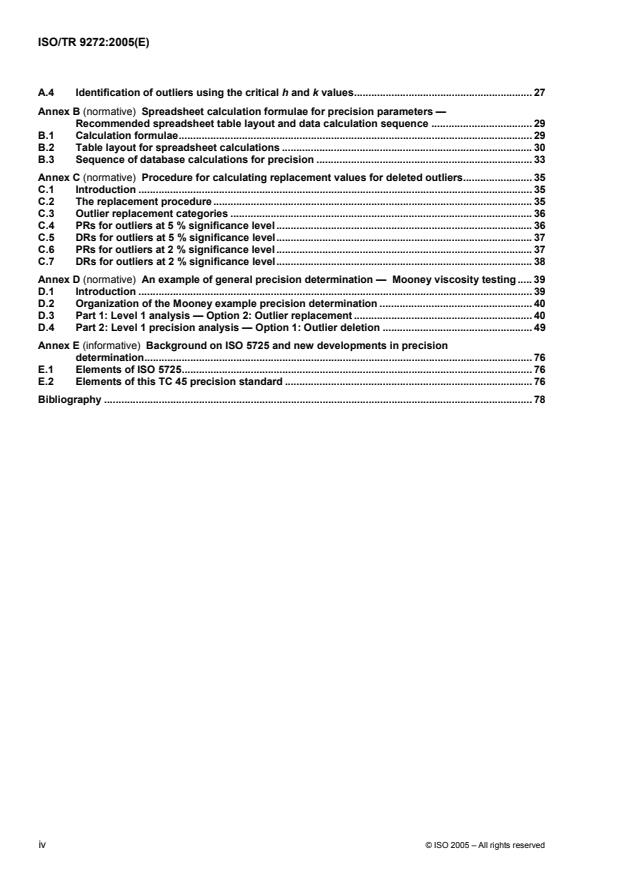
Annex A (normative) Calculating the h and k consistency statistics. 25
A.1 General background. 25
A.2 Defining and calculating the h statistic. 25
A.3 Defining and calculating the k-statistic. 26
A.4 Identification of outliers using the critical h and k values. 27
Annex B (normative) Spreadsheet calculation formulae for precision parameters —
Recommended spreadsheet table layout and data calculation sequence . 29
B.1 Calculation formulae. 29
B.2 Table layout for spreadsheet calculations .30
B.3 Sequence of database calculations for precision . 33
Annex C (normative) Procedure for calculating replacement values for deleted outliers. 35
C.1 Introduction . 35
C.2 The replacement procedure. 35
C.3 Outlier replacement categories . 36
C.4 PRs for outliers at 5 % significance level . 36
C.5 DRs for outliers at 5 % significance level. 37
C.6 PRs for outliers at 2 % significance level . 37
C.7 DRs for outliers at 2 % significance level. 38
Annex D (normative) An example of general precision determination — Mooney viscosity testing . 39
D.1 Introduction . 39
D.2 Organization of the Mooney example precision determination . 40
D.3 Part 1: Level 1 analysis — Option 2: Outlier replacement . 40
D.4 Part 2: Level 1 precision analysis — Option 1: Outlier deletion . 49
Annex E (informative) Background on ISO 5725 and new developments in precision
determination. 76
E.1 Elements of ISO 5725. 76
E.2 Elements of this TC 45 precision standard . 76
Bibliography . 78
iv © ISO 2005 – All rights reserved
Foreword
ISO (the International Organization for Standardization) is a worldwide federation of national standards bodies
ISO (the International Organization for Standardization) is a worldwide federation of national standards bodies
(ISO member bodies). The work of preparing International Standards is normally carried out through ISO
technical committees. Each member body interested in a subject for which a technical committee has been
established has the right to be represented on that committee. International organizations, governmental and
non-governmental, in liaison with ISO, also take part in the work. ISO collaborates closely with the
International Electrotechnical Commission (IEC) on all matters of electrotechnical standardization.
International Standards are drafted in accordance with the rules given in the ISO/IEC Directives, Part 2.
The main task of technical committees is to prepare International Standards. Draft International Standards
adopted by the technical committees are circulated to the member bodies for voting. Publication as an
International Standard requires approval by at least 75 % of the member bodies casting a vote.
In exceptional circumstances, when a technical committee has collected data of a different kind from that
which is normally published as an International Standard (“state of the art”, for example), it may decide by a
simple majority vote of its participating members to publish a Technical Report. A Technical Report is entirely
informative in nature and does not have to be reviewed until the data it provides are considered to be no
longer valid or useful.
Attention is drawn to the possibility that some of the elements of this document may be the subject of patent
rights. ISO shall not be held responsible for identifying any or all such patent rights.
ISO/TR 9272 was prepared by Technical Committee ISO/TC 45, Rubber and rubber products, Subcommittee
SC 2, Testing and analysis.
This second edition cancels and replaces the first edition (ISO/TR 9272:1986), which has been technically
revised.
Introduction
The primary precision standard for ISO test method standards is ISO 5725, a generic standard that presents
the fundamental statistical approach and calculation algorithms for determining repeatability and
reproducibility precision as well as accuracy and a concept related to bias called trueness. However there are
certain parts of ISO 5725 that are not compatible with precision determination in the rubber manufacturing and
carbon black industries over the past four decades.
two major problems exist:
a) strict adherence to ISO 5725 conflicts with the operational procedures and the past history of testing as
conducted in these two industries and
b) ISO 5725 does not address certain requirements that are unique to rubber and carbon black testing.
Thus although ISO 5725 is necessary as a foundation document for this Technical Report and is used as such,
it is not sufficient for the needs of TC 45.
This Technical Report replaces ISO/TR 9272, an interim document that has been used for guidance on
precision determination since 1986. This new edition of the Technical Report has a more comprehensive
approach to the overriding issue with precision determination over the past several decades — the discovery
that the reproducibility (between-laboratory variation) of many test methods is quite large. The existence of
very poor between-laboratory agreement for many fundamental test methods in the industry has been the
subject of much discussion and consternation. Experience has shown that poor reproducibility is most often
caused by only a small number (percentage) of the laboratories that may be designated outlier laboratories.
This new edition of ISO/TR 9272 describes a “robust” analysis approach that eliminates or substantially
reduces the influence of outliers. See Annex E for a more detailed discussion of these issues and additional
background on ISO 5725.
Five annexes are presented. These serve as supplements to the main body of the Technical Report. They are
in addition to the terminology section proper.
Annex A defines the Mandel h and k statistics, illustrates how they are calculated and gives tables of
critical h and k values.
Annex B lists the calculation formulae for repeatability and reproducibility. It also describes how to
generate and use six tables that are required for a spreadsheet precision analysis.
Annex C outlines the procedure for calculating replacement values for outliers that have been rejected by
h and k value analysis. Outlier replacement rather than deletion is an option that may be used for
precision determination with a minimum number of laboratories and/or materials.
Annex D is an example of a typical general precision determination programme for Mooney viscosity
testing. It shows how a precision database is reviewed for outliers, using both the h and the k statistics,
and illustrates some of the problems with outlier identification and removal as described in ISO 5725-2.
Annex E presents some background on ISO 5725, robust analysis and other issues related to precision
determination.
Annex E is given mainly as background information that is important for a full understanding of precision
determination. Annexes A, B, and C contain detailed instructions and procedures needed to perform the
operations called for in various parts of this Technical Report. The use of these annexes in this capacity
avoids long sections of involved instruction in the main body of the Technical Report, thus allowing better
understanding of the concepts involved in the determination of precision.
vi © ISO 2005 – All rights reserved
TECHNICAL REPORT ISO/TR 9272:2005(E)
Rubber and rubber products — Determination of precision for
test method standards
1 Scope
This Technical Report presents guidelines for determining, by means of interlaboratory test programmes
(ITPs), precision for test method standards used in the rubber manufacturing and the carbon black industries.
It uses the basic one-way analysis of variance calculation algorithms of ISO 5725 and as many of the terms
and definitions of ISO 5725 as possible that do not conflict with the past history and procedures for precision
determination in these two industries. Although bias is not determined in this Technical Report, it is an
essential concept in understanding precision determination. The ISO 5725 concepts of accuracy and trueness
are not determined in this Technical Report.
Two precision determination methods are given that are described as “robust” statistical procedures that
attempt to eliminate or substantially decrease the influence of outliers. The first is a “level 1 precision”
procedure intended for all test methods in the rubber manufacturing industry and the second is a specific
variation of the general precision procedure, designated “level 2 precision”, that applies to carbon black testing.
Both of these use the same uniform level experimental design and the Mandel h and k statistics to review the
precision database for potential outliers. However, they use slight modifications in the procedure for rejecting
incompatible data values as outliers. The “level 2 precision” procedure is specific as to the number of
replicates per database cell or material-laboratory combination.
2 Normative references
The following referenced documents are indispensable for the application of this document. For dated
references, only the edition cited applies. For undated references, the latest edition of the referenced
document (including any amendments) applies.
ISO 3534-1, Statistics — Vocabulary and symbols — Part 1: Probability and general statistical terms
ISO 5725 (all parts), Accuracy (trueness and precision) of measurement methods and results
3 Terms and definitions
3.1 General
For the purposes of this document, the terms and definitions given in 3.3 apply, together with those in
ISO 5725 with modifications in 3.2.
Additional terms concerning certain types of precision can be found in 5.3. Better understanding can be
gained by giving these definitions, which relate to the nature of the material to be tested, in that subclause.
3.2 ISO 5725 terms
Terms defined in ISO 5725, usually those from ISO 3534-1, are used when:
a) their definition does not conflict with the procedures required for a comprehensive treatment of precision
determination for TC 45 test method standards, and
b) when they are adequate to the task of giving definitions that are informative and promote understanding.
In this subclause, some additional notes have been added to the ISO 5725 term definitions to give greater
insight into precision determination for TC 45 test methods.
3.2.1
accepted reference value
value that serves as an agreed-upon reference for comparison and which is derived as:
a) a theoretical or established value, based on scientific principles;
b) an assigned or certified value, based on experimental work of some national or international organization;
c) a consensus or certified value, based on collaborative experimental work under the auspices of a
scientific or engineering group;
d) when a), b) and c) are not available, the expectation of the (measured) quantity, i.e. the mean of a
specified population of measurements.
3.2.2
test result
value of a characteristic obtained by carrying out a specified test method
NOTE The test method should specify that one or a number of individual measurements, determinations or
observations be made and their average or another appropriate function (median or other) be reported as the test result. It
may also require standard corrections to be applied, such as correction of gas volumes, etc.
3.2.3
accuracy
closeness of agreement between a test result and the accepted reference value
NOTE The term accuracy, when applied to a set of test results, involves a combination of random components and a
common systematic error or bias component.
3.2.4
bias
difference between the expectation of the test results and an accepted reference value
NOTE Bias is the total systematic error (deviation) as contrasted to random error. There may be one or more
systematic error components contributing to bias. A larger systematic difference from the accepted reference value is
reflected by a larger bias.
3.2.5
laboratory bias
difference between the expectation of the test results from a particular laboratory and an accepted reference
value
2 © ISO 2005 – All rights reserved
3.2.6
precision
closeness of agreement between independent test results obtained under stipulated conditions
NOTE 1 Precision (for within-laboratory conditions or repeatability) depends on the distribution of random errors and
does not relate to the true value (accepted reference value) or the specified value. For a global testing domain (between-
laboratory conditions), see 3.3.1 below, the between-laboratory precision (reproducibility) is influenced by laboratory bias
as well as the random variations inherent in such a global testing domain.
NOTE 2 The measure of precision is usually expressed in terms of the imprecision and computed as a standard
deviation of the test results. Less precision is reflected by a larger standard deviation.
NOTE 3 The term “independent test results” is defined as a set of results where the measurement of each value (of the
set) has no influence on the magnitude of any other test result in the set.
NOTE 4 Quantitative measures of precision depend critically on the stipulated conditions (the type of test domain).
Repeatability and reproducibility conditions are particular sets of extreme conditions.
NOTE 5 Alternatively, precision may be defined as a “figure of merit” concept. It is proportional to the inverse of the
dispersion of independent replicate (test or observed) values, as estimated by the standard deviation, for a specified
testing domain.
3.2.7
repeatability conditions
conditions where independent test results are obtained with the same method on identical test items (or
elements) in the same laboratory by the same operator using the same equipment within short intervals of
time
NOTE As defined in 3.3.1, a “local test domain” is the locale or environment (in a particular laboratory) under which
repeatability tests are conducted. The word “identical” should be interpreted as “nominally identical”, i.e. no intentional
differences among the items. The “intervals of time” between repeat measurement of test results may be selected by the
consensus of a particular testing community. For TC 45 and the international rubber manufacturing industry, the time
interval between repeat tests is of the order of one to seven days.
3.2.8
repeatability
precision under repeatability conditions
NOTE 1 Repeatability, defined by the symbol r, is expressed in terms of an interval or range that is a multiple of the
standard deviation; this interval should (on the basis of a 95 % probability) encompass duplicate independent test results
obtained under the defined local testing domain.
NOTE 2 Relative repeatability, (r), is expressed in terms of an interval (a multiple of the standard deviation) that is a
percentage of the mean level of the measured property; this interval should (on the basis of a 95 % probability)
encompass duplicate independent test results (on a percentage basis) obtained for a defined local testing domain.
NOTE 3 Repeatability may be dependent on the magnitude or level of the measured property and is usually reported
for particular property levels or materials or element classes (that determine the level).
NOTE 4 Although repeatability as defined above applies to a local testing domain, it can be obtained in two different
ways and the term repeatability can be used in two different contexts. It can pertain to a common community value,
obtained as an average (or pooled) value from all laboratories in an ITP among N different laboratories. This can be
referred to as a universal or global repeatability, that applies to a “typical laboratory”, that stands as a representative of all
laboratories that are part of a global testing domain. It can also pertain to the long-term or established value for a
“particular laboratory” as derived from ongoing testing in that laboratory, not related to any ITP. The second use can be
referred to as a local repeatability, i.e. repeatability obtained in and for one laboratory.
3.2.9
reproducibility conditions
conditions where test results are obtained with the same method on identical test items (or elements) in
different laboratories with different operators using different equipment
NOTE 1 Each laboratory (or location) in the global testing domain, see 3.3.1.5, conducts n repeatability tests on a
material (target material) and reproducibility is determined based on the mean values (of the n local domain tests) for the N
laboratories for that material. Reproducibility may also depend on the level of the measured property or on the materials
tested and it is also usually reported for particular levels or materials.
NOTE 2 The term “different equipment” should be interpreted as different realizations of an accepted and standard test
device, i.e. all of the test devices are nominally identical but they are located in different laboratories.
3.2.10
reproducibility
precision obtained under reproducibility conditions
NOTE 1 Reproducibility, R, (for a defined global testing domain) is obtained by way of independent tests conducted in
N laboratories (with n replicates each) on nominally identical test items or elements, expressed in terms of an interval or
range that is a multiple of the standard deviation; this interval should (on basis of a 95 % probability) encompass duplicate
test results, each obtained in different laboratories for a defined global testing domain.
NOTE 2 Relative reproducibility, (R), is expressed in terms of an interval (a multiple of the standard deviation) that is a
percentage of the mean level of the measured property; this interval should (on the basis of a 95 % probability)
encompass duplicate independent test results (on a percentage basis) each obtained in different laboratories for a defined
global testing domain.
NOTE 3 Reproducibility may also depend on the level of the measured property or on the materials tested and it is also
usually reported for particular levels or materials. Reproducibility usually does not have the dual interpretation or use as
discussed above for repeatability, since it is a “group characteristic” that only applies across a number of laboratories in a
global testing domain.
NOTE 4 As indicated in Note 1 in the definition of precision above, reproducibility is determined by the magnitude of
random variations in the global testing domain as well as the distribution of bias components in this same global domain.
Laboratories that have good agreement with either a reference value or an overall mean value for the ITP, have either
zero or a very small bias. Laboratories that do not have good mean value agreement have substantial biases and,
although the bias magnitude is relatively constant for each laboratory, it differs among the biased laboratories, i.e. it has
the characteristics of a distribution.
3.2.11
outlier
member of a set of values which is inconsistent with the other members of that set
NOTE This TC 45 standard defines a “set” as a “class of elements” that are subjected to measurement. See element
and element class defined in 3.3.1 below.
3.3 Required terms not in ISO 5725
A number of specialized terms are defined here in a systematic sequential order, from simple terms to
complex terms. This approach allows the simple terms to be used in the definition of the more complex terms;
it generates the most succinct and unambiguous definitions.
3.3.1 Basic testing terms
3.3.1.1
element
entity that is tested or observed to determine a property or characteristic; it may be a single object among a
group of objects (test pieces, etc.) or an increment or portion of a mass (or volume) of a material
NOTE The generic term element has a number of synonyms: item, test piece, test specimen, portion, aliquot part,
sub-sample, laboratory sample.
4 © ISO 2005 – All rights reserved
3.3.1.2
element class
class of elements)
category or descriptive name for a group of elements that have a common origin or have nominally identical
properties
NOTE The term “nominally identical” implies that the elements come from a source that is as homogeneous as
possible with regard to the property being measured.
3.3.1.3
testing domain
location and operational conditions under which a test is conducted; it includes a description of the element
preparation (test sample or test piece), the instrument(s) used (calibration, adjustments, settings), the selected
test technicians and the surrounding environment
3.3.1.4
local testing domain
domain comprised of one location or laboratory as typically used for quality control and internal development
or evaluation programmes
3.3.1.5
global testing domain
domain that encompasses two or more locations or laboratories, domestic or international, typically used for
producer-user testing, product acceptance and interlaboratory test programmes
3.3.1.6
balanced uniform level design
plan for an interlaboratory test programme (ITP) for precision, where all laboratories test all the materials
selected for the programme and each laboratory conducts the same number of repeated tests, n, on each
material.
3.3.2 Material and sampling terms
3.3.2.1
material
specific entity or element class to be tested; it usually exists in bulk form (solid, powder, liquid)
NOTE Material is used as a generic term to describe the “class of elements” that is tested, i.e. a material may be a
rubber, a rubber compound, a carbon black, a rubber chemical, etc. A material may or may not be homogeneous. In
product testing, the term material may be used to describe the “class of elements” or type of rubber product such as
O-rings, hose assemblies, motor mounts, etc. See also the definition of “target material” in 5.3.
3.3.2.2
lot
specified mass or volume of material or number of objects; usually generated by an identifiable process,
frequently with a recognized composition or property range
NOTE A lot may be generated by a common production (or natural) process in a restricted time period and usually
consists of a finite size or number. A lot may be a fractional part of a population. A recognized property range implies that
some rough approximation is available.
3.3.2.3
sample
〈physical sample〉 number of elements or the specified mass of a material, selected according to a particular
procedure, used to determine material, lot or population characteristics
NOTE The term “sample” should not be used as a synonym for “material”, or “target material”, see 5.3. Ideally
several “materials” are tested in any ITP with each material being different (chemically, structurally, property wise). From
each material, some number of “samples” (all nominally identical) may be taken for testing.
3.3.2.4
sample
〈data〉 number of test or observation values (n = 1, 2, 3, etc.) obtained from (one or more) physical samples by
the application of a specific test (observation) method
3.3.2.5
test sample
part of a (physical) sample of any type taken for chemical or other analytical testing, usually with a prescribed
blending or other protocol
NOTE A test sample is usually a mass or volume that is some very small fractional part of a bulk material.
3.3.2.6
test piece
object (appropriately shaped and prepared) taken from a sample (or lot) for physical or mechanical testing
NOTE The term “test specimen” is a synonym for test piece.
3.3.3 Additional statistical terms relating to precision
3.3.3.1
replicate
one of a selected number of independent fractional parts or independent number of elements, taken from a
sample; each fractional part or element is tested.
NOTE The word replicate as defined above refers to a physical object (element). It can also be used in reference to a
data set, where it refers to one of a number of independent data values.
3.3.3.2
true value
measured or observed value for an element, that would be obtained for a testing domain in the absence of
errors, deviations or variations of any sort, i.e. where there is no “system-of-causes” variation
NOTE The true value is also defined as the mean that would be obtained by testing all members of any population.
Typical “systems of causes” are the unavoidable fluctuations in temperature, humidity, operator technique, fidelity of
calibration, etc. in a controlled testing domain.
3.3.3.3
uncertainty
quantity that characterizes, in an inverse manner, the “figure of merit” for a measurement or observation; for a
given local domain, it is the magnitude of the difference between the measured element value and an
accepted reference value and includes both random and bias deviations
NOTE The definition of “uncertainty” given here attempts to capture the general nature of the concept. It has been
defined equivalently, but using different words, by a number of organizations addressing this concept. The word
“uncertainty” as defined here is distinguished from the ordinary use of the word. As indicated, “goodness” or “merit” and
“uncertainty” (doubt about the measurement) are inversely related. Uncertainty is a characteristic of a local test domain;
each local domain for any defined test may have a different uncertainty value. Precision as determined by a typical ITP
(both repeatability and reproducibility) is a characteristic of a global test domain; the precision values obtained in any ITP
are intended for universal application, i.e. to a number of laboratories as a group.
4 Field of application
4.1 General background
This Technical Report applies to test methods that have test results expressed in terms of a quantitative
continuous variable. It is in general limited to test methods that are fully developed and in routine use in a
number of laboratories.
6 © ISO 2005 – All rights reserved
Tests are conducted using standard test methods to generate test data that are used to make technical and
other decisions for commercial, technical and scientific purposes. Therefore the precision of a particular test
method is an important quality characteristic or figure of merit for a test method and a decision process.
A determination of the precision of a test method is normally conducted with (1) some selected group of
materials typically used with that method and (2) with a group of volunteer laboratories that have experience
with the test method. The determination represents an “event in time” for the test method for these materials
and laboratories. Another ITP precision determination with somewhat different materials or even with the
same materials with the same laboratories at a different time may generate precision results that differ from
the initial ITP.
The confidence intervals for the estimated values for repeatability and reproducibility standard deviations is
addressed in ISO 5725 and is not part of this Technical Report. The treatment of precision parameter
confidence intervals in ISO 5725 assumes the inherent variation in individual values for both repeatability and
reproducibility standard deviations (in a long run series of evaluation programmes), is attributable to random
test data variations with a normal distribution. Experience as indicated in References [1], [2], [3] and [4] and
elsewhere has shown, however, that the poor reproducibility among the laboratories of a typical ITP is due to
interlaboratory bias. Certain laboratories are almost always low or high compared to a reference as well as
other laboratories in all tests. This offset or bias is typically different for each laboratory that has such a bias.
This is in distinction to random deviations compared to a reference as required by a normal distribution. Thus
any confidence intervals calculated for the important precision parameter reproducibility, based on a random
model, are not valid.
Caution is urged in applying precision results of a particular test method to product testing for consumer-
producer product acceptance. Product acceptance procedures should be developed on the basis of precision
data obtained in special programmes that are specific to the commercial products and to the laboratories of
the interested parties for this type of testing.
An additional concept related to test method technical merit is “test sensitivity”. Test sensitivity is defined as
the ratio of the test discrimination power for the fundamental property measured, to the property measurement
error or standard deviation.
4.2 Defining repeatability and reproducibility
Repeatability and reproducibility are each equal to a range or interval that is a special multiple of the
respective standard deviation. The repeatability, designated r, is given by:
1/2
Repeatability = r = φ2 s (1)
r
where s = the pooled (across all laboratories) “within-laboratory” standard deviation,
r
and reproducibility, designated R, is given as:
1/2
Reproducibility = R = φ(2) s (2)
R
where s = the square root (or standard deviation) of the sum of (1) the between-laboratory variance (using
R
the mean of n values for each laboratory for the calculation) and (2) the pooled within-laboratory variance
(variance for the n values in each laboratory).
1/2
The term (2) is required since r and R are defined as the maximum difference between two single test
results that can be expected on the basis of a chance or random occurrence alone at the 5 % probability level
or 95 % confidence level. The variance of the difference (x − x ) for two values taken at random from a
1 2
population is equal to the sum of the variances for values (of x) taken one at a time from the same population.
Since there are two x values, the sum of the variances is simply the variance of x values times two and the
square root places this term on a standard deviation basis. In this context each x value represents a “test
result” as defined in any particular test method standard.
1/2
Thus (2) s is the standard deviation of differences. The factor φ �depends� on both the total degrees of
R
freedom in the estimation for either of the standard deviations and on the shape of the distribution of the
variable bias terms and the random error terms. The normal assumptions for these are (1) the distributions are
unimodal, (2) the number of test results is sufficient (approximately 20) and (3) a probability level of p = 0,05
or confidence level of 95 % is chosen. Under these assumptions the value of φ �is similar to a t-value or
approximately 2,0 and therefore the simplified expressions for r and R are
Repeatability = r = 2,83s (3)
r
Reproducibility = R = 2,83s (4)
R
For more details, see the discussion notes in the definitions for repeatability and reproducibility in 3.1.
5 Precision determination: Level 1 precision and level 2 precision
5.1 Level 1 precision
Two precision categories are described: level 1 precision and level 2 precision. Level 1 precision is discussed
first. Level 1 precision determination follows established procedures used in the rubber manufacturing industry
on an international basis for the past two decades. The determination is conducted using a balanced uniform
level design ITP with three or more materials sent to each of the participating laboratories with tests
conducted to generate an independent “test result”, on each of two test days. The ITP database is reviewed
for outliers by the Mandel h and k consistency statistics (see Annex A).
a) Options for outliers — If no outliers are found, the original database is used to develop a table of
precision results. If outliers are identified in any ITP database, there are two options for outlier treatment.
Option 1, outlier deletion, is the first choice. Option 2, outlier replacement, is chosen for an ITP with a
minimum number of laboratories (ca. six). Issues such as the number of replicate values on each test day
and/or the number of technicians or operators used to obtain a test result, which are characteristic of the
particular test, are considered on a case-by-case basis by the ITP organizing committee. Outlier
treatment is discussed in greater detail in Annexes A, C, D and E.
b) Types of test method — Level 1 precision has been successfully used for the broad range of test
methods characteristic of the rubber manufacturing industry; from simple “bench type” tests, conducted in
few minutes (hardness and pH tests) to a complex multi-step test method, such as an ageing test. Such a
test requires preliminary property measurement, a substantial ageing period (days) followed by property
measurement after ageing to obtain a final calculated test result or performance index. For such complex
tests, any realistic precision determination must include all of the procedural steps in arriving at the test
result, the basic datum used in precision analysis and determination. The procedures required for general
precision are described in Clauses 8, 9 and 10.
5.2 Level 2 precision
The carbon black industry has adopted a slightly revised precision determination procedure designated
“level 2 precision”. The number of replicates in each cell of a uniform level design ITP is specified as four, two
by each of two test technicians. The outliers are reviewed by a special procedure that depends on the number
of laboratories in the ITP and the precision, absolute or relative, is expressed by a specified procedure. The
procedures for this precision are listed in Clause 11.
5.3 Types of level 1 and level 2 precision
In addition to the ageing tests cited above, other tests also require a more complex total sequence of
operations to generate a final test result. One important test of this type is a “performance-in-rubber” test; the
evaluation of various rubbers, reinforcement fillers or other compounding materials in standardized
formulations. The typical stress-strain evaluation of a lot of a s
...
ТЕХНИЧЕСКИЙ ISO/TR
ОТЧЕТ 9272
Второе издание
2005-07-15
Резина и резиновые изделия.
Определение показателей
прецизионности для стандартов на
методы испытания
Rubber and rubber products – Determination of precision for test
method standards
Ответственность за подготовку русской версии несѐт GOST R
(Российская Федерация) в соответствии со статьѐй 18.1 Устава ISO
Ссылочный номер
©
ISO 2005
Отказ от ответственности при работе в PDF
Настоящий файл PDF может содержать интегрированные шрифты. В соответствии с условиями лицензирования, принятыми
фирмой Adobe, этот файл можно распечатать или смотреть на экране, но его нельзя изменить, пока не будет получена
лицензия на установку интегрированных шрифтов в компьютере, на котором ведется редактирование. В случае загрузки
настоящего файла заинтересованные стороны принимают на себя ответственность за соблюдение лицензионных условий
фирмы Adobe. Центральный секретариат ISO не несет никакой ответственности в этом отношении.
Adobe - торговый знак Adobe Systems Incorporated.
Подробности, относящиеся к программным продуктам, использованным для создания настоящего файла PDF, можно найти в
рубрике General Info файла; параметры создания PDF оптимизированы для печати. Были приняты во внимание все меры
предосторожности с тем, чтобы обеспечить пригодность настоящего файла для использования комитетами – членами ISO. В
редких случаях возникновения проблемы, связанной со сказанным выше, просим информировать Центральный секретариат
по адресу, приведенному ниже.
© ISO 2005
Все права сохраняются. Если не указано иное, никакую часть настоящей публикации нельзя копировать или использовать в
какой-либо форме или каким-либо электронным или механическим способом, включая фотокопии и микрофильмы, без
предварительного письменного согласия ISO, которое должно быть получено после запроса о разрешении, направленного по
адресу, приведенному ниже, или в комитет-член ISO в стране запрашивающей стороны.
ISO copyright office
Case postale 56 CH-1211 Geneva 20
Tel. + 41 22 749 01 11
Fax + 41 22 749 09 47
E-mail copyright@iso.org
Web www.iso.org
Опубликовано в Швейцарии
ii © ISO 2005 — Все права сохраняются
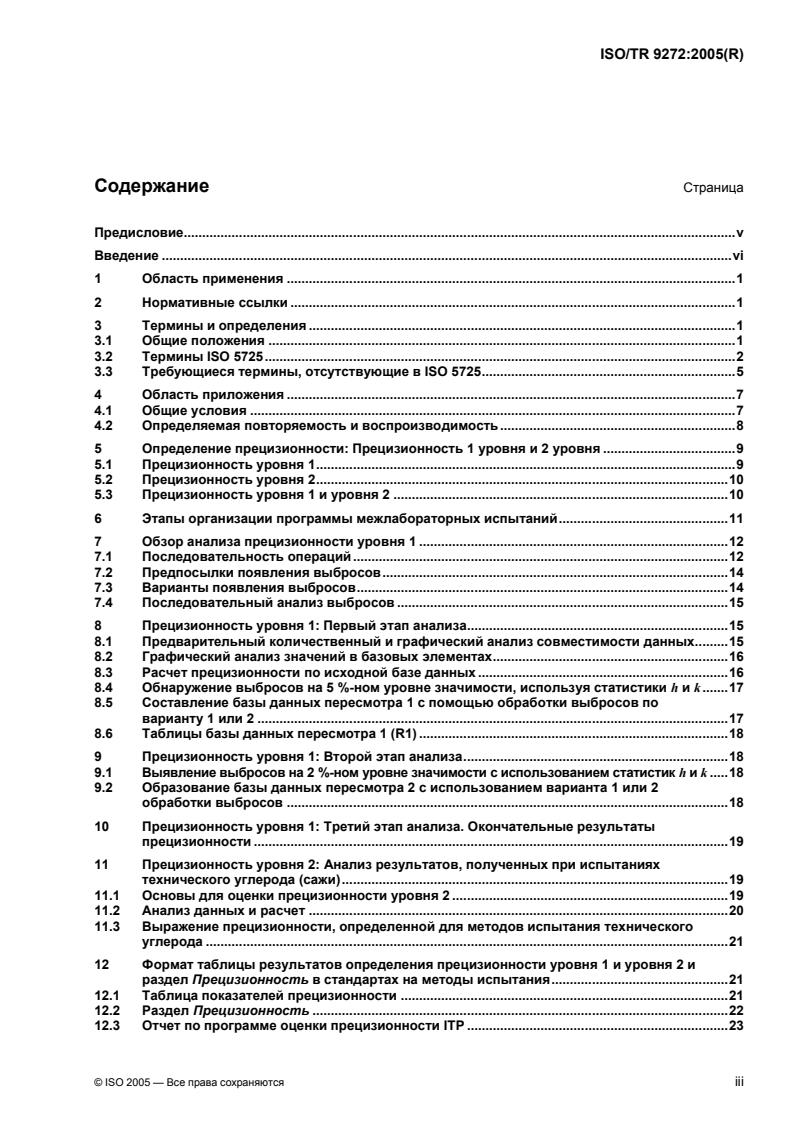
Содержание Страница
Предисловие. v
Введение . vi
1 Область применения . 1
2 Нормативные ссылки . 1
3 Термины и определения . 1
3.1 Общие положения . 1
3.2 Термины ISO 5725 . 2
3.3 Требующиеся термины, отсутствующие в ISO 5725 . 5
4 Область приложения . 7
4.1 Общие условия . 7
4.2 Определяемая повторяемость и воспроизводимость . 8
5 Определение прецизионности: Прецизионность 1 уровня и 2 уровня . 9
5.1 Прецизионность уровня 1 . 9
5.2 Прецизионность уровня 2 . 10
5.3 Прецизионность уровня 1 и уровня 2 . 10
6 Этапы организации программы межлабораторных испытаний . 11
7 Обзор анализа прецизионности уровня 1 . 12
7.1 Последовательность операций . 12
7.2 Предпосылки появления выбросов . 14
7.3 Варианты появления выбросов . 14
7.4 Последовательный анализ выбросов . 15
8 Прецизионность уровня 1: Первый этап анализа. 15
8.1 Предварительный количественный и графический анализ совместимости данных. 15
8.2 Графический анализ значений в базовых элементах. 16
8.3 Расчет прецизионности по исходной базе данных . 16
8.4 Обнаружение выбросов на 5 %-ном уровне значимости, используя статистики h и k . 17
8.5 Составление базы данных пересмотра 1 с помощью обработки выбросов по
варианту 1 или 2 . 17
8.6 Таблицы базы данных пересмотра 1 (R1) . 18
9 Прецизионность уровня 1: Второй этап анализа . 18
9.1 Выявление выбросов на 2 %-ном уровне значимости с использованием статистик h и k . 18
9.2 Образование базы данных пересмотра 2 с использованием варианта 1 или 2
обработки выбросов . 18
10 Прецизионность уровня 1: Третий этап анализа. Окончательные результаты
прецизионности . 19
11 Прецизионность уровня 2: Анализ результатов, полученных при испытаниях
технического углерода (сажи) . 19
11.1 Основы для оценки прецизионности уровня 2 . 19
11.2 Анализ данных и расчет . 20
11.3 Выражение прецизионности, определенной для методов испытания технического
углерода . 21
12 Формат таблицы результатов определения прецизионности уровня 1 и уровня 2 и
раздел Прецизионность в стандартах на методы испытания . 21
12.1 Таблица показателей прецизионности . 21
12.2 Раздел Прецизионность . 22
12.3 Отчет по программе оценки прецизионности ITP . 23
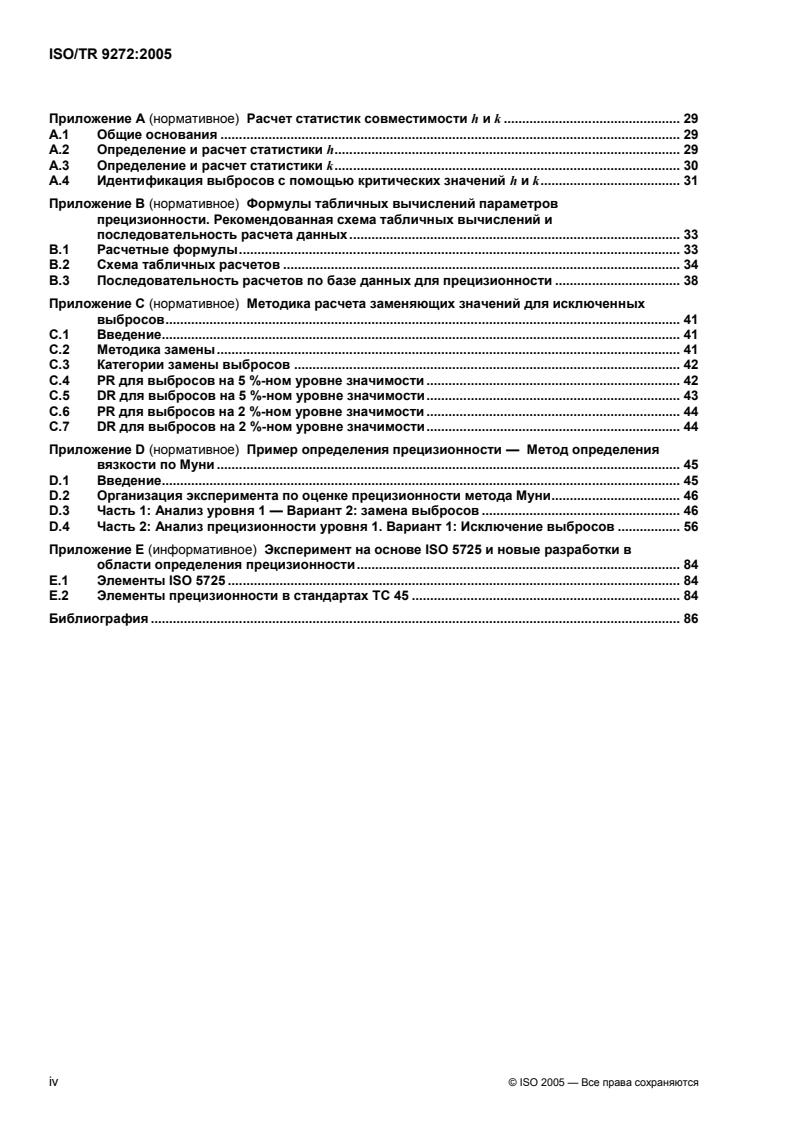
Приложение A (нормативное) Расчет статистик совместимости h и k . 29
A.1 Общие основания . 29
A.2 Определение и расчет статистики h . 29
A.3 Определение и расчет статистики k . 30
A.4 Идентификация выбросов с помощью критических значений h и k . 31
Приложение B (нормативное) Формулы табличных вычислений параметров
прецизионности. Рекомендованная схема табличных вычислений и
последовательность расчета данных . 33
B.1 Расчетные формулы . 33
B.2 Схема табличных расчетов . 34
B.3 Последовательность расчетов по базе данных для прецизионности . 38
Приложение С (нормативное) Методика расчета заменяющих значений для исключенных
выбросов . 41
С.1 Введение. 41
C.2 Методика замены . 41
C.3 Категории замены выбросов . 42
C.4 PR для выбросов на 5 %-ном уровне значимости . 42
C.5 DR для выбросов на 5 %-ном уровне значимости . 43
C.6 PR для выбросов на 2 %-ном уровне значимости . 44
C.7 DR для выбросов на 2 %-ном уровне значимости . 44
Приложение D (нормативное) Пример определения прецизионности — Метод определения
вязкости по Муни . 45
D.1 Введение. 45
D.2 Организация эксперимента по оценке прецизионности метода Муни. 46
D.3 Часть 1: Анализ уровня 1 — Вариант 2: замена выбросов . 46
D.4 Часть 2: Анализ прецизионности уровня 1. Вариант 1: Исключение выбросов . 56
Приложение E (информативное) Эксперимент на основе ISO 5725 и новые разработки в
области определения прецизионности . 84
E.1 Элементы ISO 5725 . 84
E.2 Элементы прецизионности в стандартах TC 45 . 84
Библиография . 86
iv © ISO 2005 — Все права сохраняются
Предисловие
Международная организация по стандартизации (ISO) является всемирной федерацией национальных
организаций по стандартизации (комитетов-членов ISO). Разработка международных стандартов
обычно осуществляется техническими комитетами ISO. Каждый комитет-член, заинтересованный в
деятельности, для которой был создан технический комитет, имеет право быть представленным в этом
комитете. Международные организации, правительственные и неправительственные, имеющие связи
с ISO, также принимают участие в работах. Что касается стандартизации в области электротехники, то
ISO работает в тесном сотрудничестве с Международной электротехнической комиссией (IEC).
Проекты международных стандартов разрабатываются в соответствии с правилами Директив ISO/IEC,
Часть 2.
Основной задачей технических комитетов является разработка международных стандартов. Проекты
международных стандартов, принятые техническими комитетами, рассылаются комитетам-членам на
голосование. Для опубликования их в качестве международного стандарта требуется одобрение не
менее 75 % комитетов-членов, принимающих участие в голосовании.
В исключительных случаях, когда ТК собрал информацию, отличную от той, которая обычно
публикуется как международный стандарт (современное состояние в отрасли, например), этот ТК
может вынести решение простым большинством голосов о публикации технического отчета.
Технический отчет носит целиком и полностью информативный характер и не подлежит пересмотру до
тех пор, пока содержащиеся в нем данные не перестанут считаться актуальными или полезными.
Необходимо учитывать возможность того, что некоторые элементы настоящего документа могут быть
объектом патентных прав. ISO не несет ответственности за определение каких-либо или всех таких
патентных прав.
ISO/TR 9272 был подготовлен Техническим комитетом ISO/TC 45, Резина и резиновые изделия,
Подкомитетом SC 2, Испытания и анализ.
Настоящее второе издание отменяет и заменяет первое издание (ISO/TR 9272:1986) после
технического пересмотра.
Введение
Основным стандартом по прецизионности для стандартов ISO на методы испытания является
ISO 5725, общий стандарт, который представляет фундаментальный статистический подход и
алгоритмы расчетов для определения повторяемости и воспроизводимости, а также точность и
концепцию, касающуюся систематической погрешности и называемую правильностью. Однако
определенные части ISO 5725 не совместимы с определением прецизионности в производстве резины
и технического углерода в течение последних сорока лет.
Имеется две проблемы:
a) строгое следование положениям международного стандарта ISO 5725 вступает в противоречие с
действующими процедурами и предысторией испытаний, которые проводились в двух этих
отраслях промышленности, и
b) ISO 5725 не рассматривает определенные требования, уникальные для испытаний резины и
технического углерода.
Таким образом, хотя ISO 5725 необходим как документ-основа для данного Технического отчета и
используется как таковой, его недостаточно для нужд TC 45.
Настоящий Технический отчет заменяет ISO/TR 9272, временный документ, который использовался
как руководство по определению прецизионности с 1986. Данное новое издание Технического отчета
имеет более всесторонний подход к главному вопросу в отношении определения прецизионности за
последние несколько десятилетий— открытие вопроизводимости (межлабораторной дисперсии)
большинства методов испытаний имеет большое значение. Очень плохое межлабораторное
согласование для большинства фундаментальных методов испытания в промышленности стало
предметом недоумения и широкого обсуждения. Опыт показывает, что плохую воспроизводимость
чаще всего дает очень малое число лабораторий (процент), которые можно причислить к категории
выбросов. Настоящее новое издание ISO/TR 9272 описывает подход с помощью «робастного анализа»,
который устраняет или значительно уменьшает влияние выбросов. См. Приложение E в отношении
более детального обсуждения этих вопросов и дополнительной связи с ISO 5725.
Представлено пять приложений. Они служат дополнением к основному тексту Технического отчета.
Приложения даны для правильного понимания раздела терминологии.
В Приложении A определены статистики Манделя h и k, показано, как их можно рассчитать, и даны
таблицы критических значений h и k.
В Приложении B приведены формулы для вычисления повторяемости и воспроизводимости, а
также описано, как составить и использовать шесть таблиц, которые требуются для анализа
прецизионности с использованием крупноформатных электронных таблиц.
В Приложении C представлен метод расчета значений, заменяющих выбросы, которые были
выделены в ходе анализа значений h и k. Замена (исправление) выбросов, вместо исключения их,
является вариантом, который можно использовать для определения прецизионности с участием
минимального числа лабораторий и/или материалов.
Приложение D является примером типичной программы определения прецизионности метода
Муни по определению вязкости. В приложении показано, как в полученные данные для оценки
прецизионности анализируют для обнаружения выбросов, используя обе статистики h и k, и
рассмотрено несколько проблем идентификации выбросов и их исключение в соответствии с
ISO 5725-2.
В Приложении E представлены некоторые условия для ISO 5725, робастный анализ и другие
вопросы, связанные с определением прецизионности.
vi © ISO 2005 — Все права сохраняются
Приложение E дается, главным образом, как отправная информация, которая имеет значение для
полного понимания определения прецизионности. Приложения A, B, и C содержат подробные
инструкции и методики, необходимые для выполнения операций, встречающихся в разных частях
данного Технического отчета. Использование этих приложений в данном объеме дает возможность
избежать увеличения объема разделов основного текста Технического отчета за счет введения в них
инструкций, давая, таким образом, возможность лучше понять концепции, включенные в определение
прецизионности.
ТЕХНИЧЕСКИЙ ОТЧЕТ ISO/TR 9272:2005
Резина и резиновые изделия. Определение показателей
прецизионности для стандартов на методы испытания
1 Область применения
Настоящий Технический отчет представляет руководство по определению в программах
*
межлабораторных испытаний (ITP) , прецизионности для стандартов на методы испытания,
используемые в резиновой промышленности и производстве технического углерода. В документе
использован базовый однофакторный анализ алгоритмов расчета вариации по ISO 5725 и
максимальное количество терминов и определений ISO 5725, которые не противоречат предыстории и
методикам определения прецизионности в указанных отраслях промышленности. Хотя в данном
Техническом отчете не определяется систематическая погрешность, она является важной концепцией
в понимании определения прецизионности. Концепции точности и правильности по ISO 5725 в данном
документе не определяются.
Представлено два метода определения прецизионности, представленные как ―робастные‖
статистические методики, которые пытаются устранить или существенно снизить влияние выбросов.
Первый метод –―прецизионность уровня 1‖ - предназначен для всех методов испытания, используемых
в производстве резины, а второй является конкретным случаем общей методики определения
прецизионности и обозначается ―прецизионность уровня 2 ‖, и применяется к испытаниям технического
углерода (сажи). Оба этих метода используют планирование эксперимента одного и того же уровня и
статистики Манделя h и k для анализа базы данных прецизионности на потенциальные выбросы.
Однако, в процедуре причисления несовместимых значений к выбросам используются небольшие
модификации. Метод определения ―прецизионности уровня 2‖ является специфическим методом,
ввиду числа параллельных определений на базовый элемент (ячейку базы данных) или комбинации
материал (уровень)-лаборатория.
2 Нормативные ссылки
Следующие ниже ссылочные документы обязательны при применении данного документа. Для
жестких ссылок используются только указываемые издания. Для плавающих ссылок применяется
последнее издание ссылочного документа (включая все изменения).
ISO 3534-1, Статистика. Словарь и условные обозначения. Часть 1. Общие статистические
термины и термины, используемые в теории вероятности
ISO 5725 (все части), Точность (правильность и прецизионность) методов и результатов измерения
3 Термины и определения
3.1 Общие положения
Применительно к данному документу используются термины и определения, приведенные в 3.3,
совместно с терминами и определениями ISO 5725 с изменениями, приведенными в 3.2.
*
В стандарте ГОСТ Р ИСО 5725 Программа межлабораторных испытаний по определению прецизионности (ITP)
называется Эксперимент по оценке прецизионности (прим. переводчика)
Дополнительные термины, касающиеся определенных типов прецизионности, можно найти в 5.3.
Лучшего понимания можно достичь, давая определения, которые относятся к характеристикам
испытуемого материала, в данном подразделе.
3.2 Термины ISO 5725
Термины, определенные в ISO 5725, обычно заимствованные из ISO 3534-1, используются, когда:
a) их определение не противоречит процедурам, необходимым для детального анализа данных при
оценке прецизионности для стандартов, на методы испытания, подготовленных TC 45, и
b) они адекватны задаче присвоения определений, которые являются информативными и облегчают
понимание.
В данном подразделе к определениям терминов ISO 5725 даются дополнительные замечания, чтобы
лучше понять суть определения прецизионности для методов испытания TC 45.
3.2.1
принятое опорное значение
accepted reference value
значение, которое служит в качестве согласованного для сравнения и получено как:
a) теоретическое или установленное значение, базирующееся на научных принципах;
b) приписанное или аттестованное значение, базирующееся на экспериментальных работах какой-
либо национальной или международной организации;
c) согласованное или аттестованное значение, базирующееся на совместных экспериментальных
работах под руководством научной или инженерной группы;
d) математическое ожидание измеряемой характеристики, т.е. среднее значение заданной
совокупности результатов измерения - лишь в случае, когда a), b) и c) недоступны.
3.2.2
результат измерений (или испытаний)
test result
значение характеристики, полученное выполнением регламентированного метода измерений (или
испытаний)
ПРИМЕЧАНИЕ В нормативном документе на метод измерений должно регламентироваться, сколько (одно или
несколько) единичных измерений, определений, наблюдений должно быть выполнено, способы их усреднения или
другая подходящая функция (медиана или др.) и способы представления в качестве результата измерений.
Может потребоваться введение стандартных поправок, например, приведение объема газа (к нормальной
температуре и давлению), и т.д.
3.2.3
точность
accuracy
степень близости результата измерений к принятому опорному значению
ПРИМЕЧАНИЕ Термин «точность», когда он относится к результатам измерений (испытаний), включает
сочетание случайных составляющих и общей систематической погрешности.
3.2.4
систематическая погрешность
bias
разность между математическим ожиданием результатов измерений и принятым опорным значением
ПРИМЕЧАНИЕ Термин «систематическая погрешность (bias) представляет собой общую систематическую
погрешность (отклонение) по контрасту со случайной погрешностью. Общая систематическая погрешность может
2 © ISO 2005 — Все права сохраняются
включать несколько составляющих, систематических погрешностей. Большее систематическое отклонение от
принятого опорного значения находит свое отражение в большем значении систематической погрешности.
3.2.5
систематическая погрешность лаборатории
laboratory bias
разность между математическим ожиданием результатов измерений (испытаний) в отдельной
лаборатории и принятым опорным значением
3.2.6
прецизионность
precision
степень близости друг к другу независимых результатов измерений, полученных в конкретных
регламентированных условиях
ПРИМЕЧАНИЕ 1 Прецизионность (для внутрилабораторных условий или повторяемость) зависит от
распределения случайных погрешностей и не имеет отношения к истинному значению (принятому опорному
значению) или установленному значению измеряемой величины. В отношении глобального домена измерений
(межлабораторные условия), см. 3.3.1 ниже по тексту, на межлабораторную прецизионность (воспроизводимость)
влияет систематическая погрешность лаборатории, также как случайные изменения, присущие такому
глобальному домену измерений.
ПРИМЕЧАНИЕ 2 Меру прецизионности обычно выражают в терминах неточности и вычисляют как стандартное
отклонение результатов измерений. Меньшая прецизионность соответствует большему стандартному отклонению.
ПРИМЕЧАНИЕ 3 Термин ―независимые результаты измерений (или испытаний)‖ определяется как совокупность
результатов измерений, в которой измерение каждого значения (в совокупности) не влияет на величину любого
другого результата измерений в этой же совокупности.
ПРИМЕЧАНИЕ 4 Количественные значения мер прецизионности существенно зависят от регламентированных
условий (типа домена измерений). Крайними случаями совокупностей таких условий являются условия
повторяемости и воспроизводимости.
ПРИМЕЧАНИЕ 5 Альтернативно, прецизионность можно определить как концепцию ―характеристика
надежности‖. Она пропорциональна обратной величине дисперсии независимых параллельных (измеренных или
наблюдаемых) значений, оцененных стандартным отклонением, для заданного домена измерений.
3.2.7
условия повторяемости
repeatability conditions
условия, при которых независимые результаты измерений (или испытаний) получаются одним и тем
же методом, на идентичных объектах испытания, в одной и той же лаборатории, одним и тем же
оператором, с использованием одного и того же оборудования, в пределах короткого промежутка
времени
ПРИМЕЧАНИЕ Как определено в 3.3.1, ―локальный домен измерений‖ является местоположением или
окружающей средой (в конкретной лаборатории), в которой проводятся измерения повторяемости. Слово
―идентичный‖ следует интерпретировать как ―номинально идентичный‖, т.е. преднамеренных различий среди
объектов измерений нет. ―Промежуток времени‖ между повторными измерениями можно выбрать в соответствии с
конкретными объектами испытания. Для TC 45 и международного производства резины промежуток времени
между повторными испытаниями составляет от одного до семи дней.
3.2.8
повторяемость
repeatability
прецизионность в условиях повторяемости
ПРИМЕЧАНИE 1 Повторяемость, обозначенная буквойl r, выражается в пересчете на интервал или диапазон,
который кратен стандартному отклонению; этот интервал (на основе 95 %-ной вероятности) включает результаты
параллельных независимых измерений (или испытаний), полученные в определенном локальном домене
измерений.
ПРИМЕЧАНИЕ 2 Относительная повторяемость, (r), выражается в пересчете на интервал (кратный
стандартному отклонению), который представляет собой процент от среднего уровня измеренной характеристики;
этот интервал должен (на основе 95 %-ной вероятности) включать результаты параллельных независимых
измерений (или испытаний), полученные в определенном локальном домене измерений.
ПРИМЕЧАНИЕ 3 Повторяемость может зависеть от величины или уровня измеренной характеристики и обычно
сообщается для конкретных уровней или материалов или классов элементов (которые определяют уровень).
ПРИМЕЧАНИЕ 4 Хотя повторяемость, как определено выше, применяется к локальному домену измерений, ее
можно получить двумя разными способами, а термин «повторяемость» можно использовать в двух разных
контекстах. Ее можно отнести к обычному значению сообщества, полученному как среднее (или совокупное)
значение от всех лабораторий -участниц ITP среди N разных лабораторий. Ее можно также назвать
универсальной или глобальной повторяемостью, которая применяется к ―типичной лаборатории‖, которая
является представительной от всех лабораторий, являющихся частью глобального домена измерений. Она также
может принадлежать к длительному или установленному значению для ―конкретной лаборатории‖, полученному из
проводимых испытаний в этой лаборатории, не относясь к программам ITP. Второе применение можно считать
локальной rповторяемостью, т.е. повторяемостью, полученной в или для одной лаборатории.
3.2.9
условия воспроизводимости
reproducibility conditions
условия, в которых результаты измерений (или испытаний) получают одним и тем же методом, на
идентичных объектах испытания (или элементах) в разных лабораториях, разными операторами, с
использованием различного оборудования
ПРИМЕЧАНИЕ 1 Каждая лаборатория (или местоположение) в глобальном домене измерений, см. 3.3.1.5,
проводит n измерений повторяемости на материале (целевой материал, а воспроизводимость определяют на
основе средних значений (из n испытаний в локальном домене) для N лабораторий для этого материала.
Воспроизводимость может также зависеть от уровня измеряемой характеристики или от испытуемых материалов
и обычно сообщается для конкретных уровней или материалов.
ПРИМЕЧАНИЕ 2 Термин ―различное оборудование‖ подразумевает различное использование общепринятого и
стандартного оборудования, т.е. все оборудования для испытаний, которое номинально является идентичным, но
располагается в разных лабораториях.
3.2.10
воспроизводимость
reproducibility
прецизионность в условиях вопроизводимости
ПРИМЕЧАНИЕ 1 Воспроизводимость, R, (для определенного глобального домена измерений) получают
посредством независимых измерений (или испытаний), выполненных в N lлабораториях (по n параллельных
определений каждое) на номинально идентичных объектах или элементах, выраженная в пересчете на интервал
или диапазон, кратный стандартному отклонению; этот интервал должен (на базе 95 %-ной вероятности) включать
результаты параллельных испытаний, каждый из которых получен в разных лабораториях для определенного
глобального домена испытаний.
ПРИМЕЧАНИЕ 2 Относительная воспроизводимость, (R), выражается в пересчете на интервал (кратный
стандартному отклонению), который является процентом от среднего уровня измеряемой характеристики; этот
интервал должен (на базе 95 %-ной вероятности) включать результаты параллельных испытаний (на процентной
основе), каждый из которых получен в разных лабораториях для определенного глобального домена измерений.
ПРИМЕЧАНИЕ 3 Воспроизводимость может также зависеть от уровня измеряемой характеристики или от
испытуемых материалов и обычно сообщается для конкретных уровней или материалов. Воспроизводимость
обычно не имеет двойственной интерпретации или применения подобно описанному выше для повторяемости,
поскольку является ―групповой характеристикой‖, которая применяется только по ряду лабораторий в глобальном
домене измерений.
ПРИМЕЧАНИЕ 4 Как указано в Примечании 1 в определении прецизионности, данной выше, воспроизводимость
определяется величиной случайных изменений в глобальном домене измерений, также как распределением
составляющих систематической погрешности в том же самом глобальном домене. Лаборатории, которые имеют
хорошую согласованность либо с опорным значением или общим средним значением для программы ITP, имеют
нулевую или очень незначительную систематическую погрешность. Лаборатории, которые не имеют хорошей
4 © ISO 2005 — Все права сохраняются
согласованности со средним значением имеют существенные систематические погрешности и, хотя величина
систематической погрешности относительно постоянная для каждой лаборатории, она различна среди разных
лабораторий, которые ее имеют, т.е. обладает характеристиками распределения.
3.2.11
выброс
outlier
элемент совокупности значений, который несовместим с остальными элементами данной совокупности
ПРИМЕЧАНИЕ Настоящий стандарт TC 45 определяет ―совокупность‖ как ―класс элементов‖, которые
подлежат измерению. См. термины элемент и класс элементов, определенные в 3.3.1 ниже по тексту.
3.3 Требующиеся термины, отсутствующие в ISO 5725
Ряд специализированных терминов определен здесь в систематизированной последовательности, от
простого к сложному. Такой подход позволяет простые термины использовать в определении более
сложных терминов и дает возможность образовать максимально лаконичные и точно выраженные
определения.
3.3.1 Базовые термины, касающиеся испытаний
3.3.1.1
элемент
element
совокупность, которую измеряют (испытывают) или наблюдают для определения характеристики или
характеристик; это может быть один объект среди группы объектов (испытуемых образцов и т.д.) или
инкремент или часть массы (или объема) материала
ПРИМЕЧАНИЕ Общий термин элемент имеет ряд синонимов: предмет, испытуемый образец, испытуемая
проба, порция, аликвотное количество, сокращенная проба, лабораторная проба.
3.3.1.2
класс элементов
элементный класс
element class
class of elements)
категория или описательное название для группы элементов, которые имеют общее происхождение
или номинально идентичные характеристики
ПРИМЕЧАНИЕ Термин ―номинально идентичный‖ предполагает, что эти элементы поступили из одного
источника, по возможности максимально гомогенного в отношении измеряемой характеристики.
3.3.1.3
домен измерений
testing domain
местоположение и рабочие условия, при которых проводится измерение (или испытание); сюда входит
описание подготовки элемента (анализируемая проба или образец), используемые прибор(ы)
(калибровка, наладка, установка параметров), выбранные исполнители и окружающая обстановка
3.3.1.4
локальный домен измерений
local testing domain
область, включающая одно место, или лабораторию, как типично используемую для контроля качества
и внутренних программ разработки или оценки
3.3.1.5
глобальный домен измерений
global testing domain
область, которая включает два или несколько мест, или лабораторий, отечественных или
международных, обычно используемых для испытаний ―производитель-пользователь‖, приемки
продукции и программ межлабораторных испытаний
3.3.1.6
сбалансированный эксперимент с однородными уровнями
balanced uniform level design
план для программы межлабораторных испытаний (ITP) по определению прецизионности, когда все
лаборатории испытывают все материалы, выбранные для программы, и каждая лаборатория проводит
одинаковое число повторных измерений (или испытаний), n, на каждом материале.
3.3.2 Термины, касающиеся материалов и отбора проб
3.3.2.1
материал
material
конкретная сущность или класс элементов, подлежащие испытанию; обычно существует в массе
(твердый, порошкообразный, жидкий)
ПРИМЕЧАНИЕ Материал используется как общий термин для описания ―класса элементов‖, который
испытывают, т.е. материал может представлять собой резину, резиновую смесь, сажу, синтетический каучук, и т.д.
Материал может быть гомогенным и негомогенным. При испытании продукции термин материал можно
использовать для описания ―класса элементов‖ или типа резинового изделия, например, уплотнительные кольца,
рукава в сборе, монтажные опоры двигателя, и т.д. См. также определение ―целевой материал‖ в 5.3.
3.3.2.2
(контрольная) партия
lot
установленная масса или объем материала или число объектов; обычно порожденные
идентифицируемым процессом, зачастую имеющие признанный состав или диапазон характеристик
ПРИМЕЧАНИЕ Партия может быть образована обычным производственным (или естественным) процессом в
течение ограниченного времени и обычно состоит из конечного числа объектов или имеет конечный размер.
Партия может быть частью генеральной совокупности. Признанный диапазон характеристик предполагает, что
присутствует некоторое грубое приближение.
3.3.2.3
проба
sample
физическая проба число элементов или заданная масса материала, выбранные согласно
конкретному методу, используемые для определения характеристик материала, партии или
генеральной совокупности
ПРИМЕЧАНИЕ Термин ―проба‖ не рекомендуется использовать как синоним термину ―материал‖, или ―целевой
материал‖, см. 5.3. В идеале испытывают несколько ―материалов‖ в программе ITP, так чтобы все материалы
были разные (химически, физически, структурно, известными характеристиками). От каждого материала для
испытаний можно отобрать ряд ―проб‖ (все номинально идентичные).
3.3.2.4
выборка
sample
выборка данных ряд значений измерений или наблюдений (n = 1, 2, 3, и т.д.), полученных от (одной
или нескольких) физических проб посредством применения определенного метода испытаний
(наблюдений)
3.3.2.5
проба для анализа
test sample
часть (физической) пробы любого типа, отобранной для химического или другого аналитического
испытания, обычно после надлежащего смешивания или другого порядка обработки
ПРИМЕЧАНИЕ Проба для испытания обычно представляет собой массу или объем, составляющие очень
небольшую часть всего материала.
6 © ISO 2005 — Все права сохраняются
3.3.2.6
образец для анализа
test piece
объект (определенной формы и подготовленный надлежащим образом), взятый из пробы (или партии)
для физических или механических испытаний
ПРИМЕЧАНИЕ Термин ―проба для анализа‖ является синонимом образца для анализа.
3.3.3 Дополнительные статистические термины, имеющие отношение к прецизионности
3.3.3.1
параллельная проба
replicate
одна из выбранного числа независимых дробных частей или независимого числа элементов, взятых из
пробы; испытывают каждую дробную часть или каждый элемент.
ПРИМЕЧАНИЕ Термин параллельная проба по указанному определению относится к физическому объекту
(элементу). Его также можно использовать при ссылке на набор данных, там где это относится к одному из ряда
значений независимых данных.
3.3.3.2
истинное значение
true value
измеренное или наблюдаемое значение для элемента, которое было бы получено для домена
измерений в отсутствие погрешностей, отклонений или вариаций любого типа, т.е. там где не
существует вариантов ―системы причин‖
ПРИМЕЧАНИЕ Истинное значение также определяют как среднее, которое было бы получено посредством
измерения (испытания) всех членов генеральной совокупности. Типичные ―системы причин‖ представляют собой
неизбежные колебания температуры, влажности, техники оператора, точности калибровки, и т.д. в
контролируемом домене измерений.
3.3.3.3
неопределенность (измерений)
uncertainty
величина, которая определяет ―характеристику надежности‖ измерения или наблюдения в обратном
смысле; для данного локального домена, это величина разности между измеренным значением
элемента и принятым опорным значением и включает случайное и систематическое отклонения
ПРИМЕЧАНИЕ Определение ―неопределенности‖, приведенное здесь, пытается ухватить общую суть концепции. Она
определяется равноценно, но другими словами, рядом организаций, обращающихся к этой концепции. Слово
―неопределенность‖ по приведенному в тексте определению отличается от привычного использования этого слова. Как
указано, ―хорошее качество‖ или ―надежность‖ и ―неопределенность‖ (сомнение в отношении измерения) взаимно
противоположны по смыслу. Неопределенность является характеристикой локального домена измерений; каждый
локальный домен для определенного измерения (или испытания) может иметь различное значение неопределенности.
Прецизионность, определенная в обычной программе ITP (повторяемость и воспроизводимость) является
характеристикой глобального домена измерений; значения прецизионности, полученные в какой-либо программе ITP,
предназначены для универсального применения, т.е. для ряда лабораторий как группы.
4 Область приложения
4.1 Общие условия
Настоящий Технический отчет применяется к методам испытания, результаты измерений которых
выражаются в пересчете на количественную непрерывную переменную. В общем, это ограничивает
применение до методов, которые окончательно разработаны и применяются как типовые в ряде
лабораторий.
Испытания проводят с помощью стандартных методов, чтобы получить данные, которые
используются для принятия технических и других решений для коммерческих, технических и научных
целей. Поэтому прецизионность конкретного метода испытания является важной качественной
характеристикой или характеристикой надежности метода испытания и процесса принятия решения.
Определение прецизионности метода испытания обычно осуществляется на (1) определенной группе
материалов, обычно используемых для испытаний рассматриваемым методом, и (2) в группе
лабораторий, имеющих опыт работы с рассматриваемым методом испытания и добровольно
согласившихся принять участие в эксперименте. Определение представляет собой ―событие во
времени‖ для рассматриваемых метода испытания, материалов и лабораторий. Другое определение
прецизионности в программе ITP с несколько отличающимися или даже с теми же самыми
материалами и в тех же самых лабораториях в разное время может показать результаты
прецизионности, которые будут отличаться от результатов первоначальной программы ITP.
Доверительные интервалы для оцененных значений стандартных отклонений повторяемости и
воспроизводимости указаны в ISO 5725 и не являются частью настоящего Технического отчета.
Обработка доверительных интервалов показателей прецизионности в ISO 5725 допускает, что
присущая вариация отдельных значений стандартных отклонений повторяемости и
воспроизводимости (в длительной серии испытаний эксперимента по оценке), может быть отнесена на
счет случайных изменений данных с нормальным распределением. Опыт, описанный в Ссылках [1], [2],
[3] и [4] и др. показывает, однако, что плохая воспроизводимость среди лабораторий типичной
программы ITP обусловлена межлабораторной систематической погрешностью. Определенные
лаборатории почти всегда дают результаты выше или ниже по сравнению с эталоном, также как другие
лаборатории во всех испытаниях. Такое смещение или систематическая погрешность обычно разные
для разных лабораторий, которые такую систематическую погрешность имеют. Это отличает их от
случайных отклонений, сравниваемых с эталоном, как требует нормальное распределение. Таким
образом, любые доверительные интервалы, рассчитанные для воспроизводимости как важного
параметра прецизионности, на основе статистической модели, не достоверны.
Необходимо с осторожностью применять результаты прецизионности конкретного метода испытания к
испытаниям продукции для приемки заказчиком. Процедуры приемки продукции должны быть
разработаны на основе показателей прецизионности, полученных в специальных программах,
специфичных в отношении коммерческой продукции и лабораторий заинтересованных сторон для
испытаний такого типа.
Дополнительной концепцией, связанной с технической надежностью метода испытания, является
―чувствительность измерения‖. Чувствительность определяется как отношение разрешающей
способности метода для измерения фундаментальной характеристики, к погрешности измерения этой
характеристики или стандартному отклонению.
4.2 Определяемая повторяемость и воспроизводимость
Повторяемость и воспроизводимость, каждая, равна диапазону или интервалу, представляющему
специальное кратное соответствующего стандартного отклонения. Повторяемость, обозначаемая r,
задается формулой:
1/2
Повторяемость = r = 2 s (1)
r
где s = объединенное (по всем лабораториям) ―внутрилабораторное‖ стандартное отклонение,
r
а воспроизводимость, обозначаемая R, задается выражением:
1/2
Воспроизводимость = R = (2) s (2)
R
где s = корень квадратный (или стандартное отклонение) из суммы (1) межлабораторной дисперсии
R
(используя для расчетов среднее от n значений для каждой лаборатории) и (2) объединенной
внутрилабораторной дисперсии (дисперсия для n значений в каждой лаборатории).
1/2
Член (2) требуется, поскольку r и R определяются как максимальная разность между двумя
отдельными результатами испыта
...
Questions, Comments and Discussion
Ask us and Technical Secretary will try to provide an answer. You can facilitate discussion about the standard in here.
Loading comments...