

ISO 14687:2025
(Main)Hydrogen fuel quality — Product specification
General Information
- Abstract
This document specifies the minimum quality characteristics of hydrogen fuel as distributed for utilization in residential, commercial, industrial, vehicular and stationary applications. This document is applicable to hydrogen fuelling applications, which are listed in Table 2.
- Status
- Published
- Publication Date
- 11-Feb-2025
- Technical Committee
- ISO/TC 197 - Hydrogen technologies
- Drafting Committee
- ISO/TC 197 - Hydrogen technologies
- Current Stage
- 9092 - International Standard to be revised
- Start Date
- 10-Jun-2026
- Completion Date
- 29-Aug-2026


Overview - What ISO 14687:2025 covers
ISO 14687:2025, "Hydrogen fuel quality - Product specification", defines minimum hydrogen fuel quality characteristics for distributed hydrogen used in residential, commercial, industrial, vehicular and stationary applications. The second edition replaces ISO 14687:2019 and updates product specifications to reflect recent research and changing industrial needs. The standard addresses classification of hydrogen quality grades, impurity limits, sampling and analytical methods, and quality control practices for hydrogen fuelling applications.
Key technical topics and requirements
- Fuel quality specifications: Defines impurity parameters and minimum quality characteristics for different application classes (notably PEM fuel cells for road vehicles and stationary systems). Grades (e.g., Grade D, Grade E) are provided to balance performance and cost. Informative Annex F introduces Grades F‑1/F‑2 for internal combustion engine applications.
- Analytical methods and verification: Specifies requirements for laboratory and production analysis, including reference to analytical protocols for PEM fuel cell applications.
- Sampling procedures: Details sampling points (including the concept of the boundary point between supply equipment and fuel cell systems), sample sizes and handling for gaseous and vaporized liquid samples.
- Quality control and production qualification: Outlines fuel quality control, verification tests, reporting of results and qualification test requirements for producers and station operators.
- Terminology and definitions: Establishes consistent terms (e.g., contaminant, boundary point, hydrogen fuel index) to support harmonized implementation.
- Supporting rationale and guidance: Informative annexes provide rationale for impurity selections, guidance on boundary point selection, PSA considerations and parameter rationales for non‑PEM applications.
Practical applications - who uses this standard
ISO 14687:2025 is essential for:
- Hydrogen producers and suppliers - to set product specifications and ensure compliant delivery.
- Hydrogen fuelling station operators - for on‑site quality control, sampling and verification.
- Fuel cell and vehicle OEMs - to define acceptable fuel quality for PEM fuel cell systems.
- Stationary power system integrators - to specify hydrogen feed quality and contractual requirements.
- Testing laboratories and certification bodies - to perform analytical verification and produce qualification reports.
- Regulators and infrastructure planners - to align safety, interoperability and market requirements for hydrogen refuelling networks.
Related standards
- ISO 19880‑8 - Gaseous hydrogen - Fuelling stations - Part 8: Fuel Quality Control (operations and QC practices).
- ISO 19880‑9 - Gaseous hydrogen - Fuelling stations - Part 9: Sampling for fuel quality analysis (sampling methods).
- ISO 21087 - Gas analysis - Analytical methods for hydrogen fuel - PEM fuel cell applications for road vehicles (laboratory methods and detection limits).
ISO 14687:2025 is a practical reference for anyone specifying, producing, transporting or using hydrogen as a fuel and supports reliable, interoperable hydrogen infrastructure and safe PEM fuel cell operation.
Relations
- Effective Date
- 06-Jun-2022
Get Certified
Connect with accredited certification bodies for this standard

DNV
DNV is an independent assurance and risk management provider.

Lloyd's Register
Lloyd's Register is a global professional services organisation specialising in engineering and technology.
DNV Energy Systems
Energy and renewable energy certification.
Sponsored listings
Frequently Asked Questions
ISO 14687:2025 is a standard published by the International Organization for Standardization (ISO). Its full title is "Hydrogen fuel quality — Product specification". This standard covers: This document specifies the minimum quality characteristics of hydrogen fuel as distributed for utilization in residential, commercial, industrial, vehicular and stationary applications. This document is applicable to hydrogen fuelling applications, which are listed in Table 2.
This document specifies the minimum quality characteristics of hydrogen fuel as distributed for utilization in residential, commercial, industrial, vehicular and stationary applications. This document is applicable to hydrogen fuelling applications, which are listed in Table 2.
ISO 14687:2025 is classified under the following ICS (International Classification for Standards) categories: 27.075 - Hydrogen technologies; 71.100.20 - Gases for industrial application. The ICS classification helps identify the subject area and facilitates finding related standards.
ISO 14687:2025 has the following relationships with other standards: It is inter standard links to ISO 14687:2019. Understanding these relationships helps ensure you are using the most current and applicable version of the standard.
ISO 14687:2025 is available in PDF format for immediate download after purchase. The document can be added to your cart and obtained through the secure checkout process. Digital delivery ensures instant access to the complete standard document.
Standards Content (Sample)
International
Standard
ISO 14687
Second edition
Hydrogen fuel quality — Product
2025-02
specification
Qualité du carburant hydrogène — Spécification de produit
Reference number
© ISO 2025
All rights reserved. Unless otherwise specified, or required in the context of its implementation, no part of this publication may
be reproduced or utilized otherwise in any form or by any means, electronic or mechanical, including photocopying, or posting on
the internet or an intranet, without prior written permission. Permission can be requested from either ISO at the address below
or ISO’s member body in the country of the requester.
ISO copyright office
CP 401 • Ch. de Blandonnet 8
CH-1214 Vernier, Geneva
Phone: +41 22 749 01 11
Email: copyright@iso.org
Website: www.iso.org
Published in Switzerland
ii
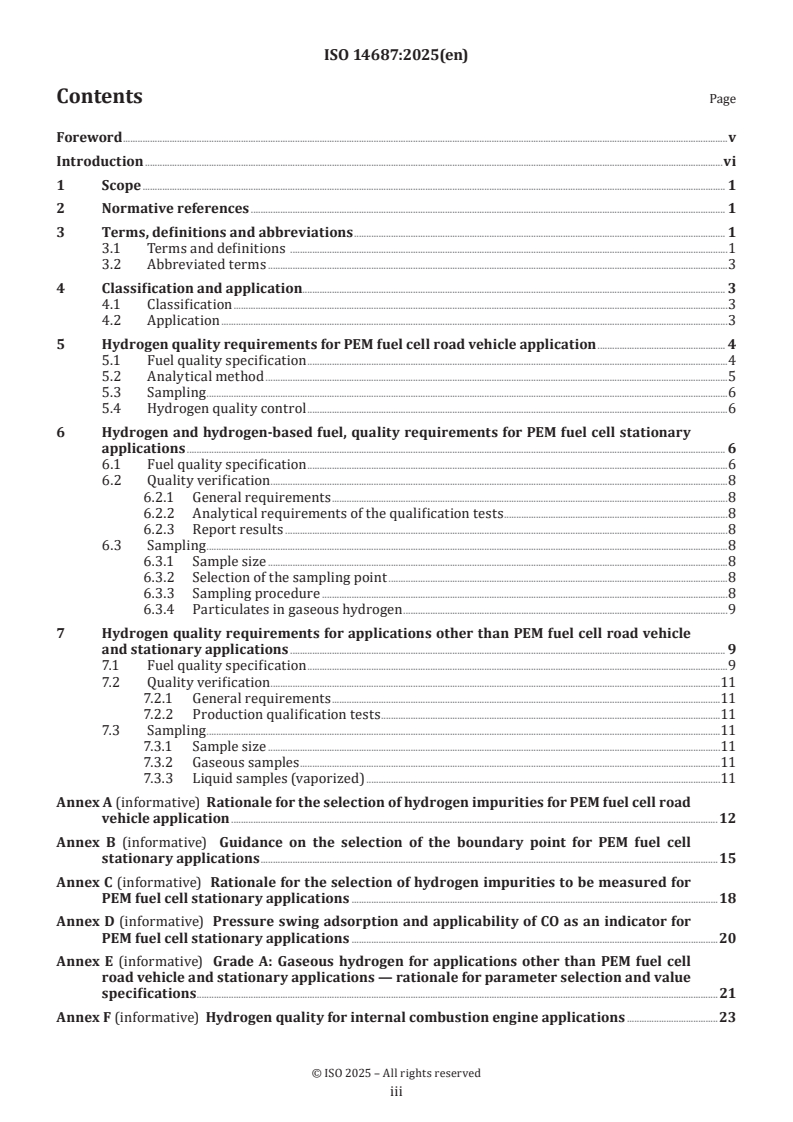
Contents Page
Foreword .v
Introduction .vi
1 Scope . 1
2 Normative references . 1
3 Terms, definitions and abbreviations . 1
3.1 Terms and definitions .1
3.2 Abbreviated terms .3
4 Classification and application. 3
4.1 Classification .3
4.2 Application .3
5 Hydrogen quality requirements for PEM fuel cell road vehicle application . 4
5.1 Fuel quality specification .4
5.2 Analytical method .5
5.3 Sampling .6
5.4 Hydrogen quality control .6
6 Hydrogen and hydrogen-based fuel, quality requirements for PEM fuel cell stationary
applications . 6
6.1 Fuel quality specification .6
6.2 Quality verification .8
6.2.1 General requirements .8
6.2.2 Analytical requirements of the qualification tests .8
6.2.3 Report results .8
6.3 Sampling .8
6.3.1 Sample size .8
6.3.2 Selection of the sampling point .8
6.3.3 Sampling procedure .8
6.3.4 Particulates in gaseous hydrogen .9
7 Hydrogen quality requirements for applications other than PEM fuel cell road vehicle
and stationary applications . 9
7.1 Fuel quality specification .9
7.2 Quality verification .11
7.2.1 General requirements .11
7.2.2 Production qualification tests .11
7.3 Sampling .11
7.3.1 Sample size .11
7.3.2 Gaseous samples .11
7.3.3 Liquid samples (vaporized) .11
Annex A (informative) Rationale for the selection of hydrogen impurities for PEM fuel cell road
vehicle application .12
Annex B (informative) Guidance on the selection of the boundary point for PEM fuel cell
stationary applications .15
Annex C (informative) Rationale for the selection of hydrogen impurities to be measured for
PEM fuel cell stationary applications .18
Annex D (informative) Pressure swing adsorption and applicability of CO as an indicator for
PEM fuel cell stationary applications .20
Annex E (informative) Grade A: Gaseous hydrogen for applications other than PEM fuel cell
road vehicle and stationary applications — rationale for parameter selection and value
specifications .21
Annex F (informative) Hydrogen quality for internal combustion engine applications .23
iii
Bibliography .27
iv
Foreword
ISO (the International Organization for Standardization) is a worldwide federation of national standards
bodies (ISO member bodies). The work of preparing International Standards is normally carried out through
ISO technical committees. Each member body interested in a subject for which a technical committee
has been established has the right to be represented on that committee. International organizations,
governmental and non-governmental, in liaison with ISO, also take part in the work. ISO collaborates closely
with the International Electrotechnical Commission (IEC) on all matters of electrotechnical standardization.
The procedures used to develop this document and those intended for its further maintenance are described
in the ISO/IEC Directives, Part 1. In particular, the different approval criteria needed for the different types
of ISO document should be noted. This document was drafted in accordance with the editorial rules of the
ISO/IEC Directives, Part 2 (see www.iso.org/directives).
ISO draws attention to the possibility that the implementation of this document may involve the use of (a)
patent(s). ISO takes no position concerning the evidence, validity or applicability of any claimed patent
rights in respect thereof. As of the date of publication of this document, ISO had not received notice of (a)
patent(s) which may be required to implement this document. However, implementers are cautioned that
this may not represent the latest information, which may be obtained from the patent database available at
www.iso.org/patents. ISO shall not be held responsible for identifying any or all such patent rights.
Any trade name used in this document is information given for the convenience of users and does not
constitute an endorsement.
For an explanation of the voluntary nature of standards, the meaning of ISO specific terms and expressions
related to conformity assessment, as well as information about ISO's adherence to the World Trade
Organization (WTO) principles in the Technical Barriers to Trade (TBT), see www.iso.org/iso/foreword.html.
This document was prepared by Technical Committee ISO/TC 197, Hydrogen technologies.
This second edition cancels and replaces the first edition (ISO 14687:2019), which has been technically
revised.
The main changes are as follows:
— a new Grade of hydrogen quality for internal combustion engine (Grade F) applications has been added
in Informative Annex F;
— rationale for each Grade D specification has been moved from ISO19880-8 to this document;
— each specification for each Grade has been modified reflecting recent research work and change in
industrial needs.
Any feedback or questions on this document should be directed to the user’s national standards body. A
complete listing of these bodies can be found at www.iso.org/members.html.
v
Introduction
In recent years, the landscape for using hydrogen as a fuel has changed significantly in response to its
potential to contribute to the reduction of greenhouse gas emissions. This shift is influenced by challenges
on both the hydrogen supply side, such as production technologies and supply chain infrastructure, and also
the hydrogen energy usage side, including advancements in fuel cell and combustion technology. To address
these changing conditions, the hydrogen fuel specifications in this document have been updated.
The hydrogen fuel specifications for proton exchange membrane (PEM) fuel cell applications in this
[2][3][4][5][6][7][8][9]
document are primarily based on research, development and data on the following items
[10][11][12][13][14]
:
— PEM fuel cell catalyst and fuel cell tolerance to hydrogen fuel impurities;
— effects/mechanisms of impurities on fuel cell power systems and components;
— impurity detection and measurement techniques for laboratory, production and in-field operations;
— fuel cell vehicle demonstration and stationary fuel cell demonstration results.
Grade D and grade E in this document are intended to apply to PEM fuel cells for road vehicles and stationary
appliances, respectively. These aim to facilitate the provision of hydrogen of reliable quality balanced with
acceptable lower cost for the hydrogen fuel supply.
In addition, Grades F-1 and F-2 are newly specified in this edition to apply to hydrogen internal combustion
engines for use in vehicular and stationary applications, respectively. The new Grades were placed in an
informative annex (Annex F) to allow experience to be gained with this fuel quality prior to inclusion in the
normative text.
While this document reflects the state-of-the-art at the date of its publication, the rapid development of
quality requirements for hydrogen technology applications would necessitate future revisions in response
to technological progress.
vi
International Standard ISO 14687:2025(en)
Hydrogen fuel quality — Product specification
1 Scope
This document specifies the minimum quality characteristics of hydrogen fuel as distributed for utilization
in residential, commercial, industrial, vehicular and stationary applications.
This document is applicable to hydrogen fuelling applications, which are listed in Table 2.
2 Normative references
The following documents are referred to in the text in such a way that some or all of their content constitutes
requirements of this document. For dated references, only the edition cited applies. For undated references,
the latest edition of the referenced document (including any amendments) applies.
ISO 19880-8, Gaseous hydrogen — Fuelling stations — Part 8: Fuel Quality Control
ISO 19880-9, Gaseous hydrogen — Fuelling stations — Part 9: Sampling for fuel quality analysis
ISO 21087, Gas analysis — Analytical methods for hydrogen fuel — Proton exchange membrane (PEM) fuel cell
applications for road vehicles
3 Terms, definitions and abbreviations
For the purposes of this document, the following terms and definitions apply.
ISO and IEC maintain terminological databases for use in standardization at the following addresses:
— ISO Online browsing platform: available at http:// www .iso .org/ obp
— IEC Electropedia: available at http:// www .electropedia .org/
3.1 Terms and definitions
3.1.1
boundary point
point between the hydrogen fuel
supply equipment (3.1.13) and the PEM fuel cell power system (3.1.9) at which the quality characteristics of
the hydrogen fuel are to be determined
3.1.2
constituent
component (or compound) found within a hydrogen fuel mixture
3.1.3
contaminant
impurity that adversely affects the components within the fuel cell system (3.1.8), the fuel cell power system
(3.1.9) or the hydrogen storage system
Note 1 to entry: An adverse effect can be reversible or irreversible.
3.1.4
customer
party responsible for sourcing
hydrogen fuel in order to operate the fuel cell power system (3.1.9)
3.1.5
detection limit
lowest quantity of a substance that can be distinguished from the absence of that substance with a stated
confidence limit
3.1.6
determination limit
lowest quantity which can be measured at a given acceptable level of uncertainty
3.1.7
fuel cell
electrochemical device that converts the chemical energy of a fuel and an oxidant to electrical energy (DC
power), heat and other reaction products
3.1.8
fuel cell system
power system used for the
generation of electricity on a fuel cell vehicle
Note 1 to entry: The fuel cell system typically contains the following subsystems: fuel cell stack, air processing, fuel
processing, thermal management and water management.
3.1.9
fuel cell power system
self-contained fuel cell assembly
used for the generation of electricity which is fixed in place in a specific location
Note 1 to entry: The fuel cell power system typically contains the following subsystems: fuel cell stack, air processing,
thermal management, water management and automatic control system. It is used in applications such as: distributed
power generation, back-up power generation, remote power generation, electricity and heat co-generation for
residential and commercial applications.
Note 2 to entry: For the purposes of the applications, the fuel cell power system does not contain a fuel processing
system due to the location of the boundary point (3.1.1).
3.1.10
gaseous hydrogen
hydrogen under gaseous form
3.1.11
hydrogen-based fuel
gas containing a specified
concentration of hydrogen used in PEM fuel cells for stationary applications
Note 1 to entry: The concentration of hydrogen in the gas is specified in tables in this document (ISO 14687).
3.1.12
hydrogen fuel index
mole fraction of a fuel mixture that is hydrogen
3.1.13
hydrogen fuel supply equipment
equipment used for the transportation or on-site generation of hydrogen fuel, and subsequently for the
delivery to the fuel cell power system (3.1.9), including additional storage, vaporization and pressure
regulation as appropriate
3.1.14
irreversible effect
effect, which results in a permanent degradation of the fuel cell system (3.1.8) or the fuel cell power system
(3.1.9) performance that cannot be restored by practical changes of operational conditions and/or gas
composition
3.1.15
liquid hydrogen
hydrogen that has been liquefied, i.e. brought to a liquid state
3.1.16
particulate
solid or liquid such as oil mist that can be entrained somewhere in the production, delivery, storage or
transfer of the hydrogen fuel to a fuel cell system (3.1.8) or a fuel cell power system (3.1.9)
3.1.17
reversible effect
effect, which results in a temporary degradation of the fuel cell system (3.1.8) or the fuel cell power system
(3.1.9) performance that can be restored by practical changes of operational conditions and/or gas
composition
3.1.18
slush hydrogen
hydrogen that is a mixture of solid and liquid at the eutectic (triple-point) temperature
3.1.19
system integrator
integrator of equipment between
the PEM fuel cell power system (3.1.9) and the hydrogen supply
3.2 Abbreviated terms
Table 1 — Abbreviated terms
Abbreviated term Definition
PEM proton exchange membrane
FCEV fuel cell electric vehicle
4 Classification and application
4.1 Classification
Hydrogen fuel shall be classified according to the following types and grade designations:
a) Type I (grades A, B, C, D, E and F): gaseous hydrogen and hydrogen-based fuel;
b) Type II (grades C and D): liquid hydrogen;
c) Type III: slush hydrogen.
4.2 Application
Table 2 characterizes representative applications of each type and grade of hydrogen fuel.
Table 2 — Hydrogen and hydrogen-based fuel classification by application
Type Grade Category Applications Clause
Gaseous hydrogen; residential/commercial combustion ap-
A ― 7
pliances (e.g. boilers, cookers and similar applications)
Gaseous hydrogen; industrial fuel for power generation and
B ― 7
heat generation except PEM fuel cell applications
Gaseous hydrogen; aircraft and space-vehicle ground support
C ― 7
systems except PEM fuel cell applications
a,b,c
D ― Gaseous hydrogen; PEM fuel cells for road vehicles 5
I
PEM fuel cells for stationary appliances
Gas
E 1 Hydrogen-based fuel 6
2 Gaseous hydrogen
Internal combustion engine applications
Gaseous hydrogen; internal combustion engine vehicular
c
F applications Annex F
Gaseous hydrogen; internal combustion engine stationary
applications
Aircraft and space-vehicle on-board propulsion and electrical
C ― 7
II
energy requirements; off-road vehicles
Liquid
a,b,c
D ― PEM fuel cells for road vehicles 5
III
― ― Aircraft and space-vehicle on-board propulsion 7
Slush
a
Grade D may be used for other fuel cell applications and internal combustion engines in vehicular and stationary applications,
including on and non-road vehicles.
b
Grade D may be used for PEM fuel cell stationary appliances alternative to grade E category 2.
c
Fuel cells can be contaminated by lower grade hydrogen. Protection against misfuelling with Grade F is ensured by the nozzle/
[15]
receptacle geometry. These geometries are specified in ISO 17268-1 . Care should be taken to ensure cross contamination
does not occur in the supply chain nor when dispensing into vehicles or other systems.
NOTE Biological and other sources of hydrogen can contain additional constituents (e.g. siloxanes or mercury)
that can affect the performance of the various applications, particularly PEM fuel cells. However, these are not included
in most of the following specifications due to insufficient information.
5 Hydrogen quality requirements for PEM fuel cell road vehicle application
5.1 Fuel quality specification
The quality of hydrogen at dispenser nozzle for grade D hydrogen (see Table 2) shall meet the requirements
of Table 3. The fuel specifications are not process-dependent or feed-stock-specific. Non-listed contaminants
have no guarantee of being benign.
Annex A provides the rationale for the selection of the impurities specified in Table 3.
Table 3 — Fuel quality specification for PEM fuel cell road vehicle application
a Type I, Type II
Constituents
(assay)
grade D
b
Hydrogen fuel index (minimum mole fraction) 99,97 %
Total non-hydrogen gases (maximum) 300 μmol/mol
Maximum concentration of individual contaminants
c
Water (H O) 5 μmol/mol
a,d
Hydrocarbons except methane
2 μmol/mol
(C1 equivalent)
Methane (CH ) 100 μmol/mol
Oxygen (O ) 5 μmol/mol
Helium (He) 300 μmol/mol
Nitrogen (N ) 300 μmol/mol
Argon (Ar) 300 μmol/mol
Carbon dioxide (CO ) 2 μmol/mol
e
Carbon monoxide (CO) 0,2 μmol/mol
a,f
Sulfur compounds
0,004 μmol/mol
(S1 equivalent)
e
Formaldehyde (HCHO) 0,2 μmol/mol
Ammonia (NH ) 0,1 μmol/mol
a,g
Halogenated compounds
0,05 μmol/mol
(Halogen equivalent)
h
Maximum particulate concentration 1 mg/kg
a
For the constituents that are grouped, such as hydrocarbons except methane, sulfur compounds and halogenated compounds,
the sum of the constituents shall be less than or equal to the acceptable limit.
b
The hydrogen fuel index is determined by subtracting the "total non-hydrogen gases" in this table, expressed in mole percent,
from 100 mole percent.
c
The allowable water content is based upon a HRS operating at 70 MPa nominal pressure and -40 °C hydrogen pre-cooling.
The allowable water content may be allowed to increase to 7 μmol/mol H O for a station only dispensing at a nominal working
pressure of 35 MPa and a precooling temperature of -26 °C or warmer. The change should be confirmed by the hydrogen quality
plan as discussed in ISO 19880-8 to ensure that no water condensate can form. The potential temperatures and pressures in the
FCEV should be considered.
d
Hydrocarbons except methane include oxygenated organic species (for example, formic acid). Hydrocarbons except methane
which can potentially be in the hydrogen gas should be determined by the hydrogen quality control plan discussed in ISO 19880-8.
Hydrocarbons except methane shall be measured on a C1 equivalent (μmol/mol).
e
The sum of measured CO and HCHO shall not exceed 0,2 μmol/mol.
f
Sulfur compounds which can potentially be in the hydrogen gas (for example, H S, COS, CS and mercaptans, which are
2 2
typically found in natural gas) should be determined by the hydrogen quality control plan discussed in ISO 19880-8. Sulfur
compounds shall be measured on a S1 equivalent (μmol/mol).
g
Halogenated compounds which can potentially be in the hydrogen gas [for example, hydrogen chloride (HCl) and organic
chlorides (R-Cl)], should be determined by the hydrogen quality control plan discussed in ISO 19880-8. Halogenated compounds
shall be measured on a halogen equivalent (μmol/mol).
h
Particulate includes both solid and liquid particles and may be comprised of oil mist. Large particulates can cause issues
[14]
with vehicle components and should be limited by using filter as specified in. No visible oil shall be found in fuel at a nozzle.
5.2 Analytical method
The analytical laboratories measuring the constituents should follow industry approved practices, such
as ISO/IEC 17025. For Grade D hydrogen, the analytical methods used shall be validated according to the
requirements in ISO 21087.
5.3 Sampling
Sampling procedures shall be in accordance with ISO 19880-9. ISO 19880-9 outlines requirements for
sampling from hydrogen refuelling stations for samples taken at the dispenser.
5.4 Hydrogen quality control
The means of assuring that the hydrogen quality meets the specification in 5.1 shall be in accordance with
ISO 19880-8.
6 Hydrogen and hydrogen-based fuel, quality requirements for PEM fuel cell
stationary applications
6.1 Fuel quality specification
The quality of hydrogen and hydrogen-based fuel, supplied to stationary PEM fuel cell appliances, shall meet
the requirements of Table 4 at the boundary point set between the hydrogen fuel supply equipment and the
PEM fuel cell power system.
NOTE 1 Annex B provides guidance for the selection of the boundary point.
NOTE 2 Annex C provides the rationale for the selection of the impurities specified in Table 4.
Type I, grade E hydrogen and hydrogen-based fuel, for PEM fuel cell applications for stationary appliances,
specify the following subcategories in order to meet the needs of different stationary applications, depending
on the requirements specified by the manufacturer:
— Type I, grade E, category 1 (hydrogen-based fuel);
— Type I, grade E, category 2 (gaseous hydrogen).
Table 4 — Fuel quality specification for PEM fuel cell stationary applications
a
Type I, grade E
Constituents
(assay)
Category 1 Category 2
b
Hydrogen fuel index
50 % 99,9 %
(minimum mole fraction)
Total non-hydrogen gases
50 % 0,1 %
(maximum mole fraction)
Non-condensing at any Non-condensing at any
c
Water (H O)
ambient conditions ambient conditions
d
Maximum concentration of individual contaminants
Hydrocarbons except
a,e
methane
10 μmol/mol 2 μmol/mol
(C1 equivalent)
Methane (CH ) 5 % (mole fraction) 100 μmol/mol
Oxygen (O ) 200 μmol/mol 50 μmol/mol
Sum of nitrogen (N ), argon (Ar)
a
and helium (He) 50 % 0,1 %
(mole fraction)
Carbon dioxide (CO ) Included in total non-hydrogen gases 2 μmol/mol
f
Carbon monoxide (CO) 10 μmol/mol 0,2 μmol/mol
a,g
Sulfur compounds
0,004 μmol/mol 0,004 μmol/mol
(S1 equivalent)
f
Formaldehyde (HCHO) 3 μmol/mol 0,2 μmol/mol
Ammonia (NH ) 0,1 μmol/mol 0,1 μmol/mol
a,h
Halogenated compounds
0,05 μmol/mol 0,05 μmol/mol
(halogen equivalent)
Maximum particulate
1 mg/kg 1 mg/kg
concentration
Maximum particle diameter 75 μm 75 μm
a
For the constituents that are grouped, such as hydrocarbons except methane, sulfur compounds and halogenated compounds,
the sum of the constituents shall be less than or equal to the acceptable limit.
b
The hydrogen fuel index is determined by subtracting the "total non-hydrogen gases" in this table, expressed in mole percent,
from 100 mole percent.
c
Each site shall be evaluated to determine the appropriate maximum water content based on the lowest expected ambient
temperature and the highest expected storage pressure.
d
The maximum concentration of impurities against the total gas content shall be determined on a dry basis.
e
Hydrocarbons except methane include oxygenated organic species. Hydrocarbons except methane which can potentially be
in the hydrogen gas should be determined by the hydrogen quality control plans referred to in ISO 19880-8. Hydrocarbons except
methane shall be measured on a C1 equivalent (μmol/mol).
f
The sum of measured CO and HCHO shall not exceed 0,2 μmol/mol.
g
Sulfur compounds which can potentially be in the hydrogen gas (for example, H S, COS, CS and mercaptans, which
2 2
are typically found in natural gas) should be determined by the hydrogen quality control plans referred to in ISO 19880-8.
Sulfur compounds shall be measured on a S1 equivalent (μmol/mol). On the purpose to avoid the degradation of the fuel cell
performance, the threshold level of 0,000 1 μmol/mol may be used for sulfur compounds.
h
Halogenated compounds which can potentially be in the hydrogen gas [for example, hydrogen chloride (HCl) and organic
chlorides (R-Cl)] should be determined by the hydrogen quality control plans referred to in ISO 19880-8. Halogenated compounds
shall be measured on a halogen equivalent (μmol/mol).
6.2 Quality verification
6.2.1 General requirements
Quality verification requirements shall be determined at the boundary point using the sampling methods
specified in 6.3.
The selection of relevant fuel contaminants for analysis as specified in Table 4 should be carried out based
on the hydrogen production method.
All analyses conducted under this document shall be undertaken using gaseous calibration standards (or
other calibration devices) that are traceable to the International System of Units (SI) via national standards,
where such standards are available.
NOTE ISO 21087 provides guidance for analytical methods.
6.2.2 Analytical requirements of the qualification tests
The frequency of testing and analytical requirements for the qualification tests shall be defined.
Consideration shall be given to the consistency of hydrogen supply in determining the test frequency and
constituents to be tested.
Annex D provides a recommended practice of the quality assurance for steam methane reforming (SMR)
hydrogen production processes using pressure swing adsorption (PSA) purification.
6.2.3 Report results
The detection limits and the determination limits for analytical methods and instruments used shall be
reported along with the results of each test and the date the sample was taken.
6.3 Sampling
6.3.1 Sample size
Where possible, the quantity of hydrogen in a single sample container should be sufficient to perform the
analyses for the hydrogen fuel quality specification. If a single sample does not contain a sufficient quantity
of hydrogen to perform all of the analyses required to assess the quality level, additional samples from the
same lot shall be taken under similar conditions. A large sample or sample with a greater pressure, where
applicable, may be required if multiple tests are to be conducted.
6.3.2 Selection of the sampling point
A boundary point shall be established so that gaseous samples are representative of the hydrogen supplies
to the PEM fuel cell power systems.
NOTE Annex B provides guidance to assist in the identification of the party responsible for the quality of hydrogen
at the boundary point and also the selection of the boundary point.
6.3.3 Sampling procedure
Gaseous hydrogen samples shall be representative of the hydrogen supply, withdrawn from the boundary
point through a suitable connection into an appropriately sized sample container. No contamination of the
hydrogen fuel shall be introduced between the boundary point and the sample container (a suitable purge
valve may be used).
The residual gases inside the sample container shall be evacuated to ensure that the sampled hydrogen is not
contaminated. If evacuation is not possible, the sample container shall be cleaned using repeated purge cycles.
[16]
Sampled gases are flammable. Measures shall be taken to avoid hazardous situations. Guidance is given in .
6.3.4 Particulates in gaseous hydrogen
Particulates in hydrogen shall be sampled from the boundary point, using a filter, if practical, under the
same conditions (pressure and flow rate) as employed in the actual hydrogen supplying condition.
Appropriate measures shall be taken for the sample gas not to be contaminated by particulates coming from
the connection device and/or the ambient air.
7 Hydrogen quality requirements for applications other than PEM fuel cell road
vehicle and stationary applications
7.1 Fuel quality specification
The quality of hydrogen supplied to the example specifications for applications other than PEM fuel cell road
vehicles and stationary applications shall meet the requirements of Table 5. A blank indicates no maximum
limiting characteristic. The absence of a maximum limiting characteristic in a listed quality level does not
imply that the component is or is not present, but merely indicates that there is no limitation regarding this
component for compliance with this document.
[17]
NOTE Other specifications can be equally suitable for these applications. CEN/TS 17977 details a
comprehensive specification for the quality of hydrogen delivered to user applications through rededicated gas
systems, which is anticipated to be suitable for many applications covered by the Grades A and B below.
Table 5 — Fuel quality specification for applications other than PEM fuel cell road vehicle and
stationary applications
a
Constituents Type I Type II Type III
(assay) Grade A Grade B Grade C Grade C
Hydrogen fuel index 98,0 % 99,90 % 99,995 % 99,995 % 99,995 %
b
(minimum mole
fraction)
Para-hydrogen ― ― ― 95,0 % 95,0 %
(minimum mole
fraction)
Impurities
(maximum content)
Total non-hydrogen 2 % 1 000 μmol/mol 50 μmol/mol 50 μmol/mol ―
gases (mole fraction)
c c d d
Water (H O) 250 μmol/mol 250 μmol/mol ―
c c
60 μmol/mol 60 μmol/mol
d d
Hydrocarbons ex- 100 μmol/mol Non-condensing ―
e
cept methane at all ambient
conditions
(C1 equivalent)
f g g
Oxygen (O ) 100 μmol/mol ―
f g g
Argon (Ar) ― ―
f d d
Nitrogen (N ) 400 μmol/mol ―
Helium (He) ― ― 39 μmol/mol 39 μmol/mol ―
f h h
Carbon dioxide (CO ) ― ―
h h
Carbon monoxide 20 μmol/mol ― ―
(CO)
i
Sulfur compounds 7 μmol/mol 10 μmol/mol ― ― ―
(S1 equivalent)
j k k k
Permanent particu- ―
lates
a
For the constituents that are grouped, such as hydrocarbons except methane and sulfur compounds, the sum of the
constituents shall be less than or equal to the acceptable limit.
b
The hydrogen fuel index is determined by subtracting the "total non-hydrogen gases" in this table, expressed in mole percent,
from 100 mole percent.
c
To prevent condensation under expected temperature condition range, the value is 250 μmol/mol at maximum operating
pressures ≤1 MPa and 60 μmol/mol at maximum operating pressures > 1 MPa.
d
Combined nitrogen, water and hydrocarbon: maximum 9 μmol/mol.
e
Hydrocarbons except methane include oxygenated organic species and shall be measured on a C1 equivalent basis (µmolC/
mol).
f
Combined oxygen, nitrogen, argon and carbon dioxide: maximum mole fraction of 1,9 % (19 000 μmol/mol).
g
Combined oxygen and argon: maximum 1 μmol/mol.
h
Combined CO and CO: maximum 1 μmol/mol.
i
Sulfur compounds excludes any sulfur from odorants and shall be measured on a S1 basis (μmolS/mol).
NOTE Odorisation is considered as a safety issue dealt with at the national level. National requirements can permit amount
fractions higher than 7 μmol/mol.
j
The hydrogen shall not contain dust, sand, dirt, gums, oils or other substances in an amount sufficient to damage residential/
commercial combustion appliances.
k
To be defined as appropriate for each application.
7.2 Quality verification
7.2.1 General requirements
The supplier shall assure, by standard practice, the verification of the quality level of hydrogen. The sampling
and control procedures are described in 7.3.
NOTE 1 Annex E provides the rationale for the selection of the impurities specified in Table 5.
NOTE 2 ISO 21087 can be used as guidance for validation protocol for analytical methods for the contaminants in
Table 5.
7.2.2 Production qualification tests
Production qualification tests are a single analysis or a series of analyses that shall be performed on the
product to assure the reliability of the production facility to supply hydrogen of the required quality level.
This production qualification can be achieved by verifying the analytical records of product from the
supplier, or, if required, by performing analyses of representative samples of the product from the facility at
appropriate intervals as agreed between the supplier and the customer. Production qualification tests can
be performed by the supplier or by a laboratory agreed upon between the supplier and the customer.
7.3 Sampling
7.3.1 Sample size
The quantity of hydrogen in a single sample container shall be sufficient to perform the analyses for the fuel
quality specifications. If a single sample does not contain a sufficient quantity of hydrogen to perform all of
the analyses required to assess the quality level, additional samples from the same lot shall be taken under
similar conditions.
7.3.2 Gaseous samples
Gaseous samples shall be representative of the hydrogen supply. Samples shall be obtained using one of the
following procedures.
a) Fill the sample container and delivery containers at the same time, on the same manifold and in the
same manner.
b) Withdraw a sample from the supply container through a suitable connection into the sample container.
c) For safety reasons, the sample container and sampling system shall have a rated service pressure at
least equal to the pressure in the supply container.
d) Connect the container being sampled directly to the analytical equipment using a suitable pressure
regulator to prevent over-pressurizing this equipment.
e) Select a representative container from the containers filled in the lot.
7.3.3 Liquid samples (vaporized)
Vaporized liquid samples shall be representative of the liquid hydrogen supply. Samples shall be obtained
using one of the following procedures:
a) by vaporizing, in the sampling line, liquid hydrogen from the supply container;
b) by flowing liquid hydrogen from the supply container into or through a suitable container in which a
representative sample is collected and then vaporized.
CAUTION — Due to the high expansion ratio for liquid hydrogen, extreme caution shall be used to
avoid overpressure within the sample container.
Annex A
(informative)
Rationale for the selection of hydrogen impurities for PEM fuel cell
road vehicle application
A.1 General
This annex gives a brief description of the impact of impurities on the stack, fuel cell components and the
complete fuel cell powertrain. Detailed information can be found in the relevant literature and journal
publications. It shall be noted that this annex refers to known impurities and their effects on the fuel cell
powertrain at the time of publication. It cannot be excluded that other impurities exist. Furthermore, in most
cases only the impact of a single impurity has been investigated and there is still the need for fundamental
research regarding the impact of a combination of the different impurities on the fuel cell powertrain.
A.2 Inert gases
The main effect due to the presence of inert gases such as Ar and N is to lower the cell voltage due to the
dilution effect of the inert species (dilution of the hydrogen gas) and inertial (diffusion) effects. Nevertheless,
under consideration of the threshold value current stack designs, fuel cell components and fuel cell
powertrains are not adversely affected by inert constituents. High inert gas concentrations will lead to
power losses, increased fuel consumption, and loss of efficiency. Furthermore, H starvation caused by high
inert gas concentrations can lead to permanent damage of the fuel cell stack or vehicle stop. Inert gases will
accumulate in the anode loop and can affect venting and recycle blower control. Further sources report that
the presence of N hinders desorption of adsorbed CO from the surface of the anode catalyst. It should also
be noted that inert gases can affect the accuracy of mass metering instruments for hydrogen dispensing.
A.3 Oxygen
Oxygen can have a detrimental effect on the fuel cell anode, but the concentration where this effect occurs is
not fully known. Higher levels of oxygen can have an impact on metal hydride storage materials.
A.4 Carbon dioxide
The contamination effects of CO depend on the concentration, fuel cell operation conditions, and anode
catalyst composition. Firstly, CO dilutes the hydrogen gas and can affect venting and recycle blower control
of the fuel cell powertrain. Furthermore, very high concentrations of CO can be catalytically converted
via a reverse water gas shift reaction into CO which in consequence poisons the catalyst. In addition, co-
occurrence of CO and CO in hydrogen has an accumulated influence on cell performance. CO can adversely
2 2
affect on-board hydrogen storage systems using metal hydride alloys.
A.5 Carbon monoxide
Carbon monoxide causes severe catalyst poison that adversely affects the performance of the fuel cell
powertrai
...