

ISO 18436-3:2025
(Main)Condition monitoring and diagnostics of machines — Requirements for training and certification of personnel — Part 3: Requirements for training bodies and the training process
General Information
- Abstract
This document specifies the requirements for bodies operating training programmes for personnel who perform machinery condition monitoring, identify machine faults, and recommend corrective action. This document specifies procedures for training of condition monitoring and diagnostics personnel.
- Status
- Published
- Publication Date
- 09-Jan-2025
- Technical Committee
- ISO/TC 108/SC 5 - Condition monitoring and diagnostics of machine systems
- Current Stage
- 9092 - International Standard to be revised
- Start Date
- 06-May-2025
- Completion Date
- 29-Aug-2026
Buy Documents

ISO 18436-3:2025 - Condition monitoring and diagnostics of machines — Requirements for training and certification of personnel — Part 3: Requirements for training bodies and the training process Released:10. 01. 2025
Overview
ISO 18436-3:2025 - part 3 of the ISO 18436 series - specifies requirements for training bodies and the training process that prepare personnel for machinery condition monitoring, diagnostics and fault recommendation. This third edition sets out organizational, administrative and technical expectations for organizations that run training programmes leading to certification in non‑intrusive condition monitoring technologies (vibration, infrared thermography, oil/wear debris analysis, acoustic/ultrasonic, electrical signature analysis).
Key topics and requirements
- Training body competence and resources
- Must have relevant technical, educational and financial resources and administrative capacity to deliver effective training programmes.
- Maintain a quality system that reflects the intent of ISO 9001.
- Impartiality and commercial neutrality
- Training programmes shall not promote specific commercial products or services and must use non‑discriminatory policies.
- Training governance and structure
- Requirements for organizational roles: management, training centres, administrative and technical training committees.
- Procedures for approving, monitoring and staffing authorized training centres.
- Personnel requirements
- Criteria for trainers, including qualifications, experience and certification; Annex A addresses trainer qualification.
- Certification or recognition processes for trainers and invigilators.
- Training process and documentation
- Documented training processes, curricula alignment with the ISO 18436 series and terminology from ISO 13372.
- Records, confidentiality, files management and a code of ethics (Annex B).
- Candidate eligibility, examinations and recognition
- Rules for entry (education, prior training, experience), conduct and grading of training examinations, and issuance of certificates of completion.
- Oversight
- Responsibilities for maintaining and updating curricula and ensuring that training enables trainees to perform required diagnostic tasks.
Practical applications - who uses this standard
- Training organizations setting up or auditing condition monitoring courses.
- Certification bodies aligning training delivery with ISO 18436 certification pathways.
- Maintenance and reliability managers who require staff competency assurance for condition‑based maintenance.
- Manufacturers and service providers designing workforce development programmes for non‑intrusive diagnostic technologies.
- Consultants and auditors assessing training quality, impartiality and compliance with international best practice.
Related standards
- ISO 18436 (all parts) - Requirements for certification of personnel in condition monitoring
- ISO 13372 - Vocabulary for condition monitoring and diagnostics of machines
- ISO 9000 / ISO 9001 - Quality management fundamentals and system guidance
Keywords: ISO 18436-3:2025, condition monitoring training, training bodies, machinery diagnostics, certification, training process, training centres, trainer qualification.
Relations
- Effective Date
- 04-Nov-2023
Buy Documents
ISO 18436-3:2025 - Condition monitoring and diagnostics of machines — Requirements for training and certification of personnel — Part 3: Requirements for training bodies and the training process Released:10. 01. 2025
Get Certified
Connect with accredited certification bodies for this standard

BSI Group
BSI (British Standards Institution) is the business standards company that helps organizations make excellence a habit.

Bureau Veritas
Bureau Veritas is a world leader in laboratory testing, inspection and certification services.

DNV
DNV is an independent assurance and risk management provider.
Sponsored listings
Frequently Asked Questions
ISO 18436-3:2025 is a standard published by the International Organization for Standardization (ISO). Its full title is "Condition monitoring and diagnostics of machines — Requirements for training and certification of personnel — Part 3: Requirements for training bodies and the training process". This standard covers: This document specifies the requirements for bodies operating training programmes for personnel who perform machinery condition monitoring, identify machine faults, and recommend corrective action. This document specifies procedures for training of condition monitoring and diagnostics personnel.
This document specifies the requirements for bodies operating training programmes for personnel who perform machinery condition monitoring, identify machine faults, and recommend corrective action. This document specifies procedures for training of condition monitoring and diagnostics personnel.
ISO 18436-3:2025 is classified under the following ICS (International Classification for Standards) categories: 03.100.30 - Management of human resources; 17.160 - Vibrations, shock and vibration measurements; 25.020 - Manufacturing forming processes. The ICS classification helps identify the subject area and facilitates finding related standards.
ISO 18436-3:2025 has the following relationships with other standards: It is inter standard links to ISO 18436-3:2012. Understanding these relationships helps ensure you are using the most current and applicable version of the standard.
ISO 18436-3:2025 is available in PDF format for immediate download after purchase. The document can be added to your cart and obtained through the secure checkout process. Digital delivery ensures instant access to the complete standard document.
Standards Content (Sample)
International
Standard
ISO 18436-3
Third edition
Condition monitoring and
2025-01
diagnostics of machines —
Requirements for training and
certification of personnel —
Part 3:
Requirements for training bodies
and the training process
Surveillance et diagnostic d'état des machines — Exigences
relatives à la formation et à la certification du personnel —
Partie 3: Exigences relatives aux organismes de formation et au
processus de formation
Reference number
© ISO 2025
All rights reserved. Unless otherwise specified, or required in the context of its implementation, no part of this publication may
be reproduced or utilized otherwise in any form or by any means, electronic or mechanical, including photocopying, or posting on
the internet or an intranet, without prior written permission. Permission can be requested from either ISO at the address below
or ISO’s member body in the country of the requester.
ISO copyright office
CP 401 • Ch. de Blandonnet 8
CH-1214 Vernier, Geneva
Phone: +41 22 749 01 11
Email: copyright@iso.org
Website: www.iso.org
Published in Switzerland
ii
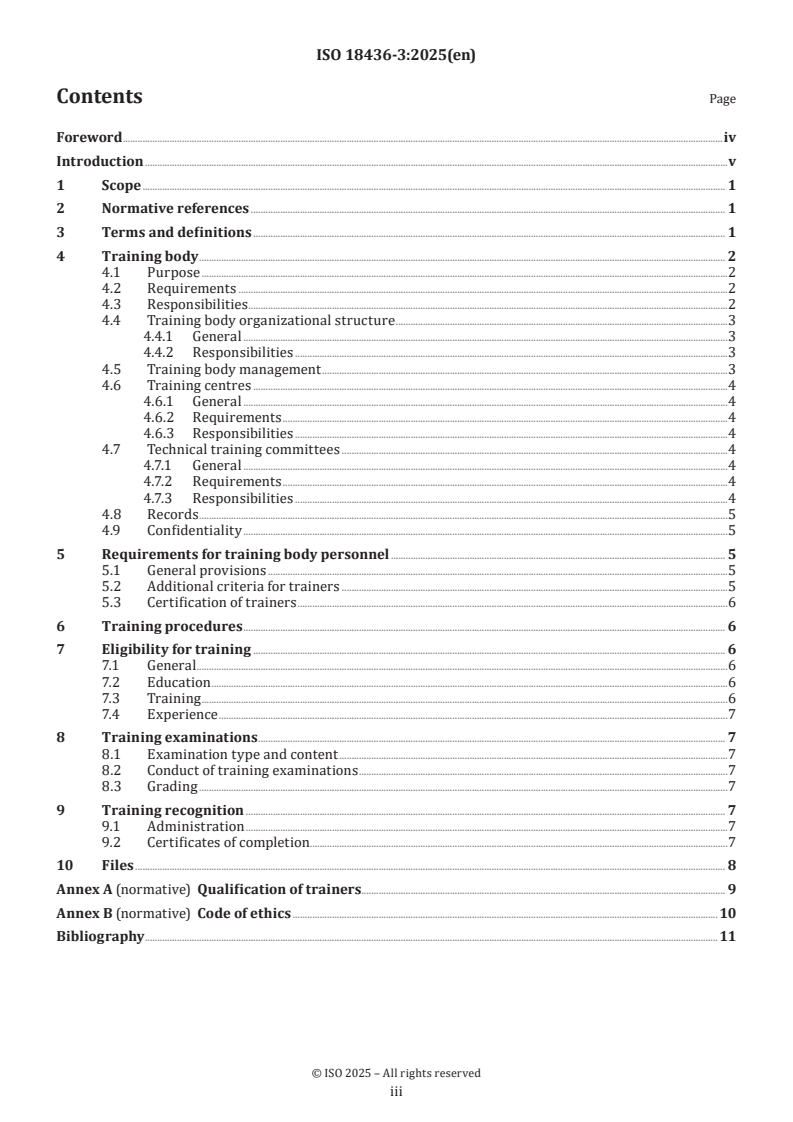
Contents Page
Foreword .iv
Introduction .v
1 Scope . 1
2 Normative references . 1
3 Terms and definitions . 1
4 Training body . 2
4.1 Purpose .2
4.2 Requirements .2
4.3 Responsibilities .2
4.4 Training body organizational structure .3
4.4.1 General .3
4.4.2 Responsibilities .3
4.5 Training body management .3
4.6 Training centres .4
4.6.1 General .4
4.6.2 Requirements .4
4.6.3 Responsibilities .4
4.7 Technical training committees .4
4.7.1 General .4
4.7.2 Requirements .4
4.7.3 Responsibilities .4
4.8 Records .5
4.9 Confidentiality .5
5 Requirements for training body personnel . 5
5.1 General provisions .5
5.2 Additional criteria for trainers .5
5.3 Certification of trainers .6
6 Training procedures . 6
7 Eligibility for training . 6
7.1 General .6
7.2 Education .6
7.3 Training .6
7.4 Experience .7
8 Training examinations . 7
8.1 Examination type and content .7
8.2 Conduct of training examinations .7
8.3 Grading .7
9 Training recognition . 7
9.1 Administration .7
9.2 Certificates of completion . . .7
10 Files . 8
Annex A (normative) Qualification of trainers. 9
Annex B (normative) Code of ethics . 10
Bibliography .11
iii
Foreword
ISO (the International Organization for Standardization) is a worldwide federation of national standards
bodies (ISO member bodies). The work of preparing International Standards is normally carried out through
ISO technical committees. Each member body interested in a subject for which a technical committee
has been established has the right to be represented on that committee. International organizations,
governmental and non-governmental, in liaison with ISO, also take part in the work. ISO collaborates closely
with the International Electrotechnical Commission (IEC) on all matters of electrotechnical standardization.
The procedures used to develop this document and those intended for its further maintenance are described
in the ISO/IEC Directives, Part 1. In particular, the different approval criteria needed for the different types
of ISO document should be noted. This document was drafted in accordance with the editorial rules of the
ISO/IEC Directives, Part 2 (see www.iso.org/directives).
ISO draws attention to the possibility that the implementation of this document may involve the use of (a)
patent(s). ISO takes no position concerning the evidence, validity or applicability of any claimed patent
rights in respect thereof. As of the date of publication of this document, ISO had not received notice of (a)
patent(s) which may be required to implement this document. However, implementers are cautioned that
this may not represent the latest information, which may be obtained from the patent database available at
www.iso.org/patents. ISO shall not be held responsible for identifying any or all such patent rights.
Any trade name used in this document is information given for the convenience of users and does not
constitute an endorsement.
For an explanation of the voluntary nature of standards, the meaning of ISO specific terms and expressions
related to conformity assessment, as well as information about ISO's adherence to the World Trade
Organization (WTO) principles in the Technical Barriers to Trade (TBT), see www.iso.org/iso/foreword.html.
This document was prepared by Technical Committee ISO/TC 108, Mechanical vibration, shock and condition
monitoring, Subcommittee SC 5, Condition monitoring and diagnostics of machines.
This third edition cancels and replaces the second edition (ISO 18436-3:2012), of which it constitutes a
minor revision.
The main changes are as follows:
— updated terminology to harmonize the document with current industry practice (such as, removing the
use of term ‘qualification’ and ‘assessment’ where practicable);
— the part title was aligned with the other parts of the ISO 18436 series.
Any feedback or questions on this document should be directed to the user’s national standards body. A
complete listing of these bodies can be found at www.iso.org/members.html.
A list of all parts in the ISO 18436 series can be found on the ISO website.
iv
Introduction
Condition monitoring and diagnostics of machines are integral parts of an effective maintenance programme.
Non-intrusive technologies used in condition monitoring and fault diagnosis include vibration, infrared
thermography, oil and wear debris analysis, acoustic and ultrasonic analysis, and electrical signature
analysis. In many instances these technologies act as complementary condition monitoring tools. The skills
and expertise of the practitioners performing the measurements and analysing the data are critical to the
effective application of these technologies.
This document defines the requirements for bodies operating training programmes in the non-intrusive
machine condition monitoring, diagnostic, and correction technologies. General requirements for training
body personnel are contained in this document. Specific requirements for personnel in condition monitoring
and diagnostics are covered in other parts of the ISO 18436 series.
v
International Standard ISO 18436-3:2025(en)
Condition monitoring and diagnostics of machines —
Requirements for training and certification of personnel —
Part 3:
Requirements for training bodies and the training process
1 Scope
This document specifies the requirements for bodies operating training programmes for personnel who
perform machinery condition monitoring, identify machine faults, and recommend corrective action.
This document specifies procedures for training of condition monitoring and diagnostics personnel.
2 Normative references
The following documents are referred to in the text in such a way that some or all of their content constitutes
requirements of this document. For dated references, only the edition cited applies. For undated references,
the latest edition of the referenced document (including any amendments) applies.
ISO 9000, Quality management systems — Fundamentals and vocabulary
ISO 13372, Condition monitoring and diagnostics of machines — Vocabulary
ISO 18436 (all parts), Condition monitoring and diagnostics of machines — Requirements for certification of
personnel
3 Terms and definitions
For the purposes of this document, the terms and definitions given in ISO 9000 and the following apply.
ISO and IEC maintain terminology databases for use in standardization at the following addresses:
— ISO Online browsing platform: available at https:// www .iso .org/ obp
— IEC Electropedia: available at https:// www .electropedia .org/
3.1
administrative committee
advisory committee
committee advising a training body
3.2
certificate of completion
written testimony of completion of training issued under the rules of a training programme
3.3
invigilator
person authorized by the training body to supervise examinations
3.4
technical training committee
committee organized by a training body to direct the technical aspects of a training programme
3.5
trainer
person with relevant technical and personal qualifications entrusted with training candidates for
certification
3.6
training body
organization competent to administer a programme to train personnel in machinery condition monitoring
and diagnostics technology
3.7
training centre
centre authorized and monitored by a training body where theoretical and practical instruction are
administered
3.8
training process
documented procedures by which a training body provides instruction to candidates for certification
3.9
training programme
programme system having its own written rules of procedure and management for training through the use
of verbal, visual and practical instruction
4 Training body
4.1 Purpose
The training body shall be responsible for the development and implementation of procedures to prepare
individuals to carry out tasks in machinery condition monitoring and diagnostics.
4.2 Requirements
A training body shall
a) have the relevant technical, educational and financial resources to ensure effective training is delivered
in accordance with the relevant part(s) of the ISO 18436 series,
b) have the administrative resources needed to organize and implement training programmes,
c) manage training that can lead to certification in accordance with the relevant part(s) of the
ISO 18436 series and shall not promote specific commercial products or services,
d) use non-discriminatory policies and procedures in the administration of the training programme, and
[1]
e) have a quality system that reflects the intent of ISO 9001 .
4.3 Responsibilities
A training body shall
a) develop, maintain and implement a technically based, practical training programme that prepares
an individual to carry out tasks in machinery condition monitoring and diagnosis which may lea
...