

IEC 60050-872:2022
(Main)International Electrotechnical Vocabulary (IEV) – Part 872: Accessibility
General Information
- Abstract
IEC 60050-872:2022 gives the general terminology used to describe accessibility and terms that writers of standards need when writing and designing International Standards. It has the status of a horizontal publication in accordance with IEC Guide 108. This terminology is consistent with the terminology developed in the other specialized parts of the IEV.
- Status
- Published
- Publication Date
- 06-Sep-2022
- Technical Committee
- TC 1 - Terminology
- Current Stage
- PPUB - Publication issued
- Start Date
- 07-Sep-2022
- Completion Date
- 05-Oct-2022
Overview
IEC 60050-872:2022, developed by the International Electrotechnical Commission (IEC), is a key component of the International Electrotechnical Vocabulary (IEV) focused specifically on accessibility. As a horizontal publication in line with IEC Guide 108, this standard provides general terminology essential for describing accessibility. It offers a consistent vocabulary for standards writers and technical committees working on the development, design, and implementation of international standards within electrical, electronic, and related technology sectors. This standard is globally relevant for anyone requiring harmonized language surrounding accessibility.
Key Topics
IEC 60050-872:2022 covers a wide range of accessibility terminology organized into clearly defined sections, including:
- Terms relating to persons: Definitions for concepts such as impairment, disability, age-related disabilities, and the characterization of individuals with specific accessibility needs.
- Terms relating to communication: Language concerning accessible communication methods, tools, and roles-such as lip speakers and interpreters for people with hearing impairments.
- Interaction and inclusion: Vocabulary on the ways people engage with products, services, or environments, with an emphasis on integration and participation for all.
- Product characteristics: Terminology to describe the accessibility features, design considerations, and inclusive attributes of products.
- Service provision: Definitions and language to support accessible services, ensuring clarity in requirements and expectations.
The standard draws upon international sources and is designed to be consistent with other specialized IEV parts, ensuring its terminology is internationally recognized and aligned.
Applications
IEC 60050-872:2022 has practical applications across multiple domains:
- Standards Development: Enables technical committees to use standardized vocabulary when drafting new international standards or revising existing documents, facilitating uniform interpretation worldwide.
- Product and Service Design: Assists designers and engineers in understanding and applying the correct terminology for accessibility, supporting the creation of inclusive products and environments.
- Regulatory Compliance: Provides a reference for organizations and regulators to harmonize requirements around accessibility, helping ensure legal compliance and global interoperability.
- Education and Training: Acts as a foundational resource for educators, trainers, and accessibility consultants who need to communicate clearly about accessibility in technical contexts.
- Policy and Communication: Offers clear definitions for policymakers, advocacy groups, and communications teams engaged in promoting inclusion and equal access.
By promoting a common language, IEC 60050-872:2022 supports the development of accessible technologies and environments, reducing misunderstandings and fostering universal access.
Related Standards
- IEC 60050 (International Electrotechnical Vocabulary series): The overarching vocabulary framework that ensures consistent terminology across all electrotechnical fields.
- IEC 63080:2017: Prior terminology related to accessibility, the content of which is now consolidated and updated within IEC 60050-872.
- Recommendation ITU-T F.791:2018: International guidance referenced for terminology associated with telecommunications accessibility.
- ISO 9241-11:2018: Basis for specific accessibility-related definitions, especially in the context of ergonomic requirements.
- IEC Guide 108: Outlines principles for horizontal publications, ensuring coherence across IEC standards.
For technical professionals, standards writers, designers, and policymakers, IEC 60050-872:2022 is an essential resource for establishing a shared understanding of accessibility terminology in the electrical and electronic industries. This fosters greater clarity, consistency, and collaboration across international borders.
To access and explore the full terminology database, visit the IEC Electropedia at www.electropedia.org.
Get Certified
Connect with accredited certification bodies for this standard

BSI Group
BSI (British Standards Institution) is the business standards company that helps organizations make excellence a habit.

TÜV Rheinland
TÜV Rheinland is a leading international provider of technical services.

TÜV SÜD
TÜV SÜD is a trusted partner of choice for safety, security and sustainability solutions.
Sponsored listings
Frequently Asked Questions
IEC 60050-872:2022 is a standard published by the International Electrotechnical Commission (IEC). Its full title is "International Electrotechnical Vocabulary (IEV) – Part 872: Accessibility". This standard covers: IEC 60050-872:2022 gives the general terminology used to describe accessibility and terms that writers of standards need when writing and designing International Standards. It has the status of a horizontal publication in accordance with IEC Guide 108. This terminology is consistent with the terminology developed in the other specialized parts of the IEV.
IEC 60050-872:2022 gives the general terminology used to describe accessibility and terms that writers of standards need when writing and designing International Standards. It has the status of a horizontal publication in accordance with IEC Guide 108. This terminology is consistent with the terminology developed in the other specialized parts of the IEV.
IEC 60050-872:2022 is classified under the following ICS (International Classification for Standards) categories: 01.040.01 - Generalities. Terminology. Standardization. Documentation (Vocabularies); 01.040.33 - Telecommunications. Audio and video engineering (Vocabularies); 11.180.01 - Aids for disabled and handicapped persons in general. The ICS classification helps identify the subject area and facilitates finding related standards.
IEC 60050-872:2022 is available in PDF format for immediate download after purchase. The document can be added to your cart and obtained through the secure checkout process. Digital delivery ensures instant access to the complete standard document.
Standards Content (Sample)
IEC 60050-872 ®
Edition 1.0 2022-09
INTERNATIONAL
STANDARD
NORME
INTERNATIONALE
HORIZONTAL PUBLICATION
PUBLICATION HORIZONTALE
International Electrotechnical Vocabulary (IEV) –
Part 872: Accessibility
Vocabulaire Electrotechnique International (IEV) –
Partie 872: Accessibilité
All rights reserved. Unless otherwise specified, no part of this publication may be reproduced or utilized in any form
or by any means, electronic or mechanical, including photocopying and microfilm, without permission in writing from
either IEC or IEC's member National Committee in the country of the requester. If you have any questions about IEC
copyright or have an enquiry about obtaining additional rights to this publication, please contact the address below or
your local IEC member National Committee for further information.
Droits de reproduction réservés. Sauf indication contraire, aucune partie de cette publication ne peut être reproduite
ni utilisée sous quelque forme que ce soit et par aucun procédé, électronique ou mécanique, y compris la photocopie
et les microfilms, sans l'accord écrit de l'IEC ou du Comité national de l'IEC du pays du demandeur. Si vous avez des
questions sur le copyright de l'IEC ou si vous désirez obtenir des droits supplémentaires sur cette publication, utilisez
les coordonnées ci-après ou contactez le Comité national de l'IEC de votre pays de résidence.
IEC Secretariat Tel.: +41 22 919 02 11
3, rue de Varembé info@iec.ch
CH-1211 Geneva 20 www.iec.ch
Switzerland
About the IEC
The International Electrotechnical Commission (IEC) is the leading global organization that prepares and publishes
International Standards for all electrical, electronic and related technologies.
About IEC publications
The technical content of IEC publications is kept under constant review by the IEC. Please make sure that you have the
latest edition, a corrigendum or an amendment might have been published.
IEC publications search - webstore.iec.ch/advsearchform IEC Products & Services Portal - products.iec.ch
The advanced search enables to find IEC publications by a
Discover our powerful search engine and read freely all the
variety of criteria (reference number, text, technical publications previews. With a subscription you will always
committee, …). It also gives information on projects, replaced have access to up to date content tailored to your needs.
and withdrawn publications.
Electropedia - www.electropedia.org
IEC Just Published - webstore.iec.ch/justpublished
The world's leading online dictionary on electrotechnology,
Stay up to date on all new IEC publications. Just Published
containing more than 22 300 terminological entries in English
details all new publications released. Available online and
and French, with equivalent terms in 19 additional languages.
once a month by email.
Also known as the International Electrotechnical Vocabulary
(IEV) online.
IEC Customer Service Centre - webstore.iec.ch/csc
If you wish to give us your feedback on this publication or
need further assistance, please contact the Customer Service
Centre: sales@iec.ch.
A propos de l'IEC
La Commission Electrotechnique Internationale (IEC) est la première organisation mondiale qui élabore et publie des
Normes internationales pour tout ce qui a trait à l'électricité, à l'électronique et aux technologies apparentées.
A propos des publications IEC
Le contenu technique des publications IEC est constamment revu. Veuillez vous assurer que vous possédez l’édition la
plus récente, un corrigendum ou amendement peut avoir été publié.
Recherche de publications IEC - IEC Products & Services Portal - products.iec.ch
webstore.iec.ch/advsearchform Découvrez notre puissant moteur de recherche et consultez
La recherche avancée permet de trouver des publications IEC gratuitement tous les aperçus des publications. Avec un
en utilisant différents critères (numéro de référence, texte, abonnement, vous aurez toujours accès à un contenu à jour
comité d’études, …). Elle donne aussi des informations sur adapté à vos besoins.
les projets et les publications remplacées ou retirées.
Electropedia - www.electropedia.org
IEC Just Published - webstore.iec.ch/justpublished
Le premier dictionnaire d'électrotechnologie en ligne au
Restez informé sur les nouvelles publications IEC. Just
monde, avec plus de 22 300 articles terminologiques en
Published détaille les nouvelles publications parues.
anglais et en français, ainsi que les termes équivalents dans
Disponible en ligne et une fois par mois par email.
19 langues additionnelles. Egalement appelé Vocabulaire
Electrotechnique International (IEV) en ligne.
Service Clients - webstore.iec.ch/csc
Si vous désirez nous donner des commentaires sur cette
publication ou si vous avez des questions contactez-nous:
sales@iec.ch.
IEC 60050-872 ®
Edition 1.0 2022-09
INTERNATIONAL
STANDARD
NORME
INTERNATIONALE
HORIZONTAL PUBLICATION
PUBLICATION HORIZONTALE
International Electrotechnical Vocabulary (IEV) –
Part 872: Accessibility
Vocabulaire Electrotechnique International (IEV) –
Partie 872: Accessibilité
INTERNATIONAL
ELECTROTECHNICAL
COMMISSION
COMMISSION
ELECTROTECHNIQUE
INTERNATIONALE
ICS 01.040.01; 01.040.33; 11.180.01 ISBN 978-2-8322-5633-6
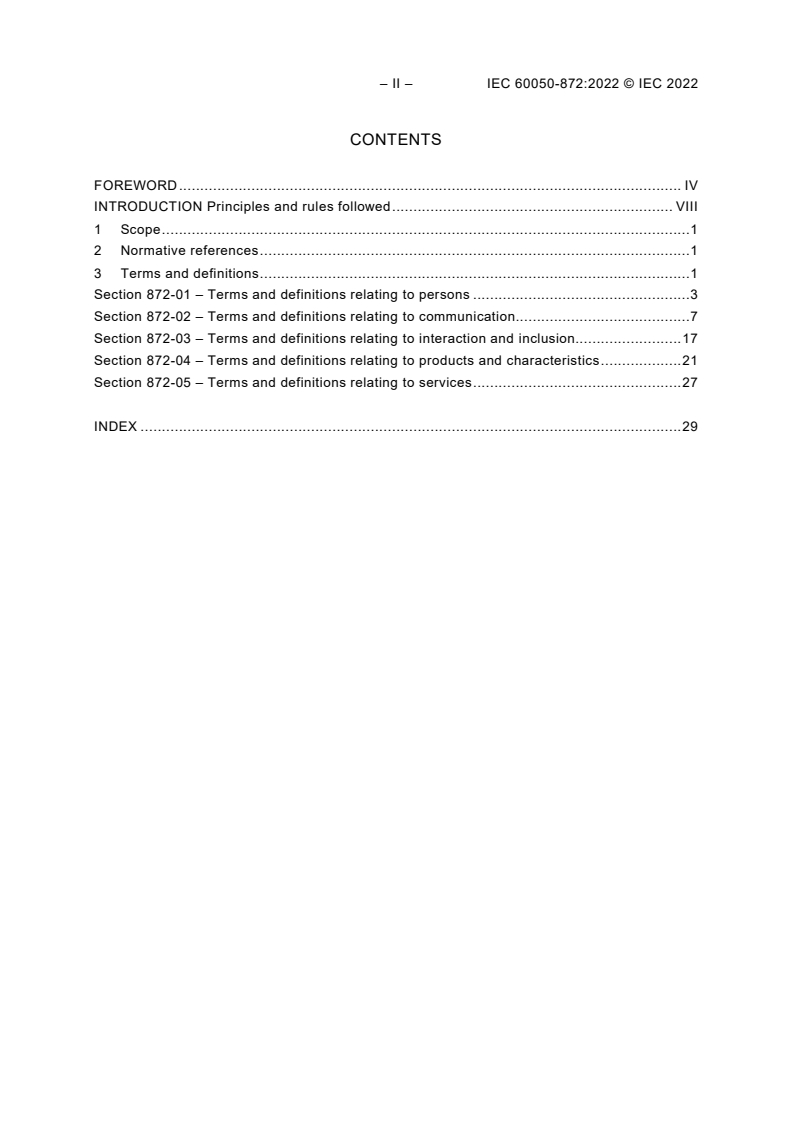
– II – IEC 60050-872:2022 © IEC 2022
CONTENTS
FOREWORD . IV
INTRODUCTION Principles and rules followed . VIII
1 Scope .1
2 Normative references .1
3 Terms and definitions .1
Section 872-01 – Terms and definitions relating to persons .3
Section 872-02 – Terms and definitions relating to communication .7
Section 872-03 – Terms and definitions relating to interaction and inclusion . 17
Section 872-04 – Terms and definitions relating to products and characteristics . 21
Section 872-05 – Terms and definitions relating to services . 27
INDEX . 29
SOMMAIRE
AVANT-PROPOS . VI
INTRODUCTION Principes d'établissement et règles suivies . XI
1 Domaine d'application .2
2 Références normatives .2
3 Termes et définitions .2
Section 872-01 – Termes et définitions relatifs aux personnes .3
Section 872-02 – Termes et définitions relatifs à la communication .7
Section 872-03 – Termes et définitions relatifs à l'interaction et à l'inclusion . 17
Section 872-04 – Termes et définitions relatifs aux produits et aux caractéristiques . 21
Section 872-05 – Termes et définitions relatifs aux services . 27
INDEX . 29
– IV – IEC 60050-872:2022 © IEC 2022
INTERNATIONAL ELECTROTECHNICAL COMMISSION
_______________
INTERNATIONAL ELECTROTECHNICAL VOCABULARY (IEV) –
Part 872: Accessibility
FOREWORD
1) The International Electrotechnical Commission (IEC) is a worldwide organization for standardization comprising
all national electrotechnical committees (IEC National Committees). The object of IEC is to promote international
co-operation on all questions concerning standardization in the electrical and electronic fields. To this end and
in addition to other activities, IEC publishes International Standards, Technical Specifications, Technical Reports,
Publicly Available Specifications (PAS) and Guides (hereafter referred to as "IEC Publication(s)"). Their
preparation is entrusted to technical committees; any IEC National Committee interested in the subject dealt with
may participate in this preparatory work. International, governmental and non-governmental organizations liaising
with the IEC also participate in this preparation. IEC collaborates closely with the International Organization for
Standardization (ISO) in accordance with conditions determined by agreement between the two organizations.
2) The formal decisions or agreements of IEC on technical matters express, as nearly as possible, an international
consensus of opinion on the relevant subjects since each technical committee has representation from all
interested IEC National Committees.
3) IEC Publications have the form of recommendations for international use and are accepted by IEC National
Committees in that sense. While all reasonable efforts are made to ensure that the technical content of IEC
Publications is accurate, IEC cannot be held responsible for the way in which they are used or for any
misinterpretation by any end user.
4) In order to promote international uniformity, IEC National Committees undertake to apply IEC Publications
transparently to the maximum extent possible in their national and regional publications. Any divergence between
any IEC Publication and the corresponding national or regional publication shall be clearly indicated in the latter.
5) IEC itself does not provide any attestation of conformity. Independent certification bodies provide conformity
assessment services and, in some areas, access to IEC marks of conformity. IEC is not responsible for any
services carried out by independent certification bodies.
6) All users should ensure that they have the latest edition of this publication.
7) No liability shall attach to IEC or its directors, employees, servants or agents including individual experts and
members of its technical committees and IEC National Committees for any personal injury, property damage or
other damage of any nature whatsoever, whether direct or indirect, or for costs (including legal fees) and
expenses arising out of the publication, use of, or reliance upon, this IEC Publication or any other IEC
Publications.
8) Attention is drawn to the Normative references cited in this publication. Use of the referenced publications is
indispensable for the correct application of this publication.
9) Attention is drawn to the possibility that some of the elements of this IEC Publication may be the subject of patent
rights. IEC shall not be held responsible for identifying any or all such patent rights.
International Standard IEC 60050-872 has been prepared by IEC technical committee 1:
Terminology.
This first edition comprises terminology formerly published in IEC 63080:2017 (together with a
few entries from Recommendation ITU-T F.791:2018, and one from ISO 9241-11:2018, that
define certain technical terms appearing in definitions), and reviewed by IEC technical
committee 100: Audio, video and multimedia systems and equipment, and IEC technical
committee 1: Terminology, as change request C00075 for inclusion in the International
Electrotechnical Vocabulary.
This publication was developed in accordance with the ISO/IEC Directives, Part 1, IEC
Supplement, Annexes SJ and SK, and was approved by the SDB team of IEC technical
committee 1: Terminology, under the SDB content procedure.
A list of all parts of the IEC 60050 series, published under the general title International
Electrotechnical Vocabulary can be found on the IEC website and is available at
www.electropedia.org.
All parts of the IEC 60050 series have the status of a horizontal publication in accordance with
IEC Guide 108.
– VI – IEC 60050-872:2022 © IEC 2022
COMMISSION ÉLECTROTECHNIQUE INTERNATIONALE
________________
VOCABULAIRE ÉLECTROTECHNIQUE INTERNATIONAL (IEV) –
Partie 872: Accessibilité
AVANT-PROPOS
1) La Commission Electrotechnique Internationale (IEC) est une organisation mondiale de normalisation composée
de l'ensemble des comités électrotechniques nationaux (Comités nationaux de l'IEC). L'IEC a pour objet de
favoriser la coopération internationale pour toutes les questions de normalisation dans les domaines de
l'électricité et de l'électronique. A cet effet, l'IEC – entre autres activités – publie des Normes internationales,
des Spécifications techniques, des Rapports techniques, des Spécifications accessibles au public (PAS) et des
Guides (ci-après dénommés "Publication(s) de l'IEC"). Leur élaboration est confiée à des comités d'études, aux
travaux desquels tout Comité national intéressé par le sujet traité peut participer. Les organisations
internationales, gouvernementales et non gouvernementales, en liaison avec l'IEC, participent également aux
travaux. L'IEC collabore étroitement avec l'Organisation Internationale de Normalisation (ISO), selon des
conditions fixées par accord entre les deux organisations.
2) Les décisions ou accords officiels de l'IEC concernant les questions techniques représentent, dans la mesure du
possible, un accord international sur les sujets étudiés, étant donné que les Comités nationaux de l'IEC intéressés
sont représentés dans chaque comité d'études.
3) Les Publications de l'IEC se présentent sous la forme de recommandations internationales et sont agréées
comme telles par les Comités nationaux de l'IEC. Tous les efforts raisonnables sont entrepris afin que l'IEC
s'assure de l'exactitude du contenu technique de ses publications; l'IEC ne peut pas être tenue responsable de
l'éventuelle mauvaise utilisation ou interprétation qui en est faite par un quelconque utilisateur final.
4) Dans le but d'encourager l'uniformité internationale, les Comités nationaux de l'IEC s'engagent, dans toute la
mesure possible, à appliquer de façon transparente les Publications de l'IEC dans leurs publications nationales
et régionales. Toutes divergences entre toutes Publications de l'IEC et toutes publications nationales ou
régionales correspondantes doivent être indiquées en termes clairs dans ces dernières.
5) L'IEC elle-même ne fournit aucune attestation de conformité. Des organismes de certification indépendants
fournissent des services d'évaluation de conformité et, dans certains secteurs, accèdent aux marques de
conformité de l'IEC. L'IEC n'est responsable d'aucun des services effectués par les organismes de certification
indépendants.
6) Tous les utilisateurs doivent s'assurer qu'ils sont en possession de la dernière édition de cette publication.
7) Aucune responsabilité ne doit être imputée à l'IEC, à ses administrateurs, employés, auxiliaires ou mandataires,
y compris ses experts particuliers et les membres de ses comités d'études et des Comités nationaux de l'IEC,
pour tout préjudice causé en cas de dommages corporels et matériels, ou de tout autre dommage de quelque
nature que ce soit, directe ou indirecte, ou pour supporter les coûts (y compris les frais de justice) et les dépenses
découlant de la publication ou de l'utilisation de cette Publication de l'IEC ou de toute autre Publication de l'IEC,
ou au crédit qui lui est accordé.
8) L'attention est attirée sur les références normatives citées dans cette publication. L'utilisation de publications
référencées est obligatoire pour une application correcte de la présente publication.
9) L'attention est attirée sur le fait que certains des éléments de la présente Publication de l'IEC peuvent faire l'objet
de droits de propriété intellectuelle ou de droits analogues. L'IEC ne saurait être tenue pour responsable de ne
pas avoir identifié de tels droits de propriété et de ne pas avoir signalé leur existence.
La Norme internationale IEC 60050-872 a été établie par le comité d'études 1 de l'IEC:
Terminologie.
Cette première édition comprend la terminologie publiée auparavant dans IEC 63080:2017
(ainsi que quelques articles, provenant de Recommandation UIT-T F.791:2018, et un de ISO
9241-11:2018, qui définissent certains termes techniques présents dans les définitions), et
passée en revue par le comité d'études 100 de l'IEC: Systèmes et équipements audio, vidéo et
services de données, et le comité d'études 1 de l'IEC: Terminologie, en tant que "change
request" C00075 pour inclusion dans le Vocabulaire Electrotechnique International.
Cette publication a été développée en conformité avec les Annexes SJ et SK du Supplément
IEC aux Directives ISO/IEC, Partie 1, et a été approuvée par l'équipe SDB du comité d'études
1 de l'IEC: Terminologie, selon la procédure de contenu SDB.
Une liste de toutes les parties de la série IEC 60050, publiée sous le titre général Vocabulaire
Electrotechnique International, peut être consultée sur le site web de l'IEC et est disponible à
l'adresse www.electropedia.org.
Toutes les parties de la série IEC 60050 ont le statut d'une publication horizontale
conformément au Guide IEC 108.
– VIII – IEC 60050-872:2022 © IEC 2022
INTRODUCTION
Principles and rules followed
General
The IEV (IEC 60050, International Electrotechnical Vocabulary) is a general purpose
multilingual vocabulary covering the field of electrotechnology, electronics and
telecommunication (available at www.electropedia.org). It comprises about 22 000
terminological entries, each corresponding to a concept. These terminological entries are
distributed among about 90 parts, each part corresponding to a given field.
EXAMPLE
Part 161 (IEC 60050-161): Electromagnetic compatibility
Part 411 (IEC 60050-411): Rotating machines
The terminological entries follow a hierarchical classification scheme part/section/concept;
within the sections, the terminological entries are organized in a systematic order.
The terms and definitions (and possibly non-verbal representations, examples, notes to entry
and sources) in the entries are given in two or more of the three IEC languages, that is to say
French, English and Russian (principal IEV languages).
In each terminological entry, the terms alone are also given in several of the additional IEV
languages [Arabic (ar), Czech (cs), German (de), Spanish (es), Finnish (fi), Italian (it), Japanese
(ja), Korean (ko), Mongolian (mn), Dutch (Belgian) (nl BE), Norwegian (no) [Bokmål (nb) and
Nynorsk (nn)], Polish (pl), Portuguese (pt), Slovenian (sl), Serbian (sr), Swedish (sv) and
Chinese (zh)].
Information regarding the IEV and the drafting and presentation of the terminological entries is
provided in the IEC Supplement to the ISO/IEC Directives, Annex SJ. The following constitutes
a summary of these rules.
Organization of a terminological entry
Each of the terminological entries corresponds to a concept, and comprises:
- an IEV number,
- possibly a letter symbol for the quantity or unit,
then, for the principal IEV languages present in the part:
- the term designating the concept, called "preferred term", possibly accompanied by
synonyms and abbreviations,
- the definition of the concept,
- possibly non-verbal representations, examples and notes to entry,
- possibly the source,
and finally, for the additional IEV languages, the terms alone.
IEV number
The IEV number is comprised of three elements, separated by hyphens:
part number: 3 digits,
section number: 2 digits,
entry number: sequence of decimal digits in which leading zeroes are permissible but
redundant (e.g. 1 to 113, 01 to 99, 001 to 127).
EXAMPLE 845-27-003
Letter symbols for quantities and units
These symbols, which are language independent, are given on a separate line following the
IEV number.
EXAMPLE
131-12-04
R
resistance
Preferred term and synonyms
The preferred term is the term that heads a terminological entry in a given language; it can be
followed by synonyms. It is printed in boldface.
Synonyms:
The synonyms are printed on separate lines under the preferred term: preferred synonyms are
printed in boldface, and admitted and deprecated synonyms are printed in lightface. Deprecated
synonyms are prefixed by the text "DEPRECATED:".
Absence of an appropriate term:
When no appropriate term exists in a given language, the preferred term is replaced by five
dots, as follows:
.....
" " (and there are of course no synonyms).
Attributes
Each term (and synonym) can be followed by attributes giving additional information, and
printed in lightface on the same line as the corresponding term, following this term.
EXAMPLE
specific use of the term:
transmission line,
– X – IEC 60050-872:2022 © IEC 2022
national variant:
lift, GB
grammatical information:
quantize, verb
transient, noun
AC, adj
Source
In some cases, it has been necessary to include in an IEV part a concept taken from another
IEV part, or from another authoritative terminology document (ISO/IEC Guide 99,
ISO/IEC 2382, etc.), either with or without modification to the definition (and possibly to the
term).
This is indicated by the mention of this source, printed in lightface, and placed at the end of the
terminological entry in each of the principal IEV languages present.
EXAMPLE SOURCE: IEC 60050-131:2002, 131-03-13, modified
Terms in additional IEV languages
These terms are placed following the terminological entries in the principal IEV languages, on
separate lines (a single line for each language), preceded by the alpha-2 code for the language
defined in ISO 639-1, and in the alphabetic order of this code.
INTRODUCTION
Principes d'établissement et règles suivies
Généralités
L'IEV (IEC 60050 – Vocabulaire Electrotechnique International) est un vocabulaire multilingue
à usage général couvrant le champ de l'électrotechnique, de l'électronique et des
télécommunications (disponible à l'adresse www.electropedia.org). Il comprend environ 22 000
articles terminologiques correspondant chacun à un concept (une notion). Ces articles
terminologiques sont répartis dans environ 90 parties, chacune correspondant à un domaine
donné.
EXEMPLE
Partie 161 (IEC 60050-161): Compatibilité électromagnétique
Partie 411 (IEC 60050-411): Machines tournantes
Les articles terminologiques suivent un schéma de classification hiérarchique
partie/section/concept, les articles terminologiques étant, au sein des sections, classés dans
un ordre systématique.
Les termes et définitions (et éventuellement les représentations non verbales, exemples, notes
à l'article et sources) sont donnés dans deux des trois langues de l'IEC ou dans les trois, c'est-
à-dire en français, en anglais et en russe (langues principales de l'IEV).
Dans chaque article terminologique, les termes seuls sont également donnés dans plusieurs
des langues additionnelles de l'IEV [arabe (ar), tchèque (cs), allemand (de), espagnol (es),
finnois (fi), italien (it), japonais (ja), coréen (ko), mongol (mn), néerlandais (belge) (nl BE),
norvégien (no) [bokmål (nb) et nynorsk (nn)], polonais (pl), portugais (pt), slovène (sl), serbe
(sr), suédois (sv) et chinois (zh)].
Des informations concernant l'IEV, la rédaction ainsi que la présentation des articles
terminologiques sont fournies dans le Supplément de l'IEC aux Directives ISO/IEC, à
l'Annexe SJ. Un résumé de ces règles est donné ci-dessous.
Constitution d'un article terminologique
Chacun des articles terminologique correspond à un concept, et comprend:
- un numéro IEV,
- éventuellement un symbole littéral de grandeur ou d'unité,
puis, pour chaque langue principale de l'IEV présente dans la partie:
- le terme désignant le concept, appelé "terme privilégié", éventuellement accompagné
de synonymes et d'abréviations,
- la définition du concept,
– XII – IEC 60050-872:2022 © IEC 2022
- éventuellement des représentations non verbales, des exemples et des notes à l'article,
- éventuellement la source,
et enfin, pour les langues additionnelles de l'IEV, les termes seuls.
Numéro IEV
Le numéro IEV comprend trois éléments, séparés par des traits d'union:
numéro de partie: 3 chiffres,
numéro de section: 2 chiffres,
numéro d'article: série de chiffres décimaux dans laquelle les zéro initiaux sont permis
mais superflus (par exemple 1 à 113, 01 à 99, 001 à 127).
EXEMPLE 845-27-003
Symboles littéraux de grandeurs et d'unités
Ces symboles, indépendants de la langue, sont donnés sur une ligne séparée à la suite du
numéro IEV.
EXEMPLE
131-12-04
R
résistance, f
Terme privilégié et synonymes
Le terme privilégié est le terme qui figure en tête d'un article dans une langue donnée; il peut
être suivi par des synonymes. Il est imprimé en caractères gras.
Synonymes:
Les synonymes sont imprimés sur des lignes séparées sous le terme privilégié: les synonymes
privilégiés sont imprimés en caractères gras, et les synonymes admis et déconseillés sont
imprimés en caractères maigres. Les synonymes déconseillés sont précédés par le texte
"DÉCONSEILLÉ:".
Absence de terme approprié:
Lorsqu'il n'existe pas de terme approprié dans une langue, le terme privilégié est remplacé par
cinq points, comme ceci:
.....
" " (et il n'y a alors bien entendu pas de synonymes).
Attributs
Chaque terme (et synonyme) peut être suivi d'attributs donnant des informations
supplémentaires; ces attributs sont imprimés en caractères maigres, à la suite de ce terme, et
sur la même ligne.
EXEMPLE
spécificité d'utilisation du terme:
rang,
variante nationale:
unité de traitement, CA
catégorie grammaticale:
quantifier, verbe
électronique, f
électronique, adj
Source
Dans certains cas, il a été nécessaire d'inclure dans une partie de l'IEV un concept pris dans
une autre partie de l'IEV, ou dans un autre document de terminologie faisant autorité
(Guide ISO/IEC 99, ISO/IEC 2382, etc.), avec ou sans modification de la définition (ou
éventuellement du terme).
Ceci est indiqué par la mention de cette source, imprimée en caractères maigres et placée à la
fin de l'article terminologique dans chacune des langues principales de l'IEV présentes.
EXEMPLE SOURCE: IEC 60050-131:2002, 131-03-13, modifié
Termes dans les langues additionnelles de l'IEV
Ces termes sont placés à la fin des articles terminologiques dans les langues principales de
l'IEV, sur des lignes séparées (une ligne par langue), précédés par le code alpha-2 de la langue,
défini dans l'ISO 639-1, et dans l'ordre alphabétique de ce code.
– 1 – IEC 60050-872:2022 © IEC 2022
INTERNATIONAL ELECTROTECHNICAL VOCABULARY (IEV) –
Part 872: Accessibility
1 Scope
This part of IEC 60050 gives the general terminology used to describe accessibility and terms
that writers of standards need when writing and designing International Standards. It has the
status of a horizontal publication in accordance with IEC Guide 108, Guidelines for ensuring
the coherence of IEC publications – Horizontal functions, horizontal publications and their
application.
This terminology is consistent with the terminology developed in the other specialized parts of
the IEV.
This horizontal publication is primarily intended for use by technical committees in the
preparation of IEC publications in accordance with the principles laid down in IEC Guide 108.
One of the responsibilities of a technical committee is, wherever applicable, to make use of
horizontal publications in the preparation of its publications.
2 Normative references
There are no normative references in this document.
3 Terms and definitions
The terms and definitions contained in this part of IEC 60050 were extracted from the
Electropedia (www.electropedia.org) (also known as the "IEV Online") – the world's most
comprehensive online terminology database covering the field of electrotechnology, electronics
and telecommunication.
VOCABULAIRE ÉLECTROTECHNIQUE INTERNATIONAL (IEV) –
Partie 872: Accessibilité
1 Domaine d'application
La présente partie de l'IEC 60050 donne la terminologie générale utilisée pour décrire
l'accessibilité, ainsi que des termes dont les rédacteurs de normes ont besoin au moment de
l'élaboration des Normes internationales. Elle a le statut de publication horizontale
conformément au Guide IEC 108, Lignes directrices pour assurer la cohérence des publications
de l'IEC – Fonctions horizontales, publications horizontales et leur application (disponible en
anglais seulement).
Cette terminologie est en accord avec la terminologie figurant dans les autres parties
spécialisées de l'IEV.
La présente publication horizontale est essentiellement destinée à l'usage des comités d'études
dans la préparation des publications de l'IEC, conformément aux principes établis dans le
Guide IEC 108.
L'une des responsabilités d'un comité d'études est d'utiliser, autant que possible, les
publications horizontales lors de la préparation de ses publications.
2 Références normatives
Le présent document ne contient aucune référence normative.
3 Termes et définitions
Les termes et définitions contenus dans la présente partie de l'IEC 60050 ont été extraits de
l'Electropedia (www.electropedia.org) (également connue sous le nom "IEV Online") – la base
de données terminologique en ligne la plus complète couvrant le champ de l'électrotechnique,
de l'électronique et des télécommunications.
– 3 – IEC 60050-872:2022 © IEC 2022
872-01 Terms and definitions relating to persons
872-01 Termes et définitions relatifs aux personnes
872-01-01
impairment
See IEV 871-02-07
déficience, f
Voir IEV 871-02-07
872-01-02
disability
hindrance, experienced by a person with impairments, to full and effective participation in society on
an equal basis with other persons in relation to barriers
EXAMPLE Impaired eyesight, deafness in varying degrees, and reduced mobility.
Note 1 to entry: The concept "disability" is an evolving concept.
SOURCE: Recommendation ITU-T F.791:2018, 3.15, modified – The definition has been revised for
conformity with the "principle of substitution" rule; "attitudinal or environmental" deleted here since
these words are present in the definition of "barriers"; "others" replaced by "other persons" for clarity.
The example has been added from entry 3.2.3 of IEC 63080:2017.
handicap, m
gêne à laquelle est confrontée une personne qui présente des déficiences, eu égard à sa participation
pleine et entière à la société sur un pied d'égalité avec les autres personnes, par rapport aux obstacles
rencontrés.
EXEMPLE Acuité visuelle affaiblie, surdité variable et mobilité réduite.
Note 1 à l'article: La notion ''handicap'' est évolutive.
SOURCE: Recommandation UIT-T F.791:2018, 3.15, modifié – La définition a été révisée pour
conformité à la règle du ''principe de substitution"; "attitudinal or environmental" supprimée dans la
définition anglaise car ces termes sont présents dans la définition de "barrier" (''obstacle''); "others"
dans la définition anglaise remplacé par "other persons" à des fins de clarté. L'exemple a été ajouté de
l'article 3.2.3 de l'IEC 63080:2017.
872-01-03
person with age-related disabilities
older person with cognitive or physical disabilities, or both
SOURCE: IEC 63080:2017, 3.23, modified – The term and definition have been revised to be
singular; "person" replaced by "older person" and "caused by the aging process" omitted; "cognitive
and physical disabilities" replaced by "cognitive or physical disabilities (3.15), or both"; the text
"itself, e.g. diminished eyesight, deafness in varying degrees, reduced mobility, or cognitive abilities"
has been omitted.
personne en situation de handicap lié à l'âge, f
personne âgée qui présente un handicap cognitif et/ou physique
SOURCE: IEC 63080:2017, 3.23, modifié – Le terme et la définition ont été révisés à des fins de
singularité; "person" replaced by "older person" and "caused by the aging process" omitted;
"cognitive and physical disabilities" remplacé par "cognitive or physical disabilities (3.15), or both"
en anglais; le texte "itself, e.g. diminished eyesight, deafness in varying degrees, reduced mobility" en
anglais a été révisé pour conformité à la définition 3.24 de la Recommandation UIT-T F.791:2018,
mais a été réécrit à des fins de conformité aux règles de terminologie. Les derniers termes "or
cognitive abilities" ont été supprimés du texte anglais puisqu'ils constituent une répétition.
872-01-04
specific needs, pl
DEPRECATED: special needs, pl
requirements for accommodation appropriate to characteristics related to age, gender, or disability
Note 1 to entry: Further information is provided in ITU Plenipotentiary Conference Resolution 175
(Busan, 2014), Telecommunication/information and communication technology accessibility for
persons with disabilities and persons with specific needs
[https://www.itu.int/en/action/accessibility/Pages/ITUmandate.aspx], ITU World Telecommunication
Development Conference Resolution 58 (Rev Dubai 2014), Telecommunication/information and
communication technology accessibility for persons with disabilities, including persons with age-
related disabilities. In: Final Report World Telecommunication Development Conference (WTDC-
14), Dubai, United Arab Emirates, 2014-03-30/04-10, pp. 396-410 Available [viewed 2019-01-09] at:
https://itu.int/en/ITU-D/Conferences/WTDC/Documents/D-TDC-WTDC-2014-PDF-E.pdf and ITU
World Telecommunication Development Conference (2014), Action plan. In: Final Report World
Telecommunication Development Conference (WTDC-14), Dubai, United Arab Emirates, 2014-03-
30/04-10, pp. 43-144. Available [viewed 2019-01-09] at https://itu.int/en/ITU-
D/Conferences/WTDC/Documents/D-TDC-WTDC-2014-PDF-E.pdf and Recommendation ITU-T
F.791:2018, clause 6.39.
SOURCE: IEC 63080:2017, 3.38, modified – The definition has been revised to express better the
concept and to avoid the implication that men are the norm and others have specific needs. In Note 1
to entry, the details of the referenced documents have been added.
– 5 – IEC 60050-872:2022 © IEC 2022
besoins particuliers, m pl
DÉCONSEILLÉ: besoins spéciaux , m pl
exigences à accommoder liés aux caractéristiques liées à l'age, le genre, ou l'handicap
Note 1 à l'article: Pour de plus amples informations, voir: Résolution 175 de la Conférence de
plénipotentiaires de l’UIT (Busan, 2014), Accessibilité des télécommunications / technologies de
l'information et de la communication pour les personnes handicapées et les personnes ayant des
besoins particuliers [https://www.itu.int//dms_pub/itu-s/opb/conf/S-CONF-PLEN-2019-PDF-F.pdf],
Résolution 58 de la Conférence mondiale de développement des télécommunications de l’UIT
(Rév.Dubaï, 2014), Accessibilité des télécommunications / technologies de l'information et de la
communication pour les personnes handicapées, y compris les personnes souffrant de handicaps liés à
l'âge, dans Rapport final de la Conférence mondiale de développement des télécommunications
(CMDT-14), Dubaï, Émirats Arabes Unis, 30 mars au 10 avril 2014, p. 396-410, disponible [consulté
le 2022-02-04] à l’adresse https://www.itu.int/en/ITU-D/TIES_Protected/WTDC14/WTDC14-
FinalReport-F.pdf, Conférence mondiale de développement des télécommunications de l’UIT (2014),
Plan d’action, dans Rapport final de la Conférence mondiale de développement des
télécommunications (CMDT-14), Dubaï, Émirats Arabes Unis, 30 mars au 10 avril 2014, pp. 396-410,
disponible [consulté le 2022-02-04] à l’adresse https://www.itu.int/en/ITU-
D/TIES_Protected/WTDC14/WTDC14-FinalReport-F.pdf, pp. 43-144, et Recommandation ITU-T
F.791:2018, article 6.39.
SOURCE: IEC 63080:2017, 3.38, modifié – La définition a été revisée afin de mieux exprimer le
concept, et d'éviter l'implication que les hommes sont la norme et les autres ont des besoins
particuliers. Dans la Note 1 à l'article, les informations détaillées des documents de référence ont été
ajoutées.
872-01-05
lip speaker
trained interpreter for persons who are deaf or hard of hearing, who speaks silently the dialogue in the
audiovisual content or in any other event in real time, so that the speech is clearly discernible for
persons with hearing disabilities who can lip-read the words from the interpreter's mouth without the
use of sign language
SOURCE: IEC Recommendation ITU-T F.791:2018, 3.22, modified – The synonym "oral interpreter"
has been omitted because “oral” is generally associated with speech and not with the mouth. The
leading article has been omitted; "deaf and hard of hearing" replaced by "deaf or hard of hearing" in
accordance with the wording in 3.21 and 3.31; "in real time" replaced by "as real time" for coherence
with 3.30.
interprète labial, m
interprète formé à destination des personnes sourdes ou malentendantes, qui répète en silence les
dialogues du contenu audiovisuel ou de tout autre événement en temps réel, de sorte que le discours
soit clairement compréhensible pour les personnes en situation de handicap auditif qui peuvent lire sur
les lèvres de l'interprète sans utiliser la langue des signes
SOURCE: Recommandation IEC UIT-T F.791:2018, 3.22, modifié – Le synonyme "interprète oral" a
été omis puisque “oral” est associé en général avec la parole et pas avec la bouche. L'article de tête a
été omis; "personnes sourdes et malentendantes" remplacé par "personnes sourdes ou malentendantes"
conformément au libellé de 3.21 et de 3.31; "in real time" remplacé par "as real time" dans l'anglais
pour cohérence avec la définition 3.30.
– 7 – IEC 60050-872:2022 © IEC 2022
872-02 Terms and definitions relating to communication
872-02 Termes et définitions relatifs à la communication
872-02-01
special need,
identification in forms or signs of any accessibility accommodation that a person with disabilities
(PWD) or a person with specific needs might require to help them be able to participate
Note 1 to entry: The terms "special need" and "special needs" shall not be used to refer to persons (see
IEV 872-01-04).
Note 2 to entry: The terms "special need" and "special needs" have a different usage when referring to
countries, as defined in ITU World Telecommunication Development Conference Resolution 58 (Rev
Dubai 2014), Telecommunication/information and communication technology accessibility for
persons with disabilities, including persons with age-related disabilities. In: Final Report World
Telecommunication Development Conference (WTDC-14), Dubai, United Arab Emirates, 2014-03-
30/04-10, pp. 396-410 Available [viewed 2019-01-09] at: https://itu.int/en/ITU-
D/Conferences/WTDC/Documents/D-TDC-WTDC-2014-PDF-E.pdf, and ITU World
Telecommunication Development Conference (2014), Action plan. In: Final Report World
Telecommunication Development Conference (WTDC-14), Dubai, United Arab Emirates, 2014-03-
30/04-10, pp. 43-144. Available [viewed 2019-01-09] at https://itu.int/en/ITU-
D/Conferences/WTDC/Documents/D-TDC-WTDC-2014-PDF-E.pdf.
SOURCE: IEC 63080:2017, 3.37, modified – The term has been revised to be singular to align with
the definition; "may" replaced by "might"; the requirement in Note 1 to entry has been redrafted for
conformity with the ISO/IEC Directives, Part 2; the details of the referenced documents have been
added to Note 2 to entry.
besoin spécial, m
identification, par des formes ou des signes, de tout aménagement d'accessibilité dont une personne en
situation de handicap ou une personne qui a des besoins particuliers peut exiger pour être en mesure
de participer
Note 1 à l'article: Les termes ''besoin spécial" et "besoins spéciaux" ne doivent pas être utilisés pour
désigner des personnes (voir IEV 872-01-04).
Note 2 à l'article: Les termes ''besoin spécial" et "besoins spéciaux" sont utilisés différemment
lorsqu'ils se rapportent à des pays, comme cela est défini dans: Résolution 58 de la Conférence
mondiale de développement des télécommunications de l’UIT (Rév.Dubaï, 2014), Accessibilité des
télécommunications / technologies de l'information et de la communication pour les personnes
handicapées, y compris les personnes souffrant de handicaps liés à l'âge, dans le Rapport final de la
Conférence mondiale de développement des télécommunications (CMDT-14), Dubaï, Émirats Arabes
Unis, 30 mars au 10 avril 2014, p. 396-410, disponible [consulté le 2022-02-04] à l’adresse
https://www.itu.int/en/ITU-D/TIES_Protected/WTDC14/WTDC14-FinalReport-F.pdf, et Plan
d’action, dans Rapport final de la Conférence mondiale de développement des télécommunications
(CMDT-14), Dubaï, Émirats Arabes Unis, 30 mars au 10 avril 2014, pp. 396-410, disponible [consulté
le 2022-02-04] à l’adresse https://www.itu.int/en/ITU-D/TIES_Protected/WTDC14/WTDC14-
FinalReport-F.pdf, pp. 43-144.
SOURCE: IEC 63080:2017, 3.37, modifié – Le terme a été révisé pour être au singulier en vue de son
alignement sur la définition; "ou qui a des besoins particuliers" remplaé par "ou une personne qui a
des besoins particuliers"; l'exigence dans la Note 1 à l'article a été reformulée afin d'être conforme aux
Directives ISO/IEC, Partie 2; les informations détaillées des documents de référence ont été ajoutées à
la Note 2 à l'article.
872-02-02
caption
captioning
transcript of spoken words and descriptions of sound effects, musical cues, and other audio
information, shown during a live or pre-recorded event
Note 1 to entry: Captions can be open, not adjustable by the user, or closed where they can be turned
on and off by the user at will. Open and closed accessible services are described in IEV 872-05-02.
SOURCE: IEC 63080:2017, 3.11, modified – The term has been revised to be singular. In the
definition "real-time" and "relevant" have been deleted and "and descriptions of" added before
"sound" and "in live or pre-recorded events" replaced by "shown during a live or pre-recorded event".
In Note 1 to entry, "users" has been replaced by "user".
– 9 – IEC 60050-872:2022 © IEC 2022
sous-titrage pour sourds et malentendants, m
transcription des mots prononcés, et d
...