

IEC TR 63377:2022
(Main)Procedures for the assessment of human exposure to electromagnetic fields from radiative wireless power transfer systems – Measurement and computational methods (frequency range of 30 MHz to 300 GHz)
General Information
- Abstract
IEC TR 63377:2022 describes assessment methods to evaluate the compliance of radiative wireless power transfer (WPT) systems operating in the frequency range from 30 MHz to 300 GHz with electromagnetic guidelines on human exposure (electromagnetic field strength, specific absorption rate (SAR), and power density). This document includes but is not limited to systems that focus the electromagnetic energy emitted by the transmitter to regions surrounding the receiver, for example, by narrow beam-forming systems, wide-beam systems and spatially closed systems. Implementations without transmitter, for example, applications that harvest energy from the environment, are not included in the scope of this document.
- Status
- Published
- Publication Date
- 03-Nov-2022
- Technical Committee
- TC 106 - Methods for the assessment of electric, magnetic and electromagnetic fields associated with human exposure
- Drafting Committee
- WG 9 - TC 106/WG 9
- Current Stage
- PPUB - Publication issued
- Start Date
- 04-Nov-2022
- Completion Date
- 24-Nov-2022
Buy Documents
IEC TR 63377:2022 - Procedures for the assessment of human exposure to electromagnetic fields from radiative wireless power transfer systems – Measurement and computational methods (frequency range of 30 MHz to 300 GHz) Released:11/4/2022
Overview
IEC TR 63377:2022 provides comprehensive procedures for assessing human exposure to electromagnetic fields (EMF) generated by radiative wireless power transfer (WPT) systems operating in the 30 MHz to 300 GHz frequency range. Published by the International Electrotechnical Commission (IEC), this Technical Report specifies measurement and computational methods to evaluate compliance with international safety guidelines governing EMF exposure-primarily focusing on electromagnetic field strength, specific absorption rate (SAR), and power density.
This standard is essential for manufacturers, researchers, and regulatory bodies aiming to ensure the safety and compliance of radiative WPT systems, which employ focused or broad electromagnetic energy beams for wireless energy transmission. It is applicable to a wide range of WPT systems, including those using narrow beam-forming, wide-beam, and spatially constrained techniques, but excludes devices that harvest ambient energy without a dedicated transmitter.
Key Topics
- Human EMF Exposure Assessment: Details step-by-step procedures for evaluating human exposure to EM fields from radiative WPT systems, ensuring alignment with established health and safety guidelines.
- Measurement and Simulation Methods: Explains both physical measurements and computational modeling techniques used to assess exposure, including the use of anatomical phantoms and numerical simulations.
- Specific Absorption Rate (SAR): Outlines how to determine local and whole-body SAR values, critical to assessing energy deposition in human tissues.
- Power Density Evaluation: Provides guidance for assessing incident and absorbed power density, particularly for frequencies above 6 GHz.
- Exposure Scenarios: Addresses various operational environments (e.g., indoor, outdoor, occupational, and public settings) and the different configurations of radiative WPT technologies (wide-beam, space diversity, and narrow-beam systems).
- Uncertainty and Validation: Presents methods for evaluating measurement and computation uncertainties, and validates assessment approaches.
Applications
Radiative WPT systems are gaining prominence in multiple sectors due to their contactless energy delivery capabilities across distances ranging from centimeters to kilometers. Key application areas include:
- Wireless Sensor Networks: Powering distributed sensor nodes in industrial, commercial, and smart infrastructure environments.
- Mobile Device Charging: Enabling contactless power delivery for smartphones, wearables, and IoT devices in both personal and public spaces.
- Electric Vehicle Charging: Facilitating automated, high-power wireless charging for stationary or moving electric vehicles.
- Industrial Automation: Supplying energy to hard-to-reach or moving equipment, reducing the need for physical connectors.
- Medical and Healthcare: Supporting remote or embedded medical device operation, with an emphasis on minimizing human EMF exposure.
- Space-Based Power Transmission: Addressing large-scale power delivery challenges, such as from satellites to ground-based receivers.
By standardizing assessment methods, IEC TR 63377:2022 helps engineers, manufacturers, and testers demonstrate compliance with international exposure limits, thus supporting the safe deployment of advanced wireless energy technologies.
Related Standards
Stakeholders using IEC TR 63377:2022 should be familiar with several related international standards and technical reports, including:
- IEC TR 62905:2018 – Covers assessment methods for WPT systems operating below 10 MHz.
- IEC PAS 63184:2021 – Provides guidance for systems below 30 MHz.
- IEC/IEEE 62209-1528:2020 – Specifies SAR measurement procedures for frequencies up to 6 GHz.
- IEC 62311:2019 – Addresses EMF assessment of electronic and electrical equipment.
- ICNIRP Guidelines – International Commission on Non-Ionizing Radiation Protection recommendations for limiting EMF exposure.
For up-to-date references and harmonization with relevant safety and measurement protocols, always consult the latest editions of these documents.
Keywords: IEC TR 63377, radiative wireless power transfer, WPT human exposure assessment, SAR, power density, electromagnetic field safety, EMF compliance, wireless charging standards, IEC EMF standards.
Buy Documents
IEC TR 63377:2022 - Procedures for the assessment of human exposure to electromagnetic fields from radiative wireless power transfer systems – Measurement and computational methods (frequency range of 30 MHz to 300 GHz) Released:11/4/2022
Get Certified
Connect with accredited certification bodies for this standard

ANCE
Mexican certification and testing association.

BSMI (Bureau of Standards, Metrology and Inspection)
Taiwan's standards and inspection authority.

Intertek Slovenia
Intertek testing, inspection, and certification services in Slovenia.
Sponsored listings
Frequently Asked Questions
IEC TR 63377:2022 is a technical report published by the International Electrotechnical Commission (IEC). Its full title is "Procedures for the assessment of human exposure to electromagnetic fields from radiative wireless power transfer systems – Measurement and computational methods (frequency range of 30 MHz to 300 GHz)". This standard covers: IEC TR 63377:2022 describes assessment methods to evaluate the compliance of radiative wireless power transfer (WPT) systems operating in the frequency range from 30 MHz to 300 GHz with electromagnetic guidelines on human exposure (electromagnetic field strength, specific absorption rate (SAR), and power density). This document includes but is not limited to systems that focus the electromagnetic energy emitted by the transmitter to regions surrounding the receiver, for example, by narrow beam-forming systems, wide-beam systems and spatially closed systems. Implementations without transmitter, for example, applications that harvest energy from the environment, are not included in the scope of this document.
IEC TR 63377:2022 describes assessment methods to evaluate the compliance of radiative wireless power transfer (WPT) systems operating in the frequency range from 30 MHz to 300 GHz with electromagnetic guidelines on human exposure (electromagnetic field strength, specific absorption rate (SAR), and power density). This document includes but is not limited to systems that focus the electromagnetic energy emitted by the transmitter to regions surrounding the receiver, for example, by narrow beam-forming systems, wide-beam systems and spatially closed systems. Implementations without transmitter, for example, applications that harvest energy from the environment, are not included in the scope of this document.
IEC TR 63377:2022 is classified under the following ICS (International Classification for Standards) categories: 17.220.20 - Measurement of electrical and magnetic quantities; 33.050.10 - Telephone equipment. The ICS classification helps identify the subject area and facilitates finding related standards.
IEC TR 63377:2022 is available in PDF format for immediate download after purchase. The document can be added to your cart and obtained through the secure checkout process. Digital delivery ensures instant access to the complete standard document.
Standards Content (Sample)
IEC TR 63377 ®
Edition 1.0 2022-11
TECHNICAL
REPORT
colour
inside
Procedures for the assessment of human exposure to electromagnetic fields
from radiative wireless power transfer systems – Measurement and
computational methods (frequency range of 30 MHz to 300 GHz)
All rights reserved. Unless otherwise specified, no part of this publication may be reproduced or utilized in any form
or by any means, electronic or mechanical, including photocopying and microfilm, without permission in writing from
either IEC or IEC's member National Committee in the country of the requester. If you have any questions about IEC
copyright or have an enquiry about obtaining additional rights to this publication, please contact the address below or
your local IEC member National Committee for further information.
IEC Secretariat Tel.: +41 22 919 02 11
3, rue de Varembé info@iec.ch
CH-1211 Geneva 20 www.iec.ch
Switzerland
About the IEC
The International Electrotechnical Commission (IEC) is the leading global organization that prepares and publishes
International Standards for all electrical, electronic and related technologies.
About IEC publications
The technical content of IEC publications is kept under constant review by the IEC. Please make sure that you have the
latest edition, a corrigendum or an amendment might have been published.
IEC publications search - webstore.iec.ch/advsearchform IEC Products & Services Portal - products.iec.ch
The advanced search enables to find IEC publications by a Discover our powerful search engine and read freely all the
variety of criteria (reference number, text, technical publications previews. With a subscription you will always have
committee, …). It also gives information on projects, replaced access to up to date content tailored to your needs.
and withdrawn publications.
Electropedia - www.electropedia.org
IEC Just Published - webstore.iec.ch/justpublished
The world's leading online dictionary on electrotechnology,
Stay up to date on all new IEC publications. Just Published
containing more than 22 300 terminological entries in English
details all new publications released. Available online and once
and French, with equivalent terms in 19 additional languages.
a month by email.
Also known as the International Electrotechnical Vocabulary
(IEV) online.
IEC Customer Service Centre - webstore.iec.ch/csc
If you wish to give us your feedback on this publication or need
further assistance, please contact the Customer Service
Centre: sales@iec.ch.
IEC TR 63377 ®
Edition 1.0 2022-11
TECHNICAL
REPORT
colour
inside
Procedures for the assessment of human exposure to electromagnetic fields
from radiative wireless power transfer systems – Measurement and
computational methods (frequency range of 30 MHz to 300 GHz)
INTERNATIONAL
ELECTROTECHNICAL
COMMISSION
ICS 17.220.20, 33.050.10 ISBN 978-2-8322-5945-0
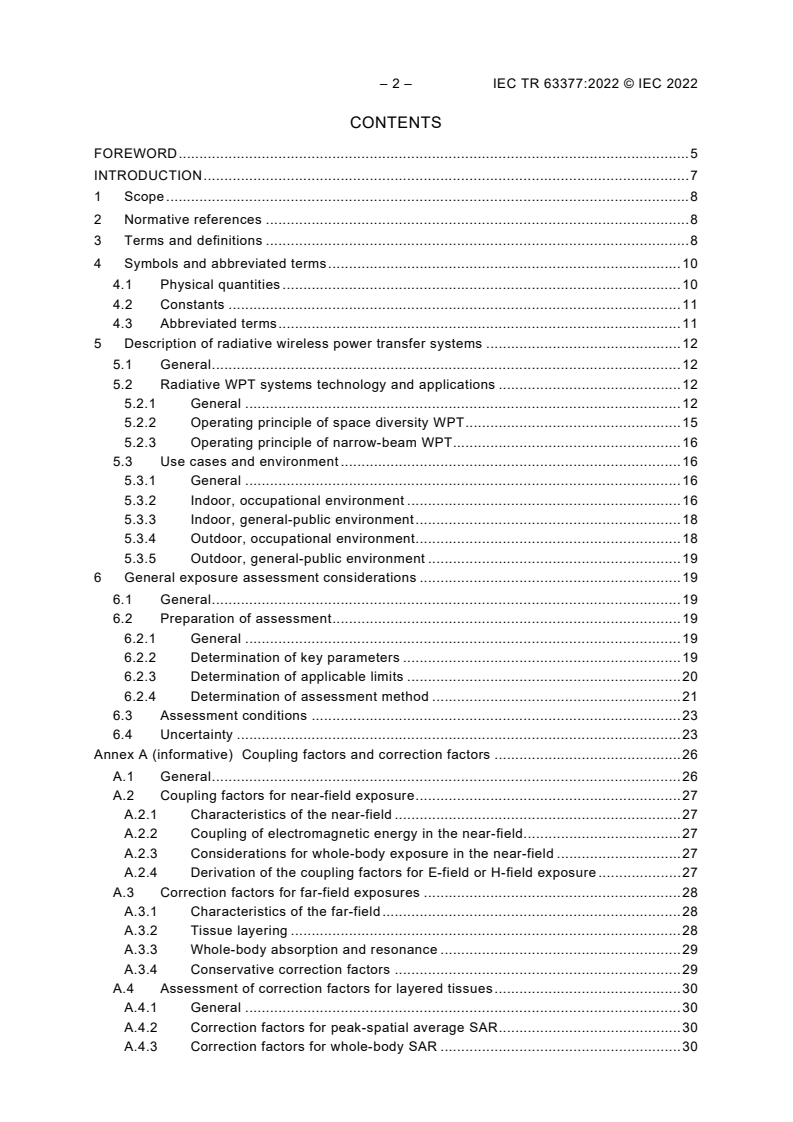
– 2 – IEC TR 63377:2022 © IEC 2022
CONTENTS
FOREWORD . 5
INTRODUCTION . 7
1 Scope . 8
2 Normative references . 8
3 Terms and definitions . 8
4 Symbols and abbreviated terms . 10
4.1 Physical quantities . 10
4.2 Constants . 11
4.3 Abbreviated terms . 11
5 Description of radiative wireless power transfer systems . 12
5.1 General . 12
5.2 Radiative WPT systems technology and applications . 12
5.2.1 General . 12
5.2.2 Operating principle of space diversity WPT . 15
5.2.3 Operating principle of narrow-beam WPT. 16
5.3 Use cases and environment . 16
5.3.1 General . 16
5.3.2 Indoor, occupational environment . 16
5.3.3 Indoor, general-public environment . 18
5.3.4 Outdoor, occupational environment. 18
5.3.5 Outdoor, general-public environment . 19
6 General exposure assessment considerations . 19
6.1 General . 19
6.2 Preparation of assessment . 19
6.2.1 General . 19
6.2.2 Determination of key parameters . 19
6.2.3 Determination of applicable limits . 20
6.2.4 Determination of assessment method . 21
6.3 Assessment conditions . 23
6.4 Uncertainty . 23
Annex A (informative) Coupling factors and correction factors . 26
A.1 General . 26
A.2 Coupling factors for near-field exposure . 27
A.2.1 Characteristics of the near-field . 27
A.2.2 Coupling of electromagnetic energy in the near-field . 27
A.2.3 Considerations for whole-body exposure in the near-field . 27
A.2.4 Derivation of the coupling factors for E-field or H-field exposure . 27
A.3 Correction factors for far-field exposures . 28
A.3.1 Characteristics of the far-field . 28
A.3.2 Tissue layering . 28
A.3.3 Whole-body absorption and resonance . 29
A.3.4 Conservative correction factors . 29
A.4 Assessment of correction factors for layered tissues . 30
A.4.1 General . 30
A.4.2 Correction factors for peak-spatial average SAR . 30
A.4.3 Correction factors for whole-body SAR . 30
A.4.4 Correction factors for partial body exposures . 30
A.4.5 Correction of SAR results in homogeneous flat phantoms . 31
Annex B (informative) Assessment procedure . 32
B.1 RF field strength and power density assessment for radiative WPT systems . 32
B.2 Local SAR assessment for radiative WPT systems operating between
30 MHz to 6 GHz . 32
B.2.1 General . 32
B.2.2 Preparation of the device under test . 33
B.2.3 Transmitter SAR assessment procedure . 33
B.2.4 Validation of the SAR assessment . 34
B.3 Incident power density (PD) assessment for local exposure over 6 GHz. 34
B.3.1 General . 34
B.3.2 Preparation of the device under test . 35
B.3.3 PD assessment procedure – Experimental only . 35
B.3.4 PD assessment procedure – Combined numerical and experimental
methods . 35
B.3.5 Validation of the assessment . 36
Annex C (informative) Description and validation of exposure mitigation techniques . 37
C.1 General . 37
C.2 Description of the technology and its implementation . 37
C.3 Validation of proximity sensors . 37
C.4 Validation of time-period power control . 38
C.5 System level validation of the exposure mitigation techniques . 38
Annex D (informative) Computational methods. 39
D.1 Methods and procedures . 39
D.2 Verification of the computational method . 39
D.3 Application of hybrid computational and experimental methods . 40
D.4 Considerations for the assessment of the numerical uncertainty . 40
D.4.1 General . 40
D.4.2 Parameters for the numerical uncertainty assessment . 40
Annex E (informative) Examples of exposure assessment . 41
E.1 Example of the dosimetric assessment of a WPT transmitter operating at
900 MHz . 41
E.1.1 Overview . 41
E.1.2 Method . 41
E.1.3 Model development and validation . 42
E.1.4 Dosimetric assessment of the anatomical models . 42
E.1.5 Results and conclusions . 43
E.2 Example E-field assessment of RF WPT system operating at 2,45 GHz . 43
E.2.1 General . 43
E.2.2 Assessment procedure . 44
E.2.3 E-field assessment results . 45
Bibliography . 50
Figure 1 – WPT system classification via radio-frequency beam technologies . 14
Figure 2 – Beam pattern diagram of omnidirectional radiative WPT. 15
Figure 3 – Beam pattern diagram of space diversity WPT . 15
Figure 4 – Beam pattern diagram of narrow-beam radiative WPT . 16
– 4 – IEC TR 63377:2022 © IEC 2022
Figure 5 – Example of indoor and occupational environments: WPT to production
equipment sensors in factory . 17
Figure 6 – Example of indoor and occupational environments: WPT to machine and
line management sensors . 17
Figure 7 – WPT to children watching sensors . 18
Figure 8 – WPT to watching sensors in nursing homes . 18
Figure 9 – Assessment process for radiative WPT . 19
Figure B.1 – Flowchart for the SAR assessment procedure between 30 MHz to 6 GHz . 33
Figure B.2 – Description of PD assessment procedure between 6 GHz to 300 GHz . 35
Figure E.1 – Anatomical model of the five-year-old girl exposed to the WPT transmitter
E-field at a distance of 400 mm. The beam of the WPT system is focused at this
distance. . 43
Figure E.2 – E-field measurement setup of RF WPT system . 44
Figure E.3 – E-field measurement scenario and positioning of WPT source
(transmitter), client, and scan areas . 45
Figure E.4 – E-field distribution measured at the distance 20 cm from RF WPT
transmitter . 46
Figure E.5 – E-field distribution measured in the far-field zone of WPT source: a) at
the distance 2 m from RF WPT transmitter – in front of the client b) at the distance
2,75 m from RF WPT transmitter – behind the client . 46
Figure E.6 – E-field measurement scenario with the cylindrical phantom . 47
Figure E.7 – E-field measurement setup of RF WPT system with cylindrical phantom . 47
Figure E.8 – E-field distribution for the case of partial obstruction by the phantom: a)
14 cm and b) 8 cm distance from phantom outer surface to transmitter-client line . 48
Figure E.9 – E-field distribution measured in the horizontal plane within the distances
45 cm to 145 cm from transmitter antenna for the case of strong obstruction by the
phantom. The position of cylindrical phantom with respect to scan area is shown. . 49
Figure E.10 – E-field distribution measured at the distance 2,75 m from RF WPT
transmitter when cylindrical phantom is placed behind the client (case 3 in Figure E.6).
Field scan is performed between the client and phantom. . 49
Table 1 – Representative characteristics of potential radiative WPT applications . 13
Table 2 – Whole-body SAR exclusions based on RF power levels. 22
Table 3 – Template of measurement uncertainty budget for assessment of the psSAR
for frequencies from 30 MHz to 6 GHz . 24
Table 4 – Template of measurement uncertainty budget for assessment of the incident
power density for frequencies above 6 GHz . 25
Table A.1 – Summary of correction factors accounting for tissue layering effects
specified in IEC 62232:2017 [12] for psSAR and wbSAR. 29
INTERNATIONAL ELECTROTECHNICAL COMMISSION
____________
PROCEDURES FOR THE ASSESSMENT OF HUMAN EXPOSURE TO
ELECTROMAGNETIC FIELDS FROM RADIATIVE WIRELESS POWER
TRANSFER SYSTEMS – MEASUREMENT AND COMPUTATIONAL
METHODS (FREQUENCY RANGE OF 30 MHz TO 300 GHz)
FOREWORD
1) The International Electrotechnical Commission (IEC) is a worldwide organization for standardization comprising
all national electrotechnical committees (IEC National Committees). The object of IEC is to promote international
co-operation on all questions concerning standardization in the electrical and electronic fields. To this end and
in addition to other activities, IEC publishes International Standards, Technical Specifications, Technical Reports,
Publicly Available Specifications (PAS) and Guides (hereafter referred to as “IEC Publication(s)”). Their
preparation is entrusted to technical committees; any IEC National Committee interested in the subject dealt with
may participate in this preparatory work. International, governmental and non-governmental organizations liaising
with the IEC also participate in this preparation. IEC collaborates closely with the International Organization for
Standardization (ISO) in accordance with conditions determined by agreement between the two organizations.
2) The formal decisions or agreements of IEC on technical matters express, as nearly as possible, an international
consensus of opinion on the relevant subjects since each technical committee has representation from all
interested IEC National Committees.
3) IEC Publications have the form of recommendations for international use and are accepted by IEC National
Committees in that sense. While all reasonable efforts are made to ensure that the technical content of IEC
Publications is accurate, IEC cannot be held responsible for the way in which they are used or for any
misinterpretation by any end user.
4) In order to promote international uniformity, IEC National Committees undertake to apply IEC Publications
transparently to the maximum extent possible in their national and regional publications. Any divergence between
any IEC Publication and the corresponding national or regional publication shall be clearly indicated in the latter.
5) IEC itself does not provide any attestation of conformity. Independent certification bodies provide conformity
assessment services and, in some areas, access to IEC marks of conformity. IEC is not responsible for any
services carried out by independent certification bodies.
6) All users should ensure that they have the latest edition of this publication.
7) No liability shall attach to IEC or its directors, employees, servants or agents including individual experts and
members of its technical committees and IEC National Committees for any personal injury, property damage or
other damage of any nature whatsoever, whether direct or indirect, or for costs (including legal fees) and
expenses arising out of the publication, use of, or reliance upon, this IEC Publication or any other IEC
Publications.
8) Attention is drawn to the Normative references cited in this publication. Use of the referenced publications is
indispensable for the correct application of this publication.
9) Attention is drawn to the possibility that some of the elements of this IEC Publication may be the subject of patent
rights. IEC shall not be held responsible for identifying any or all such patent rights.
IEC TR 63377 has been prepared by IEC technical committee 106: Methods for the assessment
of electric, magnetic and electromagnetic fields associated with human exposure. It is a
Technical Report.
The text of this Technical Report is based on the following documents:
Draft Report on voting
106/568/DTR 106/578/RVDTR
Full information on the voting for its approval can be found in the report on voting indicated in
the above table.
The language used for the development of this Technical Report is English.
– 6 – IEC TR 63377:2022 © IEC 2022
This document was drafted in accordance with ISO/IEC Directives, Part 2, and developed in
accordance with ISO/IEC Directives, Part 1 and ISO/IEC Directives, IEC Supplement, available
at www.iec.ch/members_experts/refdocs. The main document types developed by IEC are
described in greater detail at www.iec.ch/publications.
The committee has decided that the contents of this document will remain unchanged until the
stability date indicated on the IEC website under webstore.iec.ch in the data related to the
specific document. At this date, the document will be
• reconfirmed,
• withdrawn,
• replaced by a revised edition, or
• amended.
IMPORTANT – The "colour inside" logo on the cover page of this document indicates that it
contains colours which are considered to be useful for the correct understanding of its
contents. Users should therefore print this document using a colour printer.
INTRODUCTION
IEC TC 106 is tasked with preparing International Standards on measurement and simulation
methods used to assess human exposure to electric fields, magnetic fields, and electromagnetic
fields. Wireless power transfer (WPT) systems operating at 30 MHz to 300 GHz utilize electric
fields, magnetic fields, or electromagnetic fields to provide power to equipment nearby or at
distances up to several metres or more. Users or bystanders in close proximity to both the
transmitting equipment and receiving equipment or in between them could be exposed to these
fields. Assessment methods are needed to demonstrate compliance with applicable human
exposure limits. A working group (WG9) was established by IEC TC 106 to address assessment
methods of human exposure to WPT equipment.
This document consists of an overview of radiative WPT, exposure assessment methods,
procedures, and case studies, to help in the development of international standards for WPT
exposure assessment. This document addresses the frequency range of 30 MHz to 300 GHz.
For lower frequencies, WPT equipment operating below 10 MHz is covered by
IEC TR 62905:2018, and below 30 MHz is covered by IEC PAS 63184:2021, with an associated
subsequent International Standard currently under consideration by IEC TC 106. The methods
and procedures described in this document are based on the techniques of other exposure
standards covering the same frequency range. Other methods are referenced when deviations
from these assessment methods are needed.
– 8 – IEC TR 63377:2022 © IEC 2022
PROCEDURES FOR THE ASSESSMENT OF HUMAN EXPOSURE TO
ELECTROMAGNETIC FIELDS FROM RADIATIVE WIRELESS POWER
TRANSFER SYSTEMS – MEASUREMENT AND COMPUTATIONAL
METHODS (FREQUENCY RANGE OF 30 MHz TO 300 GHz)
1 Scope
This Technical Report describes assessment methods to evaluate the compliance of radiative
wireless power transfer (WPT) systems operating in the frequency range from 30 MHz to
300 GHz with electromagnetic guidelines on human exposure (electromagnetic field strength,
specific absorption rate (SAR), and power density). This document includes but is not limited
to systems that focus the electromagnetic energy emitted by the transmitter to regions
surrounding the receiver, for example, by narrow beam-forming systems, wide-beam systems
and spatially closed systems. Implementations without transmitter, for example, applications
that harvest energy from the environment, are not included in the scope of this document.
2 Normative references
There are no normative references in this document.
3 Terms and definitions
For the purposes of this document, the following terms and definitions apply.
ISO and IEC maintain terminological databases for use in standardization at the following
addresses:
• IEC Electropedia: available at http://www.electropedia.org/
• ISO Online browsing platform: available at http://www.iso.org/obp
3.1
basic restriction
BR
human exposure limits for compliance with time-varying electric, magnetic, and electromagnetic
fields evaluated inside the body that are based on established adverse health effects
Note 1 to entry: Within the scope of this document, the physical quantity used as a basic restriction is the specific
absorption rate (SAR) or absorbed (epithelial) power density.
3.2
equipment under test
EUT
equipment that is tested according to the procedures described in this document
3.3
plane-wave equivalent power density
electromagnetic wave, magnitude of the power density of a plane wave having the same ratio
of electric (E) field strength to magnetic (H) field strength
Note 1 to entry: The SI unit of plane-wave equivalent power density is watt per square metre (W/m ).
3.4
exposure
situation that occurs wherever a person is subjected to electric, magnetic, or
electromagnetic fields
3.5
far-field region
region of the electromagnetic field of an antenna wherein the predominant
components of the field are those which represent a propagation of energy and wherein the
angular field distribution is essentially independent of the distance from the antenna
[SOURCE: IEC 60050-712:1992 [1], 712-02-02, modified – Hyphen added to the term, notes to
entry omitted.]
3.6
incident field
field that would exist in the absence of a person over a volume where a person could be located
Note 1 to entry: In some documents, the incident field is called an unperturbed field or environmental field.
3.7
reactive near-field region
region of space immediately surrounding an antenna, where the predominant components of
the electric field and magnetic field are those that represent an exchange of reactive energy
between the antenna and the surrounding medium, and where the electric field and magnetic
field components are 90° out of phase
[SOURCE: IEC/IEEE 63195-1:2022 [2], 3.2.10, modified – The word "region" has been added
to the term.]
3.8
peak spatial-average SAR
psSAR
maximum SAR averaged within a local region based on a specific averaging mass, e.g. any 1 g
or 10 g of tissue in the shape of a cube
[SOURCE: IEC/IEEE 62209-1528:2020 [3], 3.37, modified – The note to entry has been
omitted.]
3.9
phantom
physical model with an equivalent human anatomy and comprised of a tissue-equivalent
medium with dielectric properties specified in IEC/IEEE 62209-1528:2020
[SOURCE IEC/IEEE 62209-1528 [3], 3.39, modified – The wording "in this document" is
replaced with "IEC/IEEE 62209-1528:2020".]
3.10
radiative wireless power transfer system
radiative WPT system
system that transfers power by radiation of electromagnetic energy from a transmitter to a
receiver in the frequency range from 30 MHz to 300 GHz
3.11
reference level
RL
level of field strength or power density derived from the basic restrictions using conservative
assumptions about exposure
– 10 – IEC TR 63377:2022 © IEC 2022
Note 1 to entry: If the reference levels are met, then the basic restrictions will be complied with, but if the reference
levels are exceeded, that does not necessarily mean that the basic restrictions will not be met.
[SOURCE IEC 62311:2019 [4], 3.1.22, modified – Abbreviated term "RL" added.]
3.12
specific absorption rate
SAR
measure of the rate at which energy is absorbed by the human body when exposed to a radio
frequency electromagnetic field
Note 1 to entry: The SAR in the tissue-equivalent medium can be determined by the rate of temperature increase
or by E-field measurements, according to the following formula:
σE ∂T
SAR c
h
ρt∂
t=0
where
SAR is the specific absorption rate in W/kg;
E is the RMS value of the electric field strength in the tissue-equivalent medium in V/m;
is the electrical conductivity of the tissue-equivalent medium in S/m;
σ
ρ is the mass density of the tissue-equivalent medium in kg/m ;
c is the specific heat capacity of the tissue-equivalent medium in J/(kg K);
h
∂T
is the initial time derivative of temperature in the tissue-equivalent medium in K/s.
∂t
t=0
[SOURCE IEC/IEEE 62209-1528:2020 [3], 3.5.1, modified – The two formulae now appear on
one line and units have been formatted as symbols rather than as written words.]
3.13
beamwidth
in a specified plane containing the direction of maximum radiation or the axis
of symmetry of a beam or a radiation lobe, angle between two directions (corresponding, for
example, to a given fraction of the maximum radiation or to the first minimums) on both sides
of this direction or axis
Note 1 to entry: The most generally used fraction is half-power beamwidth.
[SOURCE IEC 60050-712:2021 [1], 712-01-33, modified – Note 2 to entry omitted.]
3.14
whole-body SAR
wbSAR
SAR averaged over the whole body
3.15
epithelial power density
power flow through the epithelium per unit area directly under the body surface
TM
[SOURCE IEEE Std C95.1 -2019 [5], 3.1, modified – Note 1 and Note 2 omitted.]
4 Symbols and abbreviated terms
4.1 Physical quantities
The internationally accepted SI units are used throughout this document.
==
Symbol Quantity Unit Dimensions
c Specific heat capacity joule per kilogram per kelvin J/(kg K)
h
E Electric field strength volt per metre, RMS V/m
f Frequency hertz Hz
H Magnetic field strength ampere per metre, RMS A/m
J Current density ampere per square metre
A/m
P Average (temporal) absorbed watt W
power
S Power density watt per square metre
W/m
T Temperature kelvin K
Permittivity farad per metre F/m
ε
Wavelength metre m
λ
σ Electric conductivity siemens per metre S/m
µ Permeability Henrys per metre H/m
NOTE In this document temperature is quantified in degrees Celsius, as determined by: T (°C) = T (K) − 273,15.
4.2 Constants
Symbol Physical constant Magnitude
Intrinsic impedance of free space
η 120π Ω or 377 Ω
−12
Permittivity of free space
ε 8,854 × 10 F/m
−7
µ Permeability of free space
4π × 10 H/m
4.3 Abbreviated terms
RF radio frequency
RMS root mean square
RSS root sum square
CW continuous wave
WPT wireless power transfer
DRL dosimetric reference limit
E-field electric field strength
ERL exposure reference level
EUT equipment under test
H-field magnetic field strength
ICNIRP International Commission on Non-Ionizing Radiation Protection
IC integrated circuit
PD power density
TE transverse electric
TM transverse magnetic
TEM transverse electromagnetic
– 12 – IEC TR 63377:2022 © IEC 2022
5 Description of radiative wireless power transfer systems
5.1 General
Radiative WPT represents a solution to remotely charge low-power devices (e.g. sensors, RF
identification tags, mobile and wearable devices [6] , [7]) and high power applications [8] over
large distances.
Radiative WPT allows for greater distances to be covered than non-radiative WPT and does not
require mutual coupling between the transmitter and receiver. However, the longer distances
generally result in lower beam efficiency at the receiving end.
In a radiative WPT system, highly directional antennas are mostly used to transmit
electromagnetic power and the system efficiency benefits from a highly directive receiver
antenna when operated outside the near-field zone. The main theory of WPT via RF beam is
based on the Friis transmission formula:
P λ
r
= GG
(1)
rt
PR4π
t
where
P and P are the receive power and transmit power, respectively,
r t
G and G are the gains of the transmit antenna and receive antenna,
t r
λ is the wavelength representing the effective aperture area of the receive antenna, and
R is the distance between the two antennas.
A rectenna [9] is normally used to convert the received electromagnetic power into usable direct
current (DC) power.
5.2 Radiative WPT systems technology and applications
5.2.1 General
Radiative WPT systems can be classified according to the following list of technologies, and as
shown in Figure 1:
a) wide beamwidth transmission to multiple receivers at short range;
b) space diversity WPT to a single receiver (using multi-path propagation);
c) narrow beamwidth transmission to a single receiver at either short or long range [10].
NOTE Narrow beamwidth and space diversity systems apply directed beams in order to maximize efficiency of the
transmitted power towards a single receiver. Directive antennas can be used on the transmitter and/or the receiver
side. Wide beamwidth systems transmit power to multiple receivers and might not necessarily direct the transmitted
power towards them. Because of the large number of possible configurations of transmitter and receiver antennas,
a more detailed specification of wide and narrow beamwidth systems might be too restrictive for present and
upcoming technologies.
Each of the technologies in the preceding list can be used in different WPT applications
(Table 1). A detailed description of these WPT applications can be found in [10].
Energy harvesting is another wireless power technology that converts environmental
electromagnetic energy into electric power. Due to its typically low conversion efficiency and
low collection of power, it can be adequate to run or recharge small wireless micropower devices
___________
Numbers in square brackets refer to the Bibliography.
such as remote sensors. It does not include a transmitter for the RF power and therefore does
not fall under the scope of this document.
Table 1 – Representative characteristics of
potential radiative WPT applications
WPT Frequency Condition Distance Tx antenna Transmit
application band gain power
Wirelessly 915 MHz band, Indoor, Several metres 6 dBi (Typically < 50 W
powered sensor 2,45 GHz band, Outdoor to dozens of 915 MHz band),
network 5,8 GHz band metres 25 dBi
(Typically
2,45 GHz and
5,8 GHz bands)
Wireless 2,45 GHz band, Indoor Several metres 25 dBi < 50 W
charging of 915 MHz band to dozens of (Typically
mobile devices metres 2,45 GHz band)
WPT to 2,45 GHz band, Indoor, Outdoor several metres 10 dBi to 30 dBi 50 W to 1 MW
moving/flying 5,8 GHz band to 20 km (Typically
target 5,8 GHz band)
Point-to-point 2,45 GHz band, Outdoor 1 m to 20 km 100 W to 1 MW
WPT 5,8 GHz band
Wireless 2,45 GHz band, Outdoor 0,1 m to 1 m 100 kW to
charging for
5,8 GHz band 500 kW
electric vehicle
Solar power 5,8 GHz band Space to ground 36 000 km 1,3 GW
satellite
IoT devices, 24 GHz band, Indoor, Outdoor 1 m to 1 000 m 100 W
automation, 61 GHz band,
point-to-point, 122 GHz band,
etc. 244 GHz band
– 14 – IEC TR 63377:2022 © IEC 2022
a) Wide beam WPT to multiple receivers b) Space diversity WPT to a single receiver
c) Narrow beam WPT to a single receiver
[SOURCE: Figure 3.1 of ITU-R SM.2392-0 [10]]
Figure 1 – WPT system classification via radio-frequency beam technologies
Omnidirectional radiative WPT uses a wide beam transmission to transfer power to single or
multiple users (receivers) over a distance. Figure 2 illustrates the beam pattern. The transmitter
transmits electromagnetic waves with high energy and the receiver(s), using a rectenna, convert
these waves into power. Due to low efficiency of these systems, only a small fraction of the
radiated power is received by the receiver(s).
___________
Reproduced from ITU-R SM.2392-0, with the permission of ITU-R.
Figure 2 – Beam pattern diagram of omnidirectional radiative WPT
5.2.2 Operating principle of space diversity WPT
The basic principle of the space diversity WPT system is shown in b) of Figure 1 and the beam
pattern is illustrated in Figure 3. The main application of such systems is related to the indoor
environment where strong multi-path reflection from the walls is utilized to deliver the RF power
to the receiver. In a typical space diversity WPT system, a receiver IC chip, built into a receiver
device, sends out a low-level beacon signal that seeks the transmitter. Once received, the
transmitter sends the RF power back through all the multi-paths from where the beacon signal
was received. Such a multi-path functionality allows it to continuously send power from the
transmitter so that the power is then delivered mostly to the receiving antenna and less
elsewhere. This beacon process repeats, for example up to 100 times per second, which makes
it possible to send the power over a distance and while the receiving device is in motion, even
if people or objects are in the way. The bandwidth of the transmitted signals is supposed to be
sufficiently small not to affect the pathway of the transmitted energy. Hence, the signals can be
regarded as CW.
Nevertheless, in this application scenario, RF power could be delivered to other objects within
the reflected beam, including human tissue. Considering this, the assertion of human safety
operation is confirmed and demonstrated by the assessment results.
Figure 3 – Beam pattern diagram of space diversity WPT
– 16 – IEC TR 63377:2022 © IEC 2022
5.2.3 Operating principle of narrow-beam WPT
Antenna arrays are typically used for narrow-beam radiative WPT systems. As illustrated in
Figure 4, the transmitter can transfer power at a distance to one or multiple receivers, by
directing the beam patterns using beamforming techniques. The beamforming techniques
consist of controlling the amplitudes and/or phases between radiating signals of the antenna
array.
Both space diversity WPT and narrow-beam radiative WPT utilize the antenna beamforming
technology but in different ways. Space diversity WPT illustrated in Figure 3 is implemented by
making use of the multi-path reflection from the walls to deliver the power to the receiver
"around" the human body or object. On the other hand, the narrow-beam radiative WPT system
typically operates as a point-to-point power transmission to a receiver. Beamforming technique
is used to increase the gain of the transmitting array antenna to extend the operational distance
of WPT. If a person moves to a line-of-sight between transmitter and receiver, the RF
transmission stops.
Figure 4 – Beam pattern diagram of narrow-beam radiative WPT
5.3 Use cases and environment
5.3.1 General
Use cases and those environments where radiative WPT systems are used are important in
order to discuss exposure assessment and other RF exposure items. The environments
described in 5.3.2, 5.3.3, 5.3.4, and 5.3.5 are considered.
5.3.2 Indoor, occupational environment
Figure 5 and Figure 6 show typical use cases in indoor and occupational environments. In these
use cases, sensors and devices which received power by radiative WPT systems are generally
located far from human bodies (Figure 5). In some cases, radiative WPT systems are used in
an environment with humans (Figure 6). The radiated power is generally small outside of
buildings and/or rooms.
[SOURCE: Figure 2.3.5(a) of Report for the technical conditions of beam WPT, MIC, Japan [11]
Figure 5 – Example of indoor and occupational environments:
WPT to production equipment sensors in factory
[SOURCE: Figure 2.3.1(a) of Report for the technical conditions of beam WPT, MIC, Japan [11]
Figure 6 – Example of indoor and occupational environments:
WPT to machine and line management sensors
___________
Reproduced from the Report for the technical conditions of beam WPT, MIC, Japan, with the permission of the
Ministry of Internal Affairs and Communications, Japan.
Reproduced from the Report for the technical conditions of beam WPT, MIC, Japan, with the permission of the
Ministry of Internal Affairs and Communications, Japan.
– 18 – IEC TR 63377:2022 © IEC 2022
5.3.3 Indoor, general-public environment
Figure 7 and Figure 8 show typical use cases in indoor and general-public environments. In
these use cases, sensors and devices which received power by radiative WPT systems are
located near human bodies or within close contact. The radiated power is generally small
outside of buildings and/or rooms.
[SOURCE: Figure 2.3.2(b) of Report for the technical conditions of beam WPT, MIC, Japan [11]]
Figure 7 – WPT to children watching sensors
[SOURCE: Figure 2.3.1(c) of Report for the technical conditions of beam WPT, MIC, Japan [11]]
Figure 8 – WPT to watching sensors in nursing homes
5.3.4 Outdoor, occupational environment
Sensors and devices for industrial applications can be used in outdoor and in occupational
environments. In such cases, sensors and devices which received power by radiative WPT
systems are located far from human bodies or used in an environment without humans.
___________
Reproduced from the Report for the technical conditions of beam WPT, MIC, Japan, with the permission of the
Ministry of Internal Affairs and Communications, Japan.
Reproduced from the Report for the technical conditions of beam WPT, MIC, Japan, with the permission of the
Ministry of Internal Affairs and Communications, Japan.
5.3.5 Outdoor, general-public environment
In this use case, sensors and devices which received power by radiative WPT systems are
located near human bodies or within close contact. There are some possibilities that the
unwanted power could be radiated in an open space.
6 General exposure assessment considerations
6.1 General
This Clause 6 describes the basis for exposure assessments. Figure 9 shows the steps of an
exposure assessment for radiative WPT systems, including preparation of the assessment,
measurements or calculations and uncertainty.
Some form of proximity sensing can be used to detect the presence of a person within the
exposed area. This information is used to lower the transmitted power or modify
...