

IEC 60368-1:2000
(Main)Piezoelectric filters of assessed quality - Part 1: Generic specification
General Information
- Abstract
Specifies the methods of test and general requirements for piezoelectric filters of assessed quality using either capability approval or qualification approval procedures.
- Status
- Published
- Publication Date
- 27-May-2013
- Technical Committee
- TC 49 - Piezoelectric, dielectric and electrostatic devices and associated materials for frequency control, selection and detection
- Drafting Committee
- WG 1 - TC 49/WG 1
- Current Stage
- PPUB - Publication issued
- Start Date
- 10-Mar-2000
- Completion Date
- 29-Feb-2000
Buy Documents
IEC 60368-1:2000 - Piezoelectric filters of assessed quality - Part 1: Generic specification Released:3/10/2000
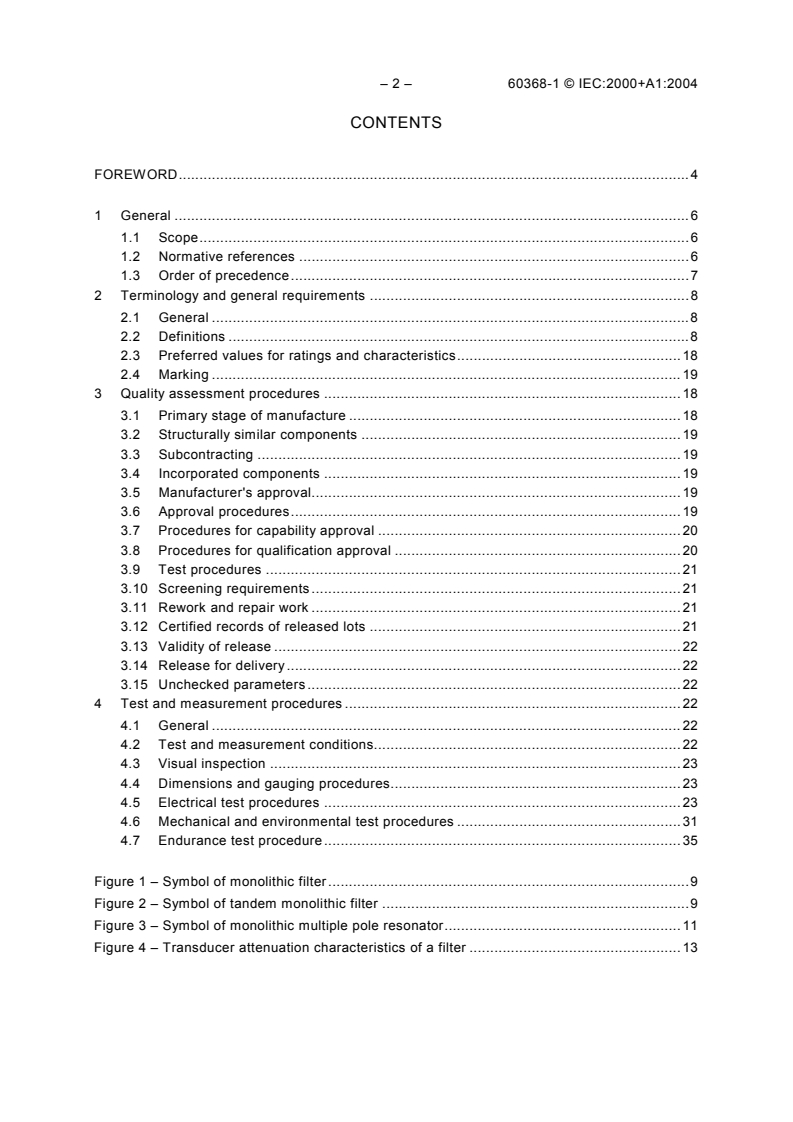
IEC 60368-1:2000+AMD1:2004 CSV - Piezoelectric filters of assessed quality - Part 1: Genericspecification Released:5/28/2013
Overview
IEC 60368-1:2000, titled "Piezoelectric filters of assessed quality – Part 1: Generic specification", is an international standard developed by the International Electrotechnical Commission (IEC). This standard specifies the methods of test and general requirements for piezoelectric filters of assessed quality. The document presents technical guidelines focusing on either capability approval or qualification approval procedures to assure the consistent quality and performance of piezoelectric filters.
Piezoelectric filters are critical components in frequency control and signal processing systems, widely used in telecommunications, measurement instruments, and electronic devices. IEC 60368-1 serves as the foundational part of the IEC 60368 series, establishing uniform quality assurance practices and test methodologies for these components.
Key Topics
Scope and Application
Defines the applicability of tests and quality requirements to piezoelectric filters, ensuring manufacturers adhere to internationally recognized parameters for assessed quality.Quality Assessment Procedures
Describes procedures including primary manufacturing stages, approval processes, testing, screening, rework, and lot release criteria essential for quality management.Test and Measurement Methods
Details electrical, mechanical, and environmental testing methodologies for piezoelectric filters, including visual inspection, electrical performance, endurance, and environmental stress testing.Terminology and Preferred Values
Establishes definitions, electrical characteristics, and preferred values that standardize the measurement and evaluation of piezoelectric filter performance.Marking and Documentation
Guidelines for proper marking of components, certified records management, and documentation requirements to track compliance and quality assurance.Environmental Testing Standards
References relevant IEC environmental testing standards (e.g., IEC 60068 series) that support robust product qualification through thermal, mechanical, humidity, vibration, and shock testing.
Applications
Piezoelectric filters complying with IEC 60368-1:2000 are suited for applications demanding high precision and reliability in frequency control such as:
Telecommunications Infrastructure
Enhancing signal clarity and noise reduction in radio and communication transmitters and receivers.Consumer Electronics
Supporting frequency selection in mobile phones, TVs, and audio equipment.Industrial and Aeronautics Equipment
Ensuring stable frequency references in instrumentation, radar, and navigation systems.Measurement and Testing Devices
Providing accurate signal filtering critical to laboratory and field testing apparatus.
The standard's rigorous approach to quality assessment ensures that piezoelectric filters perform reliably under various environmental conditions, fulfilling the requirements for critical electronic components in demanding scenarios.
Related Standards
IEC 60368-1 is part of a broader set of standards concerning piezoelectric filters and frequency control devices:
- IEC 60368-2-1: Quartz crystal filters – A guide for specific use of quartz filters.
- IEC 60368-2-2: Piezoelectric ceramic filters – A guide focusing on piezoelectric ceramic filters.
- IEC 60068 Series: Environmental Testing – Includes subspecies for cold, heat, damp heat, vibration, shock, and other environmental tests relevant to piezoelectric filter qualification.
- IEC 60050(561): International Electrotechnical Vocabulary (IEV) – Covers terminology related to piezoelectric frequency control devices.
- Future parts of IEC 60368 (e.g., Part 3, Part 4 and Part 5) expand on specific approval and outline standards for these components.
Adhering to IEC 60368-1:2000 ensures compliance with international norms for tested quality piezoelectric filters, facilitating interoperability, and reliability in global electronics markets.
Keywords: IEC 60368-1, piezoelectric filters, piezoelectric filter quality, capability approval, qualification approval, frequency control, electrical testing, environmental testing, IEC standards, signal filtering, frequency selection, electronic components standards.
Relations
- Effective Date
- 05-Sep-2023
Buy Documents
IEC 60368-1:2000 - Piezoelectric filters of assessed quality - Part 1: Generic specification Released:3/10/2000
IEC 60368-1:2000+AMD1:2004 CSV - Piezoelectric filters of assessed quality - Part 1: Genericspecification Released:5/28/2013
Frequently Asked Questions
IEC 60368-1:2000 is a standard published by the International Electrotechnical Commission (IEC). Its full title is "Piezoelectric filters of assessed quality - Part 1: Generic specification". This standard covers: Specifies the methods of test and general requirements for piezoelectric filters of assessed quality using either capability approval or qualification approval procedures.
Specifies the methods of test and general requirements for piezoelectric filters of assessed quality using either capability approval or qualification approval procedures.
IEC 60368-1:2000 is classified under the following ICS (International Classification for Standards) categories: 31.140 - Piezoelectric devices; 31.160 - Electric filters. The ICS classification helps identify the subject area and facilitates finding related standards.
IEC 60368-1:2000 has the following relationships with other standards: It is inter standard links to IEC 60368-1:2000/AMD1:2004. Understanding these relationships helps ensure you are using the most current and applicable version of the standard.
IEC 60368-1:2000 is available in PDF format for immediate download after purchase. The document can be added to your cart and obtained through the secure checkout process. Digital delivery ensures instant access to the complete standard document.
Standards Content (Sample)
NORME CEI
INTERNATIONALE IEC
60368-1
INTERNATIONAL
QC 640000
STANDARD
Quatrième édition
Fourth edition
2000-03
Filtres piézoélectriques sous assurance
de la qualité –
Partie 1:
Spécification générique
Piezoelectric filters of assessed quality –
Part 1:
Generic specification
Numéro de référence
Reference number
CEI/IEC 60368-1:2000
Numéros des publications Numbering
Depuis le 1er janvier 1997, les publications de la CEI As from 1 January 1997 all IEC publications are
sont numérotées à partir de 60000. issued with a designation in the 60000 series.
Publications consolidées Consolidated publications
Les versions consolidées de certaines publications de Consolidated versions of some IEC publications
la CEI incorporant les amendements sont disponibles. including amendments are available. For example,
Par exemple, les numéros d’édition 1.0, 1.1 et 1.2 edition numbers 1.0, 1.1 and 1.2 refer, respectively, to
indiquent respectivement la publication de base, la the base publication, the base publication incor-
publication de base incorporant l’amendement 1, et la porating amendment 1 and the base publication
publication de base incorporant les amendements 1 incorporating amendments 1 and 2.
et 2.
Validité de la présente publication Validity of this publication
Le contenu technique des publications de la CEI est The technical content of IEC publications is kept
constamment revu par la CEI afin qu'il reflète l'état under constant review by the IEC, thus ensuring that
actuel de la technique. the content reflects current technology.
Des renseignements relatifs à la date de reconfir- Information relating to the date of the reconfirmation
mation de la publication sont disponibles dans le of the publication is available in the IEC catalogue.
Catalogue de la CEI.
Les renseignements relatifs à des questions à l’étude et Information on the subjects under consideration and
des travaux en cours entrepris par le comité technique work in progress undertaken by the technical
qui a établi cette publication, ainsi que la liste des committee which has prepared this publication, as well
publications établies, se trouvent dans les documents ci- as the list of publications issued, is to be found at the
dessous: following IEC sources:
• «Site web» de la CEI* • IEC web site*
• Catalogue des publications de la CEI • Catalogue of IEC publications
Publié annuellement et mis à jour Published yearly with regular updates
régulièrement
(Catalogue en ligne)* (On-line catalogue)*
• Bulletin de la CEI • IEC Bulletin
Disponible à la fois au «site web» de la CEI* Available both at the IEC web site* and
et comme périodique imprimé as a printed periodical
Terminologie, symboles graphiques Terminology, graphical and letter
et littéraux symbols
En ce qui concerne la terminologie générale, le lecteur For general terminology, readers are referred to
se reportera à la CEI 60050: Vocabulaire Electro- IEC 60050: International Electrotechnical Vocabulary
technique International (VEI). (IEV).
Pour les symboles graphiques, les symboles littéraux For graphical symbols, and letter symbols and signs
et les signes d'usage général approuvés par la CEI, le approved by the IEC for general use, readers are
lecteur consultera la CEI 60027: Symboles littéraux à referred to publications IEC 60027: Letter symbols to
utiliser en électrotechnique, la CEI 60417: Symboles be used in electrical technology, IEC 60417: Graphical
graphiques utilisables sur le matériel. Index, relevé et symbols for use on equipment. Index, survey and
compilation des feuilles individuelles, et la CEI 60617: compilation of the single sheets and IEC 60617:
Symboles graphiques pour schémas. Graphical symbols for diagrams.
* Voir adresse «site web» sur la page de titre. * See web site address on title page.
NORME CEI
INTERNATIONALE IEC
60368-1
INTERNATIONAL
QC 640000
STANDARD
Quatrième édition
Fourth edition
2000-03
Filtres piézoélectriques sous assurance
de la qualité –
Partie 1:
Spécification générique
Piezoelectric filters of assessed quality –
Part 1:
Generic specification
IEC 2000 Droits de reproduction réservés Copyright - all rights reserved
Aucune partie de cette publication ne peut être reproduite ni No part of this publication may be reproduced or utilized in
utilisée sous quelque forme que ce soit et par aucun procédé, any form or by any means, electronic or mechanical,
électronique ou mécanique, y compris la photo-copie et les including photocopying and microfilm, without permission in
microfilms, sans l'accord écrit de l'éditeur. writing from the publisher.
International Electrotechnical Commission 3, rue de Varembé Geneva, Switzerland
Telefax: +41 22 919 0300 e-mail: inmail@iec.ch IEC web site http://www.iec.ch
CODE PRIX
Commission Electrotechnique Internationale
V
PRICE CODE
International Electrotechnical Commission
Pour prix, voir catalogue en vigueur
For price, see current catalogue
– 2 – 60368-1 © CEI:2000
SOMMAIRE
Pages
AVANT-PROPOS . 6
Articles
1 Généralités .10
1.1 Domaine d'application . 10
1.2 Références normatives . 10
1.3 Ordre de priorité. 14
2 Terminologie et prescriptions générales . 14
2.1 Généralités . 14
2.2 Définitions. 14
2.3 Valeurs et caractéristiques préférentielles . 30
2.4 Marquage. 32
3 Procédures d'assurance de la qualité . 34
3.1 Etape initiale de fabrication . 34
3.2 Modèles associables . 34
3.3 Sous-traitance. 34
3.4 Composants incorporés. 34
3.5 Agrément du fabricant. 36
3.6 Procédures d'agrément . 36
3.7 Procédures pour l'agrément de savoir-faire . 36
3.8 Procédures pour l'homologation . 38
3.9 Méthodes d'essai . 38
3.10 Exigences de sélection. 40
3.11 Travaux de retouche et de réparation . 40
3.12 Rapports certifiés de lots acceptés . 40
3.13 Validité de livraison . 40
3.14 Acceptation pour livraison . 40
3.15 Paramètres non contrôlés . 40
4 Procédures d'essai et de mesure. 42
4.1 Généralités . 42
4.2 Conditions d'essai et de mesure. 42
4.3 Contrôle visuel . 44
4.4 Dimensions et calibrage . 44
4.5 Méthodes d'essais électriques. 44
4.6 Méthodes d'essais mécaniques et d'environnement . 54
4.7 Essais d'endurance . 64
Figure 1 – Symbole d'un filtre monolithique . 16
Figure 2 – Symbole d'un filtre polylithique . 16
Figure 3 – Symbole d'un résonateur monolithique multipolaire. 16
Figure 4 – Caractéristiques de l'affaiblissement de transmission d'un filtre . 22
60368-1 © IEC:2000 – 3 –
CONTENTS
Page
FOREWORD . 7
Clause
1 General. 11
1.1 Scope . 11
1.2 Normative references. 11
1.3 Order of precedence . 15
2 Terminology and general requirements . 15
2.1 General. 15
2.2 Definitions. 15
2.3 Preferred values for ratings and characteristics . 31
2.4 Marking. 33
3 Quality assessment procedures. 35
3.1 Primary stage of manufacture. 35
3.2 Structurally similar components. 35
3.3 Subcontracting. 35
3.4 Incorporated components. 35
3.5 Manufacturer's approval . 37
3.6 Approval procedures . 37
3.7 Procedures for capability approval. 37
3.8 Procedures for qualification approval. 39
3.9 Test procedures . 39
3.10 Screening requirements . 41
3.11 Rework and repair work. 41
3.12 Certified records of released lots. 41
3.13 Validity of release. 41
3.14 Release for delivery . 41
3.15 Unchecked parameters . 41
4 Test and measurement procedures . 43
4.1 General. 43
4.2 Test and measurement conditions . 43
4.3 Visual inspection . 45
4.4 Dimensions and gauging procedures . 45
4.5 Electrical test procedures . 45
4.6 Mechanical and environmental test procedures. 55
4.7 Endurance test procedure . 65
Figure 1 – Symbol of monolithic filter . 17
Figure 2 – Symbol of tandem monolithic filter . 17
Figure 3 – Symbol of monolithic multiple pole resonator . 17
Figure 4 – Transducer attenuation characteristics of a filter. 23
– 4 – 60368-1 © CEI:2000
Figure 5 – Facteur de forme d'un filtre passe-bande. 26
Figure 6 – Caractéristique de l'ondulation dans la bande passante d'un filtre piézoélectrique. 26
Figure 7 – Déviation de l'affaiblissement dans la bande passante d'un filtre. 28
Figure 8 – Circuit d'essai pour la mesure de l'affaiblissement d'insertion, du déphasage
d'insertion et du retard de groupe . 46
Figure 9 – Circuit d'essai pour la mesure de l'affaiblissement d'écho. 50
Figure 10 – Circuit d'essai pour la mesure de la distorsion d'intermodulation . 52
Bibliographie . . 66
60368-1 © IEC:2000 – 5 –
Figure 5 – Shape factor of a band-pass filter. 27
Figure 6 – Pass-band ripple of a filter . 27
Figure 7 – Pass-band attenuation deviation of a filter . 29
Figure 8 – Test circuit for insertion attenuation, phase and group delay measurement . 47
Figure 9 – Test circuit for return attenuation measurement. 51
Figure 10 – Test circuit for the intermodulation distortion measurement. 53
Bibliography . . 67
– 6 – 60368-1 © CEI:2000
COMMISSION ÉLECTROTECHNIQUE INTERNATIONALE
____________
FILTRES PIÉZOÉLECTRIQUES SOUS ASSURANCE DE LA QUALITÉ –
Partie 1: Spécification générique
AVANT-PROPOS
1) La CEI (Commission Électrotechnique Internationale) est une organisation mondiale de normalisation composée
de l'ensemble des comités électrotechniques nationaux (Comités nationaux de la CEI). La CEI a pour objet de
favoriser la coopération internationale pour toutes les questions de normalisation dans les domaines de
l'électricité et de l'électronique. A cet effet, la CEI, entre autres activités, publie des Normes internationales.
Leur élaboration est confiée à des comités d'études, aux travaux desquels tout Comité national intéressé par le
sujet traité peut participer. Les organisations internationales, gouvernementales et non gouvernementales, en
liaison avec la CEI, participent également aux travaux. La CEI collabore étroitement avec l'Organisation
Internationale de Normalisation (ISO), selon des conditions fixées par accord entre les deux organisations.
2) Les décisions ou accords officiels de la CEI concernant les questions techniques représentent, dans la mesure
du possible, un accord international sur les sujets étudiés, étant donné que les Comités nationaux intéressés
sont représentés dans chaque comité d’études.
3) Les documents produits se présentent sous la forme de recommandations internationales. Ils sont publiés
comme normes, spécifications techniques, rapports techniques ou guides et agréés comme tels par les Comités
nationaux.
4) Dans le but d'encourager l'unification internationale, les Comités nationaux de la CEI s'engagent à appliquer de
façon transparente, dans toute la mesure possible, les Normes internationales de la CEI dans leurs normes
nationales et régionales. Toute divergence entre la norme de la CEI et la norme nationale ou régionale
correspondante doit être indiquée en termes clairs dans cette dernière.
5) La CEI n’a fixé aucune procédure concernant le marquage comme indication d’approbation et sa responsabilité
n’est pas engagée quand un matériel est déclaré conforme à l’une de ses normes.
6) L’attention est attirée sur le fait que certains des éléments de la présente Norme internationale peuvent faire
l’objet de droits de propriété intellectuelle ou de droits analogues. La CEI ne saurait être tenue pour
responsable de ne pas avoir identifié de tels droits de propriété et de ne pas avoir signalé leur existence.
La Norme internationale CEI 60368-1 a été établie par le comité d'études 49 de la CEI:
Dispositifs piézoélectriques et diélectriques pour la commande et le choix de la fréquence.
Cette quatrième édition de la CEI 60368-1 annule et remplace la troisième édition parue en
1992 et constitue une révision technique.
La CEI 60368-1 est la première partie de la nouvelle édition de la série CEI 60368 révisée pour
incorporer les exigences d'essais du Système IECQ.
Le texte de cette norme est issu des documents suivants:
FDIS Rapport de vote
49/448/FDIS 49/450/RVD
Le rapport de vote indiqué dans le tableau ci-dessus donne toute information sur le vote ayant
abouti à l'approbation de cette norme.
Cette publication a été rédigée selon les Directives ISO/CEI, Partie 3.
60368-1 © IEC:2000 – 7 –
INTERNATIONAL ELECTROTECHNICAL COMMISSION
____________
PIEZOELECTRIC FILTERS OF ASSESSED QUALITY –
Part 1: Generic specification
FOREWORD
1) The IEC (International Electrotechnical Commission) is a worldwide organization for standardization comprising
all national electrotechnical committees (IEC National Committees). The object of the IEC is to promote
international co-operation on all questions concerning standardization in the electrical and electronic fields. To
this end and in addition to other activities, the IEC publishes International Standards. Their preparation is
entrusted to technical committees; any IEC National Committee interested in the subject dealt with may
participate in this preparatory work. International, governmental and non-governmental organizations liaising
with the IEC also participate in this preparation. The IEC collaborates closely with the International Organization
for Standardization (ISO) in accordance with conditions determined by agreement between the two
organizations.
2) The formal decisions or agreements of the IEC on technical matters express, as nearly as possible, an
international consensus of opinion on the relevant subjects since each technical committee has representation
from all interested National Committees.
3) The documents produced have the form of recommendations for international use and are published in the form
of standards, technical specifications, technical reports or guides and they are accepted by the National
Committees in that sense.
4) In order to promote international unification, IEC National Committees undertake to apply IEC International
Standards transparently to the maximum extent possible in their national and regional standards. Any
divergence between the IEC Standard and the corresponding national or regional standard shall be clearly
indicated in the latter.
5) The IEC provides no marking procedure to indicate its approval and cannot be rendered responsible for any
equipment declared to be in conformity with one of its standards.
6) Attention is drawn to the possibility that some of the elements of this International Standard may be the subject
of patent rights. The IEC shall not be held responsible for identifying any or all such patent rights.
International Standard IEC 60368-1 has been prepared by IEC technical committee 49:
Piezoelectric and dielectric devices for frequency control and selection.
This fourth edition of IEC 60368-1 cancels and replaces the third edition published in 1992 and
constitutes a technical revision.
International Standard IEC 60368-1 is the first part of a new edition of the IEC standard series
for piezoelectric filters, updated to include the test requirements of the IECQ System.
The text of this standard is based on the following documents:
FDIS Report on voting
49/448/FDIS 49/450/RVD
Full information on the voting for the approval of this standard can be found in the report on
voting indicated in the above table.
This publication has been drafted in accordance with the ISO/IEC Directives, Part 3.
– 8 – 60368-1 © CEI:2000
La CEI 60368 comprend les parties suivantes présentées sous le titre général: Filtres
piézoélectriques sous assurance de la qualité:
– Partie 1: Spécification générique (CEI 60368-1)
– Partie 2: Guide d'emploi des filtres piézoélectriques –
Partie 2-1: Filtres à quartz (CEI 60368-2-1)
Partie 2-2: Filtres à céramique piézoélectrique (CEI 60368-2-2)
– Partie 3: Encombrements normalisés (CEI 60368-3, à l'étude)
– Partie 4: Spécification intermédiaire – Agrément de savoir-faire (CEI 60368-4, à publier)
– Partie 4-1: Spécification particulière cadre – Agrément de savoir-faire (CEI 60368-4-1,
à publier)
– Partie 5: Spécification intermédiaire – Homologation (CEI 60368-5, à l'étude)
– Partie 5-1: Spécification particulière cadre – Homologation (CEI 60368-5-1, à l'étude)
Le numéro QC qui figure sur la page de couverture de la présente publication est le numéro de
spécification dans le Système CEI d'Assurance de la Qualité des Composants Electroniques
(IECQ).
Le comité a décidé que le contenu de cette publication ne sera pas modifié avant 2003. A cette
date, la publication sera
• reconduite;
• supprimée;
• remplacée par une édition révisée, ou
• amendée.
60368-1 © IEC:2000 – 9 –
IEC 60368 consists of the following parts under the general title: Piezoelectric filters of
assessed quality:
– Part 1: Generic specification (IEC 60368-1)
– Part 2: Guide to the use of piezoelectric filters –
Part 2-1: Quartz crystal filters (IEC 60368-2-1)
Part 2-2: Piezoelectric ceramic filters (IEC 60368-2-2)
– Part 3: Standard outlines (IEC 60368-3, under consideration)
– Part 4: Sectional specification – Capability approval (IEC 60368-4, to be published)
– Part 4-1: Blank detail specification – Capability approval (IEC 60368-4-1, to be published)
– Part 5: Sectional specification – Qualification approval (IEC 60368-5, under consideration)
– Part 5-1: Blank detail specification – Qualification approval (IEC 60368-5-1, under con-
sideration)
The QC number which appears on the front cover of this publication is the specification number
in the IEC Quality Assessment System for Electronic Components (IECQ).
The committee has decided that the contents of this publication will remain unchanged until
2003. At this date, the publication will be
• reconfirmed;
• withdrawn;
• replaced by a revised edition, or
• amended.
– 10 – 60368-1 © CEI:2000
FILTRES PIÉZOÉLECTRIQUES SOUS ASSURANCE DE LA QUALITÉ –
Partie 1: Spécification générique
1 Généralités
1.1 Domaine d'application
La présente partie de la CEI 60368 spécifie les méthodes d'essais et les exigences générales
pour les filtres piézoélectriques dont la qualité est garantie par les procédures d'agrément de
savoir-faire ou par les procédures d'homologation.
1.2 Références normatives
Les documents normatifs suivants contiennent des dispositions qui, par suite de la référence
qui y est faite, constituent des dispositions valables pour la présente partie de la CEI 60368.
Pour les références datées, les amendements ultérieurs ou les révisions de ces publications,
ne s'appliquent pas.Toutefois, les parties prenantes aux accords fondés sur la présente partie
de la CEI 60368 sont invitées à rechercher la possibilité d'appliquer les éditions les plus
récentes des documents normatifs indiqués ci-après. Pour les références non datées, la
dernière édition du document normatif en référence s'applique. Les membres de la CEI et de
l'ISO possèdent le registre des Normes internationales en vigueur.
CEI 60027 (toutes les parties), Symboles littéraux à utiliser en électrotechnique
CEI 60050(561):1991, Vocabulaire Electrotechnique International (VEI) – Chapitre 561:
Dispositifs piézoélectriques pour la stabilisation des fréquences et le filtrage
CEI 60068-1:1988, Essais d'environnement – Partie 1: Généralités et guide
CEI 60068-2-1:1990, Essais d'environnement – Deuxième partie: Essais – Essais A: Froid
CEI 60068-2-2:1974, Essais d'environnement – Deuxième partie: Essais – Essais B: Chaleur
sèche
CEI 60068-2-3:1969, Essais d'environnement – Deuxième partie: Essais – Essai Ca: Essai
continu de chaleur humide
CEI 60068-2-6:1995, Essais d'environnement – Partie 2: Essais – Essai Fc: Vibrations
(sinusoïdales)
CEI 60068-2-7:1983, Essais d'environnement – Deuxième partie: Essais – Essai Ga et guide:
Accélération constante
CEI 60068-2-10:1988, Essais d'environnement – Deuxième partie: Essais – Essai J et guide:
Moisissures
CEI 60068-2-13:1983, Essais d'environnement – Deuxième partie: Essais – Essai M: Basse
pression atmosphérique
CEI 60068-2-14:1984, Essais d'environnement – Deuxième partie: Essais – Essai N: Variations
de température
CEI 60068-2-17:1994, Essais d'environnement – Partie 2: Essais – Essai Q: Etanchéité
60368-1 © IEC:2000 – 11 –
PIEZOELECTRIC FILTERS OF ASSESSED QUALITY –
Part 1: Generic specification
1 General
1.1 Scope
This part of IEC 60368 specifies the methods of test and general requirements for piezoelectric
filters of assessed quality using either capability approval or qualification approval procedures.
1.2 Normative references
The following normative documents contain provisions which, through reference in this text,
constitute provisions of this part of IEC 60368. For dated references, subsequent amendments
to, or revisions of, any of these publications do not apply. However, parties to agreements
based on this part of IEC 60368 are encouraged to investigate the possibility of applying the
most recent editions of the normative documents indicated below. For undated references, the
latest edition of the normative document referred to applies. Members of ISO and IEC maintain
registers of currently valid International Standards.
IEC 60027 (all parts), Letter symbols to be used in electrical technology
IEC 60050(561):1991, International Electrotechnical Vocabulary (IEV) – Chapter 561: Piezo-
electric devices for frequency control and selection
IEC 60068-1:1988, Environmental testing – Part 1: General and guidance
IEC 60068-2-1:1990, Environmental testing – Part 2: Tests – Tests A: Cold
IEC 60068-2-2:1974, Environmental testing – Part 2: Tests - Tests B: Dry heat
IEC 60068-2-3:1969, Environmental testing – Part 2: Tests – Test Ca: Damp heat, steady state
IEC 60068-2-6:1995, Environmental testing – Part 2: Tests – Test Fc: Vibration (sinusoidal)
IEC 60068-2-7:1983, Environmental testing – Part 2: Tests – Test Ga and guidance:
Acceleration, steady state
IEC 60068-2-10:1988, Environmental testing – Part 2: Tests – Test J and guidance: Mould
growth
IEC 60068-2-13:1983, Environmental testing – Part 2: Tests – Test M: Low air pressure
IEC 60068-2-14:1984, Environmental testing – Part 2: Tests – Test N: Change of temperature
IEC 60068-2-17:1994, Environmental testing – Part 2: Tests – Test Q: Sealing
– 12 – 60368-1 © CEI:2000
CEI 60068-2-20:1979, Essais d'environnement – Deuxième partie: Essais – Essai T: Soudure
CEI 60068-2-21:1999, Essais d'environnement – Partie 2-21: Essais – Essai U: Robustesse
des sorties et des dispositifs de fixation
CEI 60068-2-27:1987, Essais d'environnement – Deuxième partie: Essais – Essai Ea et guide:
Chocs
CEI 60068-2-29:1987, Essais d'environnement – Deuxième partie: Essais – Essai Eb et guide:
Secousses
CEI 60068-2-30:1980, Essais d'environnement – Deuxième partie: Essais – Essai Db et guide:
Essai cyclique de chaleur humide (cycle 12 + 12 heures)
CEI 60068-2-32:1975, Essais d'environnement – Deuxième partie: Essais – Essai Ed: Chute
libre (méthode 1)
CEI 60068-2-45:1980, Essais d'environnement – Deuxième partie: Essais – Essai XA et guide:
Immersion dans les solvants de nettoyage
CEI 60068-2-52:1996, Essais d'environnement – Partie 2: Essais – Essai Kb: Brouillard salin,
essai cyclique (solution de chlorure de sodium)
CEI 60068-2-58:1999, Essais d'environnement – Partie 2-58: Essais – Essai Td: Méthodes
d'essai de la soudabilité, de la résistance de la métallisation à la dissolution et de la résistance
à la chaleur de soudage des composants pour montage en surface (CMS)
CEI 60068-2-64:1993, Essais d'environnement – Partie 2: Méthodes d'essai – Essai Fh:
Vibrations aléatoires à large bande (asservissement numérique) et guide
CEI 60368-4, Filtres piézoélectriques sous assurance de la qualité – Partie 4: Spécification
1)
intermédiaire – Agrément de savoir-faire
CEI 60642:1979, Résonateurs et dispositifs en céramique piézoélectrique pour la commande et
le choix de la fréquence – Chapitre I: Valeurs et conditions normalisées – Chapitre II:
Conditions de mesure et d'essais
CEI 61000-4-2:1995, Compatibilité électromagnétique (CEM) – Partie 4: Techniques d'essai et
de mesure – Section 2: Essais d'immunité aux décharges électrostatiques. Publication fonda-
mentale en CEM
2)
Amendement 1 (1998)
CEI 61178-1:1993, Résonateurs à quartz – Spécification dans le Système CEI d'assurance de
la qualité des composants électroniques (IECQ) – Partie 1: Spécification générique
CEI QC 001001:1998, Système CEI d'Assurance de la Qualité des Composants Electroniques
(IECQ) – Règles fondamentales
CEI QC 001002-2:1998, IEC Quality Assessment System for Electronic Components (IECQ) –
Rules of procedure – Part 2: Documentation (publiée en anglais seulement)
CEI QC 001002-3:1998, IEC Quality Assessment System for Electronic Components (IECQ) –
Rules of Procedure – Part 3: Approval Procedures (publiée en anglais seulement)
ISO 1000:1992, Unités SI et recommandations pour l'emploi de leurs multiples et de certaines
autres unités
__________
)
A publier.
)
Il existe une édition consolidée 1.1 (1999) qui comprend la CEI 61000-4-2 (1995) ainsi que l'amendement 1
(1998).
60368-1 © IEC:2000 – 13 –
IEC 60068-2-20:1979, Environmental testing – Part 2: Tests – Test T: Soldering
IEC 60068-2-21:1999, Environmental testing – Part 2-21: Tests – Test U: Robustness of
terminations and integral mounting devices
IEC 60068-2-27:1987, Environmental testing – Part 2: Tests – Test Ea and guidance: Shock
IEC 60068-2-29:1987, Environmental testing – Part 2: Tests – Test Eb and guidance: Bump
IEC 60068-2-30:1980, Environmental testing – Part 2: Tests – Test Db and guidance: Damp
heat, cyclic (12 + 12-hour cycle)
IEC 60068-2-32:1975, Environmental testing – Part 2: Tests – Test Ed: Free fall (Procedure 1)
IEC 60068-2-45:1980, Environmental testing – Part 2: Tests – Test XA and guidance:
Immersion in cleaning solvents
IEC 60068-2-52:1996, Environmental testing – Part 2: Tests – Test Kb: Salt mist, cyclic
(sodium chloride solution)
IEC 60068-2-58:1999, Environmental testing – Part 2-58: Tests – Test Td: Test methods for
solderability, resistance to dissolution of metallization and to soldering heat of surface
mounting devices (SMD)
IEC 60068-2-64:1993, Environmental testing – Part 2: Test methods – Test Fh: Vibration,
broad-band random (digital control) and guidance
IEC 60368-4, Piezoelectric filters of assessed quality – Part 4: Sectional specification –
1)
Capability Approval
IEC 60642:1979, Piezoelectric ceramic resonators and resonator units for frequency control
and selection – Chapter I: Standard values and conditions – Chapter II: Measuring and test
conditions
IEC 61000-4-2:1995, Electromagnetic compatibility (EMC) – Part 4: Testing and measurement
techniques – Section 2: Electrostatic discharge immunity test. Basic EMC Publication
2)
Amendment 1 (1998)
IEC 61178-1:1993, Quartz crystal units – A specification in the IEC Quality Assessment System
for Electronic Components (IECQ) – Part 1: Generic specification
IEC QC 001001:1998, IEC Quality Assessment System for Electronic Components (IECQ) –
Basic Rules
IEC QC 001002-2:1998, IEC Quality Assessment System for Electronic Components (IECQ) –
Rules of Procedure – Part 2: Documentation
IEC QC 001002-3:1998, IEC Quality Assessment System for Electronic Components (IECQ) –
Rules of Procedure – Part 3: Approval Procedures
ISO 1000:1992, SI units and recommendations for use of their multiples and of certain other
units
–––––––––
1)
To be published.
2)
There is a consolidated edition 1.1 (1999) that includes IEC 61000-4-2 (1995) and its amendment 1 (1998).
– 14 – 60368-1 © CEI:2000
1.3 Ordre de priorité
En cas de divergence pour quelque raison que ce soit, les documents doivent être classés
dans l'ordre de priorité suivant:
– spécification particulière;
– spécification intermédiaire;
– spécification générique;
– tout autre document international (par exemple de la CEI) auquel on fait référence.
Le même ordre de priorité doit s'appliquer aux spécifications nationales équivalentes.
2 Terminologie et prescriptions générales
2.1 Généralités
Les unités, symboles graphiques ou littéraux et la terminologie doivent, autant que possible,
être issus des normes suivantes:
– CEI 60027
– CEI 60050(561)
– CEI 60642
– CEI 61178-1
– ISO 1000
2.2 Définitions
Pour les besoins de la présente partie de la CEI 60368, les définitions suivantes sont
applicables.
2.2.1
filtre piézoélectrique
filtre électrique dans lequel un ou plusieurs résonateurs piézoélectriques constitués de cristaux
de quartz ou d'autres matériaux piézoélectriques sont incorporés
2.2.2
filtre passe-bande
filtre ayant une bande passante unique entre deux bandes atténuées spécifiées
[VEI 561-03-33]
2.2.3
filtre coupe-bande
filtre ayant une bande atténuée unique entre deux bandes passantes spécifiées
[VEI 561-03-34]
2.2.4
filtre passe-haut
filtre ayant une bande passante unique supérieure à la fréquence de coupure et une bande
atténuée aux fréquences inférieures
[VEI 561-03-32]
2.2.5
filtre passe-bas
filtre ayant une bande passante unique inférieure à la fréquence de coupure et une bande
atténuée aux fréquences supérieures
[VEI 561-03-31]
60368-1 © IEC:2000 – 15 –
1.3 Order of precedence
Where any discrepancies occur for any reason, documents shall rank in the following order of
precedence:
– the detail specification;
– the sectional specification;
– the generic specification;
– any other international document (for example, of the IEC) to which reference is made.
The same order of precedence shall apply to equivalent national documents.
2 Terminology and general requirements
2.1 General
Units, graphical symbols, letter symbols and terminology shall, wherever possible, be taken
from the following standards:
– IEC 60027
– IEC 60050(561)
– IEC 60642
– IEC 61178-1
– ISO 1000
2.2 Definitions
For the purpose of this part of IEC 60368, the following definitions apply.
2.2.1
piezoelectric filter
an electrical filter in which one or more piezoelectric resonators made from quartz crystals or
other piezoelectric materials are incorporated
2.2.2
band-pass filter
a filter having a single pass-band between two specified stop-bands
[IEV 561-03-33]
2.2.3
band-stop filter
a filter having a single stop-band between two specified pass-bands
[IEV 561-03-34]
2.2.4
high-pass filter
a filter having a single pass-band above a cut-off frequency and a stop-band for lower
frequencies
[IEV 561-03-32]
2.2.5
low-pass filter
a filter having a single pass-band below a cut-off frequency and a stop-band for higher
frequencies
[IEV 561-03-31]
– 16 – 60368-1 © CEI:2000
2.2.6
filtre en peigne
quadripôle ayant cinq bandes ou plus dont deux ou plus sont des bandes passantes et deux ou
plus sont des bandes atténuées
[VEI 561-03-35]
2.2.7
filtre monolithique
filtre ayant au moins un résonateur monolithique multipolaire
[VEI 561-03-36 modifié]
IEC 050/2000
Figure 1 – Symbole d'un filtre monolithique
2.2.8
filtre polylithique
filtre composé d'au moins deux résonateurs monolithiques multipolaires électriquement
connectés
IEC 051/2000
Figure 2 – Symbole d'un filtre polylithique
2.2.9
résonateur monolithique multipolaire
résonateur piézoélectrique ayant au moins deux zones de vibration couplées mécaniquement
sur un seul élément cristallin
IEC 052/2000
Figure 3 – Symbole d'un résonateur monolithique multipolaire
2.2.10
niveau d'entrée
valeur de puissance, de tension ou de courant présenté aux bornes d'entrée d'un filtre
piézoélectrique
[VEI 561-03-02]
60368-1 © IEC:2000 – 17 –
2.2.6
comb filter
a two terminal pair filter in which there are five or more bands of which two or more are pass-
bands and two or more are stop-bands
[IEV 561-03-35]
2.2.7
monolithic filter
a filter with at least one monolithic multiple pole resonator
[IEV 561-03-36 modified]
IEC 050/2000
Figure 1 – Symbol of monolithic filter
2.2.8
tandem monolithic filter
a filter made by electrically connecting at least two monolithic multiple pole resonators
IEC 051/2000
Figure 2 – Symbol of tandem monolithic filter
2.2.9
monolithic multiple pole resonator
a piezoelectric resonator with at least two mechanically coupled vibrating regions on a single
crystal element
IEC 052/2000
Figure 3 – Symbol of monolithic multiple pole resonator
2.2.10
input level
the power, voltage or current value presented to the input terminal pair of a piezoelectric filter
[IEV 561-03-02]
– 18 – 60368-1 © CEI:2000
2.2.11
niveau de sortie
valeur de puissance, de tension ou de courant fourni au circuit de charge d'un filtre
piézoélectrique
[VEI 561-03-03]
2.2.12
niveau assigné
valeur de puissance, de tension ou de courant pour laquelle les caractéristiques d'un filtre
piézoélectrique sont spécifiées
[VEI 561-03-04]
2.2.13
niveau maximal
valeur de puissance, de tension ou de courant, au-dessus de laquelle une distorsion intolérable
du signal ou des modifications irréversibles peuvent se produire dans un filtre piézoélectrique
[VEI 561-03-05]
2.2.14
puissance disponible
puissance maximale qui peut être obtenue d'une source donnée par un règlage optimal de
l'impédance de charge
[VEI 561-03-06]
2.2.15
impédance d'entrée
impédance présentée par un filtre piézoélectrique à la source de signal quand il est raccordé à
l'impédance de charge spécifiée
[VEI 561-03-07 modifié]
2.2.16
impédance de sortie
impédance présentée par un filtre piézoélectrique à sa charge lorsque son entrée est
connectée à l'impédance spécifiée pour la source qui doit l'alimenter
[VEI 561-03-08]
2.2.17
impédance de charge (impédance aux bornes)
impédance présentée à un filtre piézoélectrique par sa charge ou bien par sa source
[VEI 561-03-09 modifié]
2.2.18
fréquence de coupure
fréquence de la bande passante pour laquelle l'affaiblissement relatif d'un filtre pézoélectrique
atteint une valeur spécifiée
[VEI 561-03-10]
2.2.19
fréquence centrale (d'un filtre passe-bande ou d'un filtre coupe-bande)
moyenne géométrique des fréquences de coupure limitant une même bande passante ou une
même bande atténuée
NOTE Pratiquement, la moyenne arithmétique est souvent utilisée comme une bonne approximation à la moyenne
géométrique pour les filtres piézoélectriques dont la bande passante ou la bande atténuée est relativement étroite.
[VEI 561-03-11]
60368-1 © IEC:2000 – 19 –
2.2.11
output level
the power, voltage or current value delivered to the load circuit of a piezoelectric filter
[IEV 561-03-03]
2.2.12
rated level
the power, voltage or current value at which the characteristics of a piezoelectric filter are
specified
[IEV 561-03-04]
2.2.13
maximum level
the power, voltage or current value above which unacceptable distortion of the signal or
irreversible changes may occur in a piezoelectric filter
[IEV 561-03-05]
2.2.14
available power
the maximum power which may be obtained from a given source by suitable adjustment of the
load impedance
[IEV 561-03-06]
2.2.15
input impedance
the impedance presented by a piezoelectric filter to the signal source when terminated in the
specified load impedance
[IEV 561-03-07]
2.2.16
output impedance
the impedance presented by a piezoelectric filter to the load when its input is connected to the
specified source impedance
[IEV 561-03-08]
2.2.17
terminating impedance
the impedance presented to a piezoelectric filter by its load or by its source
[IEV 561-03-09]
2.2.18
cut-off frequency
a frequency of the pass-band at which the relative attenuation of a piezoelectric filter reaches a
specified value
[IEV 561-03-10]
2.2.19
mid-band frequency (of a band-pass or band-stop filter)
the geometric mean of the cut-off frequencies limiting a single pass-band or single stop-band
NOTE In practice, the arithmetic mean is often used as a good approximation to the geometric mean for
piezoelectric filters with relatively narrow pass-bands or stop-bands.
[IEV 561-03-11]
– 20 – 60368-1 © CEI:2000
2.2.20
fréquence nominale (d'un filtre piézoélectrique)
fréquence utilisée pour identifier le filtre piézoélectrique
[VEI 561-03-12]
2.2.21
bande passante
bande des fréquences pour lesquelles l'affaiblissement relatif d'un filtre piézoélectrique est
égal ou inférieur à la valeur spécifiée
[VEI 561-03-13]
2.2.22
largeur de bande passante
intervalle des fréquences entre lesquelles l'affaiblissement d'un filtre piézoélectrique est
inférieur ou égal à un affaiblissement spécifié
[VEI 561-03-14]
2.2.23
bande atténuée
bande des fréquences pour lesquelles l'affaiblissement relatif d'un filtre piézoélectrique est
supérieur ou égal aux valeurs spécifiées
[VEI 561-03-15]
2.2.24
largeur de bande atténuée
intervalle des fréquences à l'intérieur duquel l'affaiblissement d'un filtre piézoélectrique est
égal ou supérieur à un affaiblissement spécifié
[VEI 561-03-16]
2.2.25
bande de transition
bande des fréquences entre la fréquence de coupure et le point le plus proche de la bande
atténuée adjacente
[VEI 561-03-17]
2.2.26
temps de propagation de groupe ou de boucle
temps de propagation d'une certaine caractéristique de l'enveloppe du signal entre deux
points, pour une certaine fréquence
[VEI 561-03-18]
2.2.27
temps de propagation de phase
temps de p
...
IEC 60368-1 ®
Edition 4.1 2013-05
CONSOLIDATED VERSION
INTERNATIONAL
STANDARD
NORME
INTERNATIONALE
colour
inside
Piezoelectric filters of assessed quality –
Part 1: Generic specification
Filtres piézoélectriques sous assurance de la qualité –
Partie 1: Spécification générique
All rights reserved. Unless otherwise specified, no part of this publication may be reproduced or utilized in any form
or by any means, electronic or mechanical, including photocopying and microfilm, without permission in writing from
either IEC or IEC's member National Committee in the country of the requester.
If you have any questions about IEC copyright or have an enquiry about obtaining additional rights to this publication,
please contact the address below or your local IEC member National Committee for further information.
Droits de reproduction réservés. Sauf indication contraire, aucune partie de cette publication ne peut être reproduite ni
utilisée sous quelque forme que ce soit et par aucun procédé, électronique ou mécanique, y compris la photocopie et les
microfilms, sans l'accord écrit de la CEI ou du Comité national de la CEI du pays du demandeur.
Si vous avez des questions sur le copyright de la CEI ou si vous désirez obtenir des droits supplémentaires sur cette
publication, utilisez les coordonnées ci-après ou contactez le Comité national de la CEI de votre pays de résidence.
IEC Central Office Tel.: +41 22 919 02 11
3, rue de Varembé Fax: +41 22 919 03 00
CH-1211 Geneva 20 info@iec.ch
Switzerland www.iec.ch
About the IEC
The International Electrotechnical Commission (IEC) is the leading global organization that prepares and publishes
International Standards for all electrical, electronic and related technologies.
About IEC publications
The technical content of IEC publications is kept under constant review by the IEC. Please make sure that you have the
latest edition, a corrigenda or an amendment might have been published.
Useful links:
IEC publications search - www.iec.ch/searchpub Electropedia - www.electropedia.org
The advanced search enables you to find IEC publications The world's leading online dictionary of electronic and
by a variety of criteria (reference number, text, technical electrical terms containing more than 30 000 terms and
committee,…). definitions in English and French, with equivalent terms in
It also gives information on projects, replaced and additional languages. Also known as the International
withdrawn publications. Electrotechnical Vocabulary (IEV) on-line.
IEC Just Published - webstore.iec.ch/justpublished Customer Service Centre - webstore.iec.ch/csc
Stay up to date on all new IEC publications. Just Published If you wish to give us your feedback on this publication
details all new publications released. Available on-line and or need further assistance, please contact the
also once a month by email. Customer Service Centre: csc@iec.ch.
A propos de la CEI
La Commission Electrotechnique Internationale (CEI) est la première organisation mondiale qui élabore et publie des
Normes internationales pour tout ce qui a trait à l'électricité, à l'électronique et aux technologies apparentées.
A propos des publications CEI
Le contenu technique des publications de la CEI est constamment revu. Veuillez vous assurer que vous possédez
l’édition la plus récente, un corrigendum ou amendement peut avoir été publié.
Liens utiles:
Recherche de publications CEI - www.iec.ch/searchpub Electropedia - www.electropedia.org
La recherche avancée vous permet de trouver des Le premier dictionnaire en ligne au monde de termes
publications CEI en utilisant différents critères (numéro de électroniques et électriques. Il contient plus de 30 000
référence, texte, comité d’études,…). termes et définitions en anglais et en français, ainsi que
Elle donne aussi des informations sur les projets et les les termes équivalents dans les langues additionnelles.
publications remplacées ou retirées. Egalement appelé Vocabulaire Electrotechnique
International (VEI) en ligne.
Just Published CEI - webstore.iec.ch/justpublished
Service Clients - webstore.iec.ch/csc
Restez informé sur les nouvelles publications de la CEI.
Just Published détaille les nouvelles publications parues. Si vous désirez nous donner des commentaires sur
Disponible en ligne et aussi une fois par mois par email. cette publication ou si vous avez des questions
contactez-nous: csc@iec.ch.
IEC 60368-1 ®
Edition 4.1 2013-05
CONSOLIDATED VERSION
INTERNATIONAL
STANDARD
NORME
INTERNATIONALE
colour
inside
Piezoelectric filters of assessed quality –
Part 1: Generic specification
Filtres piézoélectriques sous assurance de la qualité –
Partie 1: Spécification générique
INTERNATIONAL
ELECTROTECHNICAL
COMMISSION
COMMISSION
ELECTROTECHNIQUE
INTERNATIONALE
ICS 31.140; 31.160 ISBN 978-2-8322-0848-9
– 2 – 60368-1 © IEC:2000+A1:2004
CONTENTS
FOREWORD . 4
1 General . 6
1.1 Scope . 6
1.2 Normative references . 6
1.3 Order of precedence . 7
2 Terminology and general requirements . 8
2.1 General . 8
2.2 Definitions . 8
2.3 Preferred values for ratings and characteristics . 18
2.4 Marking . 19
3 Quality assessment procedures . 18
3.1 Primary stage of manufacture . 18
3.2 Structurally similar components . 19
3.3 Subcontracting . 19
3.4 Incorporated components . 19
3.5 Manufacturer's approval. 19
3.6 Approval procedures . 19
3.7 Procedures for capability approval . 20
3.8 Procedures for qualification approval . 20
3.9 Test procedures . 21
3.10 Screening requirements . 21
3.11 Rework and repair work . 21
3.12 Certified records of released lots . 21
3.13 Validity of release . 22
3.14 Release for delivery . 22
3.15 Unchecked parameters . 22
4 Test and measurement procedures . 22
4.1 General . 22
4.2 Test and measurement conditions. 22
4.3 Visual inspection . 23
4.4 Dimensions and gauging procedures. 23
4.5 Electrical test procedures . 23
4.6 Mechanical and environmental test procedures . 31
4.7 Endurance test procedure . 35
Figure 1 – Symbol of monolithic filter . 9
Figure 2 – Symbol of tandem monolithic filter . 9
Figure 3 – Symbol of monolithic multiple pole resonator . 11
Figure 4 – Transducer attenuation characteristics of a filter . 13
60368-1 © IEC:2000+A1:2004 – 3 –
Figure 5 – Shape factor of a band-pass filter . 14
Figure 6 – Pass-band ripple of a filter . 15
Figure 7 – Pass-band attenuation deviation of a filter . 15
Figure 8 – Test circuit for insertion attenuation, phase and group delay measurement . 24
Figure 9 – Test circuit for return attenuation measurement . 27
Figure 10 – Test circuit for the intermodulation distortion measurement . 28
Figure 11 – Measurement of out-of-band intermodulation . 29
Figure 12 – Input/output signal level of intermodulation (general) . 30
Bibliography . 36
– 4 – 60368-1 © IEC:2000+A1:2004
INTERNATIONAL ELECTROTECHNICAL COMMISSION
____________
PIEZOELECTRIC FILTERS OF ASSESSED QUALITY –
Part 1: Generic specification
FOREWORD
1) The International Electrotechnical Commission (IEC) is a worldwide organization for standardization comprising
all national electrotechnical committees (IEC National Committees). The object of IEC is to promote
international co-operation on all questions concerning standardization in the electrical and electronic fields. To
this end and in addition to other activities, IEC publishes International Standards, Technical Specifications,
Technical Reports, Publicly Available Specifications (PAS) and Guides (hereafter referred to as “IEC
Publication(s)”). Their preparation is entrusted to technical committees; any IEC National Committee interested
in the subject dealt with may participate in this preparatory work. International, governmental and non-
governmental organizations liaising with the IEC also participate in this preparation. IEC collaborates closely
with the International Organization for Standardization (ISO) in accordance with conditions determined by
agreement between the two organizations.
2) The formal decisions or agreements of IEC on technical matters express, as nearly as possible, an international
consensus of opinion on the relevant subjects since each technical committee has representation from all
interested IEC National Committees.
3) IEC Publications have the form of recommendations for international use and are accepted by IEC National
Committees in that sense. While all reasonable efforts are made to ensure that the technical content of IEC
Publications is accurate, IEC cannot be held responsible for the way in which they are used or for any
misinterpretation by any end user.
4) In order to promote international uniformity, IEC National Committees undertake to apply IEC Publications
transparently to the maximum extent possible in their national and regional publications. Any divergence
between any IEC Publication and the corresponding national or regional publication shall be clearly indicated in
the latter.
5) IEC provides no marking procedure to indicate its approval and cannot be rendered responsible for any
equipment declared to be in conformity with an IEC Publication.
6) All users should ensure that they have the latest edition of this publication.
7) No liability shall attach to IEC or its directors, employees, servants or agents including individual experts and
members of its technical committees and IEC National Committees for any personal injury, property damage or
other damage of any nature whatsoever, whether direct or indirect, or for costs (including legal fees) and
expenses arising out of the publication, use of, or reliance upon, this IEC Publication or any other IEC
Publications.
8) Attention is drawn to the Normative references cited in this publication. Use of the referenced publications is
indispensable for the correct application of this publication.
9) Attention is drawn to the possibility that some of the elements of this IEC Publication may be the subject of
patent rights. IEC shall not be held responsible for identifying any or all such patent rights.
This consolidated version of the official IEC Standard and its amendment has been prepared
for user convenience.
IEC 60368-1 edition 4.1 contains the fourth edition (2000) [documents 49/448/FDIS and 49/450/
RVD] and its amendment 1 (2004) [documents 49/682/FDIS and 49/688/RVD].
A vertical line in the margin shows where the base publication has been modified by
amendment 1. Additions and deletions are displayed in red, with deletions being struck
through.
60368-1 © IEC:2000+A1:2004 – 5 –
International Standard IEC 60368-1 has been prepared by IEC technical committee 49:
Piezoelectric and dielectric devices for frequency control and selection.
International Standard IEC 60368-1 is the first part of a new edition of the IEC standard series
for piezoelectric filters, updated to include the test requirements of the IECQ System.
The French version of the amendment has not been voted upon.
This publication has been drafted in accordance with the ISO/IEC Directives, Part 3.
IEC 60368 consists of the following parts under the general title: Piezoelectric filters of
assessed quality:
– Part 1: Generic specification (IEC 60368-1)
– Part 2: Guide to the use of piezoelectric filters –
Part 2-1: Quartz crystal filters (IEC 60368-2-1)
Part 2-2: Piezoelectric ceramic filters (IEC 60368-2-2)
– Part 3: Standard outlines (IEC 60368-3, under consideration)
– Part 4: Sectional specification – Capability approval (IEC 60368-4, to be published)
– Part 4-1: Blank detail specification – Capability approval (IEC 60368-4-1, to be published)
– Part 5: Sectional specification – Qualification approval (IEC 60368-5, under consideration)
– Part 5-1: Blank detail specification – Qualification approval (IEC 60368-5-1, under con-
sideration)
The committee has decided that the contents of the base publication and its amendment will
remain unchanged until the stability date indicated on the IEC web site under
"http://webstore.iec.ch" in the data related to the specific publication. At this date, the
publication will be
• reconfirmed;
• withdrawn;
• replaced by a revised edition, or
• amended.
IMPORTANT – The “colour inside” logo on the cover page of this publication indicates
that it contains colours which are considered to be useful for the correct understanding
of its contents. Users should therefore print this publication using a colour printer.
– 6 – 60368-1 © IEC:2000+A1:2004
PIEZOELECTRIC FILTERS OF ASSESSED QUALITY –
Part 1: Generic specification
1 General
1.1 Scope
This part of IEC 60368 specifies the methods of test and general requirements for piezoelectric
filters of assessed quality using either capability approval or qualification approval procedures.
1.2 Normative references
The following normative documents contain provisions which, through reference in this text,
constitute provisions of this part of IEC 60368. For dated references, subsequent amendments
to, or revisions of, any of these publications do not apply. However, parties to agreements
based on this part of IEC 60368 are encouraged to investigate the possibility of applying the
most recent editions of the normative documents indicated below. For undated references, the
latest edition of the normative document referred to applies. Members of ISO and IEC maintain
registers of currently valid International Standards.
IEC 60027 (all parts), Letter symbols to be used in electrical technology
IEC 60050(561):1991, International Electrotechnical Vocabulary (IEV) – Chapter 561: Piezo-
electric devices for frequency control and selection
IEC 60068-1:1988, Environmental testing – Part 1: General and guidance
IEC 60068-2-1:1990, Environmental testing – Part 2: Tests – Tests A: Cold
IEC 60068-2-2:1974, Environmental testing – Part 2: Tests - Tests B: Dry heat
IEC 60068-2-3:1969, Environmental testing – Part 2: Tests – Test Ca: Damp heat, steady state
IEC 60068-2-6:1995, Environmental testing – Part 2: Tests – Test Fc: Vibration (sinusoidal)
IEC 60068-2-7:1983, Environmental testing – Part 2: Tests – Test Ga and guidance:
Acceleration, steady state
IEC 60068-2-10:1988, Environmental testing – Part 2: Tests – Test J and guidance: Mould
growth
IEC 60068-2-13:1983, Environmental testing – Part 2: Tests – Test M: Low air pressure
IEC 60068-2-14:1984, Environmental testing – Part 2: Tests – Test N: Change of temperature
IEC 60068-2-17:1994, Environmental testing – Part 2: Tests – Test Q: Sealing
IEC 60068-2-20:1979, Environmental testing – Part 2: Tests – Test T: Soldering
IEC 60068-2-21:1999, Environmental testing – Part 2-21: Tests – Test U: Robustness of
terminations and integral mounting devices
IEC 60068-2-27:1987, Environmental testing – Part 2: Tests – Test Ea and guidance: Shock
IEC 60068-2-29:1987, Environmental testing – Part 2: Tests – Test Eb and guidance: Bump
60368-1 © IEC:2000+A1:2004 – 7 –
IEC 60068-2-30:1980, Environmental testing – Part 2: Tests – Test Db and guidance: Damp
heat, cyclic (12 + 12-hour cycle)
IEC 60068-2-32:1975, Environmental testing – Part 2: Tests – Test Ed: Free fall (Procedure 1)
IEC 60068-2-45:1980, Environmental testing – Part 2: Tests – Test XA and guidance:
Immersion in cleaning solvents
IEC 60068-2-52:1996, Environmental testing – Part 2: Tests – Test Kb: Salt mist, cyclic
(sodium chloride solution)
IEC 60068-2-58:1999, Environmental testing – Part 2-58: Tests – Test Td: Test methods for
solderability, resistance to dissolution of metallization and to soldering heat of surface
mounting devices (SMD)
IEC 60068-2-64:1993, Environmental testing – Part 2: Test methods – Test Fh: Vibration,
broad-band random (digital control) and guidance
IEC 60368-4, Piezoelectric filters of assessed quality – Part 4: Sectional specification –
1)
Capability Approval
IEC 60642:1979, Piezoelectric ceramic resonators and resonator units for frequency control
and selection – Chapter I: Standard values and conditions – Chapter II: Measuring and test
conditions
IEC 61000-4-2:1995, Electromagnetic compatibility (EMC) – Part 4: Testing and measurement
techniques – Section 2: Electrostatic discharge immunity test. Basic EMC Publication
2)
Amendment 1 (1998)
IEC 61178-1:1993, Quartz crystal units – A specification in the IEC Quality Assessment System
for Electronic Components (IECQ) – Part 1: Generic specification
IEC QC 001001:1998, IEC Quality Assessment System for Electronic Components (IECQ) –
Basic Rules
IEC QC 001002-2:1998, IEC Quality Assessment System for Electronic Components (IECQ) –
Rules of Procedure – Part 2: Documentation
IEC QC 001002-3:1998, IEC Quality Assessment System for Electronic Components (IECQ) –
Rules of Procedure – Part 3: Approval Procedures
ISO 1000:1992, SI units and recommendations for use of their multiples and of certain other
units
1.3 Order of precedence
Where any discrepancies occur for any reason, documents shall rank in the following order of
precedence:
– the detail specification;
– the sectional specification;
– the generic specification;
– any other international document (for example, of the IEC) to which reference is made.
The same order of precedence shall apply to equivalent national documents.
–––––––––
1)
To be published.
2)
There is a consolidated edition 1.1 (1999) that includes IEC 61000-4-2 (1995) and its amendment 1 (1998).
– 8 – 60368-1 © IEC:2000+A1:2004
2 Terminology and general requirements
2.1 General
Units, graphical symbols, letter symbols and terminology shall, wherever possible, be taken
from the following standards:
– IEC 60027
– IEC 60050(561)
– IEC 60642
– IEC 61178-1
– ISO 1000
2.2 Definitions
For the purpose of this part of IEC 60368, the following definitions apply.
2.2.1
piezoelectric filter
an electrical filter in which one or more piezoelectric resonators made from quartz crystals or
other piezoelectric materials are incorporated
2.2.2
band-pass filter
a filter having a single pass-band between two specified stop-bands
[IEV 561-03-33]
2.2.3
band-stop filter
a filter having a single stop-band between two specified pass-bands
[IEV 561-03-34]
2.2.4
high-pass filter
a filter having a single pass-band above a cut-off frequency and a stop-band for lower
frequencies
[IEV 561-03-32]
2.2.5
low-pass filter
a filter having a single pass-band below a cut-off frequency and a stop-band for higher
frequencies
[IEV 561-03-31]
2.2.6
comb filter
a two terminal pair filter in which there are five or more bands of which two or more are pass-
bands and two or more are stop-bands
[IEV 561-03-35]
2.2.7
monolithic filter
a filter with at least one monolithic multiple pole resonator
[IEV 561-03-36 modified]
60368-1 © IEC:2000+A1:2004 – 9 –
IEC 050/2000
IEC 1124/04
Figure 1 – Symbol of monolithic filter
2.2.8
tandem monolithic filter
a filter made by electrically connecting at least two monolithic multiple pole resonators
IEC 051/2000
IEC 1125/04
Figure 2 – Symbol of tandem monolithic filter
2.2.9
monolithic multiple pole resonator
a piezoelectric resonator with at least two mechanically coupled vibrating regions on a single
crystal element
– 10 – 60368-1 © IEC:2000+A1:2004
IEC 052/2000
IEC 1126/04
Figure 3 – Symbol of monolithic multiple pole resonator
2.2.10
input level
the power, voltage or current value presented to the input terminal pair of a piezoelectric filter
[IEV 561-03-02]
2.2.11
output level
the power, voltage or current value delivered to the load circuit of a piezoelectric filter
[IEV 561-03-03]
2.2.12
rated level
the power, voltage or current value at which the characteristics of a piezoelectric filter are
specified
[IEV 561-03-04]
2.2.13
maximum level
the power, voltage or current value above which unacceptable distortion of the signal or
irreversible changes may occur in a piezoelectric filter
[IEV 561-03-05]
2.2.14
available power
the maximum power which may be obtained from a given source by suitable adjustment of the
load impedance
[IEV 561-03-06]
60368-1 © IEC:2000+A1:2004 – 11 –
2.2.15
input impedance
the impedance presented by a piezoelectric filter to the signal source when terminated in the
specified load impedance
[IEV 561-03-07]
2.2.16
output impedance
the impedance presented by a piezoelectric filter to the load when its input is connected to the
specified source impedance
[IEV 561-03-08]
2.2.17
terminating impedance
the impedance presented to a piezoelectric filter by its load or by its source
[IEV 561-03-09]
2.2.18
cut-off frequency
a frequency of the pass-band at which the relative attenuation of a piezoelectric filter reaches a
specified value
[IEV 561-03-10]
2.2.19
mid-band frequency (of a band-pass or band-stop filter)
the geometric mean of the cut-off frequencies limiting a single pass-band or single stop-band
NOTE In practice, the arithmetic mean is often used as a good approximation to the geometric mean for
piezoelectric filters with relatively narrow pass-bands or stop-bands.
[IEV 561-03-11]
2.2.20
nominal frequency (of a piezoelectric filter)
the frequency used to identify the piezoelectric filter
[IEV 561-03-12]
2.2.21
pass-band
a band of frequencies in which the relative attenuation of a piezoelectric filter is equal to or less
than a specified value
[IEV 561-03-13]
2.2.22
pass bandwidth
the separation of frequencies between which the attenuation of a piezoelectric filter shall be
equal to or less than a specified value
[IEV 561-03-14]
2.2.23
stop band
a band of frequencies in which the relative attenuation of a piezoelectric filter is equal to or
greater than specified values
[IEV 561-03-15]
– 12 – 60368-1 © IEC:2000+A1:2004
2.2.24
stop bandwidth
the separation of frequencies between which the relative attenuation of a piezoelectric filter
shall be equal to or greater than a specified value
[IEV 561-03-16]
2.2.25
transition band
a band of frequencies between a cut-off frequency and the nearest point of the adjacent stop-
band
[IEV 561-03-17]
2.2.26
envelope delay time
the time of propagation of a certain characteristic of a signal envelope between two points, for
a certain frequency
[IEV 561-03-18]
2.2.27
phase delay time
the time of propagation of a sinusoidal oscillation of a certain frequency between two points
[IEV 561-03-19]
2.2.28
group delay
the time equal to the first derivative of the phase shift, in radians, with respect to the angular
frequency
2.2.28 2.2.29
transducer attenuation (of a filter)
the ratio, generally expressed in decibels, of the available power of a given source to the power
that the filter connected to this source delivers to a load impedance under specified conditions
[IEV 561-03-20]
60368-1 © IEC:2000+A1:2004 – 13 –
f = f × f
0 A B
or
f +f
A B
f =
where
f , f are the cut-off frequencies of the pass-band;
A B
f is the mid-band frequency.
Figure 4 – Transducer attenuation characteristics of a filter
2.2.29 2.2.30
insertion attenuation (of a filter)
the ratio, generally expressed in decibels, of the power delivered to the load impedance before
insertion of the filter to the power delivered to the load impedance after insertion of the filter
[IEV 561-03-21]
2.2.30 2.2.31
insertion phase shift
change in phase caused by the insertion of a filter into a transmission system
2.2.31 2.2.32
transducer phase
the phase difference between the output of a given filter with a specified load impedance and
the source connected to its input
[IEV 561-03-22]
– 14 – 60368-1 © IEC:2000+A1:2004
2.2.32 2.2.33
modulus of the reflection coefficient
and Z given
a dimensionless measure of the degree of mismatch between two impedances Z
a b
by the expression:
Z − Z
a b
Z + Z
a b
where
Z is the source or output impedance
a
Z is the load or input impedance
b
[IEV 561-03-23]
2.2.33 2.2.34
return attenuation
the reciprocal, generally expressed in decibels, of the modulus of the reflection coefficient
[IEV 561-03-24]
2.2.34 2.2.35
relative attenuation
the difference between the attenuation at a given frequency and the minimum attenuation in the
pass-band
[IEV 561-03-25]
2.2.35 2.2.36
shape factor (of a band-pass or band-stop filter)
the ratio of the two bandwidths of a band-pass or a band-stop filter limited by two specified
attenuation values
[IEV 561-03-26]
Frequency symmetrical band-pass filter Frequency asymmetrical band-pass filter
Figure 5a – Shape factor Figure 5b – Shape factor
for frequency symmetrical for frequency asymmetrical
band-pass filter band-pass filter
Figure 5 – Shape factor of a band-pass filter
60368-1 © IEC:2000+A1:2004 – 15 –
2.2.36 2.2.37
pass-band ripple
the difference between the peak value and the minimum value of attenuation within the pass-
band of a filter
Key
A1 specified value of the pass-
band ripple
A relative attenuation value
which defines the pass-band
ripple
B actual value of the pass-
band ripple
P , P peak value of the relative
1 2
attenuation within the pass-
band
P ≥ P
2 1
B = P (dB)
1 2
Figure 6 – Pass-band ripple of a filter
2.2.37 2.2.38
pass-band attenuation deviation
the maximum variation of the attenuation within a defined portion of the pass-band of a filter
Key
W stated portion of the pass-band
within which the attenuation
deviation is specified
A specified value of the pass-band
ripple or the pass-band
attenuation deviation
A relative attenuation value which
defines the pass-bandwidth
B actual value of the pass-band
ripple
B actual value of the pass-band
attenuation deviation
L relative attenuation in the lower
side of W
L2 relative attenuation in the upper
side of W
L ≥ L
2 1
P , P peak value of the relative
1 2
attenuation within the pass-band
P ≥ P
2 1
B1 = P2 (dB)
B = L (dB)
2 2
Figure 7 – Pass-band attenuation deviation of a filter
– 16 – 60368-1 © IEC:2000+A1:2004
2.2.38 2.2.39
distortion of envelope delay time (in an electrical network)
an unwanted variation of the envelope delay time of a signal in an electrical network as a
function of frequency
[IEV 561-03-28]
2.2.39 2.2.40
phase distortion (in an electrical network)
an unwanted variation of phase difference in an electrical network as a function of frequency
[IEV 561-03-29]
2.2.40 2.2.41
intermodulation distortion
the distortion resulting from the combination within the filter of two independent input signals
[IEV 561-03-30]
2.2.42
intermodulation product(s)
undesired signals resulting from the combination of independent input signals within the filter.
For two signals of frequencies f and f , the intermodulation product(s) have frequencies of the
1 2
form
(M f ± N f ) or (M f ± N f )
1 2 2 1
where M, N = 1, 2, 3, .
Intermodulation product(s) of signals f , f outside the pass-band are called out-of-band
1 2
intermodulation, intermodulation product(s) of signals f , f inside the pass-band are called in-
1 2
band intermodulation.
2.2.43
intermodulation ratio
the difference, expressed in decibels, between the signal output of reference in the pass-band
and the level of the intermodulation product(s)
2.2.44
intercept point
the (virtual) output level (in dBm), where the signal output of reference in the pass-band and
the intermodulation product(s) would become the same, on the assumption that the level of the
input signals increase
2.2.41 2.2.45
reference temperature
the temperature at which certain filter performance parameters are measured, normally
(25 ± 2) °C
2.2.42 2.2.46
operating temperature range
the range of temperatures, over which the piezoelectric filter will function maintaining its
specified characteristics within specified tolerances
2.2.43 2.2.47
operable temperature range
the range of temperatures, over which the piezoelectric filter shall continue to provide its
specified response characteristics, though not necessarily within the specified tolerances
60368-1 © IEC:2000+A1:2004 – 17 –
2.2.44 2.2.48
storage temperature range
the minimum and maximum temperatures as measured on the enclosure at which the
piezoelectric filter may be stored without deterioration or damage to its performance
2.2.45 2.2.49
symmetric and antisymmetric frequencies of a bipole resonator
the lower and higher of the first two resonance frequencies, respectively, of a bipole resonator
whose output terminals are short-circuited
2.3 Preferred values for ratings and characteristics
Values should preferably be chosen from the following paragraphs, unless otherwise stated in
the detail specification.
2.3.1 Temperature ranges in degrees Celsius (°C) suitable for ambient operation
–55 to +105 –10 to +60
–40 to +85 0 to +50
–20 to +70 +10 to +40
2.3.2 Climatic category
40/085/56 (see appendix A of IEC 60068-1)
For requirements where the operating temperature range of the piezoelectric filter is greater
than –40 °C to +85 °C, a climatic category consistent with the operating temperature range
shall be specified.
2.3.3 Bump severity
(4 000 ± 10) bumps at 40 g (400 m/s ) peak acceleration in each direction along three
n
mutually perpendicular axes (see IEC 60068-2-29, table 1 and 4.6.6 of this standard). Pulse
duration: 6 ms.
2.3.4 Vibration severity
Sinusoidal
10 Hz to 55 Hz
0,75 mm displacement amplitude (peak value)
30 min in each of three mutually perpendicular
55 Hz to 500 Hz axes at 1 octave/min (see 4.6.7)
or 55 Hz to 2 000 Hz
100 m/s acceleration amplitude (peak value)
10 Hz to 55 Hz
1,5 mm displacement amplitude (peak value) 30 min in each of three mutually perpendicular
axes at 1 octave/min (see 4.6.7)
55 Hz to 2 000 Hz
200 m/s acceleration amplitude (peak value)
Random
– 18 – 60368-1 © IEC:2000+A1:2004
2 2
(19,2 m/s ) /Hz between 20 Hz and 2 000 Hz
196 m/s acceleration
30 min in each of three mutually perpendicular
or axes at 1 octave/min (see 4.6.7)
2 2
(48 m/s ) /Hz between 20 Hz and 2 000 Hz
314 m/s acceleration
2.3.5 Shock severity
100 g (1 000 m/s ) peak acceleration for 6 ms duration; three shocks in each direction along
n
three mutually perpendicular axes (see IEC 60068-2-27, table I and 4.6.8 of this specification)
half-sine pulse, unless otherwise stated in the detail specification.
2.3.6 Leak rate
–1 3 –6 3
10 Pa cm /s (10 bar cm /s);
–3 3 –8 3
10 Pa cm /s (10 bar cm /s).
2.4 Marking
2.4.1 The piezoelectric filter shall be clearly and durably marked (see 4.6.19) according to a)
to g) below, and if possible with as many of the remaining items as considered necessary:
a) type designation as defined in the detail specification;
b) nominal frequency in kilohertz (kHz) or megahertz (MHz);
c) year and week of manufacture;
d) mark of conformity (unless a certificate of conformity is used);
e) factory identification code;
f) manufacturer's name or trade mark;
g) terminal identification (if applicable);
h) designation of electrical connections (if applicable);
i) serial number (if applicable);
j) surface mounted device classification (if applicable).
Where the available surface area of miniature piezoelectric filters imposes practical limits in
the amount of marking, instructions on the marking to be applied shall be given in the detail
specification.
2.4.2 The primary packaging containing the piezoelectric filter(s) shall be clearly marked with
the information listed in 2.4.1, except item g) and where necessary marked with electrostatic
sensitive device (ESD) identification.
3 Quality assessment procedures
Two methods are available for the approval of piezoelectric filters of assessed quality. They are
qualification approval and capability approval.
3.1 Primary stage of manufacture
The primary stage of manufacture for a piezoelectric filter in accordance with 3.1.1.2 and
4.2.1.2 of IEC QC 001002-3 shall be as follows:
a) for filters incorporating a sealed crystal unit:
60368-1 © IEC:2000+A1:2004 – 19 –
– the assembly of the piezoelectric filter;
b) for filters incorporating unencapsulated crystal units or monolithic multiple pole resonators:
– the final surface finishing of the crystal element in addition to the assembly of the filter.
NOTE The final surface finishing of the crystal element could be any of the following operations: lapping;
polishing; etching; cleaning, in the case of polished plates.
3.2 Structurally similar components
The grouping of structurally similar piezoelectric filters for the purpose of qualification approval,
capability approval and quality conformance inspection shall be prescribed in the relevant
sectional specification.
3.3 Subcontracting
These procedures shall be in accordance with 3.1.2 of IEC QC 001002-3.
There shall be no subcontracting after the assembly of the crystal to the electronic circuit,
except in the case of sealed crystal units, where the sealing of the final enclosure of the filter
may be permitted.
3.4 Incorporated components
Where the final component contains components of a type covered by a generic specification
in the IEC series, these shall be produced using the normal IEC release procedures.
3.5 Manufacturer's approval
To obtain manufacturer's approval the manufacturer shall meet the requirements of clause 2 of
IEC QC 001002-3.
3.6 Approval procedures
3.6.1 General
To qualify a piezoelectric filter, either capability approval or qualification approval procedures
may be used. These procedures conform to those stated in IEC QC 001001 and QC 001002-3.
3.6.2 Capability approval
Capability approval is appropriate when structurally similar piezoelectric filters based on
common design rules, are fabricated, by a group of common processes.
Under capability approval, detail specifications fall into the following three categories.
a) Capability qualifying components (CQCs)
A detail specification shall be prepared for each CQC as agreed with the National
Supervising Inspectorate (NSI). It shall identify the purpose of the CQC and include all
relevant stress levels and test limits.
b) Standard catalogue items
When a component covered by the capability approval procedure is intended to be offered
as a standard catalogue item, a detail specification complying with the blank detail
specification shall be written. Such specifications shall be registered by the IECQ and the
component may be listed in IEC QC 001005.
– 20 – 60368-1 © IEC:2000+A1:2004
c) Custom built piezoelectric filters
The content of the detail specification shall be by agreement between the manufacturer and
the customer in accordance with 4.4.3 of IEC QC 001002-3.
Further information on detail specifications is contained in the sectional specification
IEC 60368-4.
The product and capability qualifying components (CQCs) are tested in combination and
approval given to a manufacturing facility on the basis of validated design rules, processes
and quality control procedures.
Further information is given in 3.7 and in the sectional specification IEC 60368-4.
3.6.3 Qualification approval
Qualification approval is appropriate for components manufactured to a standard design and
established production process and conforming to a published detail specification.
The programme of tests defined in the detail specification for the appropriate assessment and
severity level applies directly to the piezoelectric filter to be qualified, as prescribed in 3.8 and
the sectional specification IEC 60368-5.
3.7 Procedures for capability approval
3.7.1 General
The procedures for capability approval shall be in accordance with IEC QC 001002-3.
3.7.2 Eligibility for capability approval
The manufacturer shall comply with the requirements of 4.2.1 of IEC QC 001002-3 and the
primary stage of manufacture as defined in 3.1 of this generic specification.
3.7.3 Application for capability approval
In order to obtain capability approval, the manufacturer shall apply the rules of procedure given
in clause 4 of IEC QC 001002-3.
3.7.4 Granting of capability approval
Capability approval shall be granted when the procedures in accordance with clause 4 of
IEC QC 001002-3 have been successfully completed.
3.7.5 Capability manual
The contents of the capability manual shall be in accordance with the requirements of the
sectional specification.
The NSI shall treat the capability manual as a confidential document. The manufacturer may, if
he so wishes, disclose part or all of it to a third party.
3.8 Procedures for qualification approval
3.8.1 General
The procedures for qualification approval shall be in accordance with clause 3 of
IEC QC 001002-3.
60368-1 © IEC:2000+A1:2004 – 21 –
3.8.2 Eligibility for qualification approval
The manufacturer shall comply with the requirements of 3.1.1 of IEC QC 001002-3 and the
primary stage of manufacture as defined in 3.1 of this generic specification.
3.8.3 Application for qualification approval
In order to obtain qualification approval the manufacturer shall apply the procedures given in
3.1.3 of IEC QC 001002-3.
3.8.4 Granting of qualification approval
Qualification approval shall be granted when the procedures in accordance with 3.1.5 of
IEC QC 001002-3 have been successfully completed.
3.8.5 Quality conformance inspection
The blank detail specification associated with the sectional specification shall prescribe the test
schedule for quality conformance inspection.
3.9 Test procedures
The test procedures to be used shall be selected from this generic specification. If any required
test is not included, then it shall be defined in the detail specification.
3.10 Screening requirements
Where screening is required by the customer for piezoelectric filters, this shall be specified in
the detail specification.
3.11 Rework and repair work
3.11.1 Rework
Rework is the rectification of processing errors and shall not be carried out if prohibited by the
sectional specification. The sectional specification shall state if there is a restriction on the
number of occasions that rework may take place on a specific component.
All rework shall be carried out prior to the formation of the inspection lot offered for inspection
to the requirements of the detail specification.
Such rework procedures shall be fully described in the relevant documentation produced by the
manufacturer and shall be carried out under the direct control of the chief inspector. Sub-
contracting of rework is not permitted.
3.11.2 Repair work
Repair work is the correction of defects in a component after release to the customer.
Components that have been repaired can no longer be considered as representative of the
manufacturer's production and may not be released under the IECQ System.
3.12 Certified records of released lots
When certified records of released lots (CRRL) are prescribed in the sectional specification
...