


IEC 60268-5:2003
(Main)Sound system equipment - Part 5: Loudspeakers
Sound system equipment - Part 5: Loudspeakers
IEC 60268-5:2003 applies to sound system loudspeakers, treated entirely as passive elements. Loudspeakers with built-in amplifiers are excluded. It gives the characteristics to be specified and the relevant methods of measurement for loudspeakers using sinusoidal or specified noise or impulsive signals. This third edition cancels and replaces the second edition published in 1989, amendment 1 (1993) and amendment 2 (1996). It constitutes a technical revision.
This publication is to be read in conjunction with IEC 60268-1:1985 and IEC 60268-2:1987
Equipements pour systèmes électroacoustiques - Partie 5: Haut-parleurs
La CEI 60268-5:2003 s'applique aux haut-parleurs de systèmes électroacoustiques, traités entièrement comme des éléments passifs. Les haut-parleurs avec amplificateurs incorporés sont exclus. Elle indique les caractéristiques à spécifier et les méthodes de mesure appropriées pour les haut-parleurs, utilisant des signaux sinusoïdaux, de bruit spécifié ou impulsionnels. Cette troisième édition annule et remplace la deuxième édition parue en 1989, l'amendement 1 (1993) et l'amendement 2 (1996). Elle constitue une révision technique.
Cette publication doit être lue conjointement avec la CEI 60268-1:1985 et la CEI 60268-2:1987.
General Information
- Status
- Published
- Publication Date
- 14-May-2003
- Technical Committee
- TA 20 - Analogue and digital audio
- Current Stage
- PPUB - Publication issued
- Start Date
- 15-May-2003
- Completion Date
- 31-May-2003
Relations
- Effective Date
- 05-Sep-2023
Overview
IEC 60268-5:2003 (with Amendment 1:2007) is the International Electrotechnical Commission standard for sound system equipment - Part 5: Loudspeakers. It applies to loudspeakers treated entirely as passive elements (loudspeakers with built‑in amplifiers are excluded). The standard defines the characteristics to be specified and the relevant methods of measurement using sinusoidal, specified noise or impulsive test signals. It is a technical revision of earlier editions and is to be read in conjunction with IEC 60268-1 and IEC 60268-2.
Key topics and technical requirements
The standard provides comprehensive requirements and measurement guidance, including:
- Measurement conditions & test signals: specified conditions for sinusoidal, broadband/narrow‑band noise and impulsive signals.
- Acoustical environments: free‑field, half‑space, diffuse field and simulated free‑field arrangements.
- Positioning & mounting: rules for loudspeaker and microphone placement, standard baffle configurations and measuring enclosures.
- Electrical characteristics: rated impedance, impedance curves, total Q-factor and related drive‑unit parameters.
- Input & power: rated input voltage/power, short‑term and long‑term maximums, and rated sinusoidal values.
- Frequency & response: rated frequency range, resonance/tuning frequencies, frequency response and effective frequency range.
- Acoustic output: sound pressure levels, acoustic (output) power, efficiency and mean acoustic values in defined bands.
- Directional characteristics: radiation patterns, directivity index, radiation/coverage angles.
- Non‑linearity & distortion: total harmonic distortion (THD), order‑specific harmonic and modulation distortion, and difference‑frequency distortion.
- Environmental & physical: rated ambient temperature/humidity ranges, stray magnetic field testing, dimensions, mass and cabling.
- Test apparatus & accuracy: specifications for measuring equipment, accuracy, preconditioning, and standard measuring enclosures (Annexes A/B).
Practical applications and users
IEC 60268-5 is essential for anyone involved in loudspeaker design, testing, specification and procurement:
- Loudspeaker manufacturers - to specify product performance and perform type approval testing.
- Acoustic test laboratories - to implement repeatable measurement procedures and report comparable results.
- Audio system designers & integrators - to select loudspeakers based on standardized sensitivity, directivity and power handling figures.
- Procurement/specification writers & certification bodies - to define contract requirements and evaluate compliance.
- R&D and QA teams - for development verification, production testing and troubleshooting.
Keywords: IEC 60268-5, loudspeakers, sound system equipment, loudspeaker measurement, frequency response, impedance, sensitivity, distortion, directivity, acoustic power.
Related standards
- IEC 60268-1 (general requirements)
- IEC 60268-2 (electrical measurements and test methods)
For accurate test implementation, consult the full IEC 60268-5 text and the referenced parts of the IEC 60268 series.
Buy Documents
IEC 60268-5:2003 - Sound system equipment - Part 5: Loudspeakers Released:5/15/2003 Isbn:2831869870
IEC 60268-5:2003+AMD1:2007 CSV - Sound system equipment - Part 5: Loudspeakers Released:9/11/2007 Isbn:2831892864
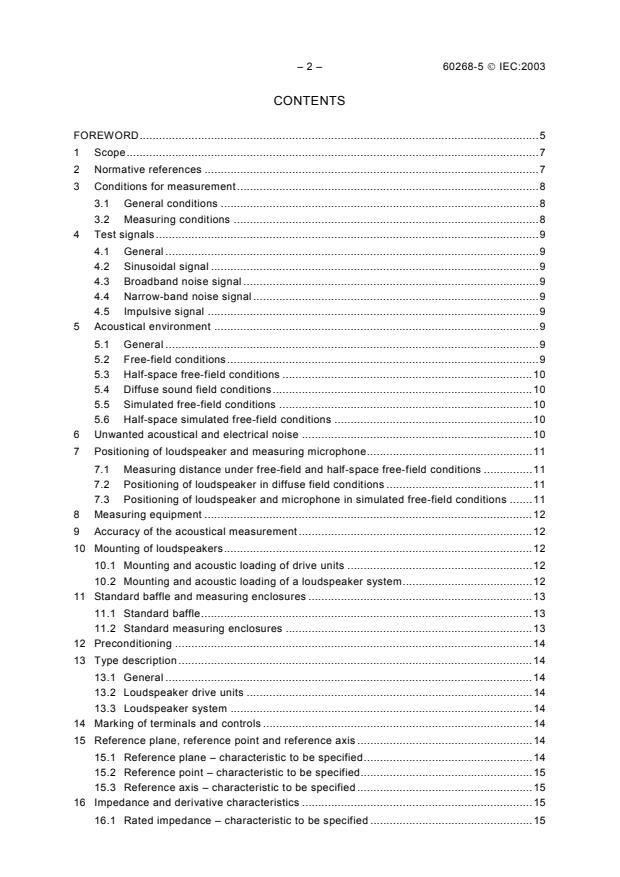
IEC 60268-5:2003 - Sound system equipment - Part 5: Loudspeakers

IEC 60268-5:2003+AMD1:2007 CSV - Sound system equipment - Part 5: Loudspeakers Released:9/11/2007 Isbn:2831892864
Get Certified
Connect with accredited certification bodies for this standard

TL 9000 QuEST Forum
Telecommunications quality management system.

ANCE
Mexican certification and testing association.

Intertek Slovenia
Intertek testing, inspection, and certification services in Slovenia.
Sponsored listings
Frequently Asked Questions
IEC 60268-5:2003 is a standard published by the International Electrotechnical Commission (IEC). Its full title is "Sound system equipment - Part 5: Loudspeakers". This standard covers: IEC 60268-5:2003 applies to sound system loudspeakers, treated entirely as passive elements. Loudspeakers with built-in amplifiers are excluded. It gives the characteristics to be specified and the relevant methods of measurement for loudspeakers using sinusoidal or specified noise or impulsive signals. This third edition cancels and replaces the second edition published in 1989, amendment 1 (1993) and amendment 2 (1996). It constitutes a technical revision. This publication is to be read in conjunction with IEC 60268-1:1985 and IEC 60268-2:1987
IEC 60268-5:2003 applies to sound system loudspeakers, treated entirely as passive elements. Loudspeakers with built-in amplifiers are excluded. It gives the characteristics to be specified and the relevant methods of measurement for loudspeakers using sinusoidal or specified noise or impulsive signals. This third edition cancels and replaces the second edition published in 1989, amendment 1 (1993) and amendment 2 (1996). It constitutes a technical revision. This publication is to be read in conjunction with IEC 60268-1:1985 and IEC 60268-2:1987
IEC 60268-5:2003 is classified under the following ICS (International Classification for Standards) categories: 33.120.40 - Aerials; 33.160.50 - Accessories. The ICS classification helps identify the subject area and facilitates finding related standards.
IEC 60268-5:2003 has the following relationships with other standards: It is inter standard links to IEC 60268-5:2003/AMD1:2007. Understanding these relationships helps ensure you are using the most current and applicable version of the standard.
IEC 60268-5:2003 is available in PDF format for immediate download after purchase. The document can be added to your cart and obtained through the secure checkout process. Digital delivery ensures instant access to the complete standard document.
Standards Content (Sample)
INTERNATIONAL IEC
STANDARD
60268-5
Third edition
2003-05
Sound system equipment –
Part 5:
Loudspeakers
Equipements pour systèmes électroacoustiques –
Partie 5:
Haut-parleurs
Reference number
Publication numbering
As from 1 January 1997 all IEC publications are issued with a designation in the
60000 series. For example, IEC 34-1 is now referred to as IEC 60034-1.
Consolidated editions
The IEC is now publishing consolidated versions of its publications. For example,
edition numbers 1.0, 1.1 and 1.2 refer, respectively, to the base publication, the
base publication incorporating amendment 1 and the base publication incorporating
amendments 1 and 2.
Further information on IEC publications
The technical content of IEC publications is kept under constant review by the IEC,
thus ensuring that the content reflects current technology. Information relating to
this publication, including its validity, is available in the IEC Catalogue of
publications (see below) in addition to new editions, amendments and corrigenda.
Information on the subjects under consideration and work in progress undertaken
by the technical committee which has prepared this publication, as well as the list
of publications issued, is also available from the following:
• IEC Web Site (www.iec.ch)
• Catalogue of IEC publications
The on-line catalogue on the IEC web site (http://www.iec.ch/searchpub/cur_fut.htm)
enables you to search by a variety of criteria including text searches, technical
committees and date of publication. On-line information is also available on
recently issued publications, withdrawn and replaced publications, as well as
corrigenda.
• IEC Just Published
This summary of recently issued publications (http://www.iec.ch/online_news/
justpub/jp_entry.htm) is also available by email. Please contact the Customer
Service Centre (see below) for further information.
• Customer Service Centre
If you have any questions regarding this publication or need further assistance,
please contact the Customer Service Centre:
Email: custserv@iec.ch
Tel: +41 22 919 02 11
Fax: +41 22 919 03 00
INTERNATIONAL IEC
STANDARD
60268-5
Third edition
2003-05
Sound system equipment –
Part 5:
Loudspeakers
Equipements pour systèmes électroacoustiques –
Partie 5:
Haut-parleurs
IEC 2003 Copyright - all rights reserved
No part of this publication may be reproduced or utilized in any form or by any means, electronic or
mechanical, including photocopying and microfilm, without permission in writing from the publisher.
International Electrotechnical Commission, 3, rue de Varembé, PO Box 131, CH-1211 Geneva 20, Switzerland
Telephone: +41 22 919 02 11 Telefax: +41 22 919 03 00 E-mail: inmail@iec.ch Web: www.iec.ch
PRICE CODE
Commission Electrotechnique Internationale
X
International Electrotechnical Commission
Международная Электротехническая Комиссия
For price, see current catalogue
– 2 – 60268-5 IEC:2003(E)
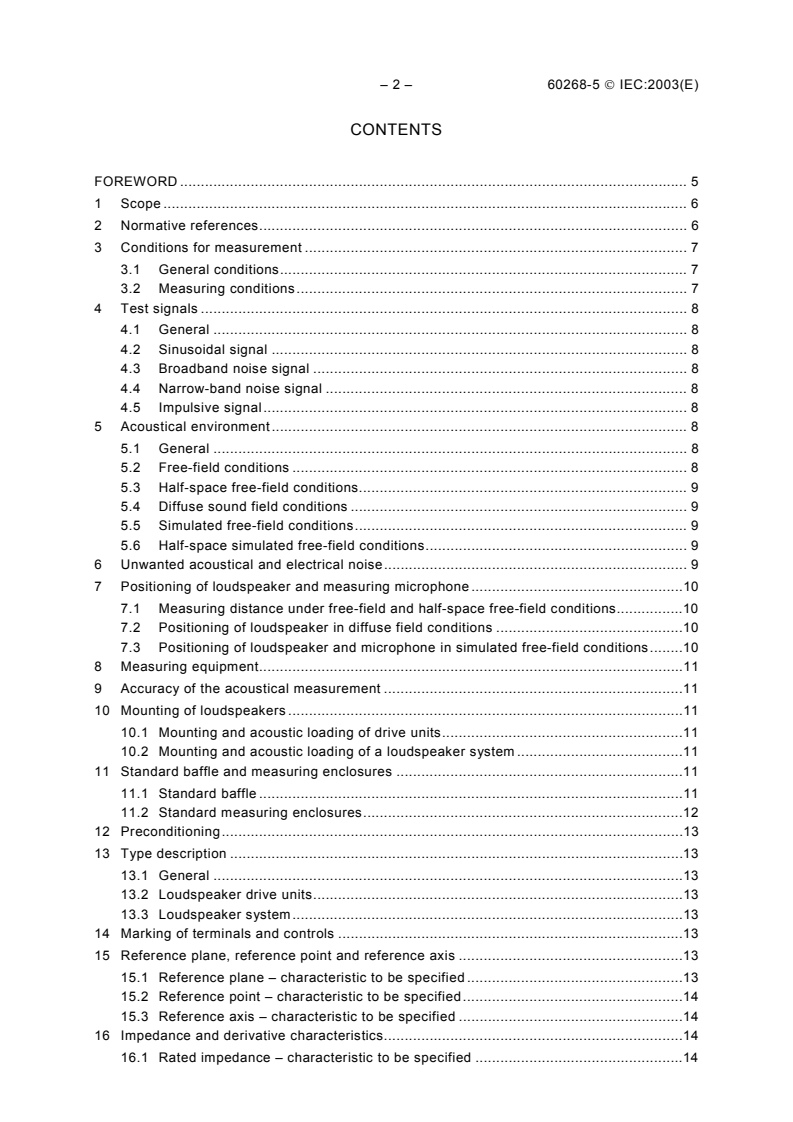
CONTENTS
FOREWORD . 5
1 Scope . 6
2 Normative references. 6
3 Conditions for measurement . 7
3.1 General conditions. 7
3.2 Measuring conditions. 7
4 Test signals . 8
4.1 General . 8
4.2 Sinusoidal signal . 8
4.3 Broadband noise signal . 8
4.4 Narrow-band noise signal . 8
4.5 Impulsive signal. 8
5 Acoustical environment. 8
5.1 General . 8
5.2 Free-field conditions . 8
5.3 Half-space free-field conditions. 9
5.4 Diffuse sound field conditions . 9
5.5 Simulated free-field conditions. 9
5.6 Half-space simulated free-field conditions. 9
6 Unwanted acoustical and electrical noise. 9
7 Positioning of loudspeaker and measuring microphone.10
7.1 Measuring distance under free-field and half-space free-field conditions.10
7.2 Positioning of loudspeaker in diffuse field conditions .10
7.3 Positioning of loudspeaker and microphone in simulated free-field conditions.10
8 Measuring equipment.11
9 Accuracy of the acoustical measurement .11
10 Mounting of loudspeakers .11
10.1 Mounting and acoustic loading of drive units.11
10.2 Mounting and acoustic loading of a loudspeaker system .11
11 Standard baffle and measuring enclosures .11
11.1 Standard baffle .11
11.2 Standard measuring enclosures.12
12 Preconditioning.13
13 Type description .13
13.1 General .13
13.2 Loudspeaker drive units.13
13.3 Loudspeaker system.13
14 Marking of terminals and controls .13
15 Reference plane, reference point and reference axis .13
15.1 Reference plane – characteristic to be specified .13
15.2 Reference point – characteristic to be specified.14
15.3 Reference axis – characteristic to be specified .14
16 Impedance and derivative characteristics.14
16.1 Rated impedance – characteristic to be specified .14
60268-5 IEC:2003(E) – 3 –
16.2 Impedance curve .14
16.3 Total Q-factor (Q ) .14
t
16.4 Equivalent air volume of a loudspeaker drive unit compliance (V ) .16
as
17 Input voltage.17
17.1 Rated noise voltage.17
17.2 Short-term maximum input voltage.18
17.3 Long-term maximum input voltage .18
17.4 Rated sinusoidal voltage.19
18 Input electrical power.19
18.1 Rated noise power – characteristic to be specified.19
18.2 Short-term maximum power – characteristic to be specified.19
18.3 Long-term maximum power – characteristic to be specified .19
18.4 Rated sinusoidal power – characteristic to be specified .19
19 Frequency characteristics .20
19.1 Rated frequency range – characteristic to be specified .20
19.2 Resonance frequency .20
19.3 Tuning frequency of a bass reflex or passive radiator loudspeaker system –
characteristic to be specified .20
20 Sound pressure under free-field and half-space free-field conditions .20
20.1 Sound pressure in a stated frequency band .20
20.2 Sound pressure level in a stated frequency band – characteristic
to be specified .21
20.3 Characteristic sensitivity in a stated frequency band.21
20.4 Characteristic sensitivity level in a stated frequency band – characteristic
to be specified .21
20.5 Mean sound pressure in a stated frequency band .21
20.6 Mean sound pressure level in a stated frequency band –
characteristic to be specified .22
21 Response under free-field and half-space free-field conditions .22
21.1 Frequency response .22
21.2 Effective frequency range .23
21.3 Transfer function .23
22 Output power (acoustic power) .24
22.1 Acoustic power in a frequency band.24
22.2 Mean acoustic power in a frequency band .25
22.3 Efficiency in a frequency band .26
22.4 Mean efficiency in a frequency band.26
23 Directional characteristics.26
23.1 Directional response pattern .26
23.2 Radiation angle .27
23.3 Directivity index .27
23.4 Coverage angle or angles .28
24 Amplitude non-linearity .29
24.1 Total harmonic distortion .29
th
24.2 Harmonic distortion of the n order (where n = 2 or n = 3) .31
24.3 Characteristic harmonic distortion.32
th
24.4 Modulation distortion of the n order (where n = 2 or n = 3).32
th
24.5 Characteristic modulation distortion of the n order (where n = 2 or n = 3) .33
24.6 Difference frequency distortion (of the second order only) .33
– 4 – 60268-5 IEC:2003(E)
25 Rated ambient conditions.34
25.1 Temperature ranges .34
25.2 Humidity ranges.34
26 Stray magnetic fields .35
26.1 Static components .35
26.2 Dynamic components.36
27 Physical characteristics .36
27.1 Dimensions.36
27.2 Mass.36
27.3 Cable assemblies .37
28 Design data .37
29 Indication of the characteristics to be specified .37
Annex A (informative) Standard measuring enclosure type A .43
Annex B (informative) Standard measuring enclosure type B .45
Annex C (informative) Definitions of terms used in Clause 13.48
Bibliography.50
Figure 1 – Impedance curve of loudspeaker .15
Figure 2 – Standard baffle, dimensions .39
Figure 3 – Standard baffle with chamfer .40
Figure 4 – Standard baffle with sub-baffle .40
Figure 5 – Standard measuring enclosure type A .41
Figure 6 – Standard measuring enclosure type B .41
Figure 7 – Block diagram of test set-up .42
Figure 8 – Measuring apparatus for stray magnetic field.42
Figure A.1 – An example of standard measuring enclosure type A .43
Figure A.2 – The correction curve for the diffraction effect of the standard measuring
enclosure from free-field to half-space free-field .44
Figure A.3 – The correction curve for the diffraction effect of a standard measuring
enclosure from free-field to half-space free-field.44
Figure B.1 – An example of standard measuring enclosure type B .45
Figure B.2 – Construction of scalable measuring enclosure type B.46
Figure B.3 – The correction curve for the diffraction effect of the standard measuring
enclosure from free-field to half-space free-field.47
Figure B.4 – The correction curve for the diffraction effect of the standard measuring
enclosure from free-field to half-space free-field.47
Table 1 – Indication of the characteristics to be specified.38
Table B.1 – Dimensions and ratios of scalable measuring enclosure type B .46
60268-5 IEC:2003(E) – 5 –
INTERNATIONAL ELECTROTECHNICAL COMMISSION
____________
SOUND SYSTEM EQUIPMENT –
Part 5: Loudspeakers
FOREWORD
1) The IEC (International Electrotechnical Commission) is a worldwide organization for standardization comprising
all national electrotechnical committees (IEC National Committees). The object of the IEC is to promote
international co-operation on all questions concerning standardization in the electrical and electronic fields. To
this end and in addition to other activities, the IEC publishes International Standards. Their preparation is
entrusted to technical committees; any IEC National Committee interested in the subject dealt with may
participate in this preparatory work. International, governmental and non-governmental organizations liaising
with the IEC also participate in this preparation. The IEC collaborates closely with the International
Organization for Standardization (ISO) in accordance with conditions determined by agreement between the
two organizations.
2) The formal decisions or agreements of the IEC on technical matters express, as nearly as possible, an
international consensus of opinion on the relevant subjects since each technical committee has representation
from all interested National Committees.
3) The documents produced have the form of recommendations for international use and are published in the form
of standards, technical specifications, technical reports or guides and they are accepted by the National
Committees in that sense.
4) In order to promote international unification, IEC National Committees undertake to apply IEC International
Standards transparently to the maximum extent possible in their national and regional standards. Any
divergence between the IEC Standard and the corresponding national or regional standard shall be clearly
indicated in the latter.
5) The IEC provides no marking procedure to indicate its approval and cannot be rendered responsible for any
equipment declared to be in conformity with one of its standards.
6) Attention is drawn to the possibility that some of the elements of this International Standard may be the subject
of patent rights. The IEC shall not be held responsible for identifying any or all such patent rights.
International Standard IEC 60268-5 has been prepared by IEC technical committee 100:
Audio, video and multimedia systems and equipment.
This third edition of IEC 60268-5 cancels and replaces the second edition published in 1989,
amendment 1 (1993) and amendment 2 (1996). This third edition constitutes a technical revision.
The text of this standard is based on the following documents:
FDIS Report on voting
100/648/FDIS 100/674/RVD
Full information on the voting for the approval of this standard can be found in the report on
voting indicated in the above table.
This standard is to be read in conjunction with IEC 60268-1, IEC 60268-2 and ISO 3741.
This publication has been drafted in accordance with the ISO/IEC Directives, Part 2.
The committee has decided that the contents of this publication will remain unchanged until 2005.
At this date, the publication will be
• reconfirmed;
• withdrawn;
• replaced by a revised edition, or
• amended.
A bilingual edition of this standard may be issued at a later date.
– 6 – 60268-5 IEC:2003(E)
SOUND SYSTEM EQUIPMENT –
Part 5: Loudspeakers
1 Scope
This standard applies to sound system loudspeakers, treated entirely as passive elements.
Loudspeakers with built-in amplifiers are excluded.
NOTE 1 The term “loudspeaker” used in this standard relates to loudspeaker drive units themselves and also to
loudspeaker systems, which comprise one or more loudspeaker drive units provided with a baffle, enclosure or
horn and such relevant devices as built-in crossover filters, transformers and any other passive element.
The purpose of this standard is to give the characteristics to be specified and the relevant
methods of measurement for loudspeakers using sinusoidal or specified noise or impulsive
signals.
NOTE 2 The methods of measurement given in this standard have been chosen for their appropriateness to the
characteristics.
NOTE 3 If equivalent results can be obtained using other methods of measurement, details of the methods used
should be presented with the results.
NOTE 4 The following items are under consideration:
– loudspeakers with built-in amplifiers;
– measurements under conditions other than free-field, half-space free-field and diffuse field;
– measurements with signals other than sinusoidal or noise or impulsive signals.
2 Normative references
The following referenced documents are indispensable for the application of this document.
For dated references, only the edition cited applies. For undated references, the latest edition
of the referenced document (including any amendments) applies.
IEC 60050(151), International Electrotechnical Vocabulary (IEV) – Part 151: Electrical and
magnetic devices
IEC 60263, Scales and sizes for plotting frequency characteristics and polar diagrams
IEC 60268-1, Sound system equipment – Part 1: General
IEC 60268-2, Sound system equipment – Part 2: Explanation of general terms and calculation
methods
IEC 60268-3, Sound system equipment – Part 3: Amplifiers
IEC 60268-11, Sound system equipment – Part 11: Application of connectors for the
interconnection of sound system components
IEC 60268-12, Sound system equipment – Part 12: Application of connectors for broadcast
and similar use
IEC 60268-14, Part 14: Circular and elliptical loudspeakers; outer frame diameters and
mounting dimensions
IEC 60651, Sound level meters
IEC 61260, Electroacoustics – Octave-band and fractional-octave-band filters
60268-5 IEC:2003(E) – 7 –
ISO 3741, Acoustics – Determination of sound power levels of noise sources using sound
pressure – Precision methods for reverberation rooms
ISO 3744, Acoustics – Determination of sound power levels of noise sources using sound
pressure – Engineering method in an essentially free field over a reflecting plane
ISO 3745, Acoustics – Determination of sound power levels of noise sources – Precision
methods for anechoic and semi-anechoic rooms
3 Conditions for measurement
3.1 General conditions
This standard is to be used in conjunction with IEC 60268-1, IEC 60268-2 and ISO 3741.
3.2 Measuring conditions
3.2.1 General
For convenience in specifying how loudspeakers are to be set up for measurement, normal
measuring conditions are defined in this standard. To obtain the correct conditions for
measurement, some values (known as “rated conditions”) shall be taken from the
manufacturer's specification. These values themselves are not subject to measurement but
they constitute the basis for measuring the other characteristics.
The following values and conditions are of this type, and shall be stated by the manufacturer:
– rated impedance;
– rated sinusoidal voltage or power;
– rated noise voltage or power;
– rated frequency range;
– reference plane;
– reference point;
– reference axis.
NOTE A full explanation of the term “rated” is given in IEC 60268-2. See also term 151-04-03 in IEC 60050(151).
3.2.2 Normal measuring conditions
A loudspeaker shall be understood to be working under normal measuring conditions when all
the following conditions are fulfilled:
a) the loudspeaker to be measured is mounted in accordance with Clause 10;
b) the acoustical environment is specified and is selected from those specified in Clause 5;
c) the loudspeaker is positioned with respect to the measuring microphone and the walls in
accordance with Clause 7;
d) the loudspeaker is supplied with a specified test signal, in accordance with Clause 4, of
a stated voltage U, within the rated frequency range in accordance with 19.1. If required,
the input power P can be calculated from the equation: P = U /R, where R is the rated
impedance in accordance with 16.1;
e) attenuators, if any, are set to their “normal” position as stated by the manufacturer. If other
positions are chosen, for example those providing a maximally flat frequency response or
maximum attenuation, these shall be specified;
f) measuring equipment suitable for determining the wanted characteristics is connected in
accordance with Clause 8.
– 8 – 60268-5 IEC:2003(E)
4 Test signals
4.1 General
Acoustical measurements shall be made under one of the following measuring signal
conditions, and the choice shall be indicated with the results.
4.2 Sinusoidal signal
The sinusoidal test signal shall not exceed the rated sinusoidal voltage (as defined in 17.4) at
any frequency. The voltage across the input terminals of the loudspeaker under test shall be
kept constant for all frequencies unless otherwise stated.
4.3 Broadband noise signal
NOTE This term is explained in IEC 60268-2.
The crest factor of a noise source should fall between 3 and 4 to avoid clipping of amplifiers.
A true r.m.s. voltmeter with a time constant at least as long as the “slow” constant of the
sound level meter, specified in IEC 60651, shall be used to measure the amplitude of
the signal.
4.4 Narrow-band noise signal
NOTE This term is explained in IEC 60268-2.
For measurement using narrow-band noise, constant relative bandwidth filters in accordance
with IEC 61260 shall be used with a pink-noise generator, the relative bandwidth being
usually 1/3 octave.
4.5 Impulsive signal
A short-duration pulse shall have constant spectral power per unit bandwidth over at least the
bandwidth of interest in the measurement. Such a signal has low energy content relative to its
peak amplitude.
NOTE To minimize the influence of acoustical and electrical noise on the measurement, the peak amplitude of the
pulse should be as high as possible within the capability of the driving amplifier and consistent with linear
operation of the loudspeaker.
5 Acoustical environment
5.1 General
Acoustical measurements shall be made under one of the acoustical field conditions specified
in 5.2 to 5.6, and the choice shall be indicated with the results.
5.2 Free-field conditions
If acoustical conditions approach those of free-field space, an environment (for example an
anechoic room) in which the sound pressure decreases with the distance (r) from a point
source according to a 1/r law, with an accuracy of ±10 %, in the region that will be occupied
by the sound field between the loudspeaker system and the microphone during the
measurements shall be used. The minimum conditions shall be deemed to exist if this
requirement is met along the axis joining the measuring microphone and the reference point
on the loudspeaker.
Free-field conditions shall exist over the whole frequency range of measurement.
60268-5 IEC:2003(E) – 9 –
5.3 Half-space free-field conditions
If acoustical conditions are used in which the free-field exists in a half space, these conditions
shall be met with a reflecting plane of sufficient size so that the sound pressure from a point
source mounted in the surface of that plane decreases in the manner specified in 5.2.
5.4 Diffuse sound field conditions
NOTE 1 These conditions are normally used for band noise measurements only.
If diffuse sound field conditions are used for measurements with 1/3 octave band limited
noise, as defined and specified in ISO 3741, the lower limiting frequency shall be determined
as specified in ISO 3741, Appendix A.
NOTE 2 While ISO 3741 provides details of measuring instruments, it should be clearly understood that both
space averaging and time averaging are required in loudspeaker power determination. This may be achieved as
stated in the standard or alternatively by using continuous space and time averaging techniques.
NOTE 3 The precision of the measurement depends on a number of factors including the room volume, the room
reverberation time, and the degree of diffusion.
NOTE 4 For measurement below 125 Hz, a room volume greater than 200 m is desirable.
5.5 Simulated free-field conditions
If acoustical conditions are used in which the simulated free-field conditions that are
equivalent to those of free space for the period of time required for a measurement, these
conditions shall be used.
The conditions shall be met in any environment (for example large, unobstructed rooms) in
which sound emitted by a loudspeaker in response to an impulsive signal reflected from any
surface or object in the environment does not reach the measuring microphone before
measurement of the direct path sound at the microphone has been completed.
Any such reflection reaching the microphone shall be excluded from the measurement by
gating or other means.
NOTE 1 These conditions are normally used only for measurements with impulsive signals.
NOTE 2 Under such conditions, successive measurements are separated by time intervals sufficient for the sound
pressure level due to reverberation within the space to decrease to a negligible value.
5.6 Half-space simulated free-field conditions
If acoustical conditions are used in which the simulated free-field exists in a half-space, these
conditions shall be used when a reflecting plane, forming one boundary of a simulated free-
field environment, is of sufficient size that no reflections from its edge reach the measuring
microphone within the measurement time.
NOTE 1 These conditions are normally used only for measurements with impulsive signals.
NOTE 2 Under such conditions, successive measurements are separated by time intervals sufficient for the sound
pressure level due to reverberation within the space to decrease to a negligible value.
6 Unwanted acoustical and electrical noise
Unwanted acoustical and electrical noise shall be kept at the lowest possible level as its
presence may obscure low-level signals.
Data related to signals which are less than 10 dB above the noise level in the frequency band
considered shall be discarded.
– 10 – 60268-5 IEC:2003(E)
7 Positioning of loudspeaker and measuring microphone
7.1 Measuring distance under free-field and half-space free-field conditions
7.1.1 General
Measurements under free-field and half-space free-field conditions should ideally be carried
out in the far field of the loudspeaker, in order to obtain consistent results. However, in
practice, imperfections of the measuring environment room and the effects of background
noise set an upper limit to the distance that can be used. Therefore, the measuring distance
should be 0,5 m or an integral number of m, and that result should be referred to a standard
distance of 1 m.
7.1.2 Single drive unit loudspeaker
For this type of loudspeaker, a measuring distance of 1 m from the reference point shall be
used unless special conditions dictate another value, which shall be stated.
7.1.3 Multi-unit loudspeaker systems
Loudspeaker systems in which two or more loudspeaker units reproduce the same frequency
band create problems of acoustical interference at the measuring point due to the interaction
of the sounds radiated by the units. This situation exists whether all units operate over the
entire frequency band under test or whether some units operate over parts of this band (for
example cross-over regions). In such cases, the measuring distance should be chosen so as
to minimize the errors due to this phenomenon.
7.2 Positioning of loudspeaker in diffuse field conditions
The loudspeaker position and orientation with respect to the walls shall be described by
means of a diagram appended to the measurement results.
An arrangement for the simultaneous movement of the loudspeaker and the microphone is
permitted for the evaluation of the power delivered by the loudspeaker in accordance with the
method prescribed in 22.1.2.2. The microphone system and the nearest microphone position
shall meet the requirements of ISO 3741.
7.3 Positioning of loudspeaker and microphone
in simulated free-field conditions
The measuring distance shall be chosen with reference to 7.1 for free-field conditions.
The position of the loudspeaker and microphone within the measuring environment shall be
such so as to maximize the time available for measurement before the first unwanted
reflection reaches the microphone.
If the measurement space is an anechoic chamber, attention shall be paid to reflections from
wedge tips, personnel floor, and supports for the loudspeaker and microphone. Errors from
these sources shall not exceed 0,5 dB over the frequency range of measurement.
The microphone distance and the maximum signal capture time available in the environment
shall be stated.
It is necessary to ignore all the output of the microphone from the time of arrival of the first
reflection onwards. Truncation errors are therefore introduced into the transfer function
measurement unless the loudspeaker response to the impulsive test signal is negligible
during this time. If present, such truncation errors shall not exceed 1 dB over the frequency
range of measurement.
60268-5 IEC:2003(E) – 11 –
8 Measuring equipment
Measurements in free-field and half-space free-field conditions shall be made using a
pressure microphone having a known calibration. For measurements under diffuse-field
conditions, a pressure microphone shall be used having a directivity index less than 2 dB.
Both these requirements shall be met for all frequencies in the frequency range of interest.
The signal generator, the amplifier supplying the signal to the loudspeaker, and the measuring
equipment at the microphone amplifier shall have an amplitude frequency response known
and constant within ±0,5 dB in the relevant frequency range, with negligible amplitude non-
linearity under test conditions. All measuring instruments shall be of the r.m.s. type, having
a time constant long enough to ensure an error not greater than 1 dB.
NOTE It is recommended that the frequency response be measured by an automatic method giving a continuous
curve. Errors due to the chosen writing speeds (along both level and frequency axes) of the level recorder should
not exceed 0,5 dB. The writing speeds along both axes should be stated.
9 Accuracy of the acoustical measurement
The frequency range over which the total errors do not exceed ±2 dB shall be stated.
NOTE The probable error sources in both the instrumentation and the measuring environment should be identified
and quantified and their contribution specified. This information should be included with the test report.
10 Mounting of loudspeakers
10.1 Mounting and acoustic loading of drive units
The performance of a drive unit is determined by the properties of the unit itself and its
acoustic loading. The acoustic loading depends upon the mounting arrangement, which shall
be clearly described in the presentation of results.
One of the following three types of mounting shall be used:
a) a standard baffle, standard measuring enclosure (type A or type B), or specified
enclosure;
b) in free air without a baffle or enclosure;
c) in half-space free-field, flush with the reflecting plane.
NOTE Mounting condition a) approaches that of a half-space free-field down to a lower limiting frequency, the
value of which depends on the chosen measuring distance. Measurements made at frequencies below this limiting
value may be used for comparative purposes only.
10.2 Mounting and acoustic loading of a loudspeaker system
Loudspeaker systems are usually measured without any additional baffle. If the manufacturer
specifies a special type of mounting for the loudspeaker systems, this shall be used for the
measurement; the mounting method used shall be specified with the results.
11 Standard baffle and measuring enclosures
11.1 Standard baffle
The standard baffle shall be made with a plane front surface that is acoustically reflective.
The baffle shall have the dimensions shown in Figure 2.
NOTE The standard baffle should be of a material of thickness adequate to ensure negligible vibration. The edge
of the radiating element should be substantially flush with the front surface of the baffle. This may be achieved by
means of a chamfer as shown in Figure 3 or by the use of a thin rigid sub-baffle, with or without a chamfer, as
shown in Figure 4.
– 12 – 60268-5 IEC:2003(E)
11.2 Standard measuring enclosures
11.2.1 General
One of the two types of standard measuring enclosures specified in 11.2.3 (type A) and
11.2.4 (type B) shall be used. The type choosen for testing shall be stated by the
manufacturer.
11.2.2 Conditions
The enclosure shall have plane or curved surfaces which have an acoustically reflective
characteristic.
NOTE 1 The material shall be appropriately thick so that the effect of vibrations can be disregarded for
measurement. If necessary, braces should be used for reinforcement between facing surfaces at and around their
centres so as to avoid panel vibrations.
NOTE 2 The enclosure should be airtight.
NOTE 3 The edge of the loudspeaker should be set on the same plane as that of the front part of the baffle.
NOTE 4 To remove standing waves that may otherwise occur in the enclosure, an appropriate sound absorbing
material shall be used. Handles or joints may be installed if their effect on acoustical reflections and undesired
vibrations can be ignored.
NOTE 5 When the loudspeaker is mounted in the enclosure, care should be taken to avoid air leakage from the
inside of the enclosure.
11.2.3 Standard measuring enclosure type A
The standard measuring enclosure type A shall be as shown in Figure 5.
NOTE 1 The characteristic of the correction curves for the standard measuring enclosure diffraction effect at
a measuring distance of 1m on the reference axis from free-field to half-space free-field is shown in Annex A.
NOTE 2 All the surfaces of this type of enclosure are plane and the joints of the surfaces are made at right
angles. No change in size is allowed. This causes the diffraction characteristic to be repeatable. Therefore, type A
is useful when analysing, studying or comparing the characteristics of loudspeakers in detail.
11.2.4 Standard measuring enclosure type B
The standard measuring enclosure type B shall be as shown in Figure 6.
NOTE 1 The characteristic of the correction curves for the standard measuring enclosure diffraction effect at
a measuring distance of 1 m on the reference axis from free-field to half-space free-field is shown in Annex B.
NOTE 2 If a smaller or larger measuring enclosure of type B is required, it should meet the requirement for
proportional scaling as shown in Annex B, Figure B.2 and Table B.1. In this case, the report should state the
outside dimensions and the net volume of the enclosure.
NOTE 3 A change in scale is allowed. It is recommended to use the standard measuring enclosure as shown
in Figure 6 for acoustical measurements. Properly scaled enclosures are useful for subjective testing.
60268-5 IEC:2003(E) – 13 –
12 Preconditioning
Permanent changes may take place in a loudspeaker as a result, for example, of motion of
the diaphragm. Therefore, the loudspeaker should be preconditioned before measurements by
application of a simulated programme signal, in accordance with IEC 60268-1, at the rated
noise voltage for at least 1 h.
The period of preconditioning shall be followed by a recovery period of at least 1 h, during
which the loudspeaker shall be disconnected, before proceeding with the measurement.
13 Type description
13.1 General
The type description shall be given by the manufacturer, as specified in 13.2 to 13.3.
NOTE See Table 1 and Annex C.
13.2 Loudspeaker drive units
13.2.1 Principle of the transducer
The principle of the transducer shall be specified, for example, whether it is electrodynamic,
electrostatic, or piezoelectric.
13.2.2 Type
The type of the loudspeaker drive unit shall be specified, for example, direct radiating or horn,
single or multi-unit.
13.3 Loudspeaker system
The number and type of drive units and acoustic loading principle shall be specified, for
example, enclosure, horn, bass reflex, column or line.
14 Marking of terminals and controls
The terminals and controls shall be marked in accordance with IEC 60268-1 and 60268-2.
15 Reference plane, reference point and reference axis
NOTE 1 These are rated conditions in accordance with 3.2.1.
NOTE 2 Strictly speaking, these terms should include the word “rated” (for example rated reference plane),
because they are specified by the manufacturer and cannot be measured. Nevertheless, confusion is unlikely if the
shorter terms are used.
15.1 Reference plane – characteristic to be specified
The reference plane with respect to some physical feature of the loudspeaker drive unit or
enclosure shall be specified by the manufacturer.
The reference plane shall be used to define the position of the reference point and the
direction of the reference axis.
NOTE For symmetrical structures, the reference plane is usually parallel to the radiating surface or to a plane
defining the front of the loudspeaker drive unit or system. For asymmetrical structures, the reference plane is
better indicated by means of a diagram.
– 14 – 60268-5 IEC:2003(E)
15.2 Reference point – characteristic to be specified
A point on the reference plane shall be specified by the manufacturer.
NOTE For symmetrical structures, the reference point is usually a point of geometric symmetry; for asymmetrical
structures, the reference point is better indicated by means of a diagram.
15.3 Reference axis – characteristic to be specified
The line that passes through the reference plane at the reference point and its direction shall
be specified by the manufacturer. The reference axis shall be used as the zero reference axis
for directional and frequency response measurements.
NOTE For symmetrical structures, the reference axis is usually perpendicular to the radiating surface or to
the reference plane.
16 Impedance and derivative characteristics
16.1 Rated impedance – characteristic to be specified
NOTE This is a rated condition in accordance with 3.2.1.
The value of a pure resistance which is to be substituted for the loudspeaker when defining
the available electric power of the source shall be specified by the manufacturer.
T
...
IEC 60268-5 ®
Edition 3.1 2007-09
CONSOLIDATED VERSION
INTERNATIONAL
STANDARD
Sound system equipment –
Part 5: Loudspeakers
All rights reserved. Unless otherwise specified, no part of this publication may be reproduced or utilized in any form
or by any means, electronic or mechanical, including photocopying and microfilm, without permission in writing from
either IEC or IEC's member National Committee in the country of the requester.
If you have any questions about IEC copyright or have an enquiry about obtaining additional rights to this publication,
please contact the address below or your local IEC member National Committee for further information.
IEC Central Office Tel.: +41 22 919 02 11
3, rue de Varembé Fax: +41 22 919 03 00
CH-1211 Geneva 20 info@iec.ch
Switzerland www.iec.ch
About the IEC
The International Electrotechnical Commission (IEC) is the leading global organization that prepares and publishes
International Standards for all electrical, electronic and related technologies.
About IEC publications
The technical content of IEC publications is kept under constant review by the IEC. Please make sure that you have the
latest edition, a corrigenda or an amendment might have been published.
Useful links:
IEC publications search - www.iec.ch/searchpub Electropedia - www.electropedia.org
The advanced search enables you to find IEC publications The world's leading online dictionary of electronic and
by a variety of criteria (reference number, text, technical electrical terms containing more than 30 000 terms and
committee,…). definitions in English and French, with equivalent terms in
It also gives information on projects, replaced and additional languages. Also known as the International
withdrawn publications. Electrotechnical Vocabulary (IEV) on-line.
IEC Just Published - webstore.iec.ch/justpublished Customer Service Centre - webstore.iec.ch/csc
Stay up to date on all new IEC publications. Just Published If you wish to give us your feedback on this publication
details all new publications released. Available on-line and or need further assistance, please contact the
also once a month by email. Customer Service Centre: csc@iec.ch.
IEC 60268-5 ®
Edition 3.1 2007-09
CONSOLIDATED VERSION
INTERNATIONAL
STANDARD
Sound system equipment –
Part 5: Loudspeakers
INTERNATIONAL
ELECTROTECHNICAL
COMMISSION
ICS 33.160.50 ISBN 2-8318-9286-4
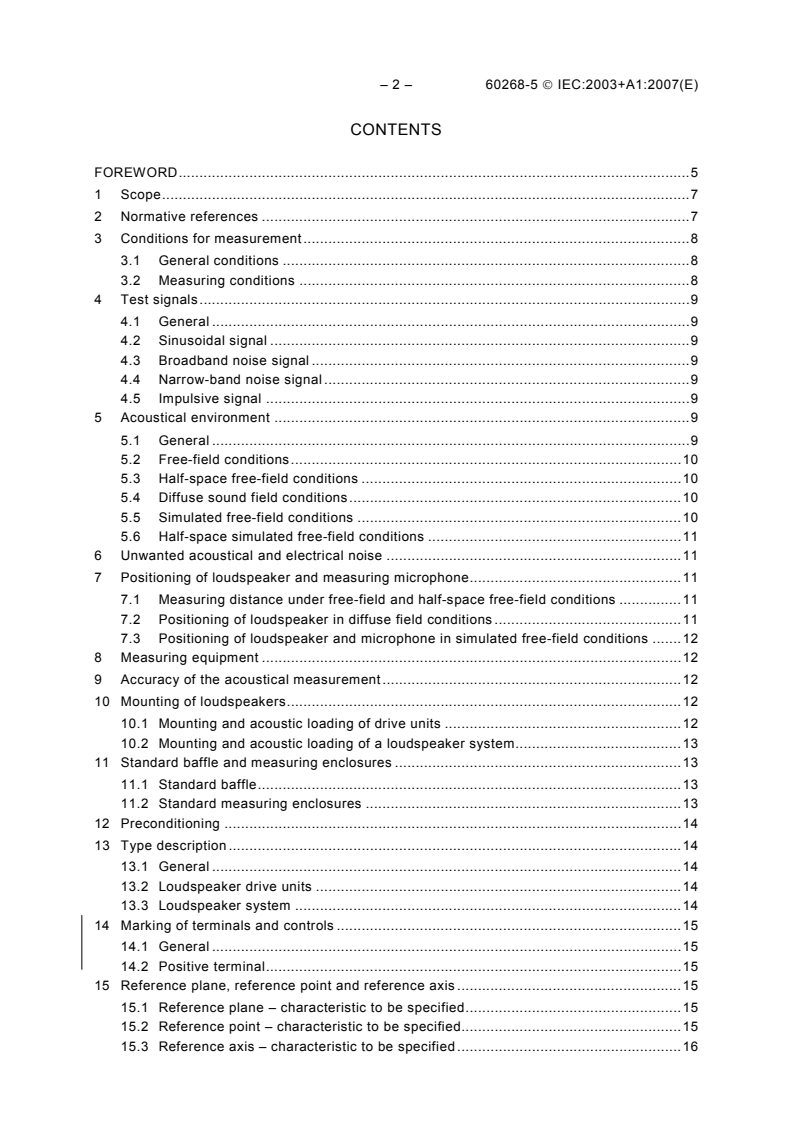
– 2 – 60268-5 © IEC:2003+A1:2007(E)
CONTENTS
FOREWORD.5
1 Scope.7
2 Normative references.7
3 Conditions for measurement.8
3.1 General conditions.8
3.2 Measuring conditions.8
4 Test signals.9
4.1 General.9
4.2 Sinusoidal signal.9
4.3 Broadband noise signal.9
4.4 Narrow-band noise signal.9
4.5 Impulsive signal.9
5 Acoustical environment.9
5.1 General.9
5.2 Free-field conditions.10
5.3 Half-space free-field conditions .10
5.4 Diffuse sound field conditions.10
5.5 Simulated free-field conditions .10
5.6 Half-space simulated free-field conditions .11
6 Unwanted acoustical and electrical noise .11
7 Positioning of loudspeaker and measuring microphone.11
7.1 Measuring distance under free-field and half-space free-field conditions .11
7.2 Positioning of loudspeaker in diffuse field conditions .11
7.3 Positioning of loudspeaker and microphone in simulated free-field conditions .12
8 Measuring equipment.12
9 Accuracy of the acoustical measurement.12
10 Mounting of loudspeakers.12
10.1 Mounting and acoustic loading of drive units .12
10.2 Mounting and acoustic loading of a loudspeaker system.13
11 Standard baffle and measuring enclosures .13
11.1 Standard baffle.13
11.2 Standard measuring enclosures.13
12 Preconditioning .14
13 Type description.14
13.1 General.14
13.2 Loudspeaker drive units .14
13.3 Loudspeaker system.14
14 Marking of terminals and controls .15
14.1 General .15
14.2 Positive terminal.15
15 Reference plane, reference point and reference axis .15
15.1 Reference plane – characteristic to be specified.15
15.2 Reference point – characteristic to be specified.15
15.3 Reference axis – characteristic to be specified .16
60268-5 © IEC:2003+A1:2007(E) – 3 –
16 Impedance and derivative characteristics .16
16.1 Rated impedance – characteristic to be specified .16
16.2 Impedance curve.16
16.3 Total Q-factor (Q ) .16
t
16.4 Equivalent air volume of a loudspeaker drive unit compliance (V ).18
as
17 Input voltage.19
17.1 Rated noise voltage.19
17.2 Short-term maximum input voltage .20
17.3 Long-term maximum input voltage .20
17.4 Rated sinusoidal voltage.21
18 Input electrical power.21
18.1 Rated noise power – characteristic to be specified .21
18.2 Short-term maximum power – characteristic to be specified .22
18.3 Long-term maximum power – characteristic to be specified .22
18.4 Rated sinusoidal power – characteristic to be specified .22
19 Frequency characteristics.22
19.1 Rated frequency range – characteristic to be specified.22
19.2 Resonance frequency.22
19.3 Tuning frequency of a bass reflex or passive radiator loudspeaker system –
characteristic to be specified .22
20 Sound pressure under free-field and half-space free-field conditions .23
20.1 Sound pressure in a stated frequency band.23
20.2 Sound pressure level in a stated frequency band – characteristic
to be specified.23
20.3 Characteristic sensitivity in a stated frequency band .23
20.4 Characteristic sensitivity level in a stated frequency band – characteristic
to be specified.24
20.5 Mean sound pressure in a stated frequency band.24
20.6 Mean sound pressure level in a stated frequency band –
characteristic to be specified .24
21 Response under free-field and half-space free-field conditions .24
21.1 Frequency response.24
21.2 Effective frequency range.25
21.3 Transfer function.26
22 Output power (acoustic power) .27
22.1 Acoustic power in a frequency band .27
22.2 Mean acoustic power in a frequency band .28
22.3 Efficiency in a frequency band.28
22.4 Mean efficiency in a frequency band.28
23 Directional characteristics.29
23.1 Directional response pattern.29
23.2 Radiation angle.30
23.3 Directivity index.30
23.4 Coverage angle or angles.31
24 Amplitude non-linearity.32
24.1 Total harmonic distortion .32
th
24.2 Harmonic distortion of the n order (where n = 2 or n = 3).33
24.3 Characteristic harmonic distortion .35
– 4 – 60268-5 © IEC:2003+A1:2007(E)
th
24.4 Modulation distortion of the n order (where n = 2 or n = 3).35
th
24.5 Characteristic modulation distortion of the n order (where n = 2 or n = 3) .36
24.6 Difference frequency distortion (of the second order only) .36
25 Rated ambient conditions .37
25.1 Temperature ranges.37
25.2 Humidity ranges.37
26 Stray magnetic fields .37
26.1 Static components.38
26.2 Dynamic components.38
27 Physical characteristics.39
27.1 Dimensions.39
27.2 Mass.39
27.3 Cable assemblies.39
28 Design data.40
29 Indication of the characteristics to be specified.40
Annex A (informative) Standard measuring enclosure type A .46
Annex B (informative) Standard measuring enclosure type B .48
Annex C (informative) Definitions of terms used in Clause 13 .51
Annex D (informative) Listening tests.53
Bibliography.53
Figure 1 – Impedance curve of loudspeaker.17
Figure 2 – Standard baffle, dimensions .42
Figure 3 – Standard baffle with chamfer.43
Figure 4 – Standard baffle with sub-baffle.43
Figure 5 – Standard measuring enclosure type A .44
Figure 6 – Standard measuring enclosure type B .44
Figure 7 – Block diagram of test set-up.45
Figure 8 – Measuring apparatus for stray magnetic field .45
Figure A.1 – An example of standard measuring enclosure type A .46
Figure A.2 – The correction curve for the diffraction effect of the standard measuring
enclosure from free-field to half-space free-field .47
Figure A.3 – The correction curve for the diffraction effect of a standard measuring
enclosure from free-field to half-space free-field .47
Figure B.1 – An example of standard measuring enclosure type B .48
Figure B.2 – Construction of scalable measuring enclosure type B .49
Figure B.3 – The correction curve for the diffraction effect of the standard measuring
enclosure from free-field to half-space free-field .50
Figure B.4 – The correction curve for the diffraction effect of the standard measuring
enclosure from free-field to half-space free-field .50
Table 1 – Indication of the characteristics to be specified .41
Table B.1 – Dimensions and ratios of scalable enclosure type B.49
60268-5 © IEC:2003+A1:2007(E) – 5 –
INTERNATIONAL ELECTROTECHNICAL COMMISSION
____________
SOUND SYSTEM EQUIPMENT –
Part 5: Loudspeakers
FOREWORD
1) The International Electrotechnical Commission (IEC) is a worldwide organization for standardization comprising
all national electrotechnical committees (IEC National Committees). The object of IEC is to promote
international co-operation on all questions concerning standardization in the electrical and electronic fields. To
this end and in addition to other activities, IEC publishes International Standards, Technical Specifications,
Technical Reports, Publicly Available Specifications (PAS) and Guides (hereafter referred to as “IEC
Publication(s)”). Their preparation is entrusted to technical committees; any IEC National Committee interested
in the subject dealt with may participate in this preparatory work. International, governmental and non-
governmental organizations liaising with the IEC also participate in this preparation. IEC collaborates closely
with the International Organization for Standardization (ISO) in accordance with conditions determined by
agreement between the two organizations.
2) The formal decisions or agreements of IEC on technical matters express, as nearly as possible, an international
consensus of opinion on the relevant subjects since each technical committee has representation from all
interested IEC National Committees.
3) IEC Publications have the form of recommendations for international use and are accepted by IEC National
Committees in that sense. While all reasonable efforts are made to ensure that the technical content of IEC
Publications is accurate, IEC cannot be held responsible for the way in which they are used or for any
misinterpretation by any end user.
4) In order to promote international uniformity, IEC National Committees undertake to apply IEC Publications
transparently to the maximum extent possible in their national and regional publications. Any divergence
between any IEC Publication and the corresponding national or regional publication shall be clearly indicated in
the latter.
5) IEC provides no marking procedure to indicate its approval and cannot be rendered responsible for any
equipment declared to be in conformity with an IEC Publication.
6) All users should ensure that they have the latest edition of this publication.
7) No liability shall attach to IEC or its directors, employees, servants or agents including individual experts and
members of its technical committees and IEC National Committees for any personal injury, property damage or
other damage of any nature whatsoever, whether direct or indirect, or for costs (including legal fees) and
expenses arising out of the publication, use of, or reliance upon, this IEC Publication or any other IEC
Publications.
8) Attention is drawn to the Normative references cited in this publication. Use of the referenced publications is
indispensable for the correct application of this publication.
9) Attention is drawn to the possibility that some of the elements of this IEC Publication may be the subject of
patent rights. IEC shall not be held responsible for identifying any or all such patent rights.
This consolidated version of the official IEC Standard and its amendment has
been prepared for user convenience.
IEC 60268-5 edition 3.1 contains the third edition (2003) [documents 100/648/FDIS
and 100/674/RVD] and its amendment 1 (2007) [documents 100/1189/CDV and
100/1245/
A vertical line in the margin shows where the base publication has been
modified by amendment 1.
– 6 – 60268-5 © IEC:2003+A1:2007(E)
International Standard IEC 60268-5 has been prepared by IEC technical committee 100:
Audio, video and multimedia systems and equipment.
This standard is to be read in conjunction with IEC 60268-1, IEC 60268-2 and ISO 3741.
This publication has been drafted in accordance with the ISO/IEC Directives, Part 2.
The committee has decided that the contents of the base publication and its amendments will
remain unchanged until the maintenance result date indicated on the IEC web site
under "http://webstore.iec.ch" in the data related to the specific publication. At this
date, the publication will be
• reconfirmed,
• withdrawn,
• replaced by a revised edition, or
• amended.
60268-5 © IEC:2003+A1:2007(E) – 7 –
SOUND SYSTEM EQUIPMENT –
Part 5: Loudspeakers
1 Scope
This standard applies to sound system loudspeakers, treated entirely as passive elements.
Loudspeakers with built-in amplifiers are excluded.
NOTE 1 The term “loudspeaker” used in this standard relates to loudspeaker drive units themselves and also to
loudspeaker systems, which comprise one or more loudspeaker drive units provided with a baffle, enclosure or
horn and such relevant devices as built-in crossover filters, transformers and any other passive element.
The purpose of this standard is to give the characteristics to be specified and the relevant
methods of measurement for loudspeakers using sinusoidal or specified noise or impulsive
signals.
NOTE 2 The methods of measurement given in this standard have been chosen for their appropriateness to the
characteristics.
NOTE 3 If equivalent results can be obtained using other methods of measurement, details of the methods used
should be presented with the results.
NOTE 4 The following items are under consideration:
– loudspeakers with built-in amplifiers;
– measurements under conditions other than free-field, half-space free-field and diffuse field;
– measurements with signals other than sinusoidal or noise or impulsive signals.
2 Normative references
The following referenced documents are indispensable for the application of this document.
For dated references, only the edition cited applies. For undated references, the latest edition
of the referenced document (including any amendments) applies.
IEC 60050(151), International Electrotechnical Vocabulary (IEV) – Part 151: Electrical and
magnetic devices
IEC 60263, Scales and sizes for plotting frequency characteristics and polar diagrams
IEC 60268-1, Sound system equipment – Part 1: General
IEC 60268-2, Sound system equipment – Part 2: Explanation of general terms and calculation
methods
IEC 60268-3, Sound system equipment – Part 3: Amplifiers
IEC 60268-11, Sound system equipment – Part 11: Application of connectors for the
interconnection of sound system components
IEC 60268-12, Sound system equipment – Part 12: Application of connectors for broadcast
and similar use
IEC 60268-14, Part 14: Circular and elliptical loudspeakers; outer frame diameters and
mounting dimensions
IEC 60651, Sound level meters
– 8 – 60268-5 © IEC:2003+A1:2007(E)
IEC 61260, Electroacoustics – Octave-band and fractional-octave-band filters
ISO 3741, Acoustics – Determination of sound power levels of noise sources using sound
pressure – Precision methods for reverberation rooms
ISO 3744, Acoustics – Determination of sound power levels of noise sources using sound
pressure – Engineering method in an essentially free field over a reflecting plane
ISO 3745, Acoustics – Determination of sound power levels of noise sources – Precision
methods for anechoic and semi-anechoic rooms
3 Conditions for measurement
3.1 General conditions
This standard is to be used in conjunction with IEC 60268-1, IEC 60268-2 and ISO 3741.
3.2 Measuring conditions
3.2.1 General
For convenience in specifying how loudspeakers are to be set up for measurement, normal
measuring conditions are defined in this standard. To obtain the correct conditions for
measurement, some values (known as “rated conditions”) shall be taken from the
manufacturer's specification. These values themselves are not subject to measurement but
they constitute the basis for measuring the other characteristics.
The following values and conditions are of this type, and shall be stated by the manufacturer:
– rated impedance;
– rated sinusoidal voltage or power;
– rated noise voltage or power;
– rated frequency range;
– reference plane;
– reference point;
– reference axis.
NOTE A full explanation of the term “rated” is given in IEC 60268-2. See also term 151-04-03 in IEC 60050(151).
3.2.2 Normal measuring conditions
A loudspeaker shall be understood to be working under normal measuring conditions when all
the following conditions are fulfilled:
a) the loudspeaker to be measured is mounted in accordance with Clause 10;
b) the acoustical environment is specified and is selected from those specified in Clause 5;
c) the loudspeaker is positioned with respect to the measuring microphone and the walls in
accordance with Clause 7;
d) the loudspeaker is supplied with a specified test signal, in accordance with Clause 4, of
a stated voltage U, within the rated frequency range in accordance with 19.1. If required,
the input power P can be calculated from the equation: P = U /R, where R is the rated
impedance in accordance with 16.1;
60268-5 © IEC:2003+A1:2007(E) – 9 –
e) attenuators, if any, are set to their “normal” position as stated by the manufacturer. If other
positions are chosen, for example those providing a maximally flat frequency response or
maximum attenuation, these shall be specified;
f) measuring equipment suitable for determining the wanted characteristics is connected in
accordance with Clause 8.
4 Test signals
4.1 General
Acoustical measurements shall be made under one of the following measuring signal
conditions, and the choice shall be indicated with the results.
4.2 Sinusoidal signal
The sinusoidal test signal shall not exceed the rated sinusoidal voltage (as defined in 17.4) at
any frequency. The voltage across the input terminals of the loudspeaker under test shall be
kept constant for all frequencies unless otherwise stated.
4.3 Broadband noise signal
NOTE This term is explained in IEC 60268-2.
The crest factor of a noise source should fall between 3 and 4 to avoid clipping of amplifiers.
A true r.m.s. voltmeter with a time constant at least as long as the “slow” constant of the
sound level meter, specified in IEC 60651, shall be used to measure the amplitude of
the signal.
4.4 Narrow-band noise signal
NOTE This term is explained in IEC 60268-2.
For measurement using narrow-band noise, constant relative bandwidth filters in accordance
with IEC 61260 shall be used with a pink-noise generator, the relative bandwidth being
usually 1/3 octave.
4.5 Impulsive signal
A short-duration pulse shall have constant spectral power per unit bandwidth over at least the
bandwidth of interest in the measurement. Such a signal has low energy content relative to its
peak amplitude.
NOTE To minimize the influence of acoustical and electrical noise on the measurement, the peak amplitude of the
pulse should be as high as possible within the capability of the driving amplifier and consistent with linear
operation of the loudspeaker.
5 Acoustical environment
5.1 General
Acoustical measurements shall be made under one of the acoustical field conditions specified
in 5.2 to 5.6, and the choice shall be indicated with the results.
– 10 – 60268-5 © IEC:2003+A1:2007(E)
5.2 Free-field conditions
If acoustical conditions approach those of free-field space, an environment (for example an
anechoic room) in which the sound pressure decreases with the distance (r) from a point
source according to a 1/r law, with an accuracy of ±10 %, in the region that will be occupied
by the sound field between the loudspeaker system and the microphone during the
measurements shall be used. The minimum conditions shall be deemed to exist if this
requirement is met along the axis joining the measuring microphone and the reference point
on the loudspeaker.
Free-field conditions shall exist over the whole frequency range of measurement.
5.3 Half-space free-field conditions
If acoustical conditions are used in which the free-field exists in a half space, these conditions
shall be met with a reflecting plane of sufficient size so that the sound pressure from a point
source mounted in the surface of that plane decreases in the manner specified in 5.2.
5.4 Diffuse sound field conditions
NOTE 1 These conditions are normally used for band noise measurements only.
If diffuse sound field conditions are used for measurements with 1/3 octave band limited noise,
as defined and specified in ISO 3741, the lower limiting frequency shall be determined as
specified in ISO 3741, Appendix A.
NOTE 2 While ISO 3741 provides details of measuring instruments, it should be clearly understood that both
space averaging and time averaging are required in loudspeaker power determination. This may be achieved as
stated in the standard or alternatively by using continuous space and time averaging techniques.
NOTE 3 The precision of the measurement depends on a number of factors including the room volume, the room
reverberation time, and the degree of diffusion.
NOTE 4 For measurement below 125 Hz, a room volume greater than 200 m is desirable.
5.5 Simulated free-field conditions
If acoustical conditions are used in which the simulated free-field conditions that are
equivalent to those of free space for the period of time required for a measurement, these
conditions shall be used.
The conditions shall be met in any environment (for example large, unobstructed rooms) in
which sound emitted by a loudspeaker in response to an impulsive signal reflected from any
surface or object in the environment does not reach the measuring microphone before
measurement of the direct path sound at the microphone has been completed.
Any such reflection reaching the microphone shall be excluded from the measurement by
gating or other means.
NOTE 1 These conditions are normally used only for measurements with impulsive signals.
NOTE 2 Under such conditions, successive measurements are separated by time intervals sufficient for the sound
pressure level due to reverberation within the space to decrease to a negligible value.
60268-5 © IEC:2003+A1:2007(E) – 11 –
5.6 Half-space simulated free-field conditions
If acoustical conditions are used in which the simulated free-field exists in a half-space, these
conditions shall be used when a reflecting plane, forming one boundary of a simulated free-
field environment, is of sufficient size that no reflections from its edge reach the measuring
microphone within the measurement time.
NOTE 1 These conditions are normally used only for measurements with impulsive signals.
NOTE 2 Under such conditions, successive measurements are separated by time intervals sufficient for the sound
pressure level due to reverberation within the space to decrease to a negligible value.
6 Unwanted acoustical and electrical noise
Unwanted acoustical and electrical noise shall be kept at the lowest possible level as its
presence may obscure low-level signals.
Data related to signals which are less than 10 dB above the noise level in the frequency band
considered shall be discarded.
7 Positioning of loudspeaker and measuring microphone
7.1 Measuring distance under free-field and half-space free-field conditions
7.1.1 General
Measurements under free-field and half-space free-field conditions should ideally be carried
out in the far field of the loudspeaker, in order to obtain consistent results. However, in
practice, imperfections of the measuring environment room and the effects of background
noise set an upper limit to the distance that can be used. Therefore, the measuring distance
should be 0,5 m or an integral number of m, and that result should be referred to a standard
distance of 1 m.
7.1.2 Single drive unit loudspeaker
For this type of loudspeaker, a measuring distance of 1 m from the reference point shall be
used unless special conditions dictate another value, which shall be stated.
7.1.3 Multi-unit loudspeaker systems
Loudspeaker systems in which two or more loudspeaker units reproduce the same frequency
band create problems of acoustical interference at the measuring point due to the interaction
of the sounds radiated by the units. This situation exists whether all units operate over the
entire frequency band under test or whether some units operate over parts of this band (for
example cross-over regions). In such cases, the measuring distance should be chosen so as
to minimize the errors due to this phenomenon.
7.2 Positioning of loudspeaker in diffuse field conditions
The loudspeaker position and orientation with respect to the walls shall be described by
means of a diagram appended to the measurement results.
An arrangement for the simultaneous movement of the loudspeaker and the microphone is
permitted for the evaluation of the power delivered by the loudspeaker in accordance with the
method prescribed in 22.1.2.2. The microphone system and the nearest microphone position
shall meet the requirements of ISO 3741.
– 12 – 60268-5 © IEC:2003+A1:2007(E)
7.3 Positioning of loudspeaker and microphone
in simulated free-field conditions
The measuring distance shall be chosen with reference to 7.1 for free-field conditions.
The position of the loudspeaker and microphone within the measuring environment shall be
such so as to maximize the time available for measurement before the first unwanted
reflection reaches the microphone.
If the measurement space is an anechoic chamber, attention shall be paid to reflections from
wedge tips, personnel floor, and supports for the loudspeaker and microphone. Errors from
these sources shall not exceed 0,5 dB over the frequency range of measurement.
The microphone distance and the maximum signal capture time available in the environment
shall be stated.
It is necessary to ignore all the output of the microphone from the time of arrival of the first
reflection onwards. Truncation errors are therefore introduced into the transfer function
measurement unless the loudspeaker response to the impulsive test signal is negligible
during this time. If present, such truncation errors shall not exceed 1 dB over the frequency
range of measurement.
8 Measuring equipment
Measurements in free-field and half-space free-field conditions shall be made using a
pressure microphone having a known calibration. For measurements under diffuse-field
conditions, a pressure microphone shall be used having a directivity index less than 2 dB.
Both these requirements shall be met for all frequencies in the frequency range of interest.
The signal generator, the amplifier supplying the signal to the loudspeaker, and the measuring
equipment at the microphone amplifier shall have an amplitude frequency response known
and constant within ±0,5 dB in the relevant frequency range, with negligible amplitude non-
linearity under test conditions. All measuring instruments shall be of the r.m.s. type, having
a time constant long enough to ensure an error not greater than 1 dB.
NOTE It is recommended that the frequency response be measured by an automatic method giving a continuous
curve. Errors due to the chosen writing speeds (along both level and frequency axes) of the level recorder should
not exceed 0,5 dB. The writing speeds along both axes should be stated.
9 Accuracy of the acoustical measurement
The frequency range over which the total errors do not exceed ±2 dB shall be stated.
NOTE The probable error sources in both the instrumentation and the measuring environment should be identified
and quantified and their contribution specified. This information should be included with the test report.
10 Mounting of loudspeakers
10.1 Mounting and acoustic loading of drive units
The performance of a drive unit is determined by the properties of the unit itself and its
acoustic loading. The acoustic loading depends upon the mounting arrangement, which shall
be clearly described in the presentation of results.
60268-5 © IEC:2003+A1:2007(E) – 13 –
One of the following three types of mounting shall be used:
a) a standard baffle, standard measuring enclosure (type A or type B), or specified
enclosure;
b) in free air without a baffle or enclosure;
c) in half-space free-field, flush with the reflecting plane.
NOTE Mounting condition a) approaches that of a half-space free-field down to a lower limiting frequency, the
value of which depends on the chosen measuring distance. Measurements made at frequencies below this limiting
value may be used for comparative purposes only.
10.2 Mounting and acoustic loading of a loudspeaker system
Loudspeaker systems are usually measured without any additional baffle. If the manufacturer
specifies a special type of mounting for the loudspeaker systems, this shall be used for the
measurement; the mounting method used shall be specified with the results.
11 Standard baffle and measuring enclosures
11.1 Standard baffle
The standard baffle shall be made with a plane front surface that is acoustically reflective.
The baffle shall have the dimensions shown in Figure 2.
NOTE The standard baffle should be of a material of thickness adequate to ensure negligible vibration. The edge
of the radiating element should be substantially flush with the front surface of the baffle. This may be achieved by
means of a chamfer as shown in Figure 3 or by the use of a thin rigid sub-baffle, with or without a chamfer, as
shown in Figure 4.
11.2 Standard measuring enclosures
11.2.1 General
One of the two types of standard measuring enclosures specified in 11.2.3 (type A) and
11.2.4 (type B) shall be used. The type choosen for testing shall be stated by the
manufacturer.
11.2.2 Conditions
The enclosure shall have plane or curved surfaces which have an acoustically reflective
characteristic.
NOTE 1 The material shall be appropriately thick so that the effect of vibrations can be disregarded for
measurement. If necessary, braces should be used for reinforcement between facing surfaces at and around their
centres so as to avoid panel vibrations.
NOTE 2 The enclosure should be airtight.
NOTE 3 The edge of the loudspeaker should be set on the same plane as that of the front part of the baffle.
NOTE 4 To remove standing waves that may otherwise occur in the enclosure, an appropriate sound absorbing
material shall be used. Handles or joints may be installed if their effect on acoustical reflections and undesired
vibrations can be ignored.
NOTE 5 When the loudspeaker is mounted in the enclosure, care should be taken to avoid air leakage from the
inside of the enclosure.
– 14 – 60268-5 © IEC:2003+A1:2007(E)
11.2.3 Standard measuring enclosure type A
The standard measuring enclosure type A shall be as shown in Figure 5.
NOTE 1 The characteristic of the correction curves for the standard measuring enclosure diffraction effect at
a measuring distance of 1m on the reference axis from free-field to half-space free-field is shown in Annex A.
NOTE 2 All the surfaces of this type of enclosure are plane and the joints of the surfaces are made at right angles.
No change in size is allowed. This causes the diffraction characteristic to be repeatable. Therefore, type A is useful
when analysing, studying or comparing the characteristics of loudspeakers in detail.
11.2.4 Standard measuring enclosure type B
The standard measuring enclosure type B shall be as shown in Figure 6.
NOTE 1 The characteristic of the correction curves for the standard measuring enclosure diffraction effect at
a measuring distance of 1 m on the reference axis from free-field to half-space free-field is shown in Annex B.
NOTE 2 If a smaller or larger measuring enclosure of type B is required, it should meet the requirement for
proportional scaling as shown in Annex B, Figure B.2 and Table B.1. In this case, the report should state the
outside dimensions and the net volume of the enclosure.
NOTE 3 A change in scale is allowed. It is recommended to use the standard measuring enclosure as shown
in Figure 6 for acoustical measurements. Properly scaled enclosures are useful for subjective testing.
12 Preconditioning
Permanent changes may take place in a loudspeaker as a result, for example, of motion of
the diaphragm. Therefore, the loudspeaker should be preconditioned before measurements by
application of a simulated programme signal, in accordance with IEC 60268-1, at the rated
noise voltage for at least 1 h.
The period of preconditioning shall be followed by a recovery period of at least 1 h, during
which the loudspeaker shall be disconnected, before proceeding with the measurement.
13 Type description
13.1 General
The type description shall be given by the manufacturer, as specified in 13.2 to 13.3.
NOTE See Table 1 and Annex C.
13.2 Loudspeaker drive units
13.2.1 Principle of the transducer
The principle of the transducer shall be specified, for example, whether it is electrodynamic,
electrostatic, or piezoelectric.
13.2.2 Type
The type of the loudspeaker drive unit shall be specified, for example, direct radiating or horn,
single or multi-unit.
13.3 Loudspeaker system
The number and type of drive units and acoustic loading principle shall be specified, for
example, enclosure, horn, bass reflex, column or line.
60268-5 © IEC:2003+A1:2007(E) – 15 –
14 Marking of terminals and controls
14.1 General
The terminals and controls shall be marked in accordance with IEC 60268-1 and IEC 60268-2
by the following principles.
14.2 Positive terminal
14.2.1 Characteristic to be specified
The
...
IEC 60268-5 ®
Edition 3.0 2003-05
INTERNATIONAL
STANDARD
NORME
INTERNATIONALE
Sound system equipment –
Part 5: Loudspeakers
Equipements pour systèmes électroacoustiques –
Partie 5: Haut-parleurs
All rights reserved. Unless otherwise specified, no part of this publication may be reproduced or utilized in any form
or by any means, electronic or mechanical, including photocopying and microfilm, without permission in writing from
either IEC or IEC's member National Committee in the country of the requester.
If you have any questions about IEC copyright or have an enquiry about obtaining additional rights to this publication,
please contact the address below or your local IEC member National Committee for further information.
Droits de reproduction réservés. Sauf indication contraire, aucune partie de cette publication ne peut être reproduite ni
utilisée sous quelque forme que ce soit et par aucun procédé, électronique ou mécanique, y compris la photocopie et les
microfilms, sans l'accord écrit de la CEI ou du Comité national de la CEI du pays du demandeur.
Si vous avez des questions sur le copyright de la CEI ou si vous désirez obtenir des droits supplémentaires sur cette
publication, utilisez les coordonnées ci-après ou contactez le Comité national de la CEI de votre pays de résidence.
IEC Central Office Tel.: +41 22 919 02 11
3, rue de Varembé Fax: +41 22 919 03 00
CH-1211 Geneva 20 info@iec.ch
Switzerland www.iec.ch
About the IEC
The International Electrotechnical Commission (IEC) is the leading global organization that prepares and publishes
International Standards for all electrical, electronic and related technologies.
About IEC publications
The technical content of IEC publications is kept under constant review by the IEC. Please make sure that you have the
latest edition, a corrigenda or an amendment might have been published.
Useful links:
IEC publications search - www.iec.ch/searchpub Electropedia - www.electropedia.org
The advanced search enables you to find IEC publications The world's leading online dictionary of electronic and
by a variety of criteria (reference number, text, technical electrical terms containing more than 30 000 terms and
committee,…). definitions in English and French, with equivalent terms in
It also gives information on projects, replaced and additional languages. Also known as the International
withdrawn publications. Electrotechnical Vocabulary (IEV) on-line.
IEC Just Published - webstore.iec.ch/justpublished Customer Service Centre - webstore.iec.ch/csc
Stay up to date on all new IEC publications. Just Published If you wish to give us your feedback on this publication
details all new publications released. Available on-line and or need further assistance, please contact the
also once a month by email. Customer Service Centre: csc@iec.ch.
A propos de la CEI
La Commission Electrotechnique Internationale (CEI) est la première organisation mondiale qui élabore et publie des
Normes internationales pour tout ce qui a trait à l'électricité, à l'électronique et aux technologies apparentées.
A propos des publications CEI
Le contenu technique des publications de la CEI est constamment revu. Veuillez vous assurer que vous possédez
l’édition la plus récente, un corrigendum ou amendement peut avoir été publié.
Liens utiles:
Recherche de publications CEI - www.iec.ch/searchpub Electropedia - www.electropedia.org
La recherche avancée vous permet de trouver des Le premier dictionnaire en ligne au monde de termes
publications CEI en utilisant différents critères (numéro de électroniques et électriques. Il contient plus de 30 000
référence, texte, comité d’études,…). termes et définitions en anglais et en français, ainsi que
Elle donne aussi des informations sur les projets et les les termes équivalents dans les langues additionnelles.
publications remplacées ou retirées. Egalement appelé Vocabulaire Electrotechnique
International (VEI) en ligne.
Just Published CEI - webstore.iec.ch/justpublished
Service Clients - webstore.iec.ch/csc
Restez informé sur les nouvelles publications de la CEI.
Just Published détaille les nouvelles publications parues. Si vous désirez nous donner des commentaires sur
Disponible en ligne et aussi une fois par mois par email. cette publication ou si vous avez des questions
contactez-nous: csc@iec.ch.
IEC 60268-5 ®
Edition 3.0 2003-05
INTERNATIONAL
STANDARD
NORME
INTERNATIONALE
Sound system equipment –
Part 5: Loudspeakers
Equipements pour systèmes électroacoustiques –
Partie 5: Haut-parleurs
INTERNATIONAL
ELECTROTECHNICAL
COMMISSION
COMMISSION
ELECTROTECHNIQUE
PRICE CODE
INTERNATIONALE
X
CODE PRIX
ICS 33.160.50 ISBN 978-2-83220-449-8
– 2 – 60268-5 IEC:2003
CONTENTS
FOREWORD . 5
1 Scope . 7
2 Normative references . 7
3 Conditions for measurement . 8
3.1 General conditions . 8
3.2 Measuring conditions . 8
4 Test signals . 9
4.1 General . 9
4.2 Sinusoidal signal . 9
4.3 Broadband noise signal . 9
4.4 Narrow-band noise signal . 9
4.5 Impulsive signal . 9
5 Acoustical environment . 9
5.1 General . 9
5.2 Free-field conditions . 9
5.3 Half-space free-field conditions . 10
5.4 Diffuse sound field conditions . 10
5.5 Simulated free-field conditions . 10
5.6 Half-space simulated free-field conditions . 10
6 Unwanted acoustical and electrical noise . 10
7 Positioning of loudspeaker and measuring microphone . 11
7.1 Measuring distance under free-field and half-space free-field conditions . 11
7.2 Positioning of loudspeaker in diffuse field conditions . 11
7.3 Positioning of loudspeaker and microphone in simulated free-field conditions . 11
8 Measuring equipment . 12
9 Accuracy of the acoustical measurement . 12
10 Mounting of loudspeakers . 12
10.1 Mounting and acoustic loading of drive units . 12
10.2 Mounting and acoustic loading of a loudspeaker system . 12
11 Standard baffle and measuring enclosures . 13
11.1 Standard baffle . 13
11.2 Standard measuring enclosures . 13
12 Preconditioning . 14
13 Type description . 14
13.1 General . 14
13.2 Loudspeaker drive units . 14
13.3 Loudspeaker system . 14
14 Marking of terminals and controls . 14
15 Reference plane, reference point and reference axis . 14
15.1 Reference plane – characteristic to be specified . 14
15.2 Reference point – characteristic to be specified . 15
15.3 Reference axis – characteristic to be specified . 15
16 Impedance and derivative characteristics . 15
16.1 Rated impedance – characteristic to be specified . 15
60268-5 IEC:2003 – 3 –
16.2 Impedance curve . 15
16.3 Total Q-factor (Q ) . 16
t
16.4 Equivalent air volume of a loudspeaker drive unit compliance (V ) . 17
as
17 Input voltage . 18
17.1 Rated noise voltage . 18
17.2 Short-term maximum input voltage . 19
17.3 Long-term maximum input voltage . 19
17.4 Rated sinusoidal voltage . 20
18 Input electrical power . 20
18.1 Rated noise power – characteristic to be specified . 20
18.2 Short-term maximum power – characteristic to be specified . 20
18.3 Long-term maximum power – characteristic to be specified . 20
18.4 Rated sinusoidal power – characteristic to be specified . 20
19 Frequency characteristics . 21
19.1 Rated frequency range – characteristic to be specified . 21
19.2 Resonance frequency . 21
19.3 Tuning frequency of a bass reflex or passive radiator loudspeaker system –
characteristic to be specified . 21
20 Sound pressure under free-field and half-space free-field conditions . 21
20.1 Sound pressure in a stated frequency band . 21
20.2 Sound pressure level in a stated frequency band – characteristic
to be specified . 22
20.3 Characteristic sensitivity in a stated frequency band . 22
20.4 Characteristic sensitivity level in a stated frequency band – characteristic
to be specified . 22
20.5 Mean sound pressure in a stated frequency band . 22
20.6 Mean sound pressure level in a stated frequency band –
characteristic to be specified . 23
21 Response under free-field and half-space free-field conditions . 23
21.1 Frequency response . 23
21.2 Effective frequency range . 24
21.3 Transfer function . 24
22 Output power (acoustic power) . 25
22.1 Acoustic power in a frequency band . 25
22.2 Mean acoustic power in a frequency band . 26
22.3 Efficiency in a frequency band . 27
22.4 Mean efficiency in a frequency band. 27
23 Directional characteristics . 27
23.1 Directional response pattern . 27
23.2 Radiation angle . 28
23.3 Directivity index . 28
23.4 Coverage angle or angles . 29
24 Amplitude non-linearity . 30
24.1 Total harmonic distortion . 30
th
24.2 Harmonic distortion of the n order (where n = 2 or n = 3) . 32
24.3 Characteristic harmonic distortion . 33
th
24.4 Modulation distortion of the n order (where n = 2 or n = 3). 33
th
24.5 Characteristic modulation distortion of the n order (where n = 2 or n = 3) . 34
24.6 Difference frequency distortion (of the second order only) . 34
– 4 – 60268-5 IEC:2003
25 Rated ambient conditions . 35
25.1 Temperature ranges . 35
25.2 Humidity ranges . 35
26 Stray magnetic fields . 36
26.1 Static components . 36
26.2 Dynamic components . 37
27 Physical characteristics . 37
27.1 Dimensions . 37
27.2 Mass . 37
27.3 Cable assemblies . 38
28 Design data . 38
29 Indication of the characteristics to be specified . 38
Annex A (informative) Standard measuring enclosure type A . 44
Annex B (informative) Standard measuring enclosure type B . 46
Annex C (informative) Definitions of terms used in Clause 13 . 49
Bibliography . 51
Figure 1 – Impedance curve of loudspeaker . 16
Figure 2 – Standard baffle, dimensions . 40
Figure 3 – Standard baffle with chamfer . 41
Figure 4 – Standard baffle with sub-baffle . 41
Figure 5 – Standard measuring enclosure type A . 42
Figure 6 – Standard measuring enclosure type B . 42
Figure 7 – Block diagram of test set-up . 43
Figure 8 – Measuring apparatus for stray magnetic field . 43
Figure A.1 – An example of standard measuring enclosure type A . 44
Figure A.2 – The correction curve for the diffraction effect of the standard measuring
enclosure from free-field to half-space free-field . 45
Figure A.3 – The correction curve for the diffraction effect of a standard measuring
enclosure from free-field to half-space free-field . 45
Figure B.1 – An example of standard measuring enclosure type B . 46
Figure B.2 – Construction of scalable measuring enclosure type B . 47
Figure B.3 – The correction curve for the diffraction effect of the standard measuring
enclosure from free-field to half-space free-field . 48
Figure B.4 – The correction curve for the diffraction effect of the standard measuring
enclosure from free-field to half-space free-field . 48
Table 1 – Indication of the characteristics to be specified . 39
Table B.1 – Dimensions and ratios of scalable measuring enclosure type B . 47
60268-5 IEC:2003 – 5 –
INTERNATIONAL ELECTROTECHNICAL COMMISSION
____________
SOUND SYSTEM EQUIPMENT –
Part 5: Loudspeakers
FOREWORD
1) The IEC (International Electrotechnical Commission) is a worldwide organization for standardization comprising
all national electrotechnical committees (IEC National Committees). The object of the IEC is to promote
international co-operation on all questions concerning standardization in the electrical and electronic fields. To
this end and in addition to other activities, the IEC publishes International Standards. Their preparation is
entrusted to technical committees; any IEC National Committee interested in the subject dealt with may
participate in this preparatory work. International, governmental and non-governmental organizations liaising
with the IEC also participate in this preparation. The IEC collaborates closely with the International
Organization for Standardization (ISO) in accordance with conditions determined by agreement between the
two organizations.
2) The formal decisions or agreements of the IEC on technical matters express, as nearly as possible, an
international consensus of opinion on the relevant subjects since each technical committee has representation
from all interested National Committees.
3) The documents produced have the form of recommendations for international use and are published in the form
of standards, technical specifications, technical reports or guides and they are accepted by the National
Committees in that sense.
4) In order to promote international unification, IEC National Committees undertake to apply IEC International
Standards transparently to the maximum extent possible in their national and regional standards. Any
divergence between the IEC Standard and the corresponding national or regional standard shall be clearly
indicated in the latter.
5) The IEC provides no marking procedure to indicate its approval and cannot be rendered responsible for any
equipment declared to be in conformity with one of its standards.
6) Attention is drawn to the possibility that some of the elements of this International Standard may be the subject
of patent rights. The IEC shall not be held responsible for identifying any or all such patent rights.
International Standard IEC 60268-5 has been prepared by IEC technical committee 100:
Audio, video and multimedia systems and equipment.
This third edition of IEC 60268-5 cancels and replaces the second edition published in 1989,
amendment 1 (1993) and amendment 2 (1996). This third edition constitutes a technical
revision.
This bilingual version (2012-11) corresponds to the monolingual English version, published in
2003-05.
The text of this standard is based on the following documents:
FDIS Report on voting
100/648/FDIS 100/674/RVD
Full information on the voting for the approval of this standard can be found in the report on
voting indicated in the above table.
This standard is to be read in conjunction with IEC 60268-1, IEC 60268-2 and ISO 3741.
The French version of this standard has not been voted upon.
This publication has been drafted in accordance with the ISO/IEC Directives, Part 2.
– 6 – 60268-5 IEC:2003
The committee has decided that the contents of this publication will remain unchanged until
2005. At this date, the publication will be
• reconfirmed;
• withdrawn;
• replaced by a revised edition, or
• amended.
60268-5 IEC:2003 – 7 –
SOUND SYSTEM EQUIPMENT –
Part 5: Loudspeakers
1 Scope
This standard applies to sound system loudspeakers, treated entirely as passive elements.
Loudspeakers with built-in amplifiers are excluded.
NOTE 1 The term “loudspeaker” used in this standard relates to loudspeaker drive units themselves and also to
loudspeaker systems, which comprise one or more loudspeaker drive units provided with a baffle, enclosure or
horn and such relevant devices as built-in crossover filters, transformers and any other passive element.
The purpose of this standard is to give the characteristics to be specified and the relevant
methods of measurement for loudspeakers using sinusoidal or specified noise or impulsive
signals.
NOTE 2 The methods of measurement given in this standard have been chosen for their appropriateness to the
characteristics.
NOTE 3 If equivalent results can be obtained using other methods of measurement, details of the methods used
should be presented with the results.
NOTE 4 The following items are under consideration:
– loudspeakers with built-in amplifiers;
– measurements under conditions other than free-field, half-space free-field and diffuse field;
– measurements with signals other than sinusoidal or noise or impulsive signals.
2 Normative references
The following referenced documents are indispensable for the application of this document.
For dated references, only the edition cited applies. For undated references, the latest edition
of the referenced document (including any amendments) applies.
IEC 60050(151), International Electrotechnical Vocabulary (IEV) – Part 151: Electrical and
magnetic devices
IEC 60263, Scales and sizes for plotting frequency characteristics and polar diagrams
IEC 60268-1, Sound system equipment – Part 1: General
IEC 60268-2, Sound system equipment – Part 2: Explanation of general terms and calculation
methods
IEC 60268-3, Sound system equipment – Part 3: Amplifiers
IEC 60268-11, Sound system equipment – Part 11: Application of connectors for the
interconnection of sound system components
IEC 60268-12, Sound system equipment – Part 12: Application of connectors for broadcast
and similar use
IEC 60268-14, Part 14: Circular and elliptical loudspeakers; outer frame diameters and
mounting dimensions
IEC 60651, Sound level meters
– 8 – 60268-5 IEC:2003
IEC 61260, Electroacoustics – Octave-band and fractional-octave-band filters
ISO 3741, Acoustics – Determination of sound power levels of noise sources using sound
pressure – Precision methods for reverberation rooms
ISO 3744, Acoustics – Determination of sound power levels of noise sources using sound
pressure – Engineering method in an essentially free field over a reflecting plane
ISO 3745, Acoustics – Determination of sound power levels of noise sources – Precision
methods for anechoic and semi-anechoic rooms
3 Conditions for measurement
3.1 General conditions
This standard is to be used in conjunction with IEC 60268-1, IEC 60268-2 and ISO 3741.
3.2 Measuring conditions
3.2.1 General
For convenience in specifying how loudspeakers are to be set up for measurement, normal
measuring conditions are defined in this standard. To obtain the correct conditions for
measurement, some values (known as “rated conditions”) shall be taken from the
manufacturer's specification. These values themselves are not subject to measurement but
they constitute the basis for measuring the other characteristics.
The following values and conditions are of this type, and shall be stated by the manufacturer:
– rated impedance;
– rated sinusoidal voltage or power;
– rated noise voltage or power;
– rated frequency range;
– reference plane;
– reference point;
– reference axis.
NOTE A full explanation of the term “rated” is given in IEC 60268-2. See also term 151-04-03 in IEC 60050(151).
3.2.2 Normal measuring conditions
A loudspeaker shall be understood to be working under normal measuring conditions when all
the following conditions are fulfilled:
a) the loudspeaker to be measured is mounted in accordance with Clause 10;
b) the acoustical environment is specified and is selected from those specified in Clause 5;
c) the loudspeaker is positioned with respect to the measuring microphone and the walls in
accordance with Clause 7;
d) the loudspeaker is supplied with a specified test signal, in accordance with Clause 4, of
a stated voltage U, within the rated frequency range in accordance with 19.1. If required,
the input power P can be calculated from the equation: P = U /R, where R is the rated
impedance in accordance with 16.1;
e) attenuators, if any, are set to their “normal” position as stated by the manufacturer. If other
positions are chosen, for example those providing a maximally flat frequency response or
maximum attenuation, these shall be specified;
60268-5 IEC:2003 – 9 –
f) measuring equipment suitable for determining the wanted characteristics is connected in
accordance with Clause 8.
4 Test signals
4.1 General
Acoustical measurements shall be made under one of the following measuring signal
conditions, and the choice shall be indicated with the results.
4.2 Sinusoidal signal
The sinusoidal test signal shall not exceed the rated sinusoidal voltage (as defined in 17.4) at
any frequency. The voltage across the input terminals of the loudspeaker under test shall be
kept constant for all frequencies unless otherwise stated.
4.3 Broadband noise signal
NOTE This term is explained in IEC 60268-2.
The crest factor of a noise source should fall between 3 and 4 to avoid clipping of amplifiers.
A true r.m.s. voltmeter with a time constant at least as long as the “slow” constant of the
sound level meter, specified in IEC 60651, shall be used to measure the amplitude of
the signal.
4.4 Narrow-band noise signal
NOTE This term is explained in IEC 60268-2.
For measurement using narrow-band noise, constant relative bandwidth filters in accordance
with IEC 61260 shall be used with a pink-noise generator, the relative bandwidth being
usually 1/3 octave.
4.5 Impulsive signal
A short-duration pulse shall have constant spectral power per unit bandwidth over at least the
bandwidth of interest in the measurement. Such a signal has low energy content relative to its
peak amplitude.
NOTE To minimize the influence of acoustical and electrical noise on the measurement, the peak amplitude of the
pulse should be as high as possible within the capability of the driving amplifier and consistent with linear
operation of the loudspeaker.
5 Acoustical environment
5.1 General
Acoustical measurements shall be made under one of the acoustical field conditions specified
in 5.2 to 5.6, and the choice shall be indicated with the results.
5.2 Free-field conditions
If acoustical conditions approach those of free-field space, an environment (for example an
anechoic room) in which the sound pressure decreases with the distance (r) from a point
source according to a 1/r law, with an accuracy of ±10 %, in the region that will be occupied
by the sound field between the loudspeaker system and the microphone during the
measurements shall be used. The minimum conditions shall be deemed to exist if this
requirement is met along the axis joining the measuring microphone and the reference point
on the loudspeaker.
– 10 – 60268-5 IEC:2003
Free-field conditions shall exist over the whole frequency range of measurement.
5.3 Half-space free-field conditions
If acoustical conditions are used in which the free-field exists in a half space, these conditions
shall be met with a reflecting plane of sufficient size so that the sound pressure from a point
source mounted in the surface of that plane decreases in the manner specified in 5.2.
5.4 Diffuse sound field conditions
NOTE 1 These conditions are normally used for band noise measurements only.
If diffuse sound field conditions are used for measurements with 1/3 octave band limited noise,
as defined and specified in ISO 3741, the lower limiting frequency shall be determined as
specified in ISO 3741, Appendix A.
NOTE 2 While ISO 3741 provides details of measuring instruments, it should be clearly understood that both
space averaging and time averaging are required in loudspeaker power determination. This may be achieved as
stated in the standard or alternatively by using continuous space and time averaging techniques.
NOTE 3 The precision of the measurement depends on a number of factors including the room volume, the room
reverberation time, and the degree of diffusion.
NOTE 4 For measurement below 125 Hz, a room volume greater than 200 m is desirable.
5.5 Simulated free-field conditions
If acoustical conditions are used in which the simulated free-field conditions that are
equivalent to those of free space for the period of time required for a measurement, these
conditions shall be used.
The conditions shall be met in any environment (for example large, unobstructed rooms) in
which sound emitted by a loudspeaker in response to an impulsive signal reflected from any
surface or object in the environment does not reach the measuring microphone before
measurement of the direct path sound at the microphone has been completed.
Any such reflection reaching the microphone shall be excluded from the measurement by
gating or other means.
NOTE 1 These conditions are normally used only for measurements with impulsive signals.
NOTE 2 Under such conditions, successive measurements are separated by time intervals sufficient for the sound
pressure level due to reverberation within the space to decrease to a negligible value.
5.6 Half-space simulated free-field conditions
If acoustical conditions are used in which the simulated free-field exists in a half-space, these
conditions shall be used when a reflecting plane, forming one boundary of a simulated free-
field environment, is of sufficient size that no reflections from its edge reach the measuring
microphone within the measurement time.
NOTE 1 These conditions are normally used only for measurements with impulsive signals.
NOTE 2 Under such conditions, successive measurements are separated by time intervals sufficient for the sound
pressure level due to reverberation within the space to decrease to a negligible value.
6 Unwanted acoustical and electrical noise
Unwanted acoustical and electrical noise shall be kept at the lowest possible level as its
presence may obscure low-level signals.
60268-5 IEC:2003 – 11 –
Data related to signals which are less than 10 dB above the noise level in the frequency band
considered shall be discarded.
7 Positioning of loudspeaker and measuring microphone
7.1 Measuring distance under free-field and half-space free-field conditions
7.1.1 General
Measurements under free-field and half-space free-field conditions should ideally be carried
out in the far field of the loudspeaker, in order to obtain consistent results. However, in
practice, imperfections of the measuring environment room and the effects of background
noise set an upper limit to the distance that can be used. Therefore, the measuring distance
should be 0,5 m or an integral number of m, and that result should be referred to a standard
distance of 1 m.
7.1.2 Single drive unit loudspeaker
For this type of loudspeaker, a measuring distance of 1 m from the reference point shall be
used unless special conditions dictate another value, which shall be stated.
7.1.3 Multi-unit loudspeaker systems
Loudspeaker systems in which two or more loudspeaker units reproduce the same frequency
band create problems of acoustical interference at the measuring point due to the interaction
of the sounds radiated by the units. This situation exists whether all units operate over the
entire frequency band under test or whether some units operate over parts of this band (for
example cross-over regions). In such cases, the measuring distance should be chosen so as
to minimize the errors due to this phenomenon.
7.2 Positioning of loudspeaker in diffuse field conditions
The loudspeaker position and orientation with respect to the walls shall be described by
means of a diagram appended to the measurement results.
An arrangement for the simultaneous movement of the loudspeaker and the microphone is
permitted for the evaluation of the power delivered by the loudspeaker in accordance with the
method prescribed in 22.1.2.2. The microphone system and the nearest microphone position
shall meet the requirements of ISO 3741.
7.3 Positioning of loudspeaker and microphone
in simulated free-field conditions
The measuring distance shall be chosen with reference to 7.1 for free-field conditions.
The position of the loudspeaker and microphone within the measuring environment shall be
such so as to maximize the time available for measurement before the first unwanted
reflection reaches the microphone.
If the measurement space is an anechoic chamber, attention shall be paid to reflections from
wedge tips, personnel floor, and supports for the loudspeaker and microphone. Errors from
these sources shall not exceed 0,5 dB over the frequency range of measurement.
The microphone distance and the maximum signal capture time available in the environment
shall be stated.
It is necessary to ignore all the output of the microphone from the time of arrival of the first
reflection onwards. Truncation errors are therefore introduced into the transfer function
measurement unless the loudspeaker response to the impulsive test signal is negligible
– 12 – 60268-5 IEC:2003
during this time. If present, such truncation errors shall not exceed 1 dB over the frequency
range of measurement.
8 Measuring equipment
Measurements in free-field and half-space free-field conditions shall be made using a
pressure microphone having a known calibration. For measurements under diffuse-field
conditions, a pressure microphone shall be used having a directivity index less than 2 dB.
Both these requirements shall be met for all frequencies in the frequency range of interest.
The signal generator, the amplifier supplying the signal to the loudspeaker, and the measuring
equipment at the microphone amplifier shall have an amplitude frequency response known
and constant within ±0,5 dB in the relevant frequency range, with negligible amplitude non-
linearity under test conditions. All measuring instruments shall be of the r.m.s. type, having
a time constant long enough to ensure an error not greater than 1 dB.
NOTE It is recommended that the frequency response be measured by an automatic method giving a continuous
curve. Errors due to the chosen writing speeds (along both level and frequency axes) of the level recorder should
not exceed 0,5 dB. The writing speeds along both axes should be stated.
9 Accuracy of the acoustical measurement
The frequency range over which the total errors do not exceed ±2 dB shall be stated.
NOTE The probable error sources in both the instrumentation and the measuring environment should be identified
and quantified and their contribution specified. This information should be included with the test report.
10 Mounting of loudspeakers
10.1 Mounting and acoustic loading of drive units
The performance of a drive unit is determined by the properties of the unit itself and its
acoustic loading. The acoustic loading depends upon the mounting arrangement, which shall
be clearly described in the presentation of results.
One of the following three types of mounting shall be used:
a) a standard baffle, standard measuring enclosure (type A or type B), or specified
enclosure;
b) in free air without a baffle or enclosure;
c) in half-space free-field, flush with the reflecting plane.
NOTE Mounting condition a) approaches that of a half-space free-field down to a lower limiting frequency, the
value of which depends on the chosen measuring distance. Measurements made at frequencies below this limiting
value may be used for comparative purposes only.
10.2 Mounting and acoustic loading of a loudspeaker system
Loudspeaker systems are usually measured without any additional baffle. If the manufacturer
specifies a special type of mounting for the loudspeaker systems, this shall be used for the
measurement; the mounting method used shall be specified with the results.
60268-5 IEC:2003 – 13 –
11 Standard baffle and measuring enclosures
11.1 Standard baffle
The standard baffle shall be made with a plane front surface that is acoustically reflective.
The baffle shall have the dimensions shown in Figure 2.
NOTE The standard baffle should be of a material of thickness adequate to ensure negligible vibration. The edge
of the radiating element should be substantially flush with the front surface of the baffle. This may be achieved by
means of a chamfer as shown in Figure 3 or by the use of a thin rigid sub-baffle, with or without a chamfer, as
shown in Figure 4.
11.2 Standard measuring enclosures
11.2.1 General
One of the two types of standard measuring enclosures specified in 11.2.3 (type A) and
11.2.4 (type B) shall be used. The type choosen for testing shall be stated by the
manufacturer.
11.2.2 Conditions
The enclosure shall have plane or curved surfaces which have an acoustically reflective
characteristic.
NOTE 1 The material shall be appropriately thick so that the effect of vibrations can be disregarded for
measurement. If necessary, braces should be used for reinforcement between facing surfaces at and around their
centres so as to avoid panel vibrations.
NOTE 2 The enclosure should be airtight.
NOTE 3 The edge of the loudspeaker should be set on the same plane as that of the front part of the baffle.
NOTE 4 To remove standing waves that may otherwise occur in the enclosure, an appropriate sound absorbing
material shall be used. Handles or joints may be installed if their effect on acoustical reflections and undesired
vibrations can be ignored.
NOTE 5 When the loudspeaker is mounted in the enclosure, care should be taken to avoid air leakage from the
inside of the enclosure.
11.2.3 Standard measuring enclosure type A
The standard measuring enclosure type A shall be as shown in Figure 5.
NOTE 1 The characteristic of the correction curves for the standard measuring enclosure diffraction effect at
a measuring distance of 1m on the reference axis from free-field to half-space free-field is shown in Annex A.
NOTE 2 All the surfaces of this type of enclosure are plane and the joints of the surfaces are made at right angles.
No change in size is allowed. This causes the diffraction characteristic to be repeatable. Therefore, type A is useful
when analysing, studying or comparing the characteristics of loudspeakers in detail.
11.2.4 Standard measuring enclosure type B
The standard measuring enclosure type B shall be as shown in Figure 6.
NOTE 1 The characteristic of the correction curves for the standard measuring enclosure diffraction effect at
a measuring distance of 1 m on the reference axis from free-field to half-space free-field is shown in Annex B.
NOTE 2 If a smaller or larger measuring enclosure of type B is required, it should meet the requirement for
proportional scaling as shown in Annex B, Figure B.2 and Table B.1. In this case, the report should state the
outside dimensions and the net volume of the enclosure.
NOTE 3 A change in scale is allowed. It is recommended to use the standard measuring enclosure as shown
in Figure 6 for acoustical measurements. Properly scaled enclosures are useful for subjective testing.
– 14 – 60268-5 IEC:2003
12 Preconditioning
Permanent changes may take place in a loudspeaker as a result, for example, of motion of
the diaphragm. Therefore, the loudspeaker should be preconditioned before measu
...
IEC 60268-5 ®
Edition 3.1 2007-09
CONSOLIDATED VERSION
INTERNATIONAL
STANDARD
NORME
INTERNATIONALE
colour
inside
Sound system equipment –
Part 5: Loudspeakers
Equipements pour systèmes électroacoustiques –
Partie 5: Haut-parleurs
All rights reserved. Unless otherwise specified, no part of this publication may be reproduced or utilized in any form
or by any means, electronic or mechanical, including photocopying and microfilm, without permission in writing from
either IEC or IEC's member National Committee in the country of the requester. If you have any questions about IEC
copyright or have an enquiry about obtaining additional rights to this publication, please contact the address below or
your local IEC member National Committee for further information.
Droits de reproduction réservés. Sauf indication contraire, aucune partie de cette publication ne peut être reproduite
ni utilisée sous quelque forme que ce soit et par aucun procédé, électronique ou mécanique, y compris la photocopie
et les microfilms, sans l'accord écrit de l'IEC ou du Comité national de l'IEC du pays du demandeur. Si vous avez des
questions sur le copyright de l'IEC ou si vous désirez obtenir des droits supplémentaires sur cette publication, utilisez
les coordonnées ci-après ou contactez le Comité national de l'IEC de votre pays de résidence.
IEC Central Office Tel.: +41 22 919 02 11
3, rue de Varembé info@iec.ch
CH-1211 Geneva 20 www.iec.ch
Switzerland
About the IEC
The International Electrotechnical Commission (IEC) is the leading global organization that prepares and publishes
International Standards for all electrical, electronic and related technologies.
About IEC publications
The technical content of IEC publications is kept under constant review by the IEC. Please make sure that you have the
latest edition, a corrigendum or an amendment might have been published.
IEC publications search - webstore.iec.ch/advsearchform IEC online collection - oc.iec.ch
The advanced search enables to find IEC publications by a Discover our powerful search engine and read freely all the
variety of criteria (reference number, text, technical publications previews. With a subscription you will always
committee, …). It also gives information on projects, replaced have access to up to date content tailored to your needs.
and withdrawn publications.
Electropedia - www.electropedia.org
IEC Just Published - webstore.iec.ch/justpublished
The world's leading online dictionary on electrotechnology,
Stay up to date on all new IEC publications. Just Published
containing more than 22 000 terminological entries in English
details all new publications released. Available online and
and French, with equivalent terms in 18 additional languages.
once a month by email.
Also known as the International Electrotechnical Vocabulary
(IEV) online.
IEC Customer Service Centre - webstore.iec.ch/csc
If you wish to give us your feedback on this publication or
need further assistance, please contact the Customer Service
Centre: sales@iec.ch.
A propos de l'IEC
La Commission Electrotechnique Internationale (IEC) est la première organisation mondiale qui élabore et publie des
Normes internationales pour tout ce qui a trait à l'électricité, à l'électronique et aux technologies apparentées.
A propos des publications IEC
Le contenu technique des publications IEC est constamment revu. Veuillez vous assurer que vous possédez l’édition la
plus récente, un corrigendum ou amendement peut avoir été publié.
Recherche de publications IEC - IEC online collection - oc.iec.ch
webstore.iec.ch/advsearchform Découvrez notre puissant moteur de recherche et consultez
La recherche avancée permet de trouver des publications IEC gratuitement tous les aperçus des publications. Avec un
en utilisant différents critères (numéro de référence, texte, abonnement, vous aurez toujours accès à un contenu à jour
comité d’études, …). Elle donne aussi des informations sur adapté à vos besoins.
les projets et les publications remplacées ou retirées.
Electropedia - www.electropedia.org
IEC Just Published - webstore.iec.ch/justpublished
Le premier dictionnaire d'électrotechnologie en ligne au
Restez informé sur les nouvelles publications IEC. Just
monde, avec plus de 22 000 articles terminologiques en
Published détaille les nouvelles publications parues.
anglais et en français, ainsi que les termes équivalents dans
Disponible en ligne et une fois par mois par email.
16 langues additionnelles. Egalement appelé Vocabulaire
Electrotechnique International (IEV) en ligne.
Service Clients - webstore.iec.ch/csc
Si vous désirez nous donner des commentaires sur cette
publication ou si vous avez des questions contactez-nous:
sales@iec.ch.
IEC 60268-5 ®
Edition 3.1 2007-09
CONSOLIDATED VERSION
INTERNATIONAL
STANDARD
NORME
INTERNATIONALE
colour
inside
Sound system equipment –
Part 5: Loudspeakers
Equipements pour systèmes électroacoustiques –
Partie 5: Haut-parleurs
INTERNATIONAL
ELECTROTECHNICAL
COMMISSION
COMMISSION
ELECTROTECHNIQUE
INTERNATIONALE
ICS 33.160.50 ISBN 2-8318-9286-4
IEC 60268-5 ®
Edition 3.1 2007-09
CONSOLIDATED VERSION
REDLINE VERSION
VERSION REDLINE
colour
inside
Sound system equipment –
Part 5: Loudspeakers
Equipements pour systèmes électroacoustiques –
Partie 5: Haut-parleurs
– 2 – 60268-5 IEC:2003+A1:2007
CONTENTS
FOREWORD . 5
1 Scope . 7
2 Normative references . 7
3 Conditions for measurement . 8
3.1 General conditions . 8
3.2 Measuring conditions . 8
4 Test signals . 9
4.1 General . 9
4.2 Sinusoidal signal . 9
4.3 Broadband noise signal . 9
4.4 Narrow-band noise signal . 9
4.5 Impulsive signal . 9
5 Acoustical environment . 9
5.1 General . 9
5.2 Free-field conditions . 9
5.3 Half-space free-field conditions . 10
5.4 Diffuse sound field conditions . 10
5.5 Simulated free-field conditions . 10
5.6 Half-space simulated free-field conditions . 10
6 Unwanted acoustical and electrical noise . 10
7 Positioning of loudspeaker and measuring microphone . 11
7.1 Measuring distance under free-field and half-space free-field conditions . 11
7.2 Positioning of loudspeaker in diffuse field conditions . 11
7.3 Positioning of loudspeaker and microphone in simulated free-field
conditions . 11
8 Measuring equipment . 12
9 Accuracy of the acoustical measurement . 12
10 Mounting of loudspeakers . 12
10.1 Mounting and acoustic loading of drive units . 12
10.2 Mounting and acoustic loading of a loudspeaker system . 12
11 Standard baffle and measuring enclosures . 13
11.1 Standard baffle . 13
11.2 Standard measuring enclosures . 13
12 Preconditioning. 14
13 Type description . 14
13.1 General . 14
13.2 Loudspeaker drive units . 14
13.3 Loudspeaker system . 14
14 Marking of terminals and controls . 14
14.1 General . 14
14.2 Positive terminal . 14
15 Reference plane, reference point and reference axis . 15
15.1 Reference plane – characteristic to be specified . 15
15.2 Reference point – characteristic to be specified . 15
15.3 Reference axis – characteristic to be specified . 15
60268-5 IEC:2003+A1:2007 – 3 –
16 Impedance and derivative characteristics . 15
16.1 Rated impedance – characteristic to be specified . 15
16.2 Impedance curve . 16
16.3 Total Q-factor (Q ) . 16
t
16.4 Equivalent air volume of a loudspeaker drive unit compliance (V ) . 17
as
17 Input voltage . 18
17.1 Rated noise voltage . 18
17.2 Short-term maximum input voltage . 19
17.3 Long-term maximum input voltage . 20
17.4 Rated sinusoidal voltage . 20
18 Input electrical power . 21
18.1 Rated noise power – characteristic to be specified . 21
18.2 Short-term maximum power – characteristic to be specified . 21
18.3 Long-term maximum power – characteristic to be specified . 21
18.4 Rated sinusoidal power – characteristic to be specified. 21
19 Frequency characteristics . 21
19.1 Rated frequency range – characteristic to be specified . 21
19.2 Resonance frequency . 21
19.3 Tuning frequency of a bass reflex or passive radiator loudspeaker system
– characteristic to be specified . 22
20 Sound pressure under free-field and half-space free-field conditions . 22
20.1 Sound pressure in a stated frequency band . 22
20.2 Sound pressure level in a stated frequency band – characteristic
to be specified . 22
20.3 Characteristic sensitivity in a stated frequency band . 23
20.4 Characteristic sensitivity level in a stated frequency band – characteristic
to be specified . 23
20.5 Mean sound pressure in a stated frequency band . 23
20.6 Mean sound pressure level in a stated frequency band –
characteristic to be specified . 23
21 Response under free-field and half-space free-field conditions . 23
21.1 Frequency response . 23
21.2 Effective frequency range . 24
21.3 Transfer function . 25
22 Output power (acoustic power) . 26
22.1 Acoustic power in a frequency band . 26
22.2 Mean acoustic power in a frequency band . 27
22.3 Efficiency in a frequency band . 27
22.4 Mean efficiency in a frequency band . 27
23 Directional characteristics . 28
23.1 Directional response pattern . 28
23.2 Radiation angle . 28
23.3 Directivity index . 29
23.4 Coverage angle or angles . 30
24 Amplitude non-linearity . 30
24.1 Total harmonic distortion . 30
th
24.2 Harmonic distortion of the n order (where n = 2 or n = 3) . 32
24.3 Characteristic harmonic distortion . 33
th
24.4 Modulation distortion of the n order (where n = 2 or n = 3) . 33
– 4 – 60268-5 IEC:2003+A1:2007
th
24.5 Characteristic modulation distortion of the n order (where n = 2 or n = 3) . 34
24.6 Difference frequency distortion (of the second order only) . 34
25 Rated ambient conditions . 35
25.1 Temperature ranges . 35
25.2 Humidity ranges . 35
26 Stray magnetic fields . 36
26.1 Static components . 36
26.2 Dynamic components . 36
27 Physical characteristics . 37
27.1 Dimensions . 37
27.2 Mass . 37
27.3 Cable assemblies . 37
28 Design data . 38
29 Indication of the characteristics to be specified . 38
Annex A (informative) Standard measuring enclosure type A . 44
Annex B (informative) Standard measuring enclosure type B . 46
Annex C (informative) Definitions of terms used in Clause 13 . 49
Annex D (informative) Listening tests . 51
Bibliography . 52
Figure 1 – Impedance curve of loudspeaker . 17
Figure 2 – Standard baffle, dimensions . 40
Figure 3 – Standard baffle with chamfer . 40
Figure 4 – Standard baffle with sub-baffle . 41
Figure 5 – Standard measuring enclosure type A . 41
Figure 6 – Standard measuring enclosure type B . 42
Figure 7 – Block diagram of test set-up . 42
Figure 8 – Measuring apparatus for stray magnetic field . 43
Figure A.1 – An example of standard measuring enclosure type A . 44
Figure A.2 – The correction curve for the diffraction effect of the standard measuring
enclosure from free-field to half-space free-field . 45
Figure A.3 – The correction curve for the diffraction effect of a standard measuring
enclosure from free-field to half-space free-field . 45
Figure B.1 – An example of standard measuring enclosure type B . 46
Figure B.2 – Construction of scalable measuring enclosure type B . 47
Figure B.3 – The correction curve for the diffraction effect of the standard measuring
enclosure from free-field to half-space free-field . 48
Figure B.4 – The correction curve for the diffraction effect of the standard measuring
enclosure from free-field to half-space free-field . 48
Table 1 – Indication of the characteristics to be specified . 39
Table B.1 – Dimensions and ratios of scalable measuring enclosure type B . 47
60268-5 IEC:2003+A1:2007 – 5 –
INTERNATIONAL ELECTROTECHNICAL COMMISSION
____________
SOUND SYSTEM EQUIPMENT –
Part 5: Loudspeakers
FOREWORD
1) The International Electrotechnical Commission (IEC) is a worldwide organization for standardization comprising
all national electrotechnical committees (IEC National Committees). The object of IEC is to promote
international co-operation on all questions concerning standardization in the electrical and electronic fields. To
this end and in addition to other activities, IEC publishes International Standards, Technical Specifications,
Technical Reports, Publicly Available Specifications (PAS) and Guides (hereafter referred to as “IEC
Publication(s)”). Their preparation is entrusted to technical committees; any IEC National Committee interested
in the subject dealt with may participate in this preparatory work. International, governmental and non-
governmental organizations liaising with the IEC also participate in this preparation. IEC collaborates closely
with the International Organization for Standardization (ISO) in accordance with conditions determined by
agreement between the two organizations.
2) The formal decisions or agreements of IEC on technical matters express, as nearly as possible, an international
consensus of opinion on the relevant subjects since each technical committee has representation from all
interested IEC National Committees.
3) IEC Publications have the form of recommendations for international use and are accepted by IEC National
Committees in that sense. While all reasonable efforts are made to ensure that the technical content of IEC
Publications is accurate, IEC cannot be held responsible for the way in which they are used or for any
misinterpretation by any end user.
4) In order to promote international uniformity, IEC National Committees undertake to apply IEC Publications
transparently to the maximum extent possible in their national and regional publications. Any divergence
between any IEC Publication and the corresponding national or regional publication shall be clearly indicated in
the latter.
5) IEC provides no marking procedure to indicate its approval and cannot be rendered responsible for any
equipment declared to be in conformity with an IEC Publication.
6) All users should ensure that they have the latest edition of this publication.
7) No liability shall attach to IEC or its directors, employees, servants or agents including individual experts and
members of its technical committees and IEC National Committees for any personal injury, property damage or
other damage of any nature whatsoever, whether direct or indirect, or for costs (including legal fees) and
expenses arising out of the publication, use of, or reliance upon, this IEC Publication or any other IEC
Publications.
8) Attention is drawn to the Normative references cited in this publication. Use of the referenced publications is
indispensable for the correct application of this publication.
9) Attention is drawn to the possibility that some of the elements of this IEC Publication may be the subject of
patent rights. IEC shall not be held responsible for identifying any or all such patent rights.
This consolidated version of the official IEC Standard and its amendment has been
prepared for user convenience.
IEC 60268-5 edition 3.1 contains the third edition (2003) [documents 100/648/FDIS and
100/674/RVD] and its amendment 1 (2007) [documents 100/1189/CDV and 100/1245/RVC].
In this Redline version, a vertical line in the margin shows where the technical content is
modified by amendment 1. Additions and deletions are displayed in red, with deletions
being struck through. A separate Final version with all changes accepted is available in
this publication.
– 6 – 60268-5 IEC:2003+A1:2007
International Standard IEC 60268-5 has been prepared by IEC technical committee 100:
Audio, video and multimedia systems and equipment.
The bilingual version (2013-08) of this standard corresponds to the monolingual English
version, published in 2007-09.
This standard is to be read in conjunction with IEC 60268-1, IEC 60268-2 and ISO 3741.
The French versions of this standard and its amendment 1 have not been voted upon.
This publication has been drafted in accordance with the ISO/IEC Directives, Part 2.
The committee has decided that the contents of the base publication and its amendments will
remain unchanged until the stability date indicated on the IEC web site under
"http://webstore.iec.ch" in the data related to the specific publication. At this date, the
publication will be
• reconfirmed;
• withdrawn;
• replaced by a revised edition, or
• amended.
IMPORTANT – The 'colour inside' logo on the cover page of this publication indicates
that it contains colours which are considered to be useful for the correct
understanding of its contents. Users should therefore print this document using a
colour printer.
60268-5 IEC:2003+A1:2007 – 7 –
SOUND SYSTEM EQUIPMENT –
Part 5: Loudspeakers
1 Scope
This standard applies to sound system loudspeakers, treated entirely as passive elements.
Loudspeakers with built-in amplifiers are excluded.
NOTE 1 The term “loudspeaker” used in this standard relates to loudspeaker drive units themselves and also to
loudspeaker systems, which comprise one or more loudspeaker drive units provided with a baffle, enclosure or
horn and such relevant devices as built-in crossover filters, transformers and any other passive element.
The purpose of this standard is to give the characteristics to be specified and the relevant
methods of measurement for loudspeakers using sinusoidal or specified noise or impulsive
signals.
NOTE 2 The methods of measurement given in this standard have been chosen for their appropriateness to the
characteristics.
NOTE 3 If equivalent results can be obtained using other methods of measurement, details of the methods used
should be presented with the results.
NOTE 4 The following items are under consideration:
– loudspeakers with built-in amplifiers;
– measurements under conditions other than free-field, half-space free-field and diffuse field;
– measurements with signals other than sinusoidal or noise or impulsive signals.
2 Normative references
The following referenced documents are indispensable for the application of this document.
For dated references, only the edition cited applies. For undated references, the latest edition
of the referenced document (including any amendments) applies.
IEC 60050(151), International Electrotechnical Vocabulary (IEV) – Part 151: Electrical and
magnetic devices
IEC 60263, Scales and sizes for plotting frequency characteristics and polar diagrams
IEC 60268-1, Sound system equipment – Part 1: General
IEC 60268-2, Sound system equipment – Part 2: Explanation of general terms and calculation
methods
IEC 60268-3, Sound system equipment – Part 3: Amplifiers
IEC 60268-11, Sound system equipment – Part 11: Application of connectors for the
interconnection of sound system components
IEC 60268-12, Sound system equipment – Part 12: Application of connectors for broadcast
and similar use
IEC 60268-14, Part 14: Circular and elliptical loudspeakers; outer frame diameters and
mounting dimensions
IEC 60651, Sound level meters
– 8 – 60268-5 IEC:2003+A1:2007
IEC 61260, Electroacoustics – Octave-band and fractional-octave-band filters
ISO 3741, Acoustics – Determination of sound power levels of noise sources using sound
pressure – Precision methods for reverberation rooms
ISO 3744, Acoustics – Determination of sound power levels of noise sources using sound
pressure – Engineering method in an essentially free field over a reflecting plane
ISO 3745, Acoustics – Determination of sound power levels of noise sources – Precision
methods for anechoic and semi-anechoic rooms
3 Conditions for measurement
3.1 General conditions
This standard is to be used in conjunction with IEC 60268-1, IEC 60268-2 and ISO 3741.
3.2 Measuring conditions
3.2.1 General
For convenience in specifying how loudspeakers are to be set up for measurement, normal
measuring conditions are defined in this standard. To obtain the correct conditions for
measurement, some values (known as “rated conditions”) shall be taken from the
manufacturer's specification. These values themselves are not subject to measurement but
they constitute the basis for measuring the other characteristics.
The following values and conditions are of this type, and shall be stated by the manufacturer:
– rated impedance;
– rated sinusoidal voltage or power;
– rated noise voltage or power;
– rated frequency range;
– reference plane;
– reference point;
– reference axis.
NOTE A full explanation of the term “rated” is given in IEC 60268-2. See also term 151-04-03 in IEC 60050(151).
3.2.2 Normal measuring conditions
A loudspeaker shall be understood to be working under normal measuring conditions when all
the following conditions are fulfilled:
a) the loudspeaker to be measured is mounted in accordance with Clause 10;
b) the acoustical environment is specified and is selected from those specified in Clause 5;
c) the loudspeaker is positioned with respect to the measuring microphone and the walls in
accordance with Clause 7;
d) the loudspeaker is supplied with a specified test signal, in accordance with Clause 4, of
a stated voltage U, within the rated frequency range in accordance with 19.1. If required,
the input power P can be calculated from the equation: P = U /R, where R is the rated
impedance in accordance with 16.1;
e) attenuators, if any, are set to their “normal” position as stated by the manufacturer. If other
positions are chosen, for example those providing a maximally flat frequency response or
maximum attenuation, these shall be specified;
60268-5 IEC:2003+A1:2007 – 9 –
f) measuring equipment suitable for determining the wanted characteristics is connected in
accordance with Clause 8.
4 Test signals
4.1 General
Acoustical measurements shall be made under one of the following measuring signal
conditions, and the choice shall be indicated with the results.
4.2 Sinusoidal signal
The sinusoidal test signal shall not exceed the rated sinusoidal voltage (as defined in 17.4) at
any frequency. The voltage across the input terminals of the loudspeaker under test shall be
kept constant for all frequencies unless otherwise stated.
4.3 Broadband noise signal
NOTE This term is explained in IEC 60268-2.
The crest factor of a noise source should fall between 3 and 4 to avoid clipping of amplifiers.
A true r.m.s. voltmeter with a time constant at least as long as the “slow” constant of the
sound level meter, specified in IEC 60651, shall be used to measure the amplitude of
the signal.
4.4 Narrow-band noise signal
NOTE This term is explained in IEC 60268-2.
For measurement using narrow-band noise, constant relative bandwidth filters in accordance
with IEC 61260 shall be used with a pink-noise generator, the relative bandwidth being
usually 1/3 octave.
4.5 Impulsive signal
A short-duration pulse shall have constant spectral power per unit bandwidth over at least the
bandwidth of interest in the measurement. Such a signal has low energy content relative to its
peak amplitude.
NOTE To minimize the influence of acoustical and electrical noise on the measurement, the peak amplitude of the
pulse should be as high as possible within the capability of the driving amplifier and consistent with linear
operation of the loudspeaker.
5 Acoustical environment
5.1 General
Acoustical measurements shall be made under one of the acoustical field conditions specified
in 5.2 to 5.6, and the choice shall be indicated with the results.
5.2 Free-field conditions
If acoustical conditions approach those of free-field space, an environment (for example an
anechoic room) in which the sound pressure decreases with the distance (r) from a point
source according to a 1/r law, with an accuracy of ±10 %, in the region that will be occupied
by the sound field between the loudspeaker system and the microphone during the
measurements shall be used. The minimum conditions shall be deemed to exist if this
requirement is met along the axis joining the measuring microphone and the reference point
on the loudspeaker.
– 10 – 60268-5 IEC:2003+A1:2007
Free-field conditions shall exist over the whole frequency range of measurement.
5.3 Half-space free-field conditions
If acoustical conditions are used in which the free-field exists in a half space, these conditions
shall be met with a reflecting plane of sufficient size so that the sound pressure from a point
source mounted in the surface of that plane decreases in the manner specified in 5.2.
5.4 Diffuse sound field conditions
NOTE 1 These conditions are normally used for band noise measurements only.
If diffuse sound field conditions are used for measurements with 1/3 octave band limited noise,
as defined and specified in ISO 3741, the lower limiting frequency shall be determined as
specified in ISO 3741, Appendix A.
NOTE 2 While ISO 3741 provides details of measuring instruments, it should be clearly understood that both
space averaging and time averaging are required in loudspeaker power determination. This may be achieved as
stated in the standard or alternatively by using continuous space and time averaging techniques.
NOTE 3 The precision of the measurement depends on a number of factors including the room volume, the room
reverberation time, and the degree of diffusion.
NOTE 4 For measurement below 125 Hz, a room volume greater than 200 m is desirable.
5.5 Simulated free-field conditions
If acoustical conditions are used in which the simulated free-field conditions that are
equivalent to those of free space for the period of time required for a measurement, these
conditions shall be used.
The conditions shall be met in any environment (for example large, unobstructed rooms) in
which sound emitted by a loudspeaker in response to an impulsive signal reflected from any
surface or object in the environment does not reach the measuring microphone before
measurement of the direct path sound at the microphone has been completed.
Any such reflection reaching the microphone shall be excluded from the measurement by
gating or other means.
NOTE 1 These conditions are normally used only for measurements with impulsive signals.
NOTE 2 Under such conditions, successive measurements are separated by time intervals sufficient for the sound
pressure level due to reverberation within the space to decrease to a negligible value.
5.6 Half-space simulated free-field conditions
If acoustical conditions are used in which the simulated free-field exists in a half-space, these
conditions shall be used when a reflecting plane, forming one boundary of a simulated free-
field environment, is of sufficient size that no reflections from its edge reach the measuring
microphone within the measurement time.
NOTE 1 These conditions are normally used only for measurements with impulsive signals.
NOTE 2 Under such conditions, successive measurements are separated by time intervals sufficient for the sound
pressure level due to reverberation within the space to decrease to a negligible value.
6 Unwanted acoustical and electrical noise
Unwanted acoustical and electrical noise shall be kept at the lowest possible level as its
presence may obscure low-level signals.
60268-5 IEC:2003+A1:2007 – 11 –
Data related to signals which are less than 10 dB above the noise level in the frequency band
considered shall be discarded.
7 Positioning of loudspeaker and measuring microphone
7.1 Measuring distance under free-field and half-space free-field conditions
7.1.1 General
Measurements under free-field and half-space free-field conditions should ideally be carried
out in the far field of the loudspeaker, in order to obtain consistent results. However, in
practice, imperfections of the measuring environment room and the effects of background
noise set an upper limit to the distance that can be used. Therefore, the measuring distance
should be 0,5 m or an integral number of m, and that result should be referred to a standard
distance of 1 m.
7.1.2 Single drive unit loudspeaker
For this type of loudspeaker, a measuring distance of 1 m from the reference point shall be
used unless special conditions dictate another value, which shall be stated.
7.1.3 Multi-unit loudspeaker systems
Loudspeaker systems in which two or more loudspeaker units reproduce the same frequency
band create problems of acoustical interference at the measuring point due to the interaction
of the sounds radiated by the units. This situation exists whether all units operate over the
entire frequency band under test or whether some units operate over parts of this band (for
example cross-over regions). In such cases, the measuring distance should be chosen so as
to minimize the errors due to this phenomenon.
7.2 Positioning of loudspeaker in diffuse field conditions
The loudspeaker position and orientation with respect to the walls shall be described by
means of a diagram appended to the measurement results.
An arrangement for the simultaneous movement of the loudspeaker and the microphone is
permitted for the evaluation of the power delivered by the loudspeaker in accordance with the
method prescribed in 22.1.2.2. The microphone system and the nearest microphone position
shall meet the requirements of ISO 3741.
7.3 Positioning of loudspeaker and microphone
in simulated free-field conditions
The measuring distance shall be chosen with reference to 7.1 for free-field conditions.
The position of the loudspeaker and microphone within the measuring environment shall be
such so as to maximize the time available for measurement before the first unwanted
reflection reaches the microphone.
If the measurement space is an anechoic chamber, attention shall be paid to reflections from
wedge tips, personnel floor, and supports for the loudspeaker and microphone. Errors from
these sources shall not exceed 0,5 dB over the frequency range of measurement.
The microphone distance and the maximum signal capture time available in the environment
shall be stated.
It is necessary to ignore all the output of the microphone from the time of arrival of the first
reflection onwards. Truncation errors are therefore introduced into the transfer function
measurement unless the loudspeaker response to the impulsive test signal is negligible
– 12 – 60268-5 IEC:2003+A1:2007
during this time. If present, such truncation errors shall not exceed 1 dB over the frequency
range of measurement.
8 Measuring equipment
Measurements in free-field and half-space free-field conditions shall be made using a
pressure microphone having a known calibration. For measurements under diffuse-field
conditions, a pressure microphone shall be used having a directivity index less than 2 dB.
Both these requirements shall be met for all frequencies in the frequency range of interest.
The signal generator, the amplifier supplying the signal to the loudspeaker, and the measuring
equipment at the microphone amplifier shall have an amplitude frequency response known
and constant within ±0,5 dB in the relevant frequency range, with negligible amplitude non-
linearity under test conditions. All measuring instruments shall be of the r.m.s. type, having
a time constant long enough to ensure an error not greater than 1 dB.
NOTE It is recommended that the frequency response be measured by an automatic method giving a continuous
curve. Errors due to the chosen writing speeds (along both level and frequency axes) of the level recorder should
not exceed 0,5 dB. The writing speeds along both axes should be stated.
9 Accuracy of the acoustical measurement
The frequency range over which the total errors do not exceed ±2 dB shall be stated.
NOTE The probable error sources in both the instrumentation and the measuring environment should be identified
and quantified and their contribution specified. This information should be included with the test report.
10 Mounting of loudspeakers
10.1 Mounting and acoustic loading of drive units
The performance of a drive unit is determined by the properties of the unit itself and its
acoustic loading. The acoustic loading depends upon the mounting arrangement, which shall
be clearly described in the presentation of results.
One of the following three types of mounting shall be used:
a) a standard baffle, standard measuring enclosure (type A or type B), or specified
enclosure;
b) in free air without a baffle or enclosure;
c) in half-space free-field, flush with the reflecting plane.
NOTE Mounting condition a) approaches that of a half-space free-field down to a lower limiting frequency, the
value of which depends on the chosen measuring distance. Measurements made at frequencies below this limiting
value may be used for comparative purposes only.
10.2 Mounting and acoustic loading of a loudspeaker system
Loudspeaker systems are usually measured without any additional baffle. If the manufacturer
specifies a special type of mounting for the loudspeaker systems, this shall be used for the
measurement; the mounting method used shall be specified with the results.
60268-5 IEC:2003+A1:2007 – 13 –
11 Standard baffle and measuring enclosures
11.1 Standard baffle
The standard baffle shall be made with a plane front surface that is acoustically reflective.
The baffle shall have the dimensions shown in Figure 2.
NOTE The standard baffle should be of a material of thickness adequate to ensure negligible vibration. The edge
of the radiating element should be substantially flush with the front surface of the baffle. This may be achieved by
means of a chamfer as shown in Figure 3 or by the use of a thin rigid sub-baffle, with or without a chamfer, as
shown in Figure 4.
11.2 Standard measuring enclosures
11.2.1 General
One of the two types of standard measuring enclosures specified in 11.2.3 (type A) and
11.2.4 (type B) shall be used. The type choosen for testing shall be stated by the
manufacturer.
11.2.2 Conditions
The enclosure shall have plane or curved surfaces which have an acoustically reflective
characteristic.
NOTE 1 The material shall be appropriately thick so that the effect of vibrations can be disregarded for
measurement. If necessar
...
Questions, Comments and Discussion
Ask us and Technical Secretary will try to provide an answer. You can facilitate discussion about the standard in here.
Loading comments...