


IEC 62572-3:2016
(Main)Fibre optic active components and devices - Reliability standards - Part 3: Laser modules used for telecommunication
General Information
- Abstract
IEC 62572-3:2016(E) deals with reliability assessment of laser modules used for telecommunication. The aim of this standard is to establish a standard method of assessing the reliability of laser modules in order to minimize risks and to promote product development and reliability and to establish means by which the distribution of failures with time can be determined. This should enable the determination of equipment failure rates for specified end of life criteria. In addition, guidance is given in IEC TR 62572-2. This third edition cancels and replaces the second edition published in 2014. This third edition constitutes a technical revision in which errors in Table 1 and Table 2 have been corrected.
- Status
- Published
- Publication Date
- 17-Feb-2016
- Technical Committee
- SC 86C - Fibre optic systems, sensing and active devices
- Current Stage
- PPUB - Publication issued
- Start Date
- 18-Feb-2016
- Completion Date
- 31-May-2016
Buy Documents
IEC 62572-3:2016 - Fibre optic active components and devices - Reliability standards - Part 3: Laser modules used for telecommunication Released:2/18/2016
IEC 62572-3:2016 - Fibre optic active components and devices - Reliability standards - Part 3: Laser modules used for telecommunication Released:8/18/2017
Overview
IEC 62572-3:2016 - Fibre optic active components and devices - Reliability standards - Part 3: Laser modules used for telecommunication - defines a standardized method for assessing the reliability of telecommunication laser modules. The standard’s aim is to minimize field risks, promote product development and reliability, and provide methods to determine failure distributions and equipment failure rates against specified end‑of‑life criteria. The 2016 (3rd) edition corrects errors previously present in Table 1 and Table 2.
Key topics and requirements
- Reliability assessment framework: Procedures for qualification, maintenance of qualification, and interpretation of reliability data to derive failure rates and median life.
- Test categories: Includes life tests, burn‑in and screening, temperature cycling/thermal shock, sealing/hermeticity, shock and vibration, high‑temperature storage, electrostatic discharge (ESD) sensitivity, and residual gas analysis (RGA).
- Structural similarity and component-level focus: Use of capability qualifying components (CQC) and submount/component testing to identify failure mechanisms and activation energies.
- Quality assurance process: Demonstration of product quality, responsibilities for laser module manufacturers (LMM), system suppliers (SS), system operators (SO) and network operators (NO), and recommendations for Quality Improvement Programmes (QIPs).
- Documentation and deliveries: Requirements for supplier documentation, reporting of test results, and design/process change management.
- Reference test tables and guidance: Detailed test matrices in Table 1 (initial qualification) and Table 2 (maintenance), with informative Annex A offering guidance on life test conditions and interpretation.
Applications and who uses it
IEC 62572-3 is directly applicable to:
- Laser module manufacturers (LMMs) - for product development, qualification and supplier QA.
- System suppliers (SS) - integrating modules into telecom equipment and defining reliability specs.
- Network and system operators (NO / SO) - procurement, acceptance testing and lifecycle planning.
- Reliability, component and test engineers - establishing test programs, burn‑in strategies and failure‑rate calculations. Practical uses include setting acceptance criteria, designing burn‑in/screening procedures, qualifying new designs or suppliers, and estimating field failure rates for maintenance and warranty planning.
Related standards
- IEC TR 62572-2 (Laser module degradation guidance)
- IEC 60068 series (environmental testing)
- IEC 60749 series (semiconductor mechanical and climatic tests)
- MIL‑STD‑883 (microcircuit test methods) These normative references are cited in IEC 62572-3 and are essential when applying its test methods.
Keywords: IEC 62572-3, laser module reliability, fibre optic active components, telecommunication laser modules, reliability testing, life tests, burn-in, hermeticity, ESD, RGA.
Relations
- Effective Date
- 05-Sep-2023
Buy Documents
IEC 62572-3:2016 - Fibre optic active components and devices - Reliability standards - Part 3: Laser modules used for telecommunication Released:2/18/2016
IEC 62572-3:2016 - Fibre optic active components and devices - Reliability standards - Part 3: Laser modules used for telecommunication Released:8/18/2017
Get Certified
Connect with accredited certification bodies for this standard

ANCE
Mexican certification and testing association.

Intertek Slovenia
Intertek testing, inspection, and certification services in Slovenia.

LNE (Laboratoire National de Métrologie et d'Essais)
French national laboratory for metrology and testing.
Sponsored listings
Frequently Asked Questions
IEC 62572-3:2016 is a standard published by the International Electrotechnical Commission (IEC). Its full title is "Fibre optic active components and devices - Reliability standards - Part 3: Laser modules used for telecommunication". This standard covers: IEC 62572-3:2016(E) deals with reliability assessment of laser modules used for telecommunication. The aim of this standard is to establish a standard method of assessing the reliability of laser modules in order to minimize risks and to promote product development and reliability and to establish means by which the distribution of failures with time can be determined. This should enable the determination of equipment failure rates for specified end of life criteria. In addition, guidance is given in IEC TR 62572-2. This third edition cancels and replaces the second edition published in 2014. This third edition constitutes a technical revision in which errors in Table 1 and Table 2 have been corrected.
IEC 62572-3:2016(E) deals with reliability assessment of laser modules used for telecommunication. The aim of this standard is to establish a standard method of assessing the reliability of laser modules in order to minimize risks and to promote product development and reliability and to establish means by which the distribution of failures with time can be determined. This should enable the determination of equipment failure rates for specified end of life criteria. In addition, guidance is given in IEC TR 62572-2. This third edition cancels and replaces the second edition published in 2014. This third edition constitutes a technical revision in which errors in Table 1 and Table 2 have been corrected.
IEC 62572-3:2016 is classified under the following ICS (International Classification for Standards) categories: 31.260 - Optoelectronics. Laser equipment; 33.180.99 - Other fibre optic equipment. The ICS classification helps identify the subject area and facilitates finding related standards.
IEC 62572-3:2016 has the following relationships with other standards: It is inter standard links to IEC 62572-3:2014. Understanding these relationships helps ensure you are using the most current and applicable version of the standard.
IEC 62572-3:2016 is available in PDF format for immediate download after purchase. The document can be added to your cart and obtained through the secure checkout process. Digital delivery ensures instant access to the complete standard document.
Standards Content (Sample)
IEC 62572-3 ®
Edition 3.0 2016-02
INTERNATIONAL
STANDARD
Fibre optic active components and devices – Reliability standards –
Part 3: Laser modules used for telecommunication
All rights reserved. Unless otherwise specified, no part of this publication may be reproduced or utilized in any form
or by any means, electronic or mechanical, including photocopying and microfilm, without permission in writing from
either IEC or IEC's member National Committee in the country of the requester. If you have any questions about IEC
copyright or have an enquiry about obtaining additional rights to this publication, please contact the address below or
your local IEC member National Committee for further information.
IEC Central Office Tel.: +41 22 919 02 11
3, rue de Varembé Fax: +41 22 919 03 00
CH-1211 Geneva 20 info@iec.ch
Switzerland www.iec.ch
About the IEC
The International Electrotechnical Commission (IEC) is the leading global organization that prepares and publishes
International Standards for all electrical, electronic and related technologies.
About IEC publications
The technical content of IEC publications is kept under constant review by the IEC. Please make sure that you have the
latest edition, a corrigenda or an amendment might have been published.
IEC Catalogue - webstore.iec.ch/catalogue Electropedia - www.electropedia.org
The stand-alone application for consulting the entire The world's leading online dictionary of electronic and
bibliographical information on IEC International Standards, electrical terms containing 20 000 terms and definitions in
Technical Specifications, Technical Reports and other English and French, with equivalent terms in 15 additional
documents. Available for PC, Mac OS, Android Tablets and languages. Also known as the International Electrotechnical
iPad. Vocabulary (IEV) online.
IEC publications search - www.iec.ch/searchpub IEC Glossary - std.iec.ch/glossary
The advanced search enables to find IEC publications by a 65 000 electrotechnical terminology entries in English and
variety of criteria (reference number, text, technical French extracted from the Terms and Definitions clause of
committee,…). It also gives information on projects, replaced IEC publications issued since 2002. Some entries have been
and withdrawn publications. collected from earlier publications of IEC TC 37, 77, 86 and
CISPR.
IEC Just Published - webstore.iec.ch/justpublished
Stay up to date on all new IEC publications. Just Published IEC Customer Service Centre - webstore.iec.ch/csc
details all new publications released. Available online and If you wish to give us your feedback on this publication or
also once a month by email. need further assistance, please contact the Customer Service
Centre: csc@iec.ch.
IEC 62572-3 ®
Edition 3.0 2016-02
INTERNATIONAL
STANDARD
Fibre optic active components and devices – Reliability standards –
Part 3: Laser modules used for telecommunication
INTERNATIONAL
ELECTROTECHNICAL
COMMISSION
ICS 31.260; 33.180 ISBN 978-2-8322-3186-9
– 2 – IEC 62572-3:2016 © IEC 2016
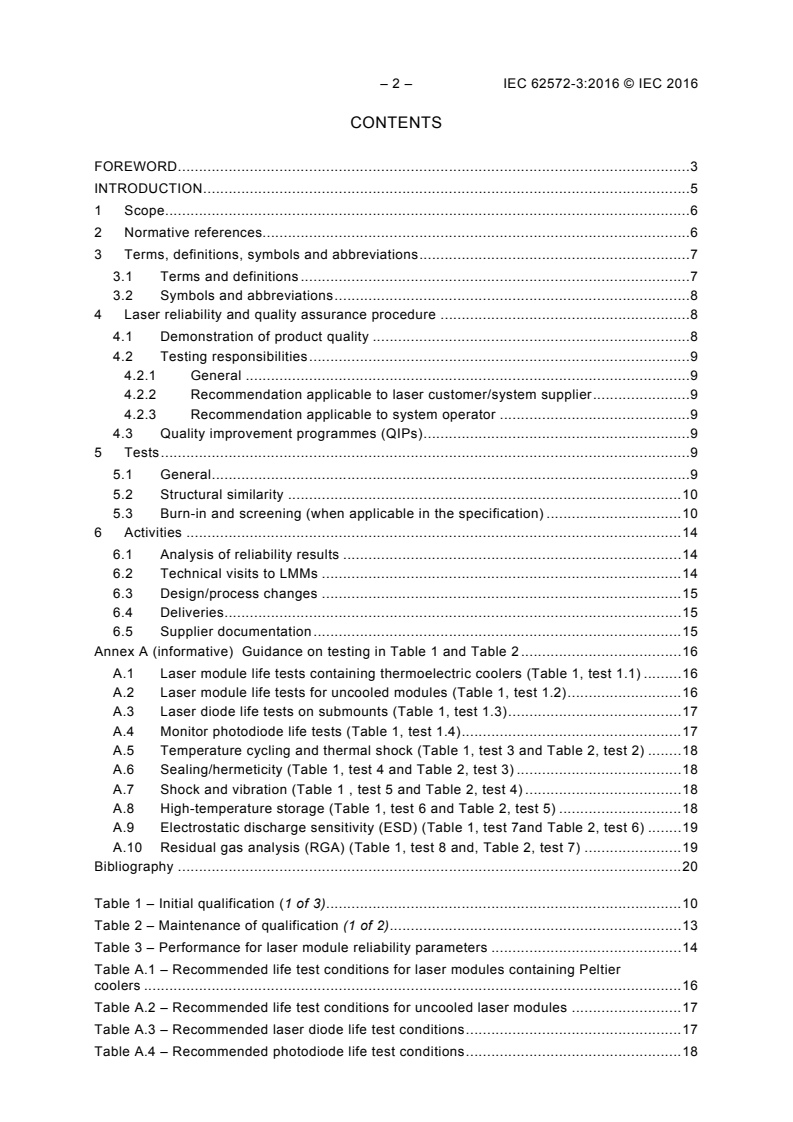
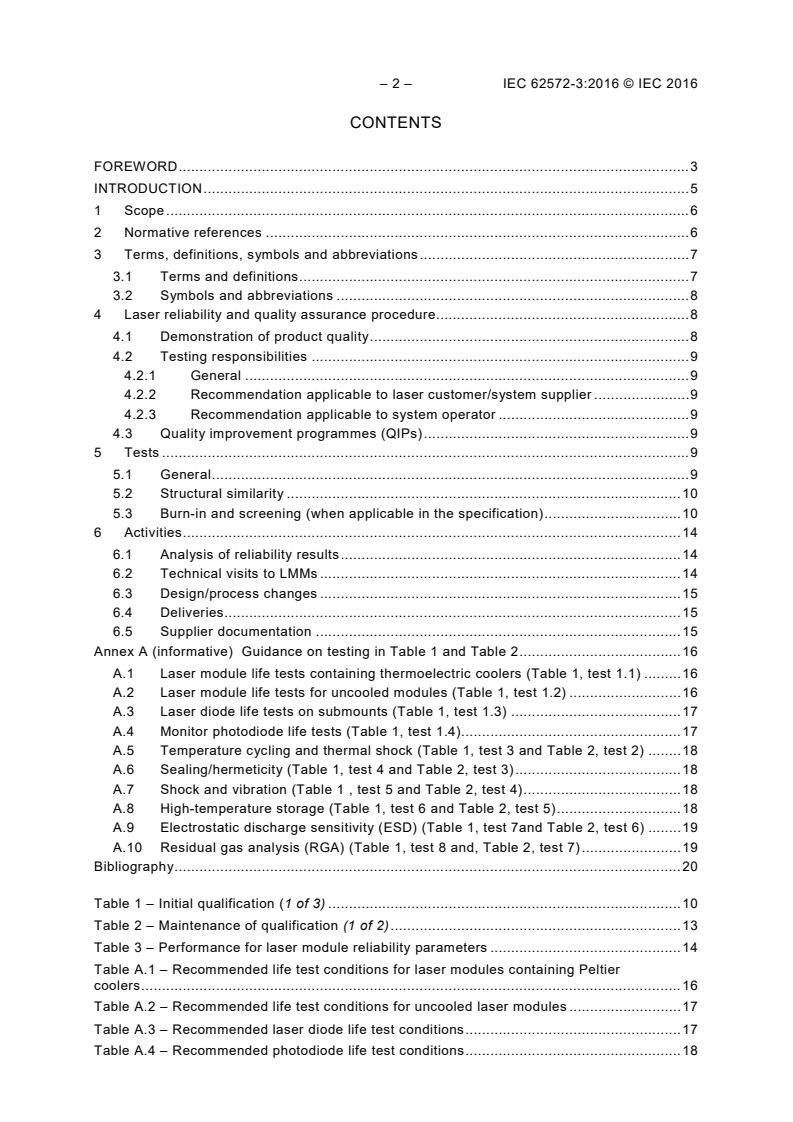
CONTENTS
FOREWORD . 3
INTRODUCTION . 5
1 Scope . 6
2 Normative references. 6
3 Terms, definitions, symbols and abbreviations . 7
3.1 Terms and definitions . 7
3.2 Symbols and abbreviations . 8
4 Laser reliability and quality assurance procedure . 8
4.1 Demonstration of product quality . 8
4.2 Testing responsibilities . 9
4.2.1 General . 9
4.2.2 Recommendation applicable to laser customer/system supplier . 9
4.2.3 Recommendation applicable to system operator . 9
4.3 Quality improvement programmes (QIPs) . 9
5 Tests . 9
5.1 General . 9
5.2 Structural similarity . 10
5.3 Burn-in and screening (when applicable in the specification) . 10
6 Activities . 14
6.1 Analysis of reliability results . 14
6.2 Technical visits to LMMs . 14
6.3 Design/process changes . 15
6.4 Deliveries . 15
6.5 Supplier documentation . 15
Annex A (informative) Guidance on testing in Table 1 and Table 2 . 16
A.1 Laser module life tests containing thermoelectric coolers (Table 1, test 1.1) . 16
A.2 Laser module life tests for uncooled modules (Table 1, test 1.2) . 16
A.3 Laser diode life tests on submounts (Table 1, test 1.3) . 17
A.4 Monitor photodiode life tests (Table 1, test 1.4) . 17
A.5 Temperature cycling and thermal shock (Table 1, test 3 and Table 2, test 2) . 18
A.6 Sealing/hermeticity (Table 1, test 4 and Table 2, test 3) . 18
A.7 Shock and vibration (Table 1 , test 5 and Table 2, test 4) . 18
A.8 High-temperature storage (Table 1, test 6 and Table 2, test 5) . 18
A.9 Electrostatic discharge sensitivity (ESD) (Table 1, test 7and Table 2, test 6) . 19
A.10 Residual gas analysis (RGA) (Table 1, test 8 and, Table 2, test 7) . 19
Bibliography . 20
Table 1 – Initial qualification (1 of 3) . 10
Table 2 – Maintenance of qualification (1 of 2) . 13
Table 3 – Performance for laser module reliability parameters . 14
Table A.1 – Recommended life test conditions for laser modules containing Peltier
coolers . 16
Table A.2 – Recommended life test conditions for uncooled laser modules . 17
Table A.3 – Recommended laser diode life test conditions . 17
Table A.4 – Recommended photodiode life test conditions . 18
INTERNATIONAL ELECTROTECHNICAL COMMISSION
____________
FIBRE OPTIC ACTIVE COMPONENTS AND DEVICES –
RELIABILITY STANDARDS –
Part 3: Laser modules used for telecommunication
FOREWORD
1) The International Electrotechnical Commission (IEC) is a worldwide organization for standardization comprising
all national electrotechnical committees (IEC National Committees). The object of IEC is to promote
international co-operation on all questions concerning standardization in the electrical and electronic fields. To
this end and in addition to other activities, IEC publishes International Standards, Technical Specifications,
Technical Reports, Publicly Available Specifications (PAS) and Guides (hereafter referred to as
“IEC Publication(s)”). Their preparation is entrusted to technical committees; any IEC National Committee
interested in the subject dealt with may participate in this preparatory work. International, governmental and
non-governmental organizations liaising with the IEC also participate in this preparation. IEC collaborates
closely with the International Organization for Standardization (ISO) in accordance with conditions determined
by agreement between the two organizations.
2) The formal decisions or agreements of IEC on technical matters express, as nearly as possible, an international
consensus of opinion on the relevant subjects since each technical committee has representation from all
interested IEC National Committees.
3) IEC Publications have the form of recommendations for international use and are accepted by IEC National
Committees in that sense. While all reasonable efforts are made to ensure that the technical content of
IEC Publications is accurate, IEC cannot be held responsible for the way in which they are used or for any
misinterpretation by any end user.
4) In order to promote international uniformity, IEC National Committees undertake to apply IEC Publications
transparently to the maximum extent possible in their national and regional publications. Any divergence
between any IEC Publication and the corresponding national or regional publication shall be clearly indicated in
the latter.
5) IEC itself does not provide any attestation of conformity. Independent certification bodies provide conformity
assessment services and, in some areas, access to IEC marks of conformity. IEC is not responsible for any
services carried out by independent certification bodies.
6) All users should ensure that they have the latest edition of this publication.
7) No liability shall attach to IEC or its directors, employees, servants or agents including individual experts and
members of its technical committees and IEC National Committees for any personal injury, property damage or
other damage of any nature whatsoever, whether direct or indirect, or for costs (including legal fees) and
expenses arising out of the publication, use of, or reliance upon, this IEC Publication or any other
IEC Publications.
8) Attention is drawn to the Normative references cited in this publication. Use of the referenced publications is
indispensable for the correct application of this publication.
9) Attention is drawn to the possibility that some of the elements of this IEC Publication may be the subject of
patent rights. IEC shall not be held responsible for identifying any or all such patent rights.
International Standard IEC 62572-3 has been prepared by subcommittee 86C: Fibre optic
systems and active devices of IEC technical committee 86: Fibre optics.
This third edition cancels and replaces the second edition published in 2014. This third edition
constitutes a technical revision in which errors in Table 1 and Table 2 have been corrected.
The text of this standard is based on the following documents:
CDV Report on voting
86C/1302/CDV 86C/1345/RVC
Full information on the voting for the approval of this standard can be found in the report on
voting indicated in the above table.
– 4 – IEC 62572-3:2016 © IEC 2016
This publication has been drafted in accordance with the ISO/IEC Directives, Part 2.
A list of all parts in the IEC 62572 series, published under the general title Fibre optic active
components and devices – Reliability standards, can be found on the IEC website.
The committee has decided that the contents of this publication will remain unchanged until
the stability date indicated on the IEC website under "http://webstore.iec.ch" in the data
related to the specific publication. At this date, the publication will be
• reconfirmed,
• withdrawn,
• replaced by a revised edition, or
• amended.
A bilingual version of this publication may be issued at a later date.
INTRODUCTION
The laser modules covered by this International Standard are purchased by system suppliers
(SS) to be inserted in equipment, which in turn are supplied/sold to a system operator (SO) or
a network operator (see definitions in Clause 3).
For the system operator to act as an informed buyer, he/she should have knowledge of the
potential risks posed by the use of critical components.
Optoelectronic component technology is continuing to develop. Consequently, during product
development phases, many failure mechanisms in laser modules have been identified. These
failure mechanisms, if undetected, could result in very short laser lifetime in system use.
– 6 – IEC 62572-3:2016 © IEC 2016
FIBRE OPTIC ACTIVE COMPONENTS AND DEVICES –
RELIABILITY STANDARDS –
Part 3: Laser modules used for telecommunication
1 Scope
This part of IEC 62572 deals with reliability assessment of laser modules used for
telecommunication.
The aim of this standard is
– to establish a standard method of assessing the reliability of laser modules in order to
minimize risks and to promote product development and reliability;
– to establish means by which the distribution of failures with time can be determined. This
should enable the determination of equipment failure rates for specified end of life criteria.
In addition, guidance is given in IEC TR 62572-2.
2 Normative references
The following documents, in whole or in part, are normatively referenced in this document and
are indispensable for its application. For dated references, only the edition cited applies. For
undated references, the latest edition of the referenced document (including any
amendments) applies.
IEC 60068-2-1, Environmental testing – Part 2-1: Tests – Test A: Cold
IEC 60068-2-14, Environmental testing – Part 2-14: Tests – Test N: Change of temperature
IEC 60749-6, Semiconductor devices – Mechanical and climatic test methods – Part 6:
Storage at high temperature
IEC 60749-8, Semiconductor devices – Mechanical and climatic test methods – Part 8:
Sealing
IEC 60749-10, Semiconductor devices – Mechanical and climatic test methods – Part 10:
Mechanical shock
IEC 60749-11, Semiconductor devices – Mechanical and climatic test methods – Part 11:
Rapid change of temperature – Two-fluid-bath method
IEC 60749-12, Semiconductor devices – Mechanical and climatic test methods – Part 12:
Vibration, variable frequency
IEC 60749-25, Semiconductor devices – Mechanical and climatic test methods – Part 25:
Temperature cycling
IEC 60749-26, Semiconductor devices – Mechanical and climatic test methods – Part 26:
Electrostatic discharge (ESD) sensitivity testing – Human body model (HBM)
IEC TR 62572-2, Fibre optic active components and devices – Reliability standards – Part 2:
Laser module degradation
MIL-STD-883, Test method standard – Microcircuits
3 Terms, definitions, symbols and abbreviations
3.1 Terms and definitions
For the purposes of this document the following definitions apply.
3.1.1
laser module
packaged assembly containing a laser diode with/without photodiode
Note 1 to entry: The module may also include a cooler and temperature sensor to enable laser temperature to be
controlled and monitored. The optical output is normally via an optical fibre pigtail.
3.1.2
submount
substrate upon which a laser diode or photodiode may be mounted for assembly into the laser
module
Note 1 to entry: Components on submounts are also subject to qualification testing.
3.1.3
laser module manufacturer
LMM
manufacturer of laser modules who provides devices meeting the requirements of the relevant
detail specification (DS) and the customer’s reliability requirements
3.1.4
network operator
NO
organization which operates a telecommunications network
3.1.5
system supplier
SS
manufacturer of telecommunications/data transmission equipment containing optoelectronic
semiconductor lasers
Note 1 to entry: The system supplier can be a laser module customer.
3.1.6
system operator
SO
network operator of telecommunications/data transmission equipment containing opto-
electronic semiconductor lasers in the transmission path
Note 1 to entry: The system may also be part of other more extensive systems, for example telecommunications,
rail, road vehicles, aerospace or weapons.
3.1.7
capability qualifying components
CQC
components selected to represent critical stages of the process and limiting or boundary
characteristics of mechanical and electro-optic design
– 8 – IEC 62572-3:2016 © IEC 2016
Note 1 to entry: Such components should aid the identification of end product failure mechanisms to enable the
determination of activation energies.
3.2 Symbols and abbreviations
T minimum storage temperature
A
T maximum storage temperature
B
T module case temperature
c
T submount temperature
s
T recommended submount temperature
s nom
T module minimum operating temperature
op min
T module maximum operating temperature
op max
T module minimum storage temperature
stg min
T module maximum storage temperature
stg max
Qc test for gross leak detection
Qk test for fine leak detection
p periodicity (in months)
n sample size
CA capability approval
CQC capability qualifying components
DS detail specification
LMM laser module manufacturer
ML median life
NO network operator
QA quality approval
QIP quality improvement programmes
RGA residual gas analysis
SO system operator
SS system supplier
4 Laser reliability and quality assurance procedure
4.1 Demonstration of product quality
This standard (where required by the specification) gives the minimum mandatory
requirements and is part of a total laser reliability and quality assurance procedure adopted
by the laser module manufacturer.
It also provides guidance on the activities of system suppliers and system operators and
provides feedback on field performance to laser module manufacturers and system suppliers.
The laser module manufacturer shall be capable of demonstrating, by means of qualification
approval of devices, technology approval or capability approval of the manufacturing process,
the following:
a) a documented and audited manufacturing process including the qualification of purchased
components in accordance with an internationally recognized quality management system;
b) a performance qualification programme, including for example, accelerated life testing,
burn-in and screening of components and modules;
c) a qualification maintenance programme to ensure continuity of reliability performance;
d) a procedure to provide feedback on reliability issues to development and production.
4.2 Testing responsibilities
4.2.1 General
The testing detailed in Table 1 and Table 2 is to be performed by the laser module
manufacturer and component suppliers (where applicable). Additional testing may be
specified in the specification.
4.2.2 Recommendation applicable to laser customer/system supplier
The system supplier is recommended to have a programme to analyse and verify the results
including failure analysis. This programme includes an independent life test of fully packaged
laser modules (see Table 2, test 1 and/or test 2 and 3 and/or test 5 (sample size >10 per
test)).
4.2.3 Recommendation applicable to system operator
The system operator is recommended to have a programme to monitor and report field failure
rates in sufficient detail to enable the system supplier and laser module manufacturer to
initiate any necessary corrective actions at an early stage in the lifetime of a product.
Suppliers may have different approaches (i.e. to reliability concepts) during the development
of product maturity, and resource limitations may dictate testing strategies.
Alternative tests and activities to those specified are permitted, provided the LMM/SS/SO can
show intent to remove end-product failures and the associated failure mechanisms. However,
this will require significant data to substantiate compliance.
4.3 Quality improvement programmes (QIPs)
Quality improvement programmes (QIPs) shall be initiated with component suppliers and
customers (SOs, SSs and LMMs) to address non-compliances (including quality and reliability
problems identified during subsequent service life of the laser). The correction of non-
compliances and subsequent QIPs are a required strategy to minimize reliability risks. The
operation of QIPs should be stated in the quality approval (QA) generic and capability
approval documents.
5 Tests
5.1 General
The tests described in Table 1 and Table 2 are designed to accelerate the main failure
mechanisms known to be reliability hazards in laser modules and shall follow the guidance
from IEC TR 62572-2. Where appropriate, the CQC shall demonstrate an ability to reduce end
product failure mechanisms. Final product validation is required to demonstrate that CQCs are
operating at the boundaries of the process or technology. These tests will reduce the risk of
unreliable component
...
IEC 62572-3 ®
Edition 3.0 2016-02
INTERNATIONAL
STANDARD
NORME
INTERNATIONALE
Fibre optic active components and devices – Reliability standards –
Part 3: Laser modules used for telecommunication
Composants et dispositifs actifs en fibres optiques – Normes de fiabilite –
Partie 3: Modules laser utilisés pour les télécommunications
All rights reserved. Unless otherwise specified, no part of this publication may be reproduced or utilized in any form
or by any means, electronic or mechanical, including photocopying and microfilm, without permission in writing from
either IEC or IEC's member National Committee in the country of the requester. If you have any questions about IEC
copyright or have an enquiry about obtaining additional rights to this publication, please contact the address below or
your local IEC member National Committee for further information.
Droits de reproduction réservés. Sauf indication contraire, aucune partie de cette publication ne peut être reproduite
ni utilisée sous quelque forme que ce soit et par aucun procédé, électronique ou mécanique, y compris la photocopie
et les microfilms, sans l'accord écrit de l'IEC ou du Comité national de l'IEC du pays du demandeur. Si vous avez des
questions sur le copyright de l'IEC ou si vous désirez obtenir des droits supplémentaires sur cette publication, utilisez
les coordonnées ci-après ou contactez le Comité national de l'IEC de votre pays de résidence.
IEC Central Office Tel.: +41 22 919 02 11
3, rue de Varembé Fax: +41 22 919 03 00
CH-1211 Geneva 20 info@iec.ch
Switzerland www.iec.ch
About the IEC
The International Electrotechnical Commission (IEC) is the leading global organization that prepares and publishes
International Standards for all electrical, electronic and related technologies.
About IEC publications
The technical content of IEC publications is kept under constant review by the IEC. Please make sure that you have the
latest edition, a corrigenda or an amendment might have been published.
IEC Catalogue - webstore.iec.ch/catalogue Electropedia - www.electropedia.org
The stand-alone application for consulting the entire The world's leading online dictionary of electronic and
bibliographical information on IEC International Standards, electrical terms containing 20 000 terms and definitions in
Technical Specifications, Technical Reports and other English and French, with equivalent terms in 16 additional
documents. Available for PC, Mac OS, Android Tablets and languages. Also known as the International Electrotechnical
iPad. Vocabulary (IEV) online.
IEC publications search - www.iec.ch/searchpub IEC Glossary - std.iec.ch/glossary
The advanced search enables to find IEC publications by a 65 000 electrotechnical terminology entries in English and
variety of criteria (reference number, text, technical French extracted from the Terms and Definitions clause of
committee,…). It also gives information on projects, replaced IEC publications issued since 2002. Some entries have been
and withdrawn publications. collected from earlier publications of IEC TC 37, 77, 86 and
CISPR.
IEC Just Published - webstore.iec.ch/justpublished
Stay up to date on all new IEC publications. Just Published IEC Customer Service Centre - webstore.iec.ch/csc
details all new publications released. Available online and If you wish to give us your feedback on this publication or
also once a month by email. need further assistance, please contact the Customer Service
Centre: csc@iec.ch.
A propos de l'IEC
La Commission Electrotechnique Internationale (IEC) est la première organisation mondiale qui élabore et publie des
Normes internationales pour tout ce qui a trait à l'électricité, à l'électronique et aux technologies apparentées.
A propos des publications IEC
Le contenu technique des publications IEC est constamment revu. Veuillez vous assurer que vous possédez l’édition la
plus récente, un corrigendum ou amendement peut avoir été publié.
Catalogue IEC - webstore.iec.ch/catalogue Electropedia - www.electropedia.org
Application autonome pour consulter tous les renseignements
Le premier dictionnaire en ligne de termes électroniques et
bibliographiques sur les Normes internationales,
électriques. Il contient 20 000 termes et définitions en anglais
Spécifications techniques, Rapports techniques et autres
et en français, ainsi que les termes équivalents dans 16
documents de l'IEC. Disponible pour PC, Mac OS, tablettes
langues additionnelles. Egalement appelé Vocabulaire
Android et iPad.
Electrotechnique International (IEV) en ligne.
Recherche de publications IEC - www.iec.ch/searchpub
Glossaire IEC - std.iec.ch/glossary
65 000 entrées terminologiques électrotechniques, en anglais
La recherche avancée permet de trouver des publications IEC
en utilisant différents critères (numéro de référence, texte, et en français, extraites des articles Termes et Définitions des
comité d’études,…). Elle donne aussi des informations sur les publications IEC parues depuis 2002. Plus certaines entrées
projets et les publications remplacées ou retirées. antérieures extraites des publications des CE 37, 77, 86 et
CISPR de l'IEC.
IEC Just Published - webstore.iec.ch/justpublished
Service Clients - webstore.iec.ch/csc
Restez informé sur les nouvelles publications IEC. Just
Published détaille les nouvelles publications parues. Si vous désirez nous donner des commentaires sur cette
Disponible en ligne et aussi une fois par mois par email. publication ou si vous avez des questions contactez-nous:
csc@iec.ch.
IEC 62572-3 ®
Edition 3.0 2016-02
INTERNATIONAL
STANDARD
NORME
INTERNATIONALE
Fibre optic active components and devices – Reliability standards –
Part 3: Laser modules used for telecommunication
Composants et dispositifs actifs en fibres optiques – Normes de fiabilite –
Partie 3: Modules laser utilisés pour les télécommunications
INTERNATIONAL
ELECTROTECHNICAL
COMMISSION
COMMISSION
ELECTROTECHNIQUE
INTERNATIONALE
ICS 31.260; 33.180.99 ISBN 978-2-8322-4711-2
– 2 – IEC 62572-3:2016 © IEC 2016
CONTENTS
FOREWORD . 3
INTRODUCTION . 5
1 Scope . 6
2 Normative references . 6
3 Terms, definitions, symbols and abbreviations . 7
3.1 Terms and definitions . 7
3.2 Symbols and abbreviations . 8
4 Laser reliability and quality assurance procedure. 8
4.1 Demonstration of product quality . 8
4.2 Testing responsibilities . 9
4.2.1 General . 9
4.2.2 Recommendation applicable to laser customer/system supplier . 9
4.2.3 Recommendation applicable to system operator . 9
4.3 Quality improvement programmes (QIPs) . 9
5 Tests . 9
5.1 General . 9
5.2 Structural similarity . 10
5.3 Burn-in and screening (when applicable in the specification) . 10
6 Activities . 14
6.1 Analysis of reliability results . 14
6.2 Technical visits to LMMs . 14
6.3 Design/process changes . 15
6.4 Deliveries . 15
6.5 Supplier documentation . 15
Annex A (informative) Guidance on testing in Table 1 and Table 2 . 16
A.1 Laser module life tests containing thermoelectric coolers (Table 1, test 1.1) . 16
A.2 Laser module life tests for uncooled modules (Table 1, test 1.2) . 16
A.3 Laser diode life tests on submounts (Table 1, test 1.3) . 17
A.4 Monitor photodiode life tests (Table 1, test 1.4). 17
A.5 Temperature cycling and thermal shock (Table 1, test 3 and Table 2, test 2) . 18
A.6 Sealing/hermeticity (Table 1, test 4 and Table 2, test 3) . 18
A.7 Shock and vibration (Table 1 , test 5 and Table 2, test 4) . 18
A.8 High-temperature storage (Table 1, test 6 and Table 2, test 5) . 18
A.9 Electrostatic discharge sensitivity (ESD) (Table 1, test 7and Table 2, test 6) . 19
A.10 Residual gas analysis (RGA) (Table 1, test 8 and, Table 2, test 7) . 19
Bibliography . 20
Table 1 – Initial qualification (1 of 3) . 10
Table 2 – Maintenance of qualification (1 of 2) . 13
Table 3 – Performance for laser module reliability parameters . 14
Table A.1 – Recommended life test conditions for laser modules containing Peltier
coolers . 16
Table A.2 – Recommended life test conditions for uncooled laser modules . 17
Table A.3 – Recommended laser diode life test conditions . 17
Table A.4 – Recommended photodiode life test conditions . 18
INTERNATIONAL ELECTROTECHNICAL COMMISSION
____________
FIBRE OPTIC ACTIVE COMPONENTS AND DEVICES –
RELIABILITY STANDARDS –
Part 3: Laser modules used for telecommunication
FOREWORD
1) The International Electrotechnical Commission (IEC) is a worldwide organization for standardization comprising
all national electrotechnical committees (IEC National Committees). The object of IEC is to promote
international co-operation on all questions concerning standardization in the electrical and electronic fields. To
this end and in addition to other activities, IEC publishes International Standards, Technical Specifications,
Technical Reports, Publicly Available Specifications (PAS) and Guides (hereafter referred to as
“IEC Publication(s)”). Their preparation is entrusted to technical committees; any IEC National Committee
interested in the subject dealt with may participate in this preparatory work. International, governmental and
non-governmental organizations liaising with the IEC also participate in this preparation. IEC collaborates
closely with the International Organization for Standardization (ISO) in accordance with conditions determined
by agreement between the two organizations.
2) The formal decisions or agreements of IEC on technical matters express, as nearly as possible, an international
consensus of opinion on the relevant subjects since each technical committee has representation from all
interested IEC National Committees.
3) IEC Publications have the form of recommendations for international use and are accepted by IEC National
Committees in that sense. While all reasonable efforts are made to ensure that the technical content of
IEC Publications is accurate, IEC cannot be held responsible for the way in which they are used or for any
misinterpretation by any end user.
4) In order to promote international uniformity, IEC National Committees undertake to apply IEC Publications
transparently to the maximum extent possible in their national and regional publications. Any divergence
between any IEC Publication and the corresponding national or regional publication shall be clearly indicated in
the latter.
5) IEC itself does not provide any attestation of conformity. Independent certification bodies provide conformity
assessment services and, in some areas, access to IEC marks of conformity. IEC is not responsible for any
services carried out by independent certification bodies.
6) All users should ensure that they have the latest edition of this publication.
7) No liability shall attach to IEC or its directors, employees, servants or agents including individual experts and
members of its technical committees and IEC National Committees for any personal injury, property damage or
other damage of any nature whatsoever, whether direct or indirect, or for costs (including legal fees) and
expenses arising out of the publication, use of, or reliance upon, this IEC Publication or any other
IEC Publications.
8) Attention is drawn to the Normative references cited in this publication. Use of the referenced publications is
indispensable for the correct application of this publication.
9) Attention is drawn to the possibility that some of the elements of this IEC Publication may be the subject of
patent rights. IEC shall not be held responsible for identifying any or all such patent rights.
International Standard IEC 62572-3 has been prepared by subcommittee 86C: Fibre optic
systems and active devices of IEC technical committee 86: Fibre optics.
This third edition cancels and replaces the second edition published in 2014. This third edition
constitutes a technical revision in which errors in Table 1 and Table 2 have been corrected.
This bilingual version (2017-08) corresponds to the monolingual English version, published in
2016-02.
– 4 – IEC 62572-3:2016 © IEC 2016
The text of this standard is based on the following documents:
CDV Report on voting
86C/1302/CDV 86C/1345/RVC
Full information on the voting for the approval of this standard can be found in the report on
voting indicated in the above table.
The French version of this standard has not been voted upon.
This publication has been drafted in accordance with the ISO/IEC Directives, Part 2.
A list of all parts in the IEC 62572 series, published under the general title Fibre optic active
components and devices – Reliability standards, can be found on the IEC website.
The committee has decided that the contents of this publication will remain unchanged until
the stability date indicated on the IEC website under "http://webstore.iec.ch" in the data
related to the specific publication. At this date, the publication will be
• reconfirmed,
• withdrawn,
• replaced by a revised edition, or
• amended.
INTRODUCTION
The laser modules covered by this International Standard are purchased by system suppliers
(SS) to be inserted in equipment, which in turn are supplied/sold to a system operator (SO) or
a network operator (see definitions in Clause 3).
For the system operator to act as an informed buyer, he/she should have knowledge of the
potential risks posed by the use of critical components.
Optoelectronic component technology is continuing to develop. Consequently, during product
development phases, many failure mechanisms in laser modules have been identified. These
failure mechanisms, if undetected, could result in very short laser lifetime in system use.
– 6 – IEC 62572-3:2016 © IEC 2016
FIBRE OPTIC ACTIVE COMPONENTS AND DEVICES –
RELIABILITY STANDARDS –
Part 3: Laser modules used for telecommunication
1 Scope
This part of IEC 62572 deals with reliability assessment of laser modules used for
telecommunication.
The aim of this standard is
– to establish a standard method of assessing the reliability of laser modules in order to
minimize risks and to promote product development and reliability;
– to establish means by which the distribution of failures with time can be determined. This
should enable the determination of equipment failure rates for specified end of life criteria.
In addition, guidance is given in IEC TR 62572-2.
2 Normative references
The following documents, in whole or in part, are normatively referenced in this document and
are indispensable for its application. For dated references, only the edition cited applies. For
undated references, the latest edition of the referenced document (including any
amendments) applies.
IEC 60068-2-1, Environmental testing – Part 2-1: Tests – Test A: Cold
IEC 60068-2-14, Environmental testing – Part 2-14: Tests – Test N: Change of temperature
IEC 60749-6, Semiconductor devices – Mechanical and climatic test methods – Part 6:
Storage at high temperature
IEC 60749-8, Semiconductor devices – Mechanical and climatic test methods – Part 8:
Sealing
IEC 60749-10, Semiconductor devices – Mechanical and climatic test methods – Part 10:
Mechanical shock
IEC 60749-11, Semiconductor devices – Mechanical and climatic test methods – Part 11:
Rapid change of temperature – Two-fluid-bath method
IEC 60749-12, Semiconductor devices – Mechanical and climatic test methods – Part 12:
Vibration, variable frequency
IEC 60749-25, Semiconductor devices – Mechanical and climatic test methods – Part 25:
Temperature cycling
IEC 60749-26, Semiconductor devices – Mechanical and climatic test methods – Part 26:
Electrostatic discharge (ESD) sensitivity testing – Human body model (HBM)
IEC TR 62572-2, Fibre optic active components and devices – Reliability standards – Part 2:
Laser module degradation
MIL-STD-883, Test method standard – Microcircuits
3 Terms, definitions, symbols and abbreviations
3.1 Terms and definitions
For the purposes of this document the following definitions apply.
3.1.1
laser module
packaged assembly containing a laser diode with/without photodiode
Note 1 to entry: The module may also include a cooler and temperature sensor to enable laser temperature to be
controlled and monitored. The optical output is normally via an optical fibre pigtail.
3.1.2
submount
substrate upon which a laser diode or photodiode may be mounted for assembly into the laser
module
Note 1 to entry: Components on submounts are also subject to qualification testing.
3.1.3
laser module manufacturer
LMM
manufacturer of laser modules who provides devices meeting the requirements of the relevant
detail specification (DS) and the customer’s reliability requirements
3.1.4
network operator
NO
organization which operates a telecommunications network
3.1.5
system supplier
SS
manufacturer of telecommunications/data transmission equipment containing optoelectronic
semiconductor lasers
Note 1 to entry: The system supplier can be a laser module customer.
3.1.6
system operator
SO
network operator of telecommunications/data transmission equipment containing opto-
electronic semiconductor lasers in the transmission path
Note 1 to entry: The system may also be part of other more extensive systems, for example telecommunications,
rail, road vehicles, aerospace or weapons.
3.1.7
capability qualifying components
CQC
components selected to represent critical stages of the process and limiting or boundary
characteristics of mechanical and electro-optic design
– 8 – IEC 62572-3:2016 © IEC 2016
Note 1 to entry: Such components should aid the identification of end product failure mechanisms to enable the
determination of activation energies.
3.2 Symbols and abbreviations
T minimum storage temperature
A
T maximum storage temperature
B
T module case temperature
c
T submount temperature
s
T recommended submount temperature
s nom
T module minimum operating temperature
op min
T module maximum operating temperature
op max
T module minimum storage temperature
stg min
T module maximum storage temperature
stg max
Qc test for gross leak detection
Qk test for fine leak detection
p periodicity (in months)
n sample size
CA capability approval
CQC capability qualifying components
DS detail specification
LMM laser module manufacturer
ML median life
NO network operator
QA quality approval
QIP quality improvement programmes
RGA residual gas analysis
SO system operator
SS system supplier
4 Laser reliability and quality assurance procedure
4.1 Demonstration of product quality
This standard (where required by the specification) gives the minimum mandatory
requirements and is part of a total laser reliability and quality assurance procedure adopted
by the laser module manufacturer.
It also provides guidance on the activities of system suppliers and system operators and
provides feedback on field performance to laser module manufacturers and system suppliers.
The laser module manufacturer shall be capable of demonstrating, by means of qualification
approval of devices, technology approval or capability approval of the manufacturing process,
the following:
a) a documented and audited manufacturing process including the qualification of purchased
components in accordance with an internationally recognized quality management system;
b) a performance qualification programme, including for example, accelerated life testing,
burn-in and screening of components and modules;
c) a qualification maintenance programme to ensure continuity of reliability performance;
d) a procedure to provide feedback on reliability issues to development and production.
4.2 Testing responsibilities
4.2.1 General
The testing detailed in Table 1 and Table 2 is to be performed by the laser module
manufacturer and component suppliers (where applicable). Additional testing may be
specified in the specification.
4.2.2 Recommendation applicable to laser customer/system supplier
The system supplier is recommended to have a programme to analyse and verify the results
including failure analysis. This programme includes an independent life test of fully packaged
laser modules (see Table 2, test 1 and/or test 2 and 3 and/or test 5 (sample size >10 per
test)).
4.2.3 Recommendation applicable to system operator
The system operator is recommended to have a programme to monitor and report field failure
rates in sufficient detail to enable the system supplier and laser module manufacturer to
initiate any necessary corrective actions at an early stage in the lifetime of a product.
Suppliers may have different approaches (i.e. to reliability concepts) during the development
of product maturity, and resource limitations may dictate testing strategies.
Alternative tests and activities to those specified are permitted, provided the LMM/SS/SO can
show intent to remove end-product failures and the associated failure mechanisms. However,
this will require significant data to substantiate compliance.
4.3 Quality improvement programmes (QIPs)
Quality improvement programmes (QIPs) shall be initiated with component suppliers and
customers (SOs, SSs and LMMs) to address non-compliances (including quality and reliability
problems identified during subsequent service life of the laser). The correction of non-
compliances and subsequent QIPs are a required strategy to minimize reliability risks. The
operation of QIPs should be stated in the quality approval (QA) generic and capability
approval documents.
5 Tests
5.1 General
The tests described in Table 1 and Table 2 are designed to accelerate the main failure
mechanisms known to be reliability hazards in laser modules and shall follow the guidance
from IEC TR 62572-2. Where appropriate, the CQC shall demonstrate an ability to reduce end
product failure mechanisms. Final product validation is required to demonstrate that CQCs are
operating at the boundaries of the process or technology. These tests will reduce the risk of
unreliable components entering system use and will enable estimates to be made of the
distribution of laser lifetimes and hence the laser failure rates.
The sample size and level of testing may vary depending on the business volume between the
laser customer/system supplier (SS) and laser module manufacturer (LMM). This information
will be given in the capability approval (CA) document and the specification where appropriate.
It is essential that the lasers evaluated are entirely representative of standard production
devices and have passed all the production and/or specified (where applicable in the
specification) burn-in and screening procedures.
– 10 – IEC 62572-3:2016 © IEC 2016
Table 1 – Initial qualification
These tests will normally be performed by the laser manufacturer as part of an initial
qualification programme.
Table 2 – Maintenance of qualification
These tests cover periodic monitoring performed on production devices to ensure that the
quality and reliability performance established during initial qualification is maintained or
improved.
5.2 Structural similarity
Where a range of laser modules is produced by a laser manufacturer, there may be some
significant structural similarity between different type codes. A combination of results from
different test programmes, where appropriate, is therefore permitted.
Consideration should be given to the fact that minor differences in technology or processing
can have a major impact on reliability, whilst not being apparent during quality assessment.
Evidence shall be presented which demonstrates that all results are directly relevant.
5.3 Burn-in and screening (when applicable in the specification)
NOTE See IEC TR 62572-2.
The screening test should be designed by the laser module manufacturer specifically for his
particular technology. Any approach based on similarity to that which is performed by other
manufacturers is good for comparison purposes, but can be ineffective in achieving the actual
screening goal. This is particularly true for fibre optic components whose technology is not yet
mature and varies significantly from supplier to supplier.
Where a manufacturer can demonstrate component and process stability, screening
procedures may be revised.
Table 1 – Initial qualification (1 of 3)
Test
Test References Conditions n
no.
1 Initial endurance test
1.1 a) Module with 25
Φ specified, constant power
e
thermoelectric cooler
Temperature: T = T
c op max
T = T
s s nom
a
Duration: 5 000 h
1.2 b) Module without 25
Φ specified, constant power
e
thermoelectric cooler
Temperature: T = T
c op max
a
Duration: 5 000 h
1.3 Laser diode (submount) Temperature: at least two
test temperatures:
Φ specified, constant power
e
T = T See footnote
max
s1 s
d
See footnote
T ≤ (T –20) °C or
s2 s1
d
T ≤ (T –10) °C if applicable
s2 s1
Duration: > 5 000 h
Table 1 (2 of 3)
Test
Test References Conditions n
no.
1.4 Photodiode Temperature: at least two
(in representative test temperatures:
package)
V or l specified
r r
b
T = 125 °C min See
s1
d
footnote
See
T ≤ (T – 30 °C)
s2 s1
d
footnote
Duration: > 1 000 h
T = T of the cooler
1.5 High temperature storage 25
stg max
of the thermoelectric
Duration: 1 000 h
cooler
1.6 Power cycle tests cooled Number of cycles: 20 K 25
devices
T = T
c op max
T = T to (T – ∆T )
s c c max
1.7 High-temperature storage T = T of the sensor 25
stg max
of the thermal sensor
2 Fibre test
d
2.1 Fibre proof test Proof test 10
d
Duration
d
Min. bend radius
2.2 Fibre retention
d
2.2.1 Fibre pull Fibre pull 10
d
2.2.2 Side pull Side pull
c d
3 Change of temperature See footnotes and
3.1 Rapid change of IEC 60749-11 Temperature: 10
temperature
T = T
A stg min
T = T
B stg max
Number of cycles = 50
3.2 Temperature cycling IEC 60749-25 Temperature: 10
IEC 60068-2-14 T = T
A stg min
T = T
B stg max
> 1 °C/min
Number of cycles = 500
d
4 Sealing IEC 60749-8 See footnote 10
Test Qk followed by Test Qc
c d
See footnotes and and Clause A.6
5 Shock and vibration See Clause A.7
5.1 Shock IEC 60749-10 5 000 m/s , 0,5 ms with/without 10
thermoelectric cooler,
15 000 m/s , 0,5 ms without
thermoelectric
cooler (where appropriate)
6-directions, 5 times each
5.2 Vibration IEC 60749-12 20 Hz to 2 000 Hz, 200 m/s , 10
3-directions, 30 min each
– 12 – IEC 62572-3:2016 © IEC 2016
Table 1 (3 of 3)
Test
Test References Conditions n
no.
6 High temperature storage IEC 60749-6 Temperature: T = T 10
stg max
(not applicable if module life
Duration: > 2 000 h
test performed at equivalent
case temperature and
(See IEC TR 62572-2)
submount temperature)
7 ESDS, modules IEC 60749-26 Human body model, see Clause A.9 5 per wafer
a) Lasers 5 discharges/test voltage, charge-
discharge cycle > 0,1 s
b) Photodiodes
d
8 Residual gas analysis MIL-STD-883, See footnote 6
Method 1018
See Clause A.10
T = T
9 Low-temperature storage IEC 60068-2-1 10
stg min
Duration: > 1 000 h
a
Provided data about the distribution of wear-out lifetime is accumulated with sufficient accuracy. Provisional
approval for product shipment shall be granted at 2 000 h. It is also recommended to continue the test until
accurate extrapolation of lifetime is possible with an upper limit of 10 000 h. Durations up to 5 000 h may be
needed for accurate lifetime prediction.
b
Or as limited by technology.
c
Results from tests 1.1 and 1.2 shall be supplemented by a laser customer/SS independent test of fully
packaged modules in accordance with Table 2, test 2 and/or test 3 (sample size ≥ 10 per test). See also 4.2.
d
Number of samples and conditions shall be determined by a laser customer/SS and LMM.
Table 2 – Maintenance of qualification (1 of 2)
Test
Test References Conditions n p
no.
1 Ongoing reliability test Periodic testing: See NOTES 6
a) Module (cooled) Test 1.1 10
b) Module (uncooled) Test 1.2 10
a
c) Laser diode (submount) Test 1.3 25
a
d) Photodiode Test 1.4 25
2 Temperature cycling IEC 60749-25 Temperature: 10 6
T = T
IEC 60068-2-14 A stg min
T = T
B stg max
> 1 °C /min
Periodic testing: number
of cycles = 100 (see
NOTE 1 )
3 Sealing IEC 60749-8 See NOTE 2 10
Test Qk followed by
Test Qc
See NOTES and Clause
A.6
4 Shock and vibration See NOTES and Clause
A.7
4.1 Shock IEC 60749-10 5 000 m/s , 0,5 ms 10
with/without
thermoelectric cooler,
15 000 m/s , 0,5 ms
without thermoelectric
cooler (where
appropriate),
6-direction, 5 times each
4.2 Vibration IEC 60749-12 20 Hz to 2 000 Hz, 200 10
m/s
3-direction, 30 min each
5 High temperature IEC 60749-6 Temperature: 10 12
storage (not applicable if
T = T
stg max
module life test
performed at equivalent
Duration: > 2 000 h
case temperature and
submount temperature)
Periodic testing: see
NOTES (See IEC TR
62572-2)
6 ESDS, modules IEC 60749-26 Periodic testing: see 5 per wafer
Clause A.9
a) Lasers
Human body model
b) Photodiodes
5 discharges/test voltage,
Charge-discharge cycle >
0,1 s
7 Residual gas analysis MIL-STD-883, See NOTE 2 See NOTE 2 6
Method 1018
Periodic testing:
see NOTES and Clause
A.10
NOTE 1 Results of test 2 are supplemented by a laser customer/system supplier (SS) independent test of fully
packaged modules in accordance with Table 2, test 2 and/or test 3 and/or test 5 (sample size ≥ 10 per test). See
also 4.2.
NOTE 2 Number of samples and conditions are determined by a laser customer/SS and LMM.
a
Out of different wafers.
– 14 – IEC 62572-3:2016 © IEC 2016
6 Activities
6.1 Analysis of reliability results
The laser module customer/system supplier (SS) shall have a programme to analyse and
verify a laser manufacturer’s reliability claims. In particular
– life test data for the complete laser module,
– life test data for initial components, for example laser diode and photodiode,
– environmental test result, i.e. inspection requirements group B, C of the detail
specification;
– where appropriate, the data and test results of appropriate CQCs (see Clause 5).
The analysis of results should lead to reporting of the laser module reliability parameters for
each of the laser module types. Minimum reliability parameters are presented in Table 3.
Where data reveals more than one wear-out mechanism, median life and dispersion in each
case shall be stated.
The failure criteria used to derive these reliability parameters shall be agreed between the
laser customer/system supplier (SS) and laser module manufacturer (LMM). The criteria will
be stated in the detail specification (see IEC TR 62572-2).
Table 3 – Performance for laser module reliability parameters
Parameter Measured value
a
Median life (ML) at 25 °C or 55 °C Years
Dispersion(s)
Wear-out failure rate
FITs
at 5 years (λ)
FITs
at 10 years (λ)
FITs
at 20 years (λ)
Wear-out activation energy eV
Random failure rate
b
(λ ) at 25 °C FITs
a
Confidence limits used %
Random failure activation energy eV
Guidance on these activities is given in IEC TR 62572-2.
NOTE This table assumes a log-normal distribution of times to failure. The dispersion parameter is the
standard deviation of the logarithm to the base ‘e’ of the times to failure (see IEC TR 625722-2).
a
Special attention should be paid to all extrapolation models used, and the justification for activation energies
employed in reliability predictions is to be stated.
b
The reference temperature used for all parameters in this table is 25 °C. An alternative reference
temperature (50 °C) may be used provided activation energies are given.
6.2 Technical visits to LMMs
Laser module designs continue to evolve, and an LMM may introduce significant changes
which impinge on reliability. Under the negotiation between customer and manufacturer,
technical visits should be performed until there is sufficient evidence of a maturing technology
and production stability. These technical meetings/visits shall contain an item on the agenda
that concerns quality and reliability. Where an LMM holds a capability approval, the frequency
of these technical visits may be reduced provided the manufacturer can demonstrate
a) that the CQCs fully represent any relevant design, process updates and reliability issues,
b) satisfactory self-audit of the quality system.
6.3 Design/process changes
The customer/system supplier (SS) shall be informed by the laser module manufacturer (LMM)
of any design or process change which may affect the form, fit or function of the end product.
6.4 Deliveries
Laser module designs will continue to evolve and therefore each delivered lot shall be
manufactured according to a stated technology and production process.
This should be verified by the supplier and customer before delivery.
6.5 Supplier documentation
The laser customer/system supplier (SS) and component manufacturer or LMM shall
incorporate, wherever possible, the tests and activities described in this standard into their in-
house component qualification, or where appropriate, capability approval procedures and
purchasing specifications. This documentation will be used in reliability/technical
presentations, tender submissions and marketing briefs to customers.
– 16 – IEC 62572-3:2016 © IEC 2016
Annex A
(informative)
Guidance on testing in Table 1 and Table 2
A.1 Laser module life tests containing thermoelectric coolers (Table 1, test 1.1)
With laser modules containing thermoelectric coolers (for example Peltier), it is difficult to
provide a significant degree of overstress to all key components simultaneously. During
“normal operation”, the laser submount temperature is usually controlled at T = 25 °C.
s
However, for a life test with a case temperature of T = T , a useful stress can be
c op max
obtained for the laser diode, fibre fixing, photodiode and thermal sensor if the cooler is
operated at a relatively high current to maintain a submount temperature of T = T . The
s s nom
conditions in Table A.1 are recommended.
Some additional testing of the cooler is recommended, for example T = T and
c op max
T = T - 10 °C.
s s
Table A.1 – Recommended life test conditions for laser modules
containing Peltier coolers
Case temperature T
op max
Laser submount temperature T = T
s s nom
Optical power Fibre output set to P at start of life test (using monitor circuit)
max
Laser current To maintain constant monitor output
Monitor current Normal bias
Thermal sensor current
Normal bias
Cooler current To maintain constant thermistor resistance (or sensor conditions)
Duration
> 5 000 h
A.2 Laser module life tests for uncooled modules (Table 1, test 1.2)
For modules without thermoelectric coolers (for example Peltier), life tests can be readily
performed over a range of temperatures up to the recommended maximum operating
temperature for the module. During initial qualification, service life tests at two or more
temperatures, for example T = T and T in the range of 40 °C to 50 °C, are
c op max c
recommended. Here, the accuracy of lifetime estimation becomes high in proportion to the
number of test levels.
An additional life test at low temperature (duration > 2 000 h at T ) may be required for
op min
modules containing epoxies or organic materials.
If only a single life test is to be performed, for example during maintenance of qualification
testing, the conditions in Table A.2 are recommended.
Table A.2 – Recommended life test conditions for uncooled laser modules
Case temperature T
op max
Optical power Fibre output set to P at start of life test (using monitor circuit)
max
Laser current To maintain constant monitor photocurrent
Monitor photocurrent Normal bias
Duration > 5 000 h
A.3 Laser diode life tests on submounts (Table 1, test 1.3)
The laser life test shall be performed with the laser operating at constant light output, as it
would be in normal operation, unless otherwise agreed with the user. Temperatures in the
range T = 50 °C to 80 °C are often used. The acceleration in the rate of degradation, relative
s
to normal operation, is therefore relatively small. The maximum temperature at which life tests
can be performed under lasing operating conditions is usually in the range T = 70 °C to
s
100 °C. However, constant current/life tests at temperatures up to T = 150 °C can be useful
s
in studying the reliability of contact metallizations. Actual failures do not often occur in well
screened laser diodes tested at temperatures T < 90 °C. In order to estimate the laser life,
s
some extrapolation is required to predict when the threshold or operating current will exceed
the pre-determined failure criterion. To obtain a reasonable increase in operating current, a
life test duration greater than 5 000 h is required.
If a single life test is to be performed, for example during maintenance of qualification testing,
the conditions in Table A.3 are recommended.
Table A.3 – Recommended laser diode life test conditions
Temperature T = 70 °C
s
Optical power Maximum specified
Bias To maintain constant monitor output
Duration > 5 000 h
A.4 Monitor photodiode life tests (Table 1, test 1.4)
Photodiode life tests are best performed with the devices under reverse bias if the
susceptibility to increased dark current is to be assessed. To obtain failures in a reasonable
timescale, temperatures in the range T = 125 °C to 200 °C are usually required. Devices with
s
organic passivations should be tested at temperatures below the curing temperature of the
passivation.
Increased bias voltage can also be used to accelerate failure, but the dependence of lifetime
on voltage would then need to be determined before a prediction of operating lifetime could
be made.
It is necessary for measurements of photodiode dark currents to include measurement at the
normal operating temperature. Measurements made at only the life test temperature may not
detect increased surface leakage, because bulk dark currents dominate at high temperatures.
Failed photodiodes with increased dark currents (as a result of the accumulation of mobile
charge) will often recover quickly if stored at high temperatures without bias. It is essential,
that at the end of the test duration, the reverse bias conditions are maintained until the
temperature is below 30 °C. The post test measurements shall be completed within 3 h. The
increase in dark current of photodiodes with exposed junctions (for example unpassivated
– 18 – IEC 62572-3:2016 © IEC 2016
mesa devices) is very sensitive to the package atmosphere, and small traces of oxygen or
water vapour can result in decreased lifetimes. Life tests should therefore be performed with
the photodiodes sealed in representative hermetic packages, and not on open submounts.
Tests in flowing (nominally dry) nitrogen can produce variable results. The conditions in
Table A.4 are recommended.
Table A.4 – Recommended photodiode life test conditions
Temperature In the range T = 125 °C to 200 °C
s
Bias Specified maximum reverse bias voltage.
Bias to be maintained during cool down prior to measurements
Duration 1 000 h
Atmosphere Photodiode in representative hermetic package
A.5 Temperature cycling and thermal shock (Table 1, test 3 and Table 2, test 2)
It is difficult to quantify the acceleration (with respect to normal operation) obtained from a
temperature cycling test. Nevertheless, it has been clearly demonstrated that temperature
cycling from T = –40 °C to +70 °C can reveal potentially serious hazards in laser modules
c
associated with fibre instability, thermal mismatch between piece parts (for example coolers
and submounts), and with fibre breaks.
For i
...